Alight: The Scanner Says 1.2 — the Balance Sheet Says 11
A price-to-free-cash-flow ratio of 1.2 reads like a spreadsheet error: barely a year and a half of free cash flow, and the whole company is yours. That is what puts Alight, the benefits administrator from Deerfield, Illinois, in 21st place in our P/FCF ranking. Next to it on the X-ray sit $1,822 million of net debt, $509 million promised to the legacy owners in tax payments, $3,124 million of goodwill written off in 2025, and a one-for-twenty reverse stock split that kept the company on the New York Stock Exchange at the end of June 2026. We recount the metric line by line against the filings with the U.S. securities regulator, the SEC — and see what survives the two-year fantasy.
 Thomas Mücke
Founder & Publisher
Thomas Mücke
Founder & Publisher
Chart
Interactive price chart (TradingView).
Note: pure fact-based analysis, not investment advice and not a solicitation to buy or sell. All figures without guarantee.
There is one investor trap that catches the thrifty in particular — the bargain trap. It works like this: you see a single number so absurdly cheap that it cannot be right. A price-to-free-cash-flow ratio of 1.2, for instance. Translated: for the price of barely a year and a half of freely available cash you buy the entire company. Your head jumps straight to "that has to be an error — or an opportunity". And in that exact moment it stops reading. Alight, Inc. (NYSE: ALIT) of Deerfield, Illinois sits in 21st place of our in-house ranking with that 1.2. So let us make a deal: instead of the number, we look at what the number stands on — the filings with the U.S. securities regulator, the SEC. An annual report (10-K) and a quarterly report (10-Q) are honest under penalty of law. And these tell of goodwill written down by $3,124 million in 2025, of $1,822 million of net debt, of a half-billion-dollar payment promise to the former owners, and of a reverse stock split that kept the company on the New York Stock Exchange at the end of June 2026. What you make of it is your call.
What Alight actually does — the invisible back office of large corporations
Alight is a benefits administrator. That sounds bureaucratic and is easy to explain in daily life: when a corporation with 80,000 employees offers health insurance, retirement plans and parental leave, somebody has to process every single case — the enrollment, the contribution math, the phone call asking whether the dentist is covered, the leave after a birth. That work is exactly what the corporation buys from Alight. Employees see an app called Alight Worklife; behind it work more than 9,500 people (as of December 31, 2025, roughly 80 percent of them in North America) and a data operation connected to over 350 external platforms and partners.
The business has one pleasant property: it recurs. Of $2,262 million of revenue in 2025, $2,108 million was recurring and only $154 million came from projects. And it is sticky: annual revenue retention was 94 percent in 2025 and 95 percent in 2024. Once a company has moved the benefits of 80,000 people to one provider, it does not switch on a whim.
The listing story is one of a blank-check merger. Alight did not arrive through a classic initial public offering; it merged on July 2, 2021 with a shell company called Foley Trasimene Acquisition Corp. — a firm consisting of nothing but money and a stock exchange listing, hunting for a business to absorb. The EDGAR history shows the renamings: Foley Trasimene Acquisition Corp. until July 6, 2021, then briefly Alight Group, Inc., and Alight, Inc. ever since. What survived that period is a structure you have to understand before talking about valuation. Which brings us to the central tension of this analysis, and it runs through every chapter: the operating business reliably throws off cash — but between that cash and the shareholder sit debt, a tax promise to the legacy owners, and a balance sheet that lost half its substance in 2025.
How the stock reached our desk
Alight did not reach our list through a news item but through a sort. The in-house stock scanner P/FCF Ranking collects every stock with positive free cash flow and a price-to-free-cash-flow ratio of at most 10, then sorts ascending — the arithmetically cheapest first. The metric itself is a division: market value divided by free cash flow over the last four quarters. Free cash flow is the money left in the till after all investment. A value of 10 means ten years of that cash stream equal today price. A value of 1.2 means barely a year and a half.
On July 27, 2026 we counted, separately for each edition. The German list showed 836 hits — it covers every market. The English edition of the same screen, which carries only U.S. names, came to 545; both had been recomputed that day. Set the market filter to the United States and the page displays 25 rows — and Alight stands in 21st place, inside the visible section, at a value of 1.2. Here is how to get there yourself: open the "Stocks" section, then "Scanner", pick the P/FCF Ranking, set the market filter at the top to the United States and look for the ALIT row. The lists are recalculated daily — the placement is a dated snapshot of July 27, 2026, not a permanent state. Should Alight later drop out of the visible 25, you will still find the name through the stock search and the company page; the order in this ranking is a sort of the entire universe, not a fixed list.
And now the honest part, on which this analysis stands or falls. We consider the 1.2 too low — by our own arithmetic. The scanner works from a market value of $0.3 billion. We recounted: the cover page of the quarterly report for March 31, 2026 reports, as of April 30, 2026, 526,847,029 Class A, 4,955,297 Class B-1, 4,955,297 Class B-2 and 484,358 Class V shares — 537,241,981 shares in total. After the one-for-twenty reverse split of June 30, 2026 that is 26,862,099 shares. Multiplied by the closing price of $18.87 on July 24, 2026 that gives a market value of $507 million — and therefore a price-to-free-cash-flow ratio of 2.0, not 1.2. From here on we use our own number and say every time where it comes from.

You do not have to take our word for it — here is the cross-check from an entirely different source. On July 9, 2026, after the reverse split, a large asset manager reported a position of 1,366,285 Class A shares to the U.S. securities regulator and put it at 5.2 percent of that class. Work that backwards and you get roughly 26.3 million Class A shares — precisely the order of magnitude that follows from the quarterly report cover page once you divide by twenty. Two independent documents, one answer. The $0.3 billion in the data set does not fit it.
The numbers over the years — given their due
Let us start with what genuinely speaks for Alight, because it gets lost in the noise around the write-downs. The business produces cash, and more of it than before. Operating cash flow from continuing operations rose to $360 million in 2025, after $193 million in 2024 and $247 million in 2023. Capital expenditures fell at the same time from $140 million (2023) through $121 million (2024) to $110 million. On the company own definition that leaves free cash flow of $250 million for 2025 — against $72 million in 2024 and $107 million in 2023. That is not an accounting trick; that is real money in the bank.
The cost side is moving too: selling, general and administrative expenses fell by $150 million, or 25.6 percent, to $435 million in 2025. A streamlining program adopted in May 2025 following the divestiture is expected to cost roughly $69 million in total (as reported in the quarterly report for March 31, 2026) and to save more than $75 million a year afterwards.
Now the other side. Revenue has fallen for three years: $2,386 million (2023), $2,332 million (2024), $2,262 million (2025) — and further to $534 million in the first quarter of 2026 after $548 million a year earlier, a decline of 2.6 percent. On the bottom line 2025 brought a loss from continuing operations of $3,078 million, caused almost entirely by the $3,124 million of goodwill impairment. Without that item, 2025 operating income would have been marginally positive at roughly $34 million — that is the fair reading, and it is still thin for a company with $2.3 billion of revenue.
And here is the calculation that actually matters: what the free cash flow really carries. Because the $250 million is a figure struck before the payments to the legacy owners under the tax agreement. Those payments sit in the report under financing activities rather than in the operating section — correct accounting, and for an investor an outflow like any other.
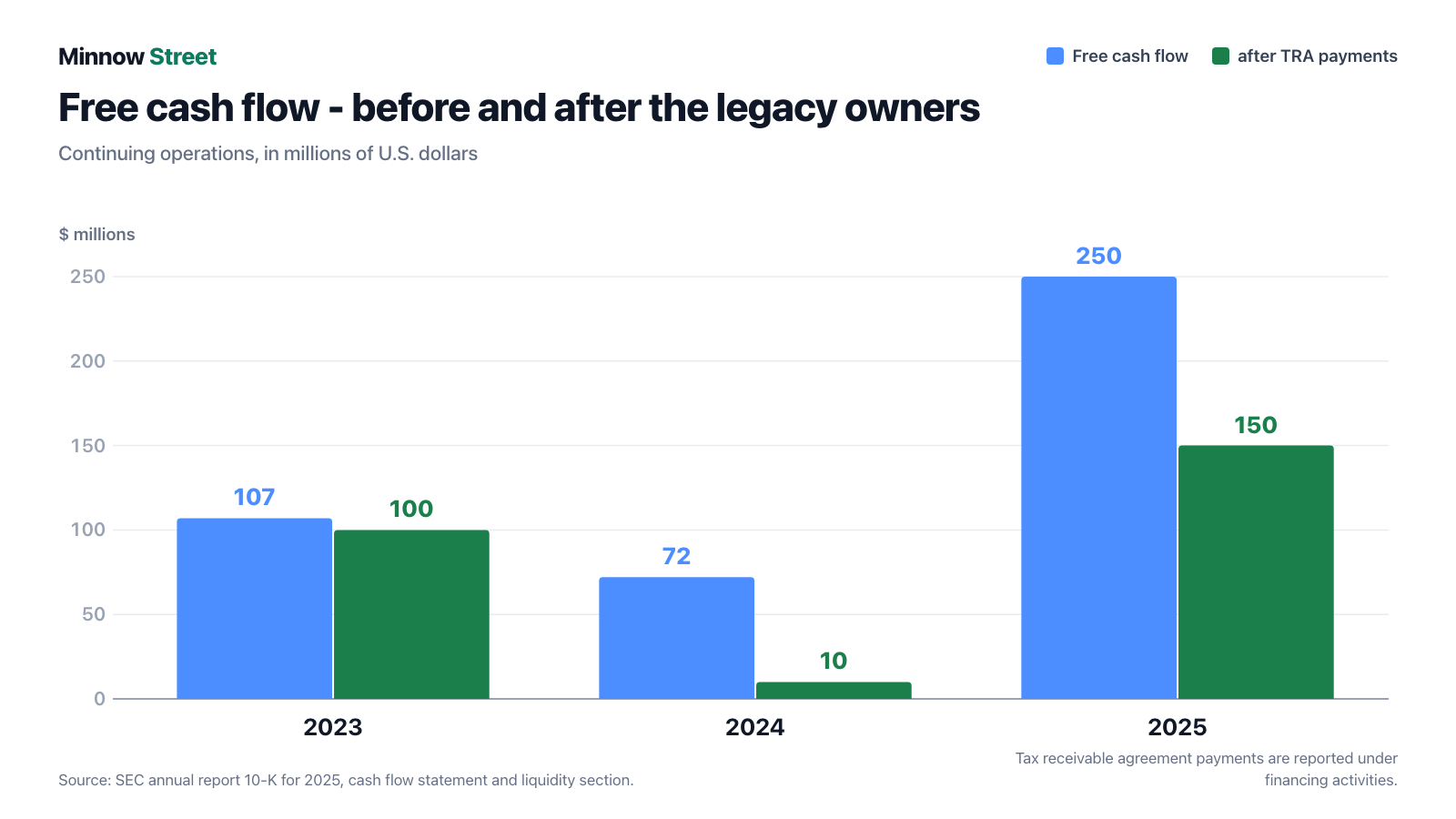
Remember this anchor: the free cash flow is real — but it is not free. In 2025, $100 million went to the legacy owners, $86 million to shareholders as dividends and $65 million into share buybacks. That left $20 million for repaying bank debt — against $2,005 million of loans outstanding.
What the filings say — the uncomfortable truths
Uncomfortable truth No. 1: market value is only a fifth of the price
A price-to-free-cash-flow ratio compares the market value with the cash stream. It ignores debt. At a debt-free company that is a small imprecision; at Alight it is half the story. As of March 31, 2026 the balance sheet carried $2,000 million of financial debt ($1,980 million long-term, $20 million current) against $178 million of cash. That makes $1,822 million of net debt. On top sits the tax agreement with the legacy owners worth another $509 million. Anyone buying the whole company would have to assume all of it.
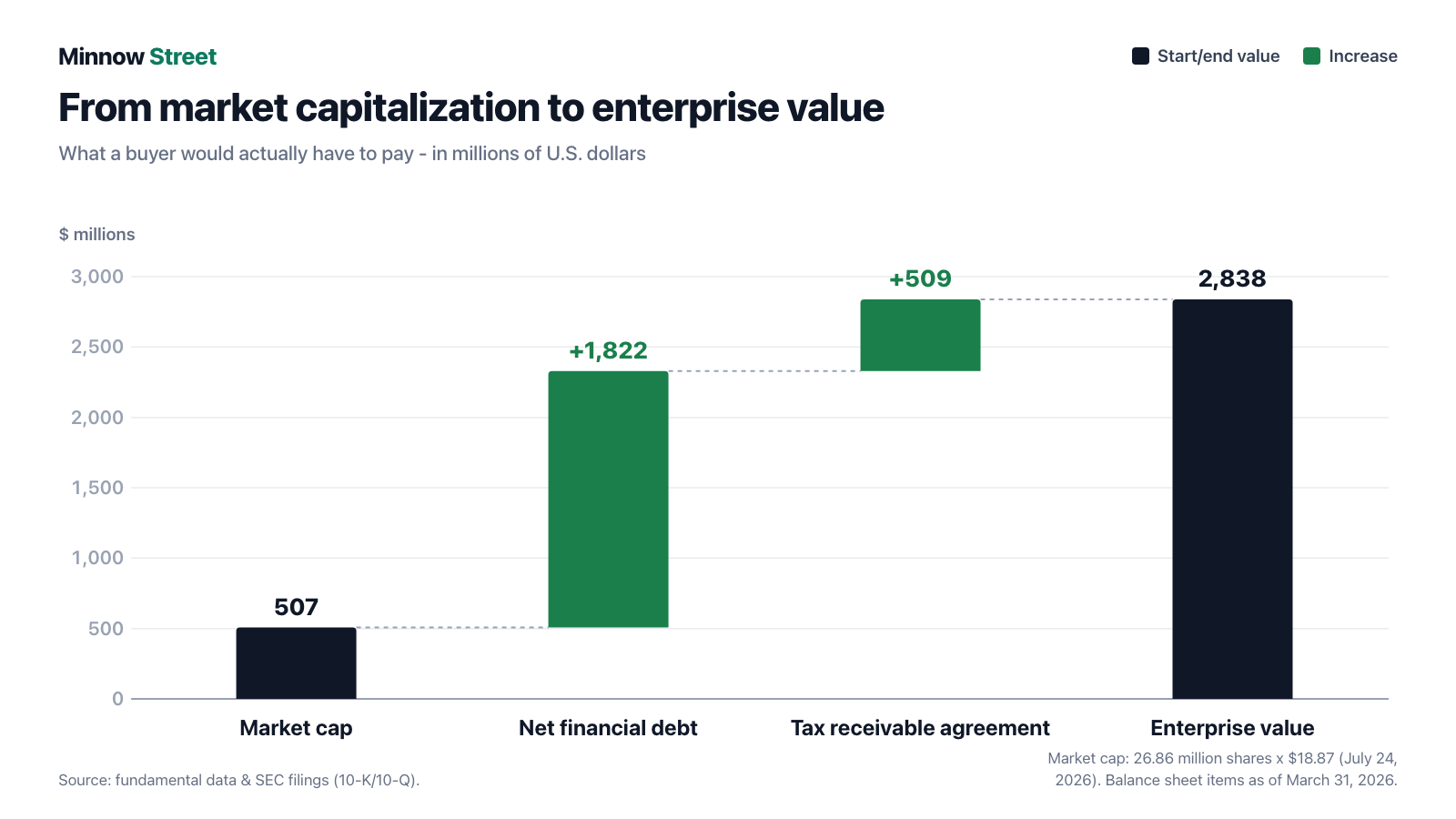
That puts the valuation as follows. Against 2025 free cash flow of $250 million, the bare market value costs 2.0 times, the enterprise value excluding the tax agreement 9.3 times, and the enterprise value including it 11.4 times. Measure free cash flow after the payments to the legacy owners ($150 million in 2025) and that last ratio rises to 18.9 times. The year-and-a-half bargain has turned into a valuation that sits at the upper end for a shrinking services business. Once you know the pattern you see it again — it runs through many names in this ranking, for instance at DXC Technology, where lease liabilities play exactly the same role.
Uncomfortable truth No. 2: 85 percent of all tax benefits belong to someone else
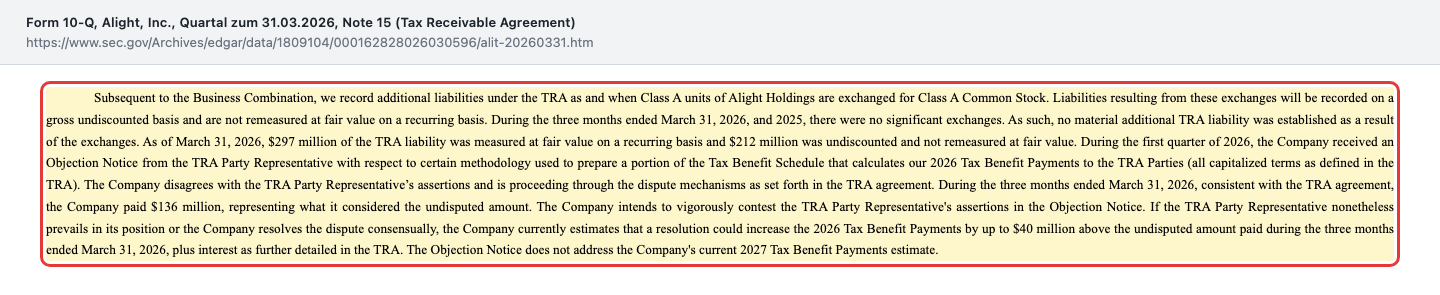
When the company merged with the blank-check vehicle, part of the old ownership stayed on as members of the operating subsidiary Alight Holding Company, LLC. For the tax benefits arising from that structure, Alight signed an agreement the filings simply call the "Tax Receivable Agreement". Its core: 85 percent of all tax savings go to those legacy owners, not to the holders of the listed Class A stock. Translated into everyday terms: you buy a house with a registered charge under which 85 percent of all future tax benefits from the building flow to the previous owner — whether or not he still has anything to do with the house.
The annual report states the danger unusually plainly:
"Accordingly, it is possible that the actual cash tax benefits realized by the Company may be significantly less than the corresponding Tax Receivable Agreement payments or that payments under the Tax Receivable Agreement may be made years in advance of the actual realization, if any, of the anticipated future tax benefits."
— Alight, Inc., SEC annual report 10-K for 2025, Item 1A Risk Factors
How large that is in practice shows up in the first quarter of 2026: Alight paid $136 million under the agreement — in a quarter with $53 million of free cash flow. The remaining obligation fell from $664 million to $509 million as a result. And it is contested: the representative of the legacy owners has formally objected to the calculation methodology, and Alight quantifies the risk itself at up to $40 million more for 2026, plus interest.
Uncomfortable truth No. 3: $3,124 million of goodwill written off in four steps
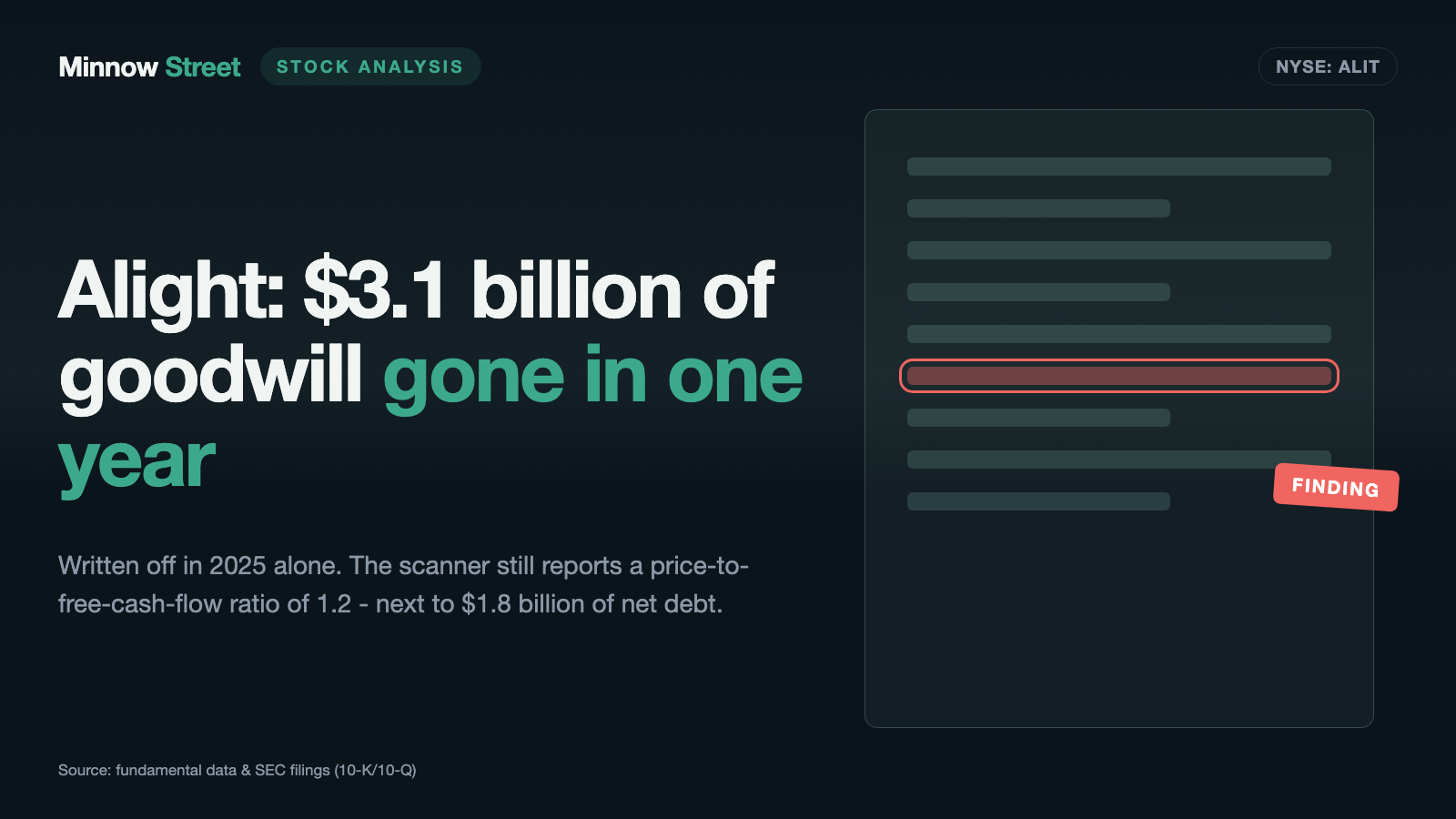
Goodwill is the amount a buyer paid above the tangible net worth of an acquired business — hope, expressed as a number. Alight carried $3,212 million of it at December 31, 2024. One year later it was $83 million. The company wrote it down in four stages during 2025: $983 million in the second quarter, $1,293 million plus $45 million in the third — and then another $803 million in the fourth. Total assets fell from $8,193 million to $4,568 million as a result, equity attributable to shareholders from $4,309 million to $1,044 million, and the accumulated deficit grew from $660 million to $3,757 million.
The sequence of that last round deserves attention. The regular annual test on October 1, 2025 produced no impairment at all — fair value and carrying value were level. Only afterwards, in the closing quarter, did the company see fresh indicators in the falling stock price and reduced expectations, and book the $803 million. With this item, a test that has been passed is no all-clear for the quarter that follows.
What is left sits entirely in one unit — and with a slim cushion:
"At December 31, 2025, our Health Solutions reporting unit had no goodwill and our Wealth Solutions reporting unit had $83 million of goodwill."
— Alight, Inc., SEC annual report 10-K for 2025, Note 6

One note on interpretation: a goodwill impairment costs no cash. It is the admission that earlier acquisitions were too expensive — and it explains why the Altman insolvency early-warning score for Alight stands at minus 2.82 (data as of July 27, 2026). A word on the scale, or the number gets misread: we carry this value in the balance-sheet variant (the "double-prime" version), which uses neither market value nor a revenue term. On that scale, below 1.1 is the distress zone and 2.6 or higher is the safe zone — not the 1.8 and 3.0 familiar from textbooks, which belong to the older formula for manufacturers. At minus 2.82, Alight is squarely in the distress zone. Two figures from the March 31, 2026 balance sheet drag it there: the accumulated deficit of $3,776 million against total assets of just $4,339 million, and an operating result that still carries the $3,124 million impairment. We ran the counter-check: strip that non-cash impairment out of the operating result and leave everything else standing, and the value rises by a good 4.8 points to roughly 2.0 — between the two thresholds, so out of the distress zone but not in the safe zone either. The Piotroski score of 5 out of 9 fits the picture: 5 is mediocre, a genuinely healthy company scores 8 or 9. Operating cash flow and the share buybacks count in its favor, while the annual result, the lower gross margin (33.8 percent after 34.0 percent) and the higher debt load relative to a shrunken balance sheet count against.
Uncomfortable truth No. 4: without the reverse split the stock would have left the New York Stock Exchange
On March 24, 2026 Alight received mail from the New York Stock Exchange. The content, verbatim from the mandatory filing with the SEC:
"On March 24, 2026, Alight, Inc. received a written notice from the New York Stock Exchange that it was not in compliance with the continued listing standard set forth in Section 802.01C of the NYSE’s Listed Company Manual, as the average closing price of the Company’s Class A common stock was less than $1.00 per share over a consecutive 30 trading-day period ending March 20, 2026."
— Alight, Inc., SEC current report 8-K of March 27, 2026, Item 3.01
The cure period runs six months, which takes it to the end of September 2026. The answer was a one-for-twenty reverse stock split, approved at the annual meeting on June 10, 2026 and effective June 30, 2026 at 5:00 p.m. New York time. Twenty shares became one; at the same time authorized Class A shares fell from 1,000,000,000 to 50,000,000 and authorized Class V shares from 175,000,000 to 8,750,000. What matters for your portfolio: a reverse split changes nothing about the value of your holding — you own a twentieth of the shares at twenty times the price. It changes only the optics. And it is a signal, not an event.
One precision that belongs to the state of play in this article: arithmetically, the minimum price rule is satisfied at the post-split price. A formal confirmation from the New York Stock Exchange that Alight again meets the standard is, however, not documented in the filings through July 27, 2026 — no further notice followed the 8-K of July 1, 2026. If you want to track this, watch for an 8-K under Item 3.01 before the deadline expires.

Uncomfortable truth No. 5: three chief financial officers in six months
Turning a company around takes a settled leadership team. At Alight, 2026 was unsettled. Rohit Verma, previously chief executive of Crawford & Company, has led the company since January 2026. The finance chair changed three times in the same half-year: interim chief financial officer Gregory Giometti announced his departure, chief accounting officer Susan Davies took over on an interim basis from May 8, 2026, and Stephen Lasher has run the function since June 15, 2026. None of this is a scandal on its own. Taken together it describes a leadership floor under reconstruction while the stock fell below one dollar — and it is why the next quarterly numbers carry more weight than usual: they are the first this team owns in full.
Valuation — orders of magnitude, not day prices
Let us pull the orders of magnitude together, each with its own date. Market value stood at roughly $507 million on July 24, 2026 (26.86 million shares times a closing price of $18.87). That equals 0.22 times annual revenue of $2,262 million and roughly half of the $1,027 million of book equity at March 31, 2026. There is no price-to-earnings ratio — there are no earnings.
For context, a cross-check from the filings themselves: on the cover page of the annual report for 2025, Alight puts the market value of shares not held by insiders at $2,703,242,376 as of June 30, 2025. From that level the stock has fallen to about a fifth by July 24, 2026. From the split-adjusted all-time high of $248.52 on September 10, 2021 the decline is 92.4 percent; from the 52-week high of $112.05 (July 25, 2025) it is 83.2 percent. We calculated both ourselves from the split-adjusted price series. The summary data on our own company page shows different distances (95.4 percent below the all-time high, 90.8 percent below the 52-week high); those come from a series that does not consistently reflect the reverse split of June 30, 2026. Throughout this article the self-calculated figures apply.
The professional view: the analyst consensus sits on a price target well above the current level and an adjusted earnings expectation in the mid single-digit dollars per share after the reverse split. That is precisely the bet — that adjusted earning power holds and the balance sheet is given time. Anyone taking it should know that it hangs on a debt maturity in 2028: by then the $2,005 million of loans have to be repaid or refinanced. At $250 million of free cash flow in the best of the last three years and $100 million a year of tax promises, that is no formality. How quickly such a calculation can tip is on show at TTEC Holdings — another services company from the same ranking, where debt rather than cash flow writes the story.
A word on the dividend, because many data sources still carry one: it is gone. On February 19, 2026 Alight announced it would replace the quarterly dividend of most recently $0.04 per share (pre-split) with debt reduction and share repurchases. In 2025 that line still consumed $86 million.
Opportunities and risks at a glance
What speaks for Alight:
- Dependable revenue: $2,108 million of the $2,262 million of 2025 revenue was recurring, and annual revenue retention was 94 percent. Switching providers is a year-long project for a large corporation.
- Real cash generation: $360 million of operating cash flow in 2025 against $110 million of capital expenditures — the best figure of the last three years.
- A cost program with numbers attached: roughly $69 million of expense for a streamlining program expected to save more than $75 million a year (as of March 31, 2026).
- A tidy maturity profile through 2028: no bonds, one term loan, plus a $330 million revolving credit facility running to May 31, 2030 and undrawn at December 31, 2025.
- Buyback authorization: $216 million was still available at December 31, 2025 — meaningful leverage against a market value of roughly $507 million if the company uses it.
What speaks against it:
- Revenue down for three years: $2,386 million to $2,332 million to $2,262 million, and another 2.6 percent lower in the first quarter of 2026.
- Debt load: $2,000 million at March 31, 2026 against $178 million of cash, due 2028; the credit market valued that same debt at only $1,441 million on that date.
- Tax promise: $509 million of remaining obligation, of which up to $40 million for 2026 is disputed; $136 million was paid in the first quarter of 2026 alone.
- A balance sheet without cushion: goodwill written down from $3,212 million to $83 million, accumulated deficit of $3,776 million at March 31, 2026, Altman score at minus 2.82 — on that scale the distress zone begins below 1.1.
- The listing question is solved only technically: the one-dollar minimum was reached through the reverse split, not through a recovery driven by the business.
- Leadership in flux: a new chief executive since January 2026 and three chief financial officers in the first half of 2026.
A human conclusion
Back to the bargain trap from the beginning. The 1.2 in the scanner was not an error — it was a partial truth, and partial truths are more dangerous than clear errors because they feel verifiable. Alight earns money. $250 million of free cash flow in a year is a considerable achievement for a company worth $507 million. It is just that this money does not reach shareholders first; it reaches the legacy owners first, then the banks. What arrives at the end of the chain will be decided in the years up to 2028.
Perhaps that is the real takeaway: a metric only ever measures what is inside it — never what stands beside it. Market value sits in the numerator; the debt sits nowhere. Know that, and a 1.2 is something you can start working with. Miss it, and you buy it. What you make of that is your decision. And that is exactly as it should be.
Sources
- Quarterly report 10-Q for March 31, 2026 (filed May 5, 2026) — cover page share count, balance sheet, statement of cash flows, Note 15 (tax receivable agreement), Note 16 (fair values), Note 17 (restructuring)
- Annual report 10-K for 2025 (filed February 24, 2026) — Item 1 Business, Item 1A Risk Factors, Item 7 MD&A with the free cash flow reconciliation, Note 4 (divestiture), Note 6 (goodwill), Note 15 (tax receivable agreement)
- Current report 8-K of March 27, 2026 — Item 3.01, New York Stock Exchange notice on the minimum price
- Current report 8-K of July 1, 2026 — Item 5.03, one-for-twenty reverse stock split and reduction of authorized capital
- Current report 8-K of February 19, 2026 — Item 8.01, quarterly dividend replaced by deleveraging and share repurchases
- Current report 8-K of June 4, 2026 — Item 5.02, appointment of the new chief financial officer
- Current report 8-K of June 11, 2026 — Item 5.07, resolutions of the annual meeting of June 10, 2026 including the reverse split authorization
- Schedule 13G of July 9, 2026 — 1,366,285 Class A shares equal 5.2 percent of the class; an independent cross-check of the post-split share count
- SEC master record for CIK 0001809104 (former names Foley Trasimene Acquisition Corp. / Alight Group, Inc. / Alight, Inc., listing venue NYSE; checked July 27, 2026 for deregistration, delisting and tender offers — no hits)
- Screening and valuation data: in-house stock scanner and fundamental data — measured on July 27, 2026: P/FCF Ranking, U.S. selection, 21st place at a ratio of 1.2; 836 hits in the German list (all markets), 545 in the English list (U.S. names only), 25 rows displayed in each
- Own price series (closing price $18.87 on July 24, 2026; split-adjusted all-time high $248.52 on September 10, 2021; 52-week high $112.05 on July 25, 2025)
This article is journalistic analysis and explicitly not investment advice, not a recommendation to buy or sell, and not a solicitation to trade in securities. Stocks can suffer a total loss at any time; that is especially true for companies with high debt and negative earnings. All figures rest on publicly available documents retrieved on the dates stated and may have changed since. The author holds no position in Alight, Inc. at the time of publication.
Our Bottom Line at a Glance
- Core business neutral
- Benefits administration is a sticky business: $2,108 million of the $2,262 million of 2025 revenue was recurring, and annual revenue retention was 94 percent (2024: 95). But revenue has now fallen for a third consecutive year — $2,386 million (2023), $2,332 million (2024), $2,262 million (2025) — and another 2.6 percent in the first quarter of 2026, to $534 million.
- Cash generation positive
- Operating cash flow from continuing operations rose to $360 million in 2025 (2024: $193 million, 2023: $247 million) while capital expenditures fell to $110 million. The resulting $250 million of free cash flow is the best figure of the last three years and considerable against a market value of roughly $507 million (as of 24.07.2026).
- Leverage negative
- At March 31, 2026 there is $2,000 million of financial debt against $178 million of cash, due 2028. On that same date the credit market valued that debt at only $1,441 million — three months earlier it was $1,922 million against $2,005 million of book value. Only $20 million was repaid during 2025.
- Claims of the legacy owners negative
- 85 percent of all tax benefits from the 2021 structure go to the former owners. Remaining obligation at March 31, 2026: $509 million, after $664 million at the end of 2025. In the first quarter of 2026 alone $136 million flowed out — against $53 million of free cash flow. Up to $40 million for 2026 is in dispute.
- Balance-sheet substance negative
- Goodwill fell in four write-down steps during 2025 from $3,212 million to $83 million, total assets from $8,193 million to $4,568 million, equity attributable to shareholders from $4,309 million to $1,044 million. The accumulated deficit stood at $3,776 million on March 31, 2026. Altman score (balance-sheet variant): minus 2.82, squarely in the distress zone that begins below 1.1 on that scale; even without the impairment the value would sit at roughly 2.0, in the grey zone below the safe threshold of 2.6.
- Hook and data quality neutral
- 21st place in the U.S. selection of the in-house P/FCF ranking at a value of 1.2 (measured 27.07.2026; 836 hits in the German list covering all markets, 545 in the U.S.-only English list, 25 rows displayed in each). The underlying market value of $0.3 billion is not used here: the share count in the quarterly report and the closing price of 24.07.2026 give $507 million and therefore a ratio of 2.0, and a Schedule 13G of 09.07.2026 confirms the share count independently. The dividend yield still carried in data sets is also stale — the payout ended on 19.02.2026.
Alight is not a cheap stock; it is a stock with a cheap-looking metric. The benefits administration business delivers real cash — $250 million of free cash flow in 2025 against a market value of roughly $507 million. Between that money and the shareholder, however, sit $1,822 million of net debt maturing in 2028, a $509 million tax promise to the legacy owners, $3,124 million of goodwill written off in 2025, and revenue falling for a third consecutive year. On an enterprise value basis Alight costs 11.4 times free cash flow, not 1.2 times. Not investment advice.
What Our Rating Means
Substance risk
We found at least one documented issue that threatens the company itself — regardless of how the stock is currently valued.
The red rating here does not stand for the fallen share price but for documented substance findings in the filings themselves. Goodwill was written down in four steps during 2025 from $3,212 million to $83 million, equity attributable to shareholders fell from $4,309 million to $1,044 million, and the accumulated deficit rose to $3,776 million at March 31, 2026. Financial debt of $2,000 million maturing in 2028 faces $178 million of cash; the credit market marked that same debt at $1,441 million on March 31, 2026, after $1,922 million a quarter earlier. On top sits a payment promise of $509 million to the legacy owners, of which $136 million flowed out in the first quarter of 2026 alone. That the New York Stock Exchange minimum price was met only through a one-for-twenty reverse split is the consequence, not the cause. This is a balance-sheet finding, not a verdict on price. The decision is yours.
A journalistic assessment by our editorial team at the time of the deep dive, based on public sources — not investment advice and not a solicitation to buy or sell. Your personal circumstances (investment goals, risk capacity, taxes) cannot be taken into account. What our levels mean, how verdicts are formed, and what conflicts of interest exist →
Worth Noting
- Hook and source: 21st place in the U.S. selection of the in-house P/FCF ranking, measured live and separately per edition on July 27, 2026 (836 hits in the German list covering all markets, 545 in the U.S.-only English list, 25 rows displayed in each). The scanner lists are recalculated daily; the placement is a snapshot and can drop out of the 25 visible rows.
- Why we calculated the market value ourselves: the value carried in the data set, $0.3 billion, differs by more than a fifth from the "share count times price" calculation. Our figure rests on the 537,241,981 shares from the cover page of the quarterly report (as of April 30, 2026), converted to 26,862,099 shares after the one-for-twenty reverse split of June 30, 2026, and the closing price of $18.87 on July 24, 2026. A Schedule 13G of July 9, 2026 confirms the order of magnitude independently: 1,366,285 Class A shares are reported there as 5.2 percent of the class, which implies roughly 26.3 million Class A shares. Metrics resting on the divergent market value are not used in this article.
- On the dividend yield in summary data: Alight replaced its quarterly dividend on February 19, 2026 with debt reduction and share repurchases. Yield figures from data sets still carrying the old payout are stale.
- On the price distances: our data set shows 95.4 percent below the all-time high and 90.8 percent below the 52-week high; neither figure consistently reflects the reverse split of June 30, 2026. Calculated from the split-adjusted price series we get 92.4 percent (peak $248.52 on September 10, 2021) and 83.2 percent (52-week high $112.05 on July 25, 2025), each against $18.87 on July 24, 2026. The article uses the self-calculated figures.
- Risk of confusion: Alight, Inc. (ALIT, NYSE) is not the same as same-named relief organizations or lighting companies. The SEC company name is "Alight, Inc."; the EDGAR history carries the former names Foley Trasimene Acquisition Corp. (until July 6, 2021) and Alight Group, Inc.
- Every figure from the filings carries the date of its report, not the date of the data retrieval. Free cash flow time series refer throughout to continuing operations; the payroll and professional services business sold in 2024 is presented as a discontinued operation in every year shown.
- Status of the mandatory checks on July 27, 2026: the most recent periodic report is the quarterly report for March 31, 2026 (filed May 5, 2026); no newer one existed at the editorial deadline. The SEC filing record contains no deregistration (Form 15), no delisting of the Class A shares (Form 25), no tender offer and no going-private transaction. Four current reports were filed after the quarterly report (June 4, June 11, June 18 and July 1, 2026); all have been reviewed.
Frequently Asked Questions
Because the metric simply divides market value by free cash flow. At a measured market value of $0.3 billion and roughly $259 million of free cash flow over four quarters that produces 1.2 — 21st place in the U.S. selection on July 27, 2026. Debt does not enter the calculation at all. Using the full share count from the quarterly report and the closing price of July 24, 2026, market value is $507 million and the ratio is 2.0.
When the company listed in 2021, part of the former ownership stayed invested in the operating subsidiary Alight Holding Company, LLC. For the tax benefits arising from that arrangement, Alight promised to pay 85 percent to those legacy owners. The remaining obligation stood at $509 million on March 31, 2026, and $136 million flowed out in the first quarter of 2026 alone. The payments run under financing activities and therefore do not reduce reported free cash flow.
Arithmetically nothing: on June 30, 2026 twenty shares became one share at twenty times the price, and the value of your holding is unchanged. Fractional shares were paid out in cash. Economically it is a signal: the trigger was the New York Stock Exchange notice of March 24, 2026 that the average closing price over 30 trading days had been below one dollar. The reverse split cures the minimum price rule, not the cause.
Because earlier acquisitions were no longer worth what the books said. The annual report cites the sustained decline in the stock price and reduced expectations for future business — weaker new bookings and higher losses on contract renewals. The write-down came in four steps: $983, $1,293, $45 and $803 million, totaling $3,124 million. It cost no cash, but it cost equity: the amount attributable to shareholders fell from $4,309 million to $1,044 million.
On the company own definition, $250 million for 2025 — $360 million from operations less $110 million of capital expenditures. Deduct the payments to the legacy owners, which the report books under financing activities, and $150 million remains. In 2024 the figures were $72 million and $10 million, in 2023 $107 million and $100 million. In the first quarter of 2026, $53 million of free cash flow faced $136 million of payments.
That is the legacy of the 2021 blank-check merger. Only the Class A share trades on the NYSE. Class B-1 and Class B-2 are non-voting shares from an earnout arrangement with the sellers that convert into Class A shares once certain marks are met. Class V shares carry votes but no economic interest; they mirror units in the operating subsidiary. Class Z shares are authorized but unissued. As of April 30, 2026 the four classes totaled 537,241,981 shares before the reverse split.
It is an early-warning system for payment difficulties. We carry it in the balance-sheet variant, whose scale puts the distress zone below 1.1 and the safe zone at 2.6 or above — not the 1.8 and 3.0 familiar from textbooks. At minus 2.82, Alight is squarely in the distress zone. The drivers are the accumulated deficit of $3,776 million against $4,339 million of total assets and an operating result weighed down by the impairment. Without that impairment the value would be roughly 2.0, in the grey zone between the two.
The second quarter 2026 report is next; our data set lists August 4, 2026 as the expected date. Three lines will matter then: the fair value of financial debt (last reported at $1,441 million against $2,000 million of book value), the status of the tax agreement including the disputed $40 million, and the revenue trend after the 2.6 percent decline in the first quarter. The next goodwill test follows on October 1.
Found an error?
Did you spot a factual error, an outdated number, or a typo in this deep dive? Let us know briefly — your report goes straight to the editorial team.