Heidmar Maritime: 50 ships, not one of them its own — and a stock listing that sat on the balance sheet
As of April 30, 2026 Heidmar commercially runs 50 tankers and bulkers, roughly 6.5 million deadweight tons. The Piraeus-based manager owns none of them. It reached Nasdaq in February 2025 not through an IPO but by acquiring a company that was already listed — and the annual report calls the resulting $11.08 million of goodwill the value of the listing itself, in as many words. Four months later it was written off. Revenue rose 93 percent in 2025 to $55.85 million; the bottom line showed a $22.56 million loss. Two shareholders hold 89 percent of the stock. Before you buy a fleet, find out who owns the ship you are sailing on.
 Thomas Mücke
Founder & Publisher
Thomas Mücke
Founder & Publisher
Chart
Interactive price chart (TradingView).
Note: pure fact-based analysis, not investment advice and not a solicitation to buy or sell. All figures without guarantee.
There is an investor trap that closes especially fast around shipping stocks, and it works through a single number: the fleet trap. You read "50 ships, 6.5 million deadweight tons" and your head does the rest — 50 tankers, that has to be a few billion dollars of steel, so surely there is value here. At Heidmar Maritime Holdings (Nasdaq: HMR) of Piraeus, Greece, the number is accurate, and it still misleads. Heidmar owns none of those 50 ships. It runs them commercially for other owners — finds cargo, negotiates freight rates, settles accounts, and takes a fee. That is a perfectly legitimate model, it is called asset-light, and it has real advantages. But it means the fleet count tells you about as much about earning power as the number of apartments tells you about a property manager's income. So let us make a deal: before you let 50 ships speak for themselves, we read together what Heidmar filed with the U.S. securities regulator, the SEC — the annual report on Form 20-F for 2025 filed April 30, 2026, the interim reports on Form 6-K that followed, and the prospectus supplement of June 1, 2026. Those documents describe a revenue jump whose margin almost entirely evaporates, a stock listing that was carried as an asset on the balance sheet, and two shareholders who own 89 percent of the company. What you make of it is up to you.
What Heidmar actually does: property manager for tankers
Heidmar Inc. was founded in 1984; today's holding company, Heidmar Maritime Holdings Corp., was incorporated in the Republic of the Marshall Islands on May 7, 2024 and is run out of Piraeus, with further offices in London, Singapore, Chennai, Hong Kong and Dubai. The core business has three parts. First, the tanker pools: several owners place ships of the same class into a common pot, Heidmar markets them as one fleet, and earnings are shared through a points system. Three pools are active — Dorado (medium-range product tankers), Blue Fin (Suezmax) and SeaLion (Aframax and LR2). Second, individual commercial management agreements: here, per the annual report, Heidmar typically takes a commission of 1.25 percent on gross freight and demurrage plus a daily administration fee of between $100 and $350 per vessel. Third, technical management, added with the March 2024 purchase of Landbridge Ship Management of Hong Kong: crewing, maintenance, class certificates.
There is a fourth business that now dominates the numbers and is easy to miss: Heidmar charters ships in on its own account and charters them out again. Economically that is something entirely different from a fee — it is a trading business carrying the full cost on the buy side. This is where the central tension of this analysis sits, and it runs through every chapter: Heidmar is growing, but it is growing where the least sticks, while the high-margin fee business has been shrinking for three years.
As of April 30, 2026 the annual report details the fleet: 50 commercially managed vessels with roughly 6.5 million deadweight tons — five VLCCs (the largest crude tankers), nine Suezmaxes, four LR2s, two LR1s, 11 medium-range product tankers, seven Aframaxes, three small tankers, one platform supply vessel and five bulk carriers; three more vessels are served purely as chartering broker. Another three VLCCs, three MR tankers and two LR2s are under technical management. Of the 50 vessels, 13 trade in the pools and 34 run under individual agreements. And the number keeps growing: in 2020 it was six. For the other side of the same industry — a company that owns its ships, with everything that means for capital tied up and leverage — see our analysis of Carnival, where the fleet sits on the balance sheet rather than in a management contract.
How the stock reached our desk
No filter of ours produced Heidmar. The stock arrived through a review of Nasdaq-listed small caps that did not yet have a deep dive on this site. The reason is simple: the shares have only traded since February 20, 2025. As of July 30, 2026 HMR appears in none of our scanners — the lists are recomputed daily, but a company with about eighteen months of price history, two annual reports and a float of roughly eleven percent simply does not supply the data that momentum, valuation or quality filters need. Take that as the first finding: where the usual metrics stay silent, you have to read the notes. That is what we do now.
The numbers over the years, honestly appraised
First, what genuinely speaks for Heidmar. Operations visibly picked up in the first quarter of 2026: $18.35 million of revenue against $5.84 million in the prior-year quarter, net income of $2.78 million after a $6.03 million loss, and cash rising from $18.65 million at year end to $27.55 million as of March 31, 2026. Cash from operations in the quarter was $6.56 million. Administrative expenses also fell, from $6.09 million to $3.56 million. And the environment helps: in the May 26, 2026 release the chief executive describes freight rates at "historically elevated levels", driven by disruption around the Strait of Hormuz and longer trading patterns. That effect is real — longer voyages tie up more ships per ton carried.
Now the chart that explains the rest of the analysis. The interesting part is not total revenue but its composition:
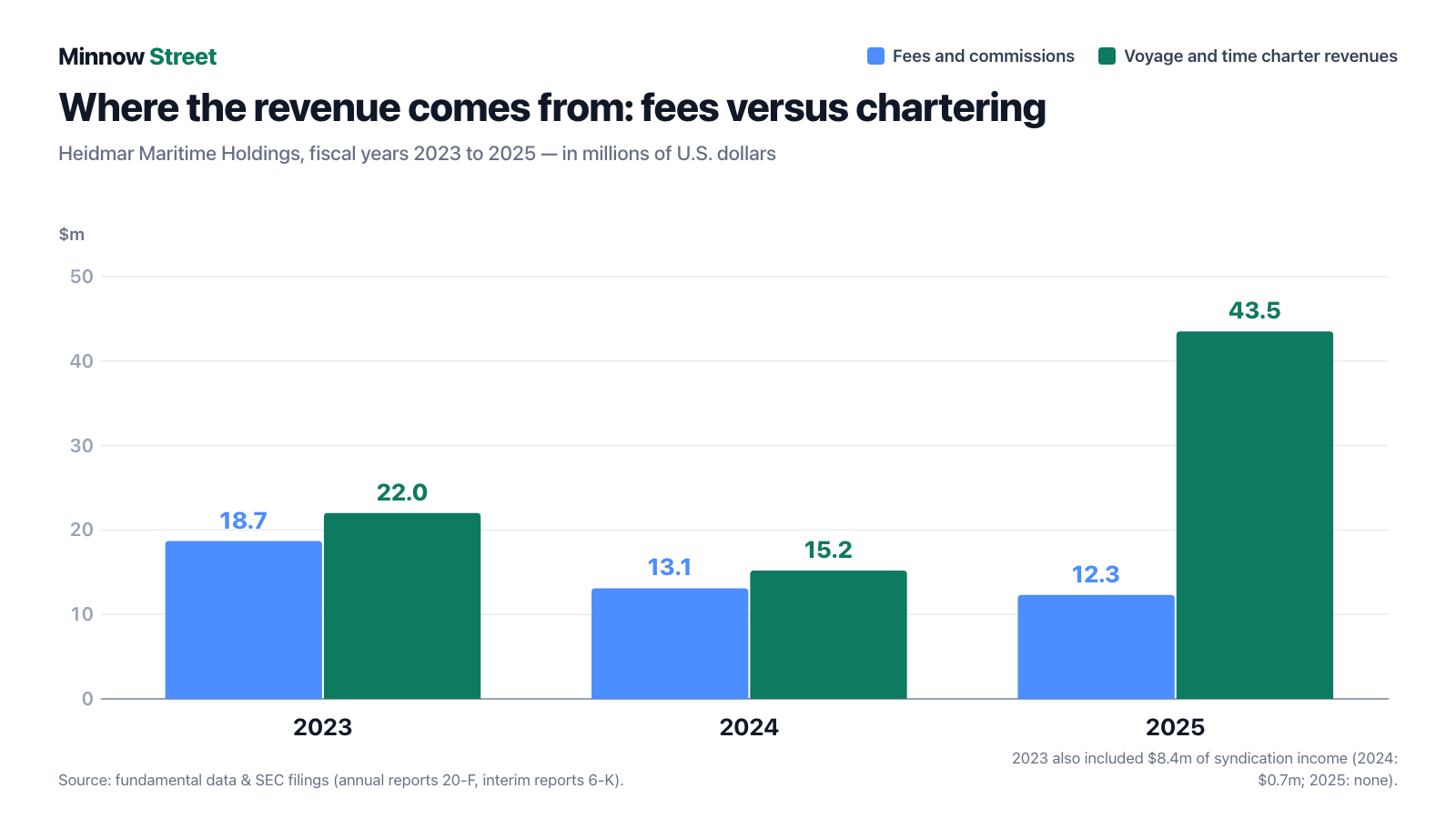
In total, 2025 looked like a record year: $55.85 million of revenue, up 93 percent from 2024 ($28.95 million). The bottom line still showed a net loss of $22.56 million. For comparison: on revenue of $49.10 million in 2023 the same company earned $19.55 million, and in 2024 it earned $1.91 million on $28.95 million. Revenue is back at the 2023 level; earnings are nowhere near it. Which brings us to the uncomfortable truths.
What the filings say: the uncomfortable truths
Uncomfortable truth no. 1: the listing was carried as an asset, and written off four months later
Heidmar did not reach Nasdaq through an initial public offering. On June 18, 2024 it signed a business combination agreement with MGO Global Inc., a U.S. company already listed on Nasdaq. On February 19, 2025 MGO merged into a Heidmar subsidiary while the Heidmar shareholders contributed their stakes in exchange — and on February 20, 2025 trading began under the symbol HMR. The split shows the balance of power: MGO stockholders received 3,212,368 shares, MGO's financial adviser 1,413,462, and the Heidmar shareholders 52,497,968 — 94.34 percent against 5.66 percent. That left 57,123,798 shares in issue.
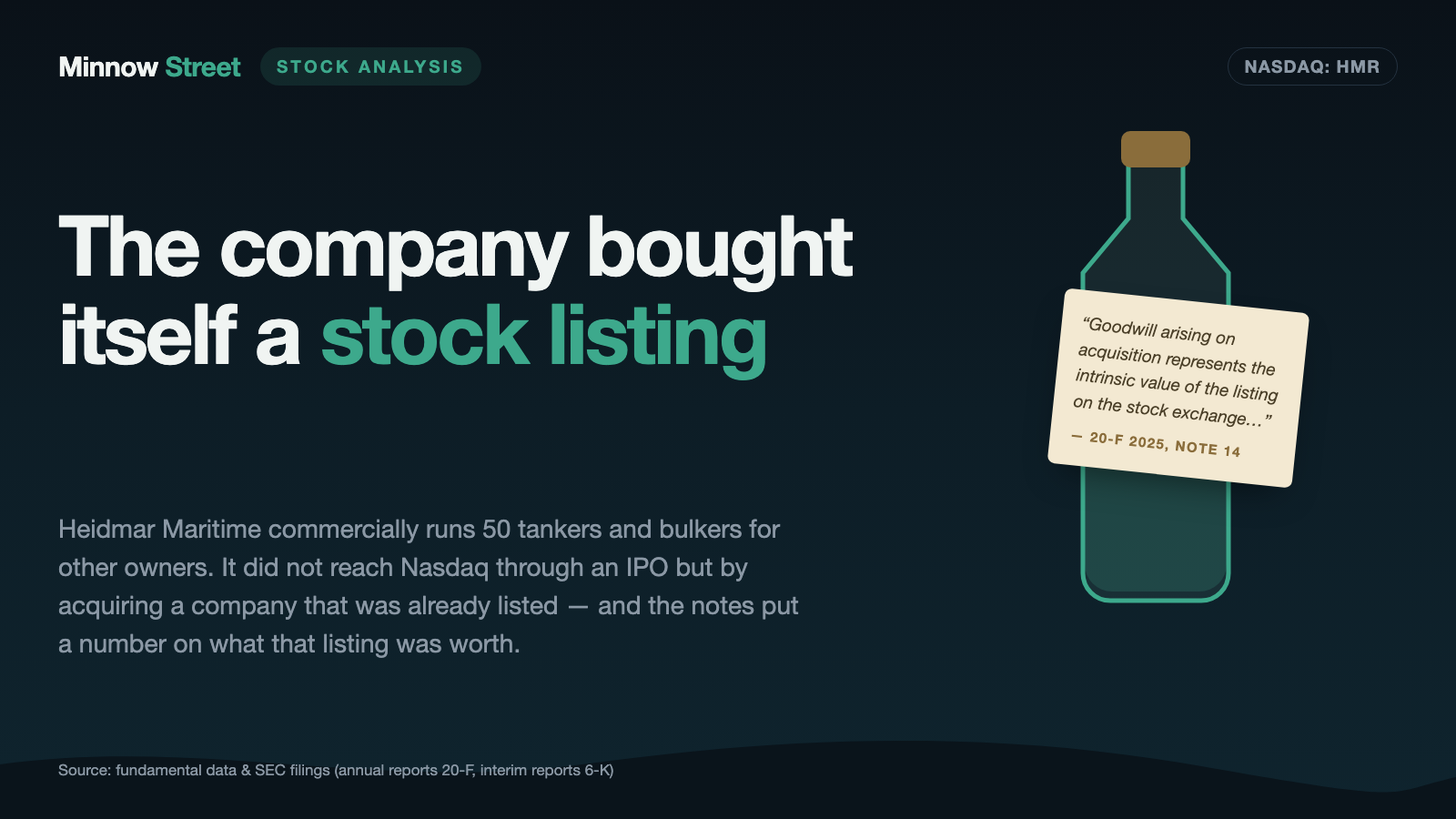
In accounting terms it was a purchase, with Heidmar Inc. as the acquirer and MGO as the acquired entity. The purchase consideration came to $14,258,460 — paid in Heidmar shares valued at $3.06 each, derived from a total equity valuation of $175 million (a discounted cash flow analysis using a 12 percent cost of capital and 2 percent long-term growth). The net assets acquired were worth $3,176,286. The difference of $11,082,174 went into the balance sheet as goodwill. And the notes say in one sentence what that goodwill actually is:
“Goodwill arising on acquisition represents the intrinsic value of the listing on the stock exchange through the acquisition of MGO.”
— Heidmar Maritime Holdings Corp., SEC annual report 20-F for 2025, Note 14 “Business Combination”

That is unusually candid and therefore worth noting. Goodwill is normally the premium paid for customer relationships, brands or know-how. Here it is the price of admission to a trading floor. And then comes the part you should know: along with MGO, Heidmar also acquired its operating subsidiary, Americana Liberty LLC — an online seller of patriotically themed flagpoles and consumer goods. That has nothing to do with tanker management, and Heidmar drew the conclusion. On June 27, 2025, a little over four months after the combination, Americana Liberty was sold. The consideration was a receivable of $334,942. Goodwill and trademark were written off in full. The loss on disposal was $12,862,936; total loss from discontinued operations came to $13,923,516. Put in everyday terms: you buy a house because you need the parking space in front of it, then sell the house four months later for the price of a used car. The parking space — the listing — remains. But those $13.9 million are the main reason 2025 ended with a $22.56 million loss rather than the $8.64 million from continuing operations.
Uncomfortable truth no. 2: almost nothing sticks from the revenue jump
Revenue rising from $28.95 million to $55.85 million looks like a breakthrough. Let us take it apart. Fees — commissions and management income from pools and individual contracts, the actual core business — brought in $12.33 million in 2025. In 2024 it was $13.10 million; in 2023 it was $18.72 million. That part has been shrinking for two years, and sharply: down 34 percent from 2023. The report gives the reason. The average number of vessels in the pools fell from 30.0 (2024) to 18.0 (2025), and pool days from 10,792 to 6,608. The 50 managed vessels are distributed differently than before — more individual contracts, fewer pool entries.
The entire increase comes from chartering: $43.52 million of voyage and time charter revenue against $15.18 million a year earlier. The catch is the cost side. From the income statement in the annual report: voyage expenses of $2.69 million, operating lease expenses of $6.47 million, operating lease expenses to related parties of $7.82 million, voyage and charter-in expenses of $18.87 million and a further $5.91 million of charter-in from related parties — $41.76 million in total. What remains is roughly $1.76 million, or 4.0 percent (our own calculation from those lines). In everyday terms: that is the margin of a middleman who buys at 96 cents and sells at a dollar — one price slip and the dollar is gone while the 96 cents of cost remain.
Above that sit the administrative costs. They rose to $19.26 million in 2025 (2024: $12.90 million; 2023: $10.10 million) — $5.0 million of that is share-based compensation to executives and staff, and roughly $1.9 million is additional professional and audit cost associated with the listing. So the decisive comparison reads: the fee business brought in $12.33 million, and administration cost $19.26 million. Operating income for 2025 was negative $4.88 million, after plus $4.09 million (2024) and plus $19.64 million (2023). Remember the sentence: revenue that is 78 percent pass-through does not make a company bigger, only harder to read.
Uncomfortable truth no. 3: two shareholders hold 89 percent, and the biggest customer is family
As of April 29, 2026 the ownership looked like this. Rhea Marine Ltd., wholly owned by chief executive Pankaj Khanna, held 26,238,379 shares, or 44.5 percent. Maistros Shipinvest Corp., indirectly owned by Miltiadis Marinakis, held exactly the same amount — another 44.5 percent. Together, 89.0 percent. All other officers and directors combined held 371,258 shares, or 0.6 percent. Heidmar therefore qualifies as a controlled company under Nasdaq rules and may opt out of several corporate governance requirements. A shareholders agreement gives Maistros the right to nominate a majority of the board for as long as its holding exceeds 15 percent, and Khanna can only be removed as chief executive with the consent of Maistros and 75 percent of the remaining shareholders.
Now the business side. The risk factors of the annual report name a dependency with unusual clarity:
“The Capital vessels compose 25 of the 49 vessels currently managed by Heidmar and accounted for 37% of our total revenues from the Pools during the year ended December 31, 2025. Capital is owned by the father of the indirect owner of Maistros Shipinvest Corp., one of our major shareholders.”
— Heidmar Maritime Holdings Corp., SEC annual report 20-F for 2025, Item 3.D “Risk Factors”

This is not an accusation. Family ties are the norm in Greek shipping, and Heidmar discloses them in full. But it shifts the assessment. A manager whose largest customer belongs to the family of a 44.5 percent owner does not negotiate its terms in an open market. And the dependency reaches beyond the pools: the largest single balance sheet item at December 31, 2025 is a right-of-use asset from a lease with a related party of $40.28 million — 56 percent of total assets, and close to four times the $10.71 million of shareholders equity. Behind it stands the platform supply vessel ACE Supplier, chartered in for five years in April 2025. It produced $8.08 million of revenue in 2025 and cost $7.82 million — a surplus of $0.25 million.
Uncomfortable truth no. 4: the float is smaller than what can still be issued
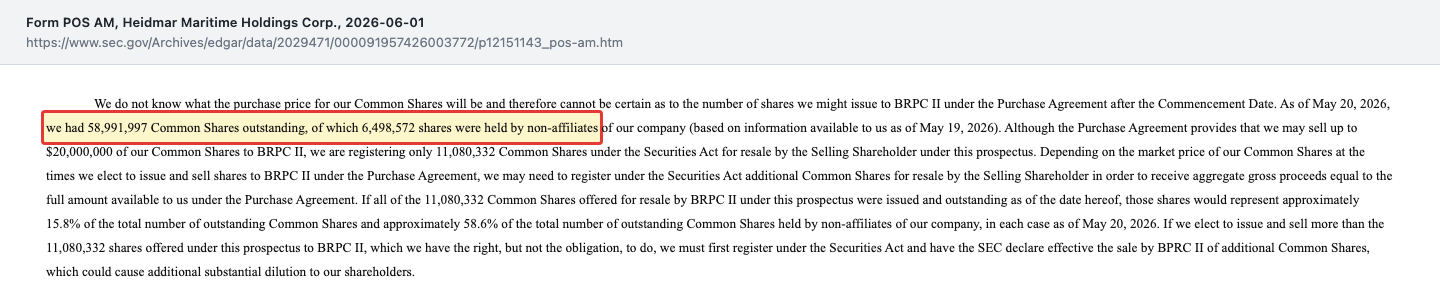
Dilution is the dullest word in market language and one of the most important. Translated, it means your slice of the cake gets smaller without the cake getting bigger. At Heidmar it is worth looking closely. On May 20, 2026 there were 58,991,997 shares outstanding — of which only 6,498,572 were held by non-affiliates, roughly 11 percent. That is the freely tradable stock.
Against that stand three additions that are already agreed or registered. First the earnout shares: the business combination agreement provided that each of the two principal shareholders receives a further 2,606,338 shares if Heidmar reached at least $45 million of revenue, $30 million of EBITDA or $25 million of net income in 2025, with another 141,346 shares going to MGO's financial adviser. At $55.85 million of revenue the condition is met, and the annual report records: "Our board of directors has determined that the financial milestone to issue the Earnout Shares was met." That is 5,354,022 shares, not yet included in the last reported share count of May 20, 2026. Second, 1,961,172 share awards that were still unvested at December 31, 2025. Third, the equity line with B. Riley Principal Capital II for up to $20 million, for which 11,080,332 shares are registered for resale — more than the entire float.
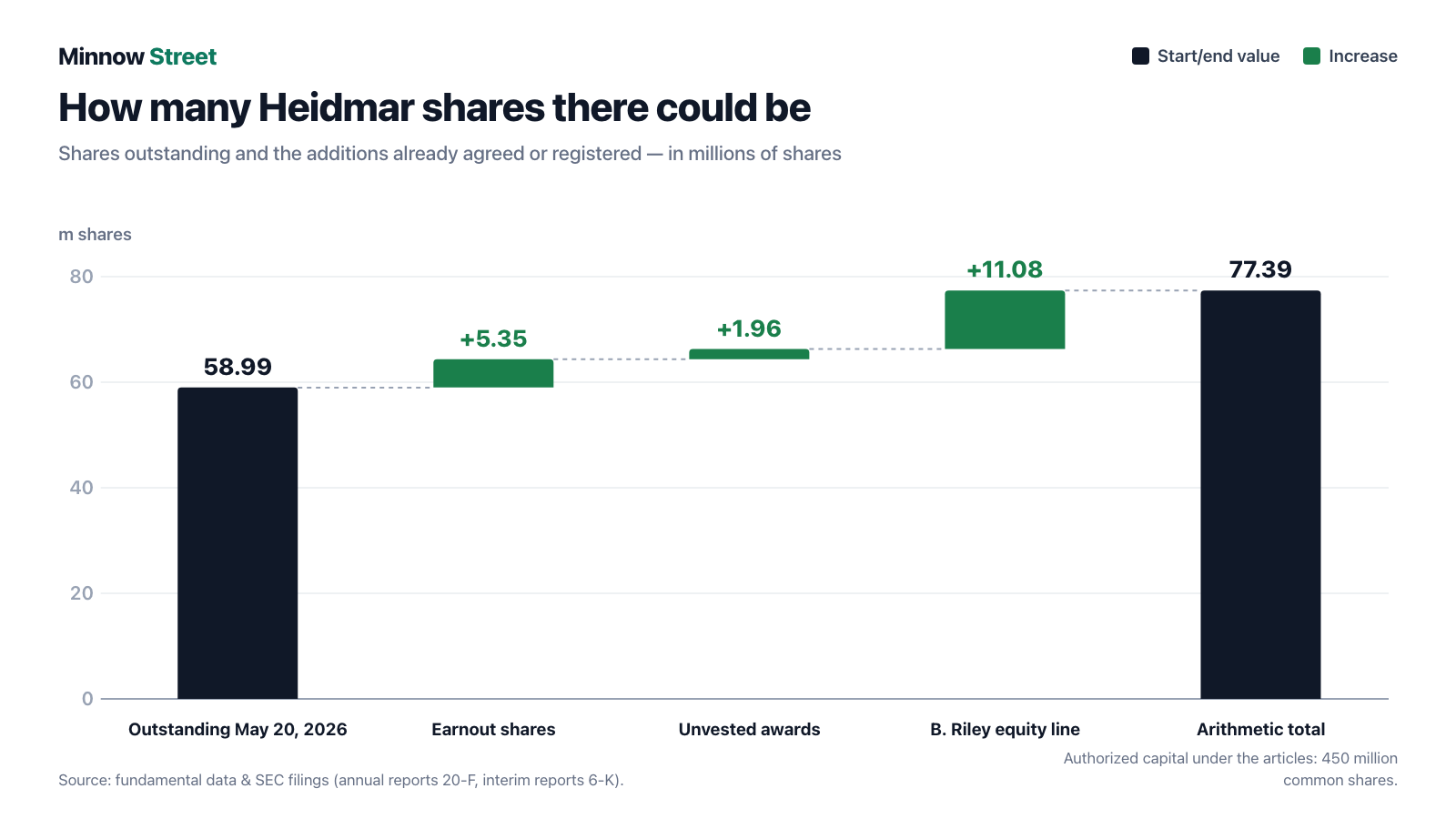
Arithmetically that gives 77.39 million shares — 31 percent more than today. Little of it has been used so far: through March 31, 2026 Heidmar had sold only 260,628 shares through the equity line, at an average of $1.27, for gross proceeds of roughly $330,940. But the articles allow up to 450 million common shares and 50 million preferred shares, and holders of common stock expressly have no preemptive rights. The prospectus states the consequence plainly: further issuance beyond the registered amount could cause "additional substantial dilution". How quickly that can happen at a young company financing its listing is visible in our analysis of Arrive AI, a Nasdaq newcomer whose capital story runs along the same lines with different mechanics.
Uncomfortable truth no. 5: the listing that was worth $11 million is now on the clock
There is a certain irony here: the very listing for which Heidmar booked $11.08 million of goodwill is the one it now has to defend. On April 22, 2026 the Nasdaq notice arrived — the closing bid price had been below $1.00 for 30 consecutive business days, breaching the minimum bid price requirement of Listing Rule 5550(a)(2).
“the applicable grace period to regain compliance is 180 days, or until October 19, 2026.”
— Heidmar Maritime Holdings Corp., SEC annual report 20-F for 2025, Note 22 “Subsequent Events”

The deficiency is cured once the closing bid price is at least $1.00 for ten consecutive business days, and Heidmar states it intends to use the period and cure the shortfall. Trading continues unchanged in the meantime. For context, this is a running deadline, not a delisting — and the last closing price documented in a filing was $1.14 on May 28, 2026, just above the threshold. If it stays there, the matter resolves itself. If it does not, a second grace period or a reverse split come into view. One further detail fits the picture: while chief executive Khanna emphasised in the March 24, 2026 release that he had raised his personal stake to roughly 45 percent through open-market purchases, three directors filed Form 144 notices between June 11 and July 6, 2026 of their intention to sell a combined 244,862 shares — against a total holding of 371,258 shares for all officers and directors other than Khanna.
Valuation: cheap against revenue, expensive against substance
How expensive is Heidmar? A price-earnings ratio cannot be formed for 2025 because the year ended in a loss. The most honest dated anchor is the price the prospectus supplement documents itself: $1.14 on May 28, 2026. Multiplied by the 58,991,997 shares outstanding, that gives a market value of roughly $67 million; the fundamental data show about $66 million as of July 30, 2026. Both figures sit close together, so the order of magnitude holds.
Measured against 2025 revenue of $55.85 million, that is a price-to-sales ratio of about 1.2 — moderate at first glance. Except that roughly 78 percent of that revenue is pass-through from the chartering business. Set the market value against the fee business instead, which brought in $12.33 million in 2025, and you land at 5.4 times. Against substance it gets uncomfortable: shareholders equity was $14.18 million at March 31, 2026 — roughly $0.24 per share. That is a price-to-book ratio of about 4.7. For a company without its own ships a premium to book value is defensible in principle, because its worth lies in contracts and relationships rather than in steel. But 4.7 times book on an operating result that was negative in 2025 is not a margin of safety.
Two further points belong in the picture. First, analyst coverage: as of July 30, 2026 exactly one analyst covers the stock, with a price target of $2.625. A single vote is not a consensus but an opinion — the real finding is that professionals barely follow the company. Second, tradability: with a float of roughly 6.5 million shares and average daily dollar volume in the low six figures (data as of July 30, 2026), even a mid-sized order moves the price. Anyone planning to get in or out should not assume they can do so at will.
Opportunities and risks at a glance
What speaks for Heidmar Maritime:
- The model ties up no capital: Heidmar owns none of the 50 vessels it managed as of April 30, 2026, carries neither newbuilding finance nor residual value risk. The balance sheet shows $27.55 million of cash at March 31, 2026 and no conventional financial debt.
- 2026 started strongly: $18.35 million of revenue in the first quarter against $5.84 million a year earlier, $2.78 million of net income after a $6.03 million loss, and $6.56 million of cash from operations.
- The managed fleet keeps growing: from six vessels in 2020 to 50 as of April 30, 2026, including five additions in the first half of 2026 alone — a Suezmax newbuilding, two secondhand Suezmaxes, a VLCC and a product tanker.
- The market backdrop helps: rerouting and longer voyages around the Middle East raise tonne-mile demand, supporting freight rates and utilization — and Heidmar earns on the intermediation.
- More than 40 years in the market, a proprietary settlement and reporting platform (eFleetWatch), offices in six shipping hubs, and a chief executive who holds 44.5 percent of the stock through Rhea Marine and therefore carries personal risk.
What speaks against it:
- The high-margin fee business is shrinking: from $18.72 million (2023) through $13.10 million (2024) to $12.33 million (2025), while administrative expenses rose to $19.26 million. Operating income in 2025 was negative $4.88 million.
- The revenue jump comes from a business with roughly 4.0 percent gross margin; a fall in freight rates does not carry the cost side down with it.
- Extreme ownership concentration: 89.0 percent held by two shareholders as of April 29, 2026, a float of 6,498,572 out of 58,991,997 shares, controlled company status with reduced governance obligations and a chief executive who is effectively irremovable.
- Entanglement with the largest customer: 25 of 49 pool vessels and 37 percent of pool revenue come from Capital Maritime, owned by the father of the indirect owner of a 44.5 percent shareholder; plus a $40.28 million charter with a related party that produced a $0.25 million surplus in 2025.
- Dilution potential of 31 percent from shares already agreed or registered, authorized capital of 450 million shares with no preemptive rights — and a Nasdaq minimum bid price deadline running to October 19, 2026.
A human conclusion
Back to the fleet trap. It is not dangerous because the 50 ships are made up — they sail, Heidmar charters them out, and the number is printed in the annual report. It is dangerous because it suggests a scale that has nothing to do with earnings. What Heidmar actually earns rests on a shrinking fee base of $12.33 million, on a pass-through business with a four percent margin, and on a handful of shipowners of whom the largest belongs to the family of a co-owner. What Heidmar also became is a listed company that bought its listing, valued it on the balance sheet, wrote it off, and now has to defend it against a deadline. The first quarter of 2026 shows that something can come of this — $2.78 million of net income and a larger cash pile are not an accident. Whether it becomes a business that can carry $19 million of administration and 77 million possible shares is open. So the honest question is not "are 50 ships a lot?" but: do you want to be a co-owner of eleven percent of a company whose other 89 percent belongs to two families who are also its biggest business partners? If yes, you now know the price. If no, you have saved yourself an expensive lesson. What you make of it is your decision. And that is exactly as it should be.
Sources
Every original document used in this analysis, for you to read yourself:
- Heidmar Maritime Holdings Corp. — SEC annual report 20-F for 2025 (filed April 30, 2026)
- Heidmar Maritime Holdings Corp. — SEC annual report 20-F for 2024 (filed May 15, 2025)
- Heidmar Maritime Holdings Corp. — SEC report on Form 6-K filed May 28, 2026: first quarter 2026 results
- Heidmar Maritime Holdings Corp. — SEC report on Form 6-K filed April 24, 2026: Nasdaq minimum bid price notice
- Heidmar Maritime Holdings Corp. — SEC report on Form 6-K filed March 24, 2026: full-year 2025 results
- Heidmar Maritime Holdings Corp. — SEC prospectus supplement POS AM filed June 1, 2026 (share count, float, equity line)
- Heidmar Maritime Holdings Corp. — Full SEC filing history, including Schedule 13D/A (November 17 and 18, 2025) and the Form 144 notices (June and July 2026)
- Fundamental data (metrics, share count, float, analyst coverage; data as of July 30, 2026), reconciled with the SEC filings.
Transparency & disclaimer: This analysis is journalistic commentary on publicly available information. It is not investment advice, not a financial analysis in any regulatory sense, and not a solicitation to buy or sell securities. Equity investments carry substantial risk up to and including total loss. All information is provided without warranty; the data cut-off is noted in the text. The author holds no position in Heidmar Maritime shares at the time of publication.
Our Bottom Line at a Glance
- Business model neutral
- Asset-light and capital-efficient: Heidmar owns none of the 50 vessels it managed as of April 30, 2026, carries neither newbuilding finance nor residual value risk, and reports no conventional financial debt. The price of that model is a thin earnings base — fee income was $12.33 million in 2025 while administration cost $19.26 million.
- Earnings quality negative
- Revenue rose 93 percent in 2025 to $55.85 million, yet operating income turned to minus $4.88 million (2023: plus $19.64 million). The reason is the shift: fees fell from $18.72 million (2023) to $12.33 million, while $43.52 million of charter revenue left only about $1.76 million, or 4.0 percent gross margin (our own calculation from the 2025 income statement).
- Balance sheet and liquidity neutral
- At March 31, 2026 cash of $27.55 million stood against shareholders equity of $14.18 million, with $6.56 million of cash from operations in the quarter. The structure is the burden: $40.28 million of the December 31, 2025 balance sheet is a right-of-use asset from a five-year charter with a related party, offset by an equally large lease liability.
- Ownership and related parties negative
- Two shareholders each held 44.5 percent as of April 29, 2026, together 89.0 percent; the non-affiliate float was 6,498,572 of 58,991,997 shares on May 20, 2026. At the same time Capital Maritime, which per the annual report is owned by the father of the indirect owner of one of those shareholders, supplies 25 of the 49 pool vessels and 37 percent of 2025 pool revenue.
- Dilution and listing negative
- Agreed or registered are 5,354,022 earnout shares, 1,961,172 share awards and 11,080,332 shares for a $20 million equity line — arithmetically 77.39 million shares, or 31 percent more, with no preemptive rights and authorized capital of 450 million shares. In parallel, the Nasdaq minimum bid price deadline runs to October 19, 2026.
- Current momentum positive
- The first quarter of 2026 was the best since the listing: $18.35 million of revenue after $5.84 million a year earlier, $2.78 million of net income after a $6.03 million loss, administrative expenses cut from $6.09 million to $3.56 million, and cash raised from $18.65 million to $27.55 million. Eight vessels traded on voyage or time charter in the quarter, against one a year before.
Heidmar Maritime is a ship manager without ships: 50 tankers and bulkers under commercial management as of April 30, 2026, but the high-margin fee base has shrunk since 2023 from $18.72 million to $12.33 million, while revenue growth comes from a chartering business with roughly 4.0 percent gross margin. The Nasdaq listing arrived in 2025 through a combination with the listed MGO Global; the $11.08 million of goodwill booked at the time — described in the notes as the value of the listing itself — was written off four months later and drove much of the $22.56 million annual loss. Two shareholders hold 89.0 percent, the largest pool customer belongs to the family of one of them, and the Nasdaq minimum bid price deadline runs to October 19, 2026. The first quarter of 2026, with $2.78 million of net income, shows the model can work. Not investment advice.
What Our Rating Means
Open questions
The business works in principle, but one material question is open. As long as it stays open, our findings do not carry a quality verdict.
Yellow here stands for an open operating question, not for an acute substance risk. Against red: the cash position of $27.55 million at March 31, 2026, no conventional financial debt, positive cash from operations of $6.56 million in the quarter and net income of $2.78 million — there is no going-concern language, no negative equity and no financial delisting risk; the Nasdaq deadline of October 19, 2026 is a price question, not a balance sheet one. Against green: the actual core business has been shrinking for two years — fee revenue from $18.72 million (2023) to $12.33 million, average pool vessels from 30.0 to 18.0, operating income negative in 2025. The growth comes from a pass-through business at four percent margin, and earning power rests on a few shipowners, the largest of whom is related to a major shareholder. The stock is also expensive at roughly 4.7 times book — but that is a price argument and does not set this rating. What sets it is the unanswered question of whether the strong first quarter of 2026 turns into a durable fee base or remains a freight-rate peak. The decision is yours.
A journalistic assessment by our editorial team at the time of the deep dive, based on public sources — not investment advice and not a solicitation to buy or sell. Your personal circumstances (investment goals, risk capacity, taxes) cannot be taken into account. What our levels mean, how verdicts are formed, and what conflicts of interest exist →
Worth Noting
- Heidmar reached our research list through a review of Nasdaq-listed small caps without an existing deep dive. The stock appeared in none of our scanners on July 30, 2026 — the lists are recomputed daily, but with trading starting on February 20, 2025 and only two annual reports on file, the history that momentum, valuation or quality filters need is missing.
- Heidmar reports as a foreign private issuer on Forms 20-F and 6-K; there is no quarterly report on Form 10-Q. Quarterly figures appear voluntarily as an exhibit to a 6-K — the first quarter 2026 numbers come from the May 28, 2026 release and are unaudited, while the 2025 annual figures come from the audited annual report filed April 30, 2026.
- Not to be confused: HMR is not Heidmar Inc., the operating subsidiary founded in 1984, and not the former U.S. company MGO Global Inc., whose listing provided the route to market. Valuation figures are dated and evergreen: the anchor is the $1.14 closing price documented in the prospectus supplement on May 28, 2026; daily prices are not a buy argument.
Frequently Asked Questions
Heidmar Maritime Holdings Corp. (Nasdaq: HMR), based in Piraeus, Greece, is a commercial and technical ship manager, not a shipowner. It charters out other people's tankers and bulk carriers: finding cargo, negotiating rates and settling accounts in return for commissions and management fees. As of April 30, 2026 that covered 50 vessels with roughly 6.5 million deadweight tons, 13 of them in three tanker pools and 34 under individual agreements. A chartering business on its own account sits alongside.
Not through an initial public offering but through a business combination. On February 19, 2025 the Nasdaq-listed MGO Global Inc. merged into a Heidmar subsidiary; the Heidmar shareholders contributed their stakes in exchange and received 94.34 percent of the shares. The stock has traded under the symbol HMR since February 20, 2025. In accounting terms it was a purchase of $14.26 million with $11.08 million of goodwill, described in the notes as the intrinsic value of the stock exchange listing.
Two reasons. First, the sale of Americana Liberty, the subsidiary acquired with MGO, on June 27, 2025: goodwill and trademark were written off and the loss from discontinued operations came to $13.92 million. Second, the earnings mix: the revenue increase came from chartering at roughly 4.0 percent gross margin, while fee income fell to $12.33 million and administrative expenses rose to $19.26 million. The bottom line was a $22.56 million loss.
Because the company is registered with the U.S. securities regulator, the SEC, as a foreign private issuer. That group reports on a different rhythm: an annual report on Form 20-F instead of a 10-K, and interim reports on Form 6-K instead of quarterly reports (10-Q) and current reports (8-K). Heidmar publishes quarterly figures voluntarily as an exhibit to a 6-K — most recently on May 28, 2026 for the first quarter of 2026.
As of April 29, 2026 two companies each held 26,238,379 shares, or 44.5 percent each: Rhea Marine Ltd., wholly owned by chief executive Pankaj Khanna, and Maistros Shipinvest Corp., indirectly owned by Miltiadis Marinakis. Together that is 89.0 percent. All other officers and directors held 371,258 shares, or 0.6 percent. Heidmar therefore counts as a controlled company under Nasdaq rules and may opt out of several governance requirements.
The closing bid price had been below $1.00 for 30 consecutive business days, breaching the minimum bid price requirement of Listing Rule 5550(a)(2). Heidmar has 180 days, running to October 19, 2026. The deficiency is cured once the closing bid price is at least $1.00 for ten consecutive business days. Until then the stock trades as usual; no delisting has been ordered.
On May 20, 2026 there were 58,991,997 shares outstanding. On top of that come 5,354,022 earnout shares whose condition the annual report reports as met, 1,961,172 unvested share awards, and 11,080,332 shares registered for resale under a $20 million equity line. Arithmetically that is 77.39 million shares, or 31 percent more. The articles allow up to 450 million common shares, and holders of common stock have no preemptive rights.
No. As of July 30, 2026 the fundamental data show no dividend, and the annual report on Form 20-F for 2025 records no distribution. The report describes dividends only as a general possibility at the board's discretion and notes that Heidmar is a holding company with no significant assets beyond its subsidiaries, so any payout would depend on distributions from those subsidiaries.
Found an error?
Did you spot a factual error, an outdated number, or a typo in this deep dive? Let us know briefly — your report goes straight to the editorial team.