Liberty Energy Stock: The Profit Comes From the Portfolio, Not From the Well
Liberty Energy ranks 19th in our in-house Big Earnings Surprise screen (U.S. selection, 81 hits, as of July 26, 2026). The Denver fracturing contractor has repeatedly beaten analyst estimates — yet that profit barely comes from the core business any more: in 2025 Liberty earned $72.7 million from operations and $162.6 million from investments. We read the Form 10-Q for June 30, 2026 and the Form 10-K for 2025. Check where a profit comes from before you mistake it for earning power.
 Thomas Mücke
Founder & Publisher
Thomas Mücke
Founder & Publisher
Chart
Interactive price chart (TradingView).
Note: pure fact-based analysis, not investment advice and not a solicitation to buy or sell. All figures without guarantee.
There is an investor trap that springs precisely when a company reports and the headline reads "earnings beat expectations." Call it the surprise trap. Our brain hears "better than expected" and quietly translates it into "the company is doing better."
That is a short circuit. An earnings surprise measures the distance between an estimate and a result. It says nothing about where that result came from.
With Liberty Energy Inc. (NYSE: LBRT) the question is worth asking. The Denver-based fracturing contractor earned $72.7 million from its actual business in 2025 — and $162.6 million from its investments. More than twice as much. The first half of 2026 looked little different: $35.0 million from operations, $60.2 million from the portfolio.
Before we turn that into a judgement, here is the deal: we read together what Liberty itself filed under penalty of law with the U.S. securities regulator, the SEC — the Form 10-Q for June 30, 2026, the Form 10-K for 2025 and every current report in between.
What Liberty Energy actually does — sand, pressure and now power
When an oil company drills a hole in the ground, the work is not finished. The rock at the bottom holds oil and gas the way a sponge holds water. To get anything out, it has to be broken open.
That is Liberty's job. The company rolls up with a fracturing fleet — a train of high-pressure pumps, sand silos, blenders and control cabins — and forces water, sand and chemicals into the wellbore at enormous pressure. The sand, known in the trade as proppant, holds the resulting fractures open once the pressure drops. Only then does the oil flow.
Liberty is therefore not an oil producer but a contractor to oil producers. That distinction matters: when the oil price rises, the producer earns more immediately. Liberty earns more only if the producer then drills more — and only if Liberty can push through a higher price for the work. From one fleet in December 2011 it has grown to roughly 40 active fleets as of June 30, 2026, run by about 5,800 employees (as of December 31, 2025).
A second leg arrived in 2025. Subsidiary Liberty Power Innovations (LPI) builds distributed power generation — gas engines that make electricity where the grid does not reach. It began as support for Liberty's own fleets. It now aims at a far larger market: data centers.
"The convergence of AI-driven data center expansion, the onshoring of domestic manufacturing, and increased industrial electrification has created structural demand growth for power."
— Liberty Energy Inc., Form 10-K for 2025, Item 7 Management’s Discussion and Analysis
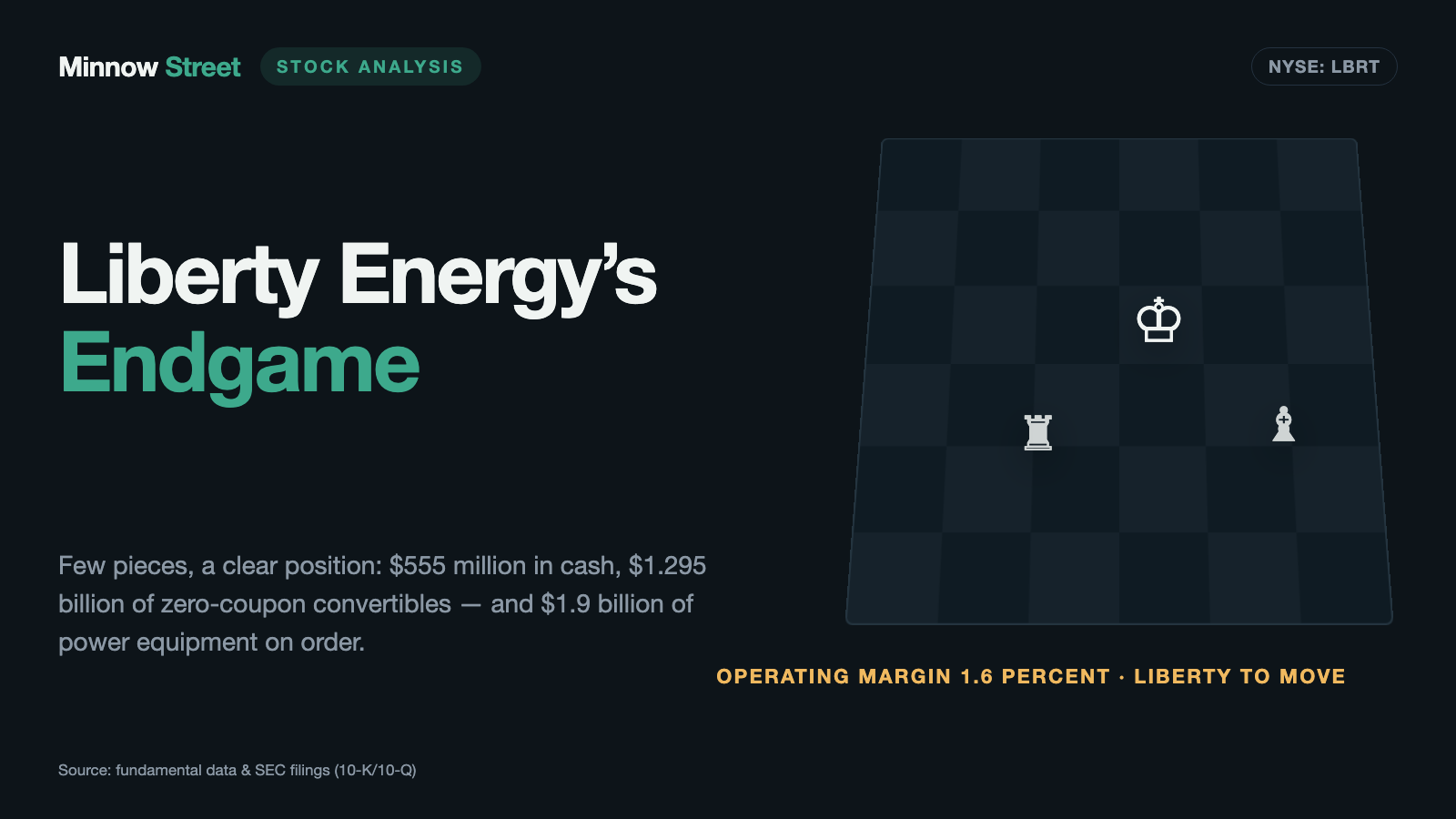
And that brings us to the central tension of this analysis, which runs through every chapter: Liberty earns its money in fracturing but books its reported profit from investments — and is betting the next several years on a power business whose equipment is already ordered while the offtake contracts are not yet signed. For a smaller view of how quickly an oilfield supplier swings between boom and lull, our analysis of Natural Gas Services covers the same industry from the compression side.
Where the stock landed on our desk
We run roughly 3,500 stocks through our scanners every day. On July 26, 2026, Liberty Energy sat at rank 19 in the U.S. selection of our Big Earnings Surprise screen, out of 81 U.S. hits. To repeat it yourself: open the screen, set the country filter to "US," read the list from the top. It is recalculated daily, so the rank can move.
The screen looks for companies whose reported earnings per share repeatedly came in well above the analyst estimate. The reasoning: a company that beats estimates that consistently is being systematically underrated, because the estimates lag the business. For Liberty the gap was 28.6 percent in the most recent quarter and, averaged over the last four quarters, 145.2 percent (data as of July 24, 2026).
Note the most important sentence in this chapter right now: this screen measures how accurate estimates are, not how good a company is. And it measures against an adjusted figure — a number from which special items have been stripped out. The result under U.S. accounting rules is a different quantity.
The fundamental view of the same data set is mixed (as of July 26, 2026): a Piotroski F-Score of 4 out of 9 — a nine-point test of the direction of the balance sheet, on which a thoroughly healthy company scores 8 or 9; 4 is the lower middle. The relative strength rating of 88 means the stock has outrun 88 percent of all others over twelve months. The public float is 98.1 percent, with insiders holding roughly 2 percent.
The numbers over the years — what genuinely impresses
Let us start with what is good. And there is a fair amount.
First, the balance sheet. On June 30, 2026 Liberty held $555.4 million in cash, up from $27.6 million at the end of 2025. Total assets were $4,488.1 million and equity was $1,963.8 million. That is an equity ratio of 43.8 percent. The $750.0 million revolving credit facility was undrawn at the balance sheet date; after $19.4 million of letters of credit, $448.3 million of availability remained. All financial covenants were met.
Second, the maturity profile. Only $32.2 million of debt comes due through 2030. The big block of $1,295.0 million does not arrive until 2031 and 2032. A company with essentially nothing to repay for four years does not stumble easily into a corner.
Third, returns to shareholders. Liberty paid $0.18 per share in dividends during the first half of 2026 — $0.09 per quarter, $30.3 million in total. On July 14, 2026 the board declared the next quarterly dividend of $0.09 per share, payable September 18, 2026.
Fourth, the view of the professionals: as of July 25, 2026 there were fourteen analyst opinions — four "strong buy," two "buy," eight "hold" and no sell. The average price target was $33.85. Anyone drawing comfort from that should know what is being valued: mostly an expectation about a power business that has not yet produced revenue.
Now let us look at what those strengths have to carry.
Uncomfortable truth No. 1: the profit comes from the portfolio
Look at how the two sources of earnings have shifted over the years.
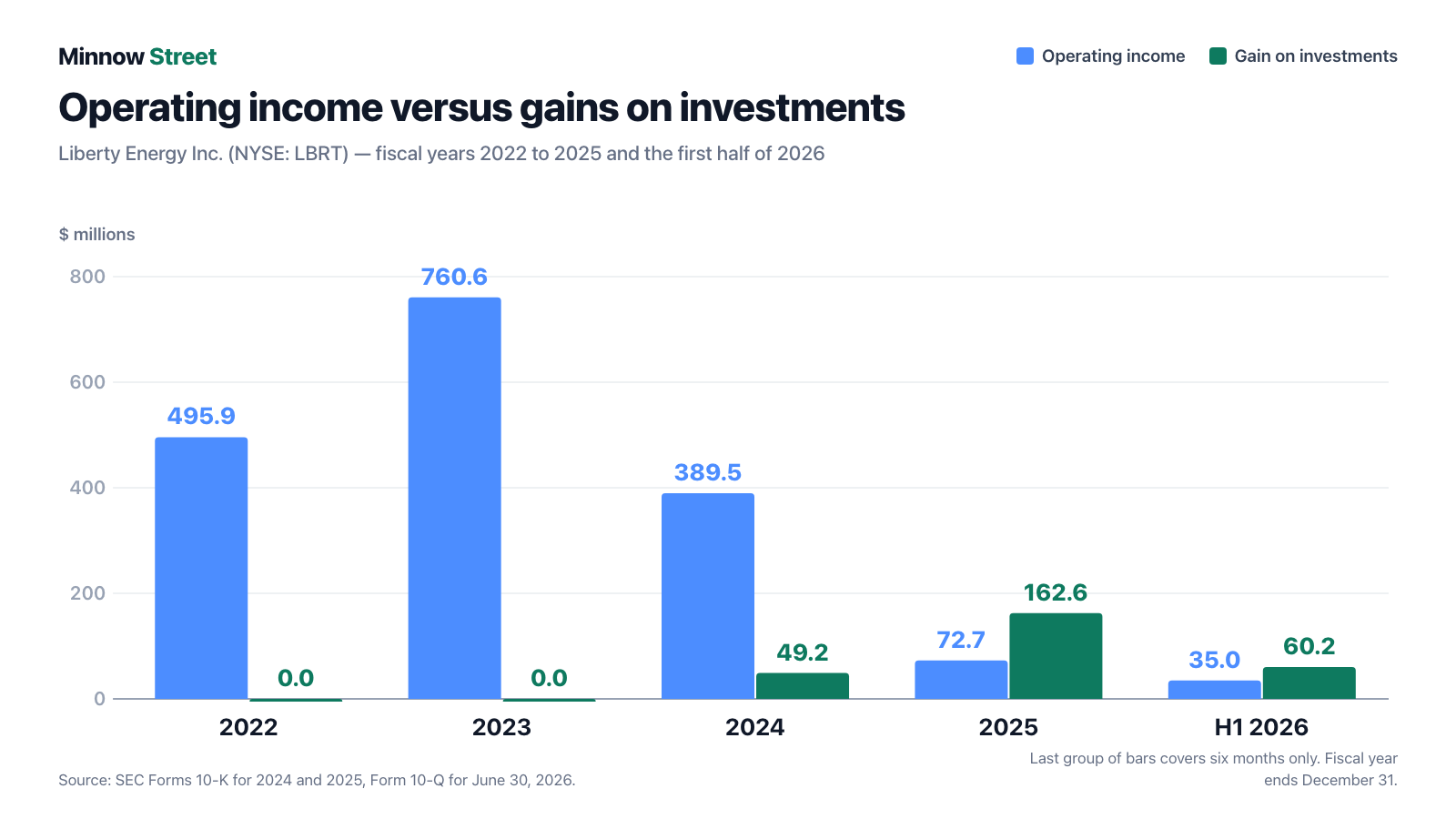
In 2022 and 2023 the "gain on investments" line was a clean zero. The business carried itself: $495.9 million of operating income in 2022 and $760.6 million in 2023 — on revenue of $4,747.9 million that works out to an operating margin of 16.0 percent.
Then it turned. Operating income fell to $389.5 million in 2024 and to $72.7 million in 2025 — down 90 percent from 2023, while revenue over the same span slipped by only about 16 percent. The 2025 operating margin was 1.8 percent.
The first half of 2026 did not improve matters; it merely packaged them differently. Revenue rose by $189.8 million, or roughly 9 percent, to $2,209.8 million. Operating income still fell, from $55.2 million to $35.0 million. The reason is in the quarterly report: cost of services rose 21 percent in the second quarter while revenue rose 14 percent. More work at worse prices.
A line worth keeping: when costs rise faster than revenue, growth is not progress — it is just more activity.
So where did the profit come from? From a small investment portfolio Liberty has built up over the years. On June 30, 2026 it held $184.9 million of stakes carried at fair value: Fervo Energy at $104.8 million, Tamboran Resources at $43.4 million, Oklo at $28.1 million and $8.6 million of other investments. All three large positions are listed on the New York Stock Exchange and are carried at quoted prices — every price move lands straight in the income statement.
Fervo Energy completed its initial public offering during the second quarter of 2026. That made the stake measurable at a market price for the first time, and Liberty booked $64.1 million of gain from it alone. Total quarterly profit was $43.1 million; operating income was $12.7 million. The arithmetic writes itself.
The Oklo stake carries a story that appears in no chart. Liberty invested $10.0 million in the fission power start-up during the third quarter of 2023, and then chief executive Christopher A. Wright joined the Oklo board. On February 3, 2025 the U.S. Senate confirmed Wright as Secretary of Energy of the United States. He resigned every role — at Liberty and at Oklo. Since then Oklo is no longer a related party.
Uncomfortable truth No. 2: $1.9 billion ordered, customers not yet signed
This is where the numbers get large. Very large relative to the company.

"During the year, we entered into various equipment supply contracts for the purchase of power generation equipment, including engines, balance of plant equipment, and related services for our distributed power solutions business for an aggregate price of approximately $1.3 billion. As of June 30, 2026, the total remaining commitments under these contracts was $1.1 billion. (…) In addition, on July 22, 2026, we entered into an additional equipment supply contract with CAT, which has a purchase price of approximately $801 million. We expect to receive the equipment currently on order under these supply contracts beginning in 2027 through 2030."
— Liberty Energy Inc., Form 10-Q for June 30, 2026, Liquidity and Capital Resources
Convert that into a proportion you can remember. Outstanding commitments of $1.1 billion plus the Caterpillar contract of roughly $801 million come to about $1.9 billion. Liberty Energy's entire market capitalization on July 24, 2026 was roughly $2.83 billion (closing price of $17.36 across 163,191,416 shares). The company has ordered engines worth roughly two thirds of its own market value.
The three known contracts in detail: Bergen Engines AS on May 1, 2026 for a combined $505.0 million (delivery from the second half of 2027 through 2028), Wärtsilä North America on June 22, 2026 for roughly $332.6 million (delivery 2029 through 2030) and Caterpillar on July 22, 2026 for roughly $801 million (delivery 2027 through early 2029).
And who takes the power? This is exactly where Liberty becomes unusually plain in its own risk factors.

"We have also recently announced a development agreement with Vantage Data Centers for at least 1 GW of power development over the next five years. However, this contract is not with the end-user of the eventual data center for actual provision of power, and while Vantage plans to work with us in concert with their customers, we must still secure these opportunities with the data center end user and arrive on acceptable final contract terms."
— Liberty Energy Inc., Form 10-K for 2025, Item 1A Risk Factors
The same paragraph carries the second caveat: the reservation and preliminary energy services agreement with a data center developer in Texas for 330 megawatts still depends on executing a final, binding contract before Liberty can deploy the generation and recognize revenue from the project.
For scale: 1 gigawatt is roughly the output of a mid-sized nuclear plant. Liberty is therefore talking about an undertaking larger than anything it has built to date — and ordering engines for it while the demand side still consists of letters of intent.
The Form 10-Q for June 30, 2026 added a risk factor that the annual report did not contain.

It states that any sustained reduction or delay in data center development activity could materially and adversely affect demand for Liberty's distributed power solutions, its results of operations and its financial condition. Taken seriously, a new risk factor in a quarterly report says something about nervousness in the market — not about a catastrophe.
Uncomfortable truth No. 3: free cash flow has turned
Profit is an opinion; cash is a fact. So we always look at free cash flow as well: the money left over after spending on plant and equipment. It is the amount a company can use to repay debt, pay dividends or buy back shares without raising fresh capital.
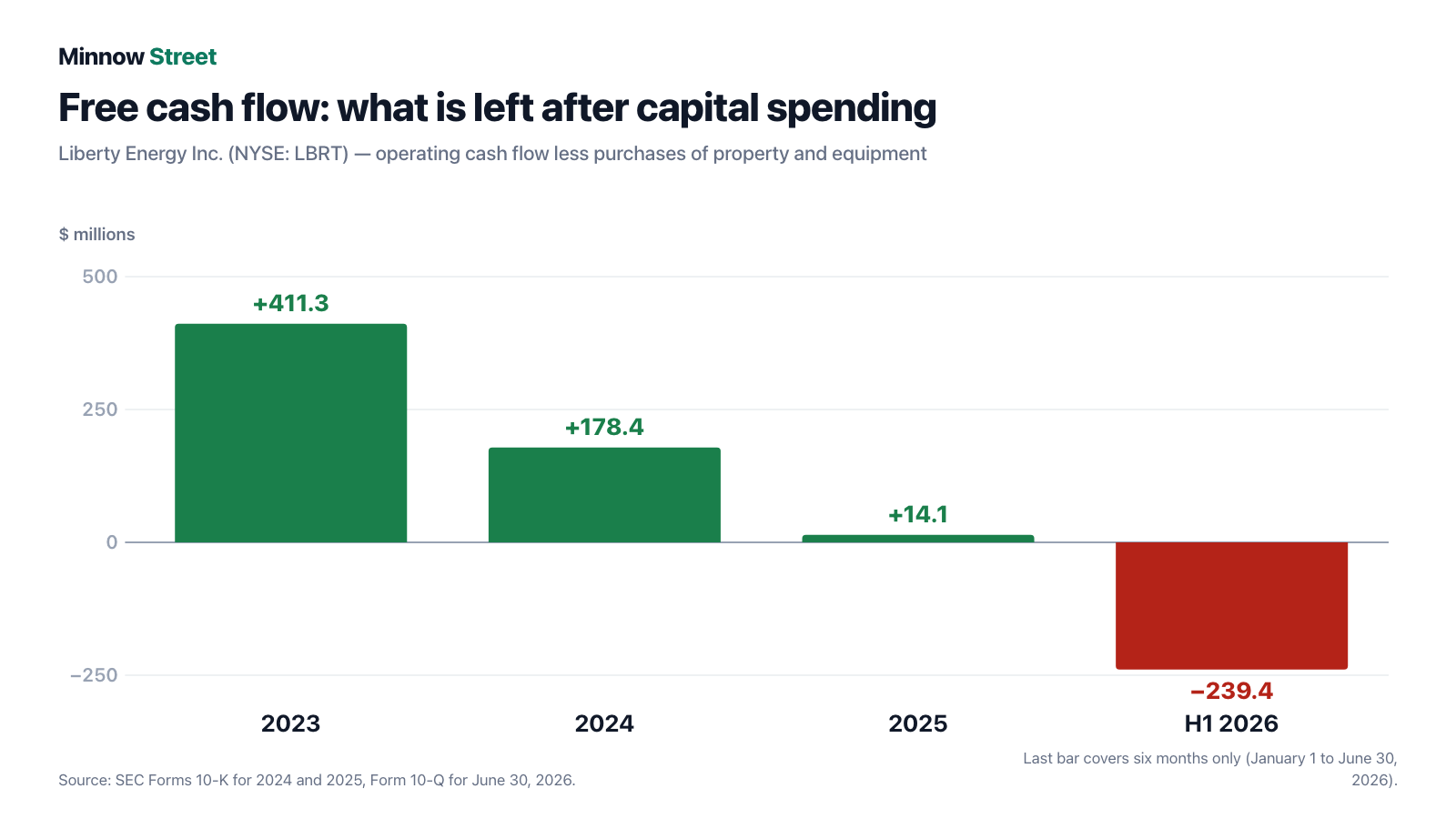
In 2023, $411.3 million was left after capital spending ($1,014.6 million of operating cash flow less $603.3 million of purchases). In 2024 it was $178.4 million and in 2025 only $14.1 million. In the first half of 2026 the figure went negative: $141.4 million of operating cash flow against $380.9 million of purchases leaves negative $239.4 million.
Operating cash flow more than halved year over year, from $362.7 million to $141.4 million. Liberty attributes that in the filing to higher cash operating expenses and a $165.4 million increase in receivables. At the same time capital spending rose by $109.4 million because Liberty is paying deposits on long-lead time equipment for the power business.
So where did the full treasury come from? From financing. In February and March 2026 Liberty issued two convertible notes.

A convertible note is a loan with a built-in exchange right: the holder may later swap the debt for shares if the price is high enough. Because that right has value, the holder forgoes interest. The everyday picture: you lend your neighbour money at no interest and in return get the right to buy his car at a price fixed today, should it be worth more later.
Liberty raised $770.0 million (due March 1, 2031) and $525.0 million (due March 1, 2032) that way — $1,295.0 million at zero percent. Net proceeds were $746.0 million and $511.3 million. The exchange starts at $34.50 per share for the 2031 notes and $37.44 for the 2032 notes — premiums of roughly 32.5 percent and 30.0 percent respectively over the reference prices documented in the filing, $26.04 on February 3, 2026 and $28.80 on March 25, 2026.
None of that is free. Liberty also bought capped calls — transactions that cushion the later dilution — for $109.3 million plus $77.2 million, or $186.5 million. That cash genuinely left the company, yet appears in no income statement line: it reduces additional paid-in capital directly, which fell from $978.4 million to $833.0 million despite share issuance. Measured against net proceeds of $1,257.3 million, that is roughly 14.8 percent. And the protection has a ceiling: it works only up to $65.10 and $72.00 per share respectively.
One detail at the margin is worth noting. The credit agreement was amended on February 3, 2026 to permit bridge financing of up to $600.0 million, to be incurred no later than June 30, 2026. Liberty never drew it, and the option has now lapsed. A company that arranges a bridge has planned for the case where the bond market does not cooperate. It cooperated.
What Liberty Energy costs today
No daily prices, just orders of magnitude with a date attached. On July 24, 2026 the closing price was $17.36; across the 163,191,416 shares reported as of July 20, 2026 in the quarterly report, that is a market capitalization of roughly $2.83 billion.
Three rough yardsticks follow. The price-to-sales ratio is roughly 0.7, measured against $4.20 billion of revenue over the trailing twelve months. The price-to-book ratio is roughly 1.4: the market pays about one and a half times the $1,963.8 million of book equity. The price-earnings ratio of roughly 23.5 is the least honest of the three, because the underlying profit largely comes from revaluing investments.
Add the debt: $1,291.8 million of borrowings plus $264.2 million of finance leases less $555.4 million of cash gives roughly $1.00 billion of net debt (as of June 30, 2026). Together with the equity value, the whole enterprise costs about $3.8 billion — against adjusted EBITDA of $277.0 million for the half year.
For cyclical context: in the second quarter of 2026 the WTI oil price averaged $95.65 per barrel against $64.57 a year earlier, while Henry Hub gas averaged $2.95 per million British thermal units against $3.19. The average onshore rig count for the United States and Canada was 688, against 686 a year earlier. A far higher oil price therefore produced almost no additional drilling — and Liberty could not convert it into a better margin. For how such prices move the producer side, our analysis of APA Corporation covers the same value chain one step upstream.
Opportunities and risks at a glance
What speaks for Liberty Energy:
- Solid balance sheet: $555.4 million of cash, a 43.8 percent equity ratio, and an undrawn $750.0 million revolver with $448.3 million of availability (June 30, 2026).
- Almost no maturity pressure: only $32.2 million of debt comes due through 2030, with the rest in 2031 and 2032 — at a zero percent coupon.
- Market position: roughly 40 active fracturing fleets, its own sand mines in the Permian Basin, and proprietary equipment from dual-fuel to electric pumps.
- A real demand pool: power consumption by data centers is growing, and the acquisition of IMG Energy Solutions on March 3, 2025 bought engineering and grid interconnection expertise.
- An investment portfolio with hidden reserves: $184.9 million of fair value at June 30, 2026, including $104.8 million in Fervo Energy.
- Dependable distribution: $0.09 per share per quarter, most recently declared on July 14, 2026.
What speaks against it:
- The core business barely earns anything: an operating margin of 1.6 percent in the first half of 2026, against 16.0 percent in 2023.
- The reported profit hangs on investments carried at quoted prices — in the second quarter of 2026 Fervo alone accounted for $64.1 million against a quarterly profit of $43.1 million.
- Free cash flow of negative $239.4 million in the first half of 2026, after positive $411.3 million in 2023.
- Roughly $1.9 billion of power equipment commitments against a market capitalization of roughly $2.83 billion (July 24, 2026) — with offtake arrangements the company itself describes as not yet binding.
- A new regulatory risk: moratoria and permitting requirements for data centers, added as a standalone risk factor in the quarterly report filed July 23, 2026.
- Tariff burden: $7.7 million of tariffs and duties on imported pump components in the second quarter of 2026 alone.
- Price pressure without a volume lever: despite WTI averaging $95.65 in the second quarter of 2026, drilling activity was merely level with a year earlier.
A human conclusion
Back to the surprise trap from the opening. Liberty Energy has beaten analyst estimates repeatedly and by a wide margin — that is the only reason the stock reached our desk at all. But the surprise tells a different story than expected: it was not the fracturing business that ran better than thought. It was the investment portfolio.
What remains is a company in the middle of a rebuild. The old business carries the costs but hardly any profit. The new business has ordered, paid and planned — but delivered nothing and sold nothing. Between the two sits a balance sheet strong enough to absorb that gap for a few years: plenty of cash, almost no maturities, interest-free debt.
Whether the rebuild succeeds will not be decided by an earnings surprise but by two signatures — the data center end user's, and the one under the final contract in Texas. Until then, Liberty Energy is a fracturing contractor with a well-stocked securities portfolio and a very large order.
What you make of that is your decision. And that is exactly as it should be.
Sources
- Form 10-Q for June 30, 2026 (filed July 23, 2026)
- Form 10-Q for March 31, 2026 (filed April 23, 2026)
- Form 10-K for 2025 (filed February 2, 2026)
- Form 10-K for 2024 (filed February 6, 2025)
- Form 8-K dated May 7, 2026 (Bergen Engines AS supply contracts)
- Form 8-K dated June 25, 2026 (Wärtsilä North America supply contract)
- Form 8-K dated July 23, 2026 (second-quarter 2026 results)
- Full filing history at SEC EDGAR, CIK 0001694028
- Fundamental data & in-house stock scanner, as of July 24 to 26, 2026
This analysis is journalism and editorial context, not investment advice. It is not a solicitation to buy or sell securities. Share prices can move sharply, and a total loss of the capital invested is possible. All figures are drawn from publicly available sources verified as of the stated dates; no warranty is given for completeness or accuracy. The author holds no position in Liberty Energy Inc. at the time of publication.
Our Bottom Line at a Glance
- Balance sheet and liquidity positive
- Cash stood at $555.4 million on June 30, 2026, up from $27.6 million at the end of 2025. Equity was $1,963.8 million against total assets of $4,488.1 million, or 43.8 percent. The $750.0 million revolving credit facility was undrawn, with $448.3 million of remaining availability. Only $32.2 million of debt matures through 2030 — the remaining $1,295.0 million falls due in 2031 and 2032. All covenants were met at the balance sheet date.
- Core business and margin negative
- Operating income fell from $760.6 million in 2023 to $389.5 million in 2024 and $72.7 million in 2025, and stood at $35.0 million in the first half of 2026 — an operating margin of 1.6 percent. Cost of services rose 21 percent in the second quarter of 2026 while revenue rose 14 percent. Adjusted EBITDA fell from $348.9 million to $277.0 million on a half-year basis.
- Source of the profit negative
- The reported profit mostly comes from investments: $162.6 million in 2025 against $72.7 million of operating income, and $60.2 million against $35.0 million in the first half of 2026. In the second quarter of 2026 the mark-up of Fervo Energy after its initial public offering alone produced $64.1 million against a quarterly profit of $43.1 million. These positions are carried at quoted market prices and move daily.
- Cash flow and capital spending negative
- Operating cash flow halved in the first half of 2026, from $362.7 million to $141.4 million, while purchases of property and equipment rose from $271.4 million to $380.9 million. That leaves negative $239.4 million, after positive $14.1 million for full-year 2025 and positive $411.3 million in 2023. Outstanding power equipment commitments stood at $1.1 billion on June 30, 2026, plus roughly $801 million from the Caterpillar contract of July 22, 2026.
- The power generation opportunity neutral
- Demand for distributed power is real, and the acquisition of IMG Energy Solutions on March 3, 2025 for roughly $19.6 million bought engineering and interconnection expertise. But the company writes in its own risk factors to the 2025 annual report that the Vantage Data Centers arrangement is not with the end user, and that the 330-megawatt project in Texas still requires a final, binding contract before it can generate revenue.
- Valuation neutral
- A market capitalization of roughly $2.83 billion (closing price of $17.36 on July 24, 2026 across 163,191,416 shares) equates to a price-to-sales ratio of roughly 0.7 and a price-to-book ratio of roughly 1.4. The price-earnings ratio of roughly 23.5 rests on a profit largely produced by investment revaluations. Fourteen analyst opinions averaged a $33.85 target, split into four "strong buy," two "buy" and eight "hold" (data as of July 25, 2026).
Liberty Energy is one of the largest hydraulic fracturing contractors in North America and is building a second business in distributed power for data centers. What is proven: a solid balance sheet with $555.4 million of cash, an equity ratio of 43.8 percent, maturities that do not arrive until 2031 and 2032, and an undrawn $750.0 million revolving facility. Against that stands a core business whose operating income fell from $760.6 million in 2023 to $72.7 million in 2025 and accounted for just 1.6 percent of revenue in the first half of 2026. The reported profit mostly comes from investments, free cash flow has turned to negative $239.4 million, and roughly $1.9 billion of power equipment is on order against offtake arrangements the company itself describes as not yet binding. Not investment advice.
What Our Rating Means
Open questions
The business works in principle, but one material question is open. As long as it stays open, our findings do not carry a quality verdict.
Red would require a finding against substance, and there is none: $555.4 million of cash as of June 30, 2026, equity of $1,963.8 million at a 43.8 percent equity ratio, positive operating cash flow, an undrawn $750.0 million revolving facility, covenants met, effective disclosure controls and $1,295.0 million of debt that does not mature until 2031 and 2032. Green would require proof that the core business carries itself: the operating margin was 1.6 percent in the first half of 2026 against 16.0 percent in 2023, the reported profit mostly comes from investments carried at daily quoted prices, and free cash flow has swung from positive $411.3 million in 2023 to negative $239.4 million in the first half of 2026. At the same time roughly $1.9 billion of power equipment is on order while the company itself writes that the flagship arrangements are not yet binding. That is a weighty open operational question, but not a threat to substance — hence yellow. The decision is yours.
A journalistic assessment by our editorial team at the time of the deep dive, based on public sources — not investment advice and not a solicitation to buy or sell. Your personal circumstances (investment goals, risk capacity, taxes) cannot be taken into account. What our levels mean, how verdicts are formed, and what conflicts of interest exist →
Worth Noting
- LBRT reached our research list as number 19 of 81 U.S. hits in our in-house Big Earnings Surprise screen (measured on the live page on July 26, 2026) — part of our series filling the top 50 of that screen with analyses. The scanner lists are recalculated daily, so the rank can move.
- What the screen measures: repeated large upside gaps between reported earnings per share and the analyst estimate. That is a statement about how accurate estimates are, not about company quality — and those estimates refer to an adjusted figure, not to the result under U.S. accounting rules.
- Metric trap: the price-earnings ratio and return on equity are misleading for Liberty Energy, because a large part of the profit comes from revaluing investments rather than from the business. The Piotroski F-Score stood at 4 of 9 on July 26, 2026 — a nine-point test of the direction of the balance sheet, on which a thoroughly healthy company scores 8 or 9.
- Currency note: the most recent quarterly report (Form 10-Q) is dated July 23, 2026 and has been fully analysed, as has the Form 10-K for 2025 dated February 2, 2026. As of July 26, 2026 no filing had been made after July 23, 2026. There is no merger, no take-private, no going-private transaction and no delisting.
- Risk of confusion: Liberty Energy Inc. (CIK 1694028) was named "Liberty Oilfield Services Inc." until April 21, 2022, and older sources still carry the former name. The company is unrelated to Liberty Media or Liberty Global. The stakes in Oklo, Tamboran Resources and Fervo Energy are separately listed companies, not parts of the group.
Frequently Asked Questions
Liberty Energy provides completions services for onshore oil and gas wells in North America — mainly hydraulic fracturing, plus wireline services, sand from its own mines, field gas processing and data analytics. About 40 fracturing fleets were active as of June 30, 2026. A second leg is the subsidiary Liberty Power Innovations, which is building distributed power generation for industrial customers and data centers.
That screen looks for companies whose reported earnings per share repeatedly came in well above the analyst estimate. For Liberty Energy the gap was 28.6 percent in the most recent quarter and, averaged over the last four quarters, 145.2 percent (data as of July 24, 2026). On July 26, 2026 that put the stock at rank 19 of 81 U.S. hits. The lists are recalculated daily.
In the first half of 2026, $2,209.8 million of revenue left $35.0 million of operating income — an operating margin of 1.6 percent. In the second quarter alone it was $12.7 million on $1,188.6 million of revenue, or 1.1 percent. For comparison, the operating margin was 16.0 percent in 2023. Cost of services rose 21 percent in the second quarter of 2026 while revenue rose only 14 percent.
Liberty is buying engines and balance of plant equipment for planned data center and industrial power projects. By June 30, 2026 it had signed contracts worth roughly $1.3 billion, of which $1.1 billion was still outstanding; on July 22, 2026 a Caterpillar contract of roughly $801 million was added. Delivery runs from 2027 through 2030, with payments made in installments tied to manufacturing and takeover.
A convertible note is a loan the holder may later exchange for shares. Because that exchange right has value, the holder gives up interest: Liberty pays zero percent on $1,295.0 million. The cost sits elsewhere — in the possible exchange starting at $34.50 and $37.44 per share, and in the $186.5 million Liberty paid for capped call transactions.
Christopher A. Wright led Liberty as chief executive officer and chairman of the board. On February 3, 2025 the U.S. Senate confirmed him as Secretary of Energy of the United States; he then resigned both roles and his seat on the board of Oklo. Since that date Oklo is no longer a related party for Liberty. The related separation arrangement raised stock-based compensation expense in 2025.
Two customers are disclosed separately. In the second quarter of 2026, Customer A accounted for 8 percent and Customer B for 9 percent of consolidated revenue; on a half-year basis each accounted for 10 percent. Of accounts receivable and unbilled revenue, Customer A represented 10 percent as of June 30, 2026, down from 16 percent at December 31, 2025. That does not read as an existential single-customer dependency.
Yes. It paid $0.18 per share in the first half of 2026, or $0.09 per quarter, for a total cash outflow of $30.3 million. On July 14, 2026 the board approved another quarterly dividend of $0.09 per share, payable on September 18, 2026 to holders of record as of September 4, 2026.
Found an error?
Did you spot a factual error, an outdated number, or a typo in this deep dive? Let us know briefly — your report goes straight to the editorial team.