Carriage Services: People Always Die — So Why Does This Funeral Operator Need $100 Million of Fresh Equity?
"People always die" is the one sentence that makes an industry instantly likeable. Carriage Services runs 155 funeral homes in 24 states and 28 cemeteries, earned a record $51.5 million in 2025 and has been raising prices for years. Its filings with the U.S. securities regulator, the SEC, tell the second half of the story: comparable funeral contract volume fell 5.8 percent in the first quarter of 2026, the cremation rate hit 60.8 percent in 2025 — and the company says a cremation brings in roughly one-third of what a traditional burial does. Growth therefore comes from acquisitions. On May 6, 2026 the company opened a program to sell up to $100 million of new shares, after three straight years without buying back a single one. We read the filings to see who ends up paying that bill.
 Thomas Mücke
Founder & Publisher
Thomas Mücke
Founder & Publisher
Chart
Interactive price chart (TradingView).
Note: pure fact-based analysis, not investment advice and not a solicitation to buy or sell. All figures without guarantee.
There is an investor trap that feels like plain common sense, which is exactly why it works so well: the certainty trap. It consists of a single sentence everyone signs off on immediately: "People always die." The sentence is true, it is comforting, and it has a nasty side effect. Once it is lodged in your head, you stop doing arithmetic. Why check a balance sheet when biology guarantees demand? Carriage Services (NYSE: CSV) of Houston is the second-largest publicly traded funeral home and cemetery operator in the United States — 155 funeral homes in 24 states, 28 cemeteries in 9 states, 2,321 employees, all as of December 31, 2025. So here is the deal: before you believe the comforting sentence, let us read together what the company itself filed with the U.S. securities regulator, the SEC — the annual report (10-K) for 2025, the quarterly report (10-Q) as of March 31, 2026, the prospectus supplement of May 6, 2026 and the annual meeting report of May 14, 2026. Filings like these are honest under penalty of law. And this set tells of a record profit, of shrinking case volume, of a balance sheet built mostly out of acquisition premiums — and of a company that bought back no stock at all for three years and may now sell $100 million of new shares. What you make of it is your call.
What Carriage Services actually does — two businesses under one roof
Carriage Services sells two things people would rather not buy and never return. The first business is funeral homes, accounting for roughly 68 percent of revenue (10-Q as of March 31, 2026; for full-year 2025 it was 65 percent): removal, preparation, memorial services, caskets, urns, cremation. The second is cemeteries, the remaining 32 percent: grave sites, mausoleum spaces, niches, markers, interments. Both are sold in two tenses — "atneed", at the time of death, and "preneed", ordered and paid for during a customer\'s lifetime. That preneed business is the real core of the model, and in everyday terms it works like a savings plan for your own funeral: you pay today, delivery comes later. Until then the money sits in trusts the company administers but cannot touch. As of December 31, 2025, the backlog stood at 93,286 preneed funeral contracts and 65,681 preneed cemetery contracts.
The company owns the real estate under 136 of its 155 funeral homes and leases only 19. More than 40 percent of its businesses sit in California, Texas and Florida. And here is the central tension of this analysis, running through every chapter: the number of deaths is guaranteed, the revenue per death is not. Because the core business is shrinking by volume and a cremation brings in a fraction of a burial, Carriage can only grow by buying — and buying costs money the company neither holds in cash nor keeps from operations.

How this stock landed on our desk
Not through a breakout and not through a message board, but through the SEC filing stream. Fairness demands the cross-check against our own data, and we ran it: CSV appears in none of the result lists of our in-house stock scanner as of July 30, 2026 — no momentum filter, no quality filter, no valuation filter picked the stock up. Those lists are recalculated every day, so the finding holds for that date. On May 6, 2026, Carriage Services filed three documents within a few hours: a current report (8-K) on a new distribution agreement, a prospectus supplement (424B5) covering up to $100 million of new shares, and its quarterly numbers. Nine days earlier, a shelf registration (S-3ASR) had already gone in. When a 34-year-old, profitable company with a steady dividend assembles a package like that, it is worth reading — because it answers the question no ratio answers: why does this company need money right now? Conventional metrics only get you so far here. The price-to-earnings ratio looks harmless at just over 14, the price-to-book ratio unremarkable at just under 3 — but neither tells you what that book value is made of or where the profit comes from. Note the finding up front: with a roll-up, you read the balance sheet first and the income statement second.
The numbers over the years — given their due
First the genuinely impressive part, and there is plenty. Revenue rose 9.1 percent in two years, from $382.5 million to $417.4 million. Operating income climbed 20.6 percent over the same stretch to $97.7 million — so the company is not just growing, it is getting more profitable. Net income jumped to $51.5 million in 2025, or $3.25 per diluted share, up from $2.10 a year earlier. Interest expense fell from $36.3 million in 2023 to $32.1 million in 2024 and $28.4 million in 2025 as the company paid down its revolver. And the dividend of $0.45 per share a year has been unchanged since at least 2023 and has never been cut.
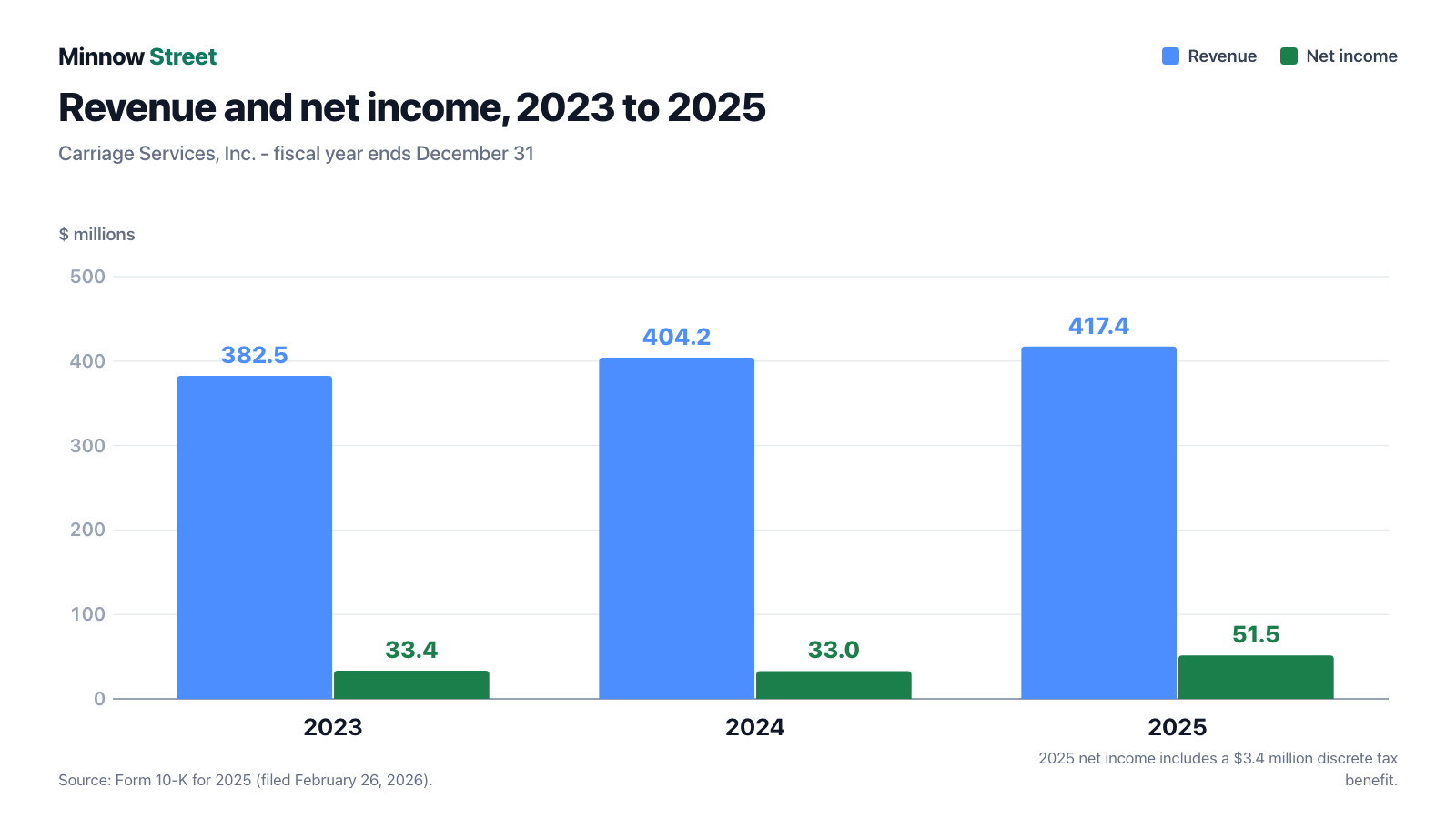
Operationally the business is respectable too. Gross margin was 35.1 percent in 2025 and 36.4 percent in the first quarter of 2026, against 35.3 percent a year earlier. A funeral home carries high fixed costs and low variable ones — hold the utilization and the money is good. Nor is the valuation stretched: at the last sale price documented in a filing, $47.48 on May 5, 2026 as cited in the prospectus supplement, that is about 14.6 times 2025 earnings. For a look at how another roll-up runs the same arithmetic, see our analysis of CBIZ and its two-billion-dollar acquisition, which shows what happens when earnings per share fail to keep pace with the purchase price.
One detail tempers the cheer: net income in the first quarter of 2026 fell from $20.9 million to $13.5 million. That sounds dramatic but is largely a comparison effect — the prior-year quarter contained a $5.8 million divestiture gain. Adjusted for gains and losses on divestitures, operating income was $25.6 million in the first quarter of 2026 against $25.8 million a year earlier, essentially flat. Note the anchor: the operation holds. The question is what is holding it up.
What the filings say — the uncomfortable truths
Uncomfortable truth no. 1: case volume is falling, and every cremation brings in a third
"People always die" is true, but it does not follow that Carriage arranges the same number of funerals every year. In the first quarter of 2026, comparable funeral contract volume fell 5.8 percent to 10,663, from 11,319 a year earlier. The filing puts it plainly: "The decline in comparable revenue is primarily driven by a 5.8% decrease in contract volume." Only price offset it — average revenue per contract rose 1.7 percent to $5,934. Price increases are a lever, but a finite one.
Behind that sits a structural shift the company itself discloses as a risk — the move from burial to cremation:
"Industry studies indicate that the percentage of cremations has increased every year, and this trend is expected to continue into the future. The trend toward cremation could cause cemeteries and traditional funeral homes to lose market share and revenue to firms specializing in cremations. Additionally, our average revenue for cremations is lower than that for traditional burials."
— Carriage Services, Inc., SEC annual report 10-K for 2025, Item 1A Risk Factors

How wide the gap is, the company quantifies elsewhere: "our average cremation service revenue is approximately one-third of the average revenue earned from a traditional burial service." The cremation rate was 60.8 percent in 2025 against 59.9 percent a year earlier, and 60.5 percent in the first quarter of 2026 against 60.1 percent. That is not quite one percentage point a year — quiet, but relentless. In everyday terms: picture a restaurant where one percent of the guests switch from the full menu to the soup every year. The room is as full as ever, the till gets thinner anyway. That is exactly why Carriage raises prices — and exactly why the price lever is a defensive line rather than growth.
Uncomfortable truth no. 2: profit is rising, cash is not
A record profit is only a record once it reaches the bank account. At Carriage there is a gap here. Operating cash flow was $60.7 million in 2025; deduct the $20.6 million that went into buildings, vehicles and equipment and free cash flow comes to $40.1 million. For comparison: $57.6 million in 2023, and just $35.9 million in 2024. Net income over the same period rose from $33.4 million to $51.5 million. Profit grew by more than half; free cash shrank by nearly a third.
The reason is in the cash flow statement. The line for accounts and preneed receivables consumed $28.2 million in 2025 (2024: $24.6 million; 2023: just $8.1 million). The balance sheet shows the same thing from the other side: ordinary receivables rose from $30.2 million to $40.6 million in 2025 (up 34.6 percent), preneed cemetery receivables from $51.0 million to $67.1 million (up 31.6 percent). Together that is $26.6 million more in receivables against a revenue increase of just $13.2 million. When a cemetery counselor sells a grave site on an installment plan today, the revenue is booked while the cash trickles in over years. Note the image: revenue is a promise, cash flow is the receipt. At Carriage, the promises are currently growing faster than the receipts.
Uncomfortable truth no. 3: three years without a buyback — and now $100 million of new stock
Here is the part that holds the whole analysis together. Carriage Services holds 11,627,818 shares in treasury, bought for $278.8 million — an average of $23.97 apiece. For years the company was a determined repurchaser. Since 2023 the machine has been idle:
"No shares were repurchased during the years ended December 31, 2025, 2024 and 2023. At December 31, 2025, our share repurchase program had $48.9 million authorized for repurchases."
— Carriage Services, Inc., SEC annual report 10-K for 2025, Item 5

Then, on May 6, 2026, the direction reversed. The quarterly report discloses it under subsequent events:
"On May 6, 2026, the Company announced it has entered into an Equity Distribution Agreement with Oppenheimer & Co. Inc. and Raymond James & Associates, Inc., serving as sales agents (together, the “Sales Agents”), with respect to its at-the-market offering program under which the Company may offer and sell, from time to time, shares of its common stock having an aggregate offering price of up to $100.0 million through the Sales Agents."
— Carriage Services, Inc., SEC quarterly report 10-Q as of March 31, 2026, Note 13

A structure like this is called an at-the-market offering. In everyday terms: instead of announcing one large capital raise, the company opens a tap and lets new shares trickle into the market in small amounts, whenever the price suits. For you as a shareholder, every new share means your slice of the cake gets thinner; the cake is supposed to get bigger in return. How much thinner at most, the prospectus supplement calculates itself: at an assumed price of $47.26, that would be 2,115,954 new shares — 13.3 percent on top of the 15,872,328 outstanding. And that is only the first layer:
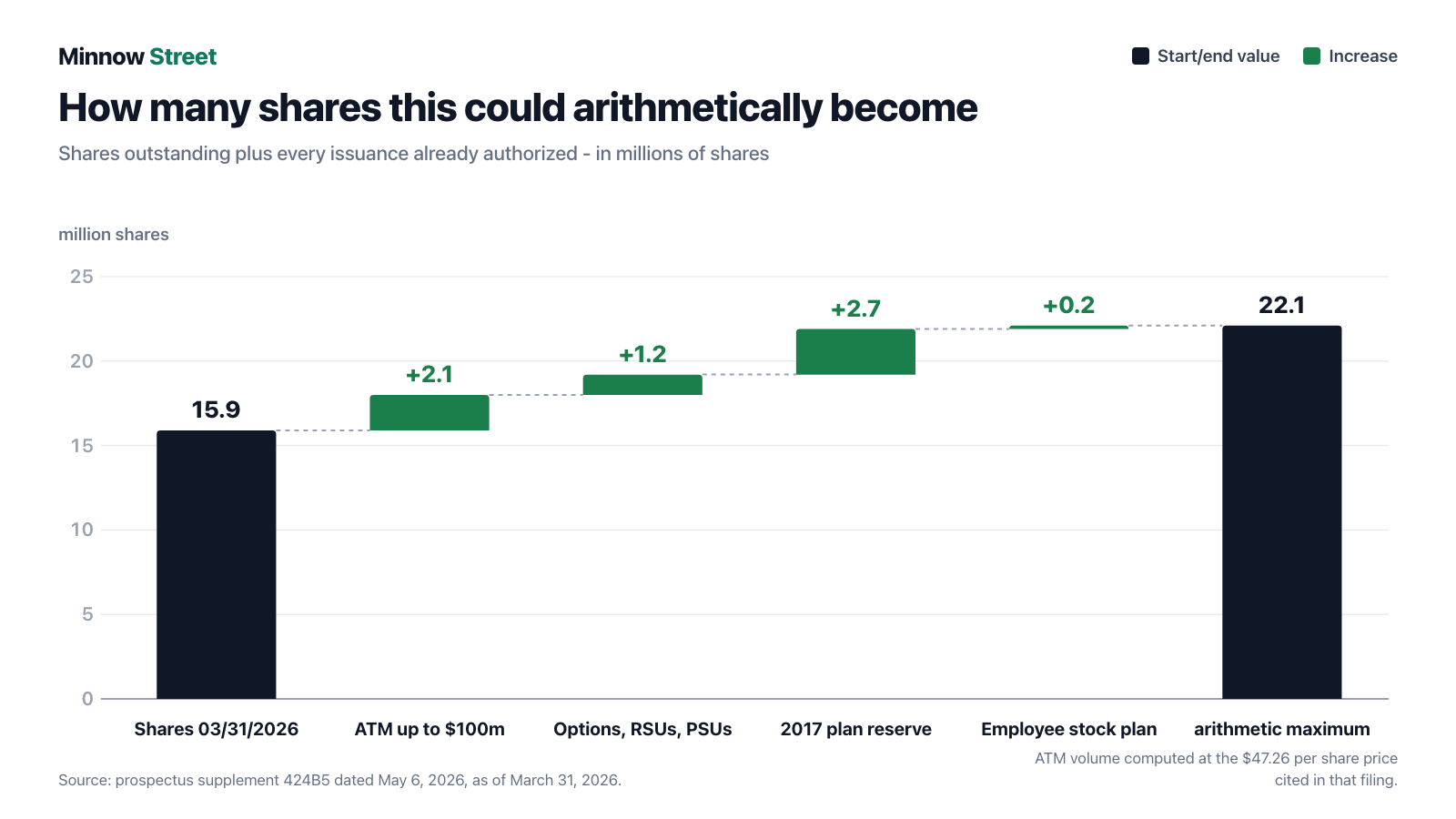
Alongside the $100 million program, the same prospectus supplement lists, as of March 31, 2026: 1.2 million shares under outstanding options, restricted stock units and performance stock units, 2.7 million shares reserved for future issuance under the 2017 omnibus incentive plan, and 0.2 million under the employee stock purchase plan. Together with the 2.1 million from the new program, 15.9 million shares could arithmetically become 22.1 million. That is a ceiling, not a forecast — but it is authorized, not speculated. For a very different illustration of how a company\'s own shares can shape a balance sheet, see our analysis of Biglari Holdings, where the company\'s own stock sits inside an in-house fund.
What the money is for, the supplement states openly: "We intend to use the net proceeds from the sale by us of the securities to which this prospectus supplement relates to fund potential acquisitions and for general corporate purposes, including debt repayments." Which closes the circle back to the central tension: because the existing business is shrinking by volume, it has to buy; because operations leave only around $40 million a year after capital expenditures, its own strength is not enough.
Uncomfortable truth no. 4: goodwill exceeds total equity
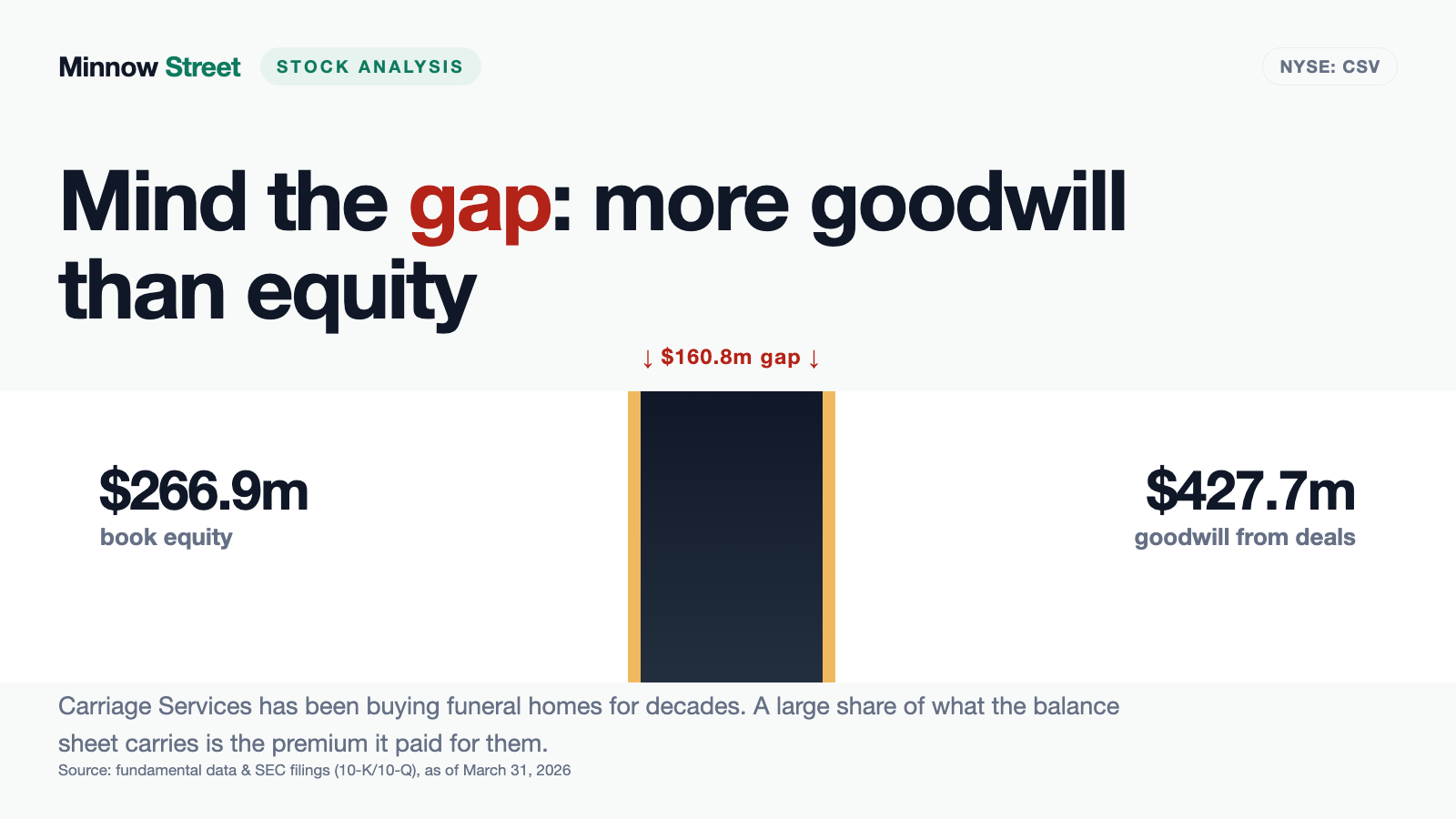
Buy a lot of companies and you rarely buy only buildings. You also pay for the customer base, the location, the reputation and the market position — and that premium lands on the balance sheet as goodwill. In everyday terms: if you buy a bakery and pay $50,000 for the oven but $150,000 for the name above the door, your balance sheet holds $50,000 of oven and $150,000 of hope. At Carriage Services, as of March 31, 2026, the books carry $427.7 million of goodwill against total book equity of $266.9 million. The premium exceeds equity by $160.8 million. Arithmetically: strip out goodwill and there is no book equity left.
How strongly a single deal shapes that ratio, the latest one shows. In September 2025, Carriage acquired six funeral homes, one cemetery and a cremation-focused business in the Orlando, Florida area for roughly $49.0 million, plus two funeral homes near Pensacola for $9.5 million. Of the $56.5 million total purchase price, $37.7 million went straight to goodwill — 66.8 percent. In fairness: the company tests goodwill for impairment annually as of August 31, deliberately used the more demanding quantitative method in 2025 and concluded that no write-down was needed. Auditor Grant Thornton LLP was reappointed at the 2026 annual meeting. So there is no sign of an overdue write-down — but there is a structural finding: what this balance sheet calls substance is mostly premium paid.
Uncomfortable truth no. 5: the cheap 2021 bond matures in 2029
In 2021, in the middle of the zero-rate era, Carriage Services issued $400 million of notes at 4.25 percent. They mature on May 15, 2029. That is cheap money: $17.0 million of interest a year on $400 million. On top sits a $250 million revolving credit facility, of which $120.5 million was drawn at March 31, 2026 (December 31, 2025: $126.7 million) at a weighted average rate of 5.9 percent. Together with $6.2 million of acquisition debt, financial debt comes to roughly $526.7 million — about 4.3 times the roughly $123 million of 2025 operating income before depreciation and amortization.
The credit agreement allows up to five times, and the company is inside the limit:
"At March 31, 2026, we were subject to the following financial covenants under our Credit Facility: (A) a Total Leverage Ratio not to exceed 5.00 to 1.00 and (B) a Fixed Charge Coverage Ratio (as defined in the Credit Facility) of not less than 1.20 to 1.00 as of the end of any period of four consecutive fiscal quarters."
— Carriage Services, Inc., SEC quarterly report 10-Q as of March 31, 2026, Note 10
The filing expressly states that all covenants were met at March 31, 2026. The interesting note sits one line above: the fair value of the notes at March 31, 2026 was $380.3 million — nearly 5 percent below the $400 million face amount. Bondholders are already demanding a higher yield than the 4.25 percent coupon delivers. Refinancing in 2029 is likely to cost more; each extra percentage point on $400 million is $4 million a year, against net income of $51.5 million in 2025. This is not an acute problem — maturity is years away, interest coverage was 3.4 times in 2025 and 3.7 times in the first quarter of 2026. But it is the reason a company that wants to fund acquisitions reaches for equity rather than more debt.
What the owners think of it
Two results from the annual meeting of May 12, 2026 stand out. The proposal to declassify the board and stand every director for annual election drew 11,975,332 votes for and 16,360 against — near unanimity among those voting. It failed anyway:
"Pursuant to the foregoing vote, the proposed amendment to the Company’s Amended and Restated Certificate of Incorporation to declassify the Board did not receive the required affirmative vote of at least 80% of the Company’s outstanding shares entitled to vote."
— Carriage Services, Inc., SEC Form 8-K of May 14, 2026, Item 5.07

1,854,346 broker non-votes were never cast — without instructions, custodians may not vote on such items, yet those shares still count against the 80 percent hurdle. The second result: the plain deadline extension of the 2017 equity incentive plan to May 2031 passed by 6,138,408 votes to 5,843,510 — 51.2 percent to 48.8 percent. On a routine item, that is a shot across the bow from shareholders. For context: chief executive Carlos R. Quezada received total 2025 compensation of $3,859,198, against a median of $26,996 for all other employees — a ratio of 143 to 1 (proxy statement 2026). The pay package itself was approved by a wide margin; the shares to fund it, apparently, only barely.
Valuation — what you get for your money
The last price documented in a filing is a clean, dated anchor: $47.48 on May 5, 2026, cited in the prospectus supplement. Multiplied by the 15,872,328 shares outstanding, that gives a market value of roughly $754 million. On that basis:
- Price-to-earnings: about 14.6 times the $3.25 per share earned in 2025. For a business with stable demand, pricing power and a 35 percent gross margin that is not expensive — but 2025 earnings included $3.4 million of one-time tax benefit.
- Price-to-sales: about 1.8 times the $417.4 million of 2025 revenue.
- Price-to-book: about 2.8 times the book value of $16.82 per share (March 31, 2026) — a book value made up entirely of goodwill, as shown above.
- Enterprise value: market value plus financial debt less cash comes to roughly $1.28 billion, or about 10.4 times the roughly $123 million of 2025 operating income before depreciation and amortization. For a leveraged roll-up, that is the more honest metric.
- Dividend yield: $0.45 a year on $47.48 is roughly 0.95 percent. Against free cash flow of $40.1 million, the payout costs $7.0 million — well covered, but not a reason to buy.
The professional view: four analysts cover the stock — two at strong buy, two at buy, none at hold or sell; the average price target is $60 (data as of July 30, 2026). That is an unusually unanimous picture, and it deserves to be read with care: for a stock with about 15.9 million shares and thin trading volume, analyst coverage is sparse, and a consensus of four voices is an opinion rather than a market verdict. A note on the data: the market value delivered by the fundamental data feed deviated by more than one fifth from our cross-check of share count and filing price, so we did not use it and work exclusively from the prospectus anchor.
Opportunities and risks at a glance
What speaks for Carriage Services:
- A business with non-negotiable demand, a high gross margin (35.1 percent in 2025) and real hard assets: 136 of the 155 funeral homes are owned outright, land included.
- Pricing works: average revenue per funeral contract rose 1.4 percent to $5,763 in 2025 and a further 1.7 percent to $5,934 in the first quarter of 2026.
- A large backlog that pre-books future revenue: 93,286 preneed funeral contracts and 65,681 preneed cemetery contracts as of December 31, 2025; net 11,967 new preneed funeral contracts were sold in 2025 (2024: 10,750).
- Falling interest burden: $28.4 million of interest expense in 2025 against $36.3 million in 2023; the revolver was paid down from $126.7 million to $120.5 million (March 31, 2026), with $127.3 million still available.
- A fragmented market full of family-owned homes — the roll-up approach still has runway, and the capital for it is now in place.
What speaks against it:
- Falling volume in the core business: comparable funeral contracts down 5.8 percent in the first quarter of 2026; price can only offset so much.
- Structural revenue erosion from cremation: a 60.8 percent rate in 2025, at roughly one-third of a burial\'s revenue — and nearly a percentage point slips every year.
- Profit is better than cash flow: $51.5 million of net income against $40.1 million of free cash flow in 2025, because receivables grew by $26.6 million.
- Dilution: up to 2.1 million new shares from the $100 million program plus 4.1 million from incentive plans and reserves — arithmetically up to 39 percent more shares.
- Balance sheet structure: $427.7 million of goodwill against $266.9 million of equity; financial debt of roughly $526.7 million equals about 4.3 times operating income before depreciation and amortization.
- Refinancing risk in 2029: the $400 million of 4.25 percent notes mature on May 15, 2029 and were marked at $380.3 million, below face, at March 31, 2026.
- Concentration: more than 40 percent of the businesses sit in California, Texas and Florida — regions with elevated exposure to hurricanes, wildfires and flooding.
A conclusion without a recommendation
Back to the certainty trap. "People always die" is not a lie — it is simply a statement about quantity, not about price. Carriage Services shows precisely where that gap sits: people die reliably, but they choose cremation more and more often, and a cremation brings the company roughly a third of what a burial used to. Management has found two honest answers — raise prices and buy competitors — and both work: $417.4 million of revenue, $97.7 million of operating income and $51.5 million of profit in 2025 are no accident. The third answer has been on file since May 6, 2026, and it is the most interesting one: because operations leave only around $40 million a year after capital expenditures, up to $100 million is now meant to come from new shareholders — at a company that simultaneously keeps an unused $48.9 million repurchase authorization in the drawer.
None of this is a scandal, and none of it is a warning sign on its own. It is the logical consequence of a model that only grows by acquisition. But it answers the question the comforting opening sentence had just talked you out of asking: the open question here is not demand, it is who pays for the growth. If you buy, you buy a solid, old, well-run business with real real estate — and you buy along with it the prospect that your share of it may shrink over the coming years. If you wait, you check three lines in every quarterly report: how many shares are on the cover page, how large is free cash flow, and is comparable case volume still falling? The decision is yours.
Sources
- Carriage Services, Inc. — SEC annual report (10-K) for 2025, filed February 26, 2026
- Carriage Services, Inc. — SEC quarterly report (10-Q) as of March 31, 2026, filed May 7, 2026
- Carriage Services, Inc. — SEC prospectus supplement (424B5) of May 6, 2026 for up to $100 million of common stock
- Carriage Services, Inc. — SEC Form 8-K of May 6, 2026, Item 1.01 (equity distribution agreement) and Item 2.02 (quarterly results)
- Carriage Services, Inc. — SEC Form 8-K of May 14, 2026, Item 5.07 (results of the annual meeting held May 12, 2026)
- Carriage Services, Inc. — SEC proxy statement (DEF 14A) of March 27, 2026
- SEC EDGAR — all filings by Carriage Services, Inc. (CIK 0001016281)
- Source: fundamental data & SEC filings (annual and quarterly reports, 10-K/10-Q) — metrics and analyst consensus, data as of July 30, 2026
This analysis is editorial commentary and not investment advice. It contains no buy or sell recommendation and is not a solicitation to buy or sell securities. Stocks can lose value at any time, and total loss is possible. All figures come from the primary sources named above and carry the as-of dates stated there. The author holds no position in Carriage Services, Inc. at the time of publication.
Our Bottom Line at a Glance
- Business model and earning power positive
- A 34-year-old, profitable business with non-negotiable demand: $417.4 million of revenue and $97.7 million of operating income in 2025, a 35.1 percent gross margin and 36.4 percent in the first quarter of 2026. The company owns the land and buildings under 136 of its 155 funeral homes. Pricing works: average revenue per contract rose 1.7 percent in the first quarter of 2026.
- Volume and revenue mix negative
- Comparable funeral contract volume fell 5.8 percent to 10,663 in the first quarter of 2026. The cremation rate rose to 60.8 percent in 2025 (2024: 59.9 percent), and the 10-K for 2025 states that a cremation brings in roughly one-third of the revenue of a traditional burial. Price offsets it, but the lever is finite.
- Cash flow quality neutral
- Free cash flow was $40.1 million in 2025, below the $57.6 million of 2023, even though net income rose from $33.4 million to $51.5 million. Receivables are the cause: up $26.6 million in 2025 against only $13.2 million more revenue. On the positive side, operating cash flow stays clearly positive and covers both the dividend and capital expenditures.
- Balance sheet and leverage neutral
- Financial debt of roughly $526.7 million equals about 4.3 times 2025 operating income before depreciation and amortization; interest coverage was 3.4 times and all credit covenants were met at March 31, 2026. At the same time, $427.7 million of goodwill exceeds total equity of $266.9 million by $160.8 million, and the $400 million of 4.25 percent notes mature on May 15, 2029 — they were marked at $380.3 million, below face, at March 31, 2026.
- Capital allocation and dilution negative
- Three years without a single repurchase despite $48.9 million of open authorization — and since May 6, 2026 a program to sell up to $100 million of new stock, arithmetically 2,115,954 shares or 13.3 percent more. Together with 4,125,044 shares from options, awards and plan reserves, 15.9 million shares could arithmetically become 22.1 million.
- Governance neutral
- The May 12, 2026 votes are telling: declassifying the board drew 11,975,332 votes for and 16,360 against yet failed on the charter's 80 percent hurdle, and the deadline extension of the equity incentive plan squeaked through 51.2 percent to 48.8 percent. Chief executive pay of $3,859,198 in 2025 sits against a median employee at $26,996 — a ratio of 143 to 1.
Carriage Services is the certainty trap in its purest form: demand is guaranteed, revenue per case is not. The business runs well — $417.4 million of revenue and $51.5 million of profit in 2025 — but core volume shrank 5.8 percent in the first quarter of 2026, and a 60.8 percent cremation rate structurally erodes revenue per case. Growth therefore comes from acquisitions whose premium fills the balance sheet: $427.7 million of goodwill against $266.9 million of equity. And because operations leave only around $40 million a year after capital expenditures, up to $100 million is to come from new shareholders as of May 6, 2026 — while a $48.9 million repurchase authorization sits unused. Not investment advice.
What Our Rating Means
Open questions
The business works in principle, but one material question is open. As long as it stays open, our findings do not carry a quality verdict.
Yellow here marks an open operating question, not a solvency risk. Carriage is a long way from the latter: consistently profitable, interest coverage of 3.4 times in 2025, all credit covenants met at March 31, 2026, no going-concern language, no goodwill write-down, an audited report from Grant Thornton and 136 funeral homes owned outright with the land. The open operating question is whether the model still grows without continuous acquisitions: comparable case volume fell 5.8 percent in the first quarter of 2026, the cremation rate climbs by nearly a percentage point a year, and free cash flow of $40.1 million in 2025 sits below the 2023 level. That $427.7 million of goodwill stands against $266.9 million of equity is the balance-sheet side of the same question. That the stock looks inexpensive at about 14.6 times earnings on the $47.48 filing anchor of May 5, 2026 is a price argument and does not change the rating. It turns green once two or three consecutive quarters show case volume stabilizing and free cash flow keeping pace with profit again. The decision is yours.
A journalistic assessment by our editorial team at the time of the deep dive, based on public sources — not investment advice and not a solicitation to buy or sell. Your personal circumstances (investment goals, risk capacity, taxes) cannot be taken into account. What our levels mean, how verdicts are formed, and what conflicts of interest exist →
Worth Noting
- This analysis was triggered by the SEC filing stream: the S-3ASR shelf registration of April 27, 2026 and the three filings of May 6, 2026 (Form 8-K on the equity distribution agreement, prospectus supplement 424B5 for up to $100 million, and the quarterly results). The cross-check on July 30, 2026 showed that CSV appears in none of our in-house stock scanner result lists as of that date; those lists are recalculated daily and may look different tomorrow.
- Data basis: annual figures from the 10-K for 2025 (as of December 31, 2025, filed February 26, 2026), interim figures from the 10-Q as of March 31, 2026 (filed May 7, 2026), the share count of 15,872,328 from that report's cover page (as of April 28, 2026), capital actions from prospectus supplement 424B5 of May 6, 2026, voting results from the Form 8-K of May 14, 2026. Fundamental data retrieved July 30, 2026.
- The market value from the fundamental data feed ($599.5 million) failed the cross-check: 15,872,328 shares x $47.48 — the last sale price documented in the prospectus supplement, dated May 5, 2026 — comes to $753.6 million, a deviation of more than one fifth. The article therefore uses only the filing anchor, and every metric derived from it carries the same as-of date.
- Possible confusion: the ticker CSV here stands for Carriage Services, not for a file format or another issuer. The larger listed competitor in the U.S. death care market is Service Corporation International (SCI), a different company with a different ticker.
- The maximum of 22.1 million shares in the dilution chart is a ceiling built from already authorized issuance, not a forecast: 15,872,328 shares outstanding plus up to 2,115,954 from the ATM program (at the $47.26 price cited in the filing) plus 1,226,298 from options, restricted stock units and performance stock units plus 2,707,421 reserved under the 2017 omnibus incentive plan plus 191,325 under the employee stock purchase plan, all as of March 31, 2026.
Frequently Asked Questions
Carriage Services operates funeral homes and cemeteries in the United States. As of December 31, 2025 that was 155 funeral homes in 24 states and 28 cemeteries in 9 states, with 2,321 employees. Roughly 68 percent of revenue comes from funeral operations and 32 percent from cemeteries. Both are sold at the time of death and as preneed contracts arranged during a customer's lifetime.
On May 6, 2026 the company signed an equity distribution agreement with Oppenheimer & Co. and Raymond James for the ongoing sale of shares at market prices. The prospectus supplement names potential acquisitions and general corporate purposes including debt repayments as the intended use. Arithmetically that is up to 2,115,954 new shares, or 13.3 percent on top of the 15,872,328 shares outstanding.
The cremation rate was 60.8 percent in 2025, up from 59.9 percent, and 60.5 percent in the first quarter of 2026. In its 10-K for 2025 the company itself states that average cremation service revenue is roughly one-third of the revenue from a traditional burial service. The trend therefore costs revenue per case every year, even if case volume were flat.
Yes, with room to spare. Operating income of $97.7 million covered interest expense of $28.4 million 3.4 times in 2025, and 3.7 times in the first quarter of 2026. The credit agreement permits leverage of up to five times adjusted earnings; the 10-Q as of March 31, 2026 confirms that all covenants were met.
Because preneed cemetery property is paid for in installments. Revenue is booked before the cash arrives. Receivables grew by $26.6 million in 2025, twice the total increase in revenue. Free cash flow therefore came to $40.1 million while net income was $51.5 million.
Goodwill is the premium Carriage paid above the tangible value of the businesses it acquired. At March 31, 2026 that was $427.7 million against equity of $266.9 million. In the most recent Florida acquisitions, $37.7 million of the $56.5 million purchase price went to goodwill. The annual impairment test found no write-down was needed in 2025.
Yes. The dividend is $0.45 per share a year, paid in quarterly instalments of $0.1125, and has been unchanged since at least 2023. It cost roughly $7.0 million in 2025 against free cash flow of $40.1 million. At the $47.48 price of May 5, 2026 that is a yield of about 0.95 percent.
Two items stood out. The proposal to declassify the board drew 11,975,332 votes for and 16,360 against, but failed against the charter requirement of 80 percent of all outstanding shares. And the plain deadline extension of the 2017 equity incentive plan passed by only 6,138,408 votes to 5,843,510 — 51.2 percent to 48.8 percent.
Found an error?
Did you spot a factual error, an outdated number, or a typo in this deep dive? Let us know briefly — your report goes straight to the editorial team.