TD SYNNEX Stock: $19.6 Billion a Quarter, 1.7 Cents on the Dollar — and Amazon Collects Warrants
TD SYNNEX is the wholesaler behind the AI boom: $62.5 billion in annual revenue, 200,000 products, 2,500 vendors — and with 26 hits, one of the most-flagged names in our in-house stock scanner (data as of July 10, 2026). We read the annual report (10-K) for fiscal year 2025 and the two quarterly reports (10-Q) as of February 28 and May 31, 2026: a quarter with 31 percent revenue growth, a 1.7 percent net margin, a first half with minus $1.16 billion of operating cash flow, a $13.9 billion inventory pile — and a freshly issued warrant that lets Amazon secure up to 3.24 million SNX shares. Not investment advice — just the arithmetic of a boom that leaves a cent and a half of every dollar behind.
 Thomas Mücke
Founder & Publisher
Thomas Mücke
Founder & Publisher
Chart
Interactive price chart (TradingView).
Note: pure fact-based analysis, not investment advice and not a solicitation to buy or sell. All figures without guarantee.
There is an investor trap that catches the sensible ones in particular: the anchoring effect. It works like this: whoever refuses to chase the AI frenzy at moonshot prices goes looking for the "reasonable back door" — and finds a stock whose headline metric looks deliciously cheap. In the summer of 2026, TD SYNNEX Corporation (NYSE: SNX) is the textbook case: the wholesaler through which a substantial share of America’s and Europe’s AI hardware flows, valued at a price-to-sales ratio of just 0.34 (data as of July 10, 2026). A third of one year’s revenue as the price for the whole company — next to the double-digit sales multiples of the chip names, that reads like a typo. And that anchor is precisely the trap. For a distributor, revenue is the wrong yardstick: of every dollar that flows through these books, TD SYNNEX keeps, after all costs, about a cent and a half. So let’s make a deal: before you take the supposedly cheap back door into the AI boom, we read together what the company itself reported, under penalty of law, to the U.S. securities regulator, the SEC — the annual report (10-K) for fiscal year 2025 and the two quarterly reports (10-Q) as of February 28 and May 31, 2026. And these filings tell a remarkable double story: the best growth since the merger — and a price for it that appears in no headline. In the end, you decide for yourself.
What TD SYNNEX actually does — and for whom
TD SYNNEX is something like the largest electronics wholesale market in the world that no consumer ever sets foot in. The company buys technology from roughly 2,500 manufacturers — more than 200,000 active products, from notebooks and networking gear to complete data center infrastructure — and sells it to tens of thousands of resellers: systems integrators, retailers, cloud providers, government contractors. The whole thing came into being on September 1, 2021, when California-based Synnex acquired its Florida rival Tech Data; since then the company has operated as TD SYNNEX with dual headquarters in Clearwater, Florida, and Fremont, California, and roughly 24,000 full-time co-workers (as of November 30, 2025). The catalog splits into two worlds: Endpoint Solutions (PCs, smartphones, printers — the bread-and-butter trade) and Advanced Solutions (data center, cloud, security, storage). And then there is Hyve Solutions: a unit that designs and builds purpose-built server, storage and networking systems for hyperscalers — the operators of the giant cloud data centers. Hyve is no longer trading but contract manufacturing, and thus the company’s most direct line into the AI build-out; since the first quarter of fiscal year 2026, TD SYNNEX reports it as its own segment for the first time. About 48 percent of fiscal 2025 revenue came from outside the United States. One calendar quirk belongs right at the start because it trips up every casual reader of the numbers: the fiscal year ends November 30. "Fiscal year 2025" here means December 2024 through November 2025, and the "second quarter of fiscal year 2026" covers March through May 2026. Which brings us to the central tension of this analysis, and it runs through every chapter: the AI boom is pumping record billions through this company — but it remains a penny-margin business that pays for its growth with inventory mountains, bank lines and, lately, warrants on its own shares. How tightly sellers and mega-customers chain themselves together in the AI boom is something we dissected at length in our Nvidia analysis — and what the boom does to a hardware supplier, at Micron.
Where the stock shows up in our scanner
Every day we run about 3,500 stocks through our scanners, and rarely is a hit list as long as this one: 26 hits as of the July 10, 2026 data cut-off — across trend, quality and momentum filters alike. The stock sits in a Stan Weinstein stage-2 uptrend, trades above the 50- and 200-day averages, ranks among the RS leaders with a relative strength of 94, appears in the quality growth filter and the EPS acceleration screen, and shows institutional accumulation — most recently 11 funds added while 7 trimmed; a good 95 percent of the shares sit with institutional investors. Behind that stand plus 72 percent in three months and plus 124 percent in twelve — at the cut-off, the stock traded just about 2 percent below its all-time high. The fundamental lens of the very same scanner judges it solid: a fundamental grade of B, a Piotroski F-score of 5 of 9 (a nine-point test of the direction of the books — 5 is midfield, not a distinction), an Altman Z-score around 5 (an insolvency early-warning gauge; the danger zone historically starts below 1.8) and a trailing price-to-earnings ratio around 19. Two footnotes cloud the picture: the net margin of recent quarters sits between 1.2 and 1.9 percent — and the insider tally counts 20 sales against zero purchases in recent months (data as of July 10, 2026). To replicate it yourself: open the SNX stock page or browse the stage-2 scanner. Remember this for everything that follows: 26 scanner hits describe the price tape, not the business model — the tape has turned, the business model has not.
The numbers over the years — honestly appraised
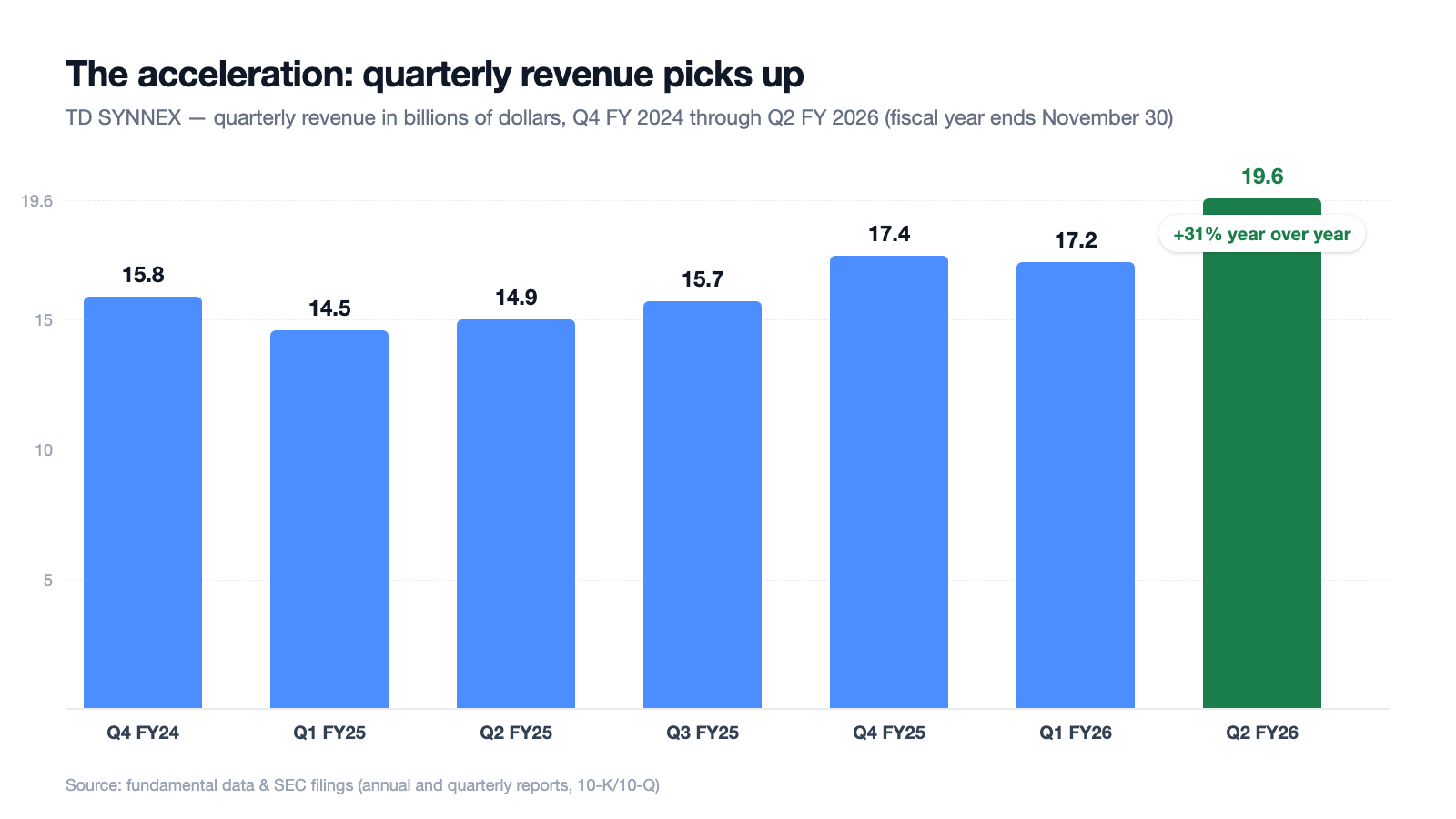
First, what genuinely impresses. TD SYNNEX is an earnings-per-share machine: diluted EPS climbed from $6.70 (fiscal year 2023) via $7.95 (2024) to $9.95 in fiscal year 2025 — up 48 percent in two years, even though net income "only" grew from $626.9 million to $827.7 million. The difference is hard-nosed capital return: across fiscal years 2023 through 2025 the company bought back roughly $1.8 billion of its own stock, pushing the diluted share count from 92.9 million down to 82.4 million — minus 11 percent. On top comes a growing dividend (most recently $0.48 per quarter, declared June 25, 2026). And then came the AI surge: in the first quarter of fiscal year 2026 (December 2025 through February 2026), revenue grew 18 percent to $17.2 billion; in the second quarter (March through May 2026) it grew 31 percent to $19.6 billion — diluted earnings per share jumped from $2.21 to $4.15 (under U.S. GAAP), the adjusted figure from $2.99 to $4.85. The driver is, of all things, the smallest unit: Hyve grew 49 percent to $3.0 billion of revenue in the second quarter and earned a 6.0 percent operating margin doing it — nearly one and a half times the company average; the filing credits growth in Manufacturing and Supply Chain Services for the hyperscalers. If you read only these paragraphs, you see a boom winner in top form. Now look at the proportions:
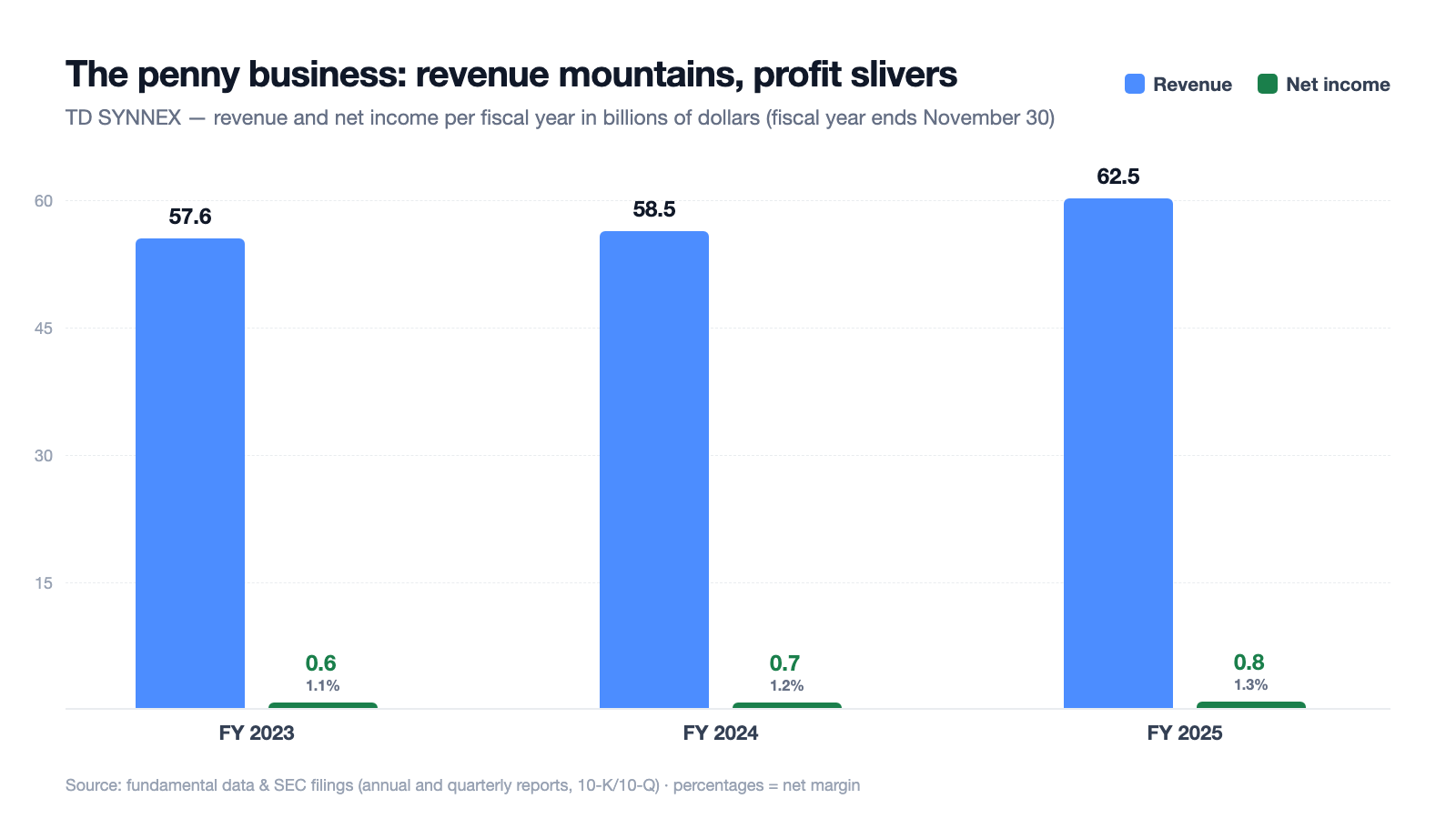
That is not a weakness of this management team — it is the physics of the industry: distribution is a pass-through business with wafer-thin spreads. In fiscal year 2025, $62.5 billion of revenue left $4.4 billion of gross profit (6.99 percent), and after selling costs, administration, $356.6 million of interest expense and taxes, $827.7 million net. The quarterly curve shows how the AI surge is currently rattling that model:
What the filings say — the uncomfortable truths
Uncomfortable truth no. 1: The penny business is in the filing — as a self-description
Give TD SYNNEX credit: the company describes the nature of its business with a candor you would wish for from many a growth stock. Right in the business section of the annual report stands the sentence that carries this entire analysis:
"Our business is characterized by low gross profit as a percentage of revenue, or gross margin, and low operating income as a percentage of revenue, or operating margin."
— TD SYNNEX Corporation, SEC annual report 10-K for fiscal year 2025, Item 1 "Business"

In fiscal 2025 numbers: a 6.99 percent gross margin, a 2.26 percent operating margin, a 1.32 percent net margin. In the record quarter ended May 31, 2026, the net margin was 1.7 percent — and the gross margin fell from 7.00 to 6.84 percent despite the boom, because the thinner-margin hyperscaler business grew disproportionately. Why this is more than a footnote: a penny business has no cushion. When $1.32 of every $100 of revenue sticks, every small shift — a price war, a tariff push, a failed major customer, a rate rise on the $4.7 billion of borrowings — turns a decent profit into a disappointment. The same principle works in reverse, and that is the fair counterpoint: a few basis points more margin, and earnings jump by double digits, as currently on display. But remember the image: TD SYNNEX is the pipeline of the AI boom, not the wellhead — and pipelines earn transit fees, not oil prices.
Uncomfortable truth no. 2: The boom’s most important customer gets warrants — Amazon will be buying with an equity discount
The most remarkable paragraph of this entire research project sits in the quarterly report as of May 31, 2026 — not in the revenue table, but in the share-based compensation footnote:
"In May 2026, the Company issued the Warrant to Amazon.com NV Investment Holdings LLC (‘Warrantholder') to acquire up to 3,238,066 Warrant Shares. The Warrant provides for the immediate vesting of 215,871 Warrant Shares at an exercise price of $0.01 per share. The remaining 3,022,195 Warrant Shares vest in tranches, at an exercise price of $191.10 per Warrant Share, upon the attainment of specified payment thresholds based on aggregate qualifying payments to the Company in consideration for qualifying sales transactions."
— TD SYNNEX Corporation, SEC quarterly report 10-Q as of May 31, 2026, Note 3 "Share-Based Compensation"
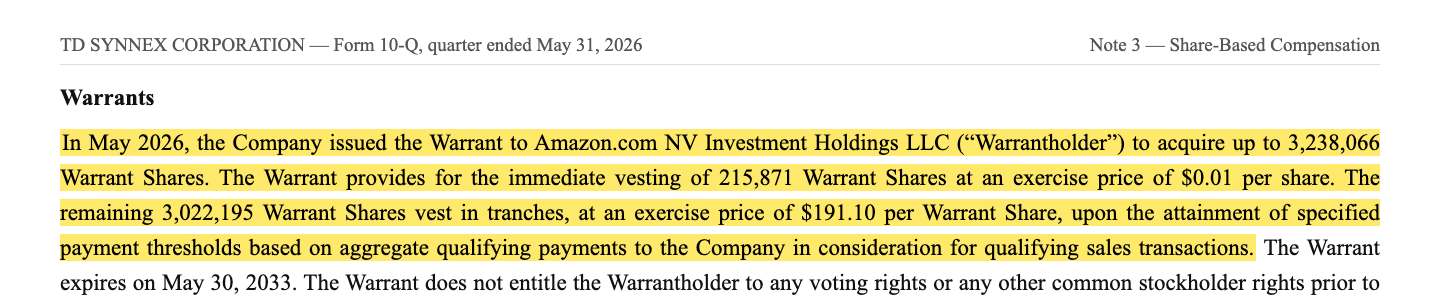
Translated into investor language: the arguably most important customer of the hyperscaler boom is being paid for its loyalty in equity. 3.24 million shares are roughly 4 percent of the entire share count; the first tranche — 215,871 shares at a symbolic penny while the stock traded around $246 — was worth a good $53 million on the day it was granted. Amazon earns the large remainder through purchase thresholds: the more it orders from TD SYNNEX, the more warrant shares vest at $191.10 — well below the July 2026 price level. In the accounts, vested warrant value is booked as a reduction of revenue: part of the celebrated growth thus flows straight back to the customer through the bookkeeping. In fairness: customer warrants like this are an established AI-boom pattern — investors who follow the sector know that far bigger names sign such deals, and locking in a hyperscaler for years (the warrant runs to May 2033) can be worth every cent. But as a fellow shareholder, keep the rule of thumb: growth paid for with rights to your own shares is never entirely free — your slice of the pie shrinks while the pie grows.
Uncomfortable truth no. 3: The AI business hangs on a few customers — with no volume guarantees
How dependent the Hyve business is on individual mega-customers is described with remarkable specificity in the risk section of the annual report:
"For example, our systems design and integration solutions product line has significant customer concentration, requires investments in working capital and infrastructure, and has customer contracts that often offer limited or no volume guarantees or protection for end-of-life investments."
— TD SYNNEX Corporation, SEC annual report 10-K for fiscal year 2025, Item 1A "Risk Factors"
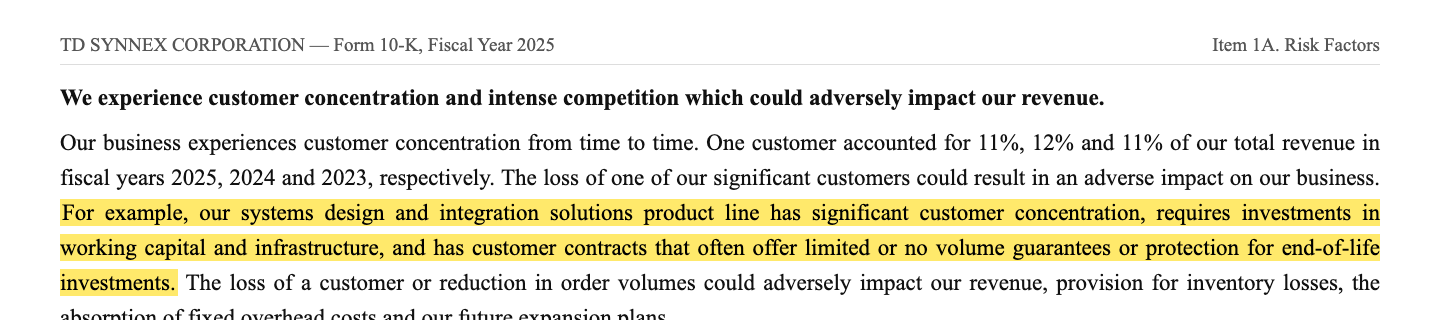
The annual report supplies the number to go with it: a single customer accounted for 11, 12 and 11 percent of total revenue in fiscal years 2025, 2024 and 2023 — on $62.5 billion of revenue, that is roughly $7 billion through one buyer. The filing names no names; notably, the quarterly report as of May 31, 2026, formally lists no 10-percent customer at all anymore — partly because a growing share of the hyperscaler business now appears in the revenue line on a net basis only (margin instead of merchandise value). The dependence does not disappear; it merely gets reported smaller. Add the mirror image on the supplier side: Apple products accounted for about 12 percent of fiscal 2025 revenue and HP for about 10 — and the supplier agreements are, per the filing, short-term and terminable on short notice. In the hyperscale market, Hyve explicitly competes with manufacturing specialists like Jabil, Celestica, Flex, Quanta and Wiwynn. Picture a baker building a giant new production line for one wholesale client — at his own expense, while the client is free to switch to the bakery across the street at any time and sweetens its loyalty with warrants on the baker’s shop. That can work brilliantly for years. But it is a different risk than that of a trader with tens of thousands of customers — and this concentrated business is currently the company’s growth engine.
Uncomfortable truth no. 4: The record half burned cash — $4.4 billion more inventory, minus $1.16 billion of operating cash flow
Profit is an opinion, cash is a fact — and the cash arithmetic of the record half stands in the latest quarterly report like this:
"Net cash used in operating activities was $1.2 billion and $174.8 million, respectively. The increase in net cash used in operating activities was primarily due to a larger increase in inventory to support growth in our business, along with a year-over-year increase in accounts receivable due to the current year sales growth."
— TD SYNNEX Corporation, SEC quarterly report 10-Q as of May 31, 2026, Item 2 "Liquidity and Capital Resources"

The line items behind it: inventories grew by $4.4 billion to $13.9 billion in six months, receivables by $1.3 billion to $13.0 billion; cash halved from $2.4 billion to $1.1 billion. Catching all of it is a considerable financing web: $4.7 billion of borrowings ($1.1 billion of it current), plus — as of November 30, 2025 — $3.7 billion of supplier-finance obligations sitting inside accounts payable (banks pay the vendors, TD SYNNEX pays the banks later) and $1.8 billion of customer receivables sold, whose discount fees alone cost $62.7 million a year. For perspective, without alarmism: growth-driven inventory builds are normal for distributors, the business still generated $1.5 billion of operating cash in fiscal year 2025, the credit covenants were met at the reporting date, and the Altman Z-score around 5 signals no distress. But you should know the mechanics: in a pass-through business, growth eats cash first — the steeper the boom, the bigger the inventory mountain built on credit. If hyperscaler demand turns, the mountain still stands while the orders are gone. One aside for balance-sheet connoisseurs: of the $9.0 billion of equity, $7.8 billion is goodwill and intangibles — largely a legacy of the Tech Data merger; tangible equity of roughly $1.2 billion is thin for a $38.5 billion balance sheet (all figures as of May 31, 2026).
Valuation: $22 billion for the boom’s pipeline
On July 10, 2026, the TD SYNNEX stock cost about $277.60 — roughly $22.4 billion of market value, up 124 percent in twelve months and just about 2 percent below the all-time high. Measured on revenue, it still looks optically cheap at a price-to-sales ratio of 0.34 — but you now know why that anchor deceives. The more honest yardsticks: the trailing price-to-earnings ratio stands around 19 — for a distributor that historically traded closer to 10 to 12 times earnings, that is already an AI premium. On analyst estimates for the current fiscal year (about $19 of adjusted earnings per share), the multiple drops to roughly 15 (all valuation figures: data as of July 10, 2026). The price-to-book ratio of 2.46 gets its aftertaste from the goodwill load mentioned above. What the market is paying for here is the combination of double-digit earnings growth, dependable capital returns — a buyback program with $1.2 billion of remaining capacity (as of November 30, 2025), a dividend yield around 0.7 percent — and the hope that Hyve graduates from penny business to margin business. The eleven analysts our scanner tracks are almost unanimously positive (consensus close to "strong buy," data as of July 10, 2026) — after a 124 percent run, though, that is more choir than second opinion. And one detail deserves a second look: while the funds accumulate, the insider tally counts 20 sales and not a single purchase. Insiders sell for many reasons — but they buy for only one.
Opportunities and risks at a glance
What speaks for TD SYNNEX:
- The AI tailwind is real and measurable: consolidated revenue up 31 percent in the second quarter of fiscal year 2026, Hyve up 49 percent to $3.0 billion with an above-average 6.0 percent operating margin (quarterly report 10-Q as of 05/31/2026).
- Scale advantages of a world leader: 200,000 products, 2,500 vendors, presence in every region (48 percent international revenue) — in a pass-through business, whoever runs the biggest hub wins (annual report 10-K FY 2025).
- A dependable earnings-per-share machine: EPS from $6.70 to $9.95 in two years (+48 percent), driven by $1.8 billion of buybacks (FY 2023–2025) and a growing dividend (most recently $0.48 per quarter); diluted share count down 11 percent since fiscal 2023.
- Solid warning systems: an Altman Z-score around 5, Piotroski 5 of 9, fundamental grade B, credit covenants met (data as of July 10, 2026, and 11/30/2025) — not a wobbling candidate but a profitable veteran.
- The technicals carry: a stage-2 uptrend, relative strength 94, institutional accumulation, 26 scanner hits (data as of July 10, 2026).
What speaks against it:
- A penny business with no cushion: a 6.99 percent gross margin and 1.32 percent net margin in fiscal year 2025 — and the gross margin even fell to 6.84 percent in the boom quarter; small disruptions have big earnings effects.
- The Amazon warrant dilutes: up to 3.24 million shares (about 4 percent) for the boom’s most important customer, first tranche at a penny exercise price; vested warrant value reduces future revenue (10-Q as of 05/31/2026, Note 3).
- Concentration risk in the growth engine: one customer at 11 to 12 percent of revenue, Hyve contracts often without volume guarantees per the risk section, competition from Jabil, Celestica, Flex, Quanta and Wiwynn; on the supply side Apple (12 percent) and HP (10 percent) with short-notice contracts.
- Growth eats cash: minus $1.16 billion of operating cash flow in the first half of fiscal year 2026, inventories up $4.4 billion to $13.9 billion, cash halved; plus $4.7 billion of borrowings, $3.7 billion of supplier finance and $1.8 billion of receivables sold (11/30/2025).
- The valuation has priced the boom in: up 124 percent in twelve months, 2 percent below the all-time high, a P/E around 19 versus a historical 10 to 12; insiders sold 20 times recently, bought zero (data as of July 10, 2026).
A human conclusion
Back to the anchoring effect from the opening. Its core is not that cheap metrics lie — it is that they try to do your thinking for you. "P/S 0.34" feels like a safety net, when all it describes is the physics of distribution: enormous flow, tiny take. The honest ledger reads like this: TD SYNNEX is an excellently run giant in a structurally thin business, currently experiencing the best thing that can happen to this model — a demand boom that has to pass through its hub. Management hands the fruits to shareholders with discipline, and the first-half 2026 numbers are simply strong. But the boom carries three price tags, all already being paid: an inventory mountain built on credit, a mega-customer who has its loyalty compensated in warrants, and a price level that already contains the AI hope — at 19 times earnings for a business its own annual report describes as low-margin. So the question for you is not "Will the AI boom keep running?" (much currently suggests it will), but: do you want to own it through the pipeline that keeps a cent and a half per dollar passed through and carries the inventory risk for it — at an all-time high? If Hyve holds its margins, the inventories dissolve into revenue and the Amazon warrant thresholds bring orders rather than just dilution, this bet can work out. If not, the cash flow statement will remind you who pre-financed the boom. What you make of it is your decision. And that is exactly as it should be.
Sources
All original documents used in this analysis — to read for yourself:
- TD SYNNEX Corporation — SEC annual report 10-K for fiscal year 2025 (ended November 30, 2025; filed January 27, 2026)
- TD SYNNEX Corporation — SEC quarterly report 10-Q as of May 31, 2026 (filed July 2, 2026; Amazon warrant, Hyve segment, first-half cash flow)
- TD SYNNEX Corporation — SEC quarterly report 10-Q as of February 28, 2026 (filed April 2, 2026; new segment structure)
- TD SYNNEX Corporation’s complete SEC filing history: EDGAR overview (sec.gov)
- Fundamental data (metrics, quarterly series, valuation; data as of July 10, 2026), reconciled with the SEC filings.
- Screener and rating data: in-house stock scanner (data as of July 10, 2026).
Transparency & disclaimer: This analysis is a journalistic contextualization of publicly available information and is not investment advice, not a financial analysis in the regulatory sense, and not a solicitation to buy or sell securities. Stock investments carry substantial risks up to total loss. All information without guarantee; the data cut-off is noted in the text in each case. The author holds no position in TD SYNNEX stock at the time of publication.
Our Bottom Line at a Glance
- Growth & AI tailwind positive
- Revenue up 31 percent to $19.6 billion in the second quarter of fiscal year 2026, Hyve up 49 percent to $3.0 billion at a 6.0 percent operating margin; diluted EPS from $2.21 to $4.15 (quarterly report 10-Q as of 05/31/2026). The AI boom measurably runs through this hub.
- Capital returns & discipline positive
- Roughly $1.8 billion of share buybacks across fiscal years 2023 through 2025 (diluted share count down 11 percent), a growing quarterly dividend of most recently $0.48, and $1.2 billion of remaining buyback capacity (11/30/2025) — the earnings-per-share machine is real.
- Business model & margins negative
- The annual report explicitly describes the business as low-margin: a 6.99 percent gross margin and 1.32 percent net margin in fiscal year 2025; in the boom quarter the gross margin fell to 6.84 percent. A penny business has no cushion for disruptions (10-K FY 2025, Item 1).
- Working capital & concentration negative
- Minus $1.16 billion of operating cash flow in the first half of fiscal year 2026, inventories up $4.4 billion to $13.9 billion, cash halved; one customer most recently at 11 to 12 percent of revenue, Hyve contracts often without volume guarantees; plus the Amazon warrant over roughly 4 percent of the shares (10-Q as of 05/31/2026; 10-K FY 2025, Item 1A).
- Valuation & technicals neutral
- A stage-2 uptrend, relative strength 94, 26 scanner hits and institutional accumulation meet a 124 percent twelve-month run, a price 2 percent below the all-time high and a P/E around 19 versus a historical 10 to 12; insiders: 20 sales, zero purchases (data as of July 10, 2026).
TD SYNNEX is the pipeline of the AI boom: $62.5 billion of annual revenue, a record quarter up 31 percent, and capital returns that have levered earnings per share by double digits for years. But it remains a penny business — a 1.3 to 1.7 percent net margin — that pays for its boom with a credit-financed $13.9 billion inventory mountain, minus $1.16 billion of first-half cash flow and warrants for its mega-customer Amazon, while the stock costs 19 times earnings near its all-time high. Whoever invests here buys the boom through the hub — inventory risk included. Not investment advice.
What Our Rating Means
- If you don't own the stock
- As long as the question raised in the bottom line stays open, we see no basis for an entry.
- If you hold it in your portfolio
- Our findings offer no acute reason to sell — the checkpoints named remain decisive.
A journalistic assessment by our editorial team at the time of the deep dive, based on public sources — not investment advice and not a solicitation to buy or sell. Your personal circumstances (investment goals, risk capacity, taxes) cannot be taken into account. What our categories mean, how verdicts are formed, and what conflicts of interest exist →
Worth Noting
- SNX reached our research list via the unusual confluence of 26 hits in our in-house stock scanner (data as of July 10, 2026) — spanning trend, quality and momentum filters at once.
- Scanner metrics (P/E, P/S, Piotroski, Altman Z, fundamental grade) are computed from trailing twelve-month figures; the inventory build and the Amazon warrant from the first half of fiscal 2026 are only partially baked in.
- Price and valuation figures are dated to July 10, 2026 (about $277.60, market value roughly $22.4 billion); analyses are evergreen, daily prices are not a buy argument. The fiscal year ends November 30 — all quarterly references carry that offset.
Frequently Asked Questions
TD SYNNEX Corporation (NYSE: SNX) is one of the world’s largest IT distributors: it buys more than 200,000 technology products from roughly 2,500 manufacturers and sells them to resellers such as systems integrators, retailers and cloud providers. In addition, its Hyve Solutions unit builds purpose-built server and data center systems for hyperscalers. Revenue in fiscal year 2025 (ended November 30, 2025): $62.5 billion, net income $827.7 million.
On September 1, 2021, California-based Synnex Corporation acquired its Florida rival Tech Data; since October 2021 the merged company has operated as TD SYNNEX Corporation. The merger is also the source of the large balance sheet positions for goodwill and intangibles of together roughly $7.8 billion (as of May 31, 2026).
TD SYNNEX’s fiscal year ends November 30. "Fiscal year 2025" therefore covers December 2024 through November 2025, and the "second quarter of fiscal year 2026" means March through May 2026. Anyone comparing these numbers with calendar-year figures of other companies should keep that offset in mind.
Substantially: in the second quarter of fiscal year 2026 (March through May 2026), consolidated revenue grew 31 percent to $19.6 billion. The hyperscaler unit Hyve Solutions grew 49 percent to $3.0 billion — and per the quarterly report would have grown far more in gross terms, since a rising share of sales is recognized on a net basis (margin instead of merchandise value). Diluted earnings per share jumped from $2.21 to $4.15.
In May 2026, TD SYNNEX issued a warrant for up to 3,238,066 of its own shares to Amazon.com NV Investment Holdings LLC — about 4 percent of the share count. 215,871 shares vested immediately at an exercise price of $0.01; the rest vests in tranches at $191.10 as Amazon reaches defined purchase thresholds. Vested warrant value is booked as a reduction of revenue; the warrant runs through May 30, 2033.
Distribution is a pass-through business: TD SYNNEX itself describes its business in the annual report (10-K) as low-margin. In fiscal year 2025, $62.5 billion of revenue left a 6.99 percent gross margin and a 1.32 percent net margin. The company earns on volume, logistics and financing — not on product margins like a manufacturer.
The price-to-sales ratio of 0.34 looks cheap but is the wrong yardstick at a 1.3 percent net margin. More honest: a trailing price-to-earnings ratio around 19 (the distributor historically traded closer to 10 to 12 times) or roughly 15 on estimates for the current fiscal year — at a price of about $277.60 and $22.4 billion of market value, just about 2 percent below the all-time high (data as of July 10, 2026).
Found an error?
Did you spot a factual error, an outdated number, or a typo in this deep dive? Let us know briefly — your report goes straight to the editorial team.