DMC Global: A $111 Million Market Cap — and a Partner Who May Demand at Least $187 Million From September
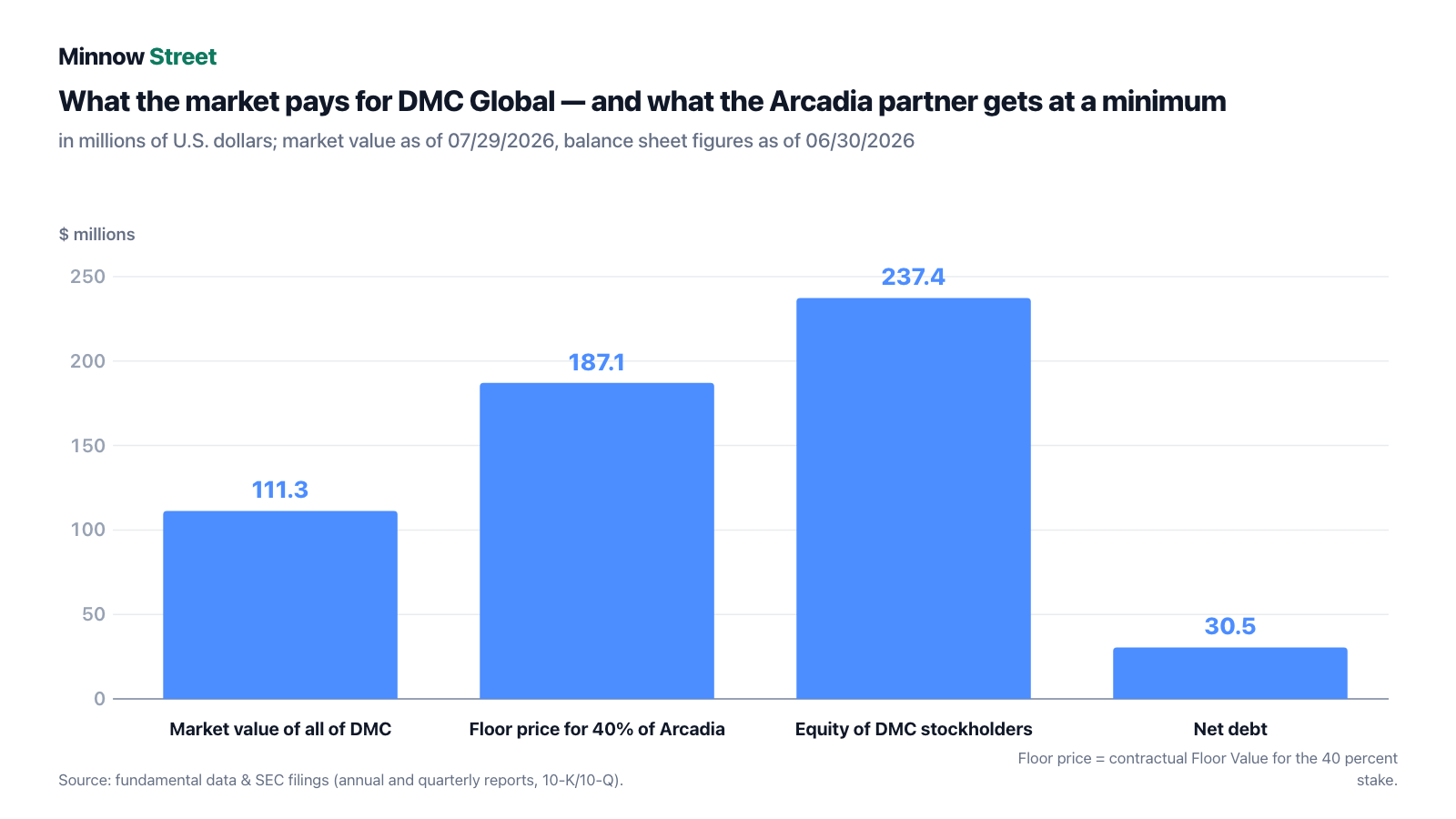
On paper DMC Global looks like a bargain. The market valued the whole company at roughly $111 million in late July 2026, while equity attributable to its stockholders stood at $237.4 million as of June 30, 2026 — less than half of book value. One line higher in the balance sheet, however, sits a redeemable noncontrolling interest of $187.08 million. That is the minimum the 40 percent partner in the Arcadia Products facade business may demand from September 6, 2026 onward. If DMC pays in preferred stock rather than cash, the company itself considers a transfer of majority voting control to that partner likely. Not investment advice — just the question of who really owns how much of this substance.
 Thomas Mücke
Founder & Publisher
Thomas Mücke
Founder & Publisher

Chart
Interactive price chart (TradingView).
Note: pure fact-based analysis, not investment advice and not a solicitation to buy or sell. All figures without guarantee.
There is a reflex that fires in investors as reliably as a knee under a doctor’s hammer: the bargain reflex. It goes like this — you see a stock trading at less than half its book value, and your mind fills in the rest of the story by itself: “there is more here than the market sees.” With DMC Global (Nasdaq: BOOM) of Broomfield, Colorado, the trigger is unusually strong. As of June 30, 2026 the balance sheet showed $237.4 million of equity attributable to stockholders; in late July 2026 the market paid roughly $111 million for the entire company. Less than half. So let us make a deal: before you buy the reflex, we read together what the company itself told the U.S. securities regulator, the SEC — the quarterly report (Form 10-Q) as of June 30, 2026, filed on July 29, 2026, the annual report (Form 10-K) for 2025 and the earnings release issued the same day. A filing with the SEC is honest under penalty of law. And this one tells of a line above equity worth $187.08 million, a date in September 2026, and a partner holding the longer lever. What you make of it is your decision.
What DMC Global actually does — three companies under one roof with nothing in common
DMC Global is a conglomerate — in everyday terms: one roof over three entirely different workshops whose people nod at each other in the yard and otherwise have no business together. The company describes itself as an owner and operator of asset-light manufacturing businesses. Concretely, they are:
- Arcadia Products — the aluminum skin of modern buildings. It designs, engineers, fabricates and finishes aluminum framing systems, windows, curtain walls, storefronts, entrance systems and interior partitions for commercial construction, plus customized windows and doors for high-end residential work. Revenue in 2025: $246.2 million. DMC bought 60 percent of the business in December 2021 — the remaining 40 percent still belongs to somebody else. Remember that sentence; it carries this entire analysis.
- DynaEnergetics — consumables for oil and gas wells. A perforating system is something like a hole punch for boreholes: a steel tube packed with shaped charges that is lowered a mile or two underground and fired exactly once. It blasts through the casing and cement so that oil and gas can flow into the well at all. Each system is used a single time, so the business lives on how many wells are being completed right now. Revenue in 2025: $270.2 million. We took apart how strongly that demand depends on the drilling plans of individual shale producers in our analysis of Prairie Operating.
- NobelClad — metal plates married by an explosion. In explosion welding, two plates are driven together by a controlled detonation until they bond permanently: a thin, expensive layer of titanium on thick, cheap structural steel, for example. The result goes into chemical plants, LNG facilities, ships and rail cars. Revenue in 2025: $93.4 million. This technology is also where the ticker BOOM comes from.
The company is old: listed since January 1989 (fundamental data), and until November 7, 2016 it traded as Dynamic Materials Corp. Only the Arcadia acquisition at the end of 2021 turned the explosion-welding specialist into today’s three-segment house. And that acquisition is the source of the central tension of this analysis, which runs through every chapter: the balance sheet says the company is worth more than twice its market price. The contract in the notes says a large part of that substance belongs to somebody else — and that somebody may present the bill from September 6, 2026 onward.
How the stock landed on our desk
Honesty first: DMC Global did not reach us through a momentum, quality or valuation filter but through our Reddit hype scan of July 30, 2026 — the daily review of the most-mentioned U.S. small caps in stock forums. So we checked live whether the stock appeared in any of our stock scanners that day: it appeared in none (checked July 30, 2026; the lists are recalculated daily, so the finding can change). That is no surprise. With a loss-making 2025, three years of falling revenue and a share price that ranged between $4.69 and $9.20 over twelve months (data as of July 29, 2026), the stock fails every growth and quality screen. The appeal lies elsewhere: in a special construction in the notes that you only find if you read. Remember the pattern right at the start: when a stock trades below book value, the interesting question is never “why so cheap?” but “what sits above equity?”
The numbers over the years — honestly credited
First what speaks for DMC Global. The company runs three real factories with machines, plants and roughly 1,500 employees as of December 31, 2025, 1,300 of them in the United States. All three businesses earned money at the operating level in the second quarter of 2026: Arcadia Products $3.6 million, DynaEnergetics $3.9 million, NobelClad $2.2 million of segment operating income. Group revenue of $157.0 million came in slightly above the prior-year quarter ($155.5 million) and 16 percent above a weak first quarter. Net income attributable to DMC stockholders was $0.5 million, or $0.10 per diluted share. Cash generation works too: operations provided $53.5 million in 2025 (2024: $46.6 million). And management is confident enough to guide — the earnings release of July 29, 2026 calls for $158 million to $168 million of revenue and $10 million to $13 million of adjusted EBITDA attributable to DMC in the third quarter of 2026.
Now the chart that explains the reflex — and immediately reins it in. Over three years revenue fell in every one of the three businesses:
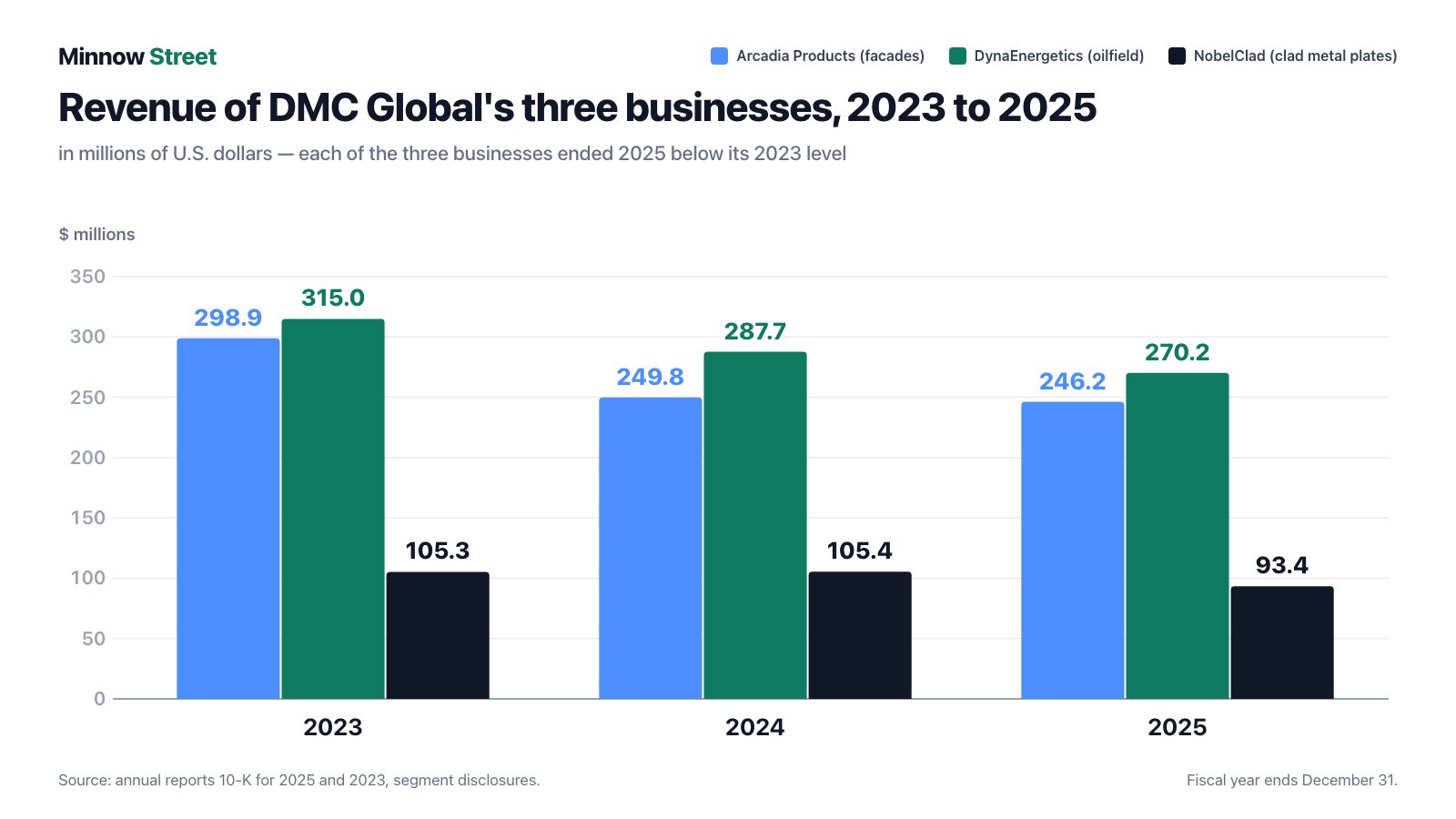
At the group level the series reads like this: revenue fell from $719.2 million (2023) through $642.9 million (2024) to $609.8 million (2025); the first half of 2026 brought $292.5 million against $314.8 million a year earlier. Operating income collapsed from $61.2 million (2023) to a loss of $131.3 million (2024) and stood at practically zero in 2025, a loss of $0.1 million. Attributable to DMC stockholders was net income of $26.3 million in 2023 ($1.08 per diluted share), a loss of $94.5 million in 2024 (minus $8.20) and a loss of $13.5 million in 2025 (minus $0.90). The break in 2024 has a name, and it leads straight to the first uncomfortable truth.
What the filings say — the uncomfortable truths
Uncomfortable truth no. 1: Arcadia’s goodwill was written off in full — the contract price stayed
When DMC bought its 60 percent of Arcadia at the end of 2021, goodwill appeared on the balance sheet — the difference between the price paid and what the acquired machines, inventories and receivables are worth individually. In everyday terms: the premium for “the business is running well.” Three years later that premium was gone. The annual report for 2025 puts it plainly:
“In 2024, the Company identified potential triggering events for its Arcadia Products reporting unit and concluded it was more likely than not that the fair value of the reporting unit was below its carrying value. As such, a quantitative impairment test was performed and resulted in a $141,725 impairment charge, which is included in ‘Goodwill impairment’ in our Consolidated Statements of Operations for the year ended December 31, 2024.”
— DMC Global Inc., SEC annual report 10-K for 2025, Note 5 “Goodwill”

The accountants, in other words, declared Arcadia worth considerably less than DMC paid for it. The contract with the minority holder took no notice. It still names a minimum value, regardless of how the business performs:
“The calculation is based on a multiple of Arcadia Products’ adjusted EBITDA over a defined period or, if higher, a ‘Floor Value’ for 100% of Arcadia Products equal to $467,700 (or $187,080 for the minority owner’s 40% interest), in each case subject to certain adjustments.”
— DMC Global Inc., SEC quarterly report 10-Q as of June 30, 2026, Note 2 “Redeemable Noncontrolling Interest”
Pause and read the two numbers side by side. Accounting says: the premium paid for Arcadia has vanished. The contract says: 100 percent of Arcadia is worth at least $467.7 million. And the market says: the whole group — Arcadia plus DynaEnergetics plus NobelClad — costs about $111 million. Three authorities, three answers. That is precisely why the floor price does not sit inside equity but on a line of its own above it, in what accountants call temporary equity:
Uncomfortable truth no. 2: from September 6, 2026 the partner decides — not DMC
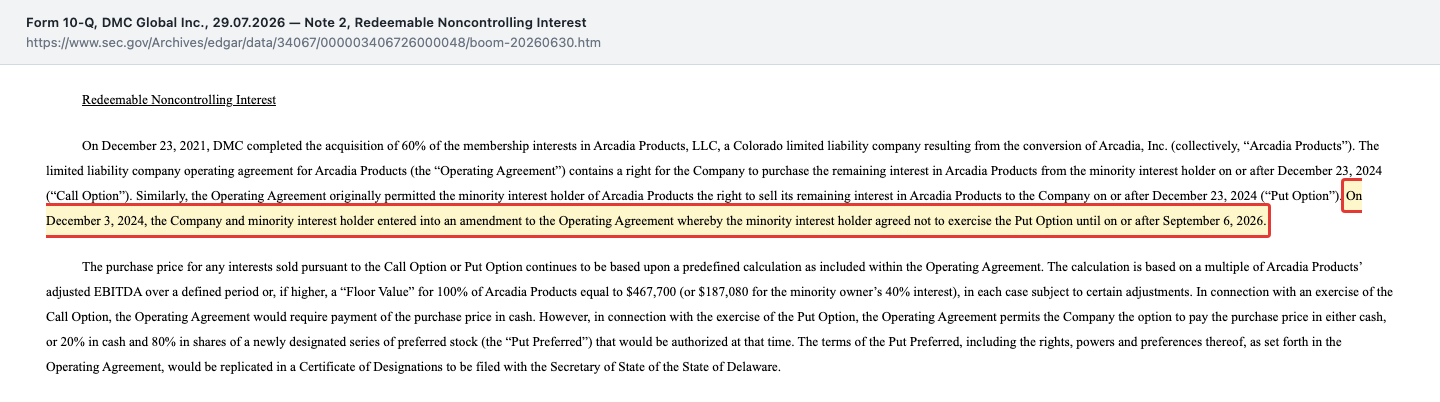
The 2021 purchase created two rights that look like mirror images but are not. DMC received a call option: it may buy the remaining 40 percent — but then strictly for cash. The minority holder received a put option: he may force DMC to take the 40 percent off his hands. Originally from December 23, 2024 — then DMC paid him $2.5 million to push the date back:
“On December 3, 2024, the Company and minority interest holder entered into an amendment to the Operating Agreement whereby the minority interest holder agreed not to exercise the Put Option until on or after September 6, 2026.”
— DMC Global Inc., SEC quarterly report 10-Q as of June 30, 2026, Note 2 “Redeemable Noncontrolling Interest”
Now the arithmetic that shows why this is not an academic question. As of June 30, 2026 DMC held $28.6 million of cash and had drawn $60.2 million of credit; net debt stood at $30.5 million. The leverage ratio relevant to the credit facility was 2.19 times against a permitted maximum of 3.0 times. Work that ratio backwards and it implies a contractually defined earnings base of roughly $27.5 million (our own calculation: 60.2 divided by 2.19). At the 3.0 times cap that would allow about $82 million of funded debt; for the put or call case the banks even built in a temporary exception:
“Key provisions of the Second Amendment include a temporary increase in the Company’s maximum leverage ratio to 3.5x adjusted EBITDA over the trailing 12 months — up from 3.0x — should either the Put Option or the Call Option be exercised.”
— DMC Global Inc., SEC quarterly report 10-Q as of June 30, 2026, Item 2 “Liquidity and Capital Resources”

Even with that exception the ceiling works out to roughly $96 million of permitted debt; against the $60.2 million already drawn, headroom is on the order of $22 million to $36 million. The floor price is $187.08 million. Remember the ratio: the credit facility covers roughly a fifth of what can come due. DMC itself sums up the squeeze in a single sentence: “Debt financing could materially impact the Company’s leverage while equity financing could materially dilute existing stockholders.”
Uncomfortable truth no. 3: if DMC pays in preferred stock, the partner can take voting control
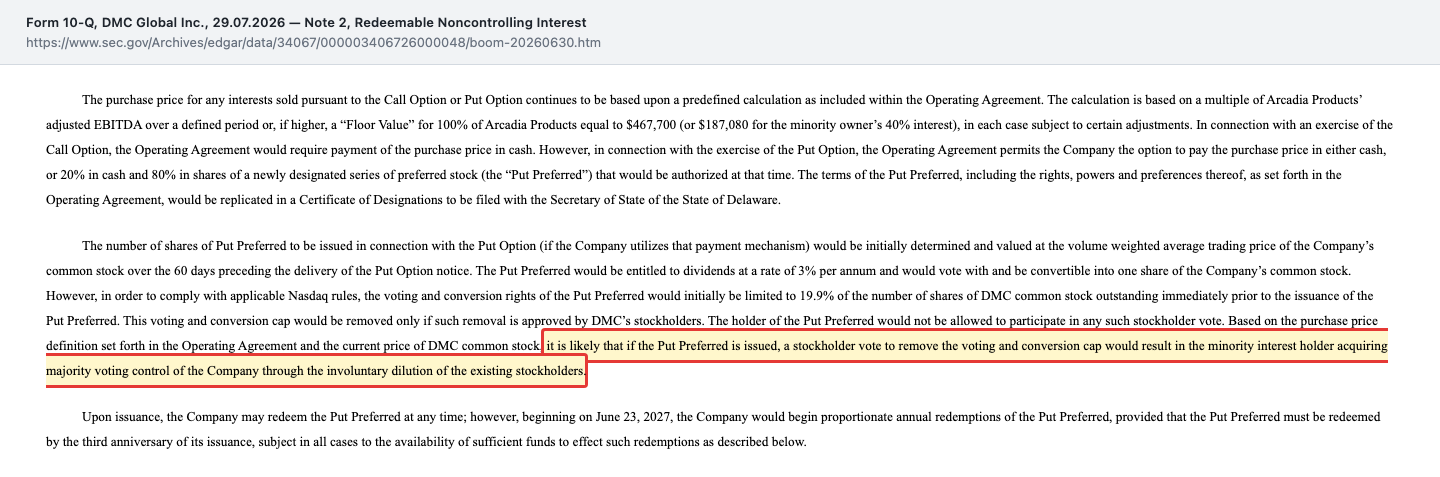
For the put case the agreement gives DMC a third route: 20 percent of the price in cash, 80 percent in a newly designated series of preferred stock. The number of shares is set by the volume weighted average trading price over the 60 days preceding the put notice; the preferred carries a 3 percent dividend and converts one-for-one into common stock. To comply with Nasdaq rules, voting and conversion rights are initially capped at 19.9 percent — a cap that falls only if stockholders vote to remove it, and the preferred holder may not participate in that vote. What would happen then is spelled out in the quarterly report itself:
“Based on the purchase price definition set forth in the Operating Agreement and the current price of DMC common stock, it is likely that if the Put Preferred is issued, a stockholder vote to remove the voting and conversion cap would result in the minority interest holder acquiring majority voting control of the Company through the involuntary dilution of the existing stockholders.”
— DMC Global Inc., SEC quarterly report 10-Q as of June 30, 2026, Note 2 “Redeemable Noncontrolling Interest”
An order-of-magnitude example makes it tangible — deliberately an exercise, not a forecast. Eighty percent of $187.08 million is about $149.7 million. Convert that into shares at the closing price of July 29, 2026 ($5.42) and you get roughly 27.6 million preferred shares against only 20,540,949 common shares outstanding (cover page of the quarterly report, as of July 22, 2026). What actually counts is the 60-day average before the put notice, not that single price; the order of magnitude does not change. In everyday terms: you own 60 percent of a house, your co-owner 40 — and the contract lets you pay him out in shares of the whole building. In the end the building is his. Which is exactly why the board has kept a poison pill in place since 2024, triggered at 10 percent ownership and explicitly covering conversion rights; it was extended most recently on April 24, 2026, out to June 4, 2027.
Uncomfortable truth no. 4: operating income does not cover the interest
A business carrying this much substance has to earn it. Right now DMC does not. In 2025 operating income of minus $0.1 million stood against net interest expense of $6.5 million; in the first half of 2026 it was $1.1 million of operating income against $2.7 million of interest. The classic metric is interest coverage — in everyday terms: how many times does the rent fit into your salary? Below 1 the salary does not cover the rent, and the rest has to come out of savings or new borrowing. That is where DMC has been over the trailing twelve months.
The tax department has already drawn its conclusion. Because the U.S. entities have posted cumulative losses for three years, the resulting tax benefits may no longer be recognized:
“As of June 30, 2026, we were in a three-year cumulative loss position at the consolidated financial statement level, driven by historical losses in the U.S. primarily related to the impairment of Arcadia Products’ goodwill in 2024.”
— DMC Global Inc., SEC quarterly report 10-Q as of June 30, 2026, Note 8 “Income Taxes”
The practical effect: domestic losses no longer generate a tax credit — in the second quarter of 2026 the group paid $1.9 million of tax on $4.0 million of pre-tax income, even though the U.S. statutory rate is 21 percent. Anyone modeling earnings power should build in that surcharge.
Uncomfortable truth no. 5: reported earnings per share have little to do with earnings
One last stumbling block that confuses screening tables. Because the redeemable noncontrolling interest is marked up to its contractual floor value every quarter, that adjustment flows into the earnings-per-share calculation — but not into net income. The result: in the second quarter of 2025 net income attributable to DMC stockholders was $0.1 million, yet the reported figure was a loss of $0.24 per share, because the adjustment subtracted $4.9 million. In the second quarter of 2026 it ran the other way: $0.5 million of net income plus a $1.5 million adjustment produced $0.10 per share. Remember the rule: at DMC, earnings per share measure not only the business but also the accounting of a contract. Price-to-earnings ratios built on such figures measure fog.
Valuation: cheap against book value — expensive against what is still to be paid
Start with the orders of magnitude, all dated. Market value on July 29, 2026 was roughly $111 million (20,540,949 shares at the $5.42 closing price; fundamental data show $110.9 million). Against trailing twelve-month revenue of about $587.6 million that is a price-to-sales ratio of roughly 0.19 — very low for an industrial manufacturer. Against equity attributable to DMC stockholders of $237.4 million as of June 30, 2026, or $11.56 per share, the price-to-book ratio is about 0.47. There is no price-to-earnings ratio: the trailing twelve months were loss-making.
Now the more honest calculation. Anyone buying all the shares today and then paying off the Arcadia partner would need roughly $111 million for the stock, $30.5 million for net debt and at least $187.1 million for the minority interest — around $329 million in total for 100 percent of all three businesses. Set against a contract that values Arcadia alone at no less than $467.7 million. That sounds like a gap you could simply pocket. It is not a bargain, though, but a disputed amount: the floor value is a negotiated contractual floor from 2021, not a market price — and the 2024 goodwill impairment shows that the company’s own auditors see the value far lower. A comparable case was another conglomerate we examined: at INNOVATE Corp, too, a billion dollars of revenue stood against a market value in the hundreds of millions — and there as well the explanation lay not in operations but in what has to be served ahead of the common stockholders.
The professionals look cautiously constructive, though coverage is thin: analyst estimates carried in the fundamental data (as of July 29, 2026) show an average price target of $8.50, a loss of $0.29 per share for the current year and earnings of $0.54 for the following one. DMC pays no dividend; distributions are at the board’s discretion and the credit agreement restricts them. And the operating headwind is real: in the earnings release of July 29, 2026 management points out that the American Institute of Architects’ Architectural Billings Index has gone “a record 41 consecutive months” without a majority of firms reporting billings growth. For a facade business, that is the weather forecast.
Opportunities and risks at a glance
What speaks for DMC Global:
- Three real factories with roughly 1,500 employees (December 31, 2025) and $649.6 million of total assets (June 30, 2026); all three segments were profitable at the operating level in the second quarter of 2026 (Arcadia $3.6 million, DynaEnergetics $3.9 million, NobelClad $2.2 million).
- Revenue has stabilized: $157.0 million in the second quarter of 2026 after $155.5 million a year earlier and $135.6 million in the first quarter of 2026; Arcadia delivered its strongest quarter since mid-2024.
- Guidance points up: $158 million to $168 million of revenue and $10 million to $13 million of adjusted EBITDA for the third quarter of 2026 (earnings release of July 29, 2026); NobelClad reports a twelve-month book-to-bill ratio of 1.33.
- The balance sheet is not overstretched: $28.6 million of cash, $30.5 million of net debt and leverage of 2.19 times against a permitted 3.0 times — all financial covenants were met as of June 30, 2026. Operations provided $53.5 million in 2025.
- Legal overhangs are cleared: the securities class action was dismissed on March 20, 2026 and the related derivative suits on May 1, 2026.
What speaks against it:
- From September 6, 2026 the minority holder may put 40 percent of Arcadia for at least $187.08 million — more than the market value of the entire group (roughly $111 million as of July 29, 2026). The decision is his alone.
- Funding is unresolved: $28.6 million of cash and credit headroom on the order of $22 million to $36 million (our own calculation from the 2.19 times leverage ratio and the 3.0 times cap, temporarily 3.5 times) are not enough; DMC explicitly names debt financing as a material burden and equity financing as material dilution.
- In the preferred-stock route the company itself considers a transfer of majority voting control to the minority holder likely — roughly $149.7 million of convertible preferred against 20,540,949 common shares outstanding (July 22, 2026).
- The business has shrunk for three years in all three segments (group revenue $719.2 million to $642.9 million to $609.8 million), operating income has not covered interest over the trailing twelve months, and U.S. tax losses are no longer recognized because of the three-year cumulative loss position.
- Arcadia’s goodwill was written off in full in 2024 at $141.7 million — the company’s own valuation of the asset therefore sits far below the contract price the very same asset can trigger.
- Governance under strain: a poison pill with a 10 percent threshold has been in force since June 2024 and was extended twice, out to June 4, 2027; the investor group Steel Partners held 5.8 percent of the shares as of February 20, 2026.
A human conclusion
Back to the bargain reflex. It is not stupid — it is merely too fast. At DMC Global every ingredient that sets it off is genuinely there: a price-to-book ratio of 0.47, a price-to-sales ratio of 0.19, three factories that make money, and an analyst price target well above the market price. What the reflex skips is a single line in the balance sheet: $187.08 million sitting above equity that does not belong to you. The book value you think you are buying is book value after deducting that line — but it has not been paid yet, and the timing of the bill is not in management’s hands, it is in the counterparty’s. From September 6, 2026 it can arrive any day. Or never. Both are possible, and that is exactly what turns the stock into a bet on an event rather than on a business. So the honest question is not “is the stock cheap?” but: do you want to co-own three decent factories when a fourth party may decide at any time whether you pay for the company with debt, with fresh shares, or with the loss of control? If yes, you know your risk. If no, you had a reflex. What you make of it is your decision. And that is exactly as it should be.
Sources
All original documents used in this analysis — for your own reading:
- DMC Global Inc. — SEC quarterly report 10-Q as of June 30, 2026 (filed July 29, 2026)
- DMC Global Inc. — Earnings release on Form 8-K Item 2.02, Exhibit 99.1 dated July 29, 2026 (second quarter 2026 results and guidance)
- DMC Global Inc. — SEC quarterly report 10-Q as of March 31, 2026 (filed April 30, 2026)
- DMC Global Inc. — SEC annual report 10-K for 2025 (filed February 23, 2026)
- DMC Global Inc. — SEC annual report 10-K for 2024 (filed February 24, 2025)
- DMC Global Inc. — Form 8-K filed April 27, 2026 (Amendment No. 2 to the Stockholder Protection Rights Agreement)
- Steel Partners Holdings L.P. — Ownership filing SCHEDULE 13D/A dated February 24, 2026
- Complete SEC filing history of DMC Global Inc.: EDGAR overview (sec.gov)
- Fundamental data (metrics, price, analyst estimates; data as of July 29, 2026), reconciled with the SEC filings.
Transparency & disclaimer: This analysis is a journalistic contextualization of publicly available information. It is not investment advice, not a financial analysis in the regulatory sense and not a solicitation to buy or sell securities. Equity investments carry substantial risk up to and including total loss. All information without warranty; the data cut-off is noted in the text. The author holds no position in DMC Global shares at the time of publication.
Our Bottom Line at a Glance
- Business model neutral
- Three genuine manufacturing businesses with nothing in common: aluminum facades (Arcadia Products, $246.2 million of revenue in 2025), perforating systems for oil and gas wells (DynaEnergetics, $270.2 million) and explosion-welded clad metal plates (NobelClad, $93.4 million). No synergies, but also no mutual dependence — instead three different cycles under one roof.
- Trading performance negative
- Group revenue fell for three consecutive years, from $719.2 million (2023) through $642.9 million (2024) to $609.8 million (2025), and every single segment ended 2025 below its 2023 level. The first half of 2026 brought $292.5 million against $314.8 million. The second quarter of 2026 stabilized at $157.0 million, slightly above the prior-year quarter — one quarter, not a trend.
- Balance sheet & debt service negative
- As of June 30, 2026 the company held $28.6 million of cash against $60.2 million of drawn borrowings, and all covenants were met (leverage 2.19 times against a permitted 3.0 times). Operating income does not cover interest, however: 2025 produced minus $0.1 million of operating income against $6.5 million of interest expense, the first half of 2026 plus $1.1 million against $2.7 million. U.S. tax losses are no longer recognized because of the three-year cumulative loss position.
- Redeemable noncontrolling interest negative
- Above equity sits a redeemable noncontrolling interest of $187.08 million (June 30, 2026) — the contractual floor value for 40 percent of Arcadia Products, puttable from September 6, 2026 at the partner's sole discretion. That is more than the market value of the whole group of roughly $111 million (July 29, 2026), and the credit facility provides only $22 million to $36 million of additional room up to the temporary 3.5 times cap.
- Dilution & control negative
- In the permitted mix of 20 percent cash and 80 percent preferred stock, roughly $149.7 million of convertible preferred would be issued against 20,540,949 common shares outstanding (July 22, 2026). The quarterly report filed July 29, 2026 states in as many words that this would likely give the minority holder majority voting control — through involuntary dilution of existing stockholders.
- Recent performance positive
- The second quarter of 2026 was the best in a year: $157.0 million of revenue, all three segments profitable at the operating level, $0.5 million of net income attributable to DMC stockholders and $10.7 million of adjusted EBITDA. Guidance for the third quarter of 2026 is $158 million to $168 million of revenue. The court also dismissed the securities class action on March 20, 2026 and the related derivative suits on May 1, 2026.
DMC Global is an industrial conglomerate of three solid but shrinking manufacturing businesses — and a balance sheet whose most important number sits above equity. $187.08 million is the contractual floor price for the 40 percent of Arcadia Products that DMC does not own; from September 6, 2026 the minority holder alone decides when to put it. That is more than the market value of the entire group of roughly $111 million (July 29, 2026). Cash ($28.6 million) and credit headroom (on the order of $22 million to $36 million) do not cover it, and if DMC pays in preferred stock the company itself considers a transfer of majority voting control to the partner likely. The fact that the second quarter of 2026 looked better again, with $157.0 million of revenue and $0.5 million of attributable net income, does not change that maturity. Not investment advice.
What Our Rating Means
Substance risk
We found at least one documented issue that threatens the company itself — regardless of how the stock is currently valued.
Red here is not about the price of the stock — measured against revenue and book value it is strikingly low, and that alone would never justify this rating. Red is about two documented balance sheet findings. First, debt service: over the trailing twelve months operating income does not cover interest — 2025 produced minus $0.1 million of operating income against $6.5 million of interest expense, and the first half of 2026 plus $1.1 million against $2.7 million — while the three-year cumulative loss position forces the company to stop recognizing tax benefits on U.S. losses. Second, dependence on a single counterparty: from September 6, 2026 the minority holder of Arcadia Products may call at least $187.08 million that DMC can service neither from cash ($28.6 million as of June 30, 2026) nor from remaining credit headroom (on the order of $22 million to $36 million) — and the alternative written into the contract would, on the company's own assessment, likely cost existing stockholders majority voting control. Several things argue against red and deserve a fair hearing: there is no going concern warning, equity is positive at $237.4 million, all covenants were met, the second quarter of 2026 was profitable at the operating level in all three segments, and operations provided $53.5 million in 2025. Where the evidence sits between two levels, the more cautious one applies — and an obligation larger than the market value of the whole company, timed by a third party, is no longer an operating question mark but a balance sheet risk. The decision is yours.
A journalistic assessment by our editorial team at the time of the deep dive, based on public sources — not investment advice and not a solicitation to buy or sell. Your personal circumstances (investment goals, risk capacity, taxes) cannot be taken into account. What our levels mean, how verdicts are formed, and what conflicts of interest exist →
Worth Noting
- DMC Global reached our research list through the Reddit hype scan of July 30, 2026. The stock appeared in none of our stock scanners that day (checked live on July 30, 2026) — the lists are recalculated daily, so the finding can change.
- The $187.08 million redeemable noncontrolling interest is a contractual floor value from the 2021 purchase agreement, not a market price. The company's own impairment test led to a full write-off of Arcadia goodwill of $141.7 million in 2024. Both figures describe the same asset — the difference is the real story of this analysis.
- Easily confused: the ticker BOOM refers to NobelClad's explosion-welding technology, not to a defense or munitions maker; until November 2016 the company traded as Dynamic Materials Corp. Valuation figures are dated and evergreen: the anchor is the $5.42 closing price of July 29, 2026 — daily prices are not a buy argument.
Frequently Asked Questions
DMC Global Inc. (Nasdaq: BOOM) of Broomfield, Colorado, is a conglomerate of three unrelated manufacturing businesses. Arcadia Products makes aluminum framing systems, windows, storefronts and interior partitions ($246.2 million of revenue in 2025). DynaEnergetics builds perforating systems that open up oil and gas wells ($270.2 million). NobelClad produces explosion-welded clad metal plates for chemical, LNG and rail applications ($93.4 million). The company was named Dynamic Materials Corp. until November 2016.
When DMC bought 60 percent of Arcadia Products in December 2021, the seller received the right to put the remaining 40 percent to DMC. It originally applied from December 23, 2024; in exchange for a one-time payment of $2.5 million it was deferred to September 6, 2026. From that day the minority holder alone may decide to sell. The price is a multiple of Arcadia's adjusted EBITDA or, if higher, a contractual Floor Value of $187.08 million for the 40 percent stake.
Because book value does not tell the whole story. Equity attributable to DMC stockholders was $237.4 million as of June 30, 2026, while market value on July 29, 2026 was roughly $111 million. Above that equity line, however, sits a redeemable noncontrolling interest of $187.08 million that can be called from September 6, 2026 onward. Add three years of falling revenue and operating income of minus $0.1 million in 2025 that did not cover $6.5 million of interest.
The quarterly report as of June 30, 2026 considers it likely, if DMC pays the purchase price in the permitted mix of 20 percent cash and 80 percent preferred stock. That preferred would convert one-for-one into common stock; voting and conversion rights are initially capped at 19.9 percent. If stockholders remove the cap — and the preferred holder may not vote on it — the company expects the minority holder to gain majority voting control through involuntary dilution.
As of June 30, 2026 the books showed $28.6 million of cash, $60.2 million of drawn borrowings and $30.5 million of net debt; total assets were $649.6 million and equity attributable to DMC stockholders $237.4 million. The leverage ratio stood at 2.19 times against a permitted maximum of 3.0 times, and all financial covenants were met. Operations provided $53.5 million in 2025, while $10.3 million flowed out in the first half of 2026.
Because the redeemable noncontrolling interest is marked up to its contractual floor value each quarter, and that adjustment flows into the earnings-per-share calculation. In the second quarter of 2025 net income attributable to DMC stockholders was $0.1 million while the adjustment subtracted $4.9 million — producing a loss of $0.24 per share. In the second quarter of 2026 it ran the other way: $0.5 million plus a $1.5 million adjustment produced $0.10 per share.
In 2024 DMC identified potential triggering events for the Arcadia Products reporting unit and concluded that its fair value was below carrying value. The quantitative impairment test that followed produced a $141.7 million charge — the entire goodwill created at acquisition. It is the main reason for the $131.3 million operating loss in 2024 and for the three-year cumulative loss position in the United States.
No. Distributions are at the board's discretion; the quarterly report as of June 30, 2026 names future capital requirements, business prospects and debt covenant compliance as the relevant factors. The syndicated credit agreement explicitly restricts dividends, other distributions to stockholders and the redemption of capital stock. Fundamental data show no dividend as of July 29, 2026.
Found an error?
Did you spot a factual error, an outdated number, or a typo in this deep dive? Let us know briefly — your report goes straight to the editorial team.