Mastercard Stock: Four of Every Ten Dollars No Longer Come From the Card
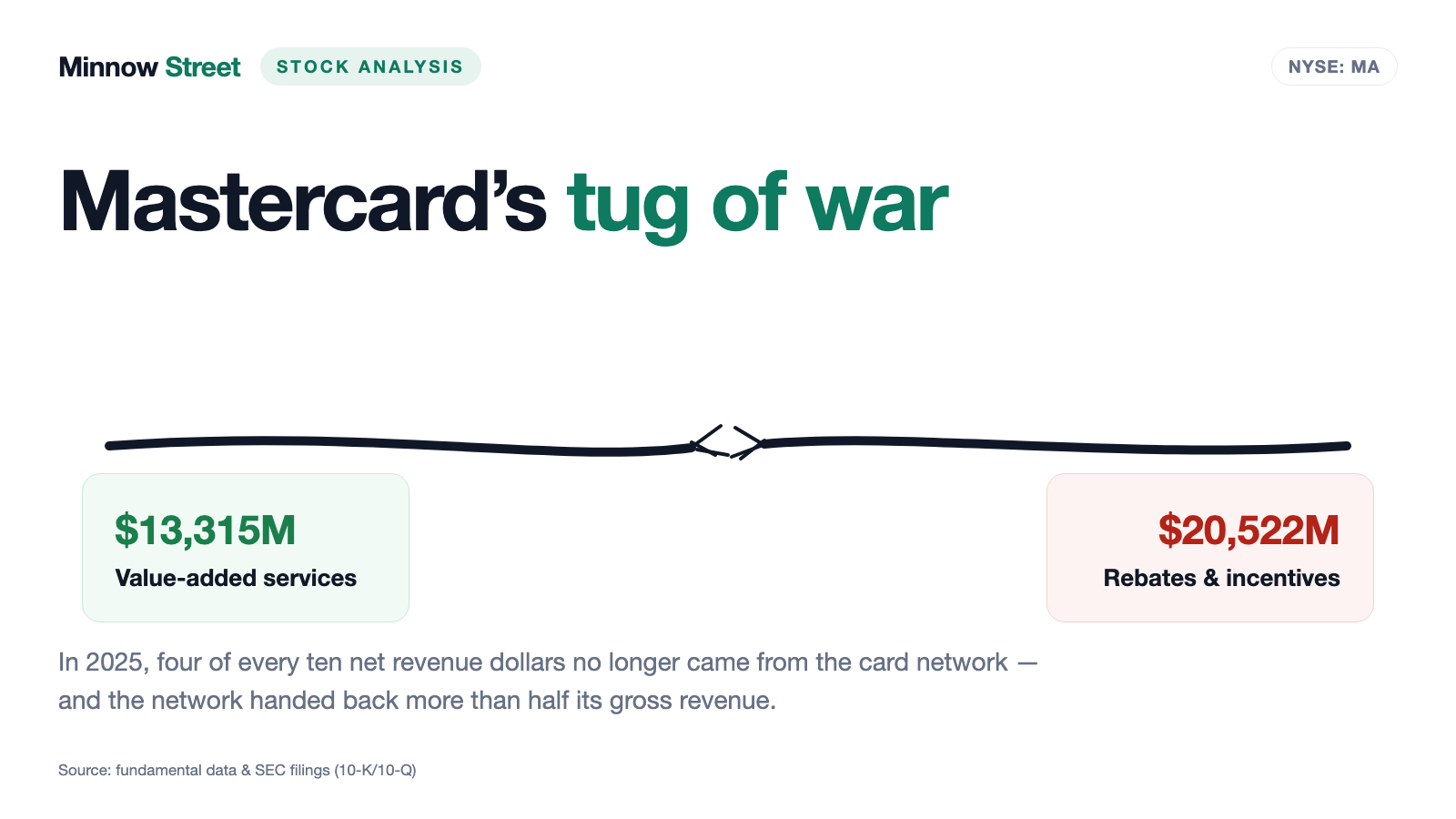
Mastercard reported net revenue of $32,791 million for 2025. Of that, $13,315 million — 40.6 percent — came from fraud prevention, data services and consulting rather than the card network. And the network itself handed $20,522 million, more than half its gross revenue, back to its own customers. Time to relabel the drawer.
 Thomas Mücke
Founder & Publisher
Thomas Mücke
Founder & Publisher
Chart
Interactive price chart (TradingView).
Note: pure fact-based analysis, not investment advice and not a solicitation to buy or sell. All figures without guarantee.
The drawer Mastercard no longer fits in
Our minds work with drawers. That is useful: we do not have to start from scratch with every company. Mastercard? Credit cards. Drawer closed, moving on.
That is exactly the trap. Drawers get labeled once and then never checked again. We think about Mastercard what was true in 2015, and we miss the fact that the company has shifted in the meantime.
The annual report for 2025 makes that unusually clear. Mastercard reports its revenue in only two categories: payment network, and value-added services and solutions. Of $32,791 million in net revenue, $13,315 million came from the second category — 40.6 percent. Fraud prevention, identity verification, data analytics, consulting. Four of every ten dollars have nothing to do with routing a card payment anymore.
And inside the card business itself sits a figure that is hard to believe: in 2025 Mastercard returned $20,522 million to its own customers to make them favor the network. What remained was $19,476 million. More than half of the network’s gross revenue flowed back out before the revenue line even began.
The deal for this article: we relabel the drawer using the figures in the annual report and the most recent quarterly report, not the picture in our heads. No recommendation, no forecast.
Two businesses, one report
Start with what Mastercard writes about itself. The opening sentence of the revenue section is the whole story in one paragraph:

"Mastercard is a payments network service provider that generates revenue from a wide range of payments solutions we provide to our customers. We classify our net revenues, which include the impact of rebates and incentives, from contracts with customers into two categories: (i) payment network and (ii) value-added services and solutions."
— Mastercard Incorporated, Form 10-K for 2025, Part I, Item 1 (Business), filed with the U.S. securities regulator, the SEC
The payment network
The familiar part. Mastercard is not a bank and does not issue cards — the banks do that. Mastercard runs the wire in between and guarantees that everyone ends up with the money they are owed. Four participants in addition to the company itself, as the report puts it: account holders, issuers, merchants and acquirers.
That work is paid for through four fee types Mastercard calls assessments. They are gross figures, measured before rebates and incentives, and they show precisely where the network earns its keep (2025, in millions of dollars, with the prior year and 2023):
- Transaction processing assessments, $15,930 (2024: $13,602; 2023: $12,067): the per-transaction fee for authorization, clearing and settlement. The largest and fastest-growing line, up 17 percent.
- Cross-border assessments, $12,021 ($10,181; $8,409): payments where the card and the merchant sit in different countries. Up 18 percent — the group’s economic barometer, tied to travel and international online commerce.
- Domestic assessments, $11,029 ($10,245; $9,566): the volume- and card-count-driven base fee in a card’s home market. Up 8 percent, the slowest line.
- Other network assessments, $1,018 ($936; $963): licensing and everything else.
One point where Mastercard differs from Visa and that is easily missed in comparisons: Mastercard discloses no separate revenue line for cross-border payments, only this gross assessment as a key metric. How much of it survives the rebates appears in no filing. Anyone comparing the two companies line by line is comparing unlike things here.
The value-added services
The part that does not fit the drawer. Mastercard sells things here that a customer can buy without a single card payment — the report says explicitly that these services and solutions can be integrated and sold with the payment network services or sold on a stand-alone basis. They include:
- Security solutions: fraud detection, threat intelligence, cyber risk assessment.
- Digital identity and authentication: tokenization, verifying who is actually paying.
- Data services and market insights: analytics for banks, merchants and public bodies.
- Consumer acquisition and engagement: loyalty programs, personalization, rewards.
- Processing, gateway, real-time payments and open finance.
The three-year series is unambiguous: $9,274 million (2023), $10,832 million (2024), $13,315 million (2025). That is 44 percent growth in two years, while the payment network went from $15,824 million through $17,335 million to $19,476 million — 23 percent over the same span. In the first quarter of 2026, $3,450 million of $8,398 million came from value-added services — 41.1 percent.
What the other side of this model looks like — where the credit risk sits and cards are actually issued — is the subject of our JPMorgan Chase analysis. Mastercard is not on that side: if a cardholder fails to pay, the bank absorbs it.
The scale
In 2025, cards carrying Mastercard brands moved $10.6 trillion in gross dollar volume, up 9 percent on a local currency basis. The network switched 175.5 billion transactions, up 10 percent. As of March 31, 2026 there were 3.7 billion Mastercard- and Maestro-branded cards issued. The network operates in more than 150 currencies and in over 220 countries and territories. As of December 31, 2025 Mastercard employed roughly 39,800 people in more than 90 countries, about 70 percent of them outside the United States, plus roughly 6,000 contingent workers; the total workforce cost for the year was $7.3 billion.
The fiscal year is the calendar year
It sounds trivial, and it is not. Mastercard’s fiscal year ends December 31; Visa’s ends September 30. When this analysis says “2025” it means calendar 2025, with no offset. Anyone lining up the quarterly numbers of the two companies has to account for that one-quarter shift.
The second share class that hurts almost nobody
Mastercard, like Visa, has more than one class of stock. Unlike Visa’s, however, the second class is effectively immaterial — and that is a piece of good news you only notice when you put the two side by side.
The listed security is the Class A share, ticker MA. Alongside it sits a non-voting Class B that only principal or affiliate customers may hold — historically the member banks. As of April 27, 2026 there were 6,547,625 of them against 877,036,230 Class A shares. In proportions: as of December 31, 2025 Class B carried 0.7 percent of equity ownership and 0.0 percent of general voting power, spread across roughly 207 holders of record as of February 6, 2026.
The conversion is simple, and that is precisely where the difference lies:
"Shares of Class B common stock are convertible on a one-for-one basis into shares of Class A common stock. Entities eligible to hold Mastercard’s Class B common stock are defined in the Company’s amended and restated certificate of incorporation (generally the Company’s principal or affiliate customers), and they are restricted from retaining ownership of shares of Class A common stock."
— Mastercard Incorporated, Form 10-K for 2025, Note 14 (Stockholders’ Equity)
One for one, with no moving factor. For contrast: at Visa the conversion rate of the Class B classes is tied to litigation costs and is reduced every time money flows into the litigation escrow account; all classes together came to roughly 10.5 percent more shares as of June 30, 2026 than the Class A line disclosed. The mechanics of that structure are in our Visa analysis. Mastercard has no such mechanism — and therefore no latent dilution to build into the model. Conversions amounted to just 0.4 million shares in 2025, 0.4 million in 2024 and 0.2 million in 2023.
Worth remembering: at Mastercard the risk does not sit in the share structure. It sits in the income statement.
How the stock reached our desk
Not through a screen. Our in-house stock scanner sorts by metrics — cheap valuation, balance sheet quality, momentum. A company with a price-to-earnings ratio around 33 and a price-to-book ratio of 74 drops out of those filters long before it reaches a hit list.
This analysis comes from a stocktaking exercise dated July 28, 2026: we listed the 100 largest U.S. stocks by market capitalization and checked which of them already had an analysis. Mastercard sat at number 18 — and had none. That is the entire hook. No signal, no trade idea, just closing a gap.
The numbers over the years — and what genuinely impresses
Start with what is actually exceptional. Because it is.
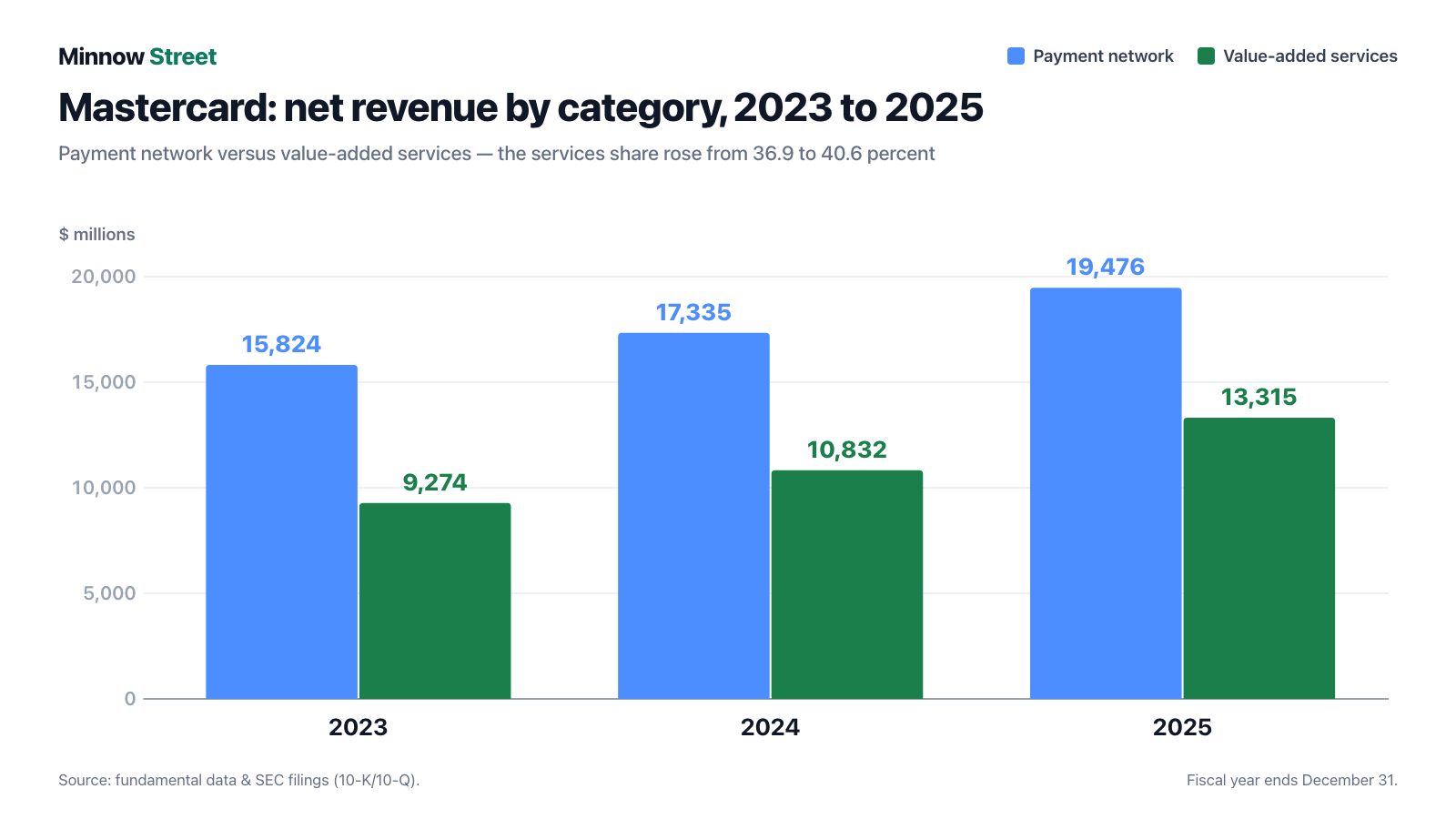
Net revenue climbed from $25,098 million (2023) through $28,167 million to $32,791 million (2025) — 31 percent in two years with no down year. Net income grew from $11,195 million to $14,968 million over the same span, and diluted earnings per share from $11.83 to $16.52.
In 2025 alone net revenue rose 16 percent, or 15 percent currency-neutral, of which 1 percentage point came from acquisitions completed in 2024. Split across the two categories: the payment network grew 12 percent and value-added services 23 percent (12 and 21 percent currency-neutral).
The real story is the ratio. Out of $32,791 million in net revenue came $18,897 million in operating income — an operating margin of 57.6 percent (2024: 55.3 percent; 2023: 55.8 percent). After tax, $14,968 million remained, or 45.6 percent. Almost 46 cents of every reported dollar ends up as profit. For scale: a good industrial company is pleased with 10 percent, a strong software company with 25.
The cash flow
Margin is bookkeeping; cash flow is truth. Operating activities generated $17,648 million in 2025 (2024: $14,780 million; 2023: $11,980 million). Of that, $489 million went into property and equipment. Roughly $17.2 billion was left free — against net income of $14,968 million. Reported profit is fully covered by real cash and then some. That is a quality marker you cannot overrate.
What happens to the money
Almost all of it goes back to shareholders. In 2025 Mastercard repurchased $11,727 million of its own shares — 21.1 million shares at an average price of $555.78 — and paid $2,756 million in dividends. Together $14.5 billion against $15.0 billion of profit. Dividends declared per share rose from $2.37 (2023) through $2.74 to $3.15 (2025).
In the first quarter of 2026 the pace increased: $4,035 million for 7.8 million shares at an average of $519.67, against $2,549 million for 4.7 million shares in the prior-year quarter. Class A shares outstanding fell from 907 million (December 31, 2024) through 887 million to 880 million (March 31, 2026).
And the current year
In the first quarter of 2026 net revenue rose 16 percent to $8,398 million (12 percent currency-neutral), net income rose 18 percent to $3,882 million, and diluted earnings per share rose 21 percent to $4.35. Gross dollar volume grew 7 percent to $2.7 trillion, cross-border volume 13 percent and switched transactions 9 percent — each on a local currency basis. The quarter included a $202 million restructuring special item.
The debt
As of March 31, 2026 total debt stood at $19.0 billion ($1,748 million short-term, $17,212 million long-term), unchanged from December 31, 2025; the earliest maturity is $750 million in November 2026. Against that sat $7,906 million in cash. Interest expense was $722 million in 2025 against operating income of $18,897 million — interest coverage of 26 times. On June 8, 2026, after the quarterly report, Mastercard placed five new note tranches totaling $5.0 billion with coupons between 4.325 and 5.000 percent. As of April 27, 2026 a further $2.5 billion of commercial paper was outstanding at a weighted-average rate of 3.82 percent.
Uncomfortable truth no. 1: more than half of network revenue flows back out
Now to what the revenue line leaves unsaid. Mastercard pays its own customers to use Mastercard. Those payments are called rebates and incentives, and in accounting terms they are not an expense — they are deducted before the revenue line. The reason is simple: a bank decides whether to give its customer a Mastercard or a Visa card. That decision is bought.

"Net revenue from our payment network included $20,522 million of rebates and incentives provided to customers, which increased 16%, on both an as-reported and currency-neutral basis, in 2025 versus the prior year, primarily due to an increase in our key drivers as well as new and renewed deals."
— Mastercard Incorporated, Form 10-K for 2025, Management’s Discussion and Analysis
Run the math. Payment network net revenue was $19,476 million in 2025. Add back the $20,522 million of incentives and gross revenue was $39,998 million. The incentives were therefore 51.3 percent of it. Of every dollar the network grossed, more than half went back to banks, merchants and partners.
The series, as far as the filings allow:
- 2024: $17,629 million of $34,964 million network gross revenue — 50.4 percent
- 2025: $20,522 million of $39,998 million — 51.3 percent
- First quarter 2026: $5,639 million of $10,587 million — 53.3 percent
A quarterly figure is not directly comparable with a full year; incentives swing with contract signings and volume. But the direction is the same in both annual steps and in the quarter: upward. And the leverage is large. A single percentage point on 2025 network gross revenue is $400 million — 2.7 percent of the year’s profit.
Important for context: this ratio is structurally far higher at Mastercard than at Visa, where client incentives amounted to 28.3 percent of gross revenue in fiscal 2025. That is not a quality judgment — the two companies cut their reporting lines differently, and Mastercard’s ratio applies to the payment network alone rather than the whole group. But it does mean that at Mastercard, bargaining power against its own customers determines a much larger slice of the result.
Mastercard names no target. The auditor explicitly treats the estimation of this item as a critical audit matter, because it rests on expectations about future customer behavior and net revenue may be materially different if those expectations do not hold.
Uncomfortable truth no. 2: the equity has almost all been bought back
This number is easy to miss, because it sits in the balance sheet under an unremarkable label.
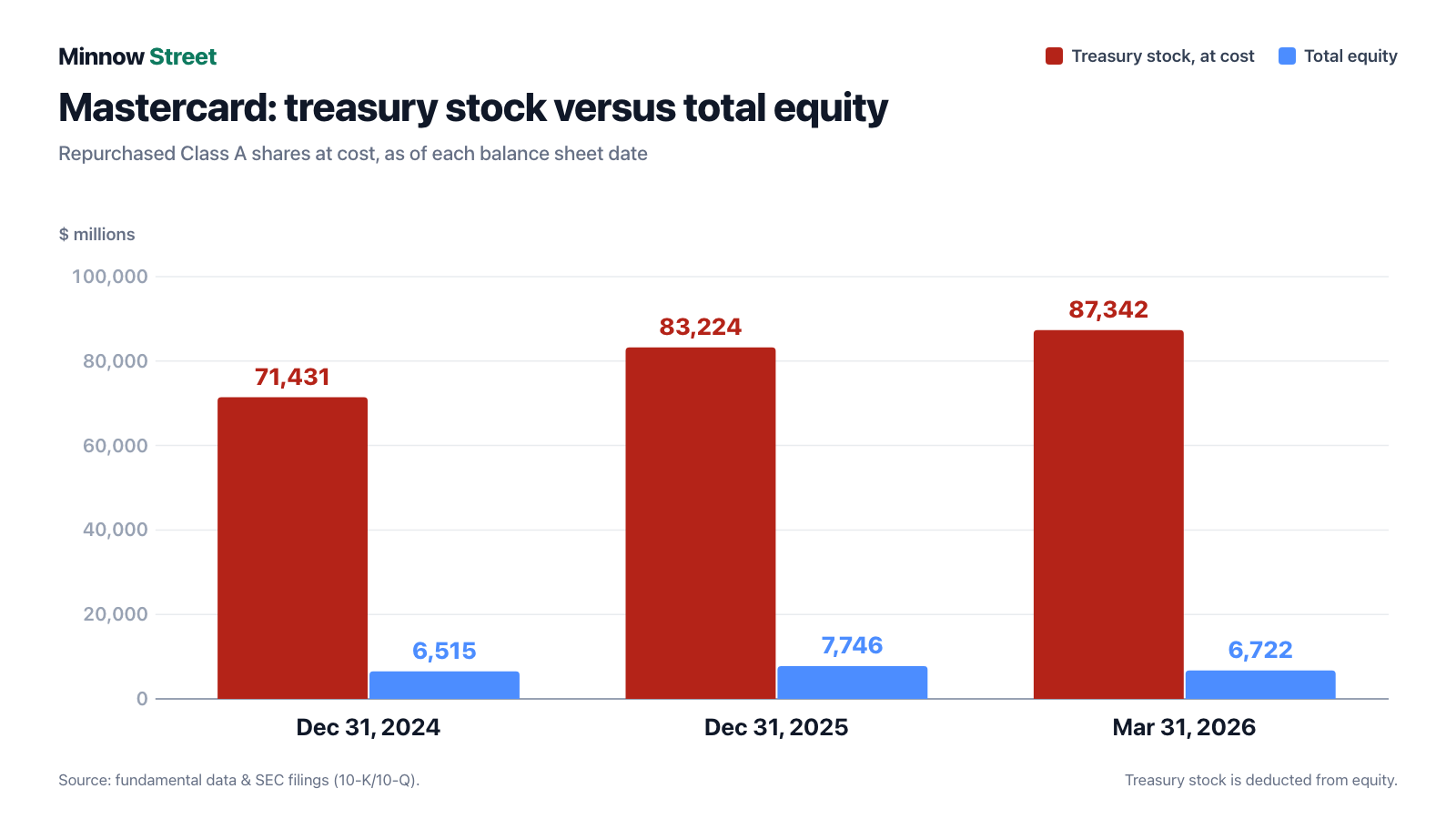
As of March 31, 2026 Mastercard held 526 million of its own Class A shares, carried in the balance sheet at a cost of $87,342 million and deducted from equity. Against that stand retained earnings of $88,146 million. What is left is total equity of $6,722 million on total assets of $52,449 million. Equity ratio: 12.8 percent.
The movement across three balance sheet dates shows how settled this pattern is: treasury stock grew from $71,431 million (December 31, 2024) through $83,224 million to $87,342 million (March 31, 2026), while total equity barely moved, from $6,515 million through $7,746 million to $6,722 million. Everything earned went straight back out.
In plain terms: Mastercard has repurchased its own stock so consistently in recent years that the accounting equity cushion is almost gone. Of 1,406 million Class A shares issued, 526 million sit in treasury — 37 percent. This is not an accident but a deliberate policy: in December 2025 the board approved another repurchase program of $14.0 billion, and in December 2024 one of $12.0 billion. As of April 27, 2026, $11.7 billion of authorization remained unused.
Two consequences are worth knowing.
First, two popular metrics become meaningless. Return on equity stood at 232 percent as of July 30, 2026. That is not superhuman performance but an arithmetic artifact: when the denominator has been bought away, the quotient can grow without limit. The same applies to the price-to-book ratio of 74 on a book value of $7.58 per share. For a company whose most valuable assets are a brand, a network and contracts, book value says little anyway — here it says nothing at all.
Second, the buffer for surprises is thin. Equity of $6.7 billion is modest against $19.0 billion of debt and the litigation exposure that follows. What defuses it is the cash flow: $17.6 billion in 2025, $3.0 billion in the first quarter of 2026 alone. A company that earns almost half its accounting equity anew in a single quarter does not need a large cushion. You just need to know that the safety here comes from the income statement, not the balance sheet.
Uncomfortable truth no. 3: Mastercard pays its own litigation bills
Since 2005 U.S. merchants have been fighting Mastercard and Visa over interchange fees — the charge the merchant’s bank remits to the card-issuing bank. At Visa that bill is carried by an escrow account and a second share class. Not at Mastercard. Here an apportionment agreed in 2011 between Mastercard, Visa and a number of banks applies:
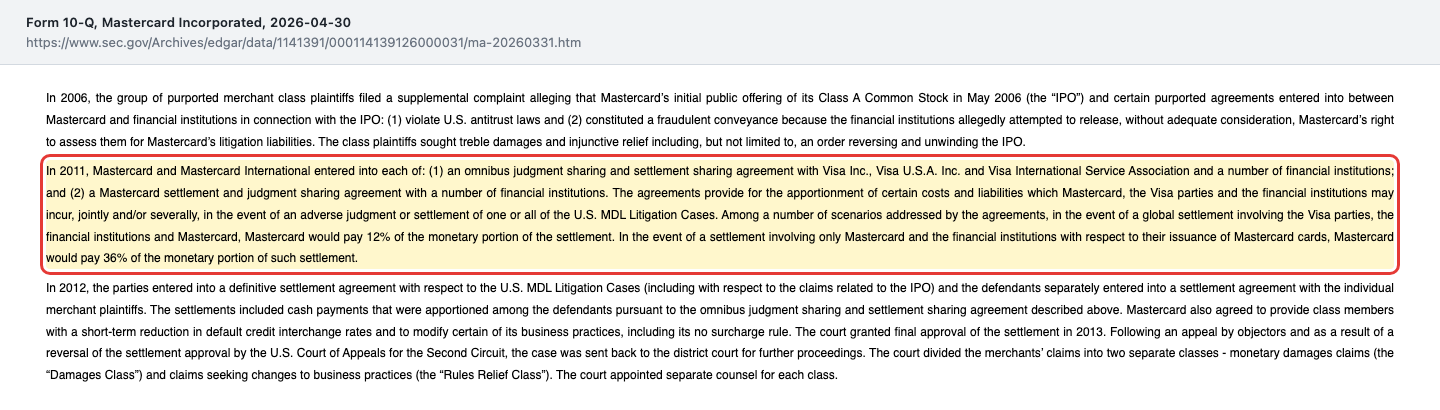
"Among a number of scenarios addressed by the agreements, in the event of a global settlement involving the Visa parties, the financial institutions and Mastercard, Mastercard would pay 12% of the monetary portion of the settlement. In the event of a settlement involving only Mastercard and the financial institutions with respect to their issuance of Mastercard cards, Mastercard would pay 36% of the monetary portion of such settlement."
— Mastercard Incorporated, Form 10-Q for the quarter ended March 31, 2026, Note 14
No escrow account, no share class carrying the bill. What gets paid runs through the income statement, in the line “Provision for litigation.” It was $539 million (2023), $680 million (2024) and $504 million (2025). The balance sheet showed accrued litigation of $339 million as of March 31, 2026, down from $800 million at December 31, 2025; of that, $177 million related to the U.S. class actions, down from $637 million — the decline came from payments made in the first quarter.
What is still open
A look at the litigation section of the quarterly report for the period ended March 31, 2026:
- United States, settlements: the damages class settlement became final in 2023; together with the individual settlements it covers over 95 percent of Mastercard’s U.S. interchange volume. The rules relief settlement was rejected by the court in 2024; a revised 2025 version was argued orally in April 2026.
- The two large opt-out groups: six merchants seek aggregate single damages in excess of $0.5 billion, with trial scheduled to begin in September 2026. Block and Intuit seek in excess of $5 billion in single damages — for their own volume and that of smaller merchants for whom they acted as payment facilitators. Expert reports and briefing are being exchanged over the course of 2026. Under U.S. antitrust law single damages can be trebled in a judgment.
- New in April 2026: a further putative class action by U.S. merchants for damages since January 2019, filed together with a motion seeking a declaration that the settlement’s prospective release — which runs through August 2028 — does not bar those claims.
- United Kingdom and Europe: over £0.3 billion (approximately $0.4 billion) of unresolved merchant claims, with more filed in April 2026. In 2025 the trial court decided certain liability issues against Mastercard; in March 2026 permission to appeal was granted on all grounds. Further issues are scheduled for trial in October 2027.
- U.K. commercial card collective action: in excess of £1 billion (approximately $1.3 billion). In February 2026 the court excluded over 100 merchants from the class on procedural grounds.
- Portugal: a proposed consumer collective action claiming approximately €0.4 billion (approximately $0.5 billion) covering roughly 20 years. Netherlands: a proposed merchant collective action estimated in excess of €0.3 billion for fees dating from 1992.
- Australia: the competition regulator has been trying liability issues since April 2026 over Mastercard’s debit agreements with merchants.
- Closed but costly: the U.K. consumer collective action — originally claiming over £10 billion — ended in 2025 with a payment of £200 million ($263 million). The EMV liability shift settlement ($80 million accrual) received final court approval in April 2026.
The scale, honestly framed: the largest single open claim — over $5 billion from Block and Intuit — equals 15 percent of 2025 net revenue and three times accounting equity as of March 31, 2026. It also equals roughly four months of operating cash flow. That is serious, but not existential — as long as the cash keeps flowing.
Uncomfortable truth no. 4: the fast part of the growth was purchased
Value-added services are the reason Mastercard no longer fits the old drawer. They are not growing entirely under their own power, though.
The annual report breaks it down: of the 23 percent growth in value-added services in 2025, 3 percentage points came from acquisitions, 18 from the underlying business and 2 from currency. The most important purchase: in December 2024 Mastercard acquired Recorded Future, a threat intelligence company, for $2.7 billion in cash, of which $1.7 billion was booked as goodwill. There were no material acquisitions in 2025 or 2023.
And then came March 2026:

"In March 2026, Mastercard entered into a definitive agreement to acquire a 100% equity interest in BVNK Holdings Limited (“BVNK”), a provider of stablecoin infrastructure, for $1.5 billion, excluding customary closing adjustments. The sellers of BVNK have the potential to earn additional contingent consideration of up to $300 million if certain performance targets are met."
— Mastercard Incorporated, Form 10-Q for the quarter ended March 31, 2026, Note 2
$1.5 billion plus up to $300 million contingent, for a provider of stablecoin infrastructure. The deal is subject to regulatory approval; Mastercard expects to close before the end of 2026. Measured against accounting equity of $6,722 million, that is a quarter of the company’s book value — for a business that has yet to report a revenue contribution.
The price of this strategy sits in the balance sheet. As of March 31, 2026 the books carried $9,525 million of goodwill and $5,495 million of other intangible assets — $15,020 million together, or 29 percent of total assets and more than twice equity. Goodwill is the amount paid above identifiable net assets; it is not amortized on a schedule but tested annually for impairment. If an acquisition underperforms, the resulting write-down lands directly on that thin equity base.
To be fair: 18 of the 23 percentage points of growth in 2025 came organically, and unsatisfied performance obligations from value-added services contracts stood at $2.0 billion as of December 31, 2025, to be recognized through 2030. The business is real. It simply was not only grown — some of it was bought.
Uncomfortable truth no. 5: the settlement guarantee breaks every balance sheet ratio
Mastercard’s rules guarantee that payments between participating banks are settled. Between the moment you pay and the moment the merchant receives the money lie a few days — and during that window Mastercard stands behind the payment arriving, even if a bank fails.
The scale of that exposure is in the notes, not the balance sheet. As of March 31, 2026 estimated gross settlement exposure was $88,147 million (December 31, 2025: $89,599 million). Of that, $16,707 million was covered by risk mitigation arrangements such as cash collateral, letters of credit and guarantees, leaving net settlement exposure of $71,440 million.
Put in proportion: as of March 31, 2026 net settlement exposure equaled 10.6 times accounting equity and 2.2 times 2025 net revenue. Mastercard additionally maintains a commercial paper program and a credit facility of $8 billion each, explicitly available for the event that one or more banks fail to settle; the facility runs to November 2030.
Mastercard states that it has historically experienced a low level of losses from customer settlement failures, and customers that do not meet its risk standards must post collateral. The risk is managed. But its magnitude bears no relation to a $52.4 billion balance sheet — and in November 2025 the Central Bank of Brazil issued a regulation requiring payment networks to extend their settlement guarantees to previously non-guaranteed transactions, such as merchant installment payments. Implementation is expected to conclude by November 2026.
Where the price is not set by the market
Litigation is one thing. Regulation is more dangerous, because it fixes the price directly instead of punishing it afterwards. What the annual report for 2025 lists as developments:
- United States: in August and September 2025 two federal district courts reached conflicting decisions on the validity of the interchange cap set by the Federal Reserve for large banks’ debit cards (Regulation II under the Durbin Amendment). One court vacated it, the other upheld it. The cap remains in effect while the litigation continues.
- New Zealand: the Commerce Commission approved caps on cross-border interchange for most card transaction types, effective May 2026.
- European Union: in July 2025 the revised systemic importance regulation took effect, introducing cyber resilience requirements and detailed outsourcing rules and widening the set of covered companies. Separately, in 2024 the European Commission requested information about Mastercard’s network fees charged to acquirers.
- Market access: South Africa mandates that domestic payments be switched in-country or by domestic companies. India, China and Saudi Arabia impose data localization requirements, and other jurisdictions are considering them.
Then there is competition from a direction that did not exist ten years ago: real-time account-to-account transfers, digital wallets, stablecoins. Mastercard explicitly names digital currencies in its own competition section as both an opportunity and a competitor to its products. The answer consists of acquisitions and in-house building blocks: roughly 130 crypto co-brand card programs, stablecoins embedded in the Mastercard Move platform, the planned BVNK purchase — and Mastercard Agent Pay, a framework launched in 2025 for payments initiated by software agents. Measured against the core business, all of it is still small.
What the stock costs
As of July 30, 2026 Mastercard’s market capitalization stood at roughly $477 billion. The trailing price-to-earnings ratio was about 33, and about 29 on the analyst estimate for the current year. Enterprise value equaled roughly 23.9 times earnings before interest, taxes, depreciation and amortization, and the price-to-sales ratio was 14.9.
For context without a daily quote: a price-to-earnings ratio of 33 means the market is paying 33 times annual profit. Against a broad market average in the region of 20, that is a clear premium. It is not unfounded — a net margin of 45.6 percent, 31 percent revenue growth in two years and a network nobody rebuilds in five years justify a good deal. But a lot of future is already in that price.
Two metrics deserve to be ignored at Mastercard, because after the buybacks they measure nothing: the price-to-book ratio of 74 and the return on equity of 232 percent. Both are artifacts of a denominator that has largely been bought away, not statements about the company.
The professional view: as of July 30, 2026 the analyst estimate for earnings per share stood at roughly $19.66 for the current and $22.80 for the coming fiscal year, against $17.29 over the trailing twelve months. Of 42 recorded ratings, 30 were buy or overweight, 11 hold and one sell. That is an expectation, not a fact.
Opportunities and risks at a glance
What speaks for Mastercard
- A second business growing faster than the first. Value-added services rose from $9,274 million to $13,315 million in two years (up 44 percent), lifting their share of net revenue from 36.9 to 40.6 percent. This revenue does not depend on interchange fees and is therefore further from the regulators.
- Margin and cash flow at a level few companies reach. A 57.6 percent operating margin and $17,648 million of operating cash flow in 2025, on $489 million of capital expenditure and net income of $14,968 million.
- No credit risk. Mastercard issues no cards and extends no credit; cardholder defaults hit the issuing banks.
- A share structure without traps. Class B carries 0.7 percent of equity, converts one for one and has no voting power. No latent dilution, no litigation-linked conversion factor.
- The economic barometer is working. Cross-border assessments rose from $8,409 million to $12,021 million in two years; in the first quarter of 2026 cross-border volume grew 13 percent on a local currency basis.
- Buybacks and dividends run reliably. $11,727 million of repurchases and $2,756 million of dividends in 2025, $4,035 million of repurchases in the first quarter of 2026 alone; $11.7 billion of authorization remaining as of April 27, 2026.
What speaks against it
- More than half of network revenue flows back out. $20,522 million of $39,998 million network gross revenue in 2025 (51.3 percent), rising to 53.3 percent in the first quarter of 2026. Each percentage point equals roughly $400 million.
- Equity has been bought down to $6,722 million — 12.8 percent of total assets (March 31, 2026) — against $87,342 million of treasury stock. The buffer for surprises comes from cash flow, not the balance sheet.
- Litigation continues and is self-funded. Over $5 billion of single damages sought by Block and Intuit, over $0.5 billion by six further opt-outs with trial from September 2026, over £1 billion in the United Kingdom, plus Portugal and the Netherlands. Accrual: $339 million (March 31, 2026).
- Goodwill and intangibles far exceed equity. $15,020 million as of March 31, 2026, or 29 percent of total assets, with the planned $1.5 billion BVNK purchase on top.
- The settlement guarantee is enormous. $88,147 million gross exposure as of March 31, 2026, of which $16,707 million is mitigated; Brazil is widening the guarantee obligation through November 2026.
- Regulation sets the price of the core business. Conflicting U.S. rulings on Regulation II, New Zealand caps from May 2026, an EU information request on network fees, data localization in India, China and Saudi Arabia.
- Valuation paid forward. Roughly 33 times trailing earnings (data as of July 30, 2026) leaves little room for disappointment.
A human conclusion
The drawer from the opening was never wrong. Mastercard earns money on card payments, carries no credit risk and keeps almost 46 cents of every reported dollar. That is in the filings, and it is exceptional.
The label just no longer covers the whole company. Four of every ten net revenue dollars now come from fraud prevention, data services and consulting — a business that grows faster, is bought more expensively and carries different risks than the network. And within the network itself, more than half of gross revenue goes back to its own customers, with the ratio rising. That is not a scandal; it is the price of a bank choosing Mastercard over Visa.
What you need to be clear about: this company’s safety does not sit in its balance sheet. It sits in $17.6 billion of annual cash flow that carries $6.7 billion of equity, $19 billion of debt and litigation claims in the billions. As long as that cash flows, everything is manageable. It is the one number worth watching at Mastercard — not book value, not return on equity.
What you make of it is your decision. And that is exactly as it should be.
Sources
- Mastercard Incorporated, Form 10-Q for the quarter ended March 31, 2026 (filed April 30, 2026, CIK 0001141391) — balance sheet, income statement, cash flow statement, Note 2 (Acquisitions), Note 3 (Revenue), Note 9 (Debt), Note 10 (Stockholders’ Equity), Note 14 (Legal and Regulatory Proceedings), Note 15 (Settlement and Other Risk Management)
- Mastercard Incorporated, Form 10-K for 2025 (period ended December 31, 2025, filed February 11, 2026) — business description, government regulation, risk factors (Item 1A), management discussion, Note 2 (Acquisitions), Note 3 (Revenue), Note 14 (Stockholders’ Equity), Note 19 (Legal and Regulatory Proceedings), critical audit matter on rebates and incentives
- Mastercard Incorporated, Form 10-K for 2024 (filed February 12, 2025) — comparative figures for 2023 and 2024, payment network rebates and incentives for 2024
- Mastercard Incorporated, first quarter 2026 earnings release (Form 8-K of April 30, 2026, Item 2.02, Exhibit 99.1) — quarterly metrics, volumes, special items, cards issued
- Mastercard Incorporated, Form 8-K of June 8, 2026 (Item 8.01) — five note tranches totaling $5.0 billion
- Mastercard Incorporated, filing index at SEC EDGAR — review of all filings from April 30, 2026 onward, including the Form 8-K of June 17, 2026 (Item 5.07, annual meeting)
- Fundamental data (market capitalization, valuation multiples, analyst estimates), data as of July 30, 2026
Important notice
This article is journalistic commentary on publicly available company filings. It is expressly not investment advice and not a solicitation to buy or sell securities. All figures come from the sources listed above and carry the reporting dates stated there; they may have changed after publication. Equity investments carry risks up to and including the total loss of the capital invested. The author held no position in Mastercard Incorporated at the time of publication.
Our Bottom Line at a Glance
- Second business carries weight positive
- Value-added services — fraud prevention, identity verification, data services, consulting — rose from $9,274 million (2023) to $13,315 million (2025) and from 36.9 to 40.6 percent of net revenue; the first quarter of 2026 reached 41.1 percent. They sit further from interchange regulation and can be sold stand-alone (10-K 2025, Note 3).
- Earnings power and cash flow positive
- Of $32,791 million in net revenue, 2025 left $18,897 million of operating income (57.6 percent) and $14,968 million of net income (45.6 percent). Operating cash flow of $17,648 million exceeded reported profit on just $489 million of capital expenditure. Interest coverage about 26 times (period ended December 31, 2025).
- Rebates and incentives negative
- The payment network returned $20,522 million as rebates and incentives in 2025 and kept $19,476 million — 51.3 percent of network gross revenue, after 50.4 percent in 2024 and 53.3 percent in the first quarter of 2026. One percentage point equals roughly $400 million. Mastercard names no target, and the auditor treats the item as a critical audit matter.
- Balance sheet structure neutral
- As of March 31, 2026, $87,342 million of treasury stock stood against total equity of $6,722 million on total assets of $52,449 million (12.8 percent). No substance risk — cash of $7,906 million and quarterly cash flow of $2,999 million — but the buffer comes from the income statement rather than the balance sheet. Price-to-book and return on equity are unusable as a result.
- Litigation negative
- Unlike Visa, Mastercard has no escrow fund: under the 2011 agreements it pays 12 percent of a global settlement or 36 percent of a settlement involving only the banks, out of its own accounts. Open items include over $5 billion of single damages sought by Block and Intuit, over $0.5 billion from six opt-outs with trial from September 2026, over £1 billion in the United Kingdom, plus claims in Portugal and the Netherlands. Accrual: $339 million (10-Q, Note 14).
- Acquisitions and regulation neutral
- Three of the 23 percentage points of value-added services growth in 2025 came from acquisitions; goodwill and intangibles totaled $15,020 million as of March 31, 2026, more than twice equity. Add the planned $1.5 billion BVNK purchase. On the pricing side regulators decide: conflicting U.S. rulings on Regulation II (August and September 2025), New Zealand caps from May 2026, an EU information request on network fees.
Mastercard earns money on card payments worldwide without carrying credit risk, and in 2025 it kept almost 46 cents of every reported dollar as profit. But four of every ten net revenue dollars no longer come from the network — they come from fraud prevention, data services and consulting — and within the network $20,522 million went back to its own customers as incentives, more than half of gross revenue. This company's safety sits in $17,648 million of cash flow, not in $6,722 million of equity. Not investment advice.
What Our Rating Means
Quality confirmed
Business model, numbers and balance sheet hold up to our review. Whether the current price supports an entry is a separate question — it hangs on the price, not on the company.
The quality is documented: a 57.6 percent operating margin and 45.6 percent net margin in 2025, operating cash flow of $17,648 million above reported profit, interest coverage of about 26 times, $10.6 trillion of volume processed, and a second business that already carries 40.6 percent of net revenue at $13,315 million and grows faster than the core network. No going-concern warning, no negative equity, no existential dependence on a single counterparty, no accounting or governance breach. The thin equity of $6,722 million (March 31, 2026) results from $87,342 million of share repurchases rather than over-indebtedness — it is supported by $2,999 million of quarterly cash flow and $7,906 million of cash. The burdensome findings — an incentive ratio above 50 percent, self-funded interchange litigation with over $5 billion of single damages outstanding, goodwill exceeding equity, regulation of the core price — are serious, but operational, legal and regulatory in nature, and they do not threaten the substance. Separately stands the price question: at roughly 33 times trailing earnings (data as of July 30, 2026) the stock is expensively paid for. That is a valuation argument, not a quality argument — and it does not change the rating. The decision is yours.
A journalistic assessment by our editorial team at the time of the deep dive, based on public sources — not investment advice and not a solicitation to buy or sell. Your personal circumstances (investment goals, risk capacity, taxes) cannot be taken into account. What our levels mean, how verdicts are formed, and what conflicts of interest exist →
Worth Noting
- Hook: stocktaking of the 100 largest U.S. stocks by market capitalization as of July 28, 2026. Mastercard sat at number 18 with no analysis. No scanner hit.
- Data as of: Form 10-Q for the quarter ended March 31, 2026 (filed April 30, 2026), Forms 10-K for 2025 and 2024, the Form 8-K earnings release of April 30, 2026 and the Form 8-K of June 8, 2026 (notes offering). Fundamental data as of July 30, 2026. Second-quarter 2026 figures were not available at press time.
- Fiscal year confusion: Mastercard's fiscal year ends December 31, Visa's September 30. Quarterly comparisons between the two are offset by one quarter.
- Incentive ratio confusion: the 51.3 percent applies to payment network gross revenue, not the whole group. Mastercard discloses incentives only for that category; Visa's 28.3 percent applies to group gross revenue. The figures are not directly comparable.
- Price-to-book (74) and return on equity (232 percent) are arithmetic artifacts of equity almost fully absorbed by repurchases and are not usable for valuation.
- Mastercard discloses no separate revenue line for cross-border payments, only the gross fee metric ("cross-border assessments", $12,021 million in 2025). A comparison with Visa's cross-border revenue line is therefore not like for like.
Frequently Asked Questions
Value-added services and solutions cover fraud detection, threat intelligence, digital identity and authentication, data services, market insights, consulting, loyalty programs, processing and real-time payments. They are one of the two revenue categories in the annual report and can be bought without the card network. In 2025 they produced $13,315 million of net revenue — 40.6 percent of the group total of $32,791 million, up from 36.9 percent in 2023.
Payment network net revenue for 2025 included $20,522 million of rebates and incentives. Together with the remaining net revenue of $19,476 million that implies gross revenue of $39,998 million, so incentives were 51.3 percent of it. In the first quarter of 2026 the ratio reached 53.3 percent ($5,639 million of $10,587 million). In accounting terms these payments reduce revenue rather than counting as an expense.
Because it has been bought back. As of March 31, 2026 Mastercard held 526 million of its own Class A shares at a cost of $87,342 million, deducted from equity. What remained was $6,722 million of equity on $52,449 million of total assets, or 12.8 percent. This is deliberate capital policy: in 2025 alone $11,727 million went into repurchases and $2,756 million into dividends.
Two: the listed, voting Class A (ticker MA on the NYSE) and an unlisted, non-voting Class B that only principal or affiliate customers may hold. As of April 27, 2026 there were 877,036,230 Class A shares against 6,547,625 Class B shares. Class B carries 0.7 percent of equity, converts one for one, and holders must sell or transfer the Class A shares they receive. There is no Class C.
Mastercard itself, through the income statement. Under the 2011 sharing agreements Mastercard pays 12 percent of the monetary portion of a global settlement involving the Visa parties and the banks, and 36 percent when only Mastercard and the banks are involved. The line "Provision for litigation" was $504 million (2025), $680 million (2024) and $539 million (2023). There is no escrow fund of the kind Visa maintains.
On December 31 — the fiscal year matches the calendar year. That is an important difference from Visa, whose fiscal year ends September 30. Anyone lining up the two companies' quarterly reports is comparing periods offset by one quarter. Mastercard's first quarter of 2026 covers January through March 2026.
In March 2026 Mastercard agreed to acquire a 100 percent equity interest in BVNK Holdings Limited, a provider of stablecoin infrastructure, for $1.5 billion plus up to $300 million of contingent consideration. Closing is subject to regulatory approval and is expected before the end of 2026. Measured against equity of $6,722 million as of March 31, 2026, the purchase price equals roughly a quarter of book value.
Yes, quarterly on both Class A and Class B. Dividends declared per share rose from $2.37 (2023) through $2.74 (2024) to $3.15 (2025); $2,756 million was paid in 2025. Share repurchases are far larger: $11,727 million in 2025 and $4,035 million in the first quarter of 2026 alone. Against a market capitalization of roughly $477 billion that implies a yield below one percent (data as of July 30, 2026).
Found an error?
Did you spot a factual error, an outdated number, or a typo in this deep dive? Let us know briefly — your report goes straight to the editorial team.