Astronics Stock: The First Profit Since 2019, a Record Backlog — and a $286 Million Bill From Its Own Rally
Astronics equips aircraft cabins with in-seat power, lighting and seat electronics — and lights up our in-house stock scanner 23 times at once, from the stage-2 trend to the Minervini trend template (scanner run as of July 17, 2026). We read the annual reports (10-K) and the quarterly report (10-Q) as of April 4, 2026: more revenue than in the old record year 2018, the first annual profit since 2019, a $734.3 million backlog — but also a 15-year patent war with Lufthansa Technik, $285.8 million spent buying back a convertible note issued just nine months earlier, and $11.9 million of cash next to $334.9 million of debt. Not investment advice — just the look into the logbook before you chase a stock that is already flying.
 Thomas Mücke
Founder & Publisher
Thomas Mücke
Founder & Publisher
Chart
Interactive price chart (TradingView).
Note: pure fact-based analysis, not investment advice and not a solicitation to buy or sell. All figures without guarantee.
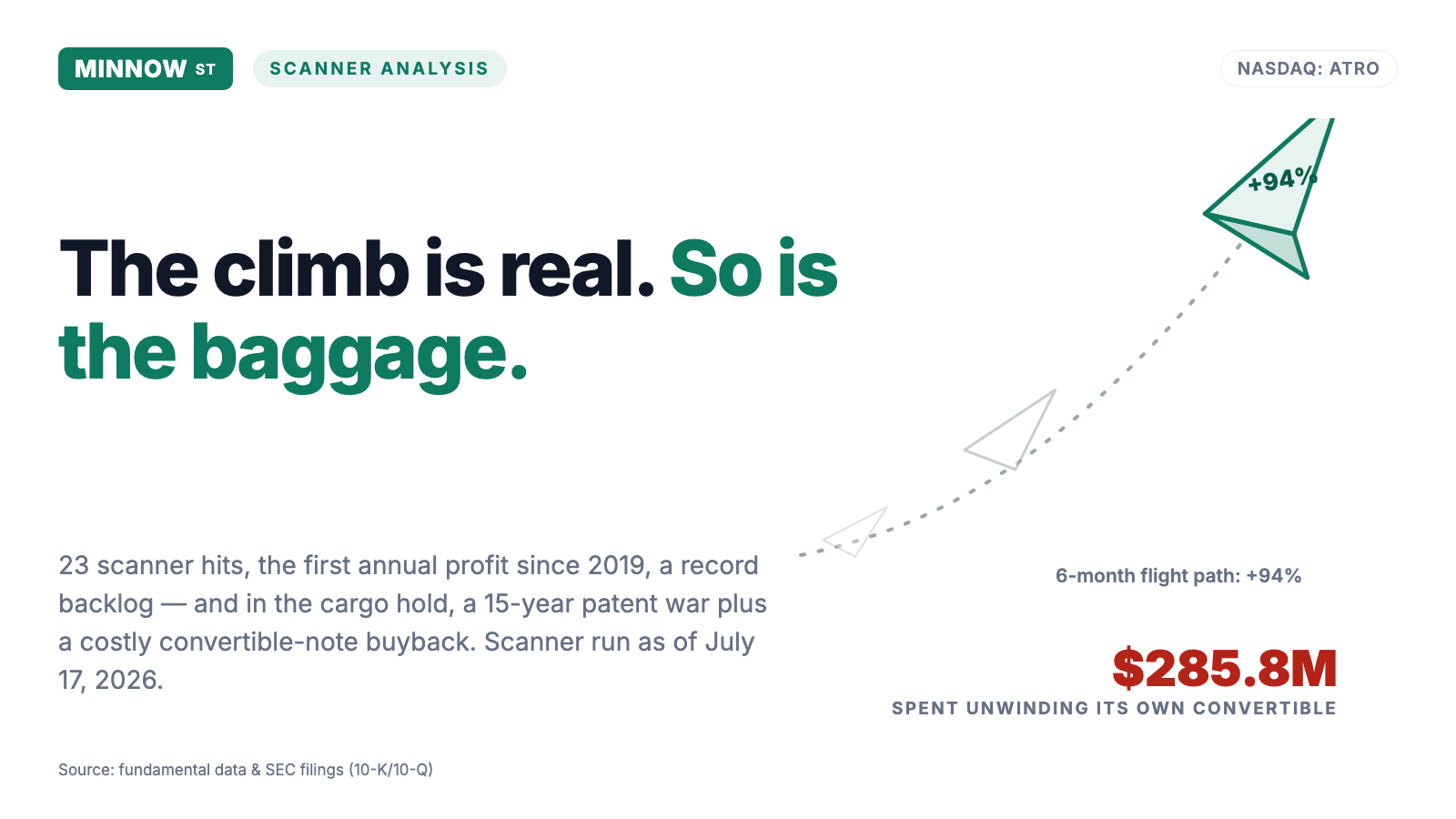
There is an investor trap that catches the careful ones in particular: the too-late trap. You discover a stock that has climbed 94 percent in six months, and your head instantly produces two equally bad answers. The first: "I need to get in before the plane leaves" — that is FOMO, the fear of missing out. The second: "Too late, too expensive, I will wait for the pullback" — that is anchoring, the reflex that treats the old, lower price as the "right" one. Both answers share one flaw: they judge the price instead of the company. Exactly such a case in the summer of 2026 is Astronics Corporation (Nasdaq: ATRO) from East Aurora, New York: a supplier of aircraft-cabin electronics whose stock has more than tripled in twelve months (data as of July 17, 2026) and which collects 23 hits in our momentum scanner run of July 17, 2026. So let’s make a deal: before you chase the flying price — or wave it off in a huff — we read together what the company itself reported, under penalty of law, to the U.S. securities regulator, the SEC: the annual report (10-K) for 2025 and the quarterly report (10-Q) as of April 4, 2026. And these filings tell of a genuine climb — and of baggage riding along in the cargo hold. In the end, you decide for yourself.
What Astronics actually does — and for whom
If you have ever charged your phone at the outlet in an airplane seat, odds are decent you were using an Astronics product. The company builds the unglamorous electronics that turn a cabin into a cabin: electrical power systems (power generation, distribution and in-seat outlets), lighting and safety equipment, seat motion, avionics and certification services — plus a second, smaller leg: automated test systems for defense electronics and mass transit. Translated, Astronics is something like the electrician of the aircraft cabin — not the architect (that is Boeing and Airbus), not the furniture maker (that is the seat manufacturers), but the one who brings power, light and motion into the seat. Per the annual report (10-K) for 2025, customers are airframe manufacturers, their suppliers, airlines and the U.S. Department of Defense; the largest single customer is Boeing at 10.4 percent of sales (more on that below). The Aerospace segment delivered roughly $797 million of revenue in 2025 — 75 percent of it with the commercial transport market — and Test Systems roughly $65 million. The company employs about 2,700 people, roughly 2,100 of them in the United States. Which brings us to the central tension of this analysis, and it runs through every chapter: the operating climb is real and documented — but a 15-year patent war, an expensively repurchased convertible note and a thin cash position ride along in the cargo hold. How the financial engineering of an industrial can dominate its equity story is something we dissected at Garrett Motion — and how fast aviation dreams can burn cash, at Virgin Galactic.
Where the stock shows up in our scanner
Every day we run about 3,500 stocks through our scanners. Astronics reached the research list through the momentum run of July 17, 2026 — and not as a footnote but as a serial offender: 23 hits, across the trend and quality filters. The stock sits in a Stan Weinstein stage-2 uptrend (price above a rising 200-day average), meets Mark Minervini’s trend template, ranks among the RS leaders with a relative-strength rating of 95 (95 means: it outperformed 95 percent of all scanned stocks), shows institutional accumulation (most recently 10 funds added while 7 trimmed) and also appears in the power-trend, dual-momentum and "pros 80 percent" filters. Behind that stand plus 66 percent in three months, plus 94 percent in six and roughly plus 218 percent in twelve; the stock trades about 13 percent below its 52-week high (all figures: data as of July 17, 2026). And the fundamental lens of the very same scanner? Here — unlike with many momentum runners — it is not damning at all: a fundamental grade of B, a Piotroski F-score of 6 of 9 (a nine-point test of the direction of the books; 6 is decent, rock-solid starts at 8) and an Altman Z-score around 7.9 (an early-warning gauge of insolvency risk; the danger zone historically starts below 1.8). Still, remember the principle: a scanner measures movement and balance-sheet direction — it does not read court files. That is exactly what the next chapters are for.
The numbers over the years — honestly appraised
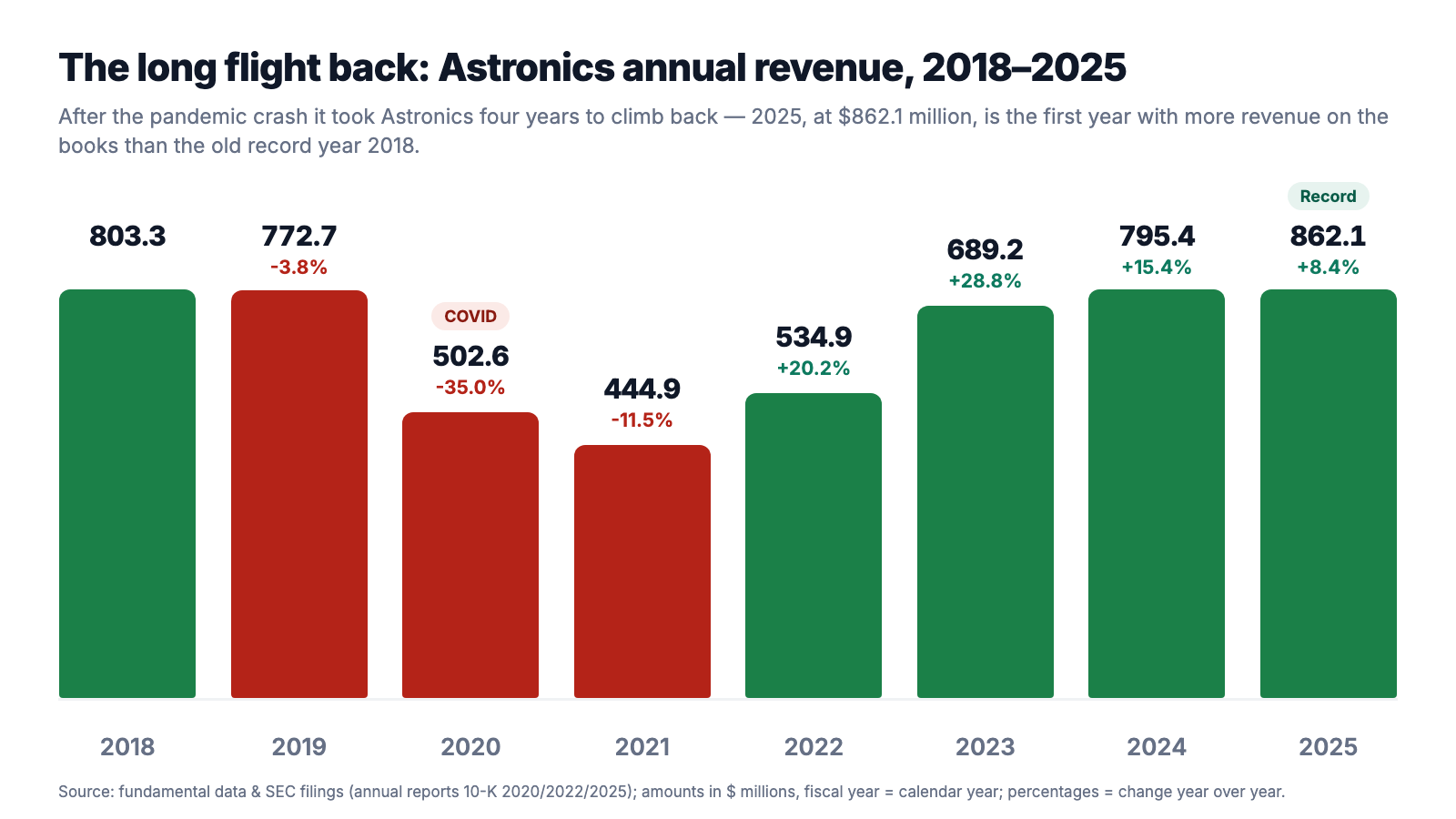
First, what genuinely impresses — and here that is no small thing. Astronics has a complete roller-coaster ride behind it: in 2018 the company generated $803.3 million of revenue, then the pandemic and the aviation crisis tore revenue down to $444.9 million by 2021 — nearly a halving. What followed were five consecutive loss years (2020 through 2024, a combined net loss of roughly $220 million, $115.8 million of it in the impairment year 2020 alone). And then the business turned: plus 28.8 percent in 2023, plus 15.4 percent in 2024, plus 8.4 percent in 2025 to $862.1 million — more than in the old record year 2018 for the first time. The bottom line for 2025 showed $29.4 million of net income ($0.81 per diluted share) — the first annual profit since 2019, despite $10.4 million of tariff expense and despite a costly financing maneuver we will get to. Gross margin rose from 27.7 to 29.9 percent, and orders came in faster than revenue went out: bookings of $924.4 million, a book-to-bill ratio of 1.07.
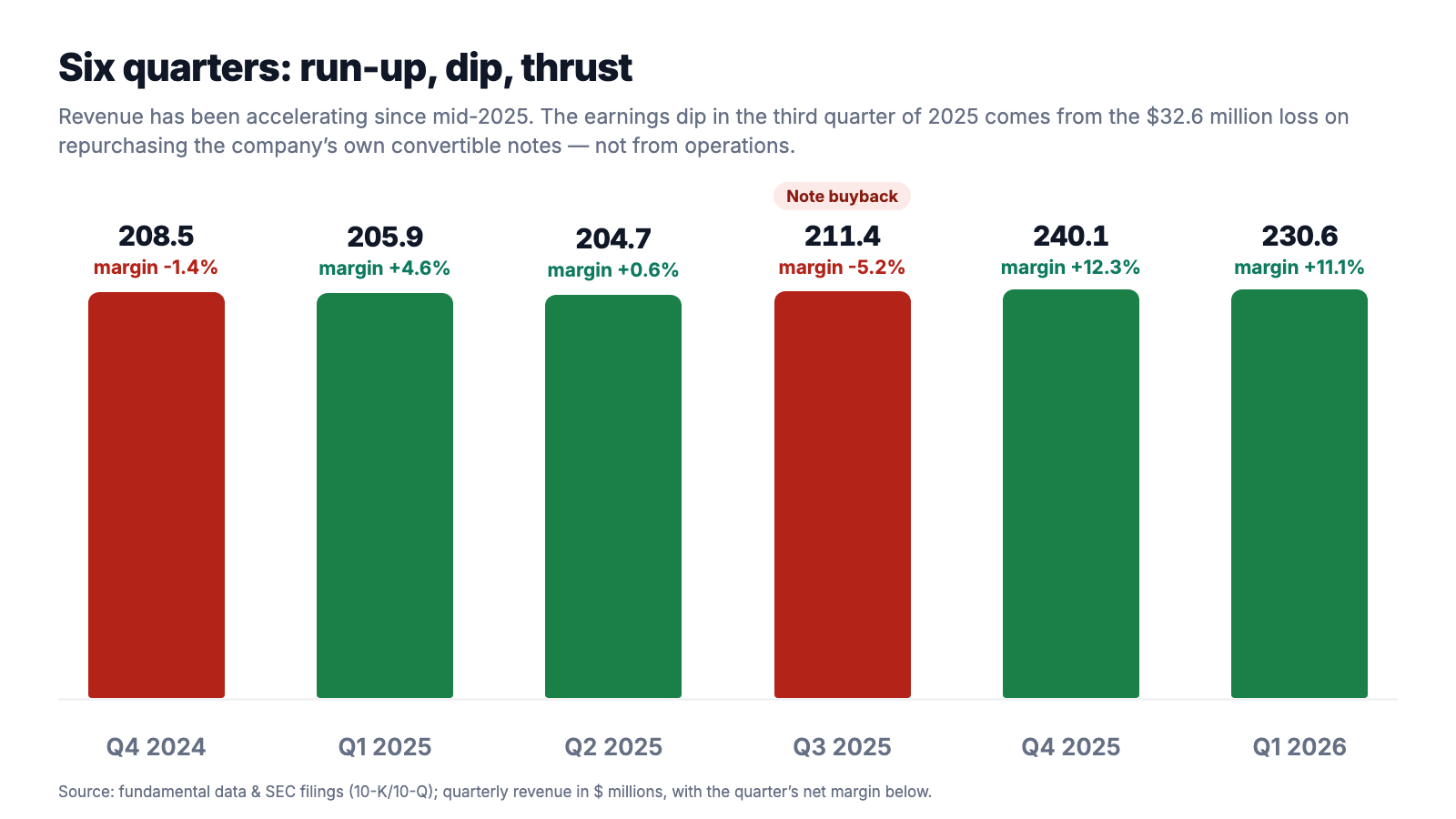
The latest quarter keeps the pace: in the first quarter of 2026 (Astronics uses 13-week quarters; this one ended April 4, 2026), revenue grew 12.0 percent to $230.6 million, and net income jumped from $9.5 million to $25.5 million ($0.67 per diluted share, helped by a small tax benefit). The Aerospace segment posted an operating margin of 16.5 percent — aided by a catch-up effect from the MV-75 military program and much lower litigation costs than in the prior-year quarter. Orders: $290.4 million in a single quarter, book-to-bill 1.26 — for every dollar shipped, $1.26 of new orders came in — and backlog reached $734.3 million. Honesty requires the problem child too: the Test Systems segment idles at $16.8 million of quarterly revenue and a 2.4 percent operating margin — in 2025, cost revisions on long-term mass transit contracts cost the company $8.3 million of revenue. Remember the pattern: the thrust comes almost entirely from the cabin — airlines are retrofitting, and Boeing and its peers are raising build rates. Which brings us to the uncomfortable truths.
What the filings say — the uncomfortable truths
Uncomfortable truth no. 1: A patent war in its 16th year — and 2026 hosts its most expensive chapters
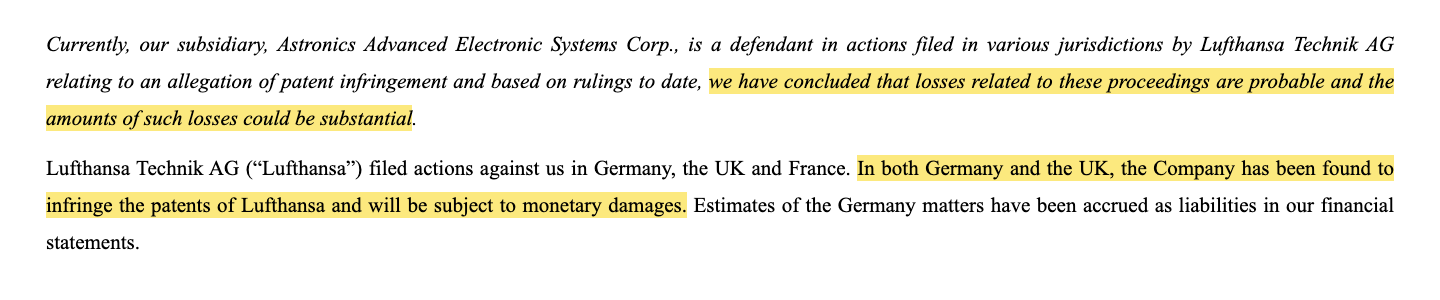
On December 29, 2010, Lufthansa Technik filed a patent suit in Mannheim, Germany, against Astronics subsidiary AES — over in-seat power systems, the heart of the cabin-power business. Fifteen and a half years later, that dispute still is not fully resolved. The annual report states with rare bluntness how serious it is:
"Currently, our subsidiary, Astronics Advanced Electronic Systems Corp., is a defendant in actions filed in various jurisdictions by Lufthansa Technik AG relating to an allegation of patent infringement and based on rulings to date, we have concluded that losses related to these proceedings are probable and the amounts of such losses could be substantial."
— Astronics Corporation, SEC annual report 10-K for 2025, Item 1A "Risk Factors"
The score after a decade and a half, sorted by country: in Germany, infringement has been confirmed at the highest level since 2019; for "direct" sales AES has already paid ($4.7 million, later partially refunded), and for "indirect" sales $17.7 million including interest sits reserved on the balance sheet (as of April 4, 2026) — and since February 25, 2026, there is no way around it anymore:
"On February 25, 2026, the German Federal Supreme Court rejected Lufthansa's and AES's petitions for leave to appeal in both matters. Therefore, the decisions of the Higher Regional Court of Karlsruhe have become final."
— Astronics Corporation, SEC quarterly report 10-Q as of April 4, 2026, note "Legal Proceedings and Other Matters"

In the UK, 2025 got genuinely expensive: the court quantified the profits to be handed over at $11.9 million, plus $5.7 million of interest and $3.5 million toward Lufthansa’s legal costs — Astronics wired $21.6 million in 2025. Both sides have appealed; per the quarterly report, the hearing before the UK Court of Appeal is scheduled for July 2026 — it can lower the bill or raise it. And in France, where AES had won twice, the highest court remanded the case in March 2025: on October 28, 2026, the validity of the patent will be re-tried, with a ruling not expected before early 2027 — if it goes against AES, another damages trial follows. For perspective, without alarmism: the quantified amounts are manageable for a company with $862 million of revenue, the patent itself expired in May 2018, and the affected products were modified back at the end of 2014. But the matter has been consuming management time and legal budget for a decade and a half — the drop in litigation costs alone improved first-quarter 2026 results by seven million dollars, which tells you in reverse what used to be burned. Whoever buys the stock buys two court dates on the 2026 calendar.
Uncomfortable truth no. 2: The rally wrote its own bill — $285.8 million for a nine-month-old note
In December 2024, Astronics raised $165 million through a convertible note: 5.5 percent interest, due 2030, convertible into shares. Then the stock roughly tripled — and the financing instrument became a problem, because the noteholders suddenly sat on a fat conversion profit at the shareholders’ expense. Management’s answer sits soberly in the quarterly report:
"The Company used approximately $189.8 million of the net proceeds from the issuance of the 2031 Convertible Notes, together with approximately $85.0 million of borrowings under its ABL Revolving Credit Facility and approximately $11.0 million of cash on hand, to repurchase approximately $132.0 million in aggregate principal amount of outstanding 2030 Convertible Notes […]. The total cash paid in connection with this repurchase was approximately $285.8 million."
— Astronics Corporation, SEC quarterly report 10-Q as of April 4, 2026, note "Long-Term Debt"
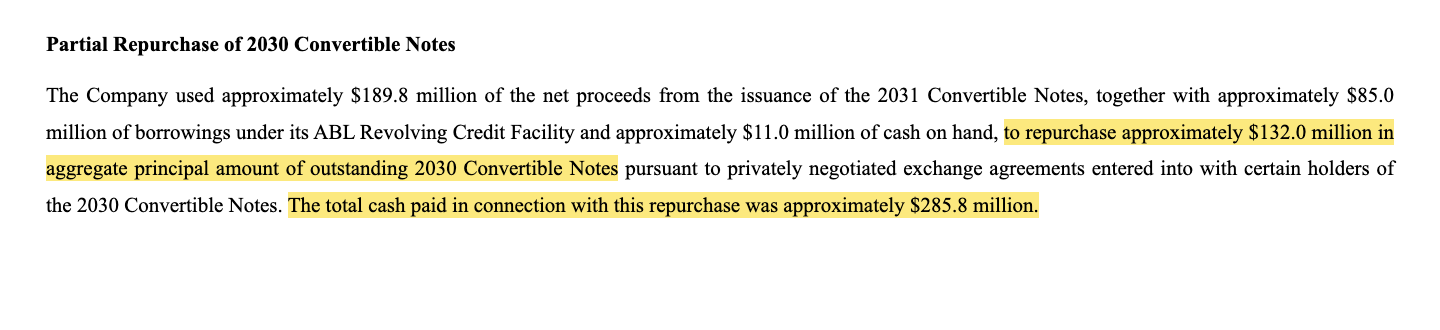
Read those numbers twice: for $132 million of principal, $285.8 million went out the door — more than double, nine months after issuance. The 2025 income statement kept a $32.6 million loss on settlement of debt from it — more than the entire net income of the year. A convertible note works like a loan with a built-in lottery ticket for the lender: if the stock soars, the lender wins — and the shareholder pays, either through dilution (your slice of the cake shrinks because new slices get cut) or, as here, through an expensive buyback. To be fair, management acted decisively: the residual dilution from the 2030 note has shrunk to $33 million of principal, the new $225 million 2031 convertible costs zero percent interest, and $26.9 million bought capped calls that soften dilution up to a stock price of $83.41. Except: at the scanner run of July 17, 2026, the stock already traded above that cap, and the conversion price of the 2031 notes is $54.87 — the next round of the same game is already open. That the same company sold 1.3 million of its own shares at an average of $16.31 through its at-the-market program in 2023 completes the chapter heading: Astronics sold stock cheaply and bought conversion rights back dearly. Remember the mechanism: convertibles are cheap while things go badly — and get expensive precisely when everything goes right.
Uncomfortable truth no. 3: The biggest customer is Boeing — and the cash box is thinner than the stock price suggests
Two sentences from the annual report belong together. The first concerns the customer list:
"We have a significant concentration of business with one major customer, The Boeing Company (“Boeing”). Sales to Boeing accounted for 10.4% of sales in 2025, 10.2% of sales in 2024, and 11.0% of sales in 2023."
— Astronics Corporation, SEC annual report 10-K for 2025, Item 1 "Business"

A tenth of revenue with one customer whose build rate depends on regulators, strikes and its own production quality — that is the kind of dependency that stays invisible for years and then shows up in a single quarter. Astronics knows this from experience: in 2024 an aerospace customer went bankrupt ($1.0 million of receivables written off, plus inventory and fixed-asset reserves), and in 2023 a contract-manufacturing customer followed with $7.5 million. The second sentence sits on the balance sheet: as of April 4, 2026, $11.9 million of cash stood next to $334.9 million of long-term debt and $161.7 million of equity against $747.1 million of total assets — an equity ratio of roughly 22 percent. This is not an emergency: the credit facility is open, interest expense fell 43 percent to $12.6 million in 2025, the new convertible carries no coupon, and operating cash flow was positive in 2025. But it explains why the impressive Altman Z-score of 7.9 is carried mostly by the high market value (the formula counts the market value of equity): this stock’s safety net is its own price — not a cash cushion in the bank. If the price falls, the net shrinks with it.
Valuation: roughly $3.1 billion of market value — what you pay for is the climb continuing
In mid-July 2026 the Astronics stock cost about $87; at 35.7 million shares of both classes (as of February 19, 2026, per the annual report) that is roughly $3.1 billion of market value (data as of July 17, 2026). Against the trailing twelve months (diluted earnings per share: roughly $1.22), that works out to a price-to-earnings ratio around 71 — expensive. The professionals’ view softens this only in part: analyst estimates see roughly $2.26 of earnings per share for the current year and roughly $2.60 for the next (data as of July 17, 2026), implying a forward price-to-earnings ratio around 39 and 33, respectively. An important label on the package: this consensus comes from just three analysts — with coverage that thin, "the consensus" is a handful of opinions rather than a market verdict. The price-to-sales ratio stands around 3.5, and the price-to-book ratio — because equity is so slim — around 19 (each: data as of July 17, 2026). Translated: the market is not paying for the present here, it is paying for the continuation — rising build rates, cabin retrofit waves, military programs like MV-75, and an end to the litigation bills. There is real evidence for all of it (book-to-bill 1.26, record backlog, first profits). But a P/E of 71 forgives no crash landing — neither at Boeing nor in court. Roughly 2 percent of the shares sit with insiders; the most recently reported insider transaction was a sale (data as of July 17, 2026).
Opportunities and risks at a glance
What speaks for Astronics:
- The turnaround is done and documented: 2025 revenue of $862.1 million above the old 2018 peak for the first time, the first annual profit since 2019 ($29.4 million), gross margin improved from 27.7 to 29.9 percent (annual report 10-K 2025).
- Demand is carrying it: bookings up 14.4 percent to $924.4 million in 2025; in the first quarter of 2026 a book-to-bill ratio of 1.26 and a backlog of $734.3 million; Aerospace operating margin of 16.5 percent in the quarter (quarterly report 10-Q as of April 4, 2026).
- Structural tailwind: airlines are retrofitting cabins with outlets, lighting and connectivity, manufacturers are raising build rates, and the military business is growing with the MV-75 program (military aircraft revenue 2025: plus 32 percent to $116.3 million).
- Financing costs are falling: interest expense down 43 percent in 2025, the new $225 million 2031 convertible is interest-free, capped calls dampen part of the dilution.
- A rare combination in the scanner: 23 hits with a stage-2 trend, an RS rating of 95 and the Minervini trend template — alongside a decent fundamental grade of B, Piotroski 6 of 9 and an Altman Z around 7.9 (data as of July 17, 2026).
What speaks against it:
- The Lufthansa patent war has run since 2010 and has two dates in 2026: the UK appeal in July and the French hearing starting October 28 — $21.6 million has already been paid, $17.7 million is reserved, and the filing itself warns that losses "could be substantial."
- The rally wrote a bill: $285.8 million of cash to repurchase $132 million in principal of the company’s own convertible, a $32.6 million book loss — and with the 2031 note (conversion price $54.87, stock above it), the next one is already deep in the money.
- A thin cushion: $11.9 million of cash next to $334.9 million of long-term debt and an equity ratio of roughly 22 percent (April 4, 2026) — the safety net is the market value, not the balance sheet.
- Concentration and a problem child: Boeing accounts for roughly a tenth of revenue, two customer bankruptcies cost double-digit millions in 2023/2024, and the Test Systems segment operates barely above break-even after mass transit cost revisions.
- The valuation forgives little: a trailing price-to-earnings ratio around 71, price-to-book around 19, a consensus of only three analysts (data as of July 17, 2026) — and after plus 218 percent in twelve months, a lot of future is already in the price.
A human conclusion
Back to the too-late trap from the opening. Its two wrong answers — "get in fast" and "wave it off in a huff" — share the same root: they judge the price instead of the company. After reading the filings, you can do better. The company: a genuine turnaround with record revenue, the first profit since 2019, a full order book and tailwind from cabin retrofits and military programs — this is not an inflated nothing, this is a business that delivers. The price: has not merely noticed that turnaround but celebrated it with plus 218 percent in twelve months, and now pays 71 times trailing earnings. In between sits the baggage the scanner does not weigh: two court dates in 2026 in a 15-year patent war, a balance sheet whose cash is thinner than its reputation, and a convertible mechanism that has already cost $285.8 million once and will present its bill again on the next leg up. So the honest question for you is not "has the plane left?" but: do you want to pay a price for a documented climb that leaves no room for quiet landings? If your answer is yes, then at least go in with open eyes — the next quarterly reports (10-Q) will show you whether book-to-bill stays above 1, what the UK Court of Appeal has decided, and whether Test Systems finally earns money. What you make of it is your decision. And that is exactly as it should be.
Sources
All original documents used in this analysis — for your own reading:
- Astronics Corporation — SEC annual report 10-K for 2025 (filed February 26, 2026)
- Astronics Corporation — SEC annual report 10-K for 2024 (filed March 5, 2025)
- Astronics Corporation — SEC annual report 10-K for 2022 (filed March 10, 2023; annual figures 2020–2022)
- Astronics Corporation — SEC annual report 10-K for 2020 (filed March 1, 2021; annual figures 2018–2020)
- Astronics Corporation — SEC quarterly report 10-Q as of 04/04/2026 (filed May 13, 2026)
- Astronics Corporation — SEC quarterly report 10-Q as of 09/27/2025 (filed November 6, 2025)
- Astronics Corporation — SEC quarterly report 10-Q as of 06/28/2025 (filed August 7, 2025)
- Astronics Corporation — SEC quarterly report 10-Q as of 03/29/2025 (filed May 7, 2025)
- Complete SEC filing history of Astronics Corporation: EDGAR overview (sec.gov)
- Fundamental data (metrics, quarterly series, valuation; data as of July 17, 2026), reconciled against the SEC filings.
- Screener and rating data: in-house stock scanner (momentum scanner run as of July 17, 2026), including the Stan Weinstein stage-2 scanner; Astronics stock page: astronics-atro.
Transparency & disclaimer: This analysis is a journalistic contextualization of publicly available information and is not investment advice, not a financial analysis in the regulatory sense and not a solicitation to buy or sell securities. Stock investments carry substantial risks up to and including total loss. All information without guarantee; the data cut-off is noted in the text. The author holds no position in Astronics shares at the time of publication.
Our Bottom Line at a Glance
- Operating turnaround & order book positive
- 2025 revenue of $862.1 million above the old 2018 peak for the first time, the first annual profit since 2019 ($29.4 million), Q1 2026 up 12 percent with a 16.5 percent Aerospace margin; book-to-bill of 1.26 and a $734.3 million backlog (quarterly report 10-Q as of 04/04/2026) — the recovery is not a price phenomenon, it is on the books.
- Momentum & scanner confluence positive
- 23 hits in the in-house stock scanner in the momentum run of July 17, 2026 (stage 2, RS rating 95, Minervini trend template, power trend, institutional accumulation) alongside decent fundamentals (grade B, Piotroski 6/9) — a rare combination, but one that reads no court files.
- Lufthansa legal risk negative
- Patent proceedings since December 2010; Germany lost with final effect on 02/25/2026 ($17.7 million reserved), $21.6 million already paid in the UK with the appeal scheduled for July 2026, France re-tries from 10/28/2026 — the 10-K itself calls further losses "probable" and potentially "substantial."
- Financing & dilution mechanics negative
- Repurchase of $132 million in principal of the company's own nine-month-old convertible for $285.8 million ($32.6 million book loss — more than the 2025 annual profit); only $11.9 million of cash next to $334.9 million of debt, and the zero-coupon 2031 note (conversion price $54.87) is already deep in the money with the stock around $87 — the same mechanism can get expensive again.
- Valuation neutral
- Roughly $3.1 billion of market value at 71 times trailing and roughly 39 times estimated current-year earnings (base: only three analysts; data as of July 17, 2026) — no bubble level for a turnaround with a full order book, but a price that already assumes the climb continues.
Astronics is a documented turnaround with momentum: record revenue, the first profit since 2019, a book-to-bill of 1.26 and 23 scanner hits. Against that stand a 15-year patent war with two court dates on the 2026 calendar, a cash position of just $11.9 million next to $334.9 million of debt, and a convertible mechanism that has already charged the rally $285.8 million once. At 71 times trailing earnings, the continuation of the climb is priced in — quiet landings are not. Not investment advice.
What Our Rating Means
- If you don't own the stock
- As long as the question raised in the bottom line stays open, we see no basis for an entry.
- If you hold it in your portfolio
- Our findings offer no acute reason to sell — the checkpoints named remain decisive.
A journalistic assessment by our editorial team at the time of the deep dive, based on public sources — not investment advice and not a solicitation to buy or sell. Your personal circumstances (investment goals, risk capacity, taxes) cannot be taken into account. What our categories mean, how verdicts are formed, and what conflicts of interest exist →
Worth Noting
- ATRO reached the research list through the momentum/stage-2 scanner run of July 17, 2026, with 23 hits in the in-house stock scanner — attention here is a trend finding, not a fundamental verdict.
- Scanner metrics (RS rating, Piotroski, Altman Z, fundamental grade) are computed on trailing twelve-month figures; the $32.6 million loss from the convertible buyback (Q3 2025) is in them, potential further litigation costs naturally are not.
- Price and valuation figures dated July 17, 2026 (about $87, roughly $3.1 billion market value based on 35.7 million shares of both classes per the 10-K); analyses are evergreen, daily prices are not a buy argument. Astronics uses 13-week quarters (Q1 2026 ended April 4, 2026); the fiscal year ends December 31.
Frequently Asked Questions
Astronics Corporation (Nasdaq: ATRO) of East Aurora, New York, builds electronics for aircraft cabins and cockpits: electrical power systems with in-seat outlets, lighting and safety equipment, seat motion, avionics and certification services. A second, smaller segment supplies automated test systems for defense and mass transit. Revenue 2025: $862.1 million, roughly $797 million of it in the Aerospace segment.
In the scanner run of July 17, 2026, ATRO collected 23 hits in our in-house stock scanner: a Stan Weinstein stage-2 uptrend, a relative-strength rating of 95, the Minervini trend template, power trend and institutional accumulation. Behind that stand plus 94 percent in six months and roughly plus 218 percent in twelve months (data as of July 17, 2026).
Lufthansa Technik has been suing over in-seat power systems since December 2010. In Germany, the rulings have been final since February 25, 2026; $17.7 million is reserved (as of April 4, 2026). In the UK, Astronics already paid $21.6 million in 2025; the appeal is scheduled for July 2026. In France, the validity of the patent will be re-tried starting October 28, 2026.
In December 2024, Astronics issued a 5.5 percent convertible note of $165 million. After the stock roughly tripled, the company repurchased 80 percent of it ($132 million in principal) in the third quarter of 2025 for a total of roughly $285.8 million in cash — booking a $32.6 million loss, more than the 2025 net income. The buyback was funded with a new zero-coupon convertible of $225 million (due 2031, conversion price $54.87).
Yes, again since 2025: $29.4 million of net income ($0.81 per diluted share) after five straight loss years (2020 through 2024). In the first quarter of 2026 (through April 4), the company earned $25.5 million on $230.6 million of revenue (plus 12 percent). The 2025 profit would have been much higher without the $32.6 million loss on the convertible buyback.
Boeing is the largest single customer: 10.4 percent of sales in 2025, 10.2 percent in 2024 and 11.0 percent in 2023 (per the annual report 10-K). On top comes the indirect dependence on aircraft build rates overall, since Astronics also supplies the manufacturers' suppliers and the airlines for retrofits.
By classic yardsticks, no: at a price around $87 (data as of July 17, 2026), the trailing price-to-earnings ratio stands around 71, price-to-sales around 3.5 and price-to-book around 19. Based on estimates from only three analysts, the current-year price-to-earnings ratio works out to around 39. The market is paying for the climb to continue, not for the present.
Found an error?
Did you spot a factual error, an outdated number, or a typo in this deep dive? Let us know briefly — your report goes straight to the editorial team.