AEVEX: One Contract Quadrupled Quarterly Revenue — and the Same Contract Is Cutting the Backlog in Half
AEVEX Corp. builds unmanned systems and autonomy software for the U.S. military and listed on the New York Stock Exchange on April 20, 2026. Six weeks later it reported its first quarter as a public company: revenue of $216.7 million against $53.3 million a year earlier, and a profit of $21.0 million after a loss of $27.3 million. Multiply that by four and you land near $870 million — the company itself guides to $600 million to $620 million for 2026. The quarterly report explains both numbers with the same name: the EUCOM AOR Deep Strike program. And it shows what that contract leaves behind in the order book: a decline of $146.5 million in three months. Not investment advice — just the question of what remains of a record quarter once the contract behind it has been delivered.
 Thomas Mücke
Founder & Publisher
Thomas Mücke
Founder & Publisher
Chart
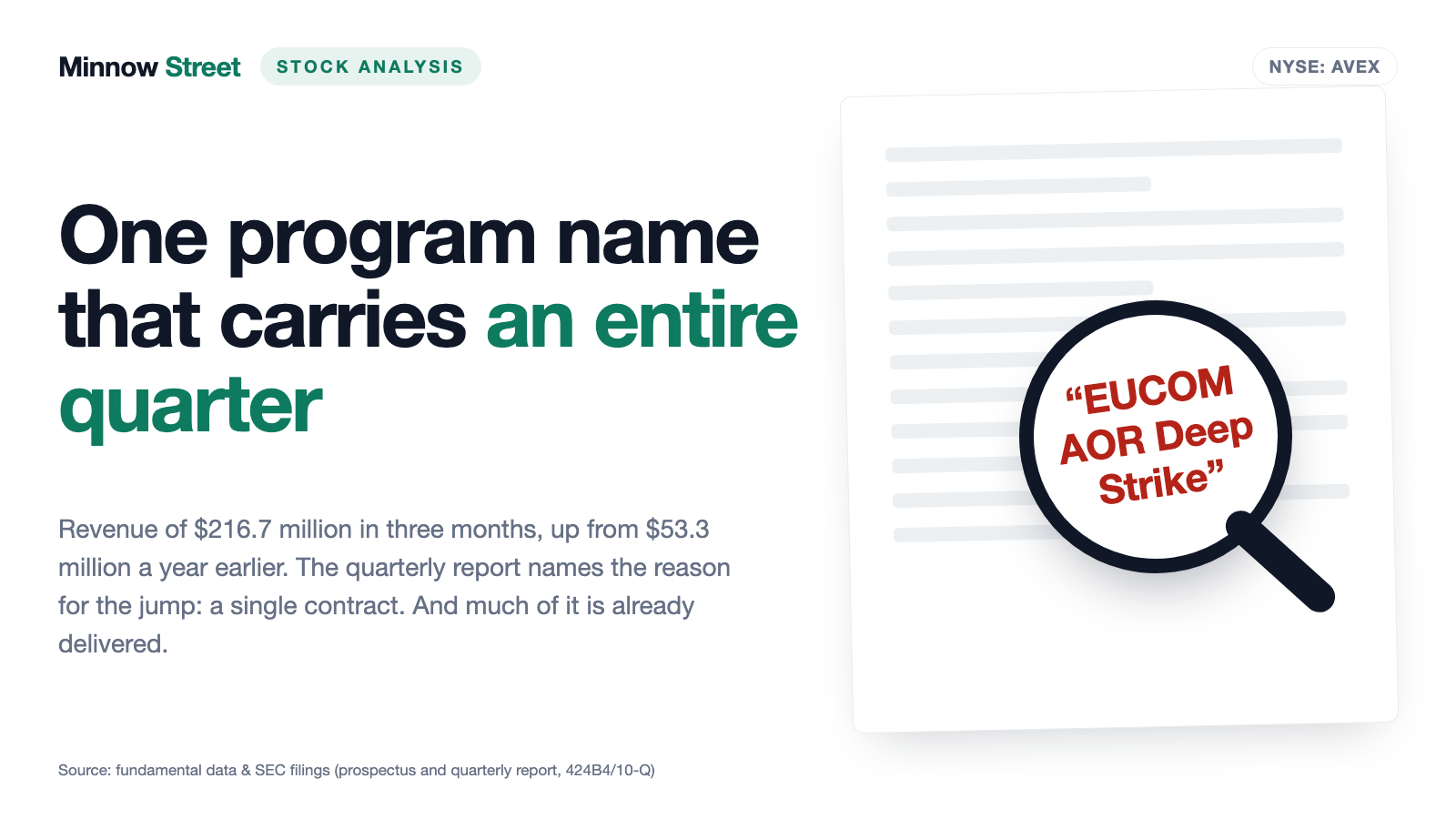
Interactive price chart (TradingView).
Note: pure fact-based analysis, not investment advice and not a solicitation to buy or sell. All figures without guarantee.
There is a small accountant living inside every investor, and he owns exactly one favorite operation: times four. A company posts a strong quarter, and he punches the revenue into his calculator, multiplies by four, and hands you the result as if it were a forecast. With AEVEX Corp. (NYSE: AVEX) his math runs like this: $216.7 million in the first quarter of 2026, times four, equals $867 million for the year — against $432.9 million for all of 2025. A doubling! The company itself guides to $600 million to $620 million for 2026. Somebody here is off by a quarter of a billion dollars, and it is not the company. So let us make a deal: before the calculator keeps going, we read together what AEVEX filed with the U.S. securities regulator, the SEC — the prospectus dated April 20, 2026 with the audited annual figures, the Form 10-Q for the quarter ended March 31, 2026, the earnings release of May 20, 2026, and the second prospectus dated June 5, 2026. A filing with the SEC is honest under penalty of law. And this one explains the record quarter with a single program name — while showing, in the same breath, what that contract leaves behind in the order book.
What AEVEX actually does — aircraft for the real thing, software at the core
AEVEX builds unmanned systems: aircraft without pilots and boats without crews, plus the software that lets them find their own way. Almost all of them are bought by government customers — the U.S. Department of War, special operations forces and the intelligence community. The company is based in Solana Beach near San Diego, employed roughly 650 people as of December 31, 2025, and says it has worked on U.S. national security missions since 2007. Two segments split the work: Tactical Systems (about 74.4 percent of 2025 revenue) designs and manufactures the vehicles themselves; Global Solutions supplies airborne surveillance, counter-drone capability, field-deployable additive manufacturing and the engineering and modification of special mission aircraft.
What separates this from a hobby drone with a camera is the software. AEVEX calls it CompassX, described in the prospectus as a "proprietary AI-based CompassX sensor-fusion engine." In plain language: sensor fusion means the aircraft does not listen to one signal but reads several senses at once — camera images, motion sensors, radio reception — and works out for itself where it is and where it is going. That matters when an adversary jams the satellite signal: a vehicle that does not need GPS keeps flying where an ordinary one stops. It is also why our AI classification places AEVEX in the "sells AI" category — here the artificial intelligence is not a marketing sticker but part of the product being sold.
The largest single undertaking carries an unwieldy name and is the quiet lead character of this analysis. The prospectus describes it this way:
"We are the sole provider on the EUCOM AOR Deep Strike program, an over $645.7 million contract to deliver over 4,800 UAS across seven platforms and have approximately $5.0 billion in UxS-specific pipeline as of December 2025."
— AEVEX Corp., SEC prospectus 424B4 filed April 20, 2026, "Business — Tactical Systems"
That names the central tension of this analysis, and it runs through every chapter: one very large contract turned AEVEX from a money-loser into a profitable company within a year — and that same contract has largely been delivered.
How the stock reached our desk — through the list of recent listings
AEVEX did not arrive via one of our scanners but through our running watchlist of newly listed U.S. stocks. The reason is itself a finding. As of July 28, 2026, AEVEX appears in none of the lists produced by our in-house stock scanner — not because of the company\'s quality, but because of how the math works. Relative strength measures price behavior over twelve months; AEVEX has only traded since April 17, 2026. The Piotroski score, our nine-point balance-sheet check, compares two audited annual reports filed as a public company; AEVEX has none. An analyst consensus is likewise missing from our data. Our scanner lists are recalculated daily, so this sentence applies to the date given and may resolve itself with time.
That is not a footnote, it is the most important caveat in this analysis: with a recent IPO, almost everything you normally use to check a stock is missing. There is no annual report (10-K), because fiscal 2025 ended before the shares were listed at all. The audited figures for 2024 and 2025 therefore sit not in an annual report but in the IPO prospectus — the document a company must file with the SEC to introduce itself before going public. It is a solid primary source, but it is a selling document with an auditor\'s opinion attached rather than an accountability report. And there is exactly one quarterly report from AEVEX as a public company. Anyone pretending to a long track record here is pretending. We are not: this analysis rests on two annual statements pulled from a prospectus and a single quarter.
Remember the rule for every new listing: a short history does not mean low risk, it means little material for comparison. How badly that can distort the picture shows up at another drone maker — in our analysis of Red Cat Holdings, announced awards and actually recognized revenue also sit far apart.
The numbers over the years — given their due
First what genuinely impresses. AEVEX is not a company with revenue hopes and no revenue: 2024 revenue was $392.2 million, 2025 revenue $432.9 million (up 10.4 percent). The first quarter of 2026 then delivered $216.7 million in three months — more than the first two quarters of 2025 combined. Gross profit, what remains after direct production costs, jumped from $3.1 million to $56.5 million, taking gross margin from 5.7 percent to 26.1 percent. An operating loss of $20.3 million became operating income of $29.6 million, and a net loss of $27.3 million became net income of $21.0 million. That is not cosmetics, that is a real turn.
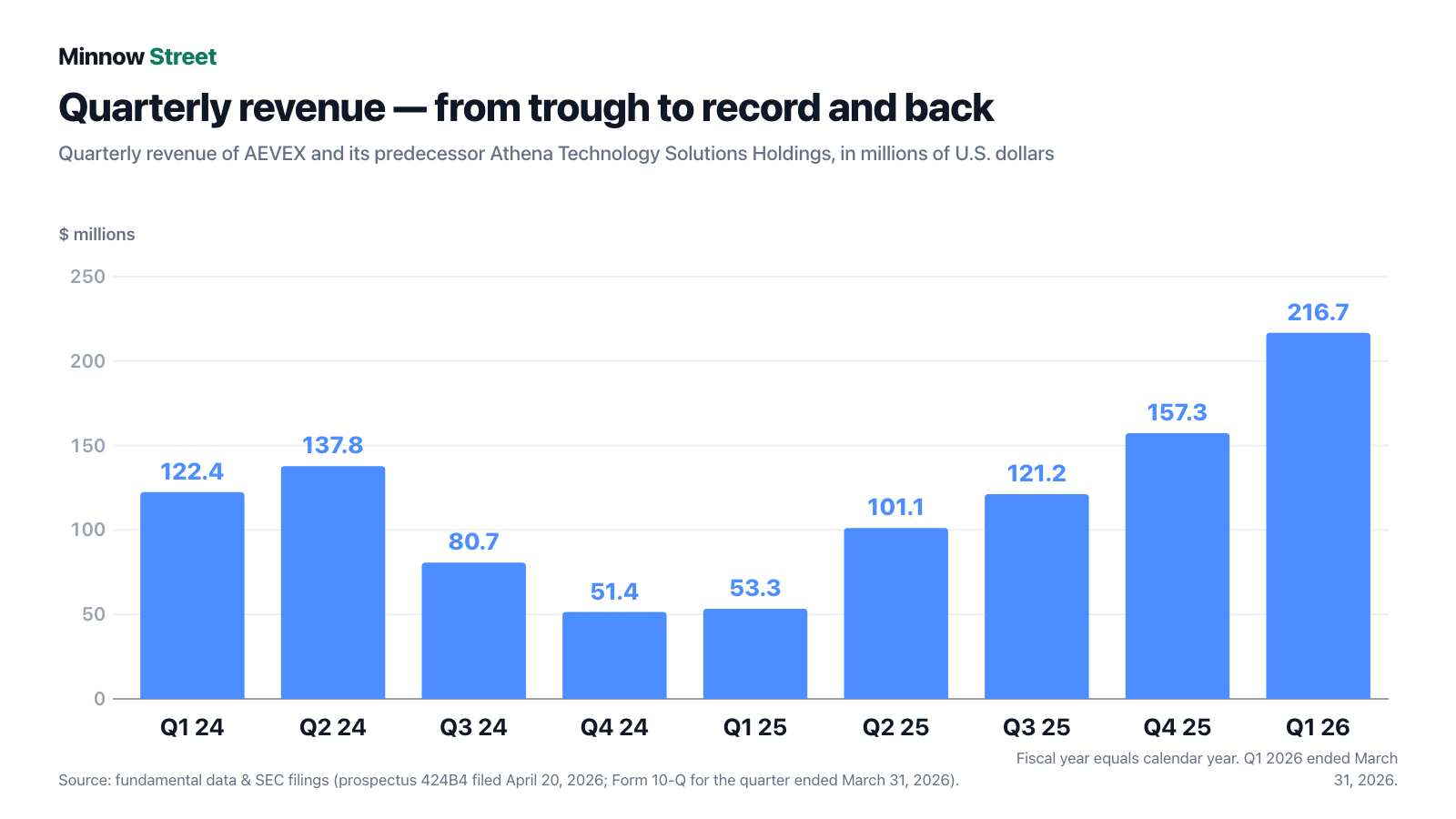
The chart also shows what the calculator misses: this company has crashed before. From $137.8 million in the second quarter of 2024 revenue fell to $51.4 million two quarters later — down 63 percent. The cause was the same as today\'s upswing, only with the sign reversed: the previous flagship program, Phoenix Ghost, was "substantially completed as of December 31, 2024," in the prospectus\' words. What followed was a year with a $16.8 million net loss, until the successor contract, Deep Strike, began to bite. At AEVEX revenue does not move in a line, it moves in waves — and every wave is named after a program.
One 2024 figure deserves an asterisk: the reported net income of $78.6 million was not operating profit of that size. It included the release of $61.6 million from an earnout liability tied to the 2022 acquisition of Tribe Aerospace — money that no longer had to be paid and therefore lifted earnings. Adjusted EBITDA was $77.0 million in 2024 and $37.6 million in 2025. For 2026 the company guides to $88.0 million to $94.5 million.
What the filings say — the uncomfortable truths
Uncomfortable truth No. 1: the record revenue and the shrinking backlog are the same event
For a defense contractor, backlog is the most important number after revenue — it says how much paid-for work already sits on the books. AEVEX reports funded backlog, meaning only awards for which money has already been appropriated. And it collapsed during the record quarter: from $503.1 million on December 31, 2025 to $356.6 million on March 31, 2026. Down $146.5 million in three months. The quarterly report explains both movements in one passage:
"The decrease of $146.5 million in funded backlog for the three months ended March 31, 2026 was primarily due to revenue recognized for the EUCOM AOR Deep Strike program during the three months ended March 31, 2026. We expect to convert approximately 93.0% of the total $356.6 million of funded backlog as of March 31, 2026 into revenue during the remainder of 2026."
— AEVEX Corp., SEC Form 10-Q for the quarter ended March 31, 2026, "Funded Backlog"

Read the second number again: 93.0 percent of the remaining backlog is meant to be consumed in 2026, leaving only 7.0 percent for 2027 and beyond — roughly $25 million. In plain terms: the shop has a full calendar until New Year\'s Eve and a blank page after it. That need not be a problem if new awards arrive — AEVEX cites an $8.1 billion pipeline and has documented a fresh win on the Army\'s Launched Effects–Short Range program. But a pipeline is a wish list, not an order book. Only what sits in funded backlog has been paid for.
Management guidance confirms the arithmetic. On May 20, 2026 AEVEX called for full-year 2026 revenue of $600 million to $620 million. After $216.7 million in the first quarter, $383 million to $403 million remains for the final nine months — an average of roughly $128 million to $134 million per quarter. The first quarter, in other words, was not the starting point of a ramp but, on the company\'s own estimate, the peak. The calculator from the opening was off by about a quarter of a billion dollars.
Uncomfortable truth No. 2: the profit is on paper, the cash left the building
One number in the first quarter of 2026 points the opposite way from earnings. Despite $21.0 million of net income, $10.4 million of cash flowed out of operations. The cash flow statement explains it: receivables rose by $30.4 million and contract assets — work performed but not yet billable — by another $41.0 million. Together, $71.4 million of work delivered and booked but not yet paid for. Of the $85.8 million in receivables outstanding on March 31, 2026, $63.8 million had not even been invoiced.
And this was no one-quarter blip. Full-year 2025 was worse:
"Net cash used in operating activities for the year ended December 31, 2025 was $97.6 million, compared to net cash provided by operating activities of $64.9 million for the year ended December 31, 2024."
— AEVEX Corp., SEC prospectus 424B4 filed April 20, 2026, "Liquidity and Capital Resources — Operating Activities"

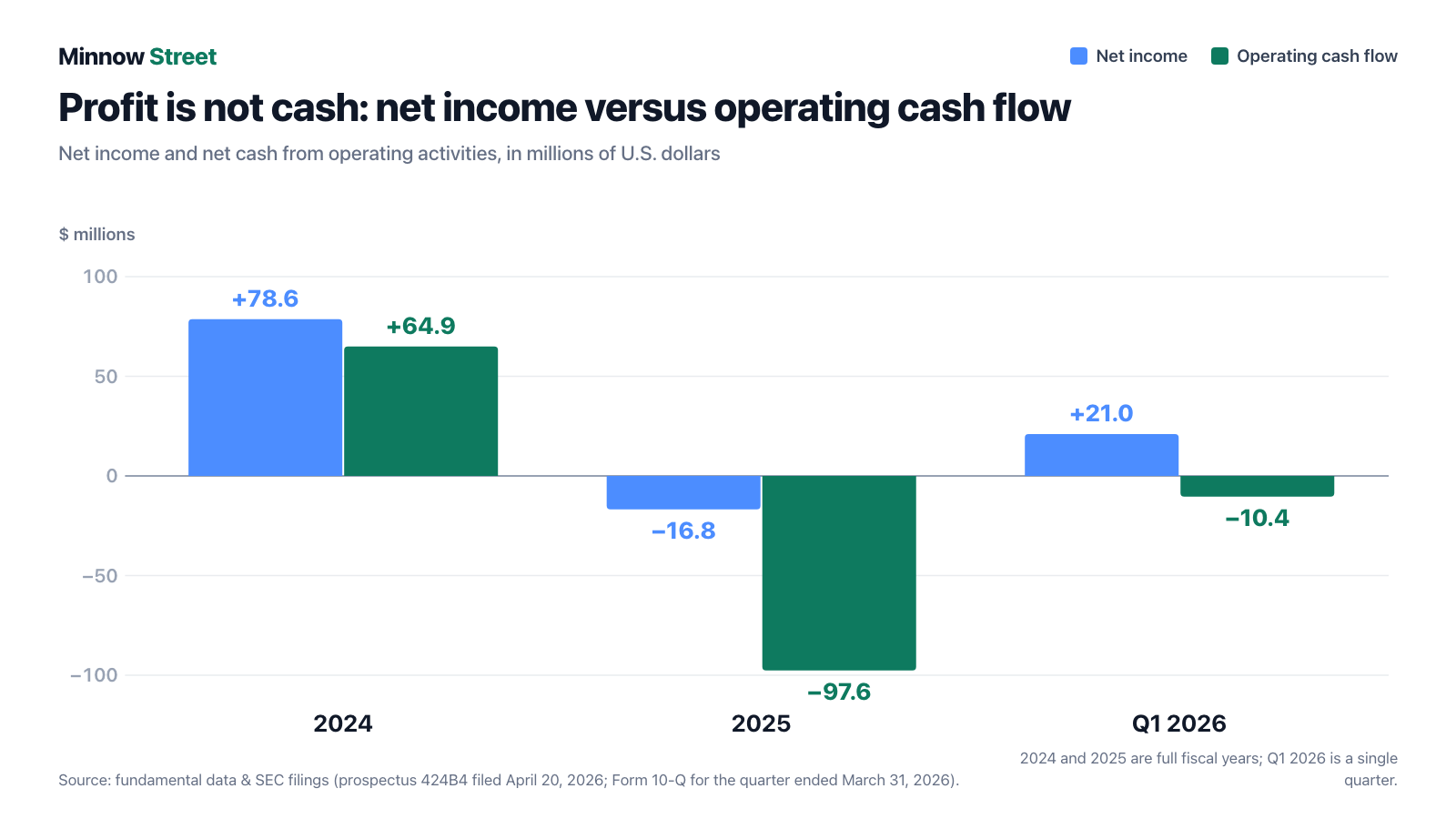
In plain terms: the business has a full order book, buys materials on its own account, builds, delivers — and then waits for a government agency to pay. The profit is already in the ledger; the money is not yet in the bank. For a company with $27.4 million of cash on March 31, 2026, that was tight. Which is exactly why the IPO was more than a trophy: from the $345.9 million of net proceeds and a new $100.0 million term loan, roughly $258.5 million of old borrowings were repaid, $3.3 million of refinancing costs and $10.3 million of IPO costs were settled — leaving roughly $174 million for general corporate purposes on our arithmetic. The old loan carried a 9.67 percent interest rate as of March 31, 2026; for 2026 the company now expects total interest expense of about $13.2 million against $32.3 million in 2025. That is the single strongest improvement in this whole analysis — and it has not yet been confirmed by an audited statement, appearing so far only in the subsequent-events note.
Uncomfortable truth No. 3: one customer, free to walk away at any time
Customer concentration is normal at defense contractors — at AEVEX it is extreme. In the first quarter of 2026, 88 percent of revenue came directly from the U.S. government and its agencies (68 percent a year earlier, 78 percent for full-year 2025 and 81 percent for 2024). Receivables are more concentrated still: customer A accounted for 71 percent of all receivables on March 31, 2026, with customer B adding 13 percent. A year earlier customer A stood at 42 percent.

More important than the percentage is the contractual position. The prospectus states it without varnish:
"The U.S. military funds a portion of our contracts through operational needs statements, and to a lesser extent, through programs of record, which provides us with less visibility and certainty on future funding allocations for our contracts. Furthermore, all of our contracts with the U.S. Government are terminable by the U.S. Government at will, and the increasing government spending reviews may result in revocation of previously awarded contracts."
— AEVEX Corp., SEC prospectus 424B4 filed June 5, 2026, "Risk Factors — We rely heavily on sales to certain customers"
Two things sit in that paragraph. First, a large share of the business hangs on operational needs statements rather than multi-year programs of record. That is a strength as long as a conflict somewhere demands resupply, and a weakness the moment things calm down — the revenue collapse after Phoenix Ghost was exactly that. Second, the customer can walk away at any time. This is standard in U.S. government contracting (the company is then reimbursed for costs incurred plus a reasonable profit), but it means a $356.6 million backlog is not a guarantee, it is a statement of intent with a termination clause. How heavily individual programs can drive a supplier\'s results also shows up in our analysis of Mercury Systems, where the wind-down of specific programs weighed on margins for years.
Uncomfortable truth No. 4: half the company does not show up in the usual market-cap math
Now the part worth reading twice. AEVEX is built as an Up-C structure — an arrangement in which the listed corporation is only one owner of the actual operating company, while the pre-IPO owners hold their stakes directly in that operating company. Those stakes can be exchanged one-for-one into Class A shares at any time. For you as an investor that means: the share count you see on a quote page is not the company\'s share count. The June 5, 2026 prospectus lays it out:
"56,470,333 shares (or 57,329,256 shares if the underwriters' option is exercised in full). If all outstanding LLC Units held by the LLC Unitholders were exchanged for newly-issued shares of Class A common stock on a one-for-one basis, 114,041,700 shares of Class A common stock would be outstanding."
— AEVEX Corp., SEC prospectus 424B4 filed June 5, 2026, "The Offering"

Attached to that structure is a second contract that costs new shareholders money: the Tax Receivable Agreement. It obliges AEVEX to pay 85 percent of the tax benefits arising from those exchanges in cash to the pre-IPO owners. Only 15 percent stays with the company. The prospectus calculates that a full exchange at the $27.00 offering price would create a liability of roughly $392.1 million, and says in so many words: "We expect that the payments we may make under the Tax Receivable Agreement will be substantial." Then there is the question of control: after the follow-on offering, private equity firm Madison Dearborn Partners holds roughly 70.0 percent of the voting power. AEVEX therefore qualifies as a "controlled company" and may forgo an independent board majority and independent board committees.
Valuation: the share count you pick decides half the answer
Here it gets practical. A data provider counting only the 56,470,333 Class A shares arrives at a market value of roughly $0.85 billion on July 28, 2026. That is not bad arithmetic — it simply describes one half of the company. Using all 114,041,700 shares that a full exchange would create, the order of magnitude changes. We therefore set the provider figure aside and work from dated anchor prices documented in the SEC filings themselves:
- $20.00 — the IPO price, with the offering closing on April 20, 2026 → roughly $2.28 billion
- $27.00 — the follow-on offering price of June 5, 2026 (the June 3 closing price, per the prospectus, was $27.66) → roughly $3.08 billion
- $15.21 — the closing price on July 28, 2026, the date of our data → roughly $1.73 billion
Measured against the company\'s own 2026 revenue guidance ($600 million to $620 million), that is a price-to-sales ratio of roughly 2.8 to 5.0, depending on which of the three days you pick. Measured against guided adjusted EBITDA ($88.0 million to $94.5 million), the multiple runs between roughly 19 and 34. For a defense supplier growing at a double-digit rate that is no bargain, but it is no bubble either — it is a price that assumes another large award follows Deep Strike.
A word on the share price, because it belongs in an honest picture: as of July 28, 2026 the stock traded roughly 62 percent below its highest price to date, reached on April 20, 2026, and below the $20.00 IPO price. A price is not a quality judgment, and a fallen price is not a reason to buy. But it does show that the market has already corrected the first-quarter extrapolation on its own.
Opportunities and risks at a glance
What speaks for AEVEX:
- A real business of scale with earning power: revenue of $432.9 million in 2025 (up 10.4 percent), $216.7 million in the first quarter of 2026 alone, gross margin there of 26.1 percent against 5.7 percent, and operating income of $29.6 million after a $20.3 million loss.
- The balance sheet was relieved by the IPO: roughly $258.5 million of old borrowings repaid, replaced by a $100.0 million term loan drawn from a $375.0 million total facility; interest expense is guided to fall to about $13.2 million in 2026 from $32.3 million in 2025.
- Technical differentiation backed by demand: sole provider on the Deep Strike program (contract value above $645.7 million, more than 4,800 aircraft), more than 6,200 systems delivered, prime contractor on 84 percent of all programs, and capacity to produce over 1,000 systems per month.
- The software is the moat candidate: CompassX delivers navigation and autonomy without a satellite signal — precisely the capability that decides between mission and failure in contested environments — and is expected to underpin 100 percent of the company\'s unmanned systems by the end of 2026.
- Policy tailwind: AEVEX sizes the addressable market for unmanned systems at roughly $11.0 billion in the U.S. and $26.0 billion globally by 2030, and cites an $8.1 billion pipeline of its own as of December 2025.
What speaks against it:
- Program dependency rather than series production: one contract explains the jump from $53.3 million to $216.7 million — and the same contract pushed funded backlog from $503.1 million down to $356.6 million, of which 93.0 percent is meant to be consumed during 2026.
- The company\'s own guidance describes a decline: $600 million to $620 million for 2026 implies roughly $128 million to $134 million per remaining quarter — far below the $216.7 million opening quarter.
- Cash and profit diverge: $97.6 million of cash used in operations during 2025 (free cash flow of negative $105.1 million), plus another $10.4 million in the first quarter of 2026 despite $21.0 million of net income; $63.8 million of the $85.8 million in receivables had not been invoiced as of March 31, 2026.
- One customer, one termination right: 88 percent of first-quarter 2026 revenue from the U.S. government and 71 percent of receivables tied to a single customer — with every government contract terminable at will, per the prospectus.
- A structure tilted against new shareholders: 114,041,700 shares instead of 56,470,333 on full exchange, roughly 70.0 percent voting control at Madison Dearborn Partners, "controlled company" status, a tax promise to the pre-IPO owners illustrated at $392.1 million — and an equity plan covering a further 11,404,170 shares with annual increases of up to 3 percent from 2027.
- A very thin reporting record: no annual report (10-K), a single quarterly report as a public company, emerging growth company status with reduced disclosure — and a lock-up for pre-IPO holders that expires on October 13, 2026 per the prospectus.
A human bottom line
Back to the calculator from the opening. It did nothing wrong — it did exactly what it was built for: multiply. Its error was not the arithmetic but the assumption behind it: that a quarter describes one fourth of a year. At AEVEX, a quarter describes a contract. That is the whole difference, and it is documented openly in the SEC filings: the same program name explains the record revenue, the margin jump, the backlog collapse and the 2025 cash outflow. Buying AEVEX is not buying a revenue curve; it is a bet that a third program follows Phoenix Ghost and Deep Strike — and that the $8.1 billion pipeline is more than a wish list.
That bet can pay. The company delivers, it carries far less debt after the IPO, its software solves a problem that is real on modern battlefields, and the policy tailwind is not marketing. But these are two very different investment cases, and you need to know which one you are buying. So the honest question is not "how fast is AEVEX growing?" but: are you willing to hold a company whose revenue arrives in waves — when the next wave does not yet have a name? If yes, then check the same single line in every quarterly report: funded backlog. If no, watching from the sidelines is an entirely respectable answer. What you make of it is your decision. And that is exactly as it should be.
Sources
Every original document used in this analysis, for you to read yourself:
- AEVEX Corp. — SEC prospectus 424B4 filed April 20, 2026 (audited 2024 and 2025 financial statements, business description, risk factors)
- AEVEX Corp. — SEC Form 10-Q for the quarter ended March 31, 2026 (filed May 20, 2026)
- AEVEX Corp. — First-quarter 2026 earnings release with full-year guidance (Exhibit 99.1 to the Form 8-K of May 20, 2026)
- AEVEX Corp. — SEC prospectus 424B4 filed June 5, 2026 (follow-on offering, share count, Tax Receivable Agreement, lock-up)
- AEVEX Corp. — SEC Form 8-K of April 24, 2026 (new $375.0 million credit facilities, repayment of prior borrowings)
- AEVEX Corp. — SEC Form 8-K of June 5, 2026 (pricing of the follow-on offering at $27.00)
- Complete SEC filing history for AEVEX Corp. (CIK 0002096300): EDGAR overview (sec.gov) — including the Forms 4 filed June 8, 2026
- Fundamental data (metrics and price history; data as of July 28, 2026), reconciled with the SEC filings listed above.
Transparency & disclaimer: this analysis is journalistic commentary on publicly available information. It is not investment advice, not a research report in any regulatory sense, and not a solicitation to buy or sell securities. Equity investments carry substantial risk, up to and including total loss. All figures are provided without warranty; the as-of date for each figure is stated in the text. The author holds no position in AEVEX shares at the time of publication.
Our Bottom Line at a Glance
- Market position & technology positive
- AEVEX is the sole provider on the EUCOM AOR Deep Strike program (contract value above $645.7 million, more than 4,800 aircraft), has delivered over 6,200 systems, and says it is prime contractor on 84 percent of all its programs. Its in-house CompassX software delivers navigation and autonomy without a satellite signal — the capability that makes the difference in contested environments (prospectus filed April 20, 2026).
- Earnings trajectory positive
- The turn is real: first-quarter 2026 revenue reached $216.7 million (prior-year quarter $53.3 million), gross margin went from 5.7 percent to 26.1 percent, and net income swung from a $27.3 million loss to a $21.0 million profit. Full-year 2025 also grew 10.4 percent to $432.9 million (Form 10-Q for the quarter ended March 31, 2026; prospectus filed April 20, 2026).
- Order book & visibility negative
- Funded backlog fell during the record quarter from $503.1 million to $356.6 million; 93.0 percent of that is meant to be consumed during 2026, leaving only 7.0 percent for 2027 and beyond. Guidance of $600 million to $620 million for 2026 implies an average of $128 million to $134 million per remaining quarter — the first quarter was the peak, not the starting point (as of May 20, 2026).
- Cash flow & balance sheet neutral
- Operations consumed $97.6 million of cash in 2025 and another $10.4 million in the first quarter of 2026 despite the reported profit — driven by a combined $71.4 million increase in receivables and unbilled work. Against that stands a markedly relieved balance sheet: roughly $258.5 million of old borrowings repaid, a $100.0 million term loan in their place, and interest expense guided to about $13.2 million in 2026 after $32.3 million in 2025.
- Customer concentration negative
- 88 percent of first-quarter 2026 revenue came directly from the U.S. government, and 71 percent of all outstanding receivables were tied to a single customer as of March 31, 2026. The prospectus states that all government contracts are terminable at will and that part of the work is funded through short-term operational needs statements rather than programs of record.
- Structure & shareholder rights negative
- 56,470,333 Class A shares become 114,041,700 on full exchange; Madison Dearborn Partners controls roughly 70.0 percent of the voting power, making AEVEX a "controlled company" with relaxed governance requirements. Add a tax promise to the pre-IPO owners illustrated at $392.1 million, an equity plan covering 11,404,170 shares, and a lock-up that expires on October 13, 2026 (prospectus filed June 5, 2026).
AEVEX is a genuine, technically strong defense company with a very short public record: first trade April 17, 2026, one quarterly report, audited annual figures available only from a prospectus. The first quarter of 2026 was spectacular — $216.7 million of revenue after $53.3 million, and $21.0 million of profit after a $27.3 million loss — and the filings attribute it largely to a single program that, in the same quarter, pushed funded backlog from $503.1 million down to $356.6 million. Add $97.6 million of cash consumed by operations in 2025, a customer supplying 88 percent of revenue who may terminate at will, and an ownership structure in which half the company sits outside the traded share. Not investment advice.
What Our Rating Means
Open questions
The business works in principle, but one material question is open. As long as it stays open, our findings do not carry a quality verdict.
Green is out of reach for lack of repeatability; red is not warranted for lack of any substance risk. The business plainly works: 2025 revenue grew 10.4 percent to $432.9 million, the first quarter of 2026 delivered $216.7 million and $21.0 million of profit, equity is positive at $222.1 million, and the IPO replaced roughly $258.5 million of old borrowings with a $100.0 million term loan, with interest expense guided down to about $13.2 million for 2026. What is open is the decisive operating question: results hang on one large contract whose delivery cut funded backlog by $146.5 million to $356.6 million in a single quarter, 93.0 percent of which is meant to be consumed during 2026. Guidance of $600 million to $620 million, implying $128 million to $134 million per remaining quarter, confirms it. Add $97.6 million of operating cash outflow in 2025 and $10.4 million in the first quarter of 2026, plus a customer supplying 88 percent of revenue who can terminate at will. No annual report (10-K) yet shows any of this over a full year as a public company, so yellow it stays. The decision is yours.
A journalistic assessment by our editorial team at the time of the deep dive, based on public sources — not investment advice and not a solicitation to buy or sell. Your personal circumstances (investment goals, risk capacity, taxes) cannot be taken into account. What our levels mean, how verdicts are formed, and what conflicts of interest exist →
Worth Noting
- AEVEX reached our research list through our watchlist of newly listed U.S. stocks rather than a scanner: as of July 28, 2026 the stock appears in no list from our in-house stock scanner, because relative strength requires twelve months of price history and the nine-point balance-sheet check requires two audited annual reports filed as a public company. Those lists are recalculated daily.
- Data basis and its limits: there is no annual report (10-K) yet, because fiscal 2025 ended before the listing. The audited 2024 and 2025 figures come from the 424B4 prospectus filed April 20, 2026, and the quarterly figures from the Form 10-Q for the period ended March 31, 2026 — the only periodic filing so far. Balance-sheet figures as of March 31, 2026 refer to the operating company before the IPO.
- Valuation figures are dated and evergreen: we use 114,041,700 shares (full exchange of all LLC units) and the three anchor prices documented in SEC filings — $20.00 (April 20, 2026), $27.00 (June 5, 2026) and the $15.21 close (July 28, 2026). A market value counting only the 56,470,333 Class A shares leaves out roughly half the company and is deliberately not used here.
Frequently Asked Questions
AEVEX Corp. (NYSE: AVEX), headquartered in Solana Beach, California, develops and manufactures unmanned aerial and surface vehicles along with the CompassX autonomy software that runs them. Its customers are almost exclusively the U.S. Department of War, special operations forces, the intelligence community and allied militaries. The company runs two segments: Tactical Systems (about 74.4 percent of 2025 revenue) and Global Solutions. It employed roughly 650 people as of December 31, 2025.
Because a single program explains the move. The Form 10-Q for the quarter ended March 31, 2026 attributes the rise from $53.3 million to $216.7 million largely to the EUCOM AOR Deep Strike program — a contract worth more than $645.7 million for over 4,800 unmanned aircraft on which AEVEX is the sole provider. Products revenue rose 624.3 percent as a result, while services revenue fell 7.2 percent.
Because fiscal 2025 ended on December 31, 2025 and AEVEX only began trading on the New York Stock Exchange on April 17, 2026. No annual report is required with the SEC for a year that ended before the listing. The audited statements for 2024 and 2025 therefore sit in the 424B4 prospectus filed April 20, 2026. The first annual report of its own will cover 2026; until then the quarterly report for the period ended March 31, 2026 is the only periodic filing.
After the follow-on offering of June 5, 2026, 56,470,333 Class A shares were outstanding. Because AEVEX is built as an Up-C structure, however, the pre-IPO owners hold their stakes directly in the operating company and can exchange them one-for-one into Class A shares. On a full exchange that would be 114,041,700 shares, per the prospectus. Computing market value from the Class A count alone leaves out roughly half the company.
It is an agreement under which AEVEX commits to pay 85 percent of the tax benefits arising from the pre-IPO owners' unit exchanges in cash to those same owners; only 15 percent stays with the company. The prospectus of June 5, 2026 illustrates that a full exchange at the then-offering price of $27.00 would create a liability of roughly $392.1 million, and expressly calls the payments "substantial."
Heavily. In the first quarter of 2026, 88 percent of revenue came directly from the U.S. government and its agencies, against 68 percent a year earlier and 78 percent for full-year 2025. A single customer accounted for 71 percent of all outstanding receivables as of March 31, 2026. The prospectus also states that all U.S. government contracts are terminable by the government at will and that part of the work is funded through short-term operational needs statements rather than programs of record.
The IPO closed on April 20, 2026: 18,400,000 Class A shares at $20.00, for net proceeds of roughly $345.9 million after $22.1 million in underwriting discounts. The money went mostly toward repaying roughly $258.5 million of old borrowings. A follow-on offering of 8,000,000 shares at $27.00 followed on June 5, 2026; the roughly $148.8 million of net proceeds to the company were, per the prospectus, used entirely to buy back units from the pre-IPO owners.
Found an error?
Did you spot a factual error, an outdated number, or a typo in this deep dive? Let us know briefly — your report goes straight to the editorial team.