Summit Midstream: A Price to Cash Flow of 3.2 — and the $1.2 Billion That Ratio Never Sees
On July 25, 2026, our in-house stock scanner listed Summit Midstream on four trend screens and one value screen: price to cash flow of 3.2, the kind of number that makes investors lean in. The quarterly report filed May 11, 2026, supplies the lines that ratio leaves out: $1,222.4 million of net debt, 6,524,467 voting Class B shares with no economic claim of their own, and 65,508 preferred shares whose $46.3 million of accrued dividends were only cleared in March 2026. Count all of it and 3.2 becomes 14.4. The stock also surfaced on Reddit that same day, with 2 mentions. Not investment advice — just a look at everything the price tag leaves off.
 Thomas Mücke
Founder & Publisher
Thomas Mücke
Founder & Publisher
Chart
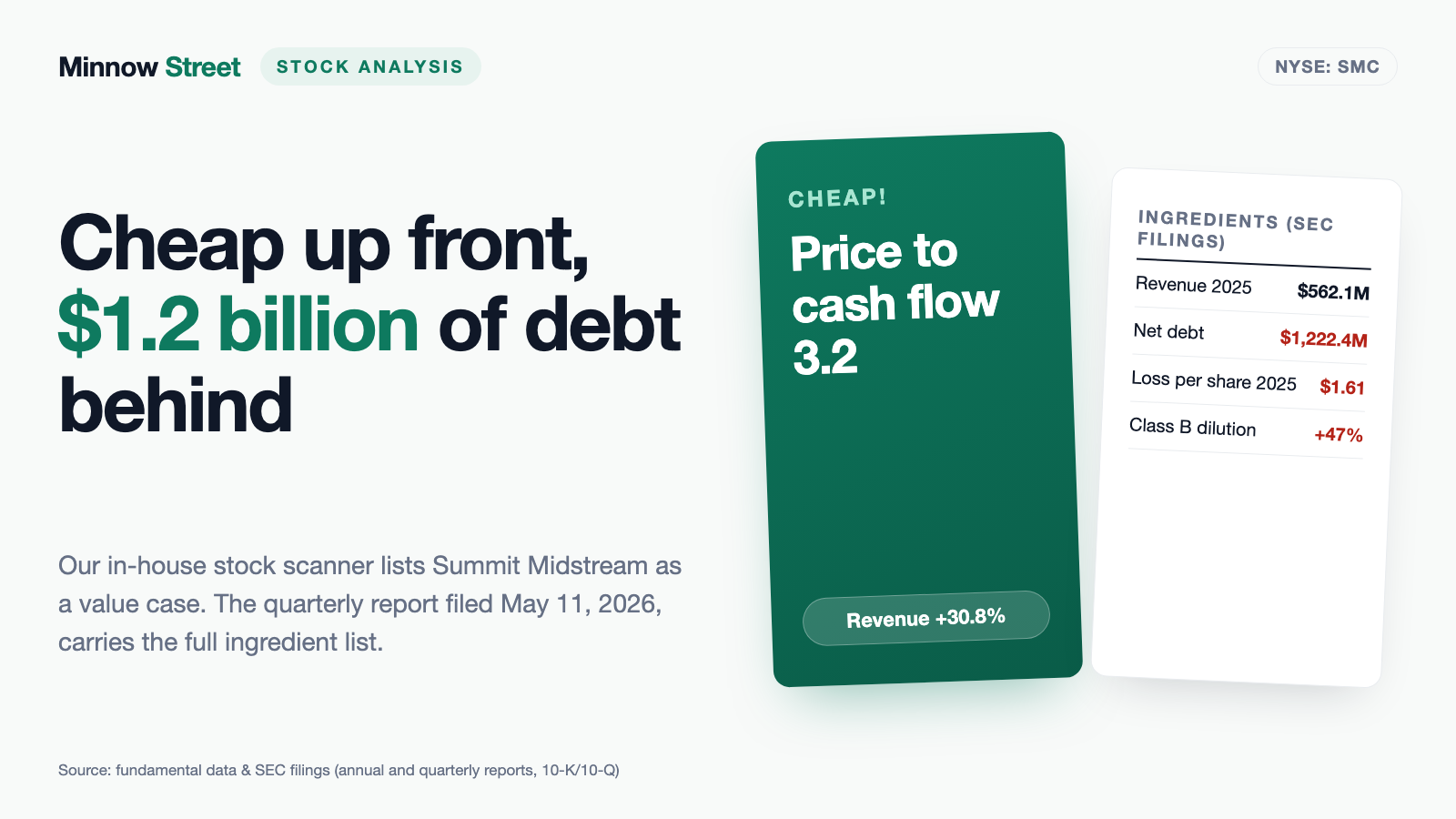
Interactive price chart (TradingView).
Note: pure fact-based analysis, not investment advice and not a solicitation to buy or sell. All figures without guarantee.
There is an investing trap that feels like a favor you are doing yourself: the bargain reflex. You spot a single low number — a price to cash flow ratio of 3.2, while the broad market trades at four or five times that — and something clicks: "The market missed this one." The reflex is stubborn precisely because it feels like diligence. You did check a metric, after all. It is just that at Summit Midstream Corporation (NYSE: SMC), that metric measures something other than most people assume. Our in-house stock scanner did list the stock on its value screen on July 25, 2026, and the same day it surfaced in our daily Reddit mention scan with 2 mentions. So let us make a deal: before you trust the price tag, we will read together what the company itself told the U.S. securities regulator, the SEC — the annual report (10-K) for 2025 filed March 16, 2026, and above all the quarterly report (10-Q) as of March 31, 2026, filed May 11, 2026. An SEC filing is honest under penalty of law. And this one describes a gas gatherer with a business running better than it has in years, $1,222.4 million of net debt, a second class of shares with no economic claim, and a single customer growing more important by the year. What you make of it is up to you.
What Summit Midstream actually does — the toll booth between wellhead and power plant
Summit Midstream belongs to the midstream business, and the word explains most of it: this is the middle of the energy chain. Upstream sit the producers pulling hydrocarbons out of the ground; downstream sit refineries, power plants and export terminals. In between, the product has to be moved, compressed, cleaned and processed — and that is Summit\'s job. Put plainly: the company is the toll booth on the highway, not the carmaker and not the driver. It does not own most of the gas flowing through its pipes; it collects a fixed fee per unit of throughput. The annual report describes the company as a "value-oriented company focused on developing, owning, and operating midstream energy infrastructure assets" located in the core producing areas of unconventional resource basins.
The business spans four regions. The Rockies are the heart of it by a wide margin: $86.1 million of revenue in the first quarter of 2026. Then come Mid-Con ($37.1 million) and the Piceance basin in Colorado ($15.0 million). And then there is the Permian segment with all of $0.9 million in revenue — which nonetheless contributed $8.7 million of adjusted segment earnings, because the business there consists largely of a stake in the Double E pipeline that never appears in the revenue line. Remember that oddity; it is a useful reminder that no single line in this company\'s statements should be trusted on its own.
Part of the revenue carries extra protection: customers sign minimum volume commitments, meaning they pay even when they ship less than agreed. That mechanism produced $4.1 million in the first quarter of 2026. Not everything is insulated, though. Under some contracts Summit is paid in product and resells the gas itself — and there, commodity swings hit directly, much as they would for a producer. For how thoroughly energy prices can shape a business, see our analysis of APA Corporation.
That frames the central tension of this analysis, and it runs through every chapter: the business is performing better than it has in years — but the common equity is worth only about a fifth of the whole enterprise. Every cheap-looking metric measures exactly that small remainder.
How the stock reached our desk
The path did not start in a balance sheet but in a forum. Our daily Reddit mention scan flagged Summit Midstream for the first time on July 25, 2026: 2 mentions, with market capitalization at the time of the scan of $421.3 million. Two mentions are not a stampede — more of a throat-clearing — but they are enough to move a company onto the review list.
Things got interesting when we checked it against our in-house stock scanner. On July 25, 2026, SMC appeared on five screens, and the mix tells a story of its own. Four are trend screens, describing price behavior: Stan Weinstein: Stage 2 (the phase in which a stock breaks out of a long base into an uptrend), Strong DCR and Tight Weekly Range (both measuring how firmly and how calmly a stock closes near its highs), and Power Trend. The fifth is the only one that says anything about price: the price to cash flow ranking, which a stock joins only if its price to cash flow ratio is no higher than 10 and its operating cash flow is positive. Both were true.
Four trend screens plus one value screen is exactly the setup that triggers the bargain reflex: the price is moving, and the stock still looks cheap. Two caveats belong here immediately. First, these screens are recalculated daily; what held on July 25, 2026, may read differently a week later. Second — and this is the heart of the analysis — the price to cash flow ratio compares common market capitalization with operating cash flow. It knows nothing about debt. At a company whose borrowings are roughly three times its equity value, that is not a technicality; it is the whole difference. We described the same effect at a retailer whose numbers also looked friendlier than its position, in our analysis of Kohl\'s.
Why there are so few filings from this company
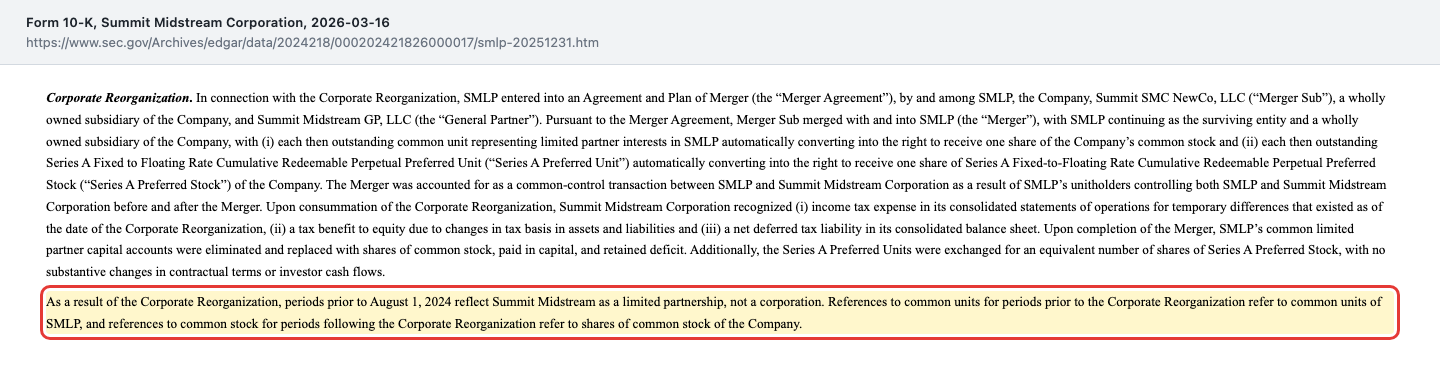
Open Summit Midstream\'s file at the SEC and you pause: under CIK 2024218 there are just two annual reports and a handful of quarterlies. For a company carrying more than a billion dollars of debt, that looks thin — as though someone tidied the past away. The explanation is mundane but essential for reading the numbers: the company changed its legal form in 2024. Until then it was the publicly traded partnership Summit Midstream Partners, LP, with its own older file number: CIK 1549922. That is where the entire prior history sits. The annual report says so plainly:
"As a result of the Corporate Reorganization, periods prior to August 1, 2024 reflect Summit Midstream as a limited partnership, not a corporation. References to common units for periods prior to the Corporate Reorganization refer to common units of SMLP, and references to common stock for periods following the Corporate Reorganization refer to shares of common stock of the Company."
— Summit Midstream Corporation, SEC annual report 10-K for 2025, basis of presentation
For you as an investor the change has two very practical consequences. First, taxes: holders of a U.S. partnership receive a Schedule K-1 every year — a cumbersome document that often arrives late and complicates filing, particularly for investors outside the United States. Since the conversion, holders get the ordinary Form 1099 instead, like any other stock. Second, the buyer base: many index funds and institutional investors are simply not permitted to own partnerships. With the conversion that barrier falls away, widening the pool of potential buyers. That is a real and frequently underrated advantage.
One more point matters: because the conversion was accounted for as a combination under common control — the legal form changed, not the ownership — the reported series continue uninterrupted. Revenue for 2023 and 2024 is therefore comparable with 2025. This analysis accordingly works on a single accounting basis throughout; where per-share figures appear for earlier periods, the filings are referring to partnership units.
The numbers over the years — credit where it is due
First, what genuinely argues for Summit Midstream. And it is more than the loss line suggests. Revenue jumped 30.8 percent in 2025, to $562.1 million — after $429.6 million in 2024 and $458.9 million in 2023. That is not one hot quarter but the result of acquisitions and higher volumes. More important still for an infrastructure business is the second series: operating cash flow, the money the running business actually deposits before capital spending and interest come out. It reached $133.6 million in 2025, following a weak interim year at $61.8 million (2024) and $126.9 million in 2023.
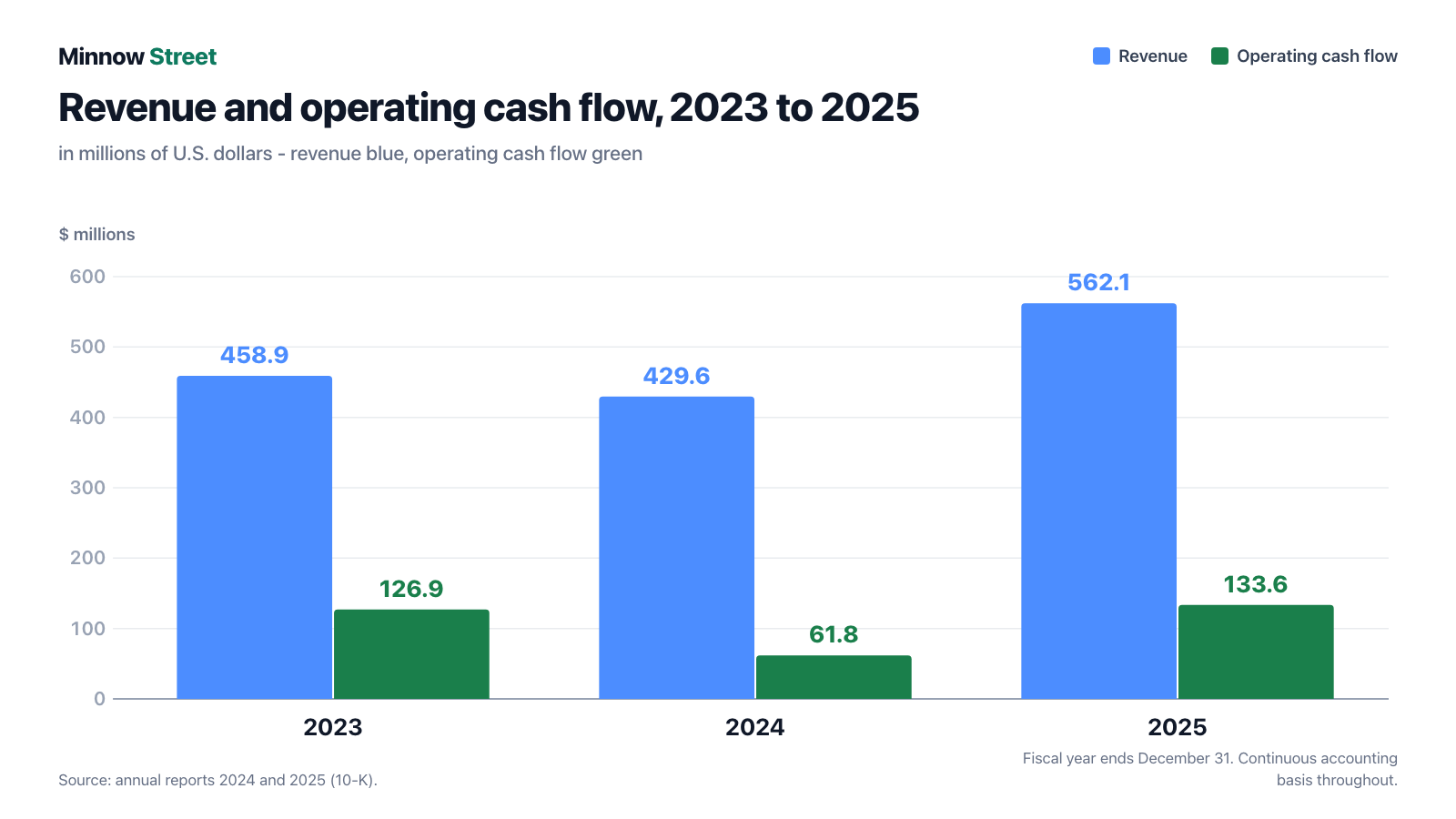
The pattern is worth noting: 2024 was the trough, and 2025 clears 2023. Operating cash flow more than doubled in a single year. The start of 2026 continues the trend — first-quarter revenue rose to $139.1 million from $132.7 million in the prior-year quarter.
Some of the tailwind comes from the market itself. The annual report for 2025 describes gas demand that has visibly turned:
"The average spot price of natural gas increased by approximately 61% from 2024 to 2025, primarily due to increasing demand. The average daily Henry Hub Natural Gas Spot Price was $3.52 per MMBtu during 2025, compared with $2.19 per MMBtu during 2024. As of January 31, 2026, Henry Hub 12-month strip pricing closed at $7.71 per MMBtu."
— Summit Midstream Corporation, SEC annual report 10-K for 2025, market environment

The same passage supplies the figure that matters most directly to a gas gatherer: the number of active gas drilling rigs in the continental United States rose, per Baker Hughes, from 102 in December 2024 to 125 in December 2025. More drilling means more gas in the pipes over time — and Summit earns on volume, not on price. As drivers the report cites population and economic growth, the displacement of coal-fired power by gas-fired generation, and growing U.S. LNG exports.
One expectation the report deflates simply by never mentioning it: data centers and the electricity demand behind artificial intelligence do not appear as demand drivers at all. If you are buying this stock as an AI derivative, the filings offer no support. Artificial intelligence appears exactly once in the entire annual report — in the cybersecurity risk section, as a tool that makes attacks more sophisticated. That is not a criticism of the company, but it is a sober check on a popular story.
What the filings say — the uncomfortable truths
Uncomfortable truth No. 1: the price tag covers only a fifth of the company
Now we take the bargain reflex apart. The price to cash flow ratio of 3.2 comes from a simple division: common market capitalization over operating cash flow. As of March 31, 2026, there were 13,814,286 common shares; multiplied by the issue price of $31.08 documented in the quarterly report, that gives market capitalization of $429.3 million. Divide by $133.6 million of operating cash flow and you land on 3.2. The arithmetic is right. It simply is not the whole company.
Anyone actually buying a business would have to take on more than the common stock. They would inherit the debt, they would have to satisfy the preferred holders, and they would have to account for the second class of shares. That measure is called enterprise value — in everyday terms: the price of a house is not just what you wire to the seller, but also the mortgage that comes with it. The bridge below shows both numbers side by side:
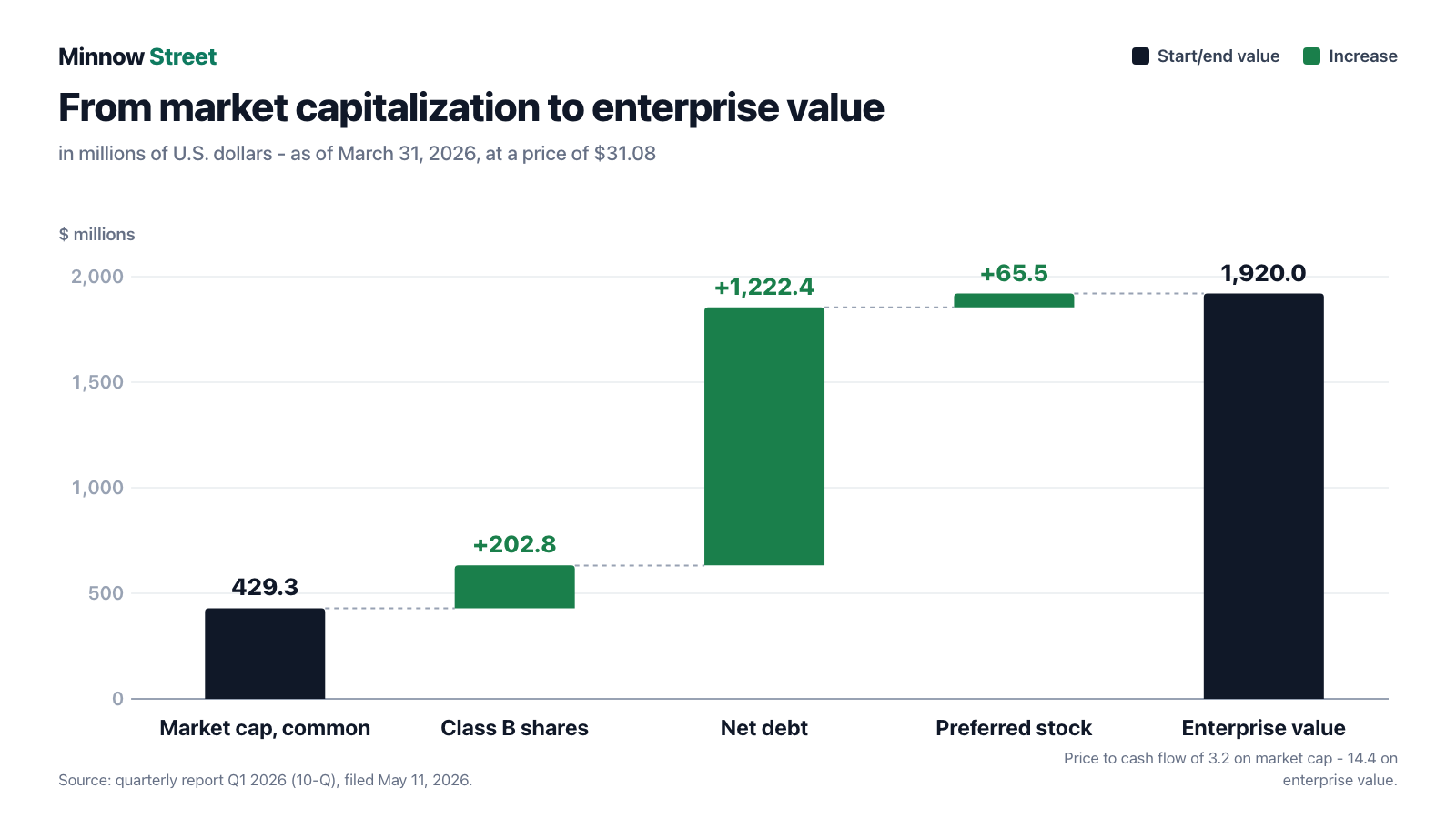
The jump is enormous: $429.3 million becomes $1,920.0 million. Measure the $133.6 million of operating cash flow against that full value and the price to cash flow ratio is 14.4 rather than 3.2. Common market capitalization thus accounts for only about a fifth of what the enterprise is worth. Remember the line: when Summit Midstream reads "cheap," you are reading the price of the smallest piece.
One item in that bridge deserves particular attention because it appears in no quote screen: the 6,524,467 Class B shares, $202.8 million in the chart. They came out of the Tall Oak acquisition, are not listed — and the quarterly report calls them expressly "non-economic": they carry votes but no economic claim of their own. That sounds harmless and is not. Their economic value sits in the associated partnership units, and the two together can be exchanged for ordinary common stock at any time. Against 13,814,286 common shares, that is roughly 47 percent in additional interests that already exist today but appear in no share count on your screen. In everyday terms: your slice of the cake has already been cut — it is simply sitting on another plate.
Uncomfortable truth No. 2: one customer now accounts for 29 percent of revenue
Growth at Summit Midstream has a flip side, and it sits in the notes to the annual report, where the company lists which counterparties make up a meaningful share of revenue:
"Counterparties accounting for a significant portion of total revenues were as follows:"
— Summit Midstream Corporation, SEC annual report 10-K for 2025, concentration disclosures
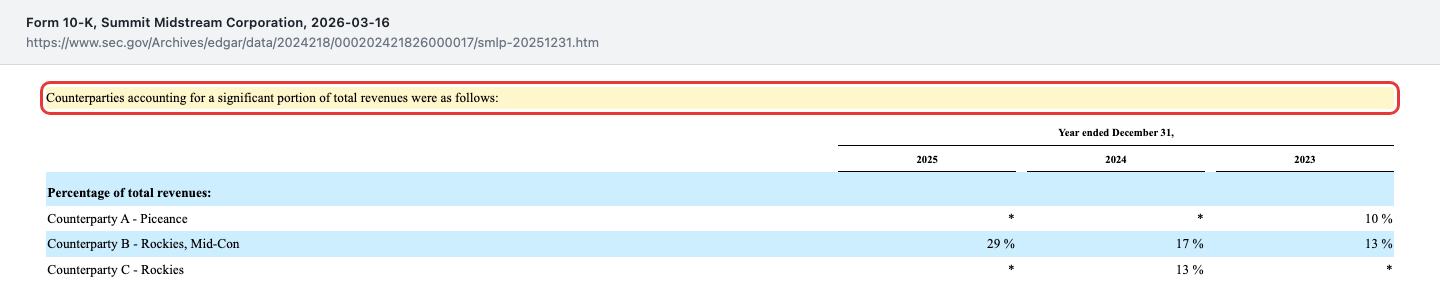
The numbers are unambiguous. The largest counterparty — active in the Rockies and Mid-Con segments — accounted for 29 percent of total revenues in 2025, after 17 percent in 2024 and 13 percent in 2023. Dependence has more than doubled in two years. On $562.1 million of annual revenue, roughly $163 million now hangs on a single signature.
You can read that favorably: a large, growing customer is a vote of confidence and fills the pipes. You also have to read it the other way. If that producer stretches its drilling program, is sold, or runs into trouble, it touches nearly a third of revenue — at a company that must pay $94.7 million of interest a year. The contractual minimum volumes cushion the blow, since they generate cash even at lower utilization. But a contract is only ever as good as the party that signed it.
Uncomfortable truth No. 3: there are others ahead of you in line
When a company distributes money, there is an order of precedence — and common shareholders stand at the very back of it. At Summit Midstream that order is not a theoretical construct; it defined the picture for six years. The quarterly report tells the story in a single paragraph:
"Because the Series A Preferred Stock ranks senior to the Company\'s common stock with respect to dividend rights, any accrued dividends on the Series A Preferred Stock must first be paid prior to the initiation of dividends to holders of the Company\'s common stock. As mentioned above, during the quarter ended March 31, 2025, the Company resumed distributions on its Series A Preferred Stock. Further, in March 2026, the Company repaid all accrued and unpaid dividends on its Series A Preferred Stock, including the $46.3 million for accrued and unpaid dividends owed from March 15, 2020 to December 14, 2024."
— Summit Midstream Corporation, SEC quarterly report 10-Q as of March 31, 2026, equity disclosures

Translated: from March 2020 through the end of 2024, preferred holders received nothing — but their claims kept accruing. Before a common shareholder could ever see a cent of dividend, that pile had to be cleared. That is exactly what happened in March 2026, at a cost of $46.3 million for the legacy balance alone. For scale, that is more than a third of the entire $133.6 million of operating cash flow generated in 2025.
This is emphatically good news — the blockage is gone, and for the first time in years the path to returning capital to common shareholders is clear. It is precisely why the board could authorize, on June 1, 2026, the first share repurchase program in company history, for up to $35 million. But the order of precedence remains: the 65,508 preferred shares will continue to be served first. In the first quarter of 2026 that already cost $3.1 million again — enough to turn a quarter that was close to break-even at the operating level into a loss of $0.43 per share.
Uncomfortable truth No. 4: the operations earn money — the company does not yet
Here the whole structure meets the ground. Summit Midstream generated $133.6 million of operating cash flow in 2025. In the same year it paid $94.7 million in interest. That is better than seven of every ten dollars the business brings in — before a single foot of pipe is replaced. Small wonder the bottom line is red: a loss of $1.61 per share in 2025, after $12.78 in 2024 and $6.11 in 2023.
The improvement is unmistakable — the loss per share has shrunk to an eighth in two years. But the direction this year counsels caution: in the first quarter of 2026 interest expense rose to $25.0 million from $22.5 million in the prior-year quarter, and a quarterly profit of $4.6 million (Q1 2025) turned into a net loss of $3.2 million. The reason lies in the debt stack as of March 31, 2026: $825.0 million of secured notes at an 8.625 percent coupon (due October 2029), $340.0 million from the new Permian term loan (due March 2031, non-recourse to the parent) and $116.0 million drawn on a $500 million revolver. That totals $1,265.8 million; net of $43.4 million of unrestricted cash, you arrive at the $1,222.4 million of net debt from the chart above.
Fairness requires the other side: the company is not in distress. As of March 31, 2026, every financial covenant was met — interest coverage stood at 2.7x against a 2.0x minimum, first lien leverage at 0.4x against a 2.5x maximum. Total leverage was roughly 4.2x, and $381 million of revolver capacity remained available. Translated: the house is heavily mortgaged, but the payments are being made comfortably.
Valuation — which number is the honest one?
Both ratios from the chart are arithmetically correct. The question is which one fits the company. For a debt-free business, a price to cash flow ratio of 3.2 would indeed be spectacular. For an infrastructure company whose borrowings are nearly three times its equity value, the second number carries more information: 14.4 on enterprise value. That is no longer a bargain for a gas gatherer, but it is not a bubble either — it is an ordinary valuation for a business with stable fees and heavy leverage.
The reason for the gap is also the opportunity: at a company this levered, every improvement lands on the share price with amplified force. Because equity represents only about a fifth of total value, an increase in the worth of the business flows disproportionately into that small remainder — in everyday terms, buy a house with little equity and rising prices make you far more in percentage terms, while falling prices take everything just as fast. The lever works in both directions, which is precisely how one stock can sit on four trend screens and a value screen at the same time.
Because daily quotes say nothing about the worth of a business, here are three dated anchors, all documented in mandatory filings. On March 31, 2026, the company issued 1,351,351 new shares at $31.08. On May 19, 2026, an insider sold 10,000 shares at $32.00. On July 2, 2026, the company\'s general counsel sold 2,600 shares at $29.72 — under a pre-arranged trading plan, which defuses the usual suspicion without changing the direction. These sales are small and no alarm signal; what stands out is that they fall in the same weeks in which the company authorized its first buyback. The company is buying while individual officers sell.
A final note on dilution: on June 29, 2026, Summit Midstream registered 424,000 additional shares for its employee plan, bringing the total reserved under the plan to 2,350,281 shares. Against 13,814,286 common shares outstanding, that is not a rounding error. For shareholders the meaning is simple: the cake is being cut into more slices.
Opportunities and risks at a glance
What argues for Summit Midstream:
- The business is growing again in earnest: $562.1 million of revenue in 2025 (up 30.8 percent), operating cash flow of $133.6 million after $61.8 million the year before, and Q1 2026 revenue of $139.1 million ahead of the prior-year quarter.
- Mostly fixed fees per unit of throughput plus minimum volume commitments ($4.1 million in Q1 2026 alone) make revenue far less price-sensitive than a producer\'s.
- Market tailwind: average gas prices rose roughly 61 percent in 2025 to $3.52 per MMBtu, and active gas rigs went from 102 to 125 — more drilling means more volume in the pipes over time.
- The balance sheet was cleaned up in 2026: $46.3 million of preferred dividend arrears repaid, the Permian loan extended to 2031 and non-recourse to the parent, and every covenant met with room to spare (interest coverage of 2.7x against a 2.0x minimum).
- Capital returns are possible for the first time: a repurchase program of up to $35 million since June 1, 2026, alongside Permian growth with 150 MMcf/d of newly contracted transportation capacity and roughly 1.9 Bcf/d in total.
- The conversion to a corporation eliminates the Schedule K-1 and opens the stock to investors barred from owning partnerships.
What argues against it:
- Heavy leverage: $1,222.4 million of net debt as of March 31, 2026, against common market capitalization of $429.3 million; total leverage of roughly 4.2x and an 8.625 percent coupon on the notes.
- Interest consumes the progress: $94.7 million of interest expense in 2025 against $133.6 million of operating cash flow — and it rose further to $25.0 million in Q1 2026.
- Still no profit: a loss of $1.61 per share in 2025 (2024: $12.78; 2023: $6.11), and another $0.43 loss per share in Q1 2026.
- Concentration in the largest customer: 29 percent of revenue in 2025, after 17 percent in 2024 and 13 percent in 2023.
- Dilution you cannot see on screen: 6,524,467 Class B shares equal roughly 47 percent in additional interests; add 424,000 newly registered employee shares (June 29, 2026) and the lock-up on the 1,351,351 shares issued to a related party on March 31, 2026, which lapses at the end of September 2026.
- Preferred holders are served first: 65,508 preferred shares cost $3.1 million again in Q1 2026 alone and rank ahead of any distribution to common shareholders.
- No support for the AI narrative: data centers do not appear in the filings as a demand driver.
A human conclusion
Back to the bargain reflex. Its problem is not that it steers you toward bad companies — Summit Midstream is not a bad company. Volumes are rising, contracts are lengthening, the balance sheet was visibly repaired in 2026, and for the first time in the company\'s history money may flow back to shareholders. The problem with the reflex is that it gives you the feeling of diligence without the work. A low ratio feels like a finding. In truth it is only a question — and at this company the answer reads: the price tag covers about a fifth of the house, and the mortgage is standing right next to it.
Buy Summit Midstream and you are not primarily buying a cheap stock. You are buying $1,222.4 million of debt with $429.3 million of equity on top — a levered bet. If the improvement continues, it lands on that small remainder with outsized force. If the largest customer walks away or rates rise further, the same remainder absorbs it first. Both are documented, both are possible, and no ratio will make that judgment for you.
So the honest question is not "is 3.2 cheap?" but rather: do you want to lend money to a company that still reports no profit, hands better than seven of every ten dollars it earns to its lenders, and draws a third of its revenue from a single signature — because you believe those three numbers keep improving? If yes, you have a thesis, and the filings give you clear checkpoints to test it. If no, you had a price tag. What you make of it is up to you. And that is exactly as it should be.
Sources
Every primary document used in this analysis, for you to read yourself:
- Summit Midstream Corporation — SEC quarterly report 10-Q as of March 31, 2026 (filed May 11, 2026)
- Summit Midstream Corporation — SEC annual report 10-K for 2025 (filed March 16, 2026)
- Summit Midstream Corporation — SEC annual report 10-K for 2024, plus the current reports 8-K dated May 11, 2026 (quarterly results), May 12, 2026 (annual meeting), June 1, 2026 (share repurchase program) and June 10, 2026 (growth projects), and the S-8 registration filed June 29, 2026: EDGAR filing history for CIK 0002024218 (sec.gov)
- Insider filings (Form 4) dated May 21 and July 6, 2026, and the notices of proposed sale (Form 144) dated May 18 and July 2, 2026, available through the same EDGAR filing history.
- Predecessor entity Summit Midstream Partners, LP — EDGAR filing history for CIK 0001549922 (sec.gov), where the corporate history prior to the August 1, 2024, conversion resides.
- Fundamental data (metrics, valuation; data as of July 25, 2026), reconciled against the SEC filings.
- Reddit mentions and screen membership: our in-house stock scanner, as of July 25, 2026; the screens are recalculated daily.
Transparency & disclaimer: This analysis is journalistic commentary on publicly available information. It is not investment advice, not a regulated financial analysis and not a solicitation to buy or sell securities. Equity investments carry substantial risk, including total loss of capital. All information is provided without warranty; the as-of date for each figure is noted in the text. The author holds no position in Summit Midstream shares at the time of publication.
Our Bottom Line at a Glance
- Business and growth positive
- Revenue rose 30.8 percent in 2025 to $562.1 million (2024: $429.6 million), and operating cash flow more than doubled to $133.6 million (2024: $61.8 million). The model is sturdy: mostly fixed fees per unit of throughput, backed by minimum volume commitments that alone contributed $4.1 million in the first quarter of 2026. The June 10, 2026, announcement added two long-term agreements totaling 150 MMcf/d for the Double E pipeline.
- Quality of earnings negative
- Growth has not yet produced a profit. The loss per share was $1.61 in 2025, after $12.78 in 2024 and $6.11 in 2023. The first quarter of 2026 closed with a net loss of $3.2 million, or $0.43 per share, even as revenue climbed to $139.1 million. The operations generate cash; the income statement does not yet generate earnings.
- Leverage and interest burden negative
- As of March 31, 2026, $1,265.8 million of debt stood against $43.4 million of unrestricted cash — $1,222.4 million net, at total leverage of roughly 4.2x. The $825.0 million of notes carry an 8.625 percent coupon; in 2025, $94.7 million went to lenders alone, better than seven of every ten dollars of operating cash flow. Covenants are met with room to spare (interest coverage of 2.7x against a 2.0x minimum), but that room is expensive.
- Customer concentration negative
- The largest counterparty accounted for 29 percent of total revenues in 2025, per the annual report, up from 17 percent in 2024 and 13 percent in 2023. Dependence on one shipper has more than doubled in two years. If that producer slows its drilling program, it touches a quarter to a third of revenue — cushioned only by the contractual minimum volume commitments.
- Balance sheet work and capital discipline positive
- The company cleaned house visibly in 2026: in March 2026 it repaid all accrued preferred dividends, including $46.3 million dating back to 2020. The Permian loan was refinanced into a new $440 million facility running to March 2031, non-recourse to the parent. On June 1, 2026, the board authorized the first share repurchase program in company history, for up to $35 million.
- Valuation neutral
- Against common market capitalization of $429.3 million (at the documented issue price of $31.08 on March 31, 2026), 2025 operating cash flow gives a price to cash flow ratio of 3.2 — but against the full enterprise value of $1,920.0 million it gives 14.4. Both numbers are correct; they answer different questions. For a heavily levered infrastructure business, the second one is the honest answer.
Summit Midstream is not a cheap stock nobody noticed. It is a company whose equity accounts for roughly a fifth of its enterprise value. The business works: $562.1 million of revenue in 2025 (up 30.8 percent), $133.6 million of operating cash flow, every covenant met, $46.3 million of preferred dividend arrears cleared in March 2026 and a first buyback authorized in June 2026. Against that sit $1,222.4 million of net debt at 8.625 percent, $94.7 million of annual interest expense, a loss of $1.61 per share and one customer worth 29 percent of revenue. Buy this and you are mostly buying debt with a slice of equity on top. Not investment advice.
What Our Rating Means
Open questions
The business works in principle, but one material question is open. As long as it stays open, our findings do not carry a quality verdict.
The business plainly functions — volumes, contracts and cash flow point up, covenants were met with real headroom as of March 31, 2026, and the 2026 balance sheet work is genuine. What remains open is the core operating question: the growth has not turned into profit. Losses per share have persisted for years, total leverage sits near 4.2x, and dependence on the largest customer climbed from 13 to 29 percent of revenue in two years. None of that is existential — interest coverage of 2.7x and $381 million of undrawn revolver argue otherwise — but it is more than housekeeping. Hence yellow: documented progress, unproven earning power. The decision is yours.
A journalistic assessment by our editorial team at the time of the deep dive, based on public sources — not investment advice and not a solicitation to buy or sell. Your personal circumstances (investment goals, risk capacity, taxes) cannot be taken into account. What our levels mean, how verdicts are formed, and what conflicts of interest exist →
Worth Noting
- Summit Midstream reached our research list through the daily Reddit mention scan (2 mentions, market capitalization of $421.3 million at the time of the scan, as of July 25, 2026). On the same day our in-house stock scanner listed the stock on four trend screens (Stan Weinstein: Stage 2, Strong DCR (>=80), Tight Weekly Range (WCR>=90), Power Trend) and on one value screen, the price to cash flow ranking. These screens are recalculated daily.
- Easy to confuse: Summit Midstream Corporation (CIK 2024218) has only been a corporation since August 1, 2024. Older documents belong to its predecessor, Summit Midstream Partners, LP (CIK 1549922). Because the merger was accounted for as a common-control transaction, the series used in this analysis run on a single continuous basis; no two accounting bases are mixed.
- Valuation anchors are dated and evergreen: the $31.08 reference is not a daily quote but the issue price of the share placement dated March 31, 2026, as documented in the quarterly report. For comparison, insider filings (Form 4) show sales at $32.00 on May 19, 2026, and $29.72 on July 2, 2026. This analysis is evergreen; daily prices are not an investment case.
Frequently Asked Questions
Summit Midstream Corporation (NYSE: SMC), based in Houston, owns the infrastructure between the wellhead and downstream processing: pipelines, compressor stations and treating facilities for natural gas, crude oil and produced water. It produces nothing and does not own most of the gas in its pipes — it collects fixed fees per unit of throughput. It operates in four regions: Rockies, Permian, Piceance and Mid-Con. Revenue reached $562.1 million in 2025.
Because today's company was only formed in 2024. Before that, Summit Midstream was a publicly traded partnership called Summit Midstream Partners, LP, with its own older file number at the U.S. securities regulator, the SEC (CIK 1549922). The conversion to a corporation took effect August 1, 2024, and filings have accumulated under the new number, CIK 2024218, ever since. The earlier history sits in the old file.
Mainly the tax paperwork. Holders of a U.S. partnership receive a Schedule K-1 — cumbersome, often late in the year and awkward for non-U.S. investors. Since the conversion, holders get an ordinary Form 1099 instead. That also opens the stock to index funds and institutions that were not permitted to own partnerships, widening the pool of potential buyers.
Because two different things sit in the numerator. Divide only the common market capitalization ($429.3 million as of March 31, 2026) by 2025 operating cash flow of $133.6 million and you get 3.2. Use the full enterprise value of $1,920.0 million — which includes $1,222.4 million of net debt plus the Class B and preferred shares — and the same cash flow gives 14.4.
They came out of the Tall Oak acquisition. The quarterly report calls them explicitly "non-economic": they carry votes but no economic claim of their own. Their value sits in the associated partnership units, and the two together can be exchanged for ordinary common stock at any time. As of May 8, 2026, there were 6,524,467 of them — roughly 47 percent in additional interests on top of the 13,814,286 common shares.
Not on the common stock. The Series A preferred shares are served first: their payments were suspended in March 2020 and resumed in the first quarter of 2025. In March 2026 the company repaid the accumulated arrears, including $46.3 million covering March 15, 2020, through December 14, 2024. Only after the preferred is current can common holders receive anything at all.
Considerably more than it used to be. The annual report for 2025 discloses that the largest counterparty, active in the Rockies and Mid-Con segments, accounted for 29 percent of total revenues. That compares with 17 percent in 2024 and 13 percent in 2023. Dependence on a single shipper has more than doubled in two years — a risk that grew right alongside the business.
The filings do not say so. The annual report for 2025 attributes rising gas demand to population and economic growth, coal-to-gas switching in power generation and growing U.S. LNG exports — data centers do not appear as a driver. Artificial intelligence shows up exactly once in the entire report, and as a risk: a tool that makes cyber-attacks more sophisticated.
Found an error?
Did you spot a factual error, an outdated number, or a typo in this deep dive? Let us know briefly — your report goes straight to the editorial team.