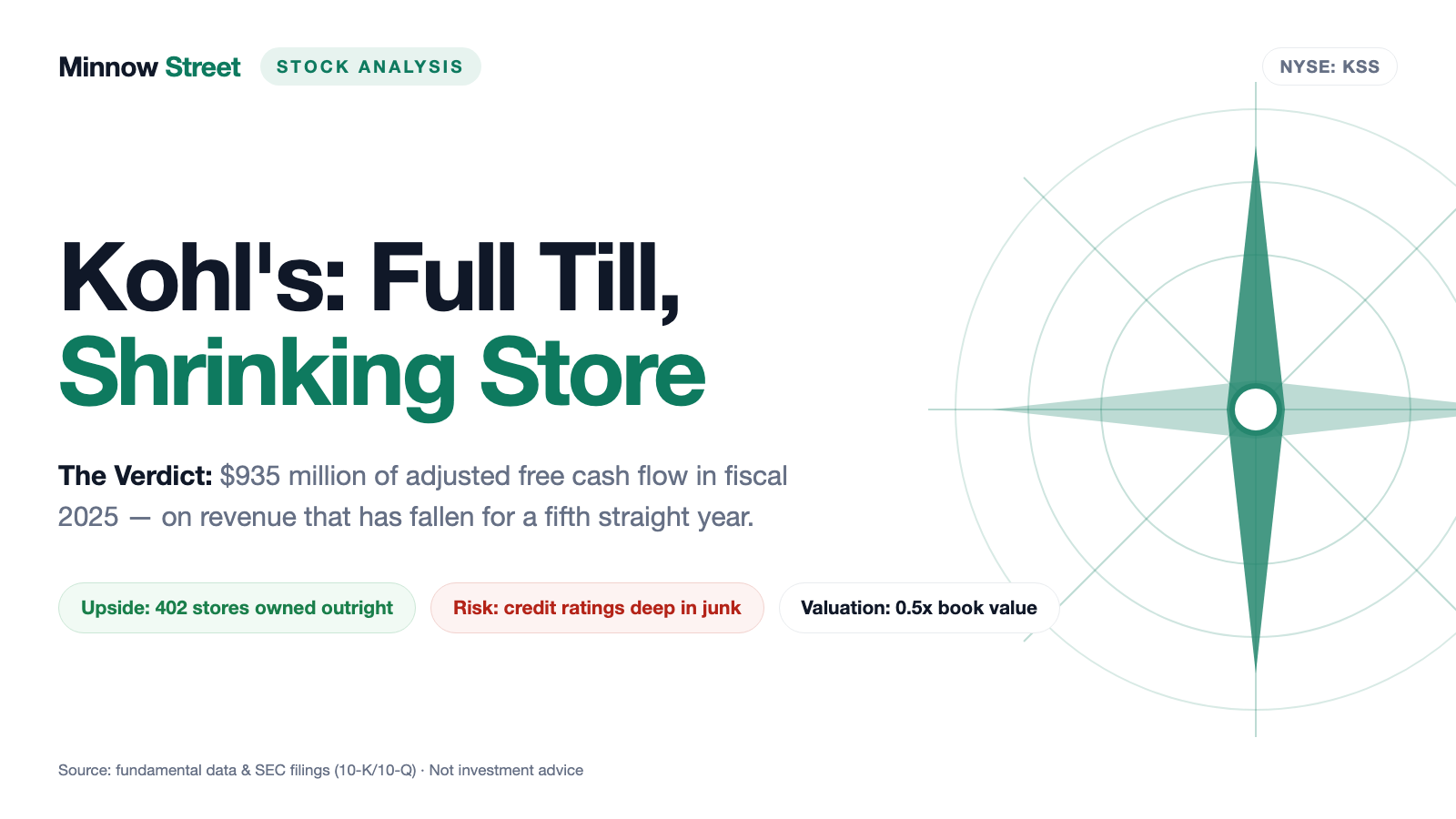
Kohl's: 402 Stores It Owns Outright, $935 Million in the Till — and a Fifth Straight Year of Falling Sales
The Wisconsin department-store chain generated more cash in fiscal 2025 than it had in years: $1.38 billion from operations, $935 million of adjusted free cash flow, the revolving credit facility drawn back down to zero. Our in-house stock scanner therefore ranks the stock 39th of 544 in its P/FCF ranking and 30th of 81 among the biggest earnings surprises (U.S. selection, as of July 25, 2026). At the same time revenue has now fallen five years running, the credit ratings sit deep in junk territory, and eleven distribution centers are pledged to bondholders. We count what is actually in the till — and what the small price tag leaves out.
 Thomas Mücke
Founder & Publisher
Thomas Mücke
Founder & Publisher
Chart
Interactive price chart (TradingView).
Note: pure fact-based analysis, not investment advice and not a solicitation to buy or sell. All figures without guarantee.
There is an investor trap that strikes exactly where Kohl's lives: the clearance-rack trap. You walk through a department store, you see a red sticker, and your brain jumps straight to "How much am I saving?" — skipping the question that matters: Do I want this at all? Markets work the same way. A stock priced at 2.02 times its free cash flow looks like that sticker. Kohl's Corporation (NYSE: KSS) is both the rack and the merchandise. So let us make a deal: before you mistake the price for an argument, we will read together what the company itself told the U.S. securities regulator, the SEC — the annual report (10-K) for fiscal 2025, the quarterly report (10-Q) for May 2, 2026 and eight current reports (8-K) filed over fifteen months. Those filings describe a full till, a fifth year of falling sales, eleven pledged distribution centers — and a chief executive who was fired on the spot.
What Kohl's Actually Does — Retailer, Landlord, Credit Partner
Kohl's is a department-store chain of a kind that barely exists in Europe: not a downtown palace but a low box on the edge of a small town, usually next to the supermarket in a strip center. As of May 2, 2026 there were 1,151 stores across 49 U.S. states, down from 1,153 on January 31, 2026 — together roughly 81 million square feet of selling space. The merchandise is moderately priced apparel, footwear, accessories, beauty and home products, part of it under proprietary labels such as Sonoma Goods for Life, Croft & Barrow or Apt. 9, part of it under national brands.
Three things you need in order to follow the rest:
- The fiscal year does not match the calendar. It ends on the Saturday closest to January 31. So "fiscal 2025" ran from February 2, 2025 to January 31, 2026 and essentially covers calendar year 2025. Fiscal 2023 contained 53 weeks rather than 52 — one extra week of sales that has to be kept in mind when comparing years.
- The company is also a property owner. Of the 1,153 locations on January 31, 2026, 402 were owned, 509 leased and 242 ground-leased. Add eleven of the thirteen distribution and e-commerce fulfillment centers plus the corporate headquarters in Menomonee Falls, Wisconsin.
- Part of the income comes from a credit card. Other revenue of $752 million in fiscal 2025 stems mostly from credit card operations. The accounts themselves are owned by an unrelated third party; Kohl's shares in the net risk-adjusted revenue of the portfolio. Translated: a slice of profit depends on how reliably its own customers pay their bills.
And then there is Sephora. The beauty retailer has run shops inside the stores since 2020; at the end of fiscal 2025 there were 855 full-size shops of roughly 2,500 square feet each and 294 small formats across more than 1,100 stores. The two partners split the operating profit of the arrangement equally. It is the only merchandise category that grew in 2025. Which brings us to the central tension of this analysis: Kohl's till was fuller in fiscal 2025 than it had been in years — but the store that fills it gets smaller every year.
Where the Stock Came Across Our Desk — Two Rankings, Two Stories
Every day we run roughly 3,500 stocks through our scanners. As of July 25, 2026, Kohl's shows up in two of them, and that is the actual reason for this analysis:
- Rank 30 of 81 in the Big Earnings Surprise ranking (U.S. selection), sorted by relative strength — Kohl's carries an RS rating of 77 there.
- Rank 39 of 544 in the P/FCF ranking (U.S. selection), which lists the stocks with the lowest ratio of market value to free cash flow. The reading: 2.02.
To replicate it yourself: open the scanner, set the country filter to "US", find the KSS row. Both lists are recomputed daily — the placements are a dated snapshot, not a property of the company.
The first list is earned. Reported earnings per share beat the analyst estimate in each of the last five quarters (fundamental data, as of July 25, 2026): plus 40.9 percent (reported May 29, 2025), plus 86.7 percent (August 27, 2025), plus 162.5 percent (November 25, 2025), plus 27.4 percent (March 10, 2026) and plus 27.8 percent (May 28, 2026). Five hits in a row is not luck — but all it says is that the expectation was too low, not that the business is growing. A surprise screen measures the distance to a forecast, not the quality of whatever did the surprising.
The second list needs an honest footnote. The 2.02 reading runs a market value of roughly $2.0 billion against trailing twelve-month free cash flow. Use the numbers from the annual report instead — $1,008 million of free cash flow, or $935 million on the company\'s adjusted basis — and you land at about two times. The order of magnitude holds either way: the market is paying roughly two years of cash flow for Kohl\'s. How quickly cheap optics can mislead is something we saw at Grocery Outlet, where a growing discounter kept tripping over its own margin. So the question that counts is not "how cheap?" but "how repeatable?"
The Numbers Over the Years — Given Their Due
First what genuinely speaks for Kohl's, and it is more than the headlines suggest. The company was profitable in each of the last three fiscal years. In 2025 it repaid the $353 million of notes that matured in July out of its own resources, took the revolver from $290 million down to zero, and rebuilt cash from $134 million to $674 million. Gross margin rose to 37.5 percent of net sales, and to 39.9 percent in the first quarter of 2026. Inventories fell 7 percent — for a retailer, that is discipline in its purest form.
The problem only appears once you line up five years:
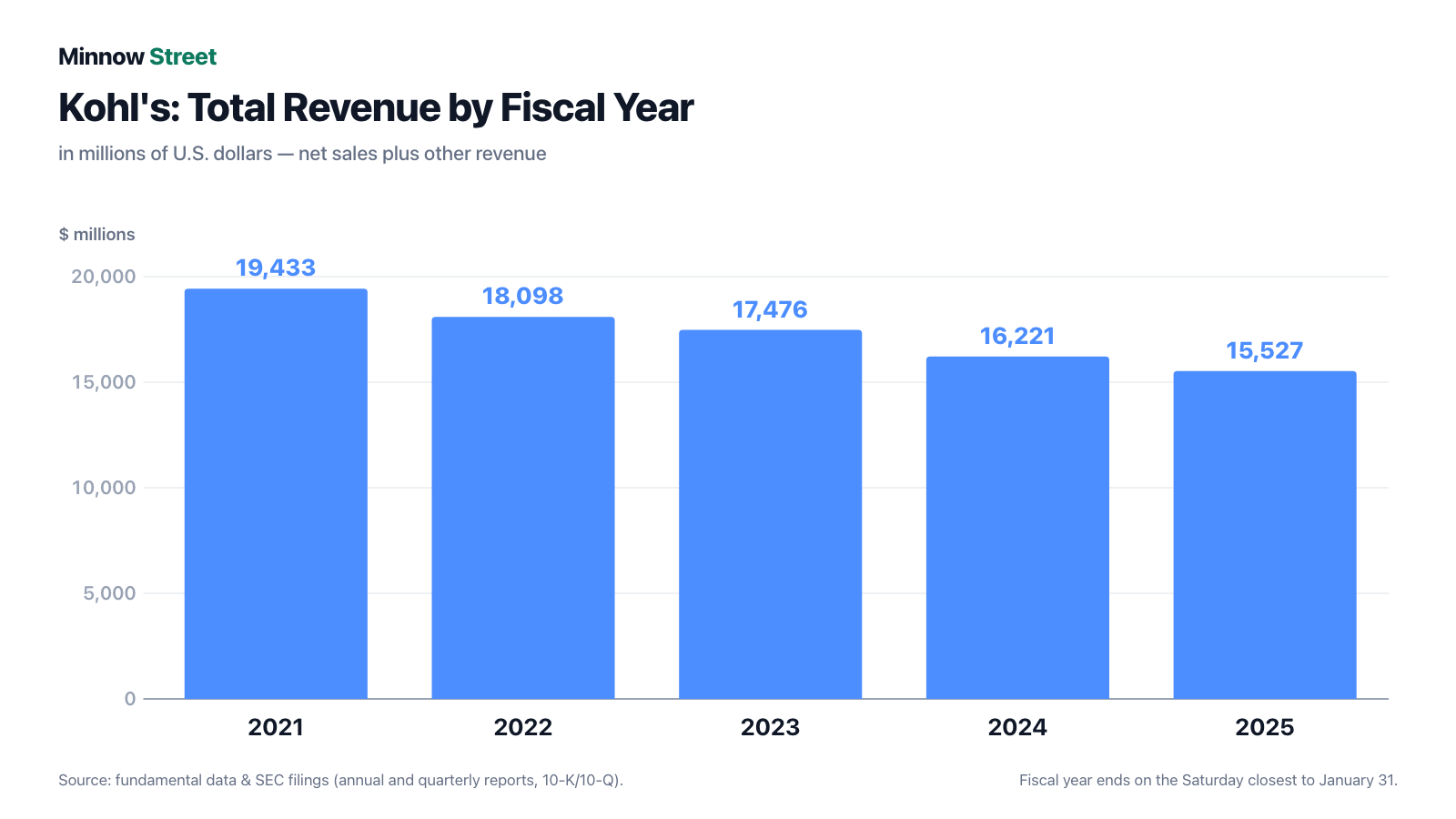
In fiscal 2025 net sales fell 4.0 percent to $14.78 billion and comparable sales fell 3.1 percent, driven by a decline in transaction volume of roughly 4 percent. Exactly one merchandise line grew: accessories including Sephora, up 2.0 percent to $3.12 billion. Everything else fell — women\'s to $3.60 billion (down 5.7 percent), men\'s to $2.93 billion (down 4.8), home to $2.21 billion (down 4.3), children\'s to $1.70 billion (down 6.5), footwear to $1.21 billion (down 6.9). Footwear is not a dying category, as the competition shows: at Deckers Outdoor, the house behind Ugg and Hoka, that exact category has grown for years. The merchandise is not the problem — the place it sits in might be.
Net income, by contrast, rose sharply: $272 million after $109 million, with diluted earnings per share up from $0.98 to $2.38. This is where a second look pays. Adjusted for one-offs — more on those in a moment — the figures were only $186 million and $1.62 per share, against $167 million and $1.50 a year earlier. Adjusted operating income came to $510 million versus $509 million in the prior year. Translated: the core business earned exactly as much in 2025 as it did in 2024. The jump in reported profit came from somewhere else.
What the Filings Say — the Uncomfortable Truths
Uncomfortable Truth No. 1: Half the Record Cash Flow Was Borrowed
The cash year 2025 is real — but it is not repeatable. Look at what it is made of:
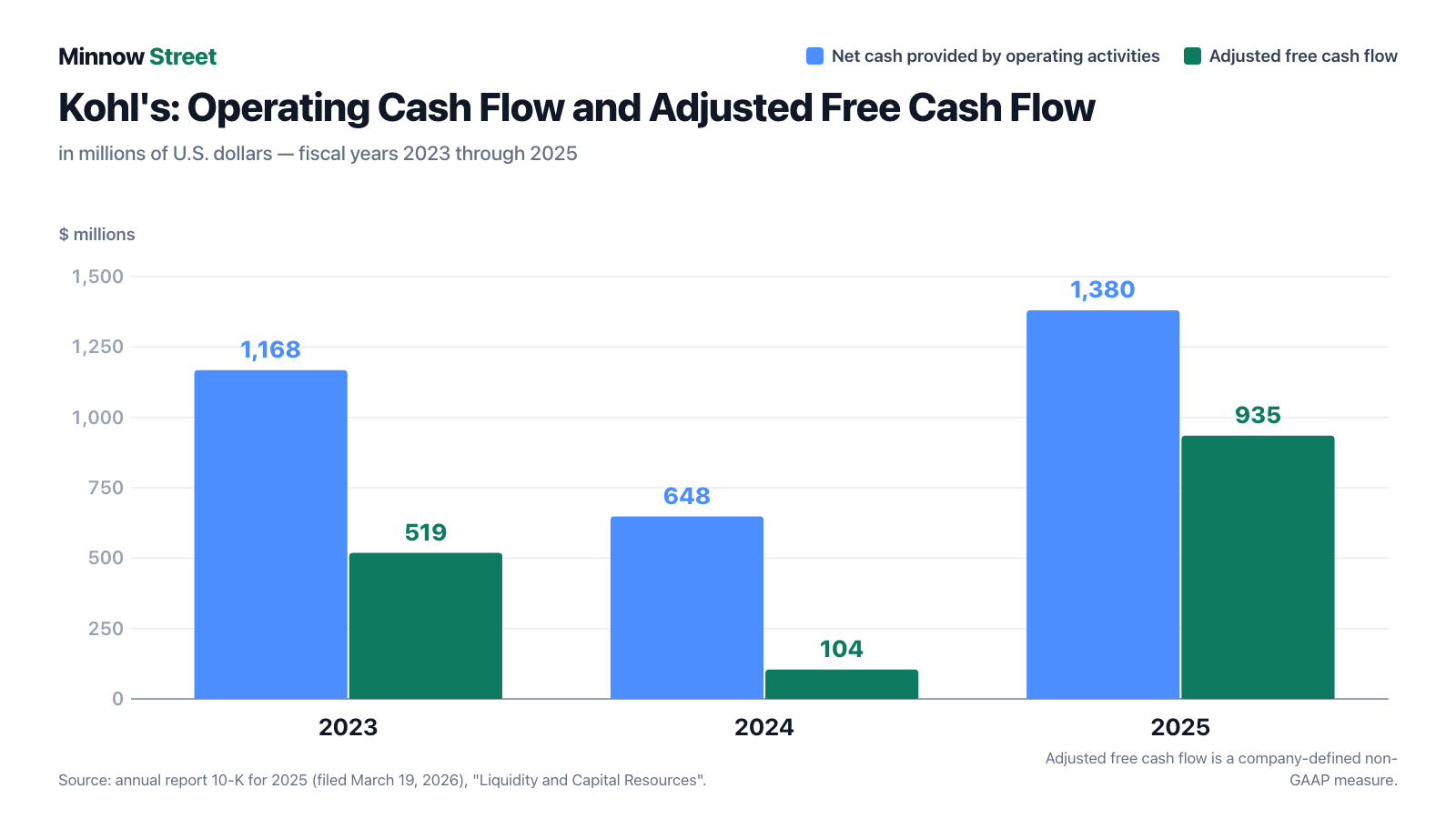
Two items explain almost the entire jump from $648 million to $1,380 million. First, the $129 million settlement gain from a credit card interchange fee lawsuit in which Kohl\'s was a plaintiff — money that arrives exactly once. Second, a $203 million reduction in inventories. Emptying a warehouse fills the till one time; after that the warehouse is empty. Strip out both and roughly $1.05 billion remains — still respectable, but not a record.
The first quarter of 2026 points the other way: an operating cash outflow of $74 million, because inventories were rebuilt by $151 million. That is seasonally normal — the prior-year quarter was an outflow of $92 million — but it is a reminder of what the annual figure represents. Remember this: cash that comes out of the warehouse is a reallocation, not earning power.
Uncomfortable Truth No. 2: The Real Debt Is Not the Bonds, It Is the Rent
At first glance the debt load looks almost relaxed: $1,405 million of principal outstanding on May 2, 2026, none of it due within a year, and a $1.5 billion revolver undrawn. The company repurchased $87 million of notes in the fourth quarter of 2025 and another $50 million in the first quarter of 2026 in the open market — booking gains of $11 million and $9 million because the paper traded below par.
The second glance falls one line lower. As of May 2, 2026 the balance sheet also carries $2,338 million of long-term finance lease and financing obligations plus $2,624 million of long-term operating lease liabilities, with a further $89 million and $95 million current. That is the rent on 509 leased stores and 242 ground leases — with initial terms of typically 20 to 25 years plus four to eight five-year renewal options. In total the lease obligations weigh roughly three and a half times the bonds. Which is exactly why enterprise value sits at about $8.2 billion (data as of July 25, 2026), four times the market value. Buy the stock for two billion and you are buying a company worth eight.
And part of the silverware is already pledged. The debt note in the quarterly report says so plainly:
"In the second quarter of 2025, we issued $360 million aggregate principal amount of 10.000% senior secured notes due 2030 and received proceeds of $357 million, net of the debt discount. The notes are guaranteed by certain of our subsidiaries. Certain of these guarantees are secured by eleven distribution centers and E-commerce Fulfillment Centers, which are held by our subsidiaries, as well as the equity interests in one of our subsidiaries."
— Kohl\'s Corporation, Form 10-Q for the quarter ended May 2, 2026, Note 3 "Debt"
That those centers are worth anything at all is stated a few pages earlier in the annual report:

Uncomfortable Truth No. 3: The Ratings Sit in Junk — and One Bond Pays for It
Credit ratings are the price tag a company wears for borrowed money. As of January 31, 2026 they read: Moody\'s B2 (outlook stable), S&P B+ (negative), Fitch BB− (negative). All three sit below investment grade. During fiscal 2025 Moody\'s cut the corporate rating from Ba3 to B2 and S&P from BB− to B+; the senior unsecured rating fell from B1 to B3 at Moody\'s.
That costs cash directly. The 2031 notes carry a coupon adjustment provision: if the rating falls below defined thresholds, the coupon steps up. Since issuance it has risen by 175 basis points — from an original 3.375 percent to 5.13 percent on the $381 million still outstanding. That is roughly $6.7 million of extra interest a year, purely for the worse grade. One improvement is visible: Moody\'s revised its outlook to positive in the first quarter of 2026.
Interestingly, the banks are already working against the picture. On June 30, 2026 Kohl\'s signed an amendment to the credit facility:

The facility now runs to June 30, 2031, the margin sits at 1.25 to 1.50 percentage points over SOFR, and in-transit inventory counts toward the borrowing base up to 15 percent. Read closely, though, and you find the clause in which the banks document their caution: Availability will now be reduced by a "Debt Maturity Reserve" — the money, in other words, that will be needed for the next bond maturities.
Uncomfortable Truth No. 4: The Chief Executive Was Fired on the Spot
On May 1, 2025 Kohl\'s filed a disclosure of a kind rarely stated so bluntly:
"On April 30, 2025, the Board of Directors (the “Board”) of the Company terminated J. Ashley Buchanan as the Company’s Chief Executive Officer for Cause (as defined in the Executive Compensation Agreement dated as of January 15, 2025 between Mr. Buchanan and Kohl’s, Inc. (the “ECA”)), effective immediately."
— Kohl\'s Corporation, Form 8-K of May 1, 2025, Item 5.02

The filing also gives the reason. Outside counsel, working for the audit committee, found that Buchanan had directed the company to do business with a vendor founded by an individual with whom he had a personal relationship, on "highly unusual terms favorable to the vendor," and that he had also caused the company to enter a multi-million dollar consulting agreement whose team included the same individual. In neither case did he disclose the relationship as the code of ethics required. The consequences: all equity awards forfeited, a pro rata portion of a $2.5 million signing incentive to be repaid, no severance. The filing states expressly that the termination was unrelated to performance, financial reporting or results.
Since then Michael J. Bender has run the company — first on an interim basis from May 1, 2025, and permanently since November 23, 2025, on a base salary of $1,475,000, a bonus target of 175 percent and an annual equity target of no less than $9.5 million. On June 10, 2026 came the next appointment: Elliott Rodgers, previously chief operations officer at Foot Locker, starts as chief operating officer on September 9, 2026. A leadership team whose core is less than a year old is steering the company through a fifth year of falling sales. That is neither good nor bad — but it is a risk without a track record.
Uncomfortable Truth No. 5: The Dividend Was Cut by Three Quarters
Anyone who held Kohl\'s as an income stock learned a painful lesson in 2025. Fiscal 2024 paid $2.00 per share, $222 million in total. Fiscal 2025 paid $0.50 per share, $56 million in total — a 75 percent cut. The company now pays $0.125 per quarter; the most recent declaration, on May 20, 2026, was payable June 24, 2026.
There were no share repurchases in 2024, 2025 or the first quarter of 2026, even though roughly $2.48 billion remains under an authorization dating from February 2022. The quarterly report puts it carefully: the company will look at resuming buybacks "as we continue to solidify our balance sheet and improve our business results." The order of capital allocation is therefore explicit — business first, then the dividend, then debt reduction, and only then shareholders. Remember: a dividend yield is only a yield once it survives the next weak season.
Uncomfortable Truth No. 6: $190 Million of Tariffs Are Paid — the Refund Exists Only in the Text
Perhaps the most interesting number in the quarterly report appears in no balance sheet line at all:

The sequence, short version: from 2025 the U.S. government imposed broad tariffs. Kohl\'s paid roughly $190 million between February 2025 and February 2026. On February 20, 2026 the Supreme Court struck down part of those tariffs, and Kohl\'s filed claims for roughly $140 million. Four days later the administration invoked a different authority and imposed new tariffs — against which the U.S. Court of International Trade ruled in May 2026, with that ruling stayed pending appeal. Kohl\'s keeps paying and keeps watching.
For investors that means a possible gain of $140 million — roughly 7 percent of market value — is in the air, recognized nowhere and datable by no one. If it arrives, it lifts one quarter\'s margin sharply. If it does not, nobody ever counted it. Both are possible; the filings state expressly that availability, timing and amount remain uncertain.
Valuation — What the Market Is Actually Pricing In
All figures in this section are orders of magnitude as of July 25, 2026, not daily prices. At roughly $2.0 billion of market value and 113,399,993 shares outstanding (cover page of the quarterly report filed June 4, 2026):
- Price-to-sales of about 0.13. The market pays roughly 13 cents for a dollar of annual revenue. A healthy chain store tends to trade between 0.5 and 1.
- Price-to-book of about 0.51. Equity stood at $4.02 billion on May 2, 2026, book value per share at roughly $35.61. The market values the company at a bit more than half of what the books say — for a company that owns 402 department stores, that is a statement.
- Price-to-earnings of about 7.6 on trailing earnings of $2.35 per share. Against the company\'s own 2026 guidance — adjusted earnings of $1.00 to $1.60 per share — it would be 11 to 18.
- Enterprise value of roughly $8.2 billion, four times the market value, for an enterprise value to EBITDA ratio of about 6.2. The gap to market value is debt and leases.
The professionals are split and, on balance, skeptical: of 16 houses, one rates the stock a strong buy, seven a hold, six a sell and two a strong sell; the mean price target is $17.85. Short interest is striking too: roughly 29.9 million shares, or a good 31 percent of the float, were sold short as of July 25, 2026. Translated: nearly a third of the freely tradable stock is betting against the company. That is not a buy argument — but it explains why this stock reacts so violently to good news.
Opportunities and Risks at a Glance
What speaks for Kohl\'s:
- The till works. $1.38 billion of operating cash flow and $935 million of adjusted free cash flow in fiscal 2025; cash of $674 million on January 31, 2026 and $429 million on May 2, 2026.
- The balance sheet was relieved. The $1.5 billion revolver was undrawn on May 2, 2026, against $545 million a year earlier; the $353 million of notes maturing in July 2025 were repaid from internal funds; the facility now runs to 2031.
- Substance in the land registry. 402 stores owned outright, eleven of thirteen logistics centers, the corporate headquarters; property and equipment of $6.78 billion net (May 2, 2026) against a market value of roughly $2.0 billion.
- Margins are rising. Gross margin of 37.5 percent in fiscal 2025 (up 34 basis points) and 39.9 percent in the first quarter of 2026; inventories down 8 percent year over year.
- Five consecutive earnings beats between May 2025 and May 2026, each between 27 and 163 percent above the estimate.
- A possible one-off of roughly $140 million from claimed tariff refunds that is recognized nowhere.
What speaks against it:
- Five years of falling revenue — from $19.43 billion to $15.53 billion of total revenue; the company\'s own 2026 guidance is a decline of 2 percent to flat, reaffirmed on May 28, 2026.
- The record cash flow was carried by one-offs: a $129 million settlement gain and a $203 million inventory reduction; on an adjusted basis the core business earned $510 million of operating income in 2025 against $509 million in 2024.
- Junk ratings. Moody\'s B2, S&P B+, Fitch BB− (January 31, 2026); the 2031 notes have stepped up 175 basis points since issuance, and the new 2030 notes carry 10.000 percent — secured by eleven logistics centers.
- Leases as hidden debt. Roughly $5.1 billion of lease and financing obligations on May 2, 2026 against $1.4 billion of bonds.
- A leadership change under pressure. The chief executive was terminated for cause in April 2025, the permanent successor named only in November 2025, and a new chief operating officer starts in September 2026.
- The dividend was cut 75 percent — from $2.00 to $0.50 per share between fiscal 2024 and fiscal 2025.
- Tariff and consumer risk. The core customer is, by the company\'s own description, especially sensitive to rising prices for food, fuel and healthcare.
A Human Verdict
Back to the clearance rack. The red sticker on this stock is real: roughly two years of cash flow, a bit more than half of book value, 402 department stores owned outright. It is not a mirage, and this is not a company on the edge — Kohl\'s earns money, pays its interest, retires debt and has just bought itself five more years of runway.
But the price is not the product. What you are buying is a department-store operator whose revenue has fallen for five years and which forecasts that it will not grow in 2026 either. The jump in cash came largely from a court settlement and an emptied warehouse; the core business stood still. The substance in the land registry is genuine, but eleven of its most valuable pieces are already pledged to the holders of a bond that costs 10 percent. And the people meant to turn this around have been in their jobs for a matter of months.
Maybe that is exactly the right bet: a property portfolio with a retail chain attached, bought at half of book, while a third of the float bets the other way. Or maybe it is the classic clearance-rack purchase, the one you get home and realize you will never use. The difference is not decided by the price but by three numbers in the coming quarters: comparable sales, the draw on the revolving credit facility, and whether $140 million of tariffs comes back. What you make of that is your decision. And that is exactly as it should be.
Sources
- Form 10-K for fiscal 2025 (year ended January 31, 2026, filed March 19, 2026) — Item 1 "Business" (stores, employees, Sephora), Item 2 "Properties" (owned, leased, ground-leased, logistics centers), Item 7 "Management\'s Discussion and Analysis" (revenue, margin, cash flow, ratings, guidance), Note 2 "Debt" and Note 3 "Leases".
- Form 10-Q for the quarter ended May 2, 2026 (filed June 4, 2026, most recent periodic report) — balance sheet, statement of operations, Note 3 "Debt", Item 2 "Management\'s Discussion and Analysis" (tariffs, liquidity, ratings), Part II Item 2 (repurchase table with documented prices), cover page (113,399,993 shares outstanding).
- Form 8-K of May 1, 2025, Item 5.02 — termination of J. Ashley Buchanan for cause, forfeiture of equity awards, repayment of a $2.5 million signing incentive, appointment of Michael J. Bender as interim chief executive.
- Form 8-K of November 24, 2025, Item 5.02 — permanent appointment of Michael J. Bender as chief executive on November 23, 2025, including compensation terms.
- Form 8-K of June 15, 2026, Item 5.02 — appointment of Elliott Rodgers as chief operating officer effective September 9, 2026.
- Form 8-K of May 20, 2026, Item 8.01 — quarterly cash dividend of $0.125 per share, payable June 24, 2026.
- Form 8-K of May 28, 2026, Exhibit 99.1 — first quarter 2026 earnings release and explicit reaffirmation of the full-year 2026 outlook.
- Form 8-K of July 1, 2026, Item 1.01 — second amendment to the credit agreement dated June 30, 2026: extension to June 30, 2031, new margins, "Debt Maturity Reserve".
- Proxy statement DEF 14A of April 10, 2026 — strategy section describing the use of generative artificial intelligence to analyze customer reviews.
- Screener and valuation data: in-house stock scanner and fundamental data (as of July 25, 2026), including the Big Earnings Surprise ranking (U.S. selection, rank 30 of 81, RS rating 77) and the P/FCF ranking (U.S. selection, rank 39 of 544, ratio 2.02).
This article is journalistic analysis of publicly available corporate filings. It is not investment advice, not a recommendation to buy or sell, and not a solicitation to buy or sell securities. Stocks can lose their entire value at any time. All figures come from the SEC filings named above and from fundamental data with the stated as-of dates; price and valuation figures carry a data cut-off of July 25, 2026 and will age. The author holds no position in Kohl\'s Corporation at the time of publication. Please make your investment decisions yourself — or with an adviser you trust.
Our Bottom Line at a Glance
- Liquidity & balance sheet positive
- Fiscal 2025 produced $1,380 million of operating cash flow and $935 million of adjusted free cash flow, up from $104 million a year earlier. The $1.5 billion revolving credit facility was undrawn on May 2, 2026, against $545 million a year before; the $353 million of notes maturing in 2025 were repaid from internal funds, and the amendment of June 30, 2026 extends the facility to 2031.
- Assets & real estate positive
- 402 of the 1,153 locations are owned outright, along with eleven of thirteen logistics centers and the corporate headquarters (January 31, 2026). Property and equipment carries at $6.78 billion and equity at $4.02 billion (May 2, 2026) — against a market value of roughly $2.0 billion as of July 25, 2026.
- Business trajectory negative
- Total revenue has fallen for a fifth straight year: $19,433 million (2021), $18,098 million (2022), $17,476 million (2023), $16,221 million (2024), $15,527 million (2025). In fiscal 2025 net sales fell 4.0 percent, comparable sales 3.1 percent and transaction volume roughly 4 percent. Company guidance for 2026 is a decline of 2 percent to flat, reaffirmed on May 28, 2026.
- Quality of the cash flow neutral
- The jump from $648 million to $1,380 million rests largely on two one-offs: a $129 million settlement gain from a credit card interchange fee lawsuit and $203 million from reducing inventories. On an adjusted basis, operating income was $510 million in 2025 against $509 million in 2024; the first quarter of 2026 saw an outflow of $74 million.
- Leverage & ratings negative
- On top of $1,405 million of bonds (May 2, 2026) sit roughly $5.1 billion of lease and financing obligations. Ratings stood at Moody's B2, S&P B+ and Fitch BB−, all below investment grade; the 2031 notes have stepped up 175 basis points since issuance, and the 2030 notes carry 10.000 percent — secured by eleven distribution and e-commerce fulfillment centers.
- Leadership & payout negative
- The chief executive was terminated for cause on April 30, 2025; the permanent successor took office only on November 23, 2025, and a new chief operating officer starts on September 9, 2026. The dividend was cut from $2.00 per share (fiscal 2024) to $0.50 (fiscal 2025), and there have been no share repurchases since 2024.
Kohl's is the clearance-rack trap in its purest form: the price really is low — roughly $2.0 billion of market value against $15.53 billion of revenue, a bit more than half of book value, about two years of cash flow. And the substance is real: 402 stores owned outright, eleven owned logistics centers, $935 million of adjusted free cash flow in fiscal 2025, an undrawn revolver running to 2031. But revenue has fallen for a fifth straight year, the record cash flow came largely from a one-time $129 million settlement gain and a $203 million inventory reduction, the ratings sit deep in junk, and eleven of the most valuable properties are pledged to the holders of a bond paying 10 percent. Not investment advice.
What Our Rating Means
Open questions
The business works in principle, but one material question is open. As long as it stays open, our findings do not carry a quality verdict.
Buy today and you are buying real estate and cash at a bit more than half of book — and at the same time a business that has shrunk for five years and, by its own forecast, will not grow in 2026 either. Watching here means checking the next quarterly reports against four numbers: do comparable sales turn positive (Q1 2026: down 1.1 percent)? Does the revolver stay undrawn (May 2, 2026: $0)? Do the claimed $140 million of tariff refunds actually arrive? And does adjusted earnings per share hold the $1.00 to $1.60 range the company guided to for 2026? Anyone drawn by the $0.50 annual dividend should know it was cut by three quarters in 2025. The decision is yours.
A journalistic assessment by our editorial team at the time of the deep dive, based on public sources — not investment advice and not a solicitation to buy or sell. Your personal circumstances (investment goals, risk capacity, taxes) cannot be taken into account. What our levels mean, how verdicts are formed, and what conflicts of interest exist →
Worth Noting
- Kohl's reached our research list through two runs of our in-house stock scanner, both as of July 25, 2026: rank 30 of 81 in the Big Earnings Surprise ranking of the U.S. selection (RS rating 77) and rank 39 of 544 in the P/FCF ranking (ratio 2.02). Both lists are recomputed daily, so the placements are a dated snapshot rather than a property of the company. The 2.02 reading uses trailing twelve-month free cash flow; on the annual report basis ($1,008 million of free cash flow in fiscal 2025, $935 million adjusted) the ratio is about two.
- Two sets of figures run side by side at Kohl's: the U.S. GAAP numbers (operating income $624 million, net income $272 million in fiscal 2025) and the company-adjusted values ($510 million and $186 million), which strip out the $129 million settlement gain and $15 million of store closing costs. Guidance for 2026 is stated exclusively on the adjusted basis. Anyone comparing years has to use the same basis — this article names both.
- Data and recency: the most recent periodic report is the Form 10-Q for the quarter ended May 2, 2026, filed June 4, 2026. Every filing after that date was reviewed — Form 8-K of June 15, 2026 (appointment of the chief operating officer), Form 8-K of July 1, 2026 (Item 1.01, second amendment to the credit agreement), Schedule 13G/A of July 14, 2026 and Forms 4 through July 16, 2026. No merger, take-private or acquisition is pending; neither a DEFM14A or PREM14A merger proxy nor an SC 13E-3 has been filed. The share count comes from the most recent document naming one (113,399,993 shares). Valuation figures are orders of magnitude as of July 25, 2026, not daily prices.
Frequently Asked Questions
Kohl's is a U.S. department-store chain headquartered in Menomonee Falls, Wisconsin. As of May 2, 2026 it operated 1,151 stores across 49 states plus a website, selling moderately priced apparel, footwear, accessories, beauty and home products. In fiscal 2025 the company booked $15.53 billion of total revenue and employed roughly 84,000 people on average. Beauty retailer Sephora runs shop-in-shops in more than 1,100 of the stores.
On the Saturday closest to January 31. Fiscal 2025 therefore ran through January 31, 2026 and essentially covers calendar year 2025; it contained 52 weeks. Fiscal 2023, by contrast, had 53 weeks, which slightly distorts multi-year comparisons. The most recent quarterly report covers the 13 weeks ended May 2, 2026.
As of July 25, 2026 the stock sits at rank 30 of 81 in the Big Earnings Surprise ranking of the U.S. selection, with an RS rating of 77, and at rank 39 of 544 in the P/FCF ranking, with a ratio of 2.02. The first list captures companies whose reported earnings came in well above estimates — for Kohl's, in five consecutive quarters. The second sorts by market value relative to free cash flow. Both lists are recomputed daily.
As of January 31, 2026, 402 of the 1,153 locations were owned, 509 leased and 242 ground-leased. The company also owns eleven of its thirteen distribution and e-commerce fulfillment centers plus its corporate headquarters; the exceptions are the leased distribution centers in San Bernardino, California and Corsicana, Texas. Property and equipment stood at $6.78 billion net on May 2, 2026.
The board terminated J. Ashley Buchanan for cause on April 30, 2025. Outside counsel engaged by the audit committee found that he had directed business to a vendor founded by an individual with whom he had a personal relationship and had failed to disclose that relationship as the code of ethics required. All of his equity awards were forfeited and a pro rata portion of a $2.5 million signing incentive must be repaid. Michael J. Bender has been the permanent successor since November 23, 2025.
As of May 2, 2026, $1,405 million of principal was outstanding in bonds, none of it due within a year, and the $1.5 billion revolving credit facility was undrawn. The lease obligations weigh far more: $2,338 million of finance lease and financing obligations plus $2,624 million of operating lease liabilities, both long-term. Credit ratings stood at Moody's B2, S&P B+ and Fitch BB−, all below investment grade.
Yes, but far less than it used to. Fiscal 2024 paid $2.00 per share; fiscal 2025 paid only $0.50 per share — a 75 percent cut. Kohl's now pays $0.125 per quarter; the declaration of May 20, 2026 was payable on June 24, 2026. There were no share repurchases in 2024, 2025 or the first quarter of 2026.
Kohl's sells no AI but says it already uses it. The fiscal 2025 annual report states that the company continues to incorporate artificial intelligence, including generative AI and machine learning, into its business operations and customer experiences. The proxy statement of April 10, 2026 is more specific: generative AI analyzes customer reviews and interactions in real time and delivers personalized product recommendations. Our AI classification therefore lists Kohl's as a user of AI.
Found an error?
Did you spot a factual error, an outdated number, or a typo in this deep dive? Let us know briefly — your report goes straight to the editorial team.