APA Corporation: Five Quarters of Beats — and a Gas Price With a Minus Sign
APA Corporation produces oil and gas in West Texas, in the Egyptian desert and in the U.K. North Sea. Five quarters in a row its reported earnings came in above the analyst consensus, most recently by 158 percent — which is why the stock sits at rank 34 of 81 in our in-house Big Earnings Surprise ranking for the U.S. selection (as of July 25, 2026). The quarterly filing also contains a number you read twice: for its U.S. natural gas APA realized an average of $(0.32) per Mcf in the first quarter of 2026. The company paid to have the gas taken away. Meanwhile net income rose to $446 million while operating cash flow halved to $554 million. We read the filings to find out where the money actually comes from — and what $3.8 billion of cleanup obligations have to do with the North Sea. Know the numbers and the surprise stops being surprising.
 Thomas Mücke
Founder & Publisher
Thomas Mücke
Founder & Publisher
Chart
Interactive price chart (TradingView).
Note: pure fact-based analysis, not investment advice and not a solicitation to buy or sell. All figures without guarantee.
The surprise trap
There is a particular satisfaction that turns investors' heads more easily than most: watching a company make the analysts look silly. Everyone expected 53 cents, the company delivered $1.38. It feels like a win — as if you had backed the underdog and been proved right.
Except that "surprise" measures nothing about the company. It measures the distance to an estimate other people produced. If those estimators systematically overlook a source of earnings, the company beats every quarter without anything about its business improving at all. That is exactly what is happening at APA Corporation, and its own filing says where the source sits.
The deal for this piece: we read the primary filings with the U.S. securities regulator, the SEC — the annual report (10-K) for 2025, the quarterly report (10-Q) for March 31, 2026, and the 8-K supplemental release of July 8, 2026. No recommendation, no price targets from us. Just the numbers in the fine print — and one of them carries a minus sign where none belongs.
What APA actually does
APA Corporation is an oil and gas producer based in Houston, Texas. Since March 1, 2021, it has been the holding company above Apache Corporation, founded in 1954 — a reorganization that changed the legal wrapper, not the business. Watch out when looking up data: some providers still list APA under the old Apache identifier at the SEC.
Production happens in three places, and the three could hardly be more different.
The Permian Basin in West Texas is the heart: 105.0 million barrels of oil equivalent in 2025, 62 percent of production and 74 percent of proved reserves. APA operates roughly 4,000 wells there. In April 2024 it acquired competitor Callon Petroleum in an all-stock deal valued at about $4.5 billion including debt, then sold non-core acreage for more than $2.1 billion in total — roughly $1.6 billion in 2024 and a further $571 million in 2025 with a complete exit from New Mexico. The proceeds went into debt reduction.
The Western Desert in Egypt contributed 53.3 million barrels of oil equivalent in 2025, or 31 percent of production. APA is the largest acreage holder there, with 7.5 million gross acres. The work runs through production-sharing contracts: the company bears the risk and cost and receives a contractually defined share of the output. One quirk inflates the numbers: Egypt's state company EGPC pays the contractor's income tax out of its own production entitlement. APA books that amount as revenue and as tax expense at the same time — economically a wash, but it makes revenue and production look larger. In the second quarter of 2026 these tax barrels came to 36 MBoe/d according to the supplemental release.
The U.K. North Sea is the remainder of an older story. APA entered in 2003 with the Forties field and acquired Mobil North Sea Limited in 2011. In 2025 the region still contributed 11.2 million barrels of oil equivalent — 7 percent of production but only 2 percent of reserves. There have been no new wells since 2023.
And then there is Suriname. In Block 58, jointly with TotalEnergies, the GranMorgu oil field is being built out: a floating production, storage and offloading vessel with 220,000 barrels per day of capacity, 150 kilometers offshore, total investment around $10.5 billion, first oil in 2028. The deal is favorably structured for APA: TotalEnergies carries 87.5 percent of the first $10 billion of gross spending, APA only 12.5 percent. On top of that, APA receives $75 million in cash once first oil flows. Suriname already appears in proved reserves at 74 million barrels of oil equivalent — without a single drop produced.
Worth remembering: APA is an oil company that produces gas whether it wants to or not. That is about to become a problem.
Where the stock landed on our desk
APA appeared in our in-house stock scanner in the "Big Earnings Surprise" list, U.S. selection: rank 34 of 81 hits, as of July 25, 2026. That list looks for companies whose reported result came in materially above what analysts expected. You can repeat it in two clicks: open Big Earnings Surprise, switch the country filter to the United States, and read down the column. The lists are recomputed daily — today's rank is not the rank the day after tomorrow.
Two more values from the same row, both as of July 25, 2026: the RS rating stands at 74. That is a rank from 1 to 99 measuring how the share price has moved relative to every other listed name. A reading of 74 means better than roughly three quarters of the market — solid, not exceptional. The fundamental score sits at 8 of 9. That scale rates balance sheet quality and earning power; 8 of 9 is a good score that many energy names currently reach, because debt has come down across the sector after the strong years from 2022 to 2024.
The run of beats is genuinely striking. According to fundamental data (as of July 25, 2026), reported earnings per share topped consensus in five consecutive quarters: by 29 percent in the first quarter of 2025, 81 percent in the second, 26 percent in the third, 42 percent in the fourth and 158 percent in the first quarter of 2026. Before that, in the first and fourth quarters of 2024, APA missed by roughly 16 percent each time.
One qualifier that often goes missing: those comparisons run on adjusted earnings, which strip out one-off items. Under U.S. accounting rules, as reported in the quarterly filing, APA earned $1.26 per share in the first quarter of 2026. Both numbers are correct; they simply measure different things.
The numbers over the years — fairly credited
Start with what genuinely impresses: this balance sheet has been cleaned up over three years, and thoroughly.
Total debt stood at roughly $6.0 billion at the end of 2024. By the end of 2025 it was $4,493 million, and $4,414 million as of March 31, 2026. That is a reduction of more than a quarter in fifteen months, funded from divestitures and the operating business rather than new equity. Quite the opposite: since the fourth quarter of 2021 APA has repurchased 98.2 million of its own shares — a meaningful share of the 353.5 million outstanding today. The remaining authorization covers another 21.9 million.
Operating cash flow rose to $4,545 million in 2025, $925 million more than in 2024. One key reason is stated verbatim in the annual report: EGPC in Egypt had been paying late for years, and in the third quarter of 2025 the Egyptian government helped, all but eliminating past-due receivables. Receivables from contracts with customers fell from $1.7 billion to $826 million.
Costs have come down too. Lease operating expense per barrel of oil equivalent fell to $11.36 in 2025 from $12.75 the year before. The rig count went from an average of about 22 in the first quarter of 2025 to about 17 in the first quarter of 2026 — and Egyptian gas production still rose. Anyone curious about how hard the service side of this business is working right now will find the counter-view in our analysis of ProPetro, the Permian service provider.
The profit line needs a closer look. Net income attributable to shareholders came to $1,434 million in 2025, or $3.99 per share, after $804 million ($2.27) in 2024 and $2,855 million ($9.25) in 2023. The jump from 2024 to 2025 is largely an absence: in 2024 APA booked $1,129 million of impairments, including $796 million on North Sea properties and $315 million in the United States. In 2025 the figure was only $44 million. A profit that rises because the prior year was written down is not operating progress — it is a base effect.
Uncomfortable truth no. 1: the gas price with a minus sign
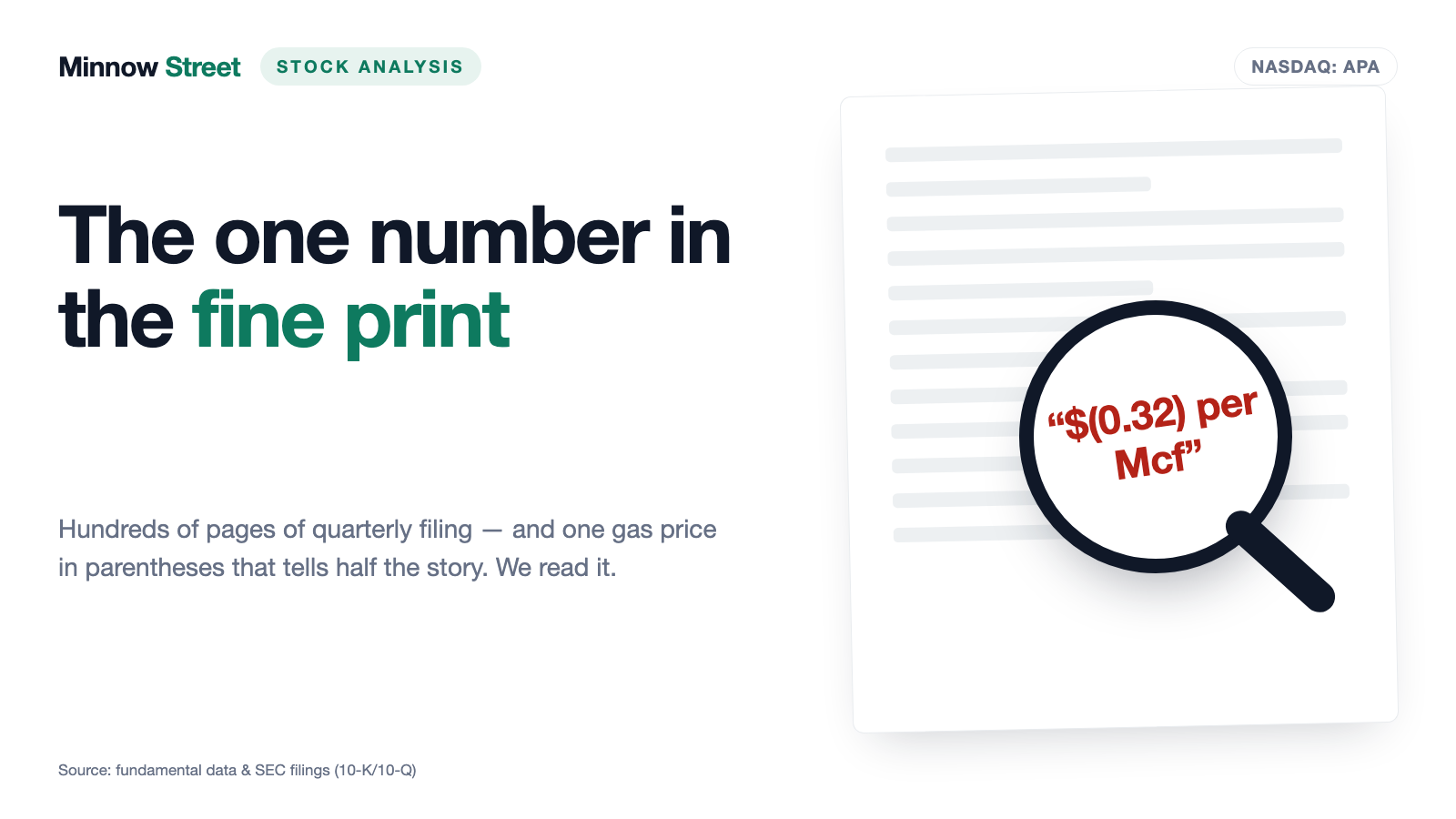
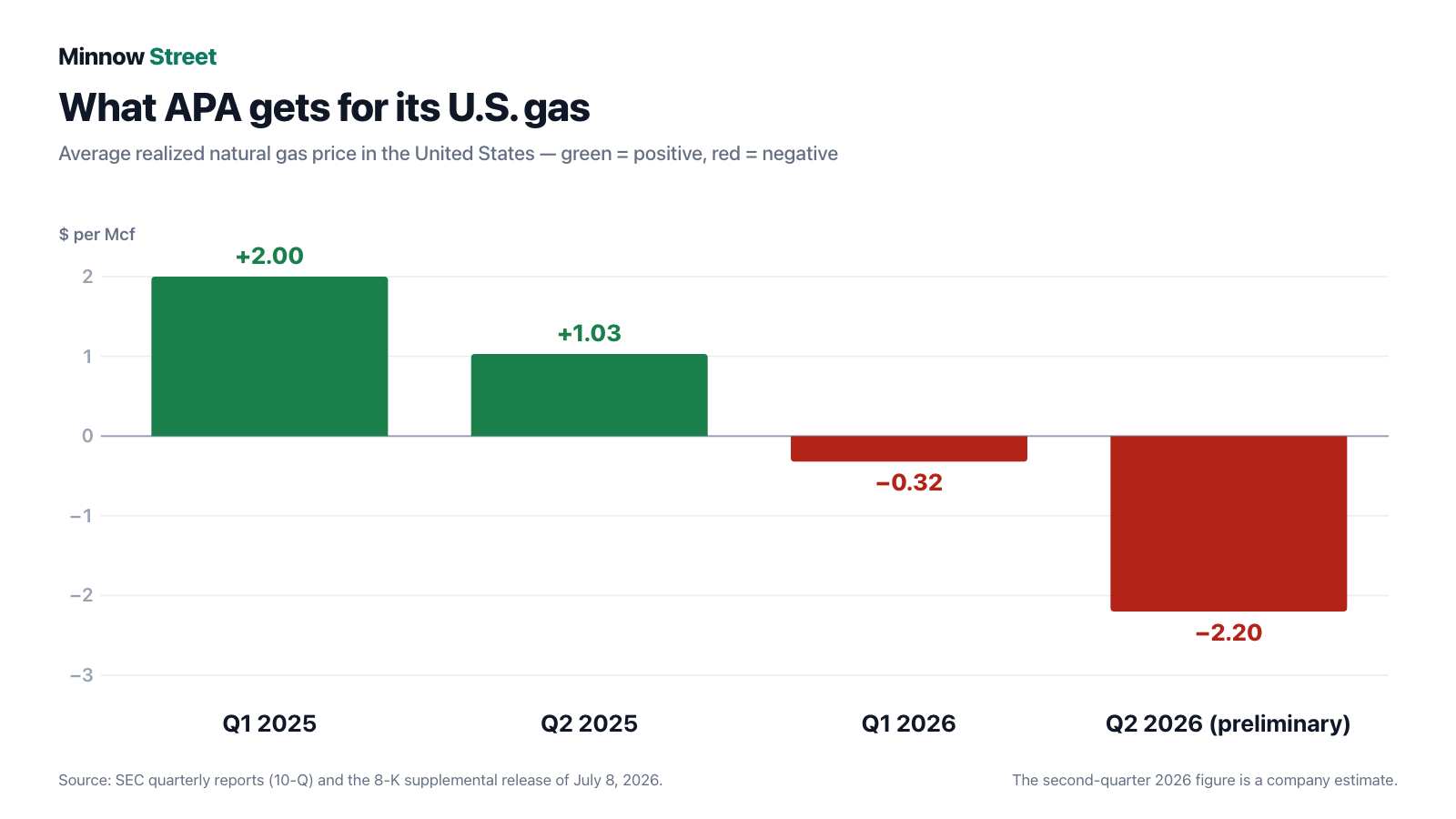
The quarterly report for March 31, 2026, contains a pricing table. Against the average realized U.S. natural gas price it reads: (0.32). In American accounts, parentheses mean minus. APA realized an average of $(0.32) per Mcf for its U.S. natural gas in the first quarter of 2026 — it paid to have the gas taken away. In the first quarter of 2025 the figure had been $2.00.
The reason is geography. The Permian Basin produces oil, and gas comes up the same wellbores. When the pipelines toward the Gulf Coast are full, gas backs up at the Waha trading hub in West Texas and the price drops below zero: whoever has to move gas pays for the privilege. Think of a moving company that can no longer get the discarded furniture into the landfill and ends up paying for disposal.
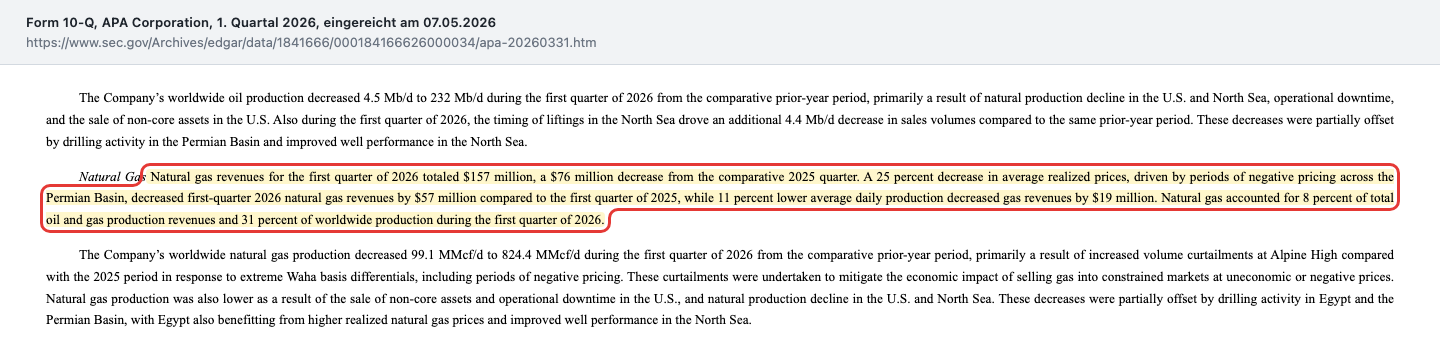
APA responded with the only sensible tool: shutting in wells. The filing puts it this way:
"These curtailments were undertaken to mitigate the economic impact of selling gas into constrained markets at uneconomic or negative prices."
— APA Corporation, Form 10-Q for the quarter ended March 31, 2026, "Natural Gas" section
The second quarter of 2026 got worse, not better. The 8-K supplemental release of July 8, 2026, gives an estimated U.S. gas price of $(2.20) per Mcf and quantifies the curtailment:
"APA curtailed approximately 137 MMcf/d of U.S. natural gas production and 12,300 barrels per day of U.S. natural gas liquids production in the second quarter in response to weak or negative Waha hub prices."
— APA Corporation, Form 8-K supplemental release of July 8, 2026, Exhibit 99.1
For scale: 137 million cubic feet a day is roughly one sixth of the company's worldwide gas production, which ran at 824.4 million cubic feet a day in the first quarter of 2026. Not sold — left in the ground.
And now the twist this analysis rests on. The very bottleneck that makes APA's own gas worthless makes reselling other people's gas highly profitable. APA holds roughly 750,000 MMBtu per day of firm transport capacity on various pipelines. Buy cheap at Waha, sell dear at the Houston Ship Channel, and the spread is the profit. In the first quarter of 2026, sales of purchased volumes brought in $385 million against purchase costs of only $75 million — a gross margin of $310 million. A year earlier: $597 million of sales, $474 million of costs, or $123 million of margin. Pre-tax income for the quarter was $830 million; the trading margin accounted for roughly 37 percent of it.
For the second quarter of 2026 APA guides to a net gain on oil and gas purchases and sales of $345 million before tax, already including a $109 million realized derivative loss. That largely explains the run of earnings beats: analysts model production, not trading margins at a congested hub. The annual report hangs the warning sign right next to it — as additional pipeline capacity comes online in the Permian, the spread between Permian and Gulf Coast prices may compress, and this profit with it.
Uncomfortable truth no. 2: profit up, cash flow halved
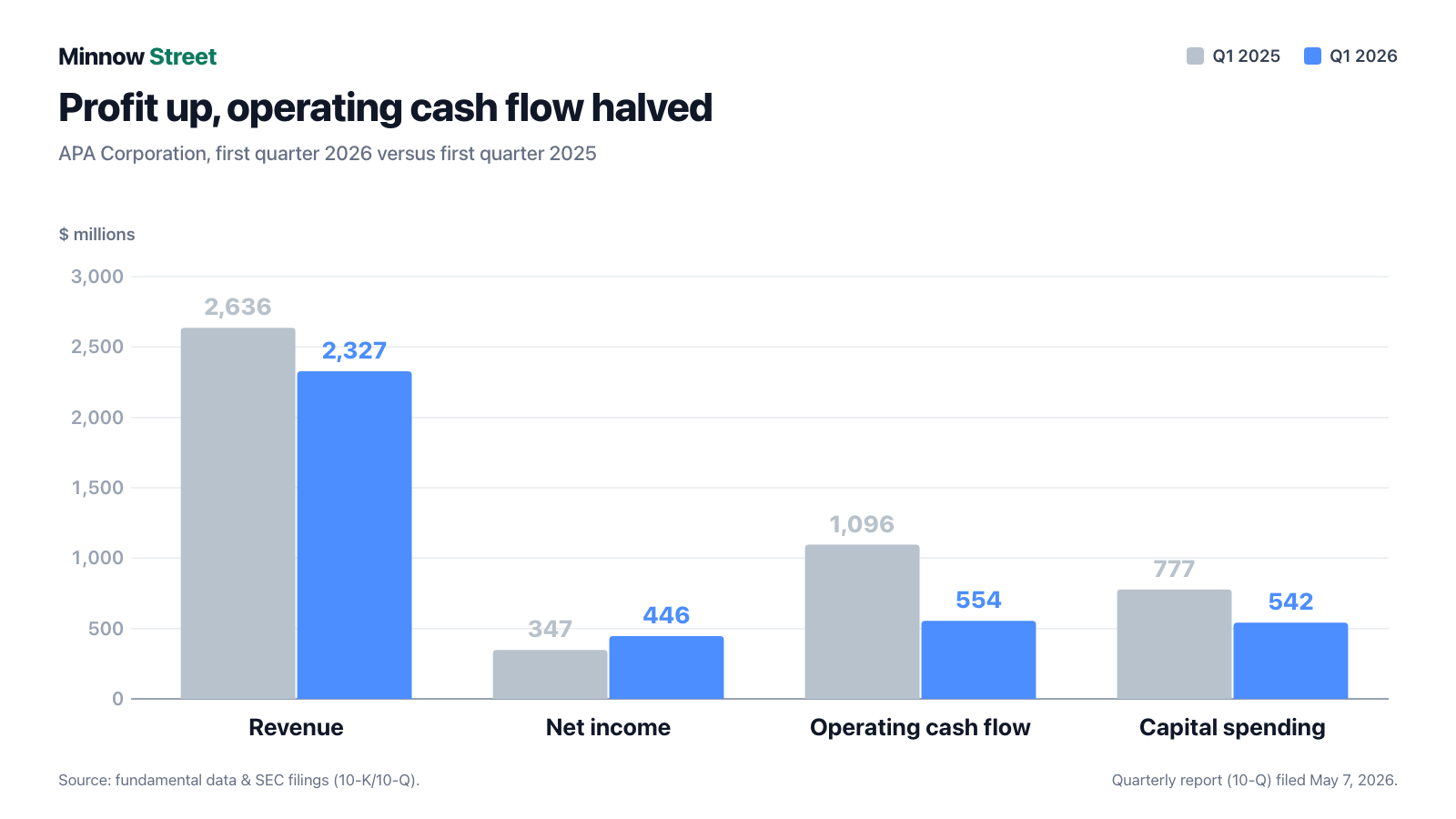
In the first quarter of 2026 net income rose to $446 million from $347 million a year earlier, and earnings per share from $0.96 to $1.26. That is the number that makes headlines.
The number beside it rarely does: operating cash flow fell over the same period from $1,096 million to $554 million. It halved. The filing gives the reasons: lower production revenue, lower gas prices — and the fact that Egyptian receivables had come in during the year-ago quarter. What lifted cash flow in 2025 is missing in 2026 as a comparison base.
Follow the money further and it gets tight. Of the $554 million, $542 million went into drilling and facilities and $4 million into leasehold acquisitions. That leaves $8 million on paper. Out of that came $88 million of dividends to APA shareholders, $65 million of distributions to Sinopec and $79 million of debt repayment. Cash fell from $516 million to $293 million.
That explains something easy to miss: APA repurchased no shares at all in the first quarter of 2026 — against 4.4 million shares at an average of $22.87 in the first quarter of 2025. The company has committed itself to returning 60 percent of free cash flow through dividends and buybacks. When free cash flow is near zero, 60 percent of it is near zero too. Buybacks resumed in the second quarter of 2026: 2.8 million shares at an average of $35.25, per the supplemental release.
For 2026 the company plans roughly $2.1 billion of upstream capital investment. $542 million of that was spent in the first quarter. Whether the rest comes out of the operating business depends on the oil price holding — in the second quarter of 2026 the estimated U.S. oil price per the supplemental release was $93.20 per barrel, well above the $72.53 of the first quarter. Oil carries this company, not gas: crude accounted for 85 percent of production revenue in the first quarter of 2026 but only 52 percent of the volume.
Uncomfortable truth no. 3: $3.8 billion of cleanup costs
Every well, every platform, every pipeline eventually has to be decommissioned. On the balance sheet that line is the asset retirement obligation. As of December 31, 2025, it stood at $2,880 million. It did not shrink in 2025, it grew: $158 million of accretion and $113 million of upward revisions against only $100 million of liabilities actually settled.
Auditor Ernst & Young designated the item a critical audit matter — the formal marker that a balance sheet position is unusually hard to estimate and unusually significant:
"The estimation of the ARO related to the North Sea segment requires significant judgment given the magnitude of the expected retirement costs."
— Ernst & Young LLP in the Form 10-K for the year ended December 31, 2025, report of independent registered public accounting firm

There is a second legacy item many people miss: Gulf of America properties APA sold years ago. If the buyers fail to decommission them, the regulator can come back to the former owner. The company estimates that potential liability at $0.9 billion to $1.2 billion and had accrued $881 million as of December 31, 2025. To be fair: in 2025 the estimate was cut for the first time in years, producing a $60 million gain — after charges of $273 million in 2024 and $212 million in 2023.
Together that is roughly $3.8 billion of cleanup obligations against $6,093 million of equity attributable to APA shareholders at the end of 2025. Not existential — but a line item that costs money every year and never produces a dollar of revenue.
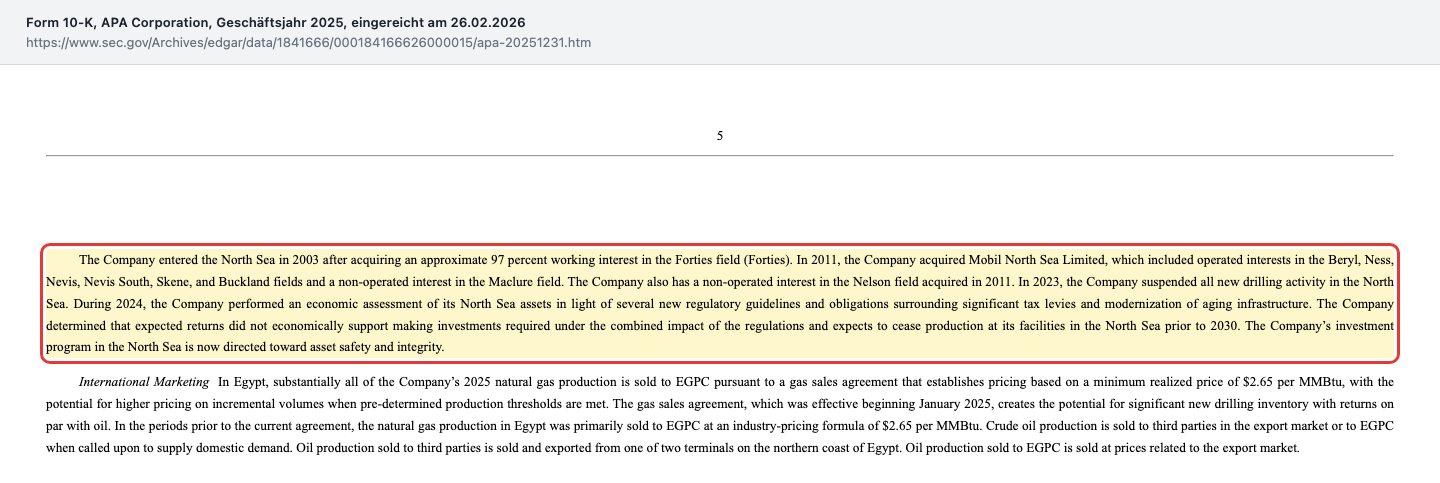
And then there is the North Sea decision. The 2025 annual report states it in one sentence:
"The Company determined that expected returns did not economically support making investments required under the combined impact of the regulations and expects to cease production at its facilities in the North Sea prior to 2030."
— APA Corporation, Form 10-K for the year ended December 31, 2025, "North Sea" section
The trigger is fiscal. The U.K. Energy Profits Levy rose under the Finance Act 2025, effective March 20, 2025, from 35 to 38 percent and runs to March 31, 2030. Add the obligations to modernize aging infrastructure. APA did the arithmetic and concluded it no longer pays.
The human side of that arithmetic sits a few pages earlier in the same report. Of 1,791 full-time employees, 486 work in the United Kingdom — more than a quarter of the workforce, for 7 percent of production and 2 percent of reserves. And that region costs $34.03 per barrel of oil equivalent to operate, against $10.19 in the United States and $8.83 in Egypt. The North Sea is expensive, small and ending — that is the calculation behind it.
Uncomfortable truth no. 4: one third of Egypt belongs to Sinopec
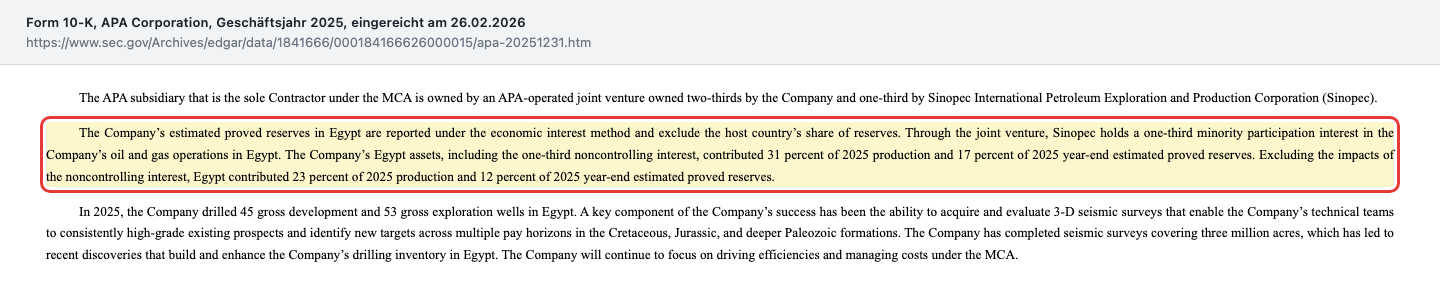
When APA reports that Egypt contributed 31 percent of 2025 production, that is accurate — and it does not describe what shareholders own. The Egyptian business runs through a joint venture in which Chinese state group Sinopec holds one third. The consolidated accounts show the full volume because APA controls the entity; economically, one third belongs to someone else.
"Excluding the impacts of the noncontrolling interest, Egypt contributed 23 percent of 2025 production and 12 percent of 2025 year-end estimated proved reserves."
— APA Corporation, Form 10-K for the year ended December 31, 2025, "Egypt" section
In hard currency: distributions to Sinopec came to $430 million in 2025, after $268 million in 2024. Of net income including noncontrolling interests ($1,692 million in 2025), $258 million belonged to the partner.
On top of that sits country risk, which APA names itself in the quarterly report for March 31, 2026: regional instability could affect countries in which the company operates — explicitly including Egypt — by impairing government finances, limiting access to foreign currency or delaying payments. That is exactly what happened between 2021 and 2024, when EGPC paid slowly. The backlog was cleared in 2025, but the filing states plainly that it continues to monitor the exposure because payment patterns may vary over time. For a look at how a producer with far less cushion handles that kind of environment, see our analysis of Battalion Oil in the Delaware Basin.
What the stock costs
As of July 25, 2026, market capitalization stood at roughly $12.9 billion. Measured against 2025 earnings of $3.99 per share, that is a price-to-earnings ratio of about 8.5. Price-to-book is about 2.0, and enterprise value to earnings before interest, taxes, depreciation and amortization about 3.2.
That order of magnitude is normal for an oil and gas producer, not cheap. The sector has always traded on single-digit earnings multiples because profit tracks the oil price and nobody owns the oil price. A P/E of 8.5 does not say "bargain", it says "cyclical". The more interesting figure is the other one: an enterprise value to EBITDA of 3.2 is low even for this sector — the market evidently assumes current earnings will not last.
The professional view matches. Of 29 firms, according to fundamental data as of July 25, 2026, 17 are at hold, 7 at buy and 5 at sell; the consensus score of 3.1 on a scale of 1 to 5 sits almost exactly on neutral. The average price target is $41.63. Analyst consensus is no oracle — 17 firms at hold mostly means nobody holds a strong view.
On the dividend: $0.25 per quarter, $1.00 a year. At the share count of April 30, 2026, that costs roughly $353 million annually — sustainable against $554 million of operating cash flow in the first quarter of 2026, but not automatic if the oil price falls.
A footnote that fits the self-image: since March 6, 2026, APA stock has also been listed on the new Nasdaq Texas exchange under the same symbol. A Texan oil company on a Texan exchange — commercially it changes nothing.
Opportunities and risks at a glance
What speaks for the stock:
- The balance sheet is materially lighter: debt down from roughly $6.0 billion at the end of 2024 to $4,414 million as of March 31, 2026, without issuing equity.
- Costs are visibly falling: lease operating expense of $11.36 per barrel of oil equivalent in 2025 against $12.75 the year before, with five fewer rigs running in the first quarter of 2026.
- Suriname is a real, already funded growth option: GranMorgu with 220,000 barrels per day of capacity from 2028, with APA carrying only 12.5 percent of the first $10 billion of gross spending.
- 98.2 million shares repurchased since the fourth quarter of 2021, with authorization for another 21.9 million — every share retired lifts the rest's claim on profit.
- Egypt is delivering again: higher gas production and a new gas sales agreement effective January 2025 with a minimum realized price of $2.65 per MMBtu, plus two million new exploration acres awarded in 2025.
What speaks against it:
- The realized U.S. gas price is negative — $(0.32) per Mcf in the first quarter of 2026, an estimated $(2.20) in the second. As long as the Waha bottleneck persists, part of the production is worth nothing.
- Operating cash flow halved in the first quarter of 2026 to $554 million; after $542 million of capital spending, essentially nothing remained.
- Roughly $3.8 billion of retirement and legacy obligations against $6,093 million of equity (December 31, 2025), with a critical audit matter attached to the North Sea.
- A substantial share of recent profit comes from trading margins at a bottleneck the company's own annual report describes as temporary.
- One third of the Egyptian business belongs to Sinopec; the headline figures overstate what accrues to shareholders.
- The North Sea wind-down ties up cash, collateral and more than a quarter of the workforce with no growth contribution.
A human conclusion
Back to the beginning. The surprise trap works because we read "158 percent above expectations" as a statement about the company, when it is a statement about the expectation. At APA you can trace it to the cent: analysts model oil and gas production. What they underestimate is a trading margin that exists because too much gas sits in the wrong place in West Texas.
That does not make APA a bad company. It is a competently run producer that has paid down debt, cut costs and bought itself a future in Suriname that somebody else funds to 87.5 percent. It only makes the surprise something other than it appears: not proof of operating strength, but a bet that a bottleneck stays put.
And the numbers worth looking at before reacting to a headline remain. A gas price with a minus sign. Cash flow that halved while profit rose. 486 employees in a region due to shut down before 2030. And $3.8 billion of cleanup that will never generate a dollar of revenue.
APA reports second-quarter 2026 results on August 6, 2026. The same pricing table will carry another figure for U.S. natural gas, and we will see whether the parentheses are still there. The decision is yours.
Sources
- APA Corporation annual report (Form 10-K) for fiscal year 2025, filed February 26, 2026, CIK 0001841666
- Quarterly report (Form 10-Q) for the quarter ended March 31, 2026, filed May 7, 2026
- Form 8-K supplemental release (Exhibit 99.1) with second-quarter 2026 information, filed July 8, 2026
- Form 8-A12B registering the dual listing on Nasdaq Texas, filed March 5, 2026
- Form 8-K reporting the results of the annual meeting held May 21, 2026, filed May 26, 2026
- All APA Corporation filings on SEC EDGAR
- Fundamental data: ratios, earnings surprises and analyst consensus, as of July 25, 2026
- In-house stock scanner: Big Earnings Surprise, U.S. selection, rank 34 of 81, as of July 25, 2026
Disclaimer: this article is journalistic commentary on publicly available filings and is not investment advice. It is not a solicitation to buy or sell securities. Share prices can move sharply; a total loss of invested capital is possible. All figures come from the primary sources named above with the stated as-of dates and may have changed since. The author holds no position in the security discussed at the time of publication.
Our Bottom Line at a Glance
- Balance sheet and deleveraging positive
- Total debt fell from roughly $6.0 billion at the end of 2024 to $4,493 million at the end of 2025 and $4,414 million as of March 31, 2026. Operating cash flow reached $4,545 million in 2025, $925 million above the prior year. Two credit facilities of $2.0 billion and £1.5 billion run to January 2030 and were entirely undrawn as of March 31, 2026.
- Earnings surprises positive
- Reported earnings per share came in above consensus for five consecutive quarters, most recently by 158 percent in the first quarter of 2026 (data as of July 25, 2026). One driver is documented: the gross margin on resales of purchased volumes, $310 million in the first quarter of 2026 alone.
- U.S. natural gas price negative
- The average realized U.S. gas price was negative in the first quarter of 2026 at $(0.32) per Mcf, down from $2.00 a year earlier. For the second quarter of 2026 APA itself estimates $(2.20) per Mcf and reports curtailments of 137 MMcf/d of gas and 12,300 barrels per day of natural gas liquids (8-K of July 8, 2026).
- Cash flow versus profit negative
- First-quarter 2026 net income rose to $446 million, yet operating cash flow halved to $554 million from $1,096 million. After $542 million of capital spending almost nothing remained; no shares were repurchased in the quarter, even though the company targets returning 60 percent of free cash flow.
- Retirement obligations and the North Sea negative
- Asset retirement obligations of $2,880 million and a Gulf of America contingency of $881 million stand as of December 31, 2025, against $6,093 million of equity attributable to APA shareholders. The auditor flagged the North Sea retirement obligation as a critical audit matter; production there is expected to cease before 2030.
- Concentration in Egypt and Suriname neutral
- One third of the Egyptian business belongs to Sinopec; excluding that minority, Egypt contributed 23 rather than 31 percent of 2025 production. Growth rests on GranMorgu offshore Suriname, a $10.5 billion project with first oil in 2028 — TotalEnergies carries 87.5 percent of the first $10 billion of gross spending, APA 12.5 percent.
APA Corporation is a deleveraged, cost-disciplined producer with a genuine growth option offshore Suriname — and at the same time a company whose recent earnings beats rest substantially on a trading margin tied to a bottleneck in West Texas. Its own U.S. gas fetched a negative price in the first quarter of 2026, operating cash flow halved, and the balance sheet carries roughly $3.8 billion of cleanup obligations. Buying here means buying an oil name with a gas problem, a North Sea wind-down and a project that only delivers in 2028. Not investment advice.
What Our Rating Means
Open questions
The business works in principle, but one material question is open. As long as it stays open, our findings do not carry a quality verdict.
The next quarterly report (10-Q) for the second quarter of 2026 is due on August 6, 2026, and answers three questions at once: does the realized U.S. gas price stay negative (company estimate $(2.20) per Mcf)? Does the trading margin repeat (guided at $345 million before tax)? And does operating cash flow recover? The decision is yours.
A journalistic assessment by our editorial team at the time of the deep dive, based on public sources — not investment advice and not a solicitation to buy or sell. Your personal circumstances (investment goals, risk capacity, taxes) cannot be taken into account. What our levels mean, how verdicts are formed, and what conflicts of interest exist →
Worth Noting
- Hook: rank 34 of 81 in our in-house stock scanner "Big Earnings Surprise" (U.S. selection), RS rating 74, fundamental score 8 of 9, as of July 25, 2026. The scanner lists are recomputed daily.
- Easily confused: APA Corporation (CIK 0001841666) has been the holding company since March 1, 2021; its subsidiary Apache Corporation (CIK 0000006769) still files its own debt documents. Some market data feeds still list APA under the old Apache identifier. Not to be confused with the Apache Software Foundation, which has nothing to do with the company.
- All valuation and consensus figures are as of July 25, 2026. Balance sheet, earnings and production figures come from the 10-K for 2025 (February 26, 2026), the 10-Q for March 31, 2026 (May 7, 2026) and the 8-K supplemental release of July 8, 2026.
Frequently Asked Questions
APA Corporation is the holding company of Apache Corporation and produces oil, natural gas and natural gas liquids. In 2025, 62 percent of production came from the Permian Basin in West Texas, 31 percent from the Western Desert in Egypt and 7 percent from the U.K. North Sea. Offshore Suriname it is developing the GranMorgu oil field with TotalEnergies, with first oil planned for 2028.
In the Permian Basin natural gas comes up as a byproduct of oil production. When pipelines cannot move it all, the price at the Waha hub falls below zero: producers pay to have the gas taken away. APA realized an average of $(0.32) per Mcf in the first quarter of 2026 and curtailed roughly 137 MMcf/d in the second quarter in response.
First-quarter 2026 net income of $446 million includes an unusually large gross margin on resales of purchased volumes: $385 million of sales against $75 million of costs. Operating cash flow fell from $1,096 million to $554 million because Egyptian receivables had been collected in the year-ago quarter and production revenue declined. Profit and cash therefore moved apart.
Every well and platform has to be decommissioned eventually. As of December 31, 2025, that obligation stood at $2,880 million on the balance sheet, plus $881 million for previously sold Gulf of America properties. Auditor Ernst & Young flagged the North Sea portion as a critical audit matter because the estimate there is especially difficult to make.
The 2025 annual report names two reasons: heavy special levies and the cost of modernizing aging infrastructure. The U.K. Energy Profits Levy rose from 35 to 38 percent effective March 20, 2025, and runs to March 31, 2030. APA assessed the economics and concluded the required investments do not pay; production is expected to cease before 2030. Some 486 of the 1,791 employees work there.
The Egyptian business runs through a joint venture in which China's Sinopec holds a one-third interest. The consolidated accounts show the full volume, but one third belongs economically to someone else: including the minority, Egypt contributed 31 percent of 2025 production; excluding it, 23 percent. Distributions to Sinopec totaled $430 million in 2025.
GranMorgu is the first oil development in Block 58 offshore Suriname, operated by TotalEnergies. A floating production, storage and offloading vessel with 220,000 barrels per day of capacity is due on stream in 2028; total investment is about $10.5 billion. TotalEnergies carries 87.5 percent of the first $10 billion of gross spending, APA 12.5 percent. Suriname already sits in reserves at 74 MMboe.
As of July 25, 2026, market capitalization was roughly $12.9 billion, the price-to-earnings ratio about 8.5 and the price-to-book ratio about 2.0. Enterprise value to EBITDA stands at about 3.2. The analyst consensus is 3.1 out of 5 — 17 of 29 firms are at hold — with an average price target of $41.63.
Found an error?
Did you spot a factual error, an outdated number, or a typo in this deep dive? Let us know briefly — your report goes straight to the editorial team.