Global Industrial: The best year in a while — and the filing explains why it will not repeat
An industrial supplies distributor from New York, $1.38 billion in revenue, a three percent dividend, public since 1995: this is exactly what a stock looks like when nobody reads the fine print. That is where the interesting part sits. Gross margin jumped to 35.5 percent in 2025 — and the quarterly report names the reason: inventory purchased before the tariffs hit. By the first quarter of 2026 margin was back to 34.8 percent. And since December 31, 2023 every single filing has carried the same sentence: the company's own controls are not effective. Not investment advice — just a look at what actually carried a solid year.
 Thomas Mücke
Founder & Publisher
Thomas Mücke
Founder & Publisher
Chart
Interactive price chart (TradingView).
Note: pure fact-based analysis, not investment advice and not a solicitation to buy or sell. All figures without guarantee.
There is an investor weakness that never registers as a mistake, because it feels like prudence: the boredom shortcut. It works like this. You come across a company that does something unspectacular — selling shelving, workbenches and pallet trucks to workshops. It has paid a dividend for years, has been listed since 1995, makes no noise. Your brain concludes: "Nothing much can be wrong here, or somebody would have noticed." And then you do not read the annual report. With a loss-making biotech you would check every footnote; with a hardware distributor paying three percent you skip the work. That is the shortcut — and it reliably steers you past the interesting parts. Global Industrial Company (NYSE: GIC) of Port Washington, New York, is one of those companies: $1.38 billion in revenue, roughly 1,980 employees, and a 2025 that looks like its best year in a long time. So let us take the long way round and read what the company itself told the Securities and Exchange Commission: the Form 10-K for 2025 and the quarterly reports on Form 10-Q for the periods ended September 30, 2025 and March 31, 2026. An SEC filing is honest under penalty of law. And this one describes a margin whose cause the company itself calls temporary, ten consecutive quarters of controls declared not effective — and three brothers who hold two thirds of the votes. In the end you decide.
What Global Industrial actually sells — the hardware store for businesses
Global Industrial is an MRO distributor. The acronym stands for "maintenance, repair and operations". Put in everyday terms: it is the hardware store for companies. When a warehouse needs new racking, a workshop a pallet truck, a canteen stainless steel tables, or a plant needs safety gear, barriers, fans or workbenches, the purchasing manager calls the MRO distributor. These are hundreds of thousands of items nobody plans individually but every business constantly consumes. Sales run through the company's own e-commerce sites and through salespeople it calls "relationship marketers": people who know their customers personally. The promise appears in the filing as a registered trademark: "We Can Supply That". Part of the assortment carries the private "Global" brand, which earns a higher margin than national brands. Revenue splits between the United States and Canada.
Two acquisitions shape the recent history. In May 2023 Global Industrial paid $72.6 million for Indoff LLC, a direct marketer of material handling products, commercial interiors and business products. In April 2025 an equipment service provider was added for $4.3 million. And one more detail worth knowing, because it easily misleads researchers: the company was called Systemax Inc. until 2021 and Global DirectMail Corp before that — it once sold computers. The North American technology business was wound down and now sits in discontinued operations. That sets the central tension of this analysis, and it runs through every chapter: a solid, boring distribution business posts its best result in years in 2025 — while the filings themselves explain why both the margin and the housekeeping are weaker than the bottom line suggests.
Where this stock landed on our desk
Global Industrial did not reach our research list through one of our momentum or value scanners but through the Reddit hype scanner, which collects tickers that appear unusually often in the large investing forums (as of July 24, 2026). That is remarkable for this name, because GIC is the opposite of a forum stock: no growth promise, no takeover fantasy, a business built on shelving and pallet trucks. Cases like this are valuable to us — not because the forum is right, but because a stock that surfaces there gets a few days of attention nobody else invests. And with a company this size one detail matters especially: the filing explicitly calls its own stock "thinly traded". Where few shares change hands, small orders move a lot — in both directions. So before we talk valuation, let us look at the numbers. The good ones first.
The numbers over the years — given their due
Start with what genuinely speaks for Global Industrial, and there is plenty. Fiscal 2025 was operationally the strongest year in some time: revenue rose 4.8 percent to $1,379.1 million, gross margin climbed from 34.3 to 35.5 percent, operating income from continuing operations gained 21.2 percent to $97.6 million, and earnings per share rose 17.8 percent to $1.85 (diluted, continuing operations). Net income came to $72.1 million. The balance sheet holds up too: $580.8 million in total assets, of which $67.5 million in cash (after $44.6 million a year earlier), $313.2 million in equity — and not a dollar of financial debt: the annual report states the company is "not currently interest rate sensitive, as we have no outstanding debt". The $103.6 million that looks like debt on the balance sheet are operating lease liabilities for warehouses and vehicles ($16.1 million current, $87.5 million non-current). Return on equity ran near 24 percent — strong for a distributor, because the model ties up little fixed capital (2025 capital expenditure: $3.1 million). Free cash flow came to $74.6 million. The company paid $40.3 million in dividends and repurchased stock for the first time since 2020: roughly 326,000 shares for $9.3 million.
Now the chart that puts this pretty picture in context — operating income across six years:
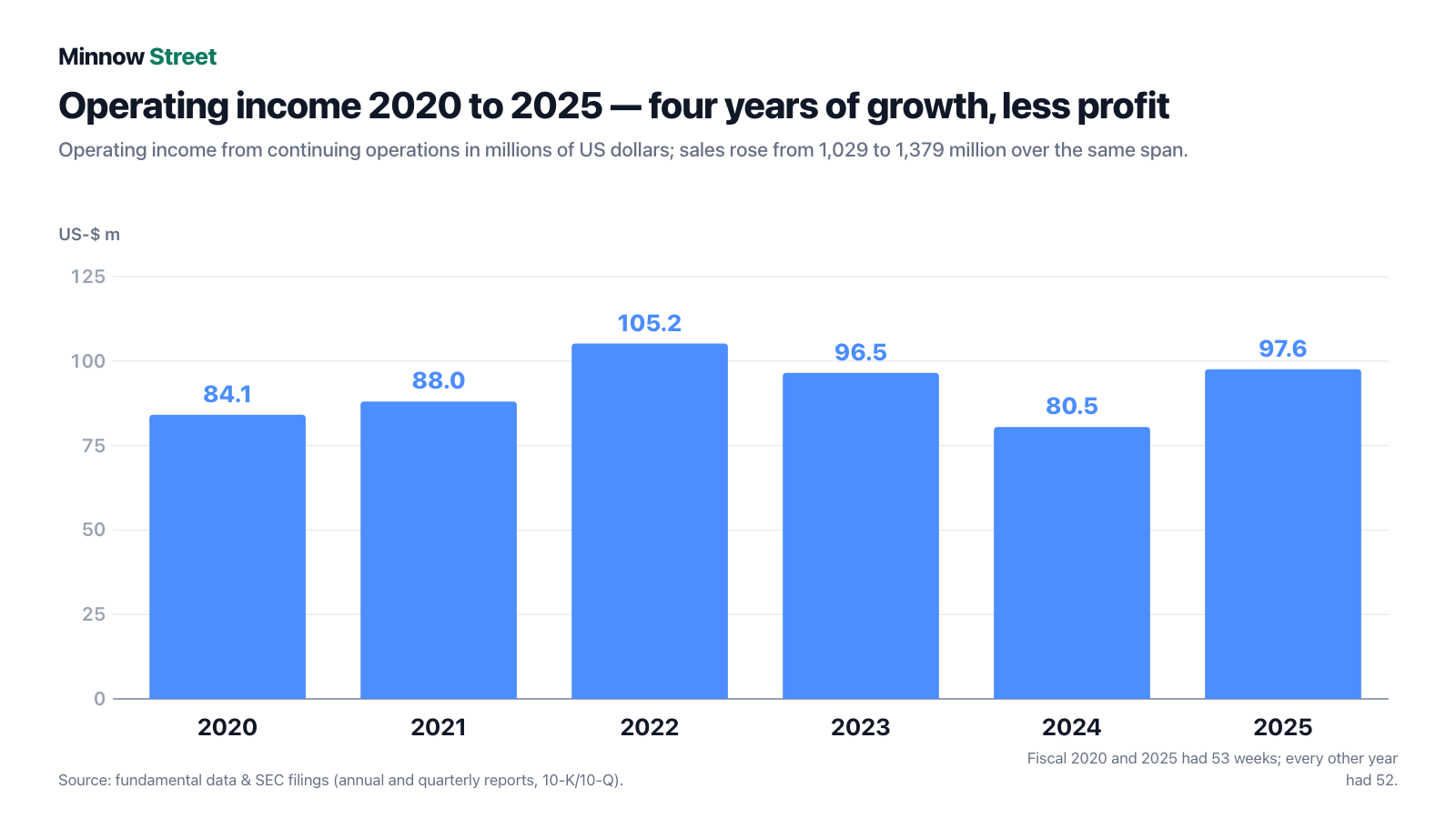
That is the first finding worth holding on to. Between 2022 and 2025 Global Industrial grew revenue by 18.3 percent and acquired two businesses along the way — and operating income still sits below the 2022 level. Growth that does not reach the bottom line points, for a distributor, to mix. Large accounts bring volume but worse pricing. The 2025 annual report describes exactly that: the increase came from "strong sales from our largest strategic accounts", "partially offset by a reduction in our smaller and transactional customer sales". The high-margin small-customer base is shrinking while the lower-margin large-account business grows. Note the pattern: revenue is rising, but it is getting cheaper. Which brings us to the uncomfortable truths.
What the filings say — the uncomfortable truths
Uncomfortable truth no. 1: For ten consecutive quarters management has said its own controls are not effective
Every annual report contains a chapter almost nobody reads: "Controls and Procedures". There management states whether the internal controls that ensure the reported numbers are correct actually work. Put in everyday terms: it is the bookkeeper's own statement about whether the filing cabinet is in order. At Global Industrial the answer has been no in every single filing since December 31, 2023.
"Based on the evaluation, the Company’s Chief Executive Officer and Chief Financial Officer concluded that, as of December 31, 2025, the Company’s disclosure controls and procedures were not effective due to material weaknesses identified at its subsidiary, Indoff LLC (Indoff), which represents approximately 13% of revenue."
— Global Industrial Company, SEC Form 10-K for 2025, Item 9A "Controls and Procedures"

You need the timeline to see the weight of it. The quarterly report for the period ended September 30, 2025 describes the weaknesses as "a continuation of those initially identified in Management’s evaluation of the control environment of the core Global Industrial business as of December 31, 2023"; the assessment at Indoff in the second quarter of 2024 was layered on top. In the annual report as of December 31, 2025 the core business is no longer named — remediated there. Not at Indoff. And the quarterly report as of March 31, 2026 repeats the same sentence, this time at 11 percent of revenue. From the end of 2023 through the end of March 2026 that is ten consecutive quarters.
Fairness demands three qualifications. First, these are IT general controls — change management, segregation of duties, privileged access. In other words: who may change what in the system, and whether the same person can both create and approve an invoice. This is not an allegation of fraud. Second, management explicitly records that the deficiencies did not result in any identified misstatements and that the financial statements present fairly in all material respects. Third, the core business was fixed, which shows the company can do it. But the arithmetic stands: a company whose stated strategy includes acquisitions has not, after more than two years, integrated the controls of a subsidiary it paid $72.6 million for. Anyone pricing in future acquisitions as a growth driver is pricing in that integration capability too.
Uncomfortable truth no. 2: The record margin was borrowed — from a warehouse that no longer exists at that price
Now to the prettiest number of 2025 and where it came from. Gross margin — the share of revenue left after purchase costs and freight — rose from 34.3 to 35.5 percent. That sounds small but it is the lever: 120 basis points on $1.38 billion of revenue is roughly $17 million, and it explains most of the earnings jump. The annual report names the reasons itself, and one of them is a timing effect: "the timing benefit from pre-tariff inventory flowing through cost of sales". In plain terms: the company held inventory it had bought cheaply before the new tariffs took effect but sold it at the new, higher prices. The difference landed in the margin. A one-time advantage — once the cheap warehouse is empty, restocking happens at tariff prices.
The good part about this analysis is that no speculation is required: the quarterly report for the period ended September 30, 2025 says itself when the benefit ends.
"As we moved through the quarter, we saw the timing benefit of pre-tariff inventory decline and we took pricing actions to mitigate the additional tariff costs that we are incurring."
— Global Industrial Company, SEC Form 10-Q for the quarter ended September 30, 2025, "Business Outlook"

What that means for the numbers shows up in the quarterly series. The 35.5 percent annual average hides a bump:
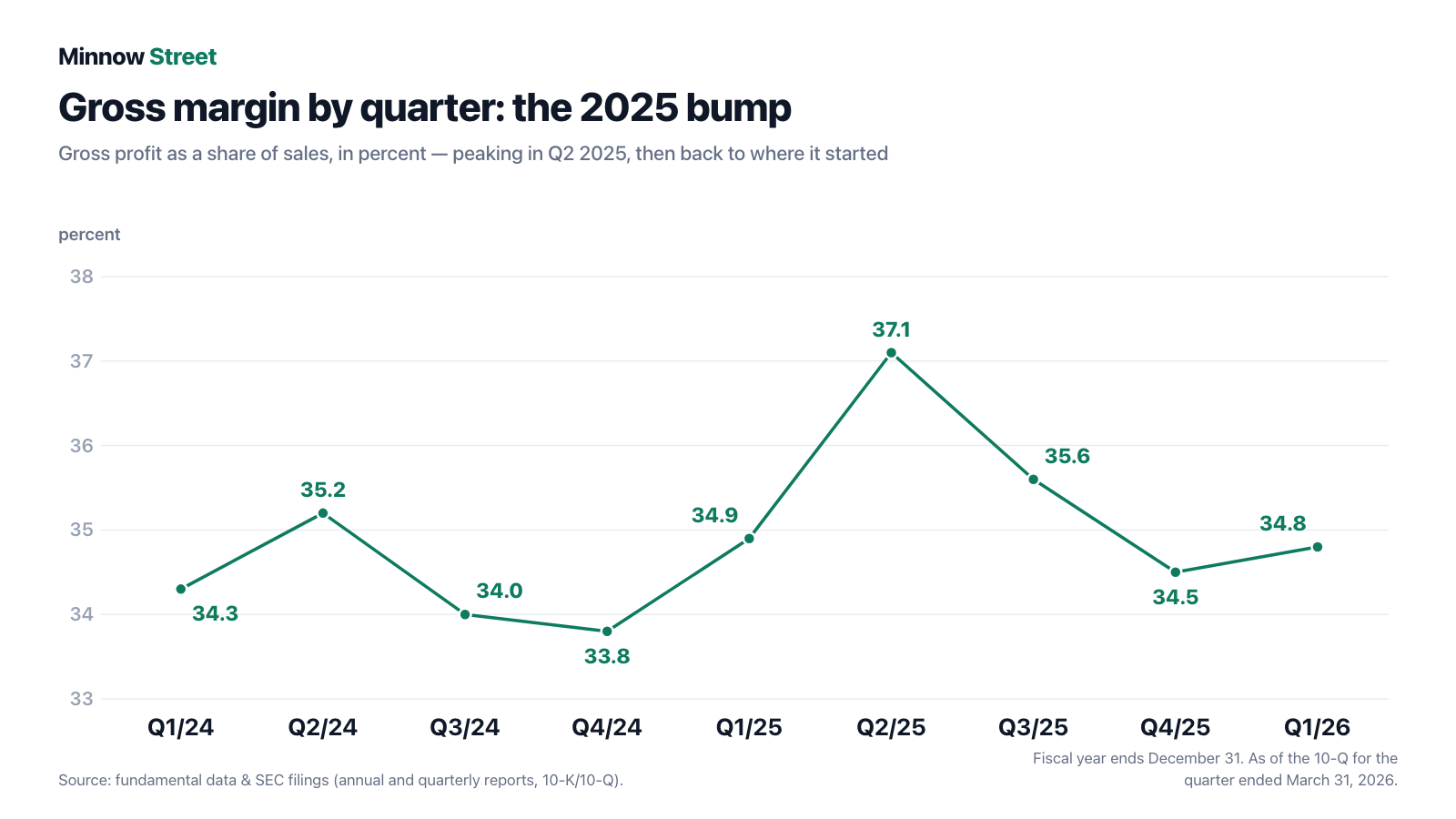
Let us size it so it becomes tangible: between the 37.1 percent peak and the 34.8 percent of the first quarter of 2026 sit roughly 230 basis points. Applied to quarterly revenue of $350.4 million, that is a good $8 million of gross profit per quarter — roughly $32 million annualized, against full-year net income of $72.1 million. Anyone simply extrapolating 2025 earnings power is carrying forward an effect the company itself calls a timing benefit. And the annual report adds a warning that tariffs will increase pressure on margins "as we sell through lower cost inventory". Note the picture: 2025 was not the new normal but a wave whose end is written into the filing.
Uncomfortable truth no. 3: Part of the 2025 growth was simply an extra week
This one is small, but it is a good illustration of why reading pays. Global Industrial does not count in calendar years but in weeks: the fiscal year ends on the Saturday closest to December 31. Every few years that produces a year of 53 weeks instead of 52. 2025 was such a year; 2024 and 2023 were not. In the United States that meant 257 selling days against 253 the year before, and in Canada 254 against 250. The effect appears right in the annual report's summary: revenue rose 4.8 percent — but average daily sales rose only 3.2 percent. Roughly a third of the reported growth was calendar, not commerce. This is not a trick; the company discloses it cleanly and supplies the adjusted figure alongside. But anyone who carries the 4.8 percent headline into a valuation model overstates the momentum. And anyone comparing it with the following year will see a growth dip that is not one: 2026 has 52 weeks again.
Uncomfortable truth no. 4: Three brothers hold two thirds of the votes — and the company takes the exemption
Who owns Global Industrial? The answer sits in the risk factors and is unambiguous: "Richard Leeds, Robert Leeds, and Bruce Leeds (each are brothers and directors and executive officers of the Company), together with trusts for the benefit of certain members of their respective families and other entities controlled by them, control approximately 64.9% of the voting power of our outstanding common stock." — three brothers, all directors and executive officers, together with family trusts control roughly 64.9 percent of the voting power. The Leeds family founded the business in 1949 and took it public in 1995. That is not a bad thing in itself: owner families often think in decades rather than quarters.
The consequence, however, is concrete. On the New York Stock Exchange a company with more than 50 percent of voting power in one hand qualifies as a "controlled company" and may exempt itself from several governance requirements. Global Industrial uses that option — and writes it out plainly:
"As a controlled company, we currently rely on the exemption from the requirement that the majority of our board of directors consist of independent directors, and although we currently have an independent Compensation Committee and Nominating/Corporate Governance Committee, as long as the we remain a “controlled company,” we may elect in the future to take advantage of any of these other exemptions."
— Global Industrial Company, SEC Form 10-K for 2025, Item 1A "Risk Factors"

Then there is the thinness of the trading. Of roughly 38.3 million shares outstanding, only about 12.9 million sit in free float as of July 24, 2026 — a good third. The filing flags this as a risk in its own words: "Our common stock is currently listed on the NYSE and is thinly traded." — thinly traded, with correspondingly higher volatility. Put in everyday terms: you buy into a well-run family business but you sit at the children's table. The family decides on a sale, on the dividend, on the board; you decide whether to be there at all. For long-term co-owners that can be exactly right — as long as interests stay aligned. You should simply know you are taking that bet.
Valuation: no bargain, but no fantasy either
How expensive is the stock? As of July 24, 2026 Global Industrial carries a market capitalization of roughly $1.32 billion. Against trailing twelve-month earnings that is a price-to-earnings ratio near 18, a price-to-sales ratio of 0.94 and a price-to-book ratio around 4.2; enterprise value sits at roughly 12.7 times operating earnings before depreciation and amortization. For a distributor with 24 percent return on equity and low capital intensity that is not an absurd price — but neither is it a margin of safety. And here the second uncomfortable truth returns: these metrics rest on earnings that contain the pre-tariff effect. Extrapolating the roughly 230 basis points of margin decline through the first quarter of 2026 across a full year moves the picture noticeably higher.
A second point deserves attention: the dividend. In February 2026 the board raised the quarterly dividend to $0.28 per share; the filing puts the expected annual total at "approximately $43 million". Against 2025 free cash flow of $74.6 million that is comfortable. But 2024 produced only $46.9 million and 2022 just $42.8 million. In a weak year the dividend consumes practically all free cash flow — and the filing explicitly conditions it on profitability and on limitations under the credit facilities. Anyone buying this as a dividend stock should watch the margin, because the two are connected. How differently numbers can read depending on which quarters you look at also shows up in other cases across our stock deep dives.
Opportunities and risks at a glance
What speaks for Global Industrial:
- A real, profitable business with substance: $1,379.1 million of 2025 revenue, $97.6 million operating income, $72.1 million net income and roughly 24 percent return on equity on just $3.1 million of capital expenditure — a model that ties up little capital.
- Solid balance sheet: $580.8 million in total assets, $67.5 million cash (after $44.6 million), $313.2 million equity and no financial debt (the $103.6 million are operating lease liabilities); $74.6 million of free cash flow in 2025.
- Shareholder-friendly capital use: dividend raised to $0.28 per quarter for 2026 (roughly a 3 percent yield as of July 24, 2026) plus the first buybacks since 2020 (326,000 shares for $9.3 million); roughly 1,049,000 shares remain authorized.
- An owner family with a long horizon: the Leeds brothers have run the house for decades and hold roughly 64.9 percent of the votes — no quarterly thinking, no hostile takeover against the family's will.
- The growth path is real: revenue rose from $1,029.0 million in 2020 to $1,379.1 million in 2025, and the core business was demonstrably remediated after the control weakness of late 2023.
What speaks against it:
- The 2025 margin contains a timing benefit from pre-tariff inventory that the company names itself and whose decline it already reported in the third quarter of 2025: from 37.1 percent (Q2/25) to 34.8 percent (Q1/26) — roughly $8 million of gross profit per quarter.
- Ten consecutive quarters of ineffective disclosure controls (December 31, 2023 through March 31, 2026), most recently over IT general controls at Indoff, acquired in 2023 for $72.6 million (13 percent of 2025 revenue) — a question mark over integration capability in future acquisitions.
- Growth does not reach the bottom line: revenue up 18.3 percent from 2022 to 2025, yet 2025 operating income ($97.6 million) still below 2022 ($105.2 million); the increase came from lower-margin large accounts while smaller customers declined.
- Tariff and sourcing risk: the filing explicitly names China and other Asia-based suppliers and warns that rising procurement costs will increase margin pressure; switching suppliers brings its own quality and ramp-up risks.
- Governance and trading depth: a controlled company relying on the exemption from independent board majority, only about 12.9 million of 38.3 million shares in free float, described by the company itself as "thinly traded" — minority shareholders have effectively no say.
A human bottom line
Back to the boredom shortcut. Its core is not that boring companies are bad — Global Industrial is a good company: profitable, lightly levered, with a family at the top that has been there for decades and understands its trade. The core of the shortcut is that being unremarkable stops you from reading the three chapters where everything essential sits. Read them and you do not suddenly own a worse company — you own the same company with more realistic expectations: a 2025 whose shine came in recognizable part from a warehouse that has emptied; a house that has called its own controls ineffective for ten quarters; and a shareholder status where three brothers decide and you watch. So the honest question is not "is this a solid company?" — it is. It is: would you pay eighteen times the earnings of a year the filing itself explains will not repeat that way? If yes, you have a thesis and a clear checkpoint in the next quarterly report. If no, you have saved yourself a shortcut. What you make of it is your decision. And that is exactly as it should be.
Sources
Every primary document used in this analysis — for reading yourself:
- Global Industrial Company — SEC Form 10-K for 2025 (filed February 27, 2026)
- Global Industrial Company — SEC Form 10-K for 2024 (filed February 26, 2025)
- Global Industrial Company — SEC Form 10-Q for the quarter ended March 31, 2026 (filed May 5, 2026)
- Global Industrial Company — SEC Form 10-Q for the quarter ended September 30, 2025 (filed October 28, 2025)
- Complete SEC filing history for Global Industrial Company: EDGAR overview (sec.gov)
- Fundamental data (metrics, quarterly margins, valuation; as of July 24, 2026), reconciled against the SEC filings: the 2025 quarterly revenues sum to $1,379.1 million and the weighted gross margin to 35.5 percent — both matching the annual report.
- Origin: in-house Reddit hype scanner (as of July 24, 2026).
Transparency & disclaimer: This analysis is journalistic commentary on publicly available information. It is not investment advice, not a financial analysis in any regulatory sense, and not an invitation to buy or sell securities. Equity investments carry substantial risk up to and including total loss. All information without warranty; the as-of date of the data is noted in the text. The author holds no position in Global Industrial Company stock at the time of publication.
Our Bottom Line at a Glance
- Business model & substance positive
- A proven distributor of industrial supplies with $1,379.1 million of 2025 revenue, roughly 24 percent return on equity and only $3.1 million of capital expenditure — a model that ties up little capital. The balance sheet is solid: $67.5 million cash and $313.2 million equity and no financial debt — the $103.6 million on the balance sheet are operating lease liabilities (December 31, 2025).
- Earnings quality negative
- The strong 2025 (gross margin 35.5 percent, operating income up 21.2 percent) carries a timing effect the company names itself: the benefit from pre-tariff inventory. Quarterly margin fell from 37.1 percent (Q2 2025) to 34.8 percent (Q1 2026) — roughly $8 million of gross profit per quarter. On top of that, a third of the 2025 revenue growth was the 53rd week.
- Internal controls negative
- Since December 31, 2023 management has reported ineffective disclosure controls in every filing — ten consecutive quarters through March 31, 2026, most recently over IT general controls at Indoff, acquired in 2023 for $72.6 million (13 percent of 2025 revenue). No misstatements were identified per the filing and the core business was remediated — the acquired subsidiary was not, after more than two years.
- Governance & tradability negative
- The three Leeds brothers control roughly 64.9 percent of voting power together with family trusts; as a controlled company Global Industrial expressly relies on the NYSE exemption from independent board majority and reserves the right to take further exemptions. Only about 12.9 million of 38.3 million shares sit in free float; the filing calls the stock "thinly traded" itself.
- Valuation & dividend neutral
- A market capitalization near $1.32 billion implies a price-to-earnings ratio around 18, price-to-sales of 0.94 and roughly 12.7 times operating earnings before depreciation and amortization (as of July 24, 2026) — not an absurd price for the quality, but no margin of safety either, particularly since earnings include the pre-tariff effect. The dividend, raised to roughly $43 million, was comfortably covered in 2025 ($74.6 million free cash flow) and far less so in 2024 ($46.9 million).
Global Industrial is a solid, boring distribution business — and that is precisely what makes it dangerous to skip the three decisive chapters of the annual report. The record 2025 (gross margin 35.5 percent, operating income up 21.2 percent to $97.6 million) carries a timing benefit from pre-tariff inventory the company names itself and whose decline it reported as early as the third quarter of 2025; by the first quarter of 2026 margin was back to 34.8 percent. Since December 31, 2023 management has declared its own disclosure controls ineffective — ten consecutive quarters, most recently over the subsidiary acquired in 2023. And above it all sit three brothers with roughly 64.9 percent of the votes in a stock the filing describes as "thinly traded". Not investment advice.
What Our Rating Means
Open questions
The business works in principle, but one material question is open. As long as it stays open, our findings do not carry a quality verdict.
The company is good, the price is not cheap, and the decisive question can be answered in a few months rather than guessed today: the next Form 10-Q shows both on one page — gross margin (last at 34.8 percent against 35.5 percent for full-year 2025) and the sentence in "Controls and Procedures" on whether the controls at Indoff are finally reported as remediated. Waiting costs little at a roughly three percent dividend yield and buys clarity on whether 2025 earnings power is the new base or was a wave. If you already own it, those two numbers give you a checkpoint instead of a gut feel. The decision is yours.
A journalistic assessment by our editorial team at the time of the deep dive, based on public sources — not investment advice and not a solicitation to buy or sell. Your personal circumstances (investment goals, risk capacity, taxes) cannot be taken into account. What our levels mean, how verdicts are formed, and what conflicts of interest exist →
Worth Noting
- Global Industrial reached our research list through the in-house Reddit hype scanner (as of July 24, 2026) — unusual for a stock with no growth promise that the annual report itself calls "thinly traded". Conventional valuation metrics do apply here, but they rest on earnings that include the pre-tariff effect.
- Easily confused: the company was named Systemax Inc. until 2021 and Global DirectMail Corp before that (CIK 0000945114) — older sources list it under those names and sometimes still with the long-wound-down technology mail-order business. On the NYSE the ticker GIC stands solely for Global Industrial Company.
- As-of dates and method: annual figures as of December 31, 2025 from the Form 10-K, quarterly figures as of March 31, 2026 from the Form 10-Q, valuation and free float as of July 24, 2026. Quarterly margins were reconciled against the filings: the four 2025 quarterly revenues sum to $1,379.1 million and the weighted gross margin to 35.5 percent — both matching the annual report. Analyses are evergreen; daily prices are not a reason to buy.
Frequently Asked Questions
Global Industrial Company (NYSE: GIC) of Port Washington, New York, distributes industrial and operating supplies across North America — the trade calls it MRO, for "maintenance, repair and operations". It sells shelving, workbenches, pallet trucks, storage equipment, safety gear and hundreds of thousands of other items businesses consume continuously, through its own e-commerce sites and a relationship sales force. Part of the assortment runs under the higher-margin private "Global" brand. 2025 revenue: $1,379.1 million with roughly 1,980 employees.
The company was founded by the Leeds family in 1949, went public in 1995 as Global DirectMail Corp and was named Systemax Inc. for many years thereafter — back when its focus was mail-order computers and technology. The North American technology business was wound down and appears in the SEC filings under discontinued operations. In 2021 the company renamed itself after its remaining principal brand, Global Industrial Company. This matters for research: older sources and databases still list the same entity (CIK 0000945114) under the former names.
Gross margin rose from 34.3 to 35.5 percent in 2025. Alongside pricing management and freight costs, the Form 10-K explicitly names a timing effect: the benefit from inventory bought cheaply before new tariffs took effect and sold afterwards at higher prices. The Form 10-Q for the quarter ended September 30, 2025 records that this benefit declined as the quarter progressed. The quarterly figures confirm it: 34.9 percent (Q1 2025), 37.1 (Q2), 35.6 (Q3), 34.5 (Q4) and 34.8 percent in the first quarter of 2026. The company itself signals greater margin variability ahead.
Every US-listed company must state in its filings whether its internal controls work — the procedures ensuring the published numbers are produced correctly. Global Industrial has reported since December 31, 2023 that these controls were not effective; most recently as of March 31, 2026 because of material weaknesses at subsidiary Indoff LLC. Specifically these are IT general controls: change management, segregation of duties and privileged access — in other words, who is allowed to change what in the system. Management records that no misstatements were identified and that the financial statements present fairly in all material respects.
Brothers Richard, Robert and Bruce Leeds — all directors and executive officers of the company — together with family trusts and other entities they control hold roughly 64.9 percent of the voting power. Because more than half the votes sit in one hand, Global Industrial qualifies as a "controlled company" on the New York Stock Exchange and may exempt itself from certain governance requirements. The Form 10-K for 2025 records that it relies on the exemption from having a majority of independent directors on the board. Free float is thin: roughly 12.9 million of 38.3 million shares as of July 24, 2026.
In February 2026 the board raised the quarterly dividend to $0.28 per share; the Form 10-K puts the expected 2026 total at roughly $43 million. Against 2025 free cash flow of $74.6 million that is comfortable. Weaker years are tighter: 2024 produced $46.9 million and 2022 only $42.8 million. The company explicitly conditions continuation of the dividend on profitability, balance sheet strength and limitations under its credit facilities. Since cash flow depends on margin and margin depends on the tariff and inventory question, the two are linked.
Between 2022 and 2025 revenue rose from $1,166.1 million to $1,379.1 million, up 18.3 percent, helped by two acquisitions. Yet 2025 operating income from continuing operations of $97.6 million still sits below the 2022 figure of $105.2 million, with a trough of $80.5 million in 2024 in between. The annual report describes the reason in the customer mix: growth came from the largest strategic accounts while sales to smaller and transactional customers declined. Large accounts bring volume but weaker pricing; higher freight and parcel fulfillment costs added to the 2024 pressure.
No. Across the SEC filings reviewed there is exactly one AI reference: the company describes offering round-the-clock chat support staffed by both AI chatbots and its own associates. That is an operational use of AI in customer service — not an AI product, not an AI revenue stream, and not an AI risk to the business model named in the filings. Our company-level AI classification therefore places Global Industrial in the "uses AI" category with the explicit caveat that the use is confined to customer service.
Found an error?
Did you spot a factual error, an outdated number, or a typo in this deep dive? Let us know briefly — your report goes straight to the editorial team.