STAAR Surgical: Shareholders Turned Down $30.75 a Share — One Quarter Later Revenue Rose 119.6 Percent
On January 6, 2026 STAAR Surgical shareholders voted against the Alcon takeover: 27,339,877 shares against, 14,904,915 in favor — even though the buyer had just raised its price from $28.00 to $30.75 per share. In the first quarter of 2026 revenue then rose 119.6 percent to $93.5 million and the bottom line turned positive again. Proof that the no vote was right? Fifty-one percent of that revenue and 57 percent of all outstanding receivables sat with two distributors in China, cash left the business despite the profit, and the company has had no permanent chief executive since February 1, 2026. We read the filings in the order they were submitted — and separate the defiance from the evidence.
 Thomas Mücke
Founder & Publisher
Thomas Mücke
Founder & Publisher
Chart
Interactive price chart (TradingView).
Note: pure fact-based analysis, not investment advice and not a solicitation to buy or sell. All figures without guarantee.
There is an investing trap that feels like strength of character: the defiance premium. It appears once you have made a decision that might have cost you money — and from that moment on you read every piece of good news as proof that you were right, and every bad one as noise. At STAAR Surgical Company (NASDAQ: STAA) of Lake Forest, California, that trap comes with a date. On January 6, 2026 shareholders voted against a takeover by eye care group Alcon: 14,904,915 shares in favor, 27,339,877 against. On the table was $30.75 per share in cash. Four months later the company reported a 119.6 percent jump in revenue and a return to profit. Who would doubt it now?
So let us make a deal: before we let a single quarter convince us, we read together what STAAR told the U.S. securities regulator, the SEC — the annual report on Form 10-K for 2025, the quarterly report on Form 10-Q for the quarter ended April 3, 2026, and every Form 8-K filed since. An SEC filing is honest under penalty of law. And this one tells the story of a real recovery, of two distributors in China who carry almost everything, of $23.9 million in advisory fees for a deal that never closed — and of a corner office with an expiry date.
What STAAR Surgical Actually Does — a Contact Lens That Stays Inside the Eye
The business model fits into two sentences, and at this company that is not a compliment but the single most important finding. STAAR makes implantable contact lenses, known as ICLs, short for implantable Collamer lens. Picture a soft, foldable lens that a surgeon inserts through a tiny incision, positioning it behind the iris and in front of the eye's natural lens. Unlike LASIK, the procedure removes no corneal tissue, and it is reversible: the lens can be taken out again. The material is Collamer, a collagen copolymer STAAR developed itself and uses exclusively.
The company has worked exclusively in ophthalmic surgery for more than 40 years, sells in more than 85 countries and reports as a single operating segment. Manufacturing runs in Monrovia, California, and since 2025 also at the Nidau plant in Switzerland; the raw material for Collamer is made in Aliso Viejo. As of January 2, 2026 STAAR employed roughly 957 people, of whom 921 were full-time and 406 were based outside the United States. The procedure is almost always elective and paid for by the patient — which matters for everything that follows: when purchasing power falls, eye surgery gets postponed; an appendectomy does not.
That frames the central tension of this analysis, and it runs through every chapter: shareholders turned down cash because they believed in the company's own future — and that future rests on two distributors in a country whose consumer mood the company itself flags as a risk in its annual report.
Where the Stock Landed on Our Desk — Rank 18 Among Turnaround Candidates
STAAR did not reach us through a press release but through a ranking produced by our in-house stock scanner. In the Turnaround Candidates list (U.S. selection) the stock stood at rank 18 of 62 on July 25, 2026, scoring 7 of 8 points in what we call the turnaround check. Both figures are explicitly a snapshot of that day: the lists are recalculated daily, and in this very series several names have already dropped out after the next computation. A rank is a photograph, not a state of being.
How the list works is worth spelling out, because it tests two very different things. First come the two mandatory pillars, and failing either one means immediate exclusion. Pillar 1, the crash: the stock must trade at least 50 percent below its all-time high. Without a real crash there is no turnaround; otherwise the screen simply catches ordinary growth stocks. Pillar 2, survival: the Altman Z-score, a long-established bankruptcy early-warning measure built from several balance sheet ratios, must sit outside the distress zone, the balance sheet may show at most one warning signal, and equity must be positive. This second pillar matters more, because the classic turnaround mistake is insolvency before the turn.
Only then does the turnaround check apply, a checklist of eight points in two blocks. Four points cover the operational turn: revenue is no longer declining in the most recent quarter, net margin sits above the level of three quarters ago, operating cash flow improves, and the balance sheet heals. Direction counts here, not condition — losses may remain losses as long as they shrink. Four more points cover market confirmation: the price is back above its 50-day line, three-month relative strength beats twelve-month, insiders are net buyers, and large funds are adding. To appear at all, a stock must clear both mandatory pillars and score at least six of the eight points.
And now the honest part, which no ranking shows: seven of eight points say something has turned, not that it will hold. The scanner measures directions across a handful of quarters. Whether the turn is durable is decided in the filings. So let us open them.
The Numbers Over the Years — Given Their Due
First what genuinely speaks for STAAR, and it is more than the last two years of red ink suggest. Between 2019 and 2023 revenue grew from $150.2 million to $322.4 million — more than a doubling in four years, profitable every year. The annual report notes it with audible pride: before 2024 the company had "over ten years of annual net sales growth" behind it and had been profitable since 2018. Gross margin reached 78.4 percent in 2023 and still stood at 76.2 percent in 2025. That is the margin of a company with a product few can copy.
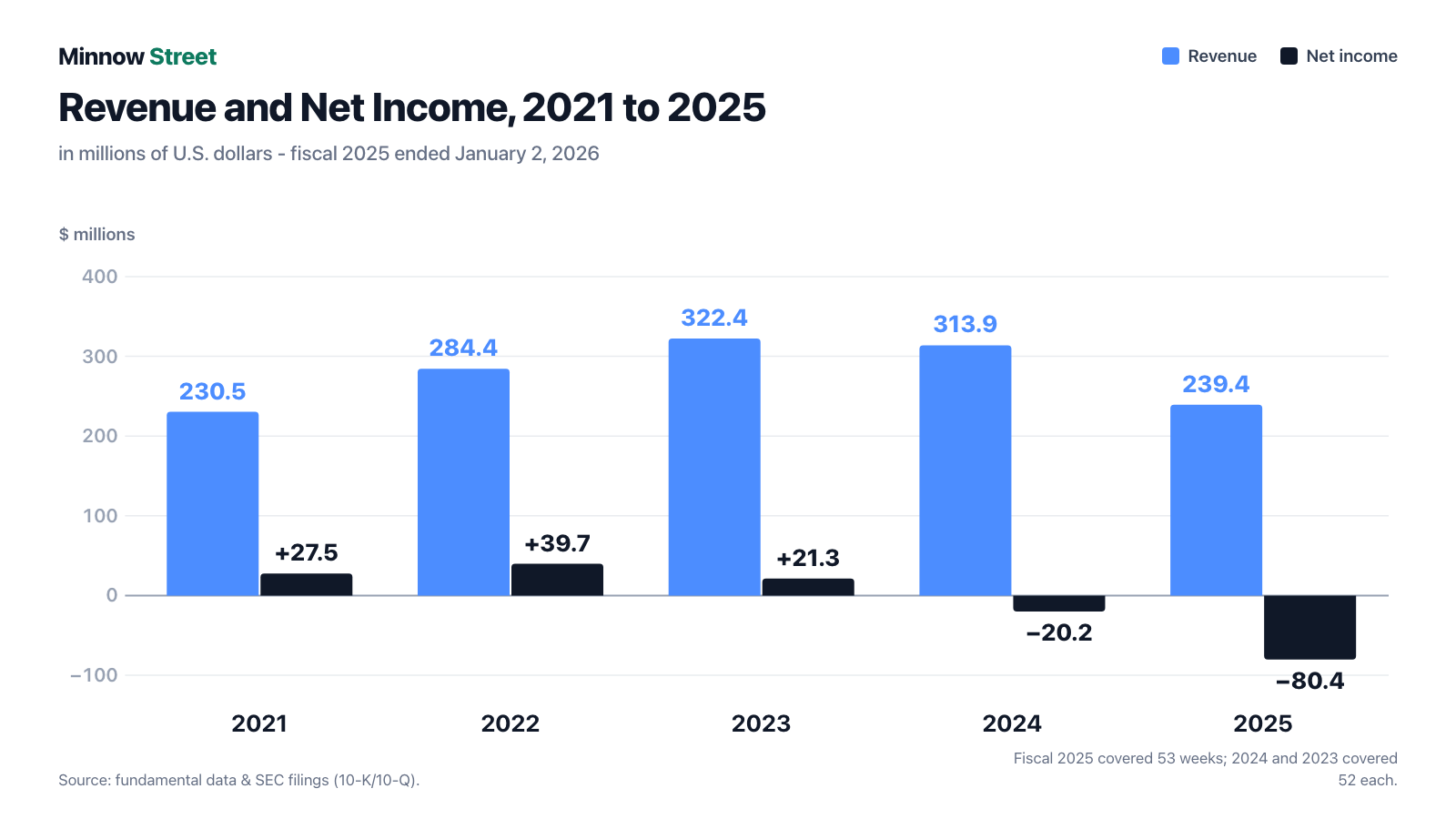
Then came the break, and it has a specific origin. In the summer of 2024 the two China distributors bought considerably more lenses than they ultimately sold, expecting a strong high season that never materialized. The result: full warehouses at the distributor, and STAAR was able to ship almost nothing to China in the first half of 2025 because demand was served out of existing stock. Revenue from the two Chinese distributors fell from $162.3 million in 2024 to $77.8 million in 2025. Group revenue dropped 23.7 percent to $239.4 million and the net result slid to minus $80.4 million.
Remember the mechanism, because it explains almost everything about this stock: when a manufacturer sells to distributors rather than end users, its own revenue does not measure demand — it measures the distributor's appetite to buy. In that respect STAAR resembles our analysis of Dexcom, where a single customer grew to 55 percent of revenue.
And then the first quarter of 2026 — the quarter everything turns on. From January 3 to April 3, 2026 STAAR booked $93.5 million of revenue, up from $42.6 million a year earlier: an increase of 119.6 percent. Gross margin rose from 65.8 to 73.6 percent, operating income went from minus $57.4 million to plus $17.4 million, and $5.2 million of net income remained, or $0.10 per diluted share, after minus $1.10 in the prior-year quarter. The company explains it this way:
„The increase was primarily driven by strong sales performance in China, while distributor inventory was maintained at or below contractual levels. Net sales to our two distributors in China were $47.4 million for the three months ended April 3, 2026, compared to net returns of $0.9 million in the prior-year period.“
— STAAR Surgical Company, Form 10-Q for the quarter ended April 3, 2026, Item 2 MD&A
That is good news, and it should stand as such. The prior-year comparison was negative — returns exceeded sales. A jump off a negative base always looks spectacular. But $47.4 million in a single quarter is also, in absolute terms, more than STAAR earned in China across the first two quarters of 2025 combined: in the second quarter of 2025 the China distributors contributed just 12 percent of $44.3 million of quarterly revenue, and the first quarter of 2025 showed net returns. Distributor inventory has been worked down, the premium EVO+ lens has launched in China, and Swiss production is ramping: by the end of 2026 the company intends to supply every EVO and EVO+ lens for China out of Switzerland, free of tariff exposure.
What the Filings Say — the Uncomfortable Truths
Uncomfortable Truth No. 1: the rejected price still sits above the share price
The sequence is fully documented in the filings. On August 4, 2025 STAAR signed a merger agreement with Alcon Research, LLC at $28.00 per share in cash. Two amendments followed, on November 7 and December 9, 2025; the second raised the price to $30.75 per share. The special meeting took place on January 6, 2026. Of 49,365,823 shares entitled to vote, 43,367,928 were represented — 87.9 percent, a very high turnout. The outcome:
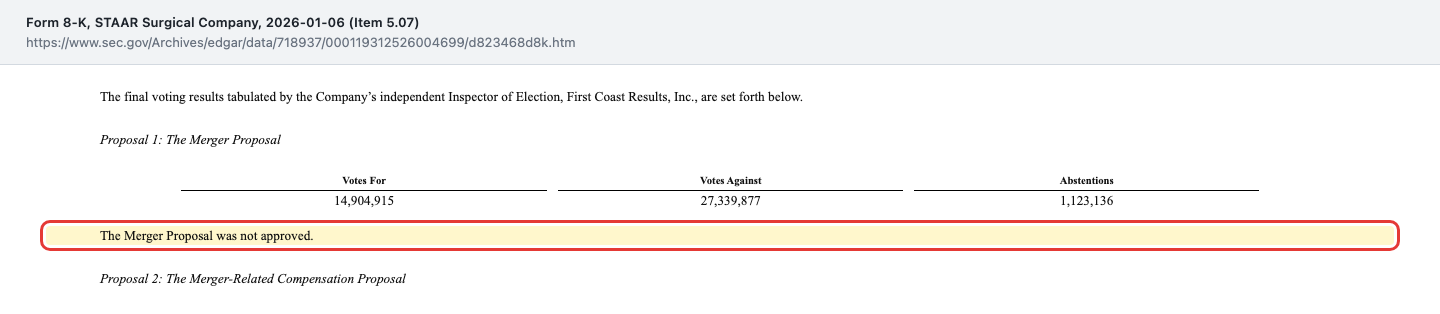
The merger agreement terminated the same day. Neither side owed a break fee. What remained is a bill: STAAR reported $17.135 million of professional fees relating to the merger for fiscal 2025, and a further $6.743 million in the first quarter of 2026 in connection with the merger and the subsequent cooperation agreement — $23.9 million in total for a deal that never happened. For scale: that is more than half of what the company spent on research and development in 2025 ($40.1 million).
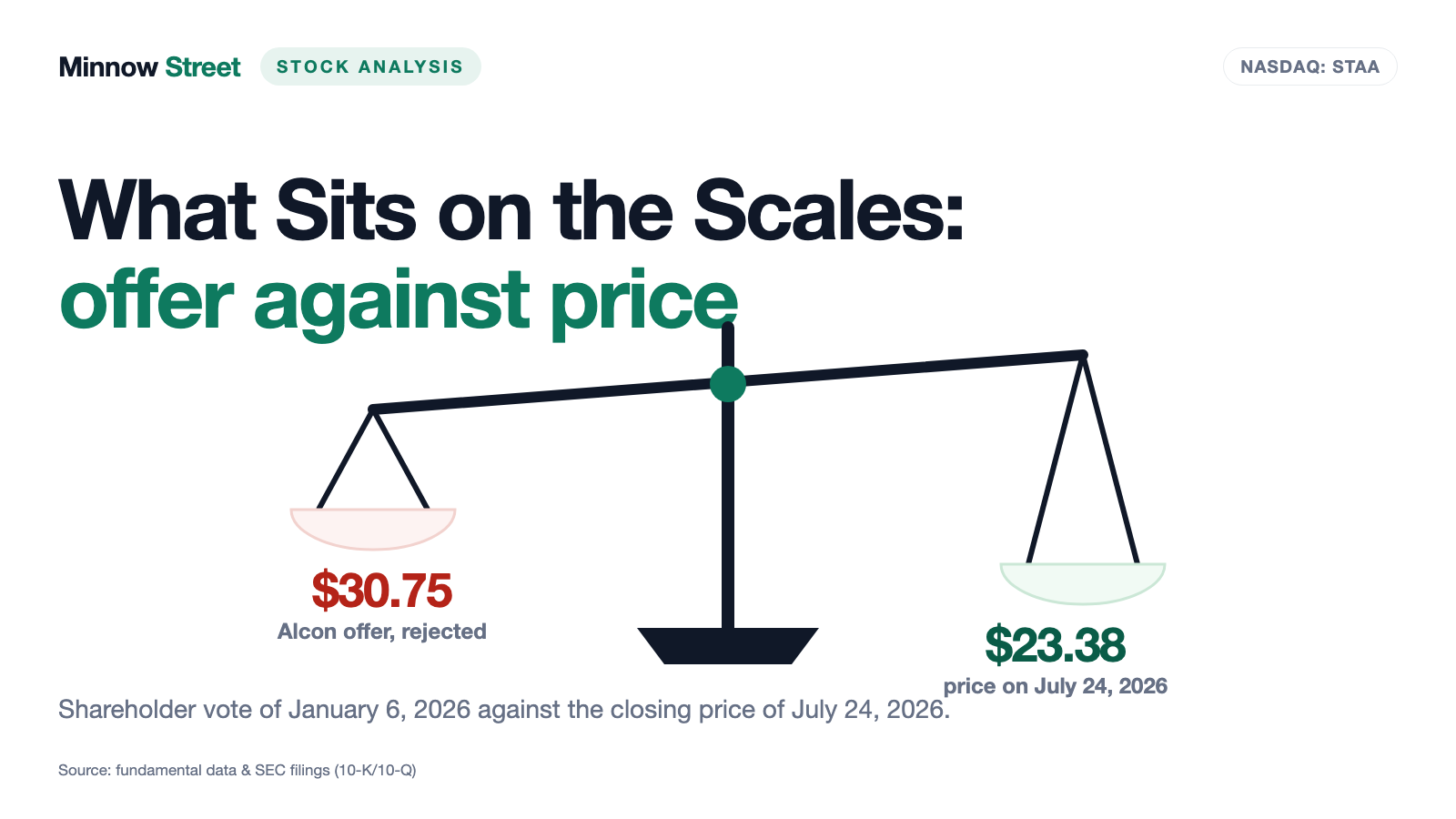
And the price comparison anyone can draw: on July 24, 2026 the stock closed at $23.38. The rejected offer was $30.75. Anyone who voted no in January 2026 held, half a year later, a security worth roughly a quarter less on the market than the offer. That is not a verdict on the decision — it is the interim score. A takeover pays today; independence may pay more later.
One point of context, and we checked it: through the most recent filing reviewed, dated June 24, 2026, there is no second attempt. After January 6, 2026 the SEC filings contain no Form 425, no new merger agreement and no disclosure of takeover talks — neither from Alcon nor from any other party.
Uncomfortable Truth No. 2: two distributors, 51 percent of revenue, 57 percent of receivables
This is the finding that overshadows everything else. In the first quarter of 2026 51 percent of group revenue came from the two Chinese distributors. As of April 3, 2026 they also accounted for 57 percent of all trade receivables, up from 33 percent as of January 2, 2026. Across the years the share swings violently: 58 percent of revenue in 2023, 51 percent in 2024, 32 percent in 2025.
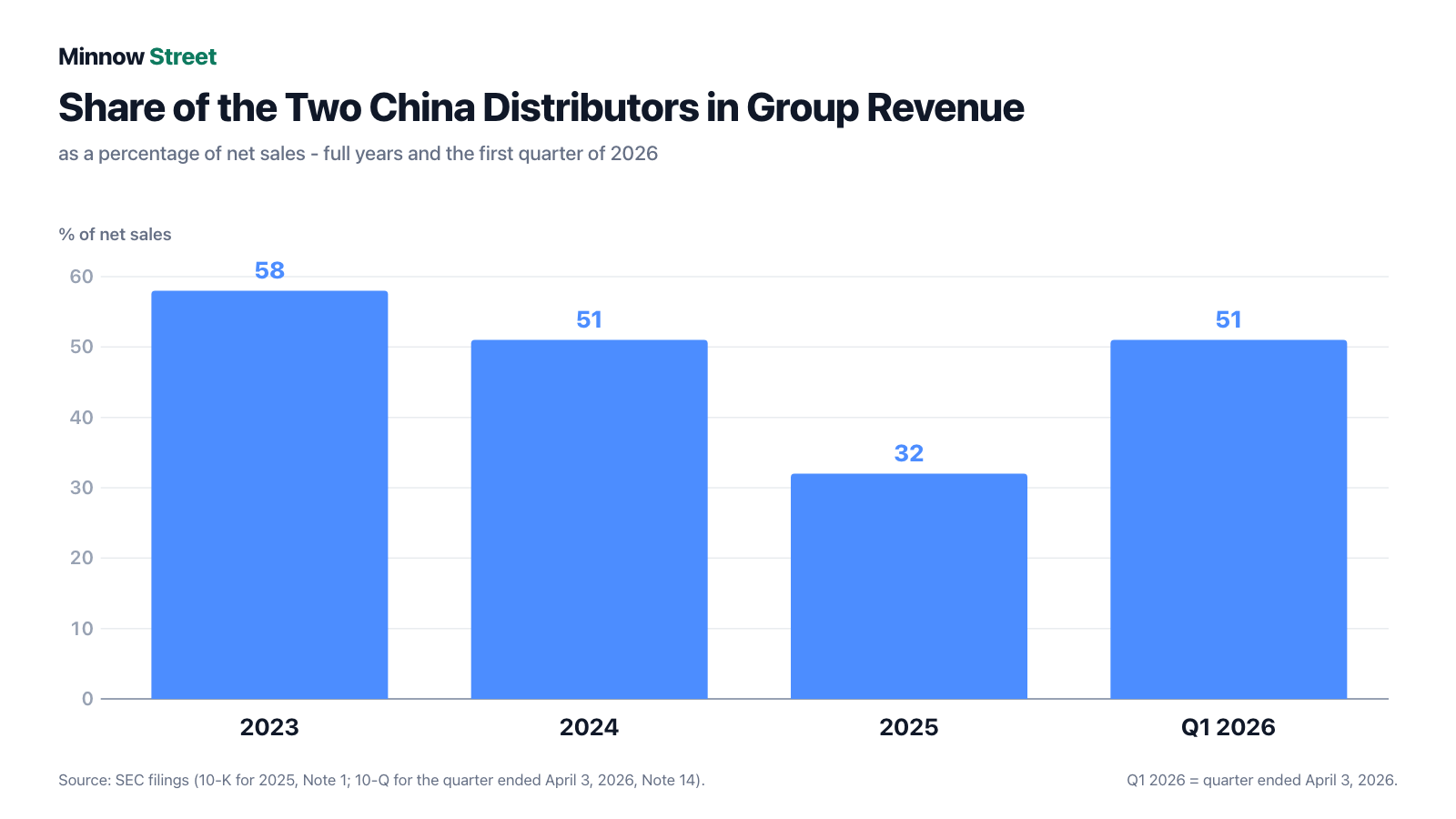
The company does not gloss over it — it writes it near the front of the annual report:
„Given the size of the Company’s business in China relative to its net sales in the rest of the world, macroeconomic conditions in China have a significant impact on the Company’s business, operations, and financial results. The sluggish economy and weak consumer consumption in China negatively impacted the Company’s financial results for fiscal 2025 and 2024 … is expected to continue to impact demand for our ICLs in China in fiscal 2026.“
— STAAR Surgical Company, Form 10-K for fiscal 2025, Item 1 Business

There is one further wrinkle you need in order to read the numbers. In April 2025, facing the threat of tariffs, STAAR moved its China business to consignment: the goods sit with the distributor but remain STAAR's property, and revenue arises only when the distributor actually buys them. Consignment sales in China came to $43.5 million in 2025 and a further $12.6 million in the first quarter of 2026. Commercially that is smart — and it makes revenue even more dependent on when a distributor chooses to draw down.
Uncomfortable Truth No. 3: profit yes, cash no
The profitable quarter was real. The cash was not. In the first quarter of 2026, net income of $5.2 million came alongside an operating cash outflow of $21.7 million. Cash and marketable securities fell from $187.5 million to $163.9 million — a $23.6 million decline in three months. The company names the reasons itself: front-loaded payments for seasonal bonuses and employee incentives, global sales meetings, severance and the costs of the cooperation agreement with Broadwood Partners. For the remainder of the year it expects to generate cash again.
The other half of the explanation sits in the balance sheet: receivables rose from $54.6 million to $85.7 million. Translated: a good part of the quarter's revenue is revenue on credit — shipped and booked, but not yet collected. And 57 percent of those receivables sit with two Chinese distributors. Anyone inclined to underestimate that combination should look at another medical device maker in our analysis of Inogen, where more units shipped likewise failed to translate into proportionally more cash.
For the full year 2025 the picture was similar: an operating cash outflow of $34.2 million plus $5.8 million of capital expenditure — free cash outflow of roughly $40.1 million. Rule of thumb: a quarterly profit tells you how the accounting was done. Cash flow tells you what actually arrived.
Uncomfortable Truth No. 4: the company has had no permanent chief since February 2026
After the lost vote things moved quickly. On January 14, 2026 STAAR signed a cooperation agreement with Broadwood Partners, L.P., its largest shareholder and the most public opponent of the sale:

On January 15, 2026 Neal C. Bradsher became chairman of the board — founder and president of Broadwood Capital, the general partner of the largest shareholder. On January 31, 2026 chief executive Stephen C. Farrell's tenure ended. Since February 1, 2026 two people have run the company jointly on an interim basis: Warren Foust, who is also president and chief operating officer, and Deborah Andrews, who is also chief financial officer. On February 4, 2026 the chief legal officer left as well. A board search committee has been looking for a new chief executive worldwide since January 15, 2026.
That this arrangement has an expiry date is stated in the filing itself:
„The Letter Agreement provides that Mr. Foust shall act as Interim Co-Chief Executive Officer until the earlier to occur of (i) August 1, 2026, and (ii) the date on which the Company makes a public announcement of the appointment of a Chief Executive Officer (the ‚Term‘).“
— STAAR Surgical Company, Form 8-K dated February 2, 2026, Item 5.02

Fairness demands the counterweight: the interim pair delivered the best quarter in two years. And one further note from the same week belongs on the scale — when two directors stepped down on January 14, 2026, the audit committee was temporarily left without the three independent members required by NASDAQ Listing Rule 5605. STAAR notified the exchange itself and restored compliance the very next day, on January 15, 2026. The matter was settled within 24 hours — but it shows how tightly the corner was taken.
Valuation — What the Market Is Paying
Let us work in orders of magnitude rather than daily prices. At the July 24, 2026 close of $23.38 and 49,788,495 shares outstanding (10-Q cover page, as of May 8, 2026), market capitalization stood at roughly $1.16 billion. Measured against 2025 revenue of $239.4 million that is a price-to-sales ratio of about 4.9; measured against trailing twelve-month revenue of $290.4 million it is about 4.0. There is no price-to-earnings ratio because 2025 was a loss year. Price-to-book comes to roughly 3.3 — market capitalization against $352.4 million of equity as of April 3, 2026.
The professionals' view, in context: across the analyst houses covered, the consensus target price is $30.00 (data as of July 25, 2026) — effectively the level of the rejected Alcon offer. The distribution is split, though: three outright buy ratings, ten holds and one outright sell. The stock's twelve-month range ran from $15.59 to $35.87. Around 5.1 million shares were sold short, a little over ten percent of shares outstanding.
And one more figure that fits the turnaround theme: the Altman Z-score — the bankruptcy early-warning measure mentioned earlier — sits at roughly 6.3, comfortably outside the distress zone. The Piotroski score, a nine-point checklist of balance sheet quality, sits at 1 out of 9 (data as of July 25, 2026). Translated: the company is not in danger, but it has just failed almost all nine quality tests. That is precisely what an early turnaround looks like — and precisely why it is a wager rather than a condition.
Opportunities and Risks at a Glance
What speaks in favor:
- A product with a real moat: Collamer is a proprietary material used exclusively by STAAR; gross margin was 76.2 percent in 2025 and 73.6 percent in the first quarter of 2026.
- The turn is measurable: revenue up 119.6 percent to $93.5 million in the first quarter of 2026, operating income from minus $57.4 million to plus $17.4 million, net income of $5.2 million after minus $54.2 million.
- Solid balance sheet: $352.4 million of equity against $98.8 million of liabilities and $37.3 million of financial debt, plus $163.9 million of cash and marketable securities (all as of April 3, 2026); the filing confirms sufficient liquidity for at least twelve months.
- Distributor inventory has been worked down: days sales outstanding fell from 145 to 85 and days inventory on hand from 367 to 219 (year-end 2025 against 2024; the methodology for days inventory on hand was changed in the fourth quarter of 2025).
- A second plant as tariff insurance: by the end of 2026 all EVO and EVO+ lenses for China are to come from Switzerland, where the company holds a tax holiday running through 2029.
- The largest shareholder now chairs the board: Broadwood Partners held 16,123,842 shares, or 32.6 percent, as of March 13, 2026, aligning its interests with those of other holders.
What speaks against:
- China concentration: 51 percent of first-quarter 2026 revenue and 57 percent of trade receivables sit with two distributors; the company flags this risk in its own annual report.
- One product, one kind of demand: the procedure is a self-funded elective, and the annual report expects weak Chinese consumer spending to keep weighing on demand in 2026.
- The turnaround is one quarter old: 2024 and 2025 ended with losses of $20.2 million and $80.4 million; the Piotroski score stands at 1 out of 9.
- Cash left the business recently: minus $21.7 million from operations in the first quarter of 2026 and minus $34.2 million in 2025, with receivables rising from $54.6 million to $85.7 million.
- A leadership gap with a deadline: two interim chiefs since February 1, 2026, with Warren Foust's letter agreement expiring August 1, 2026; the chief legal officer departed in February 2026.
- Dilution approved: the June 18, 2026 annual meeting released 3,900,000 additional shares for the compensation plan — roughly 7.8 percent of the share count.
- No price anchor left: after the failed sale the filings show no interested acquirer, and the stock closed July 24, 2026 roughly a quarter below the rejected offer.
A Human Conclusion
Back to the defiance premium. At STAAR Surgical the defiance is understandable: a large group tried to buy a company after its worst year in a decade had pushed the share price down. Saying no to that means saying, you want us cheap because we are temporarily weak. And the first quarter of 2026 gave that stance about as much wind as anyone could have hoped for.
What makes the trap treacherous is the question that disappears behind the headline: what exactly did that quarter depend on? It depended on two distributors in China who had cleared their shelves and started ordering again. That is a genuine recovery — but a recovery on a very narrow base, sold on credit, at a company that currently has nobody permanently in charge.
The decisive question sits in the next few quarterly reports and is refreshingly simple: does the revenue keep coming once the two Chinese distributors' shelves are full again — and does it arrive as cash in the bank rather than as a receivable on the balance sheet? If yes, the no-voters were right and $30.75 was too little. If no, the first quarter of 2026 was a catch-up effect that somebody mistook for a turn. What you make of that is your decision. And that is exactly as it should be.
Sources
- STAAR Surgical Company, Form 10-K for fiscal 2025 (period ended January 2, 2026, filed March 3, 2026), CIK 0000718937 — Item 1 Business, Item 1A Risk Factors, Item 7 MD&A, Notes 1, 17 and 19.
- STAAR Surgical Company, Form 10-Q for the quarter ended April 3, 2026 (filed May 13, 2026) — interim balance sheet, Item 2 MD&A, Notes 1, 13, 14 and 16; share count from the cover page (as of May 8, 2026).
- STAAR Surgical Company, Form 10-K for fiscal 2024 (period ended December 27, 2024, filed February 21, 2025) — comparative figures for 2022 through 2024.
- STAAR Surgical Company, Form 8-K dated December 9, 2025 — Item 1.01, Amendment No. 2 to the merger agreement raising the price from $28.00 to $30.75 per share.
- STAAR Surgical Company, Form 8-K dated January 6, 2026 — Items 1.02 and 5.07, special meeting voting results and termination of the merger agreement.
- STAAR Surgical Company, Form 8-K dated January 15, 2026 — Items 1.01, 3.01 and 5.02, cooperation agreement with Broadwood Partners, NASDAQ Listing Rule 5605 notice and the chief executive's departure from the board.
- STAAR Surgical Company, Form 8-K dated January 16, 2026 — Item 5.02, election of Neal C. Bradsher as board chair, new committees and restored NASDAQ compliance.
- STAAR Surgical Company, Form 8-K dated February 2, 2026 — Item 5.02, appointment of Warren Foust and Deborah Andrews as interim co-chief executives and the letter agreement expiring August 1, 2026.
- STAAR Surgical Company, Form 8-K dated June 22, 2026 — Items 5.02 and 5.07, results of the June 18, 2026 annual meeting and the 3,900,000-share increase to the equity incentive plan.
- STAAR Surgical Company, Proxy statement DEF 14A dated May 4, 2026 — beneficial ownership as of the April 20, 2026 record date, board composition, auditor BDO USA, P.C.
- Broadwood Partners, L.P., Schedule 13D/A No. 44 filed March 13, 2026 — 16,123,842 shares, or 32.6 percent, of STAAR Surgical.
- Rankings from our in-house stock scanner: Turnaround Candidates (U.S. selection, rank 18 of 62, turnaround check 7 of 8), as of July 25, 2026; the lists are recalculated daily.
- Fundamental data (market capitalization, valuation ratios, analyst consensus, twelve-month range, short interest, Altman Z and Piotroski scores), as of July 25, 2026, closing price of July 24, 2026.
Disclaimer: This article is journalistic commentary on publicly available company data. It is not investment advice, not a recommendation to buy or sell, and not a solicitation to buy or sell securities. Share prices can fall substantially at any time, and a total loss is possible. All figures come from the primary sources linked above and carry the as-of dates stated there. The author holds no position in the security discussed at the time of publication.
Our Bottom Line at a Glance
- Product and margin positive
- STAAR sells implantable contact lenses made from Collamer, a material it developed and uses exclusively, in more than 85 countries. Gross margin was 76.2 percent in 2025 and 73.6 percent in the first quarter of 2026, up from 65.8 percent a year earlier. That is the margin of a company with a product few can copy.
- Earnings power negative
- Two consecutive loss years: minus $20.2 million in 2024 and minus $80.4 million in 2025, on a 23.7 percent revenue decline to $239.4 million. The first quarter of 2026 delivered the turn with $5.2 million of net income — but it is exactly one quarter, and the Piotroski score stands at 1 of 9 (data as of July 25, 2026).
- China concentration negative
- Two distributors in China accounted for 51 percent of group revenue in the first quarter of 2026 and for 57 percent of all trade receivables as of April 3, 2026, up from 33 percent as of January 2, 2026. The fiscal 2025 annual report itself expects weak Chinese consumer spending to keep weighing on ICL demand in 2026.
- Balance sheet and cash flow neutral
- As of April 3, 2026 the company held $352.4 million of equity against $98.8 million of liabilities and only $37.3 million of financial debt, plus $163.9 million of cash and marketable securities; the Altman Z-score sits at about 6.3. The counterweight: operations consumed $34.2 million of cash in 2025 and a further $21.7 million in the first quarter of 2026, while receivables rose from $54.6 million to $85.7 million.
- Ownership and leadership neutral
- Broadwood Partners held 16,123,842 shares, or 32.6 percent, as of March 13, 2026, blocked the takeover and has supplied the board chair, Neal C. Bradsher, since January 15, 2026. The company has been run on an interim basis by Warren Foust and Deborah Andrews since February 1, 2026; Foust's letter agreement expires August 1, 2026.
- Valuation neutral
- At the July 24, 2026 close of $23.38, market capitalization stood at roughly $1.16 billion — about 4.9 times fiscal 2025 revenue and about 3.3 times book, with no price-to-earnings ratio because of the loss year. The rejected Alcon price was $30.75 per share; the analyst consensus target is $30.00.
STAAR Surgical is the defiance premium in its purest form: shareholders turned down $30.75 per share in cash on January 6, 2026, and the first quarter of 2026 promptly supplied the vindication — revenue up 119.6 percent to $93.5 million, gross margin back to 73.6 percent, $5.2 million of net income after a $54.2 million loss a year earlier. But that vindication rests on a narrow base: 51 percent of quarterly revenue and 57 percent of trade receivables sat with two distributors in China, operations consumed $21.7 million of cash, receivables rose from $54.6 million to $85.7 million, and there has been no permanent chief executive since February 1, 2026. The balance sheet carries all of it: $352.4 million of equity, $37.3 million of financial debt, $163.9 million of cash and marketable securities. Not investment advice.
What Our Rating Means
Open questions
The business works in principle, but one material question is open. As long as it stays open, our findings do not carry a quality verdict.
The business carries its own weight: a proprietary material, a 76.2 percent gross margin in 2025, sales in more than 85 countries and a balance sheet that came through the worst year in a decade undamaged — $352.4 million of equity against $37.3 million of financial debt, $163.9 million of cash and marketable securities, an Altman Z-score of about 6.3 and no going-concern language in the quarterly report. What remains open is a clearly operational question, and it weighs heavily: two loss years of minus $20.2 million and minus $80.4 million were followed by exactly one profitable quarter, 51 percent of whose revenue came from two distributors in a single country — the very distributors whose full warehouses caused the 2025 collapse. On top of that, operations consumed $21.7 million of cash despite the quarterly profit, receivables rose by $31.1 million, and the company has been led on an interim basis since February 1, 2026. None of it rises to an existential finding: two distributors are not a single counterparty, the company states its liquidity covers at least twelve months, and the 2025 collapse cost only about 13 percent of equity. This is not documented quality, but it is not a substance risk either — hence yellow. The decision is yours.
A journalistic assessment by our editorial team at the time of the deep dive, based on public sources — not investment advice and not a solicitation to buy or sell. Your personal circumstances (investment goals, risk capacity, taxes) cannot be taken into account. What our levels mean, how verdicts are formed, and what conflicts of interest exist →
Worth Noting
- STAAR Surgical reached our research list through our in-house stock scanner: rank 18 of 62 in the "Turnaround Candidates" list (U.S. selection) with a turnaround check of 7 of 8 points, as of July 25, 2026. Both the rank and the score are a snapshot of that day — the lists are recalculated daily. The list requires two mandatory pillars (at least 50 percent below the all-time high, and survival evidenced by the Altman Z-score, balance sheet warning signals and positive equity) plus at least 6 of 8 points in the turnaround check, which measures the operational turn and market confirmation.
- Every figure carries its own as-of date: annual figures from the Form 10-K for fiscal 2025 (period ended January 2, 2026, filed March 3, 2026), quarterly figures from the Form 10-Q for the quarter ended April 3, 2026 (filed May 13, 2026), merger and leadership data from the Forms 8-K dated December 9, 2025 through June 22, 2026, ownership from the proxy statement DEF 14A dated May 4, 2026, share count from the 10-Q cover page (May 8, 2026). Valuation metrics as of July 25, 2026, based on the closing price of July 24, 2026 — meant to be evergreen, with no daily price used as an argument.
- Identity and currency: the ticker STAA belongs to STAAR Surgical Company of Lake Forest, California (CIK 0000718937), not to would-be acquirer Alcon. The merger agreed on August 4, 2025 was rejected by shareholders on January 6, 2026 and terminated the same day — the company is independent, and through the most recent filing reviewed, dated June 24, 2026, there is no new attempt. The NASDAQ Listing Rule 5605 notice of January 14, 2026 was cured on January 15, 2026.
Frequently Asked Questions
STAAR Surgical makes implantable contact lenses, known as ICLs. A surgeon inserts the foldable lens through a small incision and places it behind the iris and in front of the eye's natural lens; unlike LASIK, no corneal tissue is removed and the procedure is reversible. The Collamer material is proprietary to STAAR. The company sells in more than 85 countries and reports as a single operating segment.
At the special meeting on January 6, 2026, 27,339,877 shares voted against the merger agreement and only 14,904,915 in favor, with 1,123,136 abstentions. The price had been raised on December 9, 2025 from $28.00 to $30.75 per share in cash. Largest shareholder Broadwood Partners had campaigned publicly against the sale. The agreement terminated the same day, and no termination fee was owed.
The SEC filings show no sign of one after January 6, 2026: no Form 425, no new merger agreement and no disclosure of takeover talks, from Alcon or anyone else. Every filing through the Form S-8 dated June 24, 2026 was reviewed. The only material agreement after the vote was the cooperation agreement with largest shareholder Broadwood Partners dated January 14, 2026.
Heavily, and on just two distributors. In the first quarter of 2026 they accounted for 51 percent of group revenue and, as of April 3, 2026, for 57 percent of all trade receivables. Across the years their revenue share swung between 58 percent in 2023, 51 percent in 2024 and 32 percent in 2025. The annual report explicitly names macroeconomic conditions in China as a significant driver of results.
In 2024 the two Chinese distributors bought more lenses than they could sell during the expected summer high season. They therefore entered 2025 with elevated inventory and served demand largely out of that stock, so new orders did not come. Revenue from the two distributors fell from $162.3 million in 2024 to $77.8 million in 2025, and group revenue dropped 23.7 percent to $239.4 million.
Since February 1, 2026 the company has been led jointly on an interim basis by Warren Foust, who is also president and chief operating officer, and Deborah Andrews, who is also chief financial officer. Former chief executive Stephen C. Farrell departed on January 31, 2026. Foust's letter agreement runs to August 1, 2026 or until a new chief executive is announced. Neal C. Bradsher of Broadwood Capital has chaired the board since January 15, 2026.
The fiscal year ends on the Friday nearest December 31, and each quarter generally runs 13 weeks. Fiscal 2025 therefore ran through January 2, 2026 and covered 53 weeks, while fiscal 2024 and 2023 covered 52 weeks each. The first quarter of 2026 ended April 3, 2026. Anyone comparing STAAR with calendar-year reporters is comparing slightly offset periods.
As of April 3, 2026 the books showed $451.1 million of total assets, $352.4 million of equity, $98.8 million of liabilities and only $37.3 million of financial debt, plus $163.9 million of cash and marketable securities. The quarterly report confirms sufficient liquidity for at least twelve months, and the Altman Z-score sits at about 6.3, outside the distress zone. The counterweight: operations consumed $34.2 million of cash in 2025.
Found an error?
Did you spot a factual error, an outdated number, or a typo in this deep dive? Let us know briefly — your report goes straight to the editorial team.