Inogen: 20 percent more devices sold — and only 6 percent more money
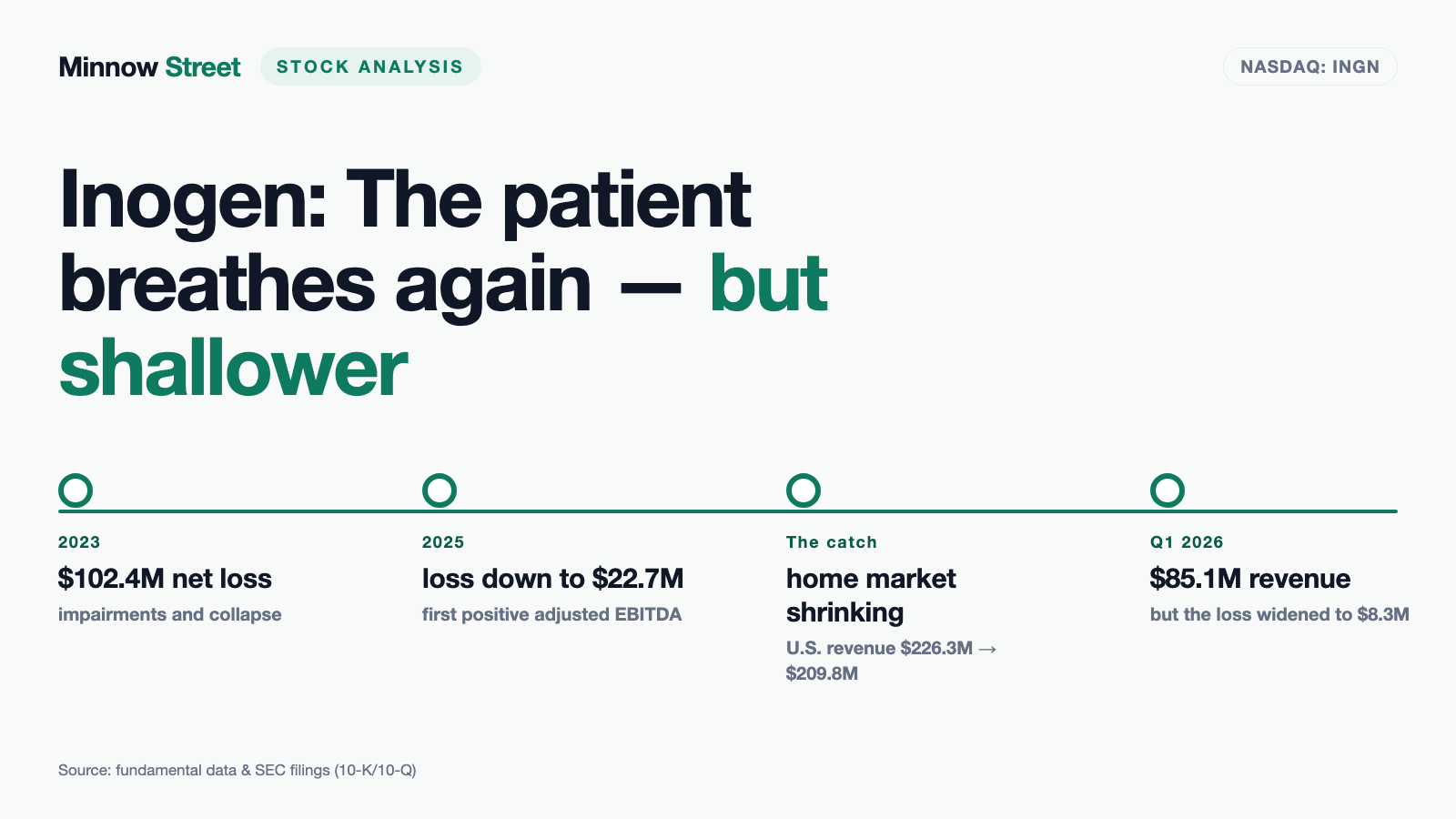
Inogen builds portable oxygen devices for people with chronic lung disease — and the company itself is just coming up for air: the annual net loss fell from $102.4 million in 2023 to $22.7 million in 2025, and adjusted operating earnings turned positive for the first time. The SEC filings also show the price of that: 189,400 systems sold in 2025 meant roughly 20 percent more units but only 5.9 percent more sales revenue — and the U.S. home market has now shrunk three years running. On July 25, 2026 the ticker jumped from rank 763 to rank 98 on Reddit. No recommendation — just a look at who is actually breathing easier here.
 Thomas Mücke
Founder & Publisher
Thomas Mücke
Founder & Publisher
Chart
Interactive price chart (TradingView).
Note: pure fact-based analysis, not investment advice and not a solicitation to buy or sell. All figures without guarantee.
There is an investing trap that catches compassionate people in particular: the recovery trap. It works like this. A patient who is getting better triggers a relief in us that is stronger than any follow-up question. We see the direction — upward! — and stop asking what altitude they are actually at. On the stock market the same movement is called a turnaround, and it is seductive precisely because every single number is true. Inogen (Nasdaq: INGN) of Beverly, Massachusetts is such a case in the summer of 2026 — and the irony sits in the product: the company makes portable oxygen devices for people with chronic lung disease. It sells air to breathe, and for years it was gasping for air itself. On July 25, 2026, the ticker jumped from rank 763 to rank 98 among the most-discussed U.S. stocks on Reddit (data from ApeWisdom). So here is the deal: before relief decides for you, let us read together what Inogen filed with the U.S. securities regulator, the SEC — the Form 10-K for 2025 and the Form 10-Q for March 31, 2026. An SEC filing is honest under penalty of law. The decision at the end is yours.
What Inogen actually does — oxygen without the cylinder
People with severe lung disease — most often chronic obstructive pulmonary disease, or COPD — frequently need supplemental oxygen around the clock. Traditionally that came from heavy pressurized cylinders that had to be delivered and swapped. Inogen builds the alternative: a portable oxygen concentrator that draws in ambient air, filters out the nitrogen and delivers enriched oxygen. No refills, no delivery service — a battery-powered device you can carry over your shoulder. The product families are Inogen One and Inogen Rove, joined by the Voxi 5 stationary device, the French airway clearance therapy Simeox (acquired in 2023) and Aurora masks for sleep apnea therapy.
Selling happens along three routes — and that split is the key to everything that follows:
"Of the $209.8 million of our 2025 revenue derived from the United States, approximately 45.1% represented sales to traditional home medical equipment providers, distributors (including our private label collaborator) and resellers; 29.5% represented direct-to-consumer sales; and 25.4% represented direct-to-consumer rentals."
— Inogen, Inc., Form 10-K for 2025, Item 1, "Domestic sales and marketing"

The rental route is the most unusual and economically the most valuable: Inogen provides the device to the patient and bills Medicare or a private insurer directly, month after month, for as long as therapy continues. The filing notes that the company believes it is the only manufacturer of portable concentrators that does this. There is no rental business outside the United States; abroad, Inogen sells only to distributors and large accounts, in 70 countries as of 2025.
That names the central tension of this analysis, and it runs through every chapter: Inogen is growing — but it is growing abroad and in unit volume, while the home market and, of all things, the recurring rental base are shrinking.
How the stock landed on our desk
We run roughly 3,500 stocks through our scanners every day. Inogen reached the research list through the Reddit hype scanner, which counts which smaller U.S. names the retail forums are talking about: 4 mentions in 24 hours and a jump from rank 763 to rank 98 among the most-discussed stocks (data from ApeWisdom, as of July 25, 2026). Little noise, a lot of movement — exactly the pattern that makes reading the filings worthwhile.
In our other scanners, Inogen produces a remarkably split picture as of July 25, 2026 — six hits pointing in two different directions. On the valuation and ownership side sit "Price-to-sales ranking", which collects every name trading at 0.7 times sales or less — companies whose market value is small relative to what they turn over — and "Professionals 80%", because institutions and insiders together hold more than 80 percent. On the trend side sit four more: "Above the 50- and 200-day average", "Power Trend", "Above the 21-day EMA pullback" and "Strong daily closing range (80 or above)" — all momentum filters signalling an intact uptrend. Hold on to that contradiction, because it runs through the whole article: the fundamentals say "cheap and shrinking," the chart says "uptrend." Neither is a verdict on quality, and scanner memberships change daily. What a very low price-to-sales ratio can hide, we took apart in our analysis of Agora — there the cash pile was larger than the entire market value, and the stock still was not a free lunch. Incidentally, the same Reddit run put a second ticker on the desk that day: LiveWire, Harley-Davidson's electric motorcycle arm — a very different case, but the same lesson about numbers without context.
The numbers over the years — given their due
Start with what genuinely impresses, and at Inogen that is a great deal. The turnaround is real. 2023 was a disaster year: a $109.4 million operating loss, $32.9 million of it from impairment charges, and a $102.4 million net loss at the bottom. Two years later the same lines read: operating loss $30.2 million, net loss $22.7 million. Operating expense fell from $236.1 million to $184.5 million — roughly 22 percent less, even as revenue rose. Adjusted earnings before interest, taxes, depreciation and amortization swung from negative $37.8 million (2023) through negative $9.5 million (2024) to positive $2.7 million (2025), black ink for the first time ever.
The balance sheet is remarkably clean along the way: as of March 31, 2026 the books showed $93.1 million in cash plus $17.1 million in marketable securities and shareholders' equity of $182.9 million — with no bank debt at all. In February 2026 the board even authorized a $30.0 million share repurchase program; in the first quarter, 298,100 shares were bought back and retired at an average of $6.29 for $1.9 million.
And revenue is growing: $315.7 million (2023), $335.7 million (2024), $348.7 million (2025), and $85.1 million in the first quarter of 2026 against $82.3 million a year earlier. The question is where it grows. That is where the second half of the story begins:
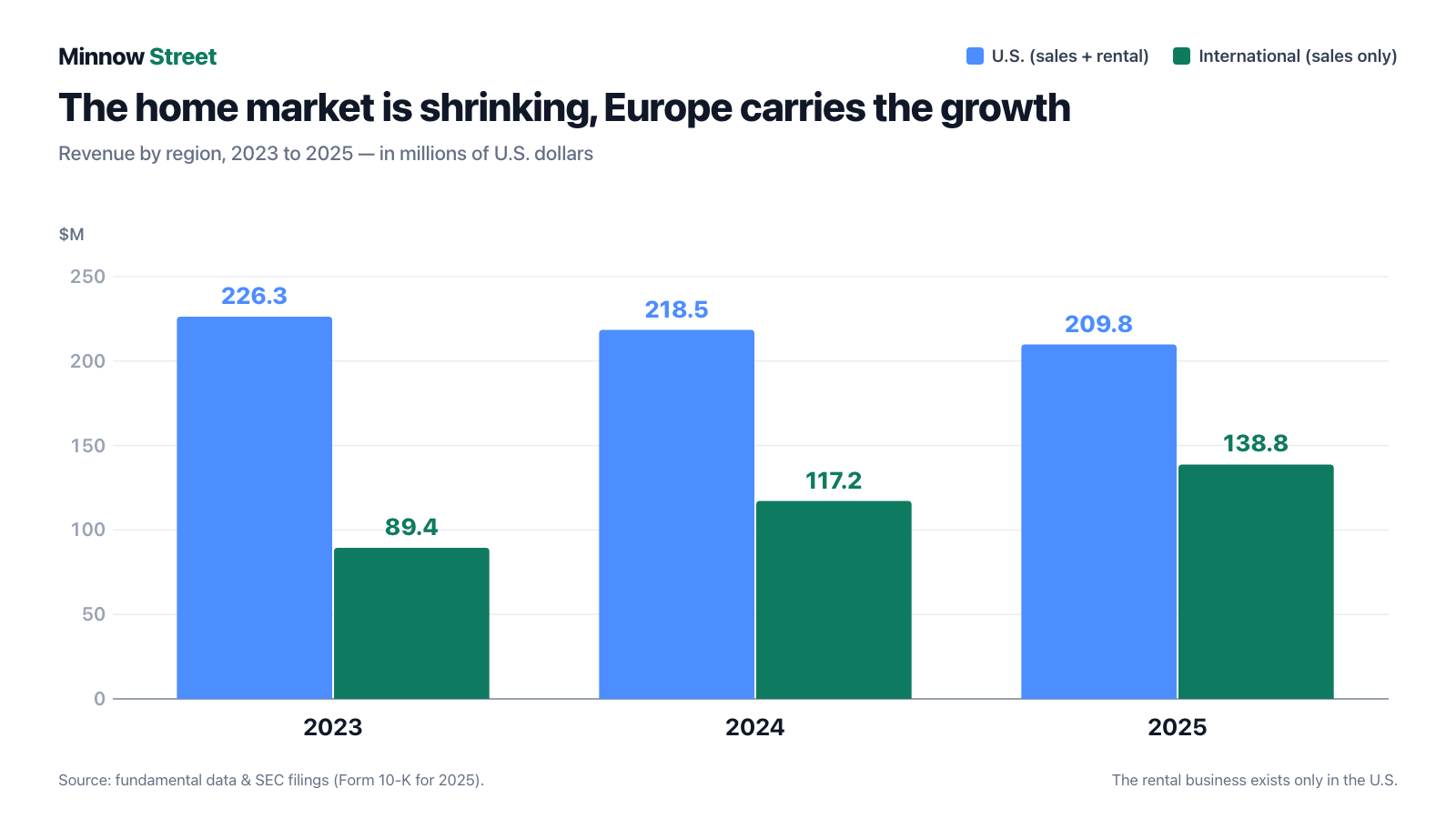
Remember this picture: the group is growing, the home market is shrinking. Which brings us to the uncomfortable truths.
What the filings say — the uncomfortable truths
Uncomfortable truth No. 1: 20 percent more devices, 6 percent more money
The annual report gives a unit number that sounds like a triumph at first glance:
"We sold approximately 189,400 oxygen systems during the year ended December 31, 2025 compared to approximately 157,500 oxygen systems sold during the year ended December 31, 2024, an increase of 20.3%."
— Inogen, Inc., Form 10-K for 2025, Item 7 Management's Discussion and Analysis
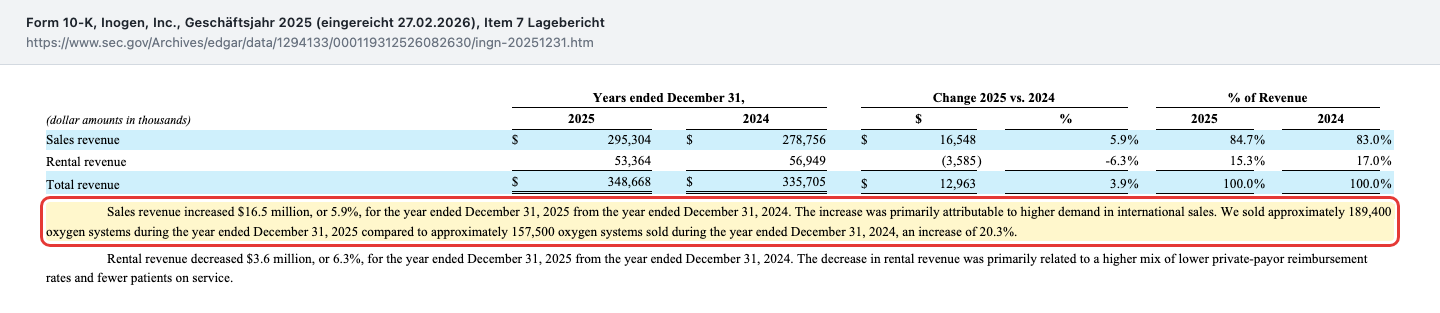
Right next to it sits the other number: sales revenue rose $16.5 million, or 5.9 percent, to $295.3 million in 2025. A fifth more devices, a twentieth more money. Do the division yourself — it is arithmetic, not magic: $295.3 million divided by 189,400 systems is about $1,559 per device; a year earlier it was $278.8 million divided by 157,500, or about $1,770. A decline of roughly 12 percent in a single year. (Both figures are our own calculation from the reported numbers; sales revenue also includes accessories, and the exact device price is not disclosed.)
Where does the pressure come from? The filing names two causes. First, channel mix: growth comes from the international distributor business, where Inogen sells at wholesale prices rather than end-customer prices. Second, cost — gross margin on sales fell from 46.7 percent to 44.5 percent, partly because of "higher cost premiums associated with open-market purchases of semiconductor chips." And competition is intensifying: the report names ten rival manufacturers and notes that the cost per generated lead now runs above historical averages.
Uncomfortable truth No. 2: the home market has shrunk three years running
This figure appears in no press release; it has to be assembled from two tables in the annual report, so here is the arithmetic to check. Sales revenue generated in the United States was $162.2 million (2023), $161.5 million (2024) and $156.5 million (2025). Rental revenue arises entirely in the United States: $64.1 million, $56.9 million and $53.4 million. Together, then: $226.3 million → $218.5 million → $209.8 million. Three years, three declines, 7.3 percent in total.
The first quarter of 2026 continues the pattern: $47.4 million of U.S. revenue against $50.3 million a year earlier — down 5.7 percent — while international revenue jumped from $32.0 million to $37.7 million. The group grew 3.4 percent in the quarter; without the international business it would have shrunk.
One detail worth holding alongside that international growth: 81.7 percent of international revenue was invoiced in euros in the first quarter of 2026 (prior-year quarter: 78.9 percent), and 85 percent of the foreign business is European. Part of the reported growth is therefore a currency move — no accusation, but a reason not to book foreign growth as operating strength without checking. Put in everyday terms: someone paid in a currency that happens to be rising earns more at home without working more.
Uncomfortable truth No. 3: the only recurring revenue line is eroding
For a medical device company, the rental channel is the most valuable thing it owns: predictable monthly income from a payor that pays reliably. That is exactly the channel shrinking.
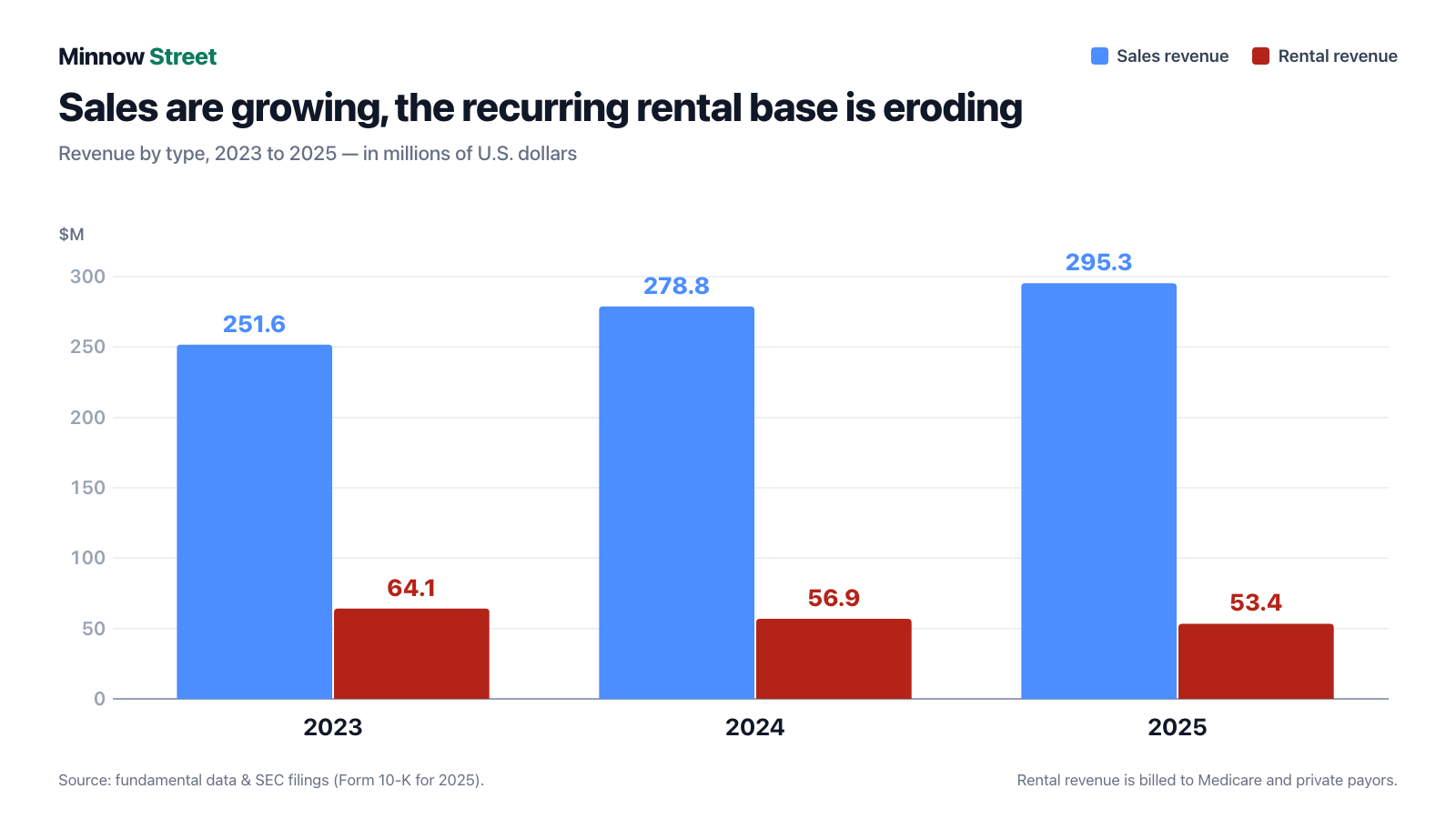
The explanation in the filing is uncomfortably specific:
"Rental revenue decreased $3.6 million, or 6.3%, for the year ended December 31, 2025 from the year ended December 31, 2024. The decrease in rental revenue was primarily related to a higher mix of lower private-payor reimbursement rates and fewer patients on service."
— Inogen, Inc., Form 10-K for 2025, Item 7 Management's Discussion and Analysis

That distinction matters, because the obvious assumption would be wrong: Medicare rates were not cut, they rose — the monthly reimbursement rate for stationary oxygen climbed, per the filing, from $90.77 (2023) to $96.11 (2025) and $98.81 effective January 1, 2026. The problem lies elsewhere: fewer patients, and more of those pay through private insurers who reimburse less. On top of that comes a rule worth knowing: Medicare pays for rented oxygen equipment for at most 36 months within a 60-month period — after that the device stays with the patient but the payments stop. The share of such "capped" patients rose from 16.6 percent (end of 2024) to 17.6 percent (end of 2025). One in six patients on service therefore generates no revenue at all.
Another sign flipped in 2025 as well: operating cash flow swung from positive $5.9 million (2024) to negative $11.2 million (2025). In fairness, that includes the one-time earn-out payment for the Physio-Assist acquisition, $9.8 million of it in the operating section — without it the line would have been roughly break-even. But "roughly break-even" is not a resting place for a company with $348.7 million of revenue either.
Uncomfortable truth No. 4: the Chinese anchor shareholder holds the clearances
On January 25, 2025, Inogen signed two agreements with Chinese medical technology group Jiangsu Yuyue Medical, brand name Yuwell: a strategic collaboration and a securities purchase agreement. Under the second, a Yuwell subsidiary bought 2,626,425 shares at $10.36 each, roughly $27.2 million in total; the placement closed on February 21, 2025. Against the 27,232,350 shares outstanding at year-end, that is about 9.6 percent — and those proceeds were effectively the entire cash inflow of the group in 2025.
The collaboration added two product lines to the range: the Voxi 5 stationary concentrator and the Aurora masks. Who owns the U.S. clearances for them appears a page further on:
"Yuwell, as the registration holder, obtained the 510(k) clearances for the Voxi and Aurora products."
— Inogen, Inc., Form 10-K for 2025, Item 1, "510(k) clearance pathway"
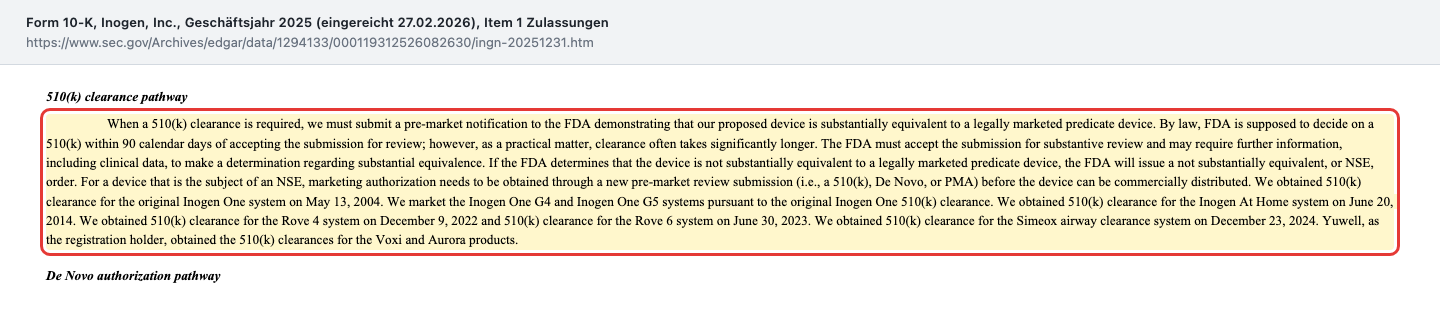
Put in everyday terms: Inogen sells two products whose operating license is issued to somebody else — somebody who is simultaneously a supplier, a distribution partner in Asia and one of its largest shareholders. That is not unusual for a distribution partnership, but it is a dependency worth knowing about. No voting, board or standstill arrangement with Yuwell is mentioned in the filings. And one more figure for context: Yuwell paid $10.36 per share in February 2025 — a dated price paid by a strategic buyer, well above what the market was asking in the summer of 2026.
A second concentration is building in parallel: the revenue share of the ten largest customers rose from 25.2 percent (2023) to 33.3 percent (2024) and 38.9 percent (2025); a single customer accounted for more than 10 percent of group revenue in 2025. The more the distributor business grows, the more Inogen depends on a handful of buyers.
Valuation: below book value, with a question mark
There is no price-to-earnings ratio, because Inogen is still loss-making. The two remaining yardsticks look unusually cheap. Market capitalization stood at roughly $167 million on July 24, 2026. Against that: trailing four-quarter revenue of about $351.5 million — a price-to-sales ratio of roughly 0.48 — and shareholders' equity of $182.9 million as of March 31, 2026. The company therefore costs less on the market than its book value, and that book value includes $110.2 million of cash and securities with no debt at all.
Constellations like that rarely occur without reason. The market is evidently pricing in three things: the shrinking home market, the falling revenue per device, and the question of whether "roughly break-even" ever becomes a profit. The professionals disagree — three analysts cover the stock, with one strong buy, one buy and one sell rating; the average price target as of July 25, 2026 was $12.67. That spread is more honest than a unanimous verdict: it shows the story really can be told both ways. Remember the sentence: a low price-to-sales ratio is not a discount, it is a question — and the question is always why.
Opportunities and risks at a glance
What speaks for Inogen:
- The turnaround is documented: net loss reduced from $102.4 million (2023) to $35.9 million (2024) and $22.7 million (2025); operating expense down from $236.1 million to $184.5 million; adjusted operating earnings positive for the first time at $2.7 million.
- A rare balance sheet for a company this size: $93.1 million of cash plus $17.1 million of securities, $182.9 million of equity and no debt whatsoever (March 31, 2026) — plus a $30.0 million buyback program running to the end of 2027.
- Genuine international growth: foreign revenue rose from $89.4 million (2023) to $138.8 million (2025), and units sold rose 20.3 percent in 2025 to roughly 189,400 systems.
- Competition is thinning in one place: Philips Respironics announced in early 2024 that it was leaving the U.S. portable oxygen concentrator market until further regulatory assessments.
- A strategic investor paid a dated price of $10.36 per share in February 2025 — well above the market valuation in the summer of 2026.
What speaks against it:
- U.S. revenue has fallen three years running ($226.3 million to $218.5 million to $209.8 million) and a further 5.7 percent in the first quarter of 2026; without the international business the group would have shrunk.
- Revenue per system sold fell, on our arithmetic, from about $1,770 to about $1,559, and gross margin on sales from 46.7 percent to 44.5 percent — volume is replacing price, and that is the more expensive road.
- The recurring rental business is eroding ($64.1 million to $53.4 million), the share of Medicare-"capped" patients rose to 17.6 percent, and operating cash flow turned negative $11.2 million in 2025.
- Dependencies are growing on several fronts: 38.9 percent of revenue with ten customers (2023: 25.2 percent), one customer above 10 percent — and anchor shareholder Yuwell holds the U.S. clearances for two new product lines.
- Off-balance-sheet burdens: an earn-out of up to $31.4 million from the New Aera acquisition, roughly 2.67 million outstanding employee stock units (about 9.8 percent of shares), and a U.S. trade investigation opened in September 2025 that covers oxygen concentrators.
A human conclusion
Back to the recovery trap. It does not lie in the improvement being invented — the improvement is real, checkable and documented in every line of the SEC filings. It lies in relief being a poor diagnostician. Look only at the direction and you see a company that has cut its loss by four fifths in two years, carries no debt and trades below book value. Read the altitude as well and you also see: a home market that has been getting smaller for three years, a recurring revenue line drying up, and growth that comes from unit volume and from Europe — both at lower prices. So the honest question is not "Is Inogen doing better?" but this: do you believe this company can earn money again without having to sell two extra devices for every extra dollar of revenue — and that the American home market stops shrinking before the international business reaches the same mature stage? If yes, you have a thesis, and the valuation gives you room. If no, you had a feeling of relief. The decision is yours.
Sources
Every original document used in this analysis, so you can read it yourself:
- Inogen, Inc. — Form 10-K for 2025 (filed February 27, 2026)
- Inogen, Inc. — Form 10-Q for March 31, 2026 (filed May 8, 2026)
- Inogen, Inc. — Form 8-K of July 1, 2026 (appointment of the chief operating officer)
- Inogen, Inc. — Form 8-K of June 11, 2026 (annual meeting, equity plan increase)
- Inogen, Inc. — Form 10-K for 2024 (filed February 28, 2025)
- Screener and rating data: our in-house stock scanner (as of July 25, 2026); Reddit mentions: our in-house Reddit hype scanner using ApeWisdom data (4 mentions in 24 hours, a jump from rank 763 to rank 98, as of July 25, 2026); market capitalization and analyst coverage: fundamental data (as of July 25, 2026, trading day July 24, 2026).
This analysis is journalism, not investment advice, and not a solicitation to buy or sell securities. Shares of small companies can move sharply; a total loss is possible. All figures come from the original documents linked above and carry the as-of dates stated there. The author holds no position in Inogen, Inc. at the time of publication.
Our Bottom Line at a Glance
- Turnaround delivery positive
- The net loss fell from $102.4 million (2023) to $35.9 million (2024) and $22.7 million (2025), and operating expense from $236.1 million to $184.5 million. Adjusted earnings before interest, taxes, depreciation and amortization turned positive for the first time in 2025, at $2.7 million.
- Balance sheet quality positive
- As of March 31, 2026, $93.1 million of cash and $17.1 million of securities stood against shareholders' equity of $182.9 million — with no financial debt at all. A $30.0 million buyback program runs to the end of 2027. One caveat: a possible earn-out of up to $31.4 million from the New Aera acquisition is carried at zero.
- Home market negative
- U.S. revenue has fallen three years running: $226.3 million (2023), $218.5 million (2024), $209.8 million (2025); down another 5.7 percent in the first quarter of 2026 against the prior-year quarter. All group growth comes from abroad, 85 percent of it European and, in the first quarter of 2026, 81.7 percent invoiced in euros.
- Price per device negative
- Approximately 189,400 systems sold in 2025 against roughly 157,500 (up 20.3 percent) produced only 5.9 percent more sales revenue. On our arithmetic, revenue per system fell from about $1,770 to about $1,559, and gross margin on sales from 46.7 percent to 44.5 percent.
- Recurring revenue negative
- Rental revenue — the only predictable income stream — fell from $64.1 million (2023) to $56.9 million (2024) and $53.4 million (2025), and a further 8.0 percent in the first quarter of 2026. The share of patients "capped" by Medicare after 36 months rose to 17.6 percent, and operating cash flow turned negative $11.2 million in 2025.
- Dependencies neutral
- The revenue share of the ten largest customers rose from 25.2 percent (2023) to 38.9 percent (2025), and one customer crossed the 10 percent mark in 2025. Anchor shareholder Yuwell (about 9.6 percent since February 2025) is simultaneously supplier, distribution partner and holder of the U.S. clearances for the Voxi and Aurora product lines.
Inogen is the recovery trap in its purest form: the improvement is real and documented in every line — net loss cut from $102.4 million to $22.7 million, adjusted operating earnings positive for the first time, a debt-free balance sheet with $110.2 million of liquidity and a market value below book. Read the altitude rather than only the direction, though, and you also see a U.S. home market shrinking for a third year ($226.3 million to $209.8 million), a rental base drying up ($64.1 million to $53.4 million), and 20 percent more devices sold for only 6 percent more money. Not investment advice.
What Our Rating Means
Open questions
The business works in principle, but one material question is open. As long as it stays open, our findings do not carry a quality verdict.
The balance sheet buys Inogen the time most turnaround cases never get: $110.2 million of liquidity, no financial debt, a market value below book. What is still missing is proof that the business can grow without giving up price. If you wait, check three lines in every report: U.S. revenue (last $47.4 million in the first quarter of 2026 against $50.3 million), rental revenue (last $12.7 million against $13.8 million) and sales revenue per system sold (last calculated at about $1,559). If those three turn, the valuation has plenty of room; if they do not, the discount is deserved. The decision is yours.
A journalistic assessment by our editorial team at the time of the deep dive, based on public sources — not investment advice and not a solicitation to buy or sell. Your personal circumstances (investment goals, risk capacity, taxes) cannot be taken into account. What our levels mean, how verdicts are formed, and what conflicts of interest exist →
Worth Noting
- INGN reached the research list through our in-house Reddit hype scanner: 4 mentions in 24 hours and a jump from rank 763 to rank 98 among the most-discussed U.S. stocks (ApeWisdom data, as of July 25, 2026). In our other scanners the stock sits, as of the same date, in six filters pointing two ways: "Price-to-sales ranking" and "Professionals 80%" on the valuation and ownership side, and "Above the 50- and 200-day average", "Power Trend", "Above the 21-day EMA pullback" and "Strong daily closing range (80 or above)" on the trend side. Scanner memberships are snapshots and change daily.
- Two figures in this analysis are our own calculations from reported numbers, not company disclosures: revenue per system sold (sales revenue divided by systems sold; sales revenue also includes accessories) and total U.S. revenue (U.S. sales revenue plus rental revenue, which arises entirely in the United States).
- All valuation figures are dated and meant to be evergreen: market capitalization of roughly $167 million as of the July 24, 2026 trading day, trailing four-quarter revenue of $351.5 million. Daily prices are not a reason to buy. The $10.36 per share figure comes from the February 2025 placement to a Yuwell subsidiary and is a historical, dated anchor, not a forecast.
Frequently Asked Questions
Inogen develops and sells portable oxygen concentrators — devices that enrich oxygen from ambient air and replace the heavy pressurized cylinder. Its main products are the Inogen One and Inogen Rove families for long-term oxygen therapy at home, plus the Voxi 5 stationary device, the Simeox airway clearance therapy and Aurora masks. In 2025 the company generated $348.7 million of revenue and sold approximately 189,400 oxygen systems.
Not yet at the bottom line, but the direction is right. The net loss fell from $102.4 million (2023) to $35.9 million (2024) and $22.7 million (2025). Adjusted earnings before interest, taxes, depreciation and amortization turned positive for the first time in 2025, at $2.7 million (2024: negative $9.5 million). In the first quarter of 2026, however, the net loss widened again to $8.3 million from $6.2 million a year earlier.
Revenue generated in the United States fell from $226.3 million (2023) to $218.5 million (2024) and $209.8 million (2025); in the first quarter of 2026 it was 5.7 percent below the prior-year quarter. The annual report names two causes: Inogen serves fewer rental patients, and more of those pay through private insurers who reimburse less than Medicare. On top of that, the sales mix is shifting toward the international distributor business.
Directly, less than you might think: Medicare service reimbursement programs accounted for about 61.9 percent of rental revenue in 2025 but only 9.5 percent of total revenue. More important than the size is a rule: Medicare pays for rented oxygen equipment for at most 36 months within a 60-month period. The share of such "capped" patients rose from 16.6 percent (end of 2024) to 17.6 percent (end of 2025) — they are still served, but they no longer generate revenue.
Yuwell is the brand name of the Chinese medical technology group Jiangsu Yuyue Medical. On January 25, 2025 the two sides signed a strategic collaboration; a Yuwell subsidiary bought 2,626,425 Inogen shares at $10.36 each, roughly $27.2 million in total (closing February 21, 2025) — about 9.6 percent of the company. Yuwell supplies two product lines, holds their U.S. clearances, and distributes Inogen devices across the Asia-Pacific region.
Market capitalization was roughly $167 million on July 24, 2026 — less than shareholders' equity of $182.9 million (March 31, 2026) and less than half of annual revenue. The market is visibly pricing in the doubts: a shrinking U.S. home market, revenue per system sold down from about $1,770 to about $1,559, and a real profit not yet achieved. A low price-to-sales ratio is not a discount; it is a question.
No financial debt at all. As of March 31, 2026 the books showed $93.1 million of cash and $17.1 million of marketable securities; total liabilities of roughly $103 million consist of trade payables, warranty reserves, lease obligations and deferred revenue. One off-balance-sheet item is worth noting: a possible earn-out payment of up to $31.4 million from the New Aera acquisition.
The Form 10-K for 2025 names ten manufacturers: Rhythm Healthcare, Caire Medical, Drive DeVilbiss Healthcare, O2 Concepts, React Health, Nidek Medical Products, Precision Medical, 3B Medical, SysMed and GCE Healthcare. Per the report, Philips Respironics announced in early 2024 that it was leaving the U.S. portable oxygen concentrator market until further regulatory assessments. Inogen also notes that its cost per generated lead now runs above historical averages.
Found an error?
Did you spot a factual error, an outdated number, or a typo in this deep dive? Let us know briefly — your report goes straight to the editorial team.