Dexcom: 9 of 9 on the Balance Sheet — and One Customer That Grew to 55 Percent
The annual report for 2025 shows the best year in company history: $4,662.0 million in revenue, $836.3 million in net income, $1,440.7 million in operating cash flow. On our in-house stock scanner, DexCom earns 9 out of 9 possible balance-sheet points — the highest score in this analysis series (as of July 26, 2026). And still the stock trades roughly 57 percent below its all-time high. The notes to the very same report list three counterparties accounting for 55, 46 and 35 percent of revenue — in 2023 the figures were 35, 37 and 30 percent. Two numbers, one contradiction — and the resolution sits in a footnote.
 Thomas Mücke
Founder & Publisher
Thomas Mücke
Founder & Publisher
Chart
Interactive price chart (TradingView).
Note: pure fact-based analysis, not investment advice and not a solicitation to buy or sell. All figures without guarantee.
There is one investor trap that loves fallen quality stocks: the anchoring effect. Your mind remembers the highest price a stock ever printed and quietly turns it into the “right” price. Anything below that feels like a discount. With DexCom, Inc. (NASDAQ: DXCM) the anchor is especially tempting, because the company can point to something rare: on the balance-sheet screen of our in-house stock scanner it scores 9 out of 9 possible points — the highest reading in this analysis series (as of July 26, 2026). And the stock still trades roughly 57 percent below its all-time high. So let us make a deal: before you trust the anchor, we read together what the company itself filed with the U.S. securities regulator, the SEC — the annual report (10-K) for 2025, filed February 12, 2026, and the quarterly report (10-Q) as of March 31, 2026, filed April 30, 2026. A filing is sworn under penalty of law. And this one tells a story about a record year, about three customers, about an open letter from the U.S. Food and Drug Administration, and about a provision larger than any debt on the books.
What Dexcom actually does — the sensor that replaces the fingertip
Dexcom builds continuous glucose monitoring systems, or CGM. Put in everyday terms: it is the difference between a photograph and a film. People with diabetes used to prick a finger several times a day to get a single blood sugar reading — a snapshot of one moment. A Dexcom sensor sits on the skin, measures around the clock and sends readings and a trend arrow to a phone. If glucose is rising too fast, the device warns before it becomes dangerous.
The business model behind it is as old as selling razor blades, and that is exactly why it is predictable: the sensors are disposable and have to be replaced every few days, while the hardware is reusable. The quarterly report says it in a single line: the company runs one operating and one reportable segment, fed by sales of disposable sensors and reusable hardware. The first product reached the market in 2006 after FDA approval; the current generation G7 launched in 2023, the 15-day version G7 15 Day in late 2025, and in August 2024 Stelo arrived as the first over-the-counter glucose biosensor in the United States — aimed at people with prediabetes and type 2 diabetes who do not use insulin. In 2025 alone the company added roughly 600,000 to 700,000 net customers, excluding Stelo users.
As of December 31, 2025 about 11,100 people worked for Dexcom, 11,000 of them full time. Since January 1, 2026 the company has been run by Jake Leach as President and CEO; long-time chief executive Kevin R. Sayer moved to the role of Executive Chairman on the same date. Roughly 28 percent of 2025 revenue came from outside the United States.
That frames the central tension of this analysis, and it runs through every chapter: the company has never been operationally stronger than it is now — and the stock has not been this out of favor in years. Both are documented, and both have reasons that sit in the same filings.
How the stock reached our desk
The trigger was not a headline but a ranking. Our in-house stock scanner lists DXCM in the U.S. selection of “Fundamental Rank (A / A+)” — 38 U.S. names met the criteria on July 26, 2026, and the page shows the 25 best placed. The stock additionally appears under “Turnaround candidates.” Both lists are recalculated daily; what holds today may look different next week.
The composition is what makes it interesting. In total, DXCM appeared in 16 scanner lists on July 26, 2026, and most of them describe quality rather than momentum: Altman-Z balance-sheet fortress, Terry Smith quality (Fundsmith criteria), Buffett criteria, quality growth, earnings acceleration. Translated: the company’s numbers pass inspection with room to spare. Two metrics explain why.
First, the Piotroski score. It asks nine simple yes-or-no questions about financial health — does the company earn money, does the money actually reach the bank account, is leverage falling, is the margin improving? DXCM scores 9 out of 9. For context: 6 out of 9 is okay, not good; a genuinely healthy company sits at 8 or 9. Nine is the maximum and rare in our database. Second, the Altman Z-score of 8.71 — a measure of bankruptcy risk. Anything above 3.0 counts as safe; 8.71 means insolvency is a long way off.
And now the number sitting in the same data set that flips the picture: relative strength — price performance against every other stock — comes in at 35 out of 99 (data as of July 24, 2026). Two thirds of the market did better. The stock trades roughly 57 percent below its all-time high and roughly 24 percent below its twelve-month high. Top balance-sheet marks, bottom-third price action — that contradiction is why this analysis exists. How often a shining earnings line hides the real argument about a stock is something we took apart in our analysis of Biogen.
The numbers over the years — given their due
First what genuinely impresses. 2025 was the best year in company history. Revenue rose to $4,662.0 million from $4,033.0 million in 2024 and $3,622.3 million in 2023 — up 15.6 percent after 11.3 percent the year before. Growth did not flatten out; it accelerated. Net income came to $836.3 million against $576.2 million (2024) and $541.5 million (2023). On a diluted per-share basis that is $2.09 after $1.42 and $1.30.
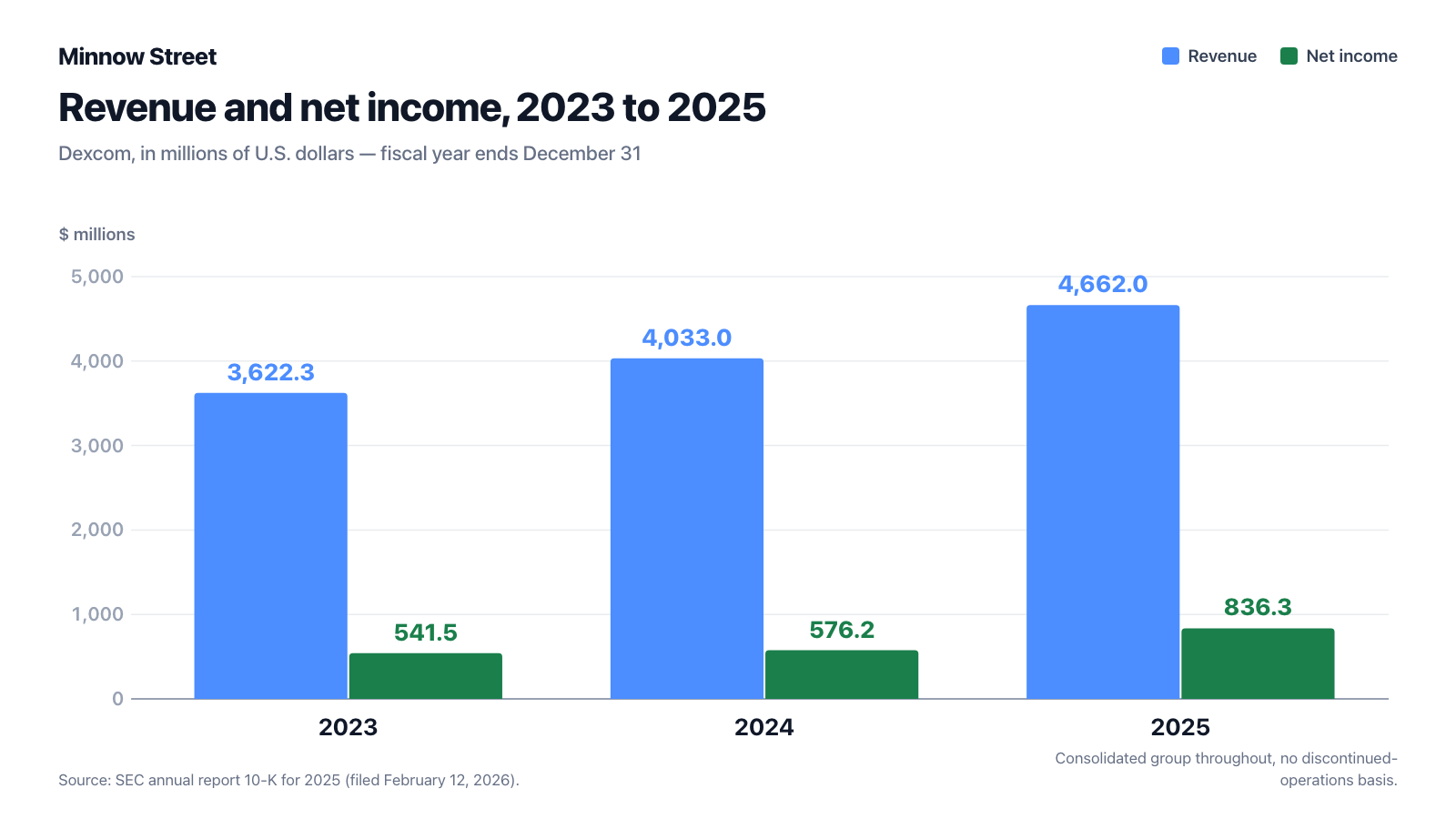
For a medical device company, operating cash flow says more than the profit line — it is the money the running business actually deposits before capital spending. It reached $1,440.7 million in 2025, after $989.5 million (2024) and $748.5 million (2023). Subtract capital expenditures of $363.5 million and roughly $1,077 million of free cash flow remains, close to double the 2024 figure. A useful rule of thumb: a profit the bank account confirms is a different profit from one that exists only on paper.
The start of 2026 continued the run, and more emphatically than the revenue line alone suggests. First-quarter revenue rose to $1,191.9 million from $1,036.0 million a year earlier, up 15.1 percent. Net income jumped from $105.4 million to $199.5 million, nearly doubling. The reason sits in the margin: gross margin climbed from 56.9 to 62.9 percent. Management attributes that to higher volumes, better absorption of fixed manufacturing costs and a more favorable product mix. Operating cash flow for the quarter came in at $525.6 million against $183.8 million — part of it from a drawdown in receivables, so timing as much as strength.
Honesty demands the multi-year check: measured over the full year, gross margin has not risen but fallen — from 63.2 percent (2023) to 60.5 percent (2024) and 60.1 percent (2025). The jump in the first quarter of 2026 is a recovery, not the continuation of a trend. One quarter does not make a summer; but it is a quarter worth remembering.
And the balance sheet? As of March 31, 2026 the company held $1,118.2 million in cash and another $1,297.0 million in short-term marketable securities — roughly $2.4 billion together. Against that stand convertible notes carried at $1,241.8 million and no drawn credit facility. The equity ratio is 44.6 percent. In November 2025 Dexcom repaid an earlier convertible note of $1.21 billion entirely in cash at maturity, without issuing a single new share. That is the kind of event that explains a score of 9 out of 9.
What the filings say — the uncomfortable truths
Uncomfortable truth No. 1: three customers, and one growing faster than the company
Here is the line that dissolves the anchoring effect from the opening. In the notes to the 2025 annual report Dexcom lists the customers accounting for at least ten percent of revenue or of gross receivables. There are three — and their shares have grown over two years:
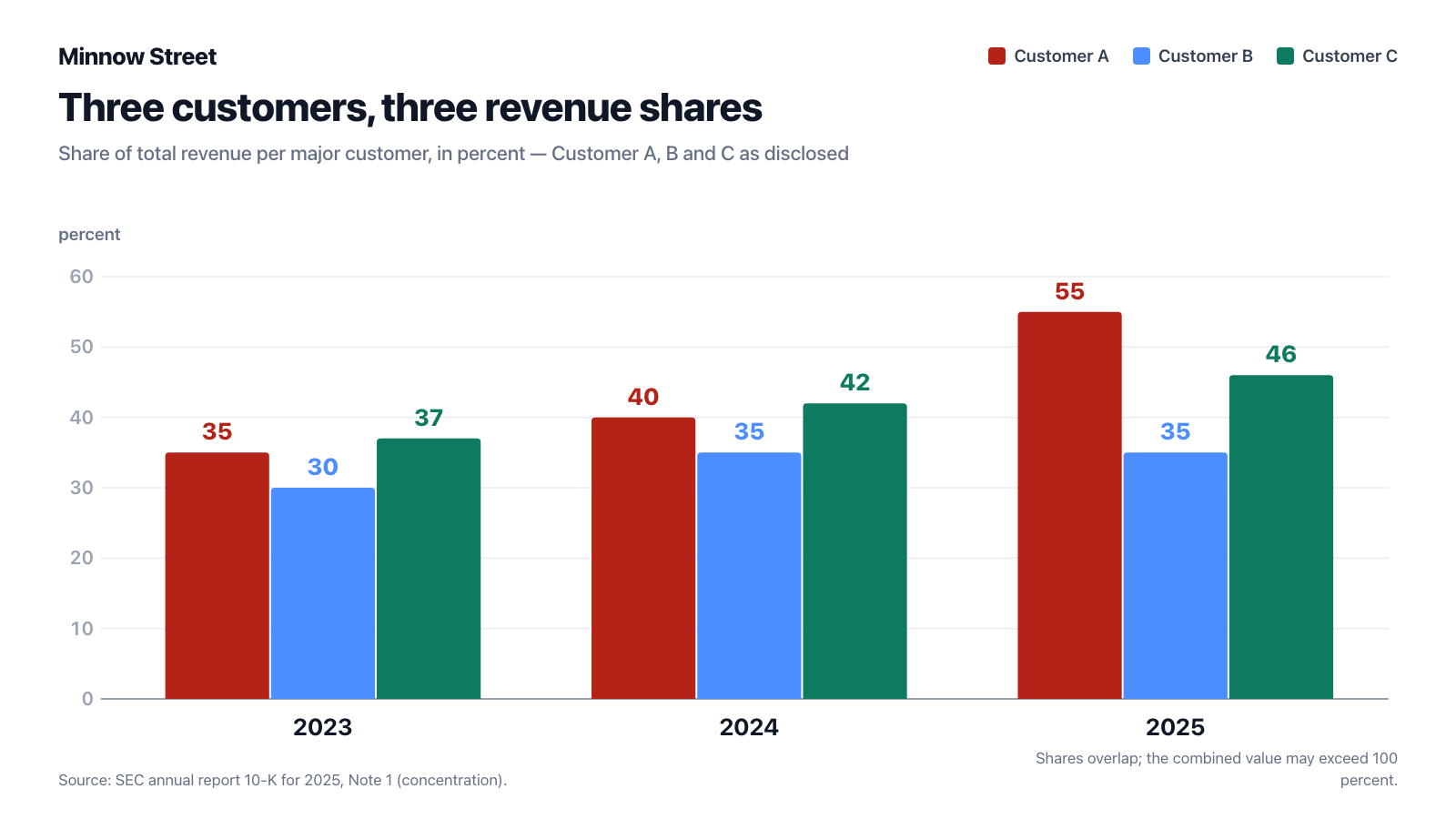
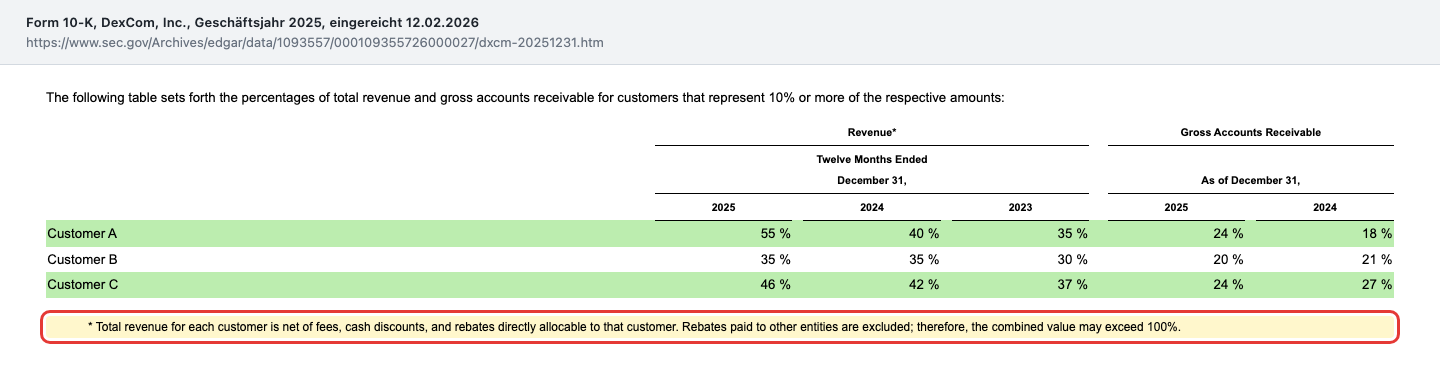
Before anyone reaches for a calculator: 55 plus 46 plus 35 equals 136 percent — and that is not an error but a quirk of the presentation. The company explains it in a footnote beneath the table:
“Total revenue for each customer is net of fees, cash discounts, and rebates directly allocable to that customer. Rebates paid to other entities are excluded; therefore, the combined value may exceed 100%.”
— DexCom, Inc., SEC annual report 10-K for 2025, Note 1 (concentration)
The overlap changes nothing about the substance: Dexcom sits behind very few, very large buyers — in U.S. health care that means pharmacy and wholesale chains plus the managers of drug benefit budgets. And the dependence is growing. The largest customer moved from 35 to 55 percent in two years. The company flags the risk itself as a separate item in its risk factors: certain distribution agreements each generated ten percent or more of total revenue in 2025, and a substantial decrease or loss of those sales could materially hurt results.
In everyday terms: if a neighbor told you his business was booming, but a single buyer brought in more than half the revenue â would you swallow for a second? That is exactly where Dexcom stands. The quarterly report shows the same thing from another angle: of $1,191.9 million in first-quarter 2026 revenue, $1,010.3 million ran through distributors and only $181.6 million went direct to consumers. Roughly 85 percent of the business passes through other people’s hands â and whoever negotiates the rebates negotiates the margin. That reimbursement can decide success or failure in health care also shows in our analysis of Aveanna Healthcare.
Uncomfortable truth No. 2: an FDA letter that has been open since March 2025
In March 2025 Dexcom received a warning letter from the FDA, the U.S. medical device regulator. It followed inspections of the plants in San Diego (October to November 2024) and Mesa, Arizona (June 2024). The agency found the company’s responses to the inspection observations (Form 483) deficient; the letter describes non-conformities in manufacturing processes and in the quality management system.
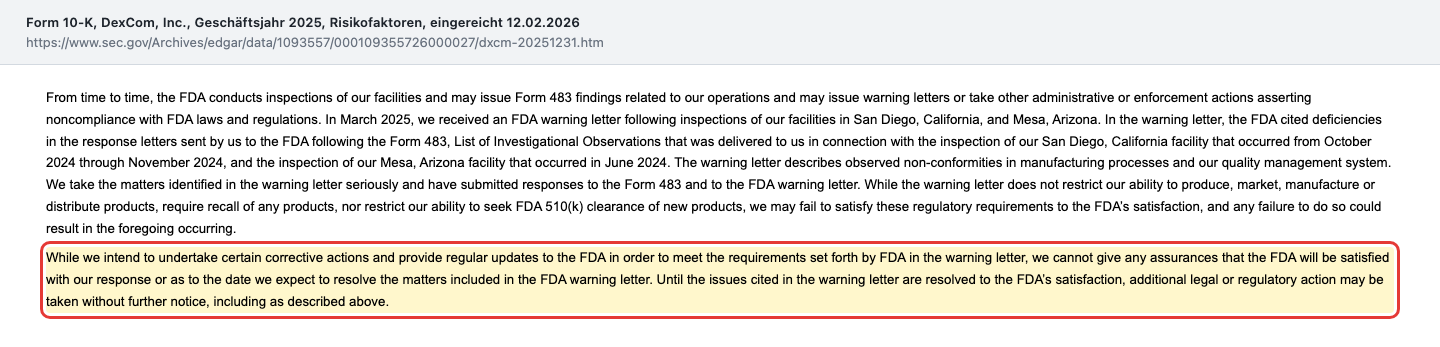
A warning letter is not a sales ban — it restricts neither production nor marketing nor distribution, requires no recall and does not block new 510(k) clearances. But it is not harmless either. And it is still not closed. The annual report filed February 12, 2026 puts it unusually plainly:
“While we intend to undertake certain corrective actions and provide regular updates to the FDA in order to meet the requirements set forth by FDA in the warning letter, we cannot give any assurances that the FDA will be satisfied with our response or as to the date we expect to resolve the matters included in the FDA warning letter.”
— DexCom, Inc., SEC annual report 10-K for 2025, Risk Factors
The quarterly report as of March 31, 2026 reports no material change to the risk factors. In plain language: a year and a half after the letter, the matter has not been publicly reported as closed. For a company whose entire revenue comes from a single product type, that is not a footnote — it is the one agency that could, in the worst case, stop everything.
Uncomfortable truth No. 3: the biggest number on the balance sheet is an estimate
Read the March 31, 2026 balance sheet from the liability side and the largest single item is not the convertible notes. It is $1,546.7 million of accrued rebates — money Dexcom has collected but will have to hand back to payers, pharmacy benefit managers and intermediaries. For comparison: the convertible notes carry at $1,241.8 million, total equity at $2,956.9 million.
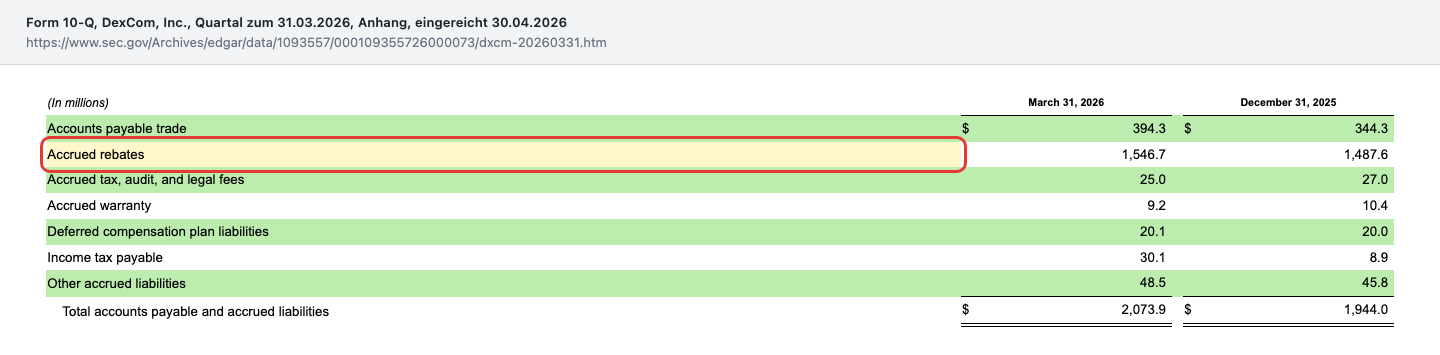
What matters is not the size but the origin of that number. It does not come from a contract; it is estimated. The quarterly report explicitly lists pharmacy rebates among the areas requiring significant estimates and assumptions — on par with inventory reserves, loss contingencies and the worldwide tax provision. In everyday terms: it is the amount written on the note that says “we will probably have to give this back” — and the note is bigger than the loan.
Why that matters to you: rebates reduce reported revenue. If the estimate runs low, a quarter looks better than it was; if it is raised later, it weighs on a future quarter. The company itself names pricing headwinds due to channel mix and rebate eligibility as a brake on growth. That is not an accusation; it is an invitation to read this one line in every report.
Uncomfortable truth No. 4: four fronts in court
The quarterly report as of March 31, 2026 devotes more than two pages to pending litigation. Four strands matter. First, a securities class action in the Southern District of California alleging that the company and executives made misleading statements about expected 2024 revenue (class period April 28, 2023 to July 25, 2024). It has been dismissed and refiled several times; the latest motion to dismiss, filed February 20, 2026, was undecided at the reporting date. Second, a further securities class action filed October 27, 2025 in New York over the accuracy, reliability and manufacturing of the G7 (class period July 26, 2024 to September 17, 2025). Third, a stockholder derivative action filed March 24, 2026 against board members and executives. Fourth, six overlapping consumer class actions brought by users of the G6 and G7 devices between September 29, 2025 and January 8, 2026.
How seriously the company takes this shows in its own wording: given the uncertainty surrounding the securities class action, the derivative actions and the G6 and G7 class action litigation, it is unable to reasonably estimate the ultimate outcome. No provision for it appears on the balance sheet — legally correct, but economically it means one thing: these risks are in no number at all.
Valuation — what 9 out of 9 costs you
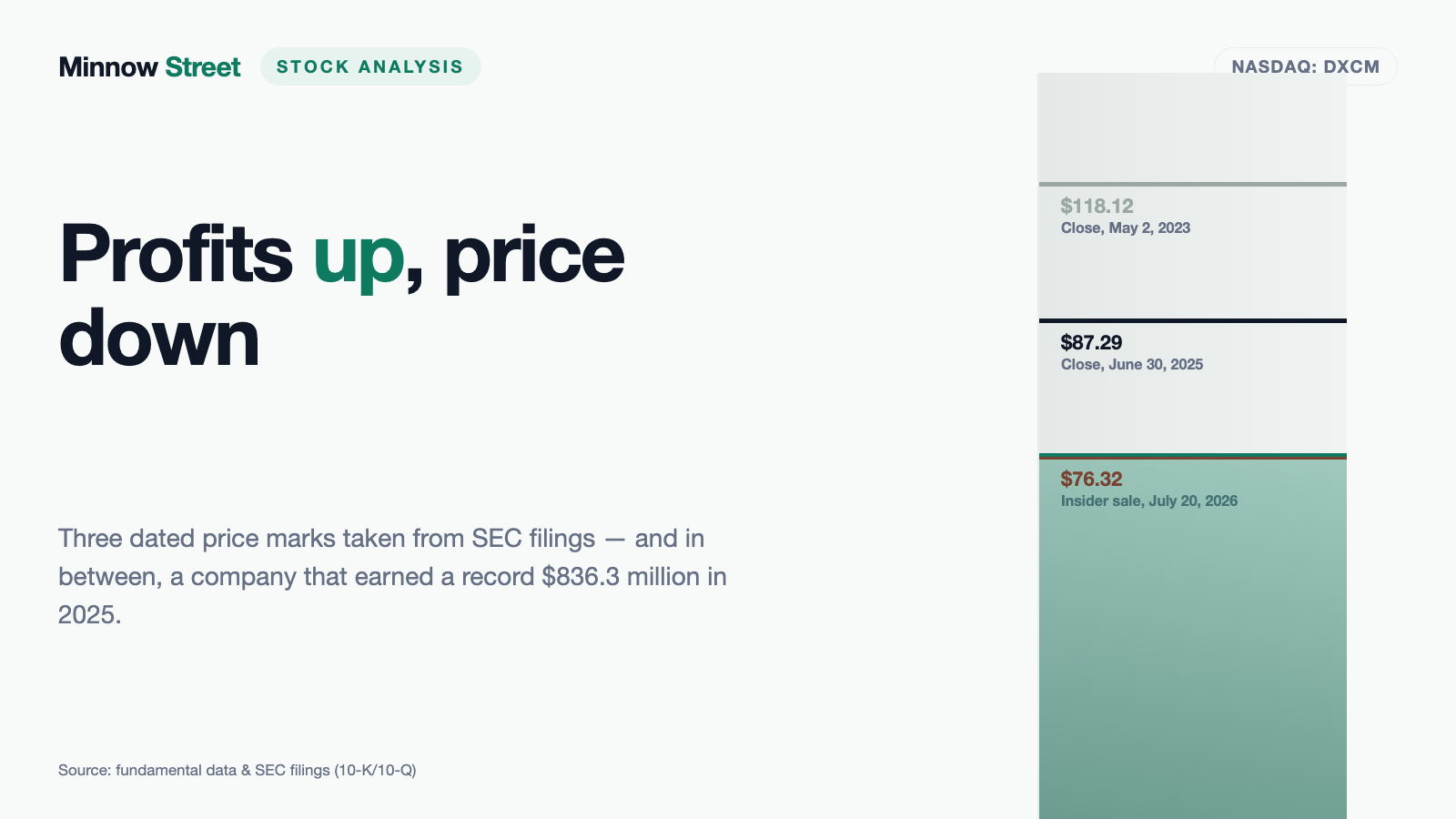
As of July 24, 2026 the stock traded at roughly 30 times trailing twelve-month earnings and roughly 28 times the estimate for the current year. Price to sales is about 5.5, enterprise value to EBITDA about 18. Market capitalization is roughly $26.5 billion. A cross-check against a price documented in a filing: 385.9 million shares times $76.32 — the price at which the Executive Chairman sold on July 20, 2026 — gives roughly $29.4 billion. The same order of magnitude.
Is that expensive? For an average industrial name, 30 times earnings would be punchy. For a company with a 35.6 percent return on equity, a 21.4 percent operating margin and net income up 45 percent in 2025, it is a normal quality valuation — the price/earnings-to-growth ratio sits near 1.3. A rule of thumb: a high price is not an argument against a company. It is an argument for looking harder at what supports it.
The professionals are considerably friendlier than the chart: 27 analysts carry the stock with an average rating of 1.11 on a scale from 1 (buy) to 5 (sell), and the mean price target of $85.24 sits roughly 24 percent above the July 24, 2026 level. Such targets are opinions, not measurements — but they show that the market is not doubting the substance here, only the pace.
The company laid out its own targets at the investor day in Mesa on May 14, 2026: organic revenue growth of at least 10 percent a year through 2030, a non-GAAP gross margin of 67 to 69 percent and a non-GAAP operating margin of 29 to 30 percent. These are non-GAAP figures and expressly not reported results — the company itself notes that it cannot reconcile them to the corresponding GAAP measures. The more concrete announcement came the same day:
“On May 14, 2026, Dexcom announced that its Board of Directors authorized and approved a share repurchase program of up to $1.0 billion of Dexcom's outstanding common stock, par value $0.001 per share (“Common Stock”), with a repurchase period ending no later than June 30, 2027 (the “Share Repurchase Program”). In connection with the approval of the Share Repurchase Program, the Board of Directors terminated its existing share repurchase program, of which $250.0 million remained available to be repurchased under the program.”
— DexCom, Inc., SEC current report 8-K filed May 15, 2026, Item 8.01

What stands out is the contrast with the quarter before: in the first quarter of 2026 Dexcom bought back no shares in the open market at all — the cash flow statement carries no such line, even though $250.0 million was available under the old program. For scale: buybacks consumed $500.0 million in 2023 (4.7 million shares), $750.0 million in 2024 (10.4 million shares) and $500.0 million in 2025 (7.7 million shares). Announcing a program and executing one are two different things.
One last dated anchor that argues for care: according to insider filings (Form 4), the Executive Chairman sold 26,759 shares at $72.00 on May 21, 2026, 26,756 shares at $72.00 on July 6, 2026 and another 26,756 shares at an average of $76.32 on July 20, 2026. All three sales ran through a pre-arranged Rule 10b5-1 trading plan adopted February 18, 2026 covering 107,027 shares — which removes the usual suspicion but not the direction. In the same quarter the CEO (33,431 shares), the chief commercial officer (17,185) and the lead independent director (10,000) adopted plans of their own. The company wants to buy; several insiders have scheduled sales on the calendar.
Opportunities and risks at a glance
What speaks for Dexcom:
- Record 2025: $4,662.0 million in revenue (up 15.6 percent), $836.3 million in net income (up 45.1 percent) and $1,440.7 million in operating cash flow, after $989.5 million the prior year.
- Top marks on the balance-sheet screen: 9 out of 9 Piotroski points and an Altman Z-score of 8.71 (data as of July 24, 2026) — the highest balance-sheet reading in this analysis series.
- Recurring revenue from disposable sensors; the company added roughly 600,000 to 700,000 net customers in 2025, excluding Stelo.
- Strong balance sheet: $2,415.2 million in cash and short-term marketable securities as of March 31, 2026, a 44.6 percent equity ratio and no drawn credit facility; the convertible note maturing in November 2025 was repaid in full in cash, $1.21 billion of it.
- Visible margin turn: gross margin of 62.9 percent in the first quarter of 2026 against 56.9 percent a year earlier, with operating income nearly doubling to $255.3 million.
- Capital returns and targets: a repurchase program of up to $1.0 billion running to June 30, 2027; at the investor day on May 14, 2026 the company guided to at least 10 percent organic revenue growth per year through 2030.
What speaks against it:
- Customer concentration: Customer A accounted for 55 percent of 2025 revenue (2024: 40 percent, 2023: 35 percent), Customer C for 46 percent and Customer B for 35 percent; in the first quarter of 2026 roughly 85 percent of revenue ran through distributors.
- An FDA warning letter covering the San Diego and Mesa plants has been open since March 2025; the annual report states the company can give no assurance as to when the matters will be resolved.
- Four legal strands: two securities class actions, a stockholder derivative action filed March 24, 2026 and six consumer class actions over the G6 and G7 — the company says it cannot reasonably estimate the outcome.
- The largest liability item is an estimate: $1,546.7 million of accrued rebates as of March 31, 2026, more than the $1,241.8 million carrying amount of the convertible notes.
- One business, one segment: all revenue depends on glucose sensors; there is no second leg to cushion a setback.
- On a full-year basis gross margin has fallen — from 63.2 percent (2023) to 60.5 percent (2024) and 60.1 percent (2025); the first-quarter 2026 jump still has to hold across several quarters.
- No dividend; relative price strength against all other stocks stands at 35 out of 99 (data as of July 24, 2026).
A human bottom line
Back to the anchoring effect from the opening. Its problem is not that it leads you to bad companies — Dexcom is plainly not a bad company. Nobody hands out nine balance-sheet points out of nine, and nobody repays a billion dollars of convertible debt in cash when things are tight. The problem with the anchor is that it asks the wrong question. It asks: how far is the stock from its high? The useful question is: what changed since that high — and has it been fixed?
The filings give an uncomfortably clear answer. What changed is not earning power; that is better than ever. What changed is bargaining position. A buyer that grows from 35 to 55 percent of revenue holds the longer lever when rebates are negotiated. And the second construction site is not in the market but in the company’s own factories: a warning letter written by the regulator whose end date the company itself cannot name.
Buying Dexcom therefore does not mean buying a cheap stock. It means buying a very good company at a normal price — with two open questions, neither of which appears in the earnings line. So the honest question is not “is 57 percent below the high cheap?” but: do you trust this company to clear its manufacturing issues with the FDA and to defend its margin against a buyer that now brings in more than half of revenue? If yes, you have a thesis, and the reports give you the measuring points — customer shares in the next annual report, the rebate line in the next quarterly report, gross margin, buyback volume. If no, you had an anchor. What you make of it is your decision. And that is exactly as it should be.
Sources
Every original document used in this analysis — for you to read yourself:
- DexCom, Inc. — SEC quarterly report 10-Q as of March 31, 2026 (filed April 30, 2026)
- DexCom, Inc. — SEC annual report 10-K for 2025 (filed February 12, 2026)
- DexCom, Inc. — SEC current report 8-K filed May 15, 2026 (investor day, share repurchase program)
- Annual report 10-K for 2024, the current reports 8-K filed March 2, 2026 (officer matters), April 30, 2026 (quarterly results) and May 28, 2026 (annual meeting), plus insider filings (Form 4) dated May 14, 19 and 26, June 5 and 17, and July 7, 16 and 21, 2026: EDGAR filing history for CIK 0001093557 (sec.gov)
- Fundamental data (metrics, valuation; data as of July 24, 2026), reconciled with the SEC filings.
- Scanner lists: our in-house stock scanner, as of July 26, 2026; the lists are recalculated daily.
Transparency & disclaimer: this analysis is journalistic commentary on publicly available information. It is not investment advice, not a regulated financial analysis and not a solicitation to buy or sell securities. Equity investments carry substantial risk up to and including total loss. All information without warranty; the cut-off date of the data is noted in the text. The author holds no position in Dexcom shares at the time of publication.
Our Bottom Line at a Glance
- Business and growth positive
- Revenue rose 15.6 percent in 2025 to $4,662.0 million (2024: $4,033.0 million; 2023: $3,622.3 million), an acceleration from the 11.3 percent posted in 2024. The first quarter of 2026 brought in $1,191.9 million, up 15.1 percent. The engine is recurring sensor sales: the company added roughly 600,000 to 700,000 net customers in 2025, excluding Stelo.
- Earnings quality and balance sheet positive
- Net income rose 45.1 percent in 2025 to $836.3 million and operating cash flow to $1,440.7 million (2024: $989.5 million). As of March 31, 2026 the balance sheet carried $2,415.2 million in cash and short-term marketable securities, an equity ratio of 44.6 percent and an undrawn credit facility. The convertible note maturing in November 2025 was repaid in full in cash, $1.21 billion of it. Piotroski 9 of 9, Altman Z 8.71 (data as of July 24, 2026).
- Customer concentration negative
- The 2025 annual report names three buyers at 55, 46 and 35 percent of revenue; per the footnote the shares overlap. The largest customer moved from 35 to 55 percent in two years. In the first quarter of 2026, $1,010.3 million of $1,191.9 million in revenue ran through distributors — roughly 85 percent. Whoever negotiates the rebates negotiates the margin, and the company itself names pricing headwinds from channel mix and rebate eligibility as a brake.
- Regulation and litigation negative
- An FDA warning letter covering the San Diego and Mesa plants has been open since March 2025; in the annual report filed February 12, 2026 Dexcom states it can give no assurance as to when the matters will be resolved, and the quarterly report filed April 30, 2026 reports no material change. In parallel, two securities class actions, a stockholder derivative action filed March 24, 2026 and six consumer class actions over the G6 and G7 are pending; the company says it cannot reasonably estimate the outcome.
- Accounting neutral
- The largest liability item as of March 31, 2026 is $1,546.7 million of accrued rebates (December 31, 2025: $1,487.6 million) — more than the $1,241.8 million carrying amount of the convertible notes and roughly 52 percent of stockholders equity. The report explicitly lists pharmacy rebates among the areas requiring significant estimates. That is not an accusation, but it is a lever: rebates reduce reported revenue.
- Valuation neutral
- As of July 24, 2026 the stock traded at roughly 30 times trailing twelve-month earnings, roughly 28 times the current-year estimate, roughly 5.5 times sales and roughly 18 times EBITDA on an enterprise value basis; the PEG ratio sits near 1.3. For a company earning a 35.6 percent return on equity that is a normal quality valuation — no bargain, but no excess either. Twenty-seven analysts carry a mean price target of $85.24.
Dexcom is not a turnaround story in the usual sense: operationally the company has never been stronger. 2025 delivered $4,662.0 million in revenue (up 15.6 percent), $836.3 million in net income (up 45.1 percent) and $1,440.7 million in operating cash flow; the balance sheet carries $2,415.2 million in cash and securities at a 44.6 percent equity ratio, and the balance-sheet screen returns 9 out of 9 points. Against that stand three buyers at 55, 46 and 35 percent of revenue, an FDA warning letter open since March 2025 covering two plants, four legal strands with no quantifiable provision, and $1,546.7 million of accrued rebates resting on an estimate. Buying here means buying a very good company at a normal price — along with two open questions that never appear in the earnings line. Not investment advice.
What Our Rating Means
Open questions
The business works in principle, but one material question is open. As long as it stays open, our findings do not carry a quality verdict.
The business model demonstrably works: recurring sensor revenue, 15.6 percent growth in 2025, $836.3 million in net income, $1,440.7 million in operating cash flow and a balance sheet with $2,415.2 million in liquid assets, a 44.6 percent equity ratio and an undrawn credit facility. The convertible note maturing in November 2025 was repaid in cash, $1.21 billion of it — the kind of proof that ratios can only imply. There is no threat to the substance: no going-concern qualification, no negative equity, no interest coverage gap, no accounting or governance breach. But two material operational questions are open, and they hold the rating at yellow. First, customer concentration: the largest buyer accounted for 55 percent of revenue in 2025 after 40 percent in 2024 and 35 percent in 2023, and in the first quarter of 2026 roughly 85 percent of revenue ran through distributors. That is not an existential dependency — the customer is more replaceable than a single contract would be — but it shifts the bargaining position for good, and whoever negotiates the rebates negotiates the margin. Second, the FDA warning letter open since March 2025 covering the San Diego and Mesa plants: the company itself writes that it cannot give assurance as to when the items will be resolved. While both questions stand open, quality is not conclusively documented. A Piotroski score of 9 of 9 and an Altman Z of 8.71 argue the other way — and where the evidence sits between two levels, the more cautious level applies. That the stock trades roughly 57 percent below its all-time high is a price observation and plays no part in this rating. The decision is yours.
A journalistic assessment by our editorial team at the time of the deep dive, based on public sources — not investment advice and not a solicitation to buy or sell. Your personal circumstances (investment goals, risk capacity, taxes) cannot be taken into account. What our levels mean, how verdicts are formed, and what conflicts of interest exist →
Worth Noting
- Dexcom reached our research list through our in-house stock scanner: the stock appears in the U.S. selection of “Fundamental Rank (A / A+)” — 38 U.S. names met the criteria on July 26, 2026, and the page shows the 25 best placed — and additionally under “Turnaround candidates.” In total DXCM appears in 16 scanner lists, among them the Altman-Z balance-sheet fortress, Terry Smith quality (Fundsmith criteria) and quality growth. The lists are recalculated daily.
- Identity verified against EDGAR: DexCom, Inc., CIK 0001093557, no former names, listed on the Nasdaq Global Select Market, large accelerated filer, fiscal year ending December 31. Note the spelling: the company files with the SEC as “DexCom, Inc.” but goes to market as “Dexcom.” Not to be confused with other CGM suppliers; Dexcom reports in a single segment.
- Valuation figures are dated and evergreen: metrics and market capitalization carry a cut-off date of July 24, 2026. Price anchors documented in filings are $118.12 (closing price on May 2, 2023, cited in connection with the capped calls on the convertible notes), $87.29 (closing price on June 30, 2025, from the cover page of the 2025 annual report) and $76.32 (weighted average sale price in an insider filing dated July 20, 2026). Daily prices are not a reason to buy.
Frequently Asked Questions
DexCom, Inc. (NASDAQ: DXCM), based in San Diego, develops and sells continuous glucose monitoring systems. A sensor worn on the skin measures glucose around the clock and transmits readings to a phone or a receiver. The sensors are disposable and have to be replaced regularly; the hardware is reusable. That business generated $4,662.0 million in revenue in 2025.
The filings name two issues that never show up in the earnings line. First, dependence on a few buyers: the largest customer accounted for 55 percent of 2025 revenue, up from 35 percent in 2023. Second, an FDA warning letter from March 2025 covering the San Diego and Mesa plants, whose resolution date the company could not name in the annual report filed February 12, 2026. Several class actions are pending on top of that.
The Piotroski score asks nine simple yes-or-no questions about a company's financial health: does it earn money, does the cash actually arrive, is leverage falling, is the margin improving? Each yes is one point. Six out of nine is okay, not good; eight or nine counts as genuinely healthy. Dexcom scores the maximum of 9 (data as of July 24, 2026) — the highest reading in the current analysis series.
The 2025 annual report names three customers at ten percent or more: Customer A at 55 percent of revenue (2024: 40, 2023: 35), Customer C at 46 percent (42/37) and Customer B at 35 percent (35/30). Per the footnote these shares overlap and may add up to more than 100 percent, because rebates paid to other entities are excluded. What is clear either way: very few, very large buyers.
No. According to the annual report, the March 2025 warning letter restricts neither production nor marketing nor distribution, requires no product recall and does not prevent the company from seeking new 510(k) clearances. It was, however, still unresolved as of the annual report filed February 12, 2026, and until the issues are resolved to the FDA's satisfaction, further action may be taken without notice.
No. Dexcom has never paid a dividend. Capital is returned through buybacks instead: $500.0 million in 2023, $750.0 million in 2024 and $500.0 million in 2025. On May 14, 2026 the board authorized a new program of up to $1.0 billion running to June 30, 2027. In the first quarter of 2026, however, no shares were repurchased in the open market at all.
Conservatively. As of March 31, 2026 the company held $1,118.2 million in cash and $1,297.0 million in short-term marketable securities. Against that stand convertible notes with a principal amount of $1.25 billion, a 0.375 percent coupon and a May 2028 maturity; the conversion price is $162.41 per share. The $200.0 million revolving credit facility was undrawn at the reporting date.
At its investor day in Mesa on May 14, 2026 the company named four goals: organic revenue growth of at least 10 percent per year through 2030, a non-GAAP gross margin of 67 to 69 percent, a non-GAAP operating margin of 29 to 30 percent and an adjusted EBITDA margin of 36 to 37 percent. These are non-GAAP measures, and the company states it cannot reconcile them to the corresponding GAAP figures.
Found an error?
Did you spot a factual error, an outdated number, or a typo in this deep dive? Let us know briefly — your report goes straight to the editorial team.