Sprouts Farmers Market: The Stock Lost 58 Percent — the Balance Sheet Lost Nothing
Sprouts Farmers Market was the darling of U.S. grocery: revenue rose 14 percent to $8.8 billion in 2025, comparable store sales gained 7.3 percent, and diluted earnings per share climbed from $3.75 to $5.31. Then the industry's most important number turned. In the first quarter of 2026 comparable store sales fell 1.7 percent — the first decline after five years of growth. The stock now trades roughly 58 percent below its all-time closing high of $179.53 (June 2, 2025), and our in-house stock scanner "Turnaround Candidates" has picked it up ever since. The balance sheet, meanwhile, is untouched: nothing drawn on the revolver, an Altman Z-score of 5.20, a $1 billion buyback authorization. We read what the filings with the U.S. securities regulator, the SEC, say about the engine that stalled — and about whether it restarts.
 Thomas Mücke
Founder & Publisher
Thomas Mücke
Founder & Publisher
Chart
Interactive price chart (TradingView).
Note: pure fact-based analysis, not investment advice and not a solicitation to buy or sell. All figures without guarantee.
There is an investor trap that springs precisely when you are trying to be sensible: the anchor-price trap. It works like this. A stock once traded at $180; today it trades at $75. Your brain does the math automatically — "down 58 percent, that has to be a bargain". The old high becomes the yardstick, even though it is nothing more than the price somebody paid on a single day in June 2025. Sprouts Farmers Market (Nasdaq: SFM) is the perfect test case. The Phoenix, Arizona grocer sells fresh, natural and organic food, grew revenue 14 percent to $8.8 billion in 2025 — and the stock has since lost roughly 58 percent, measured from its all-time closing high of $179.53 on June 2, 2025 against the closing price of $74.89 on July 24, 2026. So let us make a deal: before you think the word "cheap", we read together what Sprouts told the U.S. securities regulator, the SEC — the annual report (10-K) for fiscal 2025, the quarterly report (10-Q) for the period ended March 29, 2026 and the earnings releases in between. An SEC filing is honest under penalty of law. And this one describes a growth engine that stalled over five quarters, a balance sheet that never noticed, and a single number that decides everything: comparable store sales.
What Sprouts actually does — a farmers market with a checkout lane
Sprouts Farmers Market is a supermarket for better-for-you food — put plainly, a roofed farmers market with a checkout lane. Produce sits at the center of each store rather than at the perimeter; roughly 20 percent of selling square footage goes to fresh produce, which the annual report calls significantly higher than many peers. Around it stands a deliberately narrow, curated assortment: organic, plant-based, gluten-free, non-GMO. The stores are small by American standards at 21,000 to 25,000 square feet and are typically staffed with 75 to 100 team members. As of December 28, 2025 there were 477 stores in 24 states; as of March 29, 2026, 483 stores in 25 states and more than 36,000 team members. The footprint leans west and south: 156 stores in California (33 percent of the base), 60 in Texas, 58 in Florida, 48 in Arizona and 34 in Colorado, all as of December 28, 2025.
The model is easy to describe and hard to copy. Sprouts charges prices for fresh and differentiated goods that allow an unusually high retail spread. Gross margin reached 38.8 percent in fiscal 2025 — well above a conventional U.S. full-line grocer. Two growth levers sit on top: new stores (37 in 2025, 33 in 2024, 30 in 2023) and comparable store sales, the sales of stores open for more than 60 weeks. In retail that second number is the king metric, because it shows whether the existing stores sell more or whether there are merely more stores. That sets the tension of this analysis, and it runs through every chapter: Sprouts' balance sheet is in excellent health — but the industry's king metric is negative for the first time in years, and without it a turnaround is only a hope with a good credit line.
How the stock reached our desk — and what the scanner really says
Sprouts came onto the research list through our in-house stock scanner "Turnaround Candidates". It works with four pillars. Two are mandatory: the stock must trade at least 50 percent below its all-time high (otherwise the screen simply catches ordinary growth stocks), and survival must be secured — an Altman Z-score outside the distress zone, no more than one balance sheet warning flag, positive equity. The other two pillars form an eight-point turn checklist: four points for the operating turn (sales stabilize, margin turns, cash flow turns, the balance sheet heals) and four for market confirmation (price back above the 50-day line, relative strength turns, insiders buy on net, large funds add). A stock is displayed if it clears both mandatory pillars and reaches at least 6 of 8 points.
Now the honest part you rarely get to read. On July 26, 2026 that list held 60 hits. Sprouts is one of them — with exactly 6 of 8 points, the minimum, which puts it 30th of 60. Our scanner page shows only the 25 strongest hits, so Sprouts is not visible there. Anyone opening the list and searching for the name will not find it, and should know why. The two missing points are quickly named: on July 26, 2026 the price sat below its 50-day line (about $82.49 against a closing price of $74.89), and over the preceding twelve months insiders were not net buyers — on the contrary, our data set holds 20 sale filings and not one purchase (data as of July 26, 2026). Sprouts does earn all four points of the operating turn, plus two points of market confirmation: three-month relative strength now exceeds the twelve-month reading, and large funds added on net.
Translated: Sprouts is a turnaround candidate in the literal sense — beaten down, financially healthy, but not yet confirmed by the tape. Consistent with that, on the same date the stock also appears on our "Fallen Angels" list (58 hits — at least 40 percent down over a year with intact substance) and on "Pros 80%". All of these lists are recalculated daily, so the references carry the July 26, 2026 date and may look different tomorrow. One note on diligence, because it concerns the hook itself: our data set puts the drawdown from the all-time high at 52.4 percent. We recomputed it against the full price history since the August 1, 2013 IPO and arrive at 58.3 percent — the all-time closing high of $179.53 on June 2, 2025 against $74.89 on July 24, 2026. The mandatory pillar is cleared either way; the self-measured figure is the one used throughout this piece. What such a drawdown looks like at another beaten-down retailer is in our Dollar General analysis — that name sits on the same turnaround list.
The numbers over the years — credit where it is due
First the part that genuinely impresses, and there is plenty of it. Sprouts lifted revenue by roughly 44 percent in five years — and more than doubled net income along the way. In grocery, a business with net margins around two percent, that is not a given.
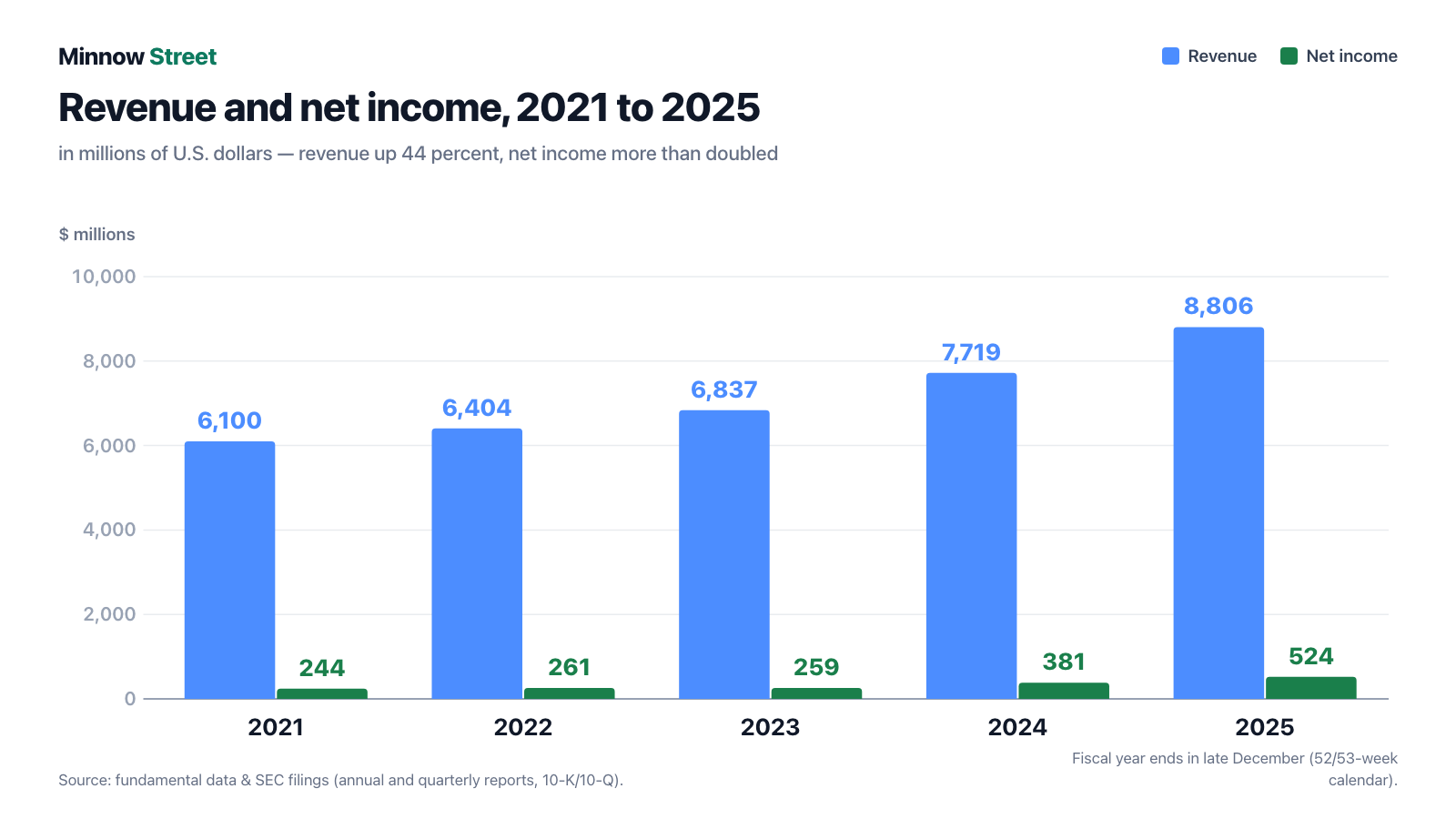
Fiscal 2025 was the best year in the company's history: $8,806.2 million of revenue (up 14 percent), $3,416.4 million of gross profit, a 38.8 percent gross margin after 38.1 percent the year before, net income of $523.7 million and diluted earnings per share of $5.31 after $3.75 in 2024 and $2.50 in 2023. Cash from operations came to $716 million against $224 million of capital expenditures net of landlord reimbursements. The annual report attributes the margin improvement explicitly to better shrink and investments in inventory management. Remember that: this company knows how to run a store.
And now the curve that changed everything — comparable store sales, the king metric, over five quarters:
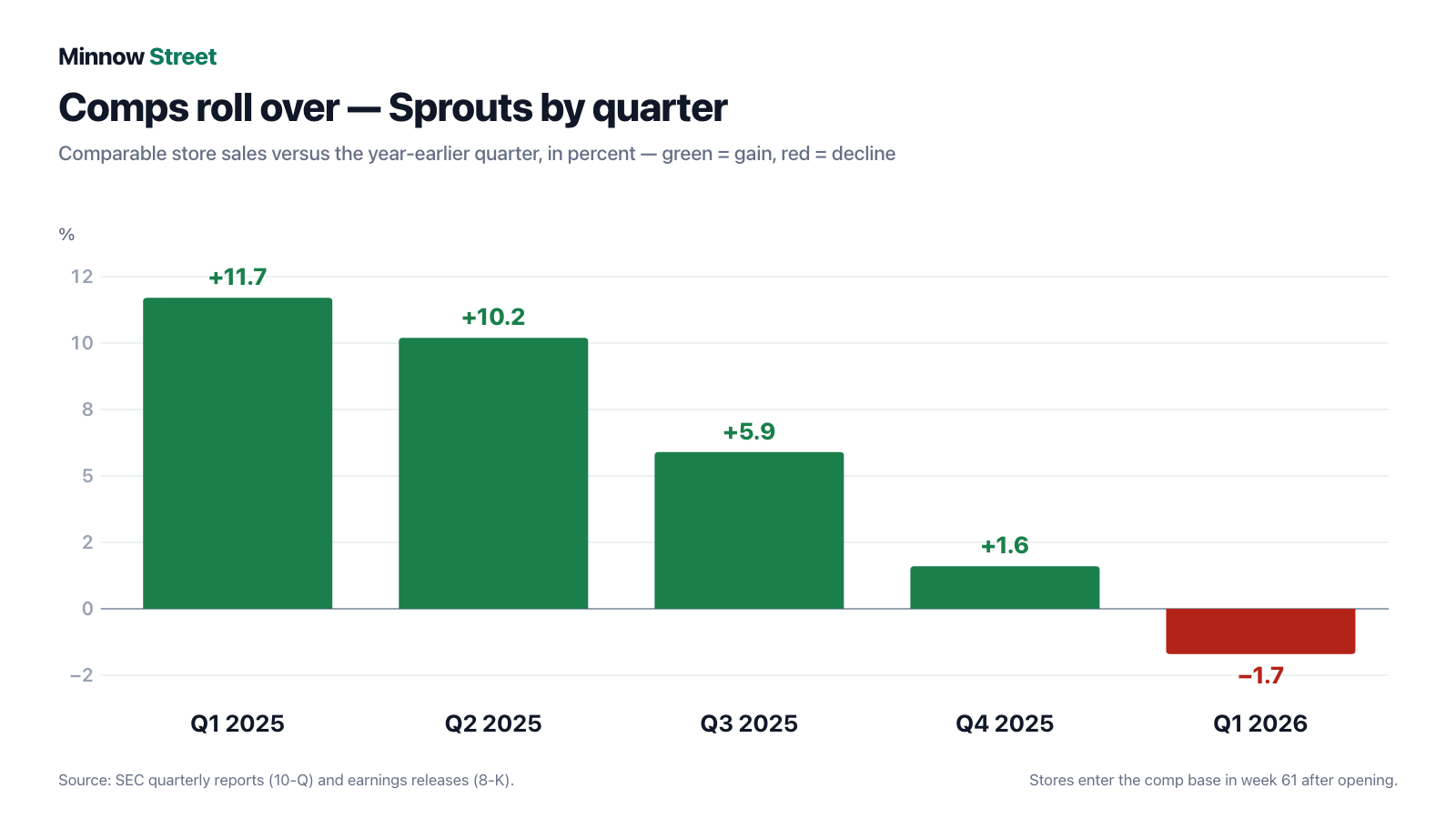
That is the core of the story. No scandal, no write-down, no debt crisis — just a number that slowed for four quarters and flipped sign in the fifth. Which brings us to the uncomfortable truths.
What the filings say — the uncomfortable truths
Uncomfortable truth No. 1: Revenue is still growing — but only because new stores keep opening
In the first quarter of 2026 Sprouts reported revenue of $2,329.2 million, up 4 percent. That sounds healthy. The quarterly report explains exactly where the increase came from:
"Net sales during the thirteen weeks ended March 29, 2026 totaled $2.3 billion, an increase of $92.7 million, or 4%, compared to the thirteen weeks ended March 30, 2025. The sales increase was driven by sales from new stores opened in the last twelve months, partially offset by a 1.7% decrease in comparable store sales."
— Sprouts Farmers Market, Inc., Form 10-Q for the quarter ended March 29, 2026, Item 2 (MD&A)
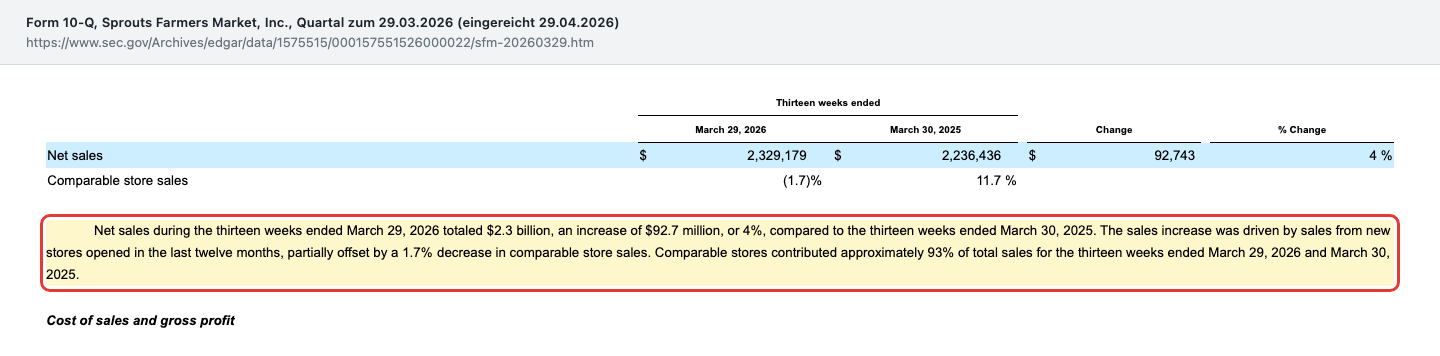
Why this matters: new stores cost money before they make any. In 2026 Sprouts intends to open more than 40 of them and spend $280 million to $310 million doing so. As long as comparable store sales grow, the existing base funds that expansion. When they fall, the company is financing growth its own base no longer earns. Put plainly: a baker opens a fourth shop while the first three sell fewer rolls than a year ago. That can be smart — but it is a bet, not an extrapolation.
Uncomfortable truth No. 2: The company's own guidance describes a plateau, not a turn
With a turnaround candidate the question is immediate: when does it turn? The most honest answer sits in the company's own guidance. For full-year 2026, on April 29, 2026 and on a 52-week basis, Sprouts guided to revenue growth of 4.5 to 6.5 percent, comparable store sales of minus 1 to plus 1 percent, EBIT of $675 million to $695 million and diluted earnings per share of $5.32 to $5.48. For reference: fiscal 2025 came in at $5.31. Second-quarter 2026 guidance calls for comparable store sales of minus 2 to zero percent and earnings per share of $1.32 to $1.36 — against $1.35 in the year-earlier quarter.
Chief executive Jack Sinclair framed it this way on April 29, 2026: "The first quarter played out largely as we expected," adding that the company expects "sequential improvement in the business throughout 2026 as we reaccelerate growth." Chief financial officer Curtis Valentine had been blunter two months earlier, on February 19, 2026, saying the company expects "challenges in 2026, especially in the first half due to strong prior year comparisons and a dynamic macro environment." Both statements are open and fair. But for an investor they mean one thing: the company itself is not promising growth for 2026, it is promising flat. Anyone betting on a turn here is betting on 2027, not on the current year.
Uncomfortable truth No. 3: More than half the merchandise comes from a single wholesaler
A supermarket lives on full shelves. Sprouts does not buy most of its dry grocery and frozen food directly but through wholesalers — and the dependence is substantial:
"KeHE is our primary distributor of dry grocery and frozen food products, accounting for approximately 52% and 50% of our total purchases in fiscal 2025 and 2024, respectively. Our current primary contractual relationship with KeHE continues through July 31, 2035 and provides that KeHE will be our primary distributor for all of our stores. Another 12% and 3% of our total purchases in fiscal 2025 and 2024, respectively, were made through our secondary distributor of dry grocery and frozen food products, UNFI. Our current primary contractual relationship with UNFI continues through July 31, 2026."
— Sprouts Farmers Market, Inc., Form 10-K for fiscal 2025, Item 1A Risk Factors
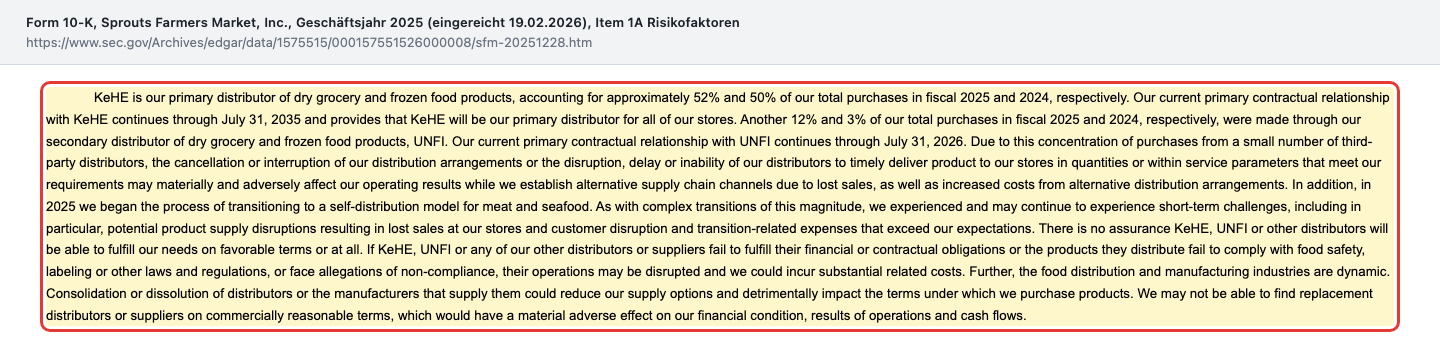
Two things stand out. First the sheer share: 64 percent of all purchases through two addresses, measured against cost of sales of $5,389.8 million in fiscal 2025. Second the movement at the secondary distributor — from 3 to 12 percent within a year, while its contract ends in July 2026 and the primary contract runs to 2035. That such a chain is fragile is something Sprouts experienced firsthand in 2025 when it moved meat and seafood to self-distribution through its own fresh distribution centers:
"During this process, we experienced third-party supply disruptions that led to availability challenges and customer disruption."
— Sprouts Farmers Market, Inc., Form 10-K for fiscal 2025, Item 1 Business

Empty shelves in the produce and fresh departments are not an operational hiccup at a chain whose entire promise is "fresh" — they attack the brand itself. That comparable store sales decelerated in exactly those quarters need not be causal; the company points mainly to demanding prior-year comparisons. But it belongs in the picture.
Uncomfortable truth No. 4: The margin is turning down — and the merchandising chief left
In the first quarter of 2026 gross margin fell from 39.6 to 39.4 percent. That sounds like nothing, but on $2.3 billion of quarterly revenue it is roughly $5 million. The quarterly report names two causes: the Sprouts Rewards loyalty program, rolled out nationwide in 2025 and accounted for as a deferred liability, and unfavorable shrink — spoilage and theft. That is notable because the annual report had credited the fiscal 2025 margin improvement explicitly to better shrink. The lever that helped in 2025 is pressing in 2026.
At the same time selling, general and administrative expenses rose to $658.8 million in the first quarter of 2026 from $623.2 million — up 5.7 percent against revenue growth of 4.1 percent. From the line items in the quarterly report, income from operations works out to $215.3 million against $226.3 million a year earlier, so the operating margin slipped from 10.1 to 9.2 percent. Diluted earnings per share came in at $1.71 after $1.81 — despite a share count roughly 4 percent smaller.
One personnel detail should be neither overrated nor overlooked. On February 16, 2026 — three days before the full-year results — chief merchandising officer J. Scott Neal notified the company of his retirement, effective immediately; Don Clark was appointed the same day. At a retailer that is the job that decides assortment, buying and price — precisely the numbers that are turning. The board was reshuffled on May 19, 2026 as well: Andrew Jhawar joined as a Class III director on the audit committee and Doug Rauch retired. The Form 8-K states explicitly that no arrangement with any other person underlay the appointment, so this is a routine succession rather than an activist deal.
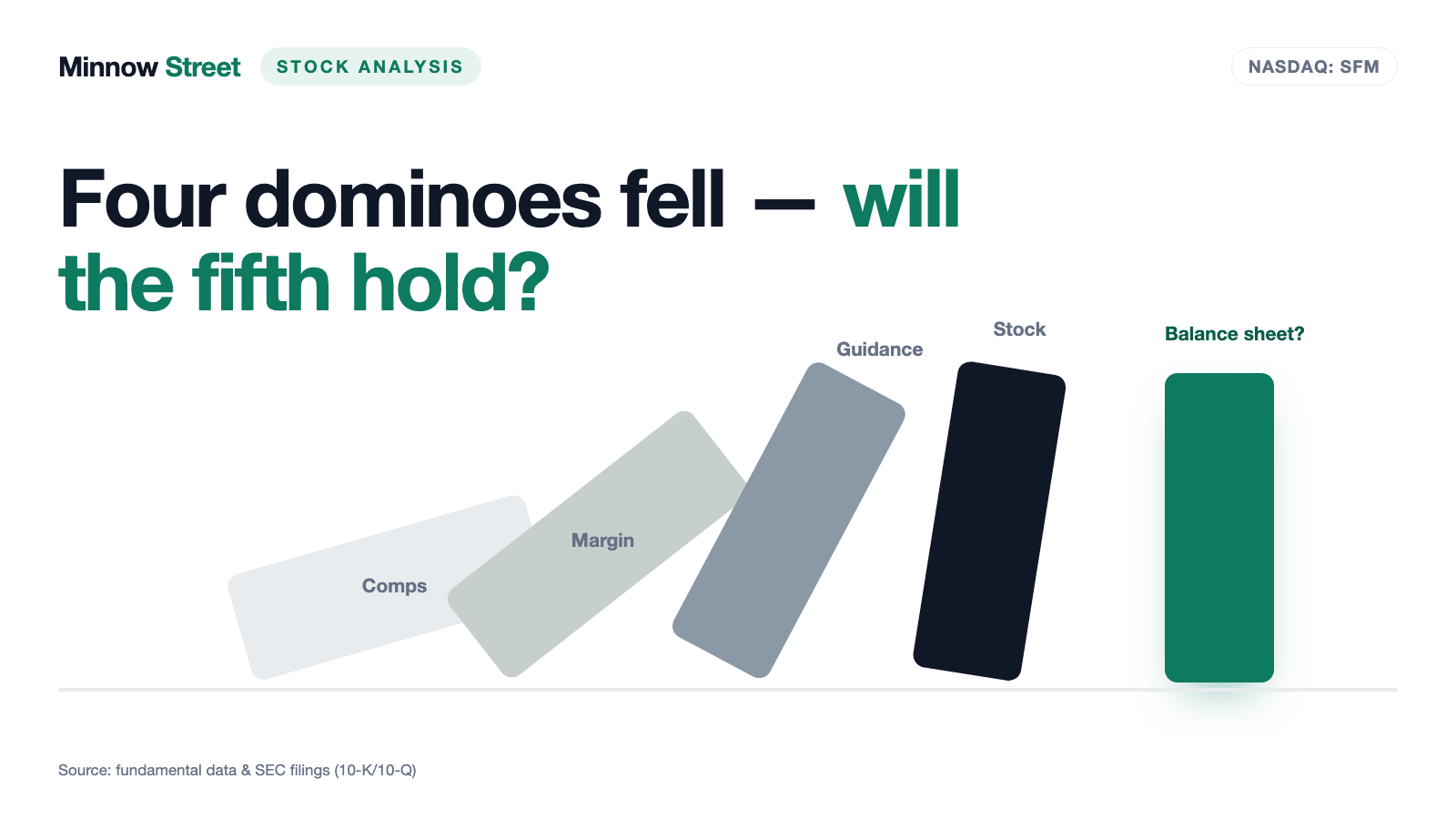
Uncomfortable truth No. 5: The fifth domino — the balance sheet — really does hold
After four uncomfortable truths comes the comfortable one, and for a turnaround it is the most important: Sprouts can pay for this dry spell. The annual report puts it in a single sentence:
"As of December 28, 2025, we had no outstanding borrowings under our Credit Agreement."
— Sprouts Farmers Market, Inc., Form 10-K for fiscal 2025, Item 7A

The $600 million revolving credit facility comes from an agreement dated July 25, 2025 and is untouched. As of March 29, 2026 the company held $252 million in cash; operating cash flow for the quarter was $235 million against $98 million of capital expenditures. The Altman Z-score — a well-established bankruptcy early-warning measure built from several balance sheet ratios, where readings above 3 count as the safe zone — stands at 5.20, with an equity ratio of 33.6 percent (data as of July 26, 2026). And management is using that strength: a $1 billion repurchase authorization without an expiration date has been running since August 13, 2025, replacing a $600 million program with $142.6 million remaining. In 2025 the company repurchased 4.0 million shares for $472 million (or $476.2 million including the 1 percent U.S. excise tax on buybacks), another 1.9 million for $140 million in the first quarter of 2026, and a further 0.5 million for $40 million between March 29 and April 27, 2026. As of April 27, 2026, 94,044,301 shares were outstanding — down from a weighted diluted 98.7 million in fiscal 2025 and 103.4 million in 2023. Remember this: the engine is sputtering, but the tank is full.
Valuation: no growth premium left — but no unconditional bargain either
How expensive is Sprouts today? Let us work in orders of magnitude rather than daily quotes. At 94.0 million shares and a closing price of $74.89 (July 24, 2026) the market capitalization is roughly $7.0 billion — the cross-check against fundamental data ($7.04 billion) matches within a tenth of a percent. Measured against diluted earnings per share of $5.31 for fiscal 2025 that is a price-earnings ratio of about 14, and against the company's own 52-week 2026 guidance ($5.32 to $5.48) essentially the same. The price-to-sales ratio is about 0.8 and enterprise value sits at roughly 8.9 times EBITDA. For a grocer that still grew 14 percent in 2025 and earns a return on equity near 37 percent, that is no longer a fantasy price — at the all-time high the same earnings implied a multiple of roughly 34.
The professional view is cautiously friendly: of 15 recorded ratings, 5 say buy, 10 say hold and none says sell, with an average price target of $92.79 (data as of July 26, 2026). At the same time 15.1 percent of the float is sold short — roughly 11.0 million shares. For a debt-free grocer that is a conspicuously high reading, and it shows how contested the question is: is this a growth company in a pothole, or an ordinary retailer settling back to its true speed after an exceptional boom? We described a similar pattern — strong discounter, collapsed valuation, open turn — in our Grocery Outlet analysis; the answer there came out differently, which is precisely why the comparison is worth your time.
Opportunities and risks at a glance
What speaks for Sprouts Farmers Market:
- A balance sheet in excellent health: nothing drawn on the $600 million revolver as of December 28, 2025, $252 million of cash as of March 29, 2026, an Altman Z-score of 5.20 and a 33.6 percent equity ratio (data as of July 26, 2026). This company can sit out a dry spell.
- High retail spread and real earnings power: a 38.8 percent gross margin and $523.7 million of net income in fiscal 2025, with $716 million of operating cash flow against $224 million of capital expenditures.
- Capital returns with substance: a $1 billion repurchase authorization since August 13, 2025; the share count fell from 103.4 million (2023, weighted diluted) to 94.0 million as of April 27, 2026.
- Expansion continues: 37 new stores in 2025, more than 40 planned for 2026, plus the move to self-distribution for meat and seafood that is meant to reach roughly 95 percent of stores in 2026.
- Valuation has normalized: roughly 14 times fiscal 2025 earnings against about 34 times at the all-time high — the premium is out of the price.
What speaks against it:
- The king metric is negative: comparable store sales fell from plus 11.7 percent (Q1 2025) through plus 10.2, plus 5.9 and plus 1.6 to minus 1.7 percent in the first quarter of 2026. Revenue growth now comes solely from new stores.
- Guidance promises no turn: minus 1 to plus 1 percent comparable store sales and $5.32 to $5.48 of diluted earnings per share for 2026 on a 52-week basis, against $5.31 in 2025; minus 2 to zero percent for the second quarter of 2026.
- Supply chain concentration: 52 percent of purchases through KeHE and another 12 percent through UNFI, whose contract expires on July 31, 2026; the move to self-distribution already produced supply disruptions and availability problems.
- Margin pressure and cost dynamics: gross margin down from 39.6 to 39.4 percent in the first quarter of 2026 (loyalty program and shrink), selling, general and administrative expenses up 5.7 percent against 4.1 percent revenue growth, operating margin down from 10.1 to 9.2 percent.
- No confirmation from inside or from the market: on July 26, 2026 the price sat below its 50-day line, insiders filed 20 sales and no purchases over twelve months, and 15.1 percent of the float is sold short. Add the California concentration at 33 percent of all stores.
A human conclusion
Back to the anchor-price trap. Its core is not that $75 is expensive — measured against earnings it is not. Its core is that the $180 from June 2025 is not a yardstick at all. That price assumed a supermarket could compound double-digit growth on the same square footage indefinitely. It no longer does, and the company itself says it will not do so again in 2026. What remains is nonetheless a remarkable business: 483 stores, 36,000 team members, a 38.8 percent gross margin, no drawn debt, a billion-dollar buyback — and one open question no filing can answer. The fifth domino is standing. Whether the four in front of it get set back up depends on whether customers return once the comparisons against the record years ease. So the honest question is not "is this cheap?" but rather: do you believe this chain will sell more groceries across the same counters two years from now — and do you have the patience to wait that long without the old high in your head? If yes, you have a thesis. If no, you had an anchor. The decision is yours.
Sources
Every primary document used in this analysis, for you to read yourself:
- Sprouts Farmers Market, Inc. — Form 10-K for fiscal 2025 (filed February 19, 2026)
- Sprouts Farmers Market, Inc. — Form 10-K for fiscal 2024 (filed February 20, 2025)
- Sprouts Farmers Market, Inc. — Form 10-Q for the quarter ended March 29, 2026 (filed April 29, 2026)
- Sprouts Farmers Market, Inc. — Form 10-Q for the quarter ended September 28, 2025, June 29, 2025 and March 30, 2025
- Sprouts Farmers Market, Inc. — Form 8-K dated April 29, 2026 with the first-quarter 2026 earnings release and outlook
- Sprouts Farmers Market, Inc. — Form 8-K dated February 19, 2026 with the fiscal 2025 results and Form 8-K of the same date on the change of chief merchandising officer
- Sprouts Farmers Market, Inc. — Form 8-K dated May 19, 2026 (board of directors) and Form 8-K dated September 8, 2025 (ten-year distribution agreement with KeHE)
- Full SEC filing history of Sprouts Farmers Market, Inc.: EDGAR overview (sec.gov)
- Fundamental data (metrics, valuation, holders, insider filings, short interest; data as of July 26, 2026) and the price history since the August 1, 2013 IPO, reconciled with the SEC filings.
- Hook: our in-house stock scanner "Turnaround Candidates", 60 hits as of July 26, 2026 — the lists are recalculated daily.
Transparency & disclaimer: this analysis is journalistic commentary on publicly available information. It is not investment advice, not a regulated financial analysis and not a solicitation to buy or sell securities. Equity investments carry substantial risk up to and including total loss. All information without warranty; the as-of date for each figure is stated in the text. At the time of publication the author holds no position in Sprouts Farmers Market shares.
Our Bottom Line at a Glance
- Balance sheet & survival positive
- The strongest part of the story: as of December 28, 2025 the $600 million revolving credit facility was undrawn, and as of March 29, 2026 the company held $252 million in cash. The Altman Z-score stands at 5.20 and the equity ratio at 33.6 percent (data as of July 26, 2026). This company can fund a multi-year dry spell out of its own pocket.
- Operating trend negative
- Retail's king metric has turned: comparable store sales fell from plus 11.7 percent (Q1 2025) through plus 10.2, plus 5.9 and plus 1.6 to minus 1.7 percent in the first quarter of 2026. The 4 percent revenue gain in that quarter came entirely from new stores, per the quarterly report. Gross margin also slipped from 39.6 to 39.4 percent and the operating margin from 10.1 to 9.2 percent.
- Company guidance negative
- Guidance issued on April 29, 2026 promises a plateau rather than a turn for 2026: comparable store sales of minus 1 to plus 1 percent and diluted earnings per share of $5.32 to $5.48 on a 52-week basis, against $5.31 in fiscal 2025; minus 2 to zero percent for the second quarter. The contribution of the 53rd calendar week (about $0.21 per share) exceeds the expected operating earnings growth.
- Supply chain concentration negative
- Roughly 64 percent of all purchases run through two wholesalers: KeHE at 52 percent (contract through July 31, 2035) and UNFI at 12 percent after 3 percent previously — with that contract ending on July 31, 2026. During the move of meat and seafood to self-distribution begun in 2025, the annual report concedes supply disruptions with availability challenges and customer disruption.
- Capital allocation positive
- A $1 billion repurchase authorization without an expiration date has been running since August 13, 2025. The company bought back 4.0 million shares for $472 million in 2025 and another 1.9 million for $140 million in the first quarter of 2026; the share count fell from 103.4 million (2023, weighted diluted) to 94,044,301 as of April 27, 2026. Expansion continues with more than 40 stores planned for 2026.
- Valuation & market picture neutral
- A market capitalization of roughly $7.0 billion equals about 14 times diluted earnings per share of $5.31 for fiscal 2025 — at the all-time high it was roughly 34 times. The premium is gone; the confirmation is missing. On July 26, 2026 the price sat below its 50-day line, 15.1 percent of the float is sold short, and insiders filed 20 sales and no purchases over twelve months.
Sprouts Farmers Market is the anchor-price trap in its purest form: the stock trades roughly 58 percent below its all-time closing high of $179.53 (June 2, 2025), yet a stock only becomes cheap once the business behind it grows again. Right now it does not — comparable store sales swung from plus 11.7 to minus 1.7 percent within five quarters, and 2026 guidance calls for minus 1 to plus 1 percent. Against that stands a balance sheet in excellent health: nothing drawn on the revolver, an Altman Z-score of 5.20 and a $1 billion buyback authorization. The turnaround is therefore not a restructuring question but a patience question: do the customers come back to the existing stores? Not investment advice.
What Our Rating Means
Open questions
The business works in principle, but one material question is open. As long as it stays open, our findings do not carry a quality verdict.
Yellow stands here for a financially very solid company with a documented operating break. Hard findings argue for quality: nothing drawn on the $600 million revolver as of December 28, 2025, an Altman Z-score of 5.20, a 33.6 percent equity ratio, a 38.8 percent gross margin and $523.7 million of net income in fiscal 2025 on $716 million of operating cash flow. Green is blocked by the break in the king metric: comparable store sales fell from plus 11.7 to minus 1.7 percent within five quarters, gross margin from 39.6 to 39.4 percent and the operating margin from 10.1 to 9.2 percent — and the company's own guidance sees no acceleration in 2026. Add the supplier concentration of roughly 64 percent of purchases across two addresses. Red would be wrong: there is no substance, debt or going-concern question.
A journalistic assessment by our editorial team at the time of the deep dive, based on public sources — not investment advice and not a solicitation to buy or sell. Your personal circumstances (investment goals, risk capacity, taxes) cannot be taken into account. What our levels mean, how verdicts are formed, and what conflicts of interest exist →
Worth Noting
- Sprouts reached the research list through our in-house stock scanner "Turnaround Candidates" (60 hits as of July 26, 2026). The stock clears both mandatory pillars and scores 6 of 8 points on the turn checklist — the minimum — which puts it 30th of 60. Because the scanner page displays only the 25 strongest hits, Sprouts is not visible there. The missing points are a price above the 50-day line and net insider buying. All scanner lists are recalculated daily.
- On the drawdown from the all-time high: our data set shows 52.4 percent. Recomputed against the full price history since the August 1, 2013 IPO it is 58.3 percent (all-time closing high of $179.53 on June 2, 2025 against $74.89 on July 24, 2026). The self-measured figure is used throughout the article; the scanner's mandatory pillar (at least 50 percent below the all-time high) is cleared on either measure.
- As-of dates and comparison bases: filing figures carry the date of the respective report (fiscal 2025 as of December 28, 2025, the first quarter of 2026 as of March 29, 2026, the share count as of April 27, 2026), while market data and metrics carry the July 26, 2026 data date. Guidance for 2026 is stated by the company explicitly on a 52-week basis, whereas fiscal 2026 ends on January 3, 2027 and runs 53 weeks — a point to keep in mind when the actual figures are compared later.
Frequently Asked Questions
Sprouts Farmers Market, Inc. (Nasdaq: SFM), headquartered in Phoenix, Arizona, operates specialty grocery stores for fresh, natural and organic food. Produce sits at the center of every store, surrounded by a curated assortment of organic, plant-based and gluten-free products. As of March 29, 2026 the chain ran 483 stores in 25 states with more than 36,000 team members; as of December 28, 2025 it had 477 stores in 24 states. Fiscal 2025 revenue was $8,806.2 million.
Because the most important number in retail turned. Comparable store sales — the sales of stores open for more than 60 weeks — fell from plus 11.7 percent in the first quarter of 2025 through plus 10.2, plus 5.9 and plus 1.6 to minus 1.7 percent in the first quarter of 2026. Measured from its all-time closing high of $179.53 on June 2, 2025, the stock lost roughly 58 percent through July 24, 2026. No balance sheet problem sits behind it: the $600 million revolver was undrawn as of December 28, 2025.
Comparable store sales measure how much the existing stores sell versus the prior year; at Sprouts a store enters the base in week 61 after opening. The metric separates real growth from pure store count growth. It came in at plus 7.3 percent in fiscal 2025, plus 7.6 percent in 2024 and plus 3.4 percent in 2023. The first quarter of 2026 brought the first decline at 1.7 percent. Comparable stores recently accounted for roughly 93 percent of total sales.
According to the earnings release dated April 29, 2026, the company expects — on a 52-week basis — revenue growth of 4.5 to 6.5 percent, comparable store sales of minus 1 to plus 1 percent, EBIT of $675 million to $695 million and diluted earnings per share of $5.32 to $5.48, against $5.31 in fiscal 2025. Second-quarter 2026 guidance calls for comparable store sales of minus 2 to zero percent. More than 40 new stores are planned.
Sprouts reports on a 52/53-week calendar ending in late December. Because those weeks drift against the calendar year, an extra week is inserted roughly every five to six years: fiscal 2026 ends on January 3, 2027 and therefore runs 53 weeks. The company estimates the impact of that extra week at about $200 million in sales, $28 million in income before interest and taxes and $0.21 in diluted earnings per share. Guidance itself is stated explicitly on a 52-week basis.
Heavily. Per the Form 10-K for fiscal 2025, roughly half of all purchases ran through wholesaler KeHE Distributors: 52 percent in fiscal 2025 after 50 percent in 2024 and 47 percent in 2023. That contract runs through July 31, 2035. Another 12 percent went through secondary distributor UNFI in fiscal 2025, up from just 3 percent — and that contract ends on July 31, 2026. Together that is roughly 64 percent of purchases through two addresses. Meat and seafood have been moving to self-distribution since 2025.
Measured against earnings, the valuation has become ordinary. At 94.0 million shares and a closing price of $74.89 (July 24, 2026) the market capitalization is roughly $7.0 billion, about 14 times diluted earnings per share of $5.31 for fiscal 2025 and about 0.8 times annual revenue. At the all-time high it was roughly 34 times. Whether that is cheap depends entirely on whether comparable store sales return — and the company's own guidance sees no acceleration in 2026.
Our in-house stock scanner "Turnaround Candidates" requires two mandatory pillars — at least 50 percent below the all-time high and secured survival — plus at least 6 of 8 points on the turn checklist. Sprouts clears both pillars and scores exactly 6 points, putting it 30th of 60 hits as of July 26, 2026. The scanner page displays only the 25 strongest hits, so the stock does not show up there. The missing points are a price above the 50-day line and net insider buying.
Found an error?
Did you spot a factual error, an outdated number, or a typo in this deep dive? Let us know briefly — your report goes straight to the editorial team.