Soluna Holdings: The AI Data Center Whose AI Business Booked Exactly $28,000 in 2025
Soluna builds data centers next to wind farms and tells the story of the AI age. Its filings with the U.S. Securities and Exchange Commission tell a different one: the AI and high-performance computing line booked exactly $28,000 of revenue in 2025 and nothing at all in the first quarter of 2026. The money comes from bitcoin mining and from hosting other miners — $29.7 million of revenue in 2025 against a $57.0 million net loss. The auditor made the going-concern question a critical audit matter, Nasdaq has been chasing the minimum bid price since April 10, 2026, and the share count went from 10.6 million (December 31, 2024) to 157.7 million (May 12, 2026). Not investment advice — just the question of what the AI story actually weighs in the books.
 Thomas Mücke
Founder & Publisher
Thomas Mücke
Founder & Publisher

Chart
Interactive price chart (TradingView).
Note: pure fact-based analysis, not investment advice and not a solicitation to buy or sell. All figures without guarantee.
There is an investor trap that requires no accounting knowledge at all, only language: the label trap. It works like this — you read a word, and your head supplies a number that is written nowhere. "AI data center" sounds like demand, like orders, like revenue. In fact it describes, to begin with, a building with power and cooling. Soluna Holdings (NASDAQ: SLNH) is the rare case where you can calculate that difference down to the cent: the company itself states, quite openly, in its annual report (10-K) for 2025 how much revenue the AI and high-performance computing line brought in. It is $28 thousand. Not million. Thousand. In the first quarter of 2026 it was zero.
So let us make a deal: before you buy the label, we will read together the filings Soluna made with the U.S. Securities and Exchange Commission — the annual report (10-K) for 2025 dated March 30, 2026, the quarterly report (10-Q) as of March 31, 2026 dated May 15, 2026, and every single current report (8-K) after that through July 24, 2026. Those filings are honest under penalty of law. They tell of a real and rather clever site concept, of a wind farm the company bought for itself — and of an auditor who asked whether the business will survive the next twelve months. In the end you decide for yourself.
What Soluna really does — power that is otherwise of no use to anyone
Soluna Holdings builds data centers where the power is generated. That sounds banal, but it is the whole trick. Wind farms in Texas regularly produce more electricity than the lines can carry away; turbines are then curtailed, and the energy generated is simply gone. Soluna puts its container data centers right next to those installations — "behind the meter," in the jargon — and buys the power before it has to reach the grid. In everyday terms: it is as if someone built a bakery right next to a mill that has to throw away flour every day because no truck comes.
With that power, as of December 31, 2025, Soluna does three things. First, proprietary bitcoin mining: $11.4 million of revenue in 2025, for which 113.2 bitcoin were mined (2024: 274 bitcoin — the reward per block halved in April 2024, and the average hashprice fell 21.5 percent). Second, hosting for third-party miners, that is, renting out space, power and cooling: $17.0 million, the largest line. Third, demand response: $1.3 million for shutting the machines down at the grid operator's call when Texas needs the power more urgently — paid standby, not production. Four sites carry all of this: Project Sophie in Murray, Kentucky (25 megawatts), Projects Dorothy 1A and 1B in Silverton, Texas (50 megawatts energized), Project Dorothy 2 (48 megawatts) and Project Kati 1 (35 megawatts), under construction. And then there is a fourth line, its own reporting segment: high-performance computing, the AI track. This is exactly where the central tension of this analysis lies, and it runs through every chapter that follows: the market values Soluna as an AI company, the books report Soluna as a bitcoin company — and the bridge between the two is a construction plan, not a contract.
A word on the prehistory, because it causes confusion in long data series: the company was incorporated in New York State in 1961 as Mechanical Technology, Incorporated, reincorporated in Nevada on March 24, 2021, and has only been called Soluna Holdings, Inc. since November 2, 2021. At the SEC everything runs under the same identifier, CIK 0000064463. Anyone who sees a corporate history reaching back to 1961 is looking at the story of an entirely different business — it has nothing to do with today's operations. And another mix-up lurks in the ticker: alongside the common stock SLNH, the preferred stock SLNHP is listed on Nasdaq, a 9.0 percent Series A preferred with a $25.00 liquidation preference, of which 4,920,045 shares were issued and outstanding as of March 31, 2026. In any distribution it ranks ahead of the common stock.
How the stock landed on our desk — and what our own lists say
Soluna did not reach us through a numerical filter but through attention: the ticker showed up in our Reddit hype scanner, which counts mentions in investor forums. That is an attention signal, not a quality signal — which is why we ran the cross-check against our own database. Finding as of July 26, 2026: SLNH appears in not a single one of our scanner lists. No momentum filter, no quality filter, no valuation filter surfaced the stock. Our in-house stock scanner recalculates those lists every day, so the finding holds for that one day — but it is unambiguous.
This is exactly the pattern the sector is known for: when bitcoin miners decide to become AI data centers, the story rises first and the revenue much later. We took that pattern apart step by step in our analysis of HIVE Digital and in our analysis of Applied Digital — there as here the decisive question is not "how many megawatts are planned?" but "how many megawatts are leased, and to whom?" Remember the line right here: megawatts in a presentation are intent, megawatts in revenue are business.
The numbers over the years — honestly credited
First what genuinely speaks for Soluna, and it is more than nothing. The hosting business is growing strongly: in the first quarter of 2026 it rose 178 percent to $6.7 million (prior-year quarter: $2.4 million), total revenue 58 percent to $9.4 million ($5.9 million). Cash is generous by the company's own historical standards: $68.6 million as of March 31, 2026, plus $17.4 million of restricted funds — a year earlier there was $9.2 million freely available. And in April 2026 the company bought itself the Briscoe wind farm with 149.85 megawatts of nameplate capacity for roughly $53.0 million: whoever generates the power no longer negotiates over its price.
Now the other side, and it sits in the same report. Over the full year, revenue did not rise, it fell: from $38.0 million (2024) to $29.7 million (2025), down 22 percent. Both big pillars shrank — bitcoin mining from $17.0 million to $11.4 million, hosting from $18.8 million to $17.0 million. This chart puts the four business lines side by side, and it is the core of this analysis:
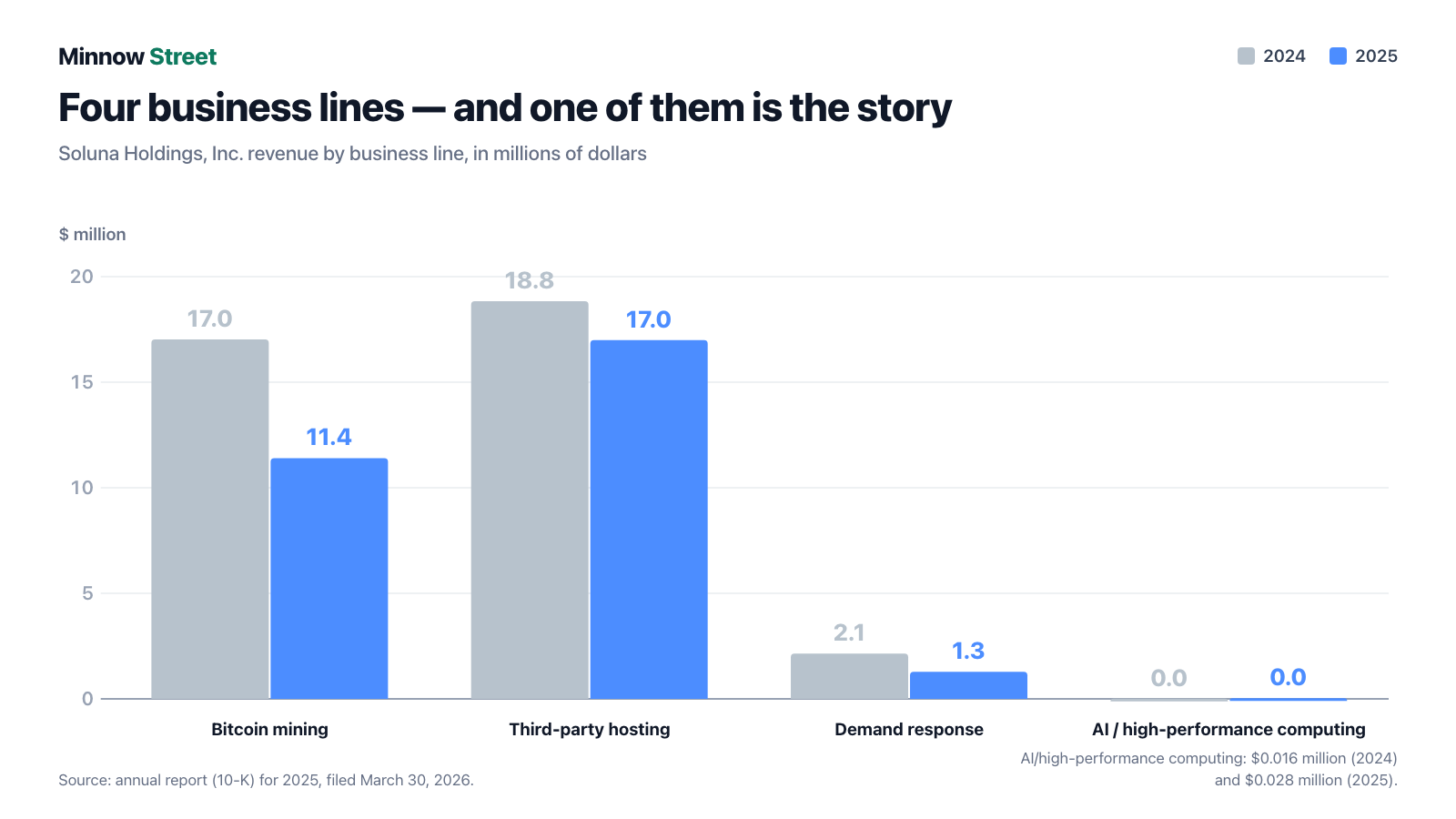
The bottom line for 2025 was a net loss of $57.0 million (2024: $58.3 million), of which $53.4 million was attributable to shareholders. The operating loss came to $33.7 million. And the cost side ran the wrong way: general and administrative expenses rose 64 percent to $30.5 million in 2025 — while revenue fell 22 percent. In the first quarter of 2026 that continued: $16.1 million of general and administrative expenses (up 171 percent), an operating loss of $16.6 million and a net loss of $17.9 million after $7.4 million in the prior-year quarter. So revenue grew 58 percent and the loss grew 143 percent. Remember the rule of thumb: growth that makes the loss grow faster than revenue is bought growth. Which brings us to the uncomfortable truths.
What the filings say — the uncomfortable truths
Uncomfortable truth no. 1: the AI business is a reporting segment without revenue
Soluna runs three reporting segments: bitcoin mining, third-party hosting and high-performance computing. The last of these is the AI track, and the annual report describes it without varnish — including the exit from the active services business:
"In the third quarter of 2024, the Company initiated Soluna Cloud Services, a new business line to provide high performance computing services to support generative AI workstreams, but decided to exit active provision of these services during the first quarter of 2025 and will focus in the future on provision of colocation services at our datacenters to host customers in the AI generative space."
— Soluna Holdings, Inc., SEC annual report 10-K for 2025, Note 16 "Segment Information"
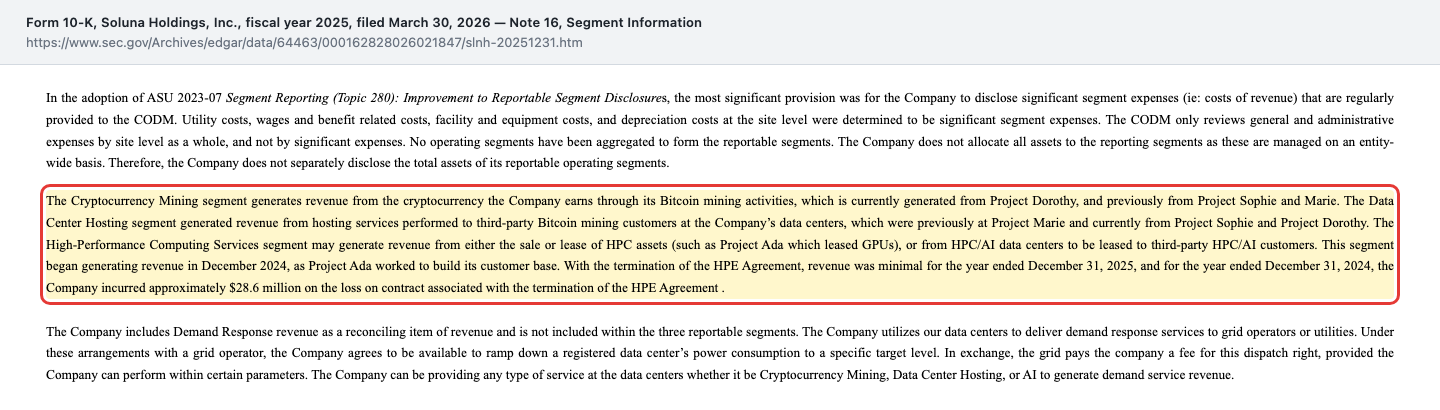
"Minimal" is quantified in the numbers section: $28 thousand in 2025, $16 thousand in 2024, zero in the first quarter of 2026. For comparison: total revenue in 2025 was $29.7 million. The AI segment made up 0.09 percent of it. What Soluna is building instead is real but not yet sold: through its subsidiary Soluna HPC, Project Kati 2 is taking shape in Willacy County, Texas — since June 3, 2026 a joint venture with data center developer Metrobloks, first phase 100 megawatts, second phase 250 megawatts. Soluna funded roughly $3.5 million of operating costs for it and committed to a capital contribution of roughly $19.0 million plus up to $2.0 million of further funding; once those contributions have been repaid together with a 14 percent internal rate of return and $100,000 per gross megawatt, the two partners split further distributions evenly. That is a properly structured deal. It is simply a construction agreement, not a lease.
How far along is the search for a tenant? That is the question this analysis hangs on — and in the summer of 2026 it got a first answer. In its monthly update of July 14, 2026, Soluna writes that due diligence with one prospect has moved into formal commercial negotiations and that a letter of intent has been signed with that one potential tenant; the focus is now on design, commercial terms and the lease. A letter of intent is not a lease — it generally binds nobody to pay, and the prospect's name appears nowhere. But it is the first documented step from construction plan to customer, and it is therefore the most important figure that could show up in the next quarterly report. The same update is worth reading for construction progress: as of July 2026 Project Kati 1 is no longer the 35-megawatt building site of year-end — the Kati 1A portion with 48 megawatts is complete, construction continues on Kati 1B with 35 megawatts, whose second phase (9 megawatts) reached substantial completion in June 2026.
Uncomfortable truth no. 2: the one real AI contract cost $28.6 million — and $19.3 million is still open
There was an AI contract once, and it is the most expensive chapter of the company's recent history. In June 2024 subsidiary CloudCo ordered access to data center and cloud services for AI and supercomputing workloads on NVIDIA H100 GPUs from Hewlett Packard Enterprise. Volume: $34.0 million over 36 months, $10.3 million of it prepaid immediately and $667 thousand a month thereafter through June 2027. In March 2025 CloudCo terminated; two days later HPE terminated for cause over an amount unpaid for more than 30 days — and, as the contract allowed, accelerated the entire remaining balance. Soluna booked a loss on the contract of $28.6 million.
The real find sits in the notes: as of December 31, 2025 the outstanding liability stood at roughly $19.3 million — and the report records that "no formal legal proceedings have commenced." A collection agent got in touch on December 3, 2025 and reported on January 15, 2026 that its engagement had ended. On the March 31, 2026 balance sheet the item still reads $19.348 million, unchanged. That is roughly 65 percent of a full year's revenue. The invoice will one day be paid or one day be written off — either moves earnings substantially, and neither is on the calendar.
Uncomfortable truth no. 3: the auditor raised the going-concern question
An audit report is a dry genre. When a "critical audit matter" appears in one, it means: this is where the auditor had to look especially closely, because the opinion depends on it. At Soluna it was the question of whether the company survives the next twelve months:
"As discussed in Note 1 to the consolidated financial statements, the Company incurred recurring operating losses, had negative cash flows from operations, and has significant outstanding debt and commitments for capital expenditures. These conditions raised substantial doubt about the Company's ability to continue as a going concern within one year after the issuance of the consolidated financial statements."
— UHY LLP, audit report in: Soluna Holdings, Inc., SEC annual report 10-K for 2025

In fairness: management considers the doubt alleviated, and it gives reasons — $76.4 million of cash as of December 31, 2025, $119.4 million net from financing activities in 2025, a project credit facility from Generate of up to $100 million and an equity purchase agreement of $250.0 million. Only: "alleviated" here expressly means "alleviated by the ability to raise new capital," not "alleviated by profits." The operating business burned $9.1 million in 2025 and $6.4 million in the first quarter of 2026 alone. The report itself says what the alternative would be if the capital does not arrive: "it will be forced to delay or scale down some or all of its development activities or perhaps even cease the operation of its business." As an aside: on March 29, 2026 long-standing auditor UHY LLP was dismissed and KPMG LLP appointed for fiscal 2026; per the filing (8-K of March 31, 2026) there were neither disagreements nor reportable events.
Uncomfortable truth no. 4: 10.6 million shares became 157.7 million
Dilution in everyday terms means: your slice of the cake stays the same size, but the cake is cut into more and more pieces. At Soluna this has happened at a pace one rarely sees. As of December 31, 2024 there were 10,607,020 common shares outstanding. As of December 31, 2025 there were 102,531,089. As of March 31, 2026: 111,717,040. As of April 24, 2026: 141,347,055. And on the cover page of the quarterly report, as of May 12, 2026: 157,747,354.
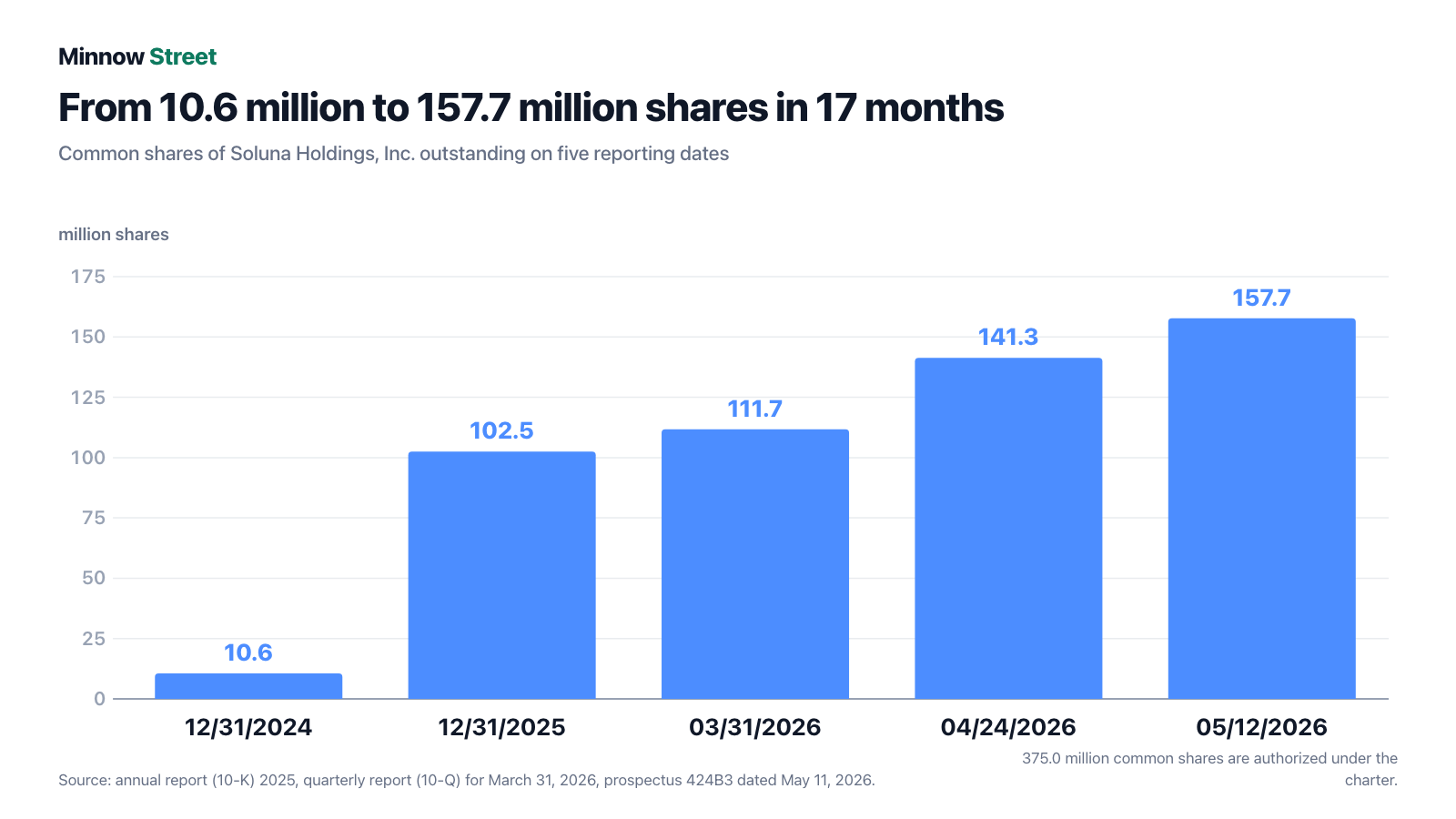
The last step is the most vivid, because the report puts a number on it in one sentence:
"Subsequent to March 31, 2026 and through the date of the issuance of these condensed financial statements, the Company has issued 36,820,572 shares of common stock for net proceeds of approximately $52.2 million."
— Soluna Holdings, Inc., SEC quarterly report 10-Q as of March 31, 2026, "Liquidity and Capital Resources"

And the queue is long. As of March 31, 2026 there were an additional 26,968,251 unvested restricted shares, 22,309,840 warrants and 2,465,230 rights outstanding, excluded from the loss per share calculation only because they would shrink the loss arithmetically. The charter authorizes 375.0 million shares — with 157.7 million outstanding there is plenty of room left. On top of that comes the equity purchase agreement with YA II PN dated March 24, 2026 of up to $250.0 million, from which not a single dollar had been drawn as of May 15, 2026. One detail on the side that gives away the prehistory: the old employee options carried a weighted average exercise price of $21.46 as of December 31, 2025 — a memento of earlier reverse splits and of prices that lie far behind.
And the staircase gained another step after the quarterly report, one that is easy to miss because it does not appear in the share count on the cover page: the Series B preferred stock issued in 2022 was converted in full during 2026 — all 62,500 shares into a combined 6,510,416 common shares, plus $2.1 million of accrued dividends paid in cash. As of March 31, 2026, 57,190 of those preferred shares were still outstanding, so most of the conversion falls after quarter-end. On June 23, 2026 Soluna withdrew the class from its charter — at that point not a single Series B share remained outstanding (8-K of June 25, 2026, Item 5.03). Soluna published no official interim share count after May 12, 2026 through July 24, 2026; the only outside check comes from a beneficial ownership report of May 26, 2026, in which 13,336,362 shares are stated as 8.5 percent of the class — which implies roughly 157 million shares outstanding and thus matches the cover-page figure.
Uncomfortable truth no. 5: the Nasdaq clock runs to October 7, 2026
On April 10, 2026 Soluna received notice from Nasdaq that the closing bid price of the common stock had been below $1.00 for 30 consecutive business days and that the company was therefore not in compliance with minimum bid price rule 5550(a)(2). The consequence is spelled out in the filing:

The price itself is not an argument for this analysis — prices change daily, and we value businesses, not daily quotes. What matters is the mechanism: to meet the rule, companies in this position regularly resort to a reverse stock split, in which, say, ten old shares become one new one. That changes nothing about the value of the business, but it makes the freshly diluted stock look "orderly" again — and creates room under the authorized capital for the next round. Anyone who read the dilution story in truth no. 4 knows why this point stands here.
Uncomfortable truth no. 6: stock compensation was larger than quarterly revenue
In the first quarter of 2026 Soluna booked $10.222 million of stock-based compensation — against quarterly revenue of $9.394 million. Staff and leadership received more in shares that quarter than the entire company earned in revenue. A year earlier it was $1.847 million. This compensation costs no cash, it costs ownership — it is the invisible part of the share staircase. And the direction is set: on July 9, 2026 the compensation committee decided to raise chief executive John Belizaire's base salary retroactively to January 1, 2026 to $600,000 and to set a target bonus of 100 percent of base salary (8-K of July 24, 2026). On July 16, 2026 Ryan Carver was additionally appointed Chief Development Officer. This is the build-out of a growth organization — paid for out of a treasury the operating business does not fill.
Valuation: what is being bought here is a building site
There is no price-to-earnings ratio, because there are no earnings. That leaves two honest anchors, both from SEC documents. The first: in the prospectus supplement of April 1, 2026, Soluna itself names the last reported sale price — $0.77 on March 6, 2026, with 110,827,939 shares outstanding at the time. The second: between April 1 and May 15, 2026 the company issued 36,820,572 shares and raised $52.2 million net, that is roughly $1.42 per share. Apply those two documented prices to the 157,747,354 shares of May 12, 2026 and you get an order of magnitude of roughly $120 million to $225 million of market value. Against 2025 revenue of $29.7 million that is a price-to-sales ratio of roughly 4 to 8 — a proud price for a bitcoin miner with falling revenue, a bargain for an AI data center. That is precisely the bet.
Book value grounds the picture: of the $113.0 million of equity as of March 31, 2026, only $47.2 million belongs to shareholders; $65.8 million belongs to the non-controlling interests in the project companies that help finance construction. Spread over the 111.7 million shares outstanding at the time, that is $0.42 of book value per share. The accumulated deficit stands at $385.2 million — against paid-in capital of $446.2 million. Translated: of every dollar investors have given this company since 1961, roughly 86 cents have been consumed. Anyone buying on valuation grounds should read that sentence twice — even if most of that past belonged to a different company.
Opportunities and risks at a glance
Opportunities
- A site concept with a real edge: data centers behind the meter of a wind farm skip the years-long grid interconnection queues — per the annual report the most important time advantage in the race for AI capacity.
- Its own power source: with the Briscoe wind farm (149.85 megawatts, bought on April 1, 2026 for roughly $53.0 million) Soluna owns generation for the first time.
- Hosting is growing fast: up 178 percent to $6.7 million in the first quarter of 2026; those revenues are mostly fixed prices or standby fees and therefore less dependent on the bitcoin price than proprietary mining.
- Access to capital is demonstrably there: $119.4 million net from financings in 2025, $52.2 million in six weeks in the spring of 2026, plus an untouched facility of $250.0 million.
- Project partners carry part of the load: $10.9 million of contributions from non-controlling interests in the first quarter of 2026 alone — the assets grow without common shareholders paying for them in full.
- A first prospect for the AI capacity: per the monthly update of July 14, 2026 a letter of intent has been signed with a potential tenant for Project Kati 2; the Kati 1A build with 48 megawatts has been completed.
Risks
- Going concern: the fiscal 2025 audit report lists it as a critical audit matter; management sees it alleviated only by the prospect of new capital, not by profits.
- AI revenue does not exist: $28 thousand in 2025, zero in the first quarter of 2026 — for Kati 2 there was only a letter of intent with an unnamed prospect through July 14, 2026, not a lease.
- Dilution with no visible brake: from 10.6 million to 157.7 million shares in 17 months, plus 26.97 million unvested restricted shares, 22.31 million warrants and an equity facility of $250.0 million.
- An open legacy item: $19.3 million from the terminated HPE contract sits unpaid on the balance sheet with no proceedings under way — the timing and size of any resolution are unknown.
- Listing deadline: the Nasdaq period runs to October 7, 2026; a common way out is a reverse stock split, which creates fresh room for dilution.
- Cost base: general and administrative expenses of $30.5 million in 2025 (up 64 percent) and $16.1 million in the first quarter of 2026 alone (up 171 percent) against $29.7 million of annual revenue.
- Bitcoin dependence: most of the revenue hangs directly or indirectly on the bitcoin price and on the economics of the mining customers; the next block reward halving hits both.
A human conclusion
At the beginning stood the label trap: we read a word and supply a number. At Soluna the number is undisputed, because the company states it itself — $28 thousand of AI revenue in 2025, zero in the first quarter of 2026. This is not an accusation. Nowhere in its filings does Soluna claim to have a running AI business; it describes cleanly that it is building one. The gap does not arise in the report, it arises between the report and the perception.
What is actually for sale here is a building site with a clever idea: turning power nobody else uses into computing. Behind it stand a wind farm of its own, four running sites, a joint venture for 350 megawatts — and a price tag that pays not for the building site but for the finished building. The construction time is financed with ownership: 10.6 million shares became 157.7 million in 17 months. Anyone getting in today is not buying the company of 2025 but the hope of the one of 2028 — and paying for it in a currency management can print more of at any time.
That can work out. Data center capacity with fast grid access is scarce, and whoever has land, power and permits together today sits at a rare table. It can also end the way the HPE contract did: a big name, a big contract, a big loss — and an invoice still sitting on the balance sheet years later. The letter of intent for Kati 2 from July 2026 is the first step in the other direction; whether it becomes a lease is not written in it. Three numbers from the next quarterly report will tell you which case applies: revenue in the high-performance computing segment, the number of shares outstanding, and the cash balance after the spring purchases. Soluna has set a date for it — the first quarterly earnings call is scheduled for August 13, 2026. What you make of it is your decision. And that is exactly as it should be.
Sources
All original documents used in this analysis — for you to read yourself:
- Soluna Holdings, Inc. — SEC annual report 10-K for 2025 (filed March 30, 2026)
- Soluna Holdings, Inc. — SEC quarterly report 10-Q as of March 31, 2026 (filed May 15, 2026)
- Soluna Holdings, Inc. — SEC current report 8-K of April 15, 2026, Item 3.01 (Nasdaq minimum bid price, deadline October 7, 2026)
- Soluna Holdings, Inc. — SEC current report 8-K of March 31, 2026, Item 4.01 (auditor change from UHY LLP to KPMG LLP)
- Soluna Holdings, Inc. — SEC current report 8-K of April 3, 2026 (purchase of the Briscoe wind farm, Tranche C credit agreement)
- Soluna Holdings, Inc. — SEC current report 8-K of April 17, 2026 (purchase of Dorothy 1A, promissory note with YA II PN)
- Soluna Holdings, Inc. — SEC current report 8-K of May 18, 2026, Item 2.02 (release of first quarter 2026 results)
- Soluna Holdings, Inc. — SEC current report 8-K of May 20, 2026 (purchase of the remaining 49 percent of Dorothy 1B for roughly $8.8 million)
- Robert L. Bugbee — SEC Schedule 13G beneficial ownership report of May 26, 2026 (13,336,362 shares, 8.5 percent, as of May 22, 2026)
- Soluna Holdings, Inc. — SEC current report 8-K/A of June 17, 2026 (audited financial statements of the Briscoe wind farm and pro forma figures for the acquisition)
- Soluna Holdings, Inc. — SEC current report 8-K of June 9, 2026 (Kati 2 joint venture with Metrobloks)
- Soluna Holdings, Inc. — SEC current report 8-K of June 25, 2026 (conversion of the Series B preferred stock into 6,510,416 common shares)
- Soluna Holdings, Inc. — SEC current report 8-K of July 14, 2026, Item 7.01 with exhibit 99.1 (June 2026 monthly update: letter of intent with a potential Kati 2 tenant, construction progress, earnings call on August 13, 2026)
- Soluna Holdings, Inc. — SEC current report 8-K of July 16, 2026 (appointment of Ryan Carver as Chief Development Officer)
- Soluna Holdings, Inc. — SEC current report 8-K of July 24, 2026, Item 5.02 (chief executive compensation)
- Soluna Holdings, Inc. — SEC prospectus supplement 424B5 of April 1, 2026 (at-the-market program, last reported sale price $0.77 on March 6, 2026)
- Soluna Holdings, Inc. — SEC prospectus 424B3 of May 11, 2026 (141,347,055 shares as of April 24, 2026)
- Full SEC filing history of Soluna Holdings, Inc.: EDGAR overview (sec.gov)
- Fundamental data (metrics, data as of July 26, 2026), reconciled with the SEC filings.
- Origin of the ticker: Reddit hype scanner; cross-check against our own database on July 26, 2026 using our in-house stock scanner.
Transparency & disclaimer: this analysis is a journalistic assessment of publicly available information and is not investment advice, not a financial analysis in the regulatory sense, and not an invitation to buy or sell securities. Equity investments carry substantial risk up to total loss. All information without warranty; the data cut-off is noted in the text. At the time of publication the author holds no position in Soluna Holdings stock.
Our Bottom Line at a Glance
- Site concept and growth positive
- The core idea works: data centers behind the meter of a wind farm skip years of grid interconnection queues and buy power that would otherwise be curtailed. Hosting grew 178 percent to $6.7 million in the first quarter of 2026, total revenue 58 percent to $9.4 million. With the Briscoe wind farm (149.85 megawatts, bought on 04/01/2026 for roughly $53.0 million) Soluna now owns the power source itself.
- AI business negative
- Story and bookkeeping are far apart: the high-performance computing segment booked exactly $28 thousand of revenue in 2025 ($16 thousand in 2024) and zero in the first quarter of 2026. The only real AI contract — $34.0 million with Hewlett Packard Enterprise for capacity on NVIDIA H100 GPUs — collapsed in March 2025 and cost $28.6 million. For Project Kati 2 the monthly update of July 14, 2026 does report a signed letter of intent with an unnamed prospect — until then the AI business exists as a construction plan, not as revenue.
- Balance sheet and going concern negative
- Auditor UHY LLP made going concern a critical audit matter in the fiscal 2025 audit report: recurring losses, negative operating cash flow, significant debt and capital expenditure commitments. In 2025, $9.1 million flowed out of operations; in the first quarter of 2026 alone, $6.4 million. On top of that the HPE liability of $19.3 million still sits on the balance sheet, and the accumulated deficit has reached $385.2 million.
- Dilution negative
- The share count rose from 10,607,020 (12/31/2024) to 157,747,354 (05/12/2026) — almost fifteenfold in 17 months. Between April 1 and May 15, 2026 alone, 36,820,572 shares were added for $52.2 million of net proceeds, plus 6,510,416 shares in 2026 from the full conversion of the Series B preferred stock. Behind that stand another 26,968,251 unvested restricted shares, 22,309,840 warrants and a still untouched equity purchase agreement of $250.0 million.
- Cost discipline and pay negative
- General and administrative expenses rose 64 percent in 2025 to $30.5 million while revenue fell 22 percent to $29.7 million. In the first quarter of 2026 they came to $16.1 million — including $10.2 million of stock-based compensation, that is more than the entire quarterly revenue of $9.4 million. On July 9, 2026 the compensation committee raised the chief executive's base salary retroactively to January 1, 2026 to $600,000 and set a target bonus of 100 percent.
- Listing and capital structure neutral
- Since April 10, 2026 a Nasdaq compliance period has been running to October 7, 2026 because the closing bid price was below $1.00 for 30 consecutive business days. Of the $113.0 million of equity as of March 31, 2026, only $47.2 million belongs to shareholders and $65.8 million to the non-controlling interests in the projects — and ahead of the common stock stand another 4,920,045 preferred shares with a $25.00 liquidation preference.
Soluna Holdings is a lesson in the label trap: a company that describes honestly what it is building gets traded for what the sign says. The sign says AI — the books say $28 thousand of AI revenue for 2025 and zero for the first quarter of 2026, alongside $29.7 million of bitcoin revenue and a $57.0 million net loss. The site concept is real, hosting is growing, the wind farm has been bought. But the auditor made going concern a critical audit matter, a $19.3 million invoice from the collapsed AI contract still sits on the balance sheet, and the share count has grown almost fifteenfold in 17 months. Anyone investing here is financing a construction plan — and paying for the build time in shares. Not investment advice.
What Our Rating Means
Substance risk
We found at least one documented issue that threatens the company itself — regardless of how the stock is currently valued.
Red here does not stand for a bad price but for documented substance findings. The fiscal 2025 audit report lists going concern as a critical audit matter: recurring operating losses, negative operating cash flow, significant debt and capital expenditure commitments. Operating cash burn accelerated from $9.1 million for the whole of 2025 to $6.4 million in the first quarter of 2026 alone, while general and administrative expenses rose 171 percent. A $19.3 million liability from a terminated contract sits unpaid on the balance sheet, the operating business does not carry itself, and the company writes that without fresh capital it would have to delay or scale down development work or even cease operations. The site concept, the wind farm it now owns and the growing hosting business are real assets — they do not change this assessment as long as the substance question is open.
A journalistic assessment by our editorial team at the time of the deep dive, based on public sources — not investment advice and not a solicitation to buy or sell. Your personal circumstances (investment goals, risk capacity, taxes) cannot be taken into account. What our levels mean, how verdicts are formed, and what conflicts of interest exist →
Worth Noting
- Soluna landed on the research list via the Reddit hype scanner. The cross-check against our own database on July 26, 2026 found that SLNH appears in none of our scanner lists — no momentum, quality or valuation filter surfaced the stock. Those lists are recalculated daily, so the finding holds for the day named.
- Data basis and currency: we evaluated the annual report (10-K) for 2025 filed March 30, 2026, the quarterly report (10-Q) as of March 31, 2026 filed May 15, 2026, and every filing made afterwards through July 24, 2026 — including the monthly update of July 14, 2026 and the beneficial ownership report of May 26, 2026. The share count comes from the cover page of the quarterly report (as of May 12, 2026); Soluna published no newer official interim figure through July 24, 2026. Added after that date was the full conversion of the Series B preferred stock into 6,510,416 common shares, most of which falls after March 31, 2026.
- On valuation: a market capitalization taken from market data is deliberately not used as a metric here, because the last price documented in a filing ($0.77 on March 6, 2026) and the average proceeds of the company's own share issuance in April and May 2026 (roughly $1.42) are far apart. Only the order of magnitude is given. Not to be confused: SLNH is the common stock, SLNHP the preferred stock of the same company.
Frequently Asked Questions
Soluna Holdings, Inc. (NASDAQ: SLNH) of Albany, New York, builds and operates data centers right next to wind and solar farms, mostly in Texas and Kentucky. There it buys power that would otherwise be curtailed and converts it into computing. Revenue in 2025 came from proprietary bitcoin mining ($11.4 million), from hosting third-party miners ($17.0 million) and from demand response in the grid ($1.3 million). As of December 31, 2025 the company had 55 employees.
Very little. The high-performance computing reporting segment, under which Soluna runs its AI business, booked $28 thousand of revenue in fiscal 2025 according to the annual report (10-K) — 0.09 percent of total revenue of $29.7 million. The year before it was $16 thousand. For the first quarter of 2026 the quarterly report (10-Q) shows zero revenue for that segment. The AI capacity is planned and partly under construction; it has not been sold.
Because it is the same company. It was incorporated in New York State in 1961 as Mechanical Technology, Incorporated, reincorporated in Nevada on March 24, 2021 and changed its name to Soluna Holdings, Inc. on November 2, 2021. Its older filings with the U.S. Securities and Exchange Commission therefore run under the same identifier, CIK 0000064463. Anyone looking at very long data series is looking at the history of an entirely different business.
SLNH is the common stock, SLNHP the 9.0 percent Series A Cumulative Perpetual Preferred Stock with a $25.00 liquidation preference per share. As of March 31, 2026 there were 4,920,045 preferred shares issued and outstanding. Both are listed on Nasdaq. The preferred ranks ahead of the common in any distribution — anyone buying SLNH stands behind SLNHP and behind all debt providers.
Serious enough that auditor UHY LLP treated it as a critical audit matter in the fiscal 2025 audit report: recurring operating losses, negative operating cash flow, significant debt and capital expenditure commitments raised substantial doubt. Management considers the doubt alleviated — by $76.4 million of cash as of December 31, 2025, an equity purchase agreement of $250.0 million and project loans. But alleviated here means: dependent on fresh capital.
On April 10, 2026 Nasdaq determined that the closing bid price had been below $1.00 for 30 consecutive business days. By October 7, 2026 the price must close at or above $1.00 for ten consecutive business days. If that fails, a second 180-day period may follow; if that fails too, Nasdaq begins the delisting process, which the company can appeal. A common way out is a reverse stock split.
Badly. As of December 31, 2024 there were 10,607,020 common shares outstanding, as of December 31, 2025 102,531,089, as of March 31, 2026 111,717,040 and as of May 12, 2026 157,747,354 — almost fifteen times as many in 17 months. Between April 1 and May 15, 2026 alone, 36,820,572 shares were issued for $52.2 million of net proceeds. The charter authorizes 375.0 million shares; on top of that come 26,968,251 unvested restricted shares and 22,309,840 warrants as of March 31, 2026. In 2026 the Series B preferred stock was also converted in full into 6,510,416 common shares, a process completed on June 23, 2026 when the class was withdrawn from the charter.
Kati 2 is Soluna's AI project in Willacy County, Texas: a joint venture with Metrobloks dated June 3, 2026, first phase 100 megawatts, second phase 250 megawatts. Soluna funded roughly $3.5 million of costs and committed to a capital contribution of roughly $19.0 million plus up to $2.0 million of further funding. In its monthly update of July 14, 2026, Soluna reports a signed letter of intent with one potential tenant for Kati 2 — that is not yet a lease. The Briscoe wind farm with 149.85 megawatts of nameplate capacity was bought on April 1, 2026 for roughly $53.0 million — power of its own, behind the meter.
Found an error?
Did you spot a factual error, an outdated number, or a typo in this deep dive? Let us know briefly — your report goes straight to the editorial team.