HIVE Digital: $297.8 Million of Revenue, a $148.4 Million Loss — and 88.7 Million New Shares in Twelve Months
HIVE Digital Technologies has only carried that name since July 2023; before then the word "Blockchain" stood in it. The new name promises data centers and artificial intelligence — in the fiscal year ended March 31, 2026 that side delivered $19.5 million of $297.8 million in revenue, or 6.6 percent. The rest was mined by machines in Paraguay, Sweden and Canada. Revenue rose 158 percent, the net loss jumped from $3.0 million to $148.4 million, and shareholders paid for the growth: 88.7 million new shares in that fiscal year alone, plus $245 million of zero-coupon exchangeable notes in the spring of 2026. On Reddit the stock shows up with 2 mentions in 24 hours (as of July 25, 2026) — and the data feed still lists it under the old name. Not investment advice — just the arithmetic of who paid for this growth.
 Thomas Mücke
Founder & Publisher
Thomas Mücke
Founder & Publisher
Chart
Interactive price chart (TradingView).
Note: pure fact-based analysis, not investment advice and not a solicitation to buy or sell. All figures without guarantee.
There is an investor trap that catches you before you have read a single number: the signboard trap. It works like this — you read a company name and your brain files the company away. "Digital Technologies" sounds like data centers and artificial intelligence. "Blockchain" sounds like 2021. Same company, two feelings. And because the sign above the shop is swapped faster than the goods on the shelves, we sometimes buy the sign and think we bought the shop. HIVE Digital Technologies (Nasdaq: HIVE) was called HIVE Blockchain Technologies Ltd. until July 12, 2023. Our in-house Reddit hype scanner first picked the stock up on July 25, 2026 at 07:00 with 2 mentions in 24 hours — and promptly listed it under the old name. Even the data vendors have not caught up with the sign change.
So let us make a deal. Before we decide whether this is a bitcoin miner or an AI company, we read together what the company itself told the U.S. securities regulator, the SEC. An annual report is honest under penalty of law. And HIVE has just filed its very first one as a U.S. domestic filer: the annual report on Form 10-K of June 2, 2026 for the fiscal year ended March 31, 2026. On top of that come ten weeks of mandatory filings that shift the picture considerably. The decision at the end is yours.
What HIVE Digital Technologies Actually Does — Power In, Compute Out
The business model is refreshingly simple at its core: HIVE buys cheap power, pushes it through specialized machines and sells what comes out the other end. Two products result. First, hashrate — computing power that secures the bitcoin network. Picture a gigantic lottery in which whoever fills out the most tickets statistically wins most often. HIVE does not fill out the tickets itself; it sells the computing power to so-called mining pools and gets paid in bitcoin. Second, high-performance computing, or HPC: Nvidia graphics cards rented out by the hour or by the month to companies that train AI models on them.
The sites sit where hydroelectric power is cheap: in Canada (New Brunswick, Quebec, Montreal, Ontario, Manitoba), in Sweden (Boden) and, since 2025, above all in Paraguay (Yguazú and Valenzuela). As of April 30, 2026 roughly 25.2 exahashes per second were installed, using 384.6 megawatts of the 464.4 megawatts available. And now the number worth remembering, because it explains almost everything about this company: as of March 31, 2026 HIVE employed 29 people. Twenty-nine. This is not a corporation with a workforce; it is a control room for machines.
Legally HIVE is a British Columbia company with its head office in San Antonio, Texas. The stock trades on Nasdaq, since May 12, 2026 additionally on the Toronto Stock Exchange (previously on its smaller sibling, the TSX Venture Exchange) and also on the Colombian stock exchange under "HIVECO." Aydin Kilic is President and CEO, Darcy Daubaras is chief financial officer, and the well-known fund manager Frank Holmes serves as executive chairman.
Which sets up the central tension of this analysis: HIVE really is growing — but the growth is not being paid for by the business, it is being paid for by the shareholder. That sentence runs through every chapter that follows.
How the Stock Landed on Our Desk — and Why the Feed Still Shows the Old Name
HIVE reached our desk through our in-house Reddit hype scanner, which counts how often a ticker is named in retail investor forums over 24 hours. On July 25, 2026 at 07:00 HIVE appeared on the list for the first time, with 2 mentions. That is not a storm, it is a throat being cleared — exactly the size at which it pays to look before a story gets loud.
The hype list is not our only handle on this stock, though. As of July 25, 2026 HIVE also sits in three of our screens: EPS Acceleration (earnings-per-share growth higher in the latest quarter than in the one before), "Below the 50- & 200-SMA" (price under both the 50- and the 200-day line) and "Kathy Donnelly: Liquid Movers Down" (at least $20 million of daily dollar volume on a day the stock is down at least 5%). None of that is a seal of quality: the first screen only compares rates of change and says nothing about the quality of earnings at a company with a loss per share, and the other two are explicitly warning and risk lists. All three are recomputed daily — this is a snapshot from the day of the analysis.
More interesting than the mention count was the name beside it. The feed carried the company as "HIVE Blockchain Technologies" — the name HIVE dropped on July 12, 2023. The annual report explains the change itself: it reflects "HIVE's evolving focus on revenue opportunities made possible by HIVE's large inventory of Nvidia GPUs cards in combination with emerging technologies, including AI, machine learning, advanced data analysis and HPC." Remember this: when the data vendor still shows the old sign three years after a renaming, that is a good reason to go look at the shelves yourself.
A word on the valuation basis, because here it matters. The same feed showed a market value of $850.4 million on July 25, 2026. We check such numbers against the filings: 270,437,030 shares (prospectus supplement of June 17, 2026) multiplied by $3.20 — the last price documented in a mandatory filing, from the Form 4 insider report of July 16, 2026 — gives roughly $865 million. The gap is just under 2 percent, so the feed value holds up. We still work with the filing figure below.
The Numbers Over the Years — Given Their Due
Start with what genuinely impresses, because there is something here. HIVE's revenue rose 158 percent in the fiscal year ended March 31, 2026 — from $115.3 million to $297.8 million. That is not an accounting trick; there are machines behind it. HIVE completed a 300-megawatt expansion in Paraguay in three phases during 2025 and lifted installed computing power to roughly 25 exahashes per second. It mined 2,885 bitcoin, up from 1,414 — more than double, and that in the first full year after the April 20, 2024 halving of block rewards, which hit every miner alike.
The cash margin improved as well. The company reported gross operating margin — revenue less direct cash costs such as power and maintenance — of $107.9 million, up from $25.1 million, with the margin rising from 22 percent to 36 percent. Cash from operations came to $62.3 million, against $16.6 million. Stop reading here and you see a company where everything is finally coming together.
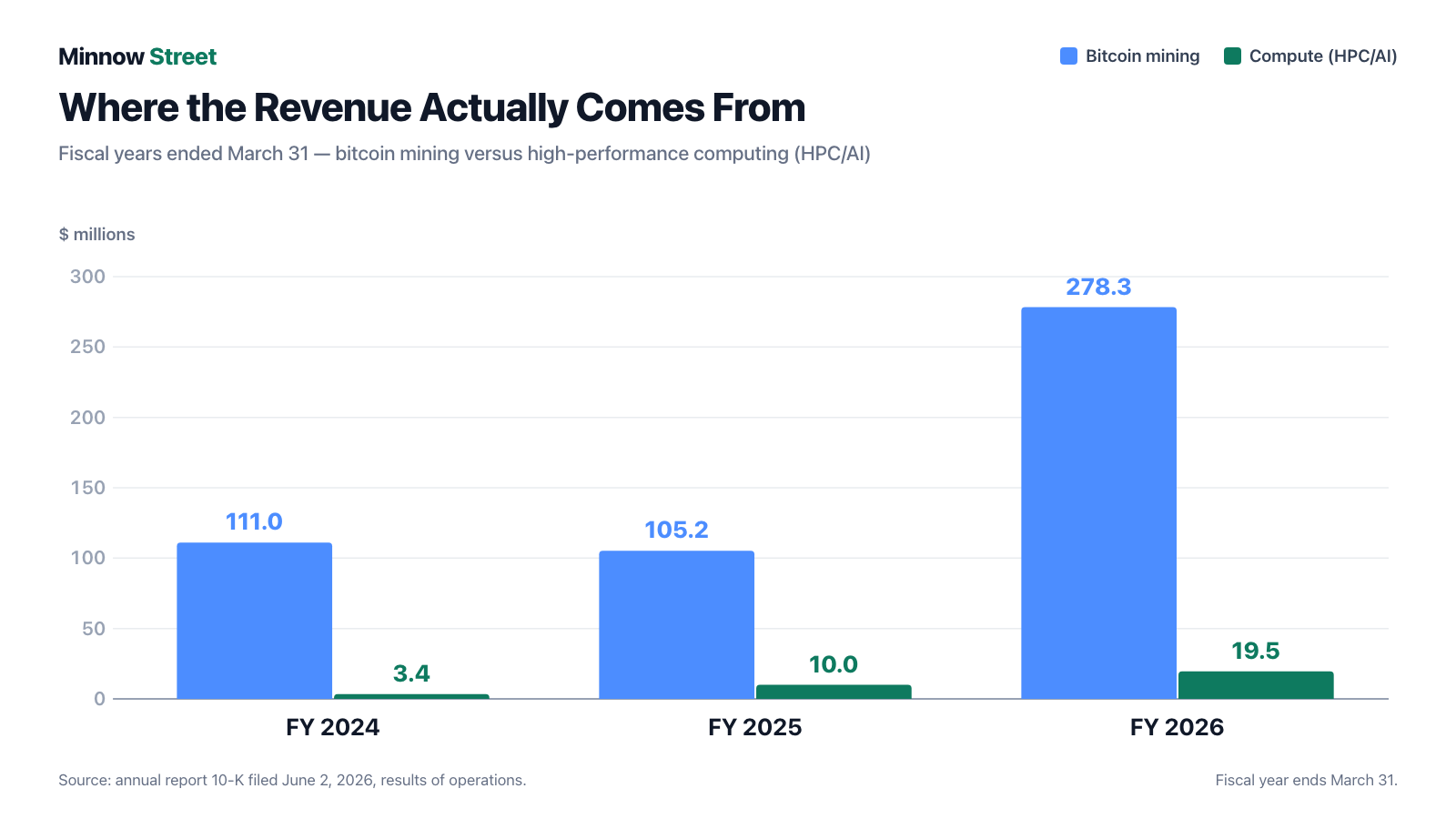
The second look belongs to the mix. In fiscal 2024, $111.0 million of mining revenue stood against just $3.4 million from the data center business; in fiscal 2025 it was $105.2 million versus $10.0 million. Anyone who reads "Digital Technologies" and thinks AI therefore gets a different picture from the revenue lines:
And then there is the bottom line. The net loss came to $148.4 million — after a $3.0 million loss the year before and a $26.5 million profit in fiscal 2024. Per share that is a loss of $0.66. How a record revenue year turned into a record loss shows up in the bridge:
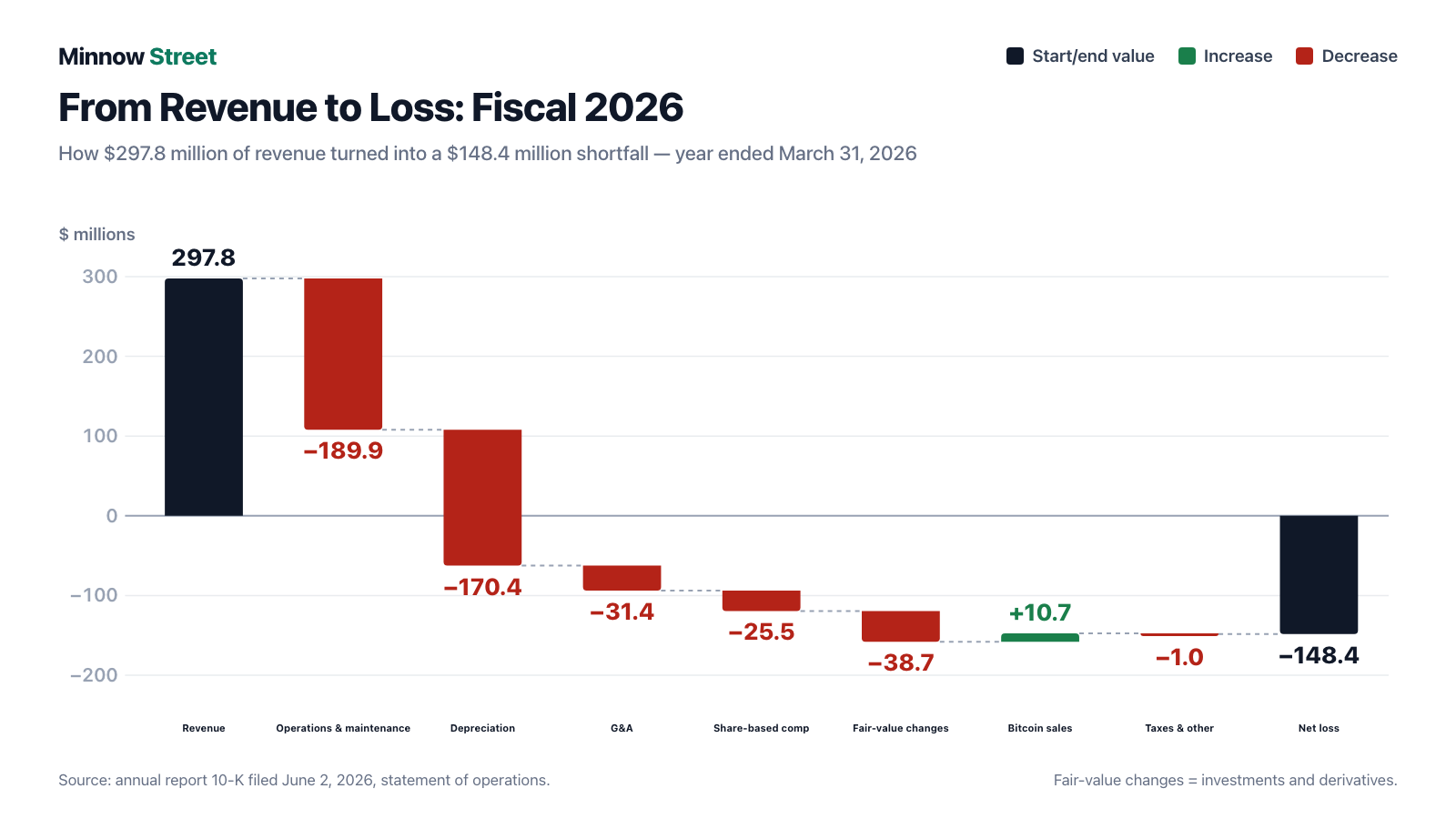
Line by line the bridge reads like this: from $297.8 million of revenue, $189.9 million goes to operations and maintenance (including $3.2 million of service fees to the rental marketplaces), then $170.4 million of depreciation, $31.4 million of general and administrative costs and $25.5 million of share-based compensation. Fair-value changes on investments and derivatives cost another $38.7 million, bitcoin sales brought in $10.7 million, and taxes and other items cost a net $1.0 million. What is left is a loss of $148.4 million.
That is the central arithmetic of this business model, and it fits in one sentence: depreciation on the machines ($170.4 million) exceeded the entire gross operating margin ($107.9 million). Translated: the machines earn money while they run, but they wear out faster than they bring in. Under U.S. accounting rules the actual gross margin was therefore minus 21 percent. Investing here means betting that the next generation of machines closes that gap.
What the Filings Say — the Uncomfortable Truths
Uncomfortable truth no. 1: the growth was paid for with new shares
Dilution is the technical term, and the everyday image is a cake: your slice stays the same size, but new slices keep getting cut, so your share of the whole gets smaller. At HIVE that cutting is the actual financing instrument. The company runs at-the-market programs: it continuously sells new shares straight into the market, in small portions, with no announced date. In the fiscal year ended March 31, 2026 that came to 88.7 million new shares from three programs for gross proceeds of $202.0 million.
The annual report says so without dressing it up:
"Furthermore, we have primarily funded our growth through at-the-market ("ATM") offerings and other issuances of our common stock. Any additional equity or convertible debt financing may be dilutive to shareholders … The issuance of additional shares of our common stock dilutes the ownership interests of existing stockholders, and future equity sales could further dilute existing holdings and may reduce the market price of our common stock."
— HIVE Digital Technologies Ltd., Form 10-K filed June 2, 2026, Item 1A Risk Factors

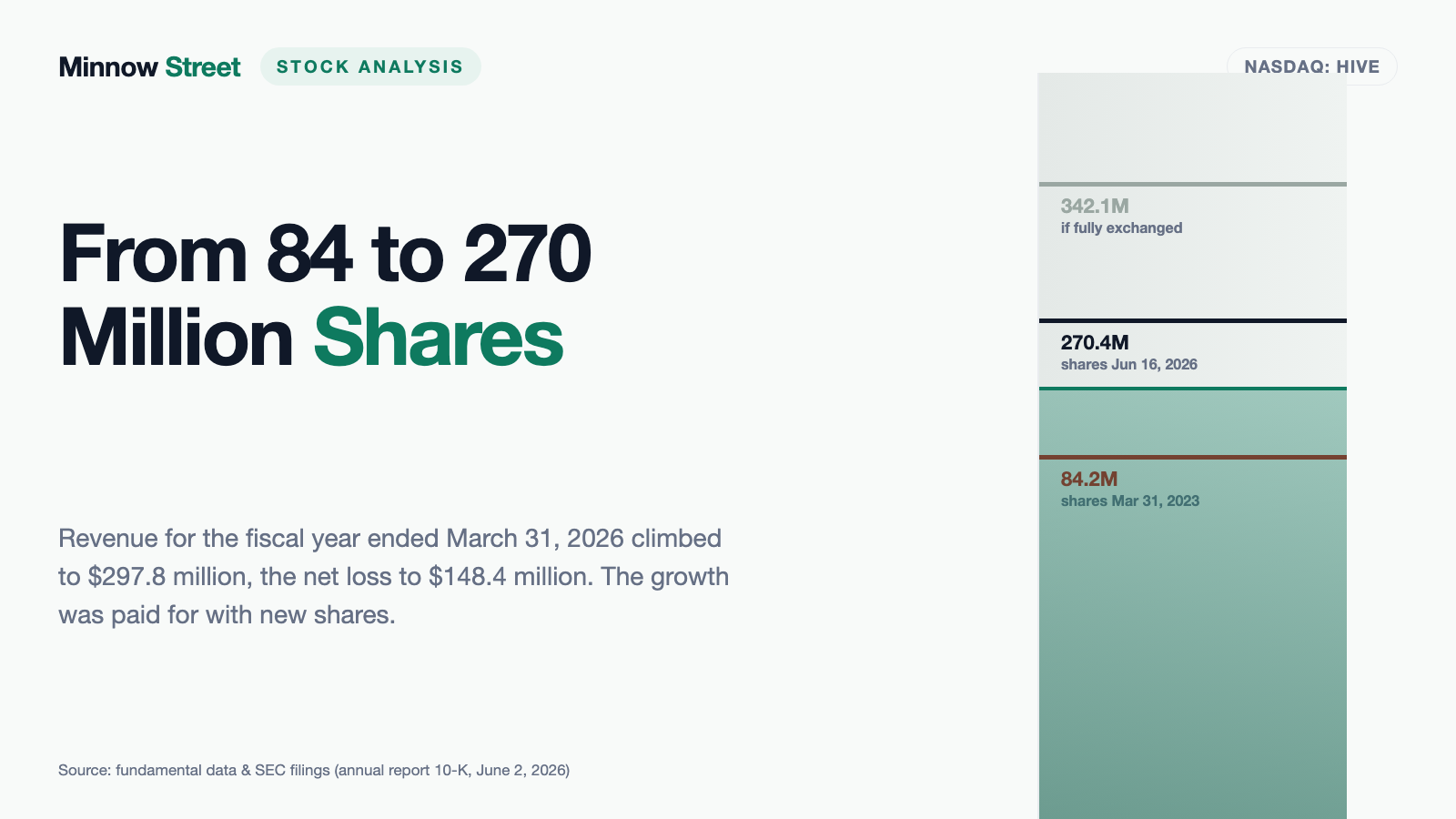
The share count series shows how far this reaches: 84.2 million as of March 31, 2023, 106.1 million a year later, 165.6 million as of March 31, 2025, 259.3 million as of March 31, 2026 and 270.4 million as of June 16, 2026. In little more than three years the number of shares has more than tripled. Additional paid-in capital rose by $227.3 million in fiscal 2026 alone (from $716.7 million to $944.0 million) — yet equity grew by only $80.2 million to $529.4 million, because the loss ate the rest. Remember this: growth paid for with fresh shares is never free.
And it is not over. The prospectus supplement of June 17, 2026 discloses that only $85.3 million of the current $300 million program has been used — $214.7 million remains sellable. That is roughly a quarter of today's market value.
Uncomfortable truth no. 2: the bitcoin cupboard is bare
Many miners keep part of the coins they mine — the practice known as HODL, a piggy bank next to the operating business. HIVE had one. It is empty now.
"Digital currencies at March 31, 2026 mainly consisted of 150 Bitcoin (March 31, 2025 - 2,201 Bitcoin). The decrease in digital currencies was mainly due to 2,139 Bitcoin used towards equipment purchases."
— HIVE Digital Technologies Ltd., Form 10-K filed June 2, 2026, balance sheet discussion of digital currencies

On the balance sheet the line fell from $181.1 million to $10.8 million. The 2,139 coins worth $208.5 million went to equipment maker Bitmain as deposits; HIVE received options to buy them back at a fixed price and has already exercised 799 of them (a $12.8 million book gain). At year end options on 166 bitcoin remained open. Together with cash of $23.1 million and working capital of only $5.4 million (prior year: $175.8 million), that means the cushion is gone. For a look at how differently this can be handled, our analysis of Hut 8 covers a miner holding 16,331 bitcoin on its balance sheet — and whose bottom line is written by the bitcoin price as a result.
Uncomfortable truth no. 3: the AI segment is a statement of intent with a price tag
Of the $297.8 million in revenue, $19.5 million came from high-performance computing — 6.6 percent. That is nearly double the prior year ($10.0 million), and it is still a side business. The segment's gross operating contribution was $7.7 million. Buy the company for its AI story today and you are mostly buying an announcement: HIVE plans capital expenditures of up to $493 million over 36 months in this area — $61 million for land, $150 million for infrastructure, $150 million for graphics cards and $132 million for graphics cards under the Bell Canada partnership. As of the report date, $38 million had been spent.
That HIVE controls only part of this segment's pace is something the company states itself:
"Since the Company uses a business-to-business model, it does not control the customer engagement and marketing of the marketplace platforms where the GPUs are rented, there can be fluctuations in the demand outside of the Company's control. There are fixed costs associated with operating in a Tier-III data center, and as such the operating margins can also vary if revenue drops, with certain fixed costs in place."
— HIVE Digital Technologies Ltd., Form 10-K filed June 2, 2026, Business Objectives and Milestones

Something is happening, though, and that belongs in the arithmetic too. The annual report names a first hard order book: on February 13, 2026 subsidiary BUZZ High Performance Computing signed customer agreements worth roughly $30 million in total contract value on fixed two-year terms for 504 liquid-cooled Nvidia B200 graphics cards at Bell Canada's data center in Manitoba. On June 18, 2026 HIVE announced that BUZZ, together with Bell Canada and the AI company Cohere, will build Canadian sovereign AI infrastructure in Merritt, British Columbia. On June 25, 2026 a letter of intent followed for leasing the 32-megawatt Boden site in Sweden — eight to ten years, roughly 25 megawatts of usable critical IT load. All of it is genuinely filed, and none of it is an invoice yet: the Boden agreement is explicitly non-binding and subject to a definitive contract.
Uncomfortable truth no. 4: one cost target was overrun by $72 million
HIVE publishes a table in the annual report setting estimated costs against actual spending on its own projects. For the largest completed project — the build-out to 25 exahashes per second — the line reads: estimated $351 million, spent $423 million. That is a little over 20 percent more than planned, or $72 million in absolute terms. The target was hit; the budget was not. As a yardstick for the $493 million AI plan this is useful: it is the only completed large-scale plan by this management team that can be checked against the outcome.
Uncomfortable truth no. 5: the funding source has changed — and brings new dilution with it
This is where the currency of the picture matters, because this part is no longer in the annual report but in the mandatory filings that followed. HIVE issued zero-coupon exchangeable notes twice in the spring of 2026, each through a Bermuda subsidiary. An exchangeable note is a loan that the holder can turn into shares — and "zero coupon" means there is no interest; the holder is paid out of the upside in the stock.
- April 21, 2026: $115 million, maturing April 15, 2031, exchange price approximately $2.57 per share (17.5 percent above the Nasdaq closing price of April 16, 2026). Up to 44,792,833 shares can be issued. Net proceeds were $109.5 million.
- June 30, 2026: $130 million, maturing July 1, 2031, exchange price approximately $4.83 per share (27.5 percent above the Nasdaq closing price of June 25, 2026). Initially 26,902,577 shares can be issued.
"The initial exchange rate is 206.9429 Common Shares per US$1,000 principal amount of Notes (equivalent to an initial exchange price of approximately US$4.83 per Common Share, which represents a premium of approximately 27.5% above the closing sale price per Common Share on the Nasdaq Capital Market on June 25, 2026, and is subject to adjustment in some events."
— HIVE Digital Technologies Ltd., Form 8-K of July 1, 2026, Item 1.01

Raising money at zero interest is a real achievement for a company with this income statement — it is far cheaper than selling more stock into the market. But the bill arrives later: together the two notes can produce up to 71.7 million additional shares — fully exchanged that would be 342.1 million shares, a good quarter more than the 270.4 million of mid-June 2026. And there are earlier off-ramps than the 2031 maturities suggest: holders may put the April notes back at par for cash on April 15, 2029 and the June notes on July 1, 2030.
To cushion the dilution, HIVE also bought capped calls — derivative contracts that economically offset part of the shares to be issued later. Cost: $19.8 million plus $15.7 million in cash, $35.5 million together, in both filings paid "using cash on hand." For context: cash was $23.1 million at the last balance sheet date.
A small but dated side note from the same weeks: chief financial officer Darcy Daubaras exercised 150,000 options on July 9, 2026 and sold 100,000 shares on July 15, 2026 at $3.19 and $3.20, leaving him with 58,900 shares held directly (Form 4 insider report of July 16, 2026). It is not a large sum, but it is the most recent documented price — and the reason we could use $3.20 above.
Valuation: What Roughly $865 Million Buys Here
A price-to-earnings ratio cannot be formed because there are no earnings. That leaves two anchors, both dated. First, revenue: at roughly 270.4 million shares (June 16, 2026) and the last documented price of $3.20 (Form 4, July 16, 2026), the market value is about $865 million — against annual revenue of $297.8 million that is a price-to-sales ratio of roughly 2.9. To show how quickly this moves: on April 16, 2026 the Nasdaq closing price worked out to roughly $2.19 (derived from the premium stated in the filing), and on June 15, 2026 it was $3.96 according to the prospectus supplement. The price-to-sales range across the spring and summer of 2026 is therefore roughly 2 to 3.6.
Second, book value: equity stood at $529.4 million as of March 31, 2026. The prospectus supplement puts net tangible book value per share at the same date at $2.00 — explicitly excluding any bitcoin. At $3.20 the market is therefore paying roughly 1.6 times net tangible book value. For a company whose assets consist of $480.5 million of machines and buildings out of $639.1 million in total, all of it wearing out on schedule, that is no bargain price — but it is no bubble either.
The professional view is considerably friendlier than our arithmetic: eight analysts carry the stock with five strong buys and three buys, and the mean price target is $7.07 (data as of July 24, 2026). That is more than double the last documented price — and it assumes the AI segment delivers what the $493 million plan promises. Anyone who wants to see the same bet in a company that financed its transformation with debt rather than stock will find it in our analysis of Bitdeer.
Opportunities and Risks at a Glance
What speaks for HIVE Digital
- The growth is real and physical: 158 percent revenue growth in the fiscal year ended March 31, 2026, roughly 25.2 exahashes per second installed as of April 30, 2026, and 2,885 bitcoin mined against 1,414.
- Cheap hydroelectric power in Paraguay, Sweden and Canada — the single most important cost lever in this business, and HIVE built it out rather than renting it.
- The financing has matured: $245 million at zero percent interest instead of yet more share sales, plus a hedge against the resulting dilution.
- First hard anchors in the AI business: customer agreements worth roughly $30 million on fixed two-year terms (February 13, 2026), the agreement with Bell Canada and Cohere (June 18, 2026), a letter of intent for 25 megawatts in Boden (June 25, 2026) and a contiguous site in Ontario with a 320-megawatt power allocation (May 19, 2026).
- The balance sheet carries none of the crypto collateral risk seen elsewhere: the report states explicitly that no bitcoin is pledged against debt.
- The step up from the TSX Venture Exchange to the Toronto Stock Exchange (May 12, 2026) widens the pool of institutional buyers.
What speaks against it
- A $148.4 million loss in a record year; depreciation ($170.4 million) exceeds the entire gross operating margin ($107.9 million), and the gross margin under U.S. accounting rules is minus 21 percent.
- Dilution as a permanent condition: 84.2 million shares (March 31, 2023) against 270.4 million (June 16, 2026), plus $214.7 million of unsold ATM capacity and up to 71.7 million shares from the exchangeable notes.
- Almost no cushion: $23.1 million of cash, 150 bitcoin and $5.4 million of working capital (March 31, 2026) against an AI investment plan of up to $493 million.
- The bottom line depends on the bitcoin price and network difficulty — both outside the company's control; the next halving of block rewards lies ahead in the cycle.
- The AI segment delivers 6.6 percent of revenue and runs through third-party rental marketplaces whose demand HIVE does not steer, by its own account.
- On the only completed large project, spending came in 20 percent above the estimate ($423 million instead of $351 million).
- The time series breaks: through fiscal 2024 HIVE reported under IFRS as a Canadian filer (40-F/6-K); since fiscal 2025 it reports under U.S. GAAP. Comparisons across that cut are not straightforward.
A Human Conclusion
Back to the signboard trap. The sign above the shop says "Digital Technologies," and the Reddit feed still says "Blockchain." Both are a little bit right — and neither tells you who is paying for the conversion. The filings do, and they say it plainly: in the fiscal year ended March 31, 2026 HIVE booked $297.8 million of revenue, lost $148.4 million, issued 88.7 million new shares and emptied its bitcoin piggy bank from 2,201 coins to 150. The shop really is growing. It just is not growing under its own power.
That need not be disqualifying. Data centers are a business in which you build first and earn later; anyone who dislikes that should not own a grid operator or a shipyard either. The fair question is not "is the company diluting?" but rather: does more business per share come out than shares went in? That is measurable. In fiscal 2024 each weighted average share carried $1.27 of revenue, in fiscal 2025 it was $0.90, and in fiscal 2026 it was $1.32. After three years at full throttle, revenue per share sits five cents above where it started. The construction phase has begun; the harvest has not.
Investing here does not buy you cash flow, it buys you a bet on timing: that the up to $493 million for AI data centers produces earnings faster than new shares and exchangeable notes divide the cake. What you make of that is your decision. And that is exactly as it should be.
Sources
Every original document used in this analysis — for you to read yourself:
- HIVE Digital Technologies Ltd. — SEC annual report on Form 10-K for the fiscal year ended March 31, 2026 (filed June 2, 2026) — the first annual report filed as a U.S. domestic filer; before that HIVE reported as a Canadian filer on Forms 40-F and 6-K.
- HIVE Digital Technologies Ltd. — SEC Form 8-K of July 1, 2026 ($130 million zero-coupon exchangeable notes, capped calls)
- HIVE Digital Technologies Ltd. — SEC Form 8-K of April 22, 2026 ($115 million zero-coupon exchangeable notes)
- HIVE Digital Technologies Ltd. — SEC prospectus supplement on Form POSASR of June 17, 2026 (270,437,030 shares outstanding, $214,696,023 of unsold ATM capacity, $2.00 net tangible book value per share)
- HIVE Digital Technologies Ltd. — SEC Form 8-K of June 22, 2026 (Bell Canada and Cohere, Boden acquisition, ATM reset)
- HIVE Digital Technologies Ltd. — SEC Form 8-K of June 25, 2026 (letter of intent to lease the Boden site)
- HIVE Digital Technologies Ltd. — SEC Form 8-K of May 7, 2026 (uplisting to the Toronto Stock Exchange, quarterly ATM update)
- HIVE Digital Technologies Ltd. — SEC Form 8-K of May 19, 2026 (land purchase with a 320 MW power allocation)
- HIVE Digital Technologies Ltd. — SEC Form 4 insider report of July 16, 2026 (chief financial officer's sale at $3.19 and $3.20)
- Complete SEC filing history for HIVE Digital Technologies Ltd.: EDGAR overview (sec.gov)
- Fundamental data (metrics, analyst view, share statistics; data as of July 24, 2026), reconciled with the SEC filings.
- Reddit mentions: our in-house Reddit hype scanner, 2 mentions in 24 hours, first captured on July 25, 2026 at 07:00.
Transparency & disclaimer: this analysis is journalistic commentary on publicly available information. It is not investment advice, not a regulated financial analysis and not a solicitation to buy or sell securities. Equity investments carry substantial risk up to and including total loss; crypto-adjacent business models are additionally exposed to price swings and regulatory intervention. All information without guarantee; the as-of date of each figure is noted in the text. The author holds no position in HIVE Digital Technologies shares at the time of publication.
Our Bottom Line at a Glance
- Growth and assets positive
- The growth is physical and verifiable: $297.8 million of revenue in the fiscal year ended March 31, 2026 against $115.3 million, 2,885 bitcoin mined against 1,414, and roughly 25.2 exahashes per second installed as of April 30, 2026 after the 300-megawatt expansion in Paraguay was completed. Cash from operations rose from $16.6 million to $62.3 million.
- Quality of earnings negative
- A record year produced a record loss: $148.4 million against $3.0 million. Depreciation on the machines ($170.4 million) exceeds the entire gross operating margin ($107.9 million); the gross margin under U.S. accounting rules is minus 21 percent. The machines wear out faster than they bring in.
- Dilution negative
- The share count rose from 84.2 million (March 31, 2023) to 270.4 million (June 16, 2026); in fiscal 2026 alone 88.7 million shares were added for $202.0 million. A further $214.7 million of selling capacity is open (as of June 17, 2026) plus up to 71.7 million shares from the two exchangeable notes. Revenue per share, at $1.32, sits just five cents above the fiscal 2024 level.
- Financial position negative
- The cushion is spent: $23.1 million of cash, 150 bitcoin (down from 2,201) and working capital of $5.4 million against $175.8 million a year earlier, all as of March 31, 2026. Against that stands an AI investment plan of up to $493 million over 36 months, of which $38 million has been spent. The $245 million from the zero-coupon notes of April and June 2026 buys room, but the anti-dilution hedge cost $35.5 million in cash.
- AI story versus AI revenue neutral
- The name promises AI; the income statement delivers $19.5 million of $297.8 million in revenue — 6.6 percent in the fiscal year ended March 31, 2026, though nearly double the prior year. Customer agreements worth roughly $30 million on fixed two-year terms (February 13, 2026) are a first hard anchor; the agreement with Bell Canada and Cohere (June 18, 2026) and the letter of intent for 25 megawatts in Boden (June 25, 2026) are genuine steps but not yet revenue — the Boden agreement is explicitly non-binding.
- Valuation neutral
- Roughly $865 million of market value (270.4 million shares × $3.20, Form 4 insider report of July 16, 2026) equals 2.9 times annual revenue and 1.6 times the net tangible book value of $2.00 per share (March 31, 2026). No bargain for a loss-making company, but no excess either — eight analysts see a mean of $7.07 (data as of July 24, 2026).
HIVE Digital Technologies is the signboard trap in pure form: the name has promised data centers and artificial intelligence since July 2023, while the revenue split for the fiscal year ended March 31, 2026 reads 93.4 percent bitcoin mining and 6.6 percent high-performance computing. The growth is real — $297.8 million of revenue instead of $115.3 million — but shareholders paid for it: 88.7 million new shares in one fiscal year, a piggy bank emptied from 2,201 bitcoin to 150, and working capital of only $5.4 million. The $245 million from two zero-coupon exchangeable notes buys time and brings up to 71.7 million further shares with it. Not investment advice.
What Our Rating Means
Substance risk
We found at least one documented issue that threatens the company itself — regardless of how the stock is currently valued.
Buying here is a bet on timing: whether the up to $493 million for AI data centers produces earnings faster than new shares and exchangeable notes divide the cake. Three numbers in the next quarterly report (10-Q) will measure it: the revenue share of high-performance computing (last reported at $19.5 million of $297.8 million), the share count (last reported at 270,437,030 as of June 16, 2026) and cash after the note proceeds (last reported at $23.1 million as of March 31, 2026). Until then HIVE is a construction site with a construction loan and no cushion — worth following, but without a safety net. The decision is yours.
A journalistic assessment by our editorial team at the time of the deep dive, based on public sources — not investment advice and not a solicitation to buy or sell. Your personal circumstances (investment goals, risk capacity, taxes) cannot be taken into account. What our levels mean, how verdicts are formed, and what conflicts of interest exist →
Worth Noting
- HIVE landed on the research list through our in-house Reddit hype scanner (2 mentions in 24 hours, first captured on July 25, 2026 at 07:00). The data feed still carried the company under the former name "HIVE Blockchain Technologies," dropped on July 12, 2023 — a reminder of how slowly data sources catch up with renamings.
- Data basis and evidence chain: all annual figures come from the Form 10-K filed June 2, 2026 for the fiscal year ended March 31, 2026 — the first annual report HIVE filed as a U.S. domestic filer. Share count, open dilution and valuation anchors come from the filings that followed (prospectus supplement of June 17, 2026, Forms 8-K of April 22 and July 1, 2026, Form 4 of July 16, 2026). No quarterly report (10-Q) for the quarter ended June 30, 2026 was on file as of July 25, 2026.
- Handle the time series with care: through fiscal 2024 HIVE reported under IFRS as a Canadian filer on Forms 40-F and 6-K; U.S. GAAP has applied since fiscal 2025. The 2024 and 2025 comparatives in the current report are restated accordingly, older publications are not. Not to be confused: HIVE Digital Technologies is unrelated to the similarly named software vendor or to the "Hive" blockchain project.
Frequently Asked Questions
HIVE runs hydro-powered data centers in Canada, Sweden and Paraguay. Its main business is selling computing power to bitcoin mining pools; alongside that it rents out Nvidia graphics cards for high-performance computing and AI workloads. In the fiscal year ended March 31, 2026, $278.3 million of revenue came from mining and $19.5 million from high-performance computing. The company employed 29 people.
On July 12, 2023 the company changed its name from HIVE Blockchain Technologies Ltd. to HIVE Digital Technologies Ltd. The annual report attributes the change to a focus on revenue opportunities from its large inventory of Nvidia graphics cards in combination with artificial intelligence, machine learning and high-performance computing. Some data vendors still list the company under the old name.
On March 31. Fiscal 2026 therefore covers April 1, 2025 through March 31, 2026 and largely maps onto calendar 2025. HIVE filed its first annual report as a U.S. domestic filer (Form 10-K) on June 2, 2026; before that it reported as a Canadian filer on Forms 40-F and 6-K.
In the fiscal year ended March 31, 2026 the net loss was $148.4 million, or $0.66 per share. The prior year showed a $3.0 million loss and fiscal 2024 a $26.5 million profit. The main driver of the jump is depreciation on the new machines: $170.4 million against $64.5 million the year before.
Substantially. The share count rose from 84.2 million (March 31, 2023) to 270.4 million (June 16, 2026). In fiscal 2026 alone HIVE issued 88.7 million new shares through at-the-market programs, raising $202.0 million. A further $214.7 million of the current program is unsold, and up to 71.7 million additional shares can come out of two exchangeable notes.
As of March 31, 2026 it held 150 bitcoin with a carrying value of $10.8 million — down from 2,201 bitcoin and $181.1 million a year earlier. 2,139 coins went to equipment maker Bitmain as deposits; HIVE received repurchase options and has already exercised 799 of them. No bitcoin is pledged as collateral against debt.
There is no price-to-earnings ratio because there are no earnings. At roughly 270.4 million shares and the last price documented in a filing, $3.20 (Form 4 insider report of July 16, 2026), the market value is about $865 million — a price-to-sales ratio of roughly 2.9 and 1.6 times the net tangible book value of $2.00 per share as of March 31, 2026.
Small so far, but growing. High-performance computing brought in $19.5 million of revenue in the fiscal year ended March 31, 2026, or 6.6 percent of the total. HIVE plans capital expenditures of up to $493 million in this area over 36 months; $38 million had been spent as of the report date. On February 13, 2026 subsidiary BUZZ signed customer agreements worth roughly $30 million on fixed two-year terms.
Found an error?
Did you spot a factual error, an outdated number, or a typo in this deep dive? Let us know briefly — your report goes straight to the editorial team.