Skeena Resources: $489 Million Riding on a Mine That Has Never Sold an Ounce
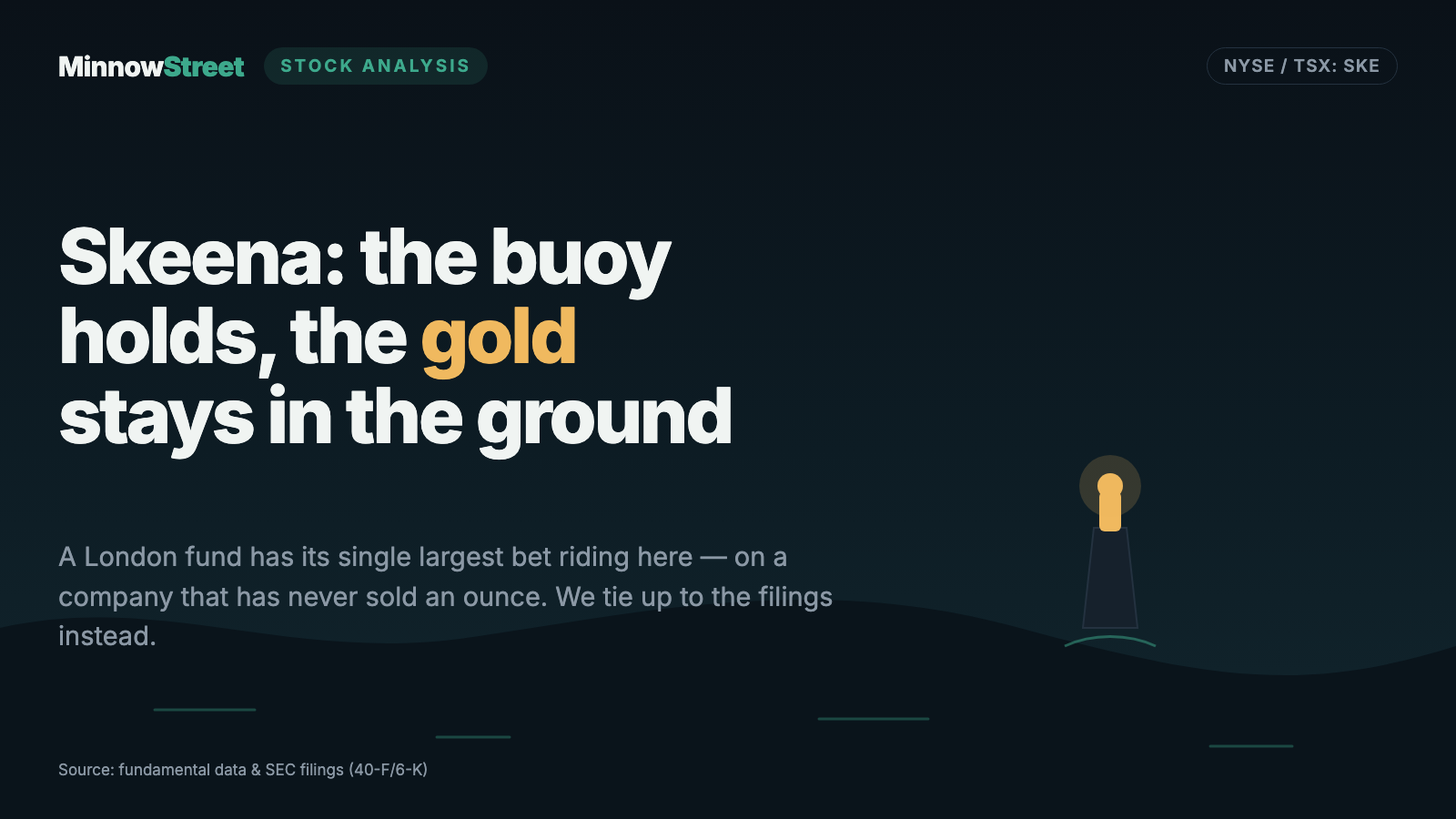
Eskay Creek in British Columbia was once one of the richest silver mines on earth. Skeena Resources is rebuilding it as an open pit — permitted, half built, first production targeted for the second quarter of 2027. A London fund has its single largest bet parked there: $489.3 million, 18.5 percent of its portfolio, in a company with no revenue at all. In March 2026 Skeena raised the construction budget from $560 million to $659 million, cancelled its $100 million cost-overrun facility in the same breath, and refinanced onto $750 million of 8.5 percent notes. Of the 2025 loss of C$182.8 million, 83 percent came not from the ground but from remeasuring a financing contract. No advice here — just the question of what a construction site is worth while nobody has seen it finished.
 Thomas Mücke
Founder & Publisher
Thomas Mücke
Founder & Publisher
Chart
Interactive price chart (TradingView).
Note: pure fact-based analysis, not investment advice and not a solicitation to buy or sell. All figures without guarantee.
There is a self-deception that has nothing to do with greed and still costs money on a regular basis — call it the construction-site trap. Anyone who has ever renovated a house knows the sentence: "We'll be done by summer." You say it honestly, you even believe it, and you say it again once summer has passed. The trap does not spring because somebody lied, but because a half-finished thing looks so convincing: the walls are up, the windows are in — what could possibly be left? At Skeena Resources Limited (NYSE and TSX: SKE) the site sits in northern British Columbia, it was 49 percent complete at the end of February 2026, and it carries a name that means something in the industry: Eskay Creek. So let's make a deal: before you believe the half-finished picture, we read together what Skeena itself filed with the U.S. Securities and Exchange Commission — the annual report on Form 40-F for 2025, filed March 24, 2026, and the interim report as of March 31, 2026, furnished on May 15, 2026. A filing with the SEC is honest under penalty of law. And this one tells of a budget that has grown, of a safety net cancelled at precisely that moment, and of a loss that is four fifths not from the ground. In the end, you decide.
What Skeena actually does — an old mine and a new hole
Skeena sells nothing. That is not a rhetorical flourish but the finding from the audited accounts: the income statement has no revenue line and starts directly with expenses. The only item the company itself tags as revenue anywhere in its own reported figures is interest income — C$3.694 million in 2024, C$2.040 million in 2023. If you come across a single revenue figure for Skeena in a database, ignore it; nothing in the filings corresponds to it. Skeena is a developer: a company that raises money in order to build a mine, in the hope of having something to sell afterwards.
The building site has history. Eskay Creek, in the so-called Golden Triangle, was an underground mine from 1994 to 2008 and ranked among the richest gold-silver deposits in the world. What tunnels could not economically reach back then, Skeena now intends to mine as an open pit — one large hole rather than a set of shafts. The difference in everyday terms: underground mining is a tunnel to the wine cellar; open-pit mining is removing the hill above the cellar. More expensive by volume, cheaper per tonne, and only sensible when the rock sits close enough to surface.
The numbers from the 2023 feasibility study sound accordingly good: 39.843 million tonnes of reserves at 3.6 grams of gold equivalent per tonne, or 4.569 million ounces of gold equivalent — of which 3.336 million ounces of gold and 87.969 million ounces of silver. Planned all-in sustaining costs run to $300 per ounce of gold once silver is credited as a by-product. That would be, if it lands, one of the cheapest mines on the planet. Which frames the central tension of this analysis, running through every chapter below: the orebody is exceptional — but everything standing between you and it has become more expensive, while the safety net got smaller.
How this stock landed on our desk
This analysis does not begin with a hit in our in-house stock screener but with a form. On May 8, 2026, Helikon Investments Ltd of London filed its Form 13F-HR with the SEC for the quarter ended March 31, 2026 (accession 0001839497-26-000002). A 13F is the mandatory quarterly disclosure for large U.S. investment managers: anyone managing more than $100 million in U.S.-listed equities must reveal what they hold. Helikon's table lists 17 positions worth $2,648,555,113 — and at the very top, larger than any other, 16,462,865 Skeena shares worth $489,276,348. That is 18.5 percent of the entire portfolio and roughly 13.5 percent of all Skeena shares outstanding.
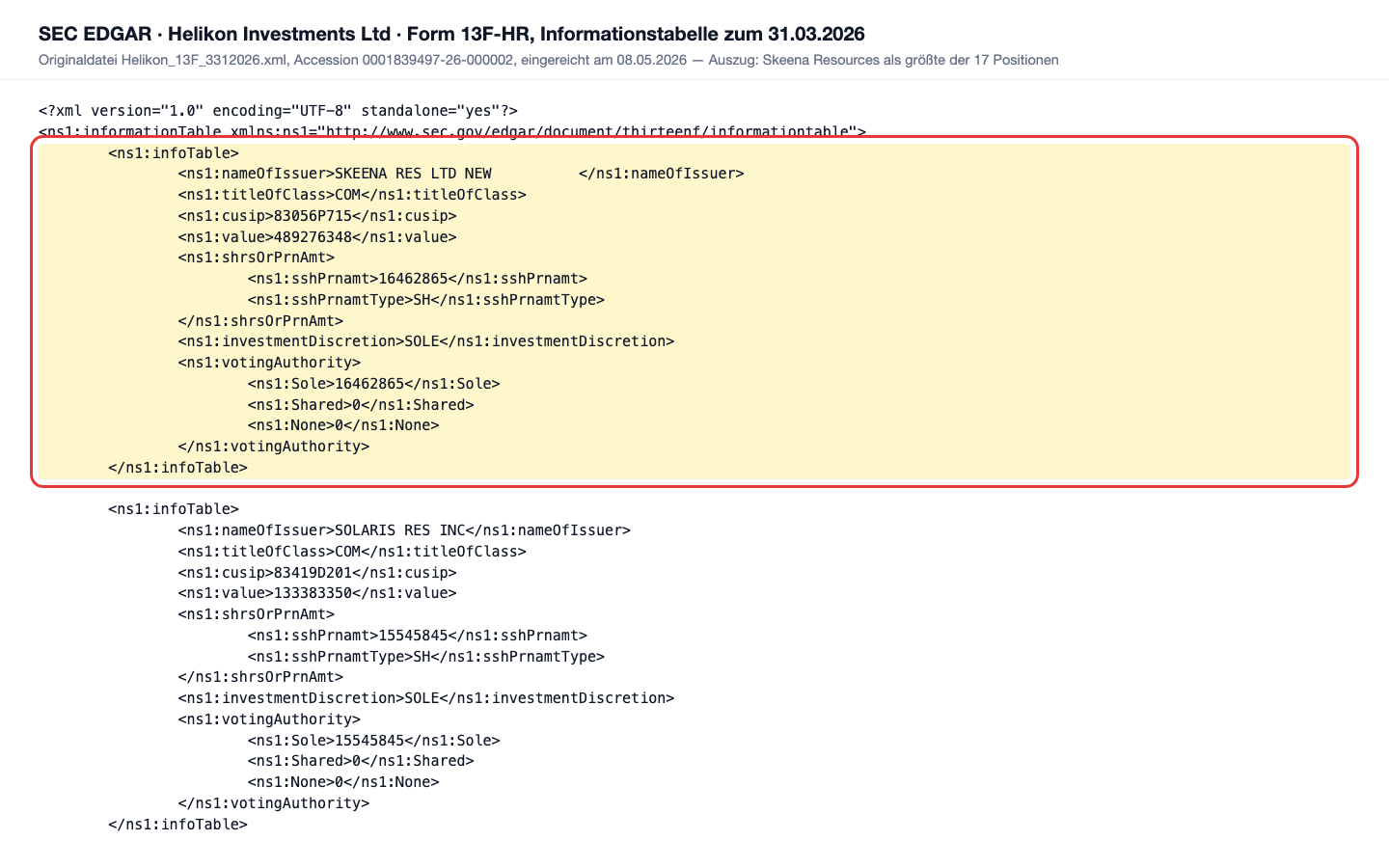
The movement across four quarter-ends is calm: 14,030,111 shares (June 30, 2025), 16,871,819 (September 30, 2025), 15,828,709 (December 31, 2025), 16,462,865 (March 31, 2026) — a 4.0 percent addition in the first quarter of 2026. That is worth noting, because the same fund reshuffled heavily in that quarter: six brand-new positions, six complete exits. It held on to Skeena. Roughly half the portfolio sits in gold and silver names and another fifth in Latin American ones; the lab supplier QIAGEN, which we have already worked through from the same list, looks like the odd one out.
Now the limitation that belongs with every 13F, so that a mandatory filing does not turn into a legend: a 13F shows U.S.-listed long positions only, reported with a 35 to 45 day lag, without short sales, without derivatives, and without anything listed outside the United States. It is a rear-view mirror, not a road map. With Skeena that is unusually tangible: the reporting date is March 31, 2026 — and ten days later the company closed the largest financing in its history. Whether the fund was still there afterwards, the form does not say. It only says what sat in the portfolio at quarter end.
A word on the screener, because honesty demands it: Skeena is not a name our filters push to the front — and at this company the usual metrics are partly unusable. No price-earnings ratio, because there are no earnings. No price-sales ratio, because there are no sales. The Piotroski score sits at 3 out of 9 — a nine-point test of balance-sheet health on which genuinely healthy companies score 8 or 9; at a company without revenue it mostly measures the absence of revenue. The equity ratio was 0.207 at December 31, 2025 and only 0.159 at March 31, 2026. And Altman Z, NCAV and cash value are missing from the data entirely — not through negligence, but because Skeena reports in Canadian dollars and trades in U.S. dollars; mixing the two unchecked produces wrong numbers. Remember this: an empty field is sometimes more honest than a filled cell.
Why there is no quarterly report from Skeena — and what that means for you
Before we get to the numbers, a point many investors overlook: there is no 10-K and no 10-Q from Skeena. The company is Canadian and uses the MJDS regime, a mutual recognition between securities regulators: it reports under Canadian rules and files the same package with the SEC as Form 40-F. The report says so itself, and adds a warning:
"The Company is permitted, under a multijurisdictional disclosure system adopted by the United States, to prepare this report in accordance with Canadian disclosure requirements, which are different from those of the United States. The Company prepares its consolidated financial statements … in accordance with International Financial Reporting Standards …, and which are not comparable to financial statements of United States companies."
— Skeena Resources Limited, SEC annual report on Form 40-F for 2025, section "Differences in United States and Canadian Reporting Practices"
In practice this means: once a year you get a complete work audited by KPMG — for 2025 filed on March 24, 2026, including an audit opinion on internal control. Three times a year you get unaudited figures attached to a Form 6-K, with no auditor review. And there is a second difference that matters especially in mining: reserves and resources are reported under the Canadian standard NI 43-101, not under SEC rules — the report states explicitly that the disclosure "may not be comparable" with that of United States companies. Comparing Skeena with a U.S. producer means comparing two different yardsticks.
The numbers over the years — credit where it is due
First the genuinely impressive part, because there is plenty of it. The hardest part of a Canadian mining project is rarely the geology; it is the permits — and those are done. In the first quarter of 2026 all major provincial and federal permits were issued, including the Mines Act permit. Environmental Assessment Certificate M26-01 carries 38 binding conditions, the federal decision statement seven. The route there ran through an agreement with the Tahltan Central Government that is a first in Canada: the Tahltan Nation's consent is embedded in the environmental certificate itself.
Real progress has been made on site as well. As of February 28, 2026 the project was 49 percent complete, detailed engineering of the process plant 92 percent, its construction 46 percent; 88 percent of procurement costs were contractually committed, and 66 percent of total project costs. Three million tonnes of material have already been moved and the tie-in to the BC Hydro grid is done. And the 2023 feasibility study models an after-tax net present value of C$1,973 million at a 42.7 percent internal rate of return with a 1.2-year payback. If it lands, this is an exceptional project.
Only: until then, money flows in one direction only. Here is the cash position over the years:
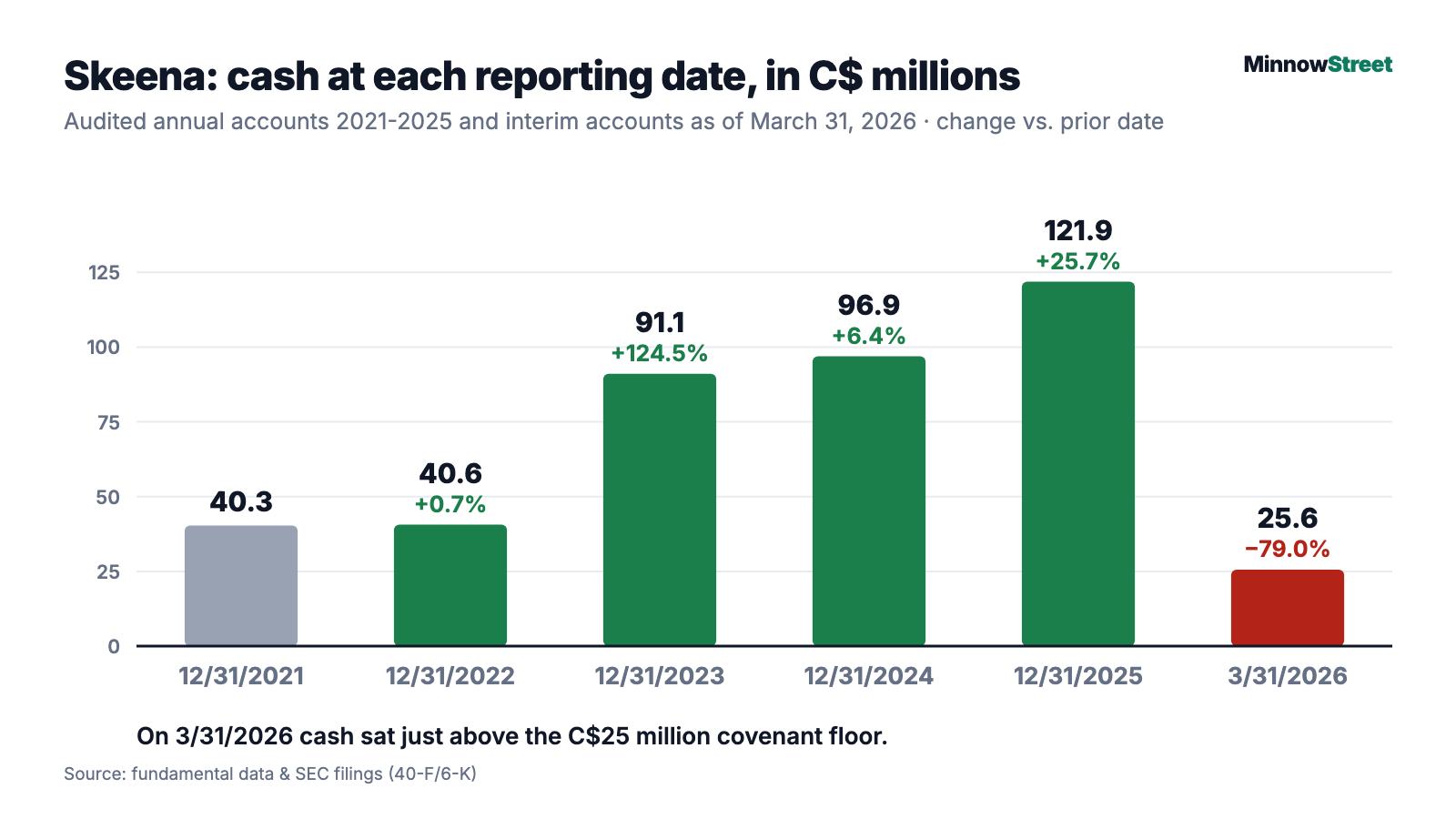
In the first quarter of 2026 alone, C$77.047 million flowed into investment, against C$43.902 million a year earlier. Most of that has so far been paid for with new shares — which is the second curve you should know:
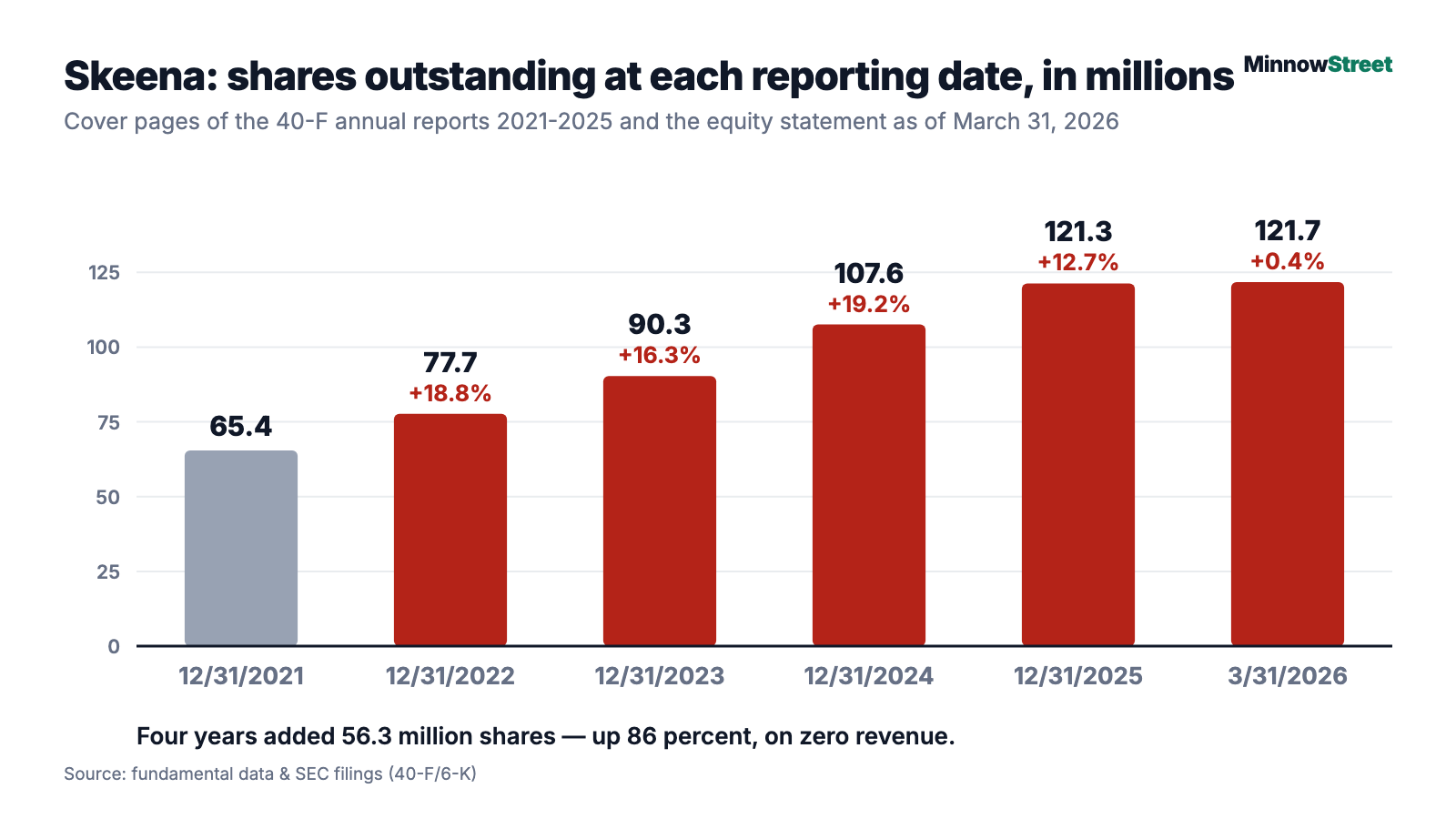
Two examples from the MD&A to make the scale tangible: on February 26, 2025 Skeena placed 3,290,000 shares at C$14.70 (C$48.363 million), and on October 8, 2025 a further 5,991,500 shares at C$24.00 (C$143.796 million). Both went into general working capital according to the use-of-proceeds disclosure. And one more figure belongs here for honesty's sake: the accumulated deficit stood at C$914.407 million as of March 31, 2026 — more than the company has raised in capital to date, were part of it not capitalised into mineral property.
What the filings say — the uncomfortable truths
Uncomfortable truth no. 1: the budget has grown — and part of the growth was merely moved
On March 31, 2026 Skeena published an updated cost estimate. The sentence that matters is there in plain text:
"The project cost outlined in the 2023 Definitive Feasibility Study ("DFS") was US$560 million. The updated cost estimate for the Project is US$659 million, both estimates are inclusive of approximately US$35 million in cost contingency. This represents an increase of US$99 million as compared to the 2023 DFS estimate."
— Skeena Resources Limited, news release of March 31, 2026 (6-K, Exhibit 99.1), section "Updated Construction Cost Estimate"
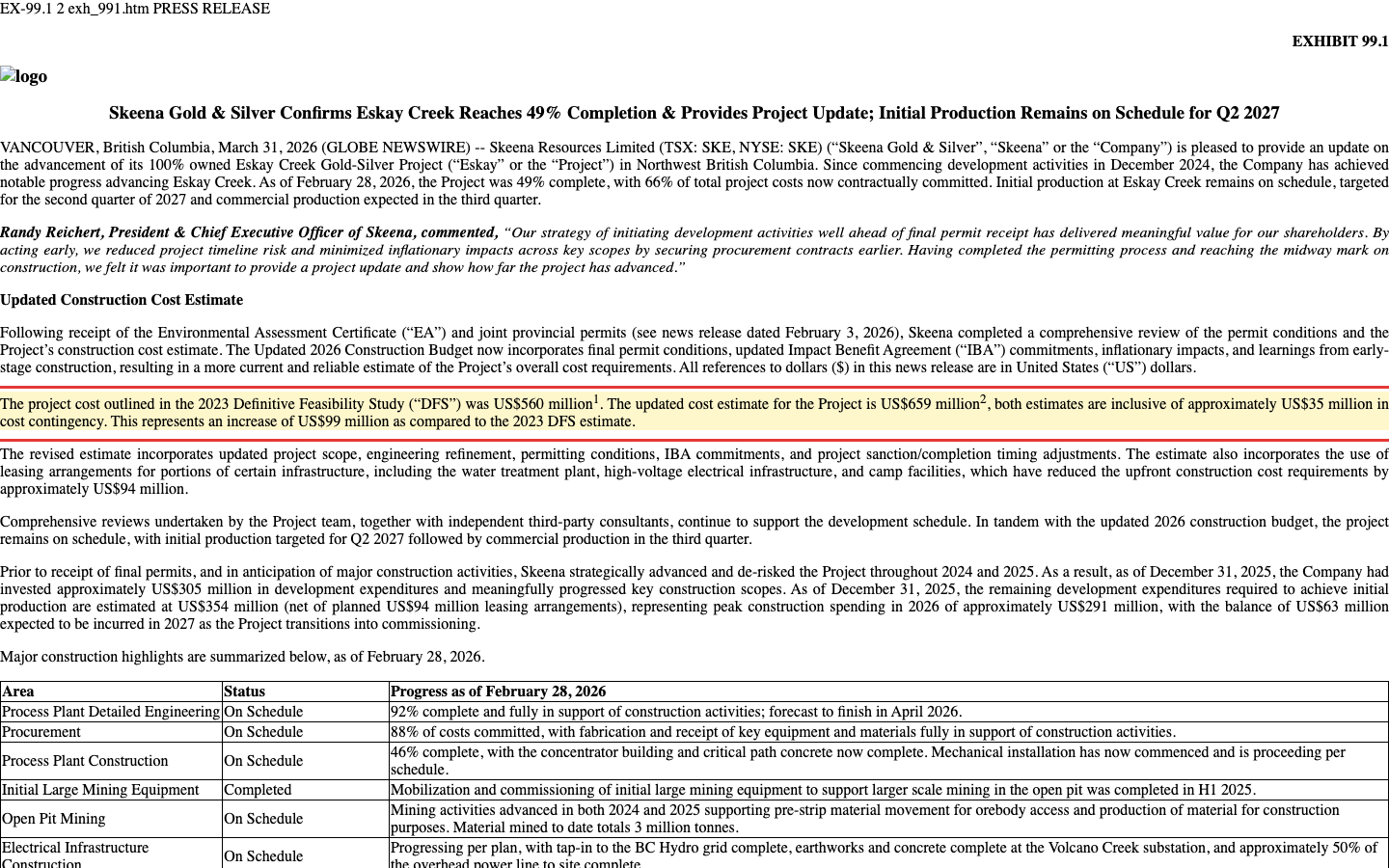
Eighteen percent more in two and a half years — in a period of high construction prices that is no catastrophe, and Skeena explains the drivers at length: tighter water-treatment standards, adjustments out of the permitting process, more expensive high-voltage equipment, a schedule stretched by about six months. But the same paragraph contains a sentence worth reading twice. The estimate "incorporates the use of leasing arrangements for portions of certain infrastructure, including the water treatment plant, high-voltage electrical infrastructure, and camp facilities, which have reduced the upfront construction cost requirements by approximately US$94 million" — in other words: water treatment, high-voltage infrastructure and the camp are no longer bought but leased, which cuts upfront cost by roughly $94 million.
Translated into everyday terms: the renovation did not get cheaper, the kitchen was rented instead of bought. Without that shift the increase would not be $99 million but roughly $193 million — some 34 percent. And the rent does not vanish; it shows up later. Lease liabilities on Skeena's balance sheet grew from C$13.533 million (end of 2024) to C$63.084 million (end of 2025), and stood at C$48.492 million long-term plus the current portion as of March 31, 2026; contractual lease commitments total C$140.908 million. Remember this: costs that disappear from a construction estimate are rarely gone — usually they have just moved house.
Uncomfortable truth no. 2: the buffer was cancelled as the budget rose
Skeena had provided for exactly this case. The June 2024 financing package with Orion Resource Partners contained, besides the gold stream, a $350 million credit line and a $100 million facility explicitly for cost overruns. On the very day the new cost estimate was published, both were buried:
"On March 31, 2026, the Company entered into an amending agreement to exercise the buy-down option for US$184,000,000 … and cancel the option to draw an additional deposit."
— Skeena Resources Limited, interim financial statements as of March 31, 2026 (6-K furnished May 15, 2026), Note 6 "Project Financing Package"
The news release of the same day is blunter still: the amendments include "the termination of the availability of the stream cost over-run facility", and the $350 million term loan was cancelled. In their place, on April 10, 2026, came $750 million of 8.500 percent notes, maturing April 1, 2031 and non-callable for two years. Of that, $184 million went to buy back the gold stream, $94.208 million into an interest reserve covering the first three semi-annual coupons, and roughly $471.8 million into a disbursement account for the remaining construction, general corporate purposes and issuance expenses.
Do the arithmetic: $63.75 million of interest a year for a company with no income. The reserve covers exactly 18 months. After that — on the notes’ semi-annual rhythm, from April 1, 2028 — the money has to come from the mine or from the cash box. First production is targeted for the second quarter of 2027, commercial production for the third. That leaves three quarters of margin between the planned start of production and the first coupon Skeena must pay itself. Not a generous cushion for a build whose budget has just risen 18 percent, and whose explicit cushion for exactly that eventuality was cancelled.
Uncomfortable truth no. 3: the loss comes from the contract, not the ground
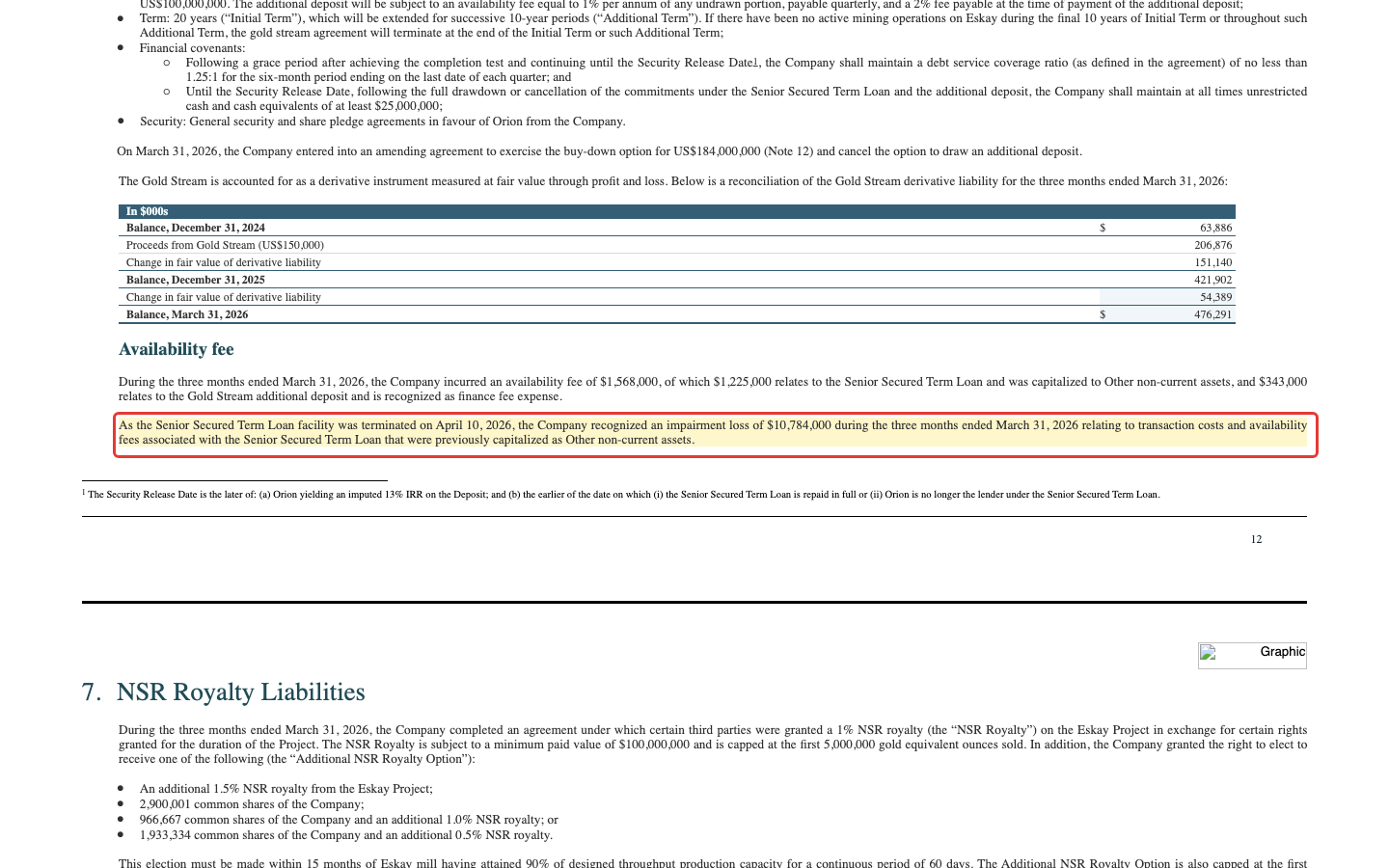
Skeena reported a 2025 loss of C$182.841 million (C$1.59 per share), after C$151.939 million the year before. Anyone who reads that as an expensive construction programme is wrong: the largest single item is C$151.140 million from remeasuring the gold stream — 83 percent of the annual loss. The first quarter of 2026 repeats the pattern: C$54.389 million out of C$104.457 million, or 52 percent.
The mechanism behind it is as simple as it is unpleasant. Skeena received $200 million in exchange for later delivering 10.55 percent of its gold production at 10 percent of the market price. That obligation is measured as a derivative: when gold rises, the promised metal becomes more valuable — and the obligation more expensive. C$63.886 million (end of 2024) thus became C$476.291 million at March 31, 2026. For $200 million received. That is the price of Skeena having had no other money available in 2024 — and simultaneously the reason a rising gold price initially shows up in these accounts as a loss.
Which is precisely why two thirds of it were bought back, for $184 million. The buy-back right was in the contract from the start — at the proportional deposit plus an imputed 18 percent internal rate of return. Two thirds of $200 million would have been $133.3 million; $184 million was paid. The premium of roughly $50.7 million is the price of the haste of 2024. How costly prefinancing gets for a producer without alternatives is something we saw in a related form at TRX Gold — there it was dilution, here it is the stream.
Uncomfortable truth no. 4: much of the mountain is spoken for before the first ounce is sold
A net smelter return royalty is a share of revenue taken off the top, before anyone deducts a single cost. Eskay Creek now carries several layers of them. Franco-Nevada holds 2.5 percent, bought in two steps for C$27 million (December 2022) and C$56 million (December 2023). Triple Flag holds 0.5 percent, originally from Barrick. And in the first quarter of 2026 another layer arrived:
"During the three months ended March 31, 2026, the Company completed an agreement under which certain third parties were granted a 1% NSR royalty … on the Eskay Project in exchange for certain rights granted for the duration of the Project. The NSR Royalty is subject to a minimum paid value of $100,000,000 and is capped at the first 5,000,000 gold equivalent ounces sold."
— Skeena Resources Limited, interim financial statements as of March 31, 2026 (6-K furnished May 15, 2026), Note 7 "NSR Royalty Liabilities"
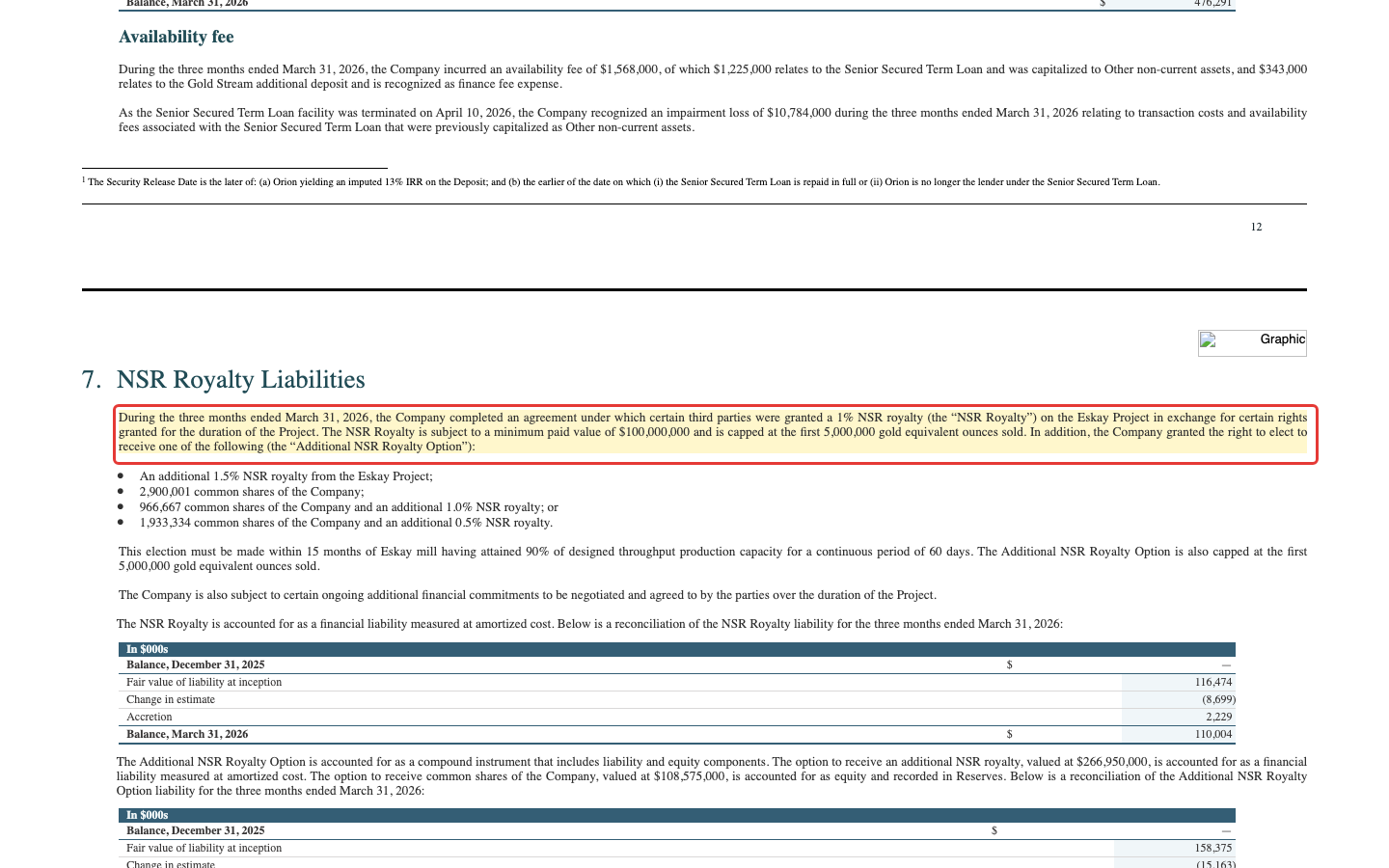
It comes with an election for the counterparty: a further 1.5 percent royalty, or 2,900,001 Skeena shares, or one of two blends — to be decided within 15 months of the mill running at 90 percent of design throughput for 60 consecutive days. No cash was paid; plenty was booked all the same: C$116.474 million of royalty liability, C$266.950 million of option liability and C$108.575 million in equity — together roughly C$492 million, capitalised into mineral property. That is the main reason total assets jumped from C$770.2 million to C$1,131.9 million in a single quarter.
And now the point that matters for valuation. The economics of the 2023 feasibility study — the very calculation the C$1,973 million net present value comes from — assume a royalty burden of 2 percent. The technical report even states explicitly that the 1.0 percent royalty sold to Franco-Nevada in December 2023 "is not included in the economic analysis in Section 22". In reality 4 percent now sits on the reserves, and the election could take it to 5.5 percent. Anyone anchoring on the 2023 net present value is anchoring on half the royalty load.
Valuation: orders of magnitude, not day prices
For an evergreen assessment we need a dated anchor rather than a daily quote — and the form from the opening supplies it. $489,276,348 for 16,462,865 shares works out to a calculated price of roughly $29.72 per share as of March 31, 2026. Against the 121,740,295 shares outstanding at that date, that puts market value in the order of $3.6 billion — or, converted at the 2025 year-end rate (C$1.00 = US$0.7296), roughly C$4.96 billion.
Because there is neither profit nor revenue, the usual multiples do not help. Three other measures put the price in context:
- Per reserve ounce: $3.6 billion against 3.336 million ounces of gold is roughly $1,084 per ounce; on a gold-equivalent basis (4.569 million ounces) roughly $792. And those ounces are still in the ground.
- Against its own net present value: the 2023 feasibility study arrives at C$1,973 million after tax. Market value sits at roughly 2.5 times that. The market is not paying for the model but for a distinctly more optimistic update of it.
- Against the model's assumptions: reserves are calculated at $1,800 per ounce of gold and $23 per ounce of silver, the economics at a 2 percent royalty and a construction budget now 18 percent higher.
In fairness, Skeena is delivering on exactly this point: work began in late 2025 on an updated technical report intended to incorporate higher gold and silver prices, improved pit slope parameters and material from the neighbouring Snip project; publication is announced for late 2026. Until then the publicly defensible basis for calculation is the one from 2023. All valuation figures as of July 24, 2026; analyses are evergreen, daily prices are not a buying argument.
Opportunities and risks at a glance
What speaks for Skeena:
- An exceptional orebody: 39.843 million tonnes of reserves at 3.6 grams of gold equivalent per tonne (4.569 million ounces, of which 3.336 million ounces of gold and 87.969 million ounces of silver) — with planned all-in sustaining costs of $300 per ounce of gold after the silver credit, one of the cheapest planned mines anywhere.
- The hardest part is done: all major provincial and federal permits were issued in the first quarter of 2026, and the Tahltan Nation's consent is embedded in Environmental Assessment Certificate M26-01 — a precedent in Canada.
- Construction is running and largely committed: 49 percent complete as of February 28, 2026, with 88 percent of procurement costs and 66 percent of project costs contractually fixed, three million tonnes of material moved and the BC Hydro grid tie-in complete.
- Funded through to production: after the $750 million note issue, roughly $471.8 million sits in a disbursement account for construction, general corporate purposes and issuance expenses, against remaining investment to first production of $354 million; the first three semi-annual coupons are prefunded with $94.208 million.
- The basis of calculation is being refreshed: an updated technical report incorporating higher metal prices, improved slope parameters and Snip material is announced for late 2026 and is intended to improve the production profile and extend mine life.
What speaks against it:
- No revenue, no profit, no production: the income statement has no revenue line; a C$182.841 million loss in 2025 and C$104.457 million in the first quarter of 2026 alone, with an equity ratio that has fallen from 0.207 to 0.159.
- The budget has risen by $99 million to $659 million — and that already embeds roughly $94 million that simply left the upfront estimate through leasing; without that effect the increase would be roughly $193 million.
- The explicit $100 million cost-overrun facility was cancelled on March 31, 2026, along with the never-drawn $350 million term loan — for which C$10.784 million of costs already paid had to be written off.
- Fixed interest without income: $63.75 million a year from the 8.5 percent notes, prefunded for only 18 months; on the semi-annual rhythm the first self-funded coupon falls on April 1, 2028, three quarters after commercial production is meant to begin.
- Prior claims on production: roughly 3.5 percent of the gold still goes to the stream, plus 4 percent of net smelter returns in royalties (with an election taking it to 5.5 percent) — against 2 percent in the 2023 economics. On top of that, 86 percent more shares than at the end of 2021.
A human bottom line
Back to the construction-site trap from the opening. Its core is not that the site is a deception — Eskay Creek is real, permitted, half built, and the material in it is exceptional. Its core is that a half-finished work answers a question you never asked. It shows you that somebody is making progress. It does not show you what the rest costs, who gets how much of it, or what happens if it takes longer. Those three answers are not on the site; they are in the filings. The budget has risen by $99 million, and roughly $94 million of further cost has moved into lease contracts rather than disappearing. The cushion for exactly this situation was removed at the moment it was needed. Of future gold, roughly 3.5 percent goes to a streaming partner and 4 to 5.5 percent to royalty holders, while the model assumes 2 percent. And the London fund holding its single largest position here knew all of that or accepted it — its form says only that it added in the first quarter of 2026, not why, and not whether it is still there. So the honest question is not "is Eskay Creek a good mine?" — it looks like one. It is: are you willing to carry the completion risk of a construction project whose safety net has just been rolled up, and to pay today two and a half times the value its own study calculates? If yes, you have a thesis. If no, you had a picture. What you make of it is your decision. And that is exactly as it should be.
Sources
Every original document used in this analysis — read them yourself:
- Skeena Resources Limited — SEC annual report on Form 40-F for 2025 (filed March 24, 2026)
- Skeena Resources Limited — Management's Discussion & Analysis for 2025, 40-F Exhibit 99.2
- Skeena Resources Limited — interim financial statements as of March 31, 2026, 6-K Exhibit 99.2 (furnished May 15, 2026)
- Skeena Resources Limited — interim MD&A as of March 31, 2026, 6-K Exhibit 99.3
- Skeena Resources Limited — news release "Eskay Creek Reaches 49% Completion" with the updated cost estimate (6-K, March 31, 2026)
- Skeena Resources Limited — news release on the completion of the $750 million note offering (6-K, April 10, 2026)
- Complete SEC filing history for Skeena Resources: EDGAR overview (sec.gov)
- Helikon Investments Ltd — Form 13F-HR as of March 31, 2026 (filed May 8, 2026, accession 0001839497-26-000002)
- Fundamental data (metrics; data as of July 24, 2026), reconciled with the SEC filings and the SEC XBRL series (CIK 1713748).
Transparency & disclaimer: this analysis is a journalistic assessment of publicly available information. It is not investment advice, not a financial analysis in the regulatory sense, and not an invitation to buy or sell securities. Equity investments carry substantial risk, up to and including total loss. All information is provided without warranty; the date of each data point is noted in the text. The author holds no position in Skeena shares at the time of publication.
Our Bottom Line at a Glance
- Orebody & project quality positive
- Eskay Creek is exceptional: 39.843 million tonnes of reserves at 3.6 grams of gold equivalent per tonne — 4.569 million ounces of gold equivalent, including 87.969 million ounces of silver. The 2023 feasibility study models all-in sustaining costs of $300 per ounce of gold after the silver credit, an after-tax net present value of C$1,973 million and a 1.2-year payback.
- Permits & construction progress positive
- The riskiest part of a Canadian mining project is done: all major provincial and federal permits were issued in the first quarter of 2026, and the Tahltan Nation's consent is embedded in Environmental Assessment Certificate M26-01. As of February 28, 2026 the project was 49 percent built, with 88 percent of procurement costs and 66 percent of project costs contractually committed.
- Cost trajectory negative
- The cost estimate rose from $560 million to $659 million (up $99 million, roughly 18 percent) — and that already embeds roughly $94 million of relief from leasing the water treatment plant, high-voltage infrastructure and camp rather than buying them. Without that shift the increase would be roughly $193 million. At the same time, on March 31, 2026, the $100 million facility for precisely such overruns was cancelled.
- Financing & balance sheet negative
- Fixed interest with no income: $63.75 million a year from $750 million of 8.5 percent notes, prefunded only through autumn 2027. The equity ratio fell from 0.207 (December 31, 2025) to 0.159 (March 31, 2026) and cash from C$121.889 million to C$25.551 million — just above the contractual C$25 million floor. C$10.784 million had to be written off for the never-drawn term loan.
- Third-party claims & dilution negative
- Much of future production is already promised away: roughly 3.5 percent of the gold through the residual stream at 10 percent of market value, plus 4 percent of net smelter returns in royalties with an election taking it to 5.5 percent — against 2 percent in the 2023 economics. Share count rose from 65.392 million (end of 2021) to 121.740 million (March 31, 2026), and the election can trigger another 2,900,001 shares.
Skeena is the construction-site trap in its purest form: a genuinely exceptional project — 4.569 million ounces of gold equivalent, planned all-in sustaining costs of $300 per ounce, every permit issued, 49 percent built — whose road to the first ounce has become more expensive and narrower. The budget rose from $560 million to $659 million, and roughly $94 million of further cost merely moved into lease contracts. The $100 million cost-overrun buffer was cancelled on March 31, 2026, and the financing now runs on 8.5 percent notes costing $63.75 million a year against zero revenue. Of the 2025 loss of C$182.841 million, 83 percent stems from remeasuring the gold stream. Not investment advice.
What Our Rating Means
Open questions
The business works in principle, but one material question is open. As long as it stays open, our findings do not carry a quality verdict.
Buying today means paying roughly 2.5 times the net present value Skeena's own 2023 study calculates — and that study assumes a 2 percent royalty rather than today's 4 to 5.5 percent, a gold price of $1,800 per ounce and a budget now 18 percent lower than the current one. Against that stands a real, permitted, half-built project with exceptional grades. The bet is that construction stays inside the new envelope, that first production arrives in the second quarter of 2027, and that the updated technical report in late 2026 lifts the basis of calculation materially. Anyone waiting checks exactly three numbers in every interim report: is the completion rate on track? Is the budget still $659 million? And how far is cash from the contractual C$25 million floor? The decision is yours.
A journalistic assessment by our editorial team at the time of the deep dive, based on public sources — not investment advice and not a solicitation to buy or sell. Your personal circumstances (investment goals, risk capacity, taxes) cannot be taken into account. What our levels mean, how verdicts are formed, and what conflicts of interest exist →
Worth Noting
- Skeena reached our research list not through a screener hit but through the Form 13F-HR of Helikon Investments Ltd (London) as of March 31, 2026: 16,462,865 shares worth $489,276,348 — the largest of 17 positions and 18.5 percent of the portfolio, increased by 4.0 percent during the first quarter of 2026. A 13F shows only U.S.-listed long positions with a 35 to 45 day lag, without shorts and derivatives — a rear-view mirror, not a road map.
- Skeena is a Canadian MJDS filer with the SEC: there is no 10-K and no 10-Q. Audit happens once a year on Form 40-F (for 2025 filed March 24, 2026); quarterly figures are only furnished as unaudited exhibits to a Form 6-K. Reserves and resources follow the Canadian NI 43-101 standard and, the report states explicitly, are not comparable with disclosure by United States companies.
- Gaps in the metrics are not a data error here: because Skeena reports in Canadian dollars while trading in U.S. dollars, the fundamental data carry neither Altman Z nor NCAV nor a cash figure for this name. The single revenue value that appears in metric series for the second quarter of 2024 has no counterpart in the filings — the income statement has no revenue line; interest income that quarter was C$670,000.
- Valuation figures are dated and evergreen: the calculated price of roughly $29.72 per share comes from the 13F filing as of March 31, 2026 ($489,276,348 for 16,462,865 shares) and serves as an order of magnitude, not a daily quote. Analyses are evergreen; daily prices are not a buying argument.
Stock Watch
This analysis is as of July 23, 2026. Stock Watch will tell you what's changed at SKE since then.
Later $1 a month per stock — signing up is free, and you'll be the first to know when it launches.
Frequently Asked Questions
Skeena Resources Limited (NYSE and TSX: SKE, based in Vancouver) is a precious-metals developer with no revenue. It is rebuilding Eskay Creek — an underground mine operated between 1994 and 2008 in British Columbia's Golden Triangle — as an open pit. The project was 49 percent complete as of February 28, 2026; first production is targeted for the second quarter of 2027 and commercial production for the third.
The 2023 feasibility study reports 39.843 million tonnes of proven and probable reserves at 3.6 grams of gold equivalent per tonne — 4.569 million ounces of gold equivalent, of which 3.336 million ounces of gold and 87.969 million ounces of silver. Important context: those reserves are calculated at a gold price of $1,800 and a silver price of $23 per ounce. An updated technical report using higher metal prices is announced for late 2026.
On March 31, 2026 Skeena published an updated estimate of $659 million against $560 million in the 2023 feasibility study — up $99 million. The company cites general construction inflation, tighter water-treatment standards, adjustments arising from permitting and from the agreement with the Tahltan Nation, more expensive high-voltage equipment and a schedule stretched by about six months. The new figure already contains roughly $94 million of relief, because water treatment, high-voltage infrastructure and the camp are leased rather than bought.
On April 10, 2026 Skeena closed an offering of $750 million of 8.500 percent senior secured notes maturing April 1, 2031 and non-callable for two years. Of the proceeds, $184 million went to buy back two thirds of the gold stream, $94.208 million into an interest reserve covering the first three semi-annual coupons, and roughly $471.8 million into a construction account. At the same time the never-drawn $350 million term loan and the $100 million cost-overrun facility were cancelled.
Because most of the loss comes from measuring a financing contract. The gold stream with Orion Resource Partners is carried as a derivative at fair value: when gold rises, the delivery obligation becomes more expensive and the loss grows. In 2025, C$151.140 million of the C$182.841 million loss came from that remeasurement — 83 percent. In the first quarter of 2026 it was C$54.389 million out of C$104.457 million.
The reserves carry 2.5 percent for Franco-Nevada and 0.5 percent for Triple Flag. In the first quarter of 2026 a further 1 percent royalty was added, with a guaranteed minimum paid value of C$100 million and a cap at the first 5 million gold-equivalent ounces, plus an election for a further 1.5 percent or 2,900,001 Skeena shares. That puts 4 percent on the reserves today, and up to 5.5 percent if the election is taken — while the 2023 feasibility study economics assume 2 percent.
Because the SEC treats Skeena as a Canadian MJDS filer. For such companies there is no 10-K and no 10-Q: the audited annual report appears on Form 40-F (for 2025 filed March 24, 2026), and quarterly figures are only furnished as unaudited exhibits to a Form 6-K. Accounting follows IFRS in Canadian dollars and reserves follow the Canadian NI 43-101 standard — both, the report states explicitly, are not comparable with U.S. filings.
A 13F is the mandatory quarterly disclosure of large U.S. investment managers. Helikon Investments Ltd of London reported 16,462,865 Skeena shares worth $489,276,348 as of March 31, 2026 — the largest of 17 positions and 18.5 percent of a $2.65 billion portfolio. Across four quarter-ends the holding rose from 14,030,111 to 16,462,865 shares. A 13F shows only U.S.-listed long positions with a 35 to 45 day lag, without shorts and derivatives: a rear-view mirror, not a road map.
Found an error?
Did you spot a factual error, an outdated number, or a typo in this deep dive? Let us know briefly — your report goes straight to the editorial team.