QIAGEN Calls It "Grown Significantly" — Four Years After the Peak, Revenue Is Still Below It
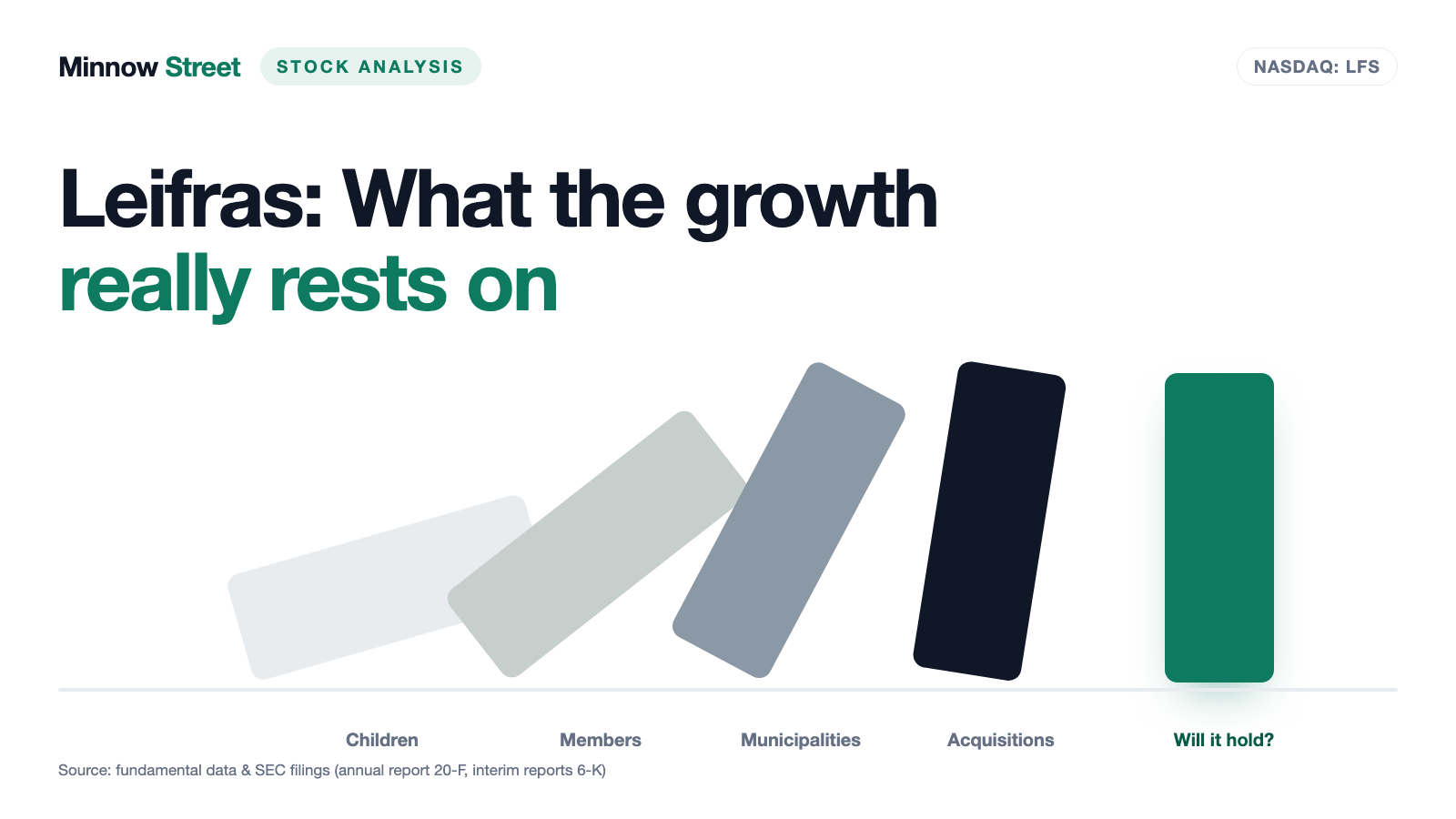
QIAGEN looks like the safest stock in the lab: a DAX 40 company, a 62 percent gross margin, 90 percent recurring revenue, more than 500,000 customers. Its annual report (20-F) for 2025 even states that the company has "grown significantly in recent years," from $1.87 billion in 2020 to $2.09 billion in 2025. That arithmetic skips the year 2021, when the books showed $2.25 billion: four years after the pandemic peak, revenue is still 7 percent below it. On April 27, 2026, QIAGEN cut its own full-year outlook from at least 5 percent growth to about 1 to 2 percent, because immigration testing demand for QuantiFERON — $503 million in sales, a quarter of the company — dropped away. Weeks earlier a London hedge fund had opened a brand-new position. At the end there is no advice, just one piece of arithmetic: what is left of "grown significantly" if you refuse to skip the year 2021?
 Thomas Mücke
Founder & Publisher
Thomas Mücke
Founder & Publisher
Chart
Interactive price chart (TradingView).
Note: pure fact-based analysis, not investment advice and not a solicitation to buy or sell. All figures without guarantee.
There is an investor trap that has nothing to do with greed and everything to do with respect — call it the white-coat trap. It works like this: a company figuratively wears a lab coat. It does something serious, something medical, something involving DNA. And a switch flips in your head: this is not a casino, this is substance. The coat is a uniform of credibility — and we rarely ask uniforms for their papers. QIAGEN N.V. (NYSE: QGEN; Frankfurt Prime Standard: QIA) wears that coat as convincingly as almost any company in Germany's DAX 40 index: it supplies the tools laboratories worldwide use to pull genetic material out of blood, tissue and swabs and make it readable. A 62.2 percent gross margin in 2025, 90 percent recurring revenue, more than 500,000 customers. So let's make a deal: before you believe the coat, we read together only what the company itself reported to the U.S. securities regulator, the SEC — the annual report (20-F) for 2025, filed March 20, 2026, and the first-quarter 2026 update furnished on May 8, 2026. A filing to the SEC is honest under penalty of law. And this one describes revenue that has sat below its own peak for four years, a single test that carries a quarter of the company, and earnings per share that grow in good part because there are ever fewer shares. In the end, the decision is yours.
What QIAGEN actually does — the toolbox behind every genetic test
QIAGEN sells no drugs and makes no diagnoses. It sells the tool chain other people use to do that — the company calls it "Sample to Insight." Picture it this way: QIAGEN is not the chef, it is the outfitter of the kitchen. It supplies the knives, the scales, the cookbooks — and above all the consumables that get used up and reordered every week. Four steps, four product groups: Sample technologies ($661.3 million of 2025 sales, 32 percent) extract DNA, RNA and proteins from the sample. Diagnostic solutions ($803.1 million, 38 percent) are the regulated clinical tests. PCR and nucleic acid amplification ($309.0 million, 15 percent) multiply the genetic material until it can be measured. Genomics/NGS ($241.8 million, 12 percent) covers sequencing consumables and the QIAGEN Digital Insights bioinformatics software. Another $74.9 million sits in "other."
The annual report names the business model itself: a "razor-razorblade model." The instrument is sold once (or close to given away); the money is made on the cartridges, kits and tubes reordered every week thereafter. That is where the 90 percent recurring revenue comes from: $1,876.4 million of the $2,090.0 million in 2025 sales were consumables and related revenue, and only $213.6 million were instruments. It is a very comfortable revenue structure — slow to fall and slow to rise. And that names the central tension of this analysis, which runs through every chapter below: QIAGEN is a genuinely excellent business that has barely grown for four years — and a growing share of the progress in earnings per share is manufactured in the capital structure, not in the lab.
How this stock landed on our desk
This analysis does not begin with a hit in our in-house stock scanner. It begins with a form. On May 8, 2026, Helikon Investments Ltd of London filed its Form 13F-HR with the SEC for the quarter ended March 31, 2026 (accession 0001839497-26-000002). A 13F is the mandatory quarterly disclosure for large U.S. institutional managers: anyone running more than $100 million in U.S.-listed equities must show what they hold. Helikon's table lists 17 positions worth $2,648,555,113 — and inside it, brand new and absent before, 1,807,989 QIAGEN shares worth $72,391,880. At each of the three preceding quarter-ends (June 30, September 30 and December 31, 2025) the same fund reported zero shares.
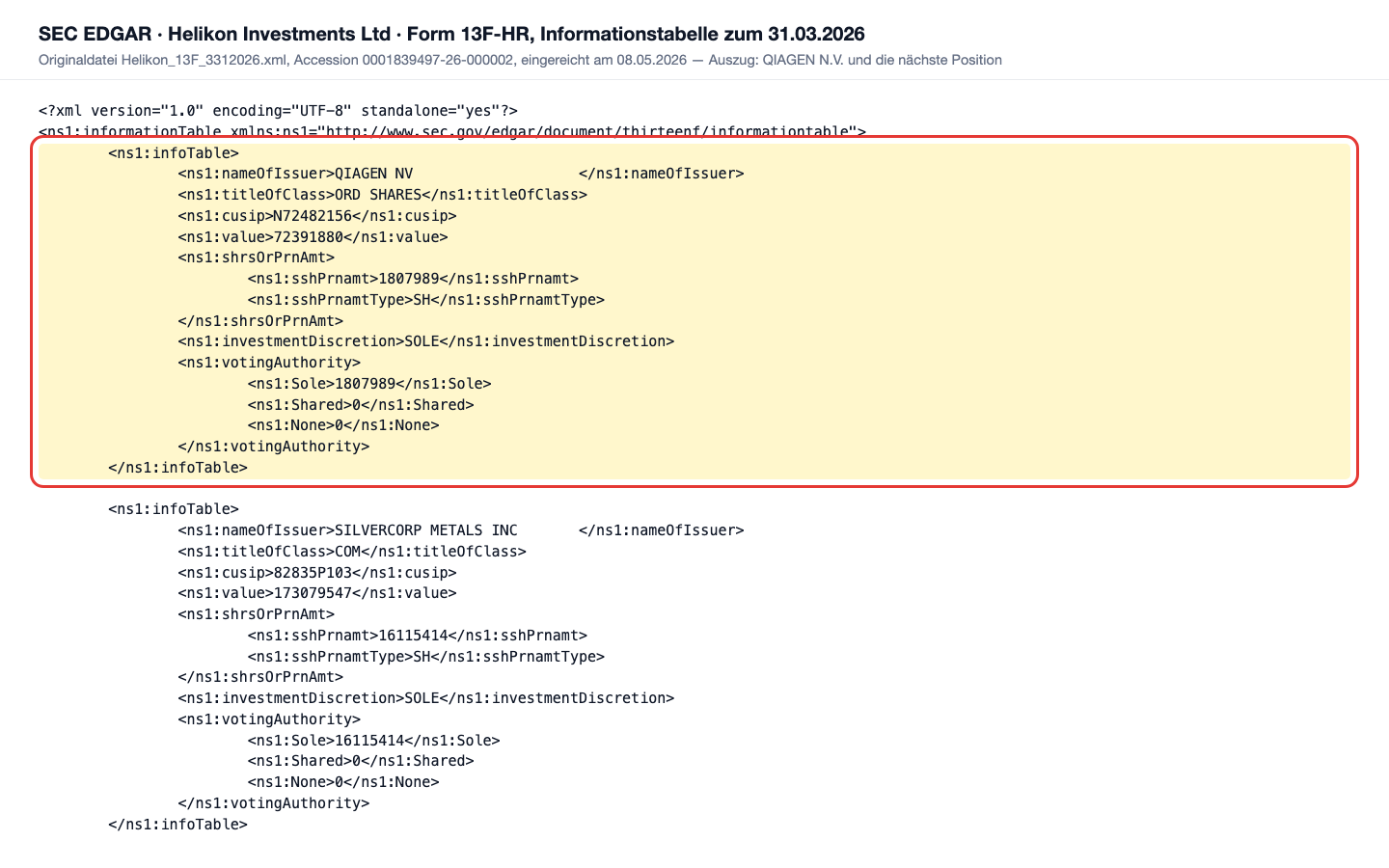
What makes it interesting is the rest of the list. A little over half the portfolio sits in gold and silver miners (Skeena Resources alone at 18.5 percent, Allied Gold at 14.4 percent, plus Collective Mining, Silvercorp, Solaris Resources, New Pacific Metals and Highlander Silver), and another fifth in Latin American assets — airports, a gas pipeline, a real estate group, a power distributor. In that portfolio, a Dutch laboratory supplier at 2.73 percent weight is the outlier. Which is exactly why it deserves a second look.
Now the limit that belongs with every 13F, so a disclosure form does not turn into a legend. A 13F shows U.S.-listed long positions only, reported with a 35- to 45-day delay, with no short positions and no derivatives, and nothing that trades outside the United States. It is a rear-view mirror, not a road map. With QIAGEN that becomes unusually concrete: the reporting date is March 31, 2026, the filing was signed on May 8, 2026 — and in between, on April 27, 2026, QIAGEN cut its own full-year outlook. Whether the fund still held the position by then, the form does not say. It says only what was in the book at quarter-end.
A word on the scanner, because honesty demands it: QIAGEN is not the kind of name our momentum, deep-value or distress filters push to the front. A company with a 22.3 percent operating margin, no balance-sheet stress and a 1-to-2-percent growth expectation triggers neither a buy signal from price strength nor an alarm from leverage. It falls through the mesh — and is worth analyzing anyway. That is precisely the gap a filing sometimes fills.
Why QIAGEN files no quarterly report — and what that means for you
Before we get to the numbers, one point most investors miss: there is no 10-K and no 10-Q from QIAGEN. With the SEC the company is a foreign private issuer, and the difference lives in the verbs:
"We file reports, including annual reports on Form 20-F, furnish periodic reports on Form 6-K and other information with the SEC, pursuant to the rules and regulations of the SEC that apply to foreign private issuers."
— QIAGEN N.V., SEC annual report 20-F for 2025, "Documents on Display"
Two different words: the annual report is filed, the interim numbers are only furnished. In practice that means you get one complete, audited document a year, with notes, a risk section and an auditor's opinion — the 20-F, filed March 20, 2026 for fiscal 2025. Three times a year you get an unaudited quarterly update attached to a Form 6-K, the same way a European company issues a press release. No quarterly notes, no segment detail at the depth of a 10-Q, no auditor review. This is entirely legal and standard for European companies with a U.S. listing — but it is a thinner information base than a U.S. issuer gives you. Buy QIAGEN and you buy that too: for nine months of the year you know less than you would about a U.S. competitor. Remember it this way: the scrutiny of a year and the timeliness of a quarter — here you do not get both at once.
The numbers over the years — honestly appraised
First what genuinely impresses, and there is plenty. The gross margin reached 62.2 percent in 2025 — of every $100 in sales, $62 survives all production costs. Operating income came to $465.9 million, a 22.3 percent margin; adjusted for special items QIAGEN reports 29.5 percent. Operating cash flow was $654 million; after $201.0 million of capital expenditure, roughly $453 million in free cash flow remains. The balance sheet as of December 31, 2025: $6,281.2 million in total assets, $3,778.2 million in equity, $839.0 million in cash plus $259.9 million in short-term investments. And the customer base is the opposite of a concentration risk — the notes put it like this: "For 2025, 2024, and 2023, no single customer represented more than ten percent of accounts receivable or consolidated net sales." Not one customer above ten percent. If you have ever analyzed a company where three buyers make up half the revenue, you know what that sentence is worth.
Now the curve this article is about — revenue since 2019:
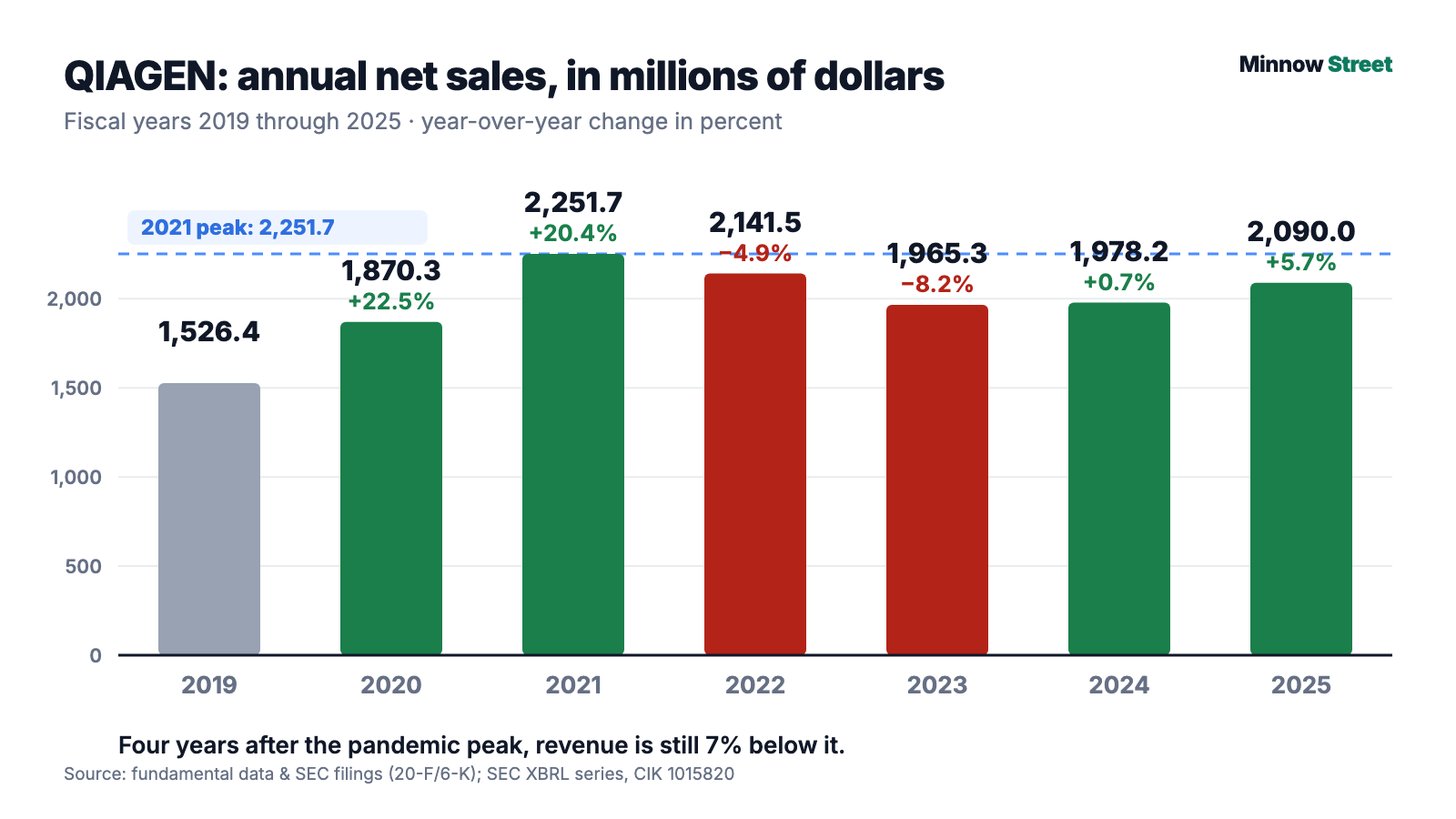
Fairness requires the explanation: 2020 and 2021 were pandemic years. QIAGEN shipped testing materials into a global emergency and revenue jumped 47 percent in two years. That the demand then evaporated is not a management failure. But it does not change your starting position as a buyer today: over five years, revenue has moved a net 11.7 percent — from $1,870.3 million (2020) to $2,090.0 million (2025), about 2.2 percent a year. That is the growth rate of an economy, not of a growth company.
One more number belongs here honestly, because it shows how fast this can also run the other way: in 2024 net income dropped to $83.6 million, from $341.3 million the year before. The cause was the "2024 Efficiency Program": QIAGEN discontinued its NeuMoDx clinical PCR system and fully impaired its $166.1 million of long-lived assets; a further $34.7 million of equipment and software was written off and $93.5 million of inventory written down. The report puts total 2024 restructuring charges at $295.1 million — in a single year. In 2025 the next program followed, estimated at $60.0 million in total costs with roughly $25.0 million still to come in 2026 — and the report adds: "We expect to identify further actions." A company under permanent renovation.
What the filings say — the uncomfortable truths
Uncomfortable truth no. 1: "Grown significantly" — measured from a year that skips the peak
In the risk section of the annual report QIAGEN describes its own trajectory. The sentence is short and you can look it up verbatim:
"We have grown significantly in recent years, with total net sales increasing from $1.87 billion in 2020 to $2.09 billion in 2025."
— QIAGEN N.V., SEC annual report 20-F for 2025, "Risks and Risk Management"
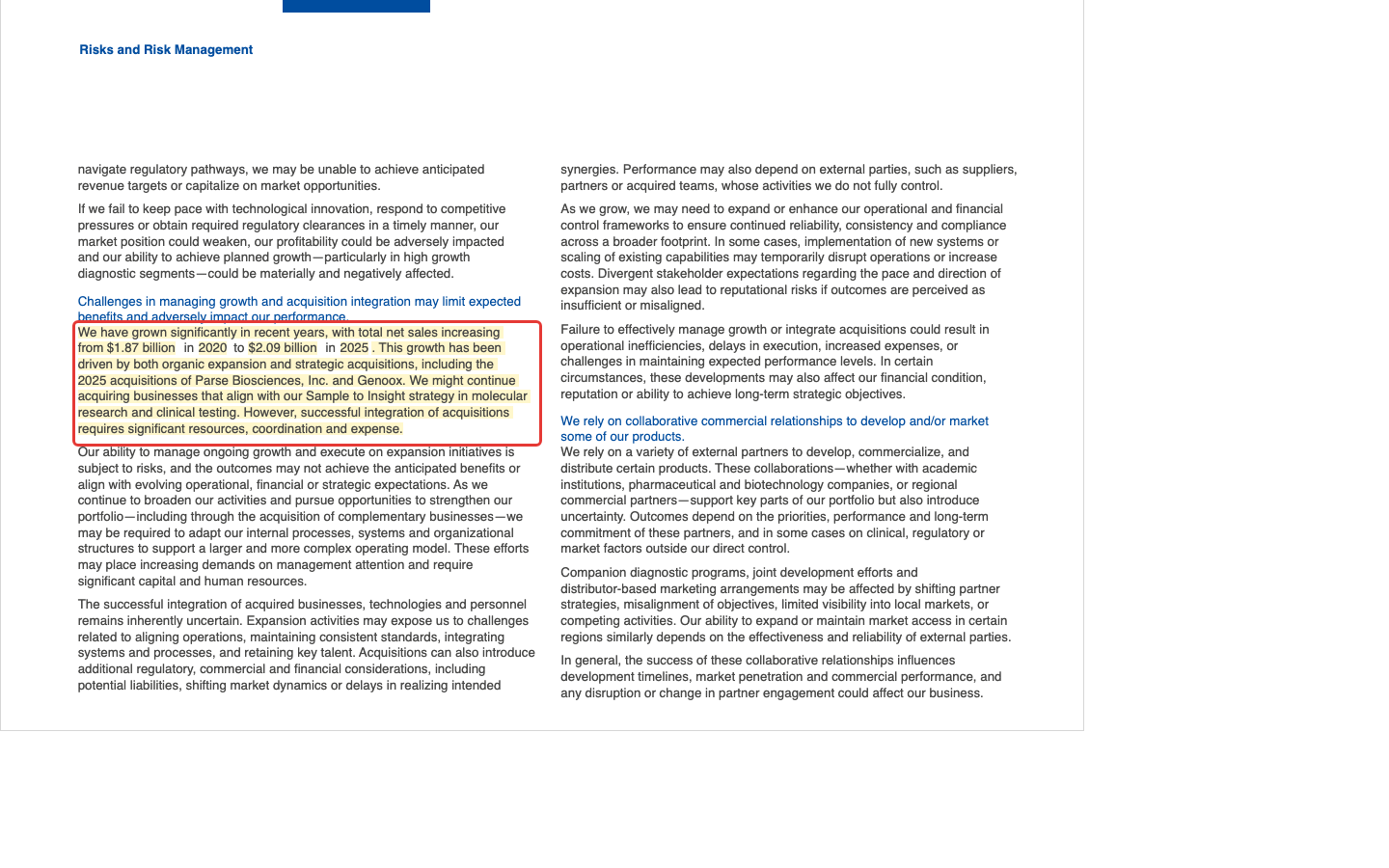
Every number in that sentence is correct. Only the starting point is chosen. Between 2020 and 2025 sits 2021, with $2,251.7 million — the highest revenue in company history. Measure from there and you do not get "grown significantly," you get minus 7.2 percent in four years. Profit tells the same story: $512.6 million of net income in 2021 against $424.9 million in 2025. Picture a runner who removes his 2021 personal best from the record book and then announces he is faster than he was in 2020. Not a lie — but not the whole track either.
Uncomfortable truth no. 2: a quarter of the company rides on one test — and that test rides partly on U.S. immigration
QuantiFERON is QIAGEN's most successful product: a blood test that detects latent tuberculosis — an infection that is not (yet) causing symptoms. It is steadily replacing the old skin test. In 2025 QuantiFERON brought in roughly $503 million, up 11 percent and 24 percent of group revenue. One test, one quarter of the company. What many investors do not have on their radar: a meaningful share of those tests are not ordered out of medical urgency but because an authority requires them — in immigration and visa procedures. And government policy changes faster than diseases do. In the first quarter of 2026 QIAGEN wrote:
"QuantiFERON sales declined 5% CER from Q1 2025, mainly due to a significant decline in immigration testing demand in the United States and the Middle East."
— QIAGEN N.V., first-quarter 2026 update, Form 6-K exhibit 99.1, May 6, 2026
The consequence appears in the same document — and it applies to the whole company, not one product line:
"QIAGEN updated on April 27 its full-year 2026 outlook for net sales to grow about 1-2% CER (previously at least 5% CER growth) … Adjusted diluted EPS are now expected to be at least $2.43 CER (previously at least $2.50 CER)."
— QIAGEN N.V., first-quarter 2026 update, Form 6-K exhibit 99.1, May 6, 2026, "Outlook"
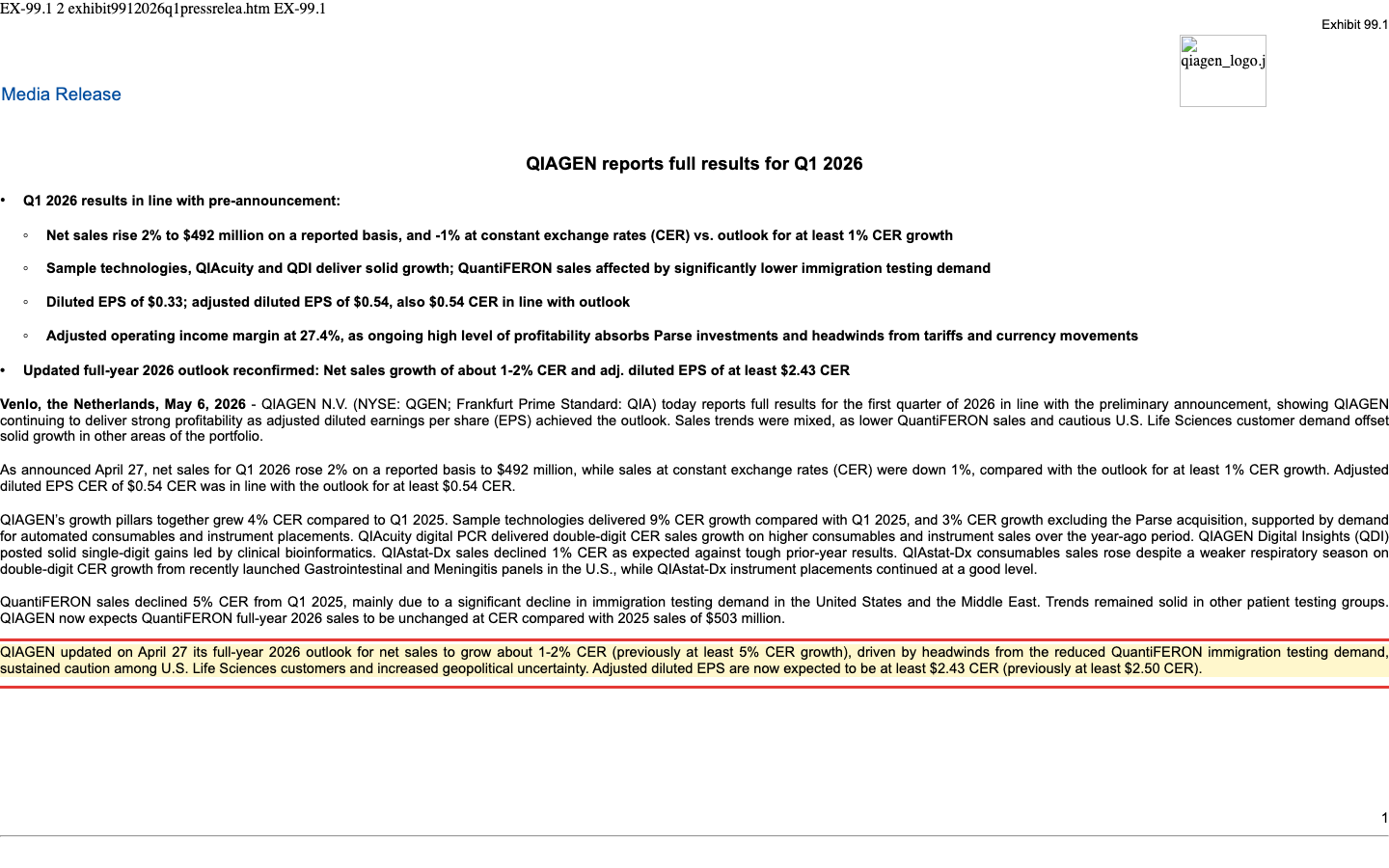
Do the timing math: on February 4, 2026, the company still pointed to at least 5 percent growth for 2026. Eleven weeks later that had become 1 to 2 percent. First-quarter 2026 revenue of $492.3 million was 2 percent above the prior year — but 1 percent below it at constant exchange rates. Operating income fell 27 percent to $84.4 million, net income fell 25 percent to $68.0 million, and free cash flow fell 44 percent to $53.7 million. Remember the image: the larger a single product looms in revenue, the more it decides the outlook for the entire company.
Uncomfortable truth no. 3: earnings per share grow even when earnings do not
Now the mechanism you need in order to read QIAGEN's numbers properly. Earnings per share is a fraction: profit on top, share count underneath. You can raise it by earning more above the line — or by shrinking below it. QIAGEN does both, and the second one very consistently:
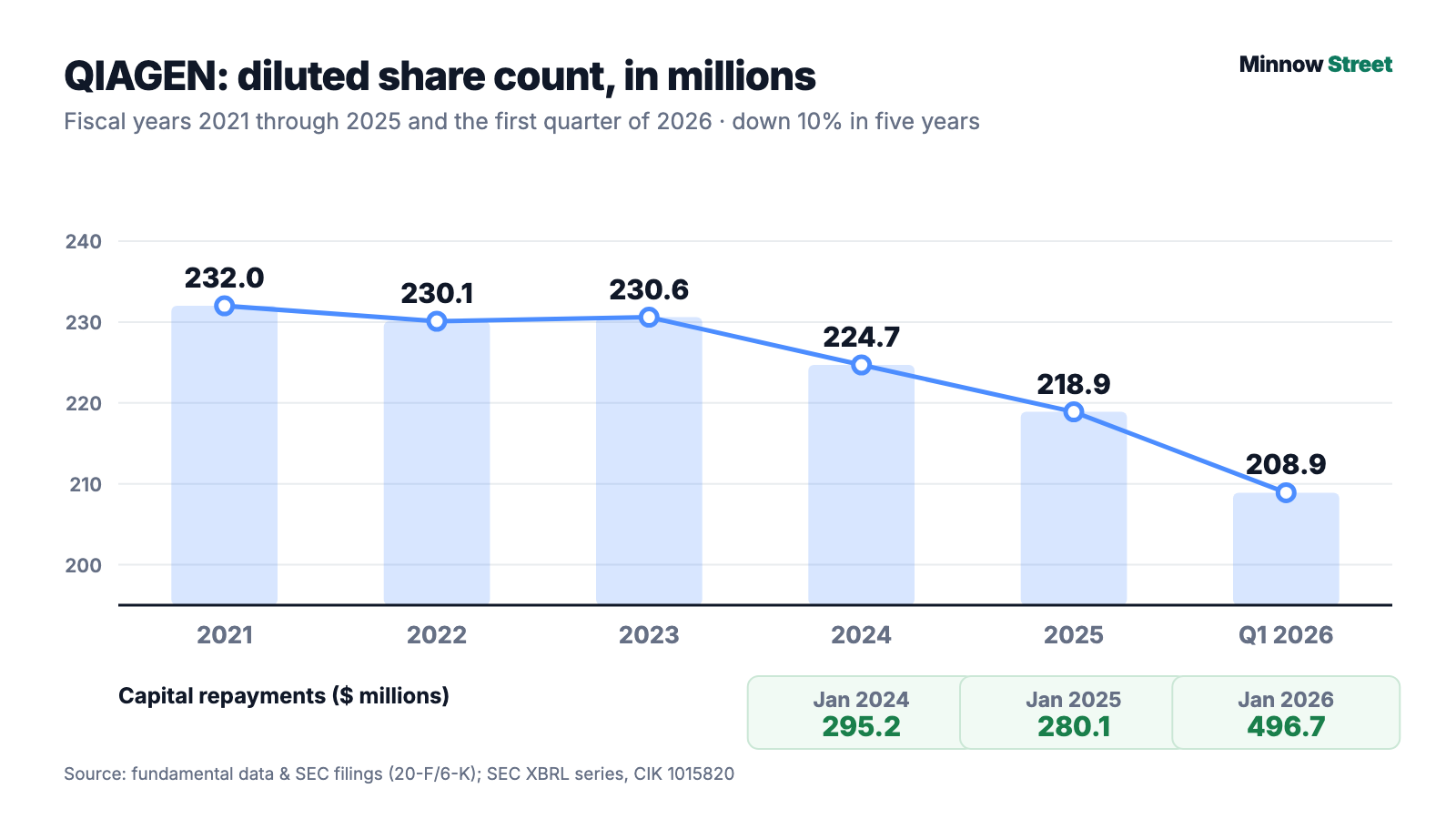
The report calls the mechanism a "synthetic share repurchase," and it is a Dutch specialty: instead of buying shares in the market, the company repays capital to every shareholder and simultaneously runs a reverse stock split — 100 shares become 95, say, and cash lands in your account. Picture the difference: a classic buyback purchases the shares of the individual holders who want out; here everyone gets a little cash and a slightly smaller piece of paper at the same time. In January 2026, $496.7 million went out this way and the share count fell about 5 percent to 206.8 million; in January 2025 it was $280.1 million (down 2.8 percent), in January 2024 $295.2 million (down 3 percent). On top came the first dividend in company history in 2025: $0.25 per share, $54.2 million in total, approved at the annual general meeting on June 26, 2025.
None of this is shady — it is a legitimate, tax-efficient and entirely common Dutch form of distribution. But the scale is worth knowing: the three capital repayments add up to $1,072.0 million. Net income for 2023, 2024 and 2025 combined was $849.8 million. Across three Januaries the company distributed about 26 percent more than it earned in three years — funded by the cash pile and by new debt. And one more detail for earnings quality: the effective tax rate in 2025 was just 13.3 percent instead of the Dutch 25.8 percent, because winding up the discontinued U.S. subsidiary NeuMoDx produced a one-time $29.0 million tax benefit. For 2026 QIAGEN plans with 18 percent again. How much a tax item can flatter a record profit is something we have seen at TG Therapeutics, where it made up the larger part of the profit.
Uncomfortable truth no. 4: the zero-interest money was called back — and replaced expensively
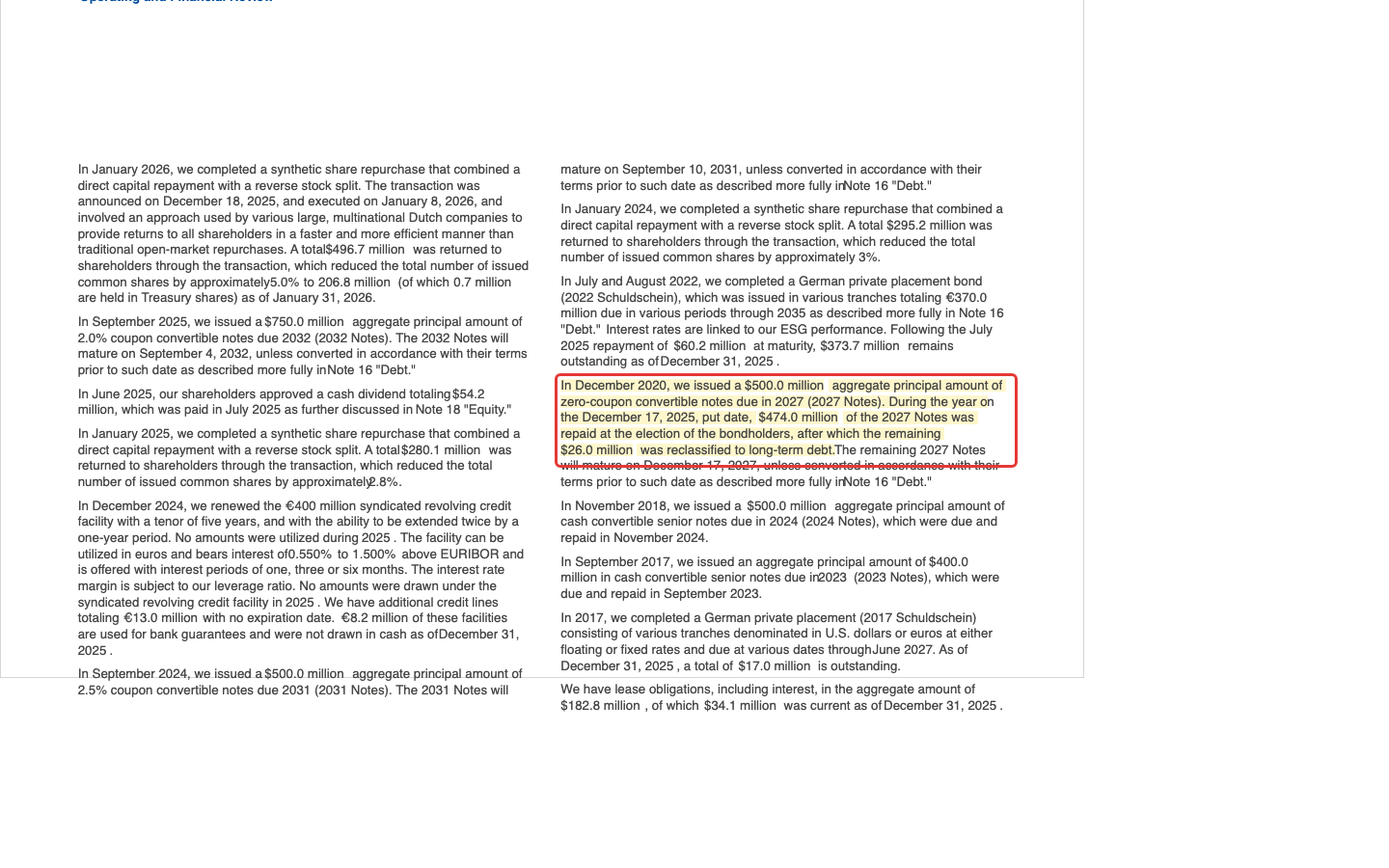
QIAGEN financed itself remarkably cheaply for years: in December 2020 it issued a convertible note of $500.0 million at 0.000 percent interest. A convertible is a loan with an exchange right — the lender gives up interest in return for the chance to convert into shares later. If the shares do not rise, it stays an interest-free loan. That is exactly what happened, which is why the holders pulled the cord at the first opportunity:
"During the year on the December 17, 2025, put date, $474.0 million of the 2027 Notes was repaid at the election of the bondholders, after which the remaining $26.0 million was reclassified to long-term debt."
— QIAGEN N.V., SEC annual report 20-F for 2025, "Other factors affecting liquidity and capital resources"
The free money was replaced with expensive money: $500.0 million at 2.500 percent in September 2024 (due 2031) and $750.0 million at 2.000 percent in September 2025 (due 2032). You can already see it in the income statement: first-quarter 2026 interest expense was $11.1 million against $7.3 million a year earlier, while interest income fell from $15.4 million to $10.6 million. Debt totals $1,646.6 million (March 31, 2026) against $646.3 million of cash, which lifted net debt to 1.3 times adjusted EBITDA, from 0.7 times at the end of 2025.
And then there is a footnote you have to read twice. Because the 2027 note carried that put date, the $498.4 million should have been shown as a current liability in the December 31, 2024 balance sheet. It was not:
"In 2025, we corrected the classification of $498.4 million of debt previously reported as long-term as of December 31, 2024 that should have been classified as current under U.S. GAAP due to the December 17, 2025 bondholder put date …"
— QIAGEN N.V., SEC annual report 20-F for 2025, Note 1.1 "Revision of Previously Issued Financial Statements"
The cover page of the 20-F carries the corresponding checked box for a correction of an error to previously issued financial statements. QIAGEN classifies the error as immaterial, and the income statement was untouched — both true. But anyone who looked at current liabilities at the end of 2024 to judge short-term solvency saw half a billion dollars in the wrong row. And the same construction is built into the future: the 2031 note can be put back on September 10, 2029, the 2032 note on September 4, 2030 — $1.25 billion combined, whose return depends entirely on whether the shares trade above conversion prices of $63.7571 and $64.7028 by then.
Valuation: fully paid for a business without growth
For an evergreen reading we need a dated anchor rather than a daily price — and the form from the opening supplies one. $72,391,880 for 1,807,989 shares works out to roughly $40 per share as of March 31, 2026. Against the roughly 206.3 million shares outstanding at that date, that is a market value on the order of $8.3 billion. Measured against 2025 net income of $424.9 million, that is a price-to-earnings ratio of about 19; against sales of $2,090.0 million, a price-to-sales ratio of about 4. Using the company's own adjusted guidance for 2026 of at least $2.43 per share, it is about 16. Add roughly $1.0 billion of net debt and enterprise value lands near $9.3 billion.
Is that expensive? For a quality business with a 62 percent gross margin and 90 percent recurring revenue, 19 times earnings is historically unremarkable — comparable suppliers to the pharma and lab world often trade higher, and West Pharmaceutical shows what the market is willing to pay for reliability. The catch sits elsewhere: that valuation assumes growth, and the company's own guidance says 1 to 2 percent. For you as an investor that means paying the price of quality while receiving, for now, the return profile of a bond substitute — plus the hope that the growth pillars (Sample technologies with the Parse Biosciences acquisition, QIAcuity, QIAstat-Dx and the QIAGEN Digital Insights bioinformatics business) turn the picture in the second half of 2026, as management expects. All valuation figures: data as of July 23, 2026; analyses are evergreen, daily prices are not a buy argument.
Opportunities and risks at a glance
What speaks for QIAGEN:
- First-class earnings quality: a 62.2 percent gross margin and a 22.3 percent operating margin in 2025 (29.5 percent adjusted), $654 million of operating cash flow against $201.0 million of capital expenditure.
- Recurring revenue as the foundation: $1,876.4 million of $2,090.0 million (90 percent) is consumables and related revenue, spread across more than 500,000 customers in over 160 countries — and no single customer reaches ten percent.
- A solid balance sheet: $3,778.2 million of equity against $6,281.2 million of total assets (December 31, 2025), net debt at 1.3 times adjusted EBITDA as of March 31, 2026, and no drawings on the €400 million revolving credit facility.
- Growth drivers with their own momentum: QIAstat-Dx grew 27 percent to $139 million in 2025 and QuantiFERON 11 percent to $503 million; the acquisitions of Genoox (May 2025) and Parse Biosciences (December 2025) extend the bioinformatics and single-cell franchises.
- Systematic capital returns: $1,072.0 million across three capital repayments (January 2024 through January 2026) plus the first dividend in company history ($0.25 per share, July 2025) — the share count is down 10 percent in five years.
What speaks against it:
- No growth for four years: 2025 revenue of $2,090.0 million sits 7.2 percent below the 2021 peak of $2,251.7 million, and net income 17 percent below; the annual report still describes the trajectory as "grown significantly," measured from 2020.
- Guidance freshly cut: on April 27, 2026, from at least 5 percent to about 1 to 2 percent sales growth at constant currency, and from at least $2.50 to at least $2.43 in adjusted earnings per share; first-quarter 2026 operating income fell 27 percent and free cash flow 44 percent.
- Product and policy risk: QuantiFERON accounts for 24 percent of revenue, and part of that demand rides on immigration and visa procedures in the United States and the Middle East — a channel no sales force in the world controls.
- Permanent restructuring and a wide gap between reported and adjusted profit: $295.1 million of restructuring charges in 2024, another program of roughly $60.0 million starting late 2025 ("We expect to identify further actions"); in 2024 reported earnings per share of $0.37 stood against $2.18 adjusted, and in the first quarter of 2026 $0.33 against $0.54.
- More expensive funding and a thinner information base: the zero-coupon convertible was called back at 94.8 percent and replaced with 2.0 and 2.5 percent paper (put dates in 2029 and 2030 covering $1.25 billion combined); as a foreign private issuer QIAGEN publishes no audited quarterly reports (no 10-Q), and the 2024 balance sheet had to be reclassified by $498.4 million.
A human conclusion
Back to the white-coat trap from the opening. Its core is not that the coat is a lie — QIAGEN is an excellently run company with a business others envy: high margins, loyal customers, no concentration risk, a balance sheet without worry lines. Its core is that the coat answers a question you never asked. It tells you the company is serious. It does not tell you whether it grows, what it costs, or where its earnings per share come from. Those three answers are not printed on the coat; they are in the 20-F. Revenue is still below its peak four years on. The 2026 outlook was cut in April to 1 to 2 percent because immigration demand for one test fell away. And a visible share of the progress per share exists because the company distributes more than it earns while shrinking the share count. The London fund that bought in during the first quarter of 2026 knew or accepted all of that — its form says only that it bought, not why, and not whether it is still there. So the honest question is not "is QIAGEN a good company?" — it is. The question is: are you willing to pay the full price for quality while the growth hangs on a government decision and part of the per-share progress comes from a calculator? If yes, you have a thesis. If no, you had an impression. What you make of it is your decision. And that is exactly as it should be.
Sources
Every original document used in this analysis, so you can read it yourself:
- QIAGEN N.V. — SEC annual report 20-F for 2025 (filed March 20, 2026)
- QIAGEN N.V. — SEC annual report 20-F for 2024 (filed March 31, 2025)
- QIAGEN N.V. — first-quarter 2026 update, Form 6-K exhibit 99.1 (furnished May 8, 2026)
- QIAGEN N.V. — U.S. GAAP quarterly report as of March 31, 2026, Form 6-K exhibit 99.1
- QIAGEN N.V. — fourth-quarter and full-year 2025 results (Form 6-K, February 6, 2026)
- Complete SEC filing history for QIAGEN N.V.: EDGAR overview (sec.gov)
- Helikon Investments Ltd — Form 13F-HR as of March 31, 2026 (filed May 8, 2026, accession 0001839497-26-000002)
- Fundamental data (metrics, valuation; data as of July 23, 2026), reconciled with the SEC filings and the SEC XBRL series (CIK 1015820).
Transparency & disclaimer: this analysis is a journalistic contextualization of publicly available information. It is not investment advice, not a regulated financial analysis and not a solicitation to buy or sell securities. Equity investments carry substantial risks up to and including total loss. All information without warranty; the data cut-off is noted in the text. The author holds no position in QIAGEN shares at the time of publication.
Our Bottom Line at a Glance
- Business quality positive
- A razor-and-blade supplier model: $1,876.4 million of $2,090.0 million in 2025 sales (90 percent) is consumables and related revenue, spread across more than 500,000 customers in over 160 countries, with no single customer above ten percent in 2023-2025. Gross margin 62.2 percent, operating margin 22.3 percent (29.5 percent adjusted).
- Growth negative
- Four years after the peak of $2,251.7 million (2021), revenue of $2,090.0 million is still 7.2 percent below it; across five years that is 2.2 percent of growth a year. On April 27, 2026, QIAGEN cut full-year guidance from at least 5 percent to about 1 to 2 percent at constant currency, and first-quarter 2026 sales came in 1 percent below the prior year at constant currency.
- Product dependency negative
- QuantiFERON accounted for roughly $503 million in 2025, or 24 percent of group revenue. Part of that demand comes from immigration and visa procedures, and its decline in the United States and the Middle East was the main driver of the guidance cut. A sales channel that depends on government decisions cannot be managed by a sales force.
- Earnings quality & capital structure neutral
- Earnings per share benefit from a shrinking denominator: diluted shares down from 232.0 million (2021) to 208.9 million (Q1 2026), funded by capital repayments totaling $1,072.0 million against $849.8 million of net income across 2023-2025. Add a 13.3 percent tax rate in 2025 including a one-time $29.0 million benefit, and a wide gap between reported and adjusted earnings ($0.37 versus $2.18 in 2024).
- Balance sheet & funding neutral
- A solid base of $3,778.2 million in equity and $646.3 million of cash (March 31, 2026), but rising costs: the zero-coupon convertible was called back at 94.8 percent ($474.0 million) and replaced with 2.0 and 2.5 percent paper; put dates on September 10, 2029 and September 4, 2030 cover $1.25 billion combined. Net debt rose to 1.3 times adjusted EBITDA, and the 2024 balance sheet had to be reclassified by $498.4 million.
QIAGEN is the white-coat trap in its purest form: a genuinely excellent business — a 62.2 percent gross margin, 90 percent recurring revenue, more than 500,000 customers with no concentration risk — whose revenue curve has not regained its 2021 pandemic peak of $2,251.7 million and stood at $2,090.0 million in 2025. The annual report calls that "grown significantly," measured from 2020. On April 27, 2026, full-year guidance was cut from at least 5 percent to 1 to 2 percent because immigration testing demand for QuantiFERON (24 percent of revenue) fell away. Meanwhile earnings per share grow through a shrinking denominator: 232.0 million shares (2021) against 208.9 million (Q1 2026). Not investment advice.
What Our Rating Means
Open questions
The business works in principle, but one material question is open. As long as it stays open, our findings do not carry a quality verdict.
Buy today and you are buying undisputed quality at a price that assumes growth: about 19 times 2025 net income and about 16 times the company's own adjusted 2026 guidance, against a growth expectation of 1 to 2 percent. The bet is that the growth pillars (sample technologies with Parse, QIAcuity, QIAstat-Dx and the bioinformatics business) turn the picture in the second half of 2026, and that the QuantiFERON decline is a one-time rebasing rather than a trend. If you wait, check exactly three numbers in every quarterly update: is QuantiFERON coming back? Is constant-currency revenue growth moving above 1 to 2 percent again? And how much of the progress per share comes from the business rather than from the shrinking share count? The decision is yours.
A journalistic assessment by our editorial team at the time of the deep dive, based on public sources — not investment advice and not a solicitation to buy or sell. Your personal circumstances (investment goals, risk capacity, taxes) cannot be taken into account. What our levels mean, how verdicts are formed, and what conflicts of interest exist →
Worth Noting
- QIAGEN reached our research list not through a scanner hit but through Form 13F-HR of Helikon Investments Ltd (London) as of March 31, 2026: 1,807,989 shares worth $72,391,880, a brand-new position in a portfolio that is more than half gold and silver miners. A 13F shows only U.S.-listed long positions with a 35- to 45-day delay, without shorts or derivatives — a rear-view mirror, not a road map.
- With the SEC, QIAGEN is a foreign private issuer: there is no 10-K and no 10-Q. Audited figures appear once a year on Form 20-F (filed March 20, 2026 for fiscal 2025), while quarterly numbers are only furnished as an unaudited exhibit to a Form 6-K. The information base between annual reports is therefore thinner than for a U.S. competitor.
- Valuation figures are dated and evergreen: the implied price of roughly $40 per share comes from the 13F as of March 31, 2026 ($72,391,880 for 1,807,989 shares) and serves as an order of magnitude, not a daily quote. Analyses are evergreen; daily prices are not a buy argument.
Stock Watch
This analysis is as of July 23, 2026. Stock Watch will tell you what's changed at QGEN since then.
Later $1 a month per stock — signing up is free, and you'll be the first to know when it launches.
Frequently Asked Questions
QIAGEN N.V. (NYSE: QGEN, Frankfurt: QIA), headquartered in Venlo, the Netherlands, supplies the tool chain for molecular testing: kits that extract DNA, RNA and proteins from blood, tissue or swabs, instruments that amplify and measure them, and interpretation software. In 2025, $661.3 million of sales came from sample technologies, $803.1 million from diagnostics, $309.0 million from PCR and $241.8 million from genomics/NGS. Ninety percent of revenue is recurring.
Only slowly. Revenue rose 6 percent in 2025 to $2,090.0 million, but it remains below the peak of $2,251.7 million set in the pandemic year 2021. For 2026 QIAGEN itself expects only about 1 to 2 percent growth at constant exchange rates, after cutting guidance on April 27, 2026 from at least 5 percent. In the first quarter of 2026, sales were 1 percent below the prior year at constant currency.
The main reason is a demand drop for QuantiFERON, the blood test for latent tuberculosis. The quarterly update cites a significant decline in immigration testing in the United States and the Middle East, alongside cautious U.S. life sciences customers, order timing in the OEM business and geopolitical uncertainty. QuantiFERON generated roughly $503 million of sales in 2025, or 24 percent of the group.
Because the SEC treats QIAGEN as a foreign private issuer. Those companies file no 10-K and no 10-Q. The audited annual report appears on Form 20-F (filed March 20, 2026 for fiscal 2025), while quarterly figures are only furnished as an unaudited exhibit to a Form 6-K. For investors that means less audit depth and less detail between annual reports.
A 13F is the quarterly disclosure required of large U.S. institutional managers. Helikon Investments Ltd of London reported 1,807,989 QIAGEN shares worth $72,391,880 as of March 31, 2026 — 2.73 percent of a $2.65 billion portfolio otherwise dominated by gold and silver miners, and a brand-new position. A 13F shows only U.S.-listed long positions with a 35- to 45-day delay, without shorts or derivatives: a rear-view mirror, not a road map.
Through so-called synthetic share repurchases: the company repays capital to all shareholders and runs a reverse stock split at the same time. January 2024 returned $295.2 million, January 2025 $280.1 million and January 2026 $496.7 million. The diluted share count fell from 232.0 million (2021) to 208.9 million in the first quarter of 2026. That lifts earnings per share even when earnings themselves do not rise.
As of March 31, 2026, debt of $1,646.6 million stood against cash of $646.3 million, putting net debt at 1.3 times adjusted EBITDA (0.7 times at the end of 2025). Most of it is convertible notes: $500.0 million at 2.5 percent (due 2031, put date September 10, 2029) and $750.0 million at 2.0 percent (due 2032, put date September 4, 2030), plus two German Schuldschein private placements.
Found an error?
Did you spot a factual error, an outdated number, or a typo in this deep dive? Let us know briefly — your report goes straight to the editorial team.