Sirius XM: The Turn Is Real — but the Free Cash Flow Belongs to Creditors for Years
Our turnaround scanner ranks Sirius XM 10th out of 62 U.S. hits with a turn check of 7 out of 8 (as of July 25, 2026), and the filings with the U.S. securities regulator, the SEC, back it up: in the first quarter of 2026 revenue rose for the first time in years, up 1.1 percent to $2,091 million, operating income gained 17 percent and free cash flow tripled to $171 million. Against that stands a balance sheet in which $21.0 billion of $27.1 billion is goodwill and FCC licenses, plus $9.76 billion of debt refinanced in March 2026 at nearly double the coupon. Anyone buying here is buying a company that has legally existed only since September 9, 2024.
 Thomas Mücke
Founder & Publisher
Thomas Mücke
Founder & Publisher
Chart
Interactive price chart (TradingView).
Note: pure fact-based analysis, not investment advice and not a solicitation to buy or sell. All figures without guarantee.
There is an investor trap nobody sees coming, because it hides inside a tool we all trust blindly: the chart. Call it the chart-memory trap. It works like this. You have known a stock for years, you carry a number in your head — "wasn't that a six-dollar stock?" — you open the chart, you see thirty, and in a tenth of a second your brain concludes: "I missed it." With Sirius XM Holdings Inc. (Nasdaq: SIRI) that conclusion is wrong, for a reason that has nothing to do with the business. On September 9, 2024, every old share was exchanged for one-tenth of a new one. Six dollars became sixty overnight — on paper. So let us make a deal: before we read a single curve, we read what the company itself told the U.S. securities regulator, the SEC — the 2025 annual report on Form 10-K, the quarterly report on Form 10-Q as of March 31, 2026, the 2026 proxy statement and half a dozen current reports on Form 8-K from the spring of 2026. An SEC filing is honest under penalty of law. And this one describes a genuine turn — alongside a balance sheet that is four-fifths made of things you cannot touch.
What Sirius XM actually does — a tollbooth in the dashboard and a radio station in your phone
Sirius XM is two businesses under one roof. The first, SiriusXM, sells a subscription: via satellites and a network of terrestrial repeaters it delivers hundreds of music, sports, comedy and news channels into cars, phones and connected speakers. As of December 31, 2025, 32.927 million subscribers in the United States held one, 31.345 million of them self-pay. In everyday terms, SiriusXM is a tollbooth in the dashboard — the car drives either way, but the express lane costs a monthly fee. Average revenue per user came to $15.11 a month in 2025. The second business, Pandora, works the other way round: it is free, and you listen to advertising. As of March 31, 2026 it had 40.068 million monthly active users plus 5.6 million paying subscribers. Together, the company estimates it reaches roughly 170 million listeners a month.
Behind that sits real infrastructure: six satellites in orbit, two of them spares, with two more (SXM-11 and SXM-12) under construction; 5,119 full- and part-time employees as of December 31, 2025; and a distribution channel many rivals envy — automakers install the receivers at the factory and bundle trial subscriptions. In 2025 Sirius XM made the Fortune 500 for the first time. Which frames the central tension of this analysis, and it runs through every chapter: the business is turning — but the profit is spoken for over years, because $9.76 billion of debt and a balance sheet that is 77 percent goodwill and FCC licenses claim every free dollar first.
Where the stock landed on our desk — rank 10 in the turnaround ranking
Sirius XM sits at rank 10 of 62 U.S. hits in our in-house turnaround candidates scanner (as of July 25, 2026), with a turn check of 7 out of 8 points. To repeat it yourself: open the scanner, set the country filter to the United States, sort by the turn check — the lists are recalculated daily, so tomorrow's rank may differ. What sits behind that score? The scanner first demands two mandatory pillars: a real collapse (at least 50 percent below the all-time high) and survivability (positive equity, a balance sheet without a cluster of warning signals). Only then does the turn check count — four points for operating direction (revenue no longer declining, rising net margin, positive or improving operating cash flow, a healing balance sheet) and four for market confirmation (price above the 50-day line, three-month relative strength above the twelve-month figure, net insider buying, institutions adding). Seven out of eight means the stock points the right way in seven of those eight tests. That is a strong reading — for context, a stock is listed at six out of eight.
Honestly assessed: a turnaround ranking is an invitation to research, not a buy signal. It measures direction, not condition. Which is exactly why we now read the filings — with another name from the same list, the data house FactSet, the starting position looked nothing like this one. At Sirius XM the four operating points are genuinely backed by numbers, and those come next.
The numbers over the years — honestly credited
First, what genuinely impresses. The first quarter of 2026 is the strongest evidence for the turn thesis. Revenue rose to $2,091 million from $2,068 million a year earlier — up 1.1 percent, the first increase after three consecutive years of decline in annual revenue ($8,953 million in 2023, $8,699 million in 2024, $8,558 million in 2025). Operating income climbed 17 percent from $387 million to $454 million, net income 20 percent from $204 million to $245 million, and diluted earnings per share from $0.59 to $0.72. The sharpest move came in free cash flow — the money actually left after all investment, plainly put, what is still in the account at month end: from $56 million to $171 million, a gain of 205 percent.
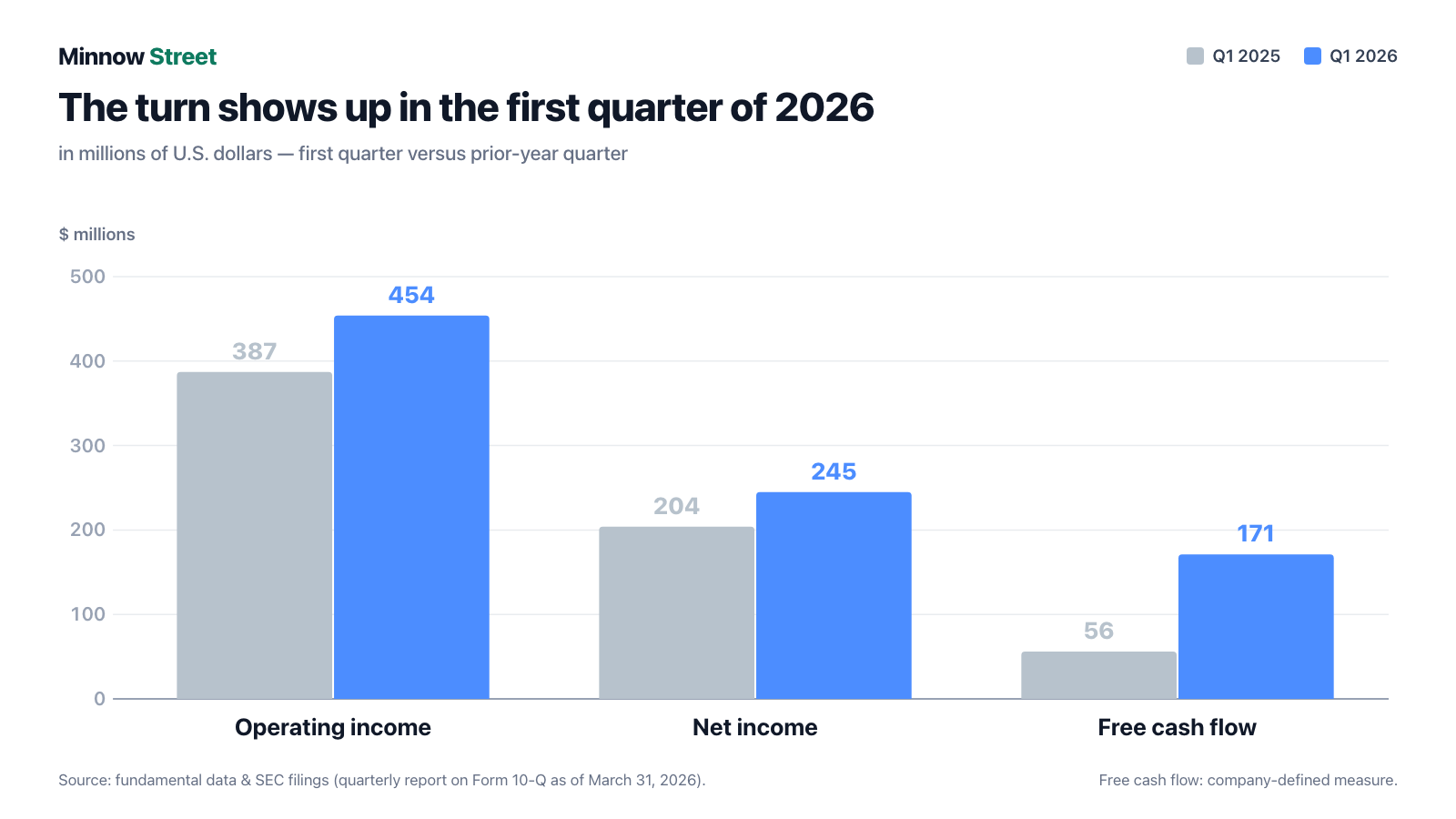
The full year shows the same direction: free cash flow reached $1,256 million in 2025 after $1,015 million — up 24 percent, driven per the report by the end of transaction costs, lower cash taxes and lower capital expenditure. Churn is easing too: monthly self-pay churn fell from 1.6 percent to 1.5 percent, and net self-pay losses in the first quarter of 2026 shrank from 303,000 to 111,000, an improvement of 63 percent. Average revenue per user rose in the quarter from $14.86 to $14.99. And the company pays out: a quarterly dividend of $0.27 per share, most recently declared April 23, 2026 and paid May 27, 2026 — $91 million a quarter.
So much for the good news. Now the other side.
Uncomfortable truth No. 1: the company in the old chart is legally a different one
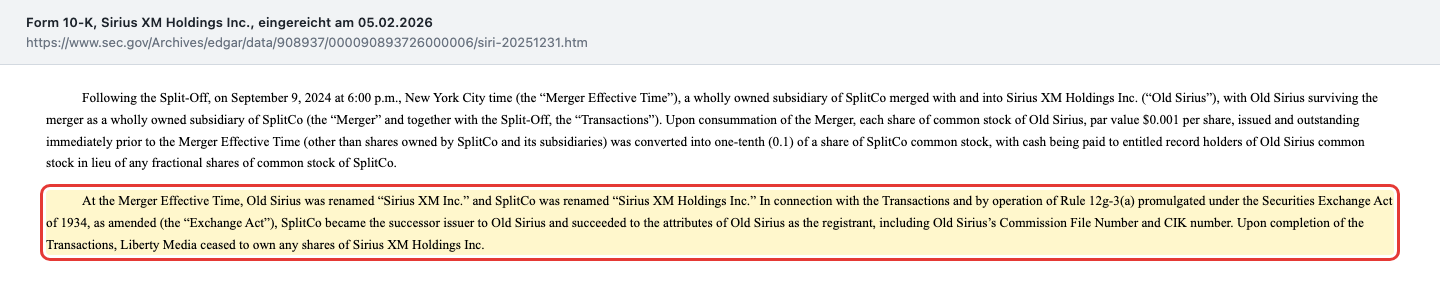
At 4:05 p.m. New York time on September 9, 2024, Liberty Media separated from its subsidiary Liberty Sirius XM Holdings Inc. — a "split-off." Just under two hours later, at 6:00 p.m., a subsidiary of that separated company merged into old Sirius XM Holdings Inc. Afterwards the old entity was named Sirius XM Inc. and became a subsidiary; the separated entity was renamed Sirius XM Holdings Inc. and is what trades today under SIRI. Every share of the old company was exchanged for one-tenth of a share in the new one; every Liberty SiriusXM share for 0.8375 new shares. The annual report puts it this way:
"At the Merger Effective Time, Old Sirius was renamed „Sirius XM Inc.“ and SplitCo was renamed „Sirius XM Holdings Inc.“ In connection with the Transactions and by operation of Rule 12g-3(a) promulgated under the Securities Exchange Act of 1934, as amended (the „Exchange Act“), SplitCo became the successor issuer to Old Sirius and succeeded to the attributes of Old Sirius as the registrant, including Old Sirius's Commission File Number and CIK number."
— Sirius XM Holdings Inc., annual report on Form 10-K for 2025, Part I, Item 1
Why this matters to you. First, the old SEC file number 001-34295 and CIK number 0000908937 carry over — so the company remains traceable with the regulator without a gap, even though it is a new legal person with a new employer identification number (EIN 93-4680139). Second, the 1-for-10 exchange explains every jump in the chart that was never a jump. Anyone who has watched a reverse split change the optics of a stock without changing anything about the business knows the pattern from our analysis of AMC Entertainment. And finally: yes, there is a Form 15-12G dated September 10, 2024 in the file — but it applies only to the reporting obligations of the old entity, today a subsidiary. The new entity keeps filing. Rule of thumb: a Form 15 is not automatically the end of a company — you have to read whose obligations it ends.
Uncomfortable truth No. 2: $21 billion of a $27 billion balance sheet is goodwill and licenses
As of March 31, 2026, Sirius XM reported total assets of $27,147 million. Of that, $12,390 million is goodwill — the premium paid above net asset value in past acquisitions — and $8,610 million is FCC licenses granted by the U.S. communications regulator. Together that is $21,000 million, or 77 percent of the balance sheet; add other intangibles of $1,424 million and you reach 83 percent. Against that sit property and equipment of $2,272 million and cash of $75 million. Equity of $11,731 million is therefore fully covered, on paper, by carrying values that rest on assumptions — not on anything you could sell.
How quickly such assumptions can break, the company demonstrated itself. In the third quarter of 2024, right after the split-off, its market capitalization fell far enough to trigger an interim impairment test. The result: $2,819 million of goodwill written off, plus $500 million on the equity investment in Sirius XM Canada. An operationally normal year turned into a loss of $1,665 million attributable to shareholders. For comparison: 2023 produced net income of $786 million and 2025 $805 million — same company, same business, one accounting entry in between. Where the revenue of a normal year actually goes is shown by the waterfall below:
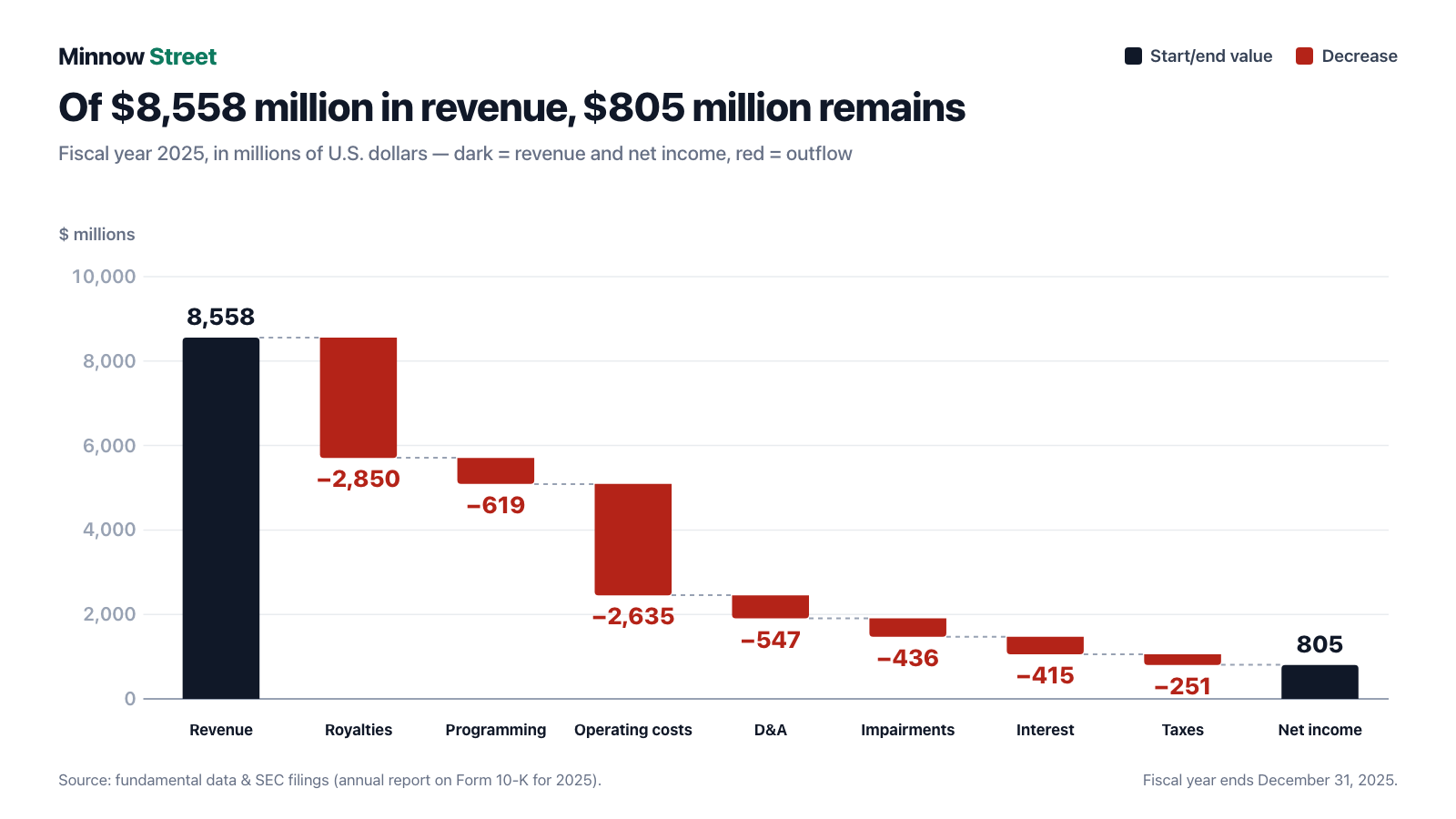
Line by line: of $8,558 million in revenue, $2,850 million goes out as revenue share and royalties to automakers, labels and talent, $619 million funds programming and content, $2,635 million covers the rest of operations (customer service and billing, transmission, subscriber acquisition, sales and marketing, product and technology, general and administrative), $547 million is depreciation and amortization, $436 million impairment and restructuring, $415 million interest and other, and $251 million taxes — leaving $805 million. What stands out: a third of revenue leaves the building before any programming has been made. That is not mismanagement, it is the business model — if you are delivered through other people's cars and play other people's music, you share.
Uncomfortable truth No. 3: the company warned about expensive refinancing — then delivered it six weeks later
The 2025 annual report, filed February 5, 2026, contains a sentence in its risk factors worth underlining:
"We have a substantial amount of indebtedness maturing in the next several years. Our ability to refinance our indebtedness on favorable terms, or at all, is dependent on (among other things) conditions in the credit and capital markets, which are beyond our control. In addition, any such refinancing efforts may increase our debt service obligations as we refinance lower interest rate debt with higher interest rate debt."
— Sirius XM Holdings Inc., annual report on Form 10-K for 2025, Item 1A Risk Factors

On February 26, 2026 — 21 days later — subsidiary Sirius XM Radio LLC announced a $1,000 million note offering; by that evening pricing was set and the size had been raised to $1,250 million at 5.875 percent, maturing April 15, 2032. The proceeds retired the old 3.125 percent notes of $1,000 million — $498.9 million through a tender offer settled March 5, the remainder discharged March 10 via a deposit with the trustee — and redeemed a further $250 million of the 5.00 percent notes due 2027.

Do the arithmetic. The new paper costs roughly $73 million of interest a year ($1,250 million at 5.875 percent). The retired pieces cost about $44 million combined ($1,000 million at 3.125 percent plus $250 million at 5.00 percent). That is roughly $30 million more a year — against 2025 net income of $805 million, about 4 percent of profit, for nothing. And total debt? It did not fall but edged up: from $9,717 million at December 31, 2025 to $9,760 million at March 31, 2026. Remember: a refinancing is not debt reduction, it is a swap of dates — sometimes at a worse price.
Uncomfortable truth No. 4: a tax agreement keeps the company on a leash
On the day of the split-off the board approved a share repurchase of $1,166 million with no end date. Nineteen months later, at March 31, 2026, cumulative repurchases stood at just $164 million — $1,003 million remained available. The first quarter of 2026 saw $21 million of buybacks, the prior-year quarter $25 million. Money is not the reason: 2025 free cash flow was $1,256 million. The explanation sits in the risk factors, and it is about taxes:
"In particular, for the two-year period following the distribution, we are subject to specific restrictions that are intended to preserve the generally tax-free status of the Split-Off, including restrictions on our ability to discontinue the conduct of certain businesses, to merge, consolidate, liquidate, or dissolve Sirius XM Holdings or Sirius XM Inc., to redeem or repurchase our common stock, or to enter into certain other corporate transactions that may cause us to undergo either a 45% or greater change in the ownership of our voting stock …"
— Sirius XM Holdings Inc., annual report on Form 10-K for 2025, Item 1A Risk Factors
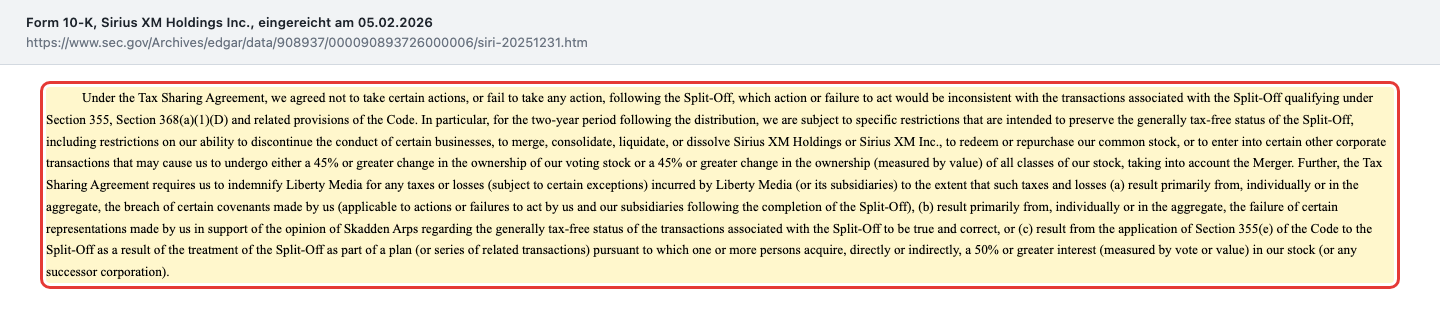
The report goes further at this point: the indemnity owed to Liberty Media is not limited in amount or subject to any cap, and it might "discourage, delay or prevent" a change of control. Anyone speculating that someone will simply buy the whole company soon ought to have read that paragraph. One more echo of the transaction sits in the file: in October 2024 purported stockholders sued Liberty Media, John C. Malone and the then board of Old Sirius in the Delaware Court of Chancery, alleging the transactions were unfair to minority holders because the new company took on tax liabilities and Liberty's debt, and because Liberty could appoint a majority of the board with staggered terms.
Uncomfortable truth No. 5: the base is still shrinking — just more slowly
The turn is a turn in costs and cash, not in growth. SiriusXM's subscriber count fell by 299,000 in 2025 to 32.927 million; self-pay subscribers slipped from 31.646 million to 31.345 million. The first quarter of 2026 continued the pattern: 31.234 million self-pay subscribers against 31.343 million a year earlier. At Pandora the move is starker — monthly active users fell 5 percent year over year, from 42.357 million to 40.068 million, and ad-supported listener hours dropped 6 percent. The company cites lower conversion rates from in-vehicle trials and simply fewer new users.
So the first-quarter revenue gain came not from more customers but from rate increases on existing plans and advertising revenue up 3.3 percent. That is legitimate — but it is a lever with an end. Rule of thumb: price increases inside a shrinking base buy time, not a future. Anyone testing the turn thesis should therefore watch net self-pay additions in the coming reports more closely than the revenue line.
Valuation — cheap, if you believe the book value
As of the July 25, 2026 data date, Sirius XM carries a market capitalization of roughly $10.0 billion. The cross-check holds: 336,619,936 shares outstanding per the cover page of the quarterly report (as of April 28, 2026) times the last closing price produces the same figure. That implies, as orders of magnitude, a price-to-earnings ratio of about 13 on the trailing twelve months and roughly 10 on forward estimates, a price-to-sales ratio of about 1.2 and — the most striking number — a price-to-book ratio of about 0.86. The stock costs less than the equity carried on the balance sheet. Including debt, enterprise value is roughly $19.7 billion, or a bit over nine times operating earnings before depreciation and amortization.
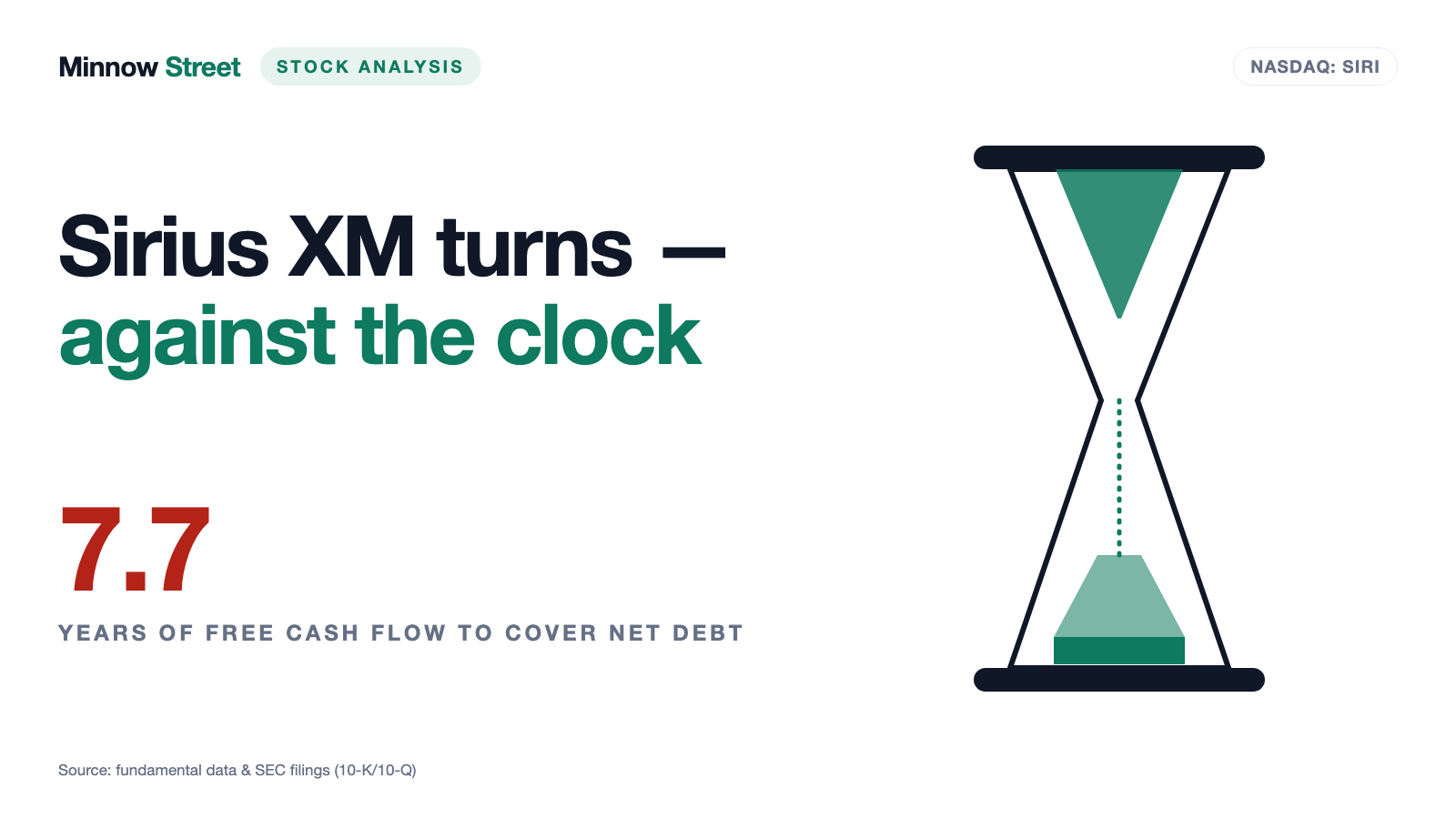
Honestly assessed: a price-to-book ratio below one only counts as an argument if you believe the book value — and 77 percent of it here is goodwill and FCC licenses, precisely the kind of value that shrank by $2,819 million inside a single quarter in 2024. A single-digit forward earnings multiple alongside a 3.6 percent dividend yield and a payout ratio near 36 percent is nonetheless no accident: the market is demanding a hefty discount for shrinking user numbers and a debt load that ties up 7.7 years of 2025 free cash flow. The professionals are split accordingly — of 15 usable ratings, 5 sit at buy, 5 at hold and 5 at sell, with an average target price of $28.38 (data as of July 25, 2026). A rare picture: near-perfect disagreement.
One more item belongs in the calculation. The $575 million convertible note carrying a 3.75 percent coupon, assumed from Liberty Media, converts into stock until March 2028 at roughly $31.33 a share (conversion rate 31.9200 shares per $1,000 of principal, as of March 31, 2026). Fully converted, that is about 18.4 million additional shares, or 5.5 percent of the current count. Dilution means your slice of the cake gets smaller without the cake growing.
Opportunities and risks at a glance
Opportunities:
- The operating turn is backed by numbers: first-quarter 2026 revenue positive again (up 1.1 percent), operating income up 17 percent, free cash flow tripled to $171 million.
- Dependable cash generation: $1,256 million in 2025 after $1,015 million — enough for the dividend ($364 million a year), capital spending and debt service.
- Churn is falling (1.5 percent monthly after 1.6 percent), and net self-pay losses in the first quarter of 2026 shrank 63 percent against the prior-year quarter.
- A distribution channel nobody can copy: factory-installed receivers in new cars, plus the 360L platform in a growing number of models.
- Valuation discount: roughly 10 times forward estimates, 0.86 times book, a 3.6 percent dividend yield at a 36 percent payout ratio.
- From September 2026 the two-year restrictions of the tax agreement fall away — the $1,003 million of remaining buyback authorization could start moving.
Risks:
- 77 percent of the balance sheet is goodwill and FCC licenses; $2,819 million of it was written off in a single quarter in 2024. A price-to-book ratio below one is only as solid as those assumptions.
- $9,760 million of total debt against $75 million of cash; net debt ties up 7.7 years of 2025 free cash flow. $1,595 million matures in 2027 and $2,575 million in 2028.
- Refinancing raises debt service: 3.125 percent out, 5.875 percent in — roughly $30 million more interest a year without any reduction in the debt total.
- The base keeps shrinking: SiriusXM lost 299,000 subscribers in 2025, Pandora lost 5 percent of its monthly active users year over year.
- About a third of revenue leaves as revenue share and royalties ($2,850 million in 2025) — rising music rights hit the margin directly.
- Litigation continues: on April 1, 2026 the New York attorney general obtained an injunction and accounting over the subscription cancellation claim, and the Mechanical Licensing Collective is suing Pandora for higher royalties.
- Concentration among holders: Berkshire Hathaway held roughly 37.1 percent as of April 2, 2026; John C. Malone has cut his stake to 5.5 percent and written call options on further shares.
A human conclusion
Back to the chart-memory trap from the opening. The chart you may have glanced at belongs to a company that has existed in this form only since September 9, 2024 — new legal person, new employer identification number, shares consolidated ten to one, and a tax agreement that ties its hands for two years. Read only the curve and you see none of that. Read the filings and you see two things: the business genuinely is turning — costs are down, cash is building, churn is easing. And at the same time the profit is spoken for over years, because a debt load has to be served that just got more expensive, and because equity rests on carrying values that once shrank by almost three billion dollars in a single quarter.
Whether that is cheap or merely looks cheap comes down to one question no scanner can answer: will enough people keep paying for radio in the car when a phone sits in the same dashboard? The turn check says 7 out of 8. The balance sheet says: bring patience. What you do with that is your decision. And that is exactly as it should be.
Sources
Every original document used in this analysis — read them yourself:
- Sirius XM Holdings Inc. — SEC annual report on Form 10-K for 2025 (filed February 5, 2026)
- Sirius XM Holdings Inc. — SEC quarterly report on Form 10-Q as of March 31, 2026 (filed April 30, 2026)
- Sirius XM Holdings Inc. — SEC proxy statement DEF 14A for the 2026 annual meeting (filed April 10, 2026)
- Sirius XM Holdings Inc. — SEC current report on Form 8-K dated March 5, 2026, Item 1.01 (5.875% notes due 2032)
- Sirius XM Holdings Inc. — SEC current report on Form 8-K dated March 10, 2026 (settlement of the tender offer)
- Sirius XM Holdings Inc. — SEC current report on Form 8-K dated June 1, 2026 (annual meeting results)
- Sirius XM Holdings Inc. — SEC Form 15-12G dated September 10, 2024 (reporting obligations of the old entity)
- John C. Malone — SEC Schedule 13D/A dated June 10, 2026 (holding in Sirius XM Holdings)
- Full SEC filing history of Sirius XM Holdings Inc.: EDGAR overview (sec.gov)
- Fundamental data (valuation, analyst picture, share count; data as of July 25, 2026), reconciled against the SEC filings.
- Hook: rank 10 of 62 U.S. hits in our in-house turnaround candidates scanner, turn check 7 out of 8, as of July 25, 2026 — the lists are recalculated daily.
Transparency & disclaimer: this analysis is journalistic commentary on publicly available information. It is not investment advice, not a regulated financial analysis and not a solicitation to buy or sell securities. Equity investments carry substantial risk up to and including total loss. All information without warranty; the data date is noted throughout the text. The author holds no position in Sirius XM shares at the time of publication.
Our Bottom Line at a Glance
- Operating turn positive
- In the first quarter of 2026 revenue rose for the first time in years — up 1.1 percent to $2,091 million — while operating income gained 17 percent to $454 million and free cash flow 205 percent to $171 million. For full-year 2025 free cash flow reached $1,256 million after $1,015 million. Monthly self-pay churn fell from 1.6 percent to 1.5 percent.
- Balance sheet quality negative
- Of $27,147 million in total assets as of March 31, 2026, $12,390 million is goodwill and $8,610 million FCC licenses — together 77 percent. In 2024 the company wrote off $2,819 million of that in a single quarter, which explains the $1,665 million annual loss. Cash last stood at $75 million.
- Leverage and refinancing negative
- Total debt of $9,760 million as of March 31, 2026, slightly above the $9,717 million at year-end 2025 — despite the refinancing. The new note pays 5.875 percent instead of 3.125 percent, roughly $30 million more interest a year. $1,595 million matures in 2027 and $2,575 million in 2028; net debt ties up 7.7 years of 2025 free cash flow.
- User trend negative
- SiriusXM lost a net 299,000 subscribers in 2025, ending at 32.927 million; self-pay subscribers fell from 31.646 million to 31.345 million and further to 31.234 million in the first quarter of 2026. Pandora monthly active users dropped 5 percent year over year to 40.068 million (March 31, 2026). The revenue gain came from price increases, not growth.
- Structure and ownership neutral
- The tax sharing agreement with Liberty Media has restricted share repurchases and combinations for two years since September 9, 2024 and may, per the annual report, prevent a change of control — $1,003 million of the $1,166 million buyback authorization is unused. Berkshire Hathaway held roughly 37.1 percent as of April 2, 2026, while John C. Malone cut his stake to 5.5 percent.
- Valuation positive
- At roughly $10.0 billion of market capitalization (data as of July 25, 2026) the price-to-earnings ratio is about 13 trailing and around 10 forward, price-to-book 0.86, and the dividend yield about 3.6 percent at a 36 percent payout ratio. The discount is real — but it is also the price charged for debt and a shrinking user base.
Sirius XM is a turnaround in which both halves of the word hold. It genuinely is turning — revenue positive again in the first quarter of 2026, operating income up 17 percent, free cash flow tripled to $171 million — and it genuinely is a bet, because the profit is spoken for over years. $9,760 million of debt stands against $75 million of cash, the March 2026 refinancing costs roughly $30 million more interest a year, and 77 percent of the balance sheet is goodwill and FCC licenses — the same kind of value that shrank by $2,819 million in a single quarter in 2024. On top of that the subscriber base is still shrinking, only more slowly. Anyone buying here is buying a company that has legally existed only since September 9, 2024. Not investment advice.
What Our Rating Means
Open questions
The business works in principle, but one material question is open. As long as it stays open, our findings do not carry a quality verdict.
The scanner's four operating turn points are backed by numbers, and the valuation prices in plenty of skepticism. What is missing is proof that the turn lasts longer than one quarter of price increases. If you wait, check three things in the coming reports. Do net self-pay additions finally turn positive after minus 111,000 in the first quarter of 2026? Do buybacks accelerate once the two-year window of the tax agreement closes in September 2026 — only $21 million of the $1,003 million authorization was used last quarter? And does total debt finally fall below the $9,760 million of March 31, 2026? While those three answers are open, this is a watch position rather than a conviction. The decision is yours.
A journalistic assessment by our editorial team at the time of the deep dive, based on public sources — not investment advice and not a solicitation to buy or sell. Your personal circumstances (investment goals, risk capacity, taxes) cannot be taken into account. What our levels mean, how verdicts are formed, and what conflicts of interest exist →
Worth Noting
- Sirius XM reached our research list through our in-house turnaround candidates scanner: rank 10 of 62 U.S. hits with a turn check of 7 out of 8, as of July 25, 2026. The scanner lists are recalculated daily, so the rank can change.
- Risk of confusion: today's Sirius XM Holdings Inc. is the former Liberty Sirius XM Holdings Inc. and has existed only since September 9, 2024; the old company of the same name has since been called Sirius XM Inc. and is a subsidiary. SEC file number 001-34295 and CIK 0000908937 carried over, the employer identification number did not. Each old share was exchanged for one-tenth of a new one — charts before that date are not comparable without adjustment. The Form 15-12G dated September 10, 2024 ends only the old entity's reporting obligations.
- Data dates: balance sheet and income figures as of December 31, 2025 (Form 10-K) and March 31, 2026 (Form 10-Q); ownership from the 2026 proxy statement (as of April 2, 2026) and the Schedule 13D/A dated June 10, 2026; valuation metrics as of July 25, 2026. The 2023 to 2025 series is stated throughout on today's reporting basis — older figures of the predecessor entity are not comparable.
Frequently Asked Questions
Sirius XM Holdings Inc. (Nasdaq: SIRI), based in New York, runs two audio businesses. SiriusXM is a subscription service: hundreds of music, sports, comedy and news channels delivered via satellite and terrestrial repeaters into cars, phones and connected speakers — 32.927 million U.S. subscribers held one as of December 31, 2025. Pandora is the ad-supported streaming platform with 40.068 million monthly active users as of March 31, 2026. Combined, the company estimates it reaches roughly 170 million listeners a month.
Because on September 9, 2024 every old share was exchanged for one-tenth of a new one. That day Liberty Media split off its subsidiary Liberty Sirius XM Holdings, which merged with old Sirius XM Holdings and was renamed Sirius XM Holdings Inc. The old entity has since been called Sirius XM Inc. and is a subsidiary. The 2025 annual report records that the new entity succeeded to the Commission file number and CIK number of the old one — CIK 0000908937 — while carrying its own employer identification number.
No. The Form 15-12G dated September 10, 2024 terminates only the reporting obligations of the old entity, since renamed Sirius XM Inc. and now a wholly owned subsidiary. The form says so in as many words: it relates solely to Old Sirius and does not affect the obligations of the successor. Today's Sirius XM Holdings Inc. keeps filing without a gap — most recently the annual report on Form 10-K on February 5, 2026 and the quarterly report on Form 10-Q on April 30, 2026.
Not according to the SEC file. Since the 2024 Liberty transaction there has been no merger proxy (DEFM14A or PREM14A) and no SC 13E-3. The current report on Form 8-K dated March 5, 2026 with Item 1.01 concerns a note issuance, not a combination. The annual report also notes that the indemnity obligation under the tax sharing agreement with Liberty Media might discourage, delay or prevent a change of control for some period after the split-off.
Total debt stood at $9,760 million as of March 31, 2026 against cash of $75 million. Net debt therefore equals roughly 7.7 years of 2025 free cash flow ($1,256 million). The commitments table shows $1,595 million maturing in 2027 and $2,575 million in 2028. The $2,000 million revolving credit facility runs to August 31, 2030 and had $1,930 million available at the reporting date.
The board approved a $1,166 million repurchase on September 9, 2024. By March 31, 2026 only $164 million had been used, leaving $1,003 million available. The annual report gives the reason: the tax sharing agreement with Liberty Media imposes restrictions for two years after the split-off to preserve its tax-free status — expressly including the repurchase of common stock. That two-year period has been running since September 9, 2024.
Per the 2026 proxy statement, Berkshire Hathaway held 124,807,117 shares, or 37.1 percent, as of April 2, 2026; The Vanguard Group held 18,320,515 shares, or 5.4 percent; and John C. Malone held 22,049,882 shares, or 6.6 percent, as of February 28, 2026. Malone reported only 18,420,796 shares, or 5.5 percent, on June 10, 2026: he donated two million shares on April 8, 2026 and sold 1,591,604 shares on April 21 at a volume-weighted average of $26.67.
Yes. The board declared a quarterly dividend of $0.27 a share on January 29, 2026, paid February 27, 2026, and declared $0.27 again on April 23, 2026, paid May 27, 2026. That is $91 million a quarter and $1.08 a share annualized — roughly a 3.6 percent yield at the July 25, 2026 data date, with a payout ratio near 36 percent of earnings.
Found an error?
Did you spot a factual error, an outdated number, or a typo in this deep dive? Let us know briefly — your report goes straight to the editorial team.