FactSet: They Sell AI — and the Same Annual Report Explains Why AI Makes Their Business Cheaper
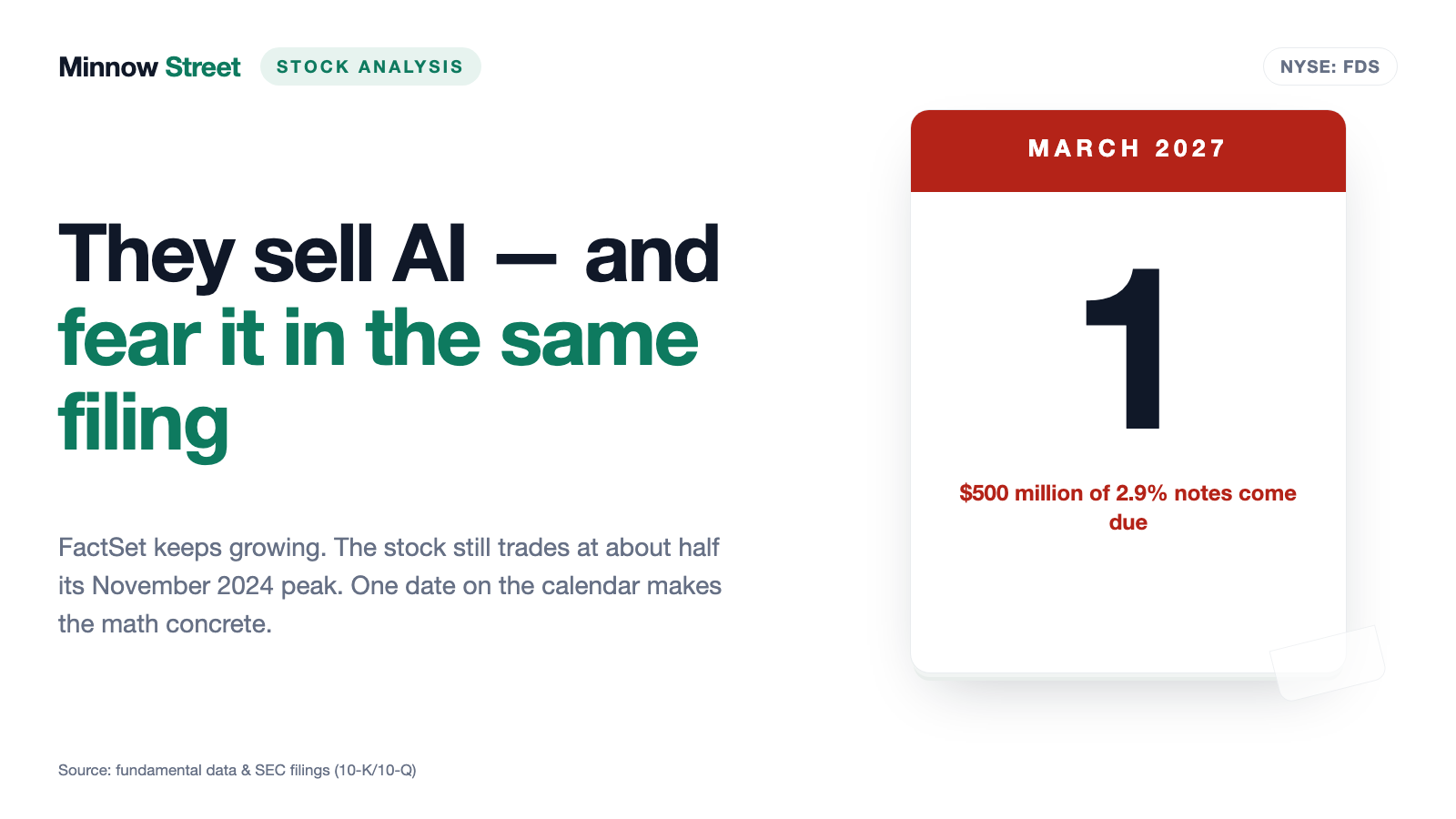
FactSet supplies the world's money managers with their numbers, and it has grown without a break for years: organic annual subscription value reached $2,485.6 million on May 31, 2026, up 7.1 percent year over year. The stock still trades at roughly half its all-time high of November 14, 2024. The reason is not on the revenue line but two lines below it: operating margin fell to 26.7 percent in the third quarter of fiscal 2026 from 33.2 percent — and even excluding every one-time item, from 36.8 to 34.0 percent. AI appears twice in the annual report: once as a source of revenue, once as a reason clients may pay less in the future. Not investment advice — just the question of what the filings say when you read them to the end.
 Thomas Mücke
Founder & Publisher
Thomas Mücke
Founder & Publisher
Chart
Interactive price chart (TradingView).
Note: pure fact-based analysis, not investment advice and not a solicitation to buy or sell. All figures without guarantee.
There is an investor trap that feels especially smart, because it looks like forward thinking: the death-certificate reflex. It works like this — a new technology shows up, somebody says "that will eat this entire industry," and your brain issues the company a death certificate on the spot. After that you never check whether it is actually earning less. FactSet Research Systems (NYSE and Nasdaq: FDS) is exactly such a case right now: a financial data supplier that many have written off since the arrival of large language models, on the assumption that its work will soon be done by an AI that answers questions for free. As of late July 2026 the stock trades at roughly half its all-time high of $499.87, reached November 14, 2024. So let us make a deal: before we sign the certificate, we read together what the company itself told the U.S. securities regulator, the SEC — the quarterly report (10-Q) for the period ended May 31, 2026 and the annual report (10-K) for fiscal 2025. An SEC filing is honest under penalty of law. And this one tells a more uncomfortable story than "AI kills data vendors": revenues are growing, subscription value is growing, the client count is growing — and yet less of it sticks every year.
What FactSet Actually Does — the Toolbox of the Money Managers
FactSet does not sell stocks and does not manage money. It sells the tools other people use to manage money. Put in everyday terms: if portfolio managers, investment bankers and wealth advisors are the tradespeople, FactSet is the toolbox — data on securities, companies, industries and people, plus analytical applications, a desktop workstation, application programming interfaces for clients’ own systems, and managed services that operate like an outsourced department. It is paid for by subscription, and that is where the model gets its calm. The metric the company measures itself by is ASV (annual subscription value): the revenues that all currently supplied subscriptions would produce over the next twelve months. As of May 31, 2026, organic ASV stood at $2,485.6 million, up 7.1 percent year over year. "Organic" here means excluding acquisitions, dispositions and currency movements — the comparison you actually want.
The client base leans to the buy side: 82 percent of organic ASV came from asset managers, asset owners and hedge funds as of August 31, 2025, and 18 percent from the sell side — brokers, banks, advisory firms, private equity and venture capital. As of May 31, 2026, FactSet counted 9,130 clients (clients with ASV of $10,000 and above) and 247,766 users, up 3.6 and 12.4 percent respectively in a year. Headcount on that date was 12,694, of whom 8,765 were in Asia Pacific, 2,476 in the Americas and 1,453 in Europe, the Middle East and Africa; roughly 68 percent of employees work in the company’s centers of excellence, mostly in India. Anyone wondering how this business can carry such a high margin will find part of the answer right there: the data is prepared where an hour of work costs less.
Which brings us to the central tension of this analysis, and it runs through every chapter that follows: the same annual report sells AI as a growth driver and names AI as the reason clients may pay less in the future. Both can be true for a while — but not indefinitely at the same price.
Where the Stock Landed on Our Desk
FactSet reached our research list through our in-house stock scanner "Turnaround-Kandidaten": rank 7 of 62 U.S. hits, turnaround check 7 of 8, as of July 25, 2026. These lists are recomputed daily, so the ranking is a dated snapshot, not a permanent state. The scanner looks for a fixed pattern: first the stock has to have genuinely collapsed, then the company has to be able to survive the drought, and only then does the actual turnaround check apply — eight points, four drawn from the quarterly numbers (revenue direction, net margin, operating cash flow, balance-sheet healing) and four from market behavior (price above the 50-day line, relative strength, net insider buying, institutional accumulation). Seven out of eight means: on paper, something here is turning.
The price side fits the first part of that pattern. From its all-time high of $499.87 on November 14, 2024, the stock fell to $185.00 on February 17, 2026 — a decline of 63.0 percent. On July 24, 2026 it closed at $254.36, roughly 49 percent below the record. A price is never a buy argument for us, but it is a dated valuation anchor, and we need it later for the math. The more interesting question is this: if the price has halved, where exactly did the business break? Because the revenue line offers no explanation — as the next section shows.
The Numbers Over the Years — Given Their Due
First, what genuinely impresses. FactSet is a growth machine with a very quiet engine. Across the four fiscal years 2022 through 2025 — each ending August 31 — revenues rose from $1,843.9 million to $2,321.7 million and net income from $396.9 million to $597.0 million. No down year, no loss year, no break.
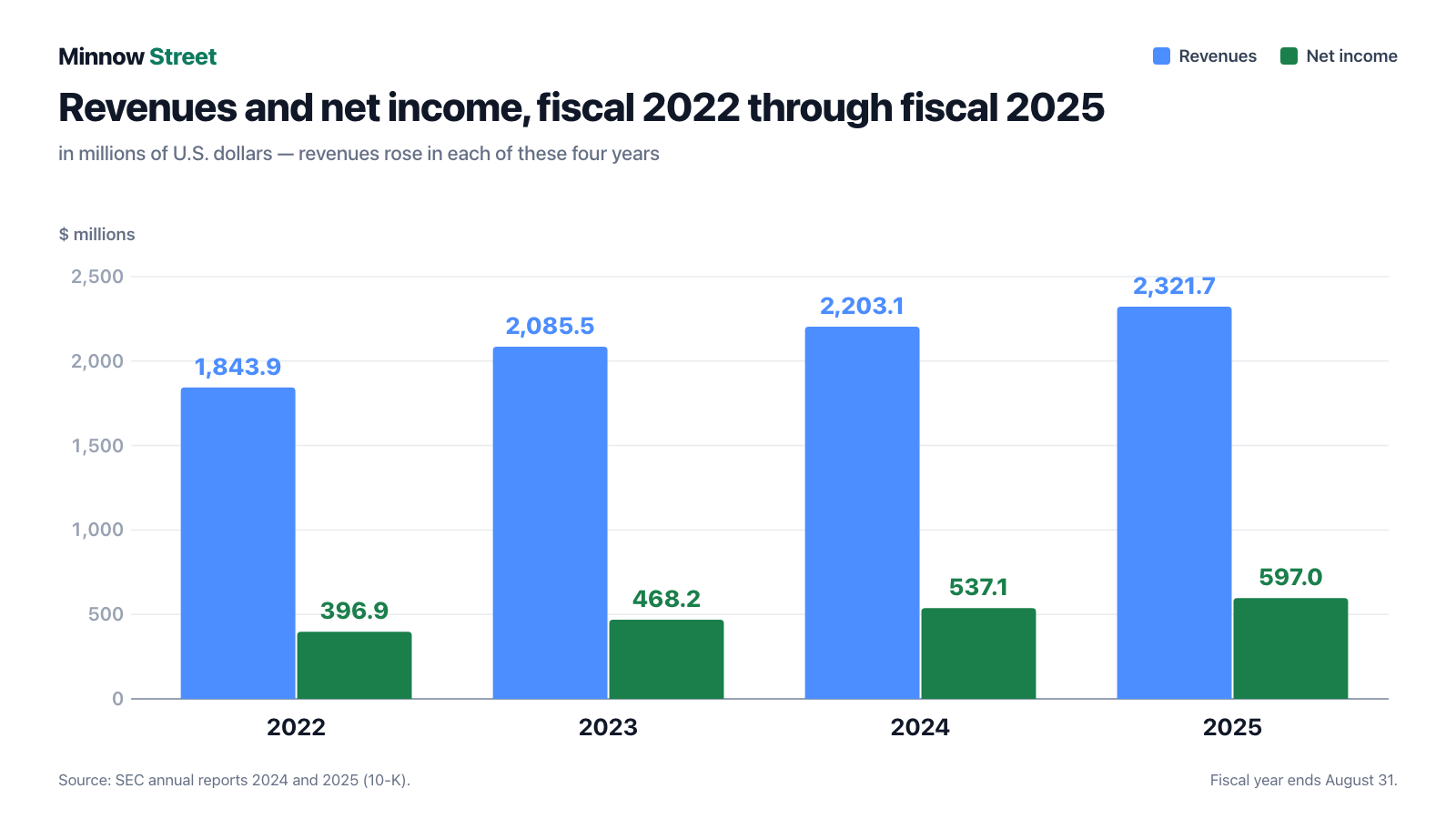
Fiscal 2026 continues the pattern. Over the first nine months (through May 31, 2026) revenues rose 6.8 percent to $1,841.6 million, and in the third quarter alone 6.4 percent to $622.9 million. Free cash flow — the money actually left after all investment — was $254.0 million in the third quarter, 11.1 percent above the prior year period. Client loyalty is high: of every hundred dollars of subscription value, more than 95 were renewed as of May 31, 2026, unchanged year over year. And the dividend rose in the third quarter of fiscal 2026 from $1.10 to $1.16 per share — according to the company, the twenty-seventh consecutive year of increases. Companies that manage that are rare.
Read only those paragraphs and the halved share price makes no sense. So let us go one line deeper.
What the Filings Say — the Uncomfortable Truths
Uncomfortable Truth No. 1: The Margin Falls Even After Stripping Out Every One-Time Item
In the third quarter of fiscal 2026 the operating margin was 26.7 percent — down from 33.2 percent a year earlier. That is the real break. There are visible one-time reasons: restructuring and severance charges of $19.6 million (prior year period: none) and CEO compensation costs of $4.3 million (prior year period: none). Together $23.9 million, against a decline in operating income of $27.9 million. So one could say: almost all of it is non-recurring, nothing to worry about.
The company itself does not say that. Its own adjusted presentation removes the one-time items and acquisition-related intangible amortization — and still arrives at an adjusted operating margin of 34.0 percent, down from 36.8 percent. Over nine months: 35.1 percent versus 37.2 percent. That is 2.8 and 2.1 percentage points respectively that no one-time item explains.
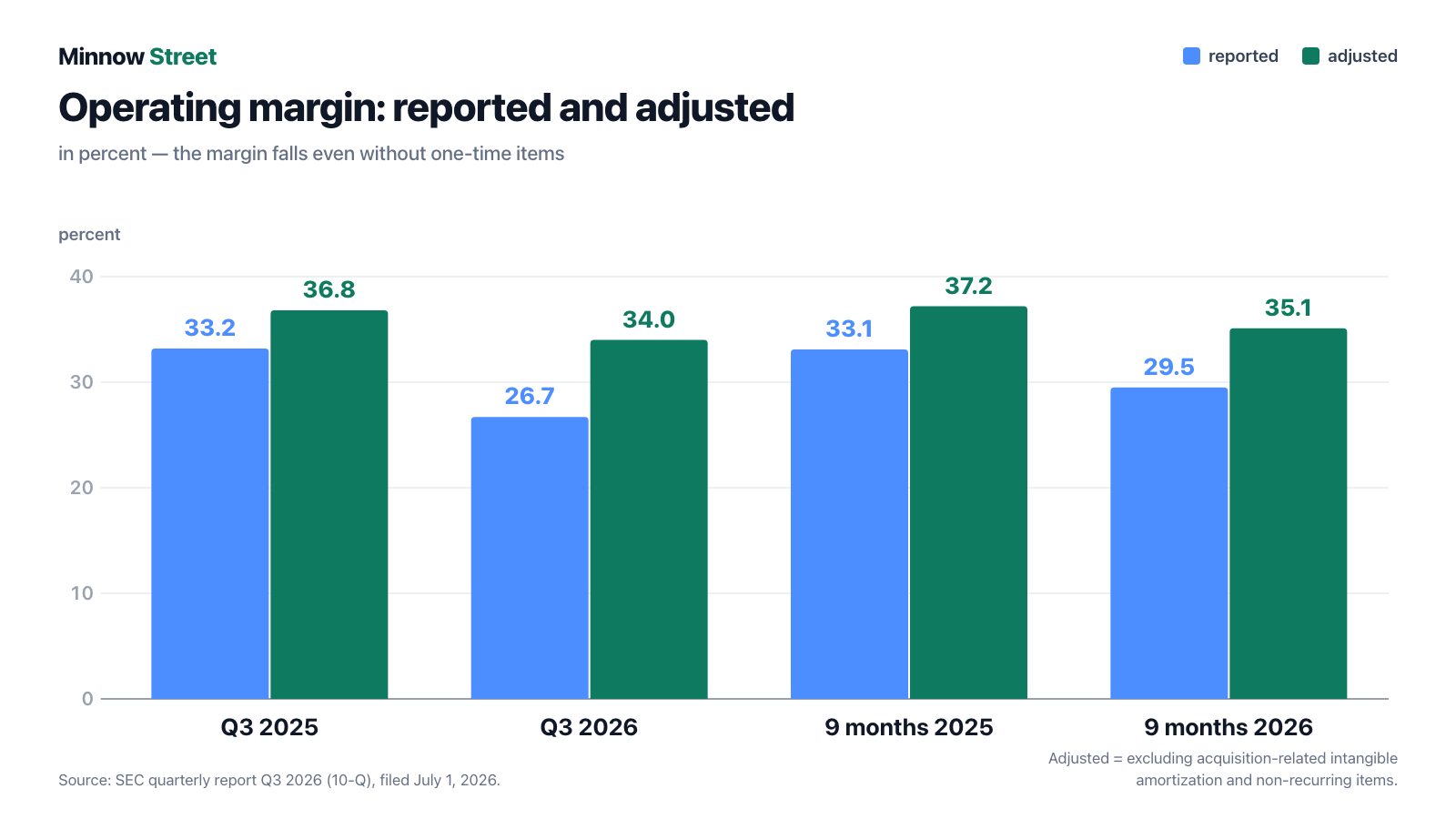
Where does the rest come from? The quarterly report is refreshingly specific. Technology-related expenses rose 40 basis points as a share of revenues in the third quarter — driven by cloud hosting, licensed software and, verbatim, AI token consumption. That is a cost line you would not have found in an annual report a few years ago:

Remember the sentence: AI costs first and pays later — and "later" has no date yet. Anyone wanting to see the other side of that trade will find it at the companies this money flows to: our NVIDIA analysis describes the same phenomenon from the receiving end of the invoice.
Uncomfortable Truth No. 2: The Same Report Sells AI and Warns About It
In the business strategy section of the fiscal 2025 annual report, AI sounds like revenue — and explicitly so, not as an aspiration:
"Our AI roadmap, driven by our FactSet AI Blueprint, is resonating with our clients, and FactSet's AI solutions are generating usage, demand and commercial transactions."
— FactSet Research Systems Inc., Form 10-K for fiscal 2025, Item 1 "Business"

About 150 pages later, in the risk factors of the same document, comes the other half of the sentence. It concerns a danger that has existed since the internet — and that AI tools make larger:
"Each year, an increasing amount of free or relatively inexpensive information becomes available, particularly through the internet, and this trend is likely to continue, especially with the deployment of AI tools."
— FactSet Research Systems Inc., Form 10-K for fiscal 2025, Item 1A "Risk Factors"

The same risk section contains another sentence that could hardly be plainer: third parties may be able to use AI to create technology that could reduce demand for the company’s products and services. And still it would be wrong to turn that into a death certificate, because the other side is documented too. As of the quarter ended May 31, 2026, per the earnings release of July 1, 2026, more than 90 percent of the top 50 clients used four or more AI products, and enterprise renewals in the quarter extended in length by 30 percent on average. On top of that, former chief technology officer Kate Stepp was named chief AI officer on March 2, 2026 — a role the company did not have before. This is not a business asleep at the wheel. It is a business standing on both sides of the same bet. For a contrast — what it looks like when AI appears in a filing as little more than a word — see our Magnachip analysis.
Uncomfortable Truth No. 3: The Data Supplier Does Not Have Its Own Controls Under Control
I had to read this paragraph twice. Under "Controls and Procedures" in the quarterly report for the period ended May 31, 2026, there is no routine check mark but the opposite:
"Our Principal Executive Officer and Principal Financial Officer have concluded that our disclosure controls and procedures were not effective as of May 31, 2026 due to a material weakness in internal control over financial reporting."
— FactSet Research Systems Inc., Form 10-Q for the quarter ended May 31, 2026, Part I Item 4 "Controls and Procedures"

What does "material weakness" mean? In everyday terms: it is not an accusation that the numbers are wrong, but a finding that the safety net has holes through which an error could fall unnoticed. Specifically it concerns IT general controls — user access and program change management in the systems supporting revenues, accounts receivable and deferred revenues. The finding was first identified as of August 31, 2024, was not remediated as of August 31, 2025, and is still not remediated as of May 31, 2026 — the third reporting year in a row. The company stresses that no misstatements resulted in the fiscal 2023 through 2025 financial statements, describes extensive remediation including outside accounting advisers, and names a target: completion during fiscal 2026, which ends August 31, 2026. For a supplier whose entire promise is "our data is right," this remains the most uncomfortable paragraph in the whole filing.
Uncomfortable Truth No. 4: Tangible Equity Is Negative $1.12 Billion — and Half a Billion Comes Due in March 2027
The balance sheet as of May 31, 2026 looks solid at first glance: $4,192.0 million in total assets, $2,032.3 million in stockholders’ equity. The second glance shifts the picture. Of those assets, $1,283.4 million is goodwill and $1,868.4 million is intangible assets — together $3,151.8 million, or 75.2 percent of everything on the asset side. That is the aftermath of the large 2022 acquisition, which also brought the debt into the house. Subtract both items from equity and you are left with tangible equity of negative $1,119.5 million. For a subscription business with no factories that is not unusual, but you should know that the book value here consists almost entirely of purchased positions rather than tangible assets.
Then there is a date. Total debt as of May 31, 2026 was $1,389.7 million against cash of $288.1 million. For the first time, $499.2 million of that sits in current liabilities: the 2027 notes, $500.0 million in principal at a 2.900 percent coupon, maturing March 1, 2027. That rate belongs to another era — the company’s own floating-rate facility bore interest at one-month Term SOFR plus 0.975 percentage points through May 31, 2026. The covenant, a contractual leverage ceiling of no more than 3.75 to 1.00, was met at the balance sheet date. What is notable is what FactSet did with its cash in the same period: over the first nine months of fiscal 2026 it repurchased 2,056,220 of its own shares for $506.0 million — 926,370 shares in the third quarter at an average of $219.21. After the balance sheet date, another $80.0 million was drawn on the revolving facility. The share count therefore fell from 37,645,870 (August 31, 2025) to 35,565,543 (June 25, 2026), a decline of 5.5 percent. That lifts earnings per share — and it consumes cash that will be needed in March 2027.
Valuation — What the Market Is Pricing In
Let us work in orders of magnitude rather than daily prices. At 35,565,543 shares outstanding (as of June 25, 2026, from the cover of the quarterly report) and a closing price of $254.36 on July 24, 2026, the market capitalization is about $9.0 billion. The company itself expects, as reaffirmed on July 1, 2026, fiscal 2026 revenues of $2,450 million to $2,470 million and diluted earnings per share of $14.85 to $15.35 (adjusted: $17.25 to $17.75). That implies a price-to-earnings ratio of roughly 16.6 to 17.1 on a reported basis and 14.3 to 14.7 on an adjusted basis. The price-to-sales ratio is about 3.7. Add the debt and subtract the cash and you get an enterprise value of roughly $10.1 billion, or a little over four times annual revenues. The dividend of $1.16 per quarter equals $4.64 annualized, about 1.8 percent on the price anchor above.
For context: a subscription business with more than 95 percent revenue retention and a 34 percent adjusted operating margin at 16 times reported earnings is historically not an expensive price — the same company cost roughly twice as much in late 2024. So the market is no longer paying up for quality; it is demanding a discount on the question of how long that quality remains billable. The professional view is split accordingly: of 21 recorded analyst opinions, two say strong buy, twelve say hold, three say sell and four say strong sell, with an average price target of $255.06 (as of July 25, 2026) — practically the previous day’s price. Translated: the guild will not commit in either direction.
Opportunities and Risks at a Glance
What speaks for FactSet:
- Recurring revenues with strong retention: organic ASV of $2,485.6 million as of May 31, 2026 (up 7.1 percent), with more than 95 percent of ASV retained — unchanged year over year.
- Growth without a dip: revenues rose from $1,843.9 million to $2,321.7 million across fiscal 2022 through 2025, net income from $396.9 million to $597.0 million; the first nine months of fiscal 2026 are up 6.8 percent.
- Real cash generation: $254.0 million of free cash flow in the third quarter of fiscal 2026 alone (up 11.1 percent), $629 million returned to shareholders over nine months, and a twenty-seventh consecutive annual dividend increase.
- AI is actually being billed: more than 90 percent of the top 50 clients used four or more AI products as of May 31, 2026, and enterprise renewals in the quarter ran 30 percent longer on average.
- An in-house cost lever: roughly 68 percent of the 12,694 employees work in centers of excellence, mostly in India (8,765 employees in Asia Pacific as of May 31, 2026).
What speaks against it:
- The margin is falling structurally: adjusted operating margin of 34.0 percent versus 36.8 percent in the quarter, 35.1 versus 37.2 percent over nine months — one-time items do not explain that.
- AI is also on the cost side: technology-related expenses up 40 basis points, explicitly driven by cloud hosting, software licenses and AI token consumption.
- The company’s own risk factors name AI as a demand risk: more free information "especially with the deployment of AI tools" — written by the firm whose product is exactly that information.
- Internal controls not effective: a material weakness in IT general controls open since fiscal 2024, still unremediated as of May 31, 2026, with remediation targeted during fiscal 2026.
- Balance sheet and calendar: goodwill plus intangibles of $3,151.8 million against $2,032.3 million of equity (tangible equity negative $1,119.5 million); $500 million of 2.900 percent notes maturing March 1, 2027 against $288.1 million of cash.
- Leadership in transition: a new chief executive since September 8, 2025, a change of chief financial officer effective April 13, 2026, and a new chief AI officer since March 2, 2026 — a great deal of change in a short time.
A Human Conclusion
Back to the death-certificate reflex. Anyone who considers FactSet finished has not read the revenue line: subscription value is growing 7.1 percent, the client count is rising, the user count is rising by double digits, and retention remains above 95 percent. Not one of those markers looks like a business whose customers are walking out. Anyone who considers FactSet a bargain because the stock has halved has to look two lines lower: the adjusted margin has been falling for quarters, technology costs are rising, and the company’s own risk factors state in black and white that AI tools spread free information that can cost demand.
The honest summary is more uncomfortable than either extreme: FactSet is currently winning the revenue and losing the price. A subscriber who stays but pays less, or demands more for the same money, still looks fine on the ASV line and no longer looks fine on the margin line. That is exactly the pattern in the numbers through May 31, 2026. Whether it continues, or whether the AI products eventually earn more than they cost in tokens, will not be decided in a headline but in the coming filings — first in the annual report for the year ending August 31, 2026, which will also show whether the control weakness has finally been closed, and then on March 1, 2027, when the half billion comes due. What you make of that is your decision. And that is exactly as it should be.
Sources
- FactSet Research Systems Inc. — Form 10-Q for the quarter ended May 31, 2026 (filed July 1, 2026)
- FactSet Research Systems Inc. — Form 10-K for fiscal 2025 (filed October 22, 2025)
- FactSet Research Systems Inc. — Form 10-K for fiscal 2024 (filed October 29, 2024)
- FactSet Research Systems Inc. — Form 8-K earnings release, Exhibit 99.1, third quarter of fiscal 2026 (July 1, 2026)
- FactSet Research Systems Inc. — Form 8-K of March 4, 2026 (Item 5.02, appointment of the chief AI officer)
- FactSet Research Systems Inc. — Form 8-K of April 8, 2026 (Item 5.02, change of chief financial officer)
- Complete SEC filing history for FactSet Research Systems Inc.: EDGAR overview (sec.gov)
- Fundamental data (metrics, price history, analyst view; as of July 25, 2026), reconciled with the SEC filings.
- Hook: our in-house stock scanner "Turnaround-Kandidaten" — rank 7 of 62 U.S. hits, turnaround check 7 of 8, as of July 25, 2026; the lists are recomputed daily.
Transparency & disclaimer: this analysis is journalistic commentary on publicly available information. It is not investment advice, not a regulated financial analysis and not a solicitation to buy or sell securities. Equity investments carry substantial risk up to and including total loss. All information without warranty; the as-of date of each figure is noted in the text. The author holds no position in FactSet shares at the time of publication.
Our Bottom Line at a Glance
- Business model and client retention positive
- A subscription business with strong retention: organic annual subscription value of $2,485.6 million as of May 31, 2026 (up 7.1 percent), retention above 95 percent of ASV, 9,130 clients (up 3.6 percent) and 247,766 users (up 12.4 percent). Revenues rose without interruption from $1,843.9 million to $2,321.7 million across fiscal 2022 through 2025.
- Margin trajectory negative
- Operating margin fell to 26.7 percent in the third quarter of fiscal 2026 from 33.2 percent. One-time items (restructuring of $19.6 million, CEO compensation of $4.3 million) explain only part of it: even adjusted, the margin slipped from 36.8 to 34.0 percent in the quarter and from 37.2 to 35.1 percent over nine months. The company's own guidance of July 1, 2026 calls for 29.5 to 31.0 percent for the full year, after 32.2 percent in fiscal 2025.
- AI as both opportunity and threat neutral
- The fiscal 2025 annual report explicitly names the company's AI solutions as a source of usage, demand and commercial transactions; as of May 31, 2026 more than 90 percent of the top 50 clients used four or more AI products. The same report warns in its risk factors that ever more free information is becoming available, "especially with the deployment of AI tools." On the cost side, AI token consumption is driving technology-related expenses higher (up 40 basis points in the third quarter of fiscal 2026).
- Internal controls negative
- The principal executive officer and principal financial officer concluded that disclosure controls were not effective as of May 31, 2026. The underlying material weakness in IT general controls — which support revenues, accounts receivable and deferred revenues — was identified as of August 31, 2024 and is open for the third reporting year in a row. The company names fiscal 2026, ending August 31, 2026, as its remediation target.
- Balance sheet and maturities negative
- Goodwill ($1,283.4 million) and intangible assets ($1,868.4 million) make up 75.2 percent of total assets and exceed stockholders' equity of $2,032.3 million by $1,119.5 million. On March 1, 2027, $500 million of 2.900 percent notes come due — against cash of $288.1 million as of May 31, 2026, after $506.0 million had gone into share repurchases over nine months and a further $80.0 million was drawn on the revolver after the balance sheet date.
- Valuation neutral
- A market capitalization of about $9.0 billion (35,565,543 shares at the $254.36 close of July 24, 2026) equals roughly 16.6 to 17.1 times the company's own fiscal 2026 earnings guidance and about 3.7 times guided revenues. For a subscription business with a 34 percent adjusted margin that is historically cheap; the average analyst price target of $255.06 (as of July 25, 2026) sits practically at the market price, with 12 of 21 opinions on hold.
FactSet is neither the victim its share price suggests nor the bargain the halved quote implies. The subscription business keeps growing (organic annual subscription value of $2,485.6 million as of May 31, 2026, up 7.1 percent), but the margin is falling even on an adjusted basis (34.0 percent versus 36.8 percent in the third quarter of fiscal 2026), and the company's own annual report names AI both as a source of revenue and as a reason free information may reduce demand. Add two hard facts from the latest filing: a material weakness in internal control open since fiscal 2024, and $500 million of 2.900 percent notes maturing March 1, 2027. Not investment advice.
Worth Noting
- FactSet reached our research list through our in-house stock scanner "Turnaround-Kandidaten": rank 7 of 62 U.S. hits, turnaround check 7 of 8, as of July 25, 2026. These lists are recomputed daily, so the ranking is a dated snapshot.
- The fiscal year ends August 31. References to the "third quarter of fiscal 2026" mean the quarter ended May 31, 2026 (reported July 1, 2026); references to "fiscal 2025" mean the year ended August 31, 2025. Anyone comparing FactSet with calendar-year reporters has to allow for that shift.
- Prices are dated valuation anchors, not buy arguments: close of $254.36 on July 24, 2026, all-time high of $499.87 on November 14, 2024, low of $185.00 on February 17, 2026. The share count of 35,565,543 comes from the cover of the quarterly report (as of June 25, 2026).
- Possible confusion: FDS is dual listed — on the New York Stock Exchange and on the Nasdaq Stock Market. The ticker does not refer to any of the several similarly named funds or index products.
Frequently Asked Questions
FactSet Research Systems Inc. (NYSE and Nasdaq: FDS), based in Norwalk, Connecticut, sells financial data, analytical applications and workstations to the investment industry — asset managers, banks, wealth advisors and private capital firms. It is paid by subscription. As of May 31, 2026 the company counted 9,130 clients and 247,766 users with 12,694 employees. Roughly 82 percent of subscription value came from the buy side as of August 31, 2025.
Because the problem is not revenue but margin. Revenues rose 6.4 percent to $622.9 million in the third quarter of fiscal 2026, yet the operating margin fell from 33.2 to 26.7 percent. Even adjusted for restructuring, CEO compensation and intangible amortization it slipped from 36.8 to 34.0 percent. From an all-time high of $499.87 on November 14, 2024, the stock fell to $185.00 on February 17, 2026.
ASV stands for annual subscription value and represents the revenues all currently supplied subscriptions would generate over the next twelve months. Organic ASV excludes acquisitions, dispositions and currency movements. As of May 31, 2026 it stood at $2,485.6 million, up 7.1 percent or $165.0 million year over year. The Americas accounted for 65 percent, EMEA for 24 percent and Asia Pacific for 11 percent.
The company says both things itself. The fiscal 2025 annual report states that its AI solutions are generating usage, demand and commercial transactions, and it warns in the risk factors that ever more free information is becoming available, "especially with the deployment of AI tools," which may reduce demand for its products. As of May 31, 2026, more than 90 percent of its top 50 clients used four or more of its AI products.
On August 31. Fiscal 2026 therefore runs from September 1, 2025 through August 31, 2026; the third quarter of that year ended May 31, 2026 and was reported on July 1, 2026. Anyone comparing FactSet with calendar-year reporters has to allow for that four-month shift — otherwise fiscal 2025 (through August 31, 2025) is being compared with a calendar year that ends four months later.
The principal executive officer and principal financial officer concluded that disclosure controls were not effective as of May 31, 2026. The cause is a material weakness in the IT general controls supporting revenues, accounts receivable and deferred revenues. The finding was first identified as of August 31, 2024 and has been open since. The company states that no misstatements resulted and names fiscal 2026, ending August 31, 2026, as its remediation target.
At 35,565,543 shares outstanding (as of June 25, 2026) and a closing price of $254.36 on July 24, 2026, the market capitalization is about $9.0 billion. Measured against the company's own fiscal 2026 guidance of $14.85 to $15.35 in reported diluted earnings per share, that is roughly 16.6 to 17.1 times earnings, or 14.3 to 14.7 times on an adjusted basis. The price-to-sales ratio is about 3.7 and the dividend yield about 1.8 percent.
As of May 31, 2026, total debt stood at $1,389.7 million against cash of $288.1 million. Of that, $499.2 million is current: the 2027 notes, $500.0 million in principal at a 2.900 percent coupon, maturing March 1, 2027. Alongside them are the 2032 notes of $500.0 million at 3.450 percent, a $375.0 million term facility maturing April 8, 2028, and $20.0 million drawn on the revolver; a further $80.0 million was drawn after the balance sheet date.
Found an error?
Did you spot a factual error, an outdated number, or a typo in this deep dive? Let us know briefly — your report goes straight to the editorial team.