Shift4 Payments: Revenue Up a Third, and Common Holders Are Down a Penny
Shift4 runs card payments for restaurants, hotels, stadiums and theme parks. Gross revenue hit $4,180 million in 2025 and rose another 32 percent to $1,121 million in the first quarter of 2026. In that same quarter common stockholders were left with a loss of one million dollars. In between sits a $2.7 billion price tag for Global Blue, a debt load that has tripled in two and a half years, and a market capitalization our own data source overstates by a quarter. We did the arithmetic ourselves — line by line, with the annual report on the table.
 Thomas Mücke
Founder & Publisher
Thomas Mücke
Founder & Publisher
Chart
Interactive price chart (TradingView).
Note: pure fact-based analysis, not investment advice and not a solicitation to buy or sell. All figures without guarantee.
The big number that isn't one
There is a weakness that catches all of us, and it has no fancy name. It goes like this: we believe the biggest number in the room. Put "$4.18 billion in revenue" on a page and the mind immediately starts thinking in that order of magnitude — before it has read a single line underneath.
With Shift4 Payments, that is exactly the trap. Gross revenue of $4,180 million in 2025 is real. It is simply not what most people take it for. More than half of it never belongs to Shift4: those are the fees that go to Visa, Mastercard and the card-issuing banks. Shift4 collects them, books them as revenue and passes them on.
The deal for the next twenty minutes: we read the real numbers together. The annual report for 2025, the quarterly report for the period ended March 31, 2026, and everything filed with the U.S. securities regulator, the SEC, since then. No recommendation, no price targets. Only what is in the documents — and what follows from it.

What Shift4 actually does
Picture the card reader on the counter of your favorite restaurant. Someone put it there, someone connected it to the register, someone makes sure the money reaches the owner's account the next morning, and someone takes a few cents out of every payment for the trouble. At roughly 200,000 businesses in America, that someone is Shift4.
The company was founded in 1999 by Jared Isaacman — then 16 years old, working out of his parents' basement. It listed on the New York Stock Exchange in 2020 and today runs three lines. First, card processing itself, called payments-based revenue, at $3,471 million in 2025. Second, software subscriptions for point-of-sale systems, mostly under the SkyTab brand, at $454 million. And third, new since July 2025: tax-free shopping, the VAT refund business for travelers, reported as TFS, at $255 million in a partial year.
That third line arrived through the largest acquisition in the company's history. On July 3, 2025 Shift4 took over Switzerland's Global Blue — the company whose forms you fill out at the airport when you want the VAT back on a handbag.
"On July 3, 2025, we completed the acquisition of Global Blue by acquiring approximately 97.4% of the Global Blue shares outstanding. […] Total purchase consideration amounted to approximately $2.7 billion of cash."
— Shift4 Payments, Form 10-K for 2025, Item 1
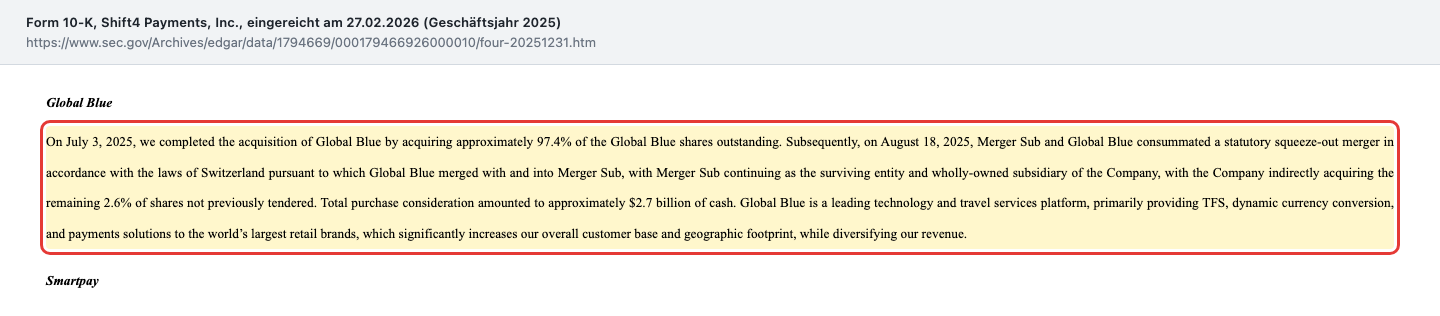
On August 18, 2025 a statutory squeeze-out merger under Swiss law followed: the remaining 2.6 percent of Global Blue holders were bought out for $47 million. Two further deals came on top — Smartpay Holdings of New Zealand on November 4, 2025 for NZ$325 million ($186 million), and on March 2, 2026 the North American business of Worldline, which trades as Bambora, for roughly $92 million and more than 140,000 merchants.
As of December 31, 2025 Shift4 employed roughly 6,300 people, 33 percent of them in the United States and 67 percent across 59 other countries. Some 2,500 of those roles arrived through acquisitions during 2025 alone. If you want to see what a pure point-of-sale vendor in the same market looks like, that is in our analysis of Toast; the other side — the old, large payments infrastructure — is covered in our analysis of FIS.
How the stock landed on our desk
Shift4 came onto the research list through our in-house stock scanner, specifically the "Turnaround Candidates" list. It looks for beaten-down stocks whose business is measurably turning. Two hurdles are mandatory: at least 50 percent below the all-time high, and survival secured, measured among other things by the Altman Z score. After that comes an eight-point turnaround checklist of which at least six must be met.
And we will start with the awkward part, so you do not have to go looking for it. On July 27, 2026 we measured both brands separately — Minnow Street and its German sister site. The result was identical on both: 60 U.S. hits in this list, of which the 25 strongest are displayed. Shift4 is listed on both company pages as a hit of that scanner, but it appears on neither visible list. The weakest stock on display carries 6 of 8 points. So Shift4 sits at rank 26 or lower — it is a hit, but not a strong one.
That is not a footnote, it is the reason for this analysis. Because the very value that carries Shift4 through the mandatory "survival secured" hurdle does not survive our own recalculation. More on that in uncomfortable truth No. 4.
These lists are recomputed daily, by the way. Rank and score are a dated snapshot, not a state of affairs. According to our data (as of July 27, 2026) Shift4 passes nine of our scanner strategies, among them "Insider Buying (Net)" and "Institutional + Insiders Building Positions". Both lists require that insiders were net buyers and that large holders were adding to their positions — that speaks for the stock, and it belongs on the table just as much as everything that follows.
The numbers over the years — credit where it is due
Before we dissect, the part that genuinely impresses: Shift4 is growing. And not a little.
Gross revenue rose from $2,565 million in 2023 through $3,331 million in 2024 to $4,180 million in 2025 — up 25 percent in the last year. More importantly, gross revenue less network fees, the part that actually belongs to Shift4, grew 46 percent in the same year, from $1,355 million to $1,981 million — in 2023 it was only $940 million. Payment volume settled on behalf of merchants rose by $44 billion, or 27 percent, in 2025.
Adjusted EBITDA — the company's own measure of operating earnings before depreciation and amortization — climbed from $678 million to $970 million in 2025. Net cash provided by operating activities, the money the business actually brings in, grew from $500 million to $634 million. Deduct investments in leased equipment ($125 million), software ($99 million) and property ($10 million), and roughly $400 million of free cash flow remains. The year before it was about $327 million.
The first quarter of 2026 continued the trend: gross revenue of $1,121 million against $848 million a year earlier, up 32 percent. After network fees it was $549 million versus $369 million, up 49 percent. Adjusted EBITDA rose from $168 million to $234 million.
A line to keep for the rest of the way: Shift4's operating business works. The question is who ends up owning the return.
Uncomfortable truth No. 1: Half of it belongs to the card networks
Back to the big number. Of the $4,180 million of gross revenue in 2025, $2,199 million went straight back out as network fees — that is 52.6 percent. What remained was $1,981 million. In the first quarter of 2026 the split was even starker: $1,121 million gross, $572 million of network fees, $549 million net.
Why does Shift4 book those fees as its own revenue at all? Because under U.S. accounting rules it acts as principal rather than agent: it bears the credit risk on those fees and sets merchant pricing itself. Technically that is correct. For your read on the business it is still misleading — every ratio built on gross revenue looks twice as good as it is.
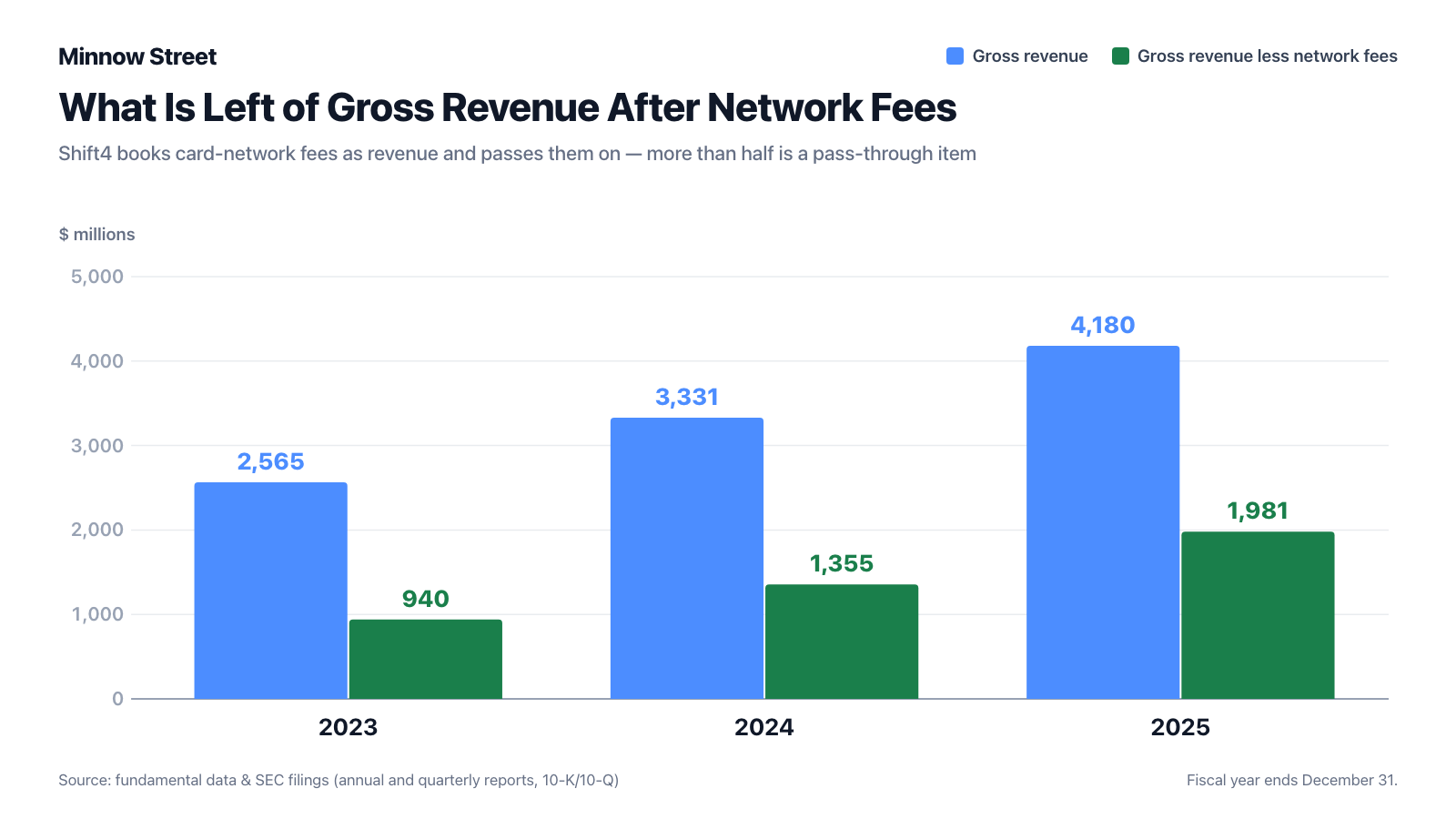
There is a second movement below the surface. The annual report contains a sentence so plainly written that it is easy to skip: volume grew faster than processing revenue because Shift4 keeps winning larger merchants — and those pay less per transaction.
"Growth in volume outpaced payments-based revenue growth, primarily due to our continued onboarding of larger merchants with lower unit pricing than our existing customer base."
— Shift4 Payments, Form 10-K for 2025, Item 7
In plain English: the cake gets bigger, the slice per customer gets thinner. In 2025 volume rose 27 percent while payments-based revenue rose only 16 percent.
Uncomfortable truth No. 2: A market cap with ghost shares
This one is unusual, and for once it does not concern only Shift4 but also the data source many ratios come from — ours included. We put it on the table because it would otherwise distort every valuation figure in this article.
Until early 2026 Shift4 had three classes of stock. Class A was the listed one you can trade. Class B and Class C belonged to founder Jared Isaacman and his holding company, Rook. Through Class B he held an interest in the operating subsidiary rather than in the listed parent — a structure common in America known as an "Up-C". As of December 31, 2025 the listed Shift4 Payments, Inc. therefore owned only 76.6 percent of the economic interest in the actual business.
On December 18, 2025 Isaacman was sworn in as the 15th Administrator of NASA. The ethics rules of the U.S. Office of Government Ethics required him to step back. On February 7, 2026 the parties signed a Transaction Agreement: Rook exchanged all of its units in the operating subsidiary for Class A shares, the corresponding Class B shares were cancelled, and Isaacman exchanged his Class C shares one for one into Class A. On June 12, 2026 the annual meeting voted to strike Class B and Class C from the charter as well.
That leaves a single class. The quarterly report states exactly 79,328,924 Class A shares as of April 30, 2026, and "no shares" for both Class B and Class C.
Now the arithmetic that surfaced while we were checking. The market value in our fundamental data is $4,792,932,864. Divide it by the closing price of July 24, 2026 and you get 99,129,952 shares. That is precisely the sum of 79,328,924 Class A shares and 19,801,028 Class B shares — today's shares plus the ones that have not existed since February 2026.
The market value is therefore roughly a quarter too high. We do not use it in this analysis and calculate instead: 79,328,924 shares times the closing price of $48.40 on July 24, 2026 gives a market capitalization of roughly $3.84 billion.
Uncomfortable truth No. 3: The billion of July 8
The $2.7 billion for Global Blue was not sitting in the till. It was borrowed and raised through preferred stock. The annual report describes the result:
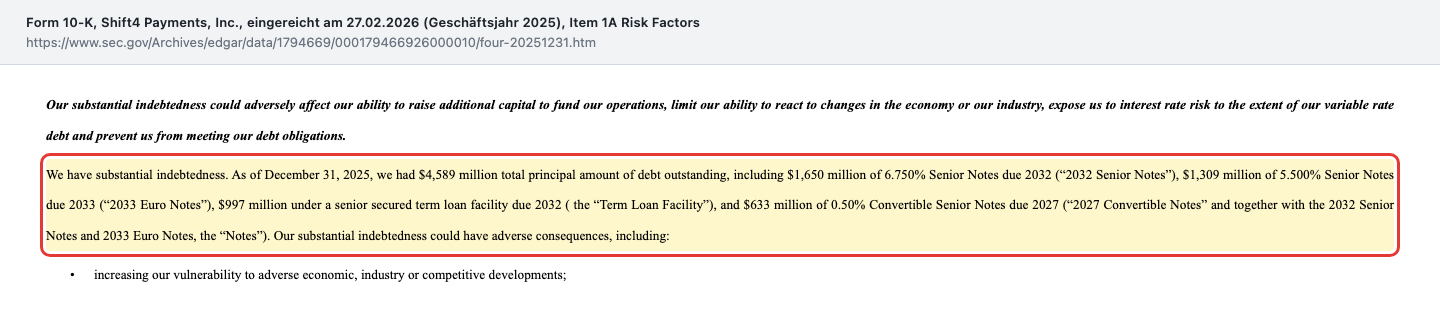
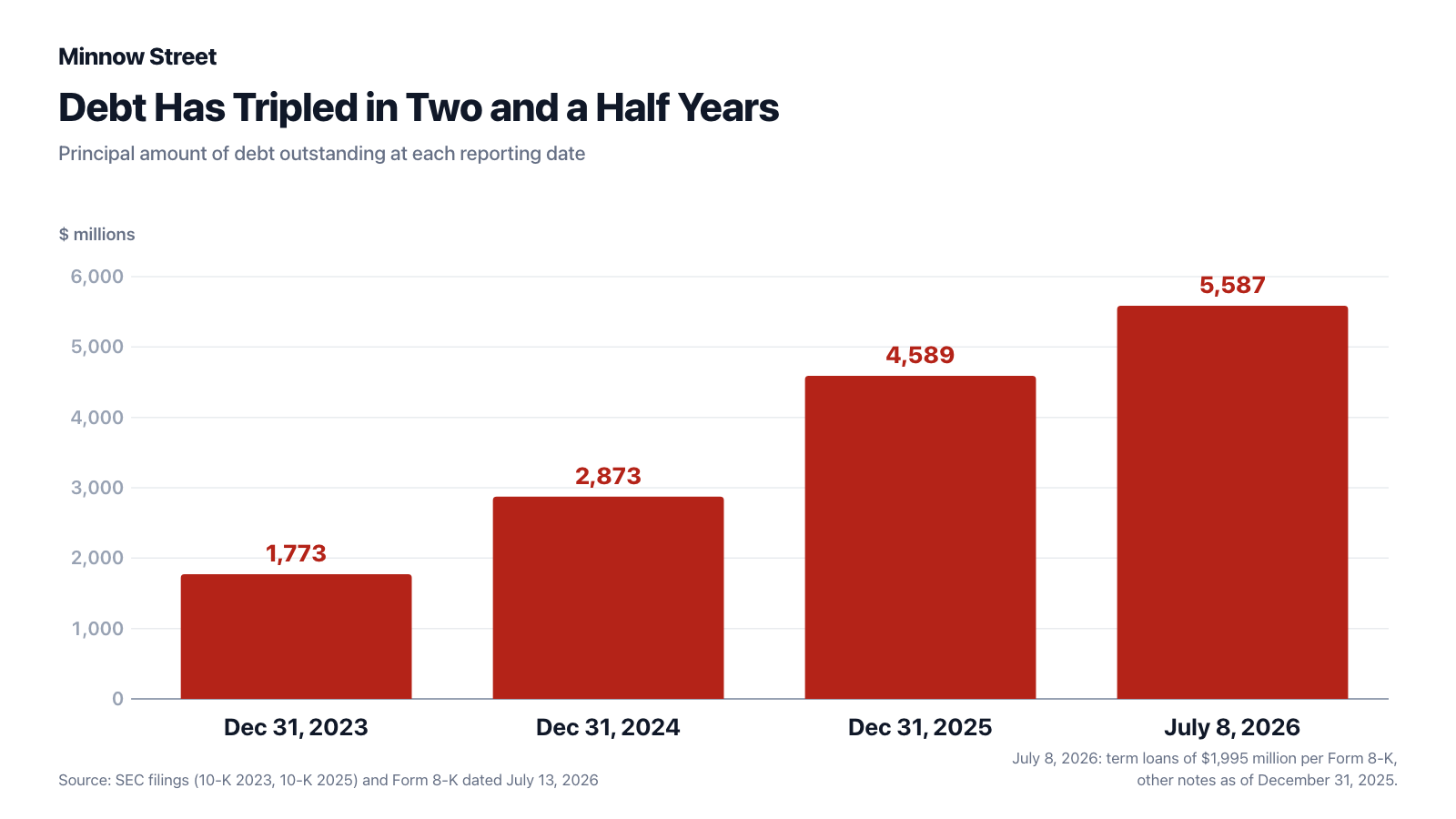
"We have substantial indebtedness. As of December 31, 2025, we had $4,589 million total principal amount of debt outstanding, including $1,650 million of 6.750% Senior Notes due 2032 […], $1,309 million of 5.500% Senior Notes due 2033 […], $997 million under a senior secured term loan facility due 2032 […], and $633 million of 0.50% Convertible Senior Notes due 2027 […]."
— Shift4 Payments, Form 10-K for 2025, Item 1A
At the end of 2023 the figure was $1,773 million; at the end of 2024, $2,873 million. And the story does not stop on December 31, 2025. On July 8, 2026 the operating subsidiary agreed Amendment No. 4 to its credit agreement: an incremental senior secured term loan of $1.0 billion, plus an extension of the revolving facility to July 8, 2031.
"As of July 8, 2026, after giving effect to the Amendment and the transactions contemplated therein, Shift4, LLC had $1,995,006,250 of outstanding borrowings of Amendment No. 3 Refinancing Term Loans (including Amendment No. 4 Incremental Term Loans) under the Amended Credit Agreement and $0 of outstanding borrowings of Revolving Loans under the Amended Credit Agreement."
— Shift4 Payments, Form 8-K dated July 13, 2026, Item 1.01
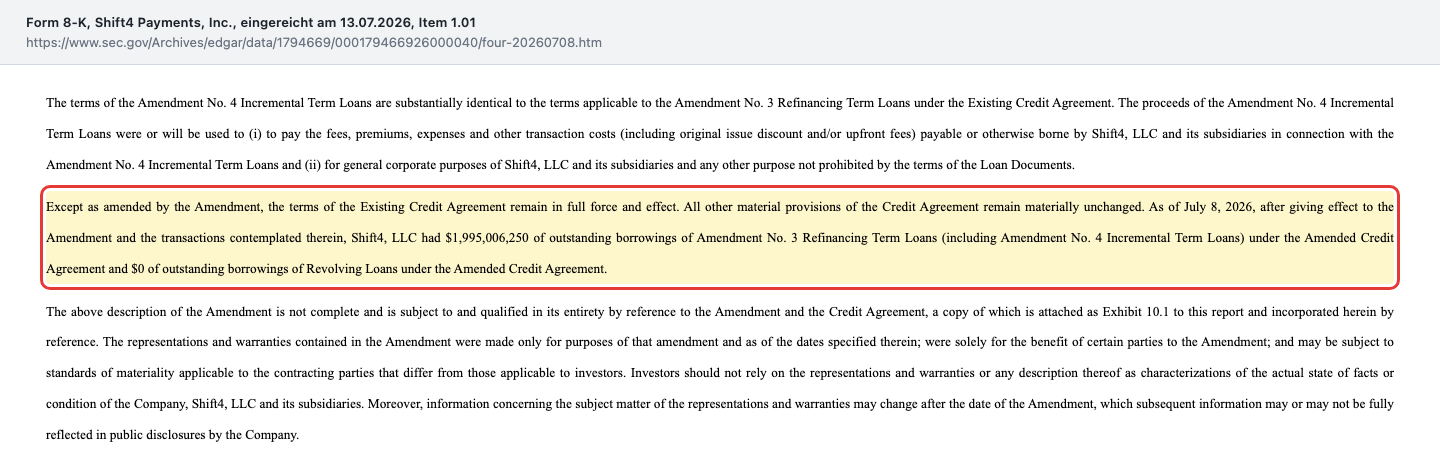
Add the remaining notes at their December 31, 2025 levels, and debt principal after this amendment stands at roughly $5,587 million — a good $5.6 billion. It has tripled in two and a half years.
What the new billion is for, the filing does not say. It states the proceeds serve transaction costs and "general corporate purposes". No acquisition is named. The last time around — late 2024 and spring 2025 — the language was similar, and a few months later Global Blue was on the table.
What the debt costs is already in the books. Interest expense rose from $32 million in 2023 through $62 million in 2024 to $190 million in 2025. In the first quarter of 2026 alone it was $65 million, against $29 million a year earlier. For comparison: income from operations in the same quarter was $50 million. Interest was larger than the operating result.
After $16 million of preferred dividends, common stockholders were left with a loss of $1 million in the first quarter of 2026, or $0.01 per share. A year earlier it was a profit of $0.24 per share. On 32 percent revenue growth.
On the positive side: the revolving facility is undrawn, only $10 million falls due within twelve months, and Amendment No. 3 of January 5, 2026 lowered the interest margin on the term loans. Of the debt outstanding at the end of 2025, $3,592 million carried fixed rates and $997 million floating rates — the latter with no interest rate hedges at all.
Uncomfortable truth No. 4: The survival score does not hold
Now to the point that put this stock on our turnaround list in the first place. The Altman Z score is a bankruptcy early-warning measure from the late 1960s. We use the Z″ variant, designed for service companies and non-manufacturers: four balance-sheet ratios, book value instead of market value. On that scale the danger zone starts below 1.1, and 2.6 and up counts as safe. Our data set carries 3.83 for Shift4 — so the mandatory "survival secured" hurdle is cleared as the rules intend.
A second look is still worthwhile. Running the original 1968 Altman formula — which includes market capitalization and was built for manufacturers — gives roughly 1.0 on the March 31, 2026 balance sheet and roughly 1.1 on the December 31, 2025 year-end figures. That is neither a contradiction nor a calculation error: these are two different models with different weights and different cut-offs, not one number on two scales. The real point lies elsewhere — both variants compress balance-sheet ratios into a single figure, and neither sees what matters at Shift4 right now: a debt-funded acquisition has pushed tangible equity deep into negative territory.
You do not have to follow that calculation to see the problem. The raw figures from the quarterly report for the period ended March 31, 2026 are enough:
- Equity ratio: 18.9 percent, measured on the $1,653 million of equity attributable to Shift4 Payments, Inc. against total assets of $8,757 million. Including noncontrolling interests it is 20.2 percent.
- Goodwill of $2,707 million plus other intangible assets of $2,884 million comes to $5,591 million — 63.8 percent of total assets. Tangible equity, meaning equity less those two items, is roughly minus $3,821 million.
- The retained deficit deepened during the first quarter of 2026 from minus $467 million to minus $644 million.
- Cash fell from $964 million to $473 million.
- Net current assets after deducting all liabilities stand at minus $4,916 million.
The Piotroski score, by contrast, holds up. It scores nine yes-or-no questions on profit, cash flow, leverage and efficiency. Using the 2024 and 2025 annual accounts we arrive at the same 6 of 9 as our data set: profit positive, operating cash flow positive and above net income, current ratio improved, gross margin improved, no material share issuance — against that, return on assets fell, leverage rose and asset turnover declined. Six out of nine is okay, not good. A genuinely healthy company sits at 8 or 9.
Uncomfortable truth No. 5: 12.7 million shares are already committed
In May 2025 Shift4 issued ten million preferred shares carrying a 6.00 percent dividend and a $100 liquidation preference each — $1.0 billion, again for Global Blue. That is not debt in the narrow sense, but it is no gift either: the paper must turn into common stock.
"Unless previously converted or redeemed, each share of Preferred Stock is automatically convert, for settlement on the mandatory conversion settlement date, which is scheduled to occur on May 1, 2028 […] into not less than the minimum conversion rate of 0.9780 shares of our Class A common stock and not more than the maximum conversion rate of 1.2224 shares of our Class A common stock, subject to adjustment."
— Shift4 Payments, Form 10-K for 2025, Item 1A
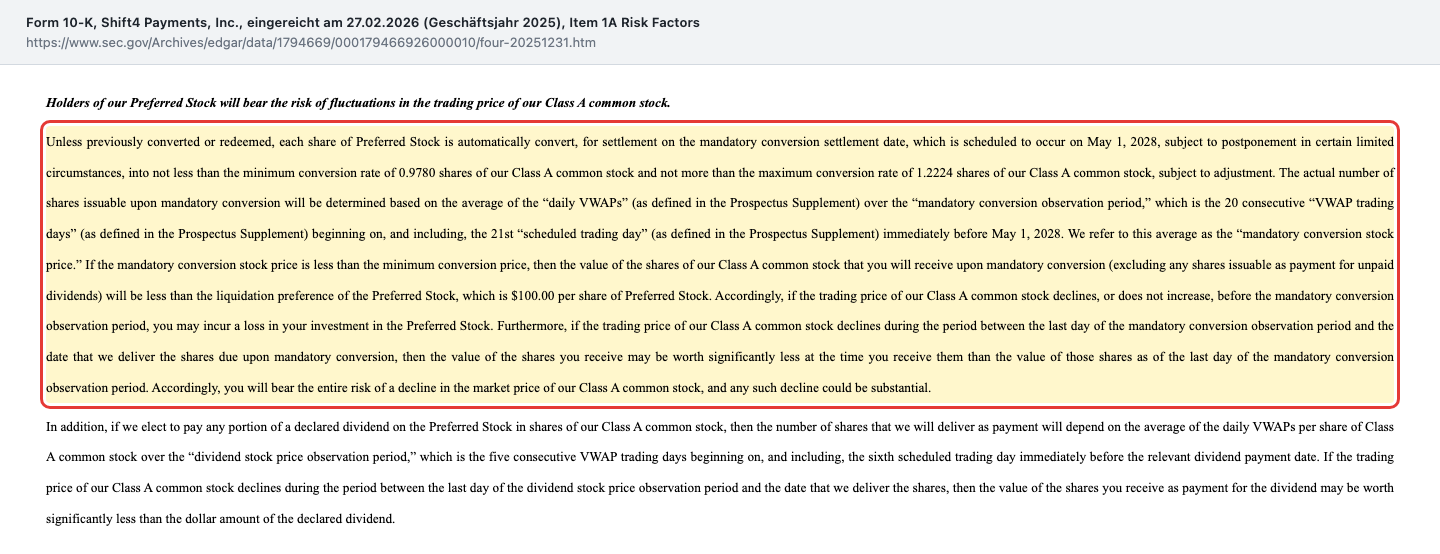
Dilution means your slice of the cake gets smaller without you doing anything. And the conversion rate is built so that it gets worse for existing holders the lower the share price stands. The maximum rate of 1.2224 applies if the stock trades at or below roughly $81.80 at conversion. At a closing price of $48.40 on July 24, 2026 that is the likely case.
As of March 31, 2026 there were already 10,423,296 preferred shares rather than the original ten million. At 1.2224 those become 12,741,437 new common shares. Against today's 79,328,924 shares that is a good 16 percent of additional paper. Until then the preferred stock costs roughly $60 million of dividends per year.
As an aside: during 2025 Shift4 repurchased 6,184,487 of its own shares for $453 million, at an average of $73.23 each. Measured against the closing price of July 24, 2026 those buybacks are worth roughly $154 million less than they cost. Of the November 2025 program, $695 million remained available at year end.
Uncomfortable truth No. 6: Twenty years for Global Blue, ten for Smartpay
When one company buys another, it has to allocate the purchase price to individual assets. Whatever is left over becomes goodwill. For the assets it does identify, it sets a useful life — and the longer that life, the smaller the annual charge against earnings.
For Global Blue, Shift4 allocated the $2,719 million among other things to $1,083 million of goodwill and $2,098 million of other intangible assets, of which $1,816 million to "merchant relationships". Useful life per the report: twenty years.
Four months later Shift4 bought Smartpay in New Zealand. Same asset class, "merchant relationships", $75 million — useful life per the same annual report: ten years. Acquired technology is treated differently too: ten years for Global Blue, three years for Smartpay.
Both sit in Note 2 of the same report, a few paragraphs apart. Both assumptions can be defensible — Global Blue works with luxury brands whose contracts run long. But the effect is unambiguous: at twenty years instead of ten, the Global Blue merchant relationships carry roughly $91 million rather than roughly $182 million of amortization per year. That is the difference between income from operations of $351 million in 2025 and roughly $260 million.
The report itself still calls the allocation "preliminary"; the valuation of goodwill, intangible assets and deferred taxes can still change within the measurement period.
A second point from the same corner: fully 63.8 percent of total assets are goodwill and intangible assets. If the travel business weakens, the carrying value of those items comes into question. And that it can weaken is something Shift4 writes in its own latest quarterly report — geopolitical and trade tensions as well as military conflicts have caused travel disruptions and weighed on consumer spending. For a business that earns on VAT refunds for tourists, that is not a throwaway line.
What the stock costs
All the figures that follow are dated anchors, not buy arguments. They use the closing price of July 24, 2026 ($48.40) and the share count from the cover page of the quarterly report (79,328,924 as of April 30, 2026).
- Market capitalization today: roughly $3.84 billion.
- Market capitalization after mandatory conversion: 92,070,361 shares times $48.40 gives roughly $4.46 billion — 16 percent more paper for the same business.
- Price-to-sales: on 2025 gross revenue roughly 0.9 times; on gross revenue less network fees of $1,981 million, however, roughly 1.9 times. After conversion: roughly 2.3 times.
- Price-to-earnings: measured against 2025 diluted earnings per share of $1.08, roughly 45.
- Enterprise value: $4.46 billion of equity after conversion plus roughly $5.59 billion of debt less $0.47 billion of cash (March 31, 2026) gives roughly $9.6 billion. That is close to 4.8 times gross revenue less network fees and roughly 9.9 times adjusted EBITDA of $970 million.
The view from the professionals is considerably friendlier: our data carries 23 analyst estimates, the average rating is clearly positive, and the consensus for earnings per share this year sits at $5.56. That would be five times the 2025 figure. Those estimates refer to adjusted measures rather than to earnings under U.S. accounting rules — and at Shift4 the gap between the two is substantial because of the amortization on the acquisitions.
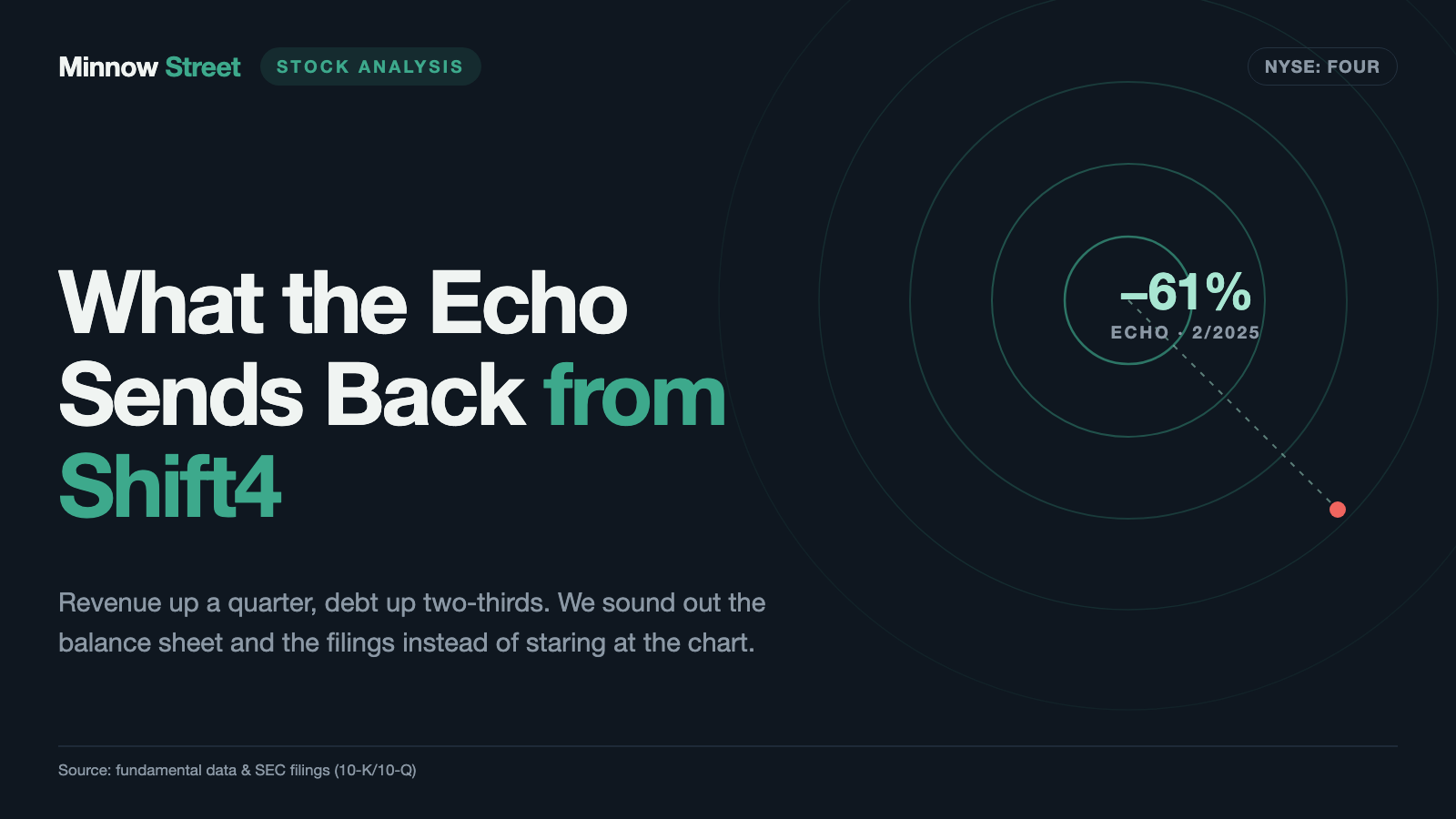
Distance from the high: the closing high was $125.66 on February 18, 2025. From the close of July 24, 2026 that is roughly 61 percent. Measured against the high of the past twelve months it is roughly 55 percent. About a fifth of the freely tradable shares were most recently sold short (data as of July 26, 2026).
Opportunities and risks at a glance
What speaks for Shift4
- The business is growing fast and under its own power: up 46 percent in gross revenue less network fees in 2025, up 49 percent in the first quarter of 2026.
- Operating cash flow is clearly positive — $634 million in 2025, $134 million in the first quarter of 2026.
- With Global Blue, Shift4 has entered a business almost nobody else runs: VAT refunds for travelers, with access to luxury brands worldwide.
- The capital structure has been simple since February 2026: one class of stock, no controlling holder, and no further payments under the old tax receivable agreement.
- Insiders were net buyers most recently, and the revolving facility is undrawn.
What speaks against Shift4
- Roughly $5.6 billion of debt against $3.84 billion of market capitalization — and in July 2026 another billion arrived with no stated purpose.
- In the first quarter of 2026 interest expense ($65 million) exceeded income from operations ($50 million); common stockholders were left with a loss.
- 12.7 million additional shares are contractually due by May 1, 2028 at the latest — roughly 16 percent dilution.
- Tangible equity is deeply negative at roughly minus $3,821 million; 63.8 percent of total assets are goodwill and intangible assets.
- The new TFS business depends on international travel, which the company itself describes as disrupted.
- North American processing runs through a single vendor, and Shift4 is not a member bank of the card networks — if the sponsor bank terminates, 180 days remain to find a replacement.
A human conclusion
We started with the big number and we end with it. $4.18 billion of revenue sounds like a company in another league. Take out what belongs to the card networks and $1.98 billion remains. After interest, amortization on three acquisitions and preferred dividends, common stockholders were left with minus one cent per share in the first quarter of 2026.
That is not accounting fraud and it is not a scandal. It is the perfectly normal price of doubling in size through acquisitions in two and a half years. The only question is whether that price ever reaches the shareholder as profit — or whether the next billion of credit is already waiting once the last one has been digested.
The most honest sentence in this analysis is the one about our own scanner: Shift4 arrived as a turnaround candidate, and the value that carried it through the survival hurdle does not hold up against the audited accounts. We would rather say that ourselves than let you find it out later.
What you make of it is your decision. And that is exactly as it should be.
Sources
- Form 10-K for 2025, Shift4 Payments, Inc., filed February 27, 2026
- Form 10-Q for the quarter ended March 31, 2026, filed May 7, 2026
- Form 10-K for 2024, filed February 19, 2025
- Form 10-K for 2023, filed February 29, 2024
- Form 8-K dated July 13, 2026 (Amendment No. 4 to the credit agreement, Items 1.01 and 2.03)
- Form 8-K dated June 17, 2026 (annual meeting of June 12, 2026, Item 5.07)
- Form 8-K dated February 10, 2026 (Transaction Agreement collapsing the Up-C structure)
- Form 8-K dated January 5, 2026 (Amendment No. 3 to the credit agreement, repricing)
- Fundamental data & SEC filings (annual and quarterly reports, 10-K/10-Q), as of July 26/27, 2026
This analysis is journalism and editorial context. It is not investment advice, not a solicitation to buy or sell securities, and not a financial analysis in a regulatory sense. Stocks can lose all of their value at any time. All figures come from the sources named above and carry the reporting date stated there; price figures are dated anchors, not forecasts. The author holds no position in Shift4 Payments at the time of publication.
Our Bottom Line at a Glance
- Growth positive
- Gross revenue less network fees rose 46 percent to $1,981 million in 2025 and another 49 percent to $549 million in the first quarter of 2026. Payment volume grew by $44 billion, or 27 percent, in 2025. Adjusted EBITDA climbed from $678 million to $970 million.
- Leverage & interest burden negative
- Debt principal grew from $1,773 million (Dec 31, 2023) to $4,589 million (Dec 31, 2025); on July 8, 2026 a $1.0 billion term loan for "general corporate purposes" was added. Interest expense rose from $62 million (2024) to $190 million (2025); in the first quarter of 2026 it exceeded income from operations at $65 million against $50 million.
- Balance sheet quality negative
- As of March 31, 2026, $1,770 million of equity stands against total assets of $8,757 million (20.2 percent). Goodwill and other intangible assets account for $5,591 million, or 63.8 percent of total assets; tangible equity is roughly minus $3,821 million. The retained deficit deepened during the quarter from minus $467 million to minus $644 million.
- Dilution negative
- The 10,423,296 preferred shares outstanding on March 31, 2026 convert mandatorily by May 1, 2028; at the maximum rate of 1.2224 that creates 12,741,437 new Class A shares and a good 16 percent dilution. Until then the preferred stock costs roughly $60 million of dividends per year. The 2025 buybacks at an average of $73.23 are roughly $154 million under water against the close of July 24, 2026.
- Capital structure positive
- Since the Transaction Agreement of February 7, 2026 there is only one class of stock: Class B and Class C have been retired, and the annual meeting of June 12, 2026 struck them from the charter. That ended the founder's voting control and future payments under the tax receivable agreement; the revolving facility is undrawn and only $10 million falls due within twelve months.
- Valuation & market picture neutral
- Roughly $3.84 billion of market capitalization (79,328,924 shares at a closing price of $48.40 on July 24, 2026) equals about 1.9 times gross revenue less network fees; after mandatory conversion it is roughly $4.46 billion and 2.3 times. Enterprise value stands at roughly $9.6 billion, or 9.9 times adjusted EBITDA. The market value in the fundamental data ($4.79 billion) counts the retired Class B shares and is not used here.
Shift4 has doubled in size through acquisitions in two and a half years — paid for with $2,719 million for Global Blue, a debt principal that rose from $1,773 million to roughly $5,600 million, and $1.0 billion of preferred stock that must become common stock by May 1, 2028. The operating business carries its weight: $1,981 million of gross revenue less network fees in 2025, $970 million of adjusted EBITDA, $634 million of operating cash flow. Very little of that has reached shareholders so far — in the first quarter of 2026, after $65 million of interest and $16 million of preferred dividends, a loss of $0.01 per share remained, on 32 percent revenue growth. Two figures are worth recalculating yourself: the market capitalization, which our data source overstates by a quarter because it still counts the retired Class B shares, and the Altman Z, which lands at roughly 1.0 rather than 3.83 when run against the audited accounts. Not investment advice.
What Our Rating Means
Open questions
The business works in principle, but one material question is open. As long as it stays open, our findings do not carry a quality verdict.
The operating business is healthy: $1,981 million of gross revenue less network fees in 2025 with 46 percent growth, $634 million of operating cash flow, $970 million of adjusted EBITDA, positive equity of $1,770 million and no sign of going-concern doubt or broken covenants. There is no substance finding in the sense of going concern or negative equity, and full-year interest coverage in 2025 was 1.85, above one. What is open is the decisive question: whether the $2.7 billion acquisition pays off is unproven. In the first quarter of 2026 interest coverage was 0.77, common stockholders were left with a loss, 63.8 percent of total assets are goodwill and intangible assets, tangible equity is around minus $3,821 million, and six weeks after the quarterly report another billion of credit arrived with no stated purpose. That is the textbook case for yellow: not a sick business, but an unproven and debt-financed rebuild. Valuation does not determine this color. The decision is yours.
A journalistic assessment by our editorial team at the time of the deep dive, based on public sources — not investment advice and not a solicitation to buy or sell. Your personal circumstances (investment goals, risk capacity, taxes) cannot be taken into account. What our levels mean, how verdicts are formed, and what conflicts of interest exist →
Worth Noting
- Shift4 came onto the research list through our in-house stock scanner "Turnaround Candidates". Measured separately on both brands on July 27, 2026: 60 U.S. hits, of which the 25 strongest are shown, the weakest of those carrying 6 of 8 points. Shift4 is listed as a hit of that scanner on both company pages but appears on neither visible list — rank 26 or lower out of 60. These lists are recomputed daily; rank and score are a dated snapshot. The mandatory pillars are at least 50 percent below the all-time high (measured value minus 64.81) and secured survival, measured among other things by the Altman Z (3.83 in the data set against a threshold of 1.1) and positive equity (equity ratio 0.1888).
- On the Altman Z, explained openly in the article: the 3.83 in the data set is the Z″ variant (four balance-sheet ratios, book value instead of market value, cut-offs 1.1 distress / 2.6 safe) and is therefore correct — the scanner's mandatory hurdle is cleared as the rules intend. The original 1968 formula run against the same accounts yields roughly 1.0 (balance sheet of March 31, 2026, trailing twelve-month earnings and revenue, market capitalization from 79,328,924 shares) or roughly 1.1 using the December 31, 2025 balance sheet. These are two different models with different weights and cut-offs, not one number on two scales. The article additionally argues from the raw balance sheet figures because neither variant captures the negative tangible equity. The Piotroski score of 6 of 9 was recalculated from the 2024 and 2025 annual accounts and confirmed.
- Multi-class finding: the market value in the fundamental data ($4,792,932,864) equals $48.35 times 99,129,952 shares — Class A (79,328,924 per the cover page of the quarterly report as of April 30, 2026) plus the Class B shares retired in February 2026 (19,801,028). It is therefore roughly a quarter too high and is not used in the article; every calculation uses the share count from the filing.
- The fiscal year matches the calendar year. The most recent periodic report is the Form 10-Q for the quarter ended March 31, 2026 (filed May 7, 2026). Filed after that and up to the July 27, 2026 data date: Form 8-K dated June 17, 2026 (annual meeting of June 12, 2026, Item 5.07, including removal of Class B and C from the charter and ratification of PricewaterhouseCoopers LLP as auditor for 2026), Form 8-K dated July 13, 2026 (Amendment No. 4, $1.0 billion incremental term loan) and insider and ownership filings. The report for the quarter ended June 30, 2026 was not yet available.
- Price and valuation figures are dated anchors, not buy arguments: closing price $48.40 on July 24, 2026, market capitalization roughly $3.84 billion, calculated with the 79,328,924 shares from the cover page of the quarterly report (April 30, 2026). All balance sheet and income figures carry the reporting date of their respective filing.
- As of July 27, 2026 no takeover, merger or take-private process is under way: no Form 25, no Form 15, no SC 14D9. The only tender offer in the record (SC TO-T dated March 21, 2025) was filed by Shift4 itself and concerned its purchase of Global Blue.
- Easily confused: "FOUR" is the Class A common stock, "FOUR.PRA" the 6.00 percent mandatory convertible preferred stock — both listed on the New York Stock Exchange. Shift4 Payments, Inc. is the listed parent; Shift4 Payments, LLC is the operating subsidiary and the borrower under the term loans. Global Blue Group Holding AG has not existed as a separate listed company since the squeeze-out of August 18, 2025.
Frequently Asked Questions
Shift4 processes card payments and supplies the point-of-sale systems that go with them — mostly for restaurants, hotels, stadiums and theme parks. Since the acquisition of Global Blue on July 3, 2025 it also runs VAT refunds for tourists. Gross revenue was $4,180 million in 2025 and the company employed roughly 6,300 people across 60 countries at year end.
Because it includes the card-network fees the company only collects and passes on. In 2025 that was $2,199 million of $4,180 million, or 52.6 percent. The company therefore reports a second measure itself: gross revenue less network fees, $1,981 million in 2025. That figure describes the business more honestly.
Debt principal stood at $4,589 million on December 31, 2025, split across two note issues, a term loan and a convertible. On July 8, 2026 an incremental term loan of $1.0 billion was added; term loans stood at $1,995,006,250 afterwards. Together with the remaining notes that is roughly $5.6 billion.
The 10,423,296 preferred shares convert mandatorily into Class A common stock no later than May 1, 2028. The conversion rate runs between 0.9780 and 1.2224 shares each; the maximum applies at a price up to roughly $81.80. That would create 12,741,437 new shares and a good 16 percent dilution against the 79,328,924 shares outstanding on April 30, 2026.
Because some sources still count the old share structure. The market value in our fundamental data equals the price times 99,129,952 shares — the 79,328,924 Class A shares plus the 19,801,028 Class B shares cancelled in February 2026. The correct market capitalization on July 24, 2026 was roughly $3.84 billion rather than $4.79 billion.
Under U.S. accounting rules Shift4 reported net income of $12 million, of which $15 million was attributable to the parent. After deducting $16 million of preferred dividends, common stockholders were left with a loss of $1 million, or $0.01 per share. A year earlier it was a profit of $0.24 per share.
Jared Isaacman was sworn in as NASA Administrator on December 18, 2025 and gave up his voting control. The Transaction Agreement of February 7, 2026 collapsed the Up-C structure, and the annual meeting on June 12, 2026 struck Class B and Class C from the charter. According to our data, 54.6 percent of the shares are freely tradable (as of July 27, 2026); the rest sits with insiders and large holders.
No. As of July 27, 2026 there is no Form 25, no Form 15 and no SC 14D9 on file with the U.S. securities regulator. The only tender offer in the record — an SC TO-T dated March 21, 2025 — was filed by Shift4 itself and concerned its purchase of Global Blue.
Found an error?
Did you spot a factual error, an outdated number, or a typo in this deep dive? Let us know briefly — your report goes straight to the editorial team.