SFL Stock: 89 Straight Quarterly Dividends — and a Year in Which $125 Million Went Out the Door With a Loss on the Bottom Line
SFL Corporation leases out container ships, tankers, car carriers and two drilling rigs — and has paid a dividend every single quarter since its 2004 listing. That streak is what carried the stock to rank 29 in our Big Earnings Surprise scanner (as of July 25, 2026). We read the annual report (20-F) for 2025 and the quarterly filings (6-K) through May 2026: a $3.7 billion fixed-rate charter backlog, 68 percent of it with investment-grade customers — but also an interest bill larger than the entire operating income, a quarterly rate cut by a quarter in the autumn of 2025, and $848 million still owed on five newbuildings. An unbroken row of check marks says nothing about how big each check mark was.
 Thomas Mücke
Founder & Publisher
Thomas Mücke
Founder & Publisher
Chart
Interactive price chart (TradingView).
Note: pure fact-based analysis, not investment advice and not a solicitation to buy or sell. All figures without guarantee.
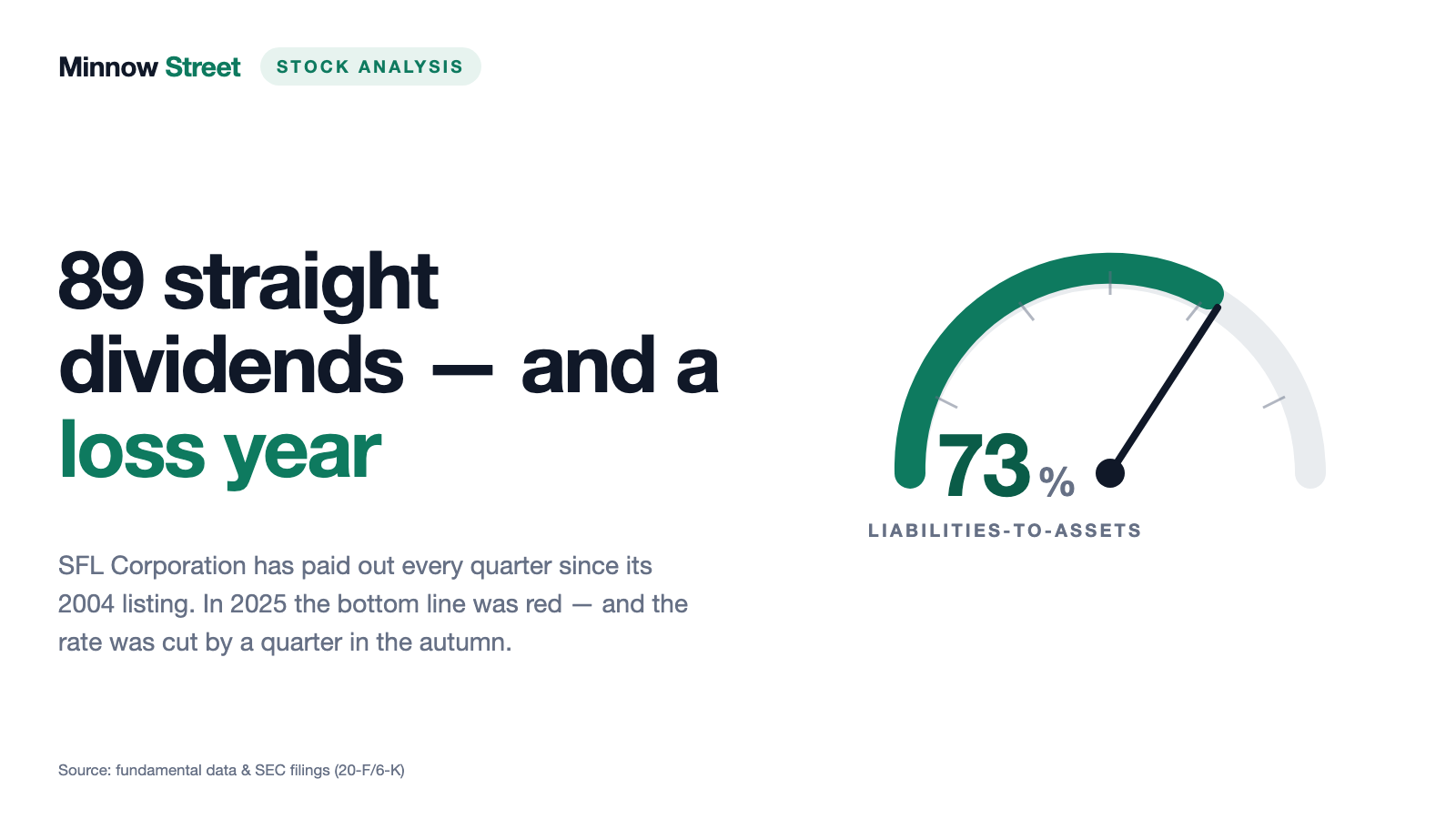
There is one number that works on investors like a seal of quality: the length of a streak. SFL Corporation Ltd. (NYSE: SFL) has paid a dividend for 89 consecutive quarters — not one skipped since its listing on the New York Stock Exchange in 2004. Our brains read a row like that as a tally sheet: 89 check marks, so 89 times everything was fine. Call it the tally-sheet trap — we count how often something happened and forget to ask how big it was each time. A streak only breaks when a payment is missed. It does not break when the payment shrinks. And it does not break when the money was never earned in the first place.
So here is the deal: we read the original filings together. The annual report (20-F) for 2025, filed on March 16, 2026, and the quarterly filings (6-K) through May 13, 2026. They contain a charter backlog of $3.7 billion that genuinely impresses. And they contain the three numbers this analysis is about: $0.94 per share paid out in 2025 against earnings of minus $0.20 per share, and an interest expense larger than the entire operating income. Remember: an unbroken row says nothing about the size of each payment.

What SFL Corporation actually does — the shipping company that ships nothing
SFL is not a shipping line in the ordinary sense. It does not operate vessels, it rents them out. Think of it as a landlord of the seas: it buys ships, signs long-term charters with large transport groups, collects the fixed rate — and leaves crewing and technical management to outside providers. That is why the group runs on 24 full-time employees (as of December 31, 2025) while managing a $3.6 billion balance sheet. That is not a typo: 24 people, $3.6 billion.
As of December 31, 2025, the fleet comprised 17 tankers, 21 container vessels, seven car carriers, two dry bulk carriers and two drilling rigs; on top of that, SFL holds 49.9 percent of four very large container vessels (19,000 TEU class) through a joint venture called River Box. Five more container ships of 16,800 TEU each, with dual-fuel engines, are under construction for delivery in 2028. The customer list reads like a who\'s who of global logistics — and that is the second half of the business model: a ship lessor does not earn on the freight market, it earns on the creditworthiness of its tenants.
For 2025 the annual report lays the dependencies out plainly: Maersk accounted for 26 percent of consolidated operating revenues (15 container vessels), Hapag-Lloyd for 15 percent (six container vessels), ConocoPhillips for 13 percent (one jack-up rig), Volkswagen for 9 percent (four car carriers) and Trafigura for 8 percent (seven tankers). Five names therefore carry roughly 71 percent of revenue. That is concentration risk and quality marker in one — such tenants pay reliably, but if one of them renegotiates, a quarter of the rent roll wobbles.
Which names the central tension of this analysis, and it runs through every chapter: the rental income is contractually secured and the dividend streak is real — but between the rent and the shareholder sits an interest bill that in 2025 exceeded the entire operating income.
How the stock reached our desk
We run several thousand stocks through our scanners every day. As of July 25, 2026, SFL appears at rank 29 of 81 U.S. hits in the Big Earnings Surprise scanner — the list of companies whose most recently reported earnings beat the consensus by the widest margin. To reproduce it: open the scanner, set the country filter to "US", scroll to rank 29. The lists are recalculated daily, so tomorrow\'s rank may differ.
What triggered the hit can be reconstructed to the cent. For the first quarter of 2026 the market expected $0.02 per share. Reported under U.S. accounting rules were $0.20 per share ($26.1 million net income). But the release itself names three one-off items inside that figure: a book gain on a vessel sale of $11.5 million, positive mark-to-market effects from hedging derivatives of roughly $2.5 million, and from equity investments of roughly $1.9 million. Together that is $15.9 million, or about $0.12 per share. Strip them out and roughly $0.08 per share remains — precisely the adjusted figure the surprise filter works with. From $0.02 to $0.08: up 300 percent.
None of that is sleight of hand; it is the standard method. But the magnitude deserves translating: the bar was set at two cents. Clearing it by six cents is a statistical sensation and, in absolute terms, eight cents earned. It is, incidentally, the fifth consecutive beat — every quarter from Q1 2025 through Q1 2026 came in above consensus, and in four of those five the consensus sat at zero or below. Remember the principle: a surprise measures the distance to the expectation, not the size of the profit.
The fundamental lens of the same scanner is correspondingly sober (all figures as of July 25, 2026): a Piotroski F-score of 3 out of 9 — a nine-point test of balance-sheet direction on which a genuinely healthy company scores 8 or 9 — an equity ratio of 26 percent, a debt-to-equity ratio of 2.7 and interest coverage of 0.75. That last one means, in plain language, that operating income did not cover the interest bill. More on that shortly — first, what genuinely impresses.
The numbers over the years — given their due
Start with the strongest figure: the fixed-rate charter backlog of roughly $3.7 billion as of March 31, 2026, with a weighted remaining term of 6.3 years. That is more than twice the market capitalization and, arithmetically, a good five years of revenue already under contract. 68 percent of it sits with investment-grade customers. For a business that lives on tenant solvency, that is the decisive quality metric — and it is good.
Utilization holds up as well: in the first quarter of 2026 it stood at 99 percent for container vessels, 100 percent for car carriers, 100 percent for tankers and 97 percent for bulkers. The two Suezmax tankers trading in the spot market earned an average of roughly $54,000 per day over the quarter — a strong number showing that SFL is not confined to fixed rates but participates in a firm tanker market. And operating cash flow is robust: $267.1 million in 2025 (2024: $369.9 million). The $125.1 million of dividends was payable out of that.
Now the four-year view — and this is where the pattern that matters becomes visible:
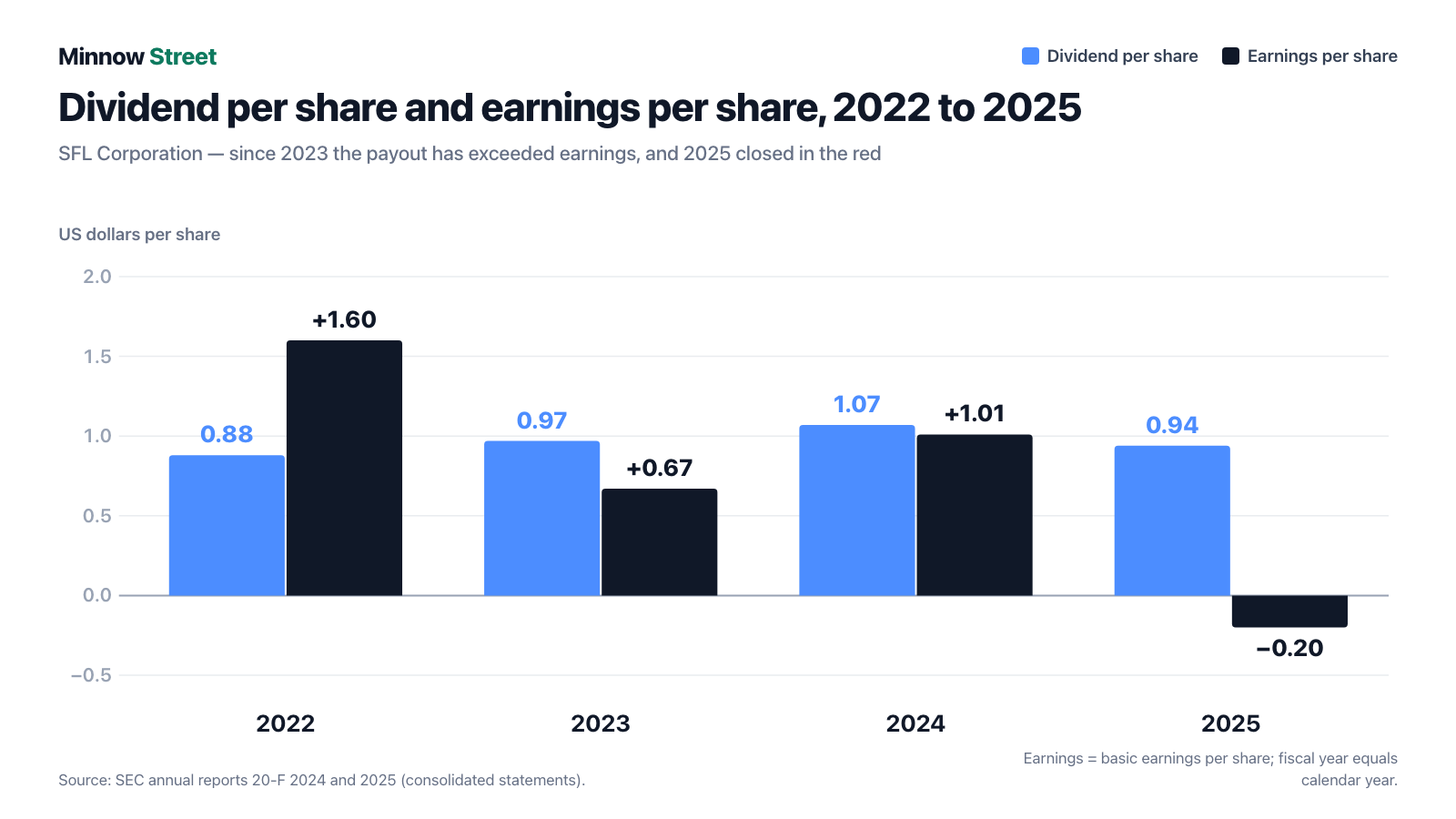
In plain numbers: in 2022 SFL earned $1.60 per share and paid out $0.88 — comfortable. In 2023 earnings fell to $0.67 while the dividend rose to $0.97. In 2024 earnings ($1.01) and dividend ($1.07) were nearly level. And in 2025, earnings of minus $0.20 faced a payout of $0.94. Revenue in the same year fell 18.9 percent, from $904.4 million to $733.0 million.
An important fairness note: for a ship lessor, accounting profit is not the whole story. The 2025 figures include $235.0 million of depreciation and a $34.1 million vessel impairment — neither costs a cent of cash. That is how such a company can report a loss and still pay a dividend. The honest question, though, is what remains of the cash collected once interest and principal are served. And there it gets uncomfortable.
What the filings say — the uncomfortable truths
Uncomfortable truth no. 1: interest expense exceeds the entire operating income
Perhaps the most important calculation in this analysis consists of two lines from the 2025 annual report. Operating income was $136.7 million. Interest expense was $180.5 million. Put differently: before a single dollar reaches a shareholder, the operating result has already gone to the lenders in full — and it is not even enough. The rest of the arithmetic is quickly told:
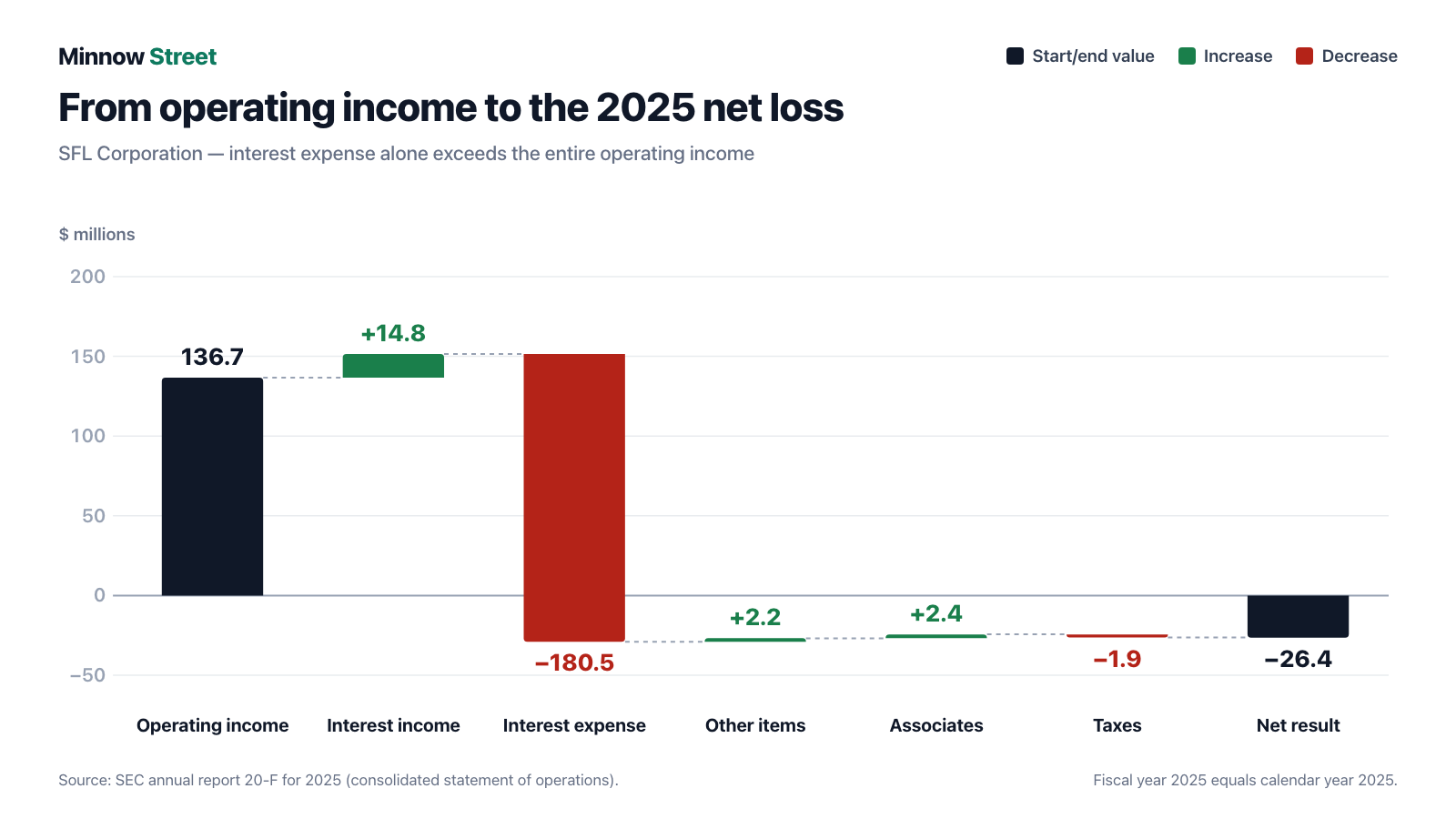
On the scale of the debt: as of December 31, 2025, $2,584.1 million of loans, bonds and lease financing sat on the books (2024: $2,862.3 million), including $666.3 million across five unsecured bonds with coupons between 7.25 and 8.875 percent. Against that stood equity of $960.9 million. Translated into an everyday image: for every dollar of equity there are $2.70 of borrowed money — and the interest on it is the single largest line in the entire income statement. It is also why a healthy freight market does not automatically reach the shareholder at SFL. For a detailed look at how a debt load can dominate an otherwise functioning business, see our analysis of NGL Energy Partners, where the distribution has been frozen since 2020.
Uncomfortable truth no. 2: the streak is intact — the rate was cut by a quarter anyway
Back to the tally-sheet trap. The dividend table in the 2025 annual report lists every single payment. The four 2024 rates were $0.26 / $0.27 / $0.27 / $0.27. 2025 opened with $0.27 (paid March 28) and $0.27 (June 27) — and then came the cut: $0.20 on September 29, 2025, and $0.20 on December 29, 2025. That is a reduction of 25.9 percent. February 2026 brought another $0.20; only in May 2026 did the board lift it to $0.22 — still roughly 19 percent below the level of early 2025.
The streak stayed formally intact because no payment was ever missed. Anyone reading only the headline "89th consecutive dividend" learns nothing about the cut. The annual report itself, incidentally, describes what the payment depends on without any embellishment:
"Our goal is to increase our quarterly dividend as we grow the business, but the timing and amount of dividends, if any, is at the sole discretion of our Board of Directors and will depend upon our operating results, financial condition, cash requirements, restrictions in terms of financing arrangements and other relevant factors."
— SFL Corporation Ltd., SEC annual report 20-F for 2025, Item 8.A "Dividend Policy"
The clause "restrictions in terms of financing arrangements" is not filler. According to the annual report, the credit agreements contain covenants that, once triggered, would expressly prohibit dividends, interest payments to shareholders and share repurchases. The related financial tests are checked quarterly: a book equity ratio of at least 0.20 to 1.0, positive working capital and minimum liquidity of $25.0 million including undrawn credit lines. As of March 31, 2026, the equity ratio stood at roughly 27 percent — above the threshold, but without a generous cushion. Remember: a dividend paid from cash rather than profit depends on the cash.
Uncomfortable truth no. 3: a significant portion of the debt matures within one year
The 2025 annual report says so with notable candour — this is the single most important sentence in the entire document:
"A significant portion of the our outstanding debt and finance lease liabilities are coming due within one year of March 16, 2026 for which we have initiated discussions and negotiations with financial institutions regarding the refinancing of credit facilities maturing in 2026 and early 2027. … However no assurance can be given that all such facilities will be timely refinanced on acceptable terms."
— SFL Corporation Ltd., SEC annual report 20-F for 2025, Item 5.B "Liquidity and Capital Resources"

The figures behind it: of the $2,584.1 million of total debt, the maturity table shows $605.9 million due within one year; together with interest and committed capital expenditure that adds up to $742.8 million of contractual payments over twelve months. Against that stood $288 million of available liquidity as of March 31, 2026 ($127.6 million of cash plus $160 million of undrawn credit lines). SFL closes the gap the way landlords do: with follow-on financing. In March 2026 the Linus rig was refinanced with a new $150 million loan, a $100 million revolving facility was arranged for Hercules, and at the end of April 2026 SFL tapped its 7.75 percent bond due 2030 for another $75 million — priced at 103.5 percent of par, implying a yield of roughly 6.8 percent. This has worked for 22 years. It is simply a task each year, not a given.
And the next bill is already written: $848.1 million is contractually committed for five dual-fuel container newbuildings due in 2028. That is more than the group\'s entire equity. Each vessel starts a ten-year fixed-rate charter with a world-leading container line on delivery, so the income side is locked in. The yard instalments, the report says, are to be funded through pre- and post-delivery credit facilities. In plain English: the next growth step is being bought on credit.
Uncomfortable truth no. 4: one drilling rig has been idle for over a year — and earns nothing until 2027
Alongside the ships, SFL runs a second leg the report calls "energy": two drilling rigs. The jack-up Linus has been working for ConocoPhillips since September 2022 and delivered roughly 13 percent of consolidated revenue in 2025. The semi-submersible Hercules, by contrast, earned next to nothing in 2025: it was, in the annual report\'s words, warm stacked in Norway — ready to work, but without a contract. The consequence shows in the revenue split: drilling revenue fell 59 percent, from $236.7 million to $96.3 million. That is $140.4 million of the total $171.4 million revenue decline — four fifths of the drop came from one idle asset.
The first quarter of 2026 continued the pattern: the energy segment generated $23.0 million of revenue but a net loss of $16.4 million at 50 percent utilization, while the shipping segment contributed $42.5 million of net income. Without the rigs, in other words, the quarter would have looked considerably better. The good news arrived on March 6, 2026: SFL announced a drilling contract in Canada with a large, investment-grade oil and gas company worth an estimated $170 million over a minimum term of 400 days. The bad news: the contract does not start until the first quarter of 2027. Until then the rig has to be moved from Norway to Canada and prepared — costs with no revenue against them. For a look at how heavily offshore oil work and its end-of-life bills can sit on a balance sheet, see our analysis of W&T Offshore.
The Hercules story also has a courtroom sequel. SFL sued in the Oslo District Court in March 2023, arguing that Seadrill had not redelivered the rig in December 2022 in the condition the contract required. In February 2025 the court ruled in SFL\'s favour: roughly $48 million including late payment interest and legal costs. Seadrill appealed on March 5, 2025, and the annual report schedules the hearings for the second and third quarters of 2026. Through the first quarter of 2026 the amount is booked nowhere as income — even though it is nearly twice the entire 2025 net loss.

Uncomfortable truth no. 5: 11.8 million of its own shares sit at a bank
Finally, a find from the fine print that matters for the share count. SFL has 146,910,679 shares issued (December 31, 2025) but computes earnings per share on only 132,992,784. A footnote in the notes explains the difference: roughly 11.8 million shares are on loan to a bank under a share lending agreement, and 2.3 million are held in treasury — both blocks are excluded from the earnings calculation.
"One of the Company's wholly-owned subsidiaries is party to a general share lending agreement and as of December 31, 2025, 11.8 million of the Company's shares were on loan and in the custody of the borrowing bank. This facility provides up to $60.0 million cash collateral to the Company, callable at any time, subject to a 50% loan to value ratio based on the market value of the pledged shares. The facility is repayable on demand, by either party to the agreement."
— SFL Corporation Ltd., SEC annual report 20-F for 2025, Note 20 "Short-Term and Long-Term Debt", share lending footnote

Why it matters: those 11.8 million shares equal roughly 8.9 percent of the EPS share count, and the $60.0 million on call equals roughly 47 percent of the cash held on March 31, 2026. It is a credit line that formally is not one — secured by the company\'s own share price. Add to that three programs renewed in May 2026: a repurchase authorization of up to $100 million (through June 2028), a dividend reinvestment plan for up to 10 million new shares, and an at-the-market program allowing up to $100 million of new equity. Neither the at-the-market program nor the reinvestment plan was used in 2024 or 2025, by the company\'s own account; the option exists, though, and taken together they could arithmetically add roughly 14 percent more shares. Your slice of the cake is only as big as the number of slices allows.
Who owns SFL — and who sits on both sides of the table
The largest shareholder is Hemen Holding Limited with 25,728,687 shares, or 17.8 percent (as of March 11, 2026), held through two trusts. Hemen is also a principal shareholder in several other listed shipping and oil-service companies, and the annual report devotes a dedicated risk factor to the resulting conflicts of interest. It gets concrete in two places: in 2024 SFL bought three newly built LR2 product tankers from entities related to Hemen for a combined $234.9 million. And in the River Box joint venture, which charters four large container vessels to MSC, SFL holds 49.9 percent — the remaining 50.1 percent sits with a Hemen subsidiary, while SFL has extended the venture a $45.0 million loan.
None of that is a flaw in itself: a major shareholder with industry reach brings deal flow. But it means part of the transaction volume takes place between related parties — the report itself notes that such agreements were made "in the context of an affiliated relationship". As a shareholder you are therefore also buying trust that those prices are at arm\'s length.
Valuation: what the market pays for the rent roll
Now the price tag (all valuation figures as of July 25, 2026). SFL\'s market capitalization stood at roughly $1.5 billion on 133.0 million EPS-relevant shares. Measured against 2025 revenue ($733.0 million) that is a price-to-sales ratio of about 2; measured against book value of $7.25 per share, a price-to-book ratio of about 1.6. A price-to-earnings ratio can only be formed on a trailing twelve-month basis and lands at roughly 50 — which says little for a lessor carrying heavy depreciation. More informative is enterprise value: market capitalization plus net debt comes to roughly $3.9 billion, about nine times adjusted operating income before depreciation. For a lessor with a six-year backlog that is no bargain, but no excess either.
The number most buyers actually care about is the dividend yield: roughly 7 to 8 percent on the current quarterly rate of $0.22 (that is $0.88 a year). That is the real valuation question here — and it is not "is that a lot?" but "how durable is it?". Four analyst voices carry an average price target of $12.38 (as of July 25, 2026); the market\'s own expectation for the current year is around $0.23 of earnings per share, well below the $0.88 annual dividend. Whoever buys here is knowingly buying a payout funded from cash flow, not from profit.
Opportunities and risks at a glance
What speaks for SFL:
- A fixed-rate charter backlog of $3.7 billion with a weighted remaining term of 6.3 years (March 31, 2026), 68 percent of it with investment-grade customers — more than twice the market capitalization in contractually committed revenue.
- Robust operating cash flow: $267.1 million in 2025 against $125.1 million of dividends paid — the payout is covered from cash even where it was not covered from profit.
- Utilization of 97 to 100 percent across all shipping segments in the first quarter of 2026; the two spot Suezmax tankers earned roughly $54,000 per day, showing SFL participates in a firm tanker market.
- Demonstrated access to capital: a $150 million loan for Linus, a $100 million facility for Hercules (March 2026) and a $75 million bond tap at 103.5 percent of par (April 2026) — despite a loss year.
- Growth is already contracted: five 16,800 TEU newbuildings for delivery in 2028, each followed by a ten-year fixed-rate charter with a world-leading container line.
What speaks against it:
- Interest expense ($180.5 million) exceeded operating income ($136.7 million) in 2025 — producing a net loss of $26.4 million against total debt of $2,584.1 million and equity of $960.9 million.
- The dividend was cut from $0.27 to $0.20 in the autumn of 2025 (down 25.9 percent) and, at $0.22 since May 2026, remains roughly 19 percent below the old level — the "streak" conceals that.
- Refinancing need: $742.8 million of contractual payments within twelve months (December 31, 2025) against $288 million of available liquidity (March 31, 2026); the annual report expressly gives no assurance that everything will be refinanced in time on acceptable terms.
- Concentration risk: five customers — Maersk, Hapag-Lloyd, ConocoPhillips, Volkswagen and Trafigura — accounted for roughly 71 percent of 2025 revenue, Maersk alone for 26 percent.
- The energy segment loses money: drilling revenue down 59 percent in 2025, a $16.4 million segment loss in the first quarter of 2026, and the new Hercules contract does not begin until the first quarter of 2027.
- $848.1 million of outstanding yard payments for the 2028 newbuildings — more than the entire equity base, funded with new credit.
A human bottom line
Back to the tally-sheet trap. Eighty-nine check marks are a genuine achievement: SFL paid out every quarter through the financial crisis, through the pandemic, through two interest-rate cycles and through a rig drought. That is not a marketing number, it is in the filings. But the filings also say what the 89 check marks do not reveal: that two of them were only three quarters the size of the ones before, that not a dollar of profit was left in 2025, and that the largest line in the income statement is not wages, not fuel and not maintenance, but interest.
The honest arithmetic looks like this: you get one of the longest-lived ship lessors in the world, with $3.7 billion of contractually secured revenue and a yield around 7 to 8 percent — and you pay with the risk that this yield comes out of the cash box while $742.8 million has to be refinanced within a year and $848.1 million raised for newbuildings. Whoever buys SFL is not buying a growth story but a rent roll with leverage. So check three lines in the next quarterly filings: the quarterly dividend (does it stay at $0.22 or rise further?), the completion of the refinancings falling due in 2026 and early 2027 — and the start of the Hercules rig in Canada. What you make of that is your decision. And that is exactly as it should be.
Sources
All original documents used in this analysis, for your own reading. SFL is a foreign private issuer and therefore reports on Form 20-F (annual report) and Form 6-K (quarterly and ad-hoc filings); there is no Form 10-Q for this company.
- SFL Corporation Ltd. — SEC annual report 20-F for 2025 (filed March 16, 2026)
- SFL Corporation Ltd. — SEC annual report 20-F for 2024 (filed March 17, 2025)
- SFL Corporation Ltd. — SEC filing 6-K of May 12, 2026 (preliminary results for the quarter ended March 31, 2026)
- SFL Corporation Ltd. — SEC filing 6-K of May 13, 2026 (interim financial statements as of March 31, 2026)
- SFL Corporation Ltd. — SEC filing 6-K of March 6, 2026 (Canadian drilling contract for Hercules, roughly $170 million)
- SFL Corporation Ltd. — SEC filing 6-K of March 18, 2026 (at-the-market equity program with BTIG, up to $100 million)
- SFL Corporation Ltd. — SEC filing 6-K of April 30, 2026 ($75 million tap of the 2030 bond)
- SFL Corporation Ltd. — SEC filing 6-K of December 19, 2025 (sale of two Suezmax tankers, termination of two charters)
- Full SEC filing history for SFL: EDGAR overview (sec.gov)
- Fundamental data (metrics, quarterly series, valuation; as of July 25, 2026), reconciled with the SEC filings.
- Screener and rating data: our in-house stock scanner (as of July 25, 2026), including the Big Earnings Surprise scanner (U.S. selection, rank 29 of 81 hits).
Transparency & disclaimer: this analysis is journalistic commentary on publicly available information. It is not investment advice, not a regulated financial analysis and not a solicitation to buy or sell securities. Equity investments carry substantial risks up to and including total loss. All information without warranty; the data cut-off is stated in the text. The author holds no position in SFL shares at the time of publication.
Our Bottom Line at a Glance
- Backlog & tenant quality positive
- A fixed-rate charter backlog of $3.7 billion with a weighted remaining term of 6.3 years (March 31, 2026), 68 percent of it with investment-grade customers; utilization of 97 to 100 percent across all shipping segments in the first quarter of 2026 (6-K of May 12, 2026).
- Dividend record neutral
- 89 consecutive quarterly dividends since the 2004 NYSE listing, most recently raised to $0.22 per share (6-K of May 12, 2026) — but cut from $0.27 to $0.20 in the autumn of 2025 (down 25.9 percent), and the $125.1 million paid in 2025 came out of $267.1 million of operating cash flow, not out of profit (20-F 2025, Item 8.A).
- Interest burden & leverage negative
- Interest expense of $180.5 million against operating income of $136.7 million in 2025 — producing a net loss of $26.4 million; total debt including leases of $2,584.1 million against equity of $960.9 million (December 31, 2025), with bond coupons between 7.25 and 8.875 percent (20-F 2025, Item 5).
- Refinancing & capital commitments negative
- $742.8 million of contractual payments within one year (December 31, 2025) against $288 million of available liquidity (March 31, 2026), plus $848.1 million of outstanding yard payments for five newbuildings due in 2028; the annual report expressly gives no assurance that all facilities will be refinanced in time on acceptable terms (20-F 2025, Item 5.B).
- Energy segment (drilling rigs) negative
- Drilling revenue down 59 percent to $96.3 million in 2025 because the semi-submersible rig Hercules was warm stacked in Norway; a $16.4 million segment loss in the first quarter of 2026 at 50 percent utilization. The new Canadian contract worth roughly $170 million does not start until the first quarter of 2027 (6-K of March 6, 2026).
- Concentration & owner proximity neutral
- Five customers accounted for roughly 71 percent of 2025 revenue (Maersk alone 26 percent) — high credit quality, but high dependence. Largest shareholder Hemen Holding, at 17.8 percent (March 11, 2026), is also a counterparty: in 2024 SFL bought three product tankers from entities related to Hemen for $234.9 million (20-F 2025, Items 4 and 7).
SFL Corporation is the landlord of the seas: 24 employees, a $3.6 billion balance sheet, $3.7 billion of contractually committed rental income and a dividend streak unbroken since 2004. The streak is real — it merely conceals that the rate was cut by a quarter in the autumn of 2025 and that 2025 closed with a $26.4 million loss, because interest expense of $180.5 million exceeded the entire operating income. Whoever invests here is buying a high payout funded from cash flow, with leverage — and the task of refinancing $742.8 million within a year and raising $848.1 million for newbuildings. Not investment advice.
What Our Rating Means
Substance risk
We found at least one documented issue that threatens the company itself — regardless of how the stock is currently valued.
The red light here is about financing, not about the share price. What carries is documented: $3.7 billion of contracted charter revenue with a remaining term of 6.3 years, 68 percent of it with investment-grade customers, utilization of 97 to 100 percent across every shipping segment, and $267.1 million of operating cash flow in 2025. The level is nevertheless decided one line further down: interest expense of $180.5 million exceeded the entire operating income of $136.7 million in 2025 — earnings no longer covered the company's own interest, and the year ended with a loss of $26.4 million. On top of that come $742.8 million of contractual payments due within one year against $288 million of available liquidity and $848.1 million of outstanding yard payments, while the annual report expressly gives no assurance that all facilities will be refinanced in time on acceptable terms. The balance sheet is not exhausted — the equity ratio of 26 percent sits above the covenant floor of 20 percent, and the first quarter of 2026 was back in the black at $26.1 million — but a landlord whose earnings no longer carry its own interest burden while it must refinance hundreds of millions depends on the capital markets, not on its own business alone. Hence red. The decision is yours.
A journalistic assessment by our editorial team at the time of the deep dive, based on public sources — not investment advice and not a solicitation to buy or sell. Your personal circumstances (investment goals, risk capacity, taxes) cannot be taken into account. What our levels mean, how verdicts are formed, and what conflicts of interest exist →
Worth Noting
- SFL landed on the research list at rank 29 of 81 U.S. hits in our in-house Big Earnings Surprise scanner (as of July 25, 2026, RS rating 78). The scanner lists are recalculated daily, so the rank quoted is a snapshot.
- SFL is a foreign private issuer and reports on Form 20-F and Form 6-K — there is no Form 10-Q. Every quarterly figure in this analysis comes from 6-K exhibits, most recently those of May 12 and May 13, 2026 (as of March 31, 2026); no later filings existed up to the July 25, 2026 data cut-off.
- Reporting and trading currency are identical (US dollars), even though the company is domiciled in Bermuda and its management works out of Norway. The renaming from Ship Finance International Limited to SFL Corporation Ltd. took place in September 2019 — the ticker was unchanged.
- Price and market-capitalization figures (roughly $1.5 billion) are as of July 25, 2026, cross-checked against the 132,992,784 EPS-relevant shares in the interim statements as of March 31, 2026; analyses are evergreen, and daily prices are not a buy argument.
Frequently Asked Questions
SFL Corporation Ltd. (NYSE: SFL, Hamilton, Bermuda) leases ships and drilling rigs on long contracts to large transport and energy groups and hands operations and crewing to outside managers — which is why 24 full-time employees (December 31, 2025) suffice for a $3.6 billion balance sheet. The fleet as of December 31, 2025 comprised 17 tankers, 21 container vessels, seven car carriers, two dry bulk carriers and two drilling rigs. Revenue in 2025: $733.0 million.
SFL has paid in every quarter since its 2004 NYSE listing — in May 2026 for the 89th time in a row, raised to $0.22 per share. Safe is not the word: in the autumn of 2025 the rate was cut from $0.27 to $0.20, down 25.9 percent. The 2025 payout of $125.1 million came against a net loss of $26.4 million and was covered by operating cash flow of $267.1 million, not by profit.
Because of interest and an idle drilling rig. Operating income of $136.7 million faced an interest expense of $180.5 million, leaving a net loss of $26.4 million, or minus $0.20 per share. On top came a $34.1 million vessel impairment and a 59 percent drop in drilling revenue to $96.3 million, because the semi-submersible rig Hercules was warm stacked in Norway.
Because the U.S. securities regulator, the SEC, treats SFL as a foreign private issuer. Such companies file no annual report on Form 10-K and no quarterly report on Form 10-Q; they file an annual report on Form 20-F and ongoing reports on Form 6-K. Quarterly figures therefore sit in 6-K exhibits — for the first quarter of 2026 in the filings of May 12 and May 13, 2026. The fiscal year matches the calendar year.
As of December 31, 2025, loans, bonds and lease financing totalled $2,584.1 million, including $666.3 million across five unsecured bonds with coupons between 7.25 and 8.875 percent. Equity stood at $960.9 million and the equity ratio at roughly 26 percent (27 percent as of March 31, 2026). Contractual payments of $742.8 million fall due within twelve months.
The largest shareholder is Hemen Holding Limited with 25,728,687 shares, or 17.8 percent (as of March 11, 2026), held through two trusts. Hemen is also a principal shareholder in other listed shipping and oil-service companies, and the annual report treats the potential conflicts of interest as a dedicated risk factor. In 2024 SFL bought three product tankers from entities related to Hemen for a combined $234.9 million.
SFL sued in the Oslo District Court in March 2023, arguing that the Hercules rig was not redelivered in December 2022 in the condition the contract required. In February 2025 the court ordered Seadrill subsidiaries to pay roughly $48 million including late payment interest and costs; Seadrill appealed on March 5, 2025. The annual report schedules the appeal hearings for the second and third quarters of 2026.
As of July 25, 2026, market capitalization stood at roughly $1.5 billion: a price-to-sales ratio of about 2 (2025 revenue $733.0 million) and a price-to-book ratio of about 1.6 (book value $7.25 per share). Enterprise value of roughly $3.9 billion equals about nine times adjusted operating income before depreciation. The dividend yield runs at roughly 7 to 8 percent — against a market expectation of only about $0.23 of earnings per share for 2026.
Found an error?
Did you spot a factual error, an outdated number, or a typo in this deep dive? Let us know briefly — your report goes straight to the editorial team.