NGL Energy Partners: America's Largest Produced-Water Disposer — Chained to $3.3 Billion in Debt and a Distribution That Has Been Frozen Since 2020
NGL Energy Partners is not a stock but an MLP: a publicly traded partnership where you buy a "unit" instead of a share and become a partner for tax purposes. The core business is impressive — with 1.063 billion barrels of produced water disposed of (fiscal year ended March 31, 2026), NGL says it is the largest independent produced-water disposal company in the United States, earning $335 million in segment operating income. But that jewel hangs on a partnership with $3.3 billion in debt, $257 million in interest, and a common-unit distribution that has been frozen since the quarter ended December 31, 2020. On Reddit the name shows up with just 2 mentions in 24 hours (ApeWisdom, as of July 23, 2026) — no meme storm, more of a whisper. We read the annual reports (10-K) and the quarterly report (10-Q). Not investment advice — just the question of who, exactly, stands ahead of you in this line.
 Thomas Mücke
Founder & Publisher
Thomas Mücke
Founder & Publisher
Chart
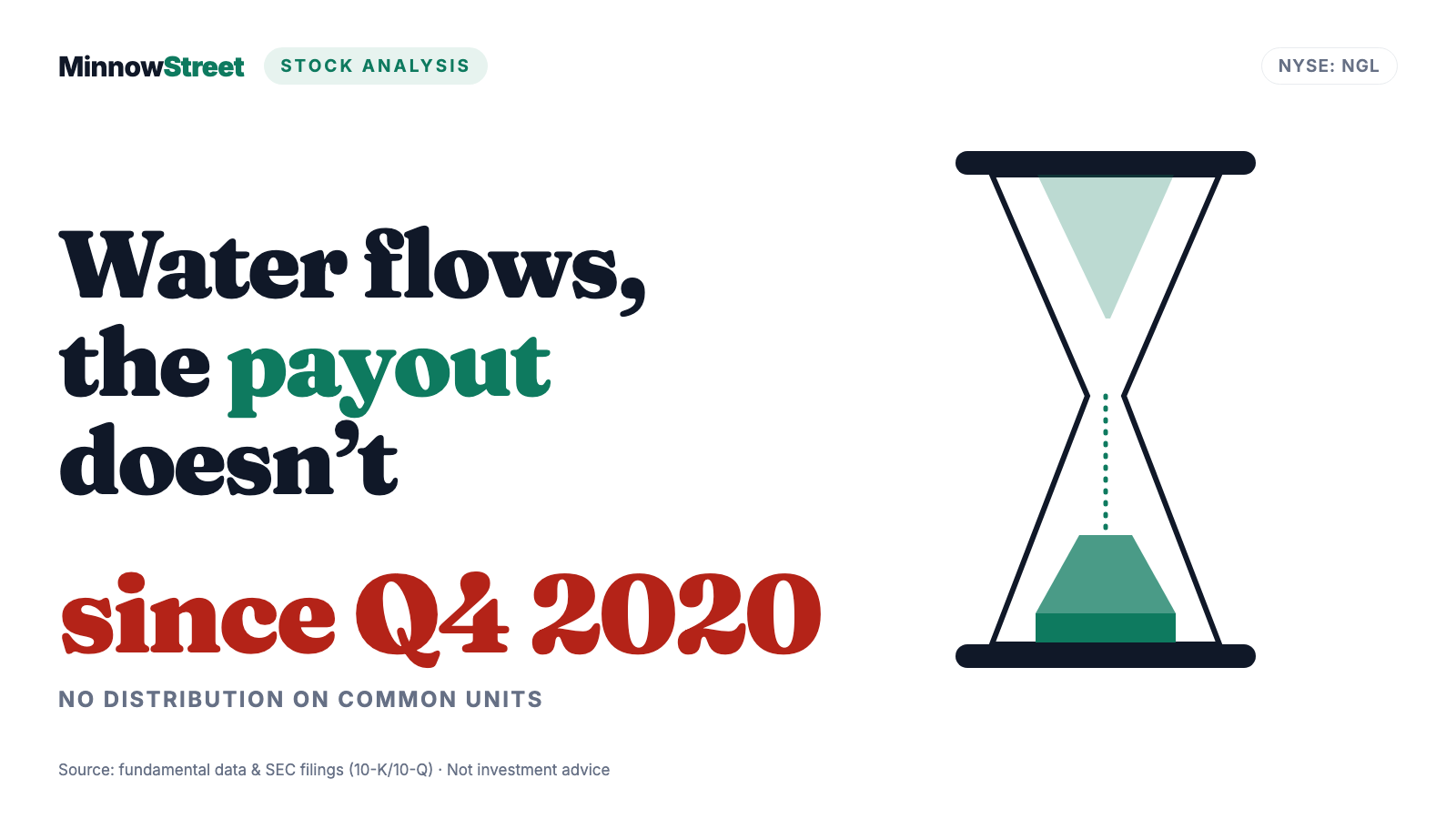
Interactive price chart (TradingView).
Note: pure fact-based analysis, not investment advice and not a solicitation to buy or sell. All figures without guarantee.
There is an investor craving as old as the stock market itself: the craving for the regular check. Not the quick pop, but the quiet supplement — a little cash hitting the account month after month, quarter after quarter, without selling anything. In the US there is a vehicle built for exactly that, the Master Limited Partnership (MLP): publicly traded pipeline and infrastructure partnerships famous for their generous cash payouts. Hear "energy MLP" and the reflex fires: fat distribution, defensive income, boring in the best sense. That reflex is where the trap sits. NGL Energy Partners LP (NYSE: NGL) of Tulsa, Oklahoma, is one such MLP — and it has not paid its common unitholders a single cent in nearly five years. On Reddit the name shows up with just 2 mentions in 24 hours (ApeWisdom, as of July 23, 2026) — no storm, a whisper. Before the income craving takes the wheel, let's make a deal: we read together only what the company itself reported, under penalty of law, to the U.S. securities regulator, the SEC — the annual report (10-K) for the fiscal year ended March 31, 2026, the prior-year report, and the quarterly report (10-Q) as of December 31, 2025. A filing to the SEC is honest under penalty of law. And this one tells the story of a genuinely strong core business chained to a mountain of debt — and of a payout line in which the common unit you bought stands dead last. In the end, you decide.
What NGL actually is — and why "stock" is already the wrong word
Let's start with the thing most people miss: NGL is not a corporation. It is a limited partnership — a publicly traded partnership. Picture it plainly: you are not buying a share here, you are buying a stake in a large partnership. Your security is therefore not called a share but a "unit", your payout not a dividend but a "distribution", and the boss is not a board but the general partner (GP), who pulls the strings. That has a practical consequence often underestimated: instead of the simple US dividend statement (form 1099), a unitholder gets a K-1 form — a partner's tax return. For anyone filing outside the US, a K-1 is not paperwork for a rainy afternoon; it routinely means a call to the tax adviser. Remember it right at the start: with an MLP you don't just buy a business, you marry a tax structure.
And the business? NGL is organized into three segments. By far the most important is Water Solutions: the disposal of produced water. That is the salty, contaminated wastewater that comes up by the barrel with every barrel of oil and gas — for each barrel of crude, several barrels of water often surface, and all of it has to go somewhere. NGL gathers this water through pipelines, disposes of it in deep injection wells, recycles part of it, and sells the crude it separates out along the way ("skim oil"). It all runs on long-term, fixed-fee contracts with acreage dedications, many carrying minimum volume commitments. The two smaller segments are Crude Oil Logistics (crude transport, centered on the 550-mile Grand Mesa Pipeline from Colorado to Cushing, Oklahoma) and Liquids Logistics (trading and storage of natural gas liquids, butane, biodiesel). Crucial for the whole analysis: NGL is in the middle of concentrating radically on water and shedding the crude and liquids pieces. That names the central tension of this analysis, and it runs through every chapter: at the top, an excellent, growing water business earns real money — but it is chained to a partnership with $3.3 billion in debt, preferred units in the way, and a distribution that has been frozen since 2020.
Where the stock shows up in our scanner — and why this is almost a non-story
NGL landed on the research list not through price strength but through the Reddit radar. Our Reddit-hype scanner (data source ApeWisdom) showed 2 mentions in 24 hours for NGL (as of July 23, 2026) — and that tininess is the first honest observation: NGL is not a meme rocket, it is the opposite. No viral storm, no Reddit army, just an unglamorous, unwieldy name — an oil-and-water partnership with a K-1 form and a unit price that has drifted sideways around $6 for years (September 30, 2025 cover date). In the momentum and trend rankings where our in-house stock scanner collects the market's steepest curves, a security like this naturally plays no role — here no curve is moving, a balance sheet is. So we flip it around: instead of a momentum row, we read the filings, which for a heavily indebted MLP are the only serious source anyway. Remember the principle: a scanner measures attention and price strength — for NGL both are secondary; what matters is who stands ahead of you in the payout line.
The numbers over the years — the water jewel, honestly appraised
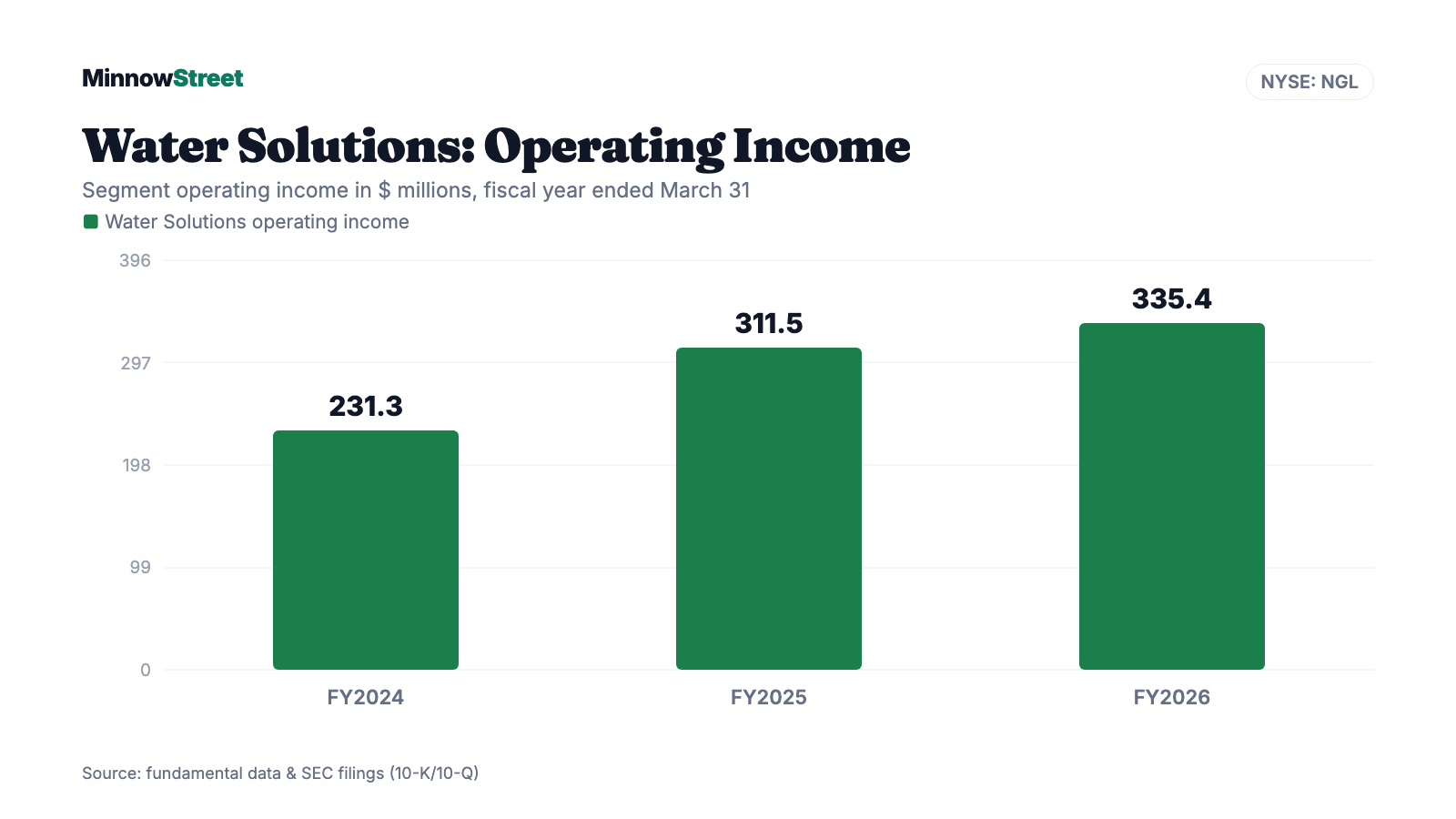
First what genuinely impresses — and that is more than a $6 unit price suggests. The Water Solutions business is a real heavyweight: in the fiscal year ended March 31, 2026 NGL's system handled roughly 1.063 billion barrels of produced water — an average of nearly 2.9 million barrels a day, plus recycled water pushing above 3.1 million barrels daily. The company calls itself, verifiably, the largest independent produced-water disposal company in the US. And this business does not just grow, it earns: segment operating income rose from $231.3 million (FY2024) through $311.5 million to $335.4 million (FY2026), and Adjusted EBITDA (earnings adjusted for one-off items) from $542.0 million to $602.7 million. This is what a core business you should not talk down looks like:
The heart of this business sits in the Northern Delaware Basin — the hottest slice of the Permian in Texas and New Mexico. There NGL runs an integrated network of roughly 840 miles of large-diameter water pipelines, 59 active disposal facilities and 141 active wells, with about 766,000 dedicated acres under long-term agreements — a "multi-decade drilling inventory," as the filing puts it. You do not rebuild a network like that overnight; it is a genuine moat. The filing says so itself, plainly enough to show in the original:
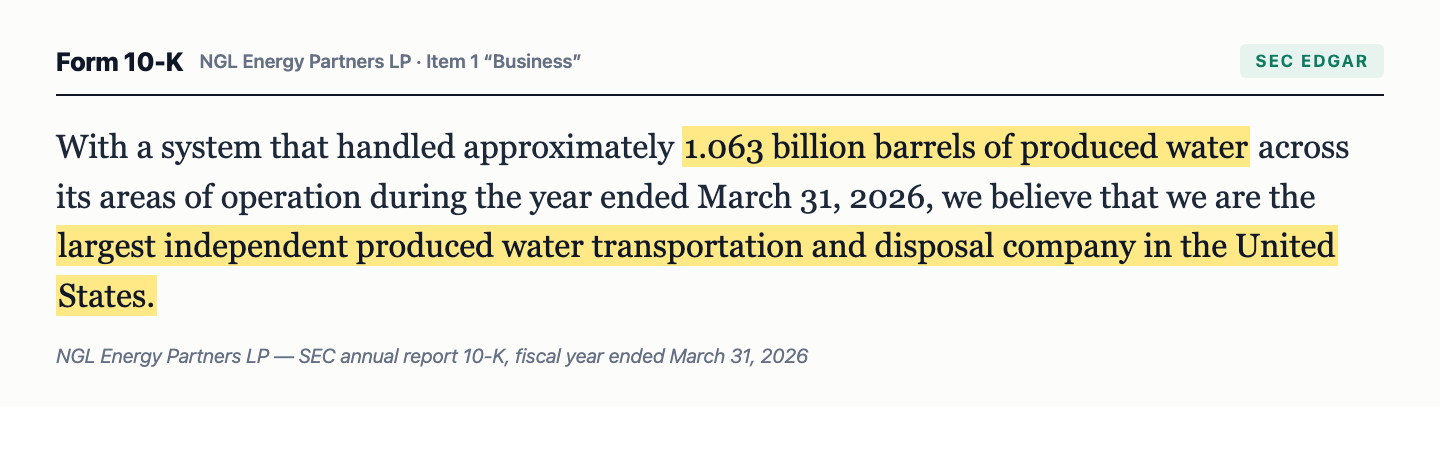
"With a system that handled approximately 1.063 billion barrels of produced water across its areas of operation during the year ended March 31, 2026, we believe that we are the largest independent produced water transportation and disposal company in the United States."
— NGL Energy Partners LP, SEC annual report 10-K for the fiscal year ended March 31, 2026, Item 1 "Business"
You have to tell the other side of the revenue curve too, so no false picture forms: NGL's total revenue has shrunk sharply in recent years — from a peak of roughly $17.8 billion (fiscal 2019) through $8.7 billion (2023) to just $3.16 billion in fiscal 2026 (prior year: $3.47 billion). That sounds dramatic, but it is mostly deliberate: NGL sold its low-margin trading business (refined products, marketing) and parts of its logistics to "become a pure-play water company." For an MLP, revenue is a treacherous figure anyway — the trading business runs billions of dollars of pass-through commodity value through the books that have little to do with real earnings. So remember: for NGL what counts is not revenue but what is left at the bottom — and that is exactly where it gets uncomfortable.
What the filings say — the uncomfortable truths
Uncomfortable truth no. 1: An MLP that has distributed nothing for nearly five years
The MLP is the classic income vehicle — and on its common units that is precisely what NGL does not deliver. The company cut the cash distribution on its common units in the middle of the COVID crisis and has not resumed it. The filing dates it to the day:
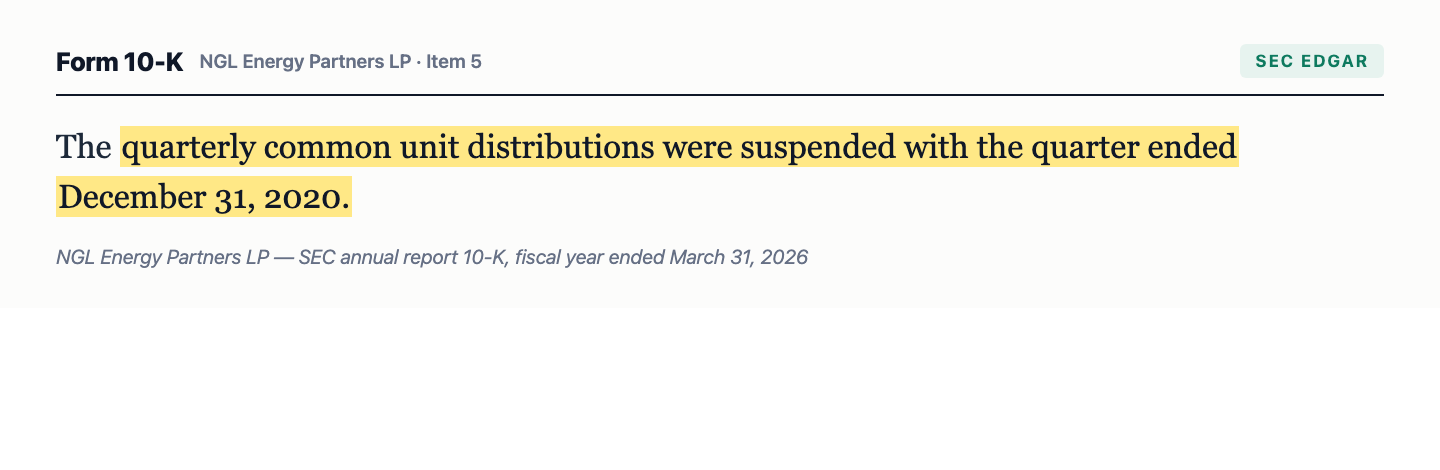
"The quarterly common unit distributions were suspended with the quarter ended December 31, 2020."
— NGL Energy Partners LP, SEC annual report 10-K for the fiscal year ended March 31, 2026, Item 5
Picture it plainly: imagine buying a stake in an apartment-building partnership because it is famous for paying out the rents every month — then learning that the payout has been stopped for five years, because the bank and silent partners must be served first. That is exactly where the common unit stands. Whoever buys NGL buys not a running distribution but the hope of its return — someday. This is not fraud and nothing hidden: it is in black and white in the filing. But it turns the classic "income investment MLP" into its exact opposite — a bet on a turnaround.
Uncomfortable truth no. 2: The mountain of debt eats almost all of operating income
Why isn't there enough money for the distribution? Because the interest comes first. As of March 31, 2026 NGL carried roughly $3.3 billion in debt — including $900 million of 8.125% secured notes due 2029, $1.3 billion of 8.375% notes due 2032, and a new $950 million Term Loan B. Against that stood cash of a mere $8.5 million — for a company this size, essentially nothing (MLPs run on their credit lines). The price of that debt is interest expense of $257.5 million in fiscal 2026. And now the decisive comparison: total consolidated operating income was only $94.7 million — so interest was almost three times what the operating business threw off in the first place.
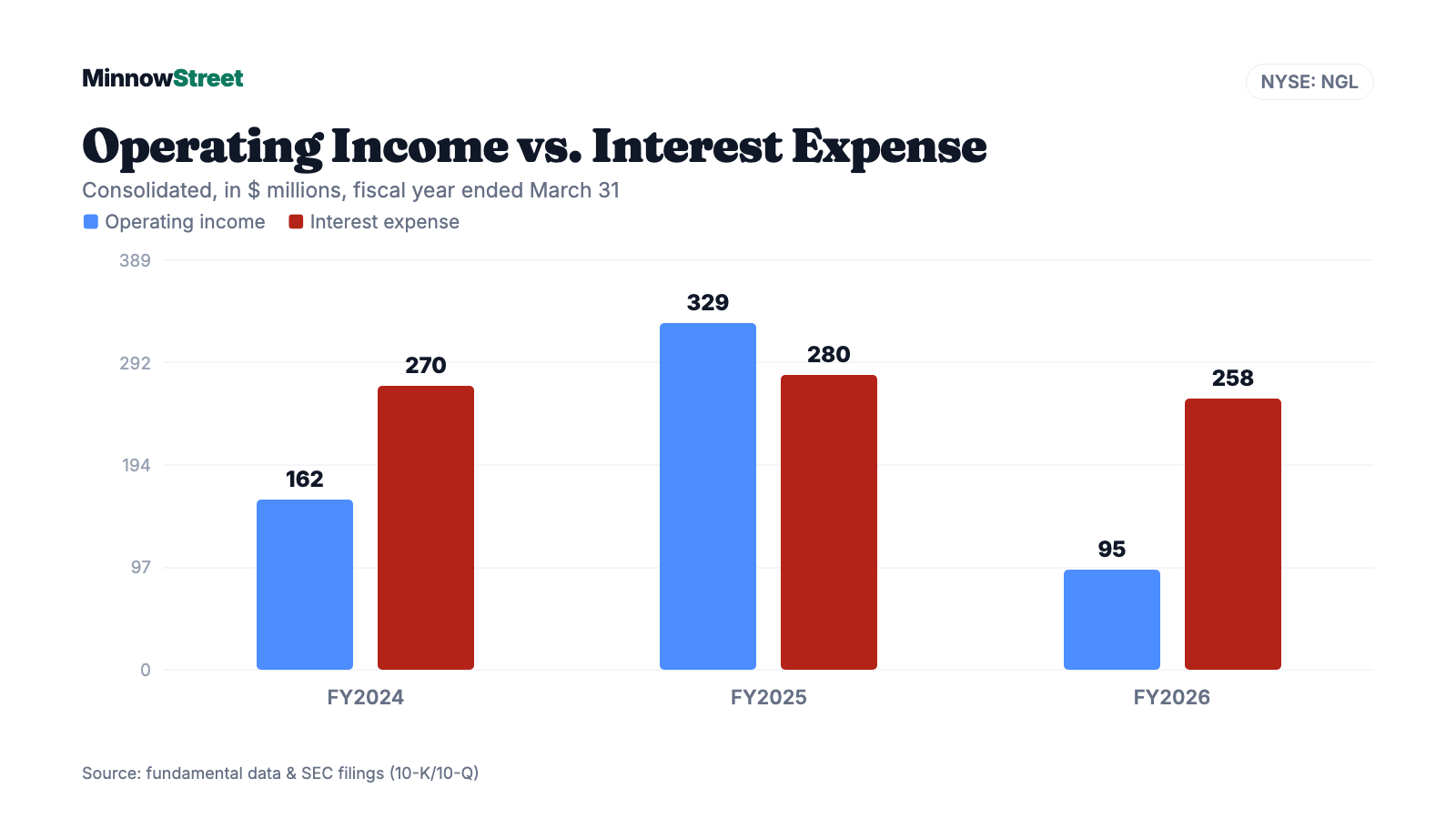
Part of the fiscal 2026 collapse is a one-off: NGL booked $256.3 million of loss on disposal and impairment, overwhelmingly from exiting the crude business — the Crude Oil Logistics segment fell to an operating loss of $226.9 million (prior year: +$46.1 million profit) as a result. That is the price of the pivot to a pure-play water company: you throw the old ballast overboard, and the farewell costs book money. But even without that one-off the underlying math remains: a water business generating roughly $600 million of Adjusted EBITDA must first pay $257 million of interest out of it — and then there are the preferred units. Which brings us to the third truth.
Uncomfortable truth no. 3: In the payout line you stand dead last
Above the common units sit three classes of preferred units — Class B, Class C and Class D (all "cumulative," meaning unpaid distributions do not vanish, they stack up). Preferred means, literally, priority: the preferred distributions for all prior quarters must be paid in full before the common units get a thought. And in the worst case — liquidation — it gets brutally clear for the common unit:
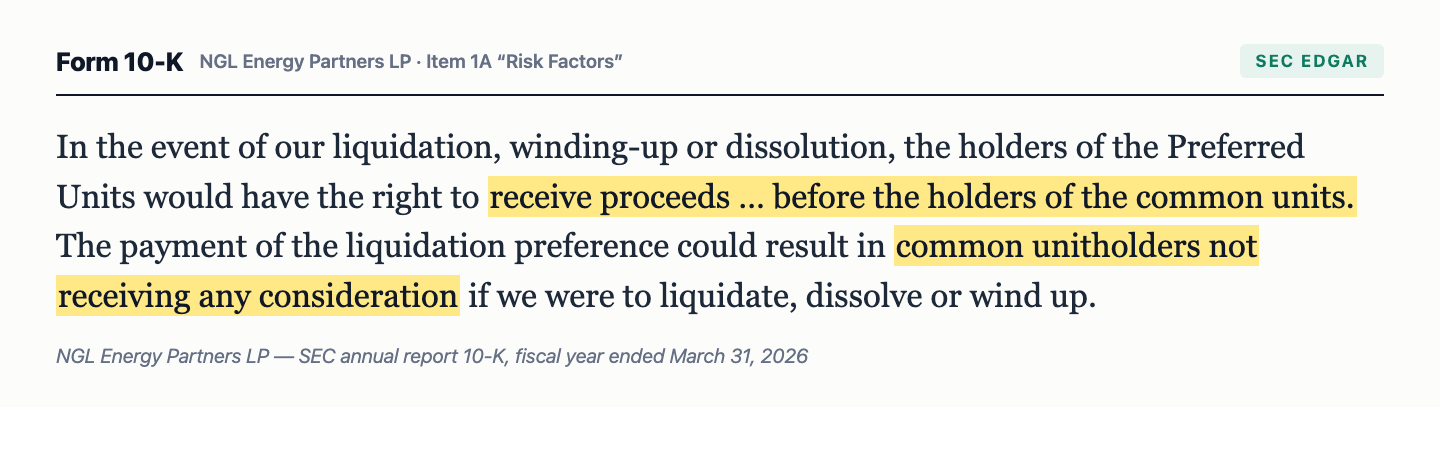
"In the event of our liquidation, winding-up or dissolution, the holders of the Preferred Units would have the right to receive proceeds from any such transaction before the holders of the common units. The payment of the liquidation preference could result in common unitholders not receiving any consideration if we were to liquidate, dissolve or wind up, either voluntarily or involuntarily."
— NGL Energy Partners LP, SEC annual report 10-K for the fiscal year ended March 31, 2026, Item 1A "Risk Factors"
This ranking is not theory; in fiscal 2026 it produced a very concrete number. Consolidated net loss was "only" $142.3 million. But after the preferred distributions and the repurchase premiums on the Class D units were deducted, the common units were allocated a loss of $405.6 million — that is −$3.19 per unit (prior year: −$0.60; FY2024: −$2.14). For a unit around $6 that is a serious number. And it fits the balance-sheet picture: the common unitholders' capital account stands at −$612 million — after years of losses and the suspended distribution, the common units' book equity has long since gone negative. Put plainly: the value of the common unit is the thin slice left over after banks, noteholders and preferred holders have taken their share.
Uncomfortable truth no. 4: The whole case is a bet on deleveraging — and the filing says so itself
Fairness demands that NGL delivers exactly here. The company is visibly shrinking its preferred and debt overhang. In fiscal 2026 it repurchased Class D Preferred Units from 600,000 down to 315,489 (carrying value $289.8 million rather than $551.1 million), paying roughly $422 million; the pandemic-era preferred arrears had already been paid in full by 2024. Management states its priorities so clearly that you have to quote it:
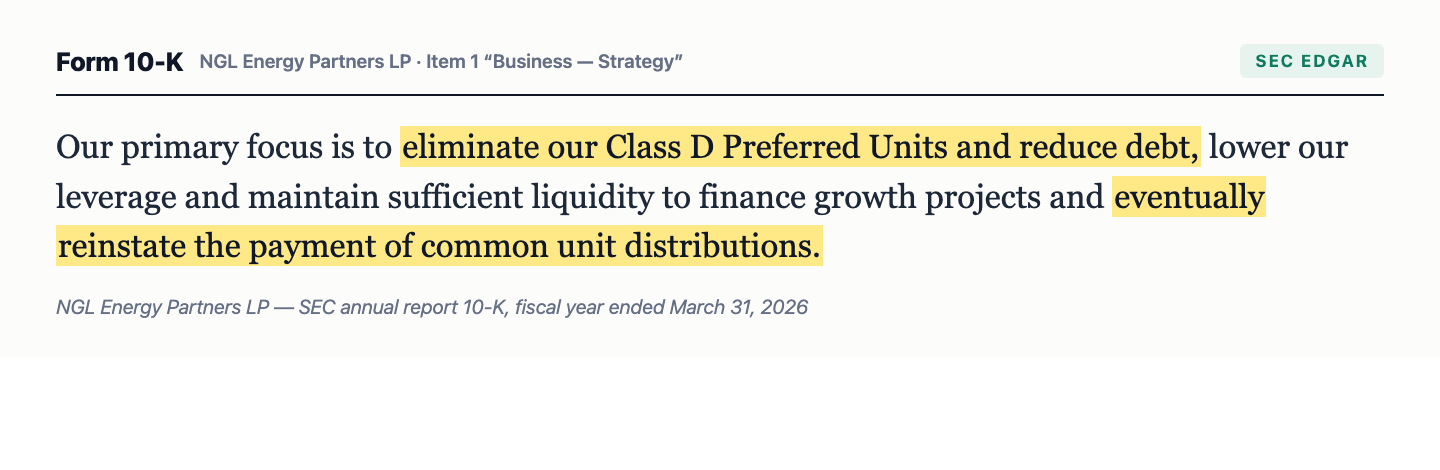
"Our primary focus is to eliminate our Class D Preferred Units and reduce debt, lower our leverage and maintain sufficient liquidity to finance growth projects and eventually reinstate the payment of common unit distributions."
— NGL Energy Partners LP, SEC annual report 10-K for the fiscal year ended March 31, 2026, Item 1 "Business — Strategy"
That is the most honest summary of the whole investment case — written by the company itself. The order is a to-do list, and the common-unit distribution stands dead last: first Class D gone, then debt down, then liquidity secured, then maybe distribute again. So whoever buys NGL is betting not on running income but on the water business being strong enough to work through that list in a reasonable time — against 8.125% to 8.375% bond coupons and a partly recycled, volatile oil demand in the background. A small footnote on the tax trap: the one technical term a non-US investor must never forget here is K-1 — the MLP structure that withholds so much capital from the common units also demands a partner's tax return at year end.
Valuation: A thin slice of equity on a thick base of debt
How expensive is NGL? Let's reckon in orders of magnitude, not daily prices. At the September 30, 2025 cover date a unit cost about $6; with roughly 124.8 million common units outstanding that puts the market value of the equity at a rough $750 million. But the real enterprise value is far higher: you have to add the $3.3 billion of debt, the $289.8 million of Class D units and the Class B/C preferred units on top — putting the enterprise value clearly above $4.5 billion. Measured against the water segment's Adjusted EBITDA of roughly $600 million, that is not absurdly expensive — for an infrastructure business with a moat, such a multiple is even on the moderate side. But this is exactly where the lever that makes the common unit dangerous sits: it is only the thin top slice on a thick base of debt and preferred capital. If enterprise value falls 15 percent, that hits the $750 million equity slice disproportionately; if it rises, the slice benefits disproportionately. A leveraged security, in other words — what tempts on the upside amplifies on the downside. How fast the market re-prices such leveraged energy structures showed up recently at Solaris Energy, also a child of the Permian — there the fantasy drove, here the balance sheet weighs.
Opportunities and risks at a glance
What speaks for NGL:
- A genuine core jewel: Water Solutions is, per the filing, the largest independent produced-water disposal company in the US (1.063 billion barrels in fiscal 2026), with a hard-to-replicate pipeline network in the Northern Delaware Basin (840 miles, 59 facilities, 141 wells, 766,000 dedicated acres) and minimum volume commitments under long-term contracts.
- The jewel grows and earns: segment operating income $231.3 million → $311.5 million → $335.4 million (FY2024 to FY2026), Adjusted EBITDA $542.0 million → $602.7 million — real, recurring earnings, not a trading fluke.
- Visible deleveraging: Class D Preferred Units repurchased from 600,000 to 315,489 (~$422 million paid), preferred arrears cleared since 2024, debt refinanced via the 2029/2032 notes and a $950 million Term Loan B — the turnaround is under way, not merely announced.
- Structural tailwind: as long as the Permian produces, produced water accumulates — several barrels of water per barrel of oil, all of which must be disposed of. This is a fee-driven "toll business," far less exposed to the oil price than production itself.
- A clear, management-committed order of operations: first eliminate Class D and deleverage, "eventually reinstate the payment of common unit distributions" — whoever believes in the execution buys the pre-stage today.
What speaks against it:
- No running distribution: the MLP cash distribution on common units has been frozen since the quarter ended December 31, 2020 — the asset class's classic income argument is entirely absent at NGL.
- The interest trap: $3.3 billion in debt, $257.5 million interest expense (FY2026) against just $94.7 million of operating income and $8.5 million of cash; notes at 8.125% to 8.375%, Class D floating (reference rate plus 7.00%) — rising rates hit straight at the core.
- You stand at the back of the line: preferred units (Class B/C/D) and the general partner rank ahead; the liquidation preference can leave common units with nothing; loss allocated to common units −$405.6 million, or −$3.19 per unit (FY2026), capital account −$612 million.
- The costly overhaul: $256.3 million loss on disposal/impairment in fiscal 2026 (Crude Oil Logistics −$226.9 million); simplifying to a pure-play water company costs book money and makes results lumpy.
- The structural hurdle for retail: an MLP with a K-1 form instead of a dividend statement — a partner filing for tax purposes, and for non-US investors routinely a matter for the tax adviser.
A human conclusion
Back to the income craving from the opening. Its core is not that MLPs are bad — many are reliable payout machines. Its core is that the "MLP" label raises a promise this particular MLP has not kept on its common units for nearly five years. Whoever buys NGL because "MLP" sounds like a monthly check is really buying something quite different: a leveraged bet that a genuinely strong water business pays down a mountain of debt and preferred capital fast enough to distribute again someday. The jewel is real — 1.063 billion barrels of produced water, $335 million of operating income, a network with a moat. But the jewel is yours only after banks, noteholders and preferred holders are served, and until then you carry −$3.19 of loss per unit and a K-1 form. So the honest question is not "is produced water a good business?" — it is — but: would you still buy this business knowing you stand dead last in the payout line and the host says "eventually"? If yes, you have a thesis about the turnaround. If no, you only had the craving for the check. What you make of it is your decision. And that is exactly as it should be.
Sources
All original documents used in this analysis — to read for yourself:
- NGL Energy Partners LP — SEC annual report 10-K for the fiscal year ended March 31, 2026 (filed May 28, 2026)
- NGL Energy Partners LP — SEC annual report 10-K for the fiscal year ended March 31, 2025 (filed May 29, 2025)
- NGL Energy Partners LP — SEC quarterly report 10-Q as of December 31, 2025 (filed February 3, 2026)
- Full SEC filing history of NGL Energy Partners LP: EDGAR overview (sec.gov)
- Fundamental data (metrics, segment and debt series, valuation; price cut-off September 30, 2025 from the 10-K cover), reconciled with the SEC filings and the SEC XBRL metric series.
- Reddit mentions: ApeWisdom (as of July 23, 2026); screener context: in-house stock scanner.
Transparency & disclaimer: This analysis is a journalistic contextualization of publicly available information and is not investment advice, not a financial analysis in the regulatory sense, and not a solicitation to buy or sell securities. Interests in a Master Limited Partnership carry substantial risks up to total loss and bring special tax obligations for many non-US investors (US form K-1). All information without warranty; the data cut-off is noted in the text in each case. The author holds no position in NGL units at the time of publication.
Our Bottom Line at a Glance
- Core business Water Solutions positive
- Per the filing, the largest independent produced-water disposal company in the US (1.063 billion barrels in the fiscal year ended March 31, 2026) with a hard-to-replicate pipeline network in the Northern Delaware Basin (840 miles, 59 facilities, 141 wells, 766,000 dedicated acres). Segment operating income grew three years running to $335.4 million (Adjusted EBITDA $602.7 million) — a fee-driven toll business with a moat.
- Capital structure & debt negative
- $3.3 billion in debt (March 31, 2026) at 8.125% to 8.375%, plus floating Class D Preferred Units (reference rate +7.00%) — interest expense of $257.5 million all but consumed operating income of $94.7 million; cash was only $8.5 million. A strong business that hands the lion's share of its earnings to creditors.
- Ranking & distribution negative
- The cash distribution on common units has been frozen since the quarter ended December 31, 2020; preferred units (Class B/C/D) and the general partner rank ahead, and in liquidation the common units can receive nothing. Loss allocated to common units −$405.6 million, or −$3.19 per unit (FY2026), capital account −$612 million — the classic MLP income argument is entirely absent here.
- Turnaround progress neutral
- Visibly under way but far from done: Class D Preferred Units repurchased from 600,000 to 315,489 (~$422 million paid), preferred arrears cleared since 2024, debt refinanced. Management commits the order of operations in writing — first eliminate Class D and deleverage, "eventually reinstate the payment"; the common unit stands at the end of that to-do list.
- Structure & valuation negative
- About $6 per unit (September 30, 2025) puts equity value at ~$750 million — only the thin top slice on an enterprise value above $4.5 billion; any change in value hits the common unit with leverage. Add the K-1 tax structure, which brings special obligations for many non-US investors.
NGL Energy Partners is the income craving in its most deceptive form: an MLP — the classic income vehicle — that distributes nothing to its common units, and has not since the quarter ended December 31, 2020. At the top sits an excellent, growing water business (the largest independent produced-water disposal company in the US, $335 million of segment operating income, $602.7 million of Adjusted EBITDA). But that jewel is chained to $3.3 billion in debt with $257.5 million of interest, to preferred units that get paid before the common unit, and to an allocated loss of −$3.19 per unit on a negative capital account. The deleveraging is real and visible, but the common unit stands at the back of the line. Whoever buys is betting on the turnaround, not on running income. Not investment advice.
What Our Rating Means
Substance risk
We found at least one documented issue that threatens the company itself — regardless of how the stock is currently valued.
Whoever buys units today is betting that NGL's water business (roughly $600 million of Adjusted EBITDA) pays down the debt and preferred mountain fast enough to distribute again someday — and carries −$3.19 of loss per unit, a leveraged capital structure and a K-1 tax form until then. Before stepping in, check four things in each quarterly report (10-Q): Does the Class D balance keep falling (last 315,489 units)? Does absolute debt drop below $3.3 billion? Does Water Solutions EBITDA stay above $600 million? And does the loss allocated to common units approach zero? Only once that list is worked through does the bet become income. The decision is yours.
A journalistic assessment by our editorial team at the time of the deep dive, based on public sources — not investment advice and not a solicitation to buy or sell. Your personal circumstances (investment goals, risk capacity, taxes) cannot be taken into account. What our levels mean, how verdicts are formed, and what conflicts of interest exist →
Worth Noting
- NGL landed on the research list via the Reddit-hype scanner (2 mentions in 24 hours, ApeWisdom, as of July 23, 2026) — deliberately not a meme stock but an unglamorous, heavily indebted energy MLP whose story sits in the balance sheet, not in the price chart.
- Identity verified against SEC EDGAR (CIK 1504461): limited partnership, active filer, no Form 15; former name "Silverthorne Energy Partners LP." The fiscal year ends March 31 — figures for "FY2026" refer to the year through March 31, 2026.
- Price and valuation figures are dated: about $6 per unit at the September 30, 2025 cover date. Analyses are evergreen; daily prices are not a buy argument. MLP note: a distribution here is a payout, the security is a unit, and the tax statement is a K-1 — for many non-US investors a matter for the tax adviser.
Frequently Asked Questions
NGL Energy Partners LP (NYSE: NGL) of Tulsa, Oklahoma, is a Master Limited Partnership (MLP) with three segments: Water Solutions (disposal of produced water from oil and gas production — the core business), Crude Oil Logistics (crude transport, including the Grand Mesa Pipeline) and Liquids Logistics (natural gas liquids trading and storage). In the fiscal year ended March 31, 2026 the water business handled roughly 1.063 billion barrels of produced water; per the filing, NGL is the largest independent produced-water disposal company in the US. Consolidated revenue was $3.16 billion, with 449 employees.
No, NGL is not a corporation but a Master Limited Partnership (MLP) — a publicly traded partnership. Investors buy "units" instead of shares and receive "distributions" instead of dividends. For tax purposes you become a partner and receive a US K-1 form instead of the simple dividend statement (1099). For non-US investors a K-1 is routinely a matter for a tax adviser — a point worth knowing before you buy.
Not on its common units: the quarterly distribution was suspended, per the annual report, with the quarter ended December 31, 2020, and has not been resumed. Priority goes to the preferred units (Class B, C and D): their distributions must be paid in full for all prior quarters before the common units receive anything. Management states its goal as first eliminating the Class D units and reducing debt and "eventually reinstate the payment of common unit distributions."
Because preferred units and the general partner are served ahead of the common units. In the fiscal year ended March 31, 2026 the consolidated net loss was $142.3 million; after deducting preferred distributions and the repurchase premiums on Class D units, the common units were allocated a loss of $405.6 million — that is −$3.19 per unit (prior year −$0.60; FY2024 −$2.14). The common unitholders' capital account stands at −$612 million.
As of March 31, 2026 debt stood at roughly $3.3 billion — including $900 million of 8.125% secured notes (due 2029), $1.3 billion of 8.375% notes (due 2032) and a new $950 million Term Loan B. Interest expense in fiscal 2026 was $257.5 million — more than two and a half times operating income of $94.7 million. Cash was only $8.5 million; the Class D Preferred Units are also floating-rate (reference rate plus 7.00%).
Very strong and growing: Water Solutions raised segment operating income from $231.3 million (FY2024) through $311.5 million to $335.4 million (FY2026), and Adjusted EBITDA from $542.0 million to $602.7 million. The core network in the Northern Delaware Basin spans roughly 840 miles of water pipelines, 59 disposal facilities and 141 wells with about 766,000 dedicated acres. Because every barrel of oil and gas production yields produced water, it is a fee-driven toll business — far less exposed to the oil price than production itself.
Mainly because of a one-off: NGL booked $256.3 million of loss on disposal and impairment, overwhelmingly from exiting the crude business — the Crude Oil Logistics segment fell to an operating loss of $226.9 million (prior year +$46.1 million) as a result. That is why consolidated operating income slid from $329.4 million (FY2025) to $94.7 million (FY2026). It is the price of the overhaul into a pure-play water company — the old ballast is thrown overboard, and the farewell costs book money.
Found an error?
Did you spot a factual error, an outdated number, or a typo in this deep dive? Let us know briefly — your report goes straight to the editorial team.