Globe Life Stock: A 20.9 Percent Return on Equity — and a Reputation That Is on Trial
Globe Life insures lower-middle to middle-income America with life and supplemental health policies, and it shows up in our Joshua growth scanner (rank 20, as of July 17, 2026). We read the annual reports (10-K) for 2024 and 2025 and the quarterly report (10-Q) as of March 31, 2026: a profit machine with a 20.9 percent return on equity, a book value that rose 19 percent, and $685 million of share buybacks in 2025 — but also an April 2024 short-seller episode, a securities class action that survived the company's dismissal motion in September 2025, and government footnotes that vanished between two annual reports. Not investment advice — just the question of what a pristine balance sheet is worth when the fight is not about the numbers but about how they are made.
 Thomas Mücke
Founder & Publisher
Thomas Mücke
Founder & Publisher
Chart
Interactive price chart (TradingView).
Note: pure fact-based analysis, not investment advice and not a solicitation to buy or sell. All figures without guarantee.
There is a reflex that reliably splits investors into two camps whenever a stock is controversial — call it the controversy reflex. The moment a short seller's report knocks a stock down, the market divides: some flee anything with a cloud over it ("no smoke without fire"); others rush in for the "discount" ("the market always overreacts"). Both skip the one question that matters: is the controversy about the numbers themselves — or about how those numbers are made? Hardly any small cap poses that question as sharply in the summer of 2026 as Globe Life Inc. (NYSE: GL) of McKinney, Texas: a down-to-earth life and supplemental health insurer for lower-middle to middle-income America, with a return on equity that many technology companies would envy — and an April 2024 short-seller episode whose legal echo still reverberates. So let's make a deal: before you choose flight or bargain, we read together what the company itself reported, under penalty of law, to the U.S. securities regulator, the SEC — the annual reports (10-K) for 2024 and 2025 and the quarterly report (10-Q) as of March 31, 2026. And these filings tell an unusual story: a pristine balance sheet whose biggest risk does not sit in the balance sheet. In the end, you decide for yourself.
What Globe Life actually does — and for whom
Globe Life sells the least glamorous product in finance: simple, small-face-amount life insurance and supplemental health policies, sold to people the big insurers tend to overlook. The company describes its market as "lower-middle to middle-income," and stresses that it has been "for over 60 years... in this same market with essentially the same products." Translated, Globe Life is something like the insurer for working America beyond the coastal metros: small policies, reliably sold, paid for over decades. One calendar note belongs up front, but the relaxed kind this time: Globe Life's fiscal year matches the calendar year and ends December 31 — no quarter offset, no mental gymnastics. And a name note: until August 2019 the company was called Torchmark Corporation; anyone reading old analyses should search under that name. Distribution runs through five divisions, almost all of them via independent agents: the American Income Life Division (by far the largest, roughly 11,920 agents, grown historically out of serving union members and working families), the Liberty National Division (roughly 3,846 agents, in-home and worksite), the Family Heritage Division (supplemental health, roughly 1,527 agents), the independent United American Division (Medicare supplement, roughly 4,396 agents) and the commission-free direct-to-consumer channel under the Globe Life brand. Which brings us to the central tension of this analysis, and it runs through every chapter: Globe Life is one of the most reliable profit machines in U.S. insurance — but its engine is an army of independent agents, and it is precisely their sales practices that have been under fire since April 2024. How a down-to-earth insurer with high returns on capital ticks is something we dissected at California auto insurer Mercury General — and how a short-seller attack plus political risk can shape a stock, at private-prison operator Geo Group.
Where the stock shows up in our scanner
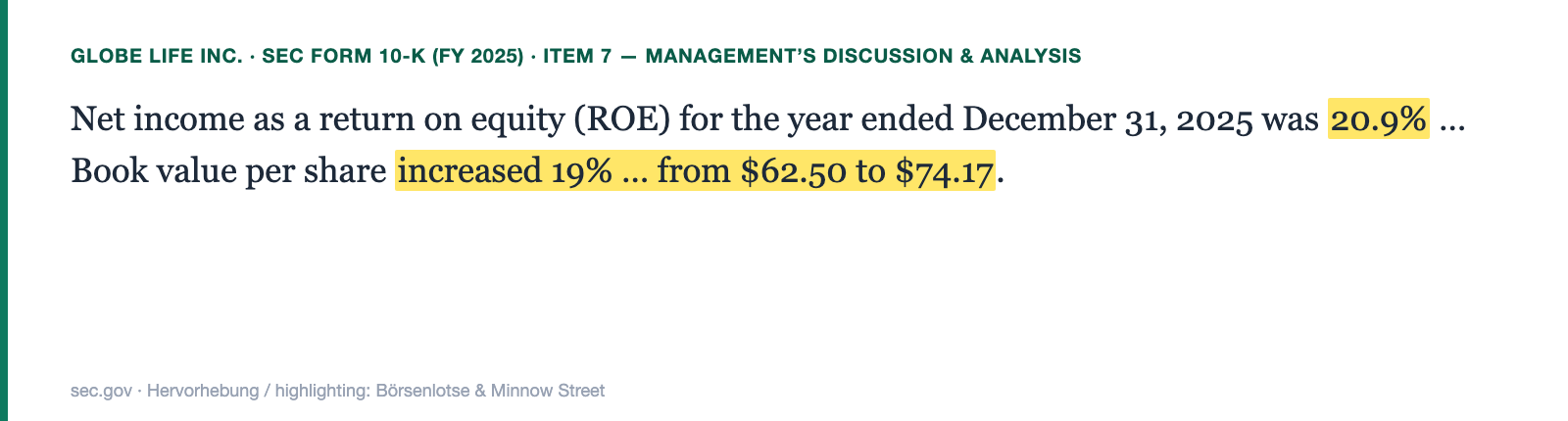
Every day we run about 3,500 stocks through our scanners. Globe Life did not reach the research list through a Reddit hype this time, but through the Joshua growth scanner, where the stock stood at rank 20 as of July 17, 2026. That is remarkable, because Globe Life is no growth sprinter but a compounder: a company that stands out not through jumps but by raising premium, profit and book value year after year and returning the surplus into its own shares. The hard number behind it is return on equity (ROE) — the share of profit earned on the capital employed, in effect the "interest rate" the business earns on its owners' capital. Remember the order of magnitude: an ROE above 15 percent is very good, above 20 percent excellent. Globe Life reports 20.9 percent for 2025. That is exactly what makes the case so interesting: when a company with that return on capital shows up in a growth scanner and still trades at a single-digit earnings multiple, the market is not buying the business — it is buying a discount on a controversy. Where the discount comes from is what the rest of this analysis clarifies.
The numbers over the years — honestly appraised
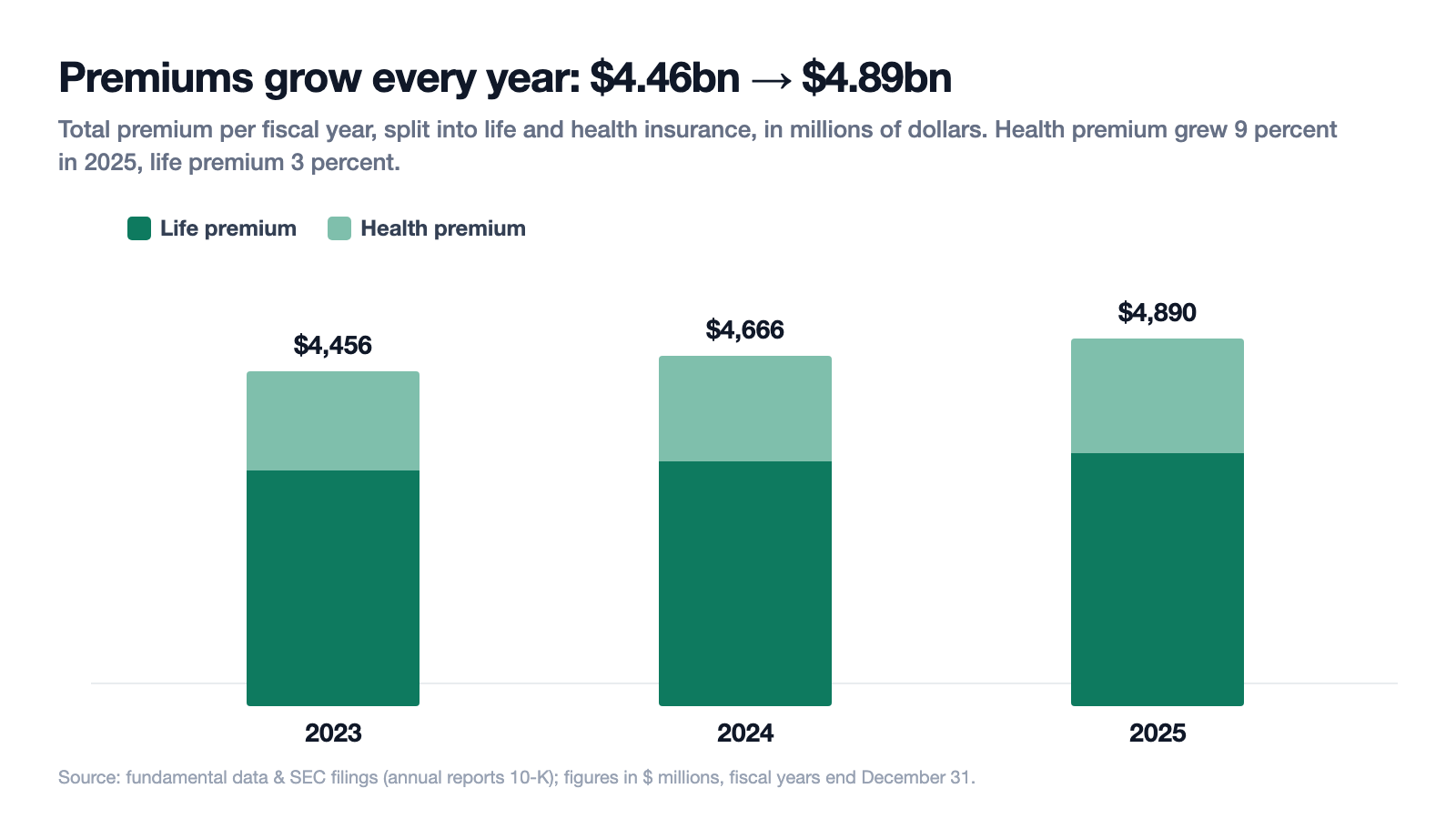
First, what genuinely impresses. Globe Life delivers exactly the boring reliability that is worth gold in insurance. Revenue rose from $5.45 billion (2023) through $5.78 billion (2024) to $5.99 billion (2025). Premium income — the heart of an insurer — grew every year: from $4.46 through $4.67 to $4.89 billion, up 5 percent in 2025 alone (life premium up 3 percent to $3.36 billion, health premium up 9 percent to $1.53 billion). And because an insurer does not just collect premiums but invests the money until it pays out, another $1.13 billion of investment income came in for 2025.
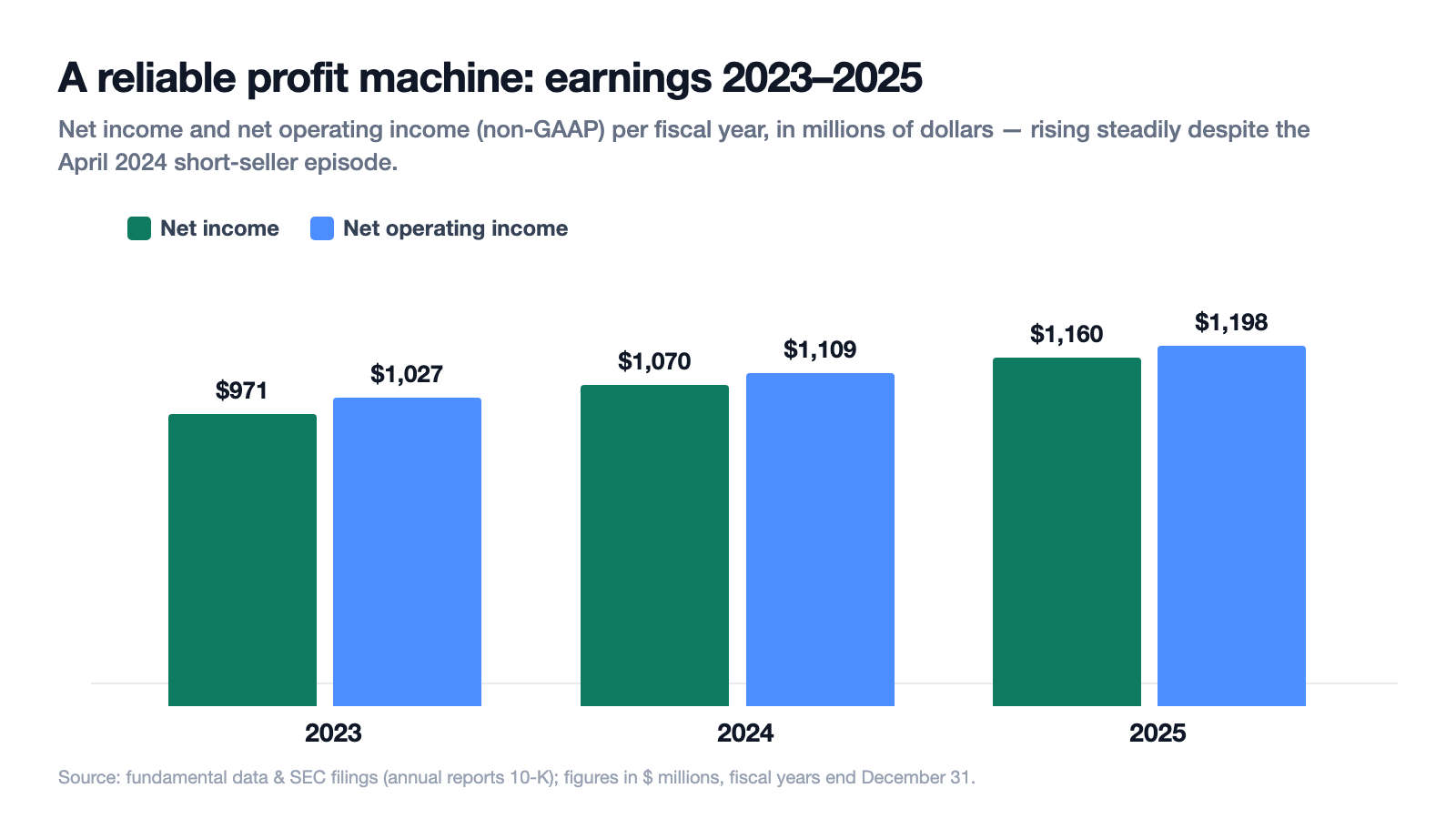
The bottom line rose from $971 million (2023) through $1.07 billion (2024) to $1.16 billion (2025) — up 18 percent per share to $14.07. Management prefers its own metric, net operating income — profit stripped of one-off capital and valuation effects, in effect the result of the core insurance business. It rose from $1.03 through $1.11 to $1.20 billion, up 17 percent per share to $14.52. Important for context: net operating income is a non-GAAP measure (not under the strict U.S. accounting rules, but defined by management) — a legitimate but company-chosen figure. What stands out: the curve does not bend anywhere. Even in 2024, the year of the short-seller episode, profit rose.
The latest quarterly report (10-Q) as of March 31, 2026, continues the trend: net income $270.5 million (after $254.6 million in the prior-year quarter), premium up 6 percent to $1.27 billion, new business (net sales) up 22 percent, ROE 17.9 percent. If you read only these paragraphs, you see a flawless compounder. But now come the chapters the market means when it demands the discount.
What the filings say — the uncomfortable truths
Uncomfortable truth no. 1: The engine is the sales force — and the company does not own it
Globe Life's growth hangs on tens of thousands of people who are not employees. The business description says it plainly:
"Agents of American Income Life, Liberty National and Family Heritage are independent contractors that exclusively sell for Globe Life."
— Globe Life Inc., SEC annual report 10-K for 2025, Item 1 "Business"
That is both blessing and curse. Blessing: an army of independent agents carries no fixed salaries, scales with new business and bears its own entrepreneurial risk. Curse: the company earns on their sales but controls their conduct at the customer's kitchen table only to a limited degree — and is still on the hook for its reputation if something goes wrong. This is exactly where the controversy bites: the April 2024 allegations are not about invented revenue on the balance sheet but about the sales practices of those agents. The company itself names the reputational risk openly in the risk section of the annual report:
"We have been the target of several short sellers who have published reports making allegations about the Company, which resulted in a significant decline in the price of our common stock."
— Globe Life Inc., SEC annual report 10-K for 2025, Item 1A "Risk Factors"
For fairness: distribution through independent agents is standard in U.S. life insurance, and Globe Life has run this model profitably for decades. But whoever buys the stock also buys the dependence on the integrity of a decentralized sales apparatus — and that is a different risk than a mountain of debt or a concentrated customer. It is harder to quantify and harder to fix.
Uncomfortable truth no. 2: The short-seller episode is no storm that has passed — the class action is alive
It would be convenient to file the April 2024 episode away as a weathered thunderstorm. The 2025 annual report does not allow it. The legal-proceedings footnote states in black and white:
"In April 2024, the trading price of our common stock dropped following the publication of certain short seller reports. As of the date of this Report, one putative securities class action and five shareholder derivative lawsuits have been filed against Globe Life Inc. related to this event."
— Globe Life Inc., SEC annual report 10-K for 2025, Note 5 "Commitments and Contingencies"
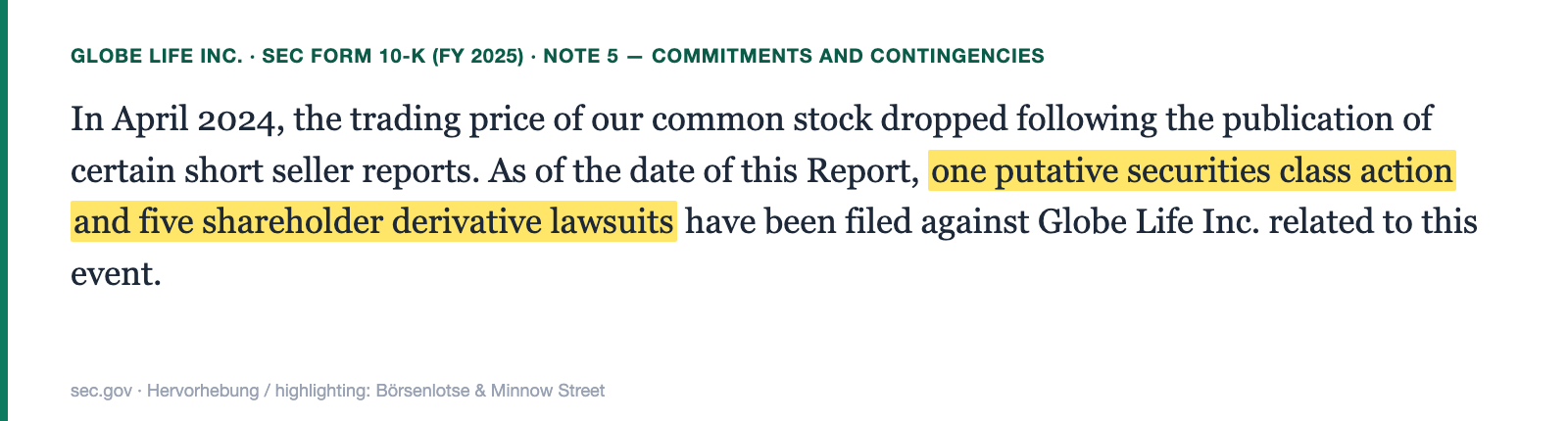
What matters is a date the report states soberly: the company filed a motion to dismiss on December 3, 2024, and that "motion was denied on September 29, 2025." Translated: the class action was not dismissed — it proceeds. The underlying class period runs, per the report, from May 8, 2019, to April 10, 2024, and the allegation is that certain disclosures about financial performance were "materially false or misleading." Globe Life says it will defend "vigorously" and writes that the size of any loss "cannot be reasonably estimated at this time." That is exactly the crux: it is not the past numbers that are in dispute, but the narrative about them — and a court has decided the allegations are worth a trial. That is no finding of guilt, but no closed case either.
Uncomfortable truth no. 3: The government footnote that vanished between two reports
Here it pays to compare two annual reports — and that is exactly the kind of detective work SEC filings are made for. The report for 2024 still named two government matters:
"On November 30, 2023, Globe Life Inc. and its subsidiary, American Income, received subpoenas from the U.S. Attorney's Office for the Western District of Pennsylvania, seeking documents relating to sales practices by certain independent sales agents ... In April 2024, Globe Life Inc. received an inquiry from the SEC's Fort Worth Regional Office requesting information related to recent short seller reports."
— Globe Life Inc., SEC annual report 10-K for 2024, Note 5 "Commitments and Contingencies"
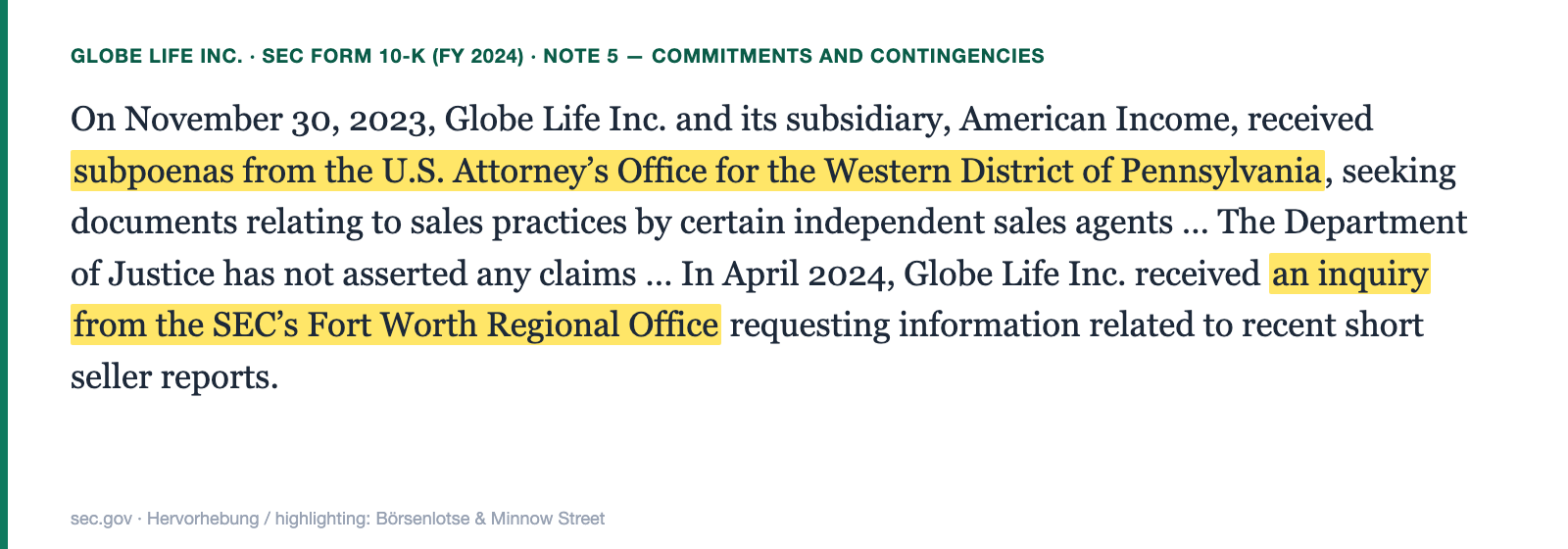
The 2024 report already recorded that the Department of Justice had "not asserted any claims" and that the company was cooperating fully. But the decisive finding comes from the 2025 report: there, neither the DOJ subpoena nor the SEC inquiry is mentioned at all. When a company drops a government matter from its legal proceedings, it usually signals that it was resolved without charges — companies do not keep listing concluded matters. Honesty requires both sides: this is a plausible piece of good news — but the report nowhere states outright "matter closed." We stick to what is there (and what is no longer there) and do not read into it what we would like. What is certain: the private shareholder class action from truth no. 2 is unaffected by this disappearance — it proceeds. One footnote for completeness: a separate matter before the U.S. Equal Employment Opportunity Commission (EEOC) (allegations by former agents) has, per the 2025 report, "concluded without achieving a resolution," and the agency could sue.
Uncomfortable truth no. 4: Two book values, $22 apart — and buybacks above book
At an insurer, "book value per share" is the most important valuation gauge — and at Globe Life it happens to have two faces. The report cites a book value per share of $74.17, but "excluding AOCI" of $96.16. AOCI (accumulated other comprehensive income) is a catch-all item within equity where, above all, interest-rate-driven changes in the value of the bond portfolio land — when rates rise, the market value of older bonds falls, and book value takes a cosmetic dent even though the insurer usually holds those bonds to maturity. That is precisely why management strips this dent out — a legitimate but company-chosen non-GAAP view. Remember the image: at an insurer, raw book value often says more about interest rates than about the business. The second number in this chapter is the buyback:
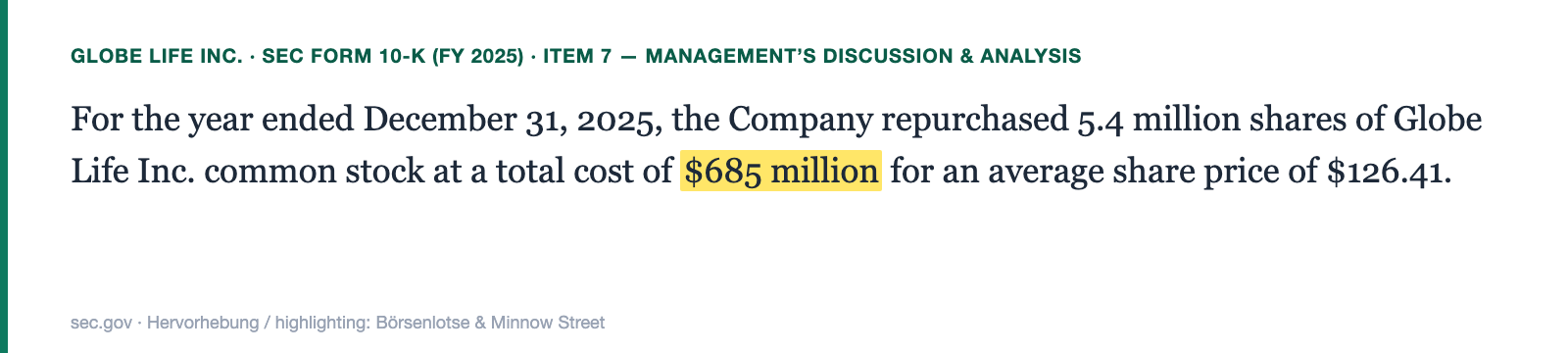
In 2025 Globe Life repurchased 5.4 million of its own shares for $685 million, at an average of $126.41 each. That is a genuine act of conviction — the company hands most of its surplus back to the remaining shareholders rather than hoarding it. But it is also a tell: at $126.41, management buys back well above the accounting book value of $74.17 — so it considers its own stock worth clearly more than the books show. For a compounder with a 20 percent return on capital that is defensible; for an investor it is the reminder that "below book" is not the right yardstick here. The right question is: is the return on capital enough to justify the controversy discount?
Valuation: insurer arithmetic, not a tech P/E
You do not value Globe Life like a growth stock, but like a capital compounder. Three numbers suffice. First, earnings per share: roughly $14.52 of net operating income (2025), up 17 percent year over year. Second, return on capital: a 20.9 percent net income ROE, 16.0 percent operating ROE excluding AOCI — both well above the 15 percent mark at which an insurer counts as highly profitable. Third, book value: $74.17 per share, or $96.16 excluding the interest-rate-driven AOCI dent, backed by $5.97 billion of equity. Taking the average 2025 repurchase price of $126.41 as a dated valuation anchor — evergreen, not day-sharp — the market pays a good 8 to 9 times operating earnings and about 1.3 times AOCI-adjusted book value. For a company that earns 16 to 21 percent on its equity year after year and buys back the surplus, that is a low price — the market is visibly pricing the controversy discount: the risk from the pending class action and from the questions about the agent sales force. Whether that discount is too large or too small hangs on exactly one unknown that no filing quantifies: the outcome of the litigation and whether the sales practices are clean. The analyst lens mostly sees a buy here — but the professionals are running the same bet, just with the opposite sign.
Opportunities and risks at a glance
What speaks for Globe Life:
- One of the most reliable profit machines in the industry: a 20.9 percent return on equity (2025), net operating income per share up 17 percent to $14.52, premium up 5 percent to $4.89 billion — and the curve does not bend in any of the three years, not even 2024.
- Book-value build plus disciplined return of capital: book value per share up 19 percent to $74.17 (excluding AOCI $96.16), plus $685 million of buybacks in 2025 at an average of $126.41 — management actively concentrates earnings per share.
- Structural tailwind: an underserved market (lower-middle to middle-income America) the company has served for over 60 years with essentially the same products — a sticky, recurring premium stream.
- The latest trend confirms it: Q1 2026 net income up 6 percent, premium up 6 percent, new business up 22 percent, ROE 17.9 percent (quarterly report 10-Q as of 03/31/2026).
- Valuation cushion: a good 8 to 9 times operating earnings and about 1.3 times AOCI-adjusted book value (anchor: 2025 repurchase price) — low for this return on capital.
What speaks against it:
- The class action is alive: after the April 2024 short-seller episode, one securities class action and five derivative suits are pending; the motion to dismiss was denied on September 29, 2025, and the size of any loss "cannot be reasonably estimated" per the report (10-K 2025, Note 5).
- Reputational and regulatory risk at the core of the model: distribution runs through tens of thousands of independent agents whose sales practices are at the center of the allegations — a risk that is hard to quantify and steer.
- Government history: the 2024 report named a DOJ subpoena (November 2023) and an SEC inquiry (April 2024); their absence from the 2025 report suggests a resolution but is not expressly confirmed there.
- Book-value optics: the interest-rate-driven AOCI dent (roughly minus $22 per share) makes raw book value volatile; the more meaningful figure is the non-GAAP "excluding AOCI" number.
- Investment income as a second engine: roughly $1.13 billion of investment result (2025) hangs on interest rates and the credit quality of the portfolio — a lever that works in both directions.
A human conclusion
Back to the controversy reflex from the opening. Its core is not that short-seller attacks are always right or always wrong — both happen. Its core is that both reflexes — flight and bargain-hunting alike — skip the same question: what is the fight about? At Globe Life we read the answer in the original documents, and it is uncomfortably precise: the past numbers are strong and stable — a 20.9 percent return on capital, growing book value, $685 million of buybacks — but the fight is not about those numbers, it is about the narrative around them and about the sales practices of the agents behind them. That is a different bet than "is the balance sheet solid?" (it is). It is the bet: does a decentralized sales organization come cleanly through a lawsuit that a court, in September 2025, deemed worth a trial? Whoever can answer that question with a calm yes finds a first-rate compounder here at a controversy price. Whoever cannot answer it waits — for the next quarterly reports with progress in the case, say — and accepts that they may miss the cheapest entry. Both are legitimate; the only illegitimate move is not to ask the question at all. What you make of it is your decision. And that is exactly as it should be.
Sources
All original documents used in this analysis — to read for yourself:
- Globe Life Inc. — SEC annual report 10-K for 2025 (fiscal year ended December 31, 2025; filed February 25, 2026)
- Globe Life Inc. — SEC annual report 10-K for 2024 (ended December 31, 2024; filed February 26, 2025; DOJ/SEC footnote, Fuzzy Panda)
- Globe Life Inc. — SEC quarterly report 10-Q as of March 31, 2026 (filed May 7, 2026)
- Globe Life Inc.'s complete SEC filing history (formerly Torchmark Corporation): EDGAR overview (sec.gov)
- Fundamental data (metrics, quarterly series, valuation), reconciled with the SEC filings.
- Screener data: Joshua growth scanner (rank 20, as of July 17, 2026).
Transparency & disclaimer: This analysis is a journalistic contextualization of publicly available information and is not investment advice, not a financial analysis in the regulatory sense, and not a solicitation to buy or sell securities. Stock investments carry substantial risks up to total loss. All information without guarantee; the data cut-off is noted in the text in each case. The author holds no position in Globe Life stock at the time of publication.
Our Bottom Line at a Glance
- Profitability & compounding positive
- A 20.9 percent return on equity (2025), net operating income per share up 17 percent to $14.52, premium up 5 percent to $4.89 billion — the earnings curve does not bend in any of the three years, not even in 2024, the year of the short-seller episode (annual report 10-K for 2025).
- Capital return & book value positive
- Book value per share up 19 percent to $74.17 (excluding AOCI $96.16), plus $685 million of buybacks in 2025 at an average of $126.41 — management concentrates earnings per share consistently, backed by $5.97 billion of equity.
- Pending class action (April 2024) negative
- From the April 2024 short-seller episode, one securities class action and five derivative suits are pending; the company's motion to dismiss was denied on September 29, 2025, and the size of any loss cannot be reasonably estimated per the report (10-K 2025, Note 5). The dispute is about the narrative around the numbers, not the numbers themselves.
- Agent distribution & reputational risk negative
- The engine is tens of thousands of independent agents whose sales practices are at the center of the allegations — a reputational and regulatory risk that is hard to quantify and steer. The 2024 report also named a DOJ subpoena and an SEC inquiry that no longer appear in the 2025 report (resolution likely, but not expressly confirmed).
- Valuation neutral
- At the average 2025 repurchase price of $126.41, the market pays a good 8 to 9 times operating earnings and about 1.3 times AOCI-adjusted book value — low for a 16 to 21 percent return on capital. The discount is the price of the controversy, whose outcome no filing quantifies.
Globe Life is one of the most reliable profit machines in U.S. insurance: a 20.9 percent return on equity, growing book value, $685 million of share buybacks — and an earnings curve that did not bend even in 2024, the year of the short-seller episode. But its biggest risk sits not in the balance sheet, but in trust: from the April 2024 episode a securities class action is pending that survived dismissal in September 2025, and the allegations target the sales practices of tens of thousands of independent agents. Whoever invests here buys a first-rate compounder at a controversy price — and bets that a decentralized sales apparatus comes cleanly through the litigation. Not investment advice.
What Our Rating Means
- If you don't own the stock
- As long as the question raised in the bottom line stays open, we see no basis for an entry.
- If you hold it in your portfolio
- Our findings offer no acute reason to sell — the checkpoints named remain decisive.
A journalistic assessment by our editorial team at the time of the deep dive, based on public sources — not investment advice and not a solicitation to buy or sell. Your personal circumstances (investment goals, risk capacity, taxes) cannot be taken into account. What our categories mean, how verdicts are formed, and what conflicts of interest exist →
Worth Noting
- GL reached our research list via the Joshua growth scanner (rank 20, as of July 17, 2026); unlike most hits, Globe Life is no growth sprinter but a capital compounder with a high return on equity.
- Metrics such as net operating income and book value "excluding AOCI" are non-GAAP measures (defined by management). They are common and meaningful at insurers but are not a GAAP standard; net income ($1.16 billion in 2025) is the directly comparable GAAP figure.
- The valuation anchor is the average 2025 repurchase price ($126.41), deliberately dated and evergreen; daily prices are not a buy argument. Globe Life's fiscal year matches the calendar year (ends December 31). Identity verified via EDGAR (CIK 0000320335, formerly Torchmark Corporation).
Frequently Asked Questions
Globe Life Inc. (NYSE: GL) of McKinney, Texas, is a life and supplemental health insurer for lower-middle to middle-income America. It sells simple life and supplemental health policies through independent agents (the American Income, Liberty National, Family Heritage and United American divisions) and a direct-to-consumer channel. Revenue in 2025: $5.99 billion, premium $4.89 billion, net income $1.16 billion. The company was called Torchmark Corporation until 2019.
In April 2024 the stock fell sharply after short sellers published reports alleging problems with the sales practices of the independent agents (the best-known came from Fuzzy Panda). Per the annual report (10-K) for 2025, one securities class action and five shareholder derivative lawsuits arose from it; the company's motion to dismiss was denied on September 29, 2025, so the class action proceeds. Globe Life disputes the allegations and is defending vigorously.
Very profitable: return on equity (ROE) was 20.9 percent in 2025, net operating income rose 17 percent to $14.52 per share, and net income reached $1.16 billion. Book value per share rose 19 percent to $74.17 (or $96.16 excluding the interest-rate-driven AOCI dent). An ROE above 20 percent is considered excellent.
AOCI (accumulated other comprehensive income) is an equity catch-all item where, above all, interest-rate-driven changes in the bond portfolio land. When rates rise, the market value of older bonds falls and book value takes a cosmetic dent — even though the insurer usually holds the bonds to maturity. That is why Globe Life reports two figures: $74.17 per share on a reported basis and $96.16 "excluding AOCI" (a non-GAAP measure). At insurers, the AOCI-adjusted number is often the more meaningful one.
Per the annual report (10-K) for 2024, Globe Life and its subsidiary American Income received a subpoena from the U.S. Department of Justice (DOJ) in November 2023 regarding the agents' sales practices, and an inquiry from the securities regulator, the SEC, in April 2024. The DOJ had asserted no claims at that point. In the 2025 annual report, neither government matter is listed anymore — consistent with a resolution without charges, though not expressly confirmed there. The private shareholder class action continues.
Unlike many industrial companies, Globe Life's fiscal year matches the calendar year and ends December 31. So there is no quarter offset: "fiscal year 2025" is simply calendar year 2025.
Measured against its return on capital, yes: at the average 2025 repurchase price of $126.41, the market pays a good 8 to 9 times operating earnings ($14.52 per share) and about 1.3 times AOCI-adjusted book value ($96.16) — low for a company with a 16 to 21 percent return on equity. The discount reflects the risk from the pending class action and the questions about the agent sales force. Not investment advice.
Found an error?
Did you spot a factual error, an outdated number, or a typo in this deep dive? Let us know briefly — your report goes straight to the editorial team.