Fortinet Stock: An 80 Percent Gross Margin — and More Than Half of Revenue Passes Through Three Doors
Fortinet (Nasdaq: FTNT), the firewall company run by brothers Ken and Michael Xie, ranks second in our in-house Terry Smith quality scanner (U.S. selection, as of July 18, 2026): an 80 percent gross margin, an operating margin above 30 percent, net cash. We read the annual report (10-K) for 2025 and the quarterly report (10-Q) as of March 31, 2026 — and they also tell the other story: 55 percent of revenue flows through just three distributors, a class action is litigating the communication of the company's own growth story, and management itself guides to falling margins in 2026. Not investment advice — just a cross-check of whether a quality seal survives its own fine print.
 Thomas Mücke
Founder & Publisher
Thomas Mücke
Founder & Publisher
Chart
Interactive price chart (TradingView).
Note: pure fact-based analysis, not investment advice and not a solicitation to buy or sell. All figures without guarantee.
There is an investor trap that catches the diligent in particular: the seal-of-approval reflex. It works like this: a filter you trust — say, a quality scanner built on the criteria of British fund manager Terry Smith — puts a stock near the top. And the moment the seal sticks, your brain switches off inspection mode. "Rank 2 out of thousands? Then surely everything checks out." Exactly this seal is worn in the summer of 2026 by Fortinet, Inc. (Nasdaq: FTNT), the firewall company from Silicon Valley: rank 2 in our in-house Terry Smith quality scanner (U.S. selection, as of July 18, 2026). The numbers behind it are genuinely impressive — an 80 percent gross margin, an operating margin above 30 percent, net cash. So let's make a deal: we let the seal be a seal and read together what Fortinet itself reported, under penalty of law, to the U.S. securities regulator, the SEC — the annual report (10-K) for fiscal year 2025 and the quarterly report (10-Q) as of March 31, 2026. And besides the quality story, those documents tell three others: about three doors through which more than half of revenue passes, about a growth story a federal court is now examining — and about a balance sheet from which the equity has almost disappeared. In the end, you decide.
What Fortinet actually does — and where the money comes from
Fortinet builds the bouncers for corporate networks. The core product is called FortiGate — a firewall, that is, a device (or software) that polices a company's data traffic and keeps attackers out. Two things set Fortinet apart from most rivals: first, the company designs its own custom chips (so-called ASICs) — instead of buying general-purpose processors, Fortinet builds the engine itself and gets more security throughput per hardware dollar. Second, everything runs on a single operating system, FortiOS, which ties firewalls, networking and cloud services into one overall system Fortinet calls the Security Fabric. On top of it sit the growth fields: Unified SASE (cloud-delivered security for remote workers and branch offices), Security Operations (AI-assisted threat detection) and the FortiGuard security subscriptions, whose threat intelligence the in-house lab FortiGuard Labs collects with millions of sensors worldwide. Fortinet was founded in 2000 by two brothers who run the company to this day: Ken Xie (chief executive officer) and Michael Xie (president and chief technology officer). Headquarters are in Sunnyvale, California; as of December 31, 2025 the company employed 15,109 people.
To understand the numbers you only need one dividing line: product versus service. Product revenue ($2.22 billion in 2025) is the classic box business — firewalls sold once. Service revenue ($4.58 billion, roughly two thirds of the company) is the subscription business: FortiGuard security updates and FortiCare support, paid up front and recognized as revenue over the contract term. The model works like pay TV: the money arrives first, delivery follows — which gives Fortinet a thick cushion of prepaid security ($7.12 billion of deferred revenue as of December 31, 2025) and makes revenue predictable. Which brings us to the central tension of this analysis, running through every chapter: in the quality metrics Fortinet is a model student — but the three biggest risks sit exactly where no quality filter looks: in distribution, in the courtroom, and in the fine print of the balance sheet. For how another heavyweight from the same scanner combines flawless numbers with built-in concentration risks, see our Apple deep dive.
Where the stock shows up in our scanner
Every day we run roughly 3,500 stocks through our scanners. Fortinet reached the research list via the Terry Smith quality scanner — rank 2 of the U.S. selection, as of July 18, 2026. This filter looks for what fund manager Terry Smith calls "good companies": high returns on capital, high margins, reliable cash generation, little debt. Fortinet fills that grid impressively: the net margin stood at 28.9 percent in the first quarter of 2026 (of $100 in revenue, almost $29 remain as profit), and the Piotroski F-Score — a nine-point health check of the books — stood at 8 of 9 as of the same date. Eight is strong; rock-solid starts right there. An interest coverage above 150 means operating profit could pay the company's interest bill more than 150 times over. On top of that, our scanner lists Fortinet in the "Altman-Z: balance-sheet fortress" filter (a bankruptcy-risk score above 4, data as of July 18, 2026). For comparison: the insurer Globe Life, another hit of this quality filter, makes the same list with an entirely different business model — the filter measures balance-sheet quality, not industry fates.
And exactly here begins the duty to cross-check. A quality scanner computes with what is in the financial statements: margins, returns, debt ratios. It does not see how many channels revenue flows through, which lawsuits are pending, or what management guides for next year. Remember this sentence, it applies to every filter in the world: a scanner answers the question "How good are the numbers?" — never the question "How durable is what produces the numbers?" Only the filings themselves answer the second question. So let's go.
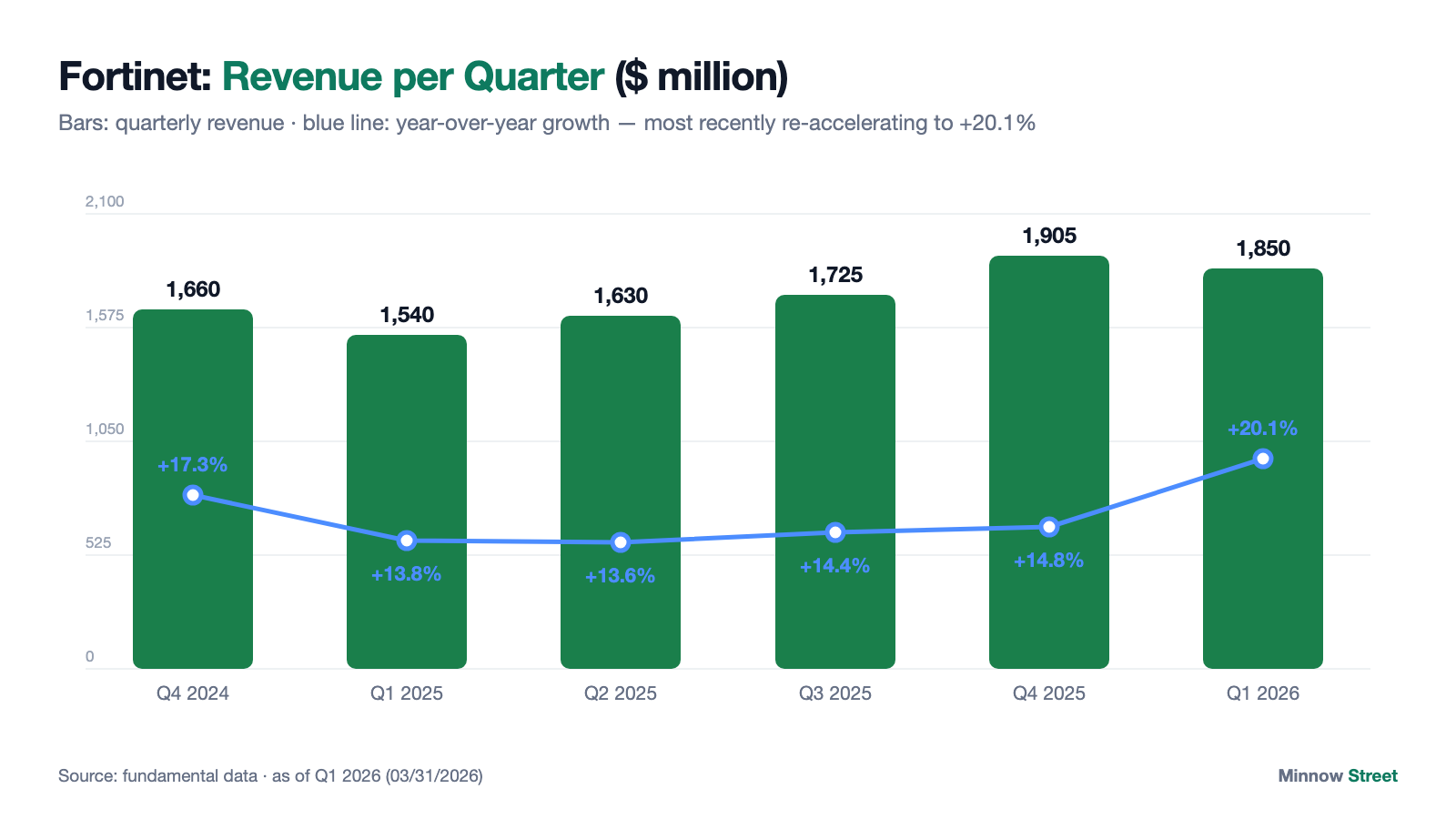
The numbers over the years — honestly appraised
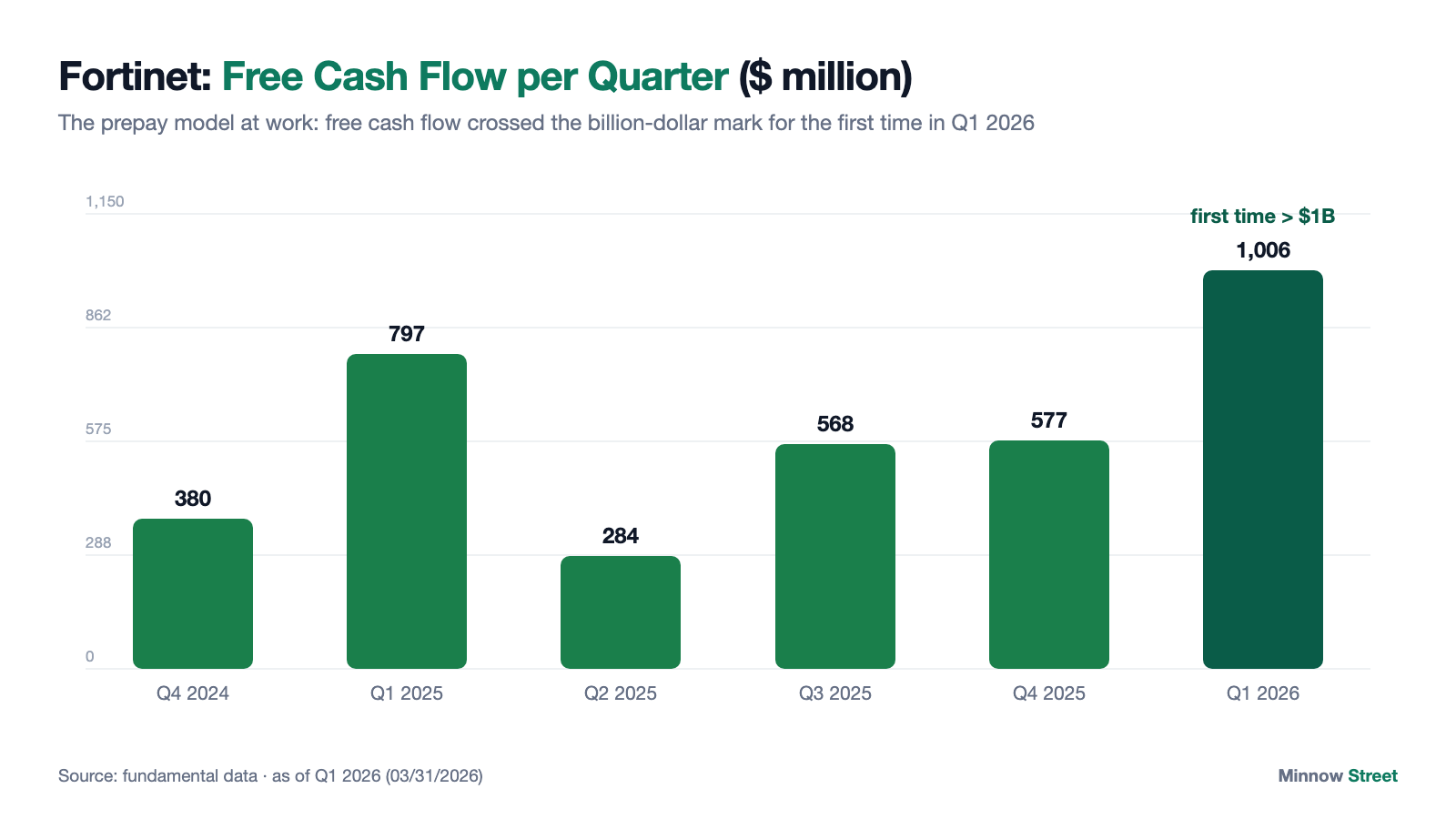
First, what genuinely impresses — and at Fortinet that is a lot. Revenue climbed from $5.30 billion (2023) through $5.96 billion (2024) to $6.80 billion in fiscal year 2025, up 14 percent. Net income rose over the same span from $1,148 million through $1,745 million to $1,853 million. The gross margin holds steady around 80 percent — of every revenue dollar, 80 cents remain after production costs — and the operating margin reached 30.7 percent in 2025. Add the cash discipline: $2,591 million of operating cash flow and $2,212 million of free cash flow in 2025 alone. And the latest quarter topped it: in the first quarter of 2026 revenue grew 20 percent to $1.85 billion, and product revenue jumped 41 percent to $645 million — the long-announced replacement cycle for aging firewalls (the "refresh") is starting to register. Free cash flow crossed the billion-dollar mark in a single quarter for the first time, at just over $1.0 billion.
Honesty, however, also includes the dent that is easy to miss in annual comparisons: 2024 was a lost hardware year. Product revenue fell from $1,927 million (2023) to $1,909 million (2024) — a decline, masked by the still-growing subscription business. Billings (newly invoiced business, an early indicator) grew just 2 percent in 2024 after years of double-digit rates, before re-accelerating 16 percent to $7.55 billion in 2025. Translated: after the buying spree of 2022/2023, customers' racks were full, and for a year Fortinet's growth hung almost entirely on the subscription base. Exactly out of this dent comes the narrative that now carries everything — the great refresh cycle. In the annual report it sounds like this:
"As organizations continue to modernize their cybersecurity infrastructure, we anticipate a significant firewall refresh and upgrade cycle in the coming years."
— Fortinet, Inc., SEC annual report 10-K for fiscal year 2025, Item 1 "Business"
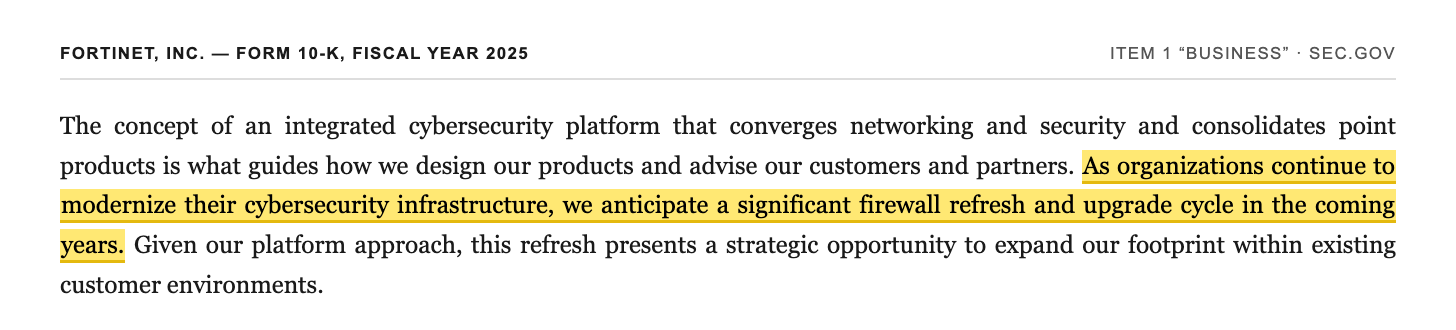
Hold on to that story for a moment — we will meet it again in court. But first, to the first uncomfortable truth, which sits in the distribution chapter.
What the filings say — the uncomfortable truths
Uncomfortable truth no. 1: more than half of revenue passes through three doors
Fortinet sells almost nothing directly to end customers. The path of a FortiGate box leads from the factory via distributors to resellers and only then to the customer. That is standard in the industry — what is unusual is the concentration: per the annual report, in 2025 Distributor A stood for 28 percent, Distributor B for 15 percent and Distributor C for 12 percent of company revenue — together, 55 percent through three doors. In the receivables the picture is even tighter:
"Additionally, a small number of distributors represents a large percentage of our revenue and accounts receivable, and one distributor accounted for 32% of our total net accounts receivable as of December 31, 2025."
— Fortinet, Inc., SEC annual report 10-K for fiscal year 2025, Item 1A "Risk Factors"
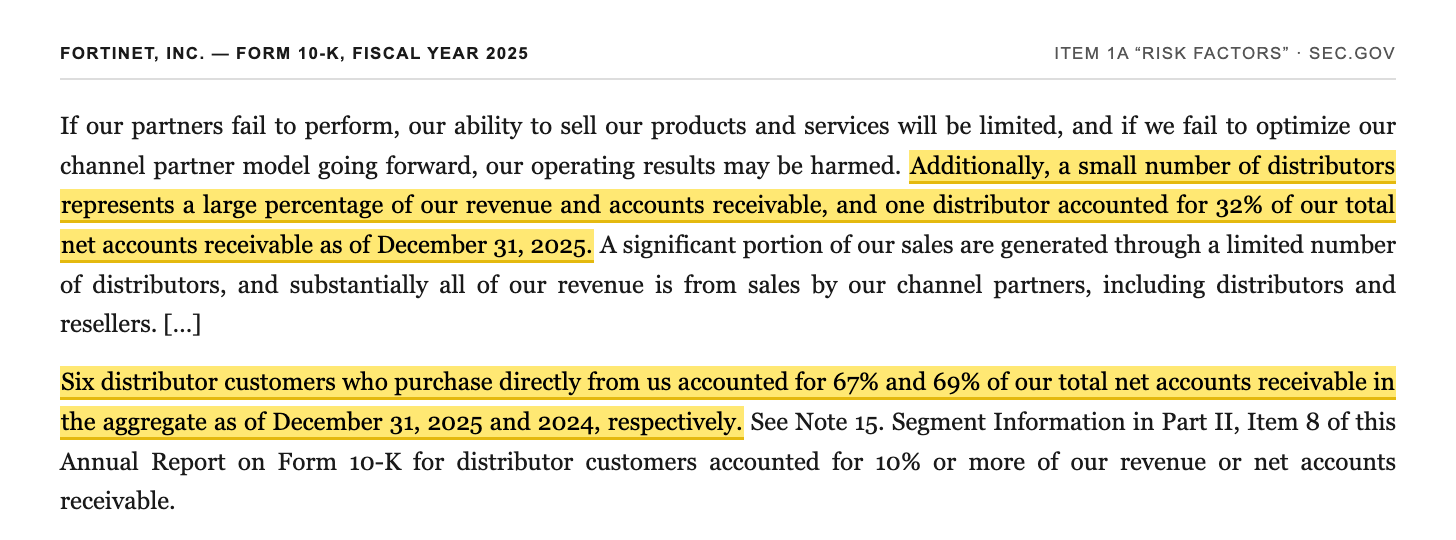
The report goes further: "Six distributor customers who purchase directly from us accounted for 67% and 69% of our total net accounts receivable in the aggregate as of December 31, 2025 and 2024, respectively." — six distributors hold two thirds of the receivables. Picture a bakery whose rolls sit in a thousand shops — but all the delivery vans belong to three haulage firms, and one of them owes the bakery a third of all outstanding invoices. If that hauler stumbles, the most important route to the customer clogs up, and the credit loss would hit the balance sheet directly. Important context: the end-customer base behind it is broad — per the annual report, Fortinet's end customers sit in over 100 countries, from small businesses to large enterprises and government agencies. So this is distribution concentration, not dependence on a few end customers. But a quality scanner cannot see this bottleneck — it simply never surfaces in margin or return on capital. Remember: concentration risks never show up in the metrics, always in the fine print.
Uncomfortable truth no. 2: a federal court is examining the growth story
Back to the refresh story. On August 6, 2025, Fortinet reported half-year results — and the stock plunged; our fundamental data shows a price decline of roughly 20 percent for the third quarter of 2025. Since September 2025 that plunge has occupied the courts: shareholders filed two class actions, since consolidated into one proceeding (In re Fortinet, Inc. Securities Litigation, U.S. District Court for the Northern District of California). The core of the allegation is stated in the quarterly report itself:
"The complaints allege that defendants made false or misleading statements about our business, operations and prospects, including regarding the 2026 firewall refresh cycle, and purport to assert claims under Sections 10(b) and 20(a) of the Exchange Act."
— Fortinet, Inc., SEC quarterly report 10-Q as of March 31, 2026, Note 10 "Commitments and Contingencies"
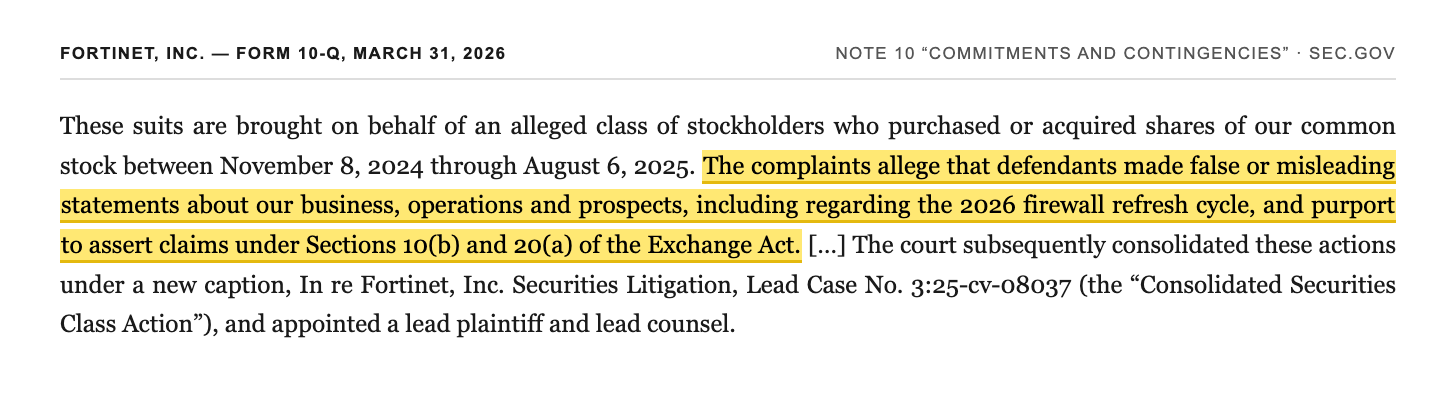
The facts, soberly sorted: the class period covers purchases between November 8, 2024 and August 6, 2025. The consolidated amended complaint filed on April 24, 2026 targets the chief executive officer, the chief technology officer, the current and the former chief financial officer, and the head of investor relations. In parallel, two so-called derivative suits by shareholders on the company's behalf run against officers and directors (Pittrof v. Xie and Marrinan v. Xie) over alleged breaches of fiduciary duty. Fairness requires three notes: first, Fortinet expressly considers the suits "without merit" and intends to defend them vigorously. Second, class actions after price crashes are near-routine in the United States and frequently end in settlement or dismissal. Third, the company has recorded no accrual, because it deems a loss neither probable nor estimable — which also means: any settlement is not yet in any number. What matters for you as a reader is something else: the question of how much the refresh cycle really carries is no longer analyst speculation but a matter of evidence in a federal proceeding. The coming quarterly reports are therefore worth reading twice.
Uncomfortable truth no. 3: Fortinet itself guides that margins will fall in 2026
The third truth hides not in the risk section but in the outlook — and it comes not from critics but from management itself:
"Total revenue is expected to increase in 2026 compared to the prior year; however, our expenses are expected to outpace revenue growth, primarily reflecting investments in sales and marketing headcount, product development and the continued capital expenditures in data centers and real estate."
— Fortinet, Inc., SEC annual report 10-K for fiscal year 2025, Item 7 "Management's Discussion and Analysis"
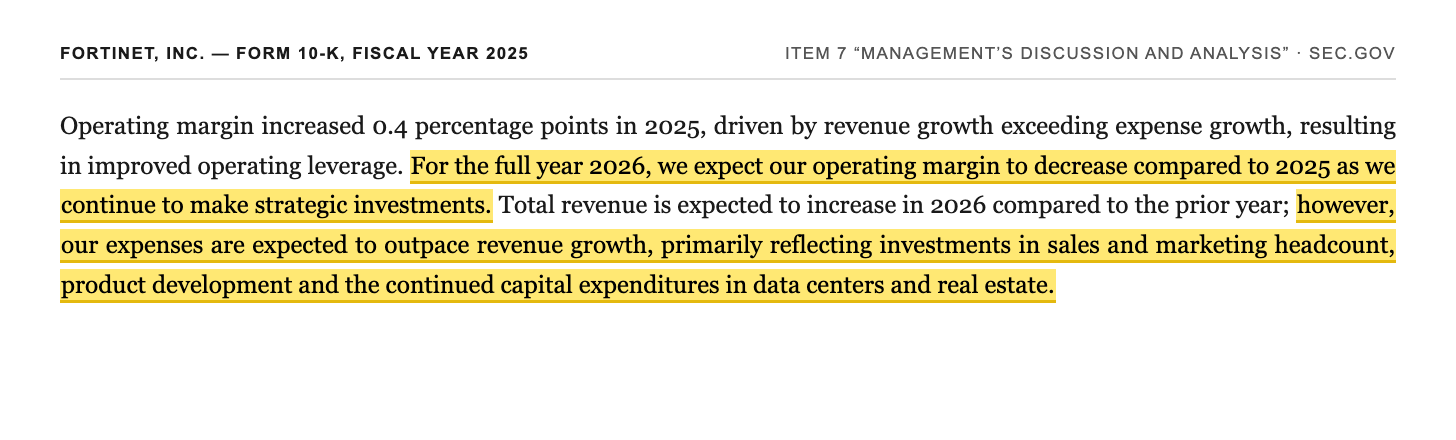
The same section contains the sentence that sums it up: "For the full year 2026, we expect our operating margin to decrease compared to 2025 as we continue to make strategic investments." That is no scandal; a company that expands sales capacity and data centers into a replacement cycle is investing counter-cyclically in its own opportunity. But it affects exactly the metric that carries Fortinet up the quality scanner. The destination of the money is notable too: besides sales headcount, it flows into company-owned data centers and real estate — Fortinet now owns $1.6 billion of property and, as a software company, carries its own real-estate risk factor in the annual report. Also striking is the weighting in the cost block: in 2025 Fortinet spent $2,348 million on sales and marketing but only $816 million on research and development — nearly three sales dollars for every engineering dollar. Not unusual for a technology company, but a useful reality check against the image of a pure engineers' firm.
Valuation: roughly $60 billion of market value — and equity that has nearly vanished
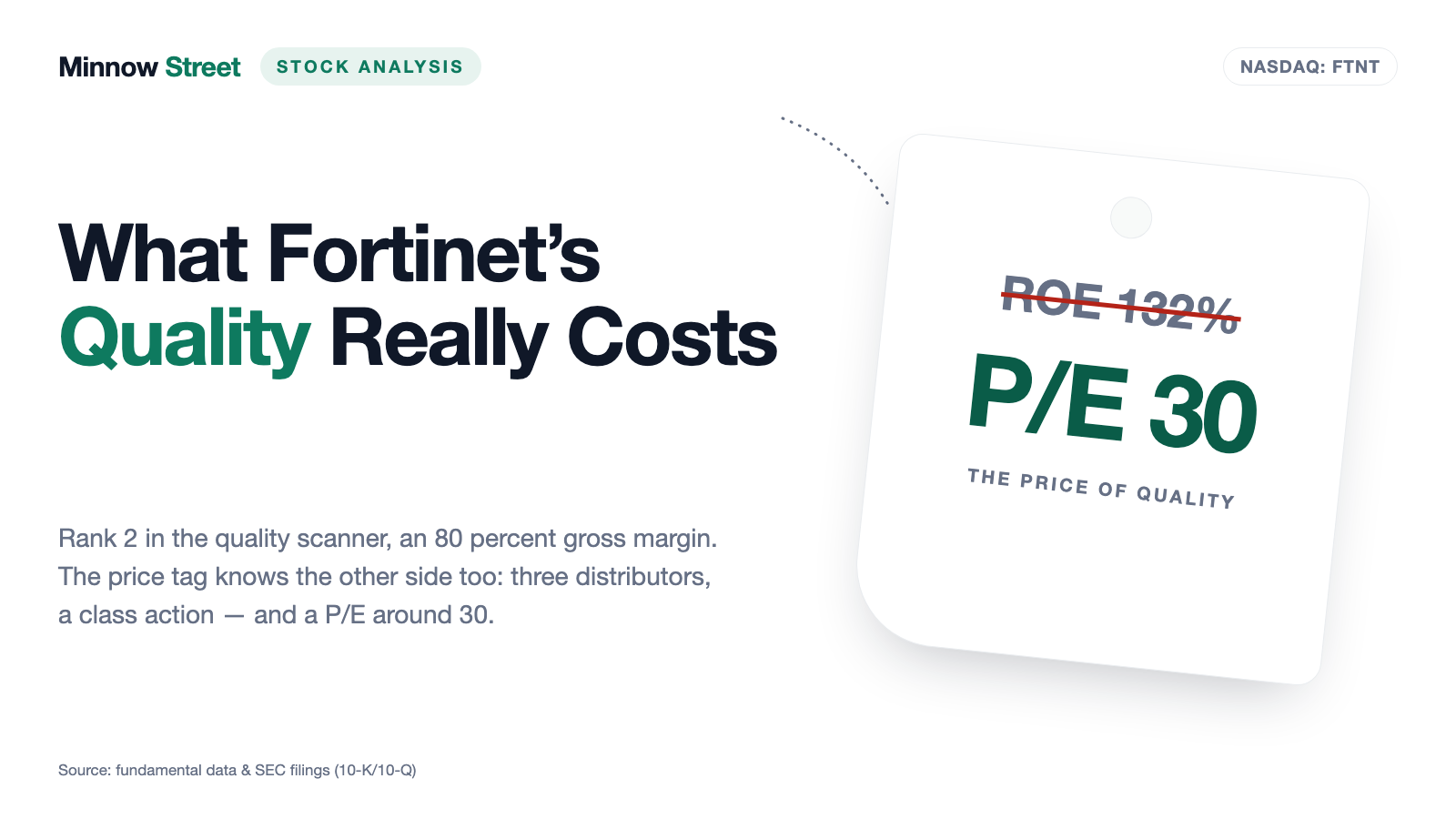
What does all this cost? Based on fundamental data as of the first quarter of 2026, Fortinet weighed in at roughly $60 billion of market value. As a price anchor, Fortinet itself serves best of all: in the first quarter of 2026 the company bought back its own shares at an average of $77.69, and shortly after quarter-end at $77.95 (per the quarterly report). Measured against the earnings of the trailing four quarters ($2.59 per share), that equals a price-to-earnings ratio around 30; measured against revenue, a price-to-sales ratio around 8 (data as of Q1 2026). That is no bargain price, but for a cybersecurity company with an 80 percent gross margin it is no outlier either. The analyst consensus of 45 firms sits at an average grade around 1.7 (on a scale where 1 means "strong buy", data as of July 18, 2026) — favorable, no cheering.
More remarkable than the price is where the money goes — and what that has done to the balance sheet. Fortinet pays no dividend; capital returns run entirely through share buybacks, and those have reached historic dimensions: 267.3 million shares for a cumulative $8.51 billion since the program's inception, including $2.29 billion in 2025 alone and another $827 million in the first quarter of 2026; the board most recently raised the total authorization to $10.25 billion. The share count fell within one year from 768 to 739 million — almost 4 percent fewer slices of the pie, the opposite of dilution. But: because buybacks reduce equity in the books, the balance sheet as of December 31, 2025 shows — despite billions in profits — an accumulated deficit of $507.9 million; equity now stands at just $1.24 billion on $10.4 billion of total assets. Dangerous it is not — next to it sit $3.92 billion in cash and investments against roughly $1.0 billion of debt, and the biggest "liability" is $7.12 billion of prepaid subscriptions, i.e. future revenue. But it distorts every equity-based metric: the return on equity of more than 130 percent is in good part an artifact of the shrunken denominator. Remember: if you buy away the denominator, every numerator becomes a giant — treat equity-based quality metrics of serial repurchasers with double caution. Incidentally, Fortinet's own risk section warns that buybacks "could occur at non-optimal prices" — a footnote with involuntary irony: part of the 2025 purchases sat above the price at which the stock traded after August 6, 2025.
Opportunities and risks at a glance
What speaks for Fortinet:
- Textbook profitability: an 80.5 percent gross margin, a 30.7 percent operating margin and $1,853 million of net income in fiscal year 2025; a Piotroski F-Score of 8 of 9 and a 28.9 percent net margin in the first quarter of 2026.
- A subscription foundation paid in advance: $4.58 billion of service revenue (two thirds of the company), $7.35 billion of deferred revenue as of March 31, 2026 — predictable revenue and $2,212 million of free cash flow in 2025, crossing $1 billion in a single quarter in Q1 2026.
- The refresh cycle delivers first evidence: product revenue +41 percent in the first quarter of 2026, billings up 16 percent in 2025 after the sputtering year 2024 (+2 percent).
- Net cash instead of a debt pile: $3.92 billion in cash and investments against roughly $1.0 billion of debt (December 31, 2025); interest coverage above 150.
- Custom chips and one operating system as a moat: a price-performance edge through ASICs, end customers in over 100 countries, plus AI-powered FortiGuard subscriptions and growing SASE/SecOps businesses.
What speaks against it:
- Distribution concentration: 55 percent of 2025 revenue via three distributors, one distributor with 32 percent of net receivables, six with 67 percent — the business model's most critical bottleneck appears in no quality metric.
- Legal risk tied to the story: a consolidated securities class action over the communication of the "2026 firewall refresh cycle" (class period 11/08/2024–08/06/2025) plus two derivative suits; outcome open, no accrual recorded.
- Guided margin pressure: per the 10-K, expenses are expected to outpace revenue growth in 2026 (sales expansion, data centers, real estate) — the operating margin is expected to decline.
- Equity nearly consumed: $8.51 billion of cumulative buybacks push equity down to $1.24 billion (accumulated deficit of $507.9 million); ROE and similar metrics carry limited meaning as a result.
- A valuation without a safety margin: a price-to-earnings ratio around 30 and price-to-sales around 8 (data as of Q1 2026) largely price in the refresh cycle's success — if it disappoints, there is no cushion; the roughly 20 percent price slide in the third quarter of 2025 demonstrated as much.
A human conclusion
Back to the seal-of-approval reflex from the opening. Its core is not that seals lie — our Terry Smith scanner measured nothing false at Fortinet. The margins are real, the cash is there, the subscription foundation carries, and the refresh cycle measurably began in the first quarter of 2026. The core of the reflex is that a seal permits us to stop thinking — and that is exactly when we miss what the filter systematically cannot see: the three doors in distribution, the federal proceeding over the company's own growth story, the self-announced margin dip, and an equity base that the buyback vacuum has swept almost clean. So the honest question for you is not "Is Fortinet a quality company?" — by everything in the filings: yes. It is: do you want to pay roughly 30 times earnings for a quality whose most important stress test — does the refresh cycle deliver what management promised? — is being litigated in court and settled in the next quarterly reports? If you answer yes, you get one of the most profitable security companies in the world. If you hesitate, you can read along in the quarterly reports (10-Q): product revenue, billings and the course of the class action are the three checkpoints where the story has to prove itself. What you make of it is your decision. And that is exactly as it should be.
Sources
All original documents used in this analysis — for your own reading:
- Fortinet, Inc. — SEC annual report 10-K for fiscal year 2025 (ended December 31, 2025; filed February 25, 2026)
- Fortinet, Inc. — SEC quarterly report 10-Q as of March 31, 2026 (filed May 8, 2026)
- Fortinet, Inc. — SEC annual report 10-K for fiscal year 2024 (ended December 31, 2024; filed February 21, 2025)
- Complete SEC filing history of Fortinet, Inc.: EDGAR overview (sec.gov)
- Fundamental data (metrics, quarterly series, valuation; data as of July 18, 2026 and Q1 2026 respectively), cross-checked against the SEC filings.
- Screener and rating data: in-house stock scanner, Terry Smith quality scanner (U.S. selection) and Altman-Z filter (data as of July 18, 2026).
Transparency & disclaimer: This analysis is a journalistic contextualization of publicly available information and is not investment advice, not a financial analysis in the regulatory sense and not a solicitation to buy or sell securities. Stock investments carry substantial risks up to and including total loss. All information without guarantee; the data cut-off is noted in the text. The author holds no position in Fortinet shares at the time of publication.
Our Bottom Line at a Glance
- Profitability & cash positive
- Textbook quality: an 80.5 percent gross margin, a 30.7 percent operating margin and $1,853 million of net income in fiscal year 2025; free cash flow of $2,212 million, crossing $1 billion in a single quarter for the first time in Q1 2026 (10-K FY 2025, 10-Q as of 03/31/2026).
- Growth & refresh cycle positive
- Revenue +14 percent in 2025, +20 percent in Q1 2026 with product revenue +41 percent — the announced firewall refresh cycle delivers first hard evidence; billings re-accelerated to +16 percent after the sputtering year 2024 (+2 percent) (10-K FY 2025, 10-Q).
- Distribution concentration negative
- Three distributors stood for 55 percent of 2025 revenue, one distributor for 32 percent of net receivables, six for 67 percent — the business model's most critical bottleneck never surfaces in a quality metric (10-K FY 2025, Item 1A and Note 15).
- Legal risk negative
- The consolidated securities class action (In re Fortinet, Inc. Securities Litigation) litigates the communication of the "2026 firewall refresh cycle" — the central growth story; plus two derivative suits. Fortinet considers everything without merit, no accrual exists, the outcome is open (10-Q as of 03/31/2026, Note 10).
- Balance sheet & valuation neutral
- Net cash of roughly $2.9 billion and $7.35 billion of prepaid subscriptions stand against nearly bought-away equity ($1.24 billion, accumulated deficit of $507.9 million) and a P/E around 30; for 2026, management itself guides to a lower operating margin (10-K FY 2025; data as of Q1 2026).
By its SEC filings, Fortinet is a genuine quality company: an 80 percent gross margin, net cash, a subscription cushion above $7 billion and a refresh cycle that measurably began in the first quarter of 2026 with 41 percent product growth. But no quality filter measures the three biggest risks: 55 percent of revenue flows through three distributors, a federal court is examining the communication of the very growth story that carries the stock, and management itself guides to falling margins for 2026 — while $8.51 billion of buybacks have nearly consumed the equity and turned every ROE-style metric into a distortion. Not investment advice.
What Our Rating Means
- If you don't own the stock
- As long as the question raised in the bottom line stays open, we see no basis for an entry.
- If you hold it in your portfolio
- Our findings offer no acute reason to sell — the checkpoints named remain decisive.
A journalistic assessment by our editorial team at the time of the deep dive, based on public sources — not investment advice and not a solicitation to buy or sell. Your personal circumstances (investment goals, risk capacity, taxes) cannot be taken into account. What our categories mean, how verdicts are formed, and what conflicts of interest exist →
Worth Noting
- FTNT reached the research list via rank 2 in the in-house Terry Smith quality scanner (U.S. selection, as of July 18, 2026); additionally a hit in the Altman-Z "balance-sheet fortress" filter. A quality scanner measures financial statements, not distribution structure, lawsuits or guidance — it never replaces the cross-check in the SEC filings.
- Valuation figures are deliberately anchored evergreen: the price anchors are the average buyback prices Fortinet itself reported in the 10-K/10-Q ($76.68 to $77.95 between early 2026 and May 2026); P/E and P/S computed from TTM figures as of 03/31/2026. Analyses are evergreen, daily prices are not a buy argument.
- Identity verified via EDGAR submissions (CIK 0001262039, Delaware, Nasdaq: FTNT, domestic filer 10-K/10-Q, no Form 15; the only former name is the styling variant "FORTINET INC" until May 2019). Fiscal year ends December 31.
Frequently Asked Questions
Fortinet, Inc. (Nasdaq: FTNT) of Sunnyvale, California sells network security: FortiGate firewalls built on custom ASIC chips, the FortiOS operating system, AI-powered FortiGuard security subscriptions, FortiCare support, plus cloud security (Unified SASE) and threat detection (Security Operations). In fiscal year 2025 (ended December 31, 2025) the company generated $6.80 billion in revenue (+14 percent) and $1,853 million in net income; roughly two thirds of revenue is subscription and service income.
The filter looks for companies with high margins, high returns on capital and low debt — and there Fortinet delivers: an 80.5 percent gross margin and a 30.7 percent operating margin in fiscal year 2025, a Piotroski F-Score of 8 of 9 and a 28.9 percent net margin in the first quarter of 2026, plus $3.92 billion in cash and investments against roughly $1.0 billion of debt (December 31, 2025). As of July 18, 2026 that makes rank 2 of the U.S. selection. The scanner, however, only measures the numbers — not distribution concentration, lawsuits or guidance.
The end-customer base is broad (end customers in over 100 countries, from small businesses to government agencies), but distribution runs through few doors: per the annual report (10-K), three distributors stood for a combined 55 percent of 2025 revenue (Distributor A 28, B 15, C 12 percent). A single distributor accounted for 32 percent of net accounts receivable, six distributors together for 67 percent. If a large distributor runs into trouble, it would hit the sales channel and the balance sheet at the same time.
After the price plunge of August 6, 2025, shareholders filed securities class actions that were consolidated into one proceeding (In re Fortinet, Inc. Securities Litigation, Northern District of California). The allegation: false or misleading statements about the business and its prospects, including the "2026 firewall refresh cycle"; the class period runs from November 8, 2024 through August 6, 2025. Fortinet considers the suits without merit, has recorded no accrual and intends to defend itself; two derivative suits against officers and directors run in parallel (per the 10-Q as of March 31, 2026).
Because share buybacks reduce equity: since the program's inception Fortinet has repurchased 267.3 million shares for a cumulative $8.51 billion — more than it has retained in earnings. As of December 31, 2025 the balance sheet therefore shows an accumulated deficit of $507.9 million, and equity stands at just $1.24 billion on $10.4 billion of total assets. Given the net cash position that is not dangerous, but equity-based metrics such as return on equity (computationally above 130 percent) become distorted.
Rather sporty: measured against the buyback prices around $78 that Fortinet itself reported (Q1/Q2 2026) and trailing-four-quarter earnings of $2.59 per share, the price-to-earnings ratio computes to about 30 and price-to-sales to about 8 (data as of Q1 2026). That already embeds a lot of confidence in the firewall refresh cycle — while the annual report guides to a lower operating margin for 2026. The analyst consensus of 45 firms sits at a grade around 1.7 (data as of July 18, 2026).
Found an error?
Did you spot a factual error, an outdated number, or a typo in this deep dive? Let us know briefly — your report goes straight to the editorial team.