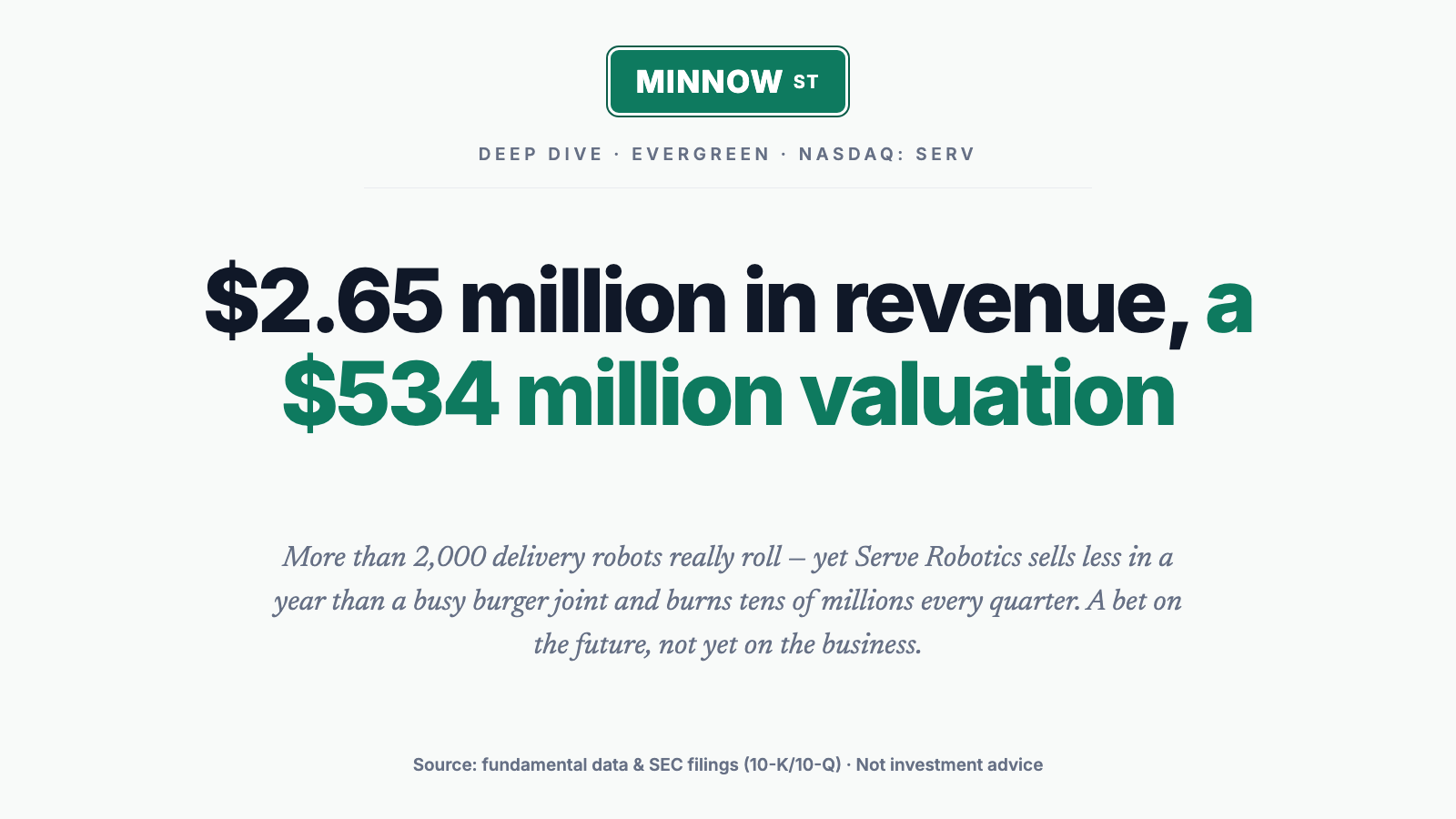
Serve Robotics Stock: $2.65 Million in Revenue, a $534 Million Valuation
Serve Robotics builds the little delivery robots that roll down U.S. sidewalks for Uber Eats and DoorDash — more than 2,000 of them, with Nvidia technology inside and Uber on the shareholder list. Our in-house stock scanner flags triple-digit revenue growth. The catch: the entire 2025 revenue was $2.65 million, against a $101 million loss. We read the annual report (10-K) and the latest quarterly report (10-Q) to separate the real robot future from the future fantasy in the price. Not investment advice — just the gap between robots that already roll and profits that do not yet exist.
 Thomas Mücke
Founder & Publisher
Thomas Mücke
Founder & Publisher
Chart
Interactive price chart (TradingView).
Note: pure fact-based analysis, not investment advice and not a solicitation to buy or sell. All figures without guarantee.
There is a feeling that seduces even sober investors into bad purchases: "I have seen the future." You watch a video on your phone in which a small, fridge-sized robot rolls down a Los Angeles sidewalk on its own, waits at the crosswalk and delivers a pizza to the front door — and immediately the voice on your shoulder pipes up: "This is the next big thing. Get in before everyone else does." Call this feeling future FOMO: the fear of missing the robot revolution. It is dangerous because it skips one simple question: does this company, with all its fascinating technology, actually make money yet — or does it burn it? So let's make a deal: before you touch a single share of Serve Robotics (Nasdaq: SERV), we read together what the company itself reported, under penalty of law, to the U.S. securities regulator, the SEC. And in those filings sits a number that stands in stark contrast to the fascination. In the end, you decide for yourself.
What Serve Robotics actually does
Serve builds and operates autonomous delivery robots. Picture them as rolling coolers on six wheels: roughly fridge-sized, electric, up to about 11 mph, with a cargo bin big enough for about four large pizzas. You order the normal way through Uber Eats or DoorDash — except a robot pulls up instead of a driver. The robots drive themselves through defined city zones (the industry calls this "level 4 autonomy"), while a human remote supervisor at headquarters keeps an eye on several robots at once and steps in when needed. Since January 2026, "Moxi" robots have additionally been rolling through hospitals, carrying medications and lab samples.
The pedigree is prominent: the technology began in 2017 as a project inside the delivery service Postmates; after Uber bought Postmates in 2020, Serve was spun out as its own company in early 2021. Uber is a shareholder to this day (2.43 percent as of March 31, 2026) and a platform partner; the graphics chips come from Nvidia, the sensors in part from Ouster. That sounds like the future — and technologically, it is. Economically, though, Serve is something else: practically pre-commercial. The company sells less in a year than a single busy burger joint and loses a mid-double-digit million amount every quarter. That contradiction is the core of this analysis.
Where the stock shows up in our scanner
Every day we run about 3,500 stocks through our scanners. Serve fires in the "triple-digit revenue growth" filter (data as of July 8, 2026) — the filter looks for companies whose latest quarterly revenue is at least double what it was roughly a year and a half earlier, rising quarter after quarter. Serve fits it textbook-style: the revenue series reads $0.2 → $0.4 → $0.6 → $0.7 → $0.9 → $3.0 million (fourth quarter of 2024 through the first quarter of 2026), rising without a gap, ending at fifteen times the start.
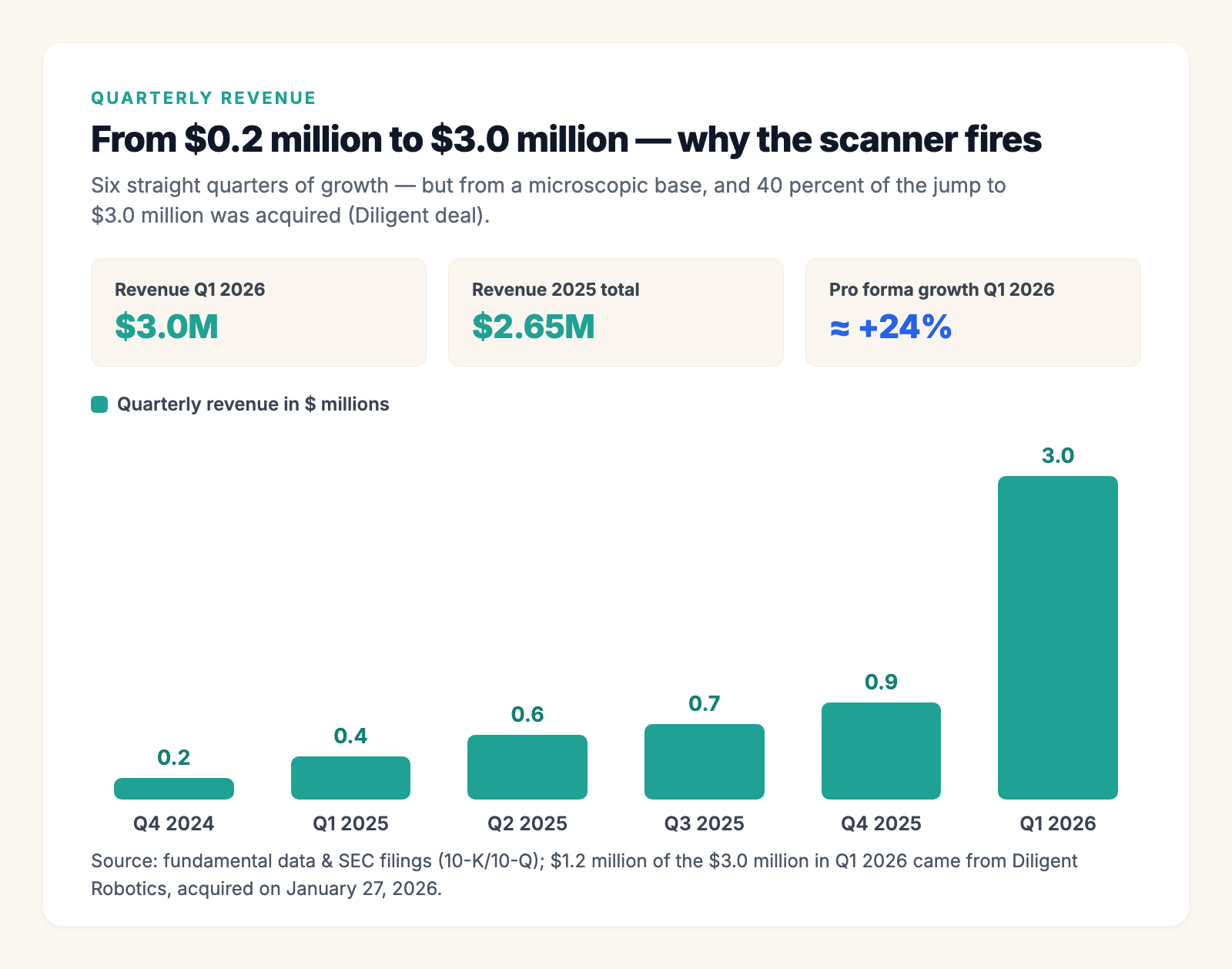
Two things must be placed right next to that. First, the base: $0.2 million in quarterly revenue is the price of a single-family house — growth from such a tiny starting point always looks spectacular in percent. Second, the acquisition: of the first quarter 2026 revenue ($3.0 million), $1.2 million came from Diligent Robotics (the hospital robots), bought only on January 27, 2026. Counting both companies as if they had already belonged together in 2025 ("pro forma"), revenue grew only about 24 percent — not the reported 578 percent.
And the scanner tells more: Serve sits in exactly one growth scanner with us — and simultaneously in eight weakness scanners: stage 4 (a Weinstein downtrend), relative-strength weakness (an RS rating of just 6 out of 99), below the 50-day and the 200-day moving averages, near the 52-week low (just 2.2 percent above it) and in the weakness cluster. Remember this tension — the growth is real, but the base is tiny, the margin is deep red and the price is sinking. It is the thread running through everything that follows. To replicate it yourself: on minnowstreet.com, open the "Scanner" menu, pick the "triple-digit revenue growth" filter and look for the SERV row.
The uncomfortable truths
Uncomfortable truth no. 1: Every dollar of revenue destroys money
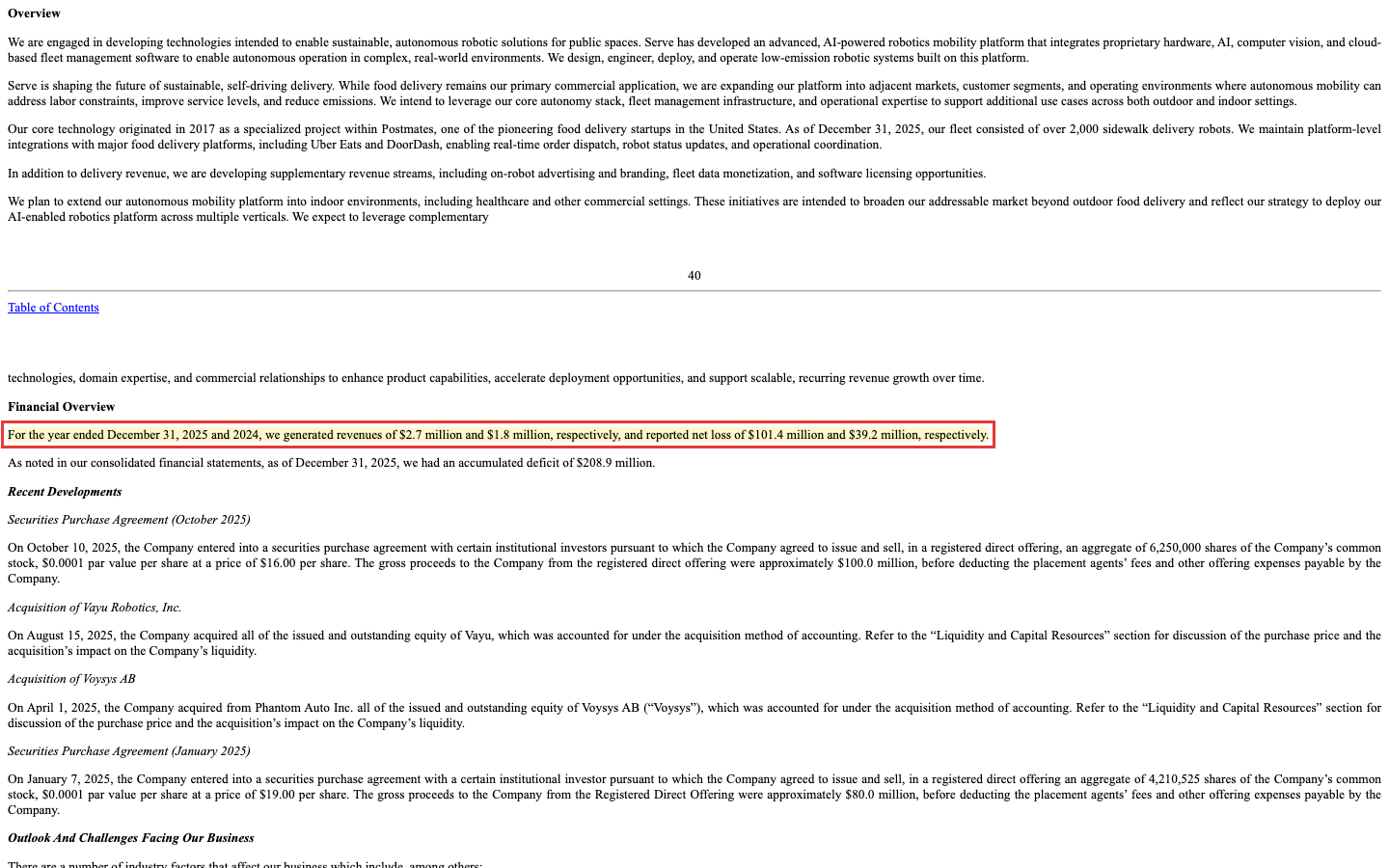
At a healthy company, something is left of revenue after the direct cost of producing it — the gross margin. At Serve, that remainder is deeply negative. In 2025, $2.65 million of revenue stood against roughly $18 million in cost of revenue: a gross loss of $15.4 million, a gross margin of about minus 580 percent. Put simply: every dollar Serve takes in currently costs a multiple in direct costs — before a single cent is spent on research, administration or sales. In the first quarter of 2026, the gross margin was "better" at roughly minus 300 percent, but still deep red. The loss the company itself discloses is correspondingly large:
"For the year ended December 31, 2025 and 2024, we generated revenues of $2.7 million and $1.8 million, respectively, and reported net loss of $101.4 million and $39.2 million, respectively."
— Serve Robotics Inc., SEC annual report 10-K for fiscal year 2025, MD&A "Financial Overview"
Picture the orders of magnitude side by side — revenue against loss:
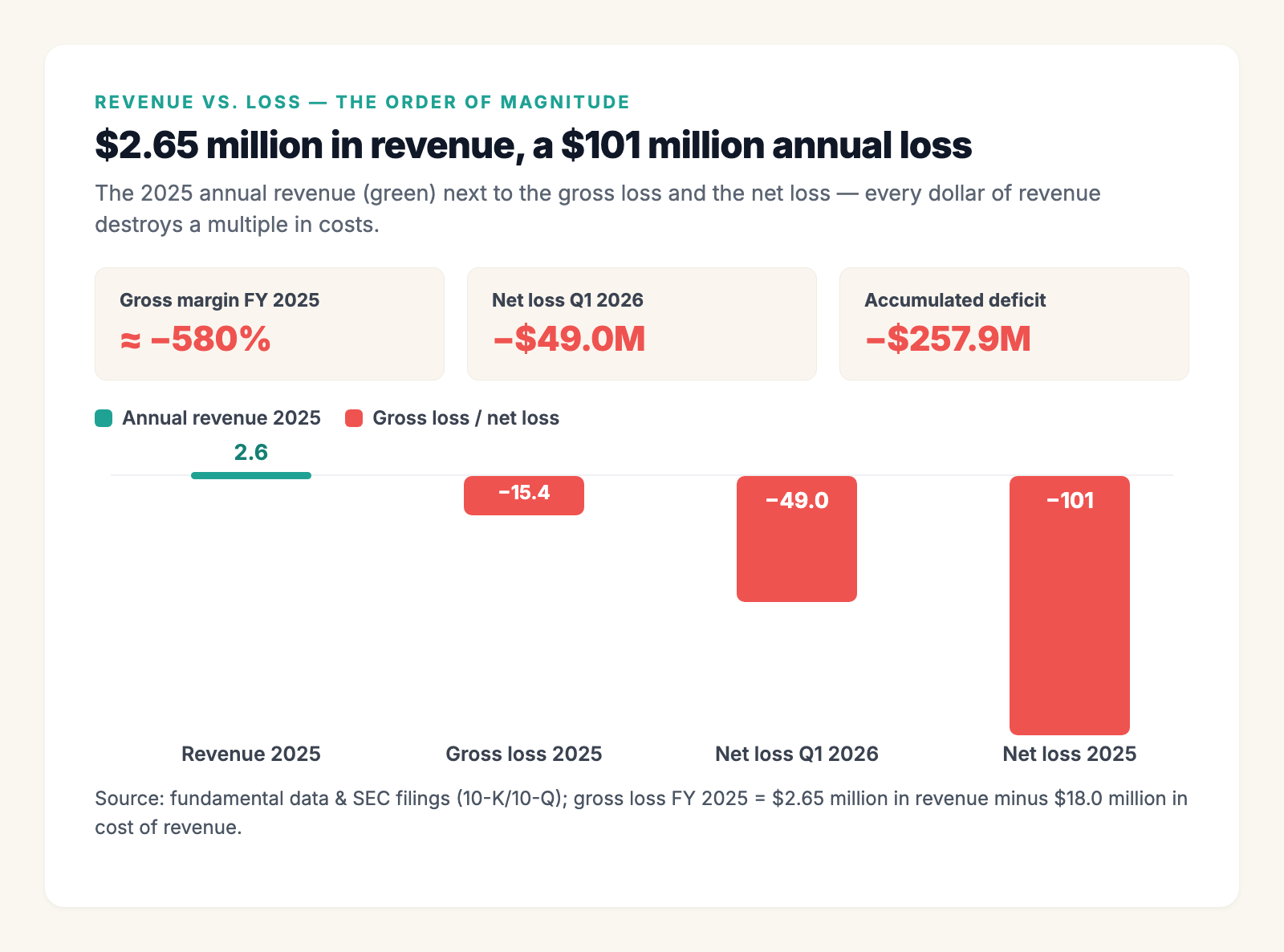
This is not a ramp-up curve that closes by itself as the business grows — most recently it widened: of the $3.0 million in first-quarter 2026 revenue, $1.2 million hung on Diligent, bought nine weeks earlier, which contributed $5.9 million of loss in the same period all by itself. The famous economies of scale ("more robots, cheaper per delivery") are not yet proven at Serve — so far, the numbers rather refute them. How brutally a hardware business can bleed at the gross margin line is something we dissected at Eos Energy — Serve is currently several leagues deeper in the red.
Uncomfortable truth no. 2: The loss is growing faster than the revenue
At a startup, you expect losses to shrink over time as the business grows into its cost base. At Serve, it is the other way around: the net loss climbed from $24.8 million (2023) to $39.2 million (2024) to $101.4 million (2025) — and the first quarter of 2026 alone added another $49.0 million. The sum of all losses since inception — the "accumulated deficit" — is quantified by the company itself:
"We have generated significant operating losses from our operations as reflected in our accumulated deficit of $257.9 million as of March 31, 2026. We have historically funded our operations from issuance of equity and debt securities, including our initial public offering in April 2024 and subsequent equity issuances."
— Serve Robotics Inc., SEC quarterly report 10-Q for Q1 2026, MD&A "Liquidity and Capital Resources"
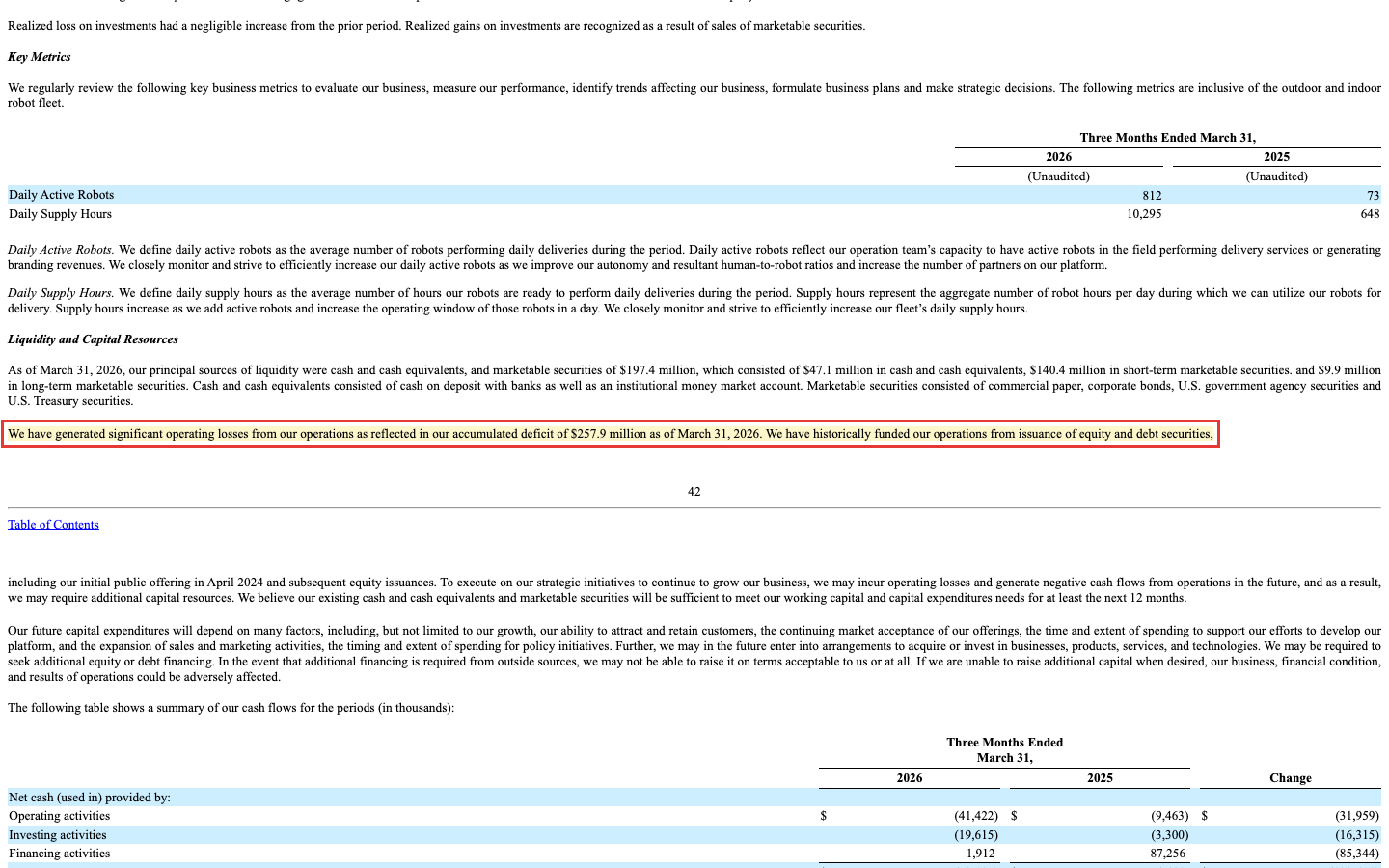
A second clock hangs on this one: the cash clock. As of March 31, 2026, Serve held $197.4 million in liquidity (cash plus marketable securities). Sounds like a lot — until you place the outflow next to it: in the first quarter of 2026, $41.4 million flowed out of operations and another $19.6 million into investments, together roughly $61 million in just three months. At that pace, the cushion mathematically does not even last a year. The company itself says it can fund operations "at least for the next twelve months" — but only by cutting spending if needed or raising fresh capital. And that fresh capital leads straight to the third truth.
Uncomfortable truth no. 3: Shareholders pay for it through ongoing dilution
When a company permanently spends more than it takes in, the money has to come from somewhere. Serve gets it mostly from the stock market — by issuing ever more shares. The 10-K states the risk with rare clarity:
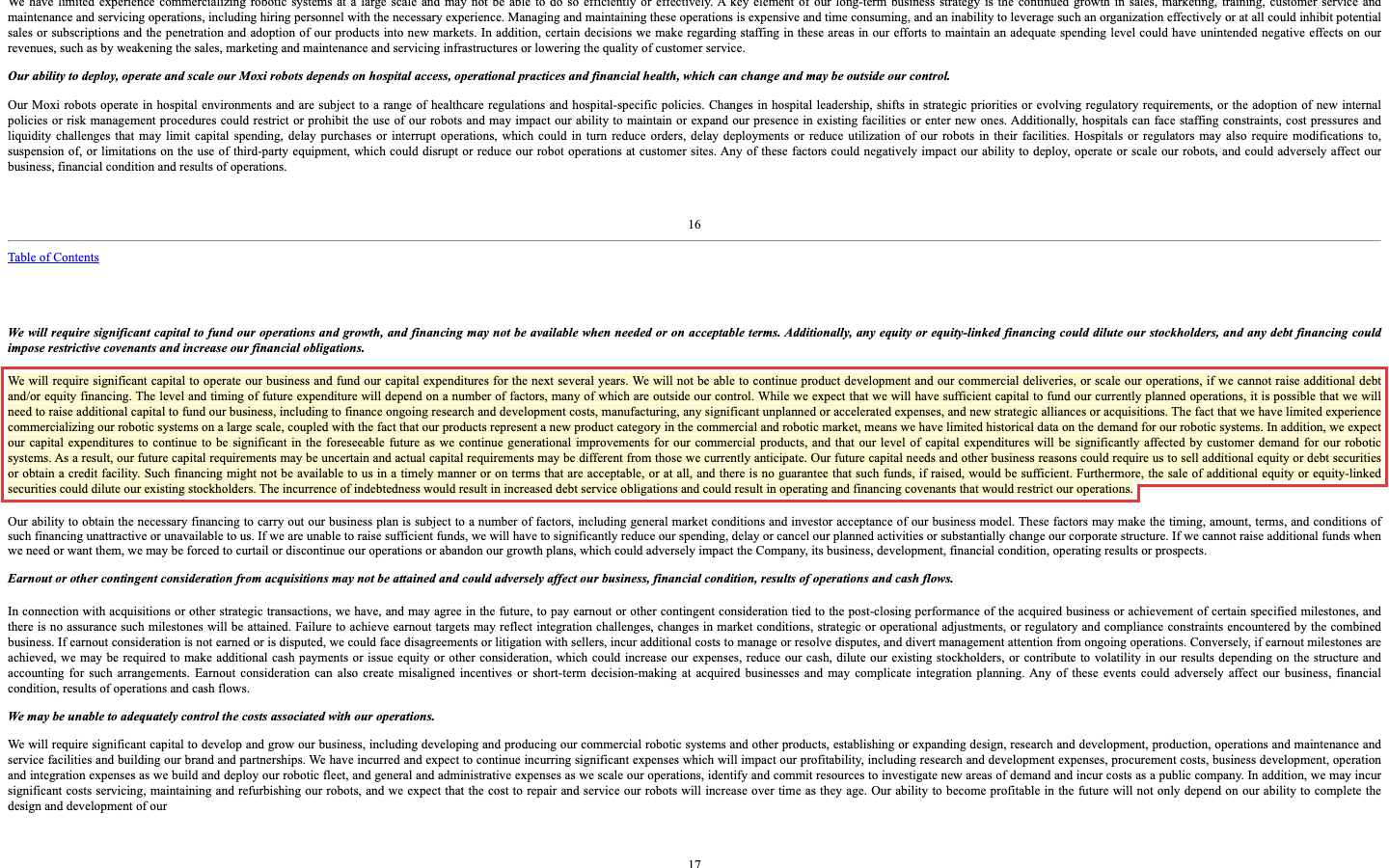
"We will require significant capital to operate our business and fund our capital expenditures for the next several years. We will not be able to continue product development and our commercial deliveries, or scale our operations, if we cannot raise additional debt and/or equity financing. […] Furthermore, the sale of additional equity or equity-linked securities could dilute our existing stockholders."
— Serve Robotics Inc., SEC annual report 10-K for fiscal year 2025, Item 1A "Risk Factors"
The warning has long since become practice. The share count rose from 51.3 million (end of 2024) to 76.0 million (March 31, 2026) — plus 48 percent in just 15 months; internal data meanwhile shows roughly 85 million. Picture a pizza that keeps being cut into more slices: your slice shrinks even if you sell nothing. The tools are in place: an at-the-market program (an "ATM" — a vending machine for freshly issued shares) of up to $150 million, shares as currency for the acquisitions (Vayu, Diligent, Vebu), and a legacy warrant held by contract manufacturer Magna over 2,145,000 shares at a symbolic exercise price of one cent. One more signal you should not ignore: over the past months there were 20 insider sales and not a single insider purchase (data as of July 8, 2026). The people who know the company best are not adding right now.
Valuation — what the market is actually paying for
Serve weighs in at roughly $534 million in market value (as of July 2, 2026). Against that stands 2025 revenue of $2.65 million — the market is paying about 200 times annual revenue. Even if you naively annualize the latest quarter (roughly $12 million), the price-to-sales ratio still lands around 45 — for a company with a gross margin between minus 300 and minus 580 percent. For comparison: an established, profitable company typically trades at one to five times revenue.
There is some substance in there: the $197.4 million of liquidity covers roughly 37 percent of the market value. Strip it out, and the market pays a good $337 million for the operating business — for $2.65 million in annual revenue and a $101 million annual loss. Everything beyond that is pure future fantasy: the bet that today's 812 daily active robots one day become tens of thousands of profitable ones. That can work out. But the price is not pricing today's business — it prices a robot world that does not exist yet, much like at Virgin Galactic, where the market value was almost pure future hope. The few analysts covering the stock see fair value at $18.45 on average (roughly plus 186 percent) — but coverage of a stock this small is thin, and price targets are snapshots, not certainties.
Opportunities and risks at a glance
What speaks for Serve Robotics:
- Real operating growth: average daily active robots rose from 73 (first quarter of 2025) to 812 (first quarter of 2026), daily supply hours from 648 to 10,295 — this is no paper startup, the robots really drive.
- A documented technology lead: level 4 autonomy on sidewalks since 2022, dozens of pending patent applications, redundant sensors (lidar, cameras, ultrasound) and a new robot generation with longer range.
- Strong names in its corner: Uber is a shareholder and platform partner, DoorDash the second platform, Magna the contract manufacturer; Nvidia and Ouster technology is built in. A second leg in healthcare (Moxi) brings contractually recurring revenue.
- A large target market with a tailwind: labor costs and driver shortages make the last mile expensive — robots could become the cheaper alternative. And for now the cushion is comfortable, with $197.4 million in liquidity and barely any financial debt.
What speaks against it:
- Practically pre-commercial: $2.65 million in 2025 annual revenue, a gross margin around minus 580 percent — every dollar of revenue destroys money.
- The reported revenue jump was 40 percent acquired (Diligent); pro forma, revenue grew only about 24 percent. Of more than 2,000 robots, only 812 were active daily.
- Exploding losses and a ticking cash clock: a $101.4 million loss in 2025, $49.0 million in the first quarter of 2026 alone, an accumulated deficit of $257.9 million; roughly $61 million of quarterly outflow against $197.4 million in liquidity.
- Ongoing dilution (plus 48 percent more shares in 15 months, an ATM program of up to $150 million), 20 insider sales and no purchase, high short interest (roughly 27 percent), stage 4 and near the 52-week low. The valuation is almost pure future fantasy — as with the revenue jump at Amprius, the second look behind the percentage is the one that pays.
A human conclusion
Remember the future FOMO from the beginning — the feeling of "I have seen the future, I have to be part of it"? After reading the filings, it sounds different. Yes, the robots are real, they really do roll down the sidewalks of Los Angeles, and the technology is impressive. But an investment does not buy robots — it buys a business. And this business sells less in a year than a burger joint, loses a multiple on every dollar it sells, piles up losses faster than revenue grows, and pays the bill with ever more shares. Exactly this feeling of not wanting to miss the future has cost investors roughly 75 percent since the all-time high.
What you make of it is your decision. And that is exactly as it should be. If you buy Serve Robotics, you are buying a bet that this fascinating technology one day becomes a profitable business — paid for today at roughly 200 times annual revenue and with ongoing dilution. If you pass, you may give up an early stake in the next great automation wave. Both are legitimate. What matters is that you know what you are betting on — the robot future, not today's business. The robots are real. The profits are not yet.
Sources
- Serve Robotics Inc. — SEC annual report 10-K for fiscal year 2025 (filed March 12, 2026)
- Serve Robotics Inc. — SEC quarterly report 10-Q for Q1 2026 (as of March 31, 2026; filed May 7, 2026)
- Fundamental data (metrics, valuation, analyst consensus, quarterly series); in-house stock scanner, data as of July 8, 2026.
Transparency & disclaimer: This analysis is a journalistic contextualization of publicly available information and is not investment advice, not a financial analysis in the regulatory sense, and not a solicitation to buy or sell securities. Stock investments carry substantial risks up to total loss. All information without guarantee; the data cut-off is noted in the text in each case. The author holds no position in Serve Robotics stock at the time of publication.
Our Bottom Line at a Glance
- Technology & market positive
- A real technology lead: level 4 autonomy on sidewalks since 2022, more than 2,000 robots in the field, dozens of pending patent applications. Uber as shareholder and platform partner, DoorDash as the second platform, Nvidia and Ouster technology built in. A large target market with tailwinds from labor costs and driver shortages.
- Operating growth neutral
- Daily active robots rose from 73 to 812, supply hours from 648 to 10,295 (Q1 2025 → Q1 2026). But 40 percent of the reported revenue jump to $3.0 million was acquired (Diligent); pro forma only about 24 percent growth, and only 812 of more than 2,000 robots are active daily.
- Profitability negative
- Practically pre-commercial: $2.65 million in 2025 annual revenue, a gross margin around minus 580 percent, a net loss of $101.4 million (2024: $39.2 million). Another $49.0 million of loss in Q1 2026 alone; accumulated deficit of $257.9 million. Every dollar of revenue destroys a multiple in costs.
- Balance sheet & dilution negative
- Liquidity of $197.4 million (03/31/2026), but roughly $61 million of quarterly outflow — mathematically less than twelve months at the Q1 pace. Share count up 48 percent in 15 months (51.3 → 76.0 million), an ATM program of up to $150 million, 20 insider sales and no purchase.
- Valuation negative
- Roughly $534 million in market value against $2.65 million in revenue = about 200 times annual revenue; even annualized still around 45. Net of liquidity, the market pays a good $337 million for a business with $2.65 million in revenue and a $101 million loss. Almost all of it is future fantasy.
Serve Robotics is both at once: a fascinating, real robotics technology with Uber and Nvidia in its corner — and a practically pre-commercial business that sells less in a year than a burger joint and destroys a multiple in costs on every dollar of revenue. The "triple-digit revenue growth" from the scanner comes off a tiny base, was 40 percent acquired and faces eight weakness scanners; the valuation of roughly 200 times revenue is almost entirely a bet on the robot future. Not investment advice.
What Our Rating Means
Substance risk
We found at least one documented issue that threatens the company itself — regardless of how the stock is currently valued.
Two existential findings carry this verdict: the annual and quarterly reports (10-K/10-Q) carry their own "Liquidity and Going Concern" note — $197.4 million in liquidity against roughly $61 million of quarterly outflow mathematically does not last twelve months — and the business destroys money already at the gross margin line (a gross margin around minus 580 percent, a $101.4 million net loss on $2.65 million in annual revenue). Whoever holds is betting that the robot fleet scales into a real business before the cash and the shareholders' patience run out; whoever buys is paying about 200 times revenue for that bet, financed by ongoing dilution. A clearly positive gross margin combined with a falling cash burn would be the trigger for a reassessment — check each quarterly report (10-Q) for exactly that. The decision is yours.
A journalistic assessment by our editorial team at the time of the deep dive, based on public sources — not investment advice and not a solicitation to buy or sell. Your personal circumstances (investment goals, risk capacity, taxes) cannot be taken into account. What our levels mean, how verdicts are formed, and what conflicts of interest exist →
Worth Noting
- Of the Q1 2026 revenue ($3.0 million), $1.2 million came from Diligent Robotics, acquired on January 27, 2026; pro forma, revenue grew only about 24 percent instead of the reported 578 percent. Diligent alone contributed $5.9 million of loss.
- No formal going-concern qualification, but a dedicated "Liquidity and Going Concern" note in both the annual report (10-K) and the quarterly report (10-Q); the company points to possible spending cuts and new capital measures.
- Uber is verifiably a shareholder (2.43 percent, 03/31/2026); a current Nvidia stake no longer appears in the holder lists of the profile data — Nvidia and Ouster are named in the 10-K as key suppliers (GPUs and lidar, respectively).
Frequently Asked Questions
Serve Robotics develops and operates autonomous delivery robots — fridge-sized, electric rolling boxes that bring food to the door via Uber Eats and DoorDash. The robots drive largely on their own within defined city zones (level 4 autonomy), while a human remote supervisor monitors several at once. Since January 2026, "Moxi" robots have additionally been running through hospitals, transporting medications and lab samples.
Because quarterly revenue rose without a gap: $0.2 → $0.4 → $0.6 → $0.7 → $0.9 → $3.0 million (fourth quarter of 2024 through the first quarter of 2026). The filter is formally met. But the base is tiny, and 40 percent of the first-quarter 2026 jump was acquired (Diligent Robotics); pro forma, revenue grew only about 24 percent instead of the reported 578 percent. At the same time, the stock sits in eight weakness scanners.
Total 2025 revenue was $2.65 million (2024: $1.8 million). Against that stood a net loss of $101.4 million (2024: $39.2 million), with another $49.0 million in the first quarter of 2026 alone. The 2025 gross margin was deeply negative at roughly minus 580 percent — every dollar of revenue costs a multiple in direct costs. The accumulated deficit stands at $257.9 million (March 31, 2026).
There is no formal going-concern qualification. As of March 31, 2026, Serve held $197.4 million in liquidity. Against that stands an outflow of roughly $61 million in the first quarter of 2026 alone — at that pace, the cushion mathematically does not even last a year. The company says it can fund operations for at least twelve months, if necessary through spending cuts or fresh capital.
Uber is verifiably a shareholder (2.43 percent as of March 31, 2026) and also a platform partner; the technology grew out of a Postmates project that was spun out as its own company in 2021 after Uber's takeover. Nvidia graphics chips and Ouster sensors are built into the robots; a current Nvidia stake, however, no longer appears in the holder lists of the profile data — so the "Nvidia investor" story should be taken with caution.
Because the valuation is almost pure future expectation: at roughly $534 million in market value against $2.65 million in revenue, the market is paying about 200 times annual revenue — for a company with a deeply negative gross margin. Add ongoing dilution (plus 48 percent more shares in 15 months), 20 insider sales without a single purchase, a price near the 52-week low and the dependence on third-party platforms like Uber Eats and DoorDash.
Found an error?
Did you spot a factual error, an outdated number, or a typo in this deep dive? Let us know briefly — your report goes straight to the editorial team.