SELLAS Stock: 78 of 80 — The Counter That $2.2 Billion Hangs On
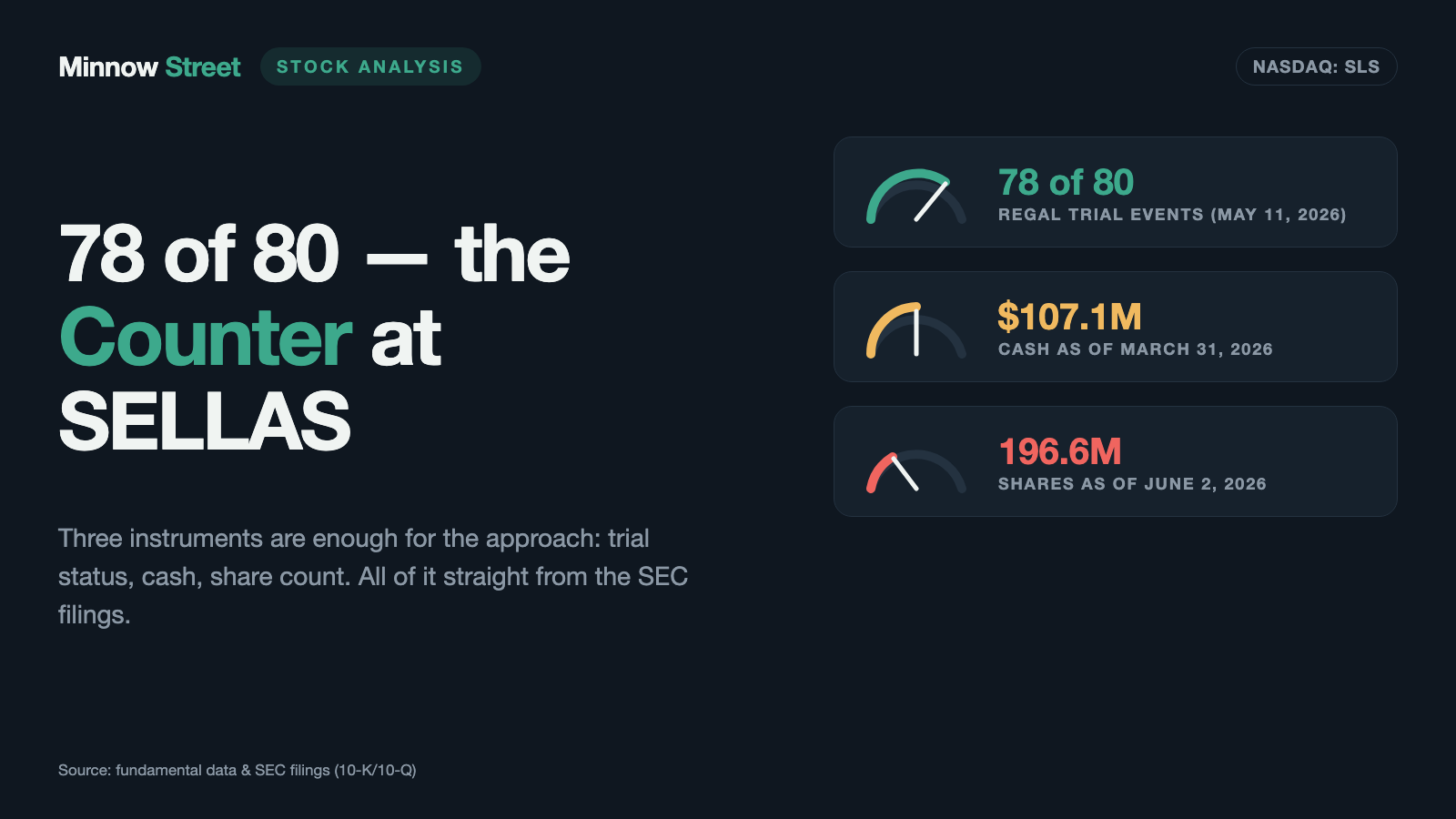
Some companies wait for a date. SELLAS Life Sciences waits for a number. Its Phase 3 REGAL study is only read out once 80 deaths have occurred — as of May 11, 2026 the count stood at 78. Until then the company is blinded to its own data, and nobody can say whether the last two events arrive in a week or in half a year. What is settled sits in the filings with the U.S. securities regulator, the SEC: 13 full-time employees, no product revenue, $107.1 million of cash as of March 31, 2026 — and a share count that grew from 32.1 million at the start of 2024 to 196,632,574 on June 2, 2026. Let us work out how much of a roughly $2.2 billion market value is expectation already paid for.
 Thomas Mücke
Founder & Publisher
Thomas Mücke
Founder & Publisher
Chart
Interactive price chart (TradingView).
Note: pure fact-based analysis, not investment advice and not a solicitation to buy or sell. All figures without guarantee.
There is an investor trap that has nothing to do with numbers and still costs money — call it the calendar trap. Human beings cannot stand "sometime." Our heads need a date to hold on to, and when they do not get one they invent one: "by the summer," "next quarter," "it cannot be much longer now." At SELLAS Life Sciences Group, Inc. (NASDAQ: SLS) there is no such date. There is a counter. The company\'s decisive study is only read out once 80 events have occurred — and in this study an "event" means a patient has died. On May 11, 2026 the file held 78 of them.
That is an uncomfortable sentence, and it is meant to be. It is not tasteless; it is how a survival trial is built. You can only tell whether people live longer on a drug once enough people have died to compare the two arms. Buying this stock means betting on a counter reading. Before we turn that bet into a market value of roughly $2.2 billion, let us make a deal: we read together what SELLAS itself has filed under penalty of perjury with the U.S. securities regulator, the SEC — the quarterly report (10-Q) for the period ended March 31, 2026, the annual report (10-K) for 2025 and every filing since. The conclusion is yours to draw.
What SELLAS actually does — 13 people, two borrowed drugs
SELLAS is a clinical-stage biopharmaceutical company: it develops cancer drugs, it does not sell any. There is no approved product, no sales force, no pharmacy counter — and therefore no product revenue. As of March 1, 2026 the annual report puts the workforce at 13 full-time employees. Thirteen. Everything else runs through contract research organizations, consultants and hospital networks.
At the center sits galinpepimut-S, or GPS — a vaccine aimed at a protein called WT1 that appears in large quantities across many cancers. In everyday terms: the immune system has a mugshot of the cancer cell but fails to act on it, because the cell looks too familiar. GPS shows it four fragments of that protein, two of them deliberately altered so the immune system files them as foreign and raises the alarm — and afterwards recognizes the genuine, unaltered fragments on the cancer cells too. The second candidate is SLS009 (generic name tambiciclib), and it works differently: it blocks the enzyme CDK9 and cuts cancer cells off from the short-lived survival proteins they constantly need to replace.
Neither belongs to SELLAS. GPS has been licensed from Memorial Sloan Kettering Cancer Center since September 4, 2014, SLS009 from GenFleet Therapeutics (Shanghai) since March 31, 2022. The corporate history explains why the company stayed so small: the listed shell was incorporated in Delaware on April 3, 2006 as Argonaut Pharmaceuticals, became RXi Pharmaceuticals in November 2006, Galena Biopharma in September 2011, and took its present name in December 2017 through a business combination with the Bermuda-based SELLAS Life Sciences Group Ltd. That sets the central tension of this analysis, and it runs through every chapter: the medical question is still unanswered, because the decisive trial is running blinded — the financial answer is long since given, and it reads: paid for in stock.
How the stock reached our desk
Through our in-house weekly ranking. On July 25, 2026 SLS sat at rank 6 of 28 U.S. hits with a relative strength rating of 98 — on a scale where 98 means only 2 percent of all stocks moved more strongly over the comparison window. You can repeat it in two clicks: open the stock scanner, pick the "1 Week Top Performers" list and sort by the relative strength column. One thing matters: these lists are recalculated daily — what sits at rank 6 today may be absent tomorrow.
What the list measures translates quickly, and it deserves an honest framing: at least 15 percent price gain over four trading days, at least 10 million dollars of average daily turnover and a relative strength rating of 70 or higher. Those are pure price criteria. They say a great many people with a great deal of money changed their minds about a stock in a short window; they say nothing about the quality of the business. Turnover is no hurdle here: average daily dollar volume recently ran at roughly $121 million (data as of July 26, 2026), twelve times the minimum. And the usual quality ratios? They barely apply, and we would rather say so than paper over it with a pretty table. There is no price-to-earnings ratio, because there are no earnings; no price-to-sales ratio, because there are no sales. The Piotroski F-Score, a nine-point test of balance-sheet quality, sits at 2 of 9 — four of its criteria require profit or a profit margin and fail automatically at a company with no income. The Altman Z-Score reads 173.6 and looks glorious; at heart it measures assets against liabilities, so anyone with almost no liabilities wins that test by default. Take the point away early: at a clinical-stage biotech you measure cash, burn, trial status and share count — not margin and profit.
The numbers over the years — honestly credited
Start with what genuinely impresses, because it is more than you would expect from a company without revenue. First, cost discipline. Total operating expenses fell from $31.5 million (2024) to $28.3 million (2025); the net loss narrowed from $30.9 million to $26.9 million. The 2025 research budget of $16.0 million breaks down into $4.3 million of external trial costs for GPS, $3.5 million for SLS009, $3.0 million of personnel, $2.1 million of manufacturing, $2.0 million of consulting and $0.7 million of other items. A large corporation spends that much on its Christmas party.
Second, the balance sheet. As of March 31, 2026, $107.1 million of cash stands against $6.8 million of liabilities — of which $3.6 million is trade payables and $0.9 million lease obligations. There is no interest-bearing debt and the equity ratio runs near 90 percent. To measure the distance travelled: on January 1, 2024 equity was negative at minus $8.0 million, and at the end of 2023 the cash balance was $2.6 million. A company that was then less than a quarter away from the end now has money for years. The quarterly report says so explicitly — and names the accumulated deficit run up along the way in the same breath:

Third, the data on the second candidate. In July 2025 SELLAS reported that the Phase 2 study of SLS009 in relapsed or refractory acute myeloid leukemia met all primary endpoints. The overall response rate was 33 percent across 54 evaluable patients, 40 percent in the 30 mg twice-weekly dose group, 44 percent in the subgroup with myelodysplasia-related mutations and 50 percent (9 of 18) in patients carrying an ASXL1 mutation — against a pre-specified threshold of 20 percent. The FDA then cleared a path into first-line therapy, and in January 2026 an agreement with the European trial network IMPACT-AML followed.
Now the other half of the same company: where the money came from.
Operating cash outflow ran at $28.4 million in 2025 (2024: $35.4 million). Cash coming in that same year was $86.3 million — and 100 percent of it came from selling stock and warrants: $51.0 million from warrant inducement rounds, $23.1 million from an offering, $12.6 million from ordinary exercises. Remember the pattern; it is the core of this business model: a clinical-stage biotech does not earn its money in the market but in the capital market — and the capital market pays in shares.
Uncomfortable truth No. 1: the counter reads 78 of 80 — and nobody knows the date
REGAL is the reason this company exists at its current size. It tests GPS in patients with acute myeloid leukemia who reached a second complete remission after second-line therapy and are ineligible for a stem-cell transplant. One arm receives GPS, the other the best available treatment; the measure is overall survival. Enrollment closed in March 2024 across roughly 95 sites in North America, Europe and Asia. And then the waiting begins:
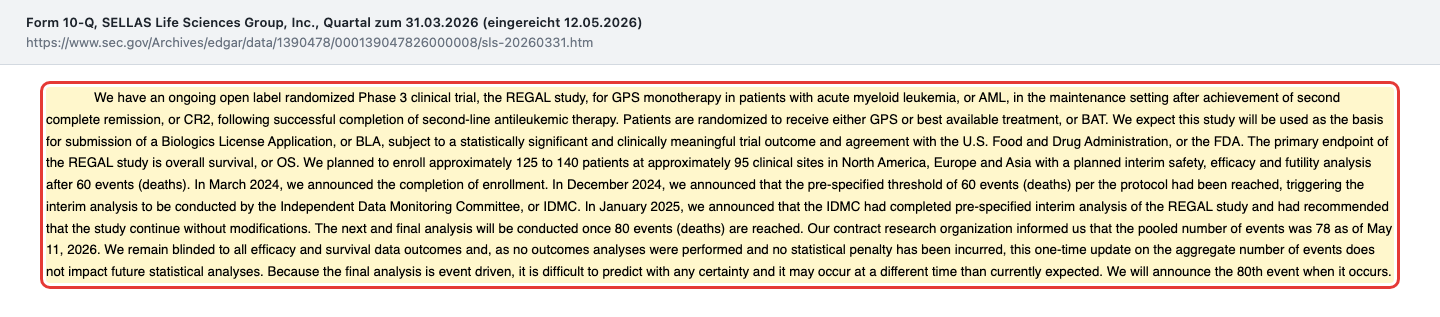
"The next and final analysis will be conducted once 80 events (deaths) are reached. […] Our contract research organization informed us that the pooled number of events was 78 as of May 11, 2026. […] Because the final analysis is event driven, it is difficult to predict with any certainty and it may occur at a different time than currently expected. We will announce the 80th event when it occurs."
— SELLAS Life Sciences Group, Inc., SEC quarterly report 10-Q for the period ended March 31, 2026, MD&A
Two points matter here. First, SELLAS is blinded — the company itself does not know whether patients on GPS live longer. It only counts how many have died. Second, the interim analysis at 60 events went well. In January 2025 the independent data monitoring committee recommended continuing the study without modifications, meaning it was stopped neither for futility nor for safety. That is a genuine positive signal. It is expressly not proof of efficacy: such a committee halts a trial only on very clear findings, in either direction.
Uncomfortable truth No. 2: 32 million shares became 197 million
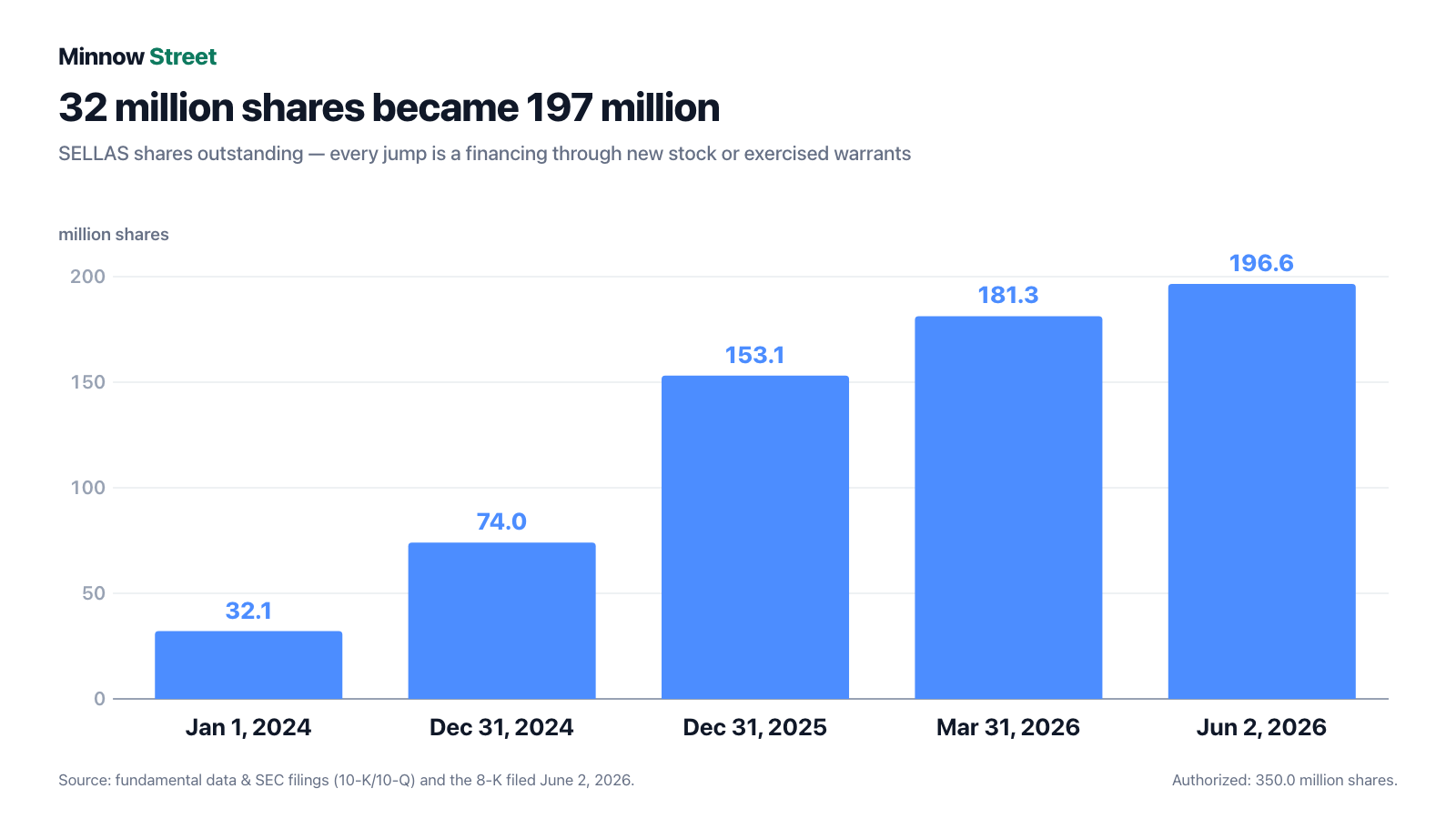
Dilution in everyday terms: your slice of the cake gets smaller because new slices keep being cut. At SELLAS you can count it line by line — and the pace is remarkable. On January 1, 2024 there were 32,132,890 shares. By the end of 2024 there were 73,977,459, by the end of 2025 already 153,103,459, by March 31, 2026 some 181,332,574, and on June 2, 2026, according to the 8-K, 196,632,574 shares. That is more than six times over in two and a half years.
One round from September 10, 2025 shows the mechanism especially clearly. A holder of existing warrants agreed to take down 19,685,040 shares at the original price of $1.20 — roughly $23.6 million gross. In return the holder received new warrants over exactly the same number of shares at $1.88, exercisable for five and a half years. Put plainly: for fresh money today, SELLAS handed over the right to still more new shares tomorrow. The same construction repeated in October 2025. The result sits in the notes to the March 31, 2026 accounts: on top of the shares in circulation, 35,936 thousand more are reserved, including 30,299 thousand warrants — 22,364 thousand of them at $2.00 running to October 2030.
The annual report names the principle itself, without decoration:
"To the extent that we raise additional capital through the sale of equity or convertible debt securities, or through the issuance of shares under management or other types of contracts, or upon the exercise or conversion of outstanding derivative securities, the ownership interests of our stockholders will be diluted."
— SELLAS Life Sciences Group, Inc., SEC annual report 10-K for 2025, Item 1A "Risk Factors"

In fairness: this is the friendliest kind of dilution there is. It did not come from a distress placement at a knock-down price but from warrants deep in the money — the cash arrived without underwriting fees on a new issue, and the balance sheet looks better than ever afterwards. Anyone who wants to see the same pattern in its harsher form will find it in our analysis of Erasca: there, less than 24 hours separated a positive data release from a contract for $550 million of new stock.
Uncomfortable truth No. 3: the partner in China is not paying — and the fight is in its third year
In December 2020 SELLAS sold the rights to GPS for mainland China, Hong Kong, Macau and Taiwan to 3D Medicines Inc. The agreement read like an insurance policy: $7.5 million immediately, milestones of up to $194.5 million and royalties in the high single digits to the low double digits. What has actually arrived by March 31, 2026 is $10.5 million. The rest — $191.5 million — is outstanding.
"In accordance with the 3D Medicines Agreement and Side Letter, we expected that 3D Medicines would begin enrolling patients in mainland China in the REGAL study in the second half of 2023 and subsequently make two development milestone payments totaling $13.0 million. […] To date, no patients have been enrolled in mainland China."
— SELLAS Life Sciences Group, Inc., SEC annual report 10-K for 2025, Item 1A "Risk Factors," and the 10-Q for the quarter ended March 31, 2026
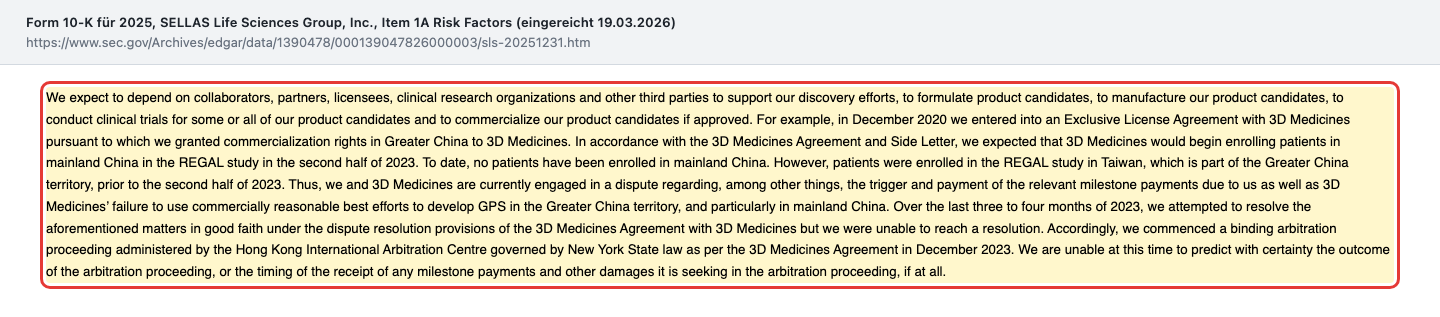
On December 20, 2023 SELLAS commenced binding arbitration before the Hong Kong International Arbitration Centre, governed by New York law. Since then: no published outcome, no forecast. The annual report simply states that management believes its claims are meritorious but cannot predict the result with certainty. The dispute already costs money: in the first quarter of 2026, general and administrative expenses rose partly because of $0.6 million of additional legal fees for this proceeding.
Uncomfortable truth No. 4: the company does not own its own core product
GPS was licensed, not invented. The agreement with Memorial Sloan Kettering Cancer Center calls for annual minimum royalties of $0.1 million, milestones of up to $17.4 million per licensed product and, on commercialization, mid-single-digit royalties on sales. SLS009 works the same way: $10.0 million paid up front to GenFleet, up to $48.0 million of development and regulatory milestones and up to $92.0 million of sales milestones. The risk summary in the annual report states the consequence bluntly: losing those license agreements would mean losing the ability to continue developing and commercializing GPS or SLS009.
Then there is the sheer size of the organization. Thirteen full-time employees would, in the success case, have to prepare, file and defend a Biologics License Application with the FDA — and then build a commercial operation. The annual report itself says the organization would need to grow. What such a company looks like after approval is visible in our analysis of Puma Biotechnology: one approved drug, a sales force, real revenue — and still a clock ticking down with the patent.
Uncomfortable truth No. 5: a third of the free float is sold short
One number shows how contested this case is. As of July 26, 2026, 55.3 million SELLAS shares were sold short — roughly 32 percent of the free float. Short selling in everyday terms: somebody borrows a share, sells it immediately and hopes to buy it back cheaper. Doing that is a bet on falling prices, and the borrowed stock has to be returned eventually.
That cuts both ways. Against the stock: a very large group of professional market participants evidently expects a failure. For the stock: the mechanics afterwards. At a measured 6.3 days of average turnover to cover, those positions would have to be bought back within hours of a positive announcement — purchases that push the price higher still. These figures are snapshots, updated every two weeks; they work as a sentiment reading, not as a forecast. What they do show for certain is that a great deal of money is arguing over this counter reading in both directions.
What the stock costs — an order-of-magnitude reading
Let us work it through soberly, with a single dated anchor. On July 24, 2026 the stock closed at $11.32; at 196,632,574 shares that gives a market value of roughly $2.23 billion. Against it stand $107.1 million of cash as of March 31, 2026 plus $28.7 million from warrants in April and May — roughly $135.8 million in total. The remainder, a good $2.09 billion, is pure expectation. Put differently: for every dollar actually in the house, the market pays about 16 dollars. Measured against book value it is 20.7 times.
There is no price-to-earnings and no price-to-sales ratio, because there are neither earnings nor sales. For a sense of the drop below: on June 30, 2025 — the measurement date on the cover of the annual report — the entire float of this company was worth $219.1 million. Closing prices over the trailing twelve months ranged from $1.39 to $15.88, and with a beta of 2.4 the swing is about two and a half times that of the broad market (data as of July 26, 2026).
And the professional view? It is thinly staffed and should be read accordingly: three analyst estimates, average price target $27.50. Three estimates are not a consensus but three opinions — and in a case whose outcome rests on a blinded trial, they may know the answer no better than the company does.
Opportunities and risks at a glance
Opportunities
- The interim analysis at 60 events went well: in January 2025 the independent data monitoring committee recommended continuing REGAL without modifications — no futility stop, no safety stop.
- The second candidate is not a placeholder: SLS009 met all primary endpoints of its Phase 2 study in July 2025 (33 percent response rate across 54 evaluable patients, 50 percent in ASXL1-mutated patients) and has FDA clearance to move into first-line therapy.
- The balance sheet carries: $107.1 million of cash as of March 31, 2026 plus $28.7 million through June 2, against an operating cash outflow of $28.4 million for all of 2025 — years of runway on paper, with no interest-bearing debt.
- GPS holds FDA orphan drug and fast track status in three indications and, since October 2024, rare pediatric disease designation for pediatric AML — routes that can shorten a review.
- The $191.5 million of milestones under the China agreement are not lost but disputed; an award in favor of SELLAS would be substantial relative to the size of the company.
Risks
- All or nothing: if the final REGAL analysis is negative, the basis for the planned licensing application disappears — and with it the great majority of what the market pays today.
- No date, only a counter: roughly seventeen months passed between 60 and 78 events. The company explicitly cannot predict when the last two will occur.
- Dilution at scale: 32.1 million shares at the start of 2024, 196,632,574 on June 2, 2026; as of March 31, 2026 another 35.9 million shares were reserved for future issuance.
- Valuation without foundation: roughly $2.23 billion of market value (July 24, 2026) against roughly $135.8 million of tangible funds, no revenue and an accumulated deficit of $283.4 million.
- Dependence on third parties: both candidates are in-licensed, the trials run through contract research organizations, and 13 full-time employees would have to carry a regulatory filing and a market launch.
- The Chinese partner has not delivered since the second half of 2023; the arbitration has been running since December 20, 2023 without a published outcome.
A human conclusion
Back to the calendar trap. What makes this stock so hard to judge is not its balance sheet — that one is clean and easy to read. It is that we want a date where none exists. "Soon" is not a point in time. Roughly seventeen months separated the 60th event from the 78th; the last two may arrive tomorrow or next year.
And behind each of those events stands a person with acute leukemia. That is where the detachment of a trial table reaches its limit — and it is also why the trial exists: if GPS works, it means people in exactly that situation live longer. Both sentences sit side by side in the same filings, signed by the same officers.
What is proven: a healthy balance sheet, a second drug that hit its endpoints, a positive interim analysis and a company that discloses its numbers with unusual clarity. What is unproven: whether the lead product works. The market has already answered the second question and priced it at $2.2 billion. The trial has not. What you make of that is your decision. And that is exactly as it should be.
Sources
- SEC quarterly report 10-Q for the period ended March 31, 2026 (filed May 12, 2026) — balance sheet, results, share count, warrants, trial status at 78 events, cash runway, arbitration
- SEC annual report 10-K for 2025 (March 19, 2026) — business model, drug candidates, MSK and GenFleet license agreements, headcount, corporate history, risk factors, legal proceedings, use of AI in peptide design
- SEC annual report 10-K for 2024 (March 20, 2025) — comparative figures, share count as of January 1, 2024, negative equity
- SEC Form 8-K of June 2, 2026 — $28.7 million from warrant exercises in April and May, 196,632,574 shares outstanding
- SEC Form 8-K of March 11, 2026 — $42.6 million from warrant exercises since year-end, 179,536,724 shares
- SEC Form 8-K of January 8, 2026 — preliminary cash position of $71.8 million as of December 31, 2025
- SEC Form 8-K of September 11, 2025 — warrant inducement agreement: 19,685,040 shares at $1.20, new warrants at $1.88
- SEC Form 8-K of June 25, 2026 — amended and restated severance and change-of-control agreements for the CEO, CFO and chief development officer
- SEC EDGAR filing index, CIK 0001390478 — recency gate: every document after May 12, 2026 reviewed, including the S-8 of June 16, 2026 and the 8-K of June 18, 2026 (annual meeting)
- Fundamental data and our in-house stock scanner, data as of July 26, 2026 (ranking as of July 25, 2026) — weekly ranking, relative strength rating, turnover, Piotroski, Altman-Z, market value, short interest, analyst picture
Journalistic analysis, not investment advice and not a solicitation to buy or sell securities. Stocks can lose their entire value; a total loss is possible. All figures come from the original documents linked above and carry the reporting date stated there. The author holds no position in SELLAS Life Sciences Group, Inc. at the time of publication.
Our Bottom Line at a Glance
- Trial status neutral
- The interim analysis at 60 events went well — in January 2025 the independent data monitoring committee recommended continuing REGAL without modifications. Proof of efficacy is still missing: SELLAS is blinded, does not know the survival data and only reads out at 80 events. On May 11, 2026 the count was 78.
- Balance sheet positive
- As of March 31, 2026, $107.1 million of cash stands against $6.8 million of liabilities with no interest-bearing debt; the equity ratio is roughly 90 percent. On January 1, 2024 equity was still negative at minus $8.0 million. A further $28.7 million of warrant proceeds arrived through June 2, 2026.
- Dilution negative
- The share count rose from 32,132,890 (January 1, 2024) to 196,632,574 (June 2, 2026) — more than six times over in two and a half years. As of March 31, 2026 another 35.9 million shares were reserved, including 22.4 million warrants at $2.00 running to October 2030.
- Second candidate positive
- SLS009 is not a placeholder: in July 2025 the Phase 2 study in relapsed or refractory AML met all primary endpoints (33 percent response rate across 54 evaluable patients, 50 percent in ASXL1-mutated patients against a 20 percent threshold), the FDA cleared the path into first-line therapy, and the European IMPACT-AML network joined in January 2026.
- Partners and licenses negative
- Both candidates are in-licensed — GPS from Memorial Sloan Kettering Cancer Center, SLS009 from GenFleet Therapeutics. Chinese licensee 3D Medicines has enrolled no mainland patient since the second half of 2023 and has not paid two milestones totaling $13.0 million; the arbitration has been running since December 20, 2023 without an outcome.
- Valuation negative
- Roughly $2.23 billion of market value (closing price $11.32 on July 24, 2026) stands against roughly $135.8 million of tangible funds and no revenue — a good $2.09 billion is expectation already paid for, 20.7 times book value. On June 30, 2025 the entire float was worth $219.1 million.
SELLAS Life Sciences is a case you can tell in two sentences. The balance sheet is that of a healthy company: $107.1 million of cash as of March 31, 2026, $6.8 million of liabilities, no interest burden, plus a second drug whose Phase 2 study met all primary endpoints in July 2025. The business is a bet: no product revenue since inception, 13 full-time employees, both candidates in-licensed, an accumulated deficit of $283.4 million — and a lead product whose registration study is only read out once 80 deaths have occurred. On May 11, 2026 the count was 78, and a date is expressly not predictable. The road there was paid for in stock: 32.1 million shares at the start of 2024 became 196,632,574 on June 2, 2026. Not investment advice.
What Our Rating Means
Open questions
The business works in principle, but one material question is open. As long as it stays open, our findings do not carry a quality verdict.
The substance is sound: as of March 31, 2026, $107.1 million of cash stands against $6.8 million of liabilities, there is no interest-bearing debt, no indication of a threat to the going concern, and with roughly $135.8 million of available funds against an operating outflow of $28.4 million in 2025 the runway is measured in years rather than quarters. What is open is an operational question, and it is the largest one available: the company has never generated product revenue since inception, and the outcome hangs on a single event — the final analysis of the Phase 3 REGAL study, which only triggers at 80 events (78 as of May 11, 2026). Add that both drug candidates are in-licensed and that 13 full-time employees would have to carry a regulatory filing in the success case. That is not a proven threat to substance, but it is not proven quality either — hence yellow. The decision is yours.
A journalistic assessment by our editorial team at the time of the deep dive, based on public sources — not investment advice and not a solicitation to buy or sell. Your personal circumstances (investment goals, risk capacity, taxes) cannot be taken into account. What our levels mean, how verdicts are formed, and what conflicts of interest exist →
Worth Noting
- SLS reached our research list as rank 6 of 28 U.S. hits in our in-house Moglen weekly ranking (as of July 25, 2026, relative strength rating 98) — part of the series filling the top 50 of that ranking with analyses. Scanner lists are recalculated daily.
- What the scanner measures: at least 15 percent price gain over four trading days, at least 10 million dollars of average daily turnover and a relative strength rating of 70 or higher. Those are pure price criteria and say nothing about the quality of the business.
- Confusion risk: the symbol "SLS" also belongs to Solstice Minerals on the Australian exchange and to Solaris Resources on the Canadian TSX. Every figure in this analysis comes from the U.S. line only — Nasdaq, ISIN US81642T2096, SEC identifier CIK 0001390478, identical in the market data feed and in the EDGAR registry.
- Ratio trap: the Piotroski F-Score (2 of 9) and the Altman Z-Score (173.6) carry little meaning at a company with no revenue and no debt — the first is pushed down because four of its criteria require profit or a profit margin, the second distorted upward because there are barely any liabilities to weigh against.
- Recency note: the latest quarterly report (10-Q) is dated May 12, 2026. Everything filed afterwards has been reviewed — the Form 8-K of June 2, 2026 (Item 8.01, cash, warrant proceeds and share count), the S-8 of June 16, 2026, the Form 8-K of June 18, 2026 (Item 5.07, annual meeting) and the Form 8-K of June 25, 2026 (Item 5.02, amended severance and change-of-control agreements). There is no takeover, no merger and no delisting.
- Valuation figures dated and evergreen: the only price anchor is the closing price of $11.32 on July 24, 2026 (market value roughly $2.23 billion on 196,632,574 shares); short interest of 32.3 percent of the float is a snapshot as of July 26, 2026 and is reported anew every two weeks. Watch list: the announcement of the 80th REGAL event, the next quarterly report with the current share count, and an award in the 3D Medicines arbitration.
Frequently Asked Questions
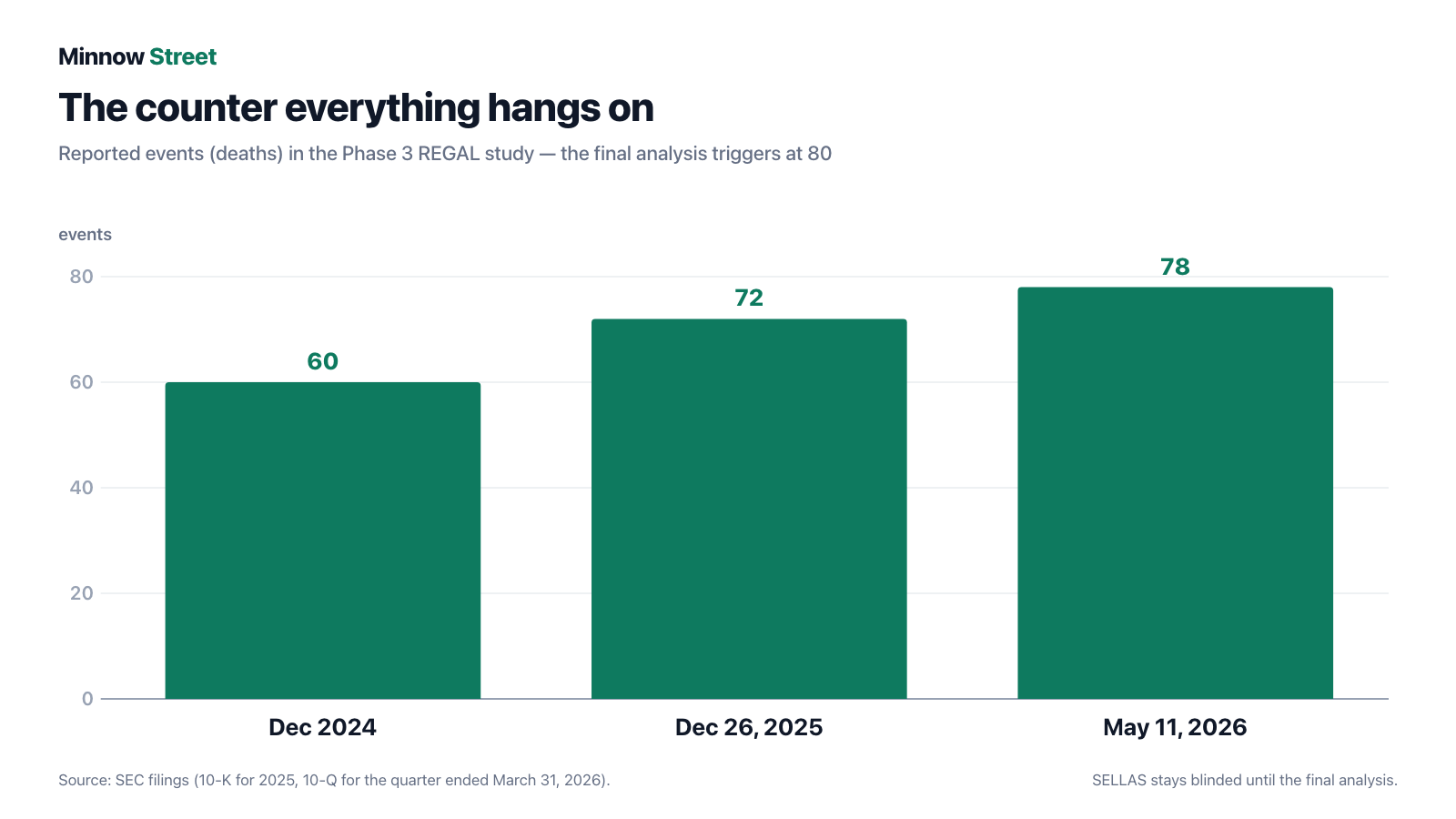
REGAL measures overall survival. The final analysis only starts once 80 deaths have occurred across both arms combined. In December 2024 the count was 60, on December 26, 2025 it was 72, and on May 11, 2026 the quarterly report put it at 78. SELLAS remains blinded until then and does not know the efficacy data itself.
There is no date. The quarterly report for the period ended March 31, 2026 states expressly that the analysis is event driven and difficult to predict with any certainty, and that the company will announce the 80th event when it occurs. Roughly seventeen months passed between the 60th and the 78th event.
No. No filing with the U.S. securities regulator through June 2026 reports a takeover, a merger or a delisting. The only related item is the Form 8-K of June 25, 2026: the board amended and restated the severance and change-of-control agreements of its three senior executives. That is a precaution, not a transaction.
The quarterly report for the period ended March 31, 2026 reports $107.1 million of cash and states the funds are sufficient for at least twelve months from the issuance of the financial statements. A further $28.7 million came in from warrant exercises through June 2, 2026. Measured against the $28.4 million operating outflow of 2025, that is several years on paper.
Because no product is approved. The only income in the company history comes from the license agreement with 3D Medicines for Greater China: $10.5 million of upfront and milestone payments through March 31, 2026. Another $191.5 million of potential milestones is outstanding and is the subject of an arbitration.
Severely. On January 1, 2024 there were 32,132,890 shares; on June 2, 2026 there were 196,632,574 — more than six times as many. As of March 31, 2026 a further 35.9 million shares were reserved for future issuance, including 30.3 million warrants. Total authorized share capital is 350 million shares.
SLS009 (tambiciclib) is a highly selective CDK9 inhibitor that SELLAS licensed from GenFleet Therapeutics of Shanghai in March 2022 for every market outside Greater China. In July 2025 the company reported that the Phase 2 study in relapsed or refractory AML met all primary endpoints — a 33 percent response rate across 54 evaluable patients.
No, the symbol is used several times over: on the Australian exchange SLS stands for Solstice Minerals, on the Canadian TSX for Solaris Resources. This analysis refers exclusively to the Nasdaq-listed SELLAS Life Sciences Group, Inc. with ISIN US81642T2096 and SEC identifier CIK 0001390478.
Found an error?
Did you spot a factual error, an outdated number, or a typo in this deep dive? Let us know briefly — your report goes straight to the editorial team.