Puma Biotechnology: One Drug, Zero Debt — and a Clock That Runs Out in 2030
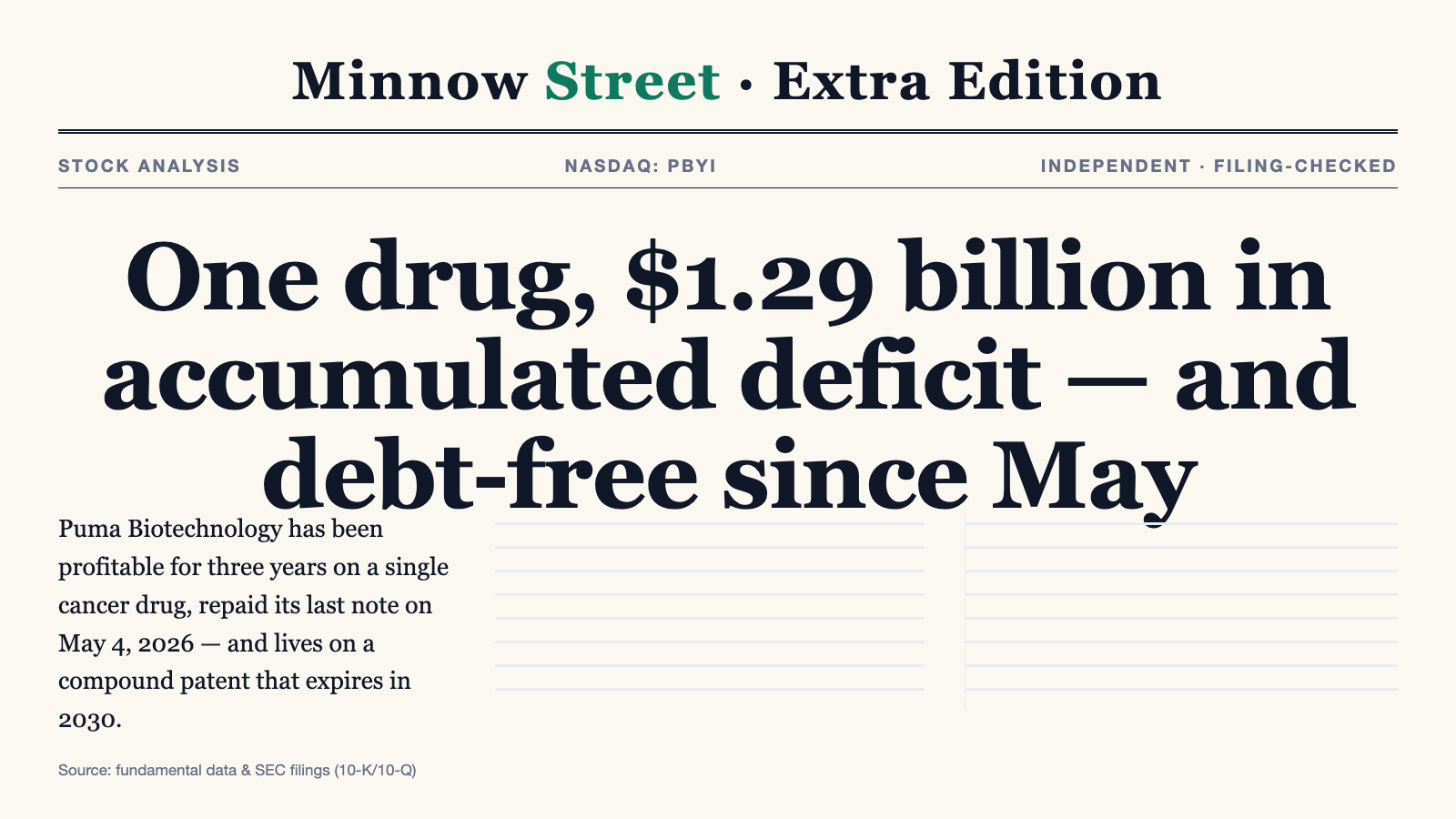
Puma Biotechnology has beaten analyst estimates five quarters in a row, which is why it sits at rank 15 in our earnings-surprise ranking. The SEC filings tell a different story: revenue has been flat between $225.1 million and $253.2 million for six years, royalty revenue fell 31 percent in 2025, and the U.S. composition-of-matter patent on the company's only product expires in 2030. On the other side of the ledger: debt-free since May 4, 2026, with $101.5 million in the bank. Not a recommendation — just the question of what a drug is worth when you can hear its clock ticking.
 Thomas Mücke
Founder & Publisher
Thomas Mücke
Founder & Publisher
Chart
Interactive price chart (TradingView).
Note: pure fact-based analysis, not investment advice and not a solicitation to buy or sell. All figures without guarantee.
There is an investing trap that catches careful people — the ones who like numbers and read lists. Call it the hurdle trap. It works like this: a company beats analyst estimates. Five quarters in a row. We read "beat" and hear "good." But a beaten estimate says nothing about the company; it says something about the hurdle. Set it low enough and you can clear it with a broken leg. At Puma Biotechnology (Nasdaq: PBYI) of Los Angeles you can see this in a single data point: on May 7, 2026 the company reported a first-quarter loss of $0.04 per share. The estimate had been minus $0.13. Result: a "positive surprise" of 69.2 percent — and still a loss.
One clarification first, because it confuses people every year: Puma Biotechnology has nothing to do with PUMA SE, the German sportswear maker. No sneakers, no shared history, no cross-holding. This is a cancer drug company with 179 employees. So here is the deal: before the surprise statistics decide for you, let us read together what Puma has told the U.S. securities regulator, the SEC — the annual report (Form 10-K) for 2025 and the quarterly report (Form 10-Q) for the quarter ended March 31, 2026. An SEC filing is honest under threat of prosecution. You decide at the end.
What Puma Biotechnology actually does — one drug, one market
Puma sells NERLYNX, a tablet containing the compound neratinib. It is used in breast cancer where a particular growth switch on the tumor cell — HER2 — is overactive. Neratinib blocks that switch permanently. It is approved in two settings: as extended adjuvant treatment after standard therapy in early-stage disease and, combined with a chemotherapy agent, in advanced disease. The compound did not come from Puma's own labs: it was in-licensed from Pfizer, and Puma still pays royalties on it, buried in cost of sales.
Outside the United States, Puma does not sell directly but grants sub-licenses — for Europe and parts of Africa, for instance, to the French company Pierre Fabre. Those partners pay royalties back; in 2025 that was $24.3 million. The rest of revenue, $204.1 million, comes from the U.S. direct business through specialty pharmacies.
How dependent the company is on that one product is something it writes into the risk section of its own annual report, in language that leaves no room for interpretation:
"NERLYNX is the only product for which we currently receive product revenue, and we expect NERLYNX to constitute the vast majority of our product revenue for the foreseeable future. By virtue of being dependent on a single product, we do not have the ability to spread out risk or commercial fluctuations across a portfolio of products. As a result, our success depends entirely on the commercial success of NERLYNX."
— Puma Biotechnology, Inc., SEC Form 10-K for 2025, Item 1A Risk Factors

The second hope is called alisertib. It inhibits a different cellular tool (Aurora kinase A) and was in-licensed from a subsidiary of Japan's Takeda — including data from 22 earlier trials in more than 1,300 patients. Puma is currently testing it in two Phase II studies: in extensive-stage small cell lung cancer and in hormone receptor-positive, HER2-negative breast cancer. Both are still enrolling. In plain language, Phase II means there are early signals but no proof, and any approval is years and hundreds of millions of dollars away.
That defines the central tension of this analysis, and it runs through every chapter: Puma has fixed everything that could be fixed — the losses, the costs, the debt. The one thing that actually matters is the one thing it cannot fix: the clock on the patent.
How this stock landed on our desk
Puma Biotechnology reached our research list through our big-earnings-surprise ranking: rank 15 of the U.S. selection with an RS rating of 89, as of July 25, 2026. This in-house stock scanner looks for companies whose reported earnings came in well above what analysts had estimated — the idea comes from momentum research, where one surprise tends to be followed by another because estimates adjust slowly. An RS rating of 89 means the stock has outperformed 89 percent of all screened names over the past twelve months. Both lists are recalculated daily, so any rank is a snapshot.
And the surprise streak really is impressive — here are the five most recently reported quarters, reported versus estimated earnings per share (data as of July 25, 2026):
- Quarter ended March 31, 2025, reported May 8, 2025: $0.06 against an estimate of minus $0.02
- Quarter ended June 30, 2025, reported August 7, 2025: $0.12 against $0.08 (up 50 percent)
- Quarter ended September 30, 2025, reported November 6, 2025: $0.21 against $0.09 (up 133 percent)
- Quarter ended December 31, 2025, reported February 26, 2026: $0.26 against $0.19 (up 37 percent)
- Quarter ended March 31, 2026, reported May 7, 2026: minus $0.04 against minus $0.13 (up 69 percent)
Notice the last line? That is where the hurdle trap snaps shut. The most recent "positive surprise" is a loss. Statistically it counts as a win, and in the ranking it sits next to genuine profit jumps. Remember this for any stock that reaches you through a surprise list: a beaten estimate is not a profit — it is a beaten estimate. We took apart a similar lesson about numbers without context at Inogen, where 20 percent more devices sold produced only 6 percent more money.
The numbers over the years — credit where it is due
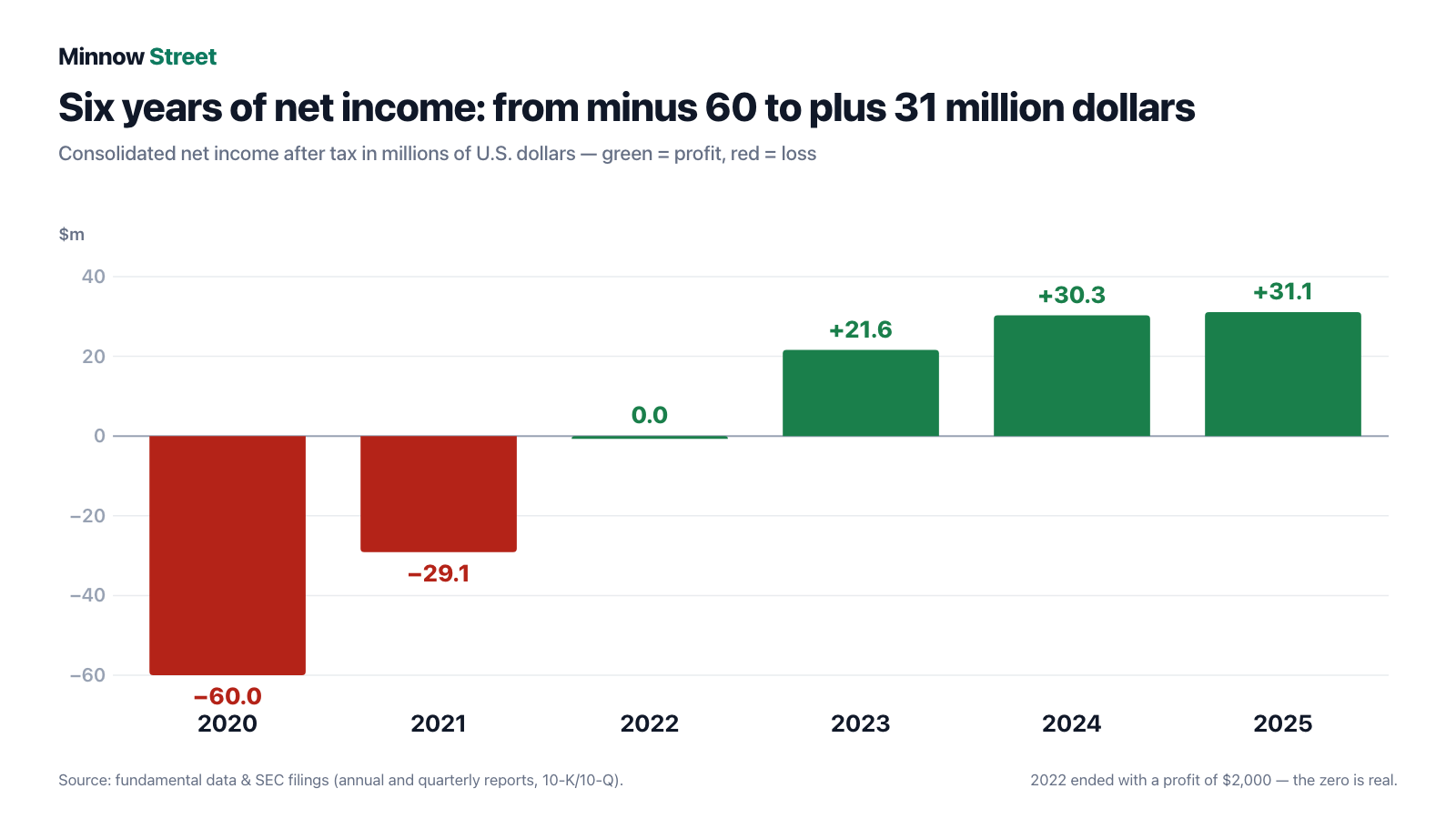
First the part that genuinely impresses, and with Puma there is plenty of it. This company has climbed out of a very deep hole. In 2020 the books showed a net loss of $60.0 million, in 2021 another $29.1 million. In 2022 the year closed with a profit of exactly $2,000 — that is not a rounding artifact, that is the number. Then it went up: $21.6 million (2023), $30.3 million (2024), $31.1 million (2025).
The balance sheet healed alongside it. Stockholders' equity — roughly, what would be left after selling everything and paying every debt — stood at minus $2.4 million at the end of 2021. It was plus $21.6 million at the end of 2022, plus $53.4 million at the end of 2023, plus $92.1 million at the end of 2024 and plus $130.3 million at the end of 2025. Four years in which the hole was not just plugged but filled.
And then came the sentence Puma had presumably been working toward for five years. It sits at the very back of the quarterly report, in the subsequent-events note, and is easy to miss:
"On May 4, 2026, the Company paid $11.5 million to Athyrium Opportunities IV Co-Invest 1 LP, consisting of principal, interest and exit fees due under the 2021 Note Purchase Agreement. This payment was made ahead of the maturity date of July 23, 2026, reduces the principal balance outstanding under the Athyrium Notes to zero and terminates all remaining obligations of the Company under the 2021 Note Purchase Agreement, other than customary continuing indemnification obligations."
— Puma Biotechnology, Inc., SEC Form 10-Q for the quarter ended March 31, 2026, Note 13 "Subsequent Event"

What that is worth becomes clear in hindsight: at the end of 2020 the balance sheet carried $121.0 million of financial debt, $111.5 million at the end of 2023, $74.1 million at the end of 2024, $28.5 million at the end of 2025 — and zero since May 4, 2026. Interest expense shrank with it: $13.3 million in 2023, $12.5 million in 2024, $6.6 million in 2025; in the first quarter of 2026 it was $0.7 million against $2.2 million a year earlier. Against that sit $101.5 million in cash and marketable securities as of March 31, 2026. A company that repays debt out of operating cash flow instead of issuing shares is the exception among small biotechs — there the equity raise is the norm. What such a company looks like with no product revenue at all we worked through at Abivax: one compound, 69 employees — and a share price made almost entirely of expectation.
A word on ratios you will encounter with this name. In our Piotroski balance-sheet check, Puma scores 7 out of 9 (data as of July 25, 2026) — solid, not outstanding; a genuinely healthy company sits at 8 or 9. The often-quoted Altman Z-score, by contrast, comes out at minus 3.4 and looks like imminent bankruptcy. It is worthless here, for a simple reason: one quarter of the Altman formula is retained earnings over total assets. Puma has accumulated $1.288 billion in deficit since inception against total assets of $192.7 million. That single term drags the whole formula into the basement, regardless of the fact that the company is now debt-free and profitable. Remember: a ratio that measures the past is not a statement about the present.
What the filings say — the uncomfortable truths
Uncomfortable truth No. 1: Revenue has not moved in six years
Everything above was achieved by cutting, not by growing. The revenue series since 2020 reads: $225.1 million, $253.2 million, $228.0 million, $235.6 million, $230.5 million and $228.4 million. Six years, six times the same order of magnitude. Operating expenses, by contrast, fell from $216.1 million (2020) to $191.1 million (2025), and selling, general and administrative expense from $118.5 million to $70.8 million. That is where the profit came from.
Beneath the flat surface, two lines move in opposite directions — and the worse one is the smaller one:
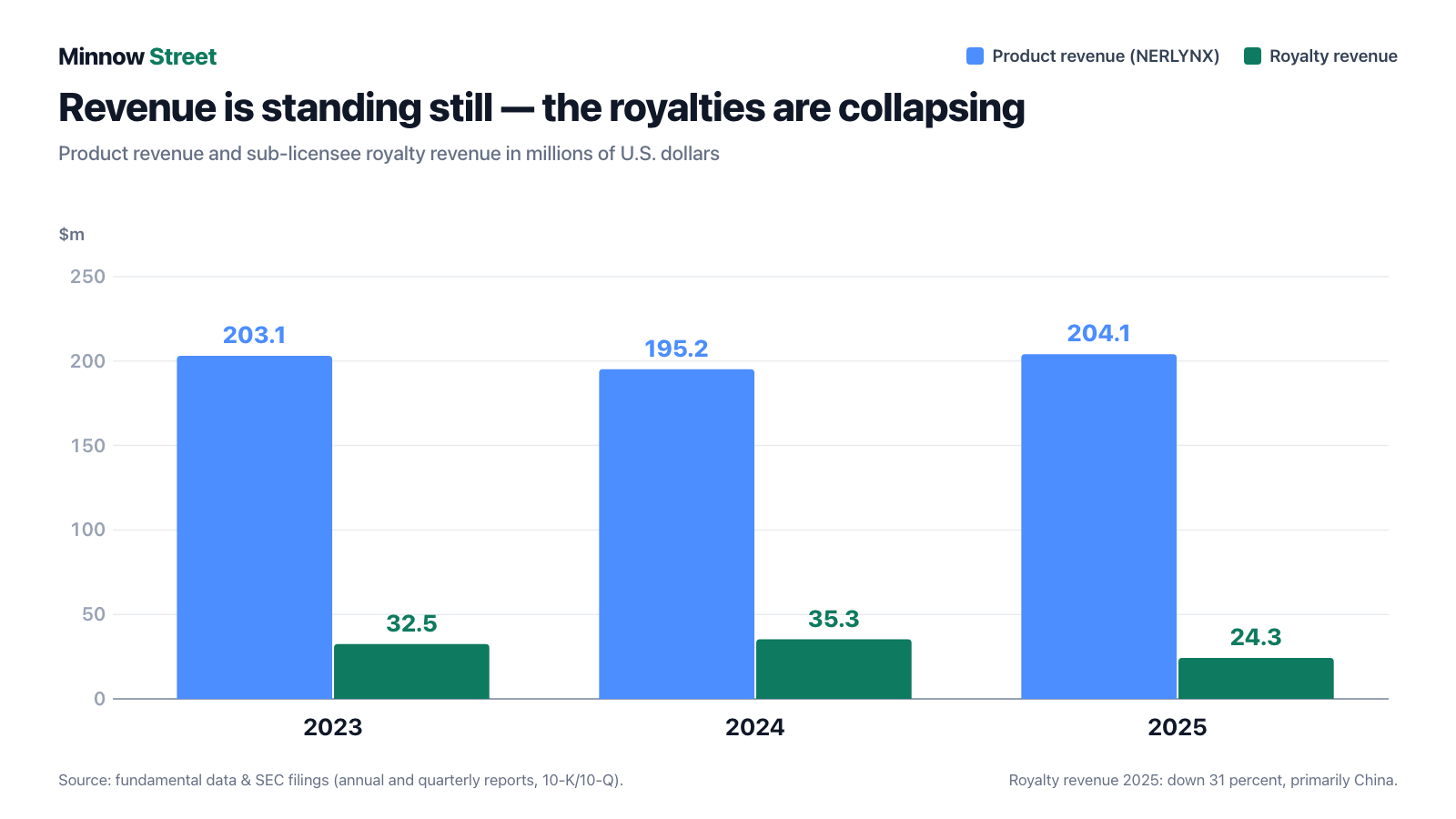
Royalty revenue is the most valuable line in the entire income statement, because almost no costs sit against it — somebody else sells, Puma collects. That line fell by $11.0 million, or 31 percent, in 2025. The annual report keeps the explanation short: lower product sales by the sub-licensees in their international territories, "primarily in China". For scale: $11.0 million equals roughly 35 percent of the entire $31.1 million full-year profit. In the first quarter of 2026 the line came in at $2.9 million — exactly as in the year-earlier quarter, so it has stabilized at the lower level.
Uncomfortable truth No. 2: Less and less of the list price survives
A quick translation of a technical term. A pharmaceutical company never books the list price as revenue. Off it come discounts, payer rebates, government-mandated chargebacks and returns. In accounting language this deduction is called variable consideration; in everyday terms it is the gap between the price tag and what lands in the till. At Puma that wedge is widening: it rose from 19.5 percent of product revenue (2024) to 24.3 percent (2025). The report names higher government chargebacks and a shift in payer mix.
Run the arithmetic yourself. For $204.1 million to survive in 2025, roughly $269.6 million had to be invoiced. Had the deduction stayed at 19.5 percent, that would have produced about $217 million — some $13 million more, or more than a third of the full-year profit. And the mechanism keeps running: in the first quarter of 2026 product revenue fell from $43.1 million to $42.0 million, and the quarterly report explicitly names a greater deduction for variable consideration as the main reason.
Uncomfortable truth No. 3: The patent clock is running — and it is dated
This is the truth that overshadows everything else. A medicine is only worth something commercially for as long as nobody else may copy it. The annual report supplies the dates itself, and not in the small print but in the intellectual property chapter:
"In the United States, we have a license to an issued patent, which is set to expire in 2030, for the composition of matter of neratinib, our lead compound."
— Puma Biotechnology, Inc., SEC Form 10-K for 2025, Item 1 "Intellectual Property"

Measured from the data date of this analysis (July 25, 2026) that is a little over four years — enough time to make a lot of money, too little to ignore. In Europe the situation is already noisier: three generic manufacturers filed oppositions against the European base patent, the case has moved to the appeal stage, and one opponent withdrew its appeal in December 2025. No outcome yet.
Uncomfortable truth No. 4: The replacement now costs money — and it flipped the quarter
Puma knows all of this, which is why alisertib exists. But research is expensive, and you see it immediately in the numbers. Research and development expense rose 13.0 percent to $62.1 million in 2025. In the first quarter of 2026 it jumped from $13.9 million to $19.8 million, up 42.8 percent. The driver sits in the breakdown: pure clinical trial expense climbed from $3.6 million to $8.8 million, up 143.1 percent.
That was enough to flip the quarter. On revenue of $44.8 million (year-earlier quarter: $46.0 million), the company posted an operating loss of $3.8 million against operating income of $4.0 million a year before; the bottom line was a net loss of $3.8 million against net income of $3.0 million. This is not an accident but a deliberate choice — yet it also answers the question of how long the profit streak survives while two Phase II trials are running.
Fairness requires the other direction too: operating cash flow in the first quarter of 2026 was clearly positive at $15.4 million (year-earlier quarter: $3.6 million). Look closely, though, and you can see where it came from: accounts receivable fell from $53.7 million to $26.3 million — $27.3 million of cash collected that had been outstanding at year end. That is money gathered in from the prior quarter, not money earned in this one. Effects like that do not repeat.
And on the side: few customers, large balances
In the United States, Puma does not sell to the pharmacy on the corner but to a small number of specialty pharmacies and distributors. The concentration footnote shows how tight that is: as of December 31, 2025, $38.9 million of total receivables of $53.7 million was owed by individual customers each accounting for more than ten percent (prior year: $22.9 million). Roughly 72 percent of open invoices therefore hang on a handful of buyers. That is normal in this industry — but it also means the payment behavior of a few partners can dictate an entire quarter's cash flow, as the first quarter of 2026 has just demonstrated.
And on the side: the founder's warrant expires on October 4, 2026
At the annual meeting on June 11, 2026, shareholders voted on something that rarely gets aired in public. Founder and chief executive Alan H. Auerbach has held a warrant since October 4, 2011 over 2,116,250 shares at $16.00 each. It was already extended once in 2021 and now expires on October 4, 2026. The board proposed extending it to 2028. Shareholders said no:

For an investor this is mostly a dilution calculation — the effect where your slice of the pie shrinks because more slices get handed out. Those 2,116,250 shares equal roughly 4.2 percent of the 50,899,456 shares outstanding. The $16.00 strike, however, sits far above the price at which the chief executive himself sold shares on July 6, 2026: $8.263 apiece. If the warrant expires worthless on October 4, 2026, that dilution disappears for good.
And since a headline like "CEO sells stock" reliably raises the pulse, here is the resolution from the same filing: the July 6, 2026 sales were, per the footnote to the Form 4, executed under a plan adopted in December 2020 to cover taxes on vesting share awards. Auerbach still held 7,261,671 shares afterwards — roughly 14 percent of the company. That is not an exit. Same rule as everywhere else: read the footnote first, then take your pulse.
Valuation: cheap on the math, expensive on the thought
Market value on the trading day of July 24, 2026 was roughly $406 million (50,899,456 shares outstanding per the quarterly report cover page as of May 4, 2026). Against the last four reported quarters that works out to a price-to-earnings ratio of about 16.6 and a price-to-sales ratio of about 1.8; price to book value is about 3.2. Because there is more in the bank than the company owed, enterprise value — market value less net cash — comes out lower at roughly $322 million; measured against operating earnings before depreciation and amortization that is around seven times (all figures as of July 25, 2026).
That sounds cheap, and for a company with stable earnings it would be. Except the market is not pricing a stable company here — it is pricing a remaining term. A rough calculation makes it tangible: if Puma earns roughly $30 million a year through 2030, that adds up to something like $120 million to $150 million before the patent expires — well below today's market value. Everything beyond that has to come from one of two sources: NERLYNX living longer than the calendar suggests, or alisertib. That is what is being voted on here, not the price-to-earnings ratio.
The professionals are little help, and that too is a finding: exactly one analyst covers the name, with a hold rating and a price target of $5.00 — below the closing price of July 24, 2026 (data as of July 25, 2026). One analyst is not a consensus, it is an opinion. For a stock with $406 million of market value, thin coverage means mostly one thing: hardly anyone is telling the story out loud — in either direction.
Opportunities and risks at a glance
What speaks for Puma Biotechnology:
- The turnaround is fully documented: net income from minus $60.0 million (2020) to plus $31.1 million (2025), equity from minus $2.4 million (2021) to plus $130.3 million (December 31, 2025).
- The company has been debt-free since May 4, 2026 — the 2021 note purchase agreement was repaid and terminated 80 days before maturity; $101.5 million sat in cash and marketable securities as of March 31, 2026.
- The profit is not an accounting question: operating cash flow was $41.8 million in 2025 after $38.9 million in 2024. Capital expenditure is effectively nil.
- The cost base is materially leaner: selling, general and administrative expense down from $118.5 million (2020) to $70.8 million (2025), with 179 employees as of December 31, 2025.
- A second compound exists and is funded: alisertib, in-licensed from a Takeda subsidiary, with data from 22 earlier trials in more than 1,300 patients, currently in two ongoing Phase II studies.
What speaks against it:
- A single approved product — the annual report itself states that success depends "entirely" on the commercial success of NERLYNX. There is no portfolio to smooth things out.
- The U.S. composition-of-matter patent on neratinib expires in 2030 and three crystal-form patents as early as 2028; in Europe an opposition appeal by generic manufacturers is pending against the base patent.
- Revenue has been stuck between $225.1 million and $253.2 million for six years; the entire profit build came from cost cuts, not from growth.
- The highest-margin line is shrinking: royalty revenue down from $35.3 million to $24.3 million in 2025 (minus 31 percent), primarily China according to the report, while the deduction for variable consideration rose from 19.5 to 24.3 percent of product revenue.
- The profit streak has already broken: the first quarter of 2026 showed a $3.8 million operating loss as clinical trial expense jumped 143.1 percent to $8.8 million. Analysts expected only $0.45 per share for 2026 after $0.61 in 2025 (data as of July 25, 2026).
A human verdict
Back to the hurdle trap. Puma Biotechnology is such a useful example precisely because the company hides nothing. The turnaround is real. The debt freedom is real. The profit is real and paid in cash. The story only goes wrong where a statistic about beaten estimates pretends to be a statement about the future. Five quarters above the estimate means the estimators were wrong five times. It does not mean a patent lasts longer, a Phase II trial works, or the Chinese royalties come back.
So the honest question for you is not "is Puma cheap?" but: do you believe this company will earn enough and develop enough in the patent years it has left to still have a business after 2030 — and is today's price fair for that? If yes, you are buying a debt-free company with cash, dependable cash flow and a second iron in the fire. If no, you are buying a remaining term at the price of a going concern. What you make of that is your decision. And that is exactly as it should be.
Sources
Every original document used in this analysis — read it yourself:
- Puma Biotechnology, Inc. — SEC Form 10-K for 2025 (filed February 26, 2026)
- Puma Biotechnology, Inc. — SEC Form 10-Q for the quarter ended March 31, 2026 (filed May 7, 2026)
- Puma Biotechnology, Inc. — SEC Form 10-K for 2024 (filed February 27, 2025)
- Puma Biotechnology, Inc. — SEC Form 8-K filed June 16, 2026 (Item 5.07, results of the June 11, 2026 annual meeting)
- Puma Biotechnology, Inc. — SEC Form 4 insider filing dated July 8, 2026 (sell-to-cover at $8.263 per share)
- Screener and rating data: our in-house stock scanner, rank 15 of the U.S. selection, RS rating 89 (as of July 25, 2026); market value, analyst coverage and earnings surprises: fundamental data (as of July 25, 2026, last trading day July 24, 2026).
This analysis is journalistic commentary, not investment advice and not a solicitation to buy or sell securities. Shares of small companies can be highly volatile; a total loss is possible. All figures come from the original documents linked above and carry the reporting date stated there. Puma Biotechnology, Inc. (Nasdaq: PBYI) has no connection whatsoever to PUMA SE of Herzogenaurach, Germany. The author holds no position in Puma Biotechnology, Inc. at the time of publication.
Our Bottom Line at a Glance
- Balance sheet and debt freedom positive
- On May 4, 2026 Puma paid $11.5 million to retire the remainder of the 2021 note purchase agreement, ending it 80 days before maturity. Financial debt fell from $121.0 million (2020) through $74.1 million (2024) and $28.5 million (December 31, 2025) to zero; $101.5 million in cash and marketable securities sat on the balance sheet as of March 31, 2026.
- Earnings power positive
- Net income moved from minus $60.0 million (2020) to plus $31.1 million (2025), and operating cash flow was $41.8 million in 2025 after $38.9 million a year earlier. The profit, however, comes from cost cuts: selling, general and administrative expense fell from $118.5 million to $70.8 million.
- Growth negative
- Revenue has been stuck between $225.1 million and $253.2 million for six years ($228.4 million in 2025). The highest-margin line is shrinking fastest: royalty revenue from sub-licensees fell 31 percent in 2025, from $35.3 million to $24.3 million, primarily because of China according to the annual report.
- Patent term negative
- The U.S. composition-of-matter patent on neratinib expires in 2030 according to the 2025 annual report, and three crystal-form patents as early as 2028; in Europe an opposition appeal by several generic manufacturers is pending. Since NERLYNX is the only approved product, that calendar governs most of the company value.
- Development pipeline neutral
- The follow-up candidate alisertib is in-licensed from a Takeda subsidiary and arrives with data from 22 earlier trials in more than 1,300 patients, but it sits in two ongoing Phase II studies with no realistic approval before the end of the decade. Clinical trial expense jumped 143.1 percent to $8.8 million in the first quarter of 2026.
- Current earnings trend negative
- The profit streak has already broken: the first quarter of 2026 closed with a $3.8 million operating loss against operating income of $4.0 million a year earlier, on revenue down from $46.0 million to $44.8 million. The analyst estimate for full-year 2026 stood at $0.45 per share as of July 25, 2026, after $0.61 in 2025.
Puma Biotechnology is the hurdle trap in pure form: five consecutive beats put the stock at rank 15 in our earnings-surprise ranking — yet the latest "surprise" on May 7, 2026 was a loss of $0.04 against an estimate of minus $0.13 per share. The turnaround behind it is real: net income from minus $60.0 million to plus $31.1 million, debt-free since May 4, 2026, $101.5 million in the bank. So is the ceiling: one product, six years of flat revenue, royalties down 31 percent — and a composition-of-matter patent that expires in 2030. Not investment advice.
Worth Noting
- PBYI reached our research list through the in-house big-earnings-surprise ranking: rank 15 of the U.S. selection with an RS rating of 89, as of July 25, 2026. The scanner measures how far reported earnings exceeded the analyst estimate — not how good the earnings were. The lists are recalculated daily, so any rank is a snapshot.
- Risk of confusion: Puma Biotechnology, Inc. (Nasdaq: PBYI, Los Angeles, CIK 0001401667) has no connection whatsoever to PUMA SE, the sportswear maker of Herzogenaurach, Germany. SEC records list the company under the former name "Innovative Acquisitions Corp" until October 2011 — the shell through which Puma Biotechnology reached the market.
- Two figures in this analysis are our own calculations from reported numbers, not company disclosures: the $269.6 million gross revenue implied for 2025 (from $204.1 million net revenue and a 24.3 percent deduction) and the rough earnings projection through 2030. The Piotroski balance-sheet score of 7 out of 9 is our own calculation (data as of July 25, 2026); the Altman Z-score of minus 3.4 is deliberately not read as a distress signal, because it is produced entirely by the $1.288 billion accumulated deficit.
- All valuation figures are dated and meant to be evergreen: market value roughly $406 million on the trading day of July 24, 2026, on 50,899,456 shares outstanding (quarterly report cover page, as of May 4, 2026). Cross-check against a documented price: on July 6, 2026 the chief executive sold shares at $8.263 each (Form 4 filed July 8, 2026), which puts the same market value at roughly $421 million. Those sales were sell-to-cover transactions under a 10b5-1 plan adopted in December 2020 and are not a sell signal.
Frequently Asked Questions
No, there is no connection at all. Puma Biotechnology, Inc. (Nasdaq: PBYI) is a pharmaceutical company in Los Angeles with 179 employees as of December 31, 2025 and one approved cancer drug. PUMA SE of Herzogenaurach, Germany is a sportswear maker listed in Germany. The only thing they share is the brand name.
Exactly one approved medicine: NERLYNX, containing the compound neratinib, a tablet for breast cancer with an overactive HER2 growth switch. In 2025 it generated $204.1 million of U.S. product revenue plus $24.3 million of royalties from international sub-licensees. A second compound, alisertib, is in two Phase II trials.
Yes, since 2022. Net income rose from minus $60.0 million (2020) through plus $21.6 million (2023) to plus $31.1 million (2025), or $0.61 per diluted share. The first quarter of 2026, however, closed with a net loss of $3.8 million because clinical trial expense jumped 143.1 percent to $8.8 million.
None since May 4, 2026. On that day, according to the subsequent-events note in the quarterly report, the company paid its lender Athyrium $11.5 million and terminated the 2021 note purchase agreement — 80 days before its July 23, 2026 maturity. As of March 31, 2026 it held $101.5 million in cash and marketable securities.
The U.S. composition-of-matter patent on neratinib expires in 2030 according to the 2025 annual report, as do two formulation patents; a combination patent with capecitabine runs to 2031, while three patents on the crystal forms expire as early as 2028. In Europe an opposition appeal brought by several generic manufacturers is pending against the base patent.
Because reported earnings beat the analyst estimate five quarters in a row — most recently on May 7, 2026 with minus $0.04 against an estimate of minus $0.13 per share. That puts the stock at rank 15 of the U.S. selection with an RS rating of 89 (as of July 25, 2026). One caveat: the latest surprise was a loss. A beaten estimate is not a profit.
Market value on the trading day of July 24, 2026 was roughly $406 million on 50,899,456 shares outstanding. That implies a price-to-earnings ratio of about 16.6 and a price-to-sales ratio of about 1.8 based on the last four quarters. Only one analyst covers the name, with a hold rating and a price target of $5.00.
Found an error?
Did you spot a factual error, an outdated number, or a typo in this deep dive? Let us know briefly — your report goes straight to the editorial team.