Erasca Stock: 57 Percent in Seven Patients — and $550 Million of New Shares the Same Day
Erasca ranks second in our in-house Moglen weekly ranking (U.S. selection, as of July 25, 2026). On July 13, 2026 the San Diego cancer research company released updated Phase 1 data for its lead compound — and signed the agreement for 31,428,572 new shares at $17.50 before the day was over. We read the Form 10-Q for the quarter ended March 31, 2026, the Form 10-K for 2025 and every filing that followed: zero revenue since inception, $1.1 billion of accumulated deficit, and a demand letter aimed at the one molecule everything depends on. Read on before you mistake a percentage for a valuation.
 Thomas Mücke
Founder & Publisher
Thomas Mücke
Founder & Publisher
Chart
Interactive price chart (TradingView).
Note: pure fact-based analysis, not investment advice and not a solicitation to buy or sell. All figures without guarantee.
There is a trap that catches almost every investor who reads a drug-trial headline: the percentage-without-the-N trap. A headline says "57 percent response rate," our brain hears "more than half of them got better" — and skips the number sitting right next to it. At Erasca, Inc. (NASDAQ: ERAS) that number is N = 7. Seven people. Four of them responded. One patient fewer and the release would have read 43 percent.
That is not a criticism of the company — every drug program starts this way, and Erasca discloses the numbers cleanly. It is a warning to us. Before turning a percentage into a market value of roughly $6.6 billion, let us make a deal: we read together what Erasca itself filed, under penalty of law, with the U.S. securities regulator, the SEC — the quarterly report (Form 10-Q) for the period ended March 31, 2026, the annual report (Form 10-K) for 2025, and every single filing that followed.
What Erasca actually does — a switch that will not turn off
Every cell contains circuits that say "divide now." One of the most important is called the RAS/MAPK pathway. In cancer that switch is often broken — stuck in the on position, so the cell keeps dividing after the signal has stopped. RAS is the most frequently mutated cancer gene there is; the company puts the number of people newly diagnosed each year worldwide with cancers driven by this pathway at more than five million.
Erasca is trying to do one thing only: switch that circuit back off, at every point at once. The company calls this its singular focus.
"We are a clinical-stage precision oncology company singularly focused on discovering, developing, and commercializing therapies for patients with RAS/MAPK pathway-driven cancers."
— Erasca, Inc., SEC prospectus supplement 424B5 of July 13, 2026, Prospectus supplement summary
The pipeline is three names long. ERAS-0015 is a so-called molecular glue against all RAS variants — the everyday picture is not a key that fits a lock but a drop of superglue that binds two parts of the cell together so the switch can no longer flip. ERAS-4001 is an inhibitor of KRAS variants, also in clinical testing. ERAS-12 is an antibody program still at the discovery stage. A fourth program, naporafenib, has been dropped: in March 2026 the company terminated its Novartis license effective June 3, 2026; patients enrolled in the ongoing SEACRAFT-1 and SEACRAFT-2 trials continue on treatment.
One point matters for everything that follows: both clinical compounds are in-licensed. ERAS-0015 comes from Guangzhou Joyo Pharmatech in China, ERAS-4001 from Medshine Discovery — both deals were signed in May 2024. Erasca did not invent the molecules; it funds, develops and intends to commercialize them. How hard the road from a good trial to an approved therapy can be is something we wrote up for another cancer developer — our Arcus Biosciences analysis shows what happens when a partner reshuffles its priorities.
And that brings us to the central tension of this analysis, which runs through every chapter: Erasca has not booked a single dollar of revenue since it was founded in 2018. The company lives purely on money investors hand over. Every piece of good news lifts the price at which it can issue new stock — and is therefore converted into new stock immediately. The share price rises; your slice shrinks.
Where the stock landed on our desk
We run about 3,500 stocks through our scanners every day. As of July 25, 2026 Erasca sits at rank 2 in the U.S. selection of our Moglen weekly ranking (28 hits). To reproduce it: open the scanner, set the country filter to "US" — the list shows the strongest weekly gainers in scanner order. It is recalculated daily, so the rank can move.
This ranking has three conditions, and all three are pure price mechanics: at least 15 percent gain over the last four trading days, average daily dollar volume of at least 10 million dollars, and a relative strength rating of at least 70. Erasca clears the two measurable hurdles by a wide margin: average dollar volume over the past 50 days ran at roughly 103 million dollars a day and the relative strength rating stood at 99 — meaning the stock outran 99 percent of all others (data as of July 25, 2026).
Remember the most important sentence of this chapter right here: this scanner measures price movement, not company quality. It tells you a lot of people are buying the stock. It tells you nothing about whether the drug works. The fundamental view of the same data set shows exactly that (as of July 25, 2026): a Piotroski F-Score of 3 out of 9 — a nine-point test of the direction of a balance sheet, on which a genuinely healthy company scores 8 or 9 and anything below 3 counts as a warning. For a company without revenue, though, the test barely applies: four of its nine criteria require profit or a profit margin. The Altman Z-Score of 52.6, an insolvency early-warning measure, is distorted upward because Erasca carries essentially no debt — its equity ratio was 82.1 percent. Both numbers say the same thing: this company is not going bankrupt soon. Neither says anything about whether it will ever earn money.
The numbers over the years — what genuinely impresses
Start with what is good. And there is more of it than a loss-making company usually offers.
First, the cash. As of March 31, 2026 the company held $408.5 million in cash, cash equivalents and marketable securities ($47.3 million in cash, $196.5 million short-term and $164.7 million long-term securities). Against that stood liabilities of only $67.7 million, $46.0 million of which were lease obligations. Erasca has no interest-bearing debt. Stockholders equity was $393.5 million on a balance sheet total of $461.2 million.
Second, the burn rate, which is remarkably disciplined: operating activities consumed only $27.4 million in the first quarter of 2026, against $31.6 million a year earlier. Research and development spending ran at $27.3 million and general and administrative at $10.6 million. Across full-year 2025 the figures were $92.9 million and $38.6 million — both below 2024 ($115.4 million and $41.7 million). A company that trims spending while its trials are running treats other people's money with care.
Third, the trial data itself. On April 27, 2026 Erasca reported its first dose-escalation results: in second-line-or-later non-small-cell lung cancer, 62 percent of 37 patients responded, and in the more heavily pretreated subgroup 75 percent of 16. The most telling number was a laboratory measure: all 14 patients assessed showed at least a 75 percent drop in circulating tumor DNA, five of them a complete disappearance. That is hard, objective evidence that the compound is doing in the body what it is supposed to do.
Fourth, the professional view: as of July 25, 2026 eight analyst ratings were on file — five "Strong Buy," three "Buy," not a single hold or sell. The mean target price was $22.80. Anyone drawing comfort from that should know this unanimity is the norm for drug developers, because an analyst here is not valuing profits but estimating probabilities.
Uncomfortable truth No. 1: the data came out Monday — so did the offering
On July 13, 2026 Erasca published updated Phase 1 data. The same day, the company signed an underwriting agreement with four investment banks for a share sale. That is neither coincidence nor scandal — it is the business model.
"On July 13, 2026, Erasca, Inc. (the "Company") entered into an underwriting agreement (the "Underwriting Agreement") with J.P. Morgan Securities LLC, Morgan Stanley & Co. LLC, Jefferies LLC and Evercore Group L.L.C., as representatives of the several underwriters named therein (collectively, the "Underwriters"), relating to the issuance and sale of 31,428,572 shares (the "Shares") of the Company's common stock, par value $0.0001 per share (the "Common Stock") at an offering price to the public of $17.50 per Share."
— Erasca, Inc., SEC Form 8-K of July 14, 2026, Item 8.01

Run the math. Gross proceeds were $550.0 million. The banks kept $1.05 per share — $33.0 million in underwriting discounts. After all expenses the company expected roughly $516.0 million, or about $593.5 million if the underwriters exercised their option for a further 4,714,285 shares in full. Closing was scheduled for July 15, 2026.
What sits in the same document and is rarely quoted is the dilution table. Net tangible book value per share stood at $1.27 on March 31, 2026. After the offering it rose to $2.66. Anyone buying the new shares at $17.50 therefore paid $14.84 per share more than the tangible assets behind them — roughly 85 percent of the purchase price. That is normal for a research company and still a number worth seeing once.
One detail on timing: in the prospectus supplement Erasca reports the last sale price before the offering as $17.90 on July 13, 2026. A year earlier, on June 30, 2025, the annual report put the market value of all shares held by non-affiliates at $316.4 million based on a price of $1.27. Rule of thumb: a research company does not sell drugs, it sells shares — and it sells them when the price is highest.
Uncomfortable truth No. 2: 119 million shares became 342 million
Dilution is the word everyone knows and almost nobody adds up. The everyday picture: the cake stays the same size but gets cut into more slices. Your slice shrinks without you doing anything.
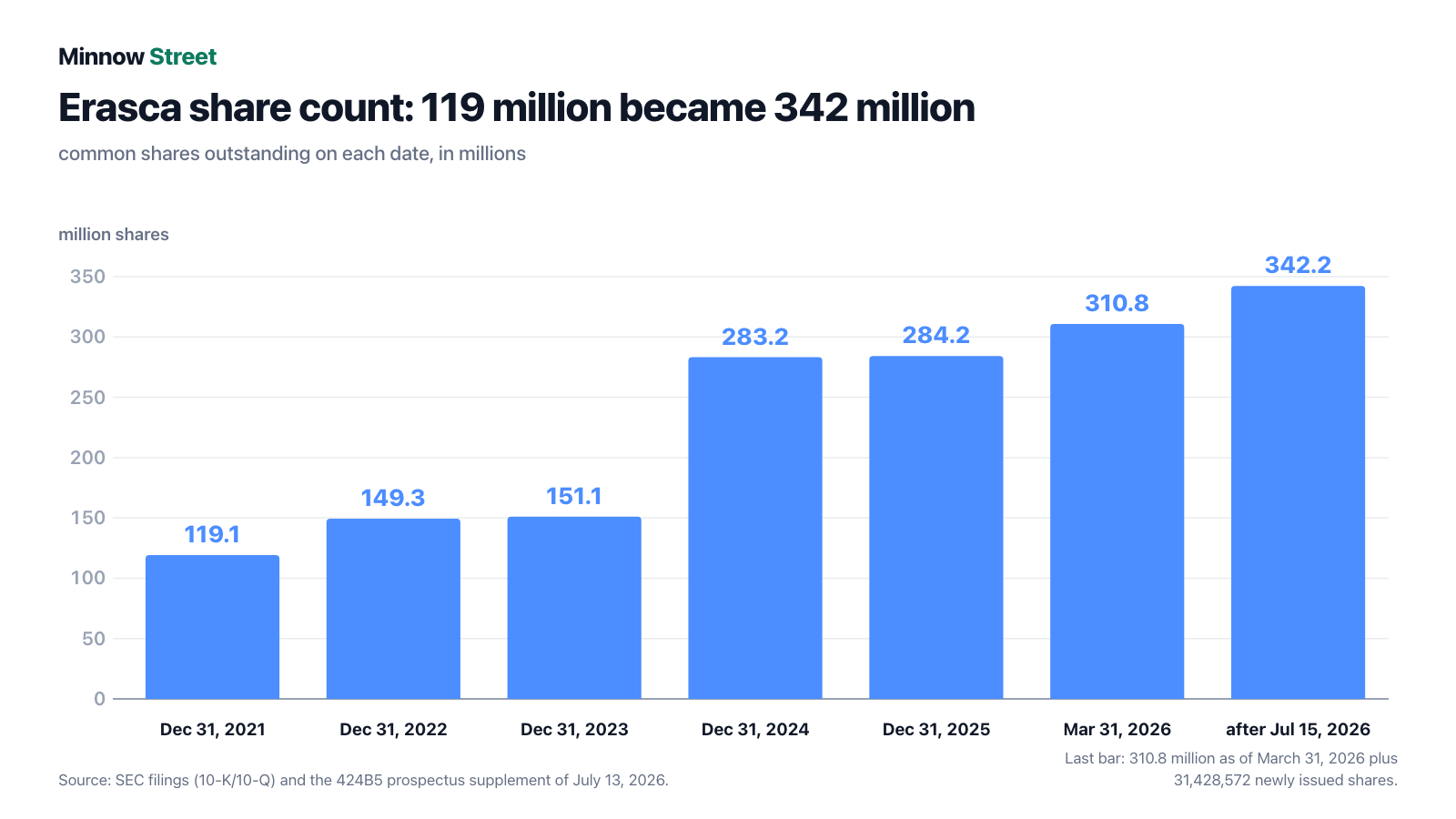
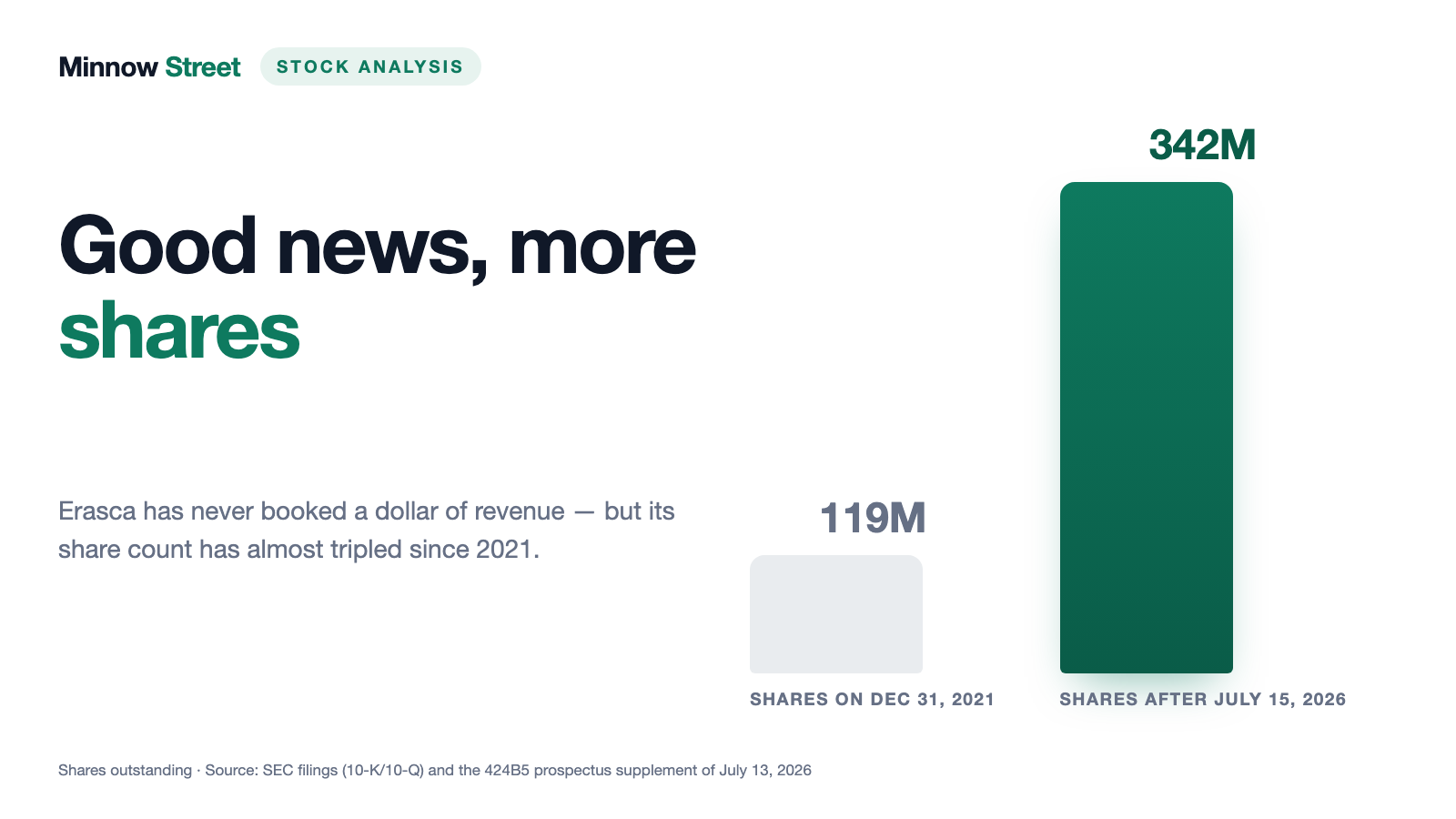
The series in plain numbers: 119.1 million shares on December 31, 2021, 149.3 million a year later, 151.1 million at the end of 2023 — then the jump to 283.2 million at the end of 2024. At the end of 2025 the count was 284.2 million, on March 31, 2026 already 310.8 million, and after the July offering roughly 342.2 million. Fundamental data as of July 25, 2026 shows 347.1 million, consistent with full exercise of the 4,714,285-share underwriters option.
The real sting, though, is not the count but the price. Look at the levels at which Erasca issued those shares:
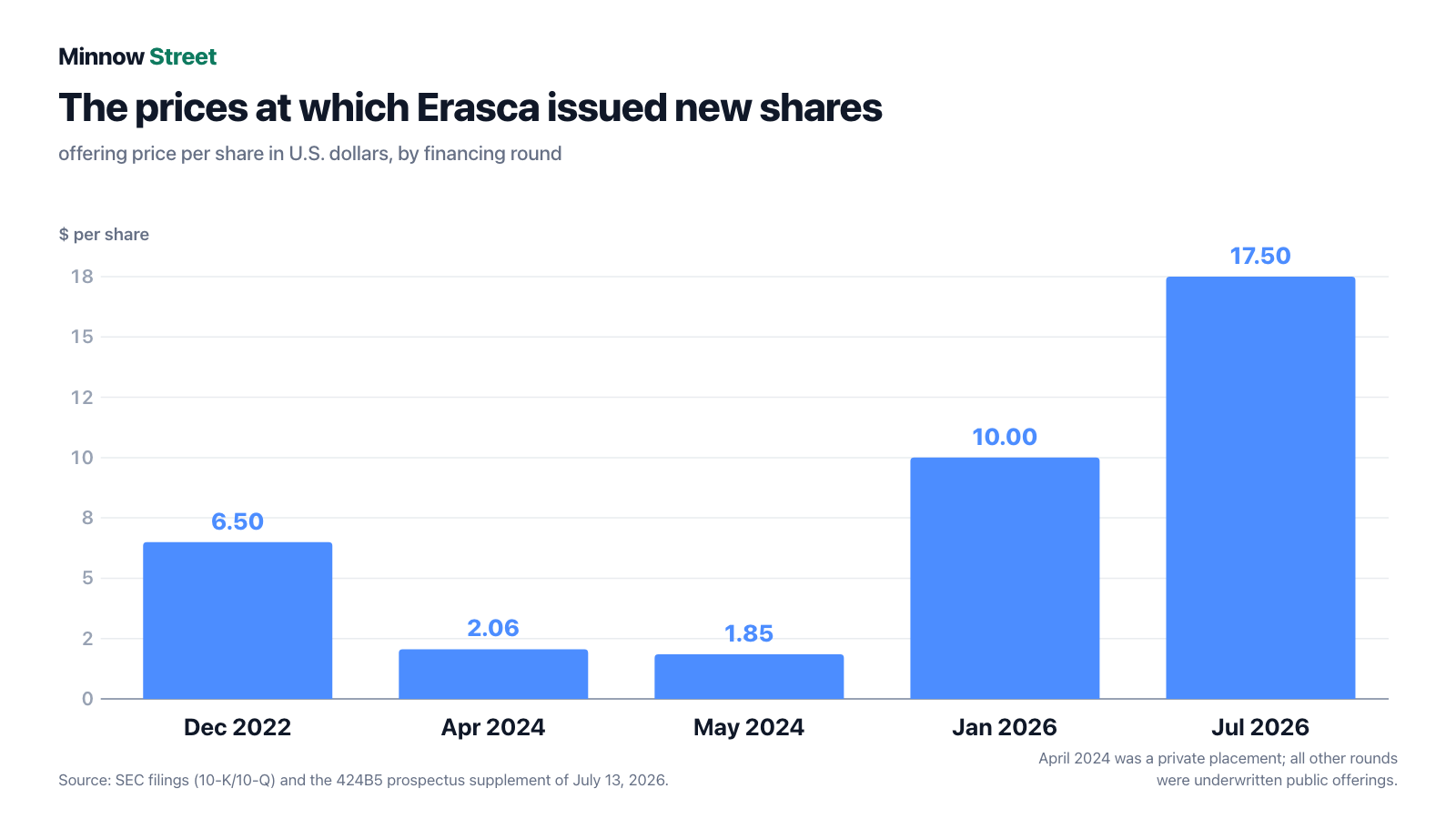
In December 2022 Erasca placed 15,384,616 shares at $6.50 for net proceeds of $94.9 million. April 2024 brought a private placement of 21,844,660 shares at $2.06 (net $43.6 million), and May 2024 the big one: 99,459,458 shares at $1.85, net $174.4 million. Anyone who bought in at $6.50 in 2022 watched the company issue two-thirds more shares at a fraction of that entry price eighteen months later. January 2026 added 25,875,000 shares at $10.00 (net $242.7 million), and July 2026 the 31,428,572 shares at $17.50.
And it is not over: as of March 31, 2026 another 78,234,040 shares were reserved for options, awards and the employee purchase plan — about a quarter of the count then outstanding. Total authorized capital is 800 million shares. The cake can be sliced a good deal thinner.
Uncomfortable truth No. 3: a demand letter aims at the one molecule
On April 27, 2026 Erasca reported its first Phase 1 data. The same day it filed a second Form 8-K about a letter it had received three days earlier.
"On April 24, 2026, we received a letter from legal counsel for Revolution Medicines, Inc. (RevMed). In the letter, RevMed alleged that (1) ERAS-0015 is "substantially equivalent" to certain compositions claimed in RevMed's U.S. Patent No. 12,409,225 (the '225 Patent) and that ERAS-0015 infringes the '225 Patent under the doctrine of equivalents (…). RevMed demanded that, among other things, we immediately cease all making, using, offering for sale, selling, and importation of ERAS-0015 in the United States for any purpose not protected by the Hatch-Waxman safe harbor (…)."
— Erasca, Inc., SEC Form 10-Q for the quarter ended March 31, 2026, Part II Item 1A
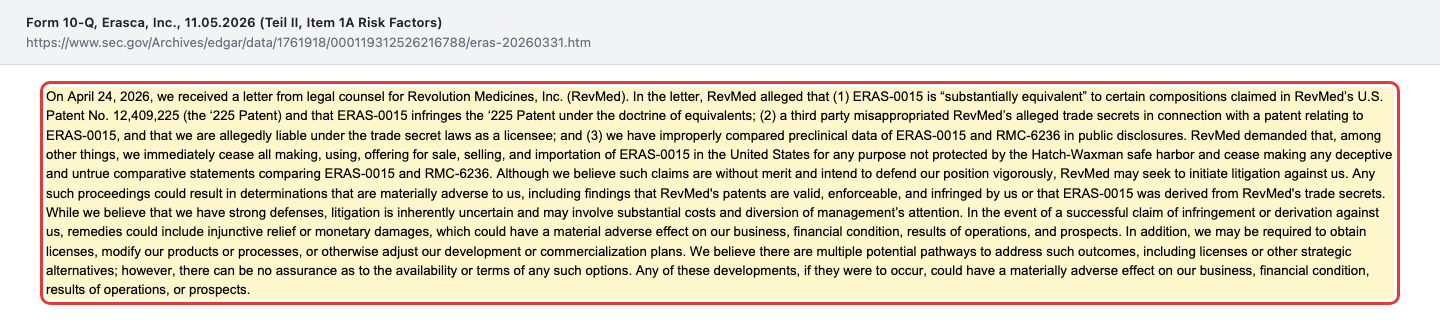
The third allegation is the spiciest: Revolution Medicines accuses Erasca of improperly comparing preclinical data for ERAS-0015 and its own compound RMC-6236 in public disclosures. And indeed — in the April 27, 2026 data release RMC-6236 appears in the footnotes as a "comparator" against which Erasca claimed a response rate 24 percentage points higher. In the updated release of July 13, 2026 that comparison is gone.
Why this weighs more than an ordinary patent dispute: apart from ERAS-0015, Erasca has just one other clinical compound. A court-ordered halt would not hit one product among many but the centerpiece. The company itself writes that remedies "could include injunctive relief or monetary damages" and names a license among the possible ways out. As of the quarterly report filed May 11, 2026, however, no suit was on file: "We are not currently a party to any material proceedings." This is a threat, not a case. But one worth keeping in the calendar.
Uncomfortable truth No. 4: $150 million for a piece of the map
The net loss for the first quarter of 2026 was $183.4 million — against $31.0 million a year earlier. That is a sixfold increase, and it has nothing to do with rising research costs. Research and development spending went up only from $26.0 million to $27.3 million.
The reason sits in Note 7. When Erasca licensed ERAS-0015 from Chinese licensor Joyo in 2024, the license covered the world except mainland China, Hong Kong and Macau. Those three territories came with an option that had a clock built into it: $50.0 million if Erasca paid before the first patient was dosed in a Phase 2 trial, $150.0 million if it paid after. And the triggering trial did not even have to be Erasca's own.
In March 2026 Joyo reported it had already dosed the first patient in a Phase 2 trial. Erasca exercised the option — and paid triple. One hundred million dollars of difference hung on a study another company was running.
"In March 2026, the Company sent Joyo notice that the Company was exercising its option to expand its territory under the Joyo License Agreement to include mainland China, Hong Kong, and Macau, and based upon feedback from Joyo that Joyo had dosed the first patient in a Phase 2 clinical trial, the Company made the corresponding $150.0 million payment (less applicable withholding amounts) to Joyo."
— Erasca, Inc., SEC Form 10-Q for the quarter ended March 31, 2026, Note 7
In accounting terms the payment lands as in-process research and development and hits the income statement in full and at once. It is not an asset on the balance sheet; it is a loss. That is why the quarterly loss per share jumped from $0.11 to $0.60. And obligations remain: up to $57.5 million in development and regulatory milestones, up to $125.0 million in commercial milestones, plus royalties in the low to mid single digit percentages of net sales. The second license, with Medshine, adds another $30.0 million and $130.0 million. As of March 31, 2026 not one milestone had been accrued, because none was considered probable.
Uncomfortable truth No. 5: the safety table contains a death
The July 13, 2026 release stresses that the compound is "generally well-tolerated." That is true, and it sits in the same document as the opposite. Of 72 treated patients, 72 percent developed a rash (51 percent of them mild), 32 percent diarrhea and 19 percent inflammation of the mouth. Dosing was interrupted for 13 percent and reduced for 8 percent. Not a single patient discontinued because of side effects. For a cancer drug, that is a good picture.
In the footnote to that same table sits this sentence:
"One Grade 3 TRAE of pneumonitis progressed to Grade 5 after withdrawal of supportive care per patient decision."
— Erasca, Inc., SEC Form 8-K of July 13, 2026, Item 8.01
In oncology language, Grade 5 means the patient died of that side effect. The company describes the case in full — a 66-year-old man with heavily pretreated pancreatic cancer and lung metastases, on a 24 milligram dose, the compound stopped immediately, high-dose steroids given; the patient asked for supportive care to be withdrawn. None of this was hidden; on the contrary, the disclosure is exemplary. But it belongs next to the 57 percent — because both sit in the same release, and only one of them made the headlines.
What the company is worth — and what is inside it
For a company with no revenue and no profit there is neither a price-to-earnings nor a price-to-sales ratio. You can only place two quantities side by side.
On one side the market value: roughly $6.6 billion (as of July 25, 2026, on about 347.1 million shares). As a sanity check, the last price documented in the prospectus supplement, $17.90 on July 13, 2026, multiplied by the roughly 342.2 million shares outstanding at that point gives about $6.1 billion — the same order of magnitude.
On the other side the tangible assets: net tangible book value after the offering came to roughly $909.5 million (based on the March 31, 2026 balance sheet plus net proceeds). The market therefore values Erasca at about seven times the money in the house. Everything above that is a bet on a drug that has not even applied for approval yet.
For timing: Erasca intends to start its first potentially registration-enabling trial in lung cancer in the first half of 2027, a Phase 3 pivotal trial in first-line pancreatic cancer in 2027, and a Phase 3 trial in RAS-mutant lung cancer in the second half of 2027 or the first half of 2028. Until then no revenue comes in — only money goes out.
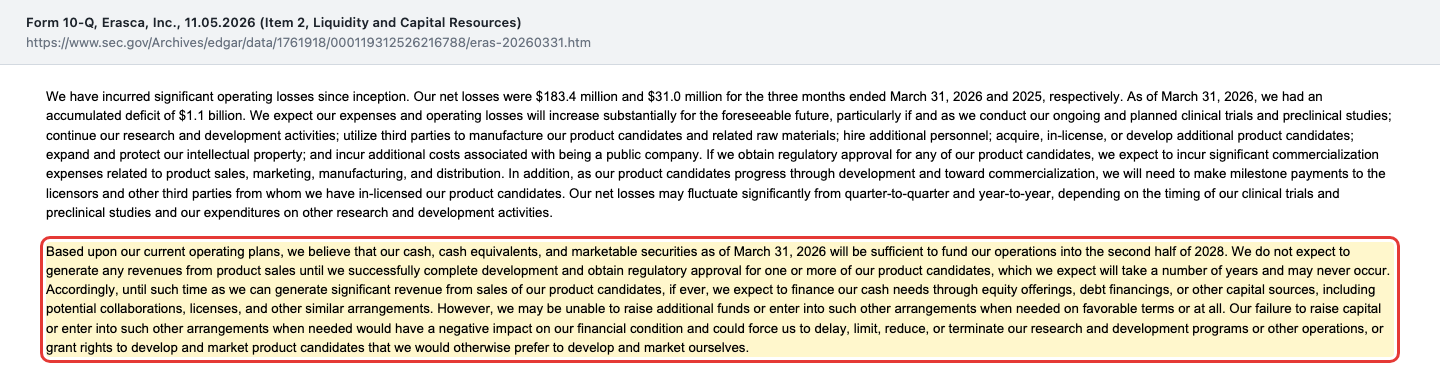
That runway statement refers to the funds held on March 31, 2026 and reads: "will be sufficient to fund our operations into the second half of 2028." The $516.0 million from the July offering is not included. At a quarterly burn of $27.4 million, the money raised stretches arithmetically well past 2028. But the burn will climb once three Phase 3 trials run at the same time — registration studies cost a multiple of dose finding. That is precisely why the money was taken now. What such a calculation looks like when everything hangs on a single readout is something we wrote up in our Abivax analysis.
Opportunities and risks at a glance
What speaks for it:
- The compound demonstrably acts: all 14 patients assessed showed at least a 75 percent drop in circulating tumor DNA, five of them a complete disappearance (release of April 27, 2026).
- Dose-finding response rates are high: 62 percent in 37 second-line lung cancer patients and 57 percent in seven pancreatic cancer patients at the recommended dose (data cutoffs April 4 and May 25, 2026).
- Tolerability is favorable for a cancer drug: no dose-limiting toxicities and not one treatment discontinuation due to side effects among 72 patients.
- The balance sheet is full and debt-free: $408.5 million as of March 31, 2026 plus roughly $516.0 million from the July offering, an equity ratio of 82.1 percent, no interest-bearing liabilities.
- The burn is disciplined: $27.4 million of operating cash outflow in the first quarter of 2026, with 2025 research and administrative spending below the prior year.
- Dropping the naporafenib program shows the company will end a project rather than throw money after it.
What speaks against it:
- Not a dollar of revenue since inception in 2018; the accumulated deficit stood at $1.1 billion on March 31, 2026, and there is no approved product.
- The share count has almost tripled from 119.1 million (December 31, 2021) to about 342.2 million (after July 15, 2026); another 78.2 million shares were reserved as of March 31, 2026.
- A competitor demanded by letter on April 24, 2026 that manufacture and sale of the lead compound in the United States stop immediately.
- Both clinical compounds are in-licensed; milestones of up to $57.5 million plus $125.0 million (Joyo) and $30.0 million plus $130.0 million (Medshine) remain outstanding.
- The data set is small: the widely quoted 57 percent comes from seven patients and counts confirmed and unconfirmed responses.
- One patient died of treatment-related pneumonitis (Grade 5) after supportive care was withdrawn at his own request.
- Roughly $6.6 billion of market value stands against about $909.5 million of tangible book value, and eight of eight analyst ratings are already positive.
A human verdict
Back to the percentage-without-the-N trap. Seven patients are seven human beings, and for each of them a response means more than any table can show. Erasca is doing something that deserves respect: it is attacking the hardest circuit in cancer medicine, disclosing its data in full — including the death — and handling its investors' money more frugally than most peers.
But a response rate is not a valuation. Between the data available today and a drug an insurer actually pays for lie three Phase 3 trials, at least two years, and an unresolved patent question aimed at precisely this one molecule. And in between sits something you should know in advance: at this company, every piece of good news becomes new shares within hours. On July 13, 2026 less than a business day separated the trial release from the underwriting agreement.
Both sit in the same documents, signed by the same executives. Whether the 57 percent or the $550 million weighs more for you depends on whether you are looking at 2028 or at the next quarter. What you make of it is your decision. And that is exactly as it should be.
Sources
- SEC Form 10-Q for the quarter ended March 31, 2026 (filed May 11, 2026) — balance sheet, income statement, cash flow, share count, licenses, at-the-market program, RevMed risk factor, runway statement
- SEC Form 10-K for 2025 (March 12, 2026) — business model, pipeline, employees, earlier offerings, risk factors, use of AI
- SEC Form 8-K of July 14, 2026 — underwriting agreement, offering price, option to purchase additional shares, net proceeds
- SEC prospectus supplement 424B5 of July 13, 2026 — business description, dilution table, last reported sale price, use of proceeds
- SEC Form 8-K of July 13, 2026 — updated Phase 1 data, safety table, development plans through 2028
- SEC Form 8-K of April 27, 2026 — first Phase 1 data, response rates, biomarker results, trial design
- SEC Form 8-K of April 27, 2026 (Items 7.01/8.01) — wording of the Revolution Medicines demand letter
- SEC EDGAR filing index, CIK 0001761918 — recency gate: shelf registration S-3ASR of July 13, 2026, Schedule 13G filings and insider reports after May 11, 2026
- Fundamental data and our in-house stock scanner, as of July 25, 2026 — Moglen weekly ranking, relative strength rating, dollar volume, Piotroski, Altman Z, market value, analyst coverage
Journalistic analysis, not investment advice and not a solicitation to buy or sell securities. Stocks can lose their entire value; a total loss is possible. All figures come from the primary documents linked above and carry the as-of date stated there. The author holds no position in Erasca, Inc. at the time of publication.
Our Bottom Line at a Glance
- Compound & trial data positive
- Dose finding produced objective signals: all 14 patients assessed showed at least a 75 percent drop in circulating tumor DNA, five of them a complete disappearance (release of April 27, 2026). Response rates ran at 62 percent in 37 second-line lung cancer patients and 57 percent in seven pancreatic cancer patients at the recommended dose (data cutoffs April 4 and May 25, 2026).
- Balance sheet & cash positive
- As of March 31, 2026 the company held $408.5 million in cash and marketable securities without a single interest-bearing liability; the equity ratio was 82.1 percent. The July 2026 offering added roughly $516.0 million. Operating cash outflow in the first quarter of 2026 was just $27.4 million.
- Earning power negative
- Not a dollar of revenue has been booked since inception in 2018, and the accumulated deficit stood at $1.1 billion on March 31, 2026. The first potentially registration-enabling trial is not due to start until the first half of 2027, with Phase 3 trials in 2027 and 2028 — product revenue is not realistic before the end of the decade.
- Dilution negative
- Shares outstanding rose from 119.1 million (December 31, 2021) through 310.8 million (March 31, 2026) to about 342.2 million after the offering priced on July 13, 2026. As of March 31, 2026 another 78.2 million shares were reserved and a $200.0 million at-the-market program sat untouched — against 800 million authorized shares.
- Legal position on the lead compound negative
- On April 24, 2026 Revolution Medicines demanded by letter an immediate halt to the manufacture, use and sale of ERAS-0015 in the United States, relying on U.S. Patent No. 12,409,225 and on trade secrets it claims were misappropriated. Erasca considers the allegations meritless; no lawsuit was pending as of May 11, 2026.
- Valuation neutral
- Roughly $6.6 billion of market value ($19.11 on July 24, 2026) stands against net tangible book value of about $909.5 million after the offering — seven times over. Price-to-earnings and price-to-sales ratios do not exist in the absence of profit and revenue. Eight of eight analyst ratings were positive as of July 25, 2026, with a mean target price of $22.80.
Erasca develops cancer drugs meant to shut down the RAS/MAPK pathway and has raised about $1.3 billion since 2018 to do it — without ever booking a dollar of revenue. Phase 1 data for the lead compound ERAS-0015 look promising: a 62 percent response rate in 37 second-line lung cancer patients and 57 percent in seven pancreatic cancer patients at the recommended dose. On the day of the most recent data release, July 13, 2026, the company signed an agreement for 31,428,572 new shares at $17.50 — $550.0 million gross. The share count has almost tripled since the end of 2021. Add a demand letter from Revolution Medicines aimed at that very compound, a one-time $150.0 million payment to licensor Joyo and a quarterly net loss of $183.4 million. Not investment advice.
What Our Rating Means
Open questions
The business works in principle, but one material question is open. As long as it stays open, our findings do not carry a quality verdict.
For a research-stage company the balance sheet is unusually solid: $408.5 million in cash and marketable securities on March 31, 2026, not a single interest-bearing liability, an equity ratio of 82.1 percent — and roughly $516.0 million on top from the July 2026 offering. Even before that raise management expected the funds to last into the second half of 2028, no report carries a going-concern warning, and with operating cash outflow running at $27.4 million a quarter the substance of the company is not in question. What is missing is proof that any of it turns into a business: not a dollar of revenue since inception in 2018, an accumulated deficit of $1.1 billion, and everything riding on a single compound whose first potentially registration-enabling trial is not due to start before the first half of 2027. The Phase 1 numbers — 62 percent response in 37 lung cancer patients, 57 percent in seven pancreatic cancer patients — are a signal, not proof, and the demand letter from Revolution Medicines dated April 24, 2026 leaves the legal position on that very compound open, with no lawsuit pending so far. The share count rising from 119.1 million at the end of 2021 to about 342.2 million is the price of funding research without revenue. A full treasury, but the core question of the business is still open — hence yellow. The decision is yours.
A journalistic assessment by our editorial team at the time of the deep dive, based on public sources — not investment advice and not a solicitation to buy or sell. Your personal circumstances (investment goals, risk capacity, taxes) cannot be taken into account. What our levels mean, how verdicts are formed, and what conflicts of interest exist →
Worth Noting
- ERAS reached our research list as rank 2 of 28 U.S. hits in our in-house Moglen weekly ranking (as of July 25, 2026, relative strength rating 99) — part of the series filling the top 50 of that ranking with analyses. Scanner lists are recalculated daily.
- What the scanner measures: at least 15 percent price gain over four trading days, at least 10 million dollars of average daily turnover and a relative strength rating of 70 or higher. Those are pure price criteria and say nothing about the quality of the business.
- Ratio trap: the Piotroski F-Score and the Altman Z-Score carry little meaning for a company with no revenue and no debt — the first is pushed down (3 of 9) because four of its criteria require profit or a profit margin, the second distorted upward (52.6) because there are no liabilities to weigh against.
- Recency note: the latest quarterly report (10-Q) is dated May 11, 2026. Everything filed afterwards has been reviewed — the Form 8-K of July 1, 2026 (Item 5.07, annual meeting), the shelf registration S-3ASR of July 13, 2026, the 424B5 prospectus supplements of July 13 and 14, 2026 and the Forms 8-K of July 13 and 14, 2026. The $550.0 million offering changes the picture and is reflected throughout this analysis. There is no takeover, no merger and no delisting.
- Number trap: the widely quoted response rates are "uORR" — they count confirmed and unconfirmed responses together. An unconfirmed response can vanish at the next assessment. The company itself notes that preliminary results may change materially as more patients enroll and follow-up lengthens.
Frequently Asked Questions
Erasca develops cancer drugs designed to switch off the RAS/MAPK pathway — the circuit inside a cell that is stuck on "divide" in many tumors. Two compounds are in clinical testing, the pan-RAS molecular glue ERAS-0015 and the pan-KRAS inhibitor ERAS-4001, alongside the discovery-stage antibody program ERAS-12. There is no approved product.
Neither. The quarterly report for the period ended March 31, 2026 states: "We do not have any products approved for sale and have not generated any revenue." The net loss for the first quarter of 2026 was $183.4 million and the full-year 2025 loss was $124.5 million. Since inception in 2018 the accumulated deficit has reached about $1.1 billion.
Because the ranking measures price movement: at least 15 percent gain over four trading days, at least 10 million dollars of average daily turnover and a relative strength rating of 70 or higher. As of July 25, 2026 Erasca showed a rating of 99 and roughly 103 million dollars of average dollar volume — rank 2 of 28 U.S. hits. The scanner says nothing about company quality.
The company states in its quarterly report that the $408.5 million held on March 31, 2026 should fund operations into the second half of 2028 under its current operating plan. That figure excludes the roughly $516.0 million from the July 2026 offering. Operating cash outflow in the first quarter of 2026 was $27.4 million.
On July 13, 2026 Erasca issued 31,428,572 new shares at $17.50, raising $550.0 million gross. Shares outstanding rose from 310,806,888 to about 342.2 million, so every existing holder now owns roughly nine percent less of the company. In exchange, net tangible book value per share rose from $1.27 to $2.66.
On April 24, 2026 Revolution Medicines demanded by letter that Erasca immediately stop making and selling ERAS-0015 in the United States. The allegations: the compound infringes U.S. Patent No. 12,409,225 under the doctrine of equivalents, a third party misappropriated trade secrets, and Erasca made improper comparative statements. Erasca considers the claims meritless; no lawsuit was on file as of May 11, 2026.
It rests on seven pancreatic cancer patients at the recommended dose of 32 milligrams, with a data cutoff of May 25, 2026, and it counts confirmed as well as unconfirmed responses. The lung cancer base was broader: 62 percent in 37 patients, data cutoff April 4, 2026. Preliminary Phase 1 results can shift materially as more patients enroll and follow-up lengthens.
No, both clinical compounds are licensed: ERAS-0015 from Guangzhou Joyo Pharmatech and ERAS-4001 from Medshine Discovery, both since May 2024. To extend the Joyo territory to China, Hong Kong and Macau Erasca paid a one-time $150.0 million in March 2026. Further milestones of up to $57.5 million and $125.0 million remain outstanding, plus royalties on future sales.
Found an error?
Did you spot a factual error, an outdated number, or a typo in this deep dive? Let us know briefly — your report goes straight to the editorial team.