ProPetro Stock: Seven Years of a Full Cycle, Nothing Earned — and Now a $1.1 Billion Bet on Data Center Power
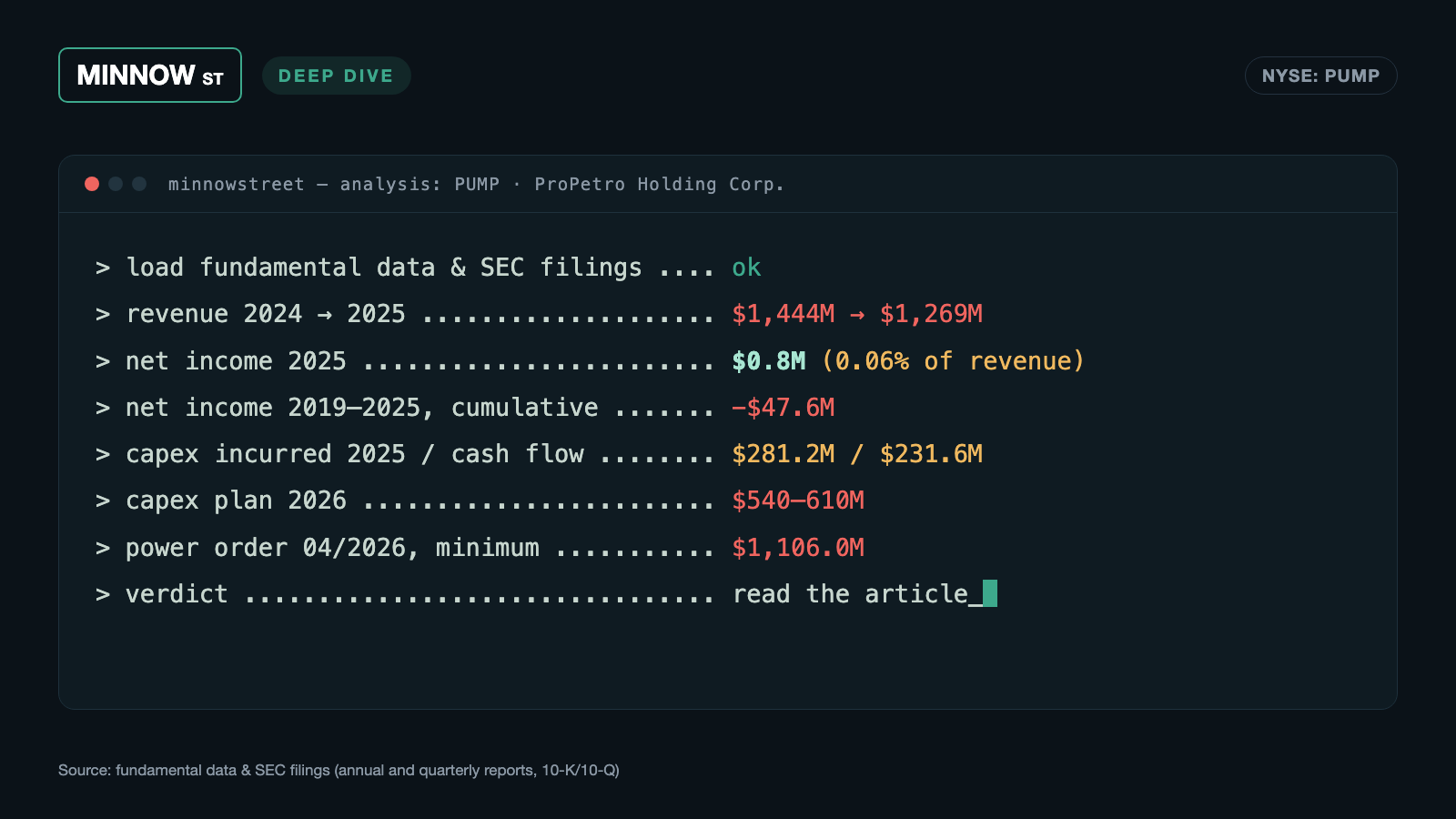
ProPetro pumps the wells of the biggest Permian producers — ExxonMobil, Occidental, EOG. The chart is in an uptrend, the CEO is buying, institutions hold 95 percent, and the balance sheet is genuinely sound. We added up the annual reports anyway: from 2019 through 2025 — a full cycle, peak to trough — the company's net results total minus $47.6 million, revenue fell 12 percent in 2025 and almost a quarter in the first quarter of 2026, and in 2025 the equipment cost more than the business brought in. The answer to that is a $1,106.0 million minimum order for power generators. Not investment advice — just the arithmetic of a company that never stops running, and rarely arrives.
 Thomas Mücke
Founder & Publisher
Thomas Mücke
Founder & Publisher
Chart
Interactive price chart (TradingView).
Note: pure fact-based analysis, not investment advice and not a solicitation to buy or sell. All figures without guarantee.
Watch someone on a treadmill and you will read effort as progress. The belt hums, the shirt soaks through, the numbers on the display climb — everything your eye associates with getting somewhere. Only the position never changes. Investors do the same thing with companies, and psychologists have a name for the reflex: we mistake activity for achievement. A business that is visibly busy — new equipment, new fleets, a new division, gigawatts on order, a chart pointing up — feels like a business that is getting ahead. Hardly any stock invites that reflex in the summer of 2026 like ProPetro Holding Corp. (NYSE: PUMP): the Permian Basin fracking specialist works about as hard as a company can work, and our own scanner lights it up in 13 filters, every single one of them a strength list (data as of July 8, 2026). Reddit has barely noticed — our Reddit hype scanner counted 3 mentions in 24 hours (ApeWisdom, as of July 16, 2026). So let’s make a deal: we ignore the display and check the position. Our instruments are the annual report (10-K) for 2025, the quarterly report (10-Q) as of March 31, 2026, and the company’s own machine-readable numbers back to 2019 — all filed with the U.S. securities regulator, the SEC, where a filing is honest under penalty of law. Then we do something almost nobody does with a cyclical company: we add up a whole cycle. At the end you get the findings, not a verdict on your behalf.
What ProPetro actually does — the pit crew of the oil patch
ProPetro does not own oil. That distinction is the whole business model. The company, headquartered in Midland, Texas, with about 1,700 employees, is a service contractor: the big producers — the E&P companies — own the acreage and the wells, and ProPetro brings the machinery that makes a well actually produce. The main act is hydraulic fracturing, "fracking": a fleet of high-pressure pumps forces water, sand and chemicals down a wellbore hard enough to crack the rock, so oil and gas can flow out. Picture a Formula 1 pit crew — the team does not own the car and never wins the race itself; it gets paid for doing one violent, highly specialized job faster and more reliably than the next crew. ProPetro is paid per job, priced after the customer specifies the well: lateral length, number of frac stages, tons of sand. Around that core sit two more trades: wireline (lowering instruments and perforating charges into the well on a cable) and cementing (sealing the steel casing against the rock). In 2025 those three lines produced 73.2 percent, 16.5 percent and 10.3 percent of revenue. Every bit of it happens in one place — the Permian Basin of West Texas and New Mexico, the most prolific oil region in the United States. And there is a fourth line, new since December 2024, which is where this story is heading: PROPWR, mobile natural-gas power generation, sold to oil producers and — the phrase the market cares about — to "general industrial projects and data centers". Its share of 2025 revenue was 0 percent. That is not a typo; it is the company’s own segment disclosure. Which brings us to the central tension of this analysis, and it runs through every chapter: ProPetro is superbly run at the level of the job and structurally unrewarding at the level of the cycle — the machines get better, the customers get bigger, the balance sheet stays clean, and at the end of seven years there is nothing left over. How a Permian service business with a fat new contract book can still disappoint is something we took apart at Target Hospitality; what the oil price does to the people on the other side of ProPetro’s invoices, we read at W&T Offshore.
Where the stock shows up in our scanner — 13 hits, and not one of them a warning
Every day we run about 3,500 stocks through our scanners. ProPetro has a row in our database — its company profile sits in the stocks section — and as of the July 8, 2026 data cut-off the stock lit up in 13 filters. What is remarkable is which ones: strength lists, all of them. Stan Weinstein Stage 2 — the advancing stage in a framework that sorts every chart into four phases. RS-Leader with a relative-strength rating of 91, meaning the stock outran 91 percent of the market over twelve months. Institutional accumulation — 14 funds building positions against 3 reducing. CEO buying, and the combined institutions and CEO buying list. Plus dual momentum and professionals at 80 percent. The price data behind it: up about 128 percent over twelve months, plus 54 percent year to date, roughly 228 percent above its 52-week low, about 95 percent institutional ownership. Now the same company’s fundamental sheet, from the same scanner run: a fundamental grade of C, an overall fundamental rating of minus 8, an EPS rating of 14 out of 99 — the bottom seventh of the market for earnings quality — a Piotroski F-Score of 4 of 9 (a nine-point test of balance-sheet health; thoroughly sound companies score 8 or 9), interest coverage of minus 0.33 on trailing twelve-month figures, and quarterly revenue down 24.7 percent year over year. One thing genuinely stands out on the good side, and we will come back to it: the Altman Z-score of 6.29. That is the classic bankruptcy thermometer — below 1.8 is the danger zone — and 6.29 is not merely safe, it is robust. This is not a contradiction in the scanners; it is their most honest output. The momentum filters measure what the stock is doing. The fundamental filters measure what the business is doing. Right now those two are describing different companies — and the whole question of this analysis is which one you are actually buying (all scanner data as of July 8, 2026).
The numbers over the years — honestly appraised
Start with what genuinely impresses, because there is real quality here. ProPetro survived. The balance sheet at the end of 2025 is the kind of thing you rarely see in this industry: $122.6 million of total debt against $829.8 million of stockholders’ equity and $91.3 million of cash — net debt of roughly $31 million, on a company doing $1.27 billion of revenue. By the first quarter of 2026 there were no borrowings at all under the revolving credit facility, $156.6 million of cash and total liquidity of $289.3 million. That is why the Altman Z reads 6.29. Management also does the unglamorous thing correctly: as the market softened through 2025 the company idled fleets rather than working for nothing — the active fracturing fleet count fell from 15 at the start of the year to 11 at the end, explicitly, in the company’s words, "to preserve them for more favorable market conditions, rather than run them at sub-economic levels". Plenty of competitors chase utilization off a cliff instead. And the fleet itself has been genuinely modernized: of 1,259,500 hydraulic horsepower at year-end 2025, 445,000 is Tier IV dual-fuel and 312,000 is FORCE electric — 60 percent of the fleet is now lower-emissions equipment the customers actually ask for.
Now the position, not the display. Revenue fell 12.1 percent to $1,269.2 million in 2025 (2024: $1,444.3 million; 2023: $1,630.4 million). Adjusted EBITDA fell 26.4 percent to $208.4 million. Net income was $0.8 million — on $1,269.2 million of revenue, that is 0.06 percent: six cents of profit per hundred dollars of work. And the first quarter of 2026 got worse, not better: revenue down 24.7 percent to $270.7 million, the fracturing segment alone down 33.4 percent to $179.3 million on "decreased customer activity, reduced customer pricing, idling of fleets", adjusted EBITDA halved to $36.4 million, and a net loss of $3.6 million after a $9.6 million profit a year earlier. The average WTI oil price tells you why: about $65 a barrel in 2025, after $76 in 2024 and $78 in 2023 — and the company writes that these trends "are expected to continue in 2026".
But the single most useful thing you can do with a cyclical company is the thing almost nobody does: stop looking at one year and add up the whole cycle. The argument for owning a cyclical is that the good years pay for the bad ones. So we pulled ProPetro’s reported annual net result for every year from 2019 through 2025 straight from the company’s machine-readable filings — the 2019 peak, the 2020 collapse, the 2021 hangover, the 2022 recovery, the strong 2023, the 2024 write-down year, the flat 2025 — and added them together. Seven years. One complete cycle, top to bottom and back. The sum is minus $47.6 million.
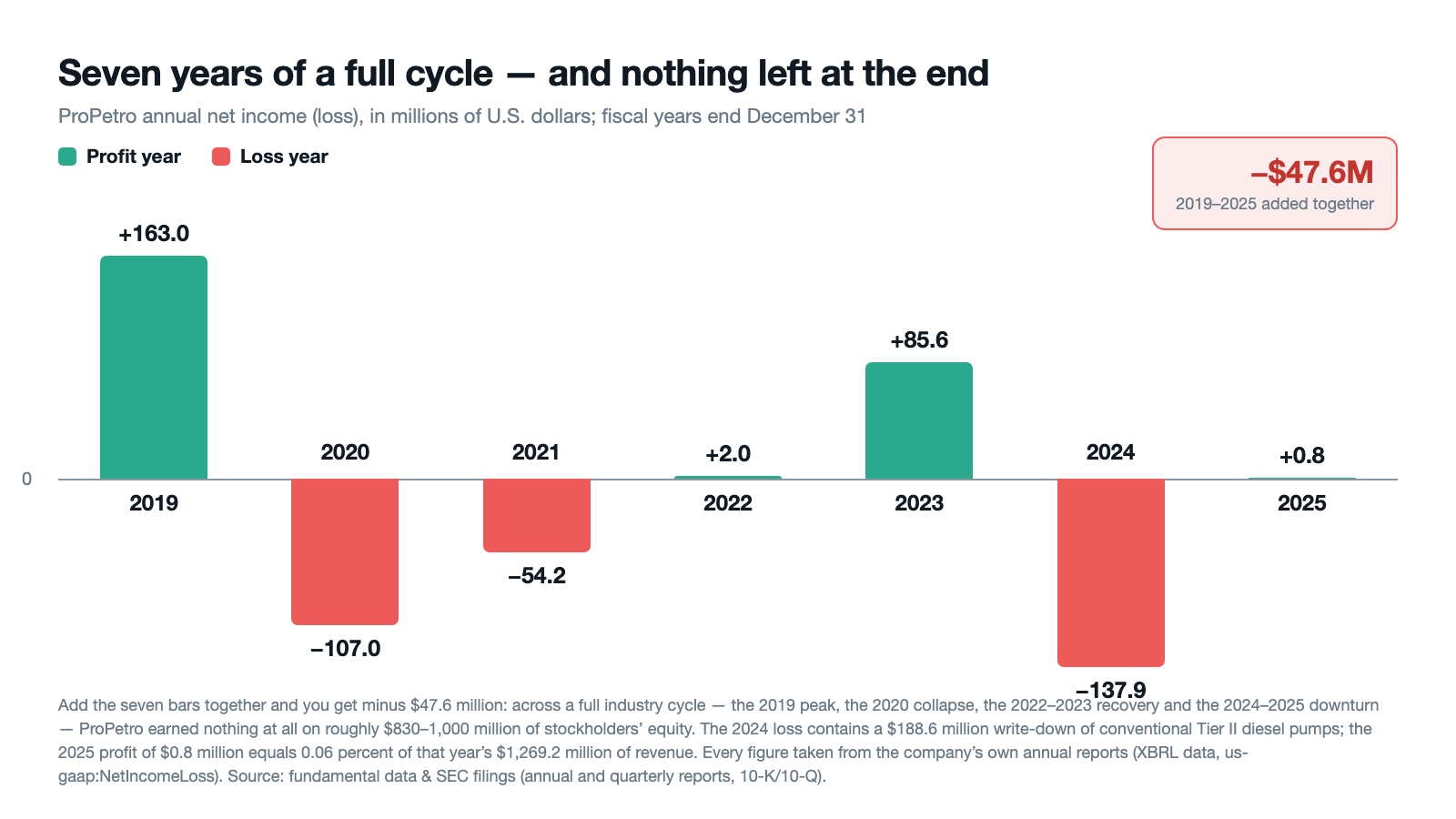
Remember the yardstick, because it is the one that matters for every cyclical business you will ever look at: a cyclical company does not earn its keep in a good quarter — it earns it across a whole cycle, or it does not earn it at all. Roughly $830 million to $1 billion of shareholders’ equity was tied up in this company through those seven years. Any owner of that equity could reasonably have asked for something in the high single digits per year just for the risk. What arrived was less than zero. That is not an accusation of mismanagement — ProPetro is, by the operational evidence, a competent operator in a brutal industry. It is a statement about the industry.
What the filings say — the uncomfortable truths
Uncomfortable truth no. 1: the treadmill is real — in 2025 the equipment cost more than the business brought in
Now we can name the mechanism behind the seven-year zero. This is a business that must keep buying machinery simply to stay in the same place, and the annual report states the requirement without flinching:
"The energy service industry is capital intensive. In conducting our business and operations, we have made, and expect to continue to make, substantial capital expenditures, including capital expenditures to maintain our fleet and costs related to purchase options under certain leases. Our total capital expenditures incurred were approximately $281.2 million, $133.4 million and $310.0 million during the years ended December 31, 2025, 2024, and 2023."
— ProPetro Holding Corp., SEC annual report 10-K 2025, Item 1A "Risk Factors"

Hold that $281.2 million next to what the business actually generated in the same year: operating cash flow of $231.6 million. The company spent 121 percent of its operating cash flow on equipment. In 2023 the ratio was 83 percent, in 2024 it was 53 percent — 2025 is the year the line was crossed. In an everyday image: the shop took in $231.60 over the counter and the machines in the back demanded $281.20 to keep running. The difference has to come from somewhere, and the filings show exactly where — a January 2026 stock sale of 17.25 million shares at $10.00 (about $163.4 million net), a Caterpillar equipment loan, an $81.1 million slice of the 2025 spending financed straight through the vendor. And the plan for 2026 does not moderate; it accelerates: management guides to $540–610 million of capital expenditures, of which $400–450 million for PROPWR. Against the 2025 operating cash flow, that is roughly two and a half times what the business produces.
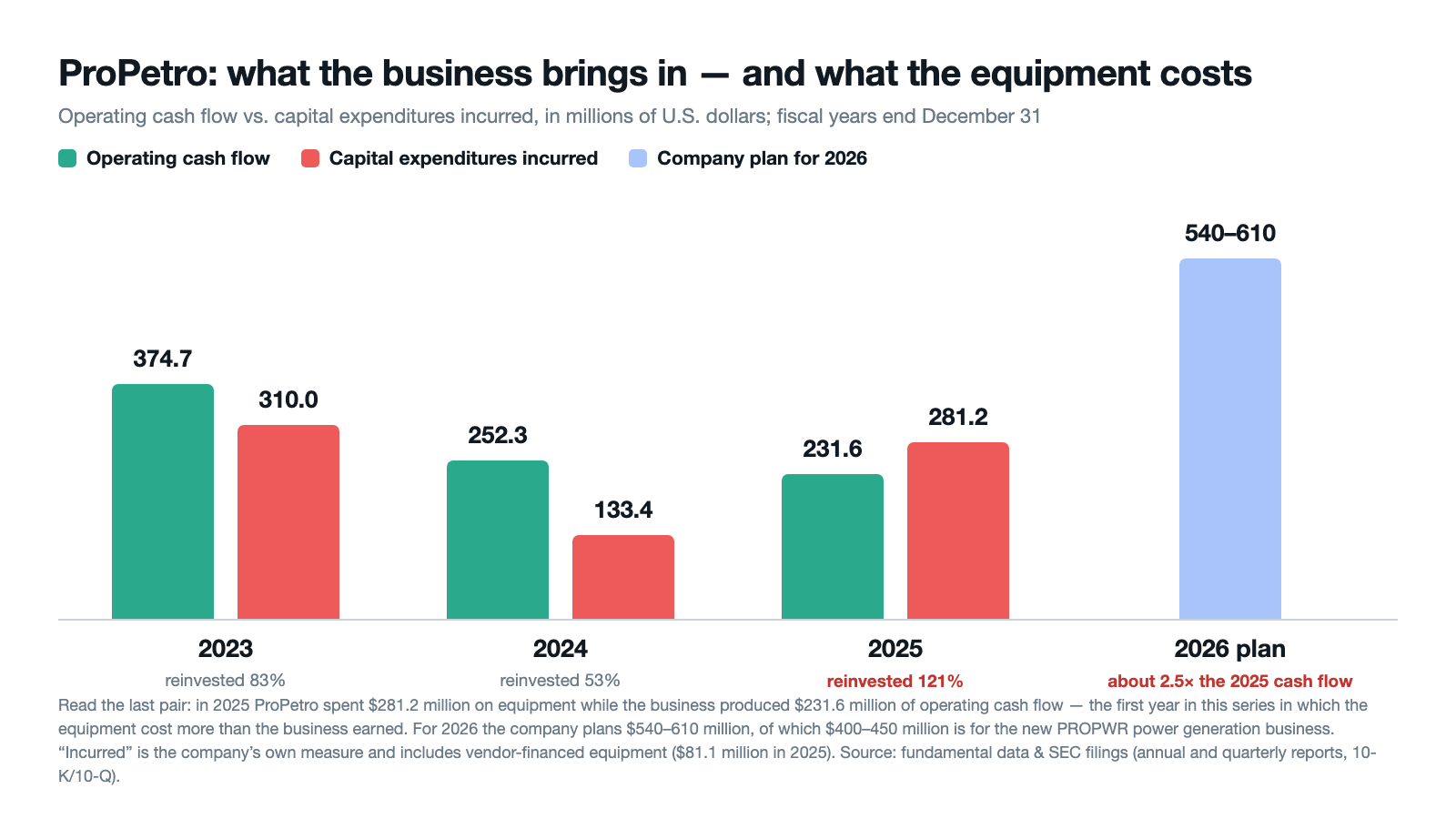
One honest note on the number itself, because it is the kind of detail that separates a read from a glance: "capital expenditures incurred" is the company’s own measure and includes equipment ordered but not yet paid for. The cash actually paid out in 2025 was $186.3 million — which is the figure most data feeds will show you. Both are true; the incurred number is the honest one for a company whose vendors are financing the shopping. Remember the mechanism: on a treadmill, stopping is not an option — the moment you stop buying pumps, the customer hires the crew that did.
Uncomfortable truth no. 2: four customers are two thirds of the business — and the biggest one has already given notice on two fleets
The pit-crew model has a structural weakness: there are very few teams, and even fewer car owners. ProPetro’s top five customers accounted for approximately 68.2 percent of revenue in 2025 (2024: 58.8 percent; 2023: 63.2 percent) — the concentration is not just high, it is rising. The top ten make up 84.5 percent. Four names carry the company: ExxonMobil at 24.9 percent, Occidental Petroleum at 13.7, EOG Resources at 12.1 and Permian Resources at 11.2 percent. ExxonMobil alone paid ProPetro about $315.9 million in 2025. Picture a workshop where every fourth dollar comes from a single client — one who is, by some margin, the largest and best-capitalized company you deal with, and who knows it. That asymmetry sets your prices. And then the annual report says this, in the plainest language a filing ever manages:
"Two of our fleets that currently perform services for ExxonMobil’s subsidiary XTO are governed by an agreement that will expire in approximately late 2026. At this time, we do not expect such agreement to be renewed or extended and, if we are not able to procure additional work from XTO, we will be required to redeploy the equipment associated with the affected fleets with other customers, exposing us to the risks described below associated with a delay or inability to redeploy our equipment."
— ProPetro Holding Corp., SEC annual report 10-K 2025, Item 1A "Risk Factors"

Read that again, because companies almost never write this about their biggest customer. This is not an analyst’s worry; it is ProPetro stating that it does not expect a contract covering two of its eleven active fleets to be renewed, in the relationship that supplies a quarter of its revenue. Two of eleven is roughly 18 percent of the working fleet looking for a new home in a market where — per the same filings — customers are cutting activity and pushing prices down. And there is a slow grind underneath: this concentration is partly a product of consolidation among the customers themselves. ExxonMobil swallowed Pioneer in May 2024; two of ProPetro’s clients became one, with one procurement department and one negotiating position. Remember the image: when your customers merge, you do not gain a bigger customer — you lose a bidder.
Uncomfortable truth no. 3: the equipment does not wear out — it goes out of fashion, and $188.6 million vanished proving it
Here is the part of the frac business that makes the arithmetic so unforgiving. In most industries, machinery is used up slowly and depreciated on a predictable schedule. In this one, the customer can decide your machinery is obsolete while it is still perfectly capable of pumping. That is exactly what happened to ProPetro’s conventional diesel pumps, and the annual report explains it in the same breath as the technology risk:
"In fiscal year 2024, we recorded a property and equipment impairment charge of $188.6 million on our conventional Tier II diesel-only hydraulic fracturing pumps and associated conventional assets (“Tier II Units”) because we determined that the marketability of our Tier II Units had declined due to decreasing customer demand for and related pricing pressures on such equipment, among other factors."
— ProPetro Holding Corp., SEC annual report 10-K 2025, Item 1A "Risk Factors"

The footnote makes it starker than the headline number. At the measurement date, those Tier II units carried a book value of about $252.4 million; their estimated fair value was $63.8 million. Three quarters of the value gone — and the appraisal leaned on "research gathered from third party auctioneers" and the "declining desirability for conventional diesel equipment". Add the $23.6 million of goodwill written off in the wireline segment the same year, and 2024’s $137.9 million loss is essentially the sound of yesterday’s capital expenditure hitting the floor. This is the treadmill’s cruelest feature: ProPetro spent $310.0 million on equipment in 2023 and wrote off $188.6 million of equipment in 2024. Not because it bought badly — the industry moved. Customers went to lower-emission fleets, so the company is now converting: 445,000 horsepower of Tier IV dual-fuel, 312,000 of FORCE electric, and 502,500 horsepower still conventional Tier II, with useful lives already shortened to end-2027. That remaining Tier II block is the next candidate for the same treatment, and the 10-K says so in as many words — if prices stay depressed and the equipment stays idle, "additional impairment expense in the future" follows. Note also what the FORCE fleets are: leased, on three-year terms, with buyout options that would themselves cost $40–50 million in 2026. The modernization is real. It is also never finished.
Uncomfortable truth no. 4: the answer to a shrinking business is a $1.1 billion order — for a segment that billed $2.2 million
So what does a company do when its core market is contracting, its biggest customer is stepping back and its machines keep depreciating into fashion? ProPetro’s answer is the boldest thing in these filings, and you should understand its size before you decide what you think of it. PROPWR, founded in December 2024, sells mobile natural-gas power generation — to oil producers, industrial sites and, above all in the market’s imagination, data centers. It is the story that re-rated this stock. Here is the arithmetic of that story, from the quarterly report:
"On April 28, 2026, ProPetro Energy Solutions, LLC, a Delaware limited liability company and wholly owned subsidiary of the Company ("PROPWR"), entered into a strategic framework agreement with Caterpillar Inc., a Delaware corporation ("Caterpillar"), under which PROPWR agreed to purchase approximately 1.5 gigawatts of incremental power generation assets, subject to certain termination rights of PROPWR and Caterpillar. Under the framework agreement, we have a minimum purchase obligation at signing of approximately $1,106.0 million subject to adjustments including annual escalations, taxes and tariffs, not inclusive of balance of plant, as well as the option to acquire up to an additional approximate 600 megawatts over a period of five years ending December 31, 2031."
— ProPetro Holding Corp., SEC quarterly report 10-Q as of March 31, 2026, Notes "Commitments and Contingencies"

Put the numbers side by side and take a breath. The minimum purchase obligation is about $1,106.0 million. The company’s entire market value in mid-July 2026 was roughly $1.65 billion; its whole equity base is $829.8 million; its operating cash flow last year was $231.6 million. In the first quarter of 2026, the power generation segment produced revenue of $2.2 million — and consumed $71.5 million of the quarter’s $85.0 million of capital expenditures. That is 84 percent of all equipment spending going into a business line contributing under one percent of sales. And of the 550 megawatts already delivered or on order, only 240 megawatts were contractually committed as of March 31, 2026 — for roughly 56 percent of that iron, the customer is still a plan.
To be fair, and it matters: this is not lunacy, and the pieces are being handled carefully. The demand for behind-the-meter power in Texas is real; ProPetro genuinely knows how to move heavy mobile equipment around the Permian and keep it running, which is most of what this business is; the framework agreement carries "certain termination rights"; the funding is being lined up in advance through Caterpillar loans, a $350 million Stonebriar lease facility and the equity raise. Nobody is hiding anything — the disclosure is exemplary. But be clear about what the bet is: a company that could not clear zero across seven years in the business it has mastered is now underwriting more than half its market value on a business it entered eighteen months ago, against customers — hyperscalers — who negotiate even harder than ExxonMobil. The prize is a genuinely better business: contracted power, priced per megawatt and per period, not per frac job. That is the escape from the treadmill, and it is the honest bull case. The entry fee is $1.1 billion, and it is due whether or not the data centers call.
Valuation: cheap on next year’s hope, expensive on this decade’s record
In mid-July 2026 ProPetro carried a market value of about $1.65 billion on roughly 122.6 million shares (data as of July 16, 2026). On the trailing twelve months the stock trades at a price-to-sales ratio of about 1.4 and about 1.7 times book value — the book being $8.06 per share, which for once is backed by real steel rather than goodwill. A trailing price-to-earnings ratio does not exist in any meaningful sense: trailing earnings per share are minus $0.11. Count in the debt and you get an enterprise value near $1.72 billion, roughly 10.5 times trailing EBITDA. The professionals’ view is constructive: the analyst consensus target sits near $18.86, and the estimates carry a hard turn — about $0.04 of earnings per share for 2026 and about $0.42 for 2027 (data as of July 8, 2026). On that 2027 estimate the stock trades near three times forward earnings, which looks like a screaming bargain and is the number the momentum crowd is trading. It deserves one piece of context: a forward multiple of three assumes a fifty-fold increase in earnings per share within eighteen months, from a company whose seven-year cumulative earnings are negative and whose revenue just fell by a quarter year over year. Estimates like that are not lies — they are what a cyclical trough looks like on a spreadsheet, and if the Permian turns and PROPWR fills its order book, they may prove conservative. But you are not being handed a cheap stock; you are being handed a leveraged bet on two recoveries at once, priced as though both are likely. The other half of the disclosure: the stock is up about 128 percent over twelve months, sits roughly 43 percent below its all-time high, and insiders are net buyers — one purchase against two sales, with the CEO on the buy side. More metrics and ratings sit in the ProPetro company profile of our scanner.
Opportunities and risks at a glance
What speaks for ProPetro:
- A genuinely sound balance sheet in a brutal industry: $122.6 million of total debt against $829.8 million of equity (December 31, 2025), no revolver borrowings and $156.6 million of cash as of March 31, 2026, total liquidity $289.3 million, an Altman Z-score of 6.29 — this company can wait out a bad cycle, which is more than most of its peers can say.
- Disciplined operators: fleets were idled rather than run "at sub-economic levels" (15 down to 11 through 2025), the wireline segment grew 15.6 percent in the first quarter of 2026 against a collapsing frac market, and the fleet is 60 percent modernized (445,000 horsepower Tier IV dual-fuel, 312,000 FORCE electric of 1,259,500 total).
- Blue-chip customers who pay: ExxonMobil, Occidental, EOG and Permian Resources are among the best-capitalized producers in North America — concentration cuts both ways, and credit risk is not the issue here.
- PROPWR is a real option on a real shortage: mobile natural-gas power for industrial sites and data centers is contracted per megawatt and per period rather than per frac job — a structurally better business than fracking if it works, with 240 megawatts already committed and 550 delivered or on order.
- The market agrees, for now: 13 hits in our in-house stock scanner, every one a strength filter (Stage 2, relative strength 91, institutional accumulation, CEO buying), about 95 percent institutional ownership, an analyst consensus target near $18.86 and 2027 estimates around $0.42 per share (data as of July 8, 2026).
What speaks against it:
- Across a full cycle the business earned nothing: net results from 2019 through 2025 total minus $47.6 million; the 2025 profit of $0.8 million is 0.06 percent of revenue; the first quarter of 2026 was a $3.6 million loss. Roughly $830 million to $1 billion of equity has been carrying that record.
- The treadmill is measurable: $281.2 million of capital expenditures incurred in 2025 against $231.6 million of operating cash flow (121 percent), and a 2026 plan of $540–610 million — about 2.5 times the 2025 cash flow — funded by an equity raise (17.25 million shares at $10.00), vendor financing and equipment loans.
- Customer concentration is high and rising: the top five customers were 68.2 percent of 2025 revenue (2024: 58.8 percent), ExxonMobil alone 24.9 percent — and the company states it does not expect the XTO agreement covering two of its eleven active fleets to be renewed beyond late 2026.
- The equipment goes obsolete faster than it depreciates: $188.6 million of Tier II diesel pumps written down in 2024 (from a $252.4 million carrying value to a $63.8 million fair value) plus $23.6 million of wireline goodwill; 502,500 horsepower of Tier II remains on the books with lives shortened to end-2027, and the 10-K warns of possible additional impairments.
- The pivot is enormous relative to the company: a minimum purchase obligation of about $1,106.0 million (Caterpillar, April 28, 2026) against a market value of roughly $1.65 billion — for a segment that billed $2.2 million in the first quarter of 2026, consumed 84 percent of that quarter’s capital expenditures, and has no contracted customer for roughly 56 percent of the equipment on order.
- The cycle is still pointing down: revenue fell 12.1 percent in 2025 and 24.7 percent in the first quarter of 2026 on "decreased customer activity, reduced customer pricing, idling of fleets"; WTI averaged about $65 in 2025 after $78 in 2023, and the company expects those trends to continue in 2026.
A human conclusion
Back to the treadmill — with this company it is not a metaphor, it is the business model. Finding one: the effort is real. ProPetro is a competent, disciplined, honestly reporting operator with a clean balance sheet, modern equipment and the best customers in the basin. Nothing in these filings suggests otherwise, and the scanner’s 13 strength hits are not a fluke — the market is right that this is a survivor. Finding two: the position barely moved. Seven years, a complete cycle, peak to trough and back — and the results add up to minus $47.6 million. Not because anyone blundered, but because in this industry the pumps must be replaced faster than they pay for themselves, the customer decides when your diesel is worthless, and four buyers set your price. Finding three: management knows all of this — which is exactly why the bet is so large. The $1.1 billion Caterpillar order is not recklessness; it is a considered attempt to step off the belt onto solid ground, using the one asset the frac years did build: the clean balance sheet. That is the honest version of the bull case, and it deserves respect. It is also, on the evidence in front of us, an unproven business consuming 84 percent of the equipment budget while billing $2.2 million a quarter, with no contracted customer for over half the iron on order. So: if you buy ProPetro today, be clear about which company you are buying. You are not buying the fracking business — that one has now shown you, over seven audited years, exactly what it returns. You are buying the escape attempt, financed by the fracking business’s balance sheet, priced at three times a 2027 estimate that requires almost everything to go right. That may well work, and if it does the multiple will look absurd in hindsight. Just do not let the hum of the belt tell you the position has already changed. What you make of it is your decision. And that is exactly as it should be.
Sources
All original documents used in this analysis — to read for yourself:
- ProPetro Holding Corp. — SEC annual report 10-K for 2025 (filed February 19, 2026)
- ProPetro Holding Corp. — SEC quarterly report 10-Q as of March 31, 2026 (filed April 30, 2026)
- ProPetro Holding Corp. — SEC XBRL company facts, us-gaap:NetIncomeLoss (annual results 2019–2025, as reported in the 10-K filings)
- ProPetro Holding Corp. — SEC XBRL company facts, us-gaap:NetCashProvidedByUsedInOperatingActivities (operating cash flow 2019–2025)
- ProPetro Holding Corp.’s complete SEC filing history: EDGAR overview (sec.gov)
- Fundamental data (metrics, quarterly series, valuation; data as of July 8 and July 16, 2026), reconciled with the SEC filings.
- Screener and rating data: in-house stock scanner (data as of July 8, 2026); Reddit mentions: ApeWisdom (as of July 16, 2026).
Transparency & disclaimer: This analysis is a journalistic contextualization of publicly available information and is not investment advice, not a financial analysis in the regulatory sense, and not a solicitation to buy or sell securities. Stock investments carry substantial risks up to total loss. All information without guarantee; the data cut-off is noted in the text in each case. The author holds no position in ProPetro stock at the time of publication.
Our Bottom Line at a Glance
- Operating quality positive
- A disciplined, competent operator: fleets were idled rather than run "at sub-economic levels" (15 down to 11 during 2025), wireline grew 15.6 percent in Q1 2026 against a collapsing frac market, and 60 percent of the 1,259,500 hydraulic horsepower is now lower-emission equipment (445,000 Tier IV dual-fuel, 312,000 FORCE electric). Customers are the best-capitalized producers in the basin (annual report 10-K for 2025).
- Balance sheet positive
- Unusually solid for the industry: $122.6 million of total debt against $829.8 million of equity and $91.3 million of cash (December 31, 2025); no revolver borrowings, $156.6 million of cash and $289.3 million of total liquidity as of March 31, 2026; Altman Z-score 6.29 (data as of July 8, 2026). This is the asset that makes the PROPWR bet possible at all.
- Earnings power across the cycle negative
- The decisive finding: net results from 2019 through 2025 — a complete cycle — add up to minus $47.6 million (SEC XBRL, us-gaap:NetIncomeLoss). The 2025 profit of $0.8 million equals 0.06 percent of revenue; Q1 2026 was a $3.6 million loss. Roughly $830 million to $1 billion of equity was tied up throughout. The good years did not pay for the bad ones.
- Capital intensity & reinvestment negative
- The treadmill is measurable: $281.2 million of capital expenditures incurred in 2025 against $231.6 million of operating cash flow (121 percent, after 83 percent in 2023 and 53 percent in 2024), funded partly by a January 2026 equity raise of 17.25 million shares at $10.00 and $81.1 million of vendor financing. The 2026 plan of $540–610 million is about 2.5 times the 2025 cash flow. The 2024 write-down of $188.6 million on Tier II diesel pumps (carrying value $252.4 million to a fair value of $63.8 million) shows why the spending never stops.
- Customer concentration negative
- Top five customers 68.2 percent of 2025 revenue and rising (2024: 58.8 percent), ExxonMobil alone 24.9 percent — and the company itself states it does not expect the XTO agreement covering two of its eleven active fleets to be renewed beyond late 2026. Customer consolidation (ExxonMobil/Pioneer, May 2024) removes bidders rather than adding volume (annual report 10-K for 2025, Item 1A).
- The PROPWR bet neutral
- Genuinely both things at once. The opportunity is real — contracted power per megawatt is a structurally better business than per-job fracking, demand for behind-the-meter power in Texas is real, and 240 megawatts are already committed. The size is the problem: a minimum purchase obligation of about $1,106.0 million (Caterpillar, April 28, 2026) against a market value of roughly $1.65 billion, for a segment that billed $2.2 million in Q1 2026, consumed 84 percent of that quarter's capex, and has no contracted customer for roughly 56 percent of the 550 megawatts on order.
ProPetro is a well-run company in a business that does not reward being well run. The balance sheet is genuinely sound ($122.6 million of debt against $829.8 million of equity, Altman Z 6.29), the operators are disciplined, the customers are blue-chip — and yet the annual results from 2019 through 2025, a complete cycle, add up to a cumulative loss of $47.6 million. The reason is visible in the cash flow statement: in 2025 the equipment cost $281.2 million while the business produced $231.6 million, and the 2026 plan is 2.5 times that cash flow. Management's answer is an escape attempt — a $1,106.0 million minimum order for power generators, roughly two thirds of the market value, for a segment that billed $2.2 million last quarter. The chart, the scanner and the CEO are all buying the escape. The seven-year record is the thing being escaped from. Not investment advice.
What Our Rating Means
- If you don't own the stock
- As long as the question raised in the bottom line stays open, we see no basis for an entry.
- If you hold it in your portfolio
- Our findings offer no acute reason to sell — the checkpoints named remain decisive.
A journalistic assessment by our editorial team at the time of the deep dive, based on public sources — not investment advice and not a solicitation to buy or sell. Your personal circumstances (investment goals, risk capacity, taxes) cannot be taken into account. What our categories mean, how verdicts are formed, and what conflicts of interest exist →
Worth Noting
- PUMP reached our research list via the Reddit hype scanner (ApeWisdom, 3 mentions in 24 hours, as of July 16, 2026) — the forums have barely noticed this stock; the 128 percent twelve-month rally ran without them. The 13 hits in our in-house stock scanner carry the July 8, 2026 data cut-off and rotate daily; notably, all 13 are strength filters while the fundamental grade is C and the EPS rating 14 of 99.
- The cycle figures (2019–2025) were taken from ProPetro's own machine-readable SEC filings (XBRL, us-gaap:NetIncomeLoss) rather than from a data vendor, and each year was checked against the annual report in which it was reported. Note that "capital expenditures incurred" ($281.2 million in 2025) is the company's own measure and includes vendor-financed equipment; the cash actually paid was $186.3 million, which is the figure most data feeds show.
- Price and valuation figures are dated to July 16, 2026 (about $13.43, market value roughly $1.65 billion); scanner, estimate and analyst data to July 8, 2026. Analyses are evergreen, daily prices are not a buy argument.
Frequently Asked Questions
ProPetro (NYSE: PUMP) is an oilfield service contractor in the Permian Basin of West Texas and New Mexico: it does not own oil, it prepares other companies' wells and is paid per job. In 2025, hydraulic fracturing produced 73.2 percent of its $1,269.2 million of revenue, wireline 16.5 percent and cementing 10.3 percent. The new PROPWR power generation business contributed 0 percent in 2025 and $2.2 million in the first quarter of 2026.
Barely, and not across the cycle. ProPetro earned $0.8 million in 2025 — 0.06 percent of $1,269.2 million of revenue — after a $137.9 million loss in 2024, and lost $3.6 million in the first quarter of 2026. Added together, the annual results from 2019 through 2025 come to a cumulative net loss of $47.6 million, verified year by year in the company's SEC XBRL data. Adjusted EBITDA in 2025 was $208.4 million, down 26.4 percent.
Because the frac business is capital intensive and its equipment ages by fashion, not by wear. In 2025 ProPetro incurred $281.2 million of capital expenditures against $231.6 million of operating cash flow — a reinvestment ratio of 121 percent, after 83 percent in 2023 and 53 percent in 2024. For 2026 the company guides to $540–610 million, roughly 2.5 times the 2025 cash flow, of which $400–450 million is for the PROPWR power generation business.
PROPWR is ProPetro's power generation subsidiary, founded in December 2024, which rents out mobile natural-gas generators to industrial sites and data centers. It is the reason the stock re-rated. On April 28, 2026 it signed a Caterpillar framework agreement for about 1.5 gigawatts with a minimum purchase obligation of approximately $1,106.0 million — against a market value of roughly $1.65 billion. In the first quarter of 2026 the segment billed $2.2 million and consumed $71.5 million of capital expenditures.
A very small group of large Permian producers. In 2025 the top five customers accounted for 68.2 percent of revenue (2024: 58.8 percent) and the top ten for 84.5 percent. ExxonMobil alone was 24.9 percent (about $315.9 million), Occidental Petroleum 13.7 percent, EOG Resources 12.1 percent and Permian Resources 11.2 percent. The annual report states that ProPetro does not expect the agreement covering two fleets for ExxonMobil's subsidiary XTO, expiring in late 2026, to be renewed.
Unusually little for this industry. Total debt was $122.6 million as of December 31, 2025 ($45.0 million under the revolving credit facility, $77.6 million of Caterpillar equipment loans) against $829.8 million of stockholders' equity and $91.3 million of cash. By March 31, 2026 there were no revolver borrowings at all, $112.0 million of Caterpillar loans, $156.6 million of cash and total liquidity of $289.3 million. The Altman Z-score of 6.29 reflects this (data as of July 8, 2026).
Because its customers stopped wanting diesel. In 2024 ProPetro impaired its conventional Tier II diesel-only fracturing pumps by $188.6 million, stating that their marketability had declined "due to decreasing customer demand for and related pricing pressures on such equipment". The units' carrying value fell from about $252.4 million to a $63.8 million fair value. A further $23.6 million of wireline goodwill was written off the same year; 502,500 horsepower of Tier II equipment remains on the books.
It depends entirely on which year you believe. At a market value of roughly $1.65 billion the stock trades at about 1.4 times trailing revenue, about 1.7 times book value and roughly 10.5 times trailing EBITDA; there is no meaningful trailing P/E (earnings per share: minus $0.11). On the 2027 analyst estimate of about $0.42 per share it trades near three times forward earnings — a multiple that assumes a roughly fifty-fold earnings increase in eighteen months (data as of July 8 and 16, 2026).
Found an error?
Did you spot a factual error, an outdated number, or a typo in this deep dive? Let us know briefly — your report goes straight to the editorial team.