Samsara: $44.5 Million in Profit — and Only $7.2 Million of It from the Business
Samsara reported net income of $44.5 million for the first quarter of fiscal year 2027. The quarterly report filed June 9, 2026, also says where it came from: $30.3 million from an arbitration award against competitor Motive, $11.9 million from interest on its own cash. Operations contributed $7.2 million — while employees received $77.5 million worth of stock in the same quarter. Not investment advice, just the question of when black ink turns into a black business.
 Thomas Mücke
Founder & Publisher
Thomas Mücke
Founder & Publisher
Chart
Interactive price chart (TradingView).
Note: pure fact-based analysis, not investment advice and not a solicitation to buy or sell. All figures without guarantee.
There is an investor trap that springs exactly once in a company's life: the sign-flip reflex. For years the bottom line reads red, then one day it reads black — and suddenly the size of the number stops mattering. “The company earns money now,” you think, and your head stops doing arithmetic. With Samsara Inc. (NYSE: IOT), this is precisely where the arithmetic gets interesting. So let's make a deal: before we talk valuation, we read together what the company itself filed with the U.S. securities regulator, the SEC — the annual report (10-K) for fiscal year 2026, filed March 16, 2026, and the quarterly report (10-Q) as of May 2, 2026, filed June 9, 2026. A filing to the SEC is honest under penalty of law. And this one describes $44.5 million of quarterly profit, of which $7.2 million came from the business.
What Samsara actually does — cameras, sensors and a subscription
Samsara does not sell software for offices. It sells software for everything that drives, digs and hauls outdoors. Its customers are trucking fleets, construction firms, utilities, retailers and municipalities. They get cameras for the cab, sensors for engines and trailers, tracking devices for excavators and containers — plus a cloud application where all of that data lands. If you want to know which truck is where, which driver tailgates and which machine is about to fail, you click into the same screen.
The business model behind it is a subscription: the devices are a means to an end, the platform is what gets paid for. In the first quarter of fiscal year 2027 (through May 2, 2026), $471.0 million of $478.8 million in revenue was subscription revenue — 98.4 percent. The United States accounted for 84.9 percent of revenue. As of January 31, 2026, more than 4,100 people worked for the company, which is headquartered in San Francisco and incorporated in Nevada.
One word on the ticker, because it gets misread constantly: IOT is Samsara's ticker symbol, not an industry label. Only the Class A share trades; the founders' high-vote Class B shares are not listed. We will come back to that.
That frames the central tension of this analysis, and it runs through every chapter: Samsara has grown around 30 percent a year and has just crossed into profit — but the profit so far comes mostly from a legal dispute and from interest, while the business itself earns 1.5 cents on every revenue dollar and employees receive more in stock than operations earn.
Where the stock showed up in our scanner
The hook is a balance-sheet list, not a chart. Our in-house stock scanner carries Samsara on the U.S. side of the “Fundamental Rank (A / A+)” list, which sorts companies by the quality of their numbers (as of July 26, 2026; the lists are recomputed daily). The page shows 38 U.S. hits on that date. You can replicate it in three clicks: open the stock scanner, pick the “Fundamental Rank (A / A+)” list, set the market to the United States.
The confluence is what stands out. On July 26, 2026, IOT appeared on nine lists at once, and they tell two different stories. On one side, high revenue growth and big earnings surprises — Samsara beat estimates in each of the last eight reported quarters. On the other, trend and liquidity screens such as Power Trend, Pros 80%, Oliver Kell: Strength on Down Day and Kathy Donnelly: Liquid Movers Up. What is missing is just as telling: not a single valuation list. This stock shows up because it grows and because it trades — not because it is cheap.
Two metrics from the July 24, 2026, data belong here, and both get rated, not merely listed. A debt-to-equity ratio of 0.046 simply means this company carries almost no borrowings — less than five cents of financing liabilities per dollar of equity. And 13.3 percent of the float sold short is high; for a company this size, figures below five percent are normal. Roughly one seventh of the freely tradable shares has been borrowed and sold by investors betting on a lower price. Hold that thought for the valuation chapter.
The numbers over the years — honestly appraised
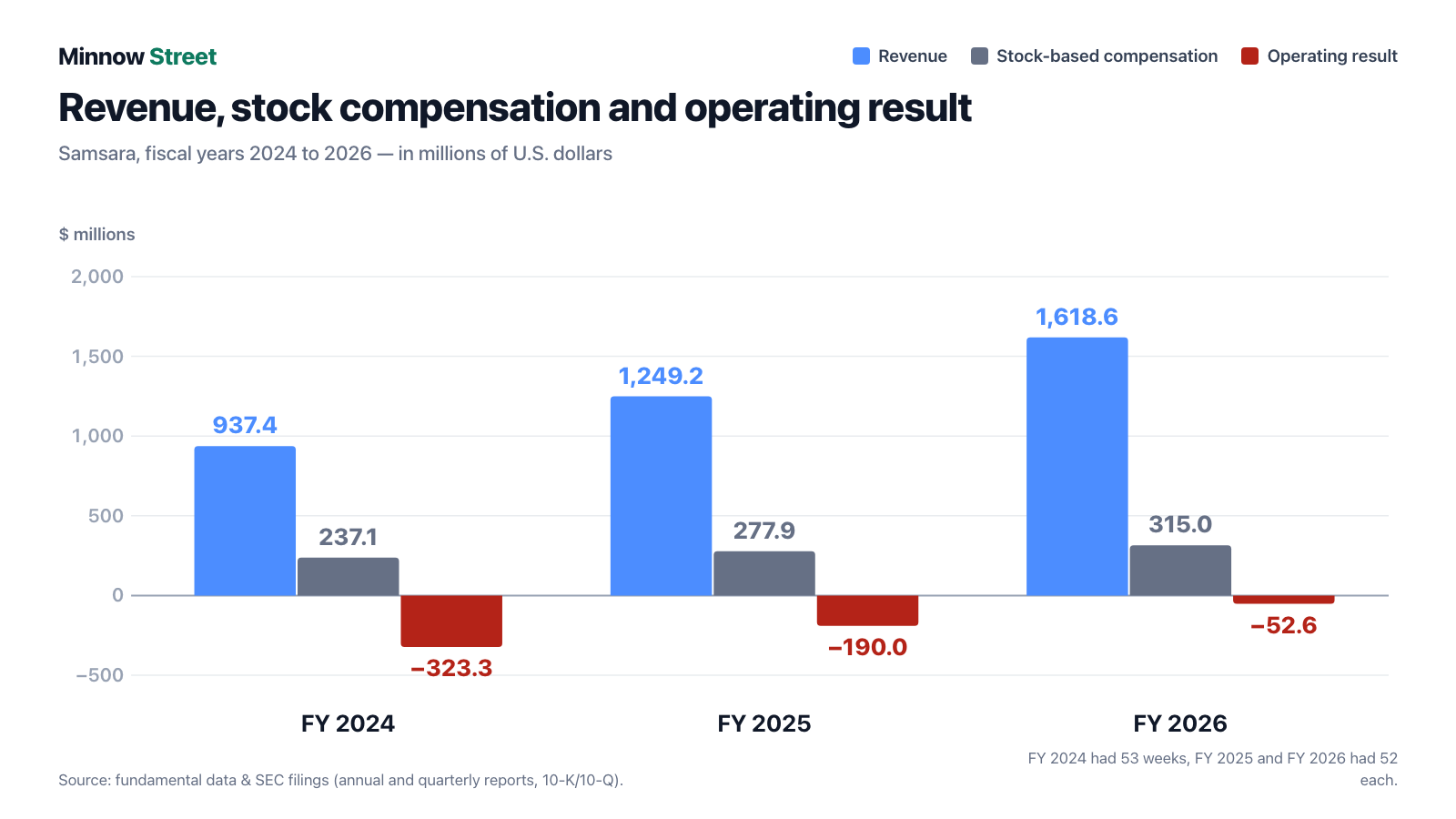
First, what genuinely impresses. Revenue reached $1,618.6 million in fiscal year 2026 — after $1,249.2 million (fiscal 2025) and $937.4 million (fiscal 2024). That is 73 percent more in two years, without a single acquisition: there is no goodwill on the balance sheet. And the pace held. In the first quarter of fiscal year 2027 revenue rose to $478.8 million from $366.9 million a year earlier, up 30.5 percent.
A calendar note before you compare the series: Samsara's fiscal year ends, per its own report, on the Saturday closest to February 1. Fiscal year 2026 ran through January 31, 2026, and therefore covers essentially calendar year 2025. It ran 52 weeks, while fiscal year 2024 ran 53 — the older comparison base is a week longer than the newer one.
The most important metric for a subscription vendor, though, sits beside the income statement rather than inside it: annual recurring revenue. It describes what today's live contracts would bring in over twelve months — the subscription equivalent of an order book. It rose from $1,102.0 million (February 3, 2024) through $1,457.9 million (February 1, 2025) and $1,889.9 million (January 31, 2026) to $1,990.6 million on May 2, 2026, up 30 percent year over year.
Underneath sits a remarkably broad footing. The number of customers above $100,000 in annual recurring revenue grew from 1,848 (February 2024) through 2,484 and 3,194 to 3,363 as of May 2, 2026. More than 12,000 customers pay at least $25,000 a year. And — a line you rarely read this way at a growth company — no single customer accounted for more than 2 percent of recurring revenue as of January 31, 2026. Picture it: this bakery does not have three wholesale buyers, it has twelve thousand regulars.
The balance sheet is solid too. As of May 2, 2026, there were $219.0 million in cash, $585.3 million in short-term and $477.1 million in long-term investments, $1,281.4 million all told. Against that stands no financial debt — only $69.0 million of lease liabilities and $15.8 million of letters of credit issued to landlords. Equity of $1,507.6 million equals 57.7 percent of the $2,614.1 million balance sheet. And the operation generates cash: $236.2 million from operations in fiscal year 2026, $81.4 million in the first quarter of fiscal year 2027 alone.
Then there is the backlog, and it is the real trump card: $3,988.5 million was contracted but not yet recognized as revenue on May 2, 2026 — roughly $1,730.5 million of it expected within twelve months. Remember the sentence: with Samsara the question is not whether revenue arrives, but what is left of it at the bottom.
What the filings say — the uncomfortable truths
Uncomfortable truth no. 1: the first profit came mostly from a tribunal
In the first quarter of fiscal year 2027 Samsara reported $44.5 million of net income, against a $22.1 million loss a year earlier. Per the June 4, 2026, release it was the third consecutive quarter of GAAP profitability. Take the number apart and the picture changes.
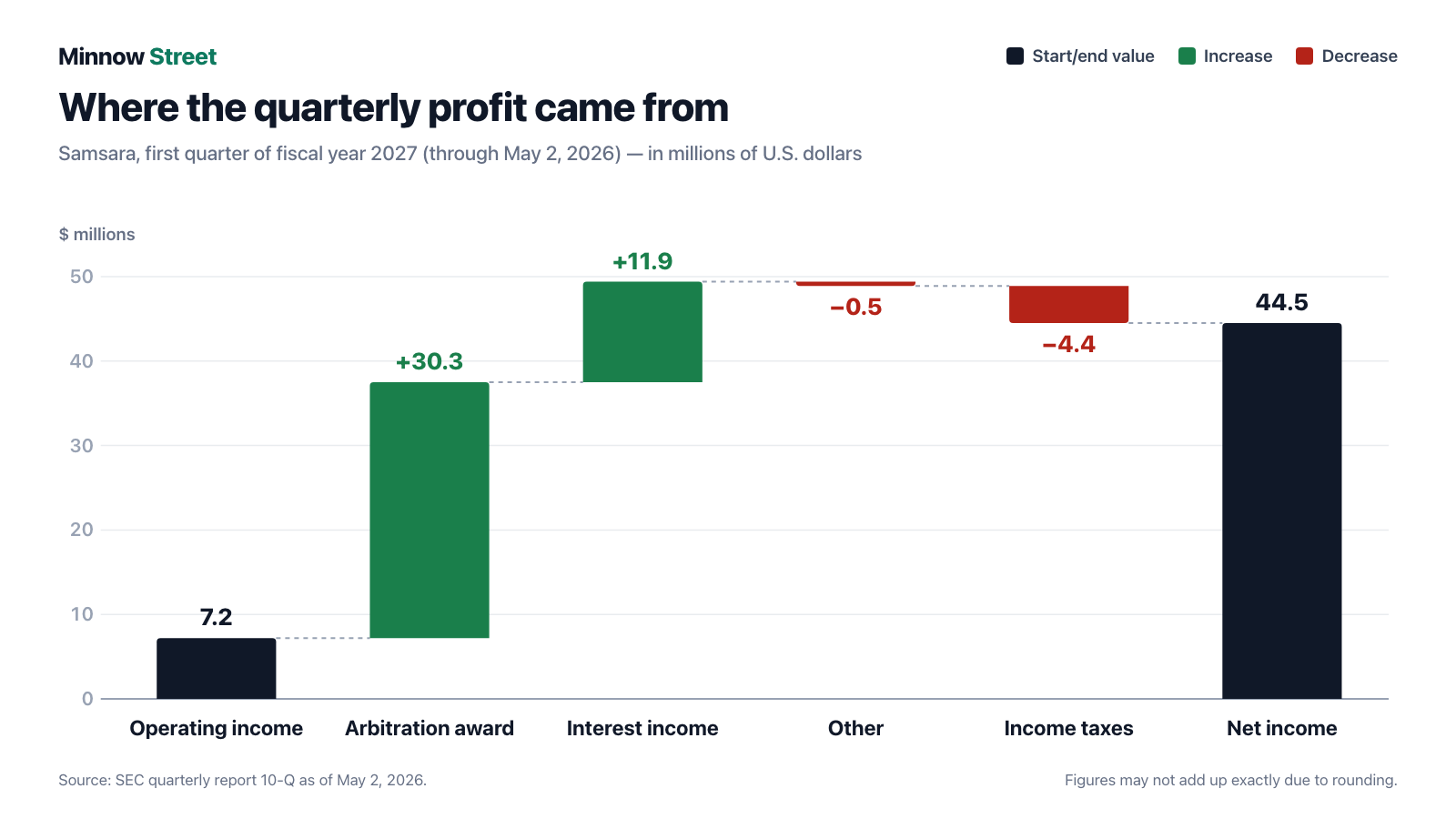
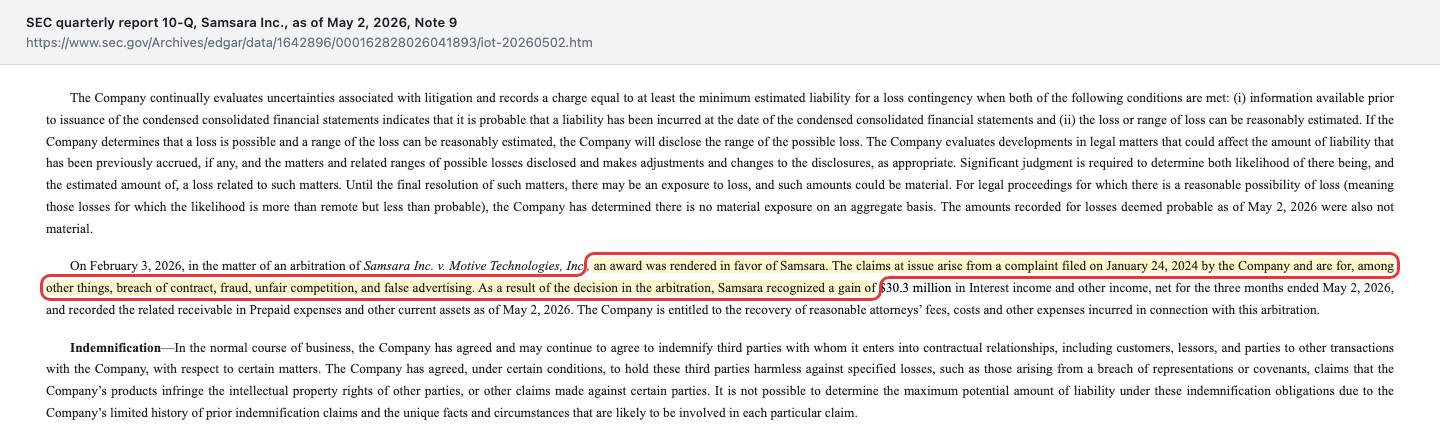
The single largest item is a legal win. Samsara filed claims in January 2024 against competitor Motive Technologies — the annual report lists Motive expressly among its primary competitors. On February 3, 2026, the arbitration panel ruled in Samsara's favor. What came of it is spelled out in the notes to the quarterly report:
“On February 3, 2026, in the matter of an arbitration of Samsara Inc. v. Motive Technologies, Inc., an award was rendered in favor of Samsara. The claims at issue arise from a complaint filed on January 24, 2024 by the Company and are for, among other things, breach of contract, fraud, unfair competition, and false advertising. As a result of the decision in the arbitration, Samsara recognized a gain of $30.3 million in Interest income and other income, net for the three months ended May 2, 2026, and recorded the related receivable in Prepaid expenses and other current assets as of May 2, 2026.”
— Samsara Inc., SEC quarterly report 10-Q as of May 2, 2026, Note 9 “Commitments and Contingencies”
Do the math: without the award, quarterly net income would have been roughly $14.2 million instead of $44.5 million. Strip out the $11.9 million of interest on the company's own cash as well, and the business leaves $7.2 million — 1.5 percent of $478.8 million in revenue. Fiscal year 2026 was starker: a $52.6 million operating loss that $53.5 million of interest and other income almost offset, leaving a $9.1 million net loss.
Fairness demands the other side, and it carries weight. First, Samsara did not invent the dispute, it won it — and the claim for recovery of attorneys' fees is still outstanding. Second, the June 4, 2026, guidance explicitly says the company expects GAAP profitability for fiscal year 2027 even excluding the award. Third, the improvement in operating income is real: from minus $33.3 million in the prior-year quarter to plus $7.2 million, a $40.5 million swing in twelve months.
Uncomfortable truth no. 2: employees received ten times what the business earned
Stock-based compensation is the technical term; in plain language, part of the payroll is settled in shares rather than cash. That is comfortable for the bank account — no money leaves. For you as a shareholder it is still a real price, because your slice of the company gets thinner. Growth paid for with fresh shares is never quite free.
At Samsara this item is large. Fiscal year 2026 carried $315.0 million — 19.5 percent of revenue, after $277.9 million (2025) and $237.1 million (2024). The first quarter of fiscal year 2027 added $77.5 million, 16.2 percent of quarterly revenue and more than ten times the $7.2 million of operating income. It was spread across research and development ($30.0 million), sales and marketing ($23.2 million), general and administrative ($20.7 million) and cost of revenue ($3.6 million).
This is exactly where the familiar gap opens up. For the same quarter Samsara reported non-GAAP operating income of $91.0 million and a 19 percent non-GAAP margin — against $7.2 million and 2 percent under GAAP. The $83.8 million difference is almost entirely stock compensation. Both numbers are correct; they answer different questions. One says how the business would look if shares were free. The other says what is left once you count them.
And the expense is already on the clock:
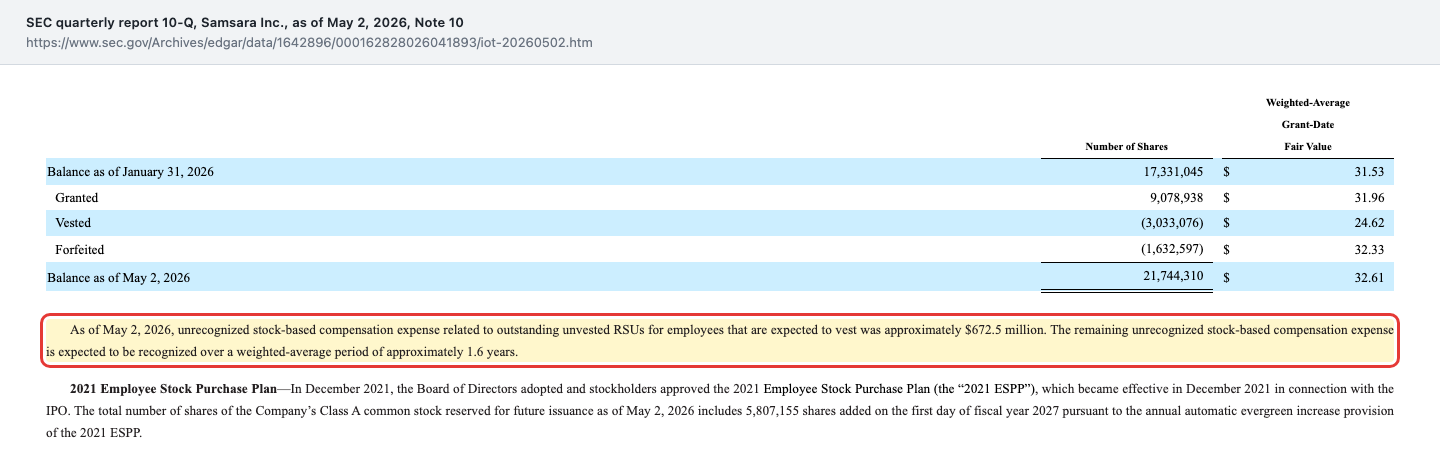
In fairness: realized dilution has been modest, because Samsara withholds shares at every vesting to cover employee taxes — $34.3 million flowed out for exactly that in the first quarter of fiscal year 2027. The weighted-average share count rose only from 567,740,728 to 581,835,917 year over year, about 2.5 percent. How much harder the same mechanism bites at a smaller software vendor is something we worked through in our Backblaze analysis.
Uncomfortable truth no. 3: nearly a third of the company sits on the employee shelf
What has been issued is one question. What may be issued is another. The quarterly report puts a number on it in a table almost nobody reads.
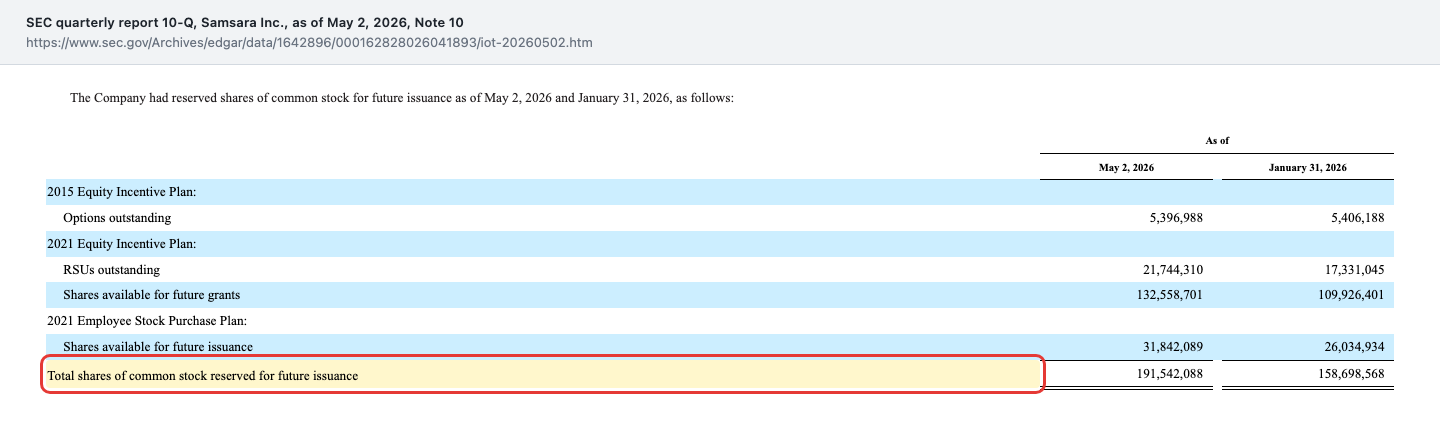
For scale: as of June 2, 2026, there were 582,710,082 shares outstanding across both voting classes. The reserve therefore equals about 33 percent of today's share count — almost as much as the entire high-vote Class B (209,925,597 shares).
The movement matters more than the level. The jump from 158,698,568 to 191,542,088 within one quarter did not come from a shareholder vote but from an automatic provision: on the first day of fiscal year 2027, 29,035,779 shares were added to the 2021 equity plan and 5,807,155 to the employee stock purchase plan — 34,842,934 together, equal to five percent and one percent respectively of the 580,715,597 shares outstanding at fiscal year end. That top-up repeats year after year for as long as the plans run. Picture it: the cake is not resliced in one go — but every year another piece automatically moves to the side table.
Uncomfortable truth no. 4: $458 million of hardware sits on the balance sheet, amortized over five years
Samsara ships cameras, sensors and tracking devices to its customers. What gets paid for, though, is the subscription. In accounting terms that leads to a decision the annual report lists among its critical estimates: the cost of those devices does not go straight to expense but onto the balance sheet as an asset — and is then spread over an assumed useful life.
“We capitalize connected device costs associated with subscription contracts as contract fulfillment costs where the connected device is not distinct from other undelivered obligations in the customer contract. […] These contract fulfillment costs are amortized over a period of benefit of five years. Determining the period of benefit requires judgment for which we take into consideration the duration of customer relationships, the expected life of the connected device, the connected device’s warranty period, past experience with customers, and other available information.”
— Samsara Inc., SEC annual report 10-K for fiscal year 2026, Item 7, “Connected Device Costs”

The scale: as of May 2, 2026, $147.9 million of current and $310.5 million of non-current connected device costs sat on the balance sheet, $458.4 million in total, up from $440.1 million on January 31, 2026. That is 17.5 percent of total assets and roughly 30 percent of equity. Another $273.4 million of sales commissions is capitalized on the same logic.
None of this is improper, and Samsara discloses the assumption. For you it means two things. First, the reported gross margin of 76.7 percent for fiscal year 2026 is the product of a spreading assumption: amortize the devices over three years instead of five and cost of revenue rises while the margin falls. Second, the gross margin has already slipped in the first quarter of fiscal year 2027, from 77.3 to 75.4 percent — cost of revenue grew 41.5 percent while revenue grew 30.5 percent.
Uncomfortable truth no. 5: you buy 63.7 percent of the equity and get 14.9 percent of the votes
Samsara has three share classes. Only the Class A share, with one vote, trades on the New York Stock Exchange. The Class B share, held largely by founders and early investors, carries ten votes. The Class C share carries none and has not been issued.
“Because of the ten-to-one voting ratio between our Class B and Class A common stock, holders of our Class B common stock collectively control a majority of the combined voting power of our common stock and therefore are able to control all matters submitted to our stockholders for approval.”
— Samsara Inc., SEC annual report 10-K for fiscal year 2026, Item 1A “Risk Factors”
In numbers: as of May 2, 2026 there were 370,981,108 Class A shares and 211,728,974 Class B shares outstanding. Class A therefore holds roughly 63.7 percent of the equity but only about 14.9 percent of the votes. The July 22, 2026, annual meeting made that visible: against 582,710,082 shares outstanding, roughly 2.26 billion votes were cast. All eight director nominees were elected, Deloitte & Touche was ratified as auditor for fiscal year 2027, and the say-on-pay proposal passed.
Samsara names one consequence itself in its risk factors: because some index providers exclude companies with multiple share classes, the structure puts it out of reach for certain indices and therefore for many index funds. For you as an investor that is not a scandal, but it is a fact with a consequence: here you can agree or you can sell — voting is not really on the menu.
Valuation — what the market is paying for
Let's work in orders of magnitude, not day prices. At a market capitalization of about $16.8 billion (data as of July 24, 2026), the market pays roughly 9.7 times trailing twelve-month revenue of $1,730.6 million. On trailing earnings the price-to-earnings ratio exceeds 300 — a figure that says nothing except that the profit is still tiny. The current-year estimate is more informative and lands around 48. Price-to-book is about 12.
For context: a price-to-sales ratio just under ten is the going rate for 30 percent subscription growth at a 76 percent gross margin. It is not absurd — it is a bet that the gross margin eventually becomes a decent net margin. We ran exactly that question at another subscription software vendor in our Q2 Holdings analysis.
And here the second number you were asked to remember comes back. The company's own guidance of June 4, 2026, calls for second-quarter revenue of $482 million to $484 million — up 23 to 24 percent, after 31 percent in the first quarter. For full fiscal year 2027 Samsara guides to $2,005 million to $2,013 million (up 24 percent), a 20 percent non-GAAP operating margin and non-GAAP earnings of $0.70 to $0.72 per share. The company itself is therefore signaling a slowdown of roughly seven percentage points — and a valuation built on growth reacts badly to that. The 13.3 percent of the float sold short fits the picture.
The professionals' view is friendlier: 21 analysts carry the stock with a mean price target of $44.78 (data as of July 24, 2026), well above the implied price of roughly $29 derived from market capitalization and share count. A price target, however, is not evidence — it is an opinion with a decimal place.
Opportunities and risks at a glance
What speaks for Samsara:
- Growth with substance: $1,618.6 million of revenue in fiscal year 2026 after $937.4 million two years earlier, and 30.5 percent growth to $478.8 million in the first quarter of fiscal year 2027 — with no acquisitions at all, as the absence of goodwill shows.
- A subscription base that barely wobbles: $1,990.6 million of annual recurring revenue on May 2, 2026, 3,363 customers above $100,000 in ARR, and not one customer above 2 percent of recurring revenue.
- Visibility for years: $3,988.5 million of contracted, unrecognized revenue as of May 2, 2026, roughly $1,730.5 million of it within twelve months.
- A debt-free balance sheet: $1,281.4 million of cash and investments, only $69.0 million of lease liabilities, a 57.7 percent equity ratio — and $236.2 million of operating cash flow in fiscal year 2026.
- The operating trend points the right way: operating income improved by $40.5 million in twelve months, from minus $33.3 million to plus $7.2 million.
- Estimates have been beaten consistently; in the eight quarters through April 30, 2026, results came in above expectations every time (data as of July 24, 2026).
What speaks against it:
- The profit mostly does not come from the business: $30.3 million of $44.5 million in the first quarter of fiscal year 2027 came from an arbitration award, another $11.9 million from interest.
- The operating margin is thin: 1.5 percent in the first quarter of fiscal year 2027 and minus 3.2 percent in fiscal year 2026 — on a gross margin above 75 percent.
- Stock-based compensation of $315.0 million, or 19.5 percent of revenue, in fiscal year 2026; another $672.5 million is committed and will be expensed over roughly 1.6 years.
- 191,542,088 shares reserved for employee plans as of May 2, 2026 — about 33 percent of the share count, with an automatic annual top-up of five and one percent.
- The company's own guidance signals a slowdown: 23 to 24 percent revenue growth in the second quarter of fiscal year 2027 after 31 percent in the first.
- The gross margin has already given ground: 75.4 percent versus 77.3 percent year over year, because cost of revenue grew 41.5 percent against 30.5 percent revenue growth.
- Equity without a say: 63.7 percent of the capital carries 14.9 percent of the votes, and the structure excludes the company from certain indices per its own filing.
- The market is skeptical and the stock is expensive: roughly 9.7 times trailing twelve-month revenue with 13.3 percent of the float sold short (data as of July 24, 2026).
A human conclusion
Back to the sign-flip reflex. Its problem is not that it leads you to bad companies — Samsara is a good company. It grows 30 percent without depending on a single large customer. It has no debt, $1.28 billion in the bank and an order book of nearly four billion. And it writes its assumptions into the filings so plainly that you do not have to hunt for them.
The problem with the reflex is that it stops reading at the sign. The $44.5 million is real — but $30.3 million of it was awarded by a tribunal, and $11.9 million was earned by the company's own cash. What the business itself produced in the first quarter of fiscal year 2027 was $7.2 million on $478.8 million of revenue. In the same quarter, employees received $77.5 million worth of stock. Put those side by side and you do not see a scandal, you see an unfinished sum: a company with a 76 percent gross margin will eventually have to explain why only 1.5 percent reaches the bottom.
So the honest question is not “is ten times sales too much?” but: do you believe Samsara can eventually throttle a sales and marketing spend that last ran $203.6 million a quarter without the growth breaking — and that stock compensation will grow more slowly than revenue while it does? If yes, you have a thesis, and the filings hand you clean measuring points every quarter: operating income excluding one-off gains, stock compensation as a share of revenue, annual recurring revenue. If no, you have seen a black number that keeps two thirds of its provenance in a footnote. What you make of it is your decision. And that is exactly as it should be.
Sources
Every original document used in this analysis — for you to read yourself:
- Samsara Inc. — SEC quarterly report 10-Q as of May 2, 2026 (filed June 9, 2026)
- Samsara Inc. — SEC annual report 10-K for fiscal year 2026 (filed March 16, 2026)
- Samsara Inc. — Current report 8-K dated June 4, 2026, exhibit 99.1 (quarterly results and guidance)
- Samsara Inc. — Current report 8-K dated July 23, 2026 (results of the July 22, 2026, annual meeting)
- Form 4 insider filings and Form 144 sale notices through July 24, 2026, plus every other filing: EDGAR overview for CIK 0001642896 (sec.gov)
- Fundamental data (metrics, valuation, analyst estimates; data as of July 24, 2026), reconciled against the SEC filings.
- Scanner lists: our in-house stock scanner, as of July 26, 2026; the lists are recomputed daily.
Transparency & disclaimer: this analysis is a journalistic contextualization of publicly available information. It is not investment advice, not a regulated financial analysis and not a solicitation to buy or sell securities. Equity investments carry substantial risk up to and including total loss. All figures without warranty; the as-of date for each number is stated in the text. The author holds no position in Samsara shares at the time of publication.
Our Bottom Line at a Glance
- Business and growth positive
- Revenue climbed from $937.4 million in fiscal year 2024 through $1,249.2 million (2025) to $1,618.6 million (2026), then added another 30.5 percent in the first quarter of fiscal year 2027 to reach $478.8 million. Annual recurring revenue hit $1,990.6 million on May 2, 2026, up 30 percent, and the count of customers above $100,000 in ARR rose to 3,363 from 2,638. Subscriptions make up 98.4 percent of quarterly revenue.
- Balance sheet and funding positive
- As of May 2, 2026, the balance sheet held $1,281.4 million in cash and investments against no financial debt — only $69.0 million of lease liabilities and $15.8 million of letters of credit. The equity ratio stood at 57.7 percent, there is no goodwill, and operating cash flow was clearly positive at $81.4 million for the quarter and $236.2 million for fiscal year 2026.
- Customer base positive
- No single customer accounted for more than 2 percent of annual recurring revenue as of January 31, 2026, and in the first quarter of fiscal year 2027 no customer exceeded 10 percent of revenue or of receivables. More than 12,000 customers pay at least $25,000 a year. For a vendor whose business could easily hang on a handful of large fleet operators, that is a remarkably broad footing.
- Earnings quality negative
- Of $44.5 million in net income for the first quarter of fiscal year 2027, $30.3 million came from an arbitration award against Motive Technologies and $11.9 million from interest. Operations contributed $7.2 million — 1.5 percent of revenue. Fiscal year 2026 was starker still: a $52.6 million operating loss that $53.5 million of interest and other income almost, but not quite, offset.
- Stock-based compensation negative
- Fiscal year 2026 carried $315.0 million of stock-based compensation, 19.5 percent of revenue; the first quarter of fiscal year 2027 carried $77.5 million against $7.2 million of operating income. Another $672.5 million of awards is outstanding and will be expensed over roughly 1.6 years. Reserved for the plans as of May 2, 2026: 191,542,088 shares, close to a third of the share count.
- Valuation neutral
- At a market capitalization of about $16.8 billion (data as of July 24, 2026), the market pays roughly 9.7 times trailing twelve-month revenue of $1,730.6 million and about 48 times the current-year earnings estimate. The company's own June 4, 2026, guidance points to a slowdown at the same time: 23 to 24 percent growth in the second quarter after 31 percent in the first. And 13.3 percent of the float is sold short.
Samsara is a growth company that owes its debts not to a bank but to its own workforce. The business works: $1,990.6 million of annual recurring revenue as of May 2, 2026, 30 percent growth, 3,363 large customers, no concentration risk, $1,281.4 million in the bank and no financial debt. Against that stands an income statement whose black ink is two thirds a lawsuit and another quarter interest, while stock-based compensation at 19.5 percent of revenue exceeds any operating margin this company has ever posted. Buying here is a bet that the margin of the business will one day outgrow the price paid to employees in shares. Not investment advice.
What Our Rating Means
Open questions
The business works in principle, but one material question is open. As long as it stays open, our findings do not carry a quality verdict.
There is little to fault in the substance: $1,281.4 million of cash and investments as of May 2, 2026, no financial debt, a 57.7 percent equity ratio, positive operating cash flow since fiscal year 2025 and a backlog of $3,988.5 million. The business model works too — subscription revenue, a 76.7 percent gross margin in fiscal year 2026, no customer above 2 percent of recurring revenue. But one material operating question is open, and it is the central one: after $1,574.6 million of accumulated losses since inception, the business itself throws off a 1.5 percent margin while 19.5 percent of revenue goes to employees in stock. The first visible profit came mostly from an arbitration award and from interest, not from selling software. That is not a substance risk — a debt-free company growing 30 percent does not get into trouble over it. But it is not proof either. Hence yellow: documented growth, unproven earning power. The decision is yours.
A journalistic assessment by our editorial team at the time of the deep dive, based on public sources — not investment advice and not a solicitation to buy or sell. Your personal circumstances (investment goals, risk capacity, taxes) cannot be taken into account. What our levels mean, how verdicts are formed, and what conflicts of interest exist →
Worth Noting
- Samsara reached our research list through our in-house stock scanner: the stock sits on the U.S. side of the “Fundamental Rank (A / A+)” list, which sorts companies by the quality of their numbers (as of July 26, 2026; the page currently shows 38 U.S. hits). On the same date IOT appeared on nine lists at once, among them “High Revenue Growth”, “Power Trend”, “Pros 80%” and “Big Earnings Surprise”. The lists are recomputed daily.
- Currency of the data: this analysis works from the annual report 10-K for fiscal year 2026 (filed March 16, 2026), the quarterly report 10-Q as of May 2, 2026 (filed June 9, 2026) and every filing made since — in particular the 8-K of June 4, 2026, with results and guidance, the 8-K of July 23, 2026, with the results of the July 22, 2026, annual meeting, and the Form 4 insider filings and Form 144 sale notices through July 24, 2026. The next quarterly report is expected in early September 2026 per the July 24, 2026, data.
- Valuation figures are dated and evergreen: the implied price of roughly $29 comes from a market capitalization of $16.8 billion (data as of July 24, 2026) divided by the 582,710,082 shares across both voting classes that the quarterly report reports as of June 2, 2026. Cross-checked against a filing price: the cover page of the annual report cites a closing price of $36.01 on August 1, 2025, which on the same share count would imply about $21.0 billion. The 20.4 percent price decline over the trailing 252 trading days (data as of July 24, 2026) accounts for the difference. Analyses are evergreen; daily prices are not a buy argument.
- Easy to confuse: the ticker IOT belongs to Samsara and is not shorthand for “internet of things”. Only the Class A share trades on the New York Stock Exchange; the high-vote Class B shares are not listed.
Frequently Asked Questions
Samsara Inc. (NYSE: IOT) of San Francisco rents out a software platform for physical operations. Its customers are trucking fleets, construction firms, utilities and government agencies. Samsara supplies cameras, sensors and tracking devices for vehicles, equipment and sites, and the data lands in one cloud application. In the first quarter of fiscal year 2027 (through May 2, 2026), $471.0 million of $478.8 million in revenue was subscription revenue.
Samsara runs an offset fiscal year that, per its annual report, ends on the Saturday closest to February 1. Fiscal year 2026 ran through January 31, 2026, and therefore covers essentially calendar year 2025; fiscal year 2027 ends January 30, 2027. The years run 52 or 53 weeks — fiscal year 2024 had 53 weeks, fiscal years 2025 and 2026 had 52 each.
On a GAAP basis, only recently and only barely. Fiscal year 2026 ended with a net loss of $9.1 million on $1,618.6 million of revenue. In the first quarter of fiscal year 2027 Samsara reported $44.5 million of net income — but $30.3 million of that came from an arbitration award and $11.9 million from interest. Operations contributed $7.2 million, or 1.5 percent of revenue.
Samsara filed claims against competitor Motive Technologies in January 2024, alleging among other things breach of contract, fraud, unfair competition and false advertising. On February 3, 2026, the arbitration panel ruled in Samsara's favor. The company booked a gain of $30.3 million from the decision in the first quarter of fiscal year 2027. A second case against the same competitor has been pending since November 2024.
The expense is heavy, the realized dilution so far modest. In fiscal year 2026 Samsara booked $315.0 million of stock-based compensation, 19.5 percent of revenue. The weighted-average share count rose only about 2.5 percent year over year to 581,835,917, because Samsara withholds shares to cover employee taxes. Reserved for the plans as of May 2, 2026, however, were 191,542,088 shares.
The Class B holders, above all co-founders Sanjit Biswas and John Bicket. Each Class B share carries ten votes; each NYSE-listed Class A share carries one. As of May 2, 2026, there were 370,981,108 Class A shares against 211,728,974 Class B shares: Class A holders own about 63.7 percent of the equity but hold only about 14.9 percent of the votes. Samsara notes itself that the structure can keep it out of certain indices.
Revenue grew 31 percent to $478.8 million in the first quarter of fiscal year 2027. For the second quarter the company guided on June 4, 2026, to only $482 million to $484 million, up 23 to 24 percent, and for full fiscal year 2027 to $2,005 million to $2,013 million, up 24 percent. The company's own guidance therefore signals a slowdown of roughly seven percentage points.
No. As of the July 24, 2026, data cut-off the stock shows no dividend and no payout ratio, and the quarterly report names no share buyback program. Free funds stay on the balance sheet: $1,281.4 million of cash and investments sat there as of May 2, 2026, against no financial debt at all.
Found an error?
Did you spot a factual error, an outdated number, or a typo in this deep dive? Let us know briefly — your report goes straight to the editorial team.