Rush Street Interactive: $26.2 Million in Profit — and Only $9.1 Million Belongs to the Listed Shares
Rush Street Interactive is growing fast: $370.4 million of revenue in the first quarter of 2026, up 41 percent, and net income of $26.2 million. But $17.1 million of that went to owners whose stakes never trade on the NYSE. The quarterly report filed April 29, 2026, spells it out in a single sentence: 55.57 percent of the operating business does not belong to Class A shareholders. Not investment advice — just the question of who actually owns this growth.
 Thomas Mücke
Founder & Publisher
Thomas Mücke
Founder & Publisher
Chart
Interactive price chart (TradingView).
Note: pure fact-based analysis, not investment advice and not a solicitation to buy or sell. All figures without guarantee.
There is an investor trap everyone knows from the supermarket and almost nobody recognizes on the stock market: the package-size trap. Two jars sit side by side, one costs $2.49, the other $3.99. You reach for the cheap one — and miss that the expensive jar holds twice as much. On the stock market the same thing happens, except the package size is called share count. At Rush Street Interactive, Inc. (NYSE: RSI) it is half the story. So let us make a deal: before we talk about growth, margin and valuation, we count together how many units this company actually has. The source is not an analyst note but what the company itself filed, under penalty of law, with the U.S. securities regulator, the SEC: the annual report (10-K) for 2025, filed February 18, 2026, and the quarterly report (10-Q) as of March 31, 2026, filed April 29, 2026.
What Rush Street Interactive actually does
Rush Street Interactive runs online casino and sports betting. If you play roulette on your phone in Pennsylvania or bet on a football game in Illinois, there is a decent chance you are doing it inside one of this company's apps. In the United States and Canada the products carry the BetRivers and PlaySugarHouse brands; in Latin America it is RushBet. On top of that sits a small retail business running betting kiosks inside land-based casinos, plus a social gaming offering where nobody plays for real money.
The headquarters is in Chicago; the work is global. As of February 17, 2026, the company counted roughly 912 employees and contractors, about 35 percent of them in technical roles and 44 percent in the United States, with the rest spread across Canada, Colombia, Estonia and Serbia. It is live in 16 U.S. states plus Colombia, Ontario, Mexico and Peru.
One thing matters for understanding the business: in the United States, gambling is a state matter, not a federal one. Online casino — the lucrative part — is legal in only nine states: Connecticut, Delaware, Maine (not yet operating), Michigan, New Jersey, Pennsylvania, West Virginia, Rhode Island and Nevada (and there only in a restricted form). Sports betting is far more widespread: 39 states and the District of Columbia allow it, 32 of them statewide online. That is this company's growth math — and its ceiling at the same time.
Which brings us to the central tension of this analysis, running through every chapter below: Rush Street Interactive is growing fast and now makes money — but less than half of this company is on the exchange at all. Anyone valuing the stock is valuing a minority stake. For a competitor in the same industry without that design feature, see our analysis of Flutter Entertainment.
Where the stock showed up in our scanner
The hook this time is not a price move but a balance-sheet screen. Our in-house stock scanner lists Rush Street Interactive in the U.S. selection of the fundamental ranking — the screen that sorts companies by the quality of their numbers rather than the shape of their chart (as of July 26, 2026; the screens are recalculated daily). On that date 38 U.S. names met the criteria; the page shows the first 25. You can replicate it in three clicks: open the stock scanner, pick the "Fundamental Rank (A / A+)" screen, set the market to the United States.
More interesting than the single screen is the confluence. On July 26, 2026, RSI appeared in 22 screens at once, and the mix is unusual because it bridges two camps. From the quality camp: Buffett criteria, quality growth, fundamental rank, institutional accumulation. From the trend camp: Stan Weinstein stage 2, William O'Neil, Mark Minervini trend criteria, near 52-week high. When a stock reads as both fundamentally sound and technically strong, it is worth a second look. That is what follows.
Two metrics as of July 24, 2026 belong here — and both get rated, not merely listed. The Beneish M-score, an early-warning indicator for dressed-up accounts, sits at minus 2.94; anything below minus 1.78 counts as unremarkable, so this is a clean reading. The debt-to-equity ratio of 0.035 means simply that this company has essentially no bank debt. The third number is the odd one out: 10.3 percent of the float is sold short. One share in ten of the freely tradable stock is betting on a decline — at a company that just reported record numbers. Hold on to that contradiction; we will come back to it.
The numbers over the years — honestly appraised
First what genuinely impresses. Revenue reached $1,134.4 million in 2025 — after $924.1 million (2024) and $691.2 million (2023). That is 64 percent in two years, without an acquisition. And the pace has not slowed but picked up: the first quarter of 2026 brought in $370.4 million against $262.4 million a year earlier, a gain of 41 percent.
Even more notable is the path from revenue to earnings. In 2023 the company posted a $51.6 million operating loss. In 2024 that became $25.0 million of income, in 2025 $87.4 million. In the first quarter of 2026 it earned $42.8 million from operations against $14.9 million a year earlier — the operating margin climbed from 5.7 to 11.6 percent. That is a genuine scale effect: revenue rose 41 percent, cost of revenue only 39 percent, and sales and marketing just 12 percent.
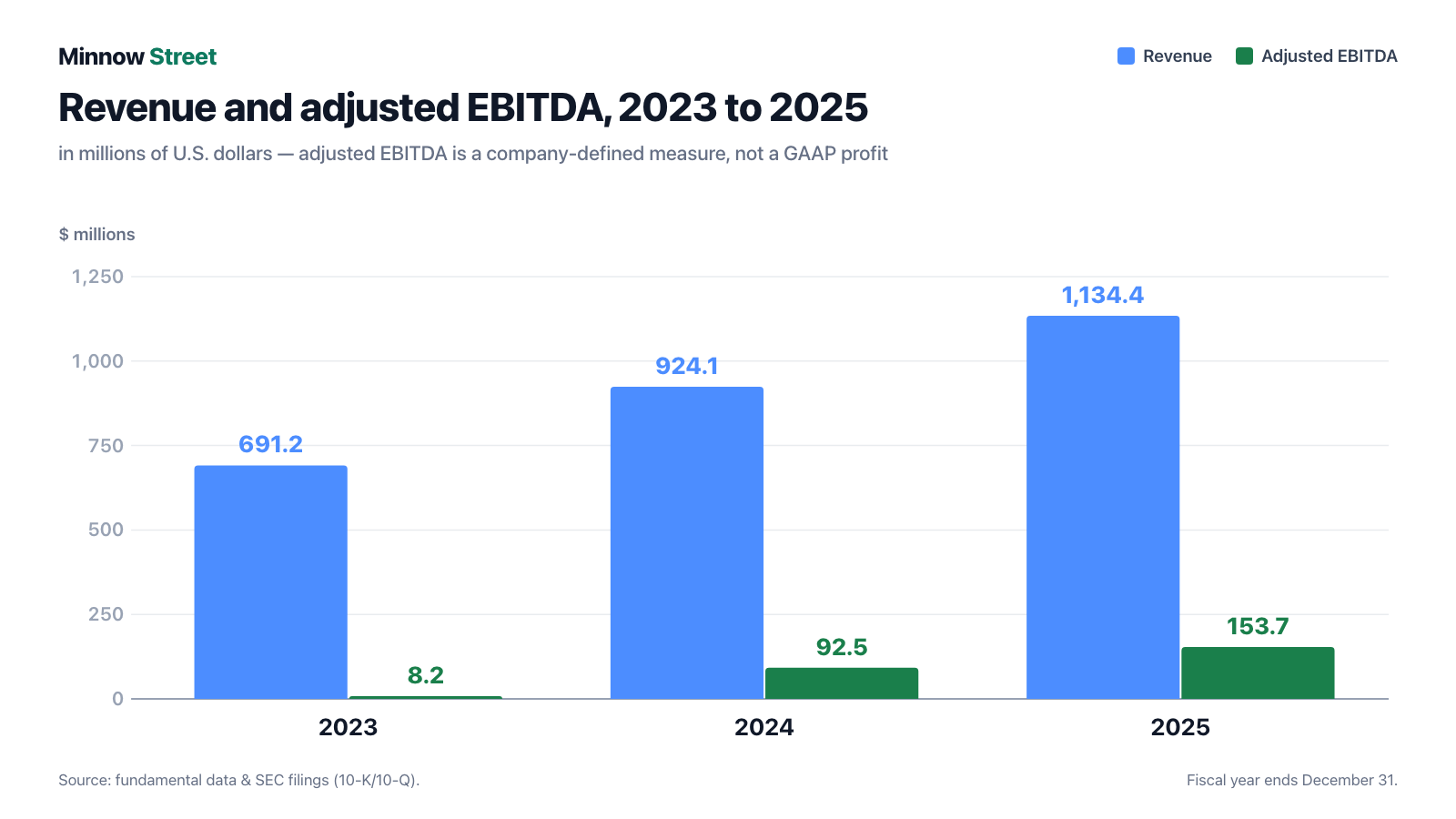
The second growth driver is geographic. Latin America — Colombia, Mexico, Peru — delivered $87.8 million in the first quarter of 2026 after $37.5 million a year earlier. Its share of total revenue rose from 14.3 to 23.7 percent. The core United States and Canada business grew from $224.9 million to $282.6 million over the same period. Both legs carry weight — but the smaller one grew 134 percent while the larger one grew 26 percent.
And the balance sheet? Unremarkably solid. As of March 31, 2026, cash stood at $330.6 million and there was no financial debt. The largest liabilities are operational: $47.2 million of player balances — money that belongs to customers — $81.0 million of accrued expenses and $42.7 million of accounts payable. Operating cash flow reached $165.0 million in 2025 after $106.4 million the year before. So much for the good news. Now the package size.
What the filings say — the uncomfortable truths
Uncomfortable truth no. 1: less than half the company trades on the NYSE
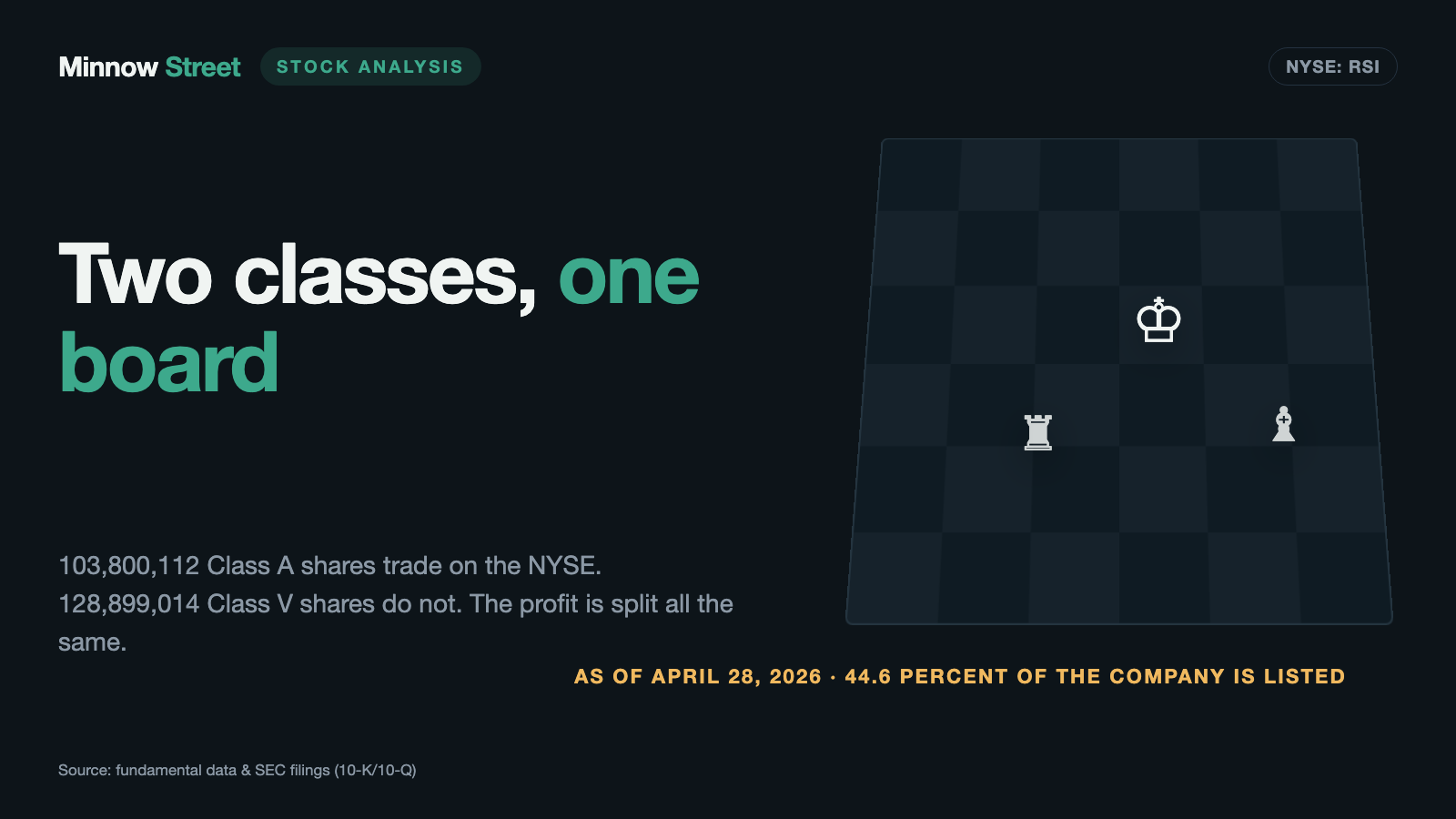
On the cover page of every quarterly report, a U.S. company must state how many shares of each class are outstanding. At Rush Street Interactive there is not one number but two — and that is the heart of this analysis.

The reason goes back to the 2020 listing. The operating business still sits inside a partnership, Rush Street Interactive, L.P. The listed Rush Street Interactive, Inc. owns only part of it. The pre-IPO owners hold the remainder directly in the partnership — plus Class V shares that carry voting rights alone, with no economic interest in the corporation. In plain terms: the listed company is not the shop, it is a partner in the shop.
How large that stake is, the quarterly report states itself:

This is not a formality; it is hard cash. In the first quarter of 2026 the group earned $26.2 million net. Of that, $17.1 million was attributed to non-controlling interests and only $9.1 million to Rush Street Interactive, Inc. — that is, to the shareholders who bought on the NYSE. For full-year 2025 the split was $40.7 million against $33.3 million.
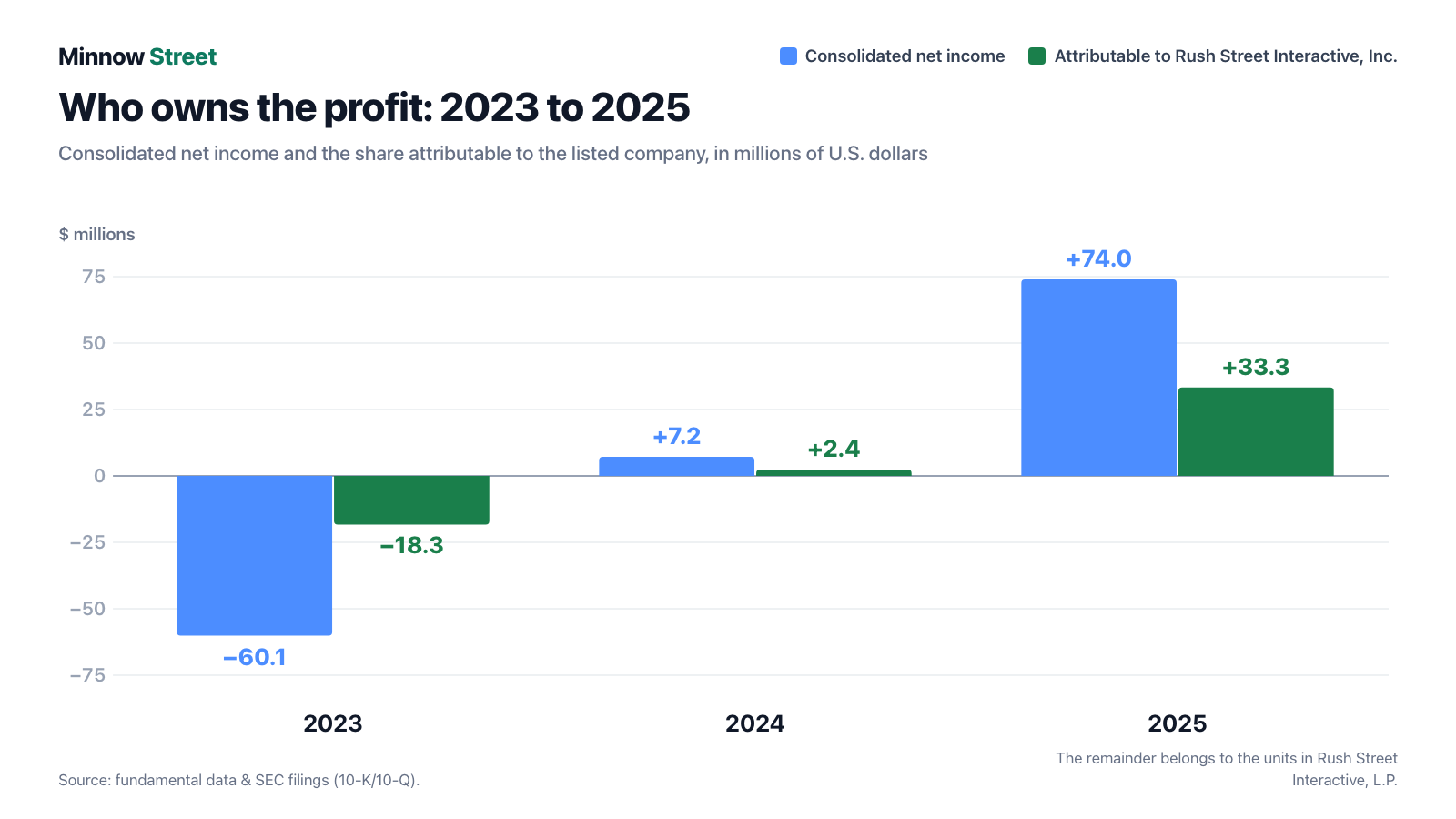
Before the reflex kicks in that this must make the stock cheap: it does not, and the logic cuts both ways. Every partnership unit can be exchanged for a Class A share. That is why the company uses 236,118,275 shares in its own diluted earnings per share for 2025 — arriving at $0.31 per share instead of the $0.35 implied by the basic figure. The company counts every unit itself the moment the math requires it. Counting only the 103.8 million shares listed on the NYSE is arithmetically correct and economically wrong.
Uncomfortable truth no. 2: the record 2025 profit was made in the tax line
"Net income up tenfold" is how you would summarize 2025 if you only read the bottom line: $74.0 million after $7.2 million. The route there is a different story. Income from operations was $87.4 million. Then came a line most income statements do not even have: "change in tax receivable agreement liability", minus $107.8 million. Pre-tax, the company therefore posted a loss of $11.1 million. What flipped the sign was the tax line — not an expense but a benefit of $85.1 million.
Both items share one origin, and that origin leads to the next uncomfortable truth. For now: a profit produced by two special items that nearly cancel each other out tells you nothing about earning power. The first quarter of 2026 shows the business without that machinery: $45.8 million pre-tax, $19.6 million of tax expense, $26.2 million of net income. Respectable — but not a tenfold jump.
Uncomfortable truth no. 3: 85 percent of the tax savings belong to the pre-IPO owners
The reason behind both special items is called the tax receivable agreement. It dates from the 2020 business combination and obliges a subsidiary of RSI to pay 85 percent of certain tax savings to the pre-IPO owners. Every time one of those owners exchanges partnership units for Class A stock, the corporation gains a tax benefit — and 85 percent of it flows straight back to the sellers by contract.
What that costs, the company writes into its own annual report:
"While many of the factors that will determine the amount of payments that the Special Limited Partner will make under the TRA are outside of our control, we expect that the payments the Special Limited Partner will make under the TRA will be substantial and could have a material adverse effect on our financial condition."
— Rush Street Interactive, Inc., SEC annual report 10-K for 2025, Item 1A Risk Factors

In numbers: as of March 31, 2026, the liability under that agreement stood at $133.4 million, of which $132.1 million is non-current and $1.2 million falls due within twelve months. As of December 31, 2024, it was just $0.7 million, and $130.1 million by December 31, 2025 — the jump comes mostly from that $107.8 million line, the rest from later unit exchanges that are booked directly in equity. Almost nothing has actually been paid yet; the quarterly report notes that no material payments have been made to date. The bill is still on the table.
To be fair: this structure is standard for U.S. listings of this type, it is fully disclosed, and the tax benefit that triggers the payments only exists because of the agreement in the first place. But it moves money — permanently, and in one direction.
Uncomfortable truth no. 4: every market hangs on somebody else's license
In most U.S. states, Rush Street Interactive holds no license of its own. There, the licenses are tied to a limited number of local entities — casinos, tribes, racetracks, sports teams — each entitled to grant a limited number of "skins": sub-permissions under which an online operator may work. Without such a partner, the market is closed.
"In most jurisdictions where we offer online casino and sports betting, we currently rely on a casino, tribe, track or professional sports team to get a 'skin.' If we cannot establish, renew or manage our relationships with our local partners, our relationships could terminate, and we would not be allowed to operate in those jurisdictions until we enter into new ones."
— Rush Street Interactive, Inc., SEC annual report 10-K for 2025, Item 1A Risk Factors

And here is the twist: some of those partners belong to the family. Under "related parties" the quarterly report explains that Neil Bluhm, his adult children — two of whom sit on the board — and Greg Carlin are owners, directors or officers of certain land-based casinos with which RSI has market-access agreements. Royalties paid to those affiliated casinos came to $18.8 million in the first quarter of 2026 (prior-year quarter: $17.4 million); receivables from them stood at $19.2 million. It is a double-edged safety net: access is secure as long as the family wants it to be — and the terms are negotiated between father and firm.
Uncomfortable truth no. 5: taxes and bans are business risk number one
Gambling is a revenue source for state governments, and revenue sources get raised. The 2025 annual report lists where that is happening: Illinois, Louisiana, Maryland, New Jersey and Ohio have increased gaming tax rates, while Arizona, Indiana, Pennsylvania, Michigan and West Virginia have proposed increases. On top of that sits a federal excise tax of 0.25 percent on every sports bet placed in the United States.
In Latin America the pattern is the same, only faster. In Colombia the president imposed a temporary value-added tax on online betting by state-of-emergency decree twice during 2025. The first decree hit customer deposits in the first quarter of 2025; the Colombian Constitutional Court ruled it unconstitutional. The second, issued in December 2025, taxes operator revenue at 19 percent and was preliminarily suspended in January 2026, with final review still pending as of the annual report filed February 18, 2026. The company explicitly attributes the rise in Latin American revenue per active user in the first quarter of 2026 to the fact that, after the court ruling, less bonus money had to be handed to players. In this business model, one tax decree can flip the margin inside a single quarter — in either direction.
And a new competitor now appears in the risk factors that did not exist three years ago: prediction markets. These are exchanges where people trade contracts on events — including sports results — but they answer to the U.S. futures regulator, the CFTC, rather than to state gaming boards. The annual report says plainly that those operators face different regulatory and tax frameworks, "which could result in a competitive advantage for them". A company whose cost base is heavily made up of gaming taxes is structurally disadvantaged against a competitor that pays none. You will recognize the same worry from our analysis of Super Group (SGHC), where regulation is likewise the main variable.
What has changed since the last quarterly report
Between the quarterly report of April 29, 2026, and today lies one event that changes the picture — and it has nothing to do with operations.
May 5 and 6, 2026 — the pre-IPO owners sell $287 million of stock. Through a prospectus supplement they placed 10,000,000 Class A shares with investors at $26.00 each; the underwriters exercised their option for a further 1,500,000 shares in full the next day. The sellers received $24.96 per share, roughly $287.0 million in total. The prospectus states it flatly: "We will not receive any proceeds from the sale of the stock to be offered by the selling holders." The company got nothing.
Who sold is in the same document. Neil G. Bluhm, chairman of the board, accounted for 10,512,150 shares, or roughly $262.4 million; Chief Executive Richard Schwartz for 816,500 shares. Bluhm's share of the voting power fell from 47.5 to 43.0 percent; he still holds 99,289,627 Class V shares. For context, the last closing price named in the prospectus was $29.17 on May 5, 2026 — so the sale went out at a discount.
One detail you cannot unsee once you have noticed it: the underlying shelf registration from 2021 covers up to 168,321,808 Class A shares. As of April 28, 2026, only 103,800,112 such shares existed at all. The potential supply is larger than the entire listed float today. That probably explains the 10.3 percent short interest from the scanner chapter better than any thesis about the operating business.
In the same transaction the company repurchased 1,153,846 of its own shares at the same $24.96, for roughly $28.8 million. The buyback program has been running since October 24, 2024, with an authorization of up to $50 million; in the first quarter of 2025 it had bought 498,622 shares at an average of $10.35.
Valuation — what $7.3 billion actually buys
As of July 24, 2026, market capitalization stood at roughly $7.28 billion. Importantly, that figure covers all 232,699,126 units of both classes, not just the listed ones. The implied price is roughly $31 per share. Cross-checked against the filings: 232,699,126 shares times the last documented closing price of $29.17 (May 5, 2026) gives $6.79 billion — a deviation of roughly 7 percent, so the order of magnitude holds.
Measured against the four quarters through March 31, 2026 (revenue $1,242.4 million, adjusted EBITDA $180.6 million, operating income $115.3 million), the picture looks like this:
- Price-to-sales: roughly 5.9.
- Price-to-earnings: roughly 92 on diluted earnings per share. Measure instead the full consolidated profit of those four quarters, $89.0 million, against market capitalization and you get roughly 82 — both are high, and both are additionally flattered by the 2025 tax benefit.
- Enterprise value: deducting $330.6 million of cash (as of March 31, 2026, with no financial debt) leaves roughly $6.95 billion. That is 38 times adjusted EBITDA and 60 times operating income. Add the $133.4 million tax receivable agreement liability and it is roughly $7.08 billion, or 39 times.
And now the calculation this whole article is about. Value the company using the 103,800,112 shares listed on the NYSE and, at roughly $31, you arrive at a market capitalization of about $3.2 billion — and a price-to-sales ratio of roughly 2.6 instead of 5.9. Same company, same numbers, half the price. That is the package-size trap in its purest form. The larger figure is the right one, because every partnership unit is exchangeable and the company itself does the math that way.
What do the professionals think? As of July 24, 2026, seven analysts cover the stock with a mean price target of $30.18 — below the implied price of roughly $31. Translation: the professionals no longer see an undervaluation. On the other side, 10.3 percent of the float was sold short on the same date, and the beta stood at 1.56 — the stock swings considerably harder than the broad market.
Opportunities and risks at a glance
What speaks for Rush Street Interactive:
- Growth that is accelerating: $691.2 million of revenue (2023), $924.1 million (2024), $1,134.4 million (2025) — and up 41 percent to $370.4 million in the first quarter of 2026.
- The turn into profitability is done: a $51.6 million operating loss (2023) became $87.4 million of operating income (2025), with the margin rising from 5.7 to 11.6 percent year over year.
- A balance sheet without financial debt: $330.6 million of cash as of March 31, 2026, and a debt-to-equity ratio of 0.035 (data as of July 24, 2026).
- Real cash rather than book profit: $165.0 million of operating cash flow in 2025 after $106.4 million.
- A second leg that carries weight: Latin America grew to $87.8 million in the first quarter of 2026 from $37.5 million and now accounts for 23.7 percent of revenue.
- Regulatory headroom: online casino is legal in only nine U.S. states so far — each additional state is a new market on the same platform cost base.
What speaks against it:
- Less than half the company is listed: 44.43 percent as of March 31, 2026. Of $26.2 million of quarterly net income, only $9.1 million was attributed to Class A shareholders.
- The 2020 tax receivable agreement routes 85 percent of certain tax savings to the pre-IPO owners — carried at $133.4 million as of March 31, 2026, and described by the company as "substantial" going forward.
- The record 2025 profit is not an operating result: $87.4 million of operating income, minus $107.8 million from the tax receivable agreement, plus an $85.1 million tax benefit.
- Market access belongs partly to third parties — and partly to the executive chairman's family: $18.8 million of royalties to affiliated casinos in the first quarter of 2026 alone.
- Tax risk in both regions: gaming tax increases enacted in five U.S. states and proposed in five more, plus two Colombian state-of-emergency decrees on a value-added tax for online betting, the most recent one at 19 percent.
- Supply overhang: the shelf registration covers up to 168,321,808 Class A shares — more than the 103,800,112 outstanding as of April 28, 2026. In May 2026, 11,500,000 of them were placed.
- The valuation leaves little room: roughly 5.9 times sales, 38 times enterprise value to adjusted EBITDA, and a mean analyst price target of $30.18 below the implied price (data as of July 24, 2026).
A human conclusion
Back to the package-size trap. Its problem is not that it leads you to bad companies — Rush Street Interactive is a good company. It grows 41 percent, it earns money from operations, it carries no debt, and it writes its structure into the filings so openly that you do not have to hunt for it. The problem with the trap is that it lets you compare the price against the wrong quantity.
If you buy here, you are not buying a business. You are buying a slice of a corporation that is itself only a partner in the business — alongside a co-owner who controls 43.0 percent of the votes, whose family controls part of the licenses, who is contractually entitled to 85 percent of the tax savings, and who sold $262 million of stock in May 2026. None of that is illegal, hidden or unusual for a company that came public through a SPAC. All of it belongs in your calculation.
So the honest question is not "is 5.9 times sales too much?" but: are you willing to sit as a minority holder next to a controlling owner whose interests may not be yours — and do you trust the operating business to deliver, over the coming quarters and without tax mechanics, what the price already assumes? If yes, you have a thesis, and every quarterly report hands you clear checkpoints: operating income, the non-controlling share, Latin American revenue. If no, you have seen attractive growth and stopped reading the receipt halfway down. What you make of it is your decision. And that is exactly as it should be.
Sources
Every original document used in this analysis, for you to read yourself:
- Rush Street Interactive, Inc. — SEC quarterly report 10-Q as of March 31, 2026 (filed April 29, 2026)
- Rush Street Interactive, Inc. — SEC annual report 10-K for 2025 (filed February 18, 2026)
- Rush Street Interactive, Inc. — Prospectus supplement 424B4 dated May 5, 2026 (secondary offering by the pre-IPO owners)
- Rush Street Interactive, Inc. — Current report 8-K dated May 7, 2026 (underwriting agreement, greenshoe, share repurchase)
- All filings by the company: EDGAR index for CIK 0001793659 (sec.gov)
- Fundamental data (metrics, valuation, analyst estimates; data as of July 24, 2026), reconciled with the SEC filings.
- Scanner screens: our in-house stock scanner, as of July 26, 2026; the screens are recalculated daily.
Transparency & disclaimer: this analysis is a journalistic contextualization of publicly available information. It is not investment advice, not a regulated financial analysis and not a solicitation to buy or sell securities. Equity investments carry substantial risk up to and including total loss. All information is provided without warranty; the as-of date for each figure is noted in the text. The author holds no position in Rush Street Interactive, Inc. shares at the time of publication.
Our Bottom Line at a Glance
- Business and growth positive
- Revenue rose from $691.2 million (2023) to $924.1 million (2024) and $1,134.4 million (2025) — and by 41 percent to $370.4 million in the first quarter of 2026. The pace is accelerating, not fading. Latin America is doing more and more of the lifting: $87.8 million in the first quarter of 2026 after $37.5 million a year earlier.
- Profitability positive
- A $51.6 million operating loss in 2023 turned into $25.0 million of operating income in 2024 and $87.4 million in 2025; the first quarter of 2026 delivered $42.8 million after $14.9 million. The operating margin climbed from 5.7 to 11.6 percent year over year. Operating cash flow reached $165.0 million in 2025 after $106.4 million.
- Ownership structure negative
- As of March 31, 2026, the listed corporation owned just 44.43 percent of the operating partnership. Of the $26.2 million of quarterly net income, $17.1 million was therefore attributed to non-controlling interests and $9.1 million to Class A shareholders. On top of that sits the 2020 tax receivable agreement: 85 percent of certain tax savings go to the pre-IPO owners, carried at $133.4 million as of March 31, 2026.
- Earnings quality neutral
- The $74.0 million of 2025 net income is not an operating result: pre-tax the company posted an $11.1 million loss because the tax receivable agreement cost $107.8 million, and only an $85.1 million tax benefit flipped the sign. The first quarter of 2026 managed without such items — $45.8 million pre-tax, $19.6 million of tax expense, $26.2 million of net income.
- Regulation and market access negative
- Online casino is legal in only nine U.S. states. In most markets, the 2025 annual report says, RSI depends on a local license holder; if the partnership ends, the company may not operate there. Several states have raised gaming tax rates or proposed increases, and Colombia issued two state-of-emergency decrees on a value-added tax for online betting in 2025, the most recent one at 19 percent.
- Valuation negative
- At roughly $7.28 billion of market capitalization (data as of July 24, 2026) against $1,242.4 million of revenue over the last four quarters, price-to-sales stands at roughly 5.9. After deducting cash, enterprise value equals 38 times adjusted EBITDA and 60 times operating income over those same four quarters. The mean analyst price target of $30.18 sits below the implied price of roughly $31.
Rush Street Interactive is a fast-growing, now profitable company with one design detail you have to know about: less than half of it trades on the NYSE. Revenue of $1,134.4 million in 2025, up 41 percent in the first quarter of 2026, $165.0 million of operating cash flow and no financial debt stand against 55.57 percent of non-controlling interests, a $133.4 million tax receivable agreement in favor of the pre-IPO owners, a $287.0 million secondary offering in May 2026 and a business that hangs on a license in every single state. Buying here means buying a minority stake in a partnership — alongside a co-owner who controls 43.0 percent of the votes. Not investment advice.
What Our Rating Means
Open questions
The business works in principle, but one material question is open. As long as it stays open, our findings do not carry a quality verdict.
The business works — after the first quarter of 2026 there is not much to argue about: 41 percent revenue growth, $42.8 million of operating income, $330.6 million of cash and no financial debt. The balance sheet is unremarkable too; the largest liabilities are player balances and accruals from ordinary operations. Two material operating questions remain open. First, earnings quality: the reported record profit for 2025 was made in the tax line, not in the business, and a single clean operating year is not yet a track record. Second, market access: in most U.S. states the permission hangs on a local license partner, and some of those partners belong to the executive chairman and his family. This is not an existential question — a debt-free company with positive cash flow does not fail over it. But it is more than a formality. Hence yellow. The decision is yours.
A journalistic assessment by our editorial team at the time of the deep dive, based on public sources — not investment advice and not a solicitation to buy or sell. Your personal circumstances (investment goals, risk capacity, taxes) cannot be taken into account. What our levels mean, how verdicts are formed, and what conflicts of interest exist →
Worth Noting
- Rush Street Interactive reached our research list through our in-house stock scanner: the stock sits in the U.S. selection of the "Fundamental Rank (A / A+)" screen, which sorts companies by the quality of their numbers (as of July 26, 2026; 38 U.S. names meet the criteria, the page shows the first 25). On the same date RSI appeared in 22 screens at once, among them the Buffett criteria, quality growth, institutional accumulation and Stan Weinstein stage 2. The screens are recalculated daily.
- Recency: this analysis draws on the annual report 10-K for 2025 (February 18, 2026), the quarterly report 10-Q as of March 31, 2026 (April 29, 2026) and every filing submitted afterwards — in particular the prospectus supplement 424B4 dated May 5, 2026, the current report 8-K dated May 7, 2026, on the secondary offering, and the 8-K dated June 3, 2026, on the annual meeting. Share counts in the text therefore come from April 28, 2026, and from the prospectus supplement dated May 5, 2026 (whose share counts are as of May 4, 2026), not from the year-end accounts.
- Valuation figures are dated and evergreen: the implied price of roughly $31 comes from a market capitalization of $7.28 billion (data as of July 24, 2026) divided by the 232,699,126 shares of both classes. Cross-check against the last closing price documented in a filing, $29.17 on May 5, 2026: $6.79 billion, a deviation of roughly 7 percent. Analyses are evergreen; a daily price is not a reason to buy.
- Not to be confused: the listed Rush Street Interactive, Inc. is not the same as Rush Street Gaming, LLC — the Bluhm family land-based casino business, which is not publicly traded but is a commercial partner of RSI.
Frequently Asked Questions
Rush Street Interactive, Inc. (NYSE: RSI), based in Chicago, operates online casino and sports betting. In the United States and Canada the products run under the BetRivers and PlaySugarHouse brands, in Latin America under RushBet. As of the 2025 annual report the company was live in 16 U.S. states plus Colombia, Ontario, Mexico and Peru, with revenue of $1,134.4 million.
Because the company went public through a SPAC in 2020. The operating business still sits in Rush Street Interactive, L.P. The listed Rush Street Interactive, Inc. owns only part of it; the pre-IPO owners hold the remainder directly in the partnership plus Class V shares that carry voting rights without an economic interest in the corporation. As of March 31, 2026, the split was 44.43 to 55.57 percent.
As of April 28, 2026, there were 103,800,112 Class A shares and 128,899,014 Class V shares outstanding, or 232,699,126 in total. Only the Class A shares trade on the NYSE. For valuation the full count matters: every partnership unit can be exchanged for a Class A share. The company itself used 236,118,275 shares in its 2025 diluted earnings per share.
Only half of it. Net income for 2025 was $74.0 million after $7.2 million a year earlier. But income from operations was $87.4 million; a $107.8 million charge from the tax receivable agreement with the pre-IPO owners pushed pre-tax income to a loss of $11.1 million, and only an $85.1 million tax benefit produced the reported profit.
A contract dating back to the 2020 business combination. It requires a subsidiary of RSI to pay 85 percent of certain tax savings to the pre-IPO owners. As of March 31, 2026, the balance sheet carried a $133.4 million liability for it, of which $132.1 million is non-current. The annual report itself calls the future payments substantial.
No financial debt. As of March 31, 2026, cash stood at $330.6 million against total assets of $677.3 million and equity of $318.6 million — of which $159.4 million belongs to non-controlling interests. The largest liabilities are operational: $47.2 million of players liabilities, $81.0 million of accrued expenses and the $133.4 million tax receivable agreement.
Heavily. Online casino is legal in only nine U.S. states. In most markets RSI also needs a local partner — a casino, tribe, track or sports team — that holds the license. The 2025 annual report states that without such partnerships the company would not be allowed to operate in those jurisdictions. Some of those partners are owned by the executive chairman and his family.
No. As of July 24, 2026, the stock carries no running dividend. The company returns capital through a repurchase program of up to $50 million authorized by the board on October 24, 2024. In May 2026 it additionally bought back 1,153,846 shares for roughly $28.8 million as part of the secondary offering.
Found an error?
Did you spot a factual error, an outdated number, or a typo in this deep dive? Let us know briefly — your report goes straight to the editorial team.