Flutter Entertainment: $16.4 Billion in Revenue, a $407 Million Loss — and a Quarterly Profit That Appears When FanDuel Is Worth Less
The house always wins — everyone who has ever stood in a betting shop knows that. Flutter Entertainment (NYSE: FLUT) is the biggest house of that kind on the planet: FanDuel, Paddy Power, Betfair, Sky Bet, PokerStars, Sportsbet, Sisal, Snai — 15.9 million average monthly players and $16.4 billion of revenue in fiscal 2025. The bottom line was still a $407 million loss. And in the first quarter of 2026, $293 million of the $209 million net income came from a fair-value gain on the Fox Option — a call over 18.6 percent of FanDuel that is carried at a lower value in the books precisely when FanDuel is worth less. Add a country that disappeared overnight and a tax that almost doubles from April 2026. Not investment advice — just the question of who really keeps the house edge in the end.
 Thomas Mücke
Founder & Publisher
Thomas Mücke
Founder & Publisher
Chart
Interactive price chart (TradingView).
Note: pure fact-based analysis, not investment advice and not a solicitation to buy or sell. All figures without guarantee.
There is one sentence almost every investor treats as a law of nature: "the house always wins." At the betting counter it is even true. The house edge is arithmetic, not luck, and whoever collects it earns over time. That is exactly why gambling stocks trigger a very specific trap — call it the house-edge trap: because the house at the table always wins, we automatically assume the company behind the house always wins too. Flutter Entertainment (NYSE: FLUT) is the biggest house of that kind on the planet — FanDuel in the United States, Paddy Power and Betfair in Ireland and Britain, Sky Bet, PokerStars, Sportsbet in Australia, Sisal and Snai in Italy, Betnacional in Brazil. 15.9 million average monthly players, $16,383 million of revenue in fiscal 2025. And the bottom line? A loss of $407 million. So let's make a deal: we drop the headlines and read together what the company itself reported, under penalty of law, to the U.S. securities regulator, the SEC — the annual report (10-K) for 2025 and the quarterly report (10-Q) as of March 31, 2026. And those filings describe three cashiers who get paid before you do: the tax authority, the legislature — and one option contract signed in 2020.
What Flutter actually does — 15.9 million players and 1,127 shops
At its core Flutter is a bookmaker at world scale. Picture the landlord who takes the bets: he does not gamble himself, he sets the odds so that a slice of every stake stays with him. That slice is the house edge, and in the accounts it shows up as revenue. In fiscal 2025, 53 percent of revenue came from sportsbook, 44 percent from online casino, poker and lottery (the industry calls it iGaming) and 3 percent from other products; 88 percent of the business runs online, complemented by 1,127 retail shops in the United Kingdom, Ireland, Italy and Serbia.
Since the start of 2025 the group reports in just two segments. The U.S. segment consists of FanDuel and the horse racing network TVG: at the end of 2025 FanDuel's online sportsbook was live in 25 states or territories, its online casino in 5, its horse racing product in 32 and the new prediction markets product "FanDuel Predicts" in 5 states. The International segment bundles roughly 100 markets: Sky Betting & Gaming, Paddy Power, Betfair, tombola and PokerStars (UK and Ireland), Sportsbet (Australia), Sisal and Snai (Italy), Adjarabet (Georgia and Armenia), MaxBet (Serbia and neighbors) and Betnacional (Brazil). Fiscal 2025 revenue: $6,967 million in the United States (+20.2 percent) and $9,416 million internationally (+14.1 percent).
That sets the central tension of this analysis, and it runs through every chapter: the house edge works — revenue has grown at double digits for years. But between the house edge and the shareholder stand three cashiers Flutter does not control: the tax legislator, the regulator, and a $4.8 billion option contract over the group's most valuable business.
How the stock landed on our desk
Not through one of our momentum or value scanners, but through a mandatory disclosure. The London hedge fund Helikon Investments Ltd must tell the SEC every quarter which U.S.-listed shares it holds; the form is called 13F-HR. In the filing as of March 31, 2026 (filed May 8, 2026), Flutter appears with 1,439,750 shares worth $146,782,513. The striking part: in the three filings before that — June 30, September 30 and December 31, 2025 — the same line read zero. It is a brand-new position, and at 5.5 percent of the reported $2,648,555,113 portfolio it is the largest new holding outside the commodities complex. In the same quarter the fund opened six new positions and exited six others entirely.
Now the framing that belongs to every 13F story — otherwise a routine filing turns into a hot tip it never was. A 13F shows only U.S.-listed long positions, with a 35 to 45 day delay, without short sales, without most derivatives and without European holdings. It is a rear-view mirror, not a road map: by the time it is published the position may already be gone, and whether it is a bet on higher prices or a hedge against something else is nowhere stated. What a 13F delivers is a research list — no more, and no less.
Honesty is required about our in-house stock scanner too. Classic metrics mislead here: no price-to-earnings ratio can be built for 2025 because the bottom line was a loss, and balance-sheet scores such as the Piotroski F-Score or the Altman Z-Score were designed for industrial balance sheets and systematically misjudge a group whose largest asset is $15.8 billion of goodwill. Remember the finding right at the start: you do not measure Flutter with the metrics thermometer, you measure it with a magnifying glass on the notes. So let's pick up the glass.
From Irish bookmaker to U.S. domestic filer
Before the numbers, a short explanation of why we can read this deeply at all — because it was not always so. The company began in 1988 as Paddy Power, formed from three independent Irish bookmakers, listed in Dublin and London in December 2000, merged with Betfair on February 2, 2016 and has been called Flutter Entertainment since May 28, 2019. It was a European company with European reporting duties. Then came the move:
"On January 29, 2024, the Company completed its registration process with the United States Securities and Exchange Commission ("SEC"), and listed on the New York Stock Exchange ("NYSE") for public trading. Since listing on the NYSE, the Company has maintained its status on the LSE and delisted from the Irish Stock Exchange. On May 31, 2024, the Company moved its primary listing to the NYSE following the approval of shareholders at the Company's Annual General Meeting held on May 1, 2024."
— Flutter Entertainment plc, SEC annual report 10-K for fiscal year 2025, Item 1 "Business — Company Information"
The second step happened quietly, and it is the one that matters more to you. As an Irish company Flutter initially qualified as a foreign private issuer — an overseas issuer allowed to report to the SEC under lighter rules. For 2023 it already filed a 10-K voluntarily, but formally it remained foreign. That changed:
"In addition, during 2024, we determined that the Company no longer qualifies as a foreign private issuer, as defined under the Exchange Act. As a result, effective as of January 1, 2025, the Company is no longer eligible to use the rules designed for foreign private issuers and is instead considered a U.S. domestic issuer."
— Flutter Entertainment plc, SEC annual report 10-K for fiscal year 2024, Item 1A "Risk Factors"
In practice: since January 1, 2025 Flutter carries the same disclosure duties as an American corporation — quarterly reports (10-Q), current reports (8-K), U.S. proxy rules, Regulation Fair Disclosure and, above all, insider transactions reported within two business days (Form 4). For you as a reader that is a real gain in visibility — with a 20-F filer from Europe those disclosures simply would not exist. One footnote makes the story whole: the EDGAR file Flutter reports under originally belonged to Amaya Inc. and then to The Stars Group Inc. — the company Flutter acquired in May 2020. The deregistration form for the old listing was filed back then "with respect to the Common Shares of The Stars Group Inc. following its acquisition by Flutter Entertainment plc as successor". That same acquisition also brought the Fox Option into the house — more on that shortly.
The numbers over the years — honestly appraised
First what genuinely impresses, and at Flutter that is the revenue curve. $9,463 million (2022), $11,790 million (2023), $14,048 million (2024), $16,383 million (2025) — three straight years of double-digit growth, and another $4,304 million (+17.4 percent) in the first quarter of 2026. Gross profit in 2025 was $7,404 million, or 45.2 percent of revenue. The adjusted operating result the company itself puts front and center grew as well: Adjusted EBITDA of $1,875 million (2023), $2,357 million (2024) and $2,845 million (2025), with the margin rising from 15.9 percent to 17.4 percent. Cash from operations in 2025 was $1,184 million. This is not a castle in the air; it is a working business.
And now the curve that explains everything else:
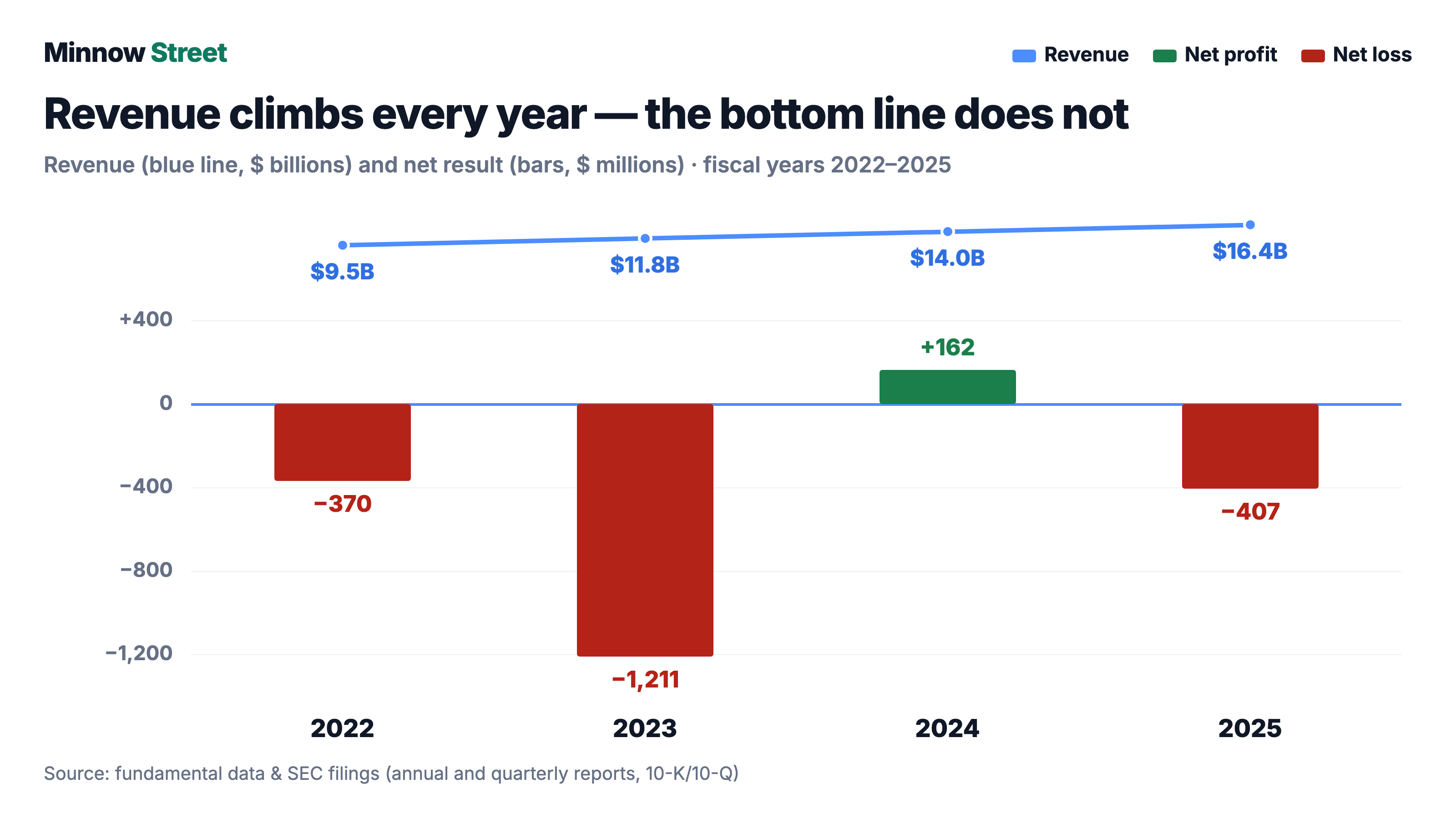
Why? For 2025 you can walk it line by line. Of $7,404 million of gross profit, $3,678 million went into sales and marketing (advertising alone was $2,053 million), $991 million into technology and development, $2,182 million into general and administrative costs — and then a $517 million goodwill impairment. What remained was an operating profit of $36 million, after $869 million a year earlier. Then come interest ($515 million net) and taxes. And here is the sentence that makes you pause: on a pre-tax loss of $121 million, Flutter paid $286 million of income taxes. That is not an error but daily life in a group that makes profits and losses in many countries at once — they cannot simply be netted. Picture it this way: your side job loses money, your main job earns money; the tax office still taxes the main job, and the loss does not help you.
A second detail shows this is no accident: depreciation and amortization rose to $1,517 million in 2025 (2024: $1,097 million). That is the delayed bill for the acquisitions — every brand bought, every customer relationship acquired is amortized over years and weighs on earnings for as long as it sits on the balance sheet. Remember the pattern: growth by acquisition shows up in revenue immediately, but in costs only later.
What the filings say — the uncomfortable truths
Uncomfortable truth no. 1: the quarterly profit appears when FanDuel is worth less
The first quarter of 2026 looked like a turning point: $209 million of net income, diluted earnings of $1.23 per share. Read only the bottom line and you see a profitable world leader. The breakdown tells a different story:
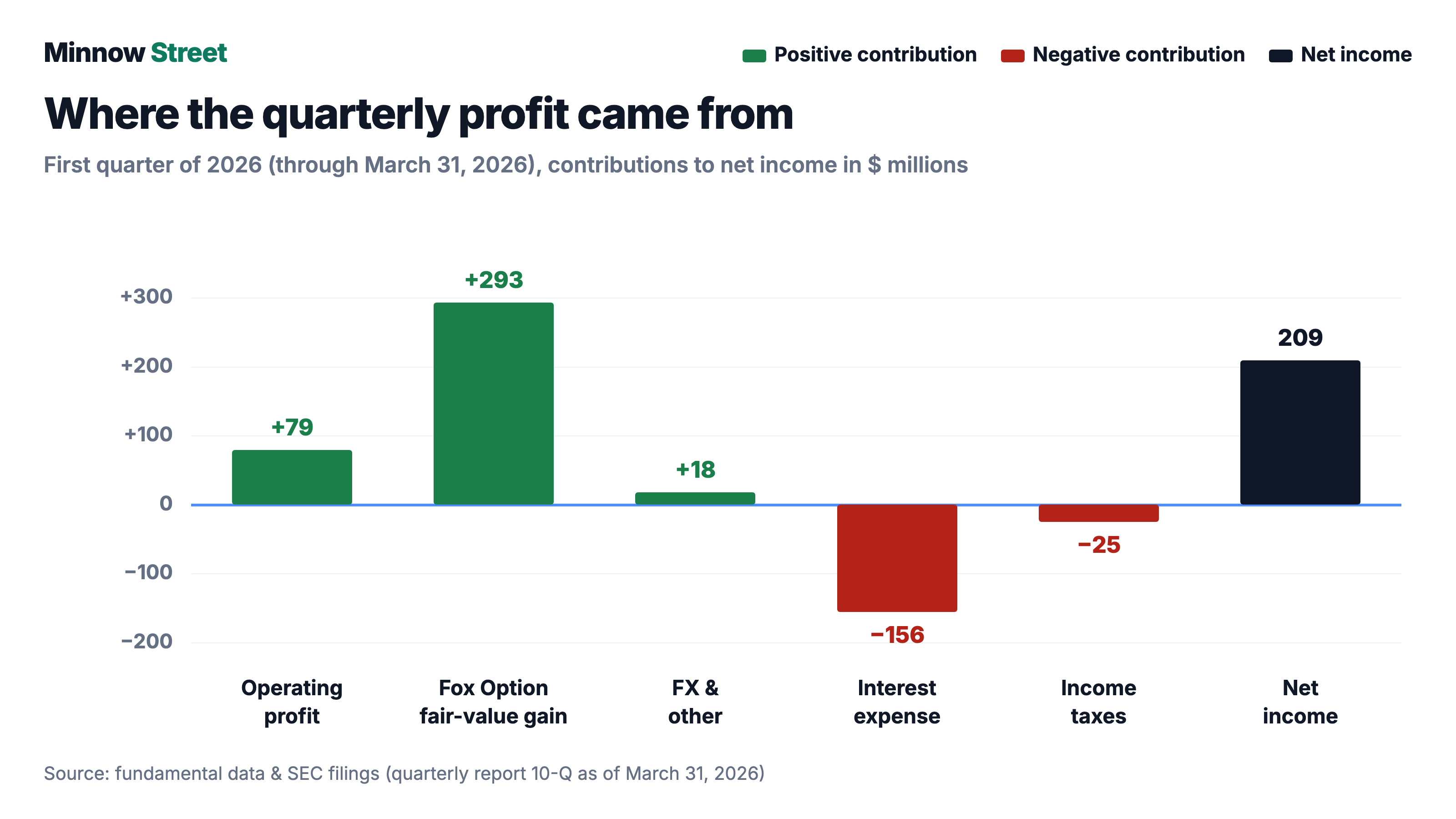
Operating profit for the quarter was $79 million — down from $223 million a year earlier. Interest expense was $156 million, income taxes $25 million. Arithmetically that is a loss. What lifted the quarter into the black is a single line from the notes:
"Fair value gain on Fox Option liability … 293"
— Flutter Entertainment plc, SEC quarterly report 10-Q as of March 31, 2026, Note 4 "Other income (expense), net"
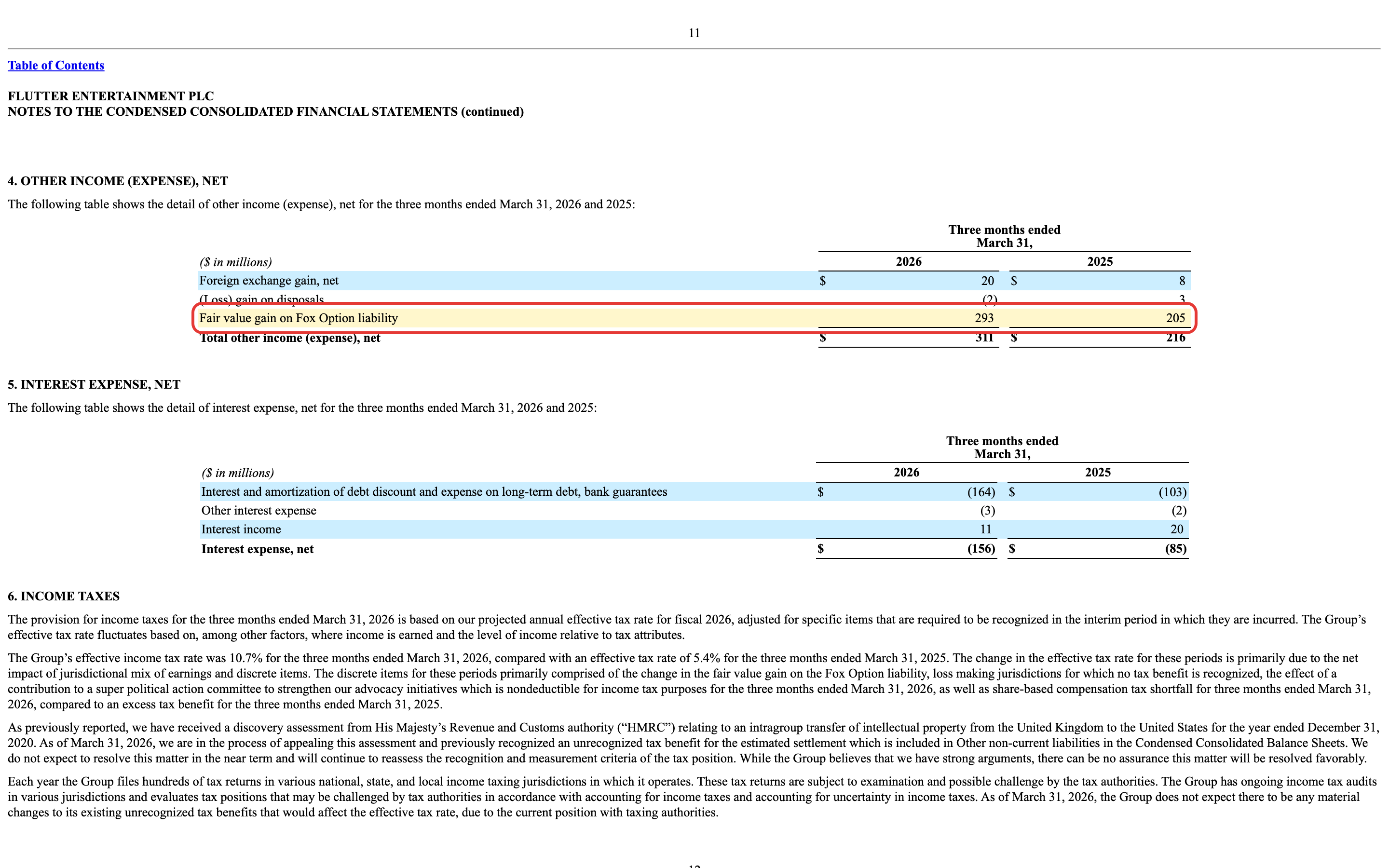
To see why this is paradoxical you need the backstory. When Flutter bought The Stars Group in 2020, it inherited an agreement with the U.S. media group Fox: Fox may buy 18.6 percent of FanDuel — at a price that grows 5 percent every year and stood at $4.8 billion as of December 31, 2025 (prior year: $4.5 billion). It can be exercised through December 2030, in cash, only in full, and only if Fox obtains a gaming license.
"The Fox Option is measured at fair value with changes in fair value recognized in earnings. As of December 31, 2025 and December 31, 2024, the fair value of the Fox Option amounts to $560 million and $810 million, respectively, which was determined using an option pricing model."
— Flutter Entertainment plc, SEC annual report 10-K for fiscal year 2025, Item 7 "Critical Accounting Policies and Estimates — Fox Option Liability"
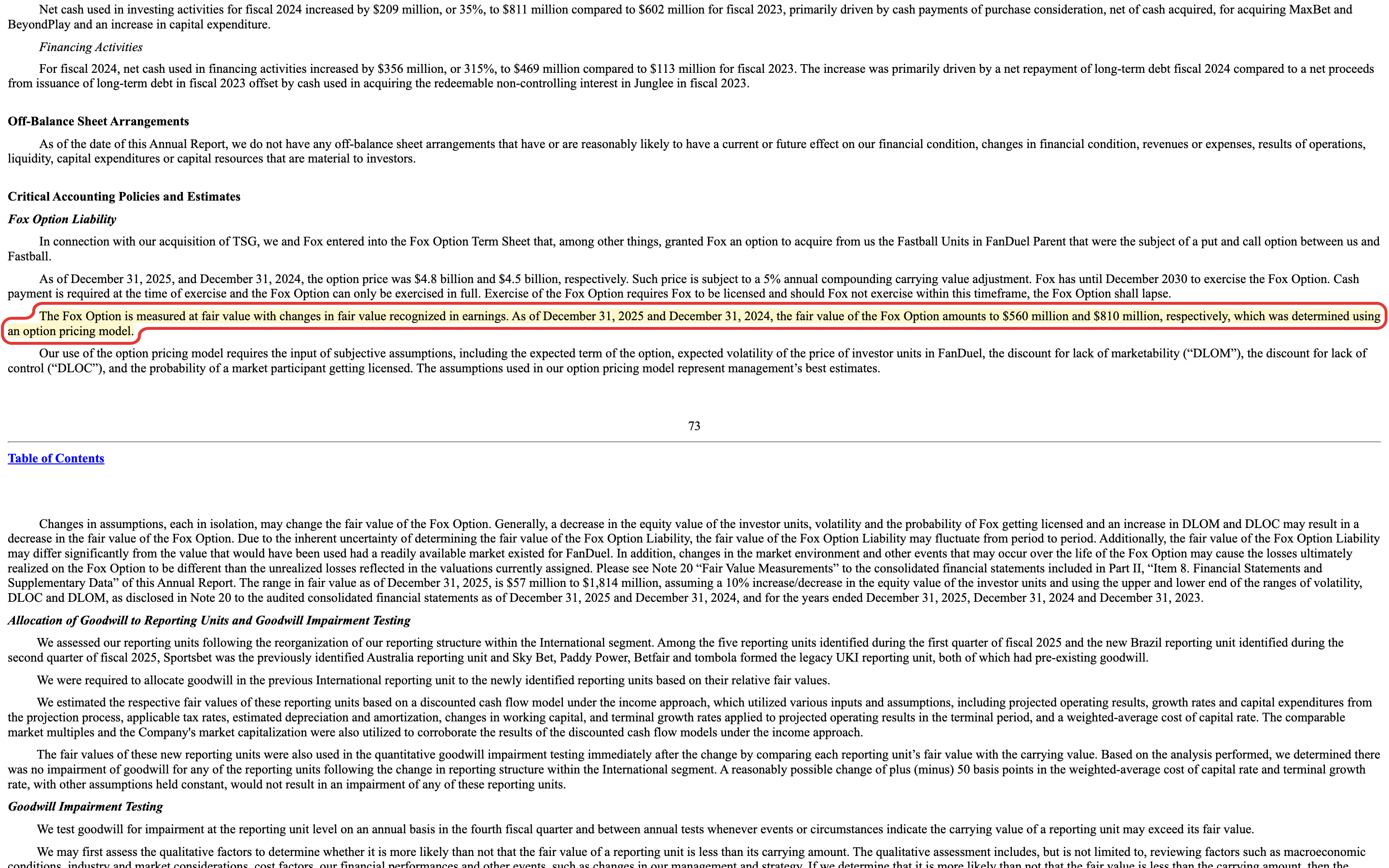
And here the circle closes. The filing itself explains what drives the value of that liability: among other inputs, the "equity value of the investor units" — the value of the FanDuel units. If that value falls, the option becomes less attractive to Fox, the carried liability shrinks — and the decline lands as income in Flutter's income statement. If FanDuel's value rises, the reverse happens: in 2024 the very same item cost $426 million of expense, in 2023 it cost $165 million. Picture it: you promised your neighbor he could buy your house at a fixed price if he wants it. If the housing market falls, that promise becomes less dangerous for you — you look better on paper even though your house is worth less. That is exactly the mechanism here. Remember it: part of Flutter's reported profit is a mirror image of falling expectations for FanDuel — not money received. The filing quantifies the leverage as well: at plus or minus 10 percent of FanDuel's equity value, the option's fair value ranges between $57 million and $1,814 million.
To be fair, here is the other side: in 2025 Flutter bought out the last outside minority in FanDuel — Boyd's 5 percent stake for $1,553 million. That implies a value of just over $31 billion for FanDuel. The group has held 100 percent since then — "subject to the Fox Option", as the filing adds in parentheses. So the option is not an accounting detail; it is a live claim on almost a fifth of the crown jewel.
Uncomfortable truth no. 2: one law, one day — and an entire country business was gone
On August 22, 2025 India's president signed a law banning every form of online real-money gaming in the country. Flutter's Indian subsidiary Junglee stopped operating the same day. What that meant in the accounts is stated plainly:
"During the third quarter of 2025, the Group recognized a goodwill impairment of $517 million attributable to the Junglee reporting unit. The Act, which was passed by the Indian Parliament and received Presidential assent on August 22, 2025, bans all forms of online real money gaming in India. As a result of the Act, from August 22, 2025, Junglee ceased offering all real-money games in India. Given there were no other viable commercial operations in the Junglee reporting unit at this time, the goodwill balance related to the Junglee reporting unit was fully impaired."
— Flutter Entertainment plc, SEC annual report 10-K for fiscal year 2025, Note 10 "Goodwill"
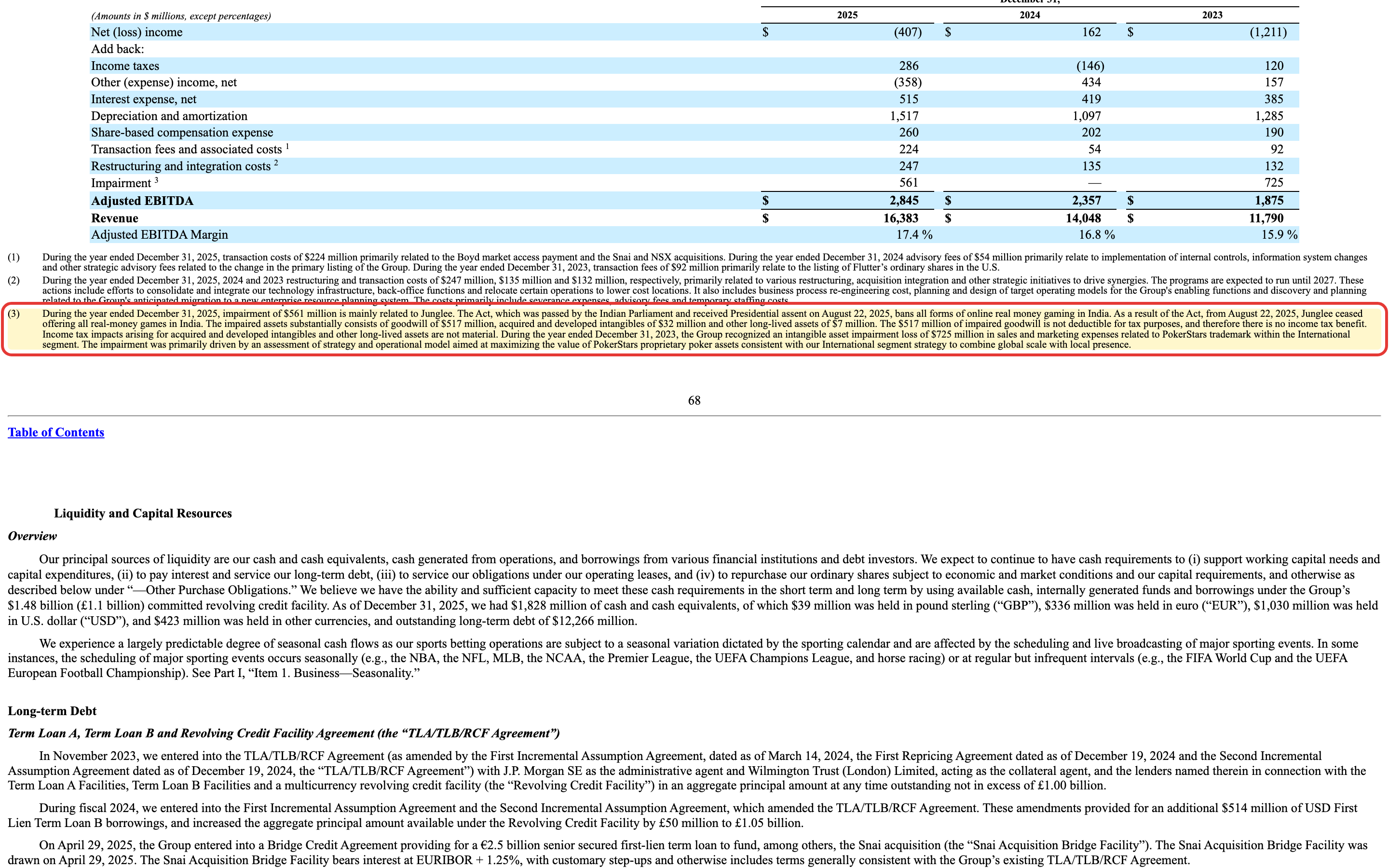
This is the key passage for understanding the industry. A gaming group does not own its markets; it owns licenses — and licenses can be revoked. No collapse in demand, no management error, no competitor: one signature, and $549 million of carrying value was history in a day. For scale: the group had spent roughly $95 million in 2023 and another $67 million in 2025 buying up more of Junglee. And the write-off was worthless for tax purposes — the filing states explicitly that the impaired goodwill is not deductible, so no tax benefit arises.
Uncomfortable truth no. 3: the tax screw keeps turning — in both core markets
Anyone who thinks India was a one-off should look at the two most important markets. In the United Kingdom, the government announced on November 26, 2025 that remote gaming duty would rise from 21 percent to 40 percent on April 1, 2026, and duty on online sports betting (excluding horse racing) from 15 percent to 25 percent on April 1, 2027. In the United States the pressure comes from the states:
"For example, Illinois imposed a progressive tax on sports betting revenue (up to 40%) from July 2024 and per-wager fee from July 2025, which has contributed to a decline in legal betting volume."
— Flutter Entertainment plc, SEC annual report 10-K for fiscal year 2025, Item 1 "Business — Regulation"
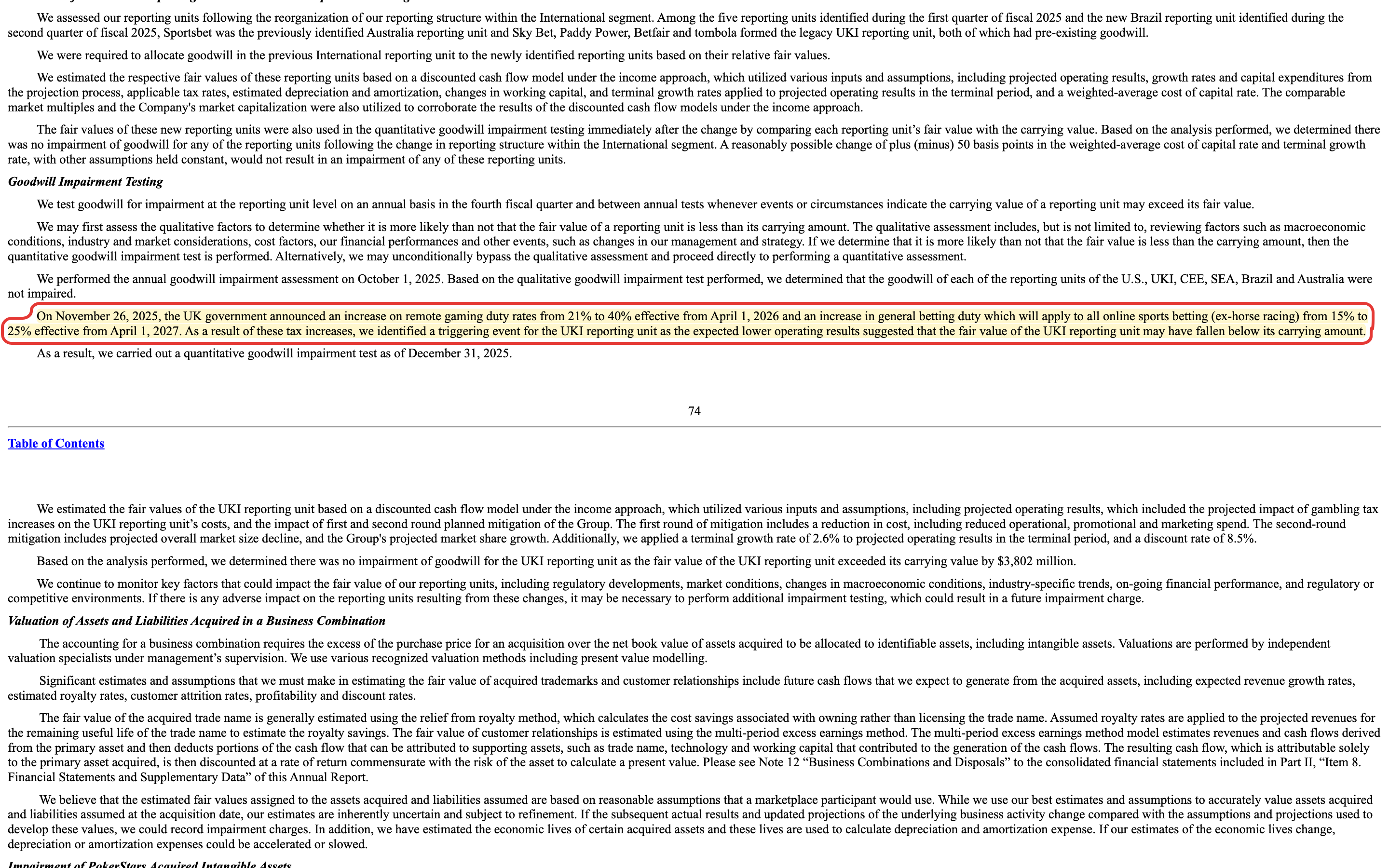
The UK increase hits a business that is no longer growing: revenue of the UKI unit was $3,547 million in 2025, slightly below the $3,599 million of the prior year. Flutter therefore had to test that unit's goodwill outside the normal cycle. The result was reassuring — fair value exceeded carrying value by $3,802 million, no impairment needed — but the route there is worth noting: in its second stage the model explicitly assumes a shrinking overall market alongside a rising Flutter market share. In plain terms: the sums work because competitors are expected to handle the tax worse. That may well be right. But it is an assumption, not a number.
Uncomfortable truth no. 4: the growth was bought — and debt almost doubled
A large part of the 2025 revenue jump came not from more players but from more companies. On April 30, 2025 Flutter acquired Snai in Italy for €2.3 billion ($2.6 billion), plus 56 percent of NSX/Betnacional in Brazil for $674 million, with call and put options over the remainder in years five and ten. On top came $1,553 million for Boyd's FanDuel stake and $1,123 million of share repurchases. Most of it was financed with debt: financial debt rose in 2025 from $6,736 million to $12,266 million, and interest expense from $419 million to $515 million. Goodwill on the balance sheet grew to $15,825 million — more than the $9,038 million of equity.
None of this is a catastrophe, but it clearly narrows the room to maneuver. Against $1,184 million of operating cash flow in 2025 stood roughly $777 million of investment in property, software and licenses — leaving a good $400 million of free cash flow while more than $5 billion went out for acquisitions, minority buyouts and repurchases. The buyback program of up to $5 billion (authorized September 25, 2024) was only about a fifth used by the end of 2025; $3,879 million remains. Remember the arithmetic: a company that spends more than it earns finances the difference — and the price of that is interest. How tight things have become in the core business at the same time shows up in the first quarter of 2026: U.S. sportsbook revenue of $1,144 million was only 0.9 percent above the prior-year quarter ($1,134 million); the growth came from U.S. online casino (+19.5 percent to $564 million) and from the freshly acquired international businesses (+27.1 percent to $2,541 million).
Valuation: what the market pays for the market leader
No price-to-earnings ratio can be built for 2025 — there were no earnings. The most honest dated anchor sits on the cover of the annual report itself: as of June 30, 2025, the ordinary shares held by non-affiliates were worth $50.37 billion at the NYSE closing price. Set against fiscal 2025 revenue of $16,383 million, that is a price-to-sales ratio of roughly 3. Add net debt at the same date (financial debt of $10,013 million less $1,691 million of cash) and enterprise value lands in the order of $59 billion — about twenty times the $2,845 million of Adjusted EBITDA.
What does that mean? It is the price of a world leader growing at double digits — no bargain and no bubble, but a valuation that assumes the adjusted result will one day become a reported profit. That is precisely the bet. Between $2,845 million of Adjusted EBITDA and a $407 million net loss sit $1,517 million of depreciation and amortization, $561 million of impairments, $515 million of interest, $286 million of taxes, $260 million of share-based compensation, $247 million of restructuring and $224 million of transaction costs. Part of that fades with time (restructuring, transaction costs); part does not (interest, taxes, share-based compensation). Whoever buys Flutter is buying the claim that the first part is bigger than the second. How differently markets price such transitions shows up elsewhere in sport and entertainment too — for example in our analysis of MSG Entertainment, or in the other pieces in our research section. Flutter pays no dividend, incidentally: the $27 million of dividends in 2025 went to minority holders in subsidiaries, not to Flutter shareholders.
Opportunities and risks at a glance
What speaks for Flutter Entertainment:
- A clear global leader with real scale: $16,383 million of revenue in fiscal 2025 (+16.6 percent), 15.9 million average monthly players, 88 percent of the business online — and in the United States, with FanDuel, the number one in a market that is still opening state by state.
- Adjusted operating earnings grow faster than revenue: Adjusted EBITDA from $1,875 million (2023) through $2,357 million (2024) to $2,845 million (2025), margin from 15.9 percent to 17.4 percent — the marketing scale effects are measurable.
- Operating cash flow is positive and steady ($1,184 million in 2025, $330 million in the first quarter of 2026 alone); cash stood at $1,828 million at the end of 2025.
- Broad diversification across roughly 100 markets and many brands: when one country falls away — as India did in 2025 — the rest keeps carrying; U.S. online casino grew 37.5 percent in 2025 to $2,095 million.
- Capital returns are running: $1,123 million of buybacks in 2025, share count down from 177.9 million to 175.2 million; $3,879 million of the $5 billion program is still open.
What speaks against it:
- The bottom line was a loss in three of four years (2022 to 2025: −$370 million, −$1,211 million, +$162 million, −$407 million); operating profit fell in 2025 from $869 million to $36 million.
- A material part of reported profit is a remeasurement effect: in the first quarter of 2026, $293 million of $209 million of net income came from the decline in the Fox Option liability — an item that grows when FanDuel is worth less and worked the other way in 2024 with $426 million of expense.
- The Fox Option itself: a claim on 18.6 percent of FanDuel at $4.8 billion (as of December 31, 2025, rising 5 percent a year), exercisable through December 2030 — and, per the filing, Fox has initiated arbitration proceedings in the past.
- Regulatory and tax risk is existential risk: India banned online real-money gaming overnight ($517 million of goodwill written off), the United Kingdom lifts remote gaming duty from 21 percent to 40 percent from April 2026, and Illinois has, per the filing, already depressed legal betting volume.
- Growth on credit: financial debt up in 2025 from $6,736 million to $12,266 million, goodwill of $15,825 million against $9,038 million of equity, depreciation and amortization up to $1,517 million — and in the first quarter of 2026 U.S. sportsbook revenue grew only 0.9 percent.
A human conclusion
Back to the house-edge trap. It is so persistent because its core is true: the house really does always win. Flutter's players lose reliably in aggregate, and that turns into $16.4 billion of revenue a year. The error sits one level down: between the house's win and the shareholder's win stand cashiers who get paid first. The tax authority takes $286 million even when the pre-tax line is a loss. The legislature can erase $549 million of carrying value with one signature — in India it did — and lifts UK duty from 21 percent to 40 percent from April 2026. The banks take $515 million of interest for the money that paid for Snai, Betnacional and the last slice of FanDuel. And somewhere in the notes, Fox waits with a contract that can reach almost a fifth of FanDuel through December 2030.
None of this makes Flutter a bad company — on the contrary, it is a market leader with real cash flow, growing adjusted earnings and a U.S. position every competitor envies. But it does break the simple story. So the honest question is not "does the house win?" It is: does enough of the house edge survive after the tax authority, the legislature, the interest bill and a 2020 option contract have helped themselves — and are you willing to wait for a reported profit that has not appeared in three of the last four years? If yes, you have a thesis. If no, you had a proverb. What you make of it is your decision. And that is exactly as it should be.
Sources
All original documents used in this analysis — for you to read yourself:
- Flutter Entertainment plc — SEC annual report 10-K for fiscal year 2025 (filed February 26, 2026)
- Flutter Entertainment plc — SEC annual report 10-K for fiscal year 2024 (filed March 4, 2025)
- Flutter Entertainment plc — SEC annual report 10-K for fiscal year 2023 (filed March 26, 2024, with the explanatory note on the voluntary use of U.S. domestic forms)
- Flutter Entertainment plc — SEC quarterly report 10-Q as of March 31, 2026 (filed May 6, 2026)
- Helikon Investments Ltd — SEC Form 13F-HR as of March 31, 2026 (filed May 8, 2026, accession 0001839497-26-000002)
- Complete SEC filing history of Flutter Entertainment plc: EDGAR overview (sec.gov)
- Fundamental data (metrics, segment contributions, valuation; data as of July 23, 2026), reconciled with the SEC filings and the SEC's XBRL financial series.
Transparency & disclaimer: this analysis is a journalistic contextualization of publicly available information and is not investment advice, not a regulated financial analysis and not a solicitation to buy or sell securities. Equity investments carry substantial risk up to total loss. All information without warranty; the data cut-off is noted in the text. The author holds no position in Flutter Entertainment shares at the time of publication.
Our Bottom Line at a Glance
- Market position & growth positive
- Flutter is the largest betting and gaming group in the world: $16,383 million of revenue in fiscal 2025 (+16.6 percent), 15.9 million average monthly players and, with FanDuel, the number one in the growing U.S. market (segment revenue +20.2 percent to $6,967 million). The first quarter of 2026 grew another 17.4 percent to $4,304 million.
- Earnings quality negative
- The bottom line was a loss in three of four years (2022 to 2025: −$370 million, −$1,211 million, +$162 million, −$407 million), and operating profit fell in 2025 from $869 million to $36 million. Of the $209 million of net income in the first quarter of 2026, $293 million came from the fair-value gain on the Fox Option liability — an item that rises when FanDuel is worth less.
- Regulation & taxes negative
- The business stands or falls with licenses. India banned all online real-money gaming on August 22, 2025, and Flutter wrote off the entire $517 million of goodwill in its Junglee unit. The United Kingdom lifts remote gaming duty from 21 percent to 40 percent on April 1, 2026 and betting duty from 15 percent to 25 percent on April 1, 2027; in Illinois, per the filing, higher levies have already reduced legal betting volume.
- Balance sheet & financing negative
- Financial debt rose in 2025 from $6,736 million to $12,266 million and interest expense from $419 million to $515 million. It paid for Snai ($2.6 billion), NSX/Betnacional ($674 million), Boyd's FanDuel stake ($1,553 million) and share repurchases ($1,123 million). Goodwill of $15,825 million clearly exceeds equity of $9,038 million.
- Cash flow & capital returns neutral
- Operating cash flow is solid ($1,184 million in 2025, $330 million in the first quarter of 2026), but after roughly $777 million of investment only a good $400 million remains free — against more than $5 billion spent on acquisitions and buybacks. The share count is falling (177.9 million to 175.2 million); there is no dividend for Flutter shareholders.
Flutter Entertainment is the house-edge trap in its purest form: the world's largest bookmaker grows at double digits, serves 15.9 million players a month and reports $2,845 million of Adjusted EBITDA for fiscal 2025 — and still shows a $407 million net loss. In between sit $1,517 million of depreciation and amortization, $515 million of interest on nearly doubled debt, $286 million of taxes despite a pre-tax loss, and a $517 million goodwill impairment because India banned online real-money gaming overnight. The quarterly profit in early 2026, meanwhile, largely comes from a remeasurement that grows when FanDuel is worth less. Not investment advice.
What Our Rating Means
Open questions
The business works in principle, but one material question is open. As long as it stays open, our findings do not carry a quality verdict.
Whoever buys today is betting that $2,845 million of Adjusted EBITDA turns into a reported profit within a reasonable time — that restructuring and transaction costs run off, that amortization of the acquisitions declines and that the tax burden stays bearable despite British and American duty increases. Whoever holds the stock checks three numbers in every report: operating profit excluding the Fox Option effect, U.S. sportsbook revenue (last up just 0.9 percent in the first quarter of 2026) and the path of financial debt from its last level of $12,266 million. As long as reported profit is largely produced by an option remeasurement, this stays a watch case. The decision is yours.
A journalistic assessment by our editorial team at the time of the deep dive, based on public sources — not investment advice and not a solicitation to buy or sell. Your personal circumstances (investment goals, risk capacity, taxes) cannot be taken into account. What our levels mean, how verdicts are formed, and what conflicts of interest exist →
Worth Noting
- Flutter Entertainment reached our research list not through a metrics scanner but through a mandatory filing: London-based Helikon Investments Ltd reported 1,439,750 Flutter shares worth $146,782,513 in its SEC Form 13F-HR as of March 31, 2026 (filed May 8, 2026) — a brand-new position. A 13F shows only U.S.-listed long positions with a 35 to 45 day delay, without short sales and derivatives: a rear-view mirror, not a road map.
- Classic metrics only go so far here: no price-to-earnings ratio can be built for 2025 without earnings, and balance-sheet scores such as Piotroski or Altman Z systematically misjudge a group carrying $15,825 million of goodwill. The meaningful figures are segment revenue, Adjusted EBITDA and the reconciliation to reported earnings.
- Valuation figures are dated and evergreen: shares held by non-affiliates were worth $50.37 billion as of June 30, 2025 (annual report cover), implying a price-to-sales ratio of roughly 3 and an enterprise value of about twenty times fiscal 2025 Adjusted EBITDA. Analyses are evergreen; daily prices are not a buy argument.
Frequently Asked Questions
Flutter Entertainment plc (NYSE: FLUT) is the world's largest sports betting and online gaming group. It owns FanDuel and TVG in the United States as well as Sky Betting & Gaming, Paddy Power, Betfair, tombola, PokerStars, Sportsbet, Sisal, Snai, MaxBet, Adjarabet and Betnacional. In fiscal 2025 the group generated $16,383 million of revenue — 53 percent from sportsbook and 44 percent from online casino, poker and lottery — served 15.9 million average monthly players and employed 28,518 people across 27 countries.
Because a lot sits between revenue and the bottom line. In fiscal 2025, after sales and marketing of $3,678 million, technology, administration and a $517 million goodwill impairment, only $36 million of operating profit remained from $16,383 million of revenue. Then came $515 million of interest and $286 million of income taxes — even though the pre-tax line was a loss of $121 million. The bottom line was −$407 million. Adjusted EBITDA in the same year was $2,845 million.
A call option held by the U.S. media group Fox over 18.6 percent of FanDuel, created when Flutter acquired The Stars Group in 2020. The exercise price stood at $4.8 billion as of December 31, 2025 (prior year $4.5 billion) and rises 5 percent a year; it can be exercised through December 2030, in cash, only in full and only with a gaming license. The balance sheet carries a matching liability, valued at $560 million as of December 31, 2025 (prior year $810 million); changes in value run through the income statement.
In the first quarter of 2026 Flutter reported $209 million of net income. Operating profit, however, was only $79 million and interest expense $156 million. What lifted the quarter was a $293 million fair-value gain on the Fox Option liability: when the expected value of the FanDuel units falls, the carried liability falls with it — and the decline is booked as income. In 2024 the same item ran the other way, with $426 million of expense.
Because Flutter has counted as a U.S. domestic issuer since January 1, 2025. The group has been listed on the NYSE since January 29, 2024 and moved its primary listing there on May 31, 2024 after shareholder approval; the Irish listing was ended and the global operational headquarters sits in New York. During 2024 the company determined that it no longer qualifies as a foreign private issuer — since then the full U.S. duties apply, including quarterly reports, Regulation FD and insider filings (Form 4).
The United Kingdom raises duty on online gaming from 21 percent to 40 percent on April 1, 2026, and duty on online sports betting (excluding horse racing) from 15 percent to 25 percent on April 1, 2027. The affected unit is UKI (Sky Bet, Paddy Power, tombola, Betfair, PokerStars) with $3,547 million of revenue in 2025. Flutter therefore had to test the unit's goodwill outside the normal cycle; fair value exceeded carrying value by $3,802 million — but on the assumption of a shrinking overall market with a rising Flutter share.
No price-to-earnings ratio can be built for 2025 because there were no earnings. The dated anchor from the annual report: as of June 30, 2025 the shares held by non-affiliates were worth $50.37 billion. Against fiscal 2025 revenue of $16,383 million that is a price-to-sales ratio of roughly 3; including net debt, enterprise value equals about twenty times the $2,845 million of Adjusted EBITDA. Flutter pays no dividend to its shareholders.
Found an error?
Did you spot a factual error, an outdated number, or a typo in this deep dive? Let us know briefly — your report goes straight to the editorial team.