Super Group: $2.2 Billion in Betting Revenue — and Nearly Four of Every Five Dollars Come From Three Countries
Super Group (NYSE: SGHC) runs the Betway betting brand and the Spin multi-brand casino, holds licenses in 20 countries and in 2025 turned $56.8 billion of wagers into $2,231 million of revenue and $218 million of profit. The annual report filed with the U.S. securities regulator, the SEC, also shows the other side: 78 percent of revenue comes from South Africa, Canada and the United Kingdom; the 2023 push into the United States was written down to zero by 2025 at a cost of $141 million, because the tax rules moved; two tax cases worth $77 million combined are still open. And because the company files as a foreign private issuer, an auditor looks at the numbers only once a year. Not investment advice — just the question of how safe a house edge really is when a legislature decides whether the table may stand.
 Thomas Mücke
Founder & Publisher
Thomas Mücke
Founder & Publisher
Chart
Interactive price chart (TradingView).
Note: pure fact-based analysis, not investment advice and not a solicitation to buy or sell. All figures without guarantee.
There is an investor trap that catches the sober-minded in particular, because it feels like arithmetic rather than hope: the house-edge trap. It goes like this. You look at a betting or casino company and think, entirely correctly, "the house always wins." The house edge is not an opinion; it is built in. At Super Group (SGHC) Ltd (NYSE: SGHC), the company behind the betting brand Betway and the multi-brand casino Spin, you can even do the math: in 2025 customers wagered $56.8 billion, of which $2,231 million stayed with the group as revenue — about $3.90 out of every $100 wagered, every day, no matter who wins which hand. And yet this very company burned $141 million in a single market over the past three years. Not because its house edge was too thin. Because the state moved the table. So let us make a deal: before you buy "the house always wins," we read together only what Super Group reported to the U.S. securities regulator, the SEC — the annual report (20-F) for 2025 filed on April 17, 2026, and the interim reports (6-K) of February and May 2026. A filing to the SEC is honest under penalty of law. In the end, the decision is yours.
What Super Group actually does — one brand for betting, many for playing
Super Group is a holding company registered on Guernsey, a Channel Island between England and France, and it runs two product worlds through subsidiaries around the world. First, Betway: a single global sports betting and casino brand licensed across Europe, the Americas and Africa, taking wagers on more than 70 sports and carrying over 90 partnerships with clubs, leagues and athletes — Arsenal in London among them, along with several NBA franchises. Second, Spin: a multi-brand online casino with more than 16 brands, plus Jumpman Gaming, majority-acquired in 2022 and fully owned since 2024, which alone operates roughly 200 brands and earns almost all of its revenue in the United Kingdom. Picture it this way: Betway is the one big store chain with its name over the door; Spin and Jumpman are the shelf of 200 private labels in the supermarket — same goods, many labels, so that every marketing channel and every taste finds something.
The scale: as of the annual report the group holds licenses in 20 jurisdictions and employs roughly 2,900 people across 16 regions. In 2025 more than 5.6 million customers played in an average month; in the first quarter of 2026 it was 6.4 million. By product, revenue is lopsided: $1,790 million of 2025 revenue came from online casino, only $408 million from sports betting and $26 million from brand licensing. Remember that right away: despite the betting image, Super Group is above all a casino company. That also sets the central tension of this analysis, and it runs through every chapter: the business earns reliably and grows fast — but nearly four of every five dollars come from three countries where a legislature decides the rules, and between two annual reports no auditor looks at the numbers at all.
How the stock reached our desk
Super Group is not a hit from our momentum or value scanners — the stock reached the research list through a mandatory SEC filing. The London hedge fund Helikon Investments Ltd reported in its Form 13F-HR as of March 31, 2026 (filed May 8, 2026) 9,424,702 Super Group shares worth $101,786,782 — and as an entirely new position: at the three preceding reporting dates (June 30, September 30 and December 31, 2025) the fund held not a single share. The portfolio held 17 positions worth $2,648,555,113 in total at that date; Super Group accounted for roughly 3.8 percent of it and for about 1.9 percent of all Super Group shares. The context is telling: in the same quarter the fund opened six new positions and sold six others outright — a rebuild quarter, not an add-on.
Which calls for the framing that belongs in every article like this one: a 13F is a rear-view mirror, not a road map. The form shows only U.S.-listed long positions, it arrives 35 to 45 days late, and it shows no short sales, no derivatives and no European holdings. What the fund has done since the reporting date, nobody knows but the fund. A 13F is a reason to look — not an argument.
And why does the stock not show up in our metric leaderboards? That is a finding in itself. Our scanners run on metrics drawn from quarterly reports — the Piotroski F-Score, a nine-point test for the direction of the books, or quarter-on-quarter growth rates. But Super Group is registered with the SEC as a foreign private issuer: there is no 10-K and no 10-Q, just an annual 20-F and voluntary 6-K announcements in between. Search for such companies with a screener alone and you often will not find them at all. So we read what exists — and that is more than most people expect.
The numbers over the years — honestly appraised
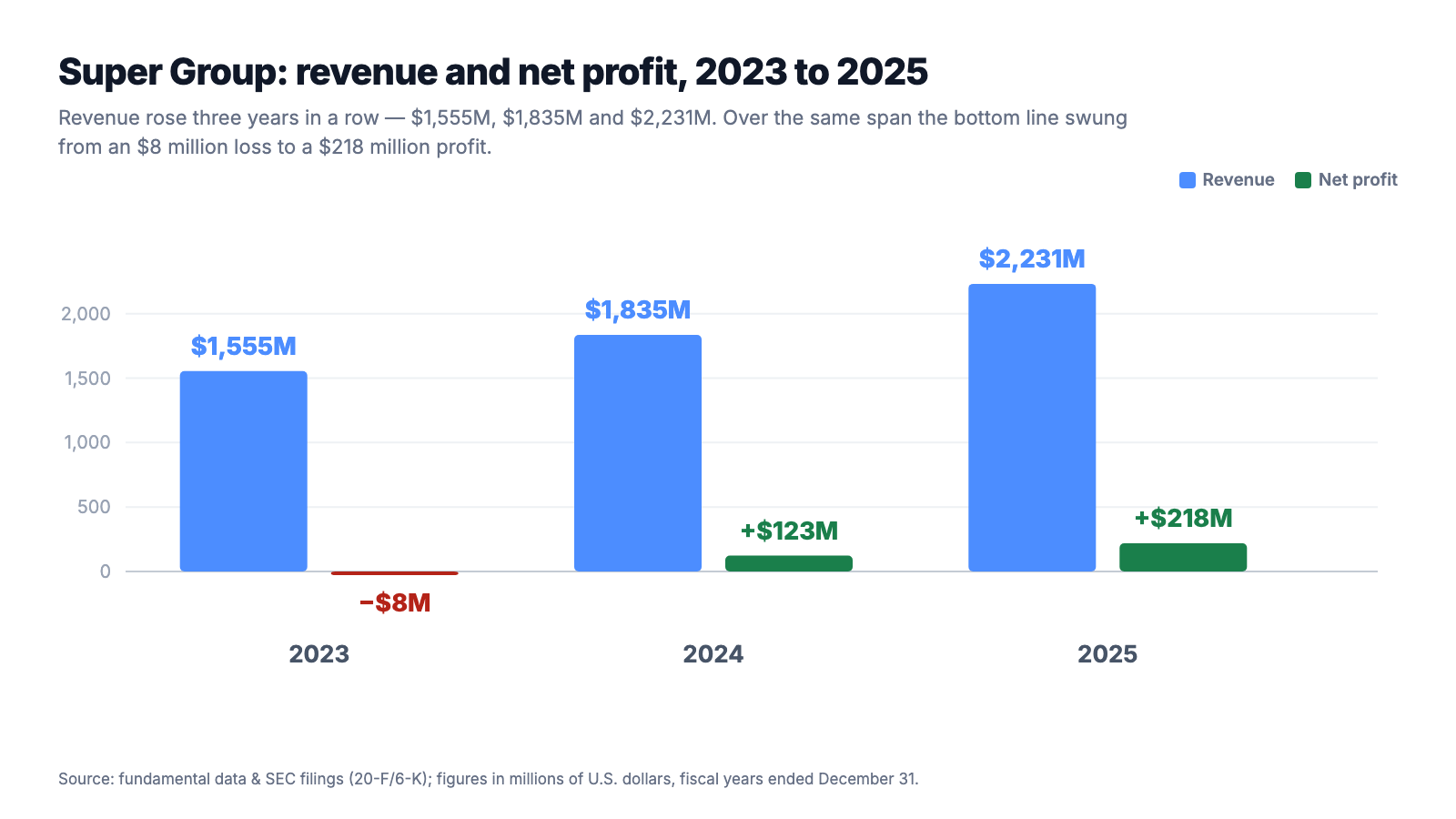
First what genuinely impresses. Revenue has grown 43 percent in three years: from $1,555 million (2023) through $1,835 million (2024) to $2,231 million (2025), a gain of 21.6 percent in the latest year. Over the same span the bottom line swung from an $8 million loss to a $218 million profit ($123 million in 2024). Adjusted EBITDA — operating profit before depreciation, interest and tax and excluding one-offs — rose 57 percent in 2025 to $559.5 million, a margin of roughly 25 percent.
The balance sheet is refreshingly undramatic as well. At December 31, 2025 there was $513.2 million of cash against total assets of $1,267 million and equity of $801 million — an equity ratio of 63 percent, with essentially no interest-bearing debt ($17 million). In February 2026 the group added a precautionary $100 million credit facility from Barclays, JPMorgan Chase and Citibank, maturing in February 2029. And the money flows back to shareholders: $156 million in 2025, and $152 million in the first quarter of 2026 alone (a 25 cent special dividend plus a 5 cent final dividend per share); the annual dividend target was raised from 16 to at least 20 cents per share. The start to 2026 fits the picture: $612 million of revenue in the first quarter (+18 percent), $86 million of profit, $152 million of adjusted EBITDA, and reaffirmed guidance of more than $2.55 billion in revenue and more than $680 million in adjusted EBITDA for the year.
One detail puts the growth story in its place: it was driven almost entirely by Betway. Its adjusted EBITDA jumped from $69 million (2023) to $222 million (2024) and $395 million (2025), while casino twin Spin moved only from $185 million through $185 million to $212 million over the same span. Remember the image: this group does not have two growth engines — it has one engine and one steady generator.
What the filings say — the uncomfortable truths
Uncomfortable truth no. 1: three countries carry 78 percent of revenue
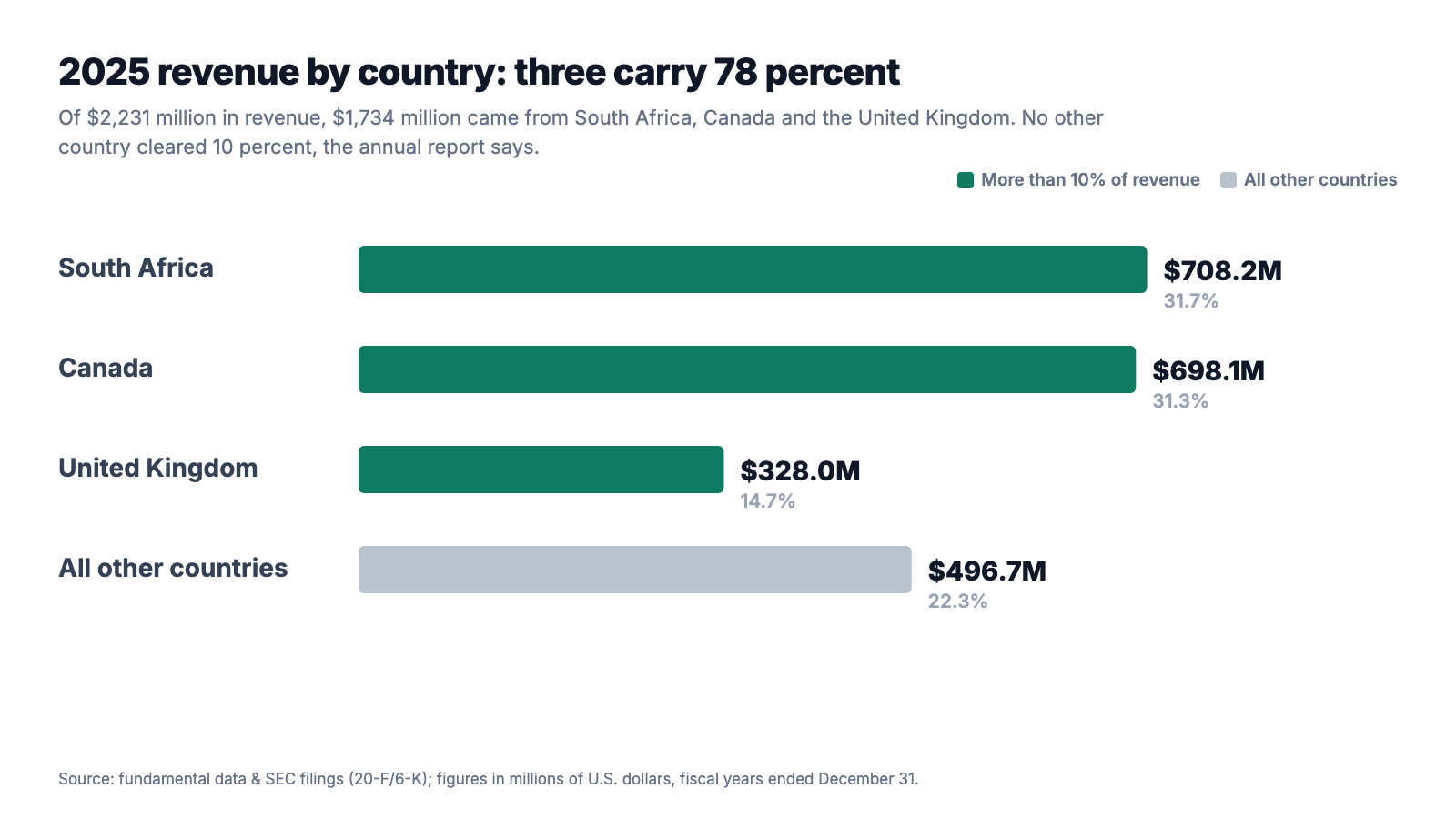
"Licensed in 20 jurisdictions," "2,900 employees across 16 regions" — that sounds like broad diversification. The notes to the annual report count differently. Of $2,231 million in 2025 revenue, $708.2 million came from South Africa, $698.1 million from Canada and $328.0 million from the United Kingdom — $1,734 million together, or 77.7 percent. No other country cleared the 10 percent threshold at which a company must break it out at all.
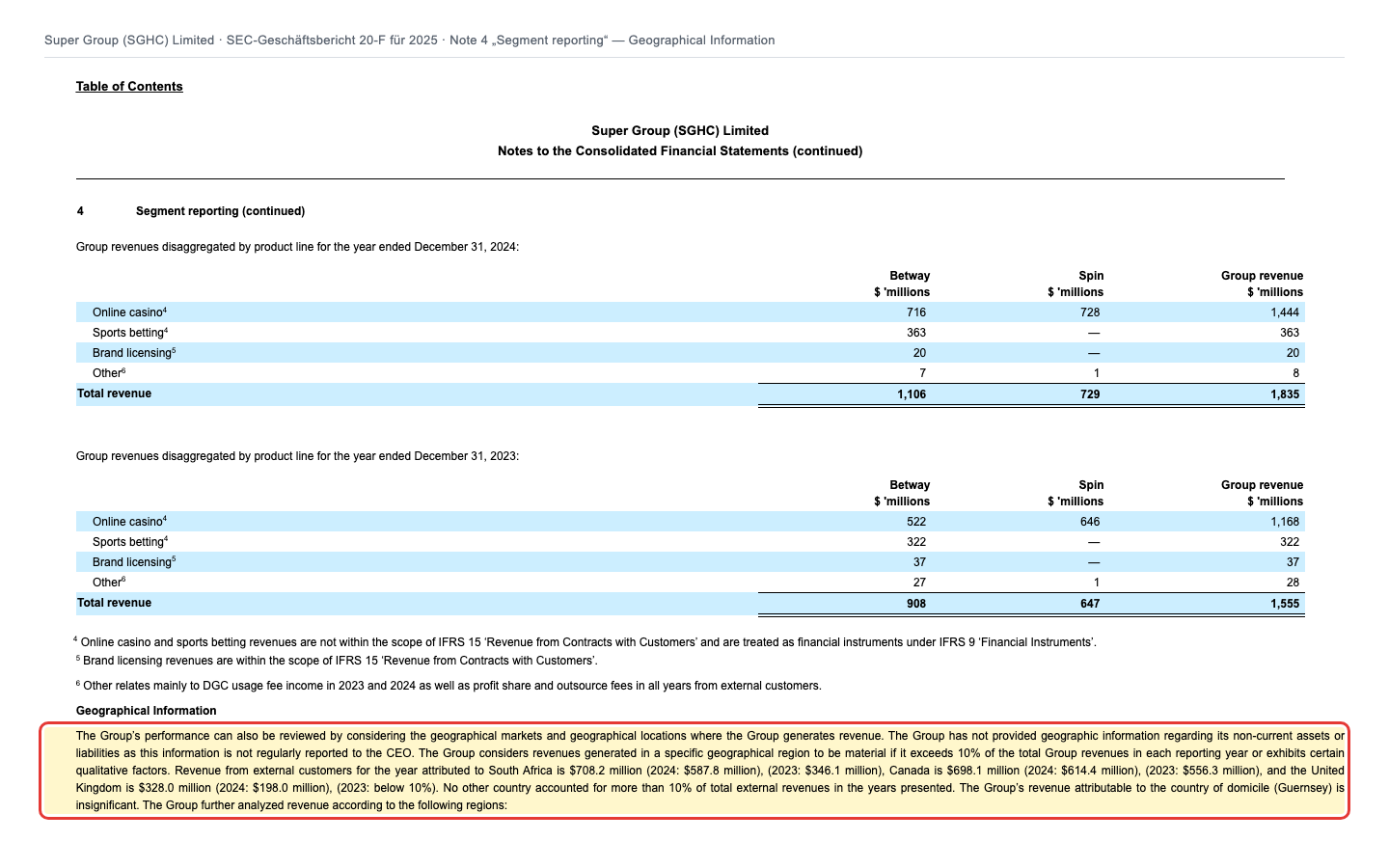
"Revenue from external customers for the year attributed to South Africa is $708.2 million (2024: $587.8 million), (2023: $346.1 million), Canada is $698.1 million (2024: $614.4 million), (2023: $556.3 million), and the United Kingdom is $328.0 million (2024: $198.0 million), (2023: below 10%). No other country accounted for more than 10% of total external revenues in the years presented."
— Super Group (SGHC) Limited, SEC annual report 20-F for 2025, Note 4 "Segment reporting," section "Geographical Information"
Picture a drinks wholesaler who proudly tells you he supplies 20 cities — but three streets buy 78 percent of his stock. As long as nobody changes the rules on those three streets, business is excellent. And in Canada, the second-largest market, there is a wrinkle you have to read twice: the group holds a license there in one single province — Ontario. For the rest of Canada the filing itself describes the market as not explicitly regulated, though the group says it is legally able to trade; search engines, it notes, do not permit gambling advertising there. Alberta plans to launch its own regime in 2026, and the filing names British Columbia and Quebec as candidates. A third of group revenue therefore rests on decisions taken in Canadian provincial legislatures.
Uncomfortable truth no. 2: the U.S. adventure cost $141 million — and ended at zero
How quickly a growth market turns into a total loss, Super Group has just demonstrated. In January 2023 it acquired Digital Gaming Corporation (DGC), which held the exclusive Betway license for the United States. In July 2024 DGC announced its exit from sports betting in all nine states where it was live. In July 2025 the U.S. online casino business under the Betway, Jackpot City and Spin Palace brands followed. The reason is in the filing:
"This closure arose due to the evolving regulatory landscape (relating to gaming taxes), the unit's performance and a shift in the Group's strategic objectives."
— Super Group (SGHC) Limited, SEC annual report 20-F for 2025, Note 10.1 "Exit from the United States market"
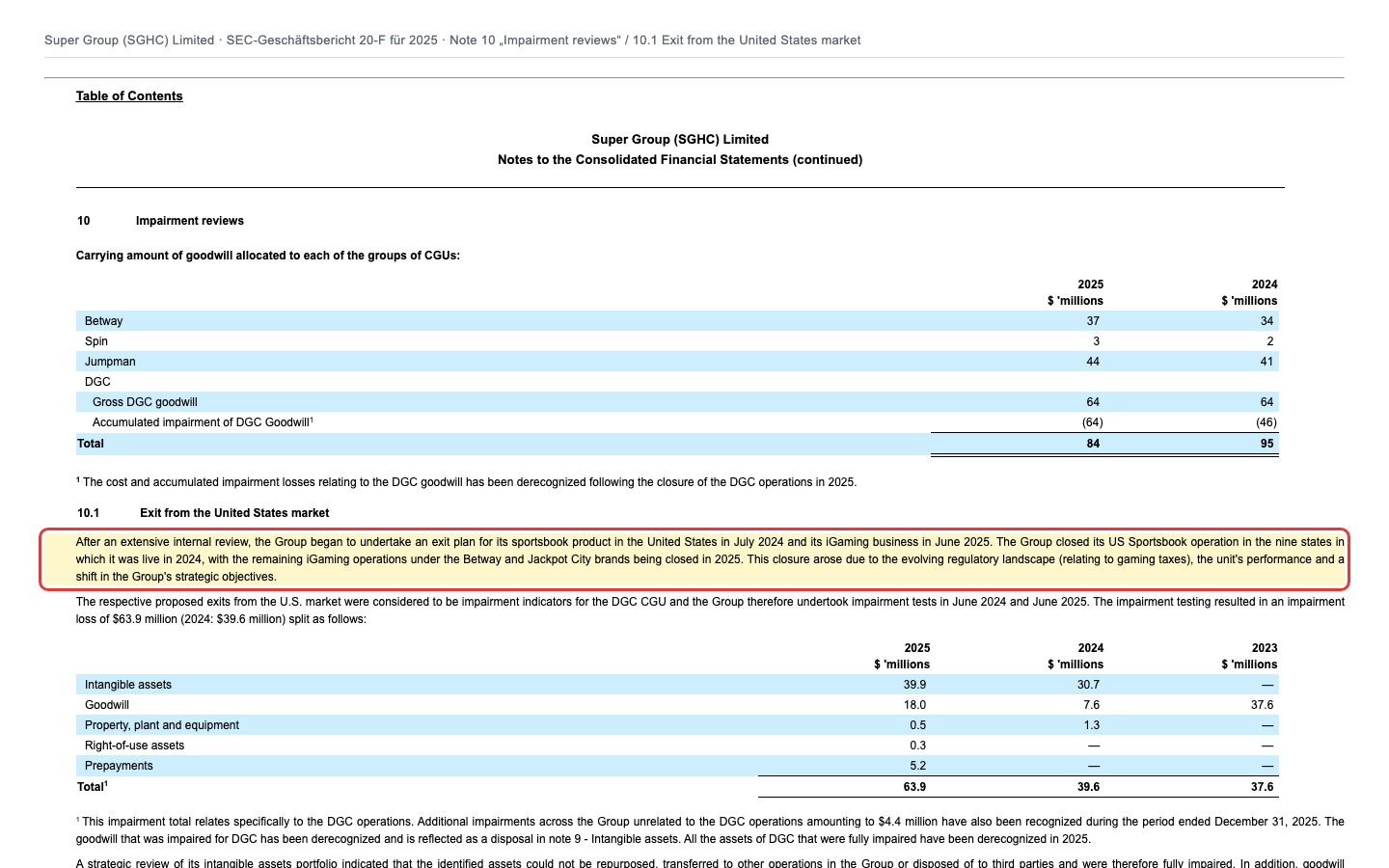
The arithmetic sits in the same note: $37.6 million of impairment in 2023, $39.6 million in 2024, $63.9 million in 2025 — $141.1 million together. The goodwill of the U.S. subsidiary was fully derecognized and every asset written down to zero. On top came onerous contracts: a $33.7 million provision on the 2024 sportsbook exit and a further $22.6 million on the 2025 casino exit, mostly for market-access fees to U.S. partners that keep running until 2030 even though revenue stopped in September 2025. In present-day terms: the U.S. unit cost $14.0 million of adjusted EBITDA in 2025 — without it the figure would have been $573.5 million instead of $559.5 million.
To be fair: the retreat was a business decision, not an accident, and it freed the company — 2026 grows without that weight. But the lesson stands, and it is the core of this analysis: the house edge did not save the company. The tax rate drove it out. The same mechanics can bite in South Africa, Canada or the United Kingdom — except that there it is not $14 million of adjusted EBITDA at stake, but the bulk of the business.
Uncomfortable truth no. 3: two open tax files worth $77 million combined
In this business model gaming taxes are not a footnote but the bill that always runs alongside. In 2025 gaming tax and license costs rose 74.4 percent to $93.1 million — from 7.3 to 11.0 percent of gaming revenue. And the notes carry two matters that are not settled. The first is a voluntary disclosure:
"During January 2024, a Voluntary Disclosure Program ("VDP") was filed with a tax authority for gaming taxes which were provided for in the preceding financial years. … A monthly payment plan was filed with the VDP and the VDP is yet to be assessed by the tax authority. The provision reclassified to accruals amounts to $50.4 million."
— Super Group (SGHC) Limited, SEC annual report 20-F for 2025, Note 21 "Provisions"
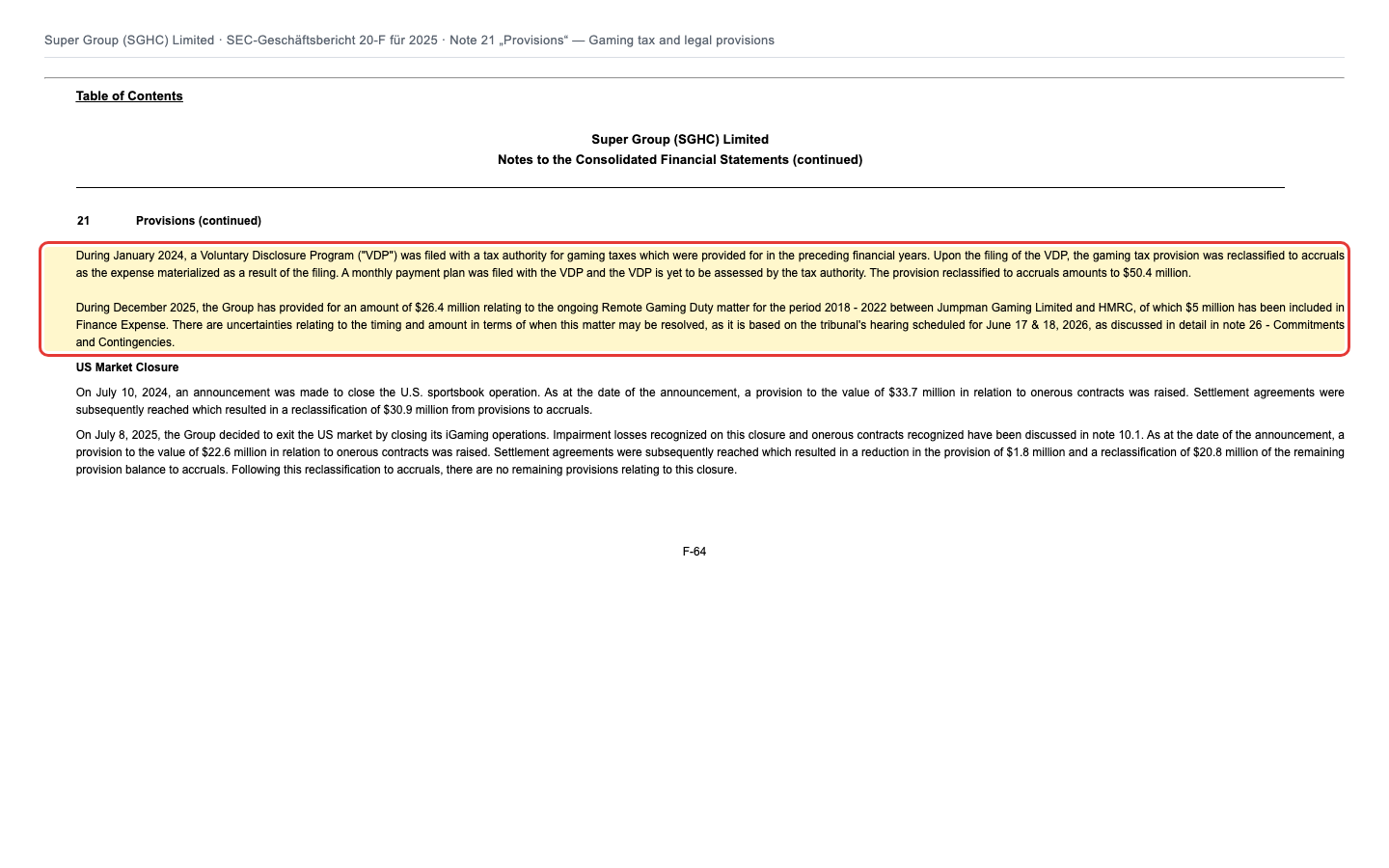
The second matter concerns the U.K. subsidiary Jumpman Gaming. HMRC first assessed £21.5 million of Remote Gaming Duty for the period from the third quarter of 2018 to the fourth quarter of 2022, later reduced to £12.1 million. Jumpman appealed — and lost: on September 16, 2025 the First-tier Tribunal dismissed the appeal. The further appeal to the Upper Tribunal was listed for June 17 and 18, 2026. The December 31, 2025 balance sheet carries £19.6 million, or $26.4 million, of which £7.1 million is interest and penalties alone. The auditor flagged the item as a critical audit matter — one of the places in the accounts that demand the most judgment. Together that is roughly $77 million of unresolved tax exposure, more than a third of one year's profit.
Uncomfortable truth no. 4: between two annual reports, nobody audits the numbers
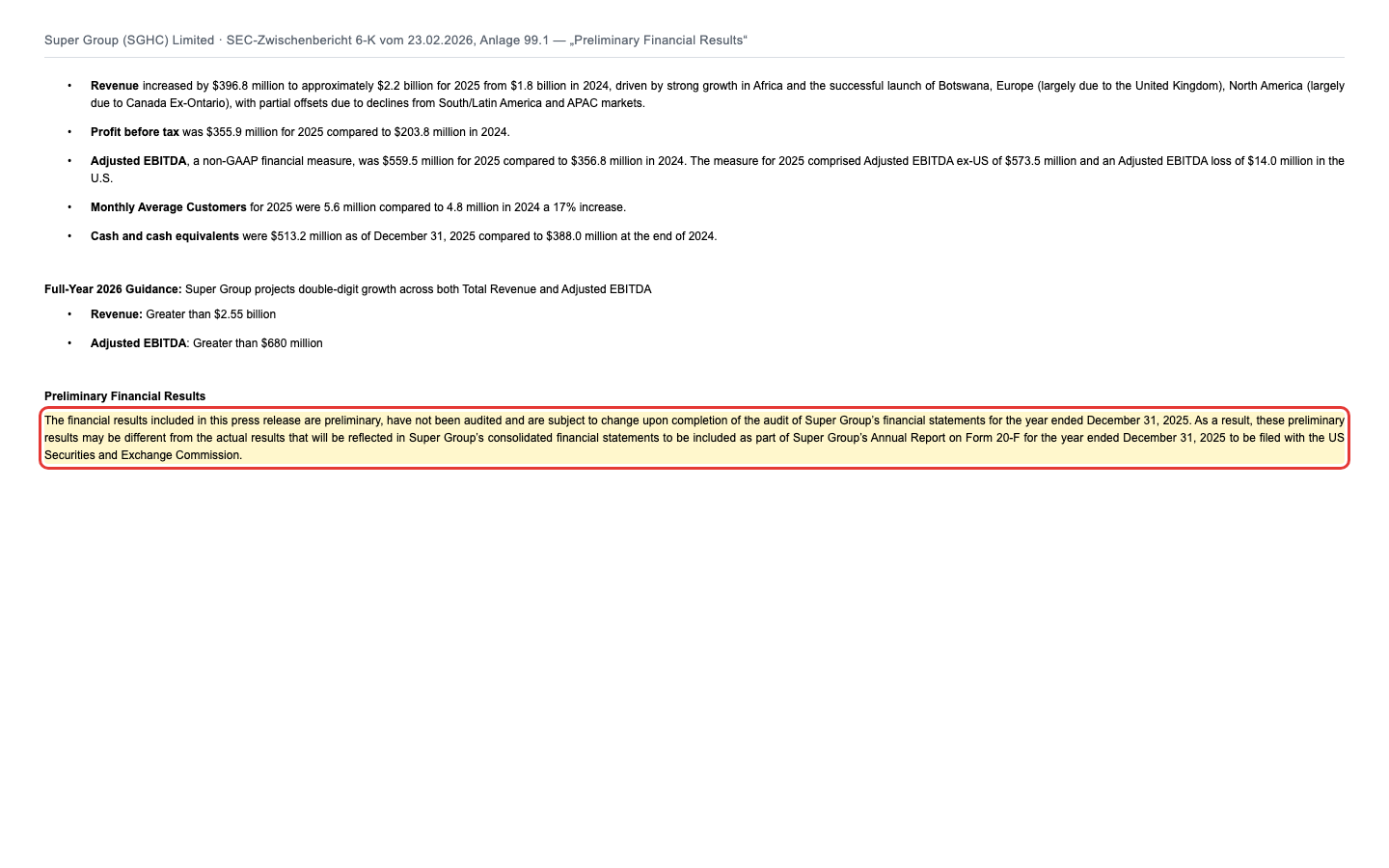
Now the truth that is not a number but touches every other one. Super Group files with the SEC as a foreign private issuer. For you as an investor that means, concretely: there is no 10-Q, so no audited quarterly report with the full mandatory package. There is one 20-F a year carrying an auditor's opinion — and in between, voluntary 6-K announcements in which the group attaches its quarterly figures as a press release. How firm those are, the company says itself:
"The financial results included in this press release are preliminary, have not been audited and are subject to change upon completion of the audit of Super Group's financial statements for the year ended December 31, 2025."
— Super Group (SGHC) Limited, SEC interim report 6-K of February 23, 2026, exhibit 99.1, section "Preliminary Financial Results"
Two more changes make comparisons with the past harder. First, the group switched its presentation currency from euros to U.S. dollars as of January 1, 2025 and restated all prior-year figures retrospectively. Second, from 2026 it is changing its segment reporting — instead of "Betway" and "Spin," the two segments will be called "Africa" and "International." Both are permitted, both are explained, and both mean the same thing for you: if you keep your own time series, you have to rebuild it twice. The auditor changed as well: after twelve years, Deloitte LLP replaced BDO LLP in 2025 (2025 audit fees: $9.3 million to Deloitte, $1.9 million to BDO, in part for re-audits); the annual meeting confirmed Deloitte on June 25, 2026 with 100 percent of the votes cast. Remember the principle: the less often the books are audited, the more weight the one annual audit carries — and the more carefully you should read it.
And a look at the share register
Who actually owns the company? According to the annual report, of 508,076,788 shares outstanding at March 31, 2026, 226,855,242 (45 percent) were held by Knutsson Limited on the Isle of Man and 97,868,113 (19 percent) by Chivers Limited, also Isle of Man. Both are owned by trust structures — Knutsson by Ridgeway Associates as trustee of the Alea Trust, Chivers by Waddle Limited as trustee of the Chivers Trust. The report states explicitly that neither the trustee companies nor their directors hold an economic interest in the trusts. Roughly 64 percent of the capital therefore sits in two trusts whose ultimate beneficiaries do not appear in the filing. That is disclosed and lawful — but it means that takeovers, dividends and strategy are effectively decided by two addresses you do not know. Chief executive Neal Menashe holds 3 percent, all directors and executive officers together 4 percent. For other cases where the ownership structure shapes the character of a stock, see our research section.
Valuation: cheap on the math — if the three countries hold
How expensive is the stock? A dated, checkable anchor comes from the very 13F filing that started this piece: Helikon's 9,424,702 shares were valued at $101,786,782 as of March 31, 2026 — which works out to about $10.80 per share. Across 508.1 million shares that implies a market value on the order of $5.5 billion. Measured against 2025 profit of $218 million, that is a price-earnings ratio of roughly 25; annualize the first quarter of 2026 ($86 million) and it is roughly 16. Price to sales sits at about 2.5. Strip out net cash ($422 million against $42 million of interest-bearing debt at March 31, 2026) and the business costs a little over seven times the adjusted EBITDA of more than $680 million guided for 2026. Add a dividend of at least 20 cents per share for 2026 — about 1.9 percent against that anchor price, and that is before the special distributions paid in 2025 and early 2026.
Measured against growth and margin, that is not an expensive stock. But the valuation says exactly what the rest of this analysis says: the market pays no premium for a business whose earnings depend 78 percent on three regulatory regimes and whose most recent foreign adventure ended in a full write-off. Buy here and you buy solid numbers with a regulatory discount — and you should know what that discount is for. If you want another case where a permit mattered more to the share price than any metric, read our ASP Isotopes analysis.
Opportunities and risks at a glance
What speaks for Super Group:
- Real, profitable growth: 2025 revenue of $2,231 million (+21.6 percent), profit of $218 million, adjusted EBITDA of $559.5 million (+57 percent, margin around 25 percent); the first quarter of 2026 added $612 million of revenue (+18 percent) and $86 million of profit.
- A clean balance sheet with no debt burden: $513.2 million of cash and $801 million of equity against $1,267 million of total assets at December 31, 2025 (63 percent equity ratio), plus an undrawn $100 million credit facility running to February 2029.
- Shareholders get paid: $156 million of distributions in 2025 and $152 million in the first quarter of 2026 alone; the annual dividend target was raised from 16 to at least 20 cents per share, and a buyback authority of up to 14.99 percent of the shares was approved at the June 25, 2026 annual meeting.
- Scale and a working engine: Betway's adjusted EBITDA rose from $69 million (2023) through $222 million (2024) to $395 million (2025); monthly active customers averaged 5.6 million in 2025 and 6.4 million in the first quarter of 2026.
- The U.S. drag is gone: after the full write-down, 2026 no longer carries the loss-maker that cost $14.0 million of adjusted EBITDA in 2025; guidance for 2026 calls for more than $2.55 billion of revenue and more than $680 million of adjusted EBITDA.
What speaks against it:
- Extreme country concentration: 77.7 percent of 2025 revenue from South Africa ($708.2 million), Canada ($698.1 million) and the United Kingdom ($328.0 million); in Canada the group is licensed in Ontario only, and the filing calls the rest of the country not explicitly regulated.
- Regulation is the core risk and has already bitten: the U.S. exit cost $141.1 million of impairments from 2023 through 2025 plus provisions for onerous contracts, triggered in part by gaming taxes according to the filing.
- Rising tax load and two open cases: gaming tax and license costs rose 74.4 percent in 2025 to $93.1 million (11.0 percent of gaming revenue, up from 7.3 percent), alongside an unassessed voluntary disclosure of $50.4 million and a $26.4 million HMRC case with the first instance already lost.
- Thin interim reporting: as a foreign private issuer there is no 10-Q; quarterly figures appear as a voluntary 6-K and are explicitly "preliminary, have not been audited." The currency switch (euros to dollars from 2025) and the segment change (Africa/International from 2026) break the time series on top of that.
- Concentrated, anonymous ownership: roughly 64 percent of the shares sit with two Isle of Man companies (Knutsson 45 percent, Chivers 19 percent) whose ultimate beneficiaries are not named in the filing; free-float holders carry effectively no weight.
A human conclusion
Back to the house-edge trap from the opening. Its core is not that the house edge is an illusion — it is real, it is computable, and at Super Group it reliably yields about $3.90 per $100 wagered. Its core is that the house edge carries a condition that appears in no probability calculation: the table has to be allowed to stand. No die decides that; a legislature does — in Pretoria, in Ottawa or Edmonton, in London. From 2023 to 2025 Super Group learned in the United States what it feels like when the answer is "no, not at this tax rate": $141 million written off, assets at zero, contracts running to 2030 with not a cent coming in. And it is this very company that draws 78 percent of its revenue from three countries.
Buy today and you are not just buying a growing, well-earning, debt-free business with a rising dividend — you are also buying three legislatures, two unresolved tax files and a calendar in which the auditor stops by once a year. So the honest question is not "does the house win?" but: do you trust yourself to spot, in three countries at once, the moment the rules turn — and would you still get up from the table in time? If yes, you have a business with real earnings at a price that knows its risks. If no, you have a bet that is not decided at the gaming table. What you make of it is your decision. And that is exactly as it should be.
Sources
Every original document used in this analysis, for you to read yourself:
- Super Group (SGHC) Limited — SEC annual report 20-F for 2025 (filed April 17, 2026)
- Super Group (SGHC) Limited — SEC interim report 6-K of May 11, 2026, exhibit 99.1 (first quarter 2026 results)
- Super Group (SGHC) Limited — SEC interim report 6-K of February 23, 2026, exhibit 99.1 (fourth quarter and full year 2025, 2026 guidance)
- Super Group (SGHC) Limited — SEC interim report 6-K of July 1, 2026 (resolutions of the June 25, 2026 annual meeting)
- Super Group (SGHC) Limited — SEC interim report 6-K of June 11, 2026 (dividend declaration)
- Helikon Investments Ltd — SEC Form 13F-HR as of March 31, 2026 (filed May 8, 2026, EDGAR overview)
- Complete SEC filing history of Super Group (SGHC) Limited: EDGAR overview (sec.gov)
- Fundamental data (metrics, valuation anchors; data as of July 23, 2026), reconciled against the SEC filings.
Transparency & disclaimer: This analysis is a journalistic contextualization of publicly available information and is not investment advice, not a financial analysis in the regulatory sense and not a solicitation to buy or sell securities. Equity investments carry substantial risks up to and including total loss. All information without warranty; the data cut-off is noted in the text. The author holds no position in Super Group shares at the time of publication.
Our Bottom Line at a Glance
- Earnings power & growth positive
- Revenue rose 21.6 percent in 2025 to $2,231 million, profit reached $218 million (from a loss of $8 million in 2023), and adjusted EBITDA climbed 57 percent to $559.5 million at a margin near 25 percent. The first quarter of 2026 continued the trend ($612 million of revenue, +18 percent; $86 million of profit), and guidance for 2026 calls for more than $2.55 billion of revenue and more than $680 million of adjusted EBITDA.
- Balance sheet & distributions positive
- At December 31, 2025, $513.2 million of cash and $801 million of equity (a 63 percent ratio) faced only $17 million of interest-bearing debt; since February 2026 an undrawn $100 million credit facility sits alongside. Distributions totaled roughly $156 million in 2025 plus $152 million in the first quarter of 2026, and the dividend target rose from 16 to at least 20 cents per share.
- Market concentration negative
- Of $2,231 million of 2025 revenue, $1,734 million — 77.7 percent — came from South Africa ($708.2 million), Canada ($698.1 million) and the United Kingdom ($328.0 million); no other country reached 10 percent. In Canada, the second-largest market, the group is licensed in Ontario only; the annual report describes the rest of the country as not explicitly regulated.
- Regulation & taxes negative
- Regulatory risk has already materialized: the U.S. exit cost $141.1 million of impairments from 2023 through 2025, triggered in part by gaming taxes according to the filing. Gaming tax and license costs rose 74.4 percent in 2025 to $93.1 million (11.0 percent of gaming revenue, up from 7.3 percent), and two matters remain open — an unassessed $50.4 million voluntary disclosure and a $26.4 million HMRC case with the first instance lost.
- Transparency & ownership neutral
- As a foreign private issuer the group publishes audited numbers only once a year (the 20-F for 2025 on April 17, 2026); the quarterly figures in its 6-K announcements are explicitly preliminary and unaudited. The currency switch from euros to dollars (from 2025) and the segment change (Africa/International from 2026) break the time series. Roughly 64 percent of the shares sit with two Isle of Man companies whose ultimate beneficiaries are not named.
Super Group is an unusually profitable online gambling operator: $2,231 million of revenue in 2025 (+21.6 percent), $218 million of profit, $559.5 million of adjusted EBITDA, $513.2 million of cash, almost no debt and a rising dividend. The price of that sits in the notes: 77.7 percent of revenue comes from South Africa, Canada and the United Kingdom; the U.S. entry ended after three years in $141.1 million of impairments because the tax rules moved; two tax matters worth roughly $77 million are unresolved; and as a foreign private issuer the company presents audited numbers only once a year. The house edge is real — it holds only as long as the table may stand. Not investment advice.
What Our Rating Means
Open questions
The business works in principle, but one material question is open. As long as it stays open, our findings do not carry a quality verdict.
Buy today and you are not betting on the gaming math — that part works — but on three legislatures leaving the rules alone: South Africa, Canada (where only Ontario is licensed so far and Alberta means to follow in 2026) and the United Kingdom. If you already hold the shares, check three lines in every report: the revenue share of those three countries, gaming tax and license costs (last $93.1 million, 11.0 percent of gaming revenue) and the two tax provisions ($50.4 million and $26.4 million). If you are waiting, the June 2026 Upper Tribunal hearing in the HMRC case and the launch of the Alberta regime give you two concrete events that show where regulation is heading. Watch rather than reach — the decision is yours.
A journalistic assessment by our editorial team at the time of the deep dive, based on public sources — not investment advice and not a solicitation to buy or sell. Your personal circumstances (investment goals, risk capacity, taxes) cannot be taken into account. What our levels mean, how verdicts are formed, and what conflicts of interest exist →
Worth Noting
- Super Group reached our research list not through a scanner hit but through Form 13F-HR of Helikon Investments Ltd as of March 31, 2026 (filed May 8, 2026): 9,424,702 shares worth $101,786,782, an entirely new position. A 13F shows only U.S.-listed long positions with a 35- to 45-day lag, without shorts or derivatives — a rear-view mirror, not a road map.
- Standard screener metrics only partly apply to this stock: as a foreign private issuer Super Group files no 10-Q, so many quarter-based metrics (the Piotroski F-Score among them) cannot be updated. Every figure used here comes straight from the 20-F for 2025 and the 6-K interim reports.
- Valuation figures are dated and evergreen: an anchor price of about $10.80 per share, derived from the 13F filing as of March 31, 2026 ($101,786,782 for 9,424,702 shares), implying a market value of roughly $5.5 billion, a P/E near 25 on 2025 profit and near 16 on the annualized first-quarter 2026 run rate. Analyses are evergreen; daily prices are not a buy argument.
Frequently Asked Questions
Super Group (SGHC) Ltd (NYSE: SGHC), based in St. Peter Port, Guernsey, is the holding company behind two online gambling offerings: Betway, a single global sports betting and casino brand, and Spin, a multi-brand online casino with more than 16 brands; the Jumpman Gaming subsidiary adds roughly 200 mostly British brands. The group is licensed in 20 jurisdictions, employs about 2,900 people and generated $2,231 million of revenue in 2025.
In 2025 Super Group generated $2,231 million of revenue (+21.6 percent) and $218 million of profit; adjusted EBITDA rose 57 percent to $559.5 million. By product, $1,790 million came from online casino and $408 million from sports betting. By country the mix is highly concentrated: $708.2 million from South Africa, $698.1 million from Canada and $328.0 million from the United Kingdom — 77.7 percent combined.
The group bought Digital Gaming Corporation with the U.S. Betway license in January 2023, exited sports betting in nine states in July 2024 and left U.S. online casino in July 2025. The 20-F for 2025 cites the evolving regulatory landscape relating to gaming taxes, the unit's performance and a shift in strategic objectives. Impairments from 2023 through 2025 total $141.1 million; the U.S. subsidiary now carries a book value of zero.
Because it is registered with the U.S. securities regulator, the SEC, as a foreign private issuer. Such companies file one annual report on Form 20-F — for 2025 on April 17, 2026 — and disclose interim updates voluntarily on Form 6-K. The quarterly figures published that way are explicitly preliminary and unaudited; an auditor signs off on the numbers only once a year.
Two, worth roughly $77 million combined. First, a Voluntary Disclosure Program filed in January 2024 covering $50.4 million of gaming taxes that the relevant authority had not assessed as of December 31, 2025. Second, a U.K. HMRC case against the Jumpman subsidiary over Remote Gaming Duty for 2018 to 2022: the First-tier Tribunal dismissed the appeal on September 16, 2025, the further appeal was heard on June 17 and 18, 2026, and the provision stands at $26.4 million.
Yes. For 2025 the annual target was 16 cents per share paid in quarterly steps, with special dividends on top. For 2026 the target was raised to at least 20 cents per share and the quarterly dividend from 4.0 to 5.0 cents. Distributions totaled roughly $156 million in 2025 and $152 million in the first quarter of 2026 alone. Cash stood at $422 million at the end of the first quarter of 2026.
Of 508,076,788 shares outstanding at March 31, 2026, Knutsson Limited (Isle of Man) held 226,855,242 shares, or 45 percent, and Chivers Limited (also Isle of Man) held 97,868,113 shares, or 19 percent — roughly 64 percent together. Both companies are owned by trust structures whose ultimate beneficiaries are not named in the annual report. Chief executive Neal Menashe holds 3 percent, all directors and executive officers together 4 percent.
Found an error?
Did you spot a factual error, an outdated number, or a typo in this deep dive? Let us know briefly — your report goes straight to the editorial team.