Rubrik Stock: Nine Straight Beats — and a $3.23 Billion Accumulated Deficit
Rubrik ranks 48th in our in-house Big Earnings Surprise screen (U.S. selection, data as of July 25, 2026): since its April 2024 IPO the company has beaten estimates in every single quarter, most recently by 633 percent. We read the Form 10-Q for the quarter ended April 30, 2026, the Form 10-K for fiscal 2026 and everything filed with the U.S. securities regulator, the SEC, since — and found three numbers that never make it into a headline: negative $481.3 million in stockholders equity, $73.4 million of stock-based compensation in a single quarter, and two distributors carrying 56 percent of revenue. Read along before you buy the headline.
 Thomas Mücke
Founder & Publisher
Thomas Mücke
Founder & Publisher
Chart
Interactive price chart (TradingView).
Note: pure fact-based analysis, not investment advice and not a solicitation to buy or sell. All figures without guarantee.
There is one investor trap that springs every time a company reports: the surprise trap. It works like this — a headline says "beats expectations," your brain quietly translates that into "makes money," and a profitable business appears out of thin air. Rubrik, Inc. (NYSE: RBRK) has set that trap nine times in a row. Since its April 2024 IPO, earnings per share have come in above the estimate in every quarter, most recently at $0.16 against an expected $(0.03). That is a 633 percent gap.
The same quarterly report shows a net loss of $41.9 million, an accumulated deficit of $3.23 billion and stockholders equity of negative $481.3 million. Both things are true. Before we turn that into a judgment, here is the deal: we read together what the company itself filed under penalty of perjury with the U.S. securities regulator, the SEC — the Form 10-Q for the quarter ended April 30, 2026, the Form 10-K for fiscal 2026, and everything filed since.
What Rubrik actually does — a vault for the copy of your data
Picture an attacker locking every file in a hospital overnight and demanding a ransom. Two questions decide everything at that moment: is there a backup, and did that backup stay clean? Rubrik is built for exactly that. The company copies data from data centers, from the cloud and from applications such as Microsoft 365 into backups that cannot be altered afterward — "immutable" in the jargon, or in plain language: a vault whose contents you can read but never overwrite.
Three further pieces turn the backup vendor into a security vendor. First, threat detection that flags unusual changes to files before anyone gets a ransom note. Second, the recovery of identities — the directories that record who inside a company is allowed to do what. If that directory is destroyed, the prettiest backup is useless. And third, since February 2026, Rubrik Agent Cloud, a platform that monitors AI agents inside a company and reverses their actions when something goes wrong.
"In fiscal 2026, we built Rubrik Agent Cloud (“RAC”), to accelerate enterprise AI transformation. RAC is designed to provide a comprehensive AI operations platform that can dynamically monitor, control, and remediate agentic actions. RAC became commercially available in February 2026."
— Rubrik, Inc., Form 10-K for fiscal 2026, Item 1 (SEC)
All of it is sold as a subscription: the customer pays annually, contracts typically run three years, pricing follows data volumes and applications. It is the same blueprint we took apart at another cloud storage vendor — our Backblaze analysis shows how hard the road from data warehouse to profitable subscription business can be. One important difference: Rubrik sells almost entirely through intermediaries, not direct. Remember that, it comes back later.
And that brings us to the central tension of this analysis, which runs through every chapter: Rubrik delivers one of the cleanest growth stories in U.S. software — and, at the same time, a balance sheet where equity has been negative for years and profit only appears once you strip out how the workforce is paid. Both readings come from the same document.
How the stock landed on our desk
We run roughly 3,500 stocks through our screens every day. As of July 25, 2026, Rubrik sits 48th in the U.S. selection of our Big Earnings Surprise screen, which had 81 hits. To reproduce it: open the screen, set the country filter to "US" — the list shows the serial surprisers in screen order and is recalculated daily, so the rank can shift.
The last five quarters looked like this (fundamental data, as of July 25, 2026; quarters carry the company's fiscal years, which end January 31):
- Q1 fiscal 2026 (quarter ended April 30, 2025, reported June 5, 2025): $(0.15) against $(0.32) expected — plus 53.1 percent.
- Q2 fiscal 2026 (July 31, 2025, reported September 9, 2025): $(0.03) against $(0.34) — plus 91.2 percent.
- Q3 fiscal 2026 (October 31, 2025, reported December 4, 2025): $0.10 against $(0.17) — plus 158.8 percent.
- Q4 fiscal 2026 (January 31, 2026, reported March 12, 2026): $0.04 against $(0.11) — plus 136.4 percent.
- Q1 fiscal 2027 (April 30, 2026, reported June 4, 2026): $0.16 against $(0.03) — plus 633.3 percent.
Two things belong at the front of any valuation here. First, the streak runs deeper: counting the first quarter after the IPO, Rubrik has beaten the estimate nine quarters in a row and has never missed as a public company. Second, those are non-GAAP figures. Under U.S. accounting rules, first-quarter fiscal 2027 earnings were $(0.21) per share, not $0.16. Remember the principle: a surprise ranking measures how wrong the expectation was, not how much money was earned.
The fundamental lens on the same data set is mixed (as of July 25, 2026): a relative strength rating of 54 — midfield, no runaway chart; a Piotroski F-Score of 5 out of 9, a nine-point test of the direction of a balance sheet, where a genuinely healthy company scores 8 or 9; and an Altman Z-Score of 1.60. That bankruptcy warning signal has its danger zone below 1.8 historically — but it has to be read correctly here. The formula leans on equity, and Rubrik's equity is negative because in a subscription business prepaid customer money sits on the liability side. A company with $1.75 billion of cash and short-term investments is not close to insolvency. The low score says nothing about default risk and everything about balance sheet structure.
The numbers over the years — what genuinely impresses
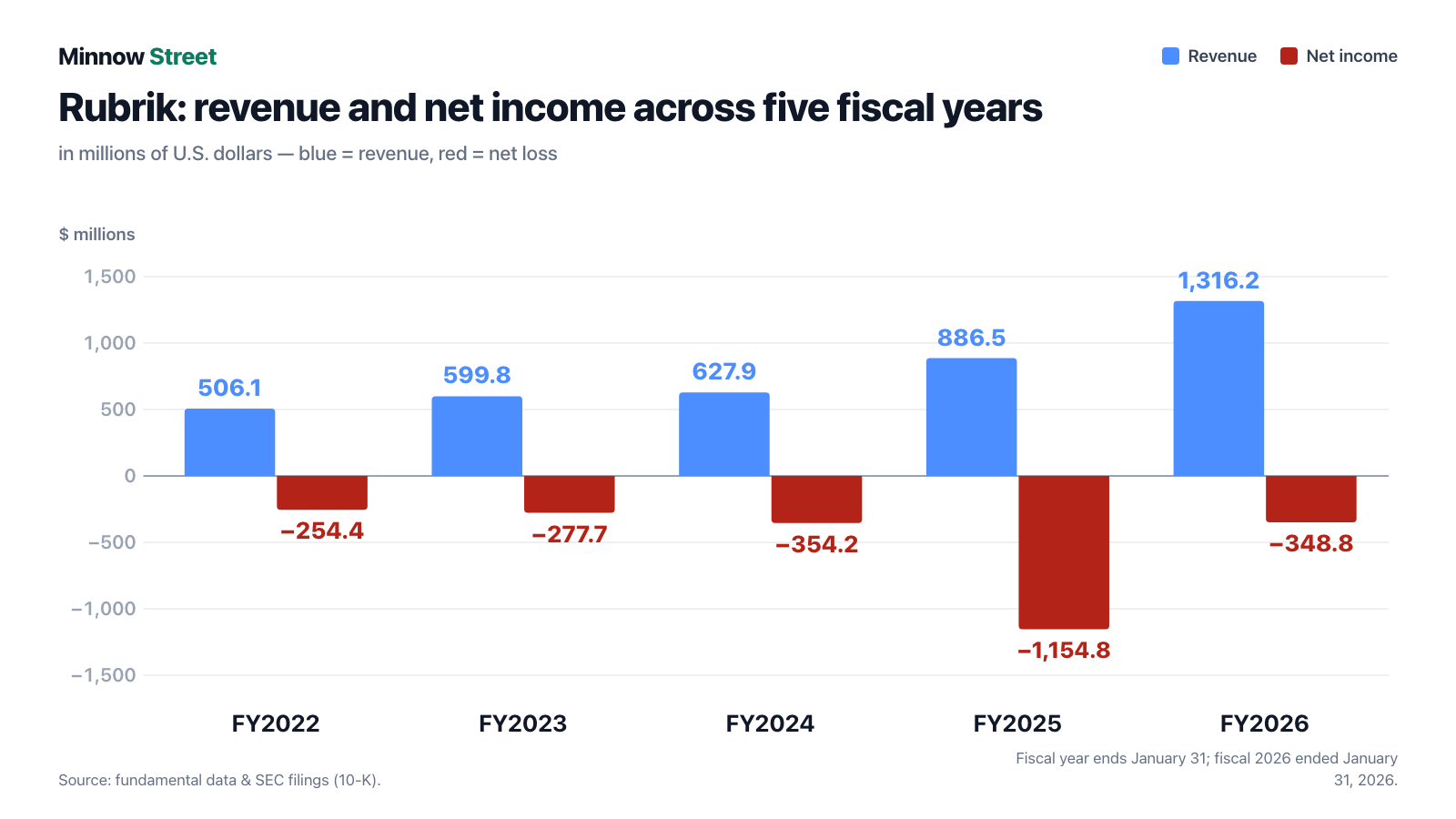
Start with what is good, because there is a lot of it. Revenue has more than doubled in five fiscal years: from $506.1 million in fiscal 2022 through $599.8 million, $627.9 million and $886.5 million to $1,316.2 million in fiscal 2026 — up 48.5 percent in the last year alone. The first quarter of fiscal 2027 added $387.1 million, 39 percent more than the prior-year quarter.
In a subscription business the more telling number is the subscription base — the company calls it subscription ARR and means the annualized value of all active contracts. It stood at $1,565.1 million on April 30, 2026, up 32 percent year over year. The pure cloud portion grew 43 percent to $1,393.9 million. And customers do not merely stay, they buy more: the average subscription dollar-based net retention rate was approximately 120 percent, meaning a hundred dollars of business from a year ago is worth about 120 dollars today, churn already deducted.
The biggest progress, though, shows up in cash. In fiscal 2024, operating activities still consumed money, at negative $4.5 million. In fiscal 2025 they produced $48.2 million, in fiscal 2026 $282.9 million. After property, equipment and capitalized internal-use software, free cash flow came to $253.3 million, up from $31.3 million. The first quarter of fiscal 2027 added $81.7 million of operating cash and $73.6 million of free cash flow, a margin of 19 percent on revenue. Gross margin holds up too: 80.5 percent in the first quarter of fiscal 2027 against 78.3 percent a year earlier, and 80.1 percent for full fiscal 2026 after 70.0 percent.
The cash box is full: $1.75 billion in cash, cash equivalents and short-term investments as of April 30, 2026. On top of that sits a backlog not yet booked as revenue: roughly $2.44 billion of contracted, non-cancelable performance obligations, of which the company expects about 53 percent to convert into revenue over the next twelve months.
Uncomfortable truth No. 1: equity has been negative for years
Now the other side of the same report. As of April 30, 2026, total assets of $2,768.2 million faced total liabilities of $3,249.6 million. Stockholders equity therefore stands at negative $481.3 million. The company does not label that statement "equity" in its quarterly report — it calls it stockholders' deficit.
The series shows this is no accident: negative $104.6 million on January 31, 2022, negative $372.6 million in 2023, negative $704.5 million in 2024, negative $553.7 million in 2025, negative $519.6 million in 2026, and negative $481.3 million on April 30, 2026. To be fair, the direction has been right for two years.
"We have generated significant operating losses from our operations as reflected in our accumulated deficit of $3.23 billion as of April 30, 2026. We expect to continue to incur operating losses, and our operating cash flows may fluctuate between positive and negative amounts for the foreseeable future."
— Rubrik, Inc., Form 10-Q for the quarter ended April 30, 2026, Liquidity and Capital Resources (SEC)

Where does the deficit come from? A large part of it from something that is good in a subscription business: prepaid customer money. As of April 30, 2026, $1,888.4 million of deferred revenue sat in liabilities ($1,122.0 million current and $766.4 million non-current) — cash already in the bank that may only be recognized as revenue over the life of the contract. The rest is real loss: an accumulated deficit of $3,228.0 million. The takeaway: negative equity is not an alarm at a subscription company, but it is not nothing either — it means the substance has to come from the future, not from the past.
Uncomfortable truth No. 2: profit appears only after you remove the payroll
This is the heart of the surprise streak. Rubrik pays a substantial share of its people in its own stock. That costs no cash — but it costs you, the shareholder, ownership. The picture: the cake stays the same size but gets cut into more slices, and your slice shrinks without you doing anything.
The scale is remarkable. In the first quarter of fiscal 2027 the company recorded $73.4 million of stock-based compensation, 19 percent of quarterly revenue and more than the entire net loss of $41.9 million. That is exactly why $(0.21) per share under U.S. accounting rules turns into an adjusted $0.16. Both numbers are correct. They just tell different stories.
Year by year: $5.7 million in fiscal 2024, then the IPO jump to $913.9 million in fiscal 2025, because employee stock only vested at listing, then $329.4 million in fiscal 2026 — a quarter of the $1,316.2 million of revenue. That explains almost the entire fiscal 2025 net loss of $1,154.8 million.
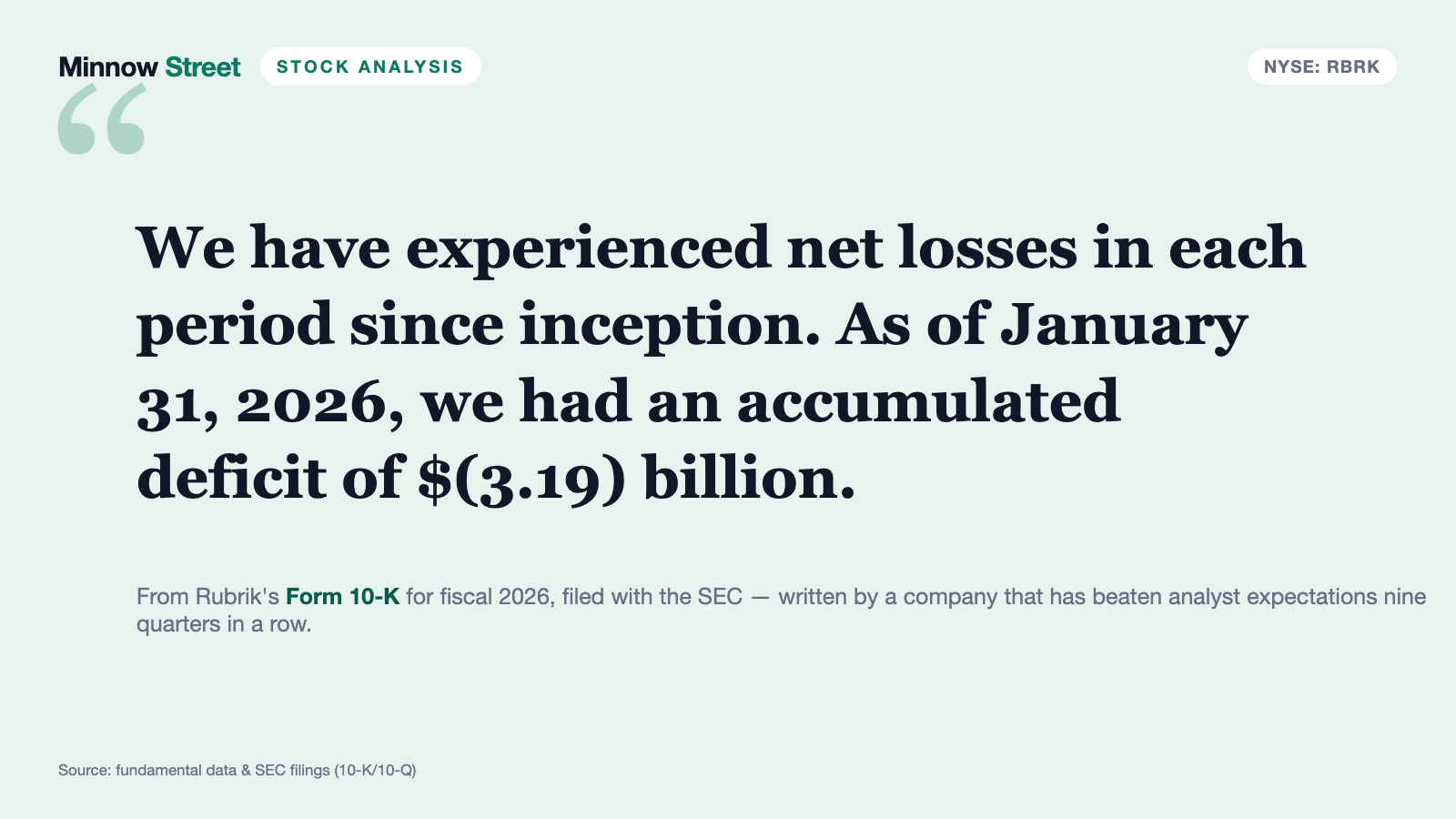
"We have experienced net losses in each period since inception. We generated net losses of $(348.8) million, $(1.15) billion and $(354.2) million for the fiscal years ended January 31, 2026, 2025 and 2024, respectively."
— Rubrik, Inc., Form 10-K for fiscal 2026, Item 1A (SEC)
What is still coming is in the report too. As of April 30, 2026 there were 41.530 million securities outstanding that can one day become shares — 8.818 million options, 23.098 million unvested restricted stock units, 9.218 million from the convertible notes and 0.396 million of restricted stock from a business combination. Against 205.829 million shares outstanding as of May 31, 2026 that is roughly 20 percent of potential dilution. The company's own guidance confirms the direction: for fiscal 2027 it models approximately 228 million weighted-average shares.
Uncomfortable truth No. 3: three intermediaries carry two thirds of revenue
Rubrik sells almost nothing itself. Its customers are formally the channel partners — and three of them are very large.
"Our three largest Channel Partners, Arrow Enterprise Computing Solutions, Exclusive Networks, and Ingram Micro Inc., and their respective affiliates collectively generated approximately 68% and 73% of our revenue for fiscal 2026 and 2025, respectively."
— Rubrik, Inc., Form 10-K for fiscal 2026, Item 1A (SEC)

The quarterly report shows the same dependency, anonymized. In the first quarter of fiscal 2027, 27 percent of revenue came through "Partner A" and 29 percent through "Partner B" — 56 percent from two addresses. In the prior-year quarter it was 29 and 32 percent, so concentration is easing slightly. Receivables look tighter: 24 percent with Partner A, 26 percent with Partner B, 11 percent with Partner C and 12 percent with Partner E — four names carrying 73 percent of the balance as of April 30, 2026. That is not an accusation; it is how enterprise software distribution works. But it means that if a single distributor stumbles, a quarter of the open invoices is at risk.
Uncomfortable truth No. 4: growth slows, year after year
Growth rates fall at every company eventually — the only questions are how fast and from what level. At Rubrik you can read it precisely, because the same metric has been defined the same way for years.
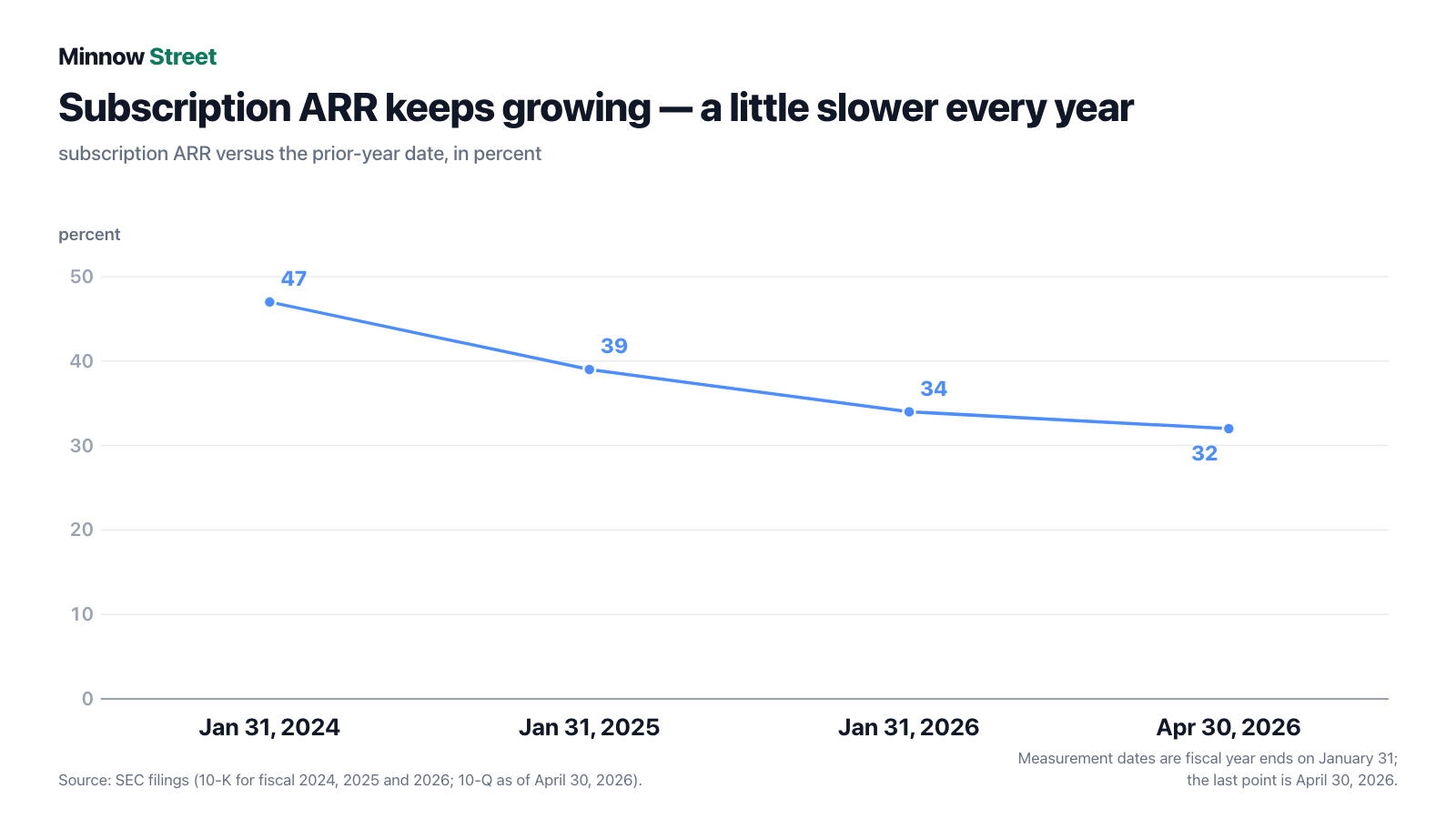
The other metrics show the same pattern. Customers with at least $100,000 of subscription ARR rose 24 percent to 2,946 as of April 30, 2026 — a year earlier the growth rate was 28 percent. The net retention rate read "over 120 percent" in the report as of April 30, 2025 and "approximately 120 percent" a year later. And the company's own fiscal 2027 guidance calls for subscription ARR of $1,854 million to $1,862 million, roughly 27 percent above the $1,462.1 million recorded on January 31, 2026.
In fairness: this is deceleration at a high level, and revenue is currently growing faster than the subscription base because older contracts are converting into recognized revenue. But the subscription base leads and revenue follows. If you want to know where revenue sits in two years, look at the falling line above.
Uncomfortable truth No. 5: a billion at zero cost — priced in shares
In June 2025 Rubrik borrowed $1.15 billion without paying a cent of interest.
"In June 2025, we completed a private offering to qualified institutional buyers of $1.15 billion aggregate principal amount of 0.00% convertible senior notes due 2030."
— Rubrik, Inc., Form 10-Q for the quarter ended April 30, 2026, Item 3 (SEC)

A convertible note is a loan with a built-in call option: the lender gives up interest and gets the right to swap the claim for stock. The conversion price is $124.76 per Class A share. To soften the dilution, Rubrik additionally spent $88.6 million on capped call transactions with banks, which work up to a cap price of $175.10 and cover roughly 9.2 million shares. Part of the roughly $1.13 billion of net proceeds went to repaying the $327.9 million drawn under the credit facility in full.
For you as an investor that means three things. First, the billion costs nothing in running interest through 2030. Second, a conversion right hangs over the stock that bites precisely when the price climbs far. And third, the debt is real: on June 15, 2030 it comes due, in cash or in stock, at the company's election.
Uncomfortable truth No. 6: 44.9 million shares hold 85 percent of the votes
Rubrik has two classes of stock. Class A trades on the New York Stock Exchange and carries one vote. Class B sits with founders, early backers and executives and carries 20 votes per share.
"Because of the 20-to-1 voting ratio between our Class B common stock and Class A common stock, the holders of our Class B common stock collectively will continue to control a majority of the combined voting power of our common stock even when the shares of Class B common stock represent as little as 5% of the outstanding shares of our Class A common stock and Class B common stock."
— Rubrik, Inc., Form 10-Q for the quarter ended April 30, 2026, Item 1A (SEC)

Do the math. As of May 31, 2026 there were 160,956,763 Class A shares and 44,871,803 Class B shares outstanding. Class A carries 161.0 million votes, Class B 897.4 million — 1,058.4 million in total. In other words: about 85 percent of the votes sit with 22 percent of the shares. The proxy statement of April 15, 2026 names who holds them: executive officers and directors as a group controlled 46.2 percent of the voting power, chief executive Bipul Sinha alone 25.2 percent, co-founder Arvind Nithrakashyap 19.7 percent, former co-founder Arvind Jain 21.1 percent and venture firm Lightspeed 18.0 percent. What such a structure does to a takeover question is something we walked through in our Roku analysis.
One note on the frequently repeated claim that Microsoft owns a stake in Rubrik: the annual report describes Microsoft explicitly as a partner — joint go-to-market work, co-engineering, products built on Azure. In the list of beneficial owners of more than five percent as of March 31, 2026, Microsoft does not appear. Anyone buying the stock because of an assumed large shareholder is buying a story the filings do not tell.
Valuation — what you pay for this business
Market capitalization stood at roughly $15.1 billion as of July 25, 2026 (closing price of $73.24 on July 24, 2026, across 205.8 million shares of both classes). The 52-week range ran from $42.25 to $99.75, so this is not a stock for weak nerves.
On trailing twelve-month revenue of $1,424.8 million that is roughly 10.6 times sales. Subtract the $1.75 billion of cash and add the $1.15 billion convertible, and the business itself costs about $14.5 billion — roughly 10.2 times revenue. Against the company's own fiscal 2027 guidance of $1,638 million to $1,648 million it is about 9.2 times. There is no price-to-earnings ratio under U.S. accounting rules because there are no earnings; against the adjusted guidance of $0.25 to $0.35 per share the arithmetic lands in the triple digits, a number better not treated as a metric at all.
For contrast, the professional view: as of July 25, 2026 there were 29 analyst opinions on file — 26 strong buy ratings, three buys, no holds and no sells — at an average price target of $95.23. Unanimity like that is rare; it is tailwind and risk in one, because when everyone is already positive the next impulse tends to come from a disappointment rather than an upgrade. On the other side stood 13.0 million shares sold short, 8.2 percent of the float, down from 16.0 million a month earlier.
Opportunities and risks at a glance
What argues for Rubrik:
- Subscription ARR grew 32 percent to $1,565.1 million as of April 30, 2026, with the cloud portion up 43 percent to $1,393.9 million.
- Free cash flow swung from negative $16.9 million in fiscal 2024 to positive $253.3 million in fiscal 2026; guidance for fiscal 2027 calls for $293 million to $303 million.
- A gross margin of 80.5 percent in the first quarter of fiscal 2027 and $1.75 billion of cash and investments — the company can afford to invest.
- 2,946 customers pay at least $100,000 a year, and existing customers keep expanding at roughly 120 percent net retention.
- Data protection is not a discretionary budget: companies that fear ransomware cut this line last.
What argues against:
- Under U.S. accounting rules the company has never earned a profit; the accumulated deficit is $3.23 billion and equity negative $481.3 million as of April 30, 2026.
- Stock-based compensation of $73.4 million exceeded the net loss in the first quarter of fiscal 2027; roughly 20 percent of potential dilution is outstanding.
- Two distributors carry 56 percent of quarterly revenue and three together roughly 68 percent of annual revenue — under agreements terminable at any time.
- Every growth rate is falling: subscription ARR from 47 to 32 percent, large-customer count from 28 to 24 percent, net retention from "over" to "approximately" 120 percent.
- About 85 percent of the votes sit with Class B holders; Class A investors have effectively no say.
- At more than ten times annual revenue a great deal of growth is already priced in — and 29 of 29 analysts are already positive.
A human conclusion
Back to the surprise trap. Nine quarters in a row above expectations is a remarkable run, and the core behind it is real: a subscription business that went from burning cash to a quarter-billion-dollar inflow in two years is doing something right. Buying Rubrik today means buying a company growing in a market nobody leaves voluntarily.
But "better than expected" is not the same as "makes money." The profit the headlines report only appears after $73.4 million of pay in own shares has been stripped out — and that bill lands on you, not on the company. Add negative equity, two distributors as a bottleneck, a billion-dollar convertible and a voting structure that leaves you outside.
Both sets of numbers sit in the same report, signed by the same officers. Which one weighs more for you depends on whether you are looking at the next three years or the next quarter. What you make of it is your decision. And that is exactly as it should be.
Sources
- Form 10-Q for the quarter ended April 30, 2026 (filed June 5, 2026) — balance sheet, results, cash flow, key metrics, partner concentration, convertible notes, dilution table, risk factors
- Form 10-K for fiscal 2026 (March 19, 2026) — business model, products, channel partners, stock-based compensation, subscription ARR, headcount
- Form 10-K for fiscal 2025 (March 20, 2025) — comparison years and subscription ARR as of January 31, 2024
- Proxy statement DEF 14A (April 15, 2026) — beneficial ownership, voting power, executive compensation, price-target option
- Form 8-K dated June 4, 2026, Exhibit 99.1 — first-quarter fiscal 2027 results and guidance
- Form 8-K dated February 4, 2026 — change at the head of global sales
- SEC EDGAR filing index, CIK 0001943896 — recency gate: Forms 4 and 144 filed after June 5, 2026
- Fundamental data and our in-house stock screen, as of July 25, 2026 — surprise streak, relative strength rating, Piotroski, Altman Z, market capitalization, analyst view
Journalistic analysis, not investment advice and not a solicitation to buy or sell securities. Stocks can lose their entire value; a total loss is possible. All figures come from the original documents linked above and carry the reporting date stated there. The author holds no position in Rubrik, Inc. at the time of publication.
Our Bottom Line at a Glance
- Growth & customer retention positive
- Revenue rose 48.5 percent to $1,316.2 million in fiscal 2026 and 39.0 percent to $387.1 million in the first quarter of fiscal 2027. Subscription ARR reached $1,565.1 million as of April 30, 2026, up 32 percent; 2,946 customers pay at least $100,000 a year and existing customers expand at roughly 120 percent net retention.
- Cash generation & liquidity positive
- Operating cash flow swung from negative $4.5 million in fiscal 2024 through positive $48.2 million in fiscal 2025 to positive $282.9 million in fiscal 2026; free cash flow reached $253.3 million after $31.3 million. As of April 30, 2026 the company held $1.75 billion in cash and short-term investments.
- Balance sheet & capital structure negative
- As of April 30, 2026 stockholders equity stood at negative $481.3 million against an accumulated deficit of $3.23 billion; the company itself labels the statement a stockholders deficit. On top sits $1.15 billion of 0.00 percent convertible notes due June 15, 2030 with a conversion price of $124.76.
- Earnings quality & dilution negative
- A GAAP loss of $(0.21) per share becomes an adjusted $0.16 once $73.4 million of stock-based compensation is removed — more than the $41.9 million net loss in the first quarter of fiscal 2027. As of April 30, 2026 there were 41.530 million potentially dilutive securities outstanding, roughly 20 percent of the 205.829 million shares.
- Dependencies & shareholder voice negative
- The three largest channel partners generated roughly 68 percent of fiscal 2026 revenue, and two individual partners 27 and 29 percent in the first quarter of fiscal 2027 — under agreements terminable at any time. Class B shares with 20 votes each hold about 85 percent of the voting power as of May 31, 2026.
- Valuation neutral
- A market capitalization of roughly $15.1 billion ($73.24 on July 24, 2026) equals about 10.6 times trailing revenue of $1,424.8 million and roughly 9.2 times the company's own fiscal 2027 guidance. There is no price-to-earnings ratio without earnings; 29 of 29 analyst opinions were positive as of July 25, 2026, at an average price target of $95.23.
Rubrik copies corporate data into backups nobody can alter afterward and sells that by subscription — a business that grew 48.5 percent to $1,316.2 million in fiscal 2026 and threw off $253.3 million of free cash flow for the first time. Since the April 2024 IPO, results have beaten estimates in every quarter, most recently at $0.16 versus an expected $(0.03) per share. Under U.S. accounting rules the same period shows a quarterly loss of $41.9 million, an accumulated deficit of $3.23 billion and equity of negative $481.3 million — the gap is stock-based compensation, $73.4 million in the first quarter alone. Add two distributors carrying 56 percent of quarterly revenue, a $1.15 billion convertible and a voting structure that puts about 85 percent of the power with Class B holders. Not investment advice.
What Our Rating Means
Open questions
The business works in principle, but one material question is open. As long as it stays open, our findings do not carry a quality verdict.
The business carries its own weight: revenue grew 48.5 percent in fiscal 2026, subscription ARR 32 percent, existing customers expand at roughly 120 percent net retention, and operating cash flow swung from negative $4.5 million to positive $282.9 million within two years. The going concern is not in question: $1.75 billion sits in cash and short-term investments, and the convertible notes carry a 0.00 percent coupon and do not mature until 2030. The negative equity of $481.3 million stems from accumulated and largely non-cash losses — $913.9 million of stock-based compensation in the IPO year alone — and from $1.89 billion of deferred, meaning already collected, subscription revenue, not from over-indebtedness under payment pressure. What is open is an operational question: under U.S. accounting rules fiscal 2026 shows an operating loss of $345.4 million, and the adjusted quarterly profit only appears once $73.4 million of stock-based compensation is removed — more than the quarterly loss itself. Add roughly 20 percent of potential dilution and two channel partners carrying 56 percent of quarterly revenue. That is not a threat to substance, but earning power is not yet proven — hence yellow. The decision is yours.
A journalistic assessment by our editorial team at the time of the deep dive, based on public sources — not investment advice and not a solicitation to buy or sell. Your personal circumstances (investment goals, risk capacity, taxes) cannot be taken into account. What our levels mean, how verdicts are formed, and what conflicts of interest exist →
Worth Noting
- RBRK came onto our research list as 48th of 81 U.S. hits in our in-house Big Earnings Surprise screen (as of July 25, 2026, relative strength rating 54) — part of our series filling the top 50 of that screen with analyses. The screens are recalculated daily.
- The surprises in the streak are adjusted figures: in the first quarter of fiscal 2027, earnings per share under U.S. accounting rules were $(0.21) against an adjusted $0.16. The screen measures the deviation from expectations, not earning power.
- Fiscal year trap: Rubrik closes its books on January 31. Fiscal 2026 covers February 2025 through January 2026, and the first quarter of fiscal 2027 covers February through April 2026. Comparing the numbers with calendar years shifts them by eleven months.
- Recency note: the latest quarterly report (10-Q) is dated June 5, 2026. Everything filed since has been reviewed — the Form 8-K of June 5, 2026 (Item 5.07, results of the annual meeting held June 3, 2026) plus Forms 4 and 144 from June and July 2026; none of it changes the picture. There is no merger, acquisition or delisting under way.
- Easy to confuse: only the Class A share trades under RBRK. Share counts from data services frequently cover that class alone (160.957 million as of May 31, 2026) and omit the 44.872 million Class B shares — the market capitalization used in this analysis counts all 205.829 million shares.
Frequently Asked Questions
Rubrik copies corporate data into backups that cannot be altered after the fact and restores them after an attack — from data centers, from the cloud and from applications such as Microsoft 365. On top of that come threat detection, recovery of user directories and, since February 2026, the AI operations platform Rubrik Agent Cloud. Everything is sold by subscription, mostly through intermediaries.
Because the company has beaten estimates in every quarter since its April 2024 IPO. In the first quarter of fiscal 2027, reported June 4, 2026, adjusted earnings came in at $0.16 versus an expected $(0.03) per share — a gap of 633 percent. As of July 25, 2026 that is good for 48th place among 81 U.S. hits.
Not under U.S. accounting rules. Fiscal 2026 showed a net loss of $348.8 million and the first quarter of fiscal 2027 a loss of $41.9 million. The accumulated deficit stands at $3.23 billion. Cash flow tells a friendlier story: $282.9 million from operating activities in fiscal 2026 and $253.3 million of free cash flow.
As of April 30, 2026 equity stood at negative $481.3 million. Two reasons: an accumulated deficit of $3.23 billion, and $1.888 billion of prepaid customer money booked as deferred revenue on the liability side until the service is delivered. The company labels the statement itself as a stockholders deficit.
On January 31. Fiscal 2026 therefore ran from February 1, 2025 through January 31, 2026, and fiscal 2027 ends January 31, 2027. The first quarter of fiscal 2027 covered February through April 2026. Comparing Rubrik figures with calendar years shifts them by eleven months.
Substantially. It cost $329.4 million in fiscal 2026, a quarter of revenue, and $73.4 million in the first quarter of fiscal 2027 — more than the net loss of $41.9 million. As of April 30, 2026 there were 41.530 million potentially dilutive securities outstanding, roughly 20 percent of the 205.829 million shares.
Class B shares carry 20 votes each. As of May 31, 2026 there were 160.957 million Class A shares against 44.872 million Class B shares, which puts about 85 percent of the voting power on the Class B side. Executive officers and directors as a group held 46.2 percent of the votes as of March 31, 2026, chief executive Bipul Sinha alone 25.2 percent.
The annual report for fiscal 2026 describes Microsoft as a strategic partner — joint go-to-market work, co-engineering, products built on Azure. In the list of beneficial owners of more than five percent as of March 31, 2026, Microsoft does not appear. A shareholding of that size is therefore not something the SEC filings support.
Found an error?
Did you spot a factual error, an outdated number, or a typo in this deep dive? Let us know briefly — your report goes straight to the editorial team.