Roku Stock: 7 of 8 Turnaround Signals, a $25 Billion Offer From Fox — and Your Vote Barely Counts
Roku pulled off what most turnaround candidates never manage: after more than $1.3 billion in combined losses (2022–2024), 2025 brought the first annual profit, and the first quarter of 2026 turned the operating line clearly positive — our in-house turnaround scanner ranks the stock no. 4 in its U.S. selection with 7 of 8 checklist points (as of July 18, 2026). Then, on June 14, 2026, Fox Corporation agreed to buy the company: $96 in cash plus 0.9693 Fox shares per Roku share. We read the annual reports (10-K), the quarterly report (10-Q) and the merger filing (8-K) — and found why the vote on the deal was effectively over before it was called. Not investment advice — just the math on what a turnaround is worth once its ending has already been sold.
 Thomas Mücke
Founder & Publisher
Thomas Mücke
Founder & Publisher
Chart
Interactive price chart (TradingView).
Note: pure fact-based analysis, not investment advice and not a solicitation to buy or sell. All figures without guarantee.
There is an investor trap that snaps shut most reliably on crashed stocks: the rear-view anchor. It works like this: your brain memorizes the old high — for Roku, Inc. (Nasdaq: ROKU), nearly $500 in mid-2021 — and from then on, every price below it feels like a discount. Roughly 72 percent below the all-time high, plus the headline "first annual profit in company history": the anchor whispers that this must be cheap. So let's make a deal: before you trust your portfolio to the comeback, we read together what Roku itself filed, under penalty of law, with the U.S. securities regulator, the SEC — the annual report (10-K) for 2025, the quarterly report (10-Q) as of March 31, 2026, and the current report (8-K) dated June 15, 2026. The first source holds a genuine turnaround: a $709.6 million annual loss (2023) became an $88.4 million profit (2025). The last one says who owns that turnaround now: Fox Corporation has agreed to buy the company — $96 in cash plus 0.9693 Fox shares per Roku share. And in between stands a sentence about 11.6 percent that turns your vote into a formality. In the end, you decide what the discount in the rear-view mirror is worth.
What Roku actually does — the kiosk at the living room door
Roku, founded in October 2002 by Anthony Wood and public since 2017, employs about 3,600 people (December 31, 2025) and runs the leading TV streaming platform in the U.S., Canada, and Mexico by hours streamed: more than 90 million streaming households, 145.6 billion hours streamed in 2025 alone (prior year: 127.1 billion). The misunderstanding many investors carry around: Roku is not a hardware maker with a software sideline — it is an advertising and commission business that gives devices away as entry tickets. The sticks and TVs with the purple logo were sold at a negative gross margin in 2025 (−$82.0 million on $592.4 million of devices revenue). The money is earned by the platform segment: $4.14 of $4.74 billion in 2025 revenue, at a gross margin of about 52 percent — advertising on the home screen and in apps, commissions on subscriptions signed up through Roku, and distribution deals with the streaming services. Picture Roku as a kiosk at the door of the living room: the door (the device) costs almost nothing, but everyone who walks through sees the billboards (advertising), and every subscription sold at the kiosk leaves a commission behind. That door to the living room is exactly what the buyer wants: with Roku, Fox acquires the front door to 90 million households. Which brings us to the central tension of this analysis, running through every chapter: the operating turnaround is real and fresh — but its payoff is no longer decided by the business. It is decided by a merger contract and the votes of one man who owns 11.6 percent of the shares.
Where the stock shows up in our scanner
We run roughly 3,500 stocks through our scanners every day. As of July 18, 2026, Roku sits at rank 4 of the U.S. selection in the turnaround scanner. To replicate it yourself: open the scanner, set the country filter to "US" — the checklist column shows 7 of 8 points for Roku. The model behind it: two mandatory pillars establish a real crash (at least 50 percent below the all-time high — Roku: about 72 percent) and survival (an Altman Z-Score near 7.5 — an early-warning gauge for financial distress whose danger zone starts below 1.1 —, positive equity, at most one balance-sheet warning flag). Then the checklist counts eight turnaround signals: revenue stabilized (up 22 percent in the latest quarter — check), net margin above its level three quarters ago and rising (check), operating cash flow positive (check), balance sheet healing (check), price back above the 50-day line (check), 3-month relative strength above the 12-month reading (check), big funds adding on balance (check). The missing eighth point deserves a moment of attention: insiders buying on balance — in the twelve months through the data cut-off, the scanner counts 20 insider sales at Roku and not a single purchase. The Piotroski F-Score, a nine-point health check of the books, stands at a robust 8 of 9. Remember the principle: a turnaround checklist measures the movement of the business — not who ends up owning the result. Which is exactly why we now read the filings.
The numbers over the years — honestly appraised
First, what genuinely impresses. Revenue knew only one direction even through the loss years: $3.13 billion (2022), $3.48 billion (2023), $4.11 billion (2024), $4.74 billion (2025, up 15 percent) — and another 22 percent jump to $1.25 billion in the first quarter of 2026, with advertising up 27 percent ($612.7 million) and subscription and distribution revenue up 30 percent ($518.5 million). The bottom line looked grim for years, but the direction has been right for three of them:
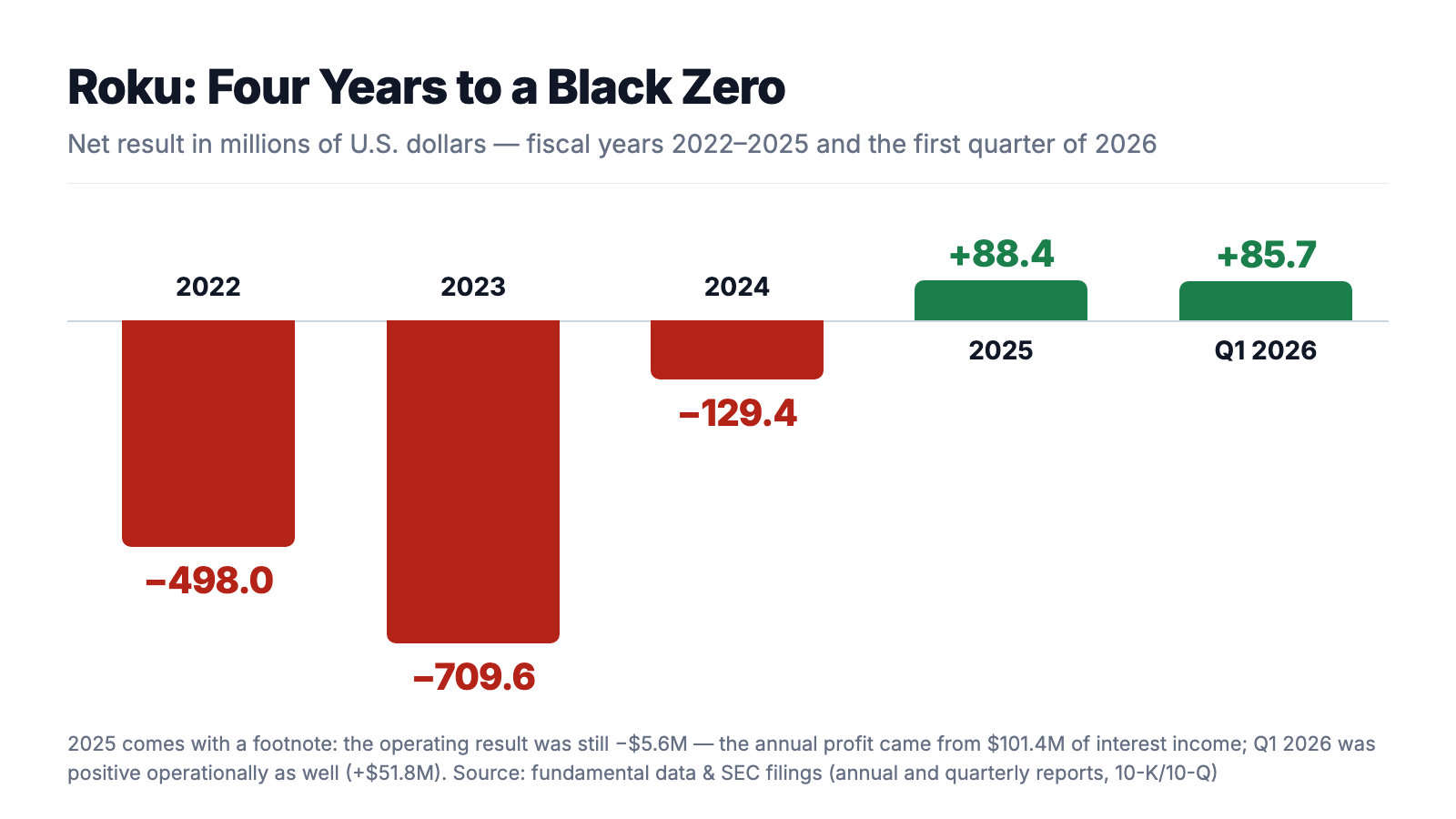
The other turnaround markers are documented too: Adjusted EBITDA climbed from $4.3 million (2023) via $260.2 million to $420.5 million (2025), trailing-twelve-month free cash flow from $203.2 million to $483.6 million, and cash stood at about $2.3 billion at year-end 2025 — with no drawn debt; the $300 million Citibank credit line sits untouched. The first quarter of 2026 then delivered what turnaround hunters had waited three years for: a clearly positive operating income of $51.8 million (prior-year quarter: −$57.7 million) and $0.57 in earnings per diluted share:
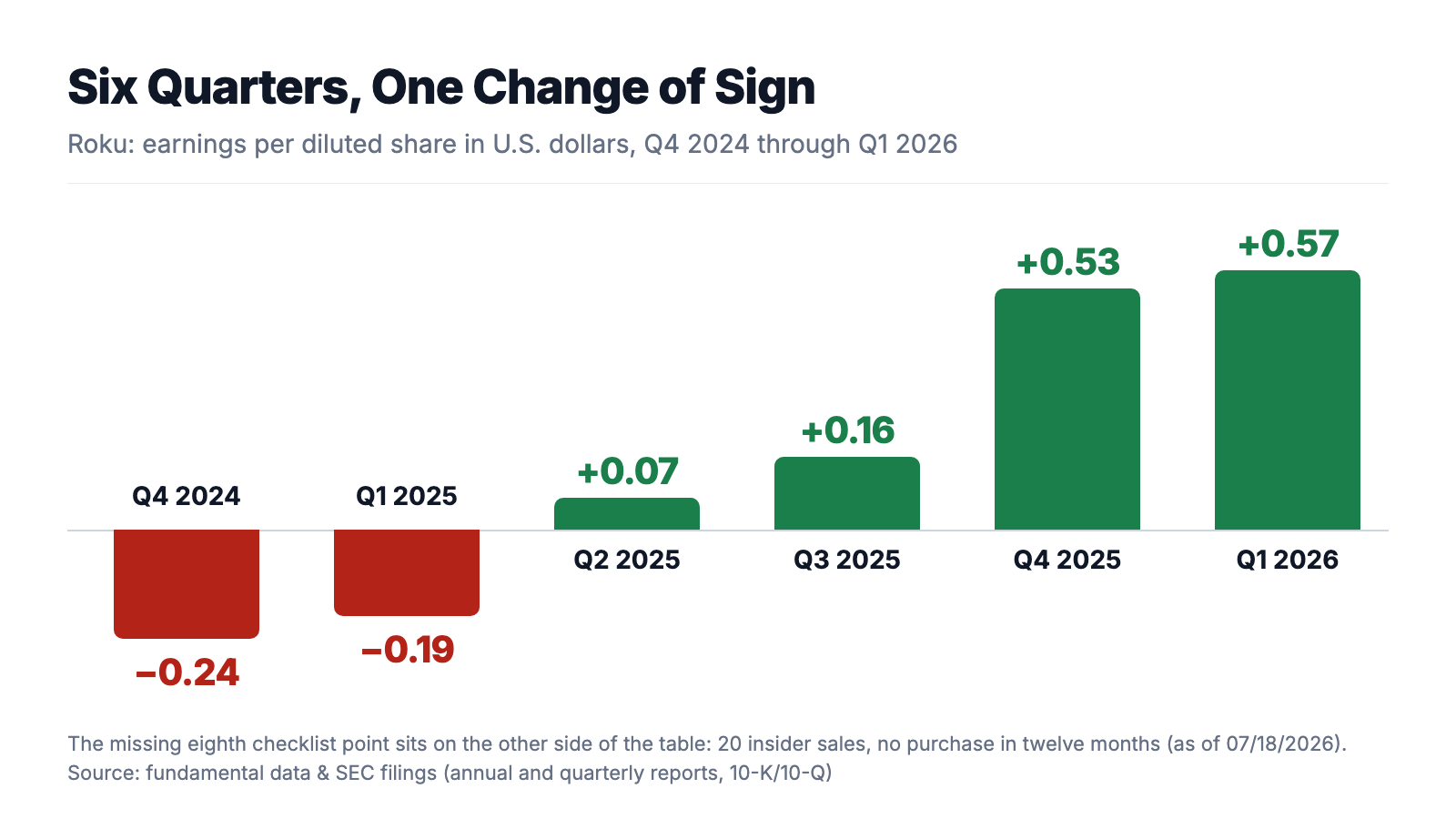
Honesty requires the footnote we will deepen in uncomfortable truth no. 2: for the full year 2025, the operating result was still slightly red at −$5.6 million — the annual profit came from interest on the cash pile. Remember the image: the turnaround is real, but it is a seedling with exactly one operationally green quarter — not a tree.
June 14, 2026: Fox buys the turnaround
Into this seedling stage crashed the news that puts everything else in this analysis into perspective. On June 15, 2026, Roku filed a current report (8-K) with the SEC covering the merger agreement signed the day before with Fox Corporation — the company behind Fox News and Fox Sports, soon to be your portfolio's new housemate. The core, in the original words:
"[E]ach share of Class A Common Stock […] and Class B Common Stock […] outstanding immediately prior to the Effective Time […] will be converted into the right to receive (i) 0.9693 (the “Exchange Ratio”) shares of Class A Common Stock, par value $0.01 per share, of Parent (“Parent Class A Common Stock”), without interest, and (ii) $96.00 in cash, without interest (the “Per Share Cash Amount”) […]"
— Roku, Inc., SEC current report 8-K dated June 15, 2026, Item 1.01 (merger agreement)
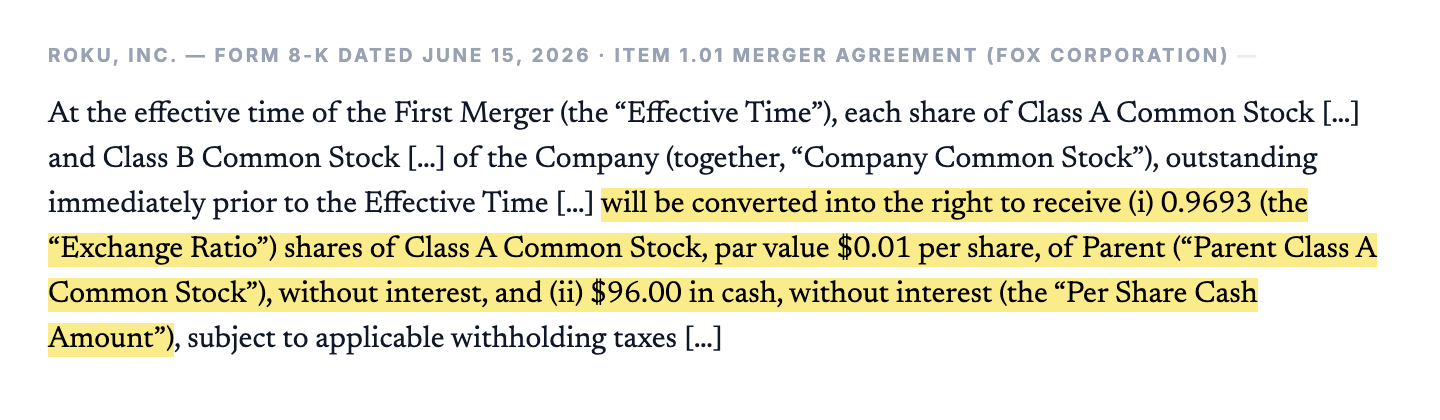
What that means, Fox itself spelled out in its investor presentation filed with the SEC (Form 425): an acquisition price of about $160 per Roku share (based on Fox's 30-day volume-weighted average price around $66), an equity value of roughly $25 billion, about 152 million new Fox shares, a $12 billion bridge financing commitment, and a cost synergy target of $400 million a year. After closing, existing Roku shareholders would own about 27 percent of the combined company; Roku's stock would leave the Nasdaq. The conditions: approval by Roku's shareholders (a simple majority of both classes voting together), approval of the share issuance by Fox's Class B holders, antitrust clearances (including under the Hart-Scott-Rodino Act), and an effective registration statement for the new Fox shares. The long-stop date is June 14, 2027 — extendable to December 14, 2027 and, at the outside, March 14, 2028. The price tags for failure were negotiated right along: a mutual termination fee of $866,084,000 — and, if regulators kill the deal, a reverse termination fee of $1.237 billion from Fox to Roku. Hold on to that number; it is the safety net under everything that follows.
What the filings say — the uncomfortable truths
Uncomfortable truth no. 1: You do not really get a say on the takeover — 11.6 percent of the shares control a majority of the votes
Roku has two share classes: the publicly traded Class A carries one vote per share, the early holders' Class B carries ten. What that means in practice is stated with unusual clarity in the annual report:
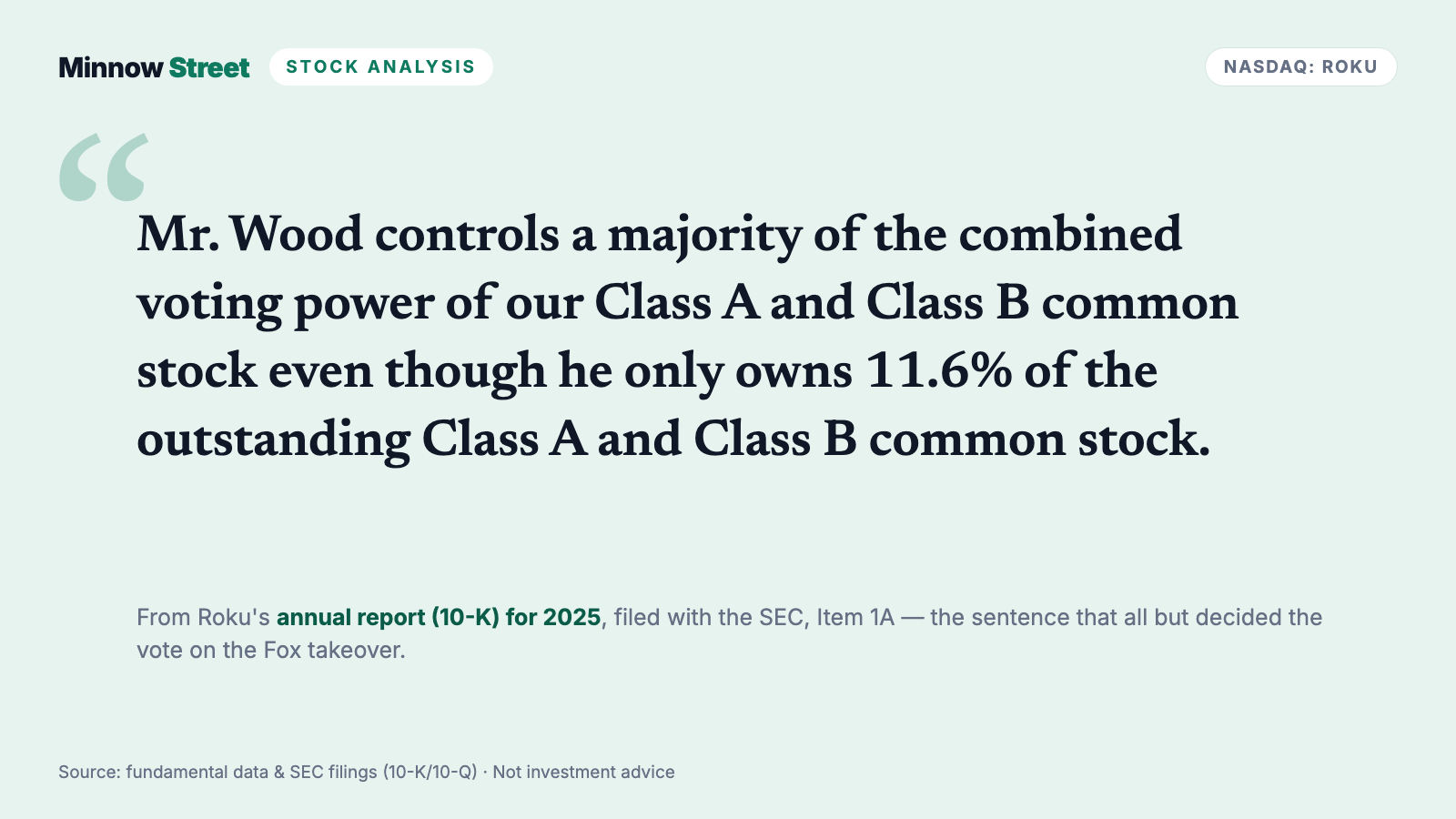
"As a result of such transfers, as of December 31, 2025, Mr. Wood controls a majority of the combined voting power of our Class A and Class B common stock even though he only owns 11.6% of the outstanding Class A and Class B common stock."
— Roku, Inc., SEC annual report 10-K for 2025, Item 1A "Risk Factors"
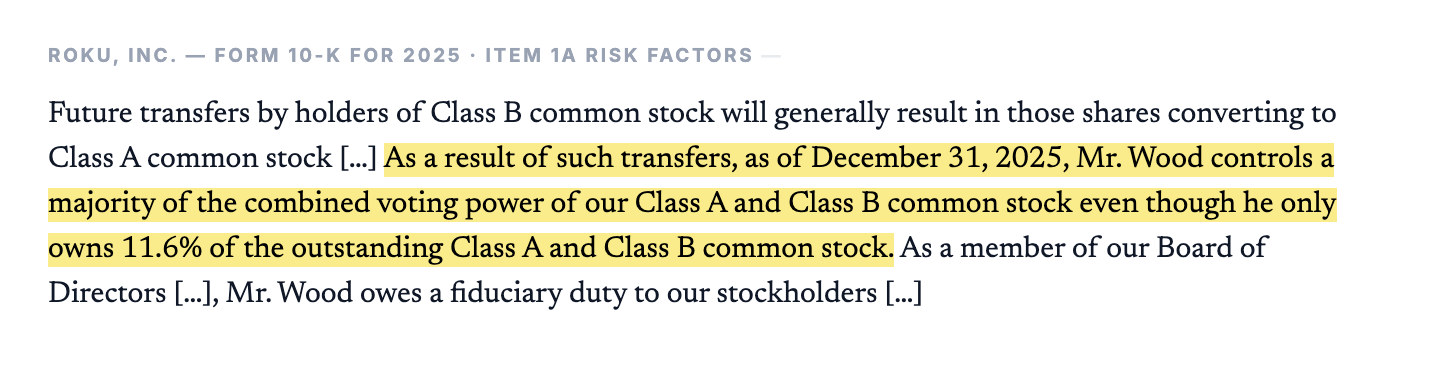
For the Fox deal, that settles the essentials: per the 8-K, Wood and allied shareholders — together holding "approximately 55% of Company's outstanding voting power" — have already committed by contract to vote for the merger in a voting and support agreement, including an obligation to vote against any competing proposal. A simple majority is all that is required. In everyday terms: the owners' meeting is scheduled, but the resolution already sits signed in an envelope. This is not an accusation — the dual-class structure has been in the prospectus since Roku went public in 2017, and Wood's interests as an 11.6 percent owner are roughly aligned with yours when it comes to the sale price. But the mechanism explains why there never had to be a bidding war: whoever wants to buy Roku has to convince exactly one man. Fox convinced him.
Uncomfortable truth no. 2: The first annual profit came from the interest account — operationally, 2025 still fell short
The headline "first annual profit" deserves its fine print. The annual report itself warns in the risk factors:
"We have incurred operating losses in the past, and we may incur operating losses in the future. Although we achieved profitability in certain quarters, we may not be able to maintain profitability in the future. As of December 31, 2025, we had an accumulated deficit of $1,488.6 million."
— Roku, Inc., SEC annual report 10-K for 2025, Item 1A "Risk Factors"
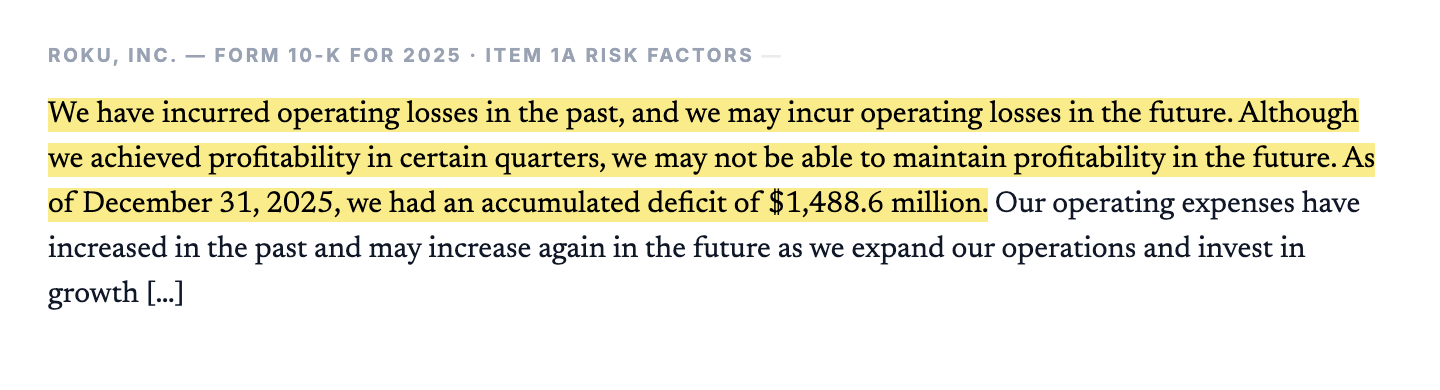
The income statement supplies the punchline: 2025 showed an operating loss of $5.6 million — the net profit of $88.4 million came from $101.4 million of other income, essentially interest on the $2.3 billion cash pile. The actual business, in other words, did not make money in 2025; the savings account did. Add the silent price of the comeback: $354.2 million of stock-based compensation in 2025 alone — four times the net profit — while the weighted share count rose from 141.6 to 147.2 million within two years. Dilution means your slice of the cake shrinks while the kitchen celebrates. Only the first quarter of 2026 (+$51.8 million operating) proved the turnaround where it belongs. One quarter does not make a summer — it makes the first day of spring.
Uncomfortable truth no. 3: The devices everyone knows lose money — by design
Roku's best-known products are also its least profitable. The devices segment — streaming sticks, Roku TVs, smart home products — contributed just 12.5 percent of 2025 revenue and sold at a negative gross margin: −$82.0 million (2025), −$80.3 million (2024), and another −$19.1 million in the first quarter of 2026 on devices revenue that fell 16 percent. That is not an accident but stated strategy:
"We have in the past and may in the future strategically reduce our Devices gross margin or record negative gross margin on devices in an effort to grow our user base and gross profit."
— Roku, Inc., SEC annual report 10-K for 2025, Item 1A "Risk Factors"
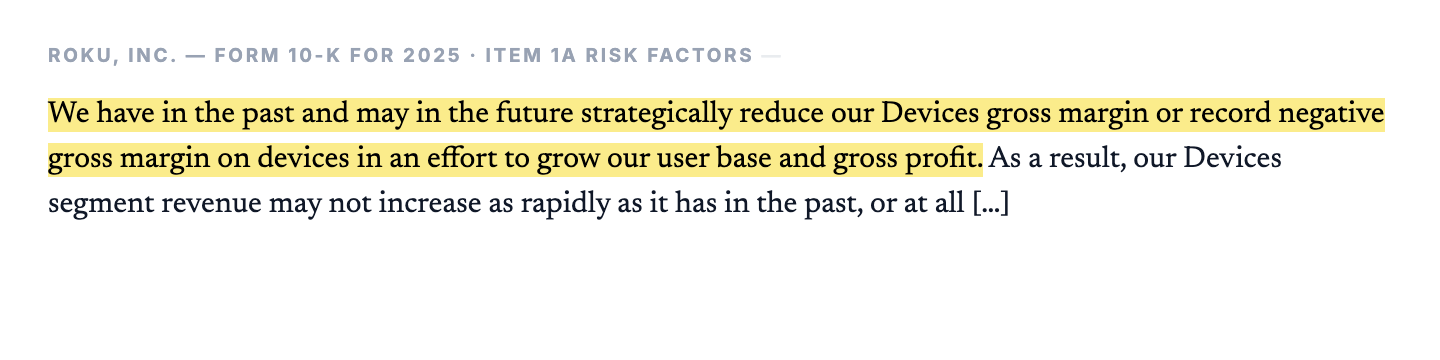
The model works as long as the kiosk takes in more than the given-away doors cost — and in 2025 it did: $2.16 billion of platform gross profit against $82 million of devices gross loss. But it also explains why Roku owns no vault in this fight: against Amazon's Fire TV, Google's TV operating system, and the TV makers' in-house systems, Roku ultimately defends its 90 million households through subsidy and convenience — much as Apple defends its ecosystem at the front door, only without Apple's pricing power. And the advertising business that pays for it all competes, in the end, with the biggest ad machines on earth — above all Alphabet. Remember the mechanism: if you give away the door, you must defend the kiosk every single day. That, too, is why a buyer with deep pockets and its own content — Fox — came knocking at this door.
Valuation: what the market pays — and what Fox pays
As of July 18, 2026, Roku's stock traded around $135, for a market value of about $20 billion. The classic multiples are of limited use here: the price-to-earnings ratio near 100 (trailing) measures a profit that has only just changed sign; the price-to-sales ratio near 4 and roughly 30 times free cash flow are the more honest yardsticks. For 2026, the 32 analysts counted by the data provider (consensus on average: buy) expect about $2.44 in earnings per share, for 2027 about $3.68 — a forward P/E of roughly 55 and 37. But the real valuation formula for this stock has been sitting in the merger agreement since June 14, 2026: value per Roku share = $96.00 in cash + 0.9693 × the Fox share price. At announcement that worked out to about $160; a price near $135 means a sizable discount to it. That discount is not a market error — it is the market's price for three residual risks: the time to closing (at worst until March 2028), the antitrust clearances — and the price risk of the Fox stock itself, because a good 40 percent of your future consideration fluctuates with it every day. Whoever buys Roku today is buying roughly 60 percent a cash claim and roughly 40 percent Fox shares on a forward basis — with the turnaround as collateral in case the forward never settles. The rear-view anchor points at $490; the contract calculates with a formula. Only one of those two numbers is enforceable in court.
Opportunities and risks at a glance
What speaks for Roku:
- The turnaround is documented: net result from −$709.6 million (2023) to +$88.4 million (2025), Adjusted EBITDA from $4.3 million to $420.5 million, free cash flow of $483.6 million (TTM) — and in the first quarter of 2026 the first clearly positive operating income (+$51.8 million) on 22 percent revenue growth.
- A platform business with network effects: more than 90 million streaming households, 145.6 billion streaming hours (2025), advertising and subscription revenue up 27 and 30 percent in the latest quarter — the no. 1 by hours streamed in the U.S., Canada, and Mexico.
- The Fox deal puts a floor under the stock: $96.00 per share in cash plus 0.9693 Fox shares (~$160 at announcement); if regulators kill the deal, Roku receives a $1.237 billion termination fee — on top of $2.4 billion in cash (March 31, 2026) with no drawn debt.
- Balance-sheet quality for the worst case: Piotroski F-Score 8 of 9, Altman Z near 7.5, positive equity, an untouched $300 million credit line — this turnaround candidate was never at risk of insolvency.
What speaks against it:
- Your vote is a formality: Anthony Wood controls a majority of the voting power with 11.6 percent of the shares (Class B: 10 votes each); roughly 55 percent of the votes are already contractually committed to the Fox deal — including the obligation to vote against any better offer.
- The bet has changed shape: instead of the turnaround you are now betting on closing and on the Fox share price — a good 40 percent of the consideration fluctuates with a stock you never chose; the contractual long-stop date runs to March 14, 2028.
- Earnings quality: 2025 was still operationally negative at −$5.6 million (the profit came from $101.4 million of interest income), the accumulated deficit stands at $1.49 billion, stock-based compensation at $354.2 million — four times the net profit.
- Insiders on the sell side: 20 insider sales and no purchase within twelve months (as of July 18, 2026) — the only missed point of the turnaround checklist; four executives adopted selling plans in November 2025, including the CEO for up to 384,000 shares.
- The structural dependencies remain: devices sold at a negative gross margin as a standing strategy, an ad business competing with Amazon, Google, and the TV makers — and a trailing P/E near 100 should the deal collapse and the stock stand on its own numbers again.
A human conclusion
Back to the rear-view anchor. Its trick is to ask you the wrong question: "How far below its high is the stock?" — as if the distance to yesterday were a claim on tomorrow. The right question has been sitting in a contract since June 14, 2026: what are $96 in cash plus 0.9693 Fox shares worth, when do they arrive, and what happens if they don't? The honest ledger reads like this: you get a genuine, fresh, SEC-documented turnaround — revenue up 22 percent, the first operationally green quarter, $2.4 billion in cash — and, at the same time, the certainty that its ending has already been sold, by a founder who controls a majority of the votes with 11.6 percent of the shares and whose allies keep the resolution signed in an envelope. The discount to the deal value is not a bargain sign but the market price for waiting time, antitrust risk, and Fox price risk — cushioned by a $1.237 billion termination fee should the regulators say no. If you hold or buy the stock, check three things from here on: the progress of the clearances (in the S-4 registration statement and subsequent 8-K filings), the Fox share price — it is now 40 percent of your consideration — and, in every quarterly report (10-Q), whether the operating turnaround holds, in case you end up owning a standalone Roku after all. And with that, the rear-view anchor gets its answer: what counts is not the distance to $490, but the distance to the formula. What you make of it is your decision. And that is exactly as it should be.
Sources
All original documents used in this analysis — for your own reading:
- Roku, Inc. — SEC annual report 10-K for 2025 (filed February 13, 2026)
- Roku, Inc. — SEC annual report 10-K for 2024 (filed February 14, 2025)
- Roku, Inc. — SEC quarterly report 10-Q as of March 31, 2026 (filed May 1, 2026)
- Roku, Inc. — SEC current report 8-K dated June 15, 2026 (merger agreement with Fox Corporation, voting and support agreements)
- Fox Corporation — Investor presentation on the Roku acquisition (Form 425 dated June 15, 2026; transaction value and synergy targets)
- Roku's complete SEC filing history: EDGAR overview (sec.gov)
- Fundamental data (metrics, quarterly series, valuation, analyst consensus; data as of July 18, 2026), reconciled against the SEC filings.
- Screener and rating data: in-house stock scanner (data as of July 18, 2026), including the turnaround scanner (U.S. selection, rank 4, checklist 7 of 8).
Transparency & disclaimer: This analysis is a journalistic contextualization of publicly available information and is not investment advice, not a financial analysis in the regulatory sense, and not a solicitation to buy or sell securities. Stock investments carry substantial risks up to total loss; whether and when the described takeover closes is open. All information without guarantee; the data cut-off is noted in the text. The author holds no position in Roku or Fox shares at the time of publication.
Our Bottom Line at a Glance
- Operating turnaround positive
- Net result from −$709.6 million (2023) to +$88.4 million (2025), Adjusted EBITDA from $4.3 million to $420.5 million, free cash flow of $483.6 million (TTM) — and in the first quarter of 2026 the first clearly positive operating income (+$51.8 million) on 22 percent revenue growth (10-K 2025; 10-Q as of 03/31/2026).
- Platform & market position positive
- More than 90 million streaming households, 145.6 billion streaming hours in 2025 (+15 percent), advertising up 27 and subscription revenue up 30 percent in the latest quarter — the leading platform by hours streamed in the U.S., Canada, and Mexico (10-K 2025; 10-Q).
- Fox deal & closing risk neutral
- Per share $96.00 in cash plus 0.9693 Fox shares (~$160 at announcement); antitrust clearances and registration outstanding, long-stop date March 14, 2028; if regulators block the deal, Fox pays Roku $1.237 billion (8-K dated 06/15/2026). A good 40 percent of the consideration fluctuates with the Fox share price.
- Voting structure negative
- Anthony Wood controls a majority of the voting power with just 11.6 percent of the shares (Class B: 10 votes); roughly 55 percent of the votes are already contractually committed to the deal via voting and support agreement — Class A holders vote, but decide nothing (10-K 2025, Item 1A; 8-K dated 06/15/2026).
- Earnings quality neutral
- 2025 was still operationally negative at −$5.6 million — the annual profit came from $101.4 million of interest income; accumulated deficit of $1,488.6 million, stock-based compensation of $354.2 million (four times net profit), weighted share count up from 141.6 to 147.2 million within two years (10-K 2025).
- Devices business & competition negative
- Devices are sold at a negative gross margin by stated strategy (−$82.0 million in 2025, −$19.1 million in Q1 2026 on revenue down 16 percent); the platform defends its households against Amazon, Google, and the TV makers through subsidy — without pricing power (10-K 2025).
Roku is the rare turnaround that could end up in a textbook: three years of shrinking losses, then the first annual profit, then the first operationally green quarter — on $2.4 billion of cash and no drawn debt. But since June 14, 2026, the stock is no longer a pure turnaround bet: Fox is buying at $96.00 in cash plus 0.9693 of its own shares per Roku share, roughly 55 percent of the voting power has committed, and the founder controls a majority of the votes with 11.6 percent of the shares. Whoever buys today is mostly buying a claim on closing, with Fox price risk attached — the turnaround is the safety net now, not the bet. Not investment advice.
What Our Rating Means
- If you don't own the stock
- As long as the question raised in the bottom line stays open, we see no basis for an entry.
- If you hold it in your portfolio
- Our findings offer no acute reason to sell — the checkpoints named remain decisive.
A journalistic assessment by our editorial team at the time of the deep dive, based on public sources — not investment advice and not a solicitation to buy or sell. Your personal circumstances (investment goals, risk capacity, taxes) cannot be taken into account. What our categories mean, how verdicts are formed, and what conflicts of interest exist →
Worth Noting
- ROKU entered the research list as rank 4 of our in-house turnaround scanner (U.S. selection, checklist 7 of 8, as of July 18, 2026) — part of our series on the top 20 of that selection.
- Scanner metrics (P/E, P/S, Piotroski, Altman Z, relative strength, insider and fund data) use trailing twelve-month figures as of July 18, 2026; the missing eighth checklist point is the insider buying signal (20 sales, 0 purchases).
- Price and market value figures (~$135, ~$20 billion) are from the July 18, 2026 feed, sanity-checked against 147.5 million weighted shares per the 10-Q as of March 31, 2026; the deal value implied at announcement (~$160) comes from Fox's investor presentation (Form 425) and moves with the Fox share price; analyses are evergreen, daily prices are not a buy argument.
Frequently Asked Questions
Roku, Inc. (Nasdaq: ROKU, San Jose, about 3,600 employees as of December 31, 2025) runs the leading TV streaming platform in the U.S., Canada, and Mexico by hours streamed. In 2025, $4.14 of $4.74 billion in revenue came from the platform segment — advertising on the home screen and in apps plus commissions on subscriptions. The well-known streaming devices are deliberately sold at a negative gross margin (−$82.0 million in 2025) to grow the user base.
Per the SEC current report (8-K) dated June 15, 2026, each Roku share (Class A and Class B) will be converted at closing into $96.00 in cash plus 0.9693 Fox Class A shares. At announcement, Fox's investor presentation put that at about $160 per share, or an equity value of roughly $25 billion; existing Roku shareholders would own about 27 percent of the combined company.
There is no fixed date in the contract. Conditions include approval by Roku's and Fox's shareholders, antitrust clearances (including Hart-Scott-Rodino), and an effective registration statement for the new Fox shares. The merger agreement names June 14, 2027 as the long-stop date, extendable to December 14, 2027 and at the outside March 14, 2028. Roughly 55 percent of Roku's voting power has already committed by contract to approve.
Because the consideration only arrives at closing and partly consists of Fox shares: $96.00 in cash plus 0.9693 Fox shares per Roku share. The discount (a price near $135 on July 18, 2026, versus about $160 at announcement) prices in the waiting time until March 2028 at the worst, the risk of missing antitrust clearances, and the price risk of the Fox stock, which makes up a good 40 percent of the consideration.
On the bottom line, yes — since 2025, with a footnote: the $88.4 million net profit sat on top of a −$5.6 million operating result; the swing factor was $101.4 million of interest income on a $2.3 billion cash pile. Only the first quarter of 2026 was clearly positive operationally as well: +$51.8 million on $1.25 billion of revenue (up 22 percent) and $0.57 in earnings per diluted share.
Our in-house turnaround scanner requires a crash of at least 50 percent below the all-time high (Roku: about 72 percent) plus secured survival, and then counts eight turnaround signals. As of July 18, 2026, Roku meets seven — revenue, margin, cash flow, balance sheet, the 50-day line, relative strength, and fund buying. Only one point is missing: insiders did not buy — the scanner counts 20 insider sales and no purchase in twelve months.
The merger agreement settles that: if either side walks away for a superior proposal, a termination fee of $866,084,000 comes due. If the deal fails on antitrust or investment-screening grounds, Fox pays Roku $1.237 billion. Roku would then stand alone again — with $2.4 billion in cash (March 31, 2026), no drawn debt, and a stock that would have to be measured against its own numbers once more.
Found an error?
Did you spot a factual error, an outdated number, or a typo in this deep dive? Let us know briefly — your report goes straight to the editorial team.