First BanCorp: the bank turned around long ago — the chart did not
An in-house screen looks for beaten-down stocks whose business is measurably turning, and it returns a bank that has been posting records for years. First BanCorp of Puerto Rico earned $344.9 million in 2025 and another $96.2 million in the second quarter of 2026, at a 2.02 percent return on average assets. Yet the stock still sits roughly 91 percent below its split-adjusted December 2004 high, because a near-death experience, a half-billion-dollar loss and a 1-for-15 reverse split sit in between. We read the filings to the U.S. securities regulator, the SEC, and ask what is left of the turnaround, what it cost and which risks the island still carries. Not investment advice — just the question of what a price chart hides about a bank.
 Thomas Mücke
Founder & Publisher
Thomas Mücke
Founder & Publisher
Chart
Interactive price chart (TradingView).
Note: pure fact-based analysis, not investment advice and not a solicitation to buy or sell. All figures without guarantee.
There is an investor trap that catches exactly the people trying to be careful: the scar trap. It works like this. You look at a price chart sitting 90 percent below its high and your brain reads it like a résumé: "Something broke here, and it was never fixed." Sometimes that is true. Sometimes you are only looking at a scar with new skin underneath. First BanCorp. (NYSE: FBP) of San Juan, Puerto Rico, is the second case. The holding company behind FirstBank Puerto Rico trades roughly 91 percent below its split-adjusted December 2004 high — and reported the best quarter in its history in the second quarter of 2026: $96.2 million of net income at a 2.02 percent return on average assets. It reached our desk through our in-house stock screen for turnaround candidates, at rank 11 of 62 U.S. hits (as of July 25, 2026). So let us make a deal: before you believe the chart, we read together what the bank itself told the U.S. securities regulator, the SEC — the annual report (10-K) for 2025, the quarterly report (10-Q) as of March 31, 2026, and the earnings release (8-K) of July 22, 2026. An SEC filing is honest under penalty of law. And this one describes a bank that finished its turnaround years ago, an island that remains the largest risk, and a hole in equity that is growing again. In the end, you decide.
What First BanCorp actually does — an island bank with two outposts
First BanCorp is a bank holding company: a parent that owns a bank. The bank is FirstBank Puerto Rico, founded in 1948, and it does what banks have always done — gather deposits and make loans. As of December 31, 2025 it ran its main office in San Juan, 57 branches in Puerto Rico, eight branches across the U.S. and British Virgin Islands and eight branches in Florida. It employed 3,218 people: 2,854 in Puerto Rico, 206 in Florida and 158 in the Virgin Islands.
Banks are measured differently from industrial companies, and that is the first step to understanding this one. Net interest income is what is left of loan interest after depositors are paid: $868.9 million in 2025. The net interest margin sets that income against interest-earning assets — it is the trading spread of the banking business, and it reached 4.87 percent in the second quarter of 2026. The provision for credit losses is the money set aside for expected loan losses: roughly $86.0 million in 2025. And the common equity tier 1 ratio tells you how much real equity stands behind the risks — 16.96 percent as of June 30, 2026, well above what regulators demand. In plain language: this bank walks the tightrope with an unusually thick mattress underneath.
The business rests on three geographic legs of very different length: Puerto Rico is the torso and legs, Florida and the Virgin Islands are the toes. That names the central tension of this analysis, and it runs through every chapter: the bank itself is more profitable than ever — but its fate hangs on an island of 3.2 million people whose budget has been supervised by a board appointed by the U.S. Congress since 2016.
How the stock reached our desk
We found it through our in-house stock screen for turnaround candidates, where it sits at rank 11 of 62 U.S. hits with a turnaround check of 7 out of 8 points (as of July 25, 2026; the lists are recomputed daily, so the rank can shift). The screen works in four pillars, and the finding only makes sense once you know them.
Pillar 1 is the crash: at least 50 percent below the all-time high. Pillar 2 is survival: distance from insolvency, no more than one balance-sheet warning signal, positive equity. Both are mandatory. Pillar 3 measures the operational turn across recent quarters (revenue stabilizing, margin turning, cash flow turning, balance sheet healing), and pillar 4 the market confirmation (price back above the 50-day line, relative strength turning, net insider buying). Pillars 3 and 4 form the eight-point checklist; six points make a hit. In short: the screen looks for companies that fell hard, survived, and whose numbers are measurably moving the right way.
Here is where it gets interesting. First BanCorp clears mandatory pillar 1 easily — not because the business is on the floor, but because the all-time high dates from December 2004, another era entirely. In between sit the near-death years of 2009 through 2013 and a 1-for-15 reverse split on January 7, 2011, which turned fifteen old shares into one new one. A reverse split is the bandage over a wound: it makes the price tradable again, but it freezes into the adjusted chart forever how deep the fall was. Remember this: the screen measures the distance to a price that has not existed at this company for more than twenty years. For the points in pillars 3 and 4 it measures the present — and at this bank the present is genuinely good. That is not a flaw in the tool but a gap worth knowing: what the filter calls "beaten down" can, at a bank with an old reverse split, simply mean "scarred."
The numbers over the years — honestly appraised
Start with what genuinely impresses. First BanCorp has walked the steepest road a bank can walk: from a loss of $524.3 million in 2010 to net income of $344.9 million in 2025. In between lie four loss years (2009, 2010, 2011 and 2013), a capital structure rebuilt more than once, and Puerto Rico's fiscal crisis. Since 2014 the bank has been profitable every single year — twelve years in a row.
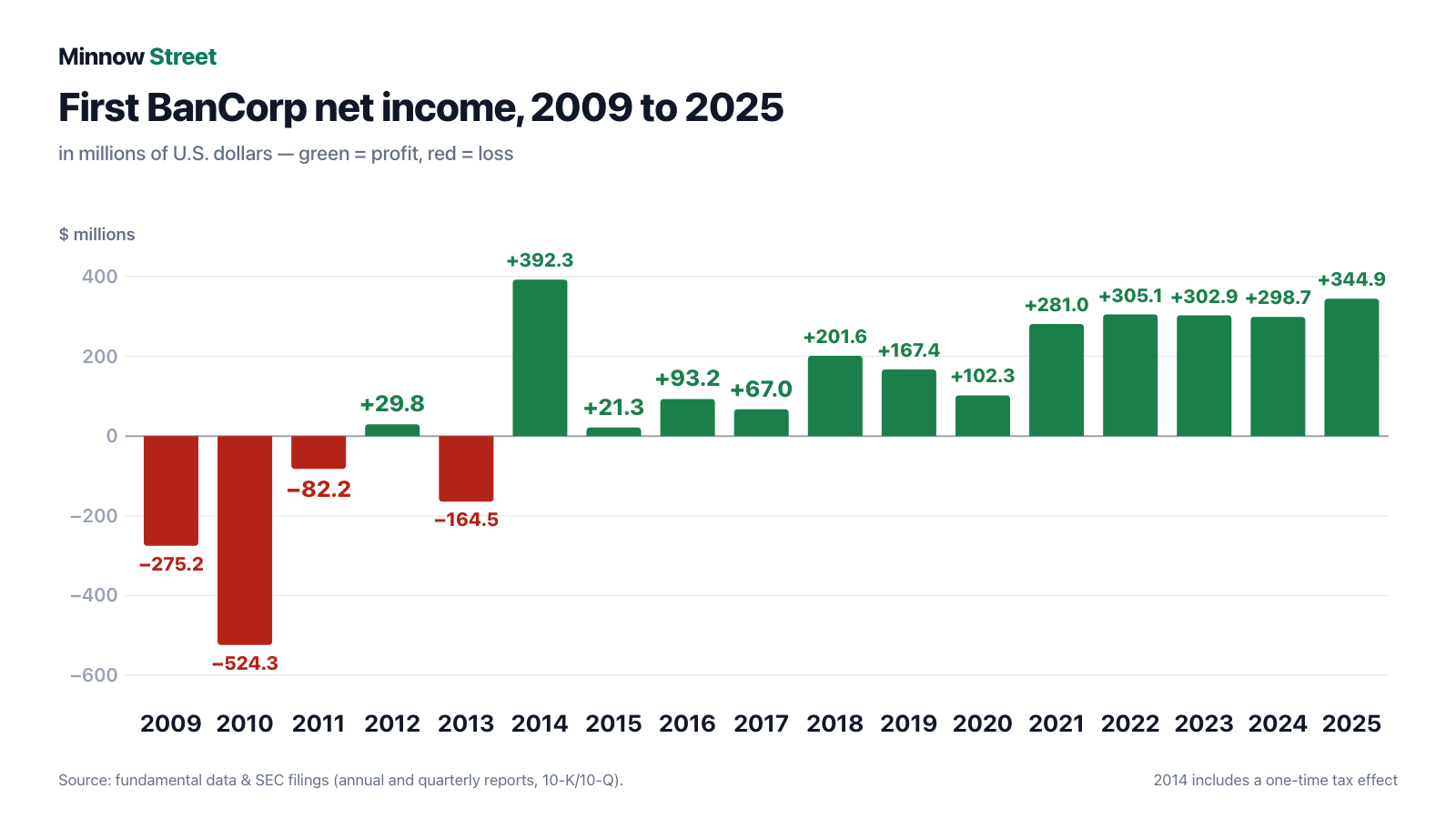
The most recent three years in detail: net interest income rose from $797.1 million (2023) through $807.5 million (2024) to $868.9 million (2025). Diluted earnings per share climbed from $1.71 through $1.81 to $2.15 — considerably faster than net income, because the bank buys back its own stock aggressively. And the current year continues the trend: in the first half of 2026 First BanCorp earned $184.9 million, or $1.19 per diluted share, after $157.2 million a year earlier.
The operating heart of a bank is its interest margin, and that has been rising for five quarters:
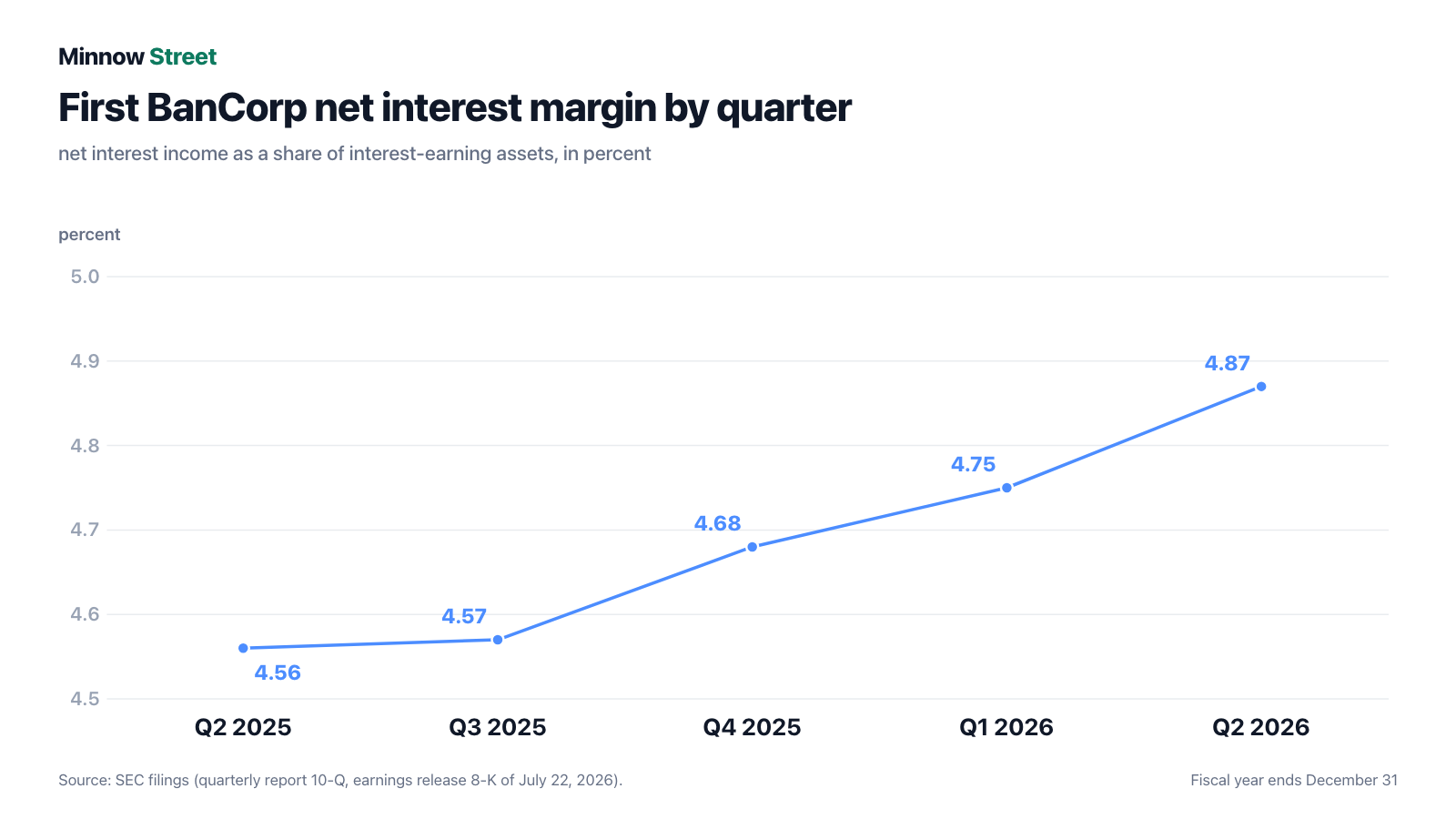
How good the second-quarter 2026 figures really are becomes clear against industry norms. A 2.02 percent return on average assets is very strong for a regional bank — 1.0 percent is the traditional mark of respectability. A 19.49 percent return on equity sits far above what most banks achieve. And a 48.07 percent efficiency ratio means the bank spends 48 cents to produce a dollar of revenue; lower is better, and below 50 is good. Chief Executive Officer Aurelio Alemán put it this way in the earnings release:
"Adjusted pre-tax, pre-provision income reached a record of $137.5 million, earnings per share increased 24% compared to the prior year, and return on average assets was 2.02%, marking our 18th consecutive quarter above 1.5%."
— First BanCorp., Exhibit 99.1 to the SEC earnings release on Form 8-K, July 22, 2026
The balance sheet looks tidy too. As of June 30, 2026 total assets stood at $19.24 billion, deposits at $16.87 billion and net loans at $13.03 billion. Non-performing assets amounted to just 0.59 percent of total assets ($113.9 million), with allowance coverage at 1.85 percent of the loan book. And the capital position is generous:

This is the part that genuinely impresses — and shareholders feel it: in the second quarter of 2026, 84 percent of earnings went back to them as dividends and buybacks. Shares outstanding fell within a year from 161.5 million to 152.7 million, so every remaining share represents a larger slice of the same bank. Of the 223.7 million shares ever issued, 71.0 million now sit in treasury, close to a third. And yet there are things worth knowing before calling this a pure success story.
What the filings say — the uncomfortable truths
Uncomfortable truth no. 1: this bank is a bet on one island
Almost everything First BanCorp is stands on 3,500 square miles in the Caribbean. 2,854 of its 3,218 employees work there, 57 of its 73 branches sit there, and the bulk of its loans were made there. The annual report says so without hedging:
"A significant portion of our business activities and credit exposure is concentrated in Puerto Rico, which has faced prolonged economic and fiscal challenges."
— First BanCorp., SEC annual report on Form 10-K for 2025, Item 1A Risk Factors
Anyone reading that as boilerplate underestimates the situation. Puerto Rico is a U.S. territory whose budget has been supervised since 2016 by a board appointed by the U.S. Congress — the PROMESA oversight board, named after the law with which Washington placed the island's finances under external control after a debt crisis. The good news: the economy is growing again, if barely — real gross national product rose 0.4 percent in fiscal 2025, the fifth consecutive year of growth. The bad news: the fiscal 2026 budget assumes roughly $1.2 billion less in federal funding, mainly in education, and holds back five percent of most agency spending for eight months in case revenue falls or Medicaid costs rise. An island economy that leans substantially on federal transfers is a different credit environment from a mainland banking region.
And the bank is not merely indirectly exposed to that government; it lends to it directly:
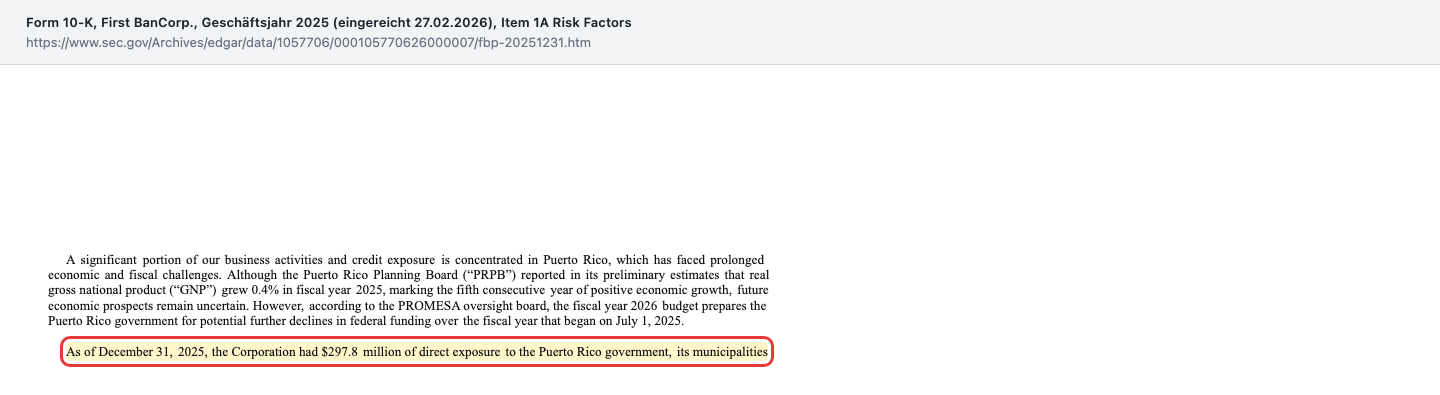
Of that $297.8 million, $211.3 million sat with municipalities that service their debt from assigned property tax revenues and have, in most cases, pledged their full taxing power. On top come public sector deposits: $3.0 billion as of June 30, 2026 — fully collateralized, but still money from a single, strained counterparty that can be moved for political reasons. In plain language: it is as if your largest tenant also parked half the building's reserve account with you. As long as things go well, that is convenient. When they do not, both problems arrive at once.
Uncomfortable truth no. 2: a $368 million hole in equity — and it is getting bigger
First BanCorp's total equity stood at $1,976.8 million as of June 30, 2026. That sounds solid until you read one line further down, where accumulated other comprehensive loss appears at minus $368.4 million — the accumulated, unrealized price losses on the securities book. Translated: the bank bought bonds at low yields before rates rose; since market rates went up, those securities are worth less. As long as they are held to maturity no cash leaves the building, but book value is already charged. 18.6 percent of equity is spoken for this way.
The 2025 annual report was relaxed about it: the portfolio would keep shrinking and the unrealized loss would decline accordingly — excluding the impact of market interest rates. That impact is precisely what arrived. The item rose from $354.6 million (December 31, 2025) to $360.7 million (March 31, 2026) and on to $368.4 million (June 30, 2026), with $7.7 million added in the second quarter alone. For you as an investor this is not an alarm but a yardstick: tangible book value per share stood at $12.68 as of June 30, 2026, and it would be noticeably higher without the securities book. Remember the line: at a bank, the most interesting loss is rarely in the income statement.
Uncomfortable truth no. 3: the record year 2025 is dressed up by about $20 million
Net income of $344.9 million in 2025 against $298.7 million a year earlier is a 15.4 percent increase and the best result in company history. The bank itself walks that number back. In its reconciliation to adjusted earnings it deducts three items: $16.6 million of tax relief from releasing a valuation allowance on deferred tax assets, $2.4 million from a pandemic-era employee retention credit and $1.1 million from reversing an FDIC special assessment. What remains is $325.3 million of adjusted earnings — against $299.4 million a year earlier, growth of 8.6 percent rather than 15.4 percent. Still good. Just differently good.
The largest of those items has a remarkable backstory:
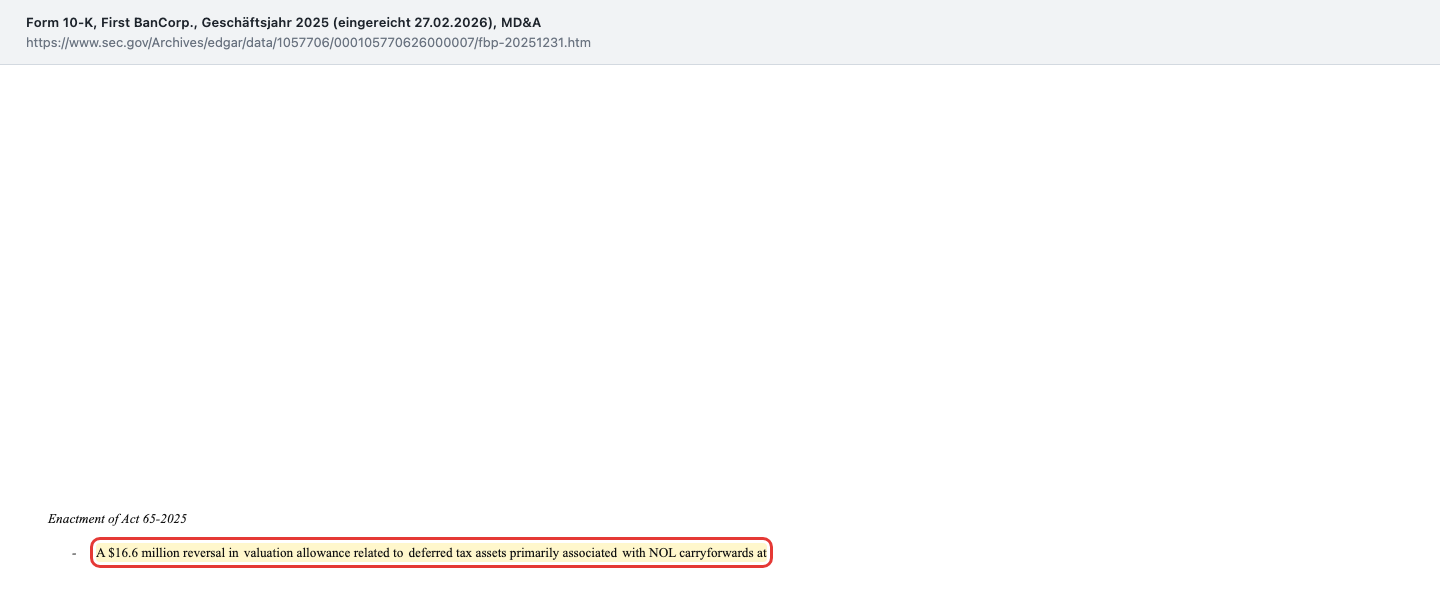
The irony is hard to miss: a meaningful share of the record 2025 profit stems from tax loss carryforwards — that is, from the very losses this bank wrote more than a decade ago. The past pays into the present. Just once, though.
Uncomfortable truth no. 4: offices, hotels and car loans
Two places in the loan book deserve a second look. First, commercial real estate:
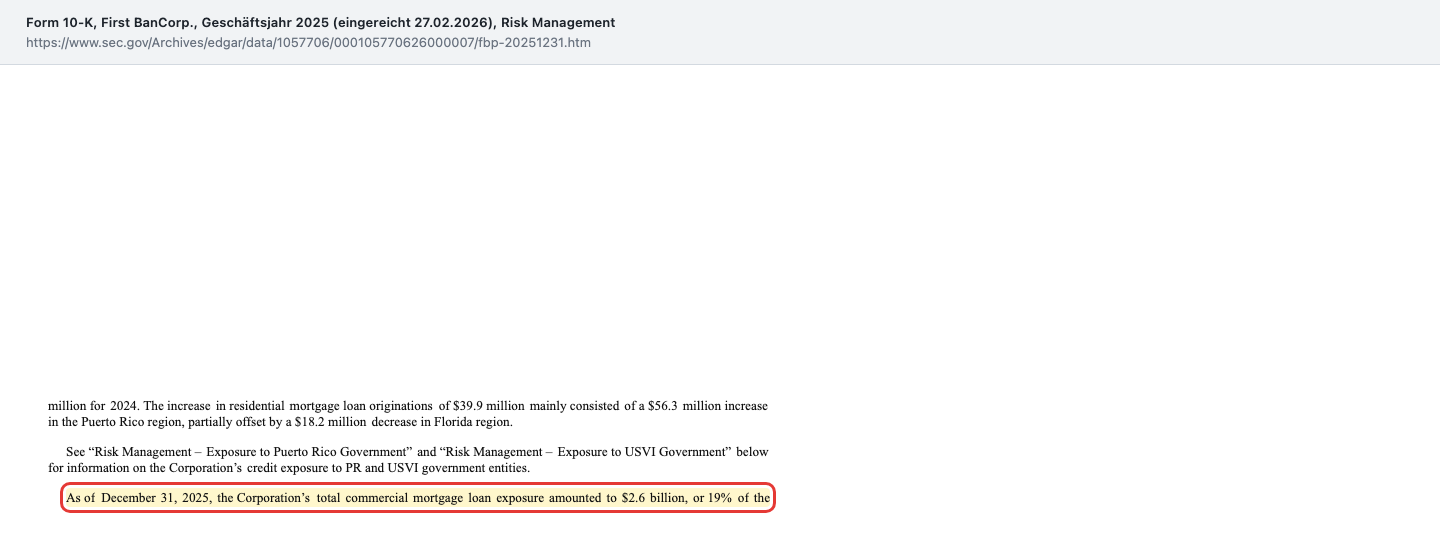
Of that $2.6 billion, $1.7 billion sat in Puerto Rico — and its composition rewards a careful read: 40 percent retail, 26 percent office real estate, 19 percent hotels. Office and hotel property have been the two hardest categories since the pandemic, and together they account for 45 percent of the Puerto Rico commercial mortgage book. Adding construction loans, commercial mortgage and construction exposure reaches $2.8 billion, or 21 percent of the loan book. That is not an alarm — charge-offs are low — but it is the place where a regional bank typically hurts first.
Second, the consumer side. In the second quarter of 2026 loans in early delinquency — 30 to 89 days past due but not yet charged off — jumped by $32.9 million to $143.4 million. Of that, $20.7 million came from consumer loans and finance leases, primarily the auto loan portfolio. At the same time the net charge-off ratio fell to 0.49 percent from 0.65 percent. Together those two facts form a picture you have to sit with: what is failing today is shrinking; what might fail tomorrow is growing. Early delinquency is the leading indicator — at a bank, it is the first number to look for in the next quarterly report.
Valuation: what the stock costs
Two yardsticks matter for a bank, and both can be dated cleanly. The first is price to book: for the quarter ended June 30, 2026 the release itself reports a closing price of $26.07; book value per share stood at $12.95 and tangible book value at $12.68. That is roughly two times book — for a bank earning 19.5 percent on equity that is not excessive, but it is no bargain either. Regional banks with average earnings power tend to trade at one to one and a half times book.
The second yardstick is the price-to-earnings ratio: against 2025 earnings of $2.15 per diluted share, the same price works out to roughly twelve times. That, too, is an order of magnitude rather than a signal: cheaper than the broad market, more expensive than the sector in its worst phases. Add a dividend of $0.76 per share over the trailing twelve months at a payout ratio of about 26 percent — plenty of room.
The professionals see it kindly but not euphorically: six analyst voices most recently produced four buy ratings and two holds at an average target price of $30.71 (data as of July 25, 2026). That implies a modest premium to the quarter-end close — a well-run bank, in other words, not a re-rating story. Readers looking for a comparison will find in our analysis of Pathward Financial a second example of how differently two banking models can look under the same regulator.
One caution about screener metrics: the classic Altman Z-score, which many filters use to gauge insolvency risk, is practically meaningless for banks — it was designed for industrial companies, and a bank carries a multiple of their liabilities by construction. Anyone judging First BanCorp's ability to survive should look at capital ratios (CET1 16.96 percent, total capital 18.21 percent as of June 30, 2026) and available liquidity of 19.60 percent of total assets, not at an industrial index.
Opportunities and risks at a glance
What speaks for First BanCorp:
- Exceptional earnings power: a 2.02 percent return on average assets and a 19.49 percent return on equity in the second quarter of 2026, with a 48.07 percent efficiency ratio — the 18th consecutive quarter above a 1.5 percent return on assets.
- Thick capital base: common equity tier 1 at 16.96 percent and total capital at 18.21 percent as of June 30, 2026, plus available liquidity equal to 19.60 percent of total assets.
- Consistent capital return: $50.0 million of buybacks and $31.0 million of dividends in the second quarter of 2026 alone — together 84 percent of quarterly earnings; shares outstanding fell from 161.5 million to 152.7 million within a year.
- Rising margin and growing business: net interest margin up five consecutive quarters to 4.87 percent, with second-quarter 2026 loan originations of $1.7 billion, 21 percent above the prior year.
- Good credit quality today: non-performing assets at 0.59 percent of total assets, an annualized net charge-off ratio of 0.49 percent and allowance coverage of 1.85 percent of the loan book (June 30, 2026).
What speaks against it:
- Puerto Rico concentration: 2,854 of 3,218 employees and 57 of 73 branches on an island under fiscal supervision; $297.8 million of direct exposure to the government, municipalities and public corporations (December 31, 2025) plus $3.0 billion of public sector deposits.
- Dependence on federal funding: the island's fiscal 2026 budget assumes roughly $1.2 billion less from Washington and holds back five percent of most agency spending for eight months.
- Unrealized-loss hole in equity: $368.4 million of unrealized securities losses as of June 30, 2026 — 18.6 percent of equity, and larger rather than smaller after the first half of 2026.
- A record year with one-time items: adjusted 2025 earnings were $325.3 million rather than $344.9 million; $16.6 million came from releasing a valuation allowance on loss carryforwards, which will not repeat.
- Property and consumer risks: 26 percent of the $1.7 billion Puerto Rico commercial mortgage book sits in office real estate and 19 percent in hotels; early delinquency rose by $32.9 million to $143.4 million in the second quarter of 2026, mostly in auto loans.
- Valuation without a margin of safety: roughly two times book and about twelve times 2025 earnings (quarter-end close of $26.07 on June 30, 2026) — the strong results are priced in.
A human conclusion
Back to the scar trap. Its core is not that charts lie — they honestly show what was. Its core is that we read them as forecasts when they are history. At First BanCorp the chart tells the story of 2009 through 2013: a bank that nearly went under, shareholders whose stakes were ground down, fifteen old shares turned into one. All of that is true, and nobody who was there got their money back. But it says nothing about whether the bank operating under that name today understands its business. The filings answer that question, and they answer it with a 2.02 percent return on assets, 16.96 percent common equity tier 1 and a management team returning 84 percent of quarterly earnings to shareholders.
The other direction is just as honest: whoever buys this stock today is no longer buying a turnaround — that one has happened and been paid for. They are buying a very well-run bank at roughly two times book, whose fate hangs on an island dependent on federal money, whose equity carries a growing unrealized-loss position, and whose record year drew a fifth of its growth from one-time items. So the honest question is not "is the turnaround intact?" but rather: are you willing to pay full price for an excellent banking franchise while carrying a geographic concentration risk that no price gain will take off your hands? If yes, you have a thesis. If no, you had a chart. What you make of it is your decision. And that is exactly as it should be.
Sources
Every original document used in this analysis, for your own reading:
- First BanCorp. — SEC annual report on Form 10-K for 2025 (filed February 27, 2026)
- First BanCorp. — SEC annual report on Form 10-K for 2024 (filed February 28, 2025)
- First BanCorp. — SEC quarterly report on Form 10-Q as of March 31, 2026 (filed May 8, 2026)
- First BanCorp. — SEC earnings release on Form 8-K, July 22, 2026 with Exhibit 99.1 (quarter ended June 30, 2026)
- Complete SEC filing history of First BanCorp.: EDGAR overview (sec.gov)
- Fundamental data (metrics, analyst consensus, split-adjusted price history and the 1-for-15 reverse split of January 7, 2011; data as of July 25, 2026), reconciled with the SEC filings.
- Hook: our in-house stock screen, list turnaround candidates, rank 11 of 62 U.S. hits, turnaround check 7 of 8 (as of July 25, 2026; the lists are recomputed daily).
Transparency & disclaimer: This analysis is journalistic commentary on publicly available information. It is not investment advice, not a regulated financial analysis and not a solicitation to buy or sell securities. Equity investments carry substantial risk, including total loss. All information without warranty; the as-of date of each figure is stated in the text. Do not confuse First BanCorp. of Puerto Rico (NYSE: FBP) with the similarly named First Bancorp of North Carolina (Nasdaq: FBNC) or the former First BanCorp of Maine. The author holds no position in First BanCorp shares at the time of publication.
Our Bottom Line at a Glance
- Earnings power positive
- In the second quarter of 2026 First BanCorp delivered a 2.02 percent return on average assets, a 19.49 percent return on equity and a 48.07 percent efficiency ratio — its 18th consecutive quarter above a 1.5 percent return on assets. The net interest margin rose for five straight quarters to 4.87 percent, and 2025 net income of $344.9 million was a company record.
- Capital & capital return positive
- Common equity tier 1 at 16.96 percent and total capital at 18.21 percent as of June 30, 2026, plus available liquidity of 19.60 percent of total assets. The second quarter of 2026 saw $50.0 million of buybacks at an average price of $25.08 and $31.0 million of dividends — 84 percent of quarterly earnings; shares outstanding fell from 161.5 million to 152.7 million within a year.
- Geographic concentration negative
- The 2025 annual report lists Puerto Rico concentration as its own risk factor: 2,854 of 3,218 employees and 57 of 73 branches sit there, alongside $297.8 million of direct exposure to the government and municipalities (December 31, 2025). The island budget has been under PROMESA supervision since 2016 and assumes roughly $1.2 billion less federal funding in fiscal 2026.
- Balance sheet quality neutral
- Credit quality is good (non-performing assets at 0.59 percent of total assets, a 0.49 percent charge-off ratio as of June 30, 2026), but equity of $1,976.8 million contains $368.4 million of unrealized securities losses — 18.6 percent, and larger rather than smaller after the first half of 2026. Early delinquency rose by $32.9 million to $143.4 million in the second quarter of 2026, mostly in auto loans.
- Earnings quality neutral
- Of the record $344.9 million earned in 2025, $325.3 million remains after the company's own adjustments; $16.6 million alone came from releasing a valuation allowance on crisis-era loss carryforwards, triggered by Puerto Rico's Act 65-2025. On an adjusted basis 2025 earnings grew 8.6 percent rather than 15.4 percent.
- Valuation neutral
- At the quarter-end close of $26.07 (June 30, 2026) the stock trades at roughly two times book value of $12.95 per share and about twelve times 2025 earnings. For a bank earning 19.5 percent on equity that is defensible but offers no margin of safety; the average analyst target price was $30.71 (data as of July 25, 2026).
First BanCorp is the scar trap in its purest form: the price chart sits roughly 91 percent below its split-adjusted December 2004 high and therefore tells the story of the 2009-2013 near-death and the 1-for-15 reverse split of January 7, 2011 — not of today's business. That business is as good as it has ever been: $96.2 million of quarterly net income, a 2.02 percent return on average assets, 16.96 percent common equity tier 1 and 84 percent of earnings returned to shareholders in the second quarter of 2026. Whoever buys today is therefore no longer buying a turnaround but a highly profitable island bank at roughly two times book — with a Puerto Rico concentration, a $368.4 million unrealized-loss hole in equity and about $20 million of one-time items inside the record year 2025. Not investment advice.
What Our Rating Means
Open questions
The business works in principle, but one material question is open. As long as it stays open, our findings do not carry a quality verdict.
The business is demonstrably excellent, the valuation already reflects it, and the open questions can be checked quarter by quarter against specific numbers. Anyone watching should track three things: does early delinquency stay above $143.4 million, or was the second-quarter 2026 jump an outlier? Does the unrealized-loss position in equity fall back below $368.4 million? And does adjusted earnings power of $325.3 million hold up in 2026 without tax one-offs? Then the island itself: how much federal funding does Puerto Rico receive in the fiscal year that began July 1, 2026? On the capital side the buyback machine speaks for itself — 84 percent of quarterly earnings most recently went back to shareholders. The decision is yours.
A journalistic assessment by our editorial team at the time of the deep dive, based on public sources — not investment advice and not a solicitation to buy or sell. Your personal circumstances (investment goals, risk capacity, taxes) cannot be taken into account. What our levels mean, how verdicts are formed, and what conflicts of interest exist →
Worth Noting
- First BanCorp reached our research list through our in-house stock screen for turnaround candidates, at rank 11 of 62 U.S. hits with a turnaround check of 7 out of 8 points (as of July 25, 2026). The lists are recomputed daily, so the rank can shift.
- An important note on the screen: this stock clears the mandatory pillar of being at least 50 percent below its all-time high because the split-adjusted high dates from December 2004 and the 1-for-15 reverse split of January 7, 2011 still shapes the adjusted chart — not because the business is weak. The classic Altman Z-score used by the filter to gauge distance from insolvency is not meaningful for banks in any case; capital ratios are what matter.
- All figures are dated and evergreen: annual figures from the 10-K for 2025, quarterly figures from the 10-Q as of March 31, 2026 and the earnings release on Form 8-K of July 22, 2026 (quarter ended June 30, 2026); valuation and analyst data as of July 25, 2026. The $26.07 price cited is the closing price documented in the quarterly release for June 30, 2026, not a daily quote.
- Risk of confusion: First BanCorp. of Puerto Rico (NYSE: FBP) is neither First Bancorp of North Carolina (Nasdaq: FBNC) nor the former First BanCorp of Maine. The authoritative identifier is SEC CIK 0001057706, registered as "FIRST BANCORP /PR/".
Frequently Asked Questions
First BanCorp. (NYSE: FBP), headquartered in San Juan, is the bank holding company for FirstBank Puerto Rico, a commercial bank founded in 1948. It gathers deposits and lends to retail and commercial customers. As of December 31, 2025 it operated 57 branches in Puerto Rico, eight across the U.S. and British Virgin Islands and eight in Florida, employed 3,218 people and reported total assets of $19.1 billion, including $16.7 billion of deposits and $12.9 billion of loans.
Because the split-adjusted all-time high dates from December 2004, and two things sit in between: the near-death years of 2009 through 2013, including a $524.3 million loss in 2010 alone, and a 1-for-15 reverse split on January 7, 2011. The roughly 91 percent gap (data as of July 25, 2026) therefore describes the history of the share, not the current condition of the bank — which posted record net income of $344.9 million in 2025.
Well above average. In the second quarter of 2026 the bank achieved a 2.02 percent return on average assets and a 19.49 percent return on equity; for regional banks a 1.0 percent return on assets is considered a solid average. Its efficiency ratio was 48.07 percent, meaning the bank spends 48 cents to produce a dollar of revenue. According to its own release, this was the 18th consecutive quarter with a return on average assets above 1.5 percent.
The 2025 annual report names the concentration in Puerto Rico explicitly as a risk factor. 2,854 of the 3,218 employees work there and 57 of the 73 branches sit there. As of December 31, 2025 the bank held $297.8 million of direct exposure to the government, its municipalities and public corporations. The island's budget has been supervised by the PROMESA oversight board since 2016 and assumes roughly $1.2 billion less federal funding for fiscal 2026.
The common equity tier 1 ratio shows how much hard equity stands behind a bank's risk-weighted assets. At 16.96 percent as of June 30, 2026 it sits far above regulatory minimums; the total capital ratio was 18.21 percent and the leverage ratio 11.72 percent. The earnings release states that all capital ratios exceeded the levels required for bank holding companies and well-capitalized banks. In practice: ample cushion for credit losses and buybacks.
Only partly. From the $344.9 million of 2025 net income the bank itself deducts, in its own reconciliation, $16.6 million of tax relief from releasing a valuation allowance on deferred tax assets, $2.4 million from an employee retention credit and $1.1 million from reversing an FDIC special assessment. Adjusted earnings were $325.3 million against $299.4 million a year earlier — growth of 8.6 percent rather than 15.4 percent. The operating improvement is real; the jump is smaller.
For the quarter ended June 30, 2026 the release reports a closing price of $26.07. Against book value of $12.95 per share that is roughly two times book, and against 2025 earnings of $2.15 per diluted share roughly twelve times earnings. The dividend over the trailing twelve months was $0.76 per share at a payout ratio of about 26 percent. The average analyst target price stood at $30.71 (data as of July 25, 2026).
The SEC record gives no indication of that. Between the quarterly report as of March 31, 2026 and July 25, 2026 the company filed only routine documents: earnings releases, officer changes, annual meeting results and employee benefit plan registrations. There is no material definitive agreement report (8-K Item 1.01), no merger proxy (DEFM14A or PREM14A) and no going-private statement (SC 13E-3). The stock is listed on the New York Stock Exchange and the company is a large accelerated filer.
Found an error?
Did you spot a factual error, an outdated number, or a typo in this deep dive? Let us know briefly — your report goes straight to the editorial team.