RF Industries Stock: Four Straight Earnings Beats, a 250 Percent Run — and a Record Quarter Worth $0.9 Million
RF Industries builds the parts of the wireless network nobody ever sees: connectors, cable harnesses, small cell enclosures, cooling systems. The stock ranks no. 3 in the U.S. selection of our in-house Big Earnings Surprise scanner (as of July 18, 2026) because reported earnings beat analyst estimates by at least 20 percent four quarters in a row — and the share price has more than tripled in twelve months. We read the annual reports (10-K) and quarterly reports (10-Q): a genuine turnaround with record revenue, a 35 percent gross margin and a growing backlog — but also a record profit of all of $0.9 million, a cash balance of $3.4 million, and a valuation near 165 times trailing earnings. Not investment advice — just the question of whether a rope woven from percentages can carry the weight of real dollars.
 Thomas Mücke
Founder & Publisher
Thomas Mücke
Founder & Publisher
Chart
Interactive price chart (TradingView).
Note: pure fact-based analysis, not investment advice and not a solicitation to buy or sell. All figures without guarantee.
There is an investor trap that works better the more often a company delivers: the streak trap. It runs on your brain's recency bias — whatever has happened four times in a row starts to feel like a law of nature. Four positive earnings surprises back to back, and your head pre-orders the fifth before it has seen a single balance sheet. RF Industries, Ltd. (Nasdaq: RFIL) is exactly such a case right now: reported earnings per share beat the analyst estimate by at least 20 percent in each of the last four quarters, the stock ranks no. 3 in the U.S. selection of our in-house Big Earnings Surprise scanner (as of July 18, 2026), and the share price has more than tripled in twelve months. So let's make a deal: before the streak becomes a law of nature in your head, we read together what the company itself filed, under penalty of law, with the U.S. securities regulator, the SEC — the annual report (10-K) for the fiscal year ended October 31, 2025, and the quarterly reports (10-Q) through April 30, 2026. Both things are in there: a genuine operating turnaround with record revenue and a record gross margin. And a "record profit" that, measured in dollars, amounts to $0.9 million — against a market value around $230 million. In the end, you decide what the streak is worth to you.
What RF Industries actually does — the plumbing of the wireless network
RF Industries is one of those suppliers whose products nobody ever sees and without which nothing transmits: coaxial connectors and adapters, signal dividers, directional couplers and filters, coaxial, data and fiber optic cables, custom cable harnesses, integrated small cell enclosures and energy-efficient cooling systems for wireless sites. The customers are telecommunications carriers, network equipment providers and original equipment manufacturers (OEMs). The company was incorporated in Nevada on November 1, 1979, went public in March 1984 — back then still under the name Celltronics — and has been called RF Industries since November 1990. Today, 289 full-time employees (as of October 31, 2025) work at five U.S. sites from San Diego to Long Island; under the group umbrella sit five acquired subsidiaries, among them Schroff Technologies (cooling systems and small cell concealment) and Microlab/FXR (radio-frequency components). Some of the connectors are made by third-party manufacturers in Asia.
The business runs through three product lines, which the company has reported as a single segment since a restructuring in the final quarter of fiscal 2025: interconnect products (standard connectors and cables, about 35 percent of revenue in the first half of fiscal 2026), custom cabling (37 percent — growing briskly, above all in the aerospace industry) and integrated systems (28 percent — small cell enclosures and cooling systems, a project business that hangs on the budget cycles of large wireless carriers). Which brings us to the central tension of this analysis, running through every chapter: the turnaround is operationally real — but it is celebrated in percentages and earned in very small dollar amounts, while the market is already paying a nine-figure price.
Where the stock shows up in our scanner
Every day we run about 3,500 stocks through our scanners. As of July 18, 2026, RF Industries carries a rare badge: rank 3 in the U.S. selection of our Big Earnings Surprise scanner. The criterion is strict: reported earnings per share must have beaten the analyst estimate by at least 20 percent in each of the last four completed quarters — most recently, RF Industries came in about 71 percent above the estimate (fundamental data, as of July 18, 2026). To replicate it yourself: open the scanner, set the country filter to "US" — the list shows the serial surprisers in scanner order. On top of that comes striking confluence: as of the same data cut-off, the stock appears in 13 further trend and momentum scanners, from Stan Weinstein's Stage 2 to relative-strength new highs to the Minervini trend criteria — with a relative strength rating of 97, the price momentum is beyond dispute. The fundamental lens of the same scanner shows the other face: a price-to-earnings ratio near 165 (trailing), an EPS rating of just 61 (the long-term earnings record has only just been repaired), a Piotroski F-Score of 7 of 9 (a nine-point test of balance-sheet direction — 7 means: most things are improving) and an Altman Z-Score around 6.5 (an early-warning gauge for insolvency; the danger zone historically starts below 1.8 — RF Industries is far away from it). Remember the principle: a surprise scanner measures percentages against expectations — not dollars against the market value. Which is exactly why we now read the filings.
The numbers over the years — honestly appraised
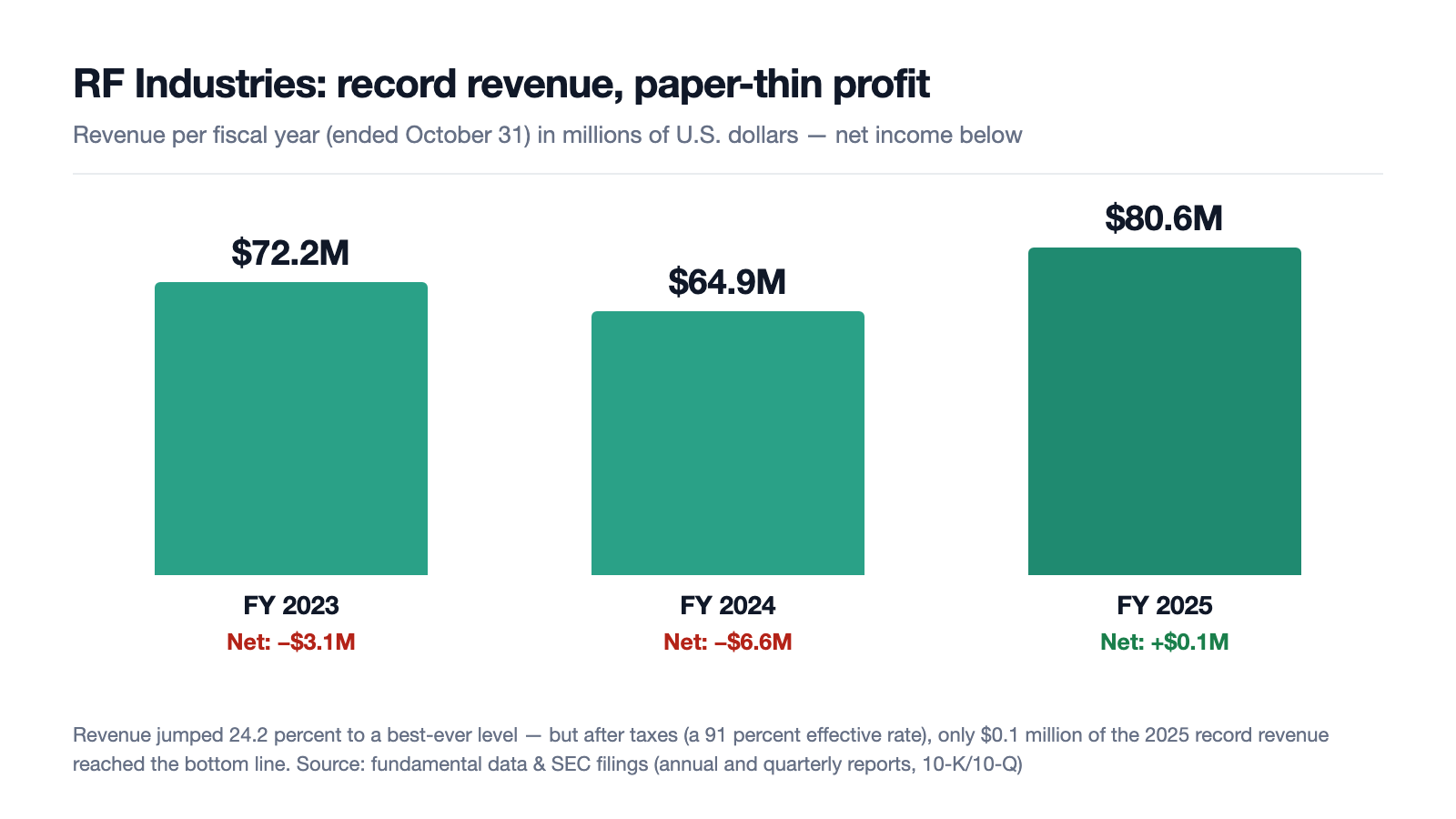
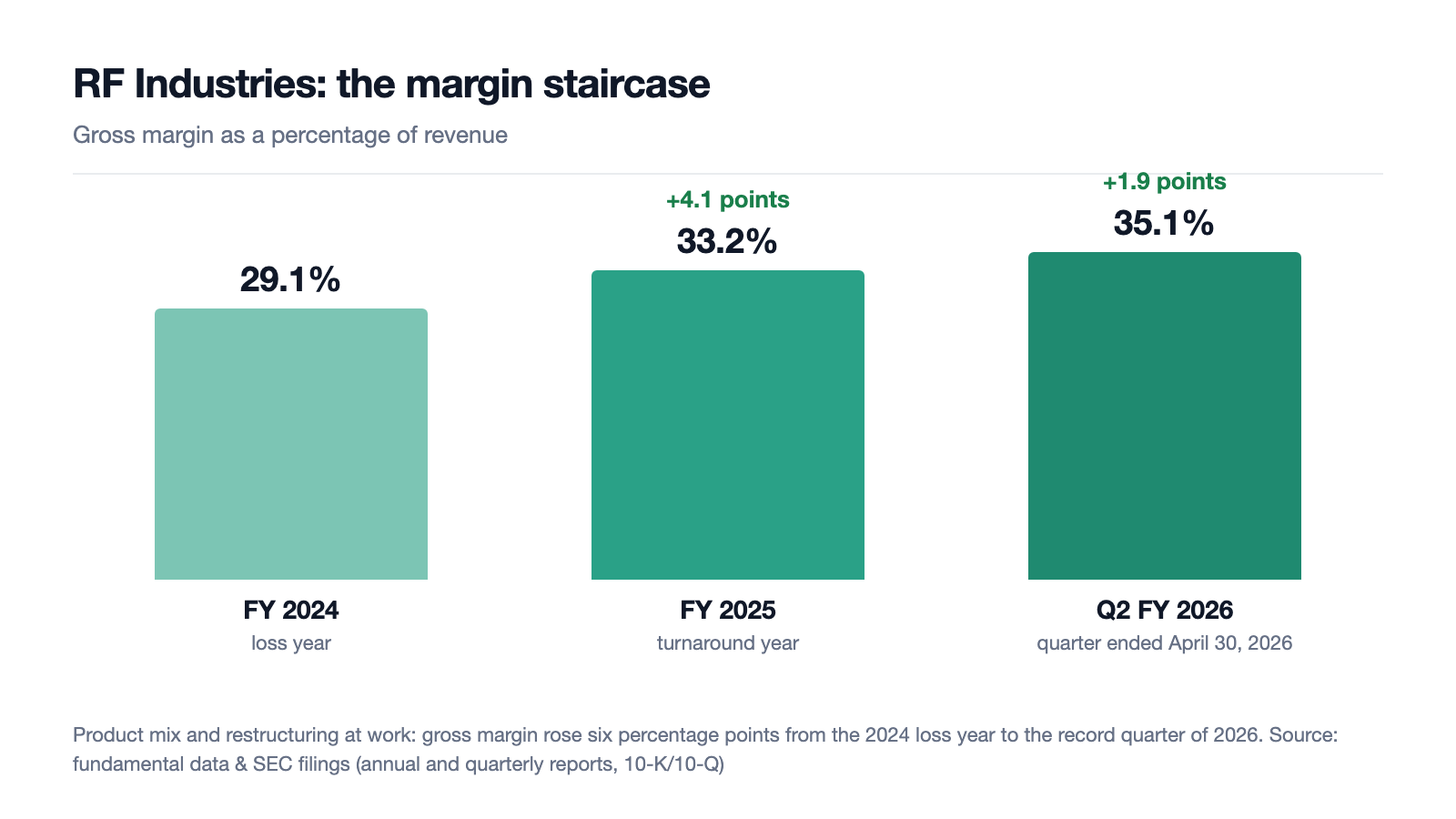
First, what genuinely impresses. RF Industries comes out of two hard loss years: in fiscal 2023 (ended October 31), revenue fell to $72.2 million with a net loss of $3.1 million; in 2024 it slid further to $64.9 million (down 10.1 percent) with a $6.6 million loss — the wireless carriers had slashed their capital spending. Then the picture turned: in fiscal 2025, revenue jumped 24.2 percent to a best-ever $80.6 million, carried by integrated systems (up 41 percent — small cells and cooling for the big carriers) and custom cabling (up 45 percent — the push into the aerospace industry). Gross margin rose from 29.1 to 33.2 percent, and the prior-year loss became net income — albeit a paper-thin $0.1 million ($0.01 per share).
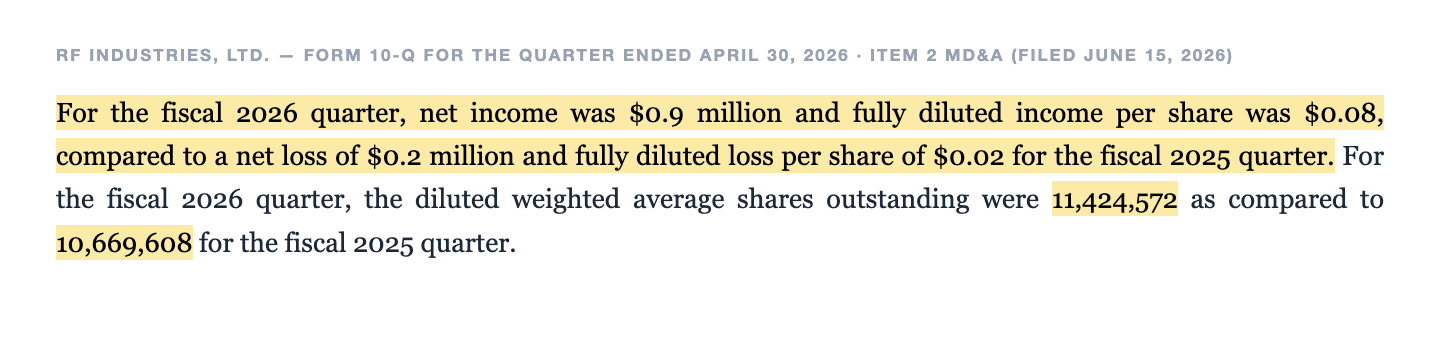
And the turn carries into the new fiscal year: the quarter ended April 30, 2026, delivered $20.7 million in revenue (up 9.4 percent), a gross margin of 35.1 percent (year-ago quarter: 31.5 percent) and $0.9 million in net income — $0.08 per share after a $0.02 loss a year earlier. The quarterly report records the swing soberly:
"For the fiscal 2026 quarter, net income was $0.9 million and fully diluted income per share was $0.08, compared to a net loss of $0.2 million and fully diluted loss per share of $0.02 for the fiscal 2025 quarter."
— RF Industries, Ltd., SEC quarterly report 10-Q for the quarter ended April 30, 2026, Item 2 "Management's Discussion and Analysis"
The order book is growing too: as of April 30, 2026, RF Industries reported a backlog of $20.0 million, up from $15.5 million as of October 31, 2025 — a 29 percent increase in six months, driven by custom cabling and integrated systems. The company has now posted pre-tax income four quarters in a row. The gross margin staircase of recent years may be the bulls' strongest exhibit:
Honesty also requires the first quarter of fiscal 2026 (ended January 31, 2026): revenue down 1.1 percent, a small net loss of $50,000 at the bottom line — because the big wireless customers time their small cell orders to budget cycles, and the integrated systems project business dropped 37 percent. Remember the image: this company does not grow like clockwork; it breathes with the ordering rhythms of a few large customers. What that means structurally is the subject of the next chapter.
What the filings say — the uncomfortable truths
Uncomfortable truth no. 1: the "record profit" is a very small number — and in 2025 the taxman took nearly all of it
Let's stay with the order of magnitude that gets drowned out in the surprise euphoria. The best quarter in recent company history produced $0.9 million in net income. The entire fiscal year 2025 — the year of the celebrated turnaround with $80.6 million in record revenue — ended with net income of $0.1 million. One reason sits in the tax line of the annual report:
"The provision for income taxes was $0.7 million or 91% and $2.8 million or (73.5%) of income before income taxes for fiscal 2025 and 2024, respectively."
— RF Industries, Ltd., SEC annual report 10-K for fiscal year 2025 (ended October 31, 2025), Item 7 "Management's Discussion and Analysis"
A 91 percent tax rate is not a curiosity but the after-effect of the loss years: RF Industries has prudently written down its deferred tax assets (the "tax vouchers" earned in the losses) with a valuation allowance. The flip side is a genuine opportunity — in the quarterly report as of April 30, 2026, the company writes that after four profitable quarters in a row it is "reasonably possible" that a significant portion of that allowance will be released:
"If the Company is able to sustain its current level of profitability and generate sufficient future taxable income, it is reasonably possible that a reduction of a significant portion of the valuation allowance may be appropriate in a future reporting period. Any such reduction could result in a material income tax benefit in the period recognized and could have a significant impact on the Company's effective tax rate and results of operations."
— RF Industries, Ltd., SEC quarterly report 10-Q as of April 30, 2026, Item 2 "Critical Accounting Estimates"
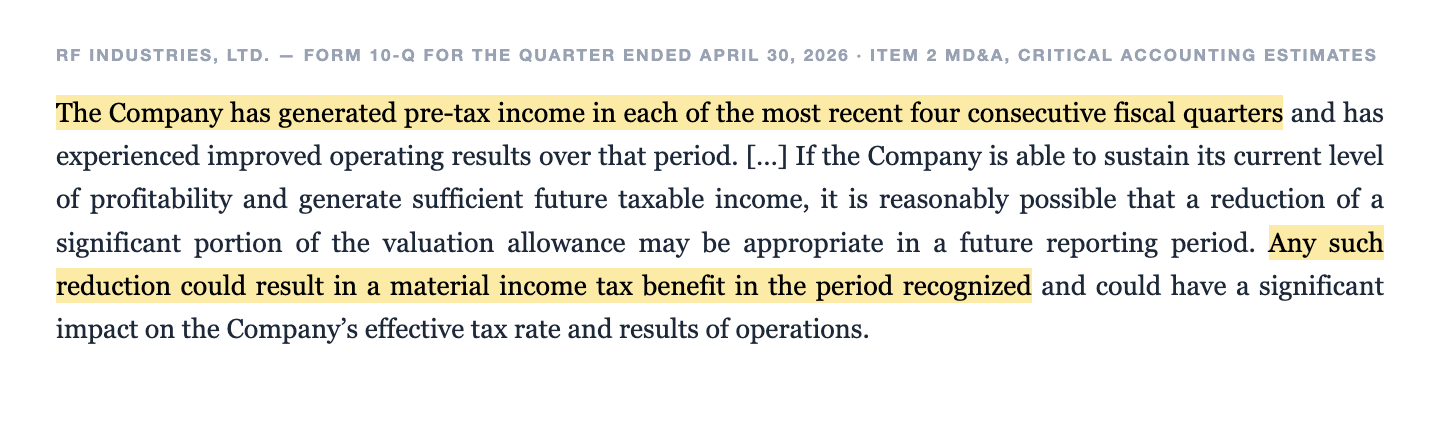
For you, that means two things: past reported profits were drawn too low for tax reasons — and one day a quarter may arrive whose earnings jump is mostly a bookkeeping entry. Growth in percentages can hide two things at once: how small the base is, and how much of it will be accounting technique.
Uncomfortable truth no. 2: a few large customers, no minimum purchases — and the project business swings by double digits
How dependent the business is on individual names, the annual report says without embellishment:
"We generate much of our revenue from a limited number of customers. […] the written agreements with these customers do not have any minimum purchase obligations and they could stop buying our products at any time and for any reason."
— RF Industries, Ltd., SEC annual report 10-K for fiscal year 2025, Item 1A "Risk Factors"
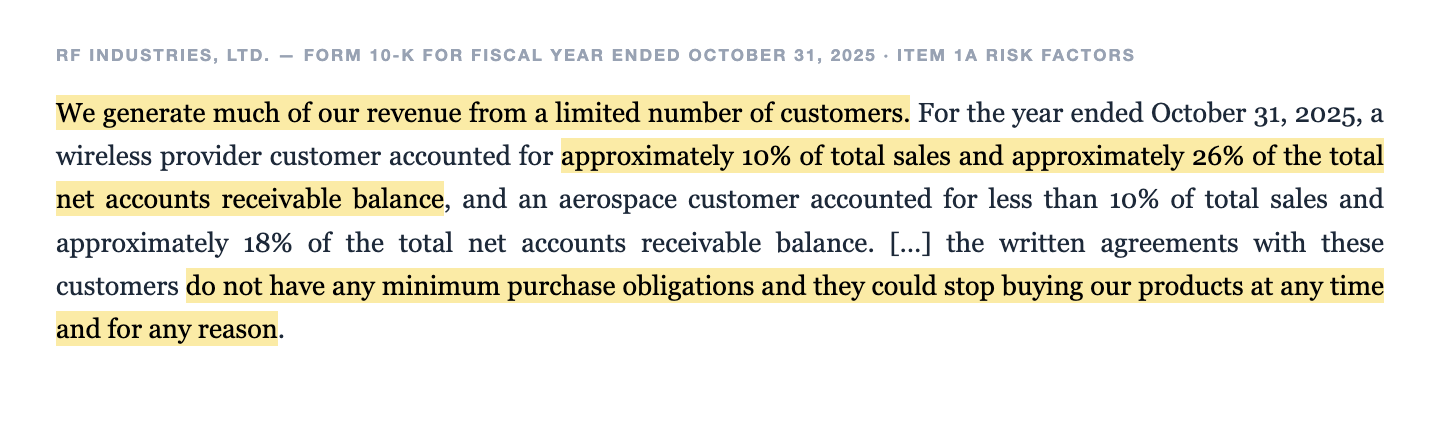
The numbers behind it: in fiscal 2025, a single wireless carrier accounted for about 10 percent of revenue and 26 percent of all outstanding receivables; in the quarter ended April 30, 2026, an aerospace customer stood at 14 percent of revenue and 20 percent of receivables. In everyday terms: picture a bakery whose biggest buyer orders differently every week, has promised nothing — and happens to owe every fourth dollar on the bakery's open invoices. The books themselves have shown what that feels like: the small cell project business dropped 37 percent in the first quarter of 2026 and was still 17 percent below the prior year in the second, "driven by the timing of orders and shipments based on budget cycles" — the carriers' budget cycles set the tempo. We dissected the same pattern at fiber-optic supplier Clearfield: when network operators cut back, the supplier feels it first. New and welcome is the second growth pillar, aerospace (custom cabling up 45 percent in fiscal 2025) — but so far it, too, is visibly concentrated on one large customer.
Uncomfortable truth no. 3: $3.4 million in cash, a drawn credit line — and a half-year that burned cash from operations
The third truth is written not in the income statement but in the cash flow statement. Despite $0.8 million in first-half net income, cash flowed out of operations on balance in the first half of fiscal 2026 — $47,000 — because growing receivables and inventories and shrinking accruals ate up the profit. Cash fell within six months from $5.1 million to $3.4 million, while $6.1 million was still drawn on the secured credit facility with Eclipse Business Capital (EBC) as of April 30, 2026 — an asset-based line whose availability hangs on a borrowing-base formula over receivables and inventories, and which originally carried interest at SOFR plus 5.00 percentage points; only in November 2025 were the maturity (to March 2029) and terms improved. And Note 1 of the quarterly report contains a paragraph you would not expect from a stock that is up 250 percent:
"The propriety of using the going concern basis is dependent upon, among other things, the achievement of future profitable operations, the ability to generate sufficient cash from operations and potential other funding sources, in addition to cash on-hand along with the current credit facility with Eclipse Business Capital (“EBC”) to meet its obligations as they become due."
— RF Industries, Ltd., SEC quarterly report 10-Q as of April 30, 2026, Note 1 (basis of presentation)
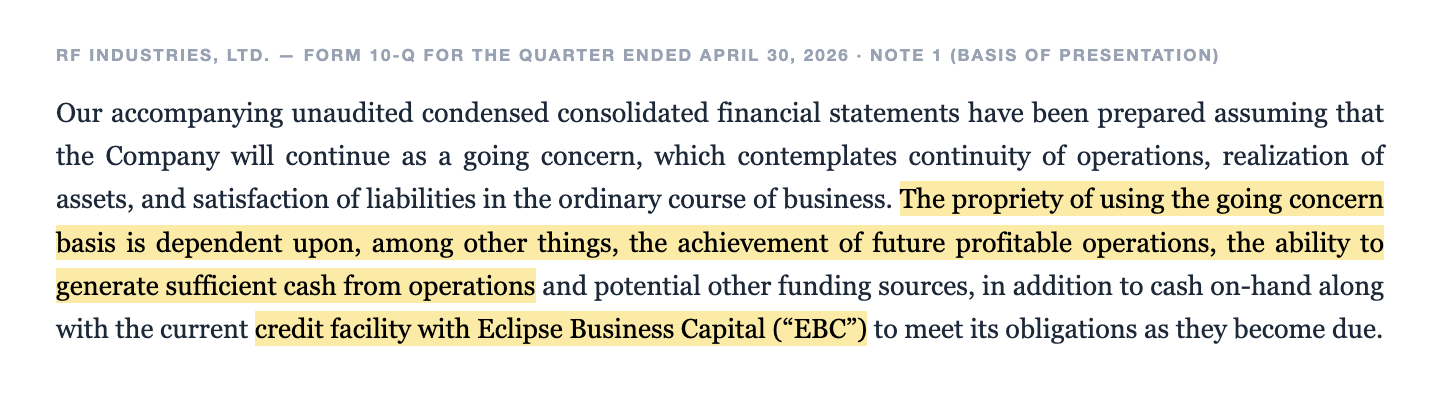
For perspective: this is not a formal going-concern warning — in the same report the company states that cash plus the credit line will cover at least the next twelve months, current assets cover current liabilities 1.9 times, and an Altman Z-Score around 6.5 signals anything but distress. But the wording is a reminder of where this company is coming from — and of how thin the buffer still is. To that, add a quiet dilution effect of the rally itself: the fully diluted share count rose within a year from 10.7 to 11.4 million (up 7 percent), because the price surge lifted every stock option into the money — a year earlier, 405,056 options were still under water; as of April 30, 2026, not a single one. And a dividend? "We did not pay or declare any dividends" — the former dividend payer has suspended its payout for years. A turnaround only becomes a rock once it shows up in the cash flow statement.
Valuation: what the market pays for the streak
Now to the price tag. In mid-July 2026, RF Industries stock traded near $21, for a market value around $230 million (all valuation figures: data as of July 18, 2026; sanity-checked against 10,851,265 shares outstanding per the quarterly report). That works out to a price-to-earnings ratio near 165 on trailing twelve-month earnings, a price-to-sales ratio around 2.8 and a price-to-book ratio around 6.2. Run the number yourself once and it loses none of its edge but all of its abstraction: even if RF Industries repeated its record quarter of $0.08 per share four times in a row, that would put $0.32 of annual earnings on the ticket — at a price near $21, still about 65 times earnings. So the market is not paying for the state achieved; it is paying for a steep extrapolation: further rising margins, the small cell business snapping back, the aerospace build-out — and perhaps the one-time tax gain from releasing the valuation allowance, which would flatter the optics of a future quarter. At connector neighbor Bel Fuse we saw how the same end market can trade at a fraction of these multiples when the profits are bigger and the story is smaller. In fairness: a micro cap with a $230 million market value, 44 percent institutional ownership and roughly a quarter of the shares in insider hands (fundamental data, as of July 18, 2026) can ride on expectations for a long time — as long as the streak holds.
Opportunities and risks at a glance
What speaks for RF Industries:
- The turnaround is documented in the filings: record revenue of $80.6 million in fiscal 2025 (up 24.2 percent), four consecutive quarters of pre-tax income, gross margin up from 29.1 to 35.1 percent (quarter ended April 30, 2026) — restructuring and product mix are working.
- The order book is growing faster than revenue: a $20.0 million backlog as of April 30, 2026, after $15.5 million as of October 31, 2025 (up 29 percent in six months).
- A second leg is being built: custom cabling up 45 percent in fiscal 2025 on the push into aerospace — reducing the pure telecom dependency.
- A hidden reserve: releasing the tax valuation allowance could, per the quarterly report, produce a material one-time income tax benefit; at the same time, a Piotroski score of 7 of 9 and an Altman Z around 6.5 show a healing, not a threatened, balance sheet (data as of July 18, 2026).
- Analyst earnings estimates trailed the business by at least 20 percent four quarters in a row — precisely the pattern our Big Earnings Surprise scanner hunts for.
What speaks against it:
- The absolute scale: $0.9 million in net income in the best quarter, $0.1 million in fiscal 2025 — against a market value around $230 million (P/E near 165, data as of July 18, 2026), the drop is enormous.
- Concentration without a net: single large customers at up to 26 percent of receivables, no minimum purchase obligations; the small cell project business recently swung double digits with carrier budget cycles (minus 37 percent in Q1, minus 17 percent in Q2 of fiscal 2026).
- A thin financial cushion: $3.4 million in cash, $6.1 million drawn on an asset-based credit line, slightly negative operating cash flow in the first half of fiscal 2026, going-concern vocabulary in Note 1 — and no dividend.
- Dilution from the rally itself: the fully diluted share count rose 7 percent within a year because every option moved into the money.
- A cyclical past: two loss years (minus $3.1 and minus $6.6 million) are only a few quarters back; demand hangs on the capital budgets of a few U.S. network operators, and part of the manufacturing sits in Asia (tariff and supply chain risk per the risk factors).
A human conclusion
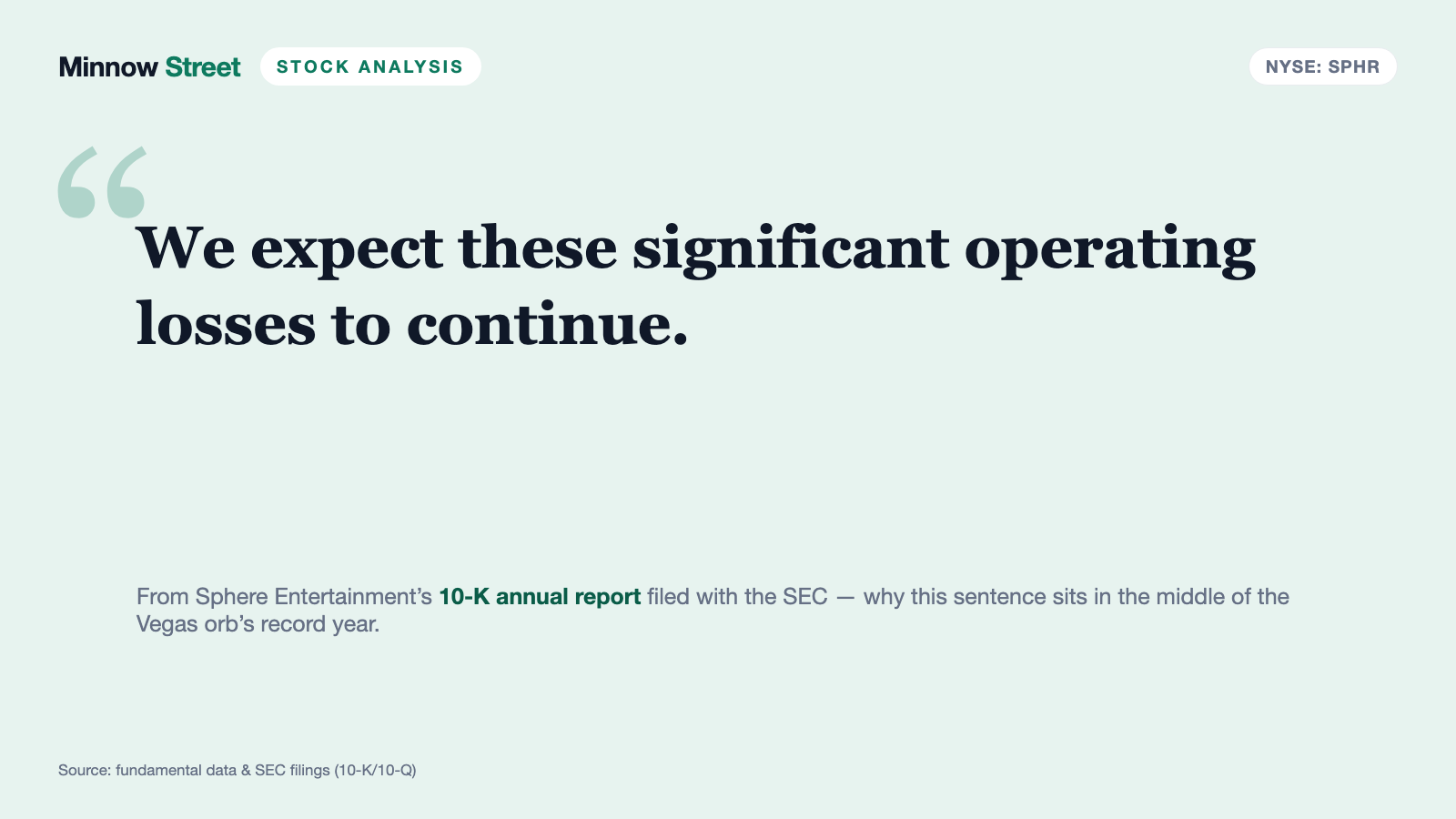
Back to the streak trap from the beginning. Its core is not that streaks lie — RF Industries' four earnings surprises are real, and the turnaround is written in documents filed under penalty of law: record revenue, a margin staircase, a growing order book, four profitable quarters. Its core is that a streak takes the one question off your hands that it cannot answer: how much was actually earned? The filings' answer is uncomfortably concrete: $0.9 million in the best quarter, $3.4 million in the till, a drawn credit line and a tax rate that most recently took nearly everything — while the market puts $230 million on the table, some 165 times trailing earnings. Between those two numbers stretches the rope from the title image. It can hold: if margins keep climbing, carrier budgets come back, aerospace delivers and the tax booster fires. It can snap: if a single large customer that has promised nothing skips a quarter. If you hold or buy the stock, check three lines in every quarterly report (10-Q): the backlog (does it grow beyond $20 million?), operating cash flow (does it turn sustainably positive?) and the tax footnote on the valuation allowance (does the book gain arrive — and does the market strip it out?). What you make of it is your decision. And that is exactly as it should be.
Sources
All original documents used in this analysis — for your own reading:
- RF Industries, Ltd. — SEC annual report 10-K for fiscal year 2025 (ended October 31, 2025; filed January 14, 2026)
- RF Industries, Ltd. — SEC annual report 10-K for fiscal year 2024 (ended October 31, 2024; filed January 21, 2025)
- RF Industries, Ltd. — SEC quarterly report 10-Q for the quarter ended April 30, 2026 (filed June 15, 2026)
- RF Industries, Ltd. — SEC quarterly report 10-Q for the quarter ended January 31, 2026 (filed March 16, 2026)
- Complete SEC filing history of RF Industries: EDGAR overview (sec.gov)
- Fundamental data (metrics, quarterly series, valuation; data as of July 18, 2026), reconciled with the SEC filings.
- Screener and rating data: in-house stock scanner (data as of July 18, 2026), including the Big Earnings Surprise scanner (U.S. selection, rank 3).
Transparency & disclaimer: This analysis is a journalistic contextualization of publicly available information and is not investment advice, not a financial analysis in the regulatory sense, and not a solicitation to buy or sell securities. Stock investments carry substantial risks up to and including total loss. All information without guarantee; the data cut-off is noted in the text. The author holds no position in RF Industries shares at the time of publication.
Our Bottom Line at a Glance
- Turnaround & surprise streak positive
- Four consecutive quarters of pre-tax income, earnings per share at least 20 percent above the analyst estimate in each of the last four quarters (most recently ~71 percent; fundamental data, as of 07/18/2026), record revenue of $80.6 million in fiscal 2025 (+24.2 percent) after two loss years — the swing is documented in the SEC filings (10-K 2025; 10-Q as of 04/30/2026).
- Margin & backlog positive
- Gross margin up from 29.1 (FY2024) through 33.2 (FY2025) to 35.1 percent in the quarter ended 04/30/2026; backlog grown within six months from $15.5 million to $20.0 million (+29 percent); custom cabling +45 percent in FY2025 on the aerospace push.
- Scale of profits & cash flow negative
- The record quarterly profit is $0.9 million, the full fiscal year 2025 produced $0.1 million (91 percent tax rate); first-half fiscal 2026 operating cash flow was slightly negative at −$47,000 — the percentage records stand on a very small dollar base (10-K 2025; 10-Q as of 04/30/2026).
- Valuation negative
- P/E near 165 (trailing), price-to-sales around 2.8, price-to-book around 6.2 at a market value around $230 million (data as of 07/18/2026); even four repeated record quarters ($0.32/share p.a.) would still leave a P/E near 65 — the market is paying for the extrapolation, not the state.
- Customer concentration negative
- Single large customers account for up to 26 percent of receivables (wireless carrier, FY2025) and 14 percent of revenue (aerospace customer, Q2 FY2026) — without minimum purchase obligations; the small cell project business swung −37 and −17 percent with carrier budget cycles (Q1/Q2 FY2026; 10-K Item 1A, 10-Q).
- Balance sheet & liquidity neutral
- Cash of $3.4 million plus the secured EBC credit facility ($6.1 million drawn; maturity extended to March 2029, terms improved in November 2025), current ratio 1.9, Altman Z around 6.5, Piotroski 7 of 9 — direction is solid, but Note 1 of the 10-Q explicitly frames the going-concern basis around future profits and the credit line, and the rally lifted every option into the money (diluted share count +7 percent).
RF Industries is the rare case in which the streak euphoria and the books are both right: the turnaround is real — record revenue, a margin staircase to 35.1 percent, a backlog up 29 percent, four surprise quarters in a row — and at the same time it is tiny: $0.9 million of net income in the best quarter, $3.4 million in cash, slightly negative first-half operating cash flow and going-concern vocabulary in the footnote. In between sits a valuation near 165 times trailing earnings that presupposes a steep continuation, plus the prospect of a one-time tax book gain from releasing the valuation allowance that will distort the optics of a future quarter. Whoever invests here is not buying the state achieved but the extension of a streak. Not investment advice.
What Our Rating Means
- If you don't own the stock
- As long as the question raised in the bottom line stays open, we see no basis for an entry.
- If you hold it in your portfolio
- Our findings offer no acute reason to sell — the checkpoints named remain decisive.
A journalistic assessment by our editorial team at the time of the deep dive, based on public sources — not investment advice and not a solicitation to buy or sell. Your personal circumstances (investment goals, risk capacity, taxes) cannot be taken into account. What our categories mean, how verdicts are formed, and what conflicts of interest exist →
Worth Noting
- RFIL joined the research list as rank 3 of our in-house Big Earnings Surprise scanner (U.S. selection, as of July 18, 2026) — part of our series on the top 20 of that selection.
- Scanner metrics (P/E, P/S, P/B, Piotroski, Altman Z, RS and EPS rating, surprise history) use trailing twelve-month figures as of the July 18, 2026 data cut-off; the confluence additionally spanned 13 trend and momentum scanners.
- Price and market value figures (~$21, ~$230 million) from the July 18, 2026 feed, sanity-checked against 10,851,265 shares outstanding per the quarterly report 10-Q as of April 30, 2026; analyses are evergreen, daily prices are not a buy argument.
Frequently Asked Questions
RF Industries, Ltd. (Nasdaq: RFIL, San Diego, 289 full-time employees as of October 31, 2025) manufactures interconnect technology for wireless and data networks: coaxial connectors and cables (interconnect, about 35 percent of revenue in the first half of fiscal 2026), custom cable assemblies and harnesses (37 percent, growing fast in aerospace) and integrated systems of small cell enclosures and cooling systems for wireless sites (28 percent). Customers are mainly U.S. carriers, network equipment providers and OEMs.
Our in-house Big Earnings Surprise scanner filters stocks whose reported earnings per share beat the analyst estimate by at least 20 percent in each of the last four completed quarters. RF Industries met that criterion as of the July 18, 2026 data cut-off and ranked no. 3 in the U.S. selection; the most recent quarterly surprise was about 71 percent above the estimate. Such streaks show that estimates are trailing the business — they say nothing about the absolute level of profit.
Operationally strong, small in absolute terms: revenue rose 9.4 percent to $20.7 million, gross margin reached 35.1 percent (prior year: 31.5 percent), and a $0.2 million loss became net income of $0.9 million, or $0.08 per share. Backlog grew within six months from $15.5 million to $20.0 million. At the same time, first-half operating cash flow was slightly negative at minus $47,000 as receivables and inventories grew.
Recently, and barely: after net losses of $3.1 million (fiscal 2023) and $6.6 million (2024), fiscal 2025 (ended October 31) closed with net income of $0.1 million — partly because the effective tax rate was 91 percent. As of April 30, 2026, the company reported its fourth consecutive quarter of pre-tax income; the quarter produced $0.9 million in net income. Releasing the tax valuation allowance could add a material book gain in a future period.
Mixed: as of April 30, 2026, the books showed $3.4 million in cash (October 31, 2025: $5.1 million) and $6.1 million drawn on a secured credit facility with Eclipse Business Capital; current assets covered current liabilities about 1.9 times. The quarterly report explicitly frames the going-concern basis with reference to future profits, cash flow and the credit line — not a formal going-concern warning, but a pointer to the thin buffer. An Altman Z-Score around 6.5 and a Piotroski score of 7 of 9 (as of July 18, 2026) show a balance sheet that is healing.
No. RF Industries has paid dividends in the past but has not distributed anything for years: no dividend was paid or declared in fiscal 2024, fiscal 2025 or the first half of fiscal 2026. Whether and when the board resumes payments is open per the annual report and depends on earnings, funding needs and other factors.
By classic yardsticks, very: as of July 18, 2026, the stock traded near $21 with a market value around $230 million — roughly 165 times trailing earnings, 2.8 times revenue and 6.2 times book value. Even four repetitions of the record quarter ($0.32 of earnings per share per year) would still leave a price-to-earnings ratio near 65. The market is paying for a steep continuation of the turnaround, not for the state achieved.
Found an error?
Did you spot a factual error, an outdated number, or a typo in this deep dive? Let us know briefly — your report goes straight to the editorial team.