Bel Fuse Stock: The Quiet 20-Bagger Inside the Data Center — and What the Chart Has Already Priced In
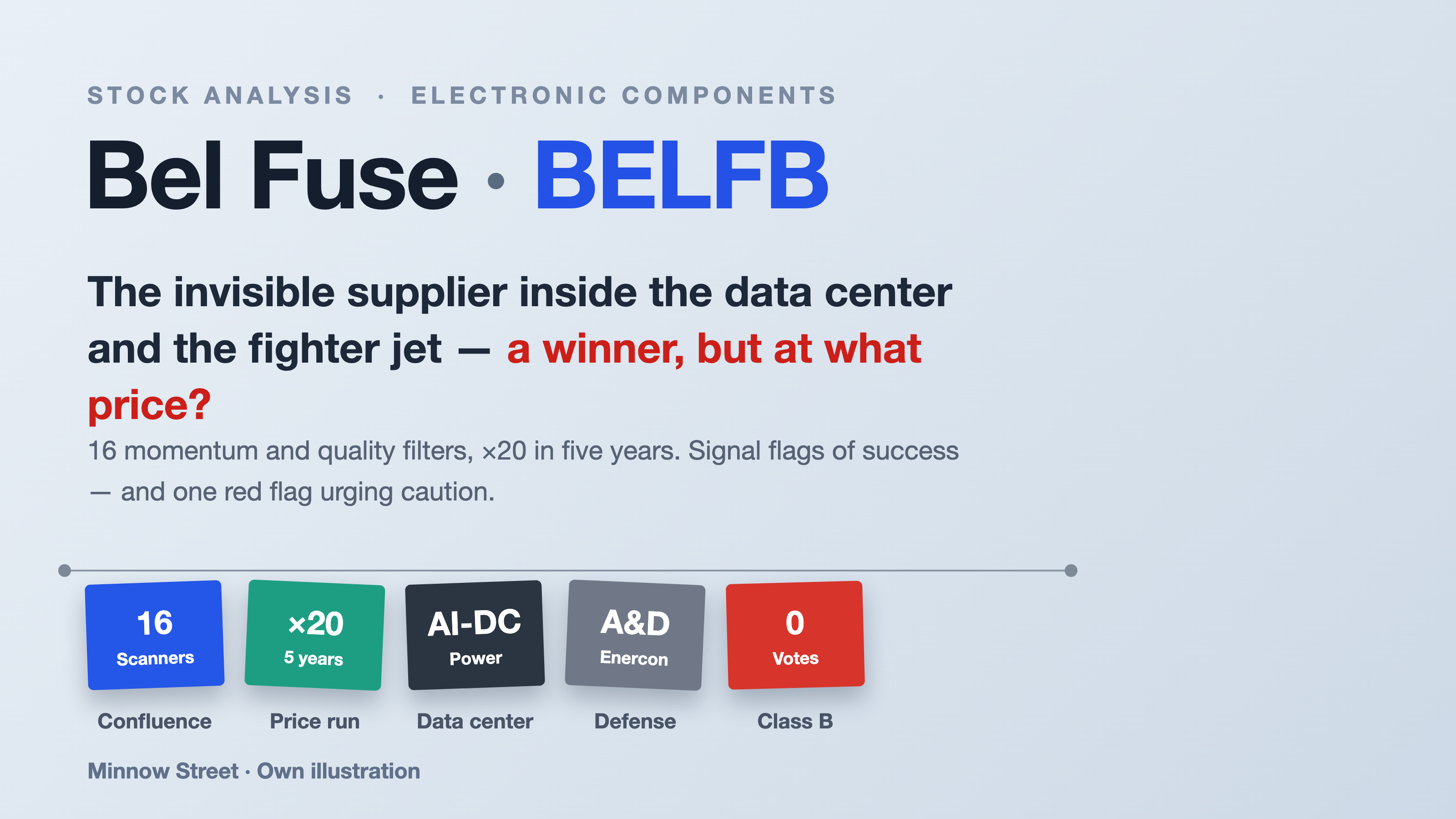
Few small caps radiate this much strength: component maker Bel Fuse has multiplied roughly twentyfold in five years, fires in 16 momentum and quality filters, and supplies the invisible parts inside AI data centers and fighter jets. We read five SEC filings and went looking for the other half of the story: a post-rally valuation, cyclical end markets, a debt-funded acquisition with a goodwill jump — and a share class that carries no vote. Not investment advice — just the honest question of whether the quality can live up to what the chart promises.
 Thomas Mücke
Founder & Publisher
Thomas Mücke
Founder & Publisher
Chart
Interactive price chart (TradingView).
Note: pure fact-based analysis, not investment advice and not a solicitation to buy or sell. All figures without guarantee.
There is a thinking error that grabs us hardest with the big winners — and it even feels smart. When a stock has multiplied roughly twentyfold in five years, your brain looks back and whispers: "It was obvious this one would rise." Psychologists call it hindsight bias: in the rearview mirror, every past price move looks self-evident and inevitable — and that deceptive "I knew it all along" quickly becomes "and it will keep going just like this". This is exactly where the trap lurks at Bel Fuse (Nasdaq: BELFB): the chart is flawless, our scanners glow green, the story sounds complete. So let's make a deal: before you chase a winner, we read together what sits in the filings with the U.S. securities regulator, the SEC — the annual report (10-K), the latest quarterly report (10-Q) and the proxy statement (DEF 14A). An SEC filing is honest under penalty of law. In the end, you decide.
What Bel Fuse actually does
Bel Fuse is a maker of electronic components founded in 1949 and headquartered in West Orange, New Jersey — one of those invisible suppliers whose name nobody knows but whose parts sit in almost every device that needs power and moves data. Picture Bel as a specialized outfitter building three kinds of unglamorous but indispensable parts:
- Power Solutions & Protection (roughly 53 percent of 2025 revenue) — power supplies and circuit protection: they turn the "raw" energy from the wall socket or a battery into the clean, precisely dosed current that sensitive electronics tolerate, and cut the circuit when something goes wrong (fuses). These are exactly the power units that also sit inside the servers of AI data centers.
- Connectivity Solutions (roughly 34 percent) — connectors and cabling: the veins and plugs through which data and power flow, from fiber-optic connectors to ruggedized military connectors built to withstand shock and heat.
- Magnetic Solutions (roughly 13 percent) — magnetic components such as transformers and inductors that filter signals and convert currents; this is the oldest, most labor-intensive leg of the business.
The end markets read like a catalog of the future: data centers, aerospace and defense, industrial, rail and e-mobility. Sounds like nothing but tailwind? Partly it is — demand for server power supplies grows with the AI build-out. But note this right away: Bel does not sell artificial intelligence, it sells the power sockets for it. That is a solid but cyclical supplier business — not a software miracle with endless margins. (For orientation: in early 2026 Bel reorganized its reporting and now runs two segments — "Aerospace, Defense & Rugged Solutions" and "Industrial Technology & Data Solutions"; the three product groups above still live inside them.)
Where the stock shows up in our scanner
Every day we run thousands of stocks through our scanners — and at Bel Fuse the finding is unusually clear-cut: the stock fires in 16 filters at once (data as of July 10, 2026), and all of them sit in the strength categories. Among them "Stan Weinstein: Stage 2", "RS leader 90", "Near 52-week high", "Ben Bennett Power Screen", "Free cash flow to market cap" and "Pros 80". That many hits at once is called confluence — several independent gauges pointing in the same direction.
What does that mean in plain words? "Stage 2" comes from chart analyst Stan Weinstein and describes the phase of a durable uptrend: the price sits above its rising moving averages, and more and more investors keep buying the stock. "RS leader" (relative strength) means: the stock has outperformed roughly 90 percent of all others. That is honestly impressive. But now comes the reminder sentence that carries this entire article: these filters measure that the stock has run well — not that it is cheap or will keep running. Momentum is a rearview mirror with forward urge; no filter in the world knows the price. Which is exactly why we now look at the numbers and the fine print. How to find the stock yourself: on minnowstreet.com, open one of the filters in the "Scanner" menu and look for the BELFB row.
The numbers over the years
Let's start with what genuinely impresses — and that is a lot. Bel Fuse is no loss-maker and no hope story, but a profitable, cash-rich company. In 2025 revenue rose to $675.5 million (from $534.8 million in the weaker year 2024), net income to $61.5 million, and the business generated $80.6 million of operating cash flow — the reported profit is backed by real money, unlike at some other scanner hits. Over the years the trend points clearly upward:
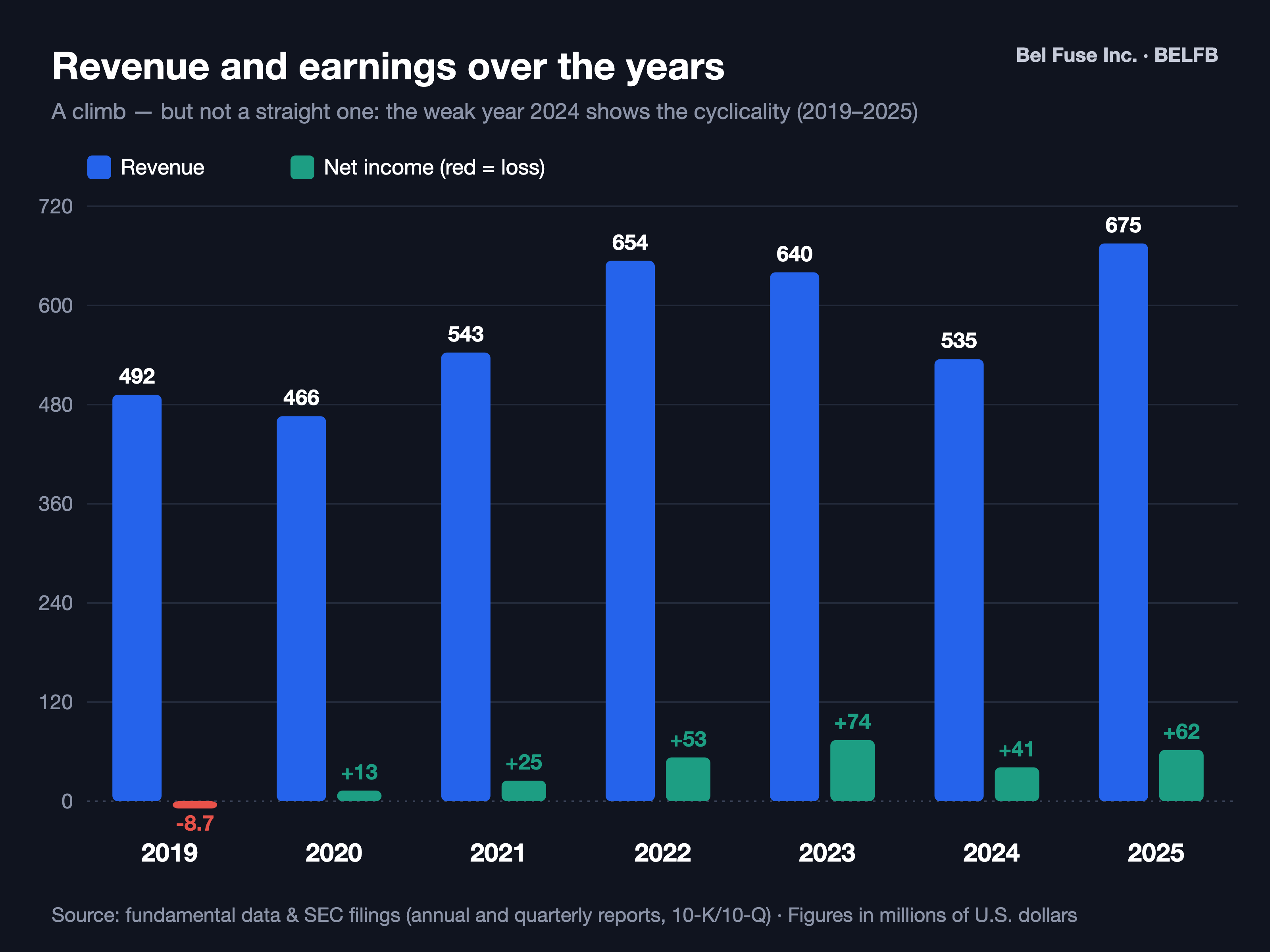
Look closely, though: the way up is no straight line. 2019 ended in a loss, and in 2024 revenue fell roughly 18 percent versus 2023 — that is the cyclicality of a component supplier whose customers cut orders in weak phases. A large part of the jump from 2024 to 2025 also has a name: Enercon, the defense/aerospace supplier acquired at the end of 2024. And that very acquisition visibly reshaped the balance sheet — goodwill and debt jumped:
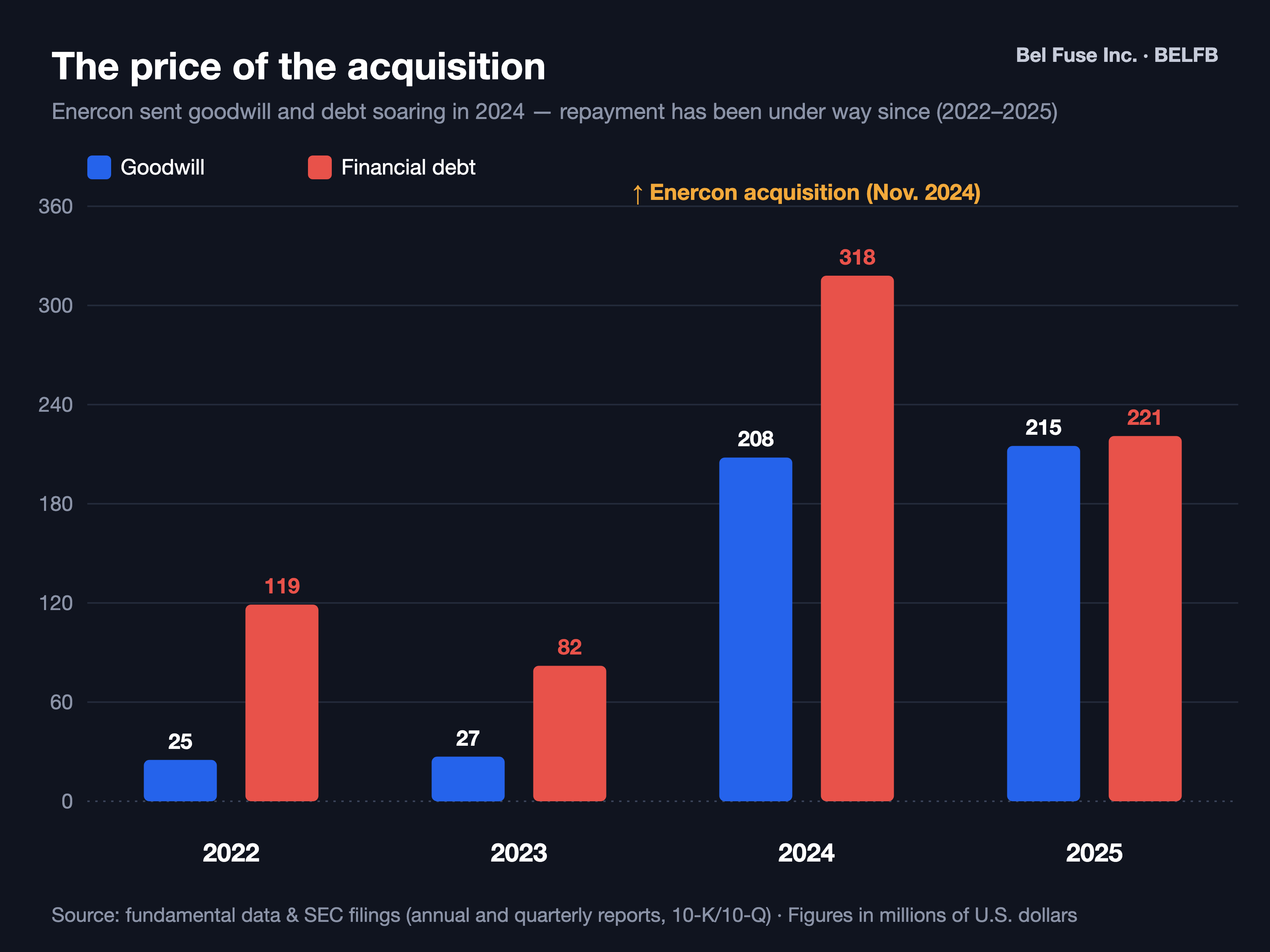
To be fair: Bel is already paying this debt down briskly, and the acquisition handed the group an entirely new, high-margin leg to stand on. But hold on to this tension: a large part of the recent growth was bought and debt-funded — not grown organically. That is no disgrace, but it changes the risk profile.
The uncomfortable truths
Uncomfortable truth no. 1: The tailwind has a cyclical backside
The pretty narrative goes: AI data centers, defense, e-mobility — growth markets all around. The uncomfortable addendum sits in the fine print: these end markets swing, some of them hard. In 2025, server power supplies (front-end power) did grow roughly 33 percent — but at the same time the rail business slumped 23.6 percent, e-mobility 41.6 percent and other industrial applications 17.9 percent. And of all things, the new crown jewel Enercon hangs on the drip of government budgets. The annual report is unusually candid about it:
"Because certain of Enercon's products are used in a variety of land, air and sea defense applications, Enercon derives a substantial portion of its revenue from the defense industry. For full fiscal year 2025, approximately 93% of Enercon's revenue was derived from customers in the defense industry."
— Bel Fuse Inc., SEC annual report 10-K for fiscal year 2025, Item 1A "Risk Factors"
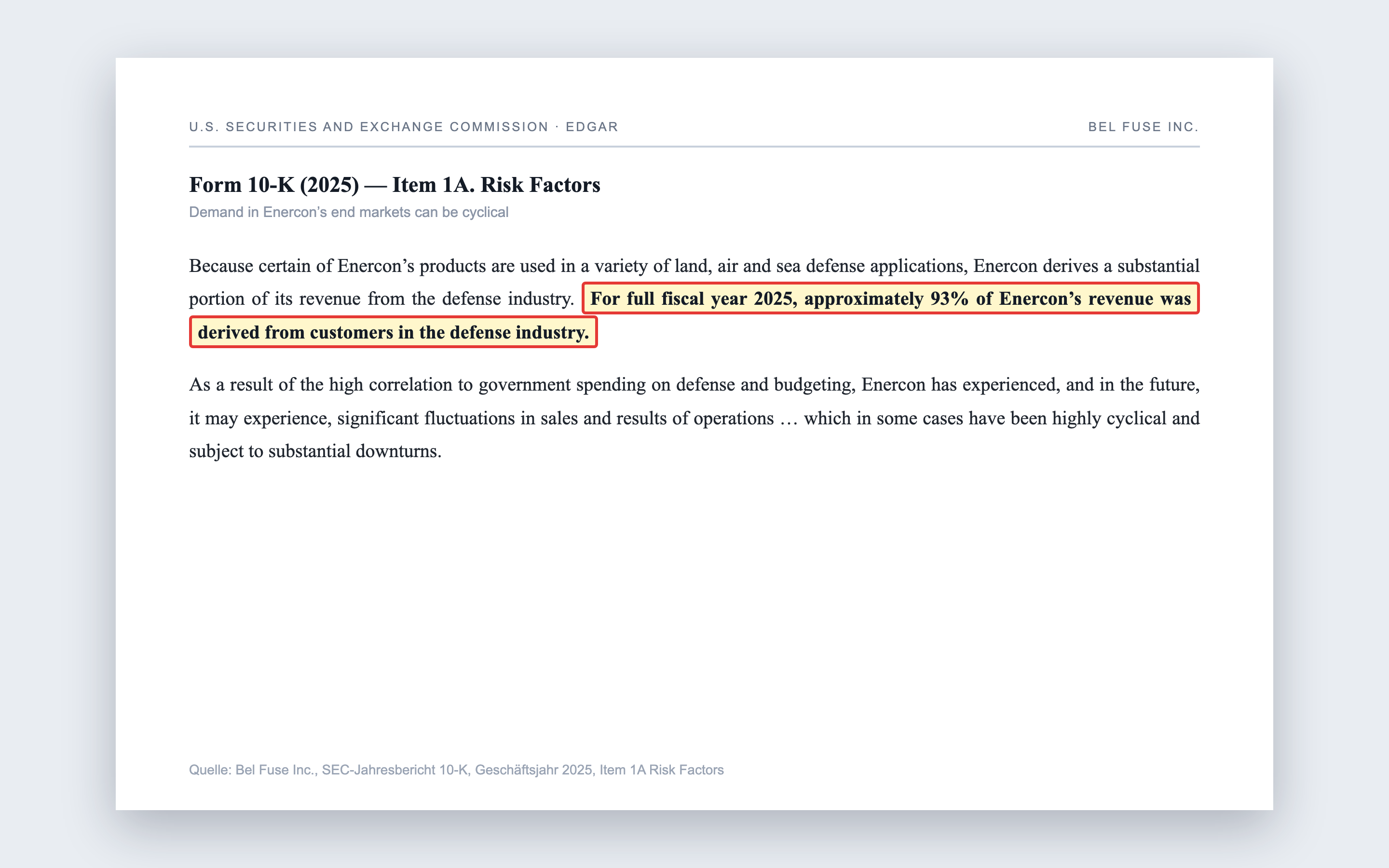
Defense programs do often run over several years — but they hang on annual budget appropriations by the U.S. and Israeli governments, on political priorities and, as Bel itself writes, on possible "government shutdowns". Add to that: Enercon sits in Netanya, Israel, with roughly 321 employees on site. The report devotes an entire risk section to the region's geopolitical risks — war, employees called up for reserve duty, boycott calls. A tailwind remains a tailwind only as long as it blows. Customer concentration risk, by the way, does not exist here: in 2025 not a single direct customer accounted for more than 10 percent of consolidated revenue — that is a genuine strength and fair to mention.
Uncomfortable truth no. 2: The bought growth largely runs on credit
Enercon was a liberating strike into the high-margin defense business — but it was expensive, and Bel paid for the larger part of it with borrowed money. The report names price and funding without make-up:
"At the closing, Bel paid an aggregate of approximately $325.6 million in cash … Bel funded the closing of the transaction through cash on hand of approximately $85.6 million and with approximately $240 million provided through incremental borrowings under the Company's revolving credit facility."
— Bel Fuse Inc., SEC annual report 10-K for fiscal year 2025, Item 1 "Business"
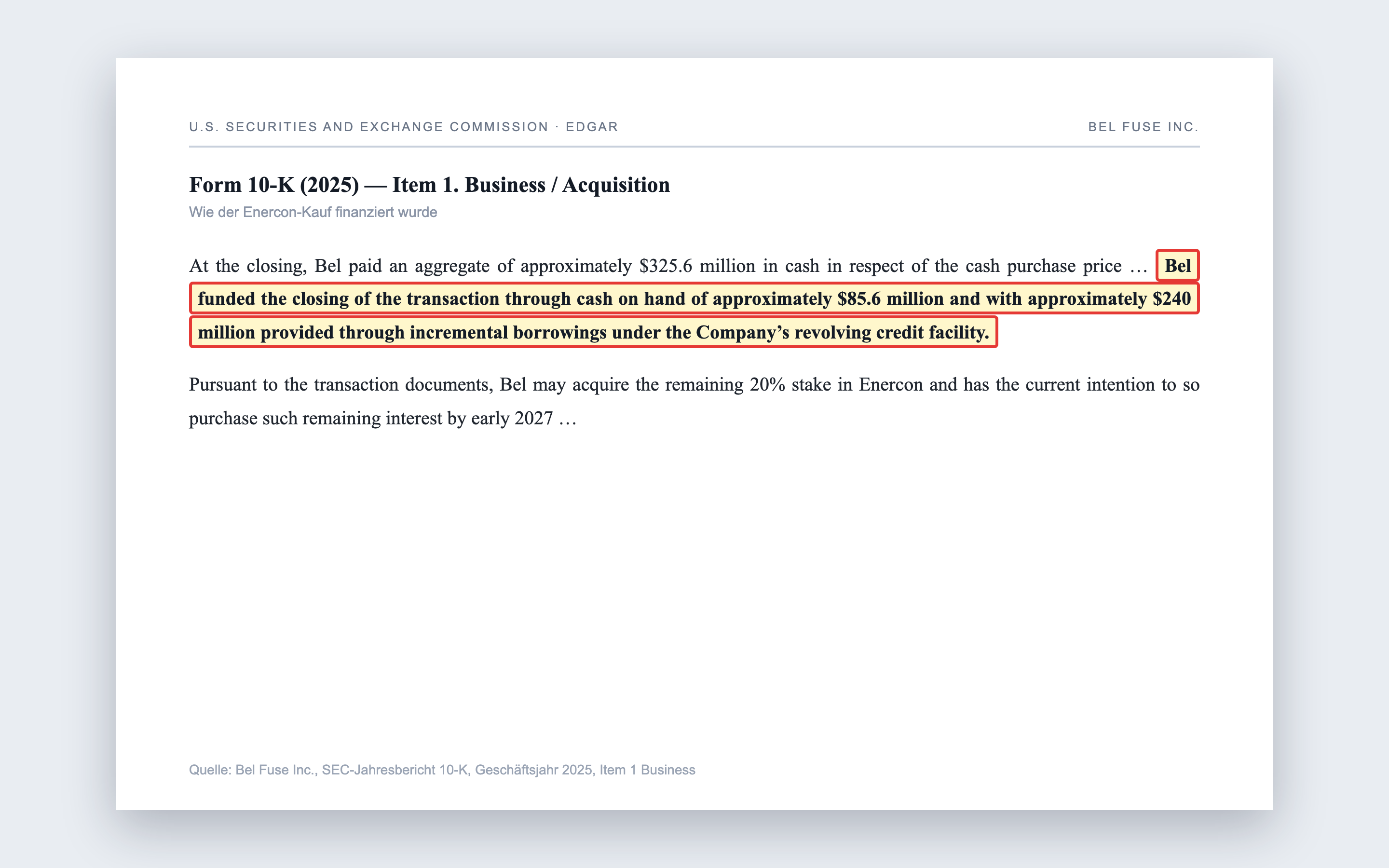
That left traces: at year-end 2025 there were still $197.5 million of financial debt on the books (a leverage ratio of roughly 1.4 times operating earnings before depreciation — the company's own credit agreement allows up to 3.5 times), and goodwill — the premium paid above net asset value, which must later prove its worth — jumped to roughly $215 million. Two things come on top that are easy to miss: Bel so far holds only 80 percent of Enercon and intends to acquire the remaining 20 percent by early 2027 through a contractual put/call option — a provision ("redeemable noncontrolling interest") of $72.4 million already sits on the balance sheet for it. And Bel keeps acquiring merrily: in March 2026 the Ethernet specialist dataMate came aboard for roughly $16 million. In fairness: the debt is manageable, repayment is running, and management integrates with experience. But growth paid for with fresh debt is never entirely free — it converts operating risk into balance-sheet risk.
Uncomfortable truth no. 3: You are buying the share without a voice
Now for the quietest but perhaps most surprising find — and it concerns the very share this analysis is about. Bel Fuse has two share classes: the Class A (ticker BELFA) and the Class B (ticker BELFB) — and whoever buys "the Bel Fuse stock" almost always buys the much larger, more liquid Class B. The catch: the Class B carries no voting rights. The proxy statement says it in no uncertain terms:
"At the close of business on the record date, there were 2,115,263 shares of Class A Common Stock outstanding. Shares of Class A Common Stock carry one vote per share, while shares of Class B Common Stock have no voting rights."
— Bel Fuse Inc., SEC proxy statement DEF 14A of April 10, 2026
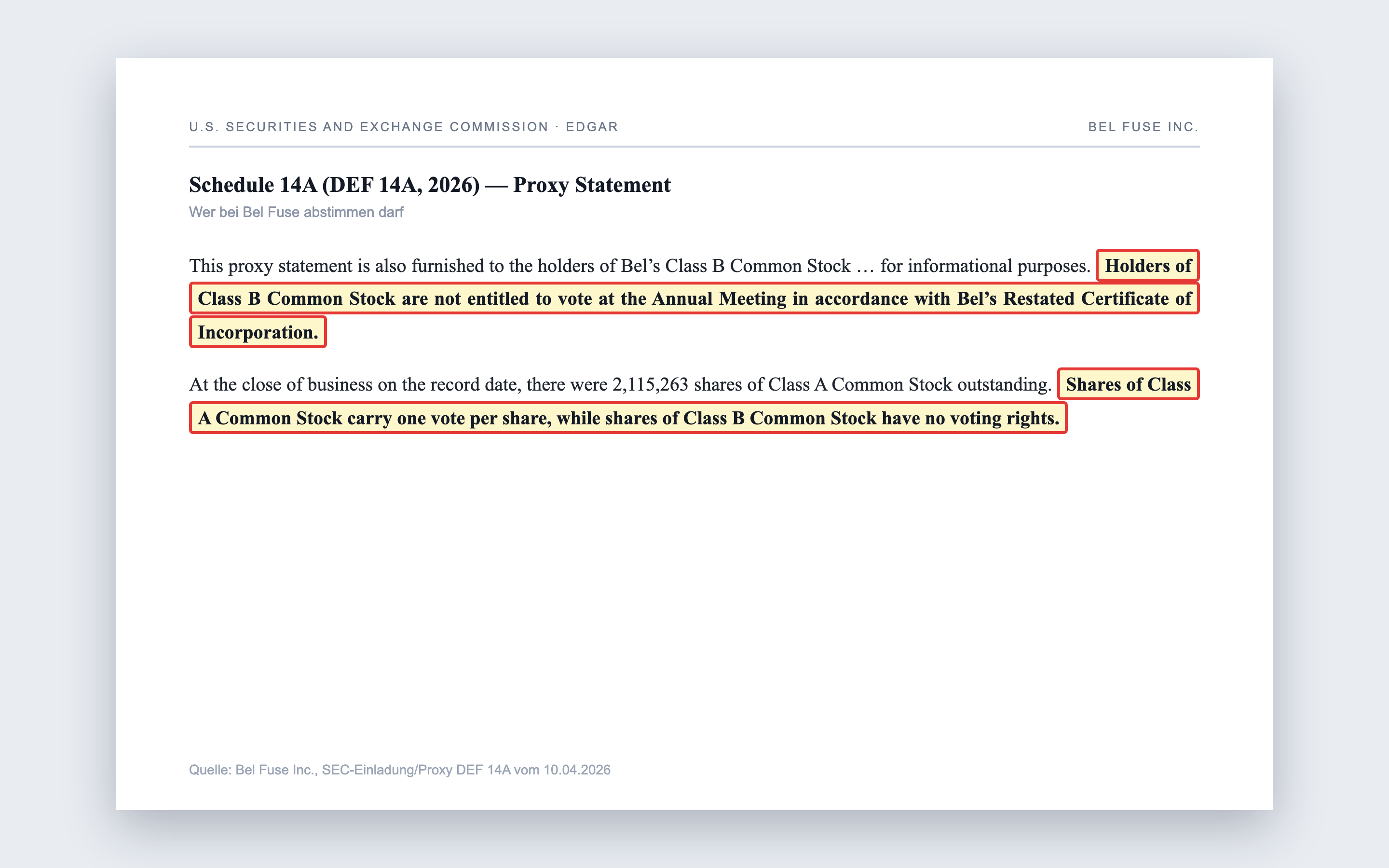
Do the quick math on what that means: the composition of the board and everything essential is decided solely by the roughly 2.1 million voting Class A shares — held by just 26 holders of record. Among the largest is Daniel Bernstein, scion of the founding family and today chairman of the board (he was chief executive until May 2025; since then Farouq Tuweiq runs the company). The board is also classified, meaning divided into staggered terms — a classic takeover defense that makes a swift change of control difficult. For you as a BELFB buyer this means: you receive the same share of profit and dividends as a Class A holder (the Class B even receives at least 5 percent more dividend per share) — but at the company you are buying into, you have no say. As long as the family manages wisely, that is no problem. It is in the moments when it does not that it gets expensive. And it explains why at Bel — unlike at some other undervalued company — no activist can come in and clean house anytime soon.
Valuation — after the rally
Now to the question hindsight bias loves to skip: what does this winner cost today? The short answer: quite a lot. At mid-2026 Bel Fuse weighs in at roughly $3.5 billion of market value. On a trailing-twelve-month basis the stock costs roughly 65 to 75 times earnings (price-to-earnings ratio), enterprise value sits around 30 times operating earnings before depreciation (EV/EBITDA), price-to-sales around 5 and price-to-book around 8.6. Even the forward price-to-earnings ratio, which already looks at the higher earnings expected in coming years, still stands around 33.
Translated: the market is already pricing in that Bel keeps growing briskly and becomes more profitable. That can succeed — the end markets are attractive, the Enercon margin helps. But it leaves little room for disappointment. One number captures the tension: you will not find a meaningful dividend yield here — the payout is symbolic at roughly 0.1 percent; you are buying pure growth, not running income. For a comparison of the thinking: how a bought revenue stream can masquerade as genuine, organic growth is something we dissected at Friedman Industries; and how tightly the valuation of a semiconductor-adjacent supplier hangs on the data-center cycle, at Cohu. Remember: with a quality stock, the company is rarely the problem — the entry price often is.
Opportunities and risks at a glance
What speaks for Bel Fuse:
- Genuine quality instead of hope: profitable, $80.6 million of operating cash flow in 2025, broadly diversified across products, end markets and customers (no customer above 10 percent of revenue).
- Structural tailwind in several future markets at once: server power supplies for data centers (front-end power +33 percent in 2025) and a new, high-margin defense/aerospace leg through Enercon.
- A clean momentum picture: 16 strength filters, a long-term uptrend (Stage 2), relative strength above roughly 90 percent of the market — the company delivers what the chart promises.
- Solid financial management: the debt taken on for Enercon is being paid down briskly (from $318 million to $221 million in 2025), and at 1.4 times, leverage sits comfortably below the credit-agreement ceiling.
What speaks against it:
- A post-rally valuation: a trailing-twelve-month P/E around 65 to 75, EV/EBITDA around 30, forward P/E around 33 — further growth is already priced in, and disappointments would be expensive.
- Cyclical, partly policy-dependent end markets: rail (−24 percent) and e-mobility (−42 percent) slumped in 2025; Enercon depends on defense budgets for 93 percent of revenue, plus location and geopolitical risk in Israel.
- Bought, debt-funded growth: $325.6 million for Enercon ($240 million of it on credit), a goodwill jump to $215 million, an open 20-percent remainder purchase (provision of $72.4 million) due by early 2027, integration risk.
- Governance: the BELFB stock has no voting rights; control sits with the founding family around Chairman Bernstein and a handful of Class A holders, and the board is classified — Class B minority shareholders have effectively no influence.
A human conclusion
Remember the hindsight bias from the opening — the "it was obvious this one would rise"? After the look into the filings you now know why that reflex is treacherous precisely with a big winner. Because it confuses two questions: "Was the past good?" (clearly yes) and "Has the future already been paid for?". Bel Fuse is a thoroughly solid, well-run company with real tailwind — that is one half of the truth, and it is impressive.
The other half: the price has run far ahead of the quality. You are paying a price today that assumes everything goes to plan — even though the end markets are cyclical, a good part of the growth was bought and debt-funded, and as a buyer of the Class B you do not even get a say. None of this is a scandal. But all of it together is the "price of optimism" that the flawless chart does not show.
What you make of it is your decision. And that is exactly as it should be. What matters is only that you know what you are betting on: not on a broken company that is cheap, but on a good company at a price that tolerates little disappointment. A quality stock remains a quality stock — but the best moment to chase a winner is rarely the one when all the scanners light up green at once.
Sources
- Bel Fuse Inc. — SEC annual report 10-K for fiscal year 2025 (as of December 31, 2025; filed February 24, 2026)
- Bel Fuse Inc. — SEC quarterly report 10-Q as of March 31, 2026 (filed May 5, 2026; segment realignment, dataMate acquisition)
- Bel Fuse Inc. — SEC proxy statement DEF 14A of April 10, 2026 (share classes/voting rights, beneficial ownership)
- Also reviewed: the 10-K for fiscal year 2024 (filed February 28, 2025) and the current report 8-K of July 2, 2026 (employment agreements Tuweiq/Hutkin).
- Fundamental data (metrics, valuation, annual and quarterly series); in-house stock scanner, data as of July 10, 2026.
Transparency & disclaimer: This analysis is a journalistic contextualization of publicly available information and is not investment advice, not a financial analysis in the regulatory sense, and not a solicitation to buy or sell securities. Stock investments carry substantial risks up to total loss. All information without guarantee; the data cut-off is noted in the text in each case. Make your investment decisions on your own responsibility and seek independent advice when in doubt.
Our Bottom Line at a Glance
- Business & quality positive
- A profitable, broadly diversified component supplier with real cash flow ($80.6 million operating in 2025) and no customer above 10 percent of revenue. Not a hope stock but an established business with genuine substance — the company delivers.
- Growth & tailwind positive
- Structural tailwind in several future markets: server power supplies for data centers (+33 percent in 2025) and a new, high-margin defense/aerospace leg through Enercon. The momentum picture (16 strength filters, Stage 2) is fundamentally underpinned.
- Cyclicality & end markets neutral
- The end markets swing: in 2024 revenue fell 18 percent, and in 2025 rail (−24 percent) and e-mobility (−42 percent) slumped. Enercon depends on U.S. and Israeli defense budgets for 93 percent of revenue, plus location and geopolitical risk in Israel. A tailwind remains a tailwind only as long as it blows.
- Acquisition, debt & goodwill neutral
- A good part of the recent growth was bought and debt-funded: $325.6 million for Enercon ($240 million of it on credit), a goodwill jump to $215 million, an open 20-percent remainder purchase (provision of $72.4 million) due by early 2027. On the positive side: repayment is running briskly (debt $318 million → $221 million), and leverage is comfortable at 1.4×.
- Valuation & governance negative
- The price has run far ahead of the quality: a trailing-twelve-month P/E around 65–75, EV/EBITDA around 30, forward P/E around 33 — further growth is priced in. Add the governance detail: the BELFB stock carries no voting rights; control sits with the founding family (Chairman Bernstein) and a handful of Class A holders, and the board is classified.
Bel Fuse is a thoroughly solid, profitable component supplier with real tailwind from AI data centers and defense — a deserved strength stock that rightly fires in 16 scanners and has multiplied roughly twentyfold in five years. The other half of the truth: the price has run ahead of the quality (P/E 65–75, EV/EBITDA around 30), the end markets are cyclical, a good part of the growth was bought with debt (Enercon), and whoever buys the BELFB stock buys the non-voting class. No scandal, but the price of optimism that the flawless chart does not show. Not investment advice.
What Our Rating Means
- If you don't own the stock
- At the current price level, we don't see a sufficient margin of safety for an entry.
- If you hold it in your portfolio
- Our findings offer no reason to sell.
A journalistic assessment by our editorial team at the time of the deep dive, based on public sources — not investment advice and not a solicitation to buy or sell. Your personal circumstances (investment goals, risk capacity, taxes) cannot be taken into account. What our categories mean, how verdicts are formed, and what conflicts of interest exist →
Worth Noting
- Price, valuation and market-value figures dated mid-2026; figures for fiscal year 2025 (as of December 31, 2025) and the first quarter of 2026. Analyses are evergreen; daily prices are not a buy argument. The trailing-twelve-month price-to-earnings ratio (roughly 65–75) sits above the multiple computed on the full, strong year 2025 because a weak fourth quarter of 2025 sits inside the twelve-month window.
- Share classes: Bel Fuse has voting Class A shares (BELFA) and non-voting Class B shares (BELFB). This analysis refers to the BELFB; revenue, profit and balance-sheet figures apply to the group as a whole. The market value of roughly $3.5 billion covers both classes.
- Special-situations screening (as of July 10, 2026): no current activist or takeover process. The last open proxy fight at Bel Fuse dates back to 2011; the most recent chain of SC 13D/A filings concerns the long-standing stake of the Gabelli/GAMCO group in the voting Class A, not an activist campaign.
Frequently Asked Questions
Bel Fuse (Nasdaq: BELFB) is a U.S. maker of electronic components founded in 1949 and headquartered in West Orange, New Jersey. The company builds power supplies and circuit protection (roughly 53 percent of revenue), connectors and cabling (roughly 34 percent) and magnetic components (roughly 13 percent) for end markets such as data centers, aerospace/defense, industrial, rail and e-mobility. It is a solid but cyclical supplier business.
Because it is a strong momentum and quality name: the stock has multiplied roughly twentyfold in five years and fires in 16 in-house filters (including Stan Weinstein Stage 2, RS leader 90, near 52-week high). This confluence, however, describes that the stock has run well — not that it is cheap or will keep running. Momentum filters do not know the price.
It is highly valued, at any rate. At mid-2026 the stock costs roughly 65 to 75 times trailing-twelve-month earnings, enterprise value sits around 30 times operating earnings before depreciation (EV/EBITDA), and the forward price-to-earnings ratio around 33. The market is thereby already pricing in further brisk growth — disappointments would be expensive. This is no longer a stock for bargain hunters.
In November 2024 Bel acquired roughly 80 percent of Enercon Technologies (Israel), a supplier of power conversion and networking solutions for aerospace and defense, for roughly $325.6 million. About $240 million of that came from the credit line. Enercon contributed roughly $136.6 million of revenue in 2025 but sent goodwill jumping from $27 million to $215 million. Bel intends to acquire the remaining 20 percent by early 2027.
Bel Fuse has two share classes: BELFA (Class A) carries voting rights (one vote per share), while BELFB (Class B) has NO voting rights under the charter. Whoever buys "the Bel Fuse stock" usually buys the more liquid, non-voting Class B. The board is decided solely by the roughly 2.1 million Class A shares, controlled by the founding family around Chairman Daniel Bernstein and a handful of holders. In return, the Class B receives at least 5 percent more dividend per share.
Indirectly yes, directly no. Bel supplies the server power units (front-end power) for data centers, whose demand rose roughly 33 percent in 2025 — and data centers also host AI applications. The SEC filings, however, nowhere name AI as a revenue source of its own; they speak of "networking and data-center applications" and "data-driven markets". Bel sells the infrastructure for AI, not the AI itself.
Found an error?
Did you spot a factual error, an outdated number, or a typo in this deep dive? Let us know briefly — your report goes straight to the editorial team.