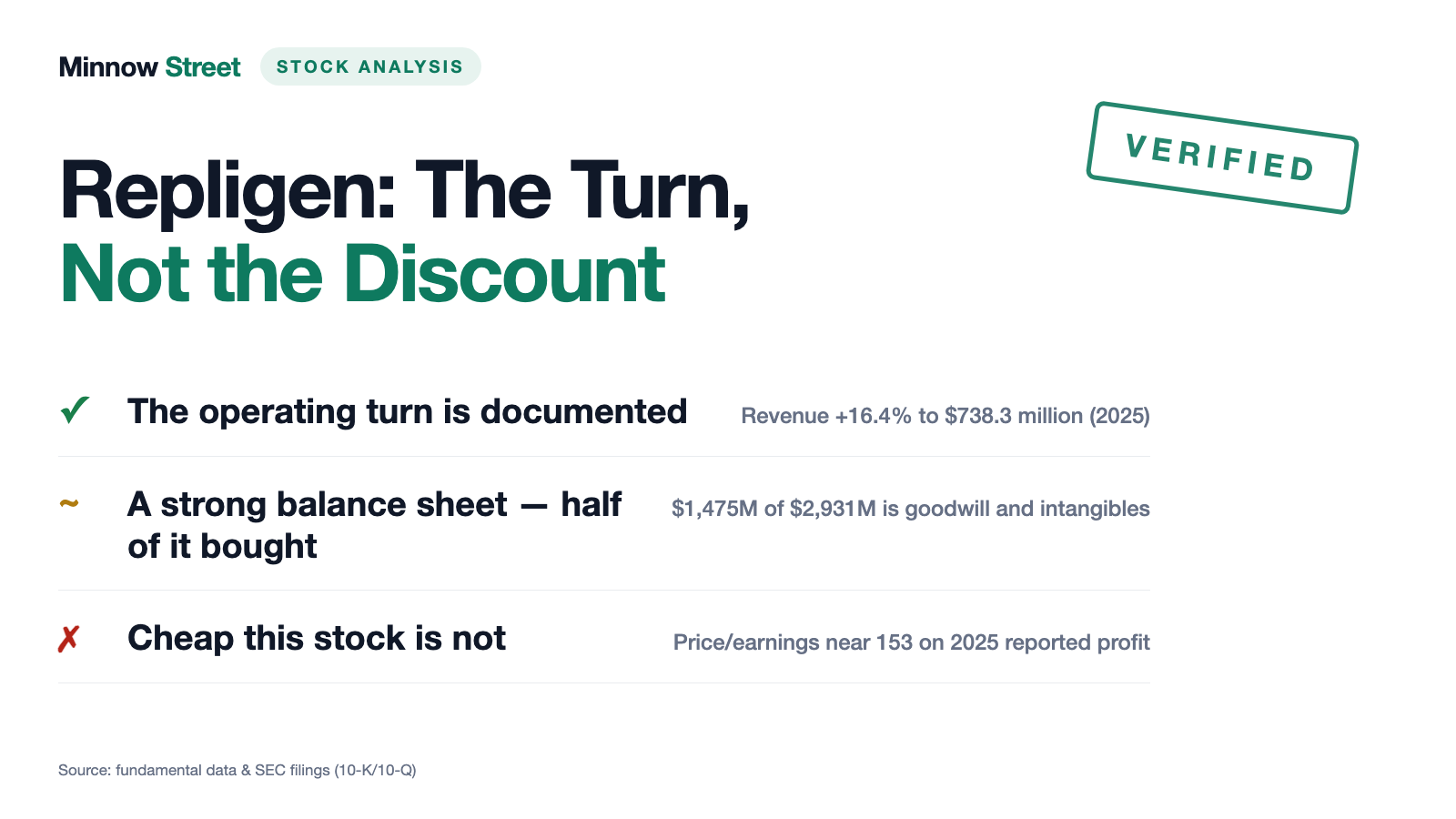
Repligen: The Turn Is Real — and Priced Like a Growth Stock
Repligen builds the filters and columns almost every modern biologic drug passes through. After the pandemic hangover the company is back: $738.3 million of revenue in fiscal 2025 and $48.9 million of net income after a $25.5 million loss the year before. The stock still sits 59 percent below its 2021 peak — and trades at 153 times earnings. We read the annual report, the quarterly report filed May 6, 2026, and the merger announcement of July 22, 2026. A filter separates what should pass from what stays behind.
 Thomas Mücke
Founder & Publisher
Thomas Mücke
Founder & Publisher
Chart
Interactive price chart (TradingView).
Note: pure fact-based analysis, not investment advice and not a solicitation to buy or sell. All figures without guarantee.
The $324 ghost: why an old high is not a price tag
One number is stuck in the mind. It dates from September 23, 2021, it reads $324.21, and it has been whispering the same line ever since: the stock used to be worth that much.
That is the anchoring effect, and it is remarkably stubborn. An old high feels like a price tag that has merely been marked down. In truth it was nothing more than the price somebody paid on one single day in one particular mood.
The company in question sells filters, of all things. Repligen builds the membranes, columns and instruments that practically every modern biotech drug passes through before it reaches a syringe. A filter does exactly one thing: it separates what should pass from what stays behind.
That is what we do here with the numbers. We read the annual report, the quarterly report and the merger announcement of July 22, 2026, do the arithmetic — and leave the $324 ghost outside for now.
What this analysis covers
- What Repligen sells, and to whom
- Where the stock landed on our desk
- The numbers over the years
- The July 22, 2026 announcement: $1.5 billion for BioLife
- Uncomfortable truth no. 1: half the balance sheet was bought — and sits in a single bucket
- Uncomfortable truth no. 2: amortization exceeds operating income
- Uncomfortable truth no. 3: $600 million of notes meet a halved cash pile
- The acquisition that went back out
- What the stock costs
- Opportunities and risks at a glance
- A human conclusion
- Sources
What Repligen sells, and to whom
Repligen is based in Waltham, Massachusetts, and lives off a business almost nobody sees: bioprocessing. That is everything happening between the cell culture vessel and the finished drug substance.
A biologic drug — an antibody, a vaccine, a cell therapy — is not mixed together chemically; it is produced by living cells. The active ingredient has to come out of that cloudy broth cleanly, reproducibly and in the manner regulators have approved. Repligen supplies the equipment for exactly that, in four franchises:
- Filtration and fluid management — hollow fiber and flat sheet membranes, tubing assemblies, single-use components. At $402.8 million in 2025, the largest franchise.
- Chromatography — separation columns (OPUS) and resins that pull the active ingredient out of the mixture. $153.2 million.
- Proteins — mainly protein A ligands, the capture molecules inside those very columns. $97.4 million.
- Process analytics — instruments that measure concentrations and quality attributes during production, bundled under the PATsmart name since 2025. $81.2 million.
The decisive point sits in one word: approved. Once a filter or a resin is part of a regulator-approved manufacturing process, switching costs time, money and fresh validation work. That is not a moat made of patents but one made of paperwork — and it often lasts longer.
Sales run mostly direct: 90.8 percent of product revenue went to customers without a distributor in 2025, after 89.7 percent the year before. Regionally that splits into North America (49 percent), Europe (34 percent) and Asia Pacific plus the rest of the world (17 percent). And there is a sentence in the annual report you rarely find at a supplier: in 2023, 2024 and 2025, no single customer accounted for 10 percent or more of revenue.
As of December 31, 2025 roughly 2,000 people worked at Repligen, up from 1,778 a year earlier. Manufacturing runs in the United States plus Estonia, Germany, Ireland, the Netherlands and Sweden. Remember those overseas sites — nearly all of them came from acquisitions, and acquisitions come back later in this piece.
Where the stock landed on our desk
Every day we run roughly 3,500 stocks through our scanners. Repligen came in through the Turnaround Candidates list — with a caveat we want to state up front.
The stock is not on the page. On July 27, 2026, 60 US stocks passed this scanner’s criteria, but only the 25 strongest are displayed. Repligen ranked 31st of 60 with 6 of 8 Turn Check points, and therefore fell outside the visible table. We got here through the complete hit list, not through what a reader sees on the page. To repeat it yourself: open the scanner, set the country filter to "US"; sorting runs on the "Turn Check" column. These lists are recomputed daily.
The list has two mandatory pillars. Miss one and you are out, no matter how good everything else looks:
- Pillar 1 — the crash: the stock must trade at least 50 percent below its all-time high. Without a real crash there is no turnaround; otherwise the list would just catch ordinary growth stocks.
- Pillar 2 — survival: the Altman Z score must be at least 1.1. That score compresses several balance sheet ratios into one number and estimates how far a company sits from insolvency. On top of that come at most one balance sheet warning flag and positive equity.
Pillar 2 Repligen clears by a wide margin: Altman Z stood at 8.94 on July 26, 2026 and the equity ratio at 71.8 percent. For context, anything above 3 counts as safe — 8.94 is one of the sturdiest balance sheets on this entire list.
Pillar 1 we recalculated against the price history, because roughly 60 tickers in this data set carry an all-time high off by a factor of 1,000. For Repligen the figure holds: the highest closing price ever was $324.21 on September 23, 2021, and the close on July 24, 2026 was $131.96. That is minus 59.3 percent. The scanner carries minus 57.31 percent in its data set — both sit clearly past the threshold, so the crash is real.
That also lets us put a number on when this hit disappears. At roughly $162.11 — exactly half the all-time high — Repligen breaks pillar 1 and drops off the list. From the July 24, 2026 level that is about 23 percent of upside. Anyone leaning on a ranking like this is leaning on a state with an expiry date. How tight that can get we showed in our Zebra Technologies analysis: same scanner, same minimum score, a very different business.
Only when both pillars stand does the counting start. The Turn Check awards eight points: four from the quarterly numbers (revenue direction, net margin, operating cash flow, balance sheet healing) and four from market behavior (price above the 50-day line, three-month relative strength versus twelve months, insider buying, institutional accumulation). At least six are required to be listed.
Repligen stands at 6 of 8 — the minimum, with no cushion. And one of those six points is particularly wobbly: the 50-day line sat at roughly $130.15 on July 24, 2026 against a price of $131.96. That is 1.4 percent of headroom. If the stock slips below it, one point falls away, the Turn Check drops to 5 of 8, and the name vanishes from the list at the next recomputation.
What does that mean for you? A scanner calculates, it does not judge. The list is where research begins and never where it ends. What sits in the filings decides the analysis — not a ranking you cannot even see.
The numbers over the years
Start with what genuinely impresses: this company absorbed a one-fifth drop in revenue without raising a single dollar of fresh equity.
In 2022 Repligen booked $801.5 million of revenue and earned $186.0 million. Then the pandemic bill arrived. Drug makers and contract manufacturers had stockpiled consumables during the supply-chain years; afterwards they emptied their warehouses instead of reordering. Revenue fell to $632.4 million in 2023 and stayed there at $634.4 million in 2024. The bottom line still showed $35.6 million of profit in 2023 and a loss of $25.5 million in 2024.
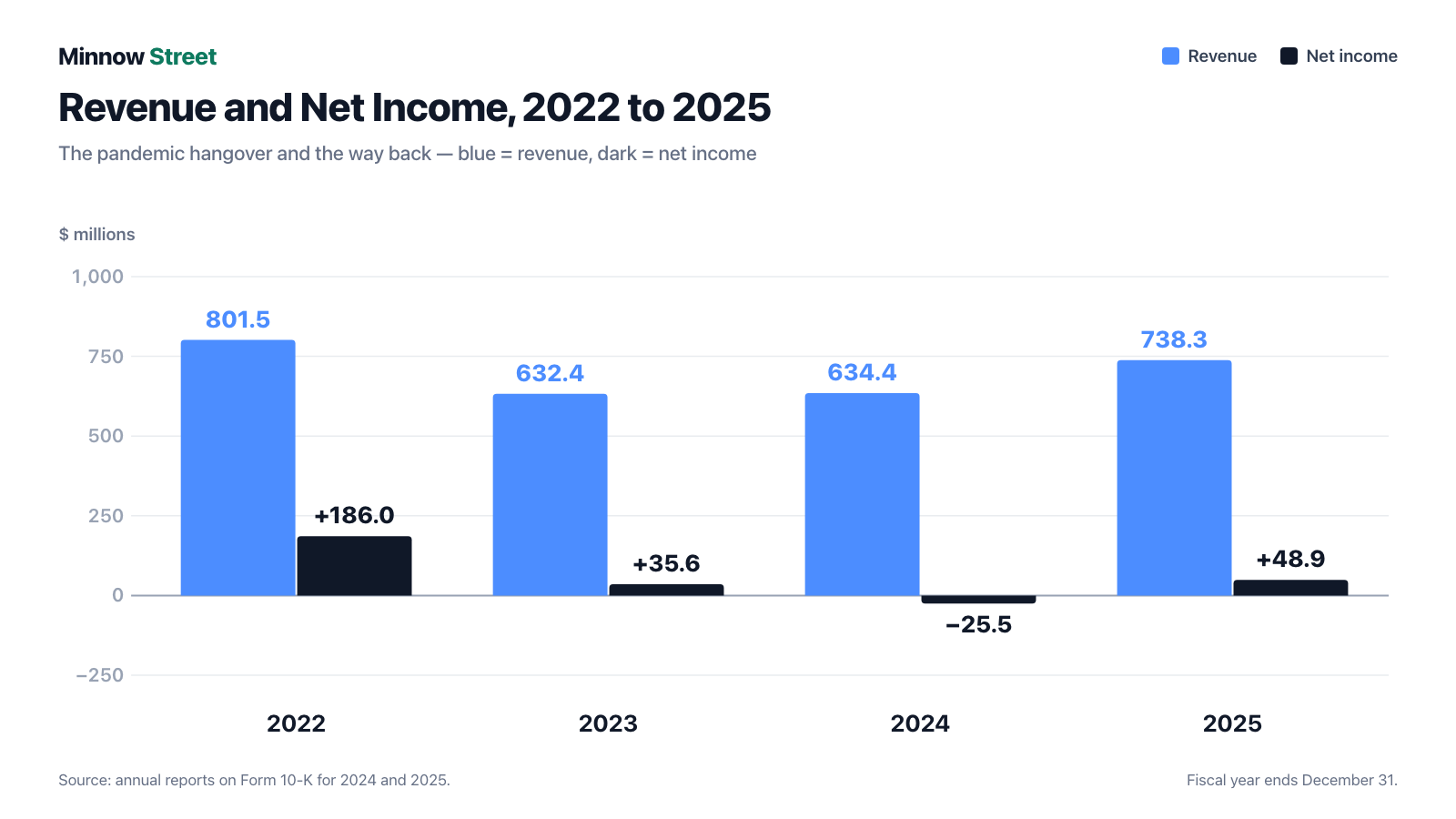
In fiscal 2025 everything turned at once. Revenue rose 16.4 percent to $738.3 million, and it was broad: filtration up 8.0 percent, chromatography up 24.7 percent, proteins up 30.9 percent, process analytics up 37.0 percent. The $25.5 million loss became a $48.9 million profit.
The most remarkable line is gross margin. It jumped from 43.3 percent to 52.3 percent — and not because prices suddenly went up:
"In 2025, gross margin was 52.3%, compared to 43.3% in 2024. The increase in gross margin resulted from the decrease in cost of goods sold as described above."
— Repligen Corporation, Form 10-K for 2025, MD&A, "Cost of goods sold"

Behind it lies the end of a cleanup phase: in 2023 and 2024 Repligen closed plants in Newton and Branchburg (New Jersey), Dallas, Simi Valley, Auburn (Massachusetts) and Oceanside (California) and wrote down inventory left over from the pandemic. In 2025 most of that ballast disappeared.
One detail puts the growth in perspective: 2024 still carried $11.5 million of COVID-19 related sales, and 2025 carried none. The $103.8 million increase is therefore even larger than it looks, because it had to absorb that loss first. Working the other way, $9.3 million of it belongs to the 908 Devices acquisition that only closed in March 2025.
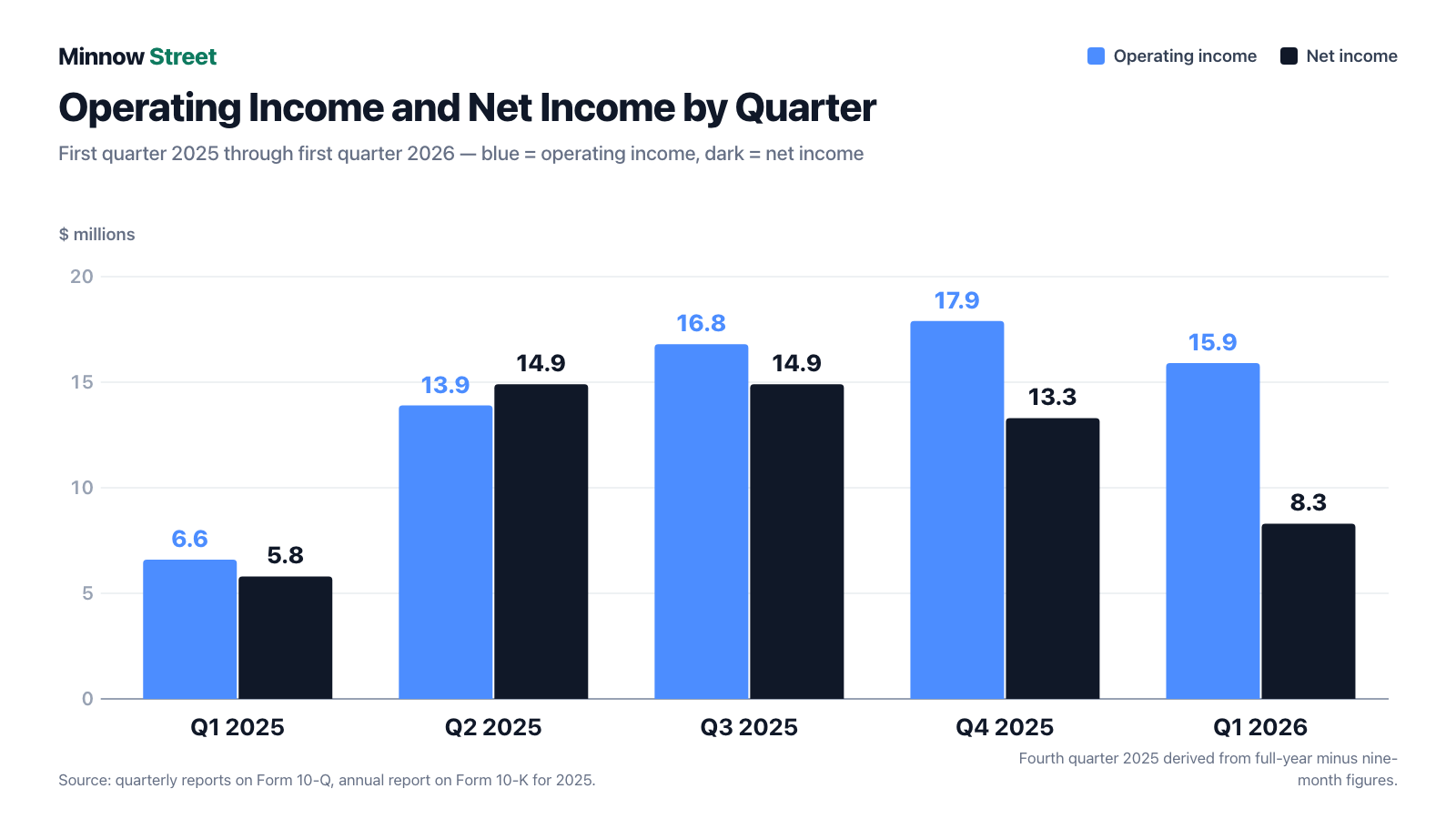
The first quarter of 2026 held the pace: $194.3 million of revenue, up 14.8 percent. Operating income rose from $6.6 million to $15.9 million. The bottom line, however, showed only $8.3 million — more on that shortly.
The quarterly series shows both at once. Operating income climbed from $6.6 million in the first quarter of 2025 through $13.9 million and $16.8 million to $17.9 million in the fourth quarter of 2025, and stood at $15.9 million in the first quarter of 2026. Net income runs a different line: $5.8 million, $14.9 million, $14.9 million, $13.3 million — and then only $8.3 million. The fourth quarter 2025 figure is derived from full-year minus nine-month numbers, because Repligen files no separate report for its closing quarter.
Rule of thumb: a one-fifth revenue decline knocks many suppliers off balance. Repligen absorbed it without an equity raise, without new debt and without damaging its balance sheet. That belongs on the credit side before we discuss the rest.
The July 22, 2026 announcement: $1.5 billion for BioLife
Read this analysis without the latest news and you are reading the wrong company. On July 21, 2026 Repligen signed a merger agreement, announced a day later:
"On July 21, 2026, Repligen Corporation, a Delaware corporation ("Repligen"), entered into an Agreement and Plan of Merger … pursuant to which Repligen will acquire, subject to the satisfaction or waiver of the conditions contained in the Merger Agreement, all of the outstanding shares of BioLife's common stock … for $11.25 cash and 0.1442 shares of Repligen's common stock, on a per share basis."
— Repligen Corporation, Current report on Form 8-K dated July 22, 2026, Item 1.01

The key terms from the accompanying press release: $31.00 per BioLife share in total value, roughly $1.5 billion of enterprise value, split 64 percent in Repligen stock and 36 percent in cash. The premium is 24 percent over the 90-day volume-weighted average price through July 21, 2026. Closing is expected in the fourth quarter of 2026.
What Repligen is buying: BioLife Solutions makes biopreservation media for cell and gene therapies — fluids in which living cells are frozen and shipped without dying. Its lead product, CryoStor, supports 18 commercially approved therapies and, per the press release, the majority of US commercially sponsored cell therapy trials. It is high-margin consumables with recurring revenue — exactly the pattern Repligen already knows from its own business.
What Repligen promises: at least $20 million of synergies in year one and at least $30 million in year two, plus an earnings contribution of at least 5 cents per share in year one and 25 cents in year two. Those figures come from the buyer and are expectations, not results.
And what is still missing: BioLife stockholder approval, expiry of the antitrust waiting period under the Hart-Scott-Rodino Act, effectiveness of the registration statement with the U.S. securities regulator, the SEC, and Nasdaq listing approval for the new shares. The outside date is January 31, 2027, subject to extension. If BioLife walks away for a superior proposal, a $59 million termination fee is payable to Repligen.
The same filing also carries preliminary numbers of its own: revenue growth of roughly 12 percent in the second quarter of 2026, 13 percent on an organic basis. Repligen has scheduled the full results for July 28, 2026.
Uncomfortable truth no. 1: half the balance sheet was bought — and sits in a single bucket
At March 31, 2026 Repligen carried total assets of $2,930.8 million. Of that:
- $1,106.9 million is goodwill, the premium paid above net asset value in acquisitions,
- $368.2 million is other intangibles — customer relationships, technologies, trade names,
- together $1,475.1 million, or roughly 50 percent of the balance sheet.
Against equity of $2,105.5 million that is about 70 percent. Put differently: strip out everything you cannot touch, and roughly $630 million of equity remains.
For a company that has bought six businesses since 2021, none of that is surprising. What is surprising is how that goodwill gets tested:
"Goodwill is not amortized and is tested for impairment at least annually at the reporting unit level. The Company operates as one reporting unit as of the goodwill impairment measurement date of October 1, 2025."
— Repligen Corporation, Form 10-K for 2025, Note 2, "Goodwill"

What does that mean? A reporting unit is the slice of a company against which goodwill is measured. Run many of them and every acquisition has to defend itself; if one division struggles, goodwill is written down there even while the rest thrives. Run one and everything is defended at once: as long as the value of the whole company exceeds book value, nothing gets written down.
For Repligen that cushion is comfortable today — roughly $7.44 billion of market value (July 24, 2026) against $2.11 billion of equity. The price of that comfort is delay. A weakening division does not show up in this calculation. It shows up when the whole company weakens — and then all at once.
Uncomfortable truth no. 2: amortization exceeds operating income
In fiscal 2025 Repligen earned $55.2 million at the operating line. In the same year it recorded $78.7 million of depreciation and amortization — on machinery, buildings and above all on purchased intangibles.
That is roughly 1.4 times operating income and equals 10.7 percent of revenue. With an operating margin of 7.5 percent it means, plainly: what Repligen earns from operations is smaller than what it writes off each year from earlier purchase prices.
Two readings of that are correct, and both belong on the table.
The friendly one: amortization costs no cash. That is precisely why operating cash flow reached $117.4 million in 2025, far above the $48.9 million of reported profit. After $23.5 million of capital expenditures, roughly $93.9 million was free. The profit is backed by cash, not by bookkeeping.
The unfriendly one: amortization of purchase prices is the invoice for growth that was bought and not yet earned. While it exceeds operating income, the acquisition run has not paid for itself in the earnings statement. And with BioLife at roughly $1.5 billion, the next wave is coming; how big it is will only appear in the purchase price allocation after closing.
There is another item that gets overlooked: $32.6 million of stock-based compensation in 2025, after $48.1 million the year before. That, too, is expense without a cash outflow — except it is settled not with money but with slices of existing holders’ ownership.
Uncomfortable truth no. 3: $600 million of notes meet a halved cash pile
Repligen has exactly one financial debt, and it comes with a date. In December 2023 the company issued $600 million of convertible notes at a 1.00 percent coupon, maturing December 15, 2028. The effective rate is 4.39 percent, because the notes were issued below their redemption amount.
A convertible is a hybrid. If the stock rises above an agreed price, holders swap paper for shares — the debt disappears and the ownership pie is cut into more slices. If it does not, it stays plain debt that has to be repaid in cash.
The agreed price is $203.06 per share (4.9247 shares per $1,000 of principal). On July 24, 2026 the stock closed at $131.96 — roughly 35 percent below. The quarterly report puts it plainly:
"The conditional conversion features of the 2023 Notes were not triggered during the calendar quarter ended March 31, 2026, therefore, the 2023 Notes are not convertible during the calendar quarter ended June 30, 2026 pursuant to the applicable last reported sales price conditions."
— Repligen Corporation, Form 10-Q for the quarter ended March 31, 2026, MD&A

Until now that was no issue, because the cash pile was larger than the debt: at March 31, 2026 the balance sheet held $582.7 million of cash and $201.9 million of marketable securities, $784.5 million together against $600 million of principal.
That is exactly what changes now. The cash component of the BioLife deal — 36 percent of roughly $1.5 billion, so about $540 million — comes from cash on hand, per the press release. Repligen itself quantifies what is left afterwards: more than $300 million of pro forma cash.
What does that mean for you? A cash pile that comfortably covered the notes becomes one that covers roughly half of them. December 15, 2028 is still two and a half years away, and at nearly $94 million of annual free cash flow the remainder is earnable. But the buffer that made this balance sheet look so relaxed will be smaller. Not an alarm — an invoice with a due date.
The acquisition that went back out
On July 1, 2021 Repligen bought France-based Polymem S.A.S. in Toulouse. The annual report of the time called it a European center of excellence for hollow fiber membranes.
On March 30, 2026 it was over. Repligen sold Polymem for roughly $4.4 million and booked a loss of $13.8 million.
That single item explains the whole first quarter of 2026. Operations went well: operating income rose from $6.6 million to $15.9 million. After the disposal loss, only $1.8 million was left before tax; the $8.3 million of net income reported in the end came courtesy of a $6.6 million tax benefit.
For a company whose balance sheet is half acquisitions, that is the first hard evidence that not every one of those six purchases since 2021 works out. Growing the way Repligen grows does not just buy revenue — it buys risk. How much of that risk can surface in a single fiscal year we described at another supplier to the biotech industry, in our Bio-Techne analysis.
What the stock costs
As of July 24 to 27, 2026, with 56,407,740 shares outstanding (as of May 1, 2026) and a closing price of $131.96 from July 24, 2026, Repligen carries a market value of roughly $7.44 billion.
Expressed in orders of magnitude:
- Price/earnings of about 153, measured against reported diluted earnings of $0.86 per share for 2025
- Price/sales of about 10.1, measured against 2025 revenue of $738.3 million
- Price/book of about 3.5 — with book value half made up of goodwill and intangibles
- Price/free cash flow of about 79, measured against $93.9 million for 2025
- Enterprise value of roughly $7.26 billion (market value plus $600 million of notes less $784.5 million of cash and securities)
And here the $324 ghost returns. A 59.3 percent discount to the September 23, 2021 peak sounds like a bargain. It is only a discount to a price set in the middle of a pandemic boom — in a year when customers were stockpiling consumables. What looks cheap is a lower price for a company that earns far less today than it did in 2022: $48.9 million instead of $186.0 million.
One word of caution: many overviews show Repligen at a forward price-to-earnings ratio of roughly 66. That number rests on adjusted earnings estimates that strip out items such as acquisition costs, restructuring and stock-based compensation. It cannot be compared with the $0.86 of reported earnings. We mention it so you know where the figure comes from — and we do not use it as a valuation anchor.
The professional view: 19 analyst estimates produce an average price target of roughly $178 — ten strong buys, four buys, five holds and no sells (data as of July 27, 2026). A consensus is a mood reading, not a forecast. Above all it says the street believes the turn, but not all the way back to the old high.
Opportunities and risks at a glance
Opportunities
- Built-in inertia: filters, resins and instruments are part of approved manufacturing processes; switching forces revalidation at the customer.
- A broad turn: all four product franchises grew by double digits in 2025, process analytics fastest at 37.0 percent, and the first quarter of 2026 added 14.8 percent.
- No customer concentration: in 2023 through 2025 not a single customer accounted for 10 percent or more of revenue.
- Balance sheet strength: a 71.8 percent equity ratio, Altman Z of 8.94, Piotroski score of 7 of 9 and only $600 million of debt at a 1.00 percent coupon.
- The BioLife deal: access to a high-margin consumables business in cell therapy, with at least $20 million of synergies in year one according to Repligen.
Risks
- Valuation: roughly 153 times reported 2025 earnings and 79 times free cash flow, for a company that ran a 6.6 percent net margin in 2025.
- Balance sheet structure: $1,475.1 million of $2,930.8 million is goodwill and intangibles, tested in a single reporting unit.
- Acquisition risk: selling Polymem, bought in 2021, cost a $13.8 million book loss on March 30, 2026.
- Cash buffer: after the BioLife cash payment Repligen expects more than $300 million of pro forma cash — against $600 million of convertible notes due December 15, 2028.
- Completion risk: the deal depends on BioLife stockholder approval, antitrust clearance and effectiveness of the registration statement; the outside date is January 31, 2027.
- Cyclicality: 2023 and 2024 showed that customer inventory behavior can cost a fifth of revenue.
A human conclusion
Back to the filter. It separates what should pass from what stays behind. We applied it here to a story that sounds very simple at first: crashed stock, company turning, therefore opportunity.
A great deal passed through. The operating turn is real, broad and backed by cash — $738.3 million of revenue, 52.3 percent gross margin, $117.4 million of operating cash flow, all four franchises up. The balance sheet is among the sturdiest on the entire turnaround list. And with BioLife, Repligen is buying something that fits its own business.
What stayed behind is the price. A multiple of 153 times earnings is not a turnaround price, it is a growth price. What also stayed behind: half the balance sheet is acquisitions, the amortization on them exceeds operating income, one of those acquisitions just went back out at a $13.8 million loss — and the cash pile that used to settle every worry will be half spent on the next deal.
None of that is a doomsday scenario. It is the list of things the $324 ghost prefers not to mention. An old high is not a price tag. It is a memory of a year that will not come back in that shape.
What you make of it is your decision. And that is exactly how it should be.
Sources
- Form 10-K for 2025, Repligen Corporation, filed February 26, 2026 (CIK 0000730272)
- Form 10-K for 2024, filed March 14, 2025 — supplies the comparative figures for 2022
- Form 10-Q for the quarter ended March 31, 2026, filed May 6, 2026
- Form 10-Q for the quarter ended September 30, 2025, filed November 4, 2025
- Form 10-Q for the quarter ended June 30, 2025, filed August 7, 2025
- Form 10-Q for the quarter ended March 31, 2025, filed April 29, 2025
- Current report on Form 8-K dated July 22, 2026 — merger agreement with BioLife Solutions (Item 1.01), preliminary quarterly results (Item 2.02) and the joint press release (Exhibit 99.1)
- Screener and metrics data: our in-house stock scanner (data as of July 26 to 27, 2026), including the Turnaround Candidates scanner (US selection, rank 31 of 60, Turn Check 6 of 8, measured July 27, 2026; the page shows only the 25 strongest hits) — the lists are recomputed daily
- Metrics, price history and analyst estimates: fundamental data, as of July 24 to 27, 2026
Journalistic analysis, not investment advice and not a solicitation to buy or sell securities. Stocks can move sharply; a total loss is possible. All figures come from the primary documents linked above and carry their own as-of date. The author holds no position in Repligen at the time of publication.
Our Bottom Line at a Glance
- Business model and market position positive
- Repligen sits at a point in the supply chain nobody likes to change: filters, columns and instruments become part of approved manufacturing processes, and swapping them forces revalidation. In fiscal 2025, 90.8 percent of product revenue went directly to customers, and not a single customer accounted for 10 percent or more of revenue. Gross margin ran at 52.3 percent.
- The turn in the numbers positive
- The way back is documented and broad: $738.3 million of revenue in fiscal 2025 after $634.4 million the year before, and $194.3 million in the first quarter of 2026, up 14.8 percent. All four product franchises grew by double digits in 2025. Net income swung from minus $25.5 million to plus $48.9 million and gross margin from 43.3 percent to 52.3 percent.
- Balance sheet strength positive
- At March 31, 2026 equity of $2,105.5 million stood against total assets of $2,930.8 million — an equity ratio of 71.8 percent, Altman Z of 8.94 and a Piotroski score of 7 of 9. The only financial debt is $600 million of convertible notes at a 1.00 percent coupon. There is no sign of balance sheet stress.
- Quality of the assets neutral
- Half the balance sheet was purchased: $1,106.9 million of goodwill and $368.2 million of other intangibles out of $2,930.8 million of total assets (March 31, 2026). The 2025 annual report tests goodwill in a single reporting unit — as long as the value of the whole company exceeds book value, no write-down follows. That not every acquisition works is shown by the March 30, 2026 sale of Polymem, bought in 2021, at a $13.8 million loss.
- Valuation negative
- At a closing price of $131.96 (July 24, 2026) and 56,407,740 shares, the market value is roughly $7.44 billion: 153 times reported 2025 earnings, 10.1 times annual revenue and 79 times free cash flow. A 59.3 percent discount to the 2021 peak is not a low price — only a lower one than back then.
- BioLife Solutions acquisition neutral
- The deal announced on July 22, 2026 adds a high-margin consumables business and, per Repligen, at least $20 million of synergies in year one. It also costs roughly $540 million of cash on hand and dilutes holders through the 64 percent stock component. Nothing is closed: BioLife stockholder approval, antitrust clearance and effectiveness of the registration statement are all outstanding. The outside date is January 31, 2027.
Repligen has put the pandemic hangover behind it: $738.3 million of revenue in fiscal 2025 after $634.4 million, $48.9 million of net income after a $25.5 million loss, gross margin back at 52.3 percent and revenue up 14.8 percent in the first quarter of 2026. The balance sheet is rock solid at a 71.8 percent equity ratio and an Altman Z of 8.94. What is missing is the discount: 153 times 2025 earnings assumes the turn runs for years. On top of that sit $600 million of convertible notes due December 15, 2028, a balance sheet that is half acquisitions, and with BioLife the next integration task. Not investment advice.
What Our Rating Means
Open questions
The business works in principle, but one material question is open. As long as it stays open, our findings do not carry a quality verdict.
The company is healthy: a 71.8 percent equity ratio, Altman Z of 8.94, a Piotroski score of 7 of 9, 52.3 percent gross margin, $117.4 million of operating cash flow in fiscal 2025 against $48.9 million of reported profit, and no customer above 10 percent of revenue. What is missing for green is earning power: net margin ran at 6.6 percent in 2025 and return on equity at roughly 2.3 percent — on equity that is half purchased goodwill and intangibles. The March 30, 2026 sale of Polymem, acquired in 2021, at a $13.8 million loss shows the acquisition run does not work out every time, and BioLife Solutions is the next and largest integration ahead. Whether revenue turns back into earnings at the old rate will be decided over the coming quarters. The decision is yours.
A journalistic assessment by our editorial team at the time of the deep dive, based on public sources — not investment advice and not a solicitation to buy or sell. Your personal circumstances (investment goals, risk capacity, taxes) cannot be taken into account. What our levels mean, how verdicts are formed, and what conflicts of interest exist →
Worth Noting
- Hook: our in-house stock scanner "Turnaround Candidates", rank 31 of 60 US hits, Turn Check 6 of 8, measured live on July 27, 2026 (scanner last computed July 26, 2026). Important: the scanner page shows only the 25 strongest hits — Repligen is not among them. The lists are recomputed daily, so rank and score are a snapshot.
- Cross-check on the mandatory pillar "at least 50 percent below the all-time high": the price history confirms the hook. Highest closing price $324.21 on September 23, 2021 against $131.96 on July 24, 2026 — minus 59.3 percent. The scanner data set carries minus 57.31 percent; both figures sit well past the threshold, and there is no all-time high off by a factor of 1,000 here. Above roughly $162.11 Repligen drops out of this list.
- Role check: in the transaction announced on July 22, 2026 Repligen is the buyer, not the target. The filing history contains no Form 25, no Form 15 and no SC 14D9; the Form 425 filings dated July 22 and July 24, 2026 are communications about its own acquisition of BioLife Solutions.
- Data as of: 10-K for 2025 filed February 26, 2026; 10-K for 2024 filed March 14, 2025 (supplies 2022); 10-Q for the quarter ended March 31, 2026 filed May 6, 2026; 10-Q reports for September 30, 2025, June 30, 2025 and March 31, 2025; current report on Form 8-K dated July 22, 2026; metrics and price history July 24 to 27, 2026.
- Do not confuse the names: Repligen (RGEN) is neither Replimune (REPL) nor Regeneron (REGN). The acquisition target, BioLife Solutions, trades under its own ticker BLFS.
- The rating in this analysis judges the company, not the entry point. A scanner hit is an invitation to research, not a buy signal.
Frequently Asked Questions
Repligen sells the equipment used to purify and process biologic drugs: filters and hollow fiber modules, chromatography columns and resins, instruments that measure production in real time, and proteins that act as capture molecules. Its customers are pharmaceutical companies and contract manufacturers. In fiscal 2025 that generated $738.3 million of revenue.
Because both mandatory conditions are met. First the crash: the stock closed at its all-time high of $324.21 on September 23, 2021 and at $131.96 on July 24, 2026 — roughly 59.3 percent lower. Second survival: the Altman Z bankruptcy warning score stood at 8.94 on July 26, 2026, and the danger zone starts below 1.1. In the Turn Check Repligen scores 6 of 8, exactly the minimum.
Because the page shows only the 25 strongest hits. On July 27, 2026, 60 US stocks passed this scanner's criteria; Repligen ranked 31st with 6 of 8 Turn Check points and therefore fell outside the displayed table. We found the stock through the complete hit list, not through the visible one. The lists are recomputed daily.
A destocking hangover. During the pandemic years drug makers stockpiled consumables; afterwards they drew down inventory instead of reordering. Revenue fell from $801.5 million (2022) to $632.4 million (2023) and stayed at $634.4 million (2024). In 2024 the figures still contained $11.5 million of COVID-19 related sales; in 2025 there were none, so the 2025 increase is genuine base business.
BioLife Solutions, a maker of biopreservation media for cell and gene therapies. BioLife holders receive $11.25 in cash plus 0.1442 Repligen shares per share, $31.00 in total. Enterprise value is roughly $1.5 billion, 64 percent in stock and 36 percent in cash. Closing is expected in the fourth quarter of 2026, conditional on BioLife stockholder approval and antitrust clearance, among other things.
Very solid — and half of it purchased. At March 31, 2026 equity of $2,105.5 million stood against total assets of $2,930.8 million, an equity ratio of 71.8 percent. Of those assets, $1,106.9 million is goodwill and $368.2 million is other intangibles, roughly half the balance sheet. The only financial debt is $600 million of convertible notes carrying a 1.00 percent coupon.
The conversion price. In December 2023 Repligen issued $600 million of convertible notes with a 1.00 percent coupon maturing December 15, 2028. Conversion runs at 4.9247 shares per $1,000, equal to $203.06 per share. With the stock at $131.96 on July 24, 2026, that is far above the market, and the quarterly report states the notes were not convertible during the second quarter of 2026. For now they are plain debt.
Based on the SEC filings we reviewed, not materially. Artificial intelligence appears in both annual reports only inside the risk factors — cybersecurity, intellectual property, EU regulation. The 2025 annual report states an intention to build AI into its business practices, not a current state, and none of the four quarterly reports mentions the topic at all. That is why we classify Repligen as neutral.
Found an error?
Did you spot a factual error, an outdated number, or a typo in this deep dive? Let us know briefly — your report goes straight to the editorial team.