Recursion Pharmaceuticals: $20 Billion Sits in the Annual Report — $6.5 Million Came In Last Quarter, and It Cost $12.5 Million
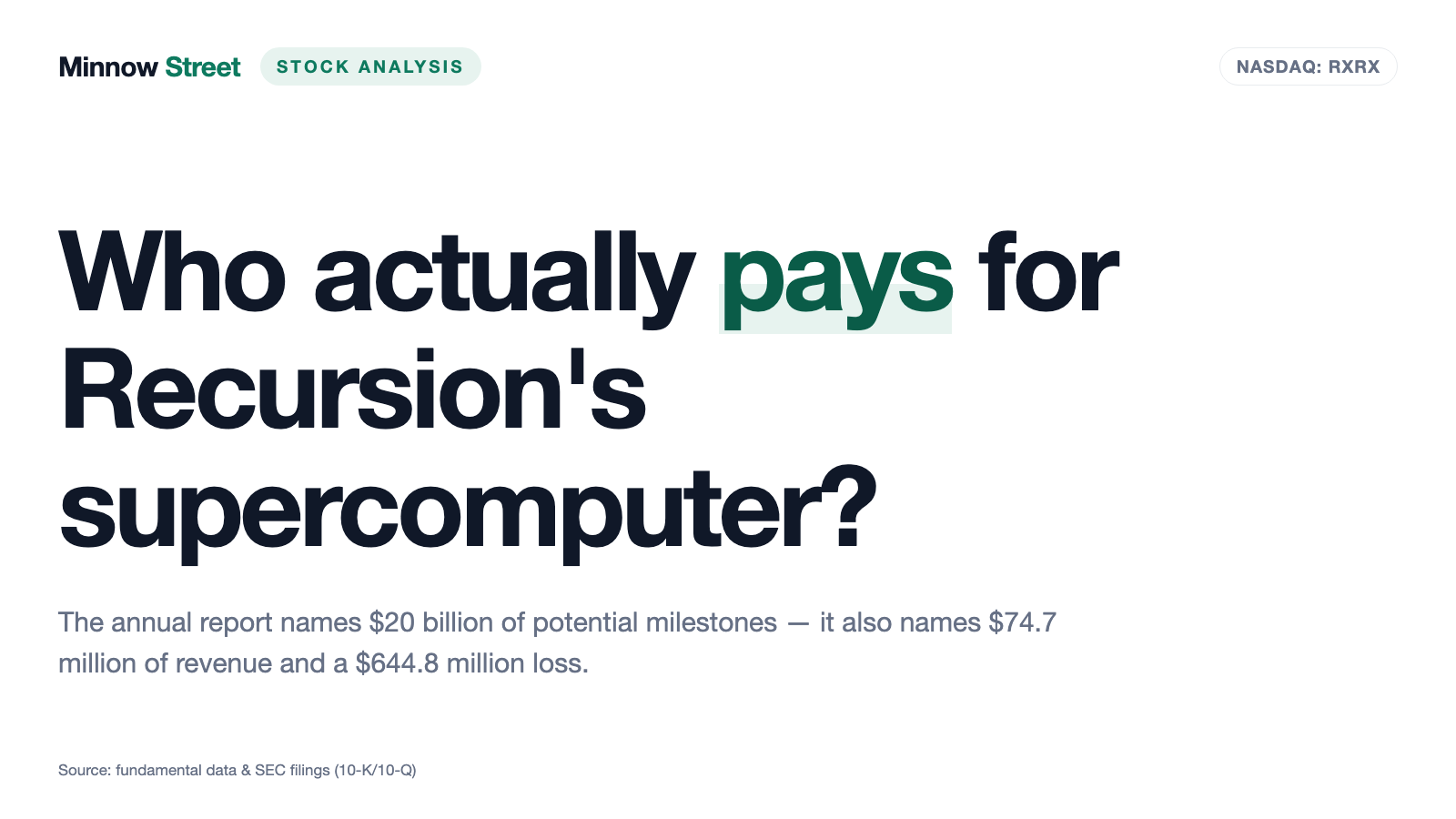
Recursion of Salt Lake City is the showcase name of AI drug discovery: its own supercomputer, partners such as Roche, Sanofi and Bayer, and an annual report that names more than $20 billion of potential future milestones. The same report also carries the actual numbers: $74.7 million of revenue in 2025, a $644.8 million loss, and a first quarter of 2026 in which $6.5 million of revenue carried $12.5 million of direct cost. The share count rose from 191.0 million at the end of 2022 to 530.8 million as of March 31, 2026. The auditor declined to attest to the internal control system for 2025, and the founder left the board at the annual meeting on June 17, 2026. Not investment advice — just the question of how much future an investor wants to pre-fund.
 Thomas Mücke
Founder & Publisher
Thomas Mücke
Founder & Publisher
Chart
Interactive price chart (TradingView).
Note: pure fact-based analysis, not investment advice and not a solicitation to buy or sell. All figures without guarantee.
There is a thinking error that even sober investors cannot defend against, because it does not run through greed but through the arithmetic in your head: the anchoring effect. It works like this — somebody names a very large number, and from that moment on your brain measures everything else against it. At Recursion Pharmaceuticals (Nasdaq: RXRX) that number sits in the company's own annual report: over $20 billion of potential future milestone payments from its pharmaceutical partnerships. Once the anchor is dropped, $74.7 million of annual revenue feels like a rounding error and a $644.8 million loss feels like an investment. So let us make a deal: we leave the anchor where it is and read, right next to it, what the same company reported to the U.S. securities regulator, the SEC, about its present — the annual report on Form 10-K for 2025 filed February 25, 2026, the quarterly report on Form 10-Q as of March 31, 2026 filed May 6, 2026, and everything that came after. An SEC filing is honest under threat of penalty. And this one describes revenue that in the last reported quarter cost more than it brought in, a share count that has nearly tripled in three and a half years, an auditor that withholds its opinion on internal control — and a founder who left the board in June 2026. What you make of it is up to you.
What Recursion actually does — a factory for pictures of cells
Picture a factory floor where robots work around the clock, seeding human cells into millions of tiny wells, treating each with a different compound or a different genetic edit, and then photographing them. From those images a computer learns what a diseased cell looks like and which substance nudges it back toward healthy. That is Recursion: a biotechnology company from Salt Lake City, Utah, founded in 2013, listed on Nasdaq since April 16, 2021, with close to 600 employees (annual report on Form 10-K for 2025). The company calls the whole system of lab robotics, image data and models the "Recursion OS" and trains it on its own supercomputer, BioHive-2 — according to the annual report built from 63 NVIDIA DGX systems with 504 H100 graphics processors and ranked number 76 on the global Top500 list in 2025. Since acquiring the British AI drug designer Exscientia in November 2024, the chemistry side belongs to it too: molecules are not only found but designed on the machine.
So much for the factory. Now the cash register. Recursion has no approved medicine at all. The money that shows up as revenue in the income statement comes entirely from research alliances: Roche and Genentech, Sanofi, Bayer and Merck KGaA pay Recursion to find targets and design molecules for them. The quarterly report puts it plainly: "Operating revenue is generated through research and development agreements derived from strategic alliances." And with that the central tension of this analysis is on the table, and it runs through every chapter: Recursion sells compute and lab work to pharmaceutical companies — but that sale does not carry itself, and everything else is paid for by shareholders with an ever-growing pile of new shares.
How the stock landed on our desk
Recursion did not arrive through a price move but through two sober oddities. First, a pass through the fundamental data: a market value of roughly $1.6 billion against trailing twelve-month revenue of $66.4 million — a price-to-sales ratio of about 24 (data as of July 28, 2026). A high price-to-sales multiple on its own is not a finding; for a young software or biotech company it is normal. It became interesting only because of the number sitting next to it: quarterly revenue was down 56 percent year over year. Expensive and shrinking at the same time — that is the combination that sends you to the primary documents.
Second, the SEC filing history itself. Since July 2026, Form 144 notices have been arriving there almost every day — advance notices of planned share sales by people close to the company. Open them and you find the same name behind each one; we come to that in the chapter on uncomfortable truths. For now, remember the working step, because it costs nothing and works on any stock: do not only look at the reports, look at the order in which they were filed. Clusters often say more than individual documents.
The numbers over the years — honestly credited
First what genuinely speaks for Recursion, and that is more than hope. Revenue is growing: from $44.6 million in 2023 to $58.8 million in 2024 to $74.7 million in 2025 — up 27 percent in the last year. The partners are not startups but Roche, Sanofi, Bayer and Merck KGaA; according to the annual report, more than $500 million of upfront and progress-based milestone payments have already been received. The balance sheet is remarkably solid for a company of this kind: $665.2 million of cash including restricted cash, $1,024.8 million of equity against total assets of $1,339.5 million (all as of March 31, 2026) — and virtually no financial debt: the annual report names just $18.7 million as of December 31, 2025, essentially the supercomputer lease and tenant improvement notes.
The cost program is working, too. After the roughly 20 percent workforce reduction in June 2025, research and development expense fell to $87.9 million in the first quarter of 2026 (prior-year quarter: $129.6 million) and general and administrative expense to $34.6 million (from $54.7 million). The net loss nearly halved: $117.5 million against $202.5 million in the first quarter of 2025. Cash used in operating activities fell from $132.0 million to $81.1 million. That is real discipline, and it deserves to be acknowledged before the "but."
And here is the "but," in a single chart:
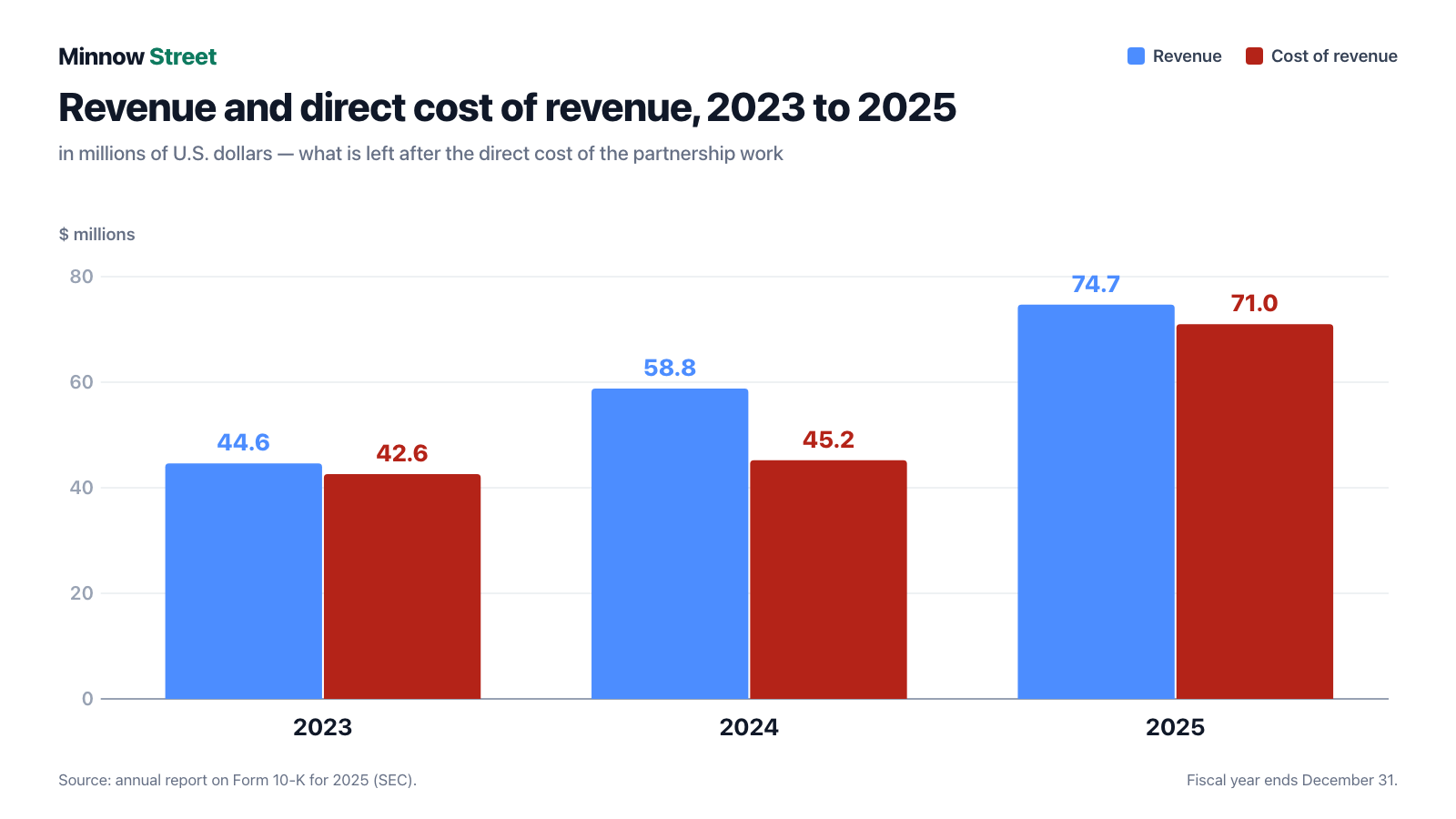
Translated into an everyday picture: imagine a contractor who takes a job for $74.70 and uses $71 of materials and labor to do it. That leaves $3.70. The workshop rent, the license and the new van are not paid for yet. At Recursion those items are called research and development ($475.3 million in 2025) and general and administrative expense ($176.6 million) — which is why the bottom line shows an operating loss of $648.1 million. Remember this sentence, because it carries the whole analysis: at Recursion, revenue is not a source of profit but a reimbursement of cost — and in most quarters it does not even cover that.
What the filings say — the uncomfortable truths
Uncomfortable truth no. 1: the $20 billion anchor sits right next to $74.7 million
The number that sets off the anchoring effect in this stock is not in a marketing brochure but in a mandatory filing. In the chapter on partnerships, the annual report for 2025 says:
"Through our partnerships with leading pharmaceutical companies including Roche and Genentech, Sanofi, Bayer, and Merck KGaA (Darmstadt, Germany), we have secured more than $500 million in upfront and progress-based milestone payments to date, with the potential for over $20 billion in additional milestones before royalties."
— Recursion Pharmaceuticals, Inc., SEC annual report on Form 10-K for 2025, Item 1, "Impact Through Partnered Pipeline"

Both numbers are correct — and they mean completely different things. The $500 million really did arrive over several years, including a $150 million upfront payment from Roche in January 2022 and two $30 million milestones in September 2024 and October 2025. The $20 billion, by contrast, is the sum of every payment theoretically reachable if every program in every contract clears all stages to market. In accounting language: Recursion has fully constrained that variable consideration — it is recognized as revenue only once it becomes sufficiently probable. Translated: the $20 billion is in the report, but in no balance sheet. The Roche contract, for instance, carries a transaction price of $210.0 million — not billions. So if you take the anchor with you, know what it measures: a possibility, not a receivable.
Uncomfortable truth no. 2: two customers are effectively the entire revenue line
If an acquaintance told you his business was thriving and you learned in passing that two customers account for essentially all of the revenue, would you swallow hard? That is exactly the situation disclosed in Recursion's notes:
"Revenue from two customers exceeded 10% of total revenue, and those two customers represented substantially all of Recursion's operating revenue during the year ended December 31, 2025."
— Recursion Pharmaceuticals, Inc., SEC annual report on Form 10-K for 2025, notes, "Additional Revenue Disclosures"
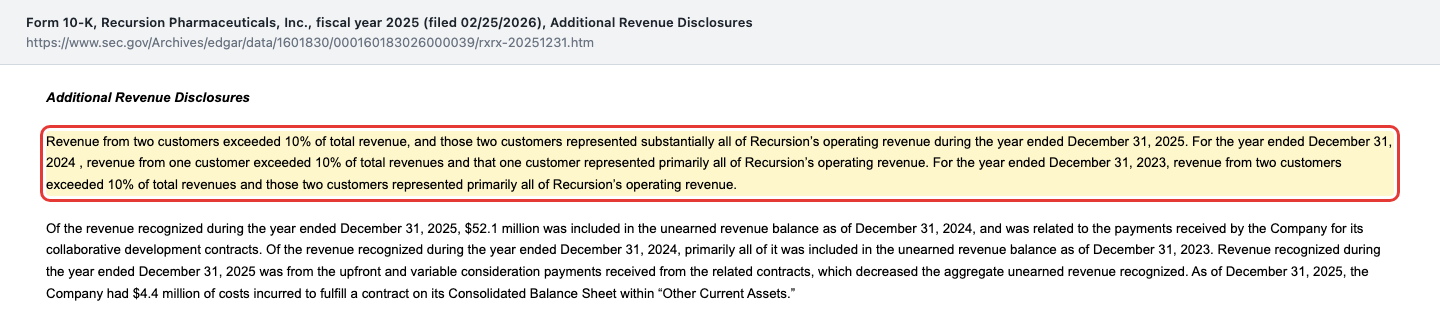
How quickly that dependency shows up is visible in the first quarter of 2026. Revenue fell from $14.7 million to $6.5 million — down 56 percent. The explanation in the quarterly report is unspectacular and instructive precisely for that reason: certain Roche project phases had been successfully completed in the prior-year period, so less revenue is recognized now. No dispute, no cancellation — just a project stage that ended. When a single such stage halves quarterly revenue, the revenue line is not a reliable engine but a metronome set by somebody else's calendar. In fairness: Recursion does not depend on this revenue to survive — the cash balance takes care of that. But that is exactly why the revenue line contributes nothing to the valuation that a price-to-sales ratio of 24 assumes.
Uncomfortable truth no. 3: revenue costs more than it brings in almost every quarter
Recursion reports the direct cost of its partnership work separately — materials, hours worked by its own staff, depreciation on lab equipment. That line is called "cost of revenue." On a full-year view something was always left over: $2.0 million after $42.6 million of cost in 2023, $13.6 million after $45.2 million in 2024, $3.7 million after $71.0 million in 2025 — 4, 23 and 5 percent of revenue respectively. So there is no improvement, but no clean trend either: the number jumps around.
The quarterly view says something else, and it is unpleasant. In all four quarters Recursion has most recently reported separately, direct cost exceeded revenue: $14.7 million against $21.8 million in the first quarter of 2025, $19.2 million against $20.2 million in the second, $5.2 million against $14.7 million in the third, and $6.5 million against $12.5 million in the first quarter of 2026 — a gross loss every time, before a single dollar goes to research, administration or the data center. Across the first nine months of 2025 that adds up to $39.1 million of revenue against $56.7 million of cost, a shortfall of $17.5 million.
That the year 2025 nonetheless closed with a $3.7 million gross profit hangs on a single quarter. Subtract the nine-month figures from the full-year figures and the fourth quarter of 2025 left about $21.3 million after $35.5 million of revenue and $14.3 million of cost — more than the entire annual gross profit. Remember this: an annual figure that hangs on one quarter is not a business model, it is a lucky date in someone else's calendar.
That is where the story "our partners help fund the platform" fails its test. In fairness: revenue recognition under milestone contracts swings by nature, and one weak quarter proves nothing. Except this is not one quarter — it is four out of five. For assessment purposes: of every dollar a pharmaceutical partner wires over, nothing remains in most quarters that could help pay for Recursion's own research.
Uncomfortable truth no. 4: shareholders pay the bill — with ever more shares
If revenue yields nothing and roughly $81 million still flows out every quarter, the money has to come from somewhere. At Recursion it comes almost entirely from issuing new shares. The quarterly report as of March 31, 2026 names $829.0 million of net proceeds from share issuances since 2024. In 2025 alone the company sold 99.9 million shares through a sales agreement with Citigroup for net proceeds of $491.7 million. Add to that a 2024 placement of 35.4 million shares at $6.50 (net $216.4 million) and the 102.1 million shares used to pay for the Exscientia acquisition in November 2024.
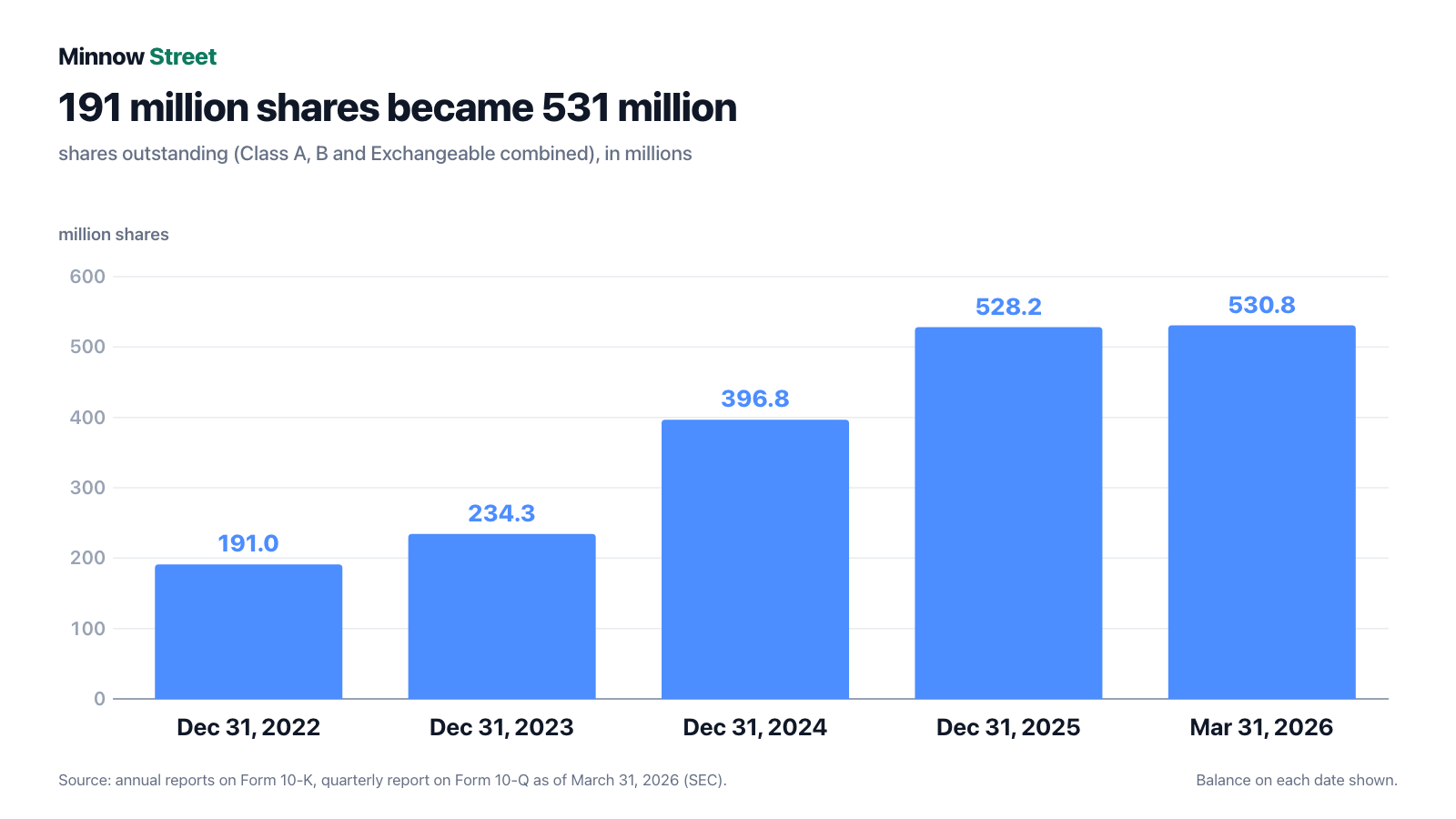
Dilution is one of those words that is easy to skim past. The everyday picture: your slice of the cake gets smaller when new slices are constantly being cut — even if the cake itself is growing. How hard it has been cut here is what the second chart shows:
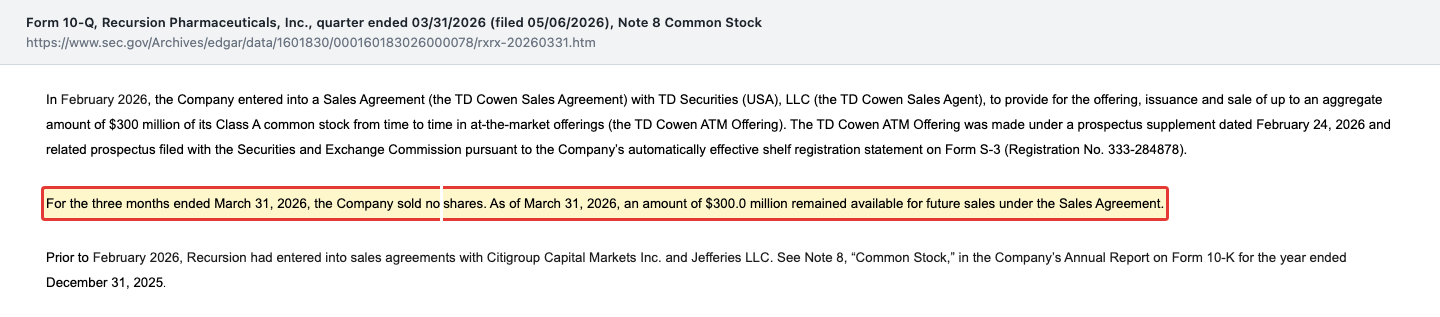
And the next cut is already prepared. In February 2026 Recursion signed a new $300 million sales agreement with TD Securities. As of the quarter end nothing had been drawn:
"For the three months ended March 31, 2026, the Company sold no shares. As of March 31, 2026, an amount of $300.0 million remained available for future sales under the Sales Agreement."
— Recursion Pharmaceuticals, Inc., SEC quarterly report on Form 10-Q as of March 31, 2026, Note 8, "Common Stock"
An important qualification: Recursion is not in acute financial distress. The first-quarter 2026 earnings release confirms a cash runway "into early 2028" with no additional financing, on planned operational cash burn of under $390 million in 2026. Arithmetically, $665.2 million of liquidity covers roughly eight quarters at the last reported burn rate. So the dilution is not an emergency; it is the business model on the financing side: growth paid for with fresh shares is never quite free.
Uncomfortable truth no. 5: the auditor withholds its opinion on the control system
An annual report of a U.S. company carries two opinions: one on the numbers and one on the system that produces them. At Recursion the first is favorable — the statements present the position fairly "in all material respects." The second reads:
"Also in our opinion, the Company did not maintain, in all material respects, effective internal control over financial reporting as of December 31, 2025."
— PricewaterhouseCoopers LLP for Recursion Pharmaceuticals, Inc., SEC annual report on Form 10-K for 2025, report of the independent registered public accounting firm
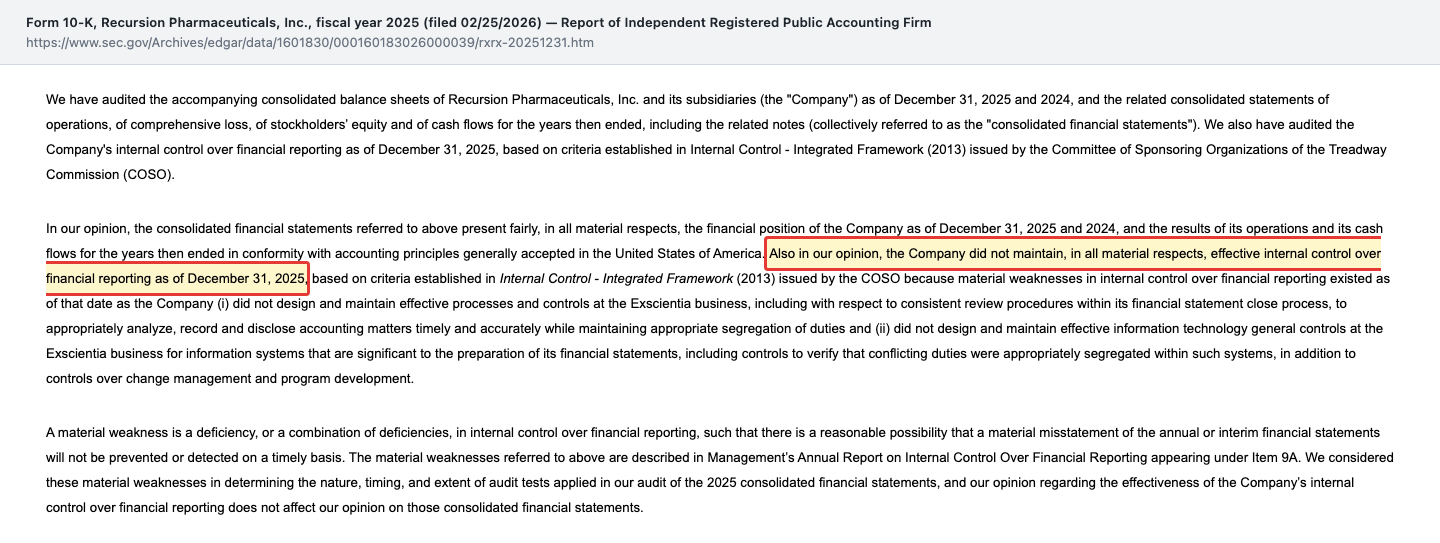
The weaknesses stem from the Exscientia acquisition: missing consistent review procedures in the financial close and missing general information technology controls, including proper segregation of duties. Recursion itself writes that these weaknesses could lead to a misstatement of "substantially all account balances or disclosures." So far only an immaterial error has resulted, in the deferral of unearned revenue for 2024 — there was no restatement of prior periods. But the weaknesses were first identified for fiscal year 2024, and as of March 31, 2026 management again classified disclosure controls as "ineffective." A new enterprise resource planning and purchase-to-pay system went live in the first quarter of 2026 and remediation is under way. Translated into an everyday picture: the bookkeeping has produced correct numbers so far — but the auditor says not all the locks on the door work yet. If you value a company by its numbers, it is worth knowing how well secured the house is in which they are produced.
Uncomfortable truth no. 6: the founder has left the board — and is selling
Back to those Form 144 notices from the chapter on how the stock landed on our desk. The path there begins in November 2025: on November 4 the board resolved that Najat Khan — previously chief research and development officer, before that responsible for data science at Johnson & Johnson — would become chief executive officer effective January 1, 2026. Co-founder Christopher Gibson, chief executive since the start, moved to the chair of the board on the same date. Five months later, on April 28, 2026, he announced that he would not stand for re-election at the annual meeting on June 17, 2026; the company expressly noted that the decision did not result from any disagreement over its operations or policies. Two other people were elected at that meeting — Gibson has not been on the board since.
The sale notices have run ever since. The most recent Form 144, dated July 27, 2026, lists every sale of the previous three months for Christopher Gibson and the vehicles attributable to him (a family trust and a limited liability company): roughly 2.32 million shares for gross proceeds of about $8.1 million, mostly since the start of July in tranches of 100,000 shares on nearly every trading day. His relationship to the issuer is stated as "Former Director."
Let us judge that honestly. The volume sold equals roughly 0.4 percent of all outstanding shares — hardly an avalanche for the share price. Founders sell for many legitimate reasons: taxes, diversification, a pre-arranged trading plan. And a share sale is not a statement about the company; every form says so explicitly. Still, the sequence belongs in an analysis, because it closes a chapter: the man whose idea the Recursion OS was is no longer chief executive, no longer on the board, and is reducing his stake. Anyone investing in the stock today is investing in the balance sheet and in the new leadership — no longer in the founder.
Valuation: what are you actually paying for?
There is no price-to-earnings ratio, because there are no earnings — 2025 showed a loss of $1.44 per share and the first quarter of 2026 a loss of $0.22. That leaves revenue as a yardstick: at a market value of roughly $1.6 billion against $66.4 million of trailing twelve-month revenue, the price-to-sales ratio is about 24 (data as of July 28, 2026). For context: a multiple like that normally requires a revenue line that grows fast and throws off cash. Here it shrank 56 percent in the latest quarter and throws off nothing. So price-to-sales is simply the wrong lens for this company.
The better lens is the balance sheet. Equity stood at $1,024.8 million as of March 31, 2026, including $665.2 million of cash; against that sit goodwill ($160.2 million) and other intangible assets ($294.1 million) from the acquisitions, which carry no cash value of their own. So the market values the company at roughly one and a half times book — put differently, about $570 million of the market value is the platform, the pipeline and the hope; the rest is cash and balance sheet. Whether $570 million is a lot or a little for a drug-discovery system plus seven clinical and preclinical programs is exactly the open question this article cannot and should not answer.
For a dated anchor point, look at a mandatory form rather than a price screen: the Form 144 dated July 27, 2026 documents a sale on July 21, 2026 of 100,000 shares for gross proceeds of $304,262.54 — roughly $3.04 per share. Multiplied by the 529.9 million Class A and Class B shares outstanding as of May 1, 2026, that implies a market value of about $1.61 billion; the fundamental data, at roughly $1.60 billion, is less than one percent away. The valuation figures in this analysis therefore stand on verified ground. The professionals' view fits the picture: of eight analyst ratings, six say hold, one buy and one strong buy, none sell (data as of July 28, 2026). If you want to see how investors handle the same starting position elsewhere — no product, plenty of cash, a big story — the pattern also shows up in our ImmunityBio analysis and in the Capricor analysis.
Opportunities and risks at a glance
What speaks for Recursion:
- A solid cash position with no debt load: $665.2 million of cash including restricted cash and $1,024.8 million of equity as of March 31, 2026, against just $18.7 million of financial debt as of December 31, 2025. The company's own runway guidance reaches into early 2028.
- First-class partners that actually pay: Roche and Genentech, Sanofi, Bayer and Merck KGaA have together provided more than $500 million of upfront and milestone payments, most recently $30 million in October 2025 for the second accepted neuroscience map.
- The cost program shows measurable effect: after the roughly 20 percent workforce reduction in June 2025, research and development expense fell to $87.9 million in the first quarter of 2026 (from $129.6 million), general and administrative expense to $34.6 million (from $54.7 million), and cash used in operations from $132.0 million to $81.1 million.
- A first clinical proof point for the platform: in the REC-4881 program for the inherited disease FAP, the company reported a median 43 percent reduction in polyp burden at week 13 and 53 percent at week 25; engagement with the U.S. Food and Drug Administration on a registrational path is under way, with an update expected in the second half of 2026.
- Owned compute instead of rental cost: the BioHive-2 supercomputer with 504 graphics processors ranked number 76 on the global Top500 list in 2025 and belongs to the company — an advantage as model workloads increase.
What speaks against it:
- Revenue does not carry itself: in all four separately reported quarters to date, direct cost exceeded revenue, most recently $12.5 million against $6.5 million in the first quarter of 2026. The $3.7 million full-year 2025 gross profit ($74.7 million minus $71.0 million) derives entirely from the closing quarter. Quarterly revenue also fell 56 percent as Roche project phases ran out.
- Heavy dilution: the share count rose from 191.0 million at the end of 2022 to 530.8 million as of March 31, 2026, with 99.9 million shares added in 2025 alone for net proceeds of $491.7 million. A further $300 million facility — roughly 19 percent of market value — sat untouched and available as of March 31, 2026.
- Control weaknesses without an opinion: the auditor judged internal control over financial reporting not effective as of December 31, 2025; the weaknesses from the Exscientia acquisition date back to fiscal year 2024 and were still unremediated as of March 31, 2026.
- Concentration and program risk: two customers accounted for substantially all operating revenue in 2025. Three clinical programs were halted in May 2025 (REC-2282 for NF2, REC-994 for CCM, REC-3964 for Clostridioides difficile), and no compound has an approval.
- An accumulated deficit of $2.2 billion as of March 31, 2026 at a valuation of roughly one and a half times book; the founder has left both the executive suite and the board and has been filing near-daily notices of share sales since July 2026.
A human conclusion
Back to the anchoring effect from the opening. The $20 billion in the annual report is not a lie — it is an honestly described possibility. But it does in your head exactly what large numbers are built to do: it makes everything beside it small. Next to it, $74.7 million of revenue feels like a beginning rather than a result after twelve years. A $644.8 million loss feels like an advance payment rather than a bill. And 340 million additional shares since the end of 2022 feel like a technical footnote rather than what they are — the price existing owners paid for the story to continue.
There are good reasons to find Recursion fascinating. It has money, strong partners, a first clinical signal and a leadership team visibly tightening the belt. It also has no revenue that carries itself, no approved product, a control system without an auditor's opinion and a financing model in which the next step almost inevitably means new shares. So the honest question is not "is AI the future of drug discovery?" — plenty of people would answer yes to that. It is: do you want to pre-fund that future, knowing that your share of it shrinks with every financing step? If yes, you have a thesis and you know what you are waiting for. If no, all you had was an anchor. What you make of it is your decision. And that is exactly as it should be.
Sources
Every primary document used in this analysis, for you to read yourself:
- Recursion Pharmaceuticals, Inc. — SEC quarterly report on Form 10-Q as of March 31, 2026 (filed May 6, 2026)
- Recursion Pharmaceuticals, Inc. — SEC annual report on Form 10-K for 2025 (filed February 25, 2026)
- Recursion Pharmaceuticals, Inc. — SEC quarterly report on Form 10-Q as of September 30, 2025 (filed November 5, 2025)
- Recursion Pharmaceuticals, Inc. — SEC quarterly report on Form 10-Q as of June 30, 2025 (filed August 5, 2025)
- Recursion Pharmaceuticals, Inc. — First quarter 2026 earnings release, exhibit 99.1 to the Form 8-K of May 6, 2026
- Recursion Pharmaceuticals, Inc. — SEC Form 8-K of November 5, 2025 (chief executive transition)
- Recursion Pharmaceuticals, Inc. — SEC Form 8-K of April 30, 2026 (founder declines re-election to the board)
- Recursion Pharmaceuticals, Inc. — SEC Form 8-K of June 18, 2026 (annual meeting voting results)
- Recursion Pharmaceuticals, Inc. — SEC Form 8-K of June 10, 2025 (workforce reduction and cash runway)
- Christopher Gibson — SEC Form 144 of July 27, 2026 (notice of proposed sale, with the schedule of sales in the past three months)
- Complete SEC filing history of Recursion Pharmaceuticals, Inc.: EDGAR overview (sec.gov)
- Fundamental data (market value, price-to-sales, analyst stance; data as of July 28, 2026), reconciled with the SEC filings.
Transparency & disclaimer: This analysis is journalistic commentary on publicly available information. It is not investment advice, not a regulated financial analysis, and not a solicitation to buy or sell securities. Equity investments carry substantial risk up to and including total loss. All figures without warranty; the data date is noted in the text. The author holds no position in Recursion shares at the time of publication.
Our Bottom Line at a Glance
- Balance sheet & financing positive
- As of March 31, 2026 the company held $665.2 million of cash including restricted cash and $1,024.8 million of equity against virtually no financial debt ($18.7 million as of December 31, 2025). At the latest quarterly operating cash burn of $81.1 million that covers roughly eight quarters; the company itself guides to a runway into early 2028.
- Earning power of revenue negative
- Revenue does not cover its own direct cost: in all four separately reported quarters to date, cost of revenue was higher — Q1 2025 ($14.7 million against $21.8 million), Q2 2025 ($19.2 million against $20.2 million), Q3 2025 ($5.2 million against $14.7 million) and Q1 2026 ($6.5 million against $12.5 million). The $3.7 million full-year 2025 gross profit ($74.7 million minus $71.0 million) derives entirely from the closing quarter. Quarterly revenue fell 56 percent as Roche project phases ran out.
- Dilution negative
- The share count (Class A, B and Exchangeable) rose from 191.0 million at the end of 2022 to 530.8 million as of March 31, 2026; 99.9 million shares were added in 2025 alone for net proceeds of $491.7 million. A further $300 million sales facility — roughly 19 percent of the market value of about $1.6 billion (data as of July 28, 2026) — sat untouched and available as of March 31, 2026.
- Controls & governance negative
- The auditor judged internal control over financial reporting not effective as of December 31, 2025; the weaknesses from the Exscientia acquisition date back to fiscal year 2024 and were still considered unremediated as of March 31, 2026. The financial statements themselves received an unqualified opinion, and only an immaterial error has resulted so far. Co-founder Christopher Gibson left the board at the annual meeting on June 17, 2026.
- Platform & pipeline neutral
- There is a first clinical signal from the company's own platform: in the Phase 2 readout, REC-4881 reduced polyp burden in FAP by a median of 43 percent at week 13 and 53 percent at week 25, and engagement with the FDA on a registrational path is under way. At the same time three clinical programs were halted in May 2025, and no compound has an approval.
- Partner base neutral
- Roche and Genentech, Sanofi, Bayer and Merck KGaA have together provided more than $500 million of upfront and milestone payments, most recently $30 million in October 2025. The "over $20 billion" of potential further milestones named in the annual report is fully constrained for accounting purposes; the Roche contract carries a transaction price of $210.0 million. In 2025 two customers accounted for substantially all operating revenue.
Recursion is the anchoring trap in pure form: the annual report names the possibility of over $20 billion of future milestones — and right beside it stands $74.7 million of revenue (2025), a $644.8 million net loss and a first quarter of 2026 in which $6.5 million of revenue carried $12.5 million of direct cost. The balance sheet is robust, with $665.2 million of liquidity and almost no debt, and the company guides to a runway into early 2028; it was paid for with a share count that grew from 191.0 million to 530.8 million, and a further $300 million facility stands ready to draw. Add a control system without an auditor's opinion and a founder who has left both the executive suite and the board. Not investment advice.
What Our Rating Means
Open questions
The business works in principle, but one material question is open. As long as it stays open, our findings do not carry a quality verdict.
Yellow because the decisive operating question is open while the substance is not acutely at risk: after twelve years the business model has not produced revenue that covers its own direct cost — in the first quarter of 2026, $6.5 million of revenue cost $12.5 million — and proof that the Recursion OS turns into approved medicines is still outstanding. Red lacks evidence: no going-concern indication, $1,024.8 million of equity, $665.2 million of liquidity against $18.7 million of financial debt, and a cash runway of roughly eight quarters (figures as of March 31, 2026 and December 31, 2025). The unremediated control weaknesses and the heavy dilution weigh on the verdict but do not tip it: the financial statements themselves carry an unqualified opinion, and only an immaterial error has resulted so far. That the stock is expensive on revenue belongs in the valuation, not in the quality light. The decision is yours.
A journalistic assessment by our editorial team at the time of the deep dive, based on public sources — not investment advice and not a solicitation to buy or sell. Your personal circumstances (investment goals, risk capacity, taxes) cannot be taken into account. What our levels mean, how verdicts are formed, and what conflicts of interest exist →
Worth Noting
- Research hook: a price-to-sales ratio of about 24 alongside quarterly revenue down 56 percent (data as of July 28, 2026), plus the striking cluster of Form 144 notices in the SEC filing history since July 2026.
- Data basis: annual report on Form 10-K for 2025 (filed February 25, 2026), quarterly report on Form 10-Q as of March 31, 2026 (filed May 6, 2026), plus the 10-Q reports as of June 30 and September 30, 2025 for the quarterly series, and every filing submitted afterwards through July 27, 2026. The market value from the fundamental data was cross-checked against share count times the sale price documented in the Form 144 (deviation below one percent).
- Possible confusion: Recursion Pharmaceuticals, Inc. was named Recursion Pharmaceuticals, LLC before the IPO — the same entity after a pure change of legal form, not a successor company. Exscientia plc, the British drug designer acquired in 2024, has not been separately listed since.
- The "over $20 billion" named in the annual report is the sum of theoretically achievable milestones across all partnership contracts and is fully constrained for accounting purposes — it is not a receivable and appears in no balance sheet line.
Frequently Asked Questions
Recursion Pharmaceuticals, Inc. (Nasdaq: RXRX) of Salt Lake City is a clinical-stage biotechnology company. In automated laboratories it generates images of treated cells at scale and analyzes them with machine learning to find drug candidates and design molecules on the machine. The whole system is called the "Recursion OS" and runs on the company's own BioHive-2 supercomputer. There are no approved medicines so far; all revenue comes from research alliances with Roche and Genentech, Sanofi, Bayer and Merck KGaA.
Revenue was $74.7 million in 2025 ($58.8 million in 2024, $44.6 million in 2023) and comes entirely from partnership agreements, not from selling medicines. In the first quarter of 2026 it fell to $6.5 million from $14.7 million in the prior-year quarter — down 56 percent, because certain Roche project phases had been completed in the earlier period. Against that revenue stood direct cost of revenue of $12.5 million in the first quarter of 2026.
As of March 31, 2026 Recursion held $665.2 million of cash including restricted cash (December 31, 2025: $753.9 million). Cash used in operating activities was $81.1 million in the first quarter of 2026. In its earnings release of May 6, 2026 the company itself stated that, with no additional financing, the cash runway extends into early 2028, on planned operational cash burn of under $390 million in 2026.
Considerably. Shares outstanding (Class A, B and Exchangeable) rose from 191.0 million at the end of 2022 to 234.3 million (2023), 396.8 million (2024), 528.2 million (2025) and 530.8 million as of March 31, 2026. In 2025 alone the company sold 99.9 million shares for net proceeds of $491.7 million. A further $300 million sales program was added in February 2026 and was still entirely untouched as of March 31, 2026.
PricewaterhouseCoopers gave the 2025 financial statements an unqualified opinion but also concluded that as of December 31, 2025 the company had not maintained effective internal control over financial reporting in all material respects. The reason lies in the acquired Exscientia business: missing consistent review procedures in the financial close and missing general information technology controls, including segregation of duties. The weaknesses date back to fiscal year 2024 and were still considered unremediated as of March 31, 2026.
Co-founder Christopher Gibson handed the chief executive role to Najat Khan effective January 1, 2026 and moved to the chair of the board. On April 28, 2026 he announced that he would not stand for re-election at the annual meeting on June 17, 2026; the company stated that no disagreement was behind the decision. Since then he has filed continuous notices of share sales on Form 144: in the three months to July 27, 2026, roughly 2.32 million shares for about $8.1 million gross, together with vehicles attributable to him.
A price-to-earnings ratio cannot be formed because there are no earnings (loss per share in 2025: $1.44). Measured against revenue the stock is expensive: roughly $1.6 billion of market value against $66.4 million of trailing twelve-month revenue gives a price-to-sales ratio of about 24 (data as of July 28, 2026). Measured against book value it is moderate: against that market value sits $1,024.8 million of equity as of March 31, 2026, including $665.2 million of cash.
According to the annual report for 2025, ongoing programs include REC-4881 for the inherited disease FAP (Phase 1b/2, the TUPELO study), REC-617 in advanced solid tumors, REC-1245 and REC-3565. For REC-4539 the annual report guided to a Phase 1 start in 2026; the earnings release of May 6, 2026 reported the first patient dosed. In a May 2025 portfolio streamlining, three clinical programs were discontinued or put up for out-licensing: REC-2282 for NF2, REC-994 for CCM and REC-3964 for Clostridioides difficile. No compound has a marketing approval so far.
Found an error?
Did you spot a factual error, an outdated number, or a typo in this deep dive? Let us know briefly — your report goes straight to the editorial team.