Capricor: One Company, One Drug, One Date — and the Distributor Is Now the Defendant
Capricor Therapeutics has raised roughly $600 million since inception and still has no approved product. Everything rides on deramiocel, a cell therapy for Duchenne muscular dystrophy: in July 2025 the U.S. Food and Drug Administration sent a rejection letter, and the new target action date is August 22, 2026. The balance sheet is remarkably solid — $278.6 million in cash and marketable securities as of March 31, 2026, almost no debt, no going-concern warning. But revenue was zero in 2025, and since May 7, 2026 Capricor has been suing its own U.S. distributor, which happens to own more than 10 percent of the company. Not investment advice: just a count of how many yeses still stand between this company and its first earned dollar.
 Thomas Mücke
Founder & Publisher
Thomas Mücke
Founder & Publisher
Chart
Interactive price chart (TradingView).
Note: pure fact-based analysis, not investment advice and not a solicitation to buy or sell. All figures without guarantee.
There is an investor trap that likes to catch the organized ones — the people who keep a calendar. Call it the countdown trap. It works like this: the moment a date is fixed, thinking stops and counting begins. Twenty-six days to go. Twelve. Three. And because a date feels so pleasantly concrete, your mind mistakes it for an answer. New Year's Eve is the harmless version: everyone stares at the last ten seconds, and nobody asks what is supposed to be different on January 2. At Capricor Therapeutics (Nasdaq: CAPR) of San Diego there is such a date on the calendar — August 22, 2026, the day by which the U.S. Food and Drug Administration is due to decide on the company's only late-stage product. So let's make a deal: before we start counting, we read together what Capricor itself reported to the U.S. securities regulator, the SEC — the quarterly report (10-Q) as of March 31, 2026, the annual report (10-K) for 2025 and the current reports (8-K) filed since. A filing to the SEC is honest under penalty of law. And this one tells of a surprisingly full bank account, of revenue that has disappeared, of a rejection letter that already happened once — and of a distribution partner who is now the defendant and still owns more than 10 percent of the shares. In the end you decide for yourself.
What Capricor actually does — one company, one product
Capricor Therapeutics is a biotechnology company with 231 employees (as of December 31, 2025, 59 of them holding advanced degrees). It develops cell therapies. In everyday terms: instead of an active ingredient pressed into a pill, here the cell itself is the medicine — grown in a lab, deep-frozen, shipped, and infused into a patient's vein, where it releases signaling molecules. The product candidate is called deramiocel (formerly CAP-1002) and targets Duchenne muscular dystrophy, or DMD — a rare inherited disease in which boys begin losing muscle around primary-school age and which usually kills through heart muscle failure. Deramiocel is meant to work where the available gene therapies do little: on skeletal and cardiac muscle that is already damaged.
Alongside it runs a second, very early effort — a platform built on exosomes, the tiny vesicles cells use to pass messages to one another and which could serve as delivery vehicles for drugs. The annual report lists a SARS-CoV-2 vaccine candidate in Phase 1 and, separately, a discovery program. Only the Phase 1 trial sits with the U.S. institute NIAID — the agency runs it itself under the "Project NextGen" initiative, with Capricor supplying the investigational product; the discovery program is a separate effort with changing research partners. For today's valuation none of that matters: commercially, Capricor is a one-product company. More than 150 granted patents and pending applications protect the technology; the company went public in 2013 through a merger with a subsidiary of Nile Therapeutics, Inc. and has carried its present name ever since. Anyone digging through older databases will therefore also find the former names Nile Therapeutics and SMI Products — same SEC registration number (CIK 0001133869), different company.
That frames the central tension of this analysis, and it runs through every chapter: the balance sheet is that of a healthy company — the business itself is that of a lottery ticket. Capricor has money, its own manufacturing plant and solid trial data. What it does not have is a single dollar of product revenue, or an approval.
How the stock reached our desk — through the regulator's calendar
Capricor did not land on our list through a metric — as of July 28, 2026 the company appears in none of our in-house stock scanners (those lists are recalculated daily), which is what you would expect with zero revenue and a loss. It landed on the desk through a filing. On June 26, 2026 the company told the SEC that the FDA's advisory committee for cellular, tissue and gene therapies would convene to discuss the application for deramiocel:
"The date for the Advisory Committee meeting is July 29, 2026, and the meeting will be available for live streaming. The Company's BLA remains on track for a target action date under the Prescription Drug User Fee Act ("PDUFA") of August 22, 2026."
— Capricor Therapeutics, Inc., SEC current report 8-K of June 26, 2026, Item 8.01
Two terms worth translating once. An advisory committee is a panel of outside experts that advises the agency; its vote is a recommendation, not a decision — the FDA often follows it, but not always. The PDUFA date is the deadline the agency has set itself for ruling on the application; it is a deadline, not a promise of a yes. Remember the difference right at the start: a date tells you when you get an answer, not what the answer is.
The numbers over the years — honestly appraised
First the case for Capricor, and it is stronger than you would expect from a company with no revenue. The balance sheet is solid. As of March 31, 2026 the company held $105.4 million in cash and $173.2 million in marketable securities — $278.6 million together. Against that stand total liabilities of only $47.6 million, of which $12.0 million is merely deferred revenue from an upfront payment. Equity of $278.7 million therefore consists almost entirely of money. The quarterly report puts it plainly:
"We believe that our current cash, cash equivalents, and marketable securities are sufficient to fund our operating capital requirements for at least the next twelve months from the issuance date of these condensed consolidated financial statements."
— Capricor Therapeutics, Inc., SEC quarterly report 10-Q as of March 31, 2026, Item 2 "Liquidity and Capital Resources"
For a biotech without a product that is not a given. In other cases this is exactly where the auditor's going-concern warning sits — with Replimune, the auditor doubted the company would survive while the market bet on the cancer approval anyway. Capricor carries no such warning. Let's do the rough math: $29.3 million of operating cash outflow in the first quarter of 2026, plus $10.7 million for equipment, leasehold improvements and construction of the new plant — about $40 million a quarter. Against $278.6 million that would be roughly seven quarters under its own power. The company's own plan is gentler: the quarterly report guides to $100.0 million to $125.0 million of spending on deramiocel in 2026 plus another $7.0 million to $10.0 million on the exosome platform — around $27 million to $34 million a quarter, because most of the $10.7 million in the first quarter was one-off construction spending for the new plant ($5.1 million of property and equipment, $0.9 million of leasehold improvements, $4.7 million of construction in progress). The honest answer is a range rather than a number: roughly seven to ten quarters, depending on whether you carry the construction spending forward. Room to breathe, but not forever.
Second: the trial data exist — and the company considers them statistically robust. The Phase 3 HOPE-3 trial randomized 106 participants across 20 U.S. sites, average age around 15; roughly 90 percent were already on cardiac medication and about 75 percent had a clinical diagnosis of cardiomyopathy. In December 2025 Capricor reported that the primary measure, the Performance of the Upper Limb score (a point test for shoulder, elbow and hand function), showed 54 percent slowing of progression (p = 0.029), and left ventricular ejection fraction showed 91 percent slowing (p = 0.041). The p-value is not a measure of how large the benefit is, but of how likely such a difference would arise by chance; below 0.05 it counts as "not random" in regulatory practice. In March 2026 data on cardiac scarring followed (p = 0.022), along with a composite global statistical test (p = 0.017).
Third: the factory is built. Capricor manufactures in-house, inside its own San Diego headquarters, and went through an FDA pre-license inspection in 2025; the agency issued Form 483 observations and subsequently accepted every one of the company's responses. The regulatory privileges for rare diseases are all in hand as well: orphan drug status (2015), rare pediatric disease designation (2017) and the RMAT designation for regenerative medicine, plus orphan drug status and classification as an advanced therapy medicinal product (ATMP) in Europe.
And now the chart that shows why none of that has become a business:
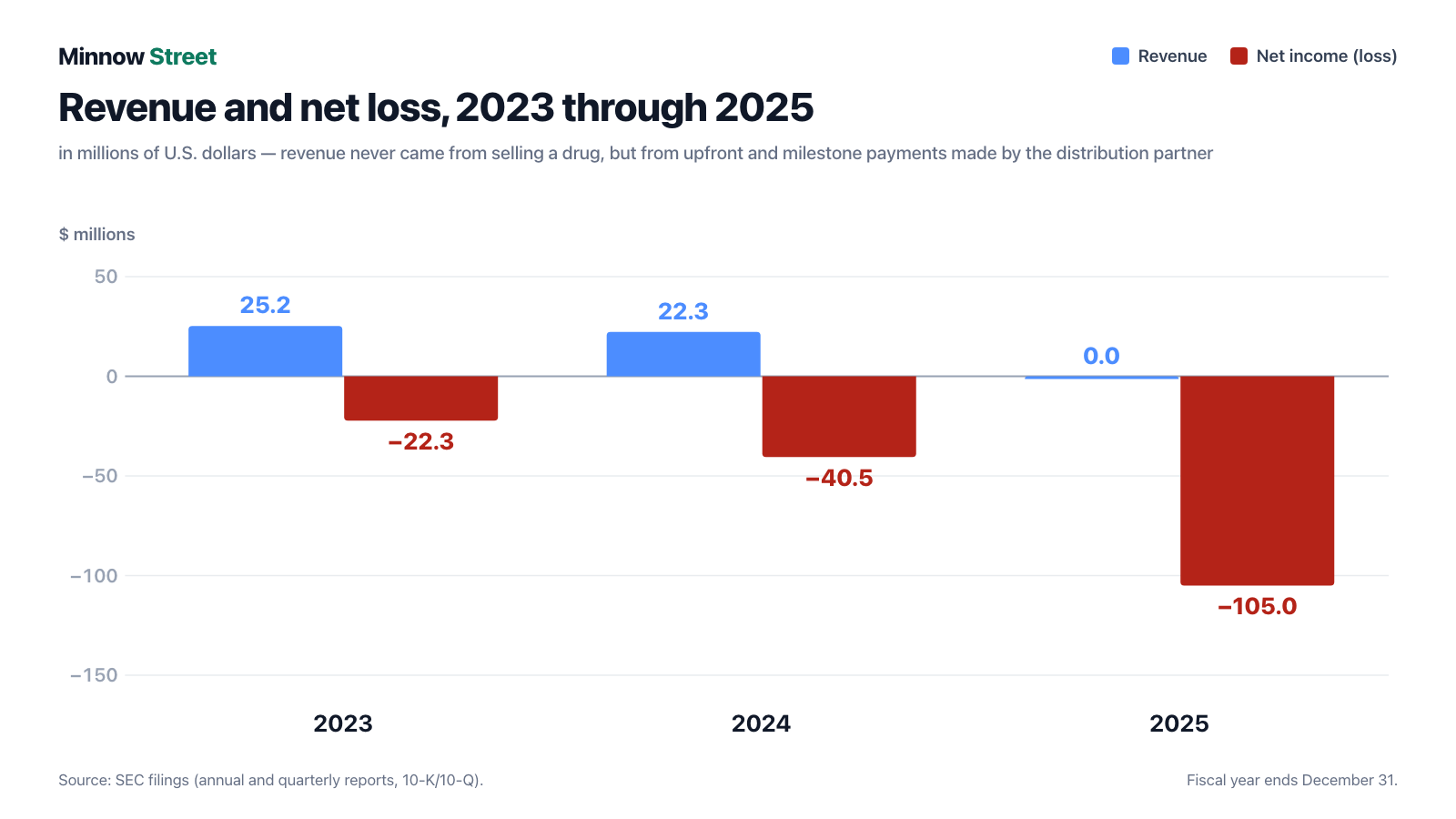
The cost increase has a comprehensible cause: research and development spending rose 69 percent in 2025 to $84.5 million, general and administrative expenses to $23.7 million — $108.1 million of operating expenses together. That money paid for the Phase 3 trial, the build-out of manufacturing and the preparation of a launch that does not exist yet. The first quarter of 2026 continued at the same pace: $27.4 million of research, $9.4 million of administration, a $33.9 million net loss, or $0.59 per share.
What the filings say — the uncomfortable truths
Uncomfortable truth no. 1: the revenue was never revenue
When you read "revenue" in a metrics database, you think of goods sold. At Capricor that line never once held a sold medicine. The $25.2 million of 2023 and the $22.3 million of 2024 were upfront and milestone payments from the Japanese distribution partner Nippon Shinyaku: $30.0 million on signing in 2022, $10.0 million after the HOPE-3 futility analysis, and another $10.0 million when the application was submitted in December 2024. Those $50.0 million had been fully recognized as revenue by the end of 2024 — and were therefore used up. In 2025 exactly nothing was left, and the same in the first quarter of 2026.
One payment still sits untouched on the balance sheet: the $12.0 million from the Japan agreement of February 10, 2023. It remains recorded as deferred revenue in current liabilities because, by the company's own account, Capricor cannot yet identify what performance obligation it covers. Translated: the money is there, it has not been earned. And another find from the same corner: the binding term sheet covering Europe, signed with the same partner on September 16, 2024, expired on April 1, 2026 without ever becoming a definitive agreement. Remember the pattern: at Capricor, money has always come from a partner, never from a patient.
Uncomfortable truth no. 2: this date has happened before — and it ended in a no
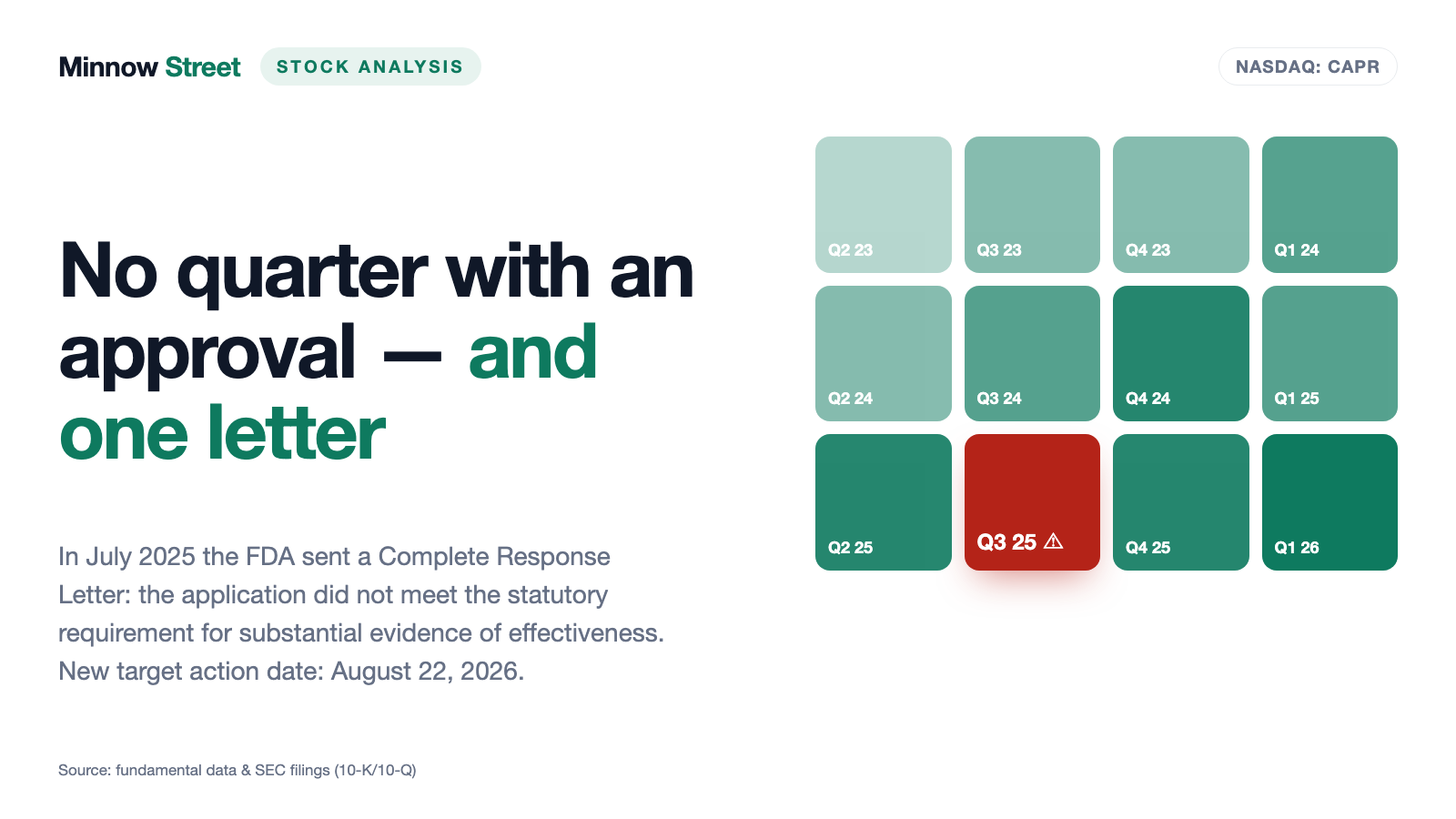
August 22, 2026 is not the first target action date for deramiocel. The first was August 31, 2025. What became of it is in the annual report:
"In July 2025, we received a Complete Response Letter ("CRL") from the FDA stating that the application did not meet the statutory requirement for substantial evidence of effectiveness and requesting additional clinical data."
— Capricor Therapeutics, Inc., SEC annual report 10-K for 2025, Item 1 "Business"

A Complete Response Letter is the FDA's formal rejection: the application cannot be approved in its present form, and the review pauses until more is filed. After a Type A meeting in August 2025 — the formal crisis meeting the FDA grants a company after a rejection — Capricor submitted the HOPE-3 data; the agency accepted that as a complete response, classified it as a Class 2 resubmission and set the new date at August 22, 2026. In fairness: the added data are new and positive, and the 2025 application did not have them. But honesty also means naming the expiry date on confidence — this agency has already said no to this product once. How quickly a date turns into a letter and a letter into a price shock is on record at Outlook Therapeutics, where even a yes from the FDA paid for nothing.
The letter had a legal aftermath, recorded in the quarterly report: on July 17, 2025 a putative securities class action was filed in the Southern District of California against Capricor and chief executive Linda Marbán, alleging violations of federal securities law. Two derivative actions against every board member followed on August 1, 2025 and November 24, 2025, plus a books-and-records demand on October 2, 2025. Outcome: open. The company had recorded no material loss contingency reserves for any of it as of March 31, 2026.
Uncomfortable truth no. 3: two days before the meeting, the agency put its own reading on the record
This analysis has a cut-off date, and it falls in the middle of the proceeding. On July 27, 2026 — two days before the advisory committee meeting — the FDA released the briefing document for that meeting, headed "FDA Briefing Document BLA# 125842/0, Drug: Deramiocel" and prepared for the Cellular, Tissue, and Gene Therapies Advisory Committee. It is the written assessment by the agency's own scientists that serves the committee members as their working basis, and it goes against Capricor. We read the document ourselves; the sentences that follow are quoted verbatim from it, not second-hand. The first concerns the primary endpoint — precisely the number the company reported as a success in December 2025:
"Study HOPE-3 was designed and statistically powered to demonstrate a treatment difference between deramiocel and placebo on the change from baseline to month 12 in PUL 2.0 total score. The results demonstrate that this pre-specified primary efficacy endpoint was not met."
— FDA, Briefing Document BLA 125842/0 "Deramiocel" for the Cellular, Tissue, and Gene Therapies Advisory Committee meeting of July 29, 2026, section 4 "Conclusions", page 47
The second objection is procedural, and in a licensing review that carries weight. It concerns the statistical analysis plan — the document that fixes, before unblinding, how the data will later be computed. Change that plan only after you know the results and you can arrange your success in hindsight, which is why the agency looks closely at when each version came into being.
"After completion of the randomized, double blind part of Study HOPE-3 and during Study HOPE-3-OLE (where all patients were treated with deramiocel), changes were made to the pre-specified statistical analysis plan (SAP), generating at least 2 additional versions. … The final version of the SAP (v. 3.0), dated November 24, 2025 was not submitted to FDA for review prior to BLA submission and was not discussed and consequently not agreed upon."
— FDA, Briefing Document BLA 125842/0 "Deramiocel", section 1.3 "Overview of Issues for Discussion", page 8
And this is where the other side belongs, because Capricor pushed back publicly the same day — not through a current report to the SEC (no 8-K on it exists as of this cut-off; the most recent one is dated July 14, 2026) but through a press release. Chief executive Linda Marbán says the results are governed by the final version of the analysis plan, and that this version was fixed before unblinding: "Our results are governed by the final analysis plan, SAP version 3.0, which was finalized prior to unblinding." The recalculations in the agency's materials, she says, rest instead on "SAP version 1.1, an unsigned incomplete internal draft which became obsolete with the addition of cohort B and did not include content specifically requested by FDA." And on the substance: "The Phase 3 HOPE-3 results demonstrate a statistically significant benefit on the primary endpoint, PUL 2.0, with supportive benefits in cardiac function." (Capricor press release of July 27, 2026.) Please sit with that contradiction rather than resolving it: agency and company are computing the same trial under two different plans — and each says theirs is the one that counts. Which one it is will be settled by the process, not by this analysis.
That leaves safety. The briefing document reports hypersensitivity reactions — allergic reactions up to and including anaphylaxis — in 22 of 53 treated participants (41.5 percent) against 8 of 52 on placebo (15.4 percent). For the agency that is a second problem in passing: a difference that visible can reveal who received the drug and thereby undo the blinding in practice. At the end the document draws the conclusion that moved the stock:
"The submitted data from Study HOPE-3, considered together with the results from Study HOPE-2, does not provide substantial evidence of effectiveness for deramiocel in DMD. Considering the observed safety risks, which include hypersensitivity reactions including anaphylaxis, the benefit-risk assessment for deramiocel appears unfavorable in the absence of evidence of effectiveness."
— FDA, Briefing Document BLA 125842/0 "Deramiocel", section 4 "Conclusions", page 47
The market answered immediately. On July 27, 2026 the stock fell 64.5 percent against the previous close of July 24, 2026 — from $19.70 to $6.995 — on roughly 29.8 million shares traded, against 1.2 to 2.5 million on the preceding sessions (source: fundamental data, as of July 28, 2026). Two qualifications belong here, and both matter. First: a briefing document is not a decision. It is the agency's position going into the meeting, and the document says so itself — the FDA will not make a final determination until the advisory committee process has been considered and all reviews finalized. The committee meets on July 29, 2026 and even then only issues a recommendation; the agency rules by August 22, 2026. Second: the document flatly contradicts what the company itself reported about HOPE-3. Anyone reading the trial numbers in this analysis has to read that contradiction alongside them: the same data are being judged in opposite directions by applicant and agency. How narrowly the matter is framed shows in the single question the committee is asked to vote on:
"Does the available evidence from Study HOPE-3 provide substantial evidence of effectiveness of deramiocel for the treatment of cardiomyopathy in DMD?"
— FDA, Briefing Document BLA 125842/0 "Deramiocel", section 1.5 "Draft Voting Questions", page 9
One question, a yes or a no, a panel of outside experts. What happened at that meeting and afterwards was not available at this analysis's cut-off.
Uncomfortable truth no. 4: the distributor is the defendant — and a major shareholder
This is where it gets unusual. Capricor is not allowed to sell its own drug in the United States. The distribution agreement of January 24, 2022 makes Nippon Shinyaku and its U.S. subsidiary NS Pharma the exclusive distributor; Capricor stays responsible for development and manufacturing and in exchange receives $80.0 million on approval, further sales-based milestones tied to annual net sales of deramiocel of up to $605.0 million, and a share of product revenue between 30 and 50 percent. On May 7, 2026 Capricor took that very partner to court:
"The Lawsuit alleges a fundamental pricing flaw in the Commercialization and Distribution Agreement dated January 24, 2022 … The Company seeks rescission of the U.S. Distribution Agreement, declaratory judgment that the Company has the right to distribute Deramiocel directly or through distributors other than NS, preliminary injunctive relief, and other equitable remedies."
— Capricor Therapeutics, Inc., SEC current report 8-K of May 7, 2026, Item 8.01

And now the sentence that truly tangles the knot — it sits in the notes to the quarterly report, in the section on related-party transactions:
"As noted above, Capricor is party to two commercialization and distribution agreements with Nippon Shinyaku, which holds more than 10% of the outstanding capital stock of Capricor Therapeutics (see Note 7 – 'Collaborations, Licenses and Revenue')."
— Capricor Therapeutics, Inc., SEC quarterly report 10-Q as of March 31, 2026, Note 8 "Related Party Transactions"

Picture a bakery that is allowed to sell its bread through exactly one merchant. The merchant also owns a tenth of the bakery. And now the bakery is suing him, claiming the agreed price was wrong from the start and that he failed to prepare the launch — with the aim of tearing up the contract and selling the bread itself. How that ends determines how much of every loaf stays with the baker. Capricor says as much in its own risk factors: spending on commercialization "will heavily depend on the outcome of our litigation with NS", and the company says it does "not have experience in the commercialization, marketing, sale or distribution of pharmaceutical products on a commercial scale". Since May 25, 2026 Capricor does at least have a chief commercial officer — the appointment of Michael T. Maurer is documented in an insider filing (Form 3) of May 28, 2026; the risk factor about missing commercial experience stands unchanged next to it in the quarterly report of May 13, 2026. Remember the image: even a yes from the FDA does not answer who gets to sell the drug, or at what price.
Uncomfortable truth no. 5: $600 million raised — and every slice of the pie got smaller
The annual report contains a sentence worth reading twice: since inception the company has taken in "approximately $600 million in funding" through equity financings, collaborations, grants and government-supported programs. The accumulated deficit as of March 31, 2026 was $338.8 million. Most of that was paid by shareholders — with their share.
Dilution means your slice of the pie gets smaller because new slices keep being cut. At Capricor it looked like this:
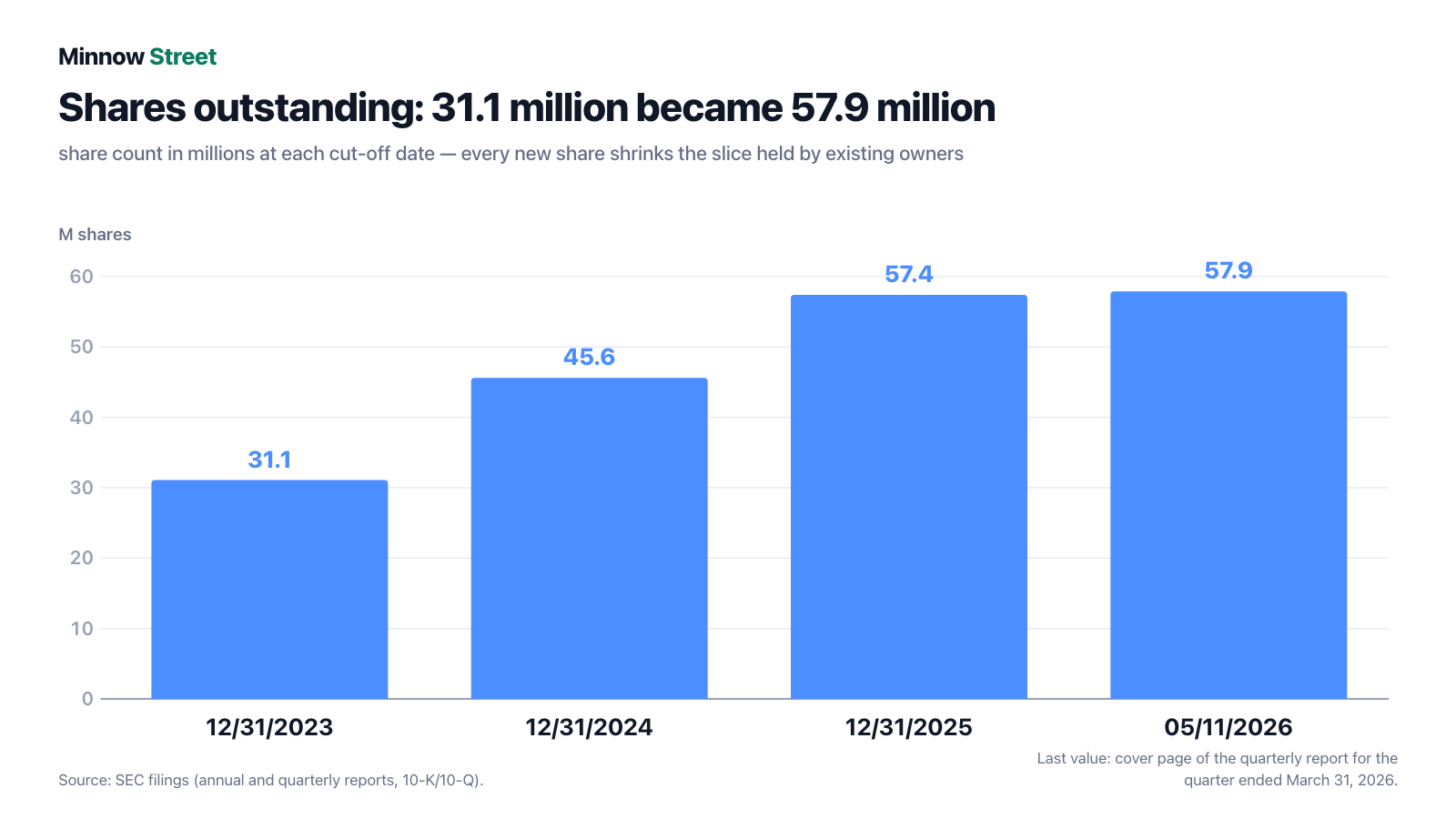
The biggest single steps are dated and on the record. On December 5, 2025 Capricor placed 6,900,000 new shares at $25.00 apiece — 6,000,000 base shares plus the fully exercised 900,000-share over-allotment option — raising gross proceeds of about $172.5 million; commissions and expenses swallowed roughly $10.5 million of that. Through an at-the-market program a further 2,682,307 shares were sold through March 31, 2026 at an average of about $28.89, for gross proceeds of roughly $77.5 million. The size of that program was cut from $150 million to $125 million on December 5, 2025; since January 1, 2026 not a single further share had been sold under it as of the filing date.
And it is not over. As of March 31, 2026 options and warrants on 17,249,737 further shares were outstanding — roughly 30 percent of the current count. They do not appear in the earnings calculation because they would mathematically reduce the loss per share and are therefore excluded as anti-dilutive. Authorized capital stands at 100 million shares; issued plus potentially issuable comes to about 75 million. Remember the line: growth paid for with fresh shares is never entirely free.
One footnote belongs on the debt side, or it gets lost: Capricor's only interest-bearing liability is a 2016 research grant of $3.4 million from the California agency CIRM. The company voluntarily converted it into a loan in February 2025, which produced interest expense for the first time in 2025 — $3,045,725, non-cash. As of March 31, 2026 the position stood at $6.3 million, entirely due within a year.
Uncomfortable truth no. 6: the landlord wanted an escape hatch too
On July 9, 2026 Capricor signed a lease for roughly 171,000 rentable square feet at 9625 Towne Centre Drive in San Diego — new headquarters, expanded cleanrooms, laboratories. Initial rent: about $958,000 a month, rising 3.0 percent a year, over a 138-month term. Before a single dollar of it flows, however, a lot of time passes, and the filing spells that out too: the term begins on the earlier of the date the lease contingency tied to FDA approval is satisfied or waived, or December 31, 2026 at the latest. The rent commencement date falls twelve months after that, and from that rent commencement date run eighteen fully rent-free months, followed by six months during which rent is payable on only 128,068 square feet. The first rent payment is therefore due roughly two and a half years after the term begins, and full rent on the entire premises only after about three years. The remarkable part is at the end of the filing:
"Subject to the terms of the Lease, if Capricor does not receive FDA approval of Deramiocel for the treatment of Duchenne muscular dystrophy by December 31, 2026, then either Capricor or Landlord may terminate the Lease by delivering written notice within five business days after such date."
— Capricor Therapeutics, Inc., SEC current report 8-K of July 14, 2026, Item 1.01

You can read that positively: management is securing capacity for a launch while negotiating an emergency exit in case it never comes. You can also read it as an X-ray — even the landlord did not want to enter this building without a return ticket. The lease does not appear on the March 31, 2026 balance sheet; there you find only $0.8 million of current and $13.9 million of non-current lease liabilities from the existing premises. Separately, the old lease for the second manufacturing site at Cedars-Sinai Medical Center in Los Angeles expires on July 31, 2026; Capricor plans to vacate and cease manufacturing there.
Valuation: what can even be valued here
An honest preface: the usual multiples do not work. There is no price-to-earnings ratio because there are no earnings. There is no price-to-sales ratio because revenue has been zero since 2025 — any figure a database shows in that field comes from old milestone payments and is misleading. And this analysis deliberately quotes no daily price: around an advisory committee meeting and a target action date the price of a company like this moves so violently that any ratio built on it would tell a different story within days. The SEC filings only help so far: the most recent market price documented there dates from June 25, 2026 — $30.38 per share, recorded in insider filings (Form 4) of June 29, 2026 covering the sale of 24,100 shares each by the chief financial officer and the general counsel. No SEC filing documents a price after that day.
What can responsibly be said comes down to four dated anchors. First, book value: $278.7 million of equity across 57,664,673 shares as of March 31, 2026 works out to roughly $4.83 per share — and because equity consists almost entirely of cash and securities, that is also the amount of money standing behind each share. Second, the prices at which the company itself sold stock: $25.00 in the December 5, 2025 offering and about $28.89 on average through the at-the-market program to the end of March 2026. After July 27, 2026 those two prices are no longer a yardstick for what the market pays today: following the release of the FDA briefing document, market capitalization at the July 27, 2026 close stood at roughly $405 million (57,911,893 shares at $6.995) — about $126 million more than the $278.6 million of cash and marketable securities as of March 31, 2026, or roughly 1.45 times the cash pile. Third, the size of the open bet: an $80.0 million milestone on approval, further sales-based milestones running up to $605.0 million of annual net sales, and a 30 to 50 percent revenue share — assuming the agreement survives the lawsuit Capricor itself filed.
And fourth, the view from the professionals: eight analyst opinions rate the stock at an average of 4.6 on a scale from 1 to 5 where 5 is the best grade (source: fundamental data, as of July 28, 2026) — a verdict that plainly prices in the approval rather than today's business. Whether it already reflects the briefing document of July 27, 2026 cannot be read off an average.
Put differently: everything an investor pays above the cash balance is the price of a yes from the FDA — plus the answer to who gets to sell afterwards. That is not a valuation in the classical sense. It is a probability calculation with two unknowns. Since July 27, 2026 that premium has become a great deal smaller; it has not disappeared.
Opportunities and risks at a glance
What speaks for Capricor:
- An unusually solid balance sheet for a biotech without an approved product: $278.6 million in cash and marketable securities as of March 31, 2026, only $47.6 million of total liabilities, no going-concern warning; the company considers itself funded for at least twelve months.
- Phase 3 data the company reports as robust: 54 percent slowing on the primary upper-limb measure (p = 0.029) and 91 percent on ejection fraction (p = 0.041) across 106 randomized participants, plus significant results on cardiac scarring in March 2026 (p = 0.022). Important caveat: in its briefing document of July 27, 2026 the FDA reads the same data the opposite way and considers the pre-specified endpoints not met.
- The application has been resubmitted and accepted, with a target action date of August 22, 2026; every rare-disease designation is in hand (orphan drug 2015, rare pediatric disease 2017, RMAT; orphan drug and ATMP in Europe).
- In-house manufacturing in San Diego that has been through an FDA pre-license inspection — the agency accepted all responses to the Form 483 observations; more than 150 granted patents and pending applications.
- High unmet medical need: deramiocel targets the cardiac and skeletal muscle damage of Duchenne, where existing gene therapies do little; approval would put an $80.0 million milestone in play, plus further sales-based milestones tied to annual net sales of up to $605.0 million.
What speaks against it:
- A single product decides everything, and the FDA already sent a rejection letter on it in July 2025 — the new date of August 22, 2026 is the second attempt, not the first. In its briefing document of July 27, 2026 for the advisory committee meeting the agency treats the pre-specified primary endpoint as missed, again finds the statutory evidence of effectiveness lacking, and reports hypersensitivity reactions in 22 of 53 treated participants (41.5 percent) against 8 of 52 on placebo (15.4 percent). Capricor contradicted this publicly the same day and holds the primary endpoint to have been met with statistical significance under its final analysis plan.
- No product revenue: the $25.2 million of 2023 and $22.3 million of 2024 were partner payments, and 2025 and the first quarter of 2026 brought zero; the net loss climbed to $105.0 million in 2025.
- The exclusive U.S. distributor has been the defendant since May 7, 2026 and simultaneously owns more than 10 percent of the stock; Capricor seeks rescission of the very agreement that promises $80.0 million on approval and a 30 to 50 percent revenue share — and says itself it has no commercialization experience.
- Heavy dilution: from 31,148,320 to 57,911,893 shares since the end of 2023, plus options and warrants on 17,249,737 more against 100 million of authorized capital; roughly $600 million raised since inception against an accumulated deficit of $338.8 million.
- Open legal exposure from the 2025 letter: a securities class action filed July 17, 2025 against the company and its chief executive, two derivative actions against the board, and a books-and-records demand — with no material reserves as of March 31, 2026. And the new lease at about $958,000 a month may be terminated by either side if approval has not arrived by December 31, 2026.
A human conclusion
Back to the countdown trap. Its point is not that dates do not matter — August 22, 2026 really is the most important number in this entire company. Its point is that a date feels like knowledge when it is only a moment in time. So if you are thinking about this stock today, the question is not "how many days left?" but: how many yeses do I actually need? First a yes from the FDA — and this agency has already said no to this product once and put its doubts back on the record in the briefing document of July 27, 2026. Second, an answer to who is allowed to sell deramiocel, because the distribution partner is now the defendant and Capricor has never marketed a drug. And third, if both land, proof that a cell therapy requiring an infusion every three months actually gets prescribed and reimbursed. The bank account buys the company roughly seven to ten quarters to work through those three questions. What speaks well of Capricor against many other biotechs is reassuring: no existential squeeze, no auditor's doubt, a real product in real trials. What speaks against it is uncomfortably concrete: between a good trial and a dollar of revenue, Capricor still has an agency and a courtroom to get through. What you make of it is your decision. And that is exactly as it should be.
Sources
Every original document used in this analysis — to read for yourself:
- Capricor Therapeutics, Inc. — SEC quarterly report 10-Q as of March 31, 2026 (filed May 13, 2026)
- Capricor Therapeutics, Inc. — SEC annual report 10-K for 2025 (filed March 17, 2026)
- Capricor Therapeutics, Inc. — SEC annual report 10-K for 2024 (filed March 26, 2025)
- Capricor Therapeutics, Inc. — SEC current report 8-K of July 14, 2026 (lease, Items 1.01 and 2.03)
- Capricor Therapeutics, Inc. — SEC current report 8-K of June 26, 2026 (advisory committee, PDUFA date)
- Capricor Therapeutics, Inc. — SEC current report 8-K of June 8, 2026 (results of the annual meeting held June 4, 2026)
- Capricor Therapeutics, Inc. — SEC current report 8-K of May 7, 2026 (lawsuit against Nippon Shinyaku and NS Pharma)
- Capricor Therapeutics, Inc. — SEC current report 8-K of May 12, 2026 (first-quarter 2026 results, Item 2.02)
- Capricor Therapeutics, Inc. — SEC insider filing Form 4 of June 29, 2026 (sale on June 25, 2026 at $30.38 per share) and Form 3 of May 28, 2026 (appointment of a chief commercial officer)
- Complete SEC filing history of Capricor Therapeutics, Inc.: EDGAR overview (sec.gov)
- U.S. Food and Drug Administration — "FDA Briefing Document BLA# 125842/0, Drug: Deramiocel" (PDF), prepared for the July 29, 2026 meeting of the Cellular, Tissue, and Gene Therapies Advisory Committee, released July 27, 2026; every agency quote in this analysis is taken verbatim from this document (sections 1.3, 1.5 and 4). Meeting announcement: fda.gov
- Capricor Therapeutics, Inc. — press release "Capricor Comments on Briefing Materials Ahead of July 29 FDA Advisory Committee Meeting for Deramiocel", July 27, 2026 (the company's rebuttal to the briefing document; no current report 8-K on it existed at the cut-off)
- Fundamental data (master data, share count, employees, analyst consensus, price and volume series; data as of July 28, 2026), reconciled with the SEC filings.
Transparency & disclaimer: this analysis is a journalistic contextualization of publicly available information. It is not investment advice, not a regulated financial analysis and not a solicitation to buy or sell securities. Equity investments carry substantial risk up to total loss — and that applies with particular force to a company whose value hangs on a single regulatory decision. All information without warranty; the data cut-off is noted in the text. At the time of publication the author holds no position in Capricor shares.
Our Bottom Line at a Glance
- Balance sheet and funding positive
- Unusually strong for a biotech with no approved product: $278.6 million in cash and marketable securities as of March 31, 2026 against only $47.6 million of total liabilities and $278.7 million of equity — equity consists almost entirely of money. The quarterly report filed May 13, 2026 calls the funds sufficient for at least twelve months; there is no going-concern warning. The only interest-bearing debt as of March 31, 2026 was the $6.3 million CIRM loan; under the repayment agreement documented in April 2026 it fell due no later than June 12, 2026, and no filing submitted so far confirms that it was settled.
- Clinical data and regulatory path negative
- On the company's account the Phase 3 HOPE-3 trial delivered statistically significant results in December 2025 (upper-limb function 54 percent slowing, p = 0.029; ejection fraction 91 percent, p = 0.041, across 106 randomized participants), with cardiac scarring data following in March 2026 (p = 0.022). The agency reads the same data differently: after the rejection letter of July 2025 it again holds, in its briefing document of July 27, 2026 for the advisory committee meeting, that the pre-specified primary endpoint was not met and the statutory evidence of effectiveness not established; it also objects to changes made to the statistical analysis plan after unblinding and reports hypersensitivity reactions in 22 of 53 treated participants (41.5 percent) against 8 of 52 on placebo (15.4 percent), plus an unfavorable benefit-risk profile. Capricor contradicted this publicly on July 27, 2026: the governing document, it says, is the final version of the analysis plan (SAP 3.0), finalized before unblinding, under which the primary endpoint PUL 2.0 was met with statistical significance. The target action date of August 22, 2026 is the second attempt, and the agency put its doubts on the record before the meeting.
- Business model and revenue negative
- There is no operating business: revenue was zero in 2025 and in the first quarter of 2026; the $25.2 million of 2023 and $22.3 million of 2024 were upfront and milestone payments from the distribution partner, fully used up by the end of 2024. The net loss climbed to $105.0 million in 2025 and $33.9 million in the first quarter of 2026. The entire value of the company rests on a single product candidate.
- Route to market and partner conflict negative
- The exclusive U.S. distributor Nippon Shinyaku/NS Pharma has been the defendant since May 7, 2026: Capricor is asking the Superior Court of New Jersey to rescind the agreement of January 24, 2022 — the same agreement that promises $80.0 million on approval and a 30 to 50 percent revenue share. The partner simultaneously owns more than 10 percent of Capricor stock, and the company concedes in its risk factors that it does not have experience in the commercialization, marketing, sale or distribution of pharmaceutical products on a commercial scale. Since May 25, 2026 there is at least a chief commercial officer (insider filing Form 3 of May 28, 2026); the risk factor in the quarterly report of May 13, 2026 stands unchanged. The binding European term sheet of September 16, 2024 expired on April 1, 2026.
- Dilution and legal exposure negative
- Shares outstanding rose from 31,148,320 (December 31, 2023) to 57,911,893 (May 11, 2026), up 86 percent; options and warrants on 17,249,737 more sit against 100 million of authorized capital. Roughly $600 million has been raised since inception against an accumulated deficit of $338.8 million. The 2025 rejection letter produced a securities class action (July 17, 2025) and two derivative actions against the board, with no material reserves as of March 31, 2026.
Capricor Therapeutics is the countdown trap in its purest form: a date on the calendar — August 22, 2026 — appears to replace the analysis. The balance sheet really is strong ($278.6 million in cash and marketable securities, $47.6 million of liabilities, no going-concern warning), and the Phase 3 data hold up statistically on the company's account. But revenue has been zero since 2025, the FDA already said no to this product in July 2025 and questions both efficacy and safety again in its briefing document of July 27, 2026 — the company publicly disputes that reading — and the exclusive U.S. distributor is now both defendant and major shareholder. Whoever invests here is not buying a metric but three consecutive yeses: from the agency, from the court and from the health care system. Not investment advice.
What Our Rating Means
Open questions
The business works in principle, but one material question is open. As long as it stays open, our findings do not carry a quality verdict.
This rating judges the company, not the stock and not the entry point. Every documented marker for the red level is absent: no going-concern warning, no negative equity, no over-indebtedness, no listing risk for financial reasons. On the contrary, as of March 31, 2026 the company held $278.6 million in cash and marketable securities against $47.6 million of total liabilities, and the quarterly report filed May 13, 2026 calls the funds sufficient for at least twelve months; on the arithmetic, depending on the pace of spending, that is about seven to ten quarters of runway. What is missing for the green level, though, is the essential thing: there is no operating business. Revenue was zero in 2025 and in the first quarter of 2026, and the entire outcome hangs on one single event — the FDA decision on deramiocel, scheduled for August 22, 2026, after the same agency sent a rejection letter in July 2025. On July 27, 2026 it went further in the briefing document for the advisory committee meeting: no statutory evidence of effectiveness, the primary endpoint missed, hypersensitivity reactions at 41.5 against 15.4 percent, an unfavorable benefit-risk profile. The company contradicted this publicly the same day and holds the primary endpoint to have been met under the final version of its analysis plan. Nothing is decided by that — the committee recommendation was still outstanding at the cut-off, the agency ruling all the more so. But a yes is plainly no longer a formality. On top of that sits an open operational question that even a yes from the FDA would not answer: the exclusive U.S. distributor has been the defendant since May 7, 2026, and the company says itself it has no commercialization experience. This is exactly the situation the yellow level exists for — the business can work, but one material operational question is open. On price the rating deliberately says nothing: whether the stock is expensive or cheap is for the scanners to decide. The decision is yours.
A journalistic assessment by our editorial team at the time of the deep dive, based on public sources — not investment advice and not a solicitation to buy or sell. Your personal circumstances (investment goals, risk capacity, taxes) cannot be taken into account. What our levels mean, how verdicts are formed, and what conflicts of interest exist →
Worth Noting
- Capricor reached our research list through the SEC filing calendar: the current report (8-K) of June 26, 2026 names July 29, 2026 as the date of the FDA advisory committee meeting and August 22, 2026 as the target action date under the Prescription Drug User Fee Act. An advisory committee issues a recommendation; the agency itself makes the decision. It did not arrive through a metric: as of July 28, 2026 Capricor appears in none of our in-house stock scanners, and those lists are recalculated daily.
- On price: no daily price serves as a yardstick in this analysis, because around an advisory committee meeting and a target action date it can multiply or collapse within hours — which is exactly what happened on July 27, 2026, when the stock fell 64.5 percent against the July 24, 2026 close (from $19.70 to $6.995) after the FDA briefing document was released. What is quoted is therefore only the dated order of magnitude: market capitalization of roughly $405 million at the July 27, 2026 close (57,911,893 shares at $6.995; the share count and market capitalization in the fundamental-data feed match the quarterly report to the digit). The most recent market price documented in an SEC filing, by contrast, is $30.38 per share, from an insider filing (Form 4) of June 29, 2026 covering a sale on June 25, 2026. What is not reliable is the trailing-twelve-month revenue of roughly $11.1 million shown in the feed: per the financial statements, revenue was zero in 2025 and in the first quarter of 2026. Revenue, earnings and balance-sheet figures are therefore taken from the filings only.
- Recency note: the most recent quarterly report (10-Q) is dated May 13, 2026 and has been fully evaluated. Everything filed afterwards has been reviewed — the current reports 8-K of June 8, 2026 (annual meeting; shareholders rejected the proposed officer exculpation amendment, and Rose, Snyder & Jacobs LLP was ratified as auditor) and July 14, 2026 (lease), the initial insider statement (Form 3) of May 28, 2026 recording the appointment of Michael T. Maurer as chief commercial officer effective May 25, 2026, plus insider filings (Form 4) and notices of proposed sale (Form 144) from May and June 2026. There was no new share registration (shelf and prospectus filings S-3 and 424B) and no capital raise after March 31, 2026; there is no deregistration notice (Form 15) and no delisting application (Form 25) — the Nasdaq listing continues. The most recent SEC filing on record is the current report of July 14, 2026. Considered outside the SEC filings: the FDA briefing document for the July 29, 2026 advisory committee meeting, released July 27, 2026 (a primary source, read in full), Capricor's rebuttal in its press release of the same day, and the price reaction of that day. No current report (8-K) covering that rebuttal exists. The outcome of the meeting and the figures for the quarter ended June 30, 2026 were not available at the time of writing.
- Do not confuse: SEC identifier 0001133869 previously carried the names Nile Therapeutics and SMI Products; Capricor went public in 2013 through a merger with a Nile subsidiary. Deramiocel was called CAP-1002 in older trials and releases — it is the same product. Analyses are evergreen; daily prices are not a buy argument.
Frequently Asked Questions
Capricor Therapeutics, Inc. (Nasdaq: CAPR) of San Diego, California, develops cell therapies. Its only late-stage product candidate is deramiocel (formerly CAP-1002), aimed at the muscle and heart damage caused by Duchenne muscular dystrophy. A very early exosome platform with a Phase 1 vaccine candidate runs alongside it. The company had 231 employees as of December 31, 2025 and manufactures in its own cleanrooms in San Diego.
The target action date under the Prescription Drug User Fee Act (PDUFA) is August 22, 2026. Capricor reported that to the U.S. securities regulator, the SEC, in a current report (8-K) on June 26, 2026; the same filing names July 29, 2026 as the date of the FDA advisory committee meeting. A PDUFA date is the agency's own commitment on when it will rule — it says nothing about how it will rule. On July 27, 2026 the FDA released its briefing document for that meeting, treating the pre-specified primary endpoint of the HOPE-3 trial as missed, finding the statutory evidence of effectiveness lacking and the benefit-risk profile unfavorable. Capricor contradicted this publicly the same day. Nothing is decided by that: the committee discusses and votes on July 29, 2026 and only issues a recommendation; the agency rules by August 22, 2026.
In July 2025 Capricor received a Complete Response Letter, the FDA's formal rejection. In the agency's words the application "did not meet the statutory requirement for substantial evidence of effectiveness", and it requested additional clinical data. After a Type A meeting in August 2025 Capricor submitted data from the Phase 3 HOPE-3 trial. The FDA accepted that as a complete response and set the new target action date at August 22, 2026.
No. Revenue was zero in fiscal 2025 and in the first quarter of 2026. The $25.2 million of 2023 and $22.3 million of 2024 were not product sales but upfront and milestone payments from distribution partner Nippon Shinyaku: $30.0 million on signing in 2022 plus two $10.0 million milestones for trial and application progress. Those $50.0 million had been fully recognized as revenue by the end of 2024.
On May 7, 2026 Capricor filed suit in the Superior Court of New Jersey against Nippon Shinyaku and its U.S. subsidiary NS Pharma. The complaint alleges a fundamental pricing flaw in the distribution agreement dated January 24, 2022 and inadequate preparation for the commercial launch; Capricor seeks rescission of the agreement and the right to distribute deramiocel itself or through other partners. According to the quarterly report, Nippon Shinyaku simultaneously holds more than 10 percent of Capricor's stock.
As of March 31, 2026 the balance sheet showed $105.4 million in cash and $173.2 million in marketable securities, $278.6 million together. The first quarter of 2026 consumed $29.3 million in operating cash outflow plus $10.7 million for equipment and construction — about $40 million a quarter, which extrapolates to roughly seven quarters. The company itself guides to $100.0 million to $125.0 million of 2026 spending on deramiocel plus $7.0 million to $10.0 million on the exosome platform, or about $27 million to $34 million a quarter, which stretches the cash to roughly eight to ten quarters. The honest answer is the range of about seven to ten quarters. The quarterly report filed May 13, 2026 calls the funds sufficient for at least twelve months; there is no going-concern warning.
Shares outstanding rose from 31,148,320 (December 31, 2023) through 45,582,288 (December 31, 2024) and 57,370,909 (December 31, 2025) to 57,911,893 as of May 11, 2026 — up 86 percent. The December 5, 2025 offering alone comprised 6,900,000 shares at $25.00 (6,000,000 base shares plus the fully exercised 900,000-share over-allotment option). On top of that sit options and warrants on 17,249,737 further shares as of March 31, 2026, against authorized capital of 100 million.
The lease signed on July 9, 2026 for roughly 171,000 rentable square feet in San Diego contains an escape clause: if Capricor has not received FDA approval for deramiocel by December 31, 2026, either party may terminate within five business days after that date. Initial base rent is $5.60 per rentable square foot per month, or about $958,000 monthly, over a 138-month term with 3.0 percent annual increases. None of it is paid for a long while, though: the rent commencement date falls twelve months after the term begins, followed by eighteen fully rent-free months and six more in which rent is payable on only 128,068 square feet — so the first rent payment is not due until roughly two and a half years after the term commences, and full rent on the entire premises only after about three years.
Found an error?
Did you spot a factual error, an outdated number, or a typo in this deep dive? Let us know briefly — your report goes straight to the editorial team.