NL Industries: $105 Million in Cash, Not a Single Employee — and a Dividend That Arrives in the Mailbox
The stock trades below book value, yields more than 6 percent and sits on a pile of cash. Sounds like the bargain you have been waiting for. The filings with the U.S. securities regulator, the SEC, tell a different story: NL Industries has no employees of its own, its reported earnings are set by a company it only owns 31 percent of — that stake cost $33.9 million in 2025 and pushed the group to a $37.8 million loss — and the payout comes from dividends other companies wire in. Since May 26, 2026 the company has been called NLI Holdings, is incorporated in Delaware and has opted out of the statutory anti-takeover protection, while its majority holder owns 83 percent. Not investment advice — just the question of why a discount sometimes lasts for decades.
 Thomas Mücke
Founder & Publisher
Thomas Mücke
Founder & Publisher
Chart
Interactive price chart (TradingView).
Note: pure fact-based analysis, not investment advice and not a solicitation to buy or sell. All figures without guarantee.
There is an investor trap that catches the thorough ones — the people who actually open the balance sheet before they buy: the ownership illusion. It works like this. You read that a company owns $105 million in cash plus listed holdings worth, together, more than the entire company costs on the exchange. And your head turns that into: "Buy the stock and a slice of that money is mine." Formally, that is even true. It is just that somebody else decides what happens to every one of those dollars. NL Industries (NYSE: NL) of Dallas is exactly that kind of case: price-to-book of roughly 0.79, a dividend yield above 6 percent, and a third of its market value sitting in cash (as of July 29, 2026). So let us make a deal before you buy those assets. We will read together what the company itself has told the U.S. securities regulator, the SEC — the annual report (10-K) for 2025, the quarterly report (10-Q) for March 31, 2026, and the current reports (8-K) filed in May 2026. An SEC filing is honest under penalty of law. And this one describes a company with no employees of its own, a loss caused by a business it does not control, a dividend funded by other people’s wire transfers — and an annual meeting in May 2026 that cleared the statutory takeover brake out of the majority holder’s way. In the end, the call is yours.
What NL Industries Actually Is — an Address in Dallas With Three Holdings
NL Industries is not a factory. It is a holding company — in plain language, a mailbox with stakes in other businesses, much like an asset manager that owns several shops and runs none of them. The annual report (10-K) for 2025 puts it plainly: "We are primarily a holding company." Three things sit under that roof.
First, CompX International Inc. (NYSE American: CIX), 87 percent owned by NL and therefore fully consolidated. CompX is the only business in the group that actually makes something: mechanical and electronic locks for mailbox banks, office furniture, tool storage, healthcare cabinetry and gas station security (the Security Products unit, $120.7 million in 2025 net sales), plus stainless steel exhaust systems, trim tabs, gauges and accessories for performance and ski boats (Marine Components, $37.6 million in 2025). Together: $158.3 million of net sales in fiscal 2025 — essentially the entire group revenue.
Second, roughly 31 percent of Kronos Worldwide, Inc. (NYSE: KRO), one of the large producers of titanium dioxide — the white pigment that makes paint opaque, plastic bright and paper white. This stake is not consolidated; it is carried under the equity method, meaning NL books its share of Kronos’ profit or loss into its own income statement without ever showing Kronos’ revenue or debt. Remember that term, because it is the key to everything that follows: the equity method means somebody else’s result lands in your result.
Third, 1.2 million shares of its own parent, Valhi, Inc. (NYSE: VHI) — more on that later, because it is a story of its own. Above it all sits the ownership chain: Valhi held roughly 83 percent of NL as of March 31, 2026, a wholly owned Contran Corporation subsidiary held roughly 91 percent of Valhi, and Contran is controlled by Lisa K. Simmons and a family trust. That frames the central tension of this analysis, and it runs through every chapter: NL Industries owns a great deal — but it controls neither the earnings it reports nor the majority that decides its fate.
One note so you do not stumble when you look things up: since May 26, 2026 the company has officially been called NLI Holdings, Inc. and is incorporated in Delaware rather than New Jersey. Nobody moved house, though: the current report states expressly that apart from the name and the state of incorporation nothing changed — the head office stays in Dallas, Texas, as do the business, the management and the facilities. The stock still trades on the New York Stock Exchange under the ticker NL, every share converted one for one, and because all the annual and quarterly reports used here were filed under the old name, we stay with "NL Industries" in this text.
How the Stock Landed on Our Desk
No hype, no headline, no price fireworks. NL Industries came onto the research list through a sober raw-data screen of our U.S. universe: we were looking for names that simultaneously trade below book value (price-to-book of roughly 0.79; as of July 29, 2026), show a dividend yield above 6 percent — and still report negative earnings per share (−$.69 for the twelve months ended March 31, 2026, rolled forward from the SEC filings). Those three numbers together are a contradiction, and contradictions are the best research signal there is. Either the company is paying out money it does not have — in which case the dividend is at risk. Or the reported loss is measuring something other than the business — in which case the discount may or may not be deserved. No metrics dashboard settles that; only the footnotes do. What happens when you actually read those footnotes at an owner-controlled holding company is something we showed most recently in our analysis of Biglari Holdings — there the surprise sat in a fund, here it sits in an affiliate. One caveat: the lists produced by our in-house stock scanner are recomputed daily, so we deliberately do not cite a scanner reading that could be stale tomorrow.
The Numbers Over the Years — Given Their Due
First, what genuinely impresses. CompX’s operating business is unglamorous and solid at the same time: net sales were $161.3 million in 2023, fell to $145.9 million in 2024 and recovered to $158.3 million in 2025 — a move of about 9 percent down and back up, without drama. Security Products earned $22.5 million of reporting unit profit in 2025 on an 18.6 percent margin; Marine Components earned $7.5 million, with gross margin recovering 70 percent from a weak prior year. The first quarter of 2026 continued the trend: $40.6 million of net sales (prior-year quarter $40.3 million), gross margin of $13.3 million versus $12.2 million, CompX segment profit of $7.1 million versus $5.9 million. A company that sells locks and boat parts and reliably earns money doing it — nothing broken there.
And now the chart that explains everything:
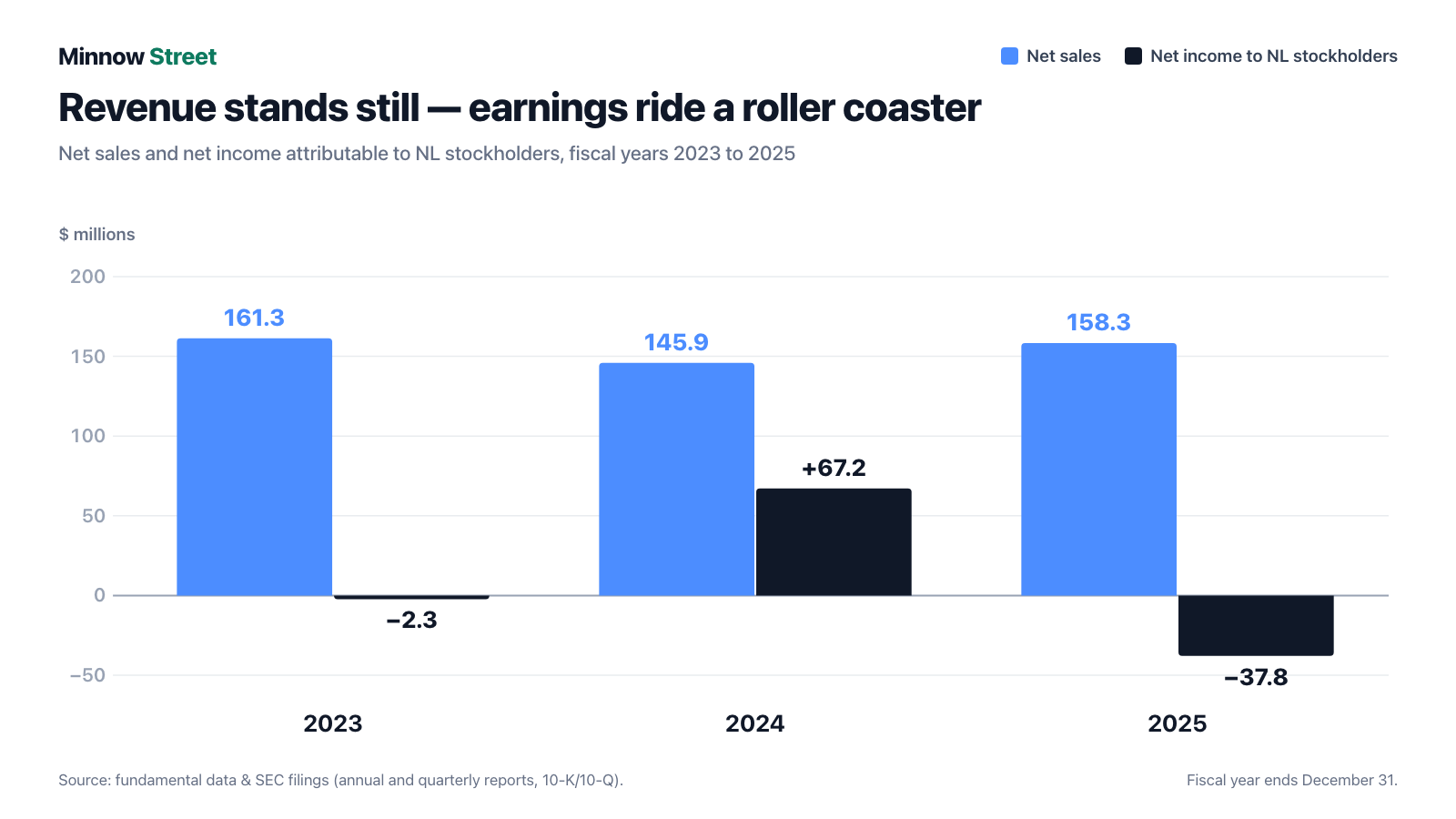
Flat revenue and a bottom line that swings by more than $100 million cannot arithmetically come from the same business. It does not. Which brings us to the uncomfortable truths.
What the Filings Say — the Uncomfortable Truths
Uncomfortable Truth No. 1: The Earnings Are Made by a Company NL Does Not Control
The explanation for the roller coaster sits one line below operating income and is called "Equity in earnings (losses) of Kronos Worldwide, Inc." It cost $15.0 million in 2023, added $26.4 million in 2024 and cost $33.9 million again in 2025. NL’s own income from operations across those same three years was $14.1 million (2023), $37.9 million (2024) and $10.7 million (2025). Put differently: in two of three years, a stake that NL does not own 69 percent of swallowed the entire operating result and then some. The filing says so itself:
"We account for our approximate 31% non-controlling interest in Kronos by the equity method. Kronos is a leading global producer and marketer of value-added titanium dioxide pigments ("TiO2"). TiO2 is used for a variety of manufacturing applications including paints, plastics, paper and other industrial and specialty products."
— NL Industries, Inc., SEC quarterly report 10-Q for March 31, 2026, "Business overview"
Why that is uncomfortable for you as an investor: titanium dioxide is a cyclical commodity. Kronos’ average selling prices in the first quarter of 2026 were 6 percent below the prior-year quarter, according to the filing; in the fourth quarter of 2025 Kronos cut jobs and lowered its normal production capacity range. Those price swings arrive at NL without NL being able to influence them. In the first quarter of 2026 the Kronos stake subtracted $1.5 million, after adding $5.5 million a year earlier.
More striking still is what the carrying value of that stake does. The equity method rolls the position forward at NL’s share of Kronos’ equity — not at the market price. And the gap between the two was recently enormous:

Read the numbers slowly. At December 31, 2025 the Kronos stake was on the books at $230.1 million but was worth only $155.7 million in the market — a gap of $74.4 million, roughly a third. Three months later, at March 31, 2026, the Kronos share price had risen from $4.42 to $6.57, market value to $231.4 million — slightly above the carrying value of $228.2 million for the first time in a while. Without NL doing anything at all. Remember the line: with an equity-method stake, the balance sheet value moves by accounting rules and the real value moves with the Kronos share price — and the two can drift far apart.
Uncomfortable Truth No. 2: The Dividend Does Not Come Out of Earnings — It Comes Out of the Mailbox
Now we resolve the contradiction that put NL on our list: a 6 percent yield alongside negative earnings per share. The answer sits in the annual report (10-K) for 2025 and is as simple as it is revealing — NL Industries has no operations of its own to pay from:
"Employees – We operate through our subsidiaries and affiliate and through our intercorporate services agreement with Contran (see Note 16 to our Consolidated Financial Statements). We have no direct employees."
— NL Industries, Inc., SEC annual report 10-K for 2025, Item 1 "Business"

So where does the money come from? From transfers by the holdings. The filing even does the math for 2026, and it states the dependency without hedging:
"Because our operations are conducted primarily through subsidiaries and affiliates, our long-term ability to meet parent company-level corporate obligations is largely dependent on the receipt of dividends or other distributions from our subsidiaries and affiliates."
— NL Industries, Inc., SEC annual report 10-K for 2025, Item 7 MD&A, section "Dividends"
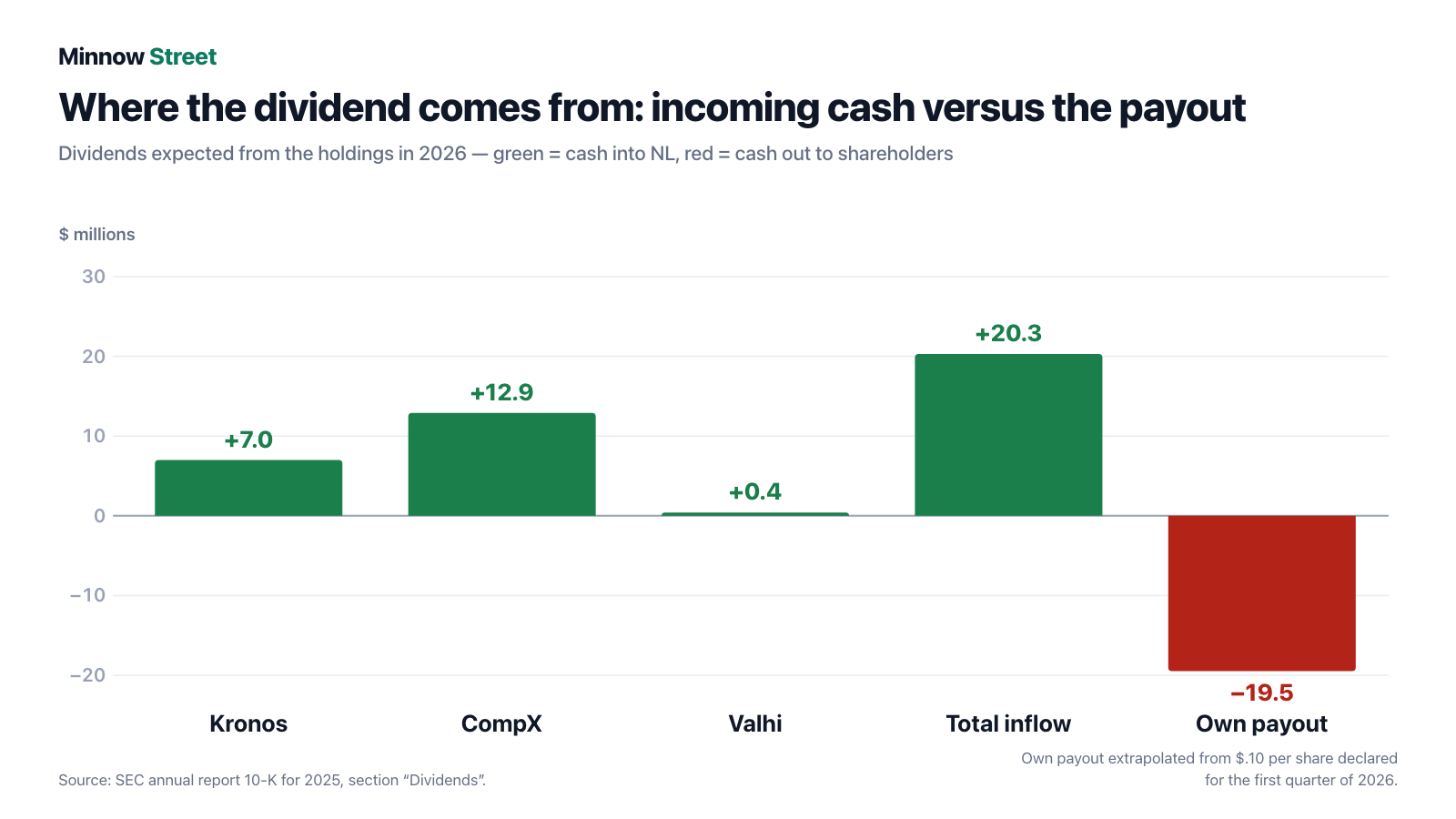
That resolves the contradiction: the reported loss is largely non-cash. In 2025 it consisted of the Kronos stake (−$33.9 million), an accounting loss on the termination of the U.S. pension plan (−$19.7 million, described explicitly as non-cash) and the price movement of the Valhi block (−$13.6 million). The dividend money, by contrast, actually arrives. The flip side: almost nothing is left over. Anyone expecting a rising dividend has to hope that Kronos or CompX raise theirs — NL cannot move that lever itself. One point in its favour: the $.10 per share rate was declared not only for the first quarter but again on May 14, 2026 for the second quarter of 2026 (payable June 23, 2026) — so the extrapolation to roughly $19.5 million a year rests on two declared quarters, not one. And the history shows how the special dividends fluctuate: $.43 per share in August 2024, $.21 in August 2025.
Uncomfortable Truth No. 3: 83 Percent Belongs to the Parent — and the Takeover Brake Was Just Voted Away
The third truth is the one that most likely explains the discount. As of March 31, 2026 Valhi, Inc. held roughly 83 percent of NL shares, and a wholly owned Contran subsidiary held roughly 91 percent of Valhi. Of the 48,862,734 shares outstanding as of May 1, 2026 (the exhibit to the current report of May 26, 2026 gives 48,898,734), only about 8.3 million are freely tradable. In plain language: you buy into a building association where a single family holds 83 of 100 votes. You may speak, but you never decide.
On May 14, 2026 that majority used its votes. The annual meeting resolved with 95.1 percent to move the company from New Jersey to Delaware and rename it NLI Holdings, Inc. — and, in a second proposal, to write into the new certificate of incorporation a clause that waives a cornerstone of U.S. minority protection. Both took effect on May 26, 2026:
"These differences include, without limitation, a provision in the Delaware Certificate in which the Company elects not to be governed by the anti-takeover provisions of Section 203 of the DGCL."
— NL Industries, Inc., SEC current report 8-K filed May 26, 2026, Item 3.03

What is Section 203? In simple terms, a statutory waiting period. A holder of 15 percent or more of a Delaware corporation generally may not complete a business combination with it for three years unless certain approvals are secured. The point is to protect minority holders from being squeezed out at a price the majority holder sets for itself. That protection has now been waived at NL, while one shareholder holds 83 percent. In fairness: for the reincorporation itself the plan of merger additionally required the approval of two-thirds of the voting stock not beneficially owned by Valhi, and that hurdle was cleared with 71.6 percent. The process was transparent and the minority was asked. But the structure that stands afterwards is a different one.
Uncomfortable Truth No. 4: The Lead Pigment Bills Are Paid — the Legacy Is Not Gone
NL Industries was organized as a New Jersey corporation back in 1891, according to its annual report, and its former business was making lead pigments for paint — the product that triggered decades of litigation in the United States. The large California public nuisance case (County of Santa Clara) ended with a settlement approved on July 24, 2019; NL paid $101.7 million in total — $25.0 million within sixty days and the remaining $76.7 million in six annual installments, the last of $16.7 million in October 2025. The Raritan Bay Superfund matter in New Jersey is also closed: in the first quarter of 2025 NL paid $56.1 million plus $.5 million of interest and received about $9.6 million back from other participating companies. Both matters are described in the filings as fully concluded — that is the good news, and it explains why the cash pile has shrunk in recent years.
The bad news sits in the same section. The quarterly report (10-Q) for March 31, 2026 states that there are currently no pending lead paint class actions and no pending cases brought by housing authorities, school districts or other government entities — and then adds a sentence that leaves everything open:
"New cases may continue to be filed against us. We do not know if we will incur liability in the future in respect of any of the pending or possible litigation in view of the inherent uncertainties involved in court and jury rulings."
— NL Industries, Inc., SEC quarterly report 10-Q for March 31, 2026, Note 14 "Commitments and contingencies"
And in the environmental accruals something moved within a single quarter that is easy to miss:

Twelve million dollars more headroom in three months — that is roughly 7.6 percent of 2025 net sales and nearly three times the $4.3 million of first-quarter 2026 net income attributable to NL stockholders. Add about five further sites for which no range of costs can be estimated at all. This is not an acute hole in the balance sheet; $105.0 million of cash absorbs sums like that easily. But it is the reason a company with this history is never valued as fully "clean." Remember the line: legacy liabilities do not end with the last installment, they end with the last statute of limitations.
Valuation: When the Balance Sheet Is Almost Nothing but Market Prices
A price-to-earnings ratio is meaningless for NL — earnings for the twelve months ended March 31, 2026 were negative (−$.69 per share, rolled forward from the SEC filings). The honest yardstick here is book value, and at this company it is unusually reliable. As of March 31, 2026 equity attributable to NL stockholders was $359.3 million, which across 48,862,734 shares works out to $7.35 per share. Market capitalization stood at roughly $283 million (as of July 29, 2026), or about $5.79 per share, giving a price-to-book ratio of roughly 0.79.
Why that book value is harder than usual: it consists almost entirely of items with a readable daily price. $105.0 million of cash (including $3.1 million restricted), the Kronos stake at a $231.4 million market value on the reporting date and $17.1 million of listed Valhi shares — $353.5 million in total. Goodwill, the only item that is neither cash nor a tradable security, sits at just $27.2 million. On the other side are total liabilities of $83.6 million, of which $55.4 million is deferred income taxes that would only fall due on a sale of the Kronos stake, and $13.0 million is environmental accruals. Interest-bearing debt: $.5 million. On top of that sits a $50 million revolving facility from parent company Valhi, of which $49.5 million was still available at March 31, 2026.
Run it roughly: $353.5 million of cash and listed holdings less $83.6 million of total liabilities leaves about $270 million — and CompX, the only business in the group that actually produces anything, with $158.3 million of annual net sales, $30.1 million of inventories and $23.5 million of net property and equipment, is not valued in that number at all. The market pays roughly $283 million for the whole thing. In other words, it pays for the cash and the securities and takes the operating business for free. A price-to-sales ratio of about 1.8 and an enterprise value of roughly $182 million (as of July 29, 2026) tell the same story from the other side.
That does not answer the decisive question, though; it only sharpens it: as a minority holder, will you ever reach that value? A discount on assets somebody else controls is not a market error — it is the price of having no control. Discounts like this on holding companies are normal and can persist for decades. They usually close only through an event: a special dividend, a sale of the stake, or a takeover offer from the majority holder. How differently cyclical industrial exposure gets priced when the cycle turns is visible in our analysis of Worthington Steel — there the cycle sits in the company’s own plants, here in a stake it cannot steer.
Opportunities and Risks at a Glance
What speaks for NL Industries:
- A balance sheet without debt: $105.0 million of cash against $.5 million of interest-bearing liabilities (March 31, 2026), plus a $50 million facility from the parent company with $49.5 million still available. No existential risk is visible here.
- A book value made almost entirely of cash and listed holdings ($353.5 million as of March 31, 2026) with only $27.2 million of goodwill — so the roughly 21 percent discount to book is a discount to market prices, not to accounting.
- A solid operating business: CompX lifted net sales to $158.3 million in 2025 and segment profit to $22.6 million ($17.0 million in 2024, $25.4 million in 2023); in the first quarter of 2026 segment profit rose to $7.1 million from $5.9 million a year earlier.
- The large legacy payments are behind it: the $101.7 million lead pigment settlement was paid off with its final installment in October 2025 and the $56.1 million Raritan Bay settlement in the first quarter of 2025 — both matters described in the filings as fully concluded.
- A real cash stream from the holdings: dividends of $20.3 million expected for 2026 (Kronos $7.0 million, CompX $12.9 million, Valhi $.4 million), covering the company’s own extrapolated payout of roughly $19.5 million.
What speaks against it:
- Earnings are set elsewhere: the 31 percent Kronos stake added $26.4 million in 2024 and cost $15.0 million in 2023 and $33.9 million in 2025 — it flipped the sign of group earnings in two of three years, with no influence from NL.
- Extreme control concentration: roughly 83 percent with Valhi, and behind it roughly 91 percent with a Contran subsidiary; only about 8.3 million of the 48,862,734 shares are freely tradable. The float decides nothing.
- Since May 26, 2026 the Delaware certificate has been in force without the Section 203 takeover brake — the statutory protection of minority holders against a business combination with the majority holder is expressly waived.
- The environmental ceiling rose from about $26 million to about $38 million within one quarter, no range can be estimated for about five further sites, and new lead paint cases may be filed at any time.
- No growth engine and no self-control: no employees of its own, $34.8 million of services fees charged by ultimate parent Contran in 2025 — including the amounts attributable to Kronos ($32.2 million in 2024, $30.8 million in 2023) — and a dividend NL can only pass on rather than earn.
A Human Conclusion
Back to the ownership illusion from the opening. Its flaw is not the arithmetic — the numbers hold: $353.5 million of cash and listed holdings against a market value of roughly $283 million, with the operating business thrown in for free. Its flaw is that it skips a question that comes before the math: who decides whether you ever get at these assets? At NL Industries the answer has been the same for decades: not you. One family holds the majority through two layers, the earnings are made by a company NL does not control, the dividend is wired in by others — and in May 2026 that same majority removed the statutory takeover protection from the charter. That may be perfectly acceptable to you: you are buying a debt-free balance sheet, a running cash stream and the chance that some event eventually closes the gap. So the honest question is not "is this cheap?" but rather: can you live with the possibility that this discount persists for another decade — and that on the day it closes, somebody else sets the price? If yes, you have a thesis. If no, you had an illusion. What you make of it is your decision. And that is exactly as it should be.
Sources
Every primary document used in this analysis — read it yourself:
- NL Industries, Inc. — SEC quarterly report 10-Q for March 31, 2026 (filed May 6, 2026)
- NL Industries, Inc. — SEC annual report 10-K for 2025 (filed March 9, 2026)
- NL Industries, Inc. — SEC annual report 10-K for 2024 (filed March 6, 2025)
- NL Industries, Inc. — SEC current report 8-K filed May 26, 2026 (reincorporation in Delaware, renaming to NLI Holdings, Section 203 opt-out)
- NL Industries, Inc. — SEC current report 8-K filed May 14, 2026 (results of the 2026 annual meeting)
- NL Industries, Inc. — SEC current report 8-K filed May 6, 2026 (first quarter 2026 results)
- Complete SEC filing history of NL Industries, Inc.: EDGAR overview (sec.gov)
- Fundamental data (market capitalization, valuation ratios, dividend yield; as of July 29, 2026), reconciled with the SEC filings.
Transparency & disclaimer: This analysis is journalistic commentary on publicly available information. It is not investment advice, not a regulated financial analysis and not a solicitation to buy or sell securities. Equity investments carry substantial risk up to and including total loss. All information without warranty; the as-of date for each figure is stated in the text. The author holds no position in NL Industries shares at the time of publication.
Our Bottom Line at a Glance
- Balance sheet & financial strength positive
- As of March 31, 2026 there was $105.0 million of cash (including restricted funds) against $.5 million of interest-bearing debt, plus a $50 million revolving facility from the parent company with $49.5 million still available. Equity attributable to NL stockholders was $359.3 million — with only $27.2 million of goodwill on the books. No substance risk is visible.
- Earnings quality negative
- Reported earnings are set by a stake NL does not control: the 31 percent Kronos position cost $15.0 million in 2023, added $26.4 million in 2024 and cost $33.9 million in 2025. Net income attributable to NL stockholders accordingly swung from −$2.3 million to +$67.2 million and back to −$37.8 million, while net sales moved only between $145.9 million and $161.3 million.
- Operating business (CompX) positive
- CompX is unglamorous and dependable: $158.3 million of net sales in 2025 after $145.9 million a year earlier, Security Products reporting unit profit of $22.5 million at an 18.6 percent margin and Marine Components at $7.5 million. In the first quarter of 2026 segment profit rose to $7.1 million from $5.9 million on essentially flat net sales of $40.6 million.
- Governance & control negative
- Valhi held roughly 83 percent of the 48,862,734 shares as of March 31, 2026, and a Contran subsidiary roughly 91 percent of Valhi; only about 8.3 million shares are freely tradable. On May 26, 2026 the company reincorporated in Delaware, was renamed NLI Holdings and expressly opted out of the Section 203 anti-takeover statute. The float decides nothing.
- Distribution neutral
- The dividend is covered but passed through: for 2026 NL expects inflows of $20.3 million (Kronos $7.0 million, CompX $12.9 million, Valhi $.4 million) and pays out roughly $19.5 million at $.10 per share per quarter — the rate declared for both the first and the second quarter of 2026. It can only rise if Kronos or CompX raise theirs — the special dividends recently swung between $.43 (2024) and $.21 per share (2025).
- Legacy liabilities neutral
- The large payments are behind it — $101.7 million of lead pigment settlement finally paid in October 2025 and $56.1 million for Raritan Bay in the first quarter of 2025. What remains: $13.0 million of accruals for roughly 27 sites, an upper end that rose from about $26 million to about $38 million in one quarter, about five sites with no estimable range, and the statement that new lead paint cases may still be filed.
NL Industries is the ownership illusion in its purest form: a stock at roughly 0.79 times book, yielding more than 6 percent, with a balance sheet that as of March 31, 2026 consisted almost entirely of market prices — $105.0 million of cash, a Kronos stake worth $231.4 million and $17.1 million of Valhi shares, against $.5 million of interest-bearing debt. The catch sits in the footnotes: no employees of its own, earnings set by a 31 percent stake (2025: −$33.9 million), a dividend other companies wire in (2026 expected: $20.3 million), and a majority holder at roughly 83 percent that in May 2026 had the statutory takeover brake voted away. Buying this means buying assets without control. Not investment advice.
What Our Rating Means
Open questions
The business works in principle, but one material question is open. As long as it stays open, our findings do not carry a quality verdict.
Red is clearly off the table: $105.0 million of cash against $.5 million of interest-bearing debt, equity of $359.3 million made almost entirely of cash and listed holdings, and a profitable operating subsidiary. Green is off the table too, because the earnings are set elsewhere: whether NL reports a profit or a loss depends on the titanium dioxide cycle at a business it does not own 69 percent of — that stake cost $15.0 million in 2023 and $33.9 million in 2025 and added $26.4 million in 2024. On top of that sits an open operating question on legacy liabilities: the upper end of possible environmental costs rose from about $26 million to about $38 million in a single quarter, about five sites cannot be estimated at all, and the filings state that new lead paint cases may still be brought. A company with a rock-solid balance sheet, a dependable small business and earnings it does not control — that is yellow. The fact that the stock trades below book and the float is tiny are price and structure questions, not quality questions; they belong in the text, not in the traffic light. The decision is yours.
A journalistic assessment by our editorial team at the time of the deep dive, based on public sources — not investment advice and not a solicitation to buy or sell. Your personal circumstances (investment goals, risk capacity, taxes) cannot be taken into account. What our levels mean, how verdicts are formed, and what conflicts of interest exist →
Worth Noting
- NL Industries came onto the research list through our own raw-data screen of the U.S. universe: we looked for names trading below book value (price-to-book roughly 0.79) that also showed a dividend yield above 6 percent and negative earnings per share (−$.69 for the twelve months ended March 31, 2026, rolled forward from the annual report 10-K for 2025 and the quarterly report 10-Q for March 31, 2026; price and valuation data as of July 29, 2026). The lists produced by our in-house stock scanner are recomputed daily and are therefore deliberately not cited as evidence.
- The most recent periodic report is the quarterly report 10-Q for March 31, 2026 (filed May 6, 2026). Everything filed after it was reviewed together with its exhibits: the 8-K of May 6, 2026 (Items 2.02 and 9.01, first quarter results), six insider filings (Form 4) of May 15, 2026, the 8-K of May 14, 2026 (Items 5.07, 7.01 and 9.01 — the annual meeting approving the reincorporation and the Section 203 opt-out, plus the press release in which the board also declared the $.10 per share dividend for the second quarter of 2026, payable June 23, 2026), Form SD of May 19, 2026 (conflict minerals, incorporating the disclosure of subsidiary CompX, no effect on the picture) and the 8-K of May 26, 2026 (Items 1.01, 2.01, 2.03, 3.03, 5.02, 5.03 and 9.01, with Exhibits 2.1 plan of merger, 3.1 Delaware certificate, 3.2 bylaws, 4.1 description of capital stock and 10.1 form of indemnification agreement — completion of the reincorporation in Delaware and the renaming to NLI Holdings, Inc.). Nothing has been filed after May 26, 2026 through the July 29, 2026 data cut-off — in particular no prospectus (424B*), no registration statement (S-3) and no deregistration form (25 or 15). Every present-tense statement about cash, credit facility, equity, debt, environmental accrual and ceiling, the board, the state of incorporation, the Section 203 status, the voting arrangement, the share count and the dividend reflects that status.
- On the share count: the cover page of the quarterly report 10-Q states exactly 48,862,734 shares outstanding as of May 1, 2026, while Exhibit 4.1 to the 8-K of May 26, 2026 ("Description of Capital Stock") already gives 48,898,734 as of May 26, 2026 — 36,000 shares, or 0.07 percent, more. The text uses the 10-Q figure throughout because it belongs with the March 31, 2026 balance sheet; wherever a present-tense statement is made, the newer figure is given alongside it. The difference changes none of the derived measures: book value per share is $7.35 on either basis. On the market capitalization cross-check: the roughly $283 million on file works out to about $5.79 per share; against book value of $7.354 per share from the same balance sheet that gives a price-to-book ratio of roughly 0.79 — precisely the figure shown in the fundamental data. No NL share price is documented in any filing, which is why the cross-check runs through share count and book value. Analyses here are evergreen; daily prices are not an argument to buy.
- Easily confused: titanium dioxide producer Kronos Worldwide (NYSE: KRO) is a separately listed company and is expressly not consolidated by NL — Kronos revenue appears nowhere in NL's figures, only NL's share of its profit or loss. Nor is parent company Valhi, Inc. (NYSE: VHI) part of NL's consolidation scope, even though NL owns 1.2 million Valhi shares. Comparing NL metrics with those of Kronos or Valhi means comparing three different reporting entities.
Frequently Asked Questions
NL Industries, Inc. (NYSE: NL) of Dallas, Texas, is a holding company. The only fully consolidated business is CompX International Inc., 87 percent owned, which makes mechanical and electronic locks as well as components for performance and ski boats — $158.3 million in net sales in 2025. On top of that come roughly 31 percent of titanium dioxide producer Kronos Worldwide, carried under the equity method, and 1.2 million shares of parent company Valhi. According to the annual report (10-K) for 2025, NL has no employees of its own.
Because the loss mostly does not come from operations. In 2025 the 31 percent Kronos stake cost $33.9 million under the equity method, the termination of the U.S. pension plan produced a $19.7 million charge described as non-cash, and the price move of the Valhi block cost $13.6 million. Income from operations in the same year was positive at $10.7 million. The bottom line was a $37.8 million loss attributable to NL stockholders.
From dividends paid by its holdings. The annual report (10-K) for 2025 expects 2026 inflows of $7.0 million from Kronos, $12.9 million from CompX and $.4 million from Valhi — $20.3 million in total. For the first and the second quarter of 2026 the board declared $.10 per share each, which extrapolates to roughly $19.5 million a year. The company itself writes that its ability to meet parent-level obligations depends largely on receiving those distributions.
As of March 31, 2026 Valhi, Inc. (NYSE: VHI) held roughly 83 percent of the 48,862,734 NL shares, and a wholly owned subsidiary of Contran Corporation held roughly 91 percent of Valhi. Contran is controlled largely by Lisa K. Simmons and a family trust; the voting arrangement runs through April 22, 2030. That leaves only about 8.3 million shares freely tradable.
Yes. The annual meeting on May 14, 2026 approved the move from New Jersey to Delaware and the renaming to NLI Holdings, Inc.; both became effective on May 26, 2026. Every share converted one for one, no certificates had to be exchanged, and the NYSE ticker remains NL. According to the current report (8-K), the business, headquarters and management were unchanged.
Section 203 of the Delaware General Corporation Law generally bars a holder of 15 percent or more from completing a business combination with the company for three years unless certain approvals are secured. NL's new certificate expressly opts out of that protection. With a majority holder at roughly 83 percent, one statutory hurdle to squeezing out the minority later has been removed. The reincorporation itself was additionally approved by 71.6 percent of the shares not owned by Valhi.
A price-to-earnings ratio cannot be formed because there are no earnings. Measured against book value the stock trades at a discount: equity attributable to NL stockholders was $359.3 million as of March 31, 2026, or $7.35 per share, against a market capitalization of roughly $283 million (as of July 29, 2026) — about 0.79 times book. Cash and listed holdings alone came to $353.5 million. Whether the discount ever closes, however, is up to the majority holder rather than the market.
The California lead pigment settlement totaling $101.7 million was paid off with the final installment in October 2025, and the Raritan Bay Superfund matter was closed with $56.1 million in the first quarter of 2025. Environmental matters remain: as of March 31, 2026 the books carried about $13 million of accruals for roughly 27 sites, and the upper end of reasonably possible costs rose from about $26 million to about $38 million. For about five sites no estimate is possible, and new lead paint cases may still be filed.
Found an error?
Did you spot a factual error, an outdated number, or a typo in this deep dive? Let us know briefly — your report goes straight to the editorial team.