Ginkgo Bioworks: The Biosecurity Business Is Gone — the $662.8 Million of Leases Are Not
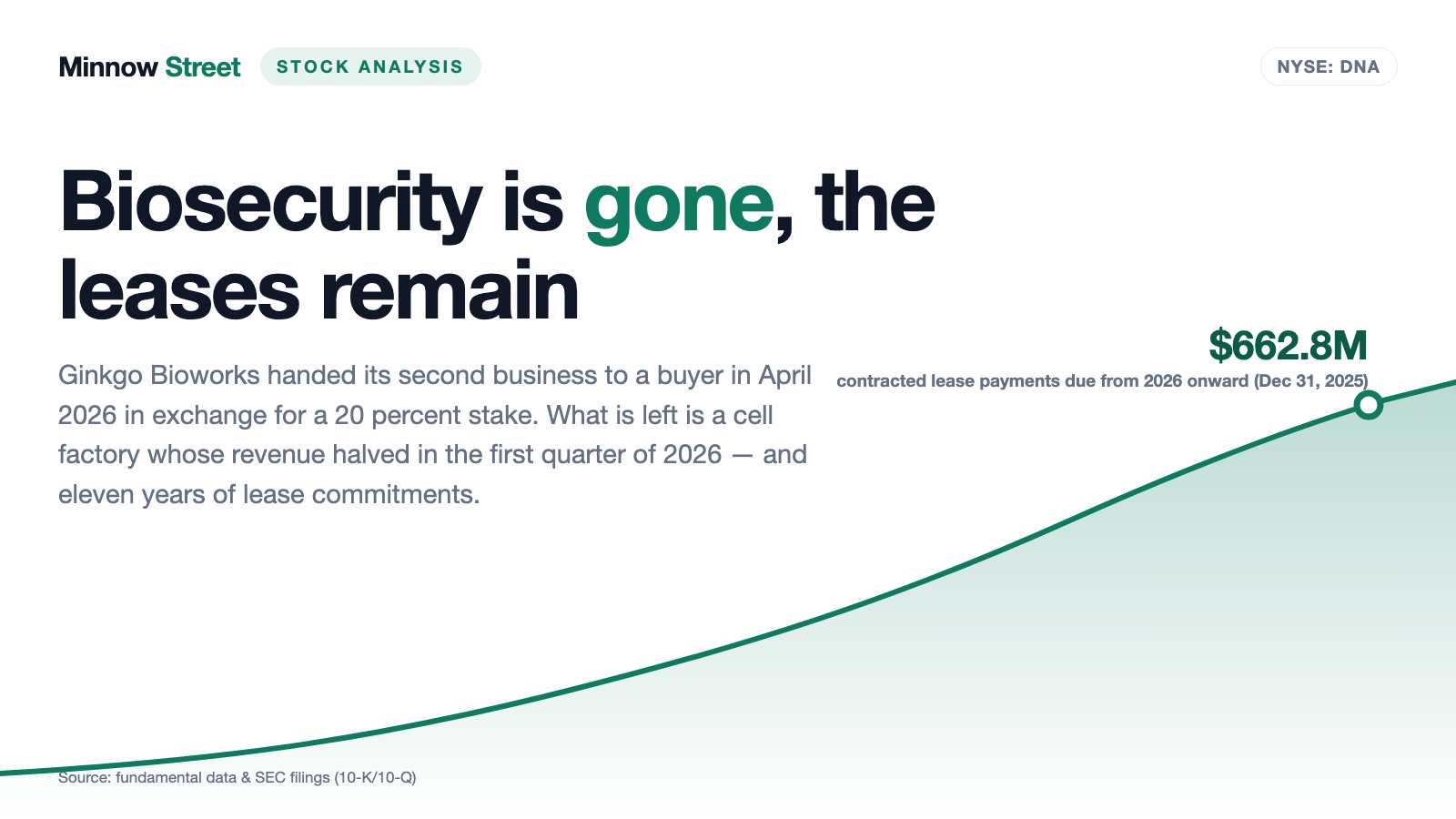
Ginkgo Bioworks set out to make biology as programmable as software. Five years after going public through a blank-check merger, the filings to the U.S. securities regulator, the SEC, add up to something sober: the second leg of the business, Biosecurity, was handed over in full on April 3, 2026 — in exchange for roughly 20 percent of the buyer, not one dollar in cash. What remains is cell engineering, whose revenue fell to $19.5 million in the first quarter of 2026 from $38.2 million a year earlier. Against that sit $373.5 million of liquidity — and $662.8 million of contracted lease payments with an average of 11.3 years left to run. Not investment advice — just the question of what a laboratory is worth when its lease runs longer than its order book.
 Thomas Mücke
Founder & Publisher
Thomas Mücke
Founder & Publisher
Chart
Interactive price chart (TradingView).
Note: pure fact-based analysis, not investment advice and not a solicitation to buy or sell. All figures without guarantee.
There is an investor trap that only springs once a stock has already fallen a long way: anchoring. Your brain remembers the highest price it ever saw and measures everything against it. Down ninety percent, it whispers: "It has never been this cheap." The problem is that an anchor is a price, not a value. With Ginkgo Bioworks (NYSE: DNA) the anchor is a matter of public record. Compensation programs written at the time of the listing carry price thresholds of $500, $600, $700 and $800 per share — and the first of them was actually met on November 15, 2021. Those numbers are restated for the later reverse stock split; in 2021 money they were $12.50 to $20. Five years on, the same company sold new shares through its market placement program at an average of a little over nine dollars apiece. So let us make a deal: before you measure anything against an old price, we read together what Ginkgo itself told the U.S. securities regulator, the SEC — the annual report (10-K) for 2025, the quarterly report (10-Q) as of March 31, 2026, and the current reports (8-K) filed in February, April, May and June 2026. A filing made under penalty of perjury is an honest document. And this one describes a second business given away, revenue cut in half, a solid cash position — and leases that run longer than any order book the company has.
What Ginkgo Bioworks actually does — a job shop for cells
Ginkgo Bioworks makes no end product of its own. It runs contract research on programmed cells — in everyday terms, a heavily automated industrial kitchen where customers arrive with a recipe request ("we need an enzyme that makes this compound cheaper") and Ginkgo works through the variants, thousands at a time, with robots instead of graduate students. The filings call the in-house facility the Autonomous Lab and the robotic carts inside it Reconfigurable Automation Carts (RACs); the large Boston installation is named Nebula in the quarterly results release of May 7, 2026. Customers came from pharmaceuticals and biotechnology (38 percent of revenue in the first quarter of 2026), government and defense (35 percent), agriculture (13 percent) and food and industry (7 percent each).
Alongside classic contract development, since 2024 Ginkgo has increasingly sold tools rather than outcomes: the robotic hardware itself, lab access as a "Cloud Lab" and — the point that matters most to the equity story — data packages for AI models. Under the name Datapoints, Ginkgo generates exactly the measurement sets pharmaceutical companies need to train their own predictive models. The annual report puts it this way: the Autonomous Lab is "a flexible wet lab built from our Reconfigurable Automation Cart (“RAC”) systems capable of large scale data generation; it powers generative AI and machine learning (“ML”) tools that enable more successful biological R&D."
The second leg was Biosecurity: pathogen monitoring at airports and border checkpoints, analyzed through a software platform, sold mainly to governments. That business exploded during the pandemic — and it is no longer part of the company. Which names the central tension of this analysis, and it runs through every chapter: Ginkgo has more than halved its cost base in two years and shed an entire segment — but revenue in the remaining business is shrinking faster than costs, and its largest obligations are leases nobody can cancel.
How the stock landed on our desk
Not through a price move, but through the regulator’s filing stream. On April 7, 2026, Ginkgo filed a current report (8-K) under Item 2.01 — "Completion of Acquisition or Disposition of Assets." Such filings are short, unexcited and usually unremarkable. This one was not: it reported the completion of the disposal of an entire segment. Open the numbers behind it and you find a business that three years earlier had generated more revenue than the whole rest of the company. Filings like this are what our in-house stock scanner collects — its lists are recalculated every day, so the trigger for this analysis carries a date: July 29, 2026. Keep this in mind from the start: at Ginkgo, the biggest news of the year sits in a two-page mandatory form, not in a press release.
The numbers over the years — credit where it is due
First what genuinely speaks for Ginkgo, and it is more than the share price suggests. The company has cut costs hard. Operating expenses fell from $1,115.9 million (2023) through $786.8 million (2024) to $485.4 million (2025) — less than half in two years. The net loss shrank in parallel from $892.9 million (2023) through $547.0 million (2024) to $312.8 million (2025). And the balance sheet is remarkably clean for a company of this kind: no financial debt, $373.5 million in cash and marketable securities, $443.2 million of equity as of March 31, 2026. For contrast, Eos Energy, another child of the blank-check wave, carried a shareholders’ deficit of $868.4 million as of March 31, 2026. Ginkgo is nowhere near that.
Now the chart that explains everything. It separates the two businesses Ginkgo ran until 2026:
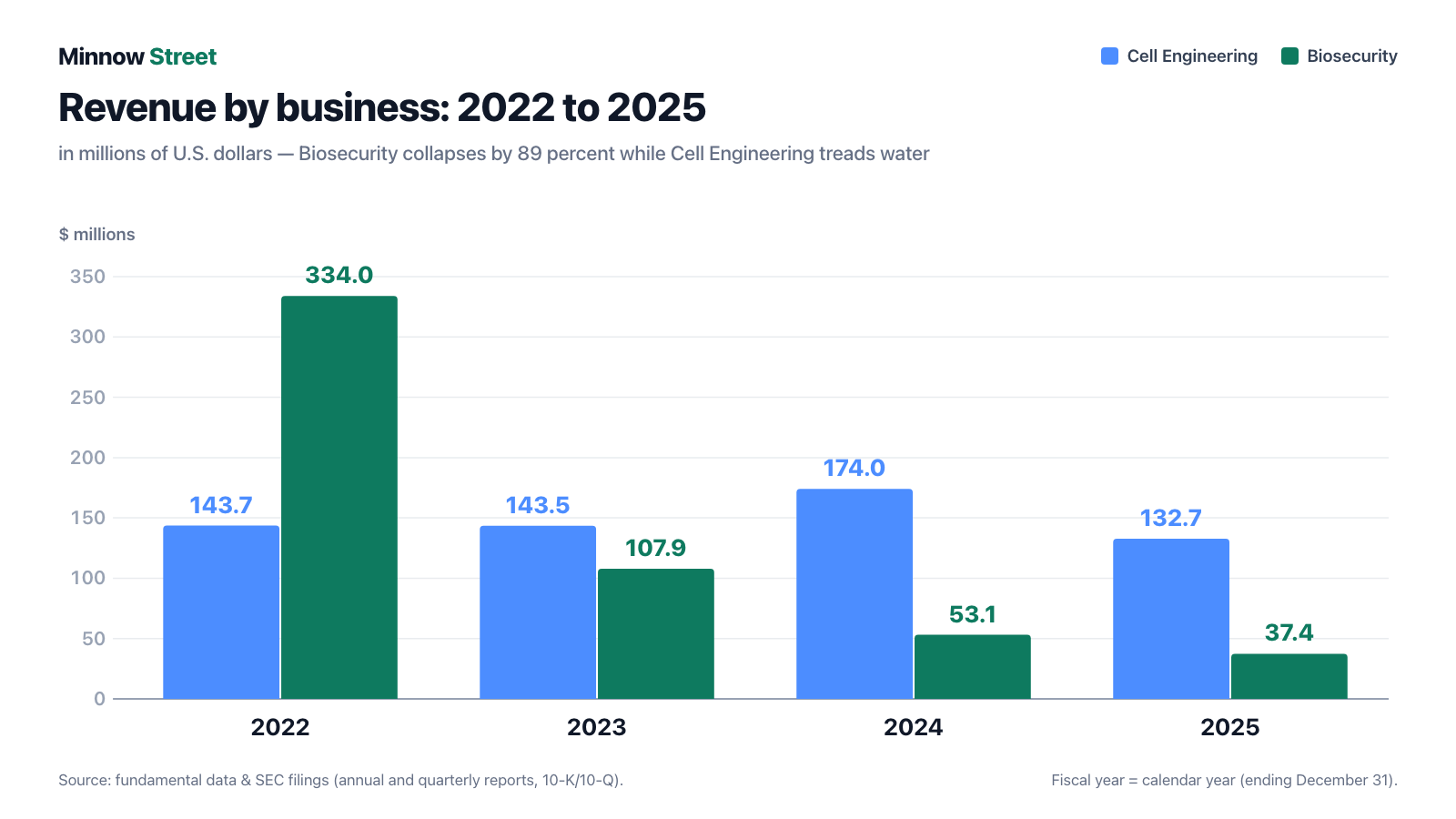
Biosecurity was a pandemic business, and Ginkgo has never pretended otherwise: demand for COVID-19 testing in schools ended in 2023, and the revenue went with it. The other line is the striking one. Cell Engineering, the actual core, stood at $132.7 million in 2025 — below its 2022 level of $143.7 million. Four years, no upward movement. The second chart shows why that is a problem:
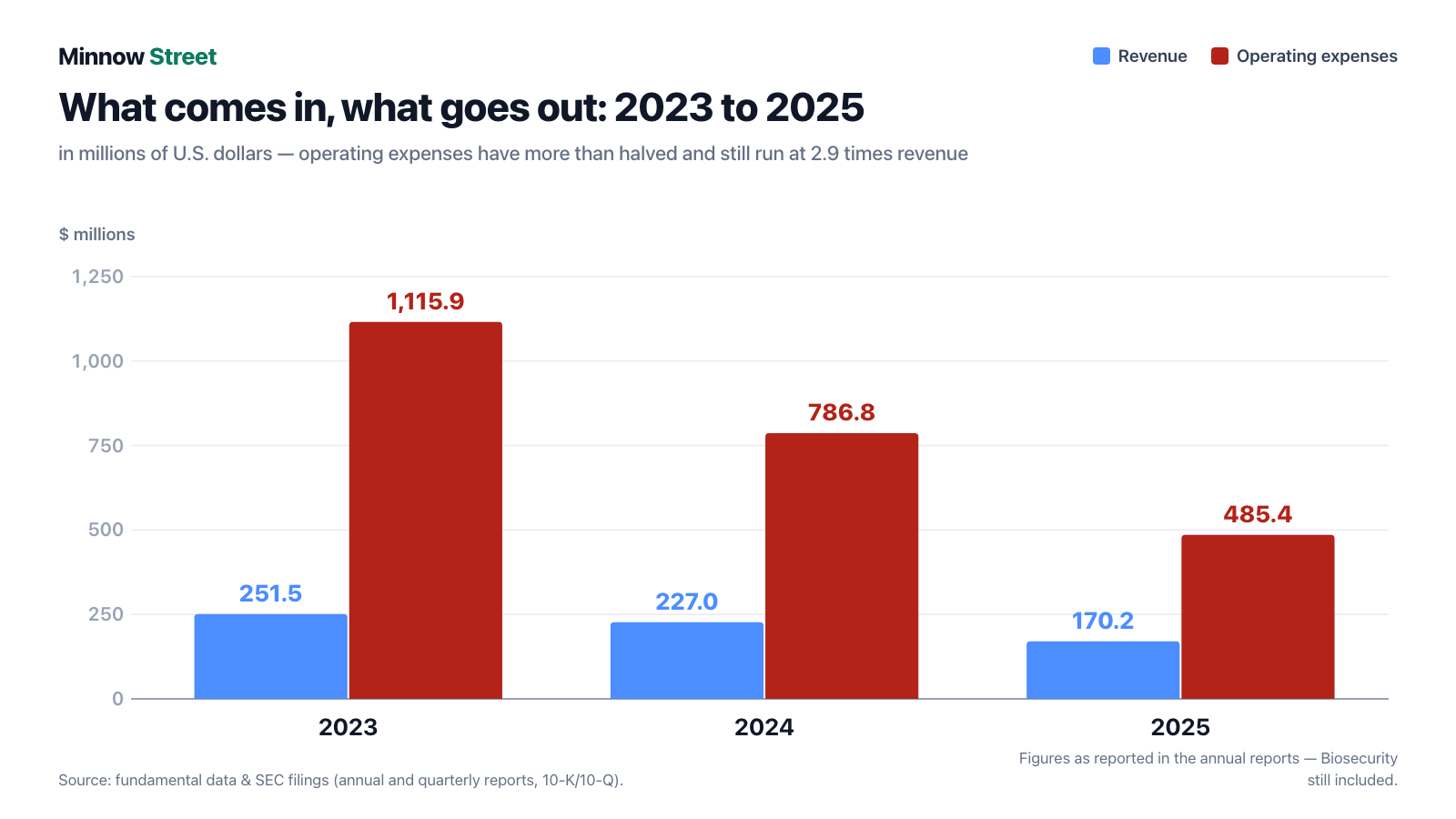
One note on comparability, because it matters for everything that follows: the annual figures for 2022 through 2025 come from the annual reports and still include Biosecurity. From the quarterly report as of March 31, 2026 onward, Ginkgo presents that segment separately as a discontinued operation — so the 2026 quarterly numbers are pure cell engineering, and the prior-year quarters have been recast accordingly. Comparing the $170.2 million of 2025 with the $19.5 million of the first quarter of 2026 means comparing two different companies. Which brings us to the uncomfortable truths.
What the filings say — the uncomfortable truths
Uncomfortable truth No. 1: the remaining business halved — and cash burn got bigger anyway
This is the number everything turns on. Revenue from continuing operations was $19.5 million in the first quarter of 2026 — against $38.2 million in the first quarter of 2025. That is 49 percent less. Ginkgo gives two reasons, and both matter. First, the prior-year quarter included $7.5 million of non-cash revenue from releasing a deferred revenue balance after a customer agreement was mutually terminated. Strip that out and revenue fell from $31 million to $19 million — still down 37 percent. Second, a large agriculture customer reduced the scope of its programs.
Against that revenue stood $90.8 million of operating expenses in the same quarter. The operating loss was $71.4 million, and the net loss including the divested business came to $82.6 million, or $1.39 per share. Now the part worth reading twice: operating cash burn from continuing operations rose — from $42.7 million in the first quarter of 2025 to $46.4 million in the first quarter of 2026. Adjusted earnings before interest, taxes, depreciation and amortization improved over the same period only from −$44.2 million to −$42.3 million. Translated: one year of restructuring, half the revenue, and roughly the same amount of cash leaving the building each quarter.
The cost program itself was anything but timid. The annual report for 2025 describes it plainly:
"This plan includes a reduction in labor expenses, primarily through a workforce reduction of more than 50%, and the consolidation and subleasing of certain facilities."
— Ginkgo Bioworks Holdings, Inc., SEC annual report 10-K for 2025, Note 3 "Restructuring"
As of December 31, 2025, Ginkgo still had 485 employees. The company put the cost of the reduction in force at $31.0 million to $32.0 million. Remember the finding: the headcount is halved, the revenue is halved — the cash burn is not. The reason sits in the next chapter.
Uncomfortable truth No. 2: $662.8 million of rent — for labs that largely stand empty
Ginkgo built during the good years. Its headquarters in Boston’s Seaport district span more than 320,000 square feet of office and laboratory space; in 2021 it signed another lease for roughly 260,000 square feet nearby, with rent payments beginning in June 2024 and a fifteen-year term. None of that can be undone. As of December 31, 2025, $662.8 million of undiscounted lease payments were therefore still outstanding, with a weighted average remaining term of 11.3 years:
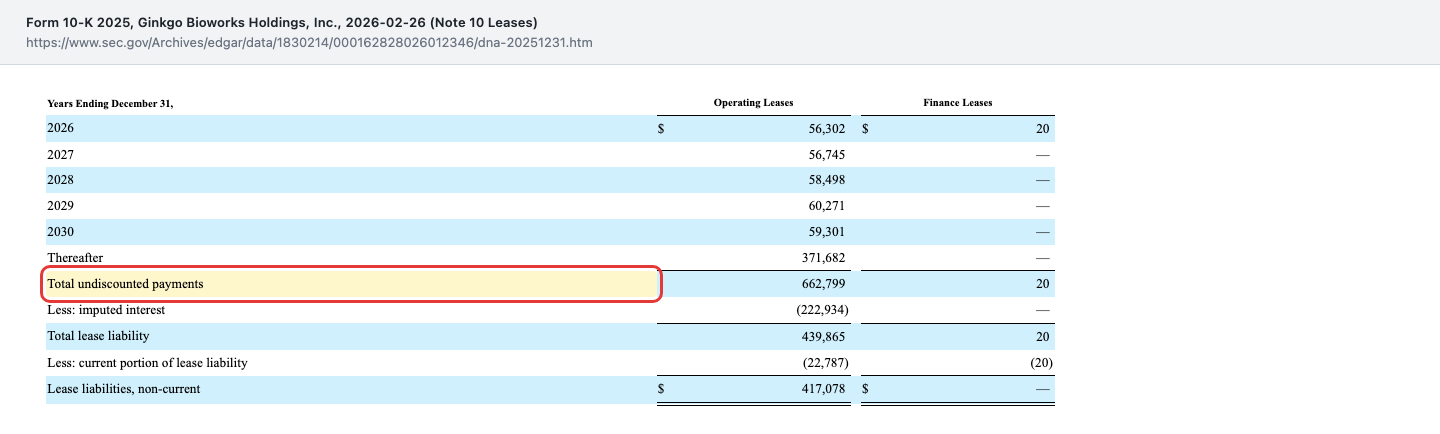
The annual installments run from $56.3 million (2026) to $60.3 million (2029) — and they rise rather than fall. For scale: revenue from continuing operations in the first quarter of 2026 was $19.5 million. Rent alone consumes an amount equivalent to roughly three quarters of revenue. In everyday terms: picture a family that leased an eight-room house in good times, now uses three rooms, and has eleven years left on the contract.
Those empty rooms appear as their own line in the quarterly report. The cost of space Ginkgo does not occupy came to $15.8 million in the first quarter of 2026 after sublease income — up from $11.7 million a year earlier. The empty space got more expensive even though the site consolidation was described as largely complete. And it costs more than 80 percent of what the operating business took in during the same quarter. The filing stays measured:
"The Company has a substantial amount of excess space and is seeking to sublease excess space consistent with its restructuring plan."
— Ginkgo Bioworks Holdings, Inc., SEC annual report 10-K for 2025, Note 10 "Leases"
In the quarterly report as of March 31, 2026 that becomes the admission that subleasing may extend beyond 2026 and, depending on market conditions, may not happen before the leases terminate at all. Hold on to this tension: a contract lab can halve its headcount, cut its programs and hand over a whole segment — it cannot halve its lease.
Uncomfortable truth No. 3: the second business was given away without a dollar of cash
On February 26, 2026 Ginkgo signed a purchase agreement for its Biosecurity business; on April 3, 2026 the closing was reported. The wording of the current report:
"On the terms and subject to the conditions in the Purchase Agreement, the Seller contributed to the Purchaser all of the issued and outstanding equity interests of Biosecurity, constituting substantially all of the Company’s operations comprising its Biosecurity segment, and in exchange, the Purchaser issued to the Seller shares of common stock of the Purchaser representing approximately 20% of the issued and outstanding equity of the Purchaser on a fully diluted basis."
— Ginkgo Bioworks Holdings, Inc., SEC current report 8-K of April 7, 2026, Item 2.01
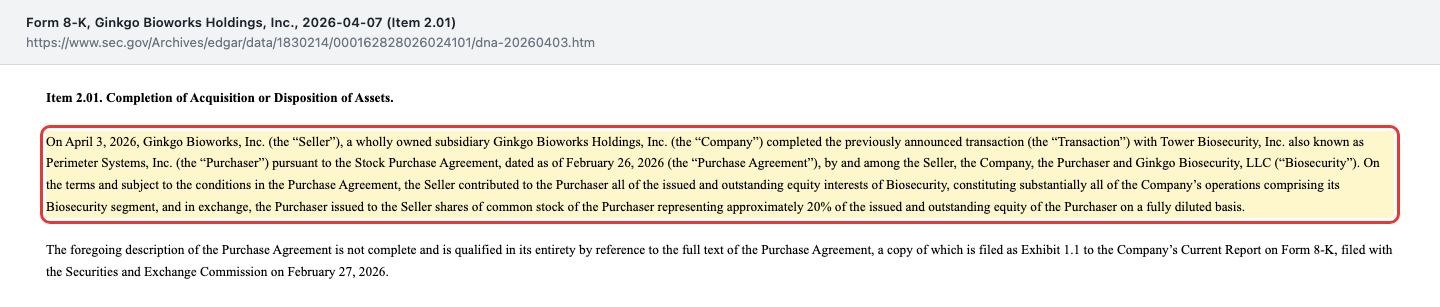
It deserves a fair reading. The segment lost money: in the first quarter of 2026 it produced $6.2 million of revenue against $13.1 million of expenses — an operating loss of $6.8 million, or $6.5 million after other income. Handing it over removes that loss. And Ginkgo keeps an interest in any later success; the notes put it at roughly 20 percent fully diluted, or about 44 percent of the buyer’s outstanding common equity as of the closing date. The other side: the buyer is a privately held company. There is no market price for the stake, no daily valuation, no exit at the click of a button. On the balance sheet as of March 31, 2026, the segment’s assets held for sale were carried at just $3.2 million. A business that produced $334.0 million of revenue in 2022 leaves the company in exchange for a piece of paper whose value the future will decide.
Uncomfortable truth No. 4: of the $373.5 million in cash, $47.0 million is locked until 2029
Liquidity is Ginkgo’s strongest argument, and it is real: $143.9 million of cash plus $229.6 million of marketable securities as of March 31, 2026, $373.5 million in total, with no financial debt. The company considers that sufficient to fund operations for at least twelve months from the filing date of the quarterly report, and guides to total cash burn of $125 million to $150 million for 2026. Run the math and the cash lasts roughly two and a half years.
One sentence at the very end of the notes shifts that calculation:
"Additionally, in April 2026, the Company was required to restrict $47.0 million of cash and cash equivalents to secure a surety bond of the same amount to fulfill its obligations under a contract with a U.S. Government National Laboratory related to the sale of RAC automation equipment. … Currently the Company expects the cash to be restricted until 2029."
— Ginkgo Bioworks Holdings, Inc., SEC quarterly report 10-Q as of March 31, 2026, Note 16 "Subsequent Events"

That is 12.6 percent of total liquidity, unavailable for about three years — and invisible in the March 31, 2026 balance sheet, because the restriction came afterwards. A further $44.8 million was already restricted at the reporting date. None of this is a warning sign in itself; surety bonds are standard on government contracts. But anyone estimating the runway should use the free portion, not the headline.
Uncomfortable truth No. 5: the listing-era anchor sits at $500 — the company’s own placement at a little over nine
Back to the anchoring trap, because Ginkgo supplies a documented example. When the company merged with the blank-check vehicle Soaring Eagle Acquisition Corp. on September 16, 2021, employees received so-called earnout shares whose vesting depends on share-price thresholds:
"The first Earnout Target of $500 per share was met on November 15, 2021."
— Ginkgo Bioworks Holdings, Inc., SEC quarterly report 10-Q as of March 31, 2026, Note 11 "Stock-Based Compensation", section "Earnouts"

One point is essential here: on August 19, 2024, Ginkgo consolidated its stock 1-for-40 — forty shares became one. Every share and price figure in the filings has been restated retroactively since, including the earnout thresholds. In 2021 money they stood at $12.50 to $20. Comparing old prices without that adjustment is wrong by a factor of forty, in both directions. Remember: after a reverse split, every historical price is a restatement, not a memory.
What can be dated cleanly: through March 31, 2026 Ginkgo placed 1.9 million Class A shares for $18.1 million of net proceeds under its market placement program — a little over nine dollars a share on average. The annual report adds a second anchor: the market value of shares held by non-affiliates as of June 30, 2025 was roughly $553 million. How quickly such a program moves the share count is something we watched at Alpha Tau, which sold new shares up the price ladder. At Ginkgo the headroom is large: a $500 million shelf registration, including a $100 million sales agreement of which only $18.1 million has been used. On top of that sits authorized capital of 15,800 million shares — against 65.3 million shares actually outstanding across all three classes as of April 30, 2026.
Valuation: what exactly are you paying for?
There is no price-to-earnings ratio — Ginkgo loses money. That leaves three more honest anchors, all dated. First, the share count: as of April 30, 2026 the cover of the quarterly report listed 53,361,141 Class A shares, 8,963,350 Class B shares and 3,000,000 non-voting Class C shares outstanding — 65.3 million in total. Many data services count Class A only and therefore arrive at a market value roughly a fifth lower; we use all three classes and say so. Second, a documented price: the company’s own share placement at a little over nine dollars (as of March 31, 2026). Together that puts the market value in the order of $0.6 billion.
Third, the offsets: against that sit $373.5 million of liquidity and $443.2 million of equity (March 31, 2026) — so the stock trades roughly in the region of its book value, not at a growth premium. On revenue, that works out to a price-to-sales ratio of about 4.7 using the $132.7 million of cell engineering revenue from 2025 as the base. That is not a bargain price for a business that is not growing.
And one item is missing from every superficial calculation: the leases. The carried lease liability stood at $439.9 million as of December 31, 2025 ($662.8 million undiscounted). Treat it as debt — and economically it is — and you are paying not $0.6 billion less cash for the operating business, but something in the order of $0.7 billion. As for the professionals: analysts captured in our market data set arrive at an average price target of $8.50 with mostly cautious ratings as of July 29, 2026 — they are not expecting a re-rating upward.
Opportunities and risks at a glance
What speaks for Ginkgo Bioworks:
- A solid financial position with no financial debt: $373.5 million of cash and marketable securities and $443.2 million of equity (March 31, 2026) — against management’s own guidance of $125 million to $150 million of cash burn for 2026, that lasts roughly two and a half years on paper.
- A radically reduced cost base: operating expenses down from $1,115.9 million (2023) through $786.8 million (2024) to $485.4 million (2025), headcount cut by more than 50 percent to 485 employees (December 31, 2025), net loss brought down from $892.9 million to $312.8 million.
- The loss maker is out: the Biosecurity business still cost $6.5 million in the first quarter of 2026; since April 3, 2026 it is gone, and the roughly 20 percent stake in the buyer remains as an option on later value.
- A field with tailwinds: data packages for training AI models and autonomous laboratories address a need Ginkgo can serve with infrastructure it already owns — government and defense already accounted for 35 percent of revenue in the first quarter of 2026.
- Nothing hidden on the balance sheet: no bonds, no convertibles, no preferred stock outstanding; the appointment of Deloitte & Touche as auditor for 2026 was ratified at the annual meeting on June 11, 2026.
What speaks against it:
- Revenue from continuing operations halved to $19.5 million in the first quarter of 2026 (prior year: $38.2 million); adjusted for a non-cash item in the prior-year quarter, the decline is still 37 percent.
- The cost program has not stopped the cash burn: operating cash burn from continuing operations of $46.4 million in the first quarter of 2026 versus $42.7 million a year earlier; adjusted EBITDA improved only from −$44.2 million to −$42.3 million.
- $662.8 million of undiscounted lease payments with 11.3 years left to run; the excess space alone cost $15.8 million in the first quarter of 2026 — more than 80 percent of quarterly revenue — and was more expensive than a year earlier.
- Dilution headroom and voting structure: a $500 million shelf registration including a $100 million sales agreement ($18.1 million used through March 31, 2026), authorized capital of 15,800 million shares against 65.3 million outstanding; Class B carries ten votes per share, and directors and executive officers together held 44.2 percent of total voting power (proxy statement of April 29, 2026, holdings as of April 14, 2026).
- $47.0 million of liquidity has been restricted since April 2026, expected until 2029; the stake in the buyer of the Biosecurity business is not publicly traded and therefore neither valued daily nor convertible into cash at short notice.
A human conclusion
Back to anchoring. It is treacherous precisely because it feels like experience. You saw the number 500, you saw the number 9, and your brain drew a conclusion about value — when all it did was compare two prices. Ginkgo Bioworks is neither the miracle of 2021 nor the wreck the chart suggests. It is a company with a very good balance sheet, first-class facilities, a real product for a real need — and two numbers that do not fit together: $19.5 million of quarterly revenue against $56.3 million of annual rent, for eleven more years. Everything else is detail. So the honest question is not "has the stock gotten cheap?" but rather: do you trust this laboratory to grow its order book faster than its cash runs out — with customers who have not signed yet? If yes, you have a thesis. If no, you had an anchor. The decision is yours.
Sources
Every original document used in this analysis — read them yourself:
- Ginkgo Bioworks Holdings, Inc. — SEC quarterly report 10-Q as of March 31, 2026 (filed May 7, 2026)
- Ginkgo Bioworks Holdings, Inc. — SEC annual report 10-K for 2025 (filed February 26, 2026)
- Ginkgo Bioworks Holdings, Inc. — SEC annual report 10-K for 2023 (filed February 29, 2024), for the 2022 revenue split
- Ginkgo Bioworks Holdings, Inc. — SEC current report 8-K of April 7, 2026, Item 2.01 (completion of the Biosecurity divestiture)
- Ginkgo Bioworks Holdings, Inc. — SEC current report 8-K of February 27, 2026, Item 1.01 (purchase agreement)
- Ginkgo Bioworks Holdings, Inc. — First quarter 2026 results release (Exhibit 99.1 to the SEC current report 8-K of May 7, 2026)
- Ginkgo Bioworks Holdings, Inc. — SEC current report 8-K of June 12, 2026, Item 5.07 (annual meeting results)
- Ginkgo Bioworks Holdings, Inc. — Proxy statement (SEC Form DEF 14A of April 29, 2026), for the distribution of voting power
- Complete SEC filing history of Ginkgo Bioworks Holdings, Inc.: EDGAR overview (sec.gov)
- Fundamental data (company profile, listing venue, analyst consensus; data as of July 29, 2026), reconciled against the SEC filings.
Transparency & disclaimer: This analysis is journalistic commentary on publicly available information. It is not investment advice, not a regulated financial analysis and not a solicitation to buy or sell securities. Equity investments carry substantial risk up to and including total loss. All information without warranty; the as-of date of each figure is stated in the text. The author holds no position in Ginkgo Bioworks shares at the time of publication.
Our Bottom Line at a Glance
- Financial position positive
- As of March 31, 2026 the books showed $373.5 million of cash and marketable securities and $443.2 million of equity with no financial debt whatsoever. Against management's own guidance of $125 million to $150 million of cash burn for 2026, that lasts roughly two and a half years — Ginkgo is not up against the wall.
- Revenue trend negative
- Revenue from continuing operations fell to $19.5 million in the first quarter of 2026 from $38.2 million a year earlier (−49 percent; −37 percent adjusted for a non-cash item). Over the years, cell engineering is not growing either: $132.7 million in 2025 against $143.7 million in 2022.
- Cost restructuring neutral
- Operating expenses fell from $1,115.9 million (2023) through $786.8 million (2024) to $485.4 million (2025), and headcount by "more than 50%" to 485 employees (December 31, 2025). The cash has not followed yet: operating cash burn rose to $46.4 million in the first quarter of 2026 from $42.7 million, and adjusted EBITDA improved by only about $2 million.
- Lease burden negative
- As of December 31, 2025, $662.8 million of undiscounted lease payments were outstanding, with a weighted average remaining term of 11.3 years and annual installments from $56.3 million (2026) to $60.3 million (2029). The excess space alone cost $15.8 million in the first quarter of 2026 — more than 80 percent of quarterly revenue and more than the $11.7 million a year earlier.
- Portfolio reshaping neutral
- The Biosecurity divestiture of April 3, 2026 removes a segment that most recently lost $6.5 million a quarter — but the consideration was not cash, it was a roughly 20 percent stake in a privately held buyer. That stake can be neither valued daily nor turned into cash at short notice.
- Capital structure negative
- As of April 30, 2026, 65.3 million shares were outstanding across three classes against 15,800 million authorized; a $500 million shelf registration with a $100 million sales agreement ($18.1 million used through March 31, 2026) stands ready. Class B carries ten votes per share — directors and executive officers together held 44.2 percent of total voting power (proxy statement of April 29, 2026, holdings as of April 14, 2026).
Ginkgo Bioworks is a textbook case of how far a listing promise and an income statement can drift apart. The company has more than halved its costs in two years, sits debt-free on $373.5 million of liquidity and shed a loss maker with the Biosecurity divestiture of April 3, 2026. At the same time, revenue in the remaining business halved to $19.5 million in the first quarter of 2026, operating cash burn actually grew to $46.4 million, and above it all sit $662.8 million of lease payments with 11.3 years to run. On the company's own guidance the cash lasts roughly two and a half years — the order book has to grow before then. Not investment advice.
What Our Rating Means
Open questions
The business works in principle, but one material question is open. As long as it stays open, our findings do not carry a quality verdict.
Yellow because the decisive operating question is open, not because the share price has fallen: continuing operations shrank 49 percent to $19.5 million in the first quarter of 2026 while operating cash burn rose to $46.4 million and adjusted EBITDA improved by only about $2 million — a turnaround that is announced rather than demonstrated. It is not red because the substance holds: $443.2 million of equity, $373.5 million of liquidity, no financial debt, no going-concern qualification, and a runway of roughly two and a half years on the company's own guidance of $125 million to $150 million of cash burn for 2026. The light turns red if quarterly revenue keeps falling without cash burn falling with it, or if the $662.8 million lease burden stays unsublet and pushes liquidity below roughly four quarters of runway. The decision is yours.
A journalistic assessment by our editorial team at the time of the deep dive, based on public sources — not investment advice and not a solicitation to buy or sell. Your personal circumstances (investment goals, risk capacity, taxes) cannot be taken into account. What our levels mean, how verdicts are formed, and what conflicts of interest exist →
Worth Noting
- Ginkgo Bioworks came onto the research list through the EDGAR filing stream: the current report 8-K of April 7, 2026 (Item 2.01) announcing completion of the Biosecurity divestiture. Our in-house stock scanner recalculates its lists daily, so the trigger for this analysis carries the date July 29, 2026.
- Time-series warning: the annual figures for 2022 through 2025 come from the annual reports and still include the Biosecurity business. From the quarterly report as of March 31, 2026 onward it is presented separately as a discontinued operation — so the 2026 quarterly figures and the recast prior-year quarters show cell engineering only. Annual and quarterly figures are therefore not directly comparable.
- All share and price figures are adjusted for the 1-for-40 reverse stock split of August 19, 2024; the earnout thresholds of $500 to $800 correspond to $12.50 to $20 in 2021 money. Market value here is derived from all three share classes (65.3 million shares as of April 30, 2026) and a documented placement price of about $9.50 per share; data services that count Class A only report a value roughly a fifth lower. Not to be confused: the warrant DNABW trades over the counter, the common stock DNA on the NYSE.
Frequently Asked Questions
Ginkgo Bioworks Holdings, Inc. (NYSE: DNA), based in Boston, runs contract research on programmed cells. Customers in pharmaceuticals, agriculture, industry and government have it develop cells, enzymes and proteins in a largely robotic laboratory. Ginkgo also sells automation hardware, lab access as a "Cloud Lab" and data packages used to train AI models. As of December 31, 2025 the company had 485 employees.
Ginkgo gave it away. A purchase agreement was signed on February 26, 2026 and the closing reported on April 3, 2026: the entire segment went to Tower Biosecurity, and in exchange Ginkgo received stock equal to roughly 20 percent of the buyer on a fully diluted basis — no cash. The business was a pandemic product: $334.0 million of revenue in 2022, only $37.4 million in 2025, and a $6.5 million quarterly loss most recently.
Continuing operations used $46.4 million of cash in the first quarter of 2026, against $42.7 million a year earlier. For full-year 2026 management guides to total cash burn of $125 million to $150 million. Against that stood $373.5 million of cash and marketable securities as of March 31, 2026 — although $47.0 million of it has been restricted since April 2026 to secure a surety bond, expected to remain restricted until 2029.
On August 19, 2024 Ginkgo consolidated its stock 1-for-40: forty shares became one, and the nominal price rose by the same factor. Every price, share and per-share figure in the SEC filings has been restated retroactively since. Comparing historical prices without that adjustment is off by a factor of forty. Trading in the warrants from the listing era was suspended by the NYSE on September 4, 2024 and the delisting form followed on September 12, 2024; they now trade over the counter, while the common stock remains listed on the NYSE.
As of December 31, 2025, undiscounted lease payments totaled $662.8 million, carried as a $439.9 million liability. The weighted average remaining term was 11.3 years, with annual installments running from $56.3 million (2026) to $60.3 million (2029). The carrying cost of space the company does not occupy alone came to $15.8 million in the first quarter of 2026 after sublease income — against $19.5 million of quarterly revenue.
Yes. Ginkgo merged with the blank-check vehicle Soaring Eagle Acquisition Corp. on September 16, 2021, and the Class A stock has traded on the NYSE under the ticker DNA since September 17, 2021. Earnout programs from that period carry price thresholds of $500, $600, $700 and $800 per share (restated for the 1-for-40 reverse split); the first was met on November 15, 2021. As of March 31, 2026 the accumulated deficit stood at $6,232.9 million.
Found an error?
Did you spot a factual error, an outdated number, or a typo in this deep dive? Let us know briefly — your report goes straight to the editorial team.