The RealReal Stock: A Marketplace That Sorts Out Fakes — and a Quarterly Profit Made of Warrant Math
The RealReal checks every Hermes bag with gemologists, micro-photography and its own AI before it is sold — and the stock has gained about 162 percent in twelve months (data as of July 8, 2026). We put the annual reports (10-K) for 2024 and 2025 and the quarterly report (10-Q) as of March 31, 2026 through the same inspection: revenue grows at a double-digit clip and adjusted EBITDA is clearly positive for the first time — but no fiscal year since the 2019 IPO has ever ended in profit, stockholders' equity stands at minus $415.5 million, part of the debt costs 13 percent interest, and the reported quarterly profit appears precisely when the share price falls. Not investment advice — just an authentication report for the numbers behind the turnaround story.
 Thomas Mücke
Founder & Publisher
Thomas Mücke
Founder & Publisher
Chart
Interactive price chart (TradingView).
Note: pure fact-based analysis, not investment advice and not a solicitation to buy or sell. All figures without guarantee.
When you buy a pre-owned luxury handbag, you are as suspicious as a customs officer: stitching, date code, hologram sticker — everything gets checked, because the market is full of fakes. With stocks, most of us do the opposite. Psychologists call it confirmation bias: once the headline "turnaround done, first profit" is in your head, you only look for evidence that supports it — and the fine print goes unread. Hardly any stock invites that reflex in the summer of 2026 like The RealReal (Nasdaq: REAL): the largest online marketplace for authenticated secondhand luxury, up about 162 percent in twelve months, growing revenue, positive EBITDA headlines (data as of July 8, 2026). Reddit, remarkably, is quiet — our Reddit hype scanner counted just 2 mentions in 24 hours (ApeWisdom, as of July 15, 2026); this rally runs without forum drums. So let’s make a deal: we treat this stock the way The RealReal treats an incoming Birkin bag — we authenticate it. Our inspection material: the annual reports (10-K) for 2024 and 2025 and the quarterly report (10-Q) as of March 31, 2026, all filed with the U.S. securities regulator, the SEC — and a filing to the SEC is honest under penalty of law. At the end you will not get a certificate of authenticity from us — you will get the findings. What you make of them is up to you.
What The RealReal actually does — "pawn shop" would be the wrong translation
The RealReal, founded in San Francisco in 2011, sells pre-owned luxury goods — handbags, fashion, jewelry, watches from Cartier via Chanel and Hermes to Rolex — on consignment. Translated: the company does not buy your bag; it takes it on commission, like an upscale consignment department store. You send it in, the company inspects, photographs, prices and sells it — and keeps a share of the sale price, the so-called take rate: on average 37.7 percent in 2025. Of a $1,000 bag, roughly $377 stay with the marketplace. The heart of the model is exactly what you lack in a private purchase: authentication. Gemologists, horologists and brand experts inspect, by the company’s account, thousands of items per day in two authentication centers in Arizona and New Jersey with about 1.4 million square feet combined, supported by micro-photography and a home-built AI called "Athena"; every piece of jewelry sold ships with a certificate. That promise is the moat — and, as we will see, the most expensive line of the bill. The dimensions: in 2025, goods worth $2.13 billion changed hands (the gross merchandise value, "GMV", up 16 percent), which produced $692.8 million of total revenue — $535.9 million in commissions, $91.1 million from selling company-owned inventory, $65.9 million in shipping fees. More than 1 million active buyers use the platform, over 80 percent of volume comes from repeat consignors and repeat buyers alike, and roughly half of all items sell within 30 days of listing. A real network, in other words. Which brings us to the central tension of this analysis, and it runs through every chapter: the operating turn is measurably real — but the balance sheet carries the scars of six loss-making years, the debt was extended rather than repaid, and the reported quarterly profits come from an accounting quantity, not from the business. How hard online marketplaces find the leap from growth story to profit machine is something we recently dissected at Groupon — there, however, with shrinking revenue. Here it grows. That is exactly what makes this case interesting.
Where the stock shows up in our scanner — four hits, all on the warning side
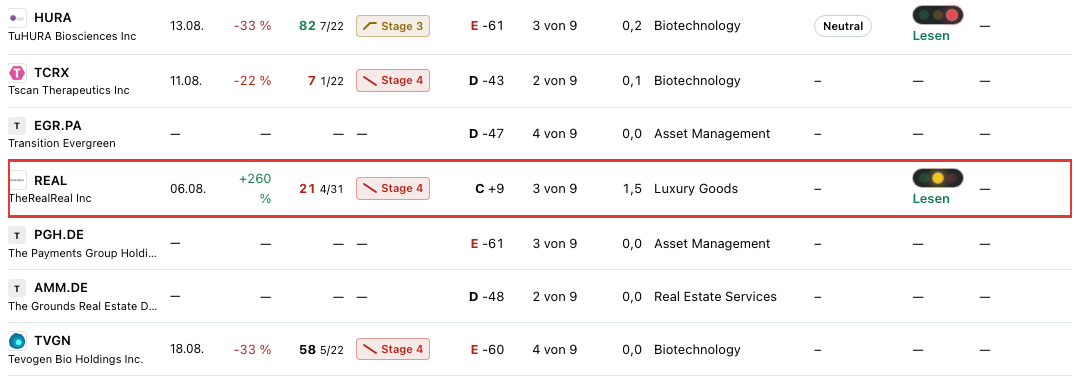
Every day we run about 3,500 stocks through our scanners. The RealReal has a row in our database — its company profile sits in the stocks section — and as of the July 8, 2026 data cut-off the stock lit up in 4 filters. What is remarkable is which ones: warning lists, all of them. The going-concern distress proxy collects companies whose balance-sheet metrics look stressed; the Altman-Z distress zone carries REAL at minus 9.15 — the Altman Z-score is a decades-old early-warning thermometer for financial distress, anything below 1.8 classically counts as the danger zone, and deeply negative readings arise above all when equity sits below zero. Add stage 4 twice, the downtrend stage in Stan Weinstein’s framework. The rest of the metrics sheet reads like two expert opinions about two different companies. On the warning side: a Piotroski F-Score of 3 of 9 (a nine-point test of balance-sheet quality; thoroughly healthy companies score 8 or 9), negative interest coverage of minus 1.27 on trailing twelve-month figures, and zero insider purchases against 20 insider sales within twelve months — the CEO sold as well. On the plus side: up 162 percent over twelve months, a relative-strength rating of 79, about 98 percent institutional ownership (largest holders: Fidelity with a good 9 percent, BlackRock with 7.6 percent) and analyst estimates that expect a profit swing. A stock sitting in distress lists and on the year’s winners list at the same time is not a contradiction in the scanners — it is their most honest finding: the metric filters compute with yesterday’s balance sheet, the price trades tomorrow’s hope, and in between sits precisely the bet this analysis is about. For context as of the data cut: after the strong run into year-end 2025, the stock spent much of 2026 in the red (minus 22.6 percent year to date), lately with a forceful rebound (plus 24.5 percent in one month; all data as of July 8, 2026).
The numbers over the years — honestly appraised
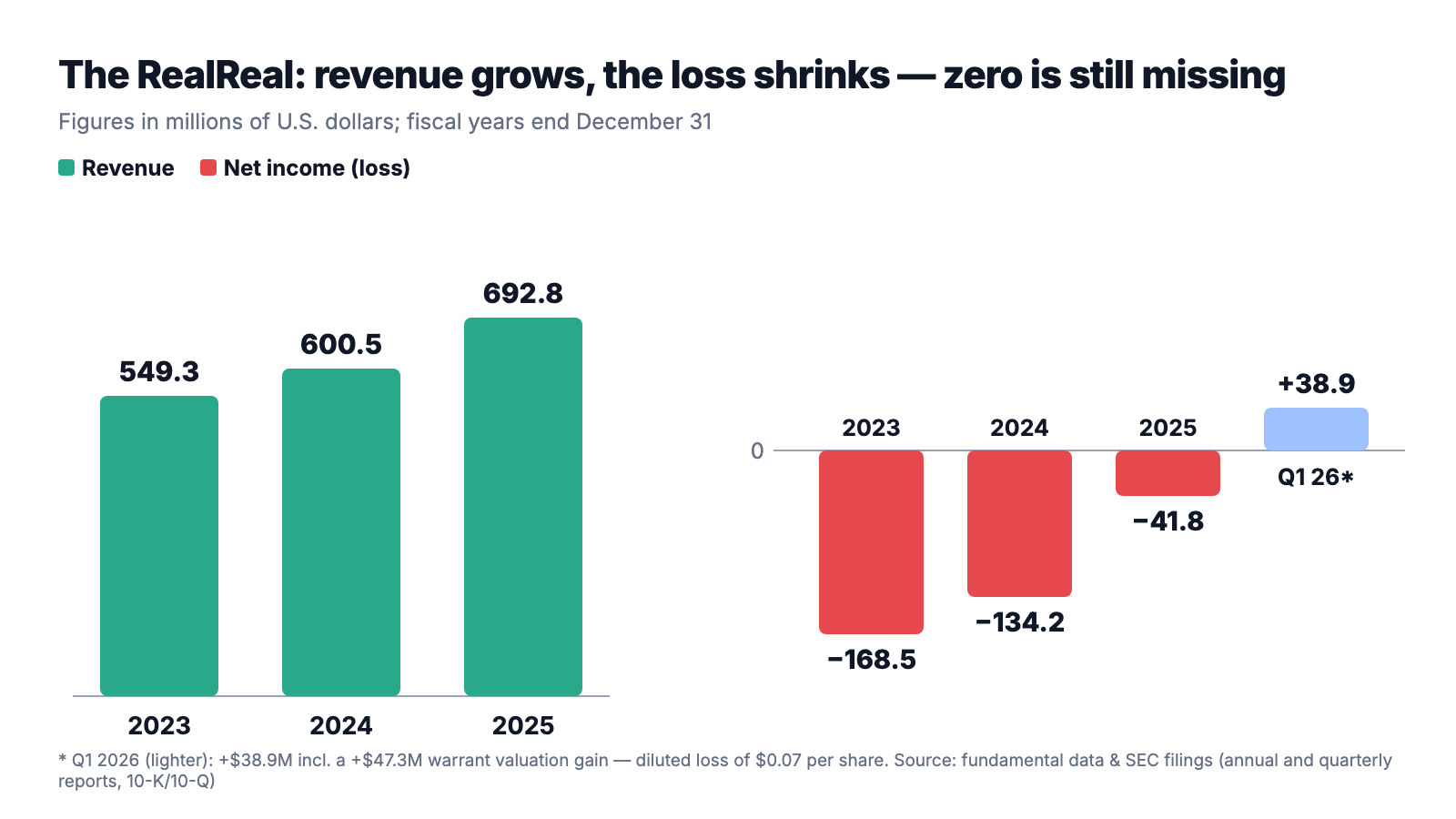
First, what genuinely impresses — and this time that is more than a courtesy. Revenue grew 15 percent to $692.8 million in 2025 (2024: $600.5 million; 2023: $549.3 million), merchandise volume rose 16 percent to $2.13 billion, and the first quarter of 2026 added another gear: revenue up 18.5 percent, consignment volume up as much as 24 percent, 1.08 million active buyers, an average order value of $646. More important still is the direction of the earnings curve: adjusted EBITDA — operating profit before interest, taxes, depreciation and one-off effects — swung from minus $55.2 million (2023) via plus $9.3 million (2024) to plus $42.1 million (2025); the first quarter of 2026 delivered $13.1 million after $4.1 million in the prior-year quarter. Operating cash flow was positive in 2024 and 2025 for the first time (2025: plus $37.0 million), and the loss from operations melted from $166.3 million (2023, including $43.5 million of restructuring) via $56.5 million (2024) to $23.9 million (2025) — and just $2.3 million in the first quarter of 2026. This turn has a backstory in the corner office: founder Julie Wainwright left in 2022, her successor John Koryl was separated in 2024, and since her promotion in October 2024, Rati Sahi Levesque has run the company — with a course change away from growth at any price toward profitable supply, efficiency and new revenue streams; the annual report itself describes exactly that as its "key initiatives". Up to this point, it reads like a textbook turnaround. Now flip the certificate over:
What the filings say — the uncomfortable truths
Uncomfortable truth no. 1: six years on the stock market, zero profitable years — and a $1.3 billion deficit
The RealReal went public in July 2019, raising $315.5 million in net proceeds. Since then — through boom, pandemic and a luxury bull market — every fiscal year has ended in a loss, without exception. The annual report sums up the most recent three years soberly:
"We experienced net losses of $168.5 million, $134.2 million, and $41.8 million in 2023, 2024 and 2025, respectively, and as of December 31, 2025 we had an accumulated deficit of $1,295.6 million."
— The RealReal, Inc., SEC annual report 10-K 2025, Item 1A "Risk Factors"

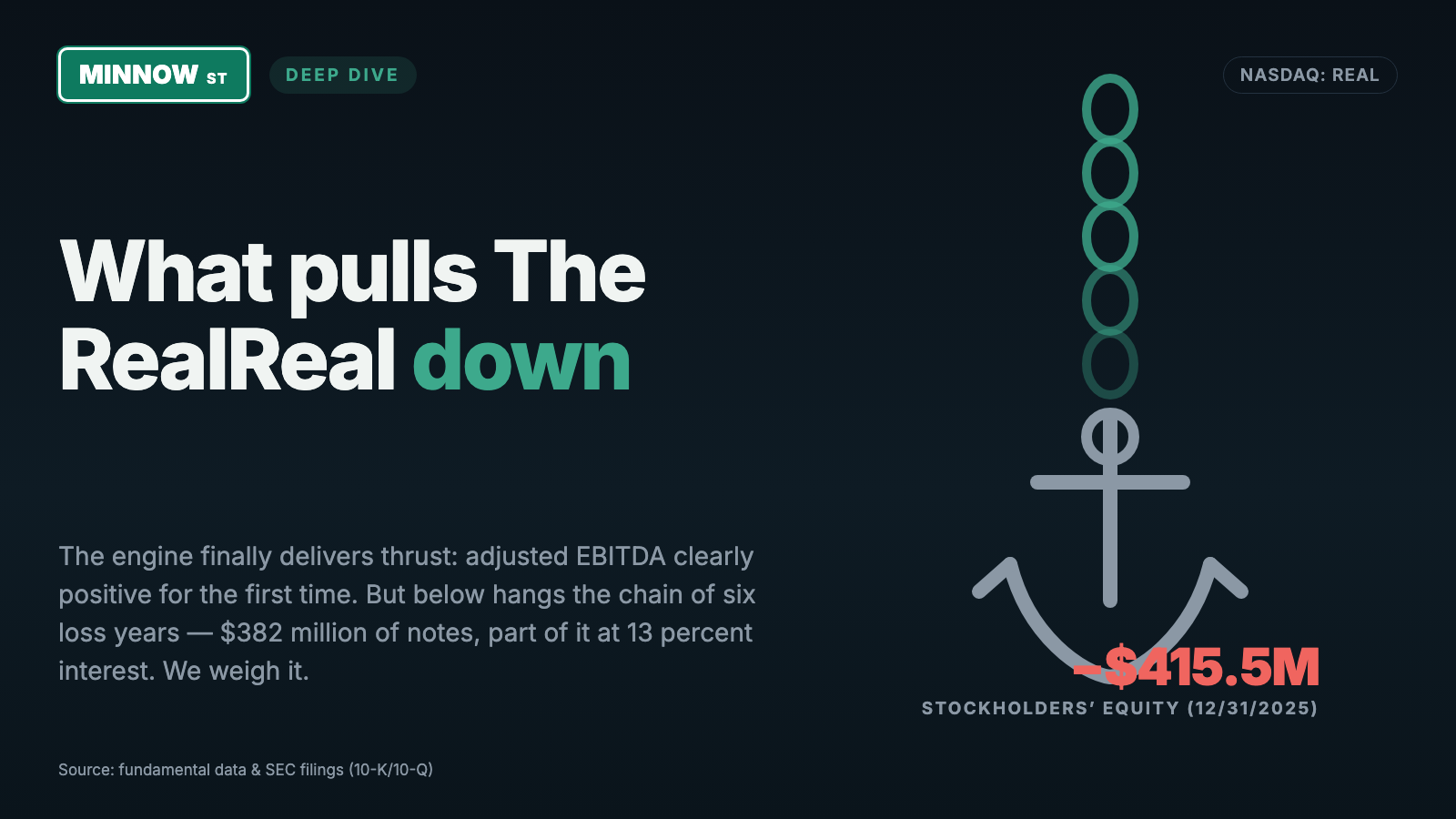
An accumulated deficit of $1.3 billion has consequences beyond an ugly number: it has pushed stockholders’ equity to minus $415.5 million (December 31, 2025) — assets of $409.0 million stand against liabilities of $824.6 million. In an everyday image: the house is renovated and the shop is busy again — but the mortgage is larger than the house and the lot combined. That is not a bankruptcy verdict; a company lives on cash flows, not book values, which is also why our scanner finding (Altman Z of minus 9.15) falls short when read in isolation. But it explains why any further financing has to come from debt or new shares — there is no cushion left from better days. And the report itself draws the most honest of all conclusions: "We cannot assure you that we will ever achieve or sustain profitability and may continue to incur significant losses going forward." Remember the yardstick: a turnaround is only a turnaround when the fiscal year prints zero — not the adjusted interim report.
Uncomfortable truth no. 2: the quarterly profit appears when the stock falls — warrant math instead of business
In the first quarter of 2026, The RealReal reported $38.9 million of net income — on an operating loss of $2.3 million. How that fits together is in the quarterly report, and the mechanics are worth genuinely understanding. In the 2024 debt exchange, creditors received warrants — rights to buy 7.89 million RealReal shares at an exercise price of $1.71. These warrants sit on the balance sheet as a liability and are remeasured to market value every quarter, with the offsetting entry running straight through the income statement:
"During the three months ended March 31, 2026, we incurred a gain of $47.3 million due to the decrease in the fair value of the warrants outstanding at March 31, 2026. The decrease in the fair value of the warrant liability was primarily driven by a decrease in the Company’s stock price during the period, which resulted in a lower valuation of the warrants."
— The RealReal, Inc., SEC quarterly report 10-Q as of March 31, 2026, Item 2 MD&A "Change in Fair Value of Warrant Liability"

Read that sentence twice: the company books a gain because its own share price fell — the worse the stock does, the better net income looks, and vice versa. In 2025, the same mechanics cost $35.8 million (the price had risen) and widened the annual loss; in 2024 it was as much as $68.2 million. The prior-year quarterly profit of $62.4 million (Q1 2025) likewise consisted of a $42.5 million warrant gain plus a $37.1 million book gain from the debt exchange. It is a seesaw: the business up front, the warrant valuation at the back — and the headline only reads the sum. Two control numbers expose the optics: on a diluted basis — counting the warrants and convertibles — the first quarter of 2026 showed a loss of $0.07 per share, and the quarter’s operating cash flow was negative at minus $16.6 million (seasonally normal, but no proof of profit either). None of this is forbidden or hidden — accounting rules actually require the entry. But remember the image: a profit that arises from your own share-price weakness is a label — not merchandise.
Uncomfortable truth no. 3: exchanged three times, never repaid — and part of the debt now costs 13 percent
The early years’ losses were financed with convertibles that look absurdly cheap from today’s vantage point: $172.5 million at 3.00 percent (2020), $287.5 million at 1.00 percent (2021). Almost none of it was repaid — it was swapped instead. In February 2024, The RealReal exchanged $152.3 million of those notes into new, secured notes of $135.0 million due 2029. Their price is in the annual report:
"The 2029 Notes bear interest at a rate of 13.00% per annum, consisting of cash interest at a rate of 8.75% per annum payable semi-annually in arrears and payment in-kind interest at a rate of 4.25% per annum payable semi-annually."
— The RealReal, Inc., SEC annual report 10-K 2025, Item 7 "Liquidity and Capital Resources"

13.00 percent instead of 1 to 3 percent — that is the market price of the risk creditors saw in this balance sheet. And the 4.25 percent "payment in kind" is not wired anywhere; it is added to the principal: by the end of 2025, the $135.0 million had already grown to $143.8 million — a debt that compounds by itself. On top, creditors received the warrants from truth no. 2 (struck at $1.71 — the stock lately traded around $12; that dilution is already baked in). Two more exchanges followed in 2025: $232.8 million of the 1 percent convertibles due 2028 were swapped into $190.1 million of new 4 percent convertibles due 2031 — creditors gave up principal (hence the book gains in the income statement), the company bought time. Net, as of March 31, 2026, $382.1 million of notes remain outstanding ($48.2 million due 2028, $143.8 million due 2029, $190.1 million due 2031) against $124.0 million of cash; interest expense rose 30 percent to $27.7 million in 2025. Fairness requires saying: the maturing 2025 notes were repaid in full in June 2025 ($27.2 million), and the maturities are now stretched — the next big wall stands in 2028/2029. But a clause ticks in the debt footnote: the 2029 notes become due as early as December 1, 2027 if more than $20 million of the old 2028 convertibles are then still outstanding and cash minus that residual falls below $75 million. Remember the order of events: whoever swaps debt instead of repaying it postpones the exam — it does not pass it. Where perpetual extension leads in the extreme case is something our look at AMC Entertainment shows — The RealReal is not there, but the direction of the interest curve is the same.
Uncomfortable truth no. 4: the moat costs at both ends — inspection lab and a falling take rate
The authenticity promise is the reason The RealReal exists — and the reason the math is so hard to close. The "Operations and Technology" line — essentially the authentication centers, single-item logistics and the technology behind them — cost $275.9 million in 2025, about 40 percent of revenue; most of the 3,140 employees work here. Unlike at eBay, every single item physically passes through intake, inspection, photo studio and warehouse — and with returns (24.2 percent of merchandise volume in 2025), it does so twice. The report itself describes how narrow the ridge is:
"Our success depends on our ability to accurately and cost-effectively determine whether an item offered for consignment is an authentic product or genuine gemstone, piece of jewelry or work of art. From time to time, we receive counterfeit goods for consignment. [...] we cannot be certain that every counterfeit item will be identified."
— The RealReal, Inc., SEC annual report 10-K 2025, Item 1A "Risk Factors"

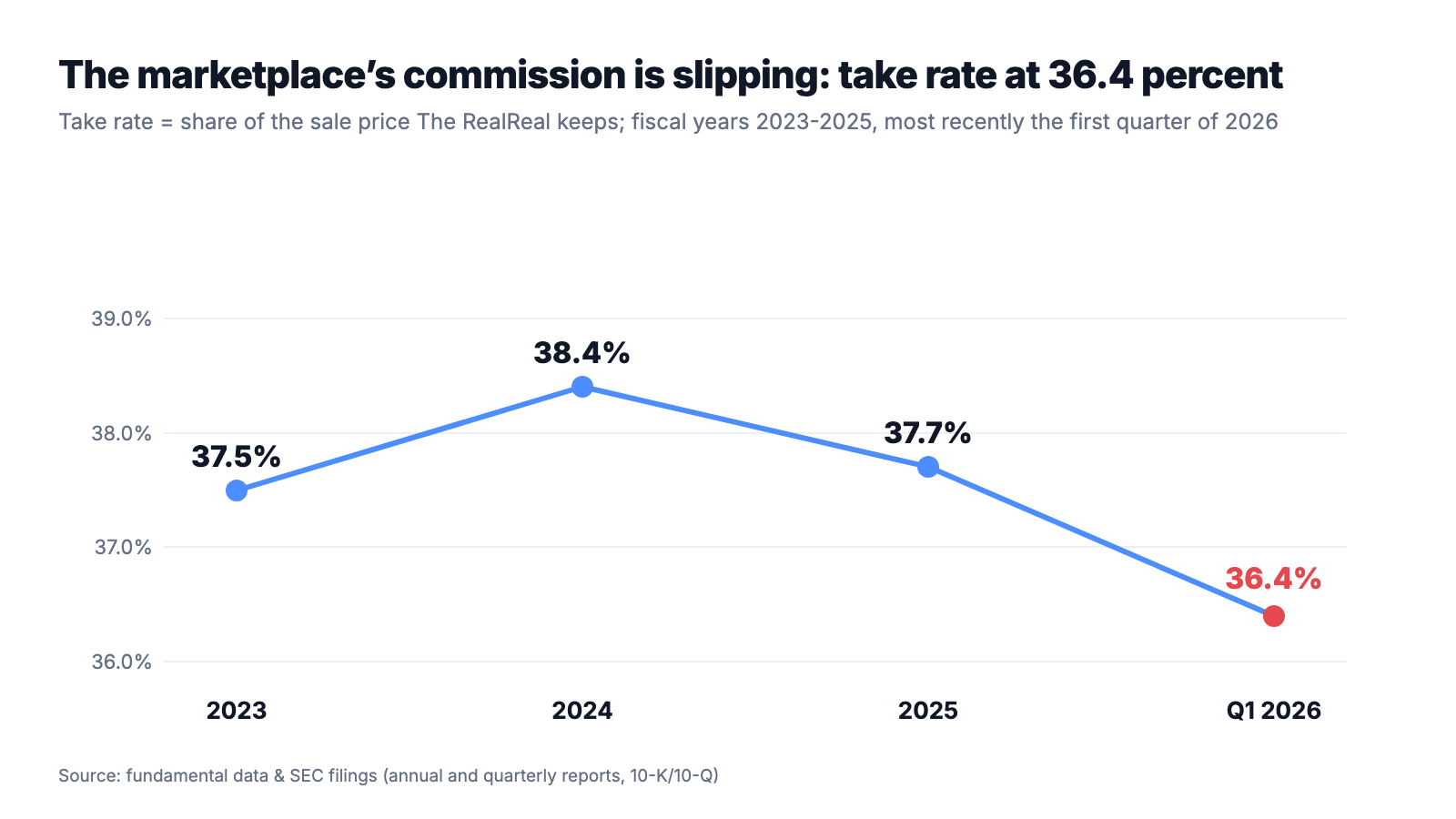
And at the other end of the bill, the one metric the marketplace lives on is falling: the take rate, the share of the sale price The RealReal keeps as commission. It stood at 38.4 percent in 2024, 37.7 percent in 2025, and just 36.4 percent in the first quarter of 2026 (prior-year quarter: 38.6). The cause is not a price war but the company’s own strategy: growth comes deliberately from high-value goods — watches, jewelry, top-tier handbags — and there, per the commission schedule, consignors receive up to 90 percent of the proceeds; on a Rolex sold above $7,500, the marketplace keeps only a narrow cut, while sub-$100 items leave 80 percent margin but pass through the same expensive inspection lab. Translated: the finer the merchandise, the smaller the marketplace’s share — the growth buys its revenue with margin. For now the math holds: gross margin reached a strong 74.6 percent in 2025, and pricier goods lift the order value ($646 in Q1 2026). But between a 38.6 and a 36.4 percent take rate lie — computed on the latest quarterly consignment volume of $606 million — millions that can quickly eat the tender EBITDA surplus. One quarter does not make a trend; the direction still belongs on your watch list.
Valuation: $1.5 billion of market value for a bet on zero
In early July 2026 The RealReal stock cost about $12.40, for a market value of roughly $1.5 billion (data as of July 8, 2026). An honest price-to-earnings ratio cannot be computed — there is no annual profit to divide by. That leaves revenue: the price-to-sales ratio sits around 2.1 on 2025 figures. Calculate like a buyer of the whole company — market value plus $382 million of notes, minus $151 million of cash (year-end 2025) — and you get an enterprise value around $1.75 billion, a good two and a half times revenue and more than 40 times the 2025 adjusted EBITDA. For comparison: when the stock traded around $2 in late 2023, the market paid barely more than the debt for the same business — then still deeply loss-making; the 162 percent twelve-month rally is therefore above all a repricing of the turnaround’s probability, not of achieved profit. The professionals’ view gives the turn real credit: seven analysts cover the stock, the consensus leans toward buy, and the earnings estimates see a small positive per-share result for 2026 for the first time (about $0.06) and about $0.22 for 2027 (data as of July 8, 2026) — on 2027 hope, that is still a price-to-earnings ratio around 55. Put differently: the price has already celebrated the zero that the books have not yet delivered. That 20 insider sales stand against not a single purchase, and that the stock still trades 55 percent below its all-time high from the 2021 euphoria, belongs in the complete price disclosure. You can find more metrics and ratings in the RealReal company profile of our scanner.
Opportunities and risks at a glance
What speaks for The RealReal:
- A marketplace with a real moat: authentication at industrial scale (two inspection centers, gemologists, horologists, home-built AI), more than 1 million active buyers, over 80 percent of volume from repeat customers, roughly half of all items sold within 30 days (annual report 10-K for 2025).
- The operating turn is documented: adjusted EBITDA from minus $55.2 million (2023) via plus $9.3 million (2024) to plus $42.1 million (2025), operating cash flow positive two years running, an operating loss of just $2.3 million in the first quarter of 2026.
- Growth with pace: revenue up 15 percent in 2025, merchandise volume up 16 percent, first quarter of 2026 up 18.5 percent in revenue and 24 percent in consignment volume; gross margin around 74.6 percent.
- Stretched maturities: the 2025 notes were repaid in full, the next large maturities sit in 2028/2029/2031; $124.0 million of cash as of March 31, 2026.
- Professionals on board: about 98 percent institutional ownership (Fidelity a good 9 percent, BlackRock 7.6 percent), seven analysts with a consensus leaning toward buy and, for the first time, positive earnings estimates for 2026/2027 (data as of July 8, 2026).
What speaks against it:
- Not a single profitable year since the 2019 IPO: an accumulated deficit of $1,295.6 million, stockholders’ equity of minus $415.5 million (December 31, 2025); the annual report itself warns that profitability is not assured.
- The reported quarterly profits are valuation math: Q1 2026 plus $38.9 million only thanks to a $47.3 million warrant gain (because the price fell); diluted loss of $0.07 per share; the quarter’s operating cash flow at minus $16.6 million.
- Expensive, thrice-exchanged debt: $382.1 million of notes, of which $143.8 million secured at 13.00 percent with a self-compounding PIK portion and an acceleration clause as of December 1, 2027; 2025 interest expense up 30 percent to $27.7 million; warrants struck at $1.71 add dilution.
- The take rate is falling: from 38.4 percent (2024) to 36.4 percent (Q1 2026), because growth comes from high-value goods with high consignor commissions; at the same time, inspection centers and single-item logistics cost about 40 percent of revenue, and 24.2 percent of merchandise volume comes back as returns and cancellations.
- Warning signals at the margin: 4 scanner hits, all in distress lists (Altman Z of minus 9.15, Piotroski 3 of 9), zero insider purchases against 20 sales within twelve months, and a perennial lawsuit with Chanel about the core of the brand promise (data as of July 8, 2026).
A human conclusion
Back to the authentication check from the opening — with this stock it is not a metaphor but the method. Finding one: the operating turn is real. Revenue and volume grow at double-digit rates, adjusted EBITDA has swung by almost $100 million in two years, operating cash flow is positive, and the new management visibly pursues a strategy rather than a story. Finding two: the reported profit is not. It arises from remeasuring the company’s own warrants — if anything, precisely when the share price falls — and it disappears the moment you count diluted shares or look at cash flow. Finding three: the past has not been worked off; it has been refinanced. Minus $415.5 million of equity, 13 percent notes with an acceleration clause, warrants struck at $1.71 — the six loss years hang on the ship like a chain, even as the engine finally delivers thrust. If this stock were a consigned handbag, it would receive the certificate "authentic — with documented signs of wear and an outstanding balance due". Whether that satisfies you at a price of a good two times revenue, with a chart that has already priced in the zero — or whether you would rather wait for the first genuinely profitable year and possibly pay more for the proof: that is no longer a question of authenticity, but of your risk tolerance. What you make of it is your decision. And that is exactly as it should be.
Sources
All original documents used in this analysis — to read for yourself:
- The RealReal, Inc. — SEC annual report 10-K for 2025 (filed February 26, 2026)
- The RealReal, Inc. — SEC annual report 10-K for 2024 (filed February 21, 2025)
- The RealReal, Inc. — SEC quarterly report 10-Q as of March 31, 2026 (filed May 7, 2026)
- The RealReal, Inc. — SEC quarterly report 10-Q as of September 30, 2025 (filed November 10, 2025)
- The RealReal, Inc. — SEC quarterly report 10-Q as of June 30, 2025 (filed August 7, 2025)
- The RealReal, Inc. — SEC quarterly report 10-Q as of March 31, 2025 (filed May 8, 2025)
- The RealReal, Inc.’s complete SEC filing history: EDGAR overview (sec.gov)
- Fundamental data (metrics, quarterly series, valuation; data as of July 8, 2026), reconciled with the SEC filings.
- Screener and rating data: in-house stock scanner (data as of July 8, 2026); Reddit mentions: ApeWisdom (as of July 15, 2026).
Transparency & disclaimer: This analysis is a journalistic contextualization of publicly available information and is not investment advice, not a financial analysis in the regulatory sense, and not a solicitation to buy or sell securities. Stock investments carry substantial risks up to total loss. All information without guarantee; the data cut-off is noted in the text in each case. The author holds no position in The RealReal stock at the time of publication.
Our Bottom Line at a Glance
- Business model & market position positive
- A consignment marketplace with a real moat: authentication at industrial scale (two inspection centers, gemologists, horologists, home-built AI), more than 1 million active buyers, over 80 percent of volume from repeat customers, roughly half of all items sold within 30 days; gross margin around 74.6 percent (annual report 10-K for 2025).
- Operating turn positive
- Adjusted EBITDA from minus $55.2 million (2023) via plus $9.3 million (2024) to plus $42.1 million (2025), operating cash flow positive two years in a row, revenue up 15 percent in 2025 and 18.5 percent in Q1 2026, operating loss of just $2.3 million in Q1 2026 — the direction is right, but a break-even fiscal year is still outstanding.
- Reported results & warrant effects negative
- The GAAP quarterly profits arise from remeasuring the company's own warrants (Q1 2026: +$47.3 million because the price fell; in 2025 the same mechanics cost $35.8 million); on a diluted basis Q1 2026 showed a loss of $0.07 per share, and the quarter's operating cash flow was negative. No profitable year since the 2019 IPO; accumulated deficit of $1,295.6 million.
- Balance sheet & debt negative
- Stockholders' equity of minus $415.5 million (December 31, 2025); $382.1 million of notes after three exchanges instead of repayment, of which $143.8 million secured at 13.00 percent with a self-compounding PIK portion and an acceleration clause as of December 1, 2027; 2025 interest expense up 30 percent to $27.7 million; warrants on 7.89 million shares struck at $1.71.
- Valuation & signals neutral
- A market value of roughly $1.5 billion — about 2.1 times 2025 revenue and, including debt, more than 40 times adjusted EBITDA — after plus 162 percent in twelve months; against that, 4 scanner hits exclusively in warning lists, a Piotroski score of 3 of 9 and zero insider purchases against 20 sales; 98 percent institutional ownership and an analyst consensus leaning toward buy (data as of July 8, 2026).
The RealReal is two stories in one stock: a consignment marketplace whose operating turn is measurably real (adjusted EBITDA of +$42.1 million in 2025, positive operating cash flow, double-digit revenue growth) — and a balance sheet still marked by six loss-making years: not a single profitable year since 2019, equity of minus $415.5 million, debt exchanged three times up to 13 percent notes, and quarterly profits that stem from warrant remeasurement rather than the business. At plus 162 percent in twelve months, the price has front-run much of the hoped-for break-even. Not investment advice.
What Our Rating Means
- If you don't own the stock
- As long as the question raised in the bottom line stays open, we see no basis for an entry.
- If you hold it in your portfolio
- Our findings offer no acute reason to sell — the checkpoints named remain decisive.
A journalistic assessment by our editorial team at the time of the deep dive, based on public sources — not investment advice and not a solicitation to buy or sell. Your personal circumstances (investment goals, risk capacity, taxes) cannot be taken into account. What our categories mean, how verdicts are formed, and what conflicts of interest exist →
Worth Noting
- REAL reached our research list via the Reddit hype scanner (ApeWisdom, 2 mentions in 24 hours, as of July 15, 2026) — what stood out here was the silence: the 162 percent rally ran without forum hype. The 4 hits in our in-house stock scanner carry the July 8, 2026 data cut-off and rotate daily.
- Scanner metrics (Altman Z, Piotroski, interest coverage) are computed from trailing twelve-month figures and reflect the young EBITDA turn only with a lag; the deeply negative Altman Z follows above all from negative equity.
- Price and valuation figures are dated to July 8, 2026 (about $12.40, market value roughly $1.5 billion); analyses are evergreen, daily prices are not a buy argument.
Frequently Asked Questions
The RealReal (Nasdaq: REAL) sells authenticated pre-owned luxury goods on consignment: consignors hand in their items, the company authenticates, prices and sells them and keeps a commission (take rate) of 37.7 percent in 2025. Of $2.13 billion in merchandise volume, $692.8 million became total revenue in 2025: $535.9 million in commissions, $91.1 million from selling company-owned inventory and $65.9 million in shipping fees.
No — no fiscal year since the July 2019 IPO has ended with net income. Losses were $168.5 million (2023), $134.2 million (2024) and $41.8 million (2025); the accumulated deficit stood at $1,295.6 million as of December 31, 2025, and stockholders' equity at minus $415.5 million. What did turn positive recently: adjusted EBITDA (2025: +$42.1 million) and operating cash flow (2025: +$37.0 million).
Only in smaller part. In the first quarter of 2026, The RealReal reported $38.9 million of net income — on a $2.3 million operating loss. The surplus stems from a $47.3 million valuation gain on the company's own warrants, which arises when the share price falls. On a diluted basis the quarter showed a loss of $0.07 per share. What is real is the operating progress: adjusted EBITDA of $13.1 million after $4.1 million in the prior-year quarter.
As of March 31, 2026, $382.1 million of notes were outstanding: $48.2 million of 1.00 percent convertibles (due 2028), $143.8 million of secured notes at 13.00 percent (due 2029, with an acceleration clause as of December 1, 2027) and $190.1 million of 4.00 percent convertibles (due 2031) — against $124.0 million of cash. Interest expense rose 30 percent to $27.7 million in 2025.
The take rate is the share of the sale price the marketplace keeps as commission. At The RealReal it fell from 38.4 percent (2024) via 37.7 percent (2025) to 36.4 percent in the first quarter of 2026. The cause is the company's own strategy: growth comes from high-value goods such as watches and jewelry, where consignors receive up to 90 percent of proceeds per the commission schedule — the finer the merchandise, the smaller the marketplace's share.
About 98 percent of the shares sit with institutional investors (data as of July 8, 2026), led by Fidelity (a good 9 percent), BlackRock (7.6 percent) and Vanguard. Founder Julie Wainwright left the company in 2022; since October 2024, long-time executive Rati Sahi Levesque has been CEO. Insiders sold recently: 20 sales within twelve months stood against not a single purchase.
Measured against revenue, not anymore: a market value of roughly $1.5 billion equals about 2.1 times 2025 revenue; including debt, the company costs a good two and a half times revenue and more than 40 times adjusted EBITDA. A price-to-earnings ratio does not exist for lack of an annual profit; on the analyst estimate for 2027 ($0.22 per share) it would sit around 55 (data as of July 8, 2026).
Found an error?
Did you spot a factual error, an outdated number, or a typo in this deep dive? Let us know briefly — your report goes straight to the editorial team.