Groupon Stock: The First Revenue Growth in Nine Years — and Why the Receipt Below It Is Still Red
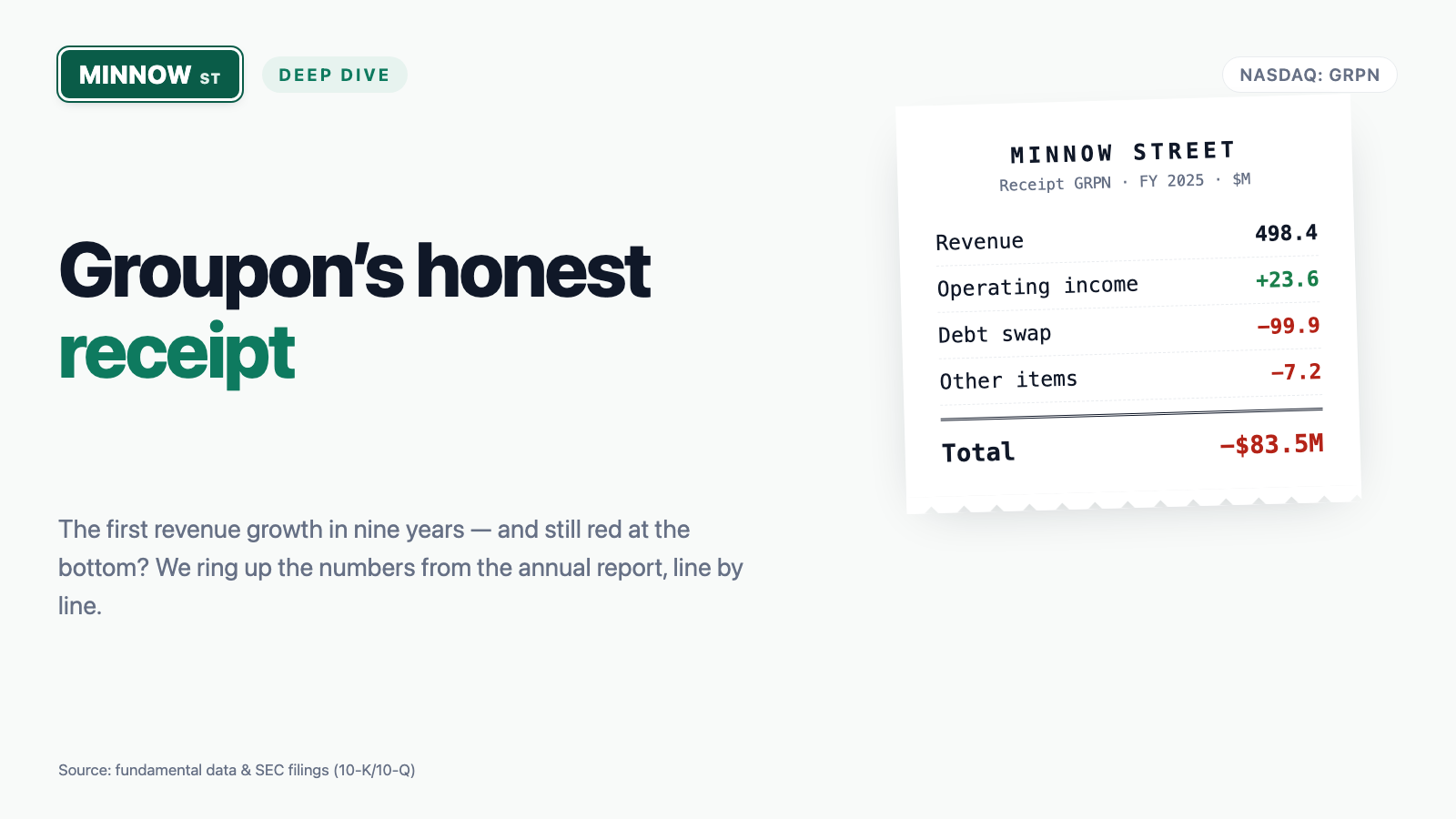
Groupon shows up in our Reddit hype scanner — just 4 mentions in 24 hours (as of July 15, 2026), a whisper rather than a storm, but the whisper has a reason: plus 125 percent in three months (data as of July 8, 2026). The deal pioneer, valued at roughly $12.7 billion at its 2011 IPO price, reports its first revenue growth in nine years under its Czech investor-CEO. We read the annual reports (10-K) for 2024 and 2025 and the quarterly report (10-Q) as of March 31, 2026: bookings are growing, but bought with discounts; the net loss widened to $83.5 million, stockholders' equity is negative, and the July 2025 debt exchange cost $99.9 million on paper. Not investment advice — we simply add up the receipt, line by line.
 Thomas Mücke
Founder & Publisher
Thomas Mücke
Founder & Publisher
Chart
Interactive price chart (TradingView).
Note: pure fact-based analysis, not investment advice and not a solicitation to buy or sell. All figures without guarantee.
There is a number that lodges in the investor brain like an anchor on the seabed: the old price. Psychologists call it the anchoring effect — whatever was once expensive feels forever "really worth more", and the further the price sits below the anchor, the louder the whisper: bargain. Hardly any stock feeds that reflex as reliably as Groupon, Inc. (Nasdaq: GRPN): the $20 offering price valued the deal pioneer at roughly $12.7 billion at its November 2011 IPO — today the company is worth about $0.9 billion, and the share price sits 96.5 percent below its all-time high (data as of July 8, 2026). And right now, of all times, the company reports its first revenue growth in nine years under its Czech investor-CEO, the stock has more than doubled within three months, and the name resurfaces in our Reddit hype scanner — with 4 mentions in 24 hours (as of July 15, 2026) more a whisper than a storm, but whispers are often how it starts. So let\'s make a deal: before the anchor does your thinking, we read the receipt together — the annual report (10-K) for 2025, its predecessor and the quarterly report (10-Q) as of March 31, 2026, all filed with the U.S. securities regulator, the SEC. An SEC filing is honest under penalty of law. And this receipt has line items that appear in no comeback story. In the end, you decide for yourself.
What Groupon actually does — and what the company earns from today
If you remember Groupon only as the 2010s email flood of wellness vouchers: the basic principle still stands. Groupon runs an online marketplace for local experiences — restaurants, massages, go-karting, beauty — plus the categories goods and travel, reported in two segments: North America and International. The business model is that of a commission till: the merchant lists the offer, Groupon brings the customer, collects the purchase price — and keeps a cut before the rest flows to the merchant. In the numbers: in 2025, $1,665.8 million of "gross billings" ran through the till (everything customers paid in total), and $498.4 million of revenue stuck with Groupon — the marketplace operator\'s stall fee, roughly 30 cents per booking dollar. 16.2 million active customers bought at least once in the twelve months through the end of 2025 (plus 5.2 percent). Remarkable is who runs this shop: since 2023, Dusan Senkypl has been at the helm — co-founder and board chairman of the Prague investment group Pale Fire Capital, which per the 2026 proxy statement is the largest stockholder with 26.24 percent. Of 1,734 employees, only 421 still sit in North America; the chief technology officer leads his team from Munich. An American comeback with a European engine room, in other words. Which brings us to the central tension of this analysis, and it runs through every chapter: the turnaround is measurable — customers, bookings and even revenue are growing again. But it is dearly paid for: with discounts that squeeze the margin, a loss that grows faster than revenue, and a balance sheet on which the equity is already used up. How quickly shrunken internet celebrities become comeback stories — and what such waves are worth — is something we dissected at AMC Entertainment; how a Reddit blip and a turnaround diet read side by side, at Wendy\'s.
Where the stock shows up in our scanner
Every day we run about 3,500 stocks through our scanners. Groupon reached our research list via the Reddit hype scanner — 4 mentions in 24 hours (ApeWisdom, as of July 15, 2026), no noise, but a blip, and our radar registers blips too. In the metrics scanners the stock then lights up in 9 filters as of the July 8, 2026 data cut-off — and the list reads like two expert opinions about two different companies. Opinion one, the momentum lens, is thrilled: episodic pivot (a volume-backed price surge after a long base), dollar breakout (bullish), liquid movers (up), inside day and "above the 50- and 200-day averages" — behind them stand plus 125 percent in three months, plus 66 percent in two, and an EPS rating of 86 because earnings estimates are turning. Opinion two, the balance-sheet lens, sounds the alarm: the stock sits in the going-concern distress proxy and in the Altman-Z distress zone — the Altman Z-score, a classic insolvency early-warning built from several balance-sheet ratios, stands at minus 6.97, the Piotroski F-score (a nine-point test of balance-sheet quality) at a meager 3 of 9, the fundamental grade is a D, and the trailing twelve-month numbers (including the debt-swap loss — more on that in a moment) even push interest coverage below zero. On top, the Stan Weinstein scanner files the ticker under stage 3 — the distribution phase in which a steep advance gets decided: breakout or breakdown. Remember this fingerprint: when momentum filters and distress filters fire at the same time, the market is not arguing about the price — it is arguing about the substance.
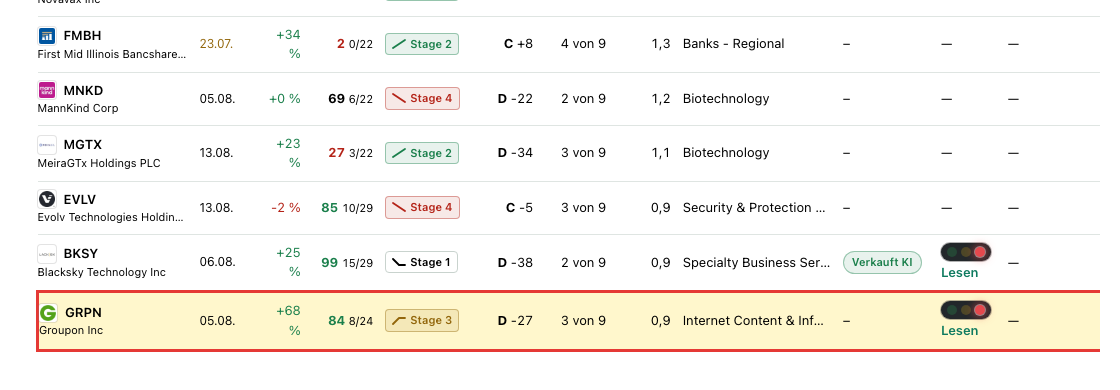
Two qualifications, so the alarm report does not boom louder than it deserves: the Altman Z-score punishes negative equity harshly by construction — for a company with $296.1 million of cash (December 31, 2025), positive free cash flow and no note maturity before 2027, it measures balance-sheet optics more than acute solvency. Groupon is not a bankruptcy candidate in the literal sense based on these filings. But the filters ask the right question, and it is uncomfortable enough: what is a comeback worth that cannot yet afford its own balance sheet?
The numbers over the years — honestly appraised
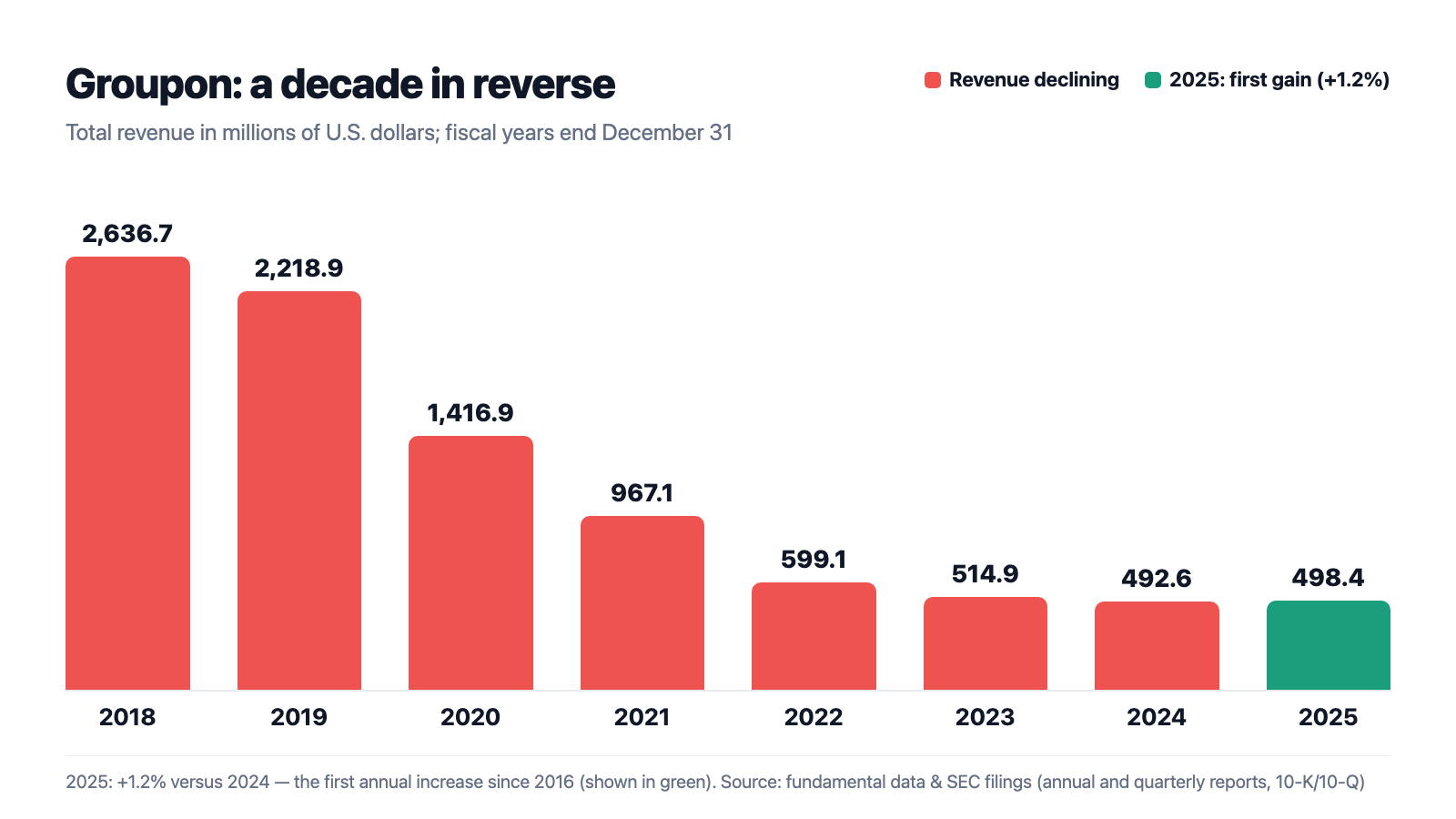
First, what genuinely impresses — and after eight years of continuous shrinkage, that is not a courtesy phrase. When Senkypl took over in March 2023, Groupon was a company in free fall: revenue had collapsed from $3,013.6 million (2016) to $514.9 million (2023), and cash had melted from $498.7 million to $141.6 million within two years. Since then the new leadership has delivered what turnaround managers promise: operating income turned positive in 2024 (+$8.8 million) and nearly tripled to +$23.6 million in 2025. Operating cash flow rose to $64.5 million in 2025, free cash flow to $49.9 million (prior year: $40.6 million), and cash grew to $296.1 million. The customer base is growing again — 16.2 million active customers, plus 5.2 percent, in North America even plus 7.4 percent —, gross billings gained 6.9 percent to $1,665.8 million, and total revenue rose 1.2 percent to $498.4 million in 2025: the first annual increase since 2016. Even the long-bleeding international Local business grew its billings by double digits excluding the abandoned Italian operation, per the annual report. Whoever reads only these paragraphs understands why the stock more than doubled in three months. Now turn the receipt over:
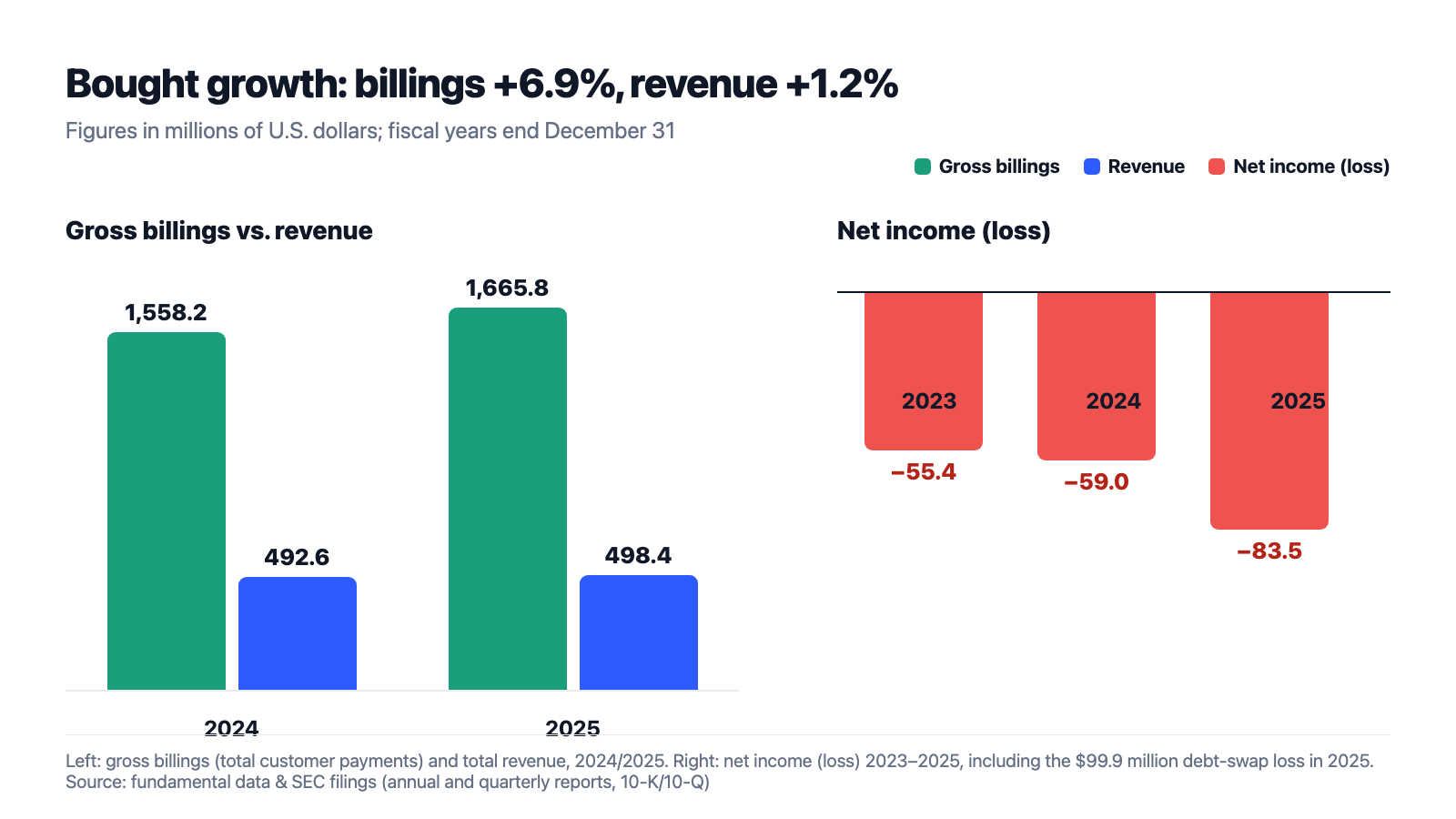
Because the same filings tell the other half: the net loss widened for the third year in a row in 2025 — $55.4 million (2023), $59.0 million (2024), $83.5 million (2025). Adjusted EBITDA stagnated at $69.3 million despite all the growth signals (prior year: $69.3 million). And read against 6.9 percent billings growth, the 1.2 percent revenue increase is not a triumph but a price tag: Groupon lets less of the money passing through stick with it, in order to get the growth at all. Remember the mechanism: at a marketplace, the risk is not the till — it is the stall fee. Whoever has to lower it so that merchants and customers stay is growing at its own expense. Which brings us to the uncomfortable truths.
What the filings say — the uncomfortable truths
Uncomfortable truth no. 1: the growth is bought — with discounts that eat into the commission
The most important line of the annual report sits inconspicuously in the segment discussion of North America, the heart of the company (77 percent of revenue). It explains why 6.9 percent more bookings became only 1.2 percent more revenue:
"Our Local revenue increased by 4.5%, lagging the rate of growth in gross billings as a result of promotional discounts and higher redemption rates."
— Groupon, Inc., SEC annual report 10-K for 2025, Item 7 MD&A "North America"

Translated into shopkeeper English: Groupon puts coupons on the coupons. "Promotional discounts" are price cuts Groupon finances itself to pull customers back onto the platform — they do not shrink the merchant\'s share, they shrink Groupon\'s own commission. Add "higher redemption rates": when more sold vouchers actually get redeemed, Groupon pays out more to merchants and keeps fewer scraps of expired deals. Together that means: the marketplace lowers its stall fee so the market looks full. In parallel, marketing spend rose noticeably per the annual report — more paid search, more customer acquisition. Fairness requires saying: this is exactly what phase one of a turnaround looks like; first comes traffic, then margin — that is management\'s declared bet. But the yardstick stays hard: of the $107.6 million of additional billings, only $5.9 million arrived as revenue at Groupon — roughly five and a half cents per incremental booking dollar, while the existing base delivers about 30 cents. Growth at one-sixth of the list rate is not yet a business model — it is a down payment on one.
Uncomfortable truth no. 2: in the first quarter of 2026, the core market of all places stutters
The comeback narrative lives off North America: that is where customers grew 7.4 percent in 2025, where Local revenue rose 4.5 percent, where the brand\'s pricing power sits. And exactly there, the latest quarterly report logs the first reverse gear of the new era:
"North America revenue, gross profit and cost of revenue decreased by $1.2 million, $0.9 million and $0.3 million for the three months ended March 31, 2026 compared with the prior year period. Our Local revenue decreased 0.5%, lagging the rate of growth in gross billings, as a result of higher promotional discounts."
— Groupon, Inc., SEC quarterly report 10-Q as of March 31, 2026, Item 2 MD&A "North America"

The whole quarter in numbers: total revenue of $117.2 million — to the cent the level of the prior-year quarter. Units sold fell 4.6 percent, in North America even 6.5 percent — fewer deals went over the counter; only higher average baskets and the growing international business (revenue plus 4.7 percent) held the sum together. Operationally the company slid to a $3.3 million loss (prior-year quarter: plus $1.9 million); the bottom line showed a net loss of $12.9 million after $7.2 million of net income — where fairness requires noting that the prior-year quarter was flattered by $10.2 million of currency gains and the current one carried $2.8 million of currency losses; swings like that on intercompany accounts say little about the business. What says a lot: the discounts that bought the 2025 growth got higher in the opening quarter of 2026 — and the core market still produced no growth. One quarter does not break a trend, and management says it keeps investing in the rebuild. But remember the touchstone: a bought comeback must eventually run without register-slip giveaways — this one did not yet in the first quarter of 2026.
Uncomfortable truth no. 3: the debt swap — $224 million of new debt for $150 million of old, booked loss: $99.9 million
Why did the net loss widen to $83.5 million in 2025 even though operating income was positive? The answer sits in the financing footnote, and it is the most expensive single line on the Groupon receipt. The company finances itself with convertible notes — loans with a built-in right to swap into shares. In the summer of 2025, Groupon pushed its most pressing maturities into the future, and the creditors charged for the extension:
"On July 2, 2025, the Company issued its senior, unsecured 2030 Notes, consisting of (i) $20.0 million aggregate principal amount of 2030 Notes issued in exchange for $20.0 million aggregate principal amount of the Company’s outstanding 2026 Notes, and (ii) $224.1 million aggregate principal amount of 2030 Notes issued in exchange for $150.0 million aggregate principal amount of the Company’s outstanding 2027 Notes. The Company determined that the exchange of the 2026 Notes and the 2027 Notes for 2030 Notes should be accounted for as a debt extinguishment, resulting in a loss on extinguishment of debt of $99.9 million."
— Groupon, Inc., SEC annual report 10-K for 2025, Note 8 "Financing Arrangements"

Run the math on that swap, because it is the most honest price tag of this turnaround: for $150.0 million of old debt (due 2027, 6.25 percent interest, secured) there are now $224.1 million of new notes on the books (due June 2030, 4.875 percent, unsecured) — a principal premium of roughly 49 percent for pushing repayment out by three years. The lower coupon is optics: the interest runs on the higher amount, and more has to be repaid at the end. Read positively, the swap buys exactly what a rebuild needs — time: after the $33.7 million of 2026 notes were repaid in cash at maturity in March 2026, only $47.3 million comes due before 2030; the big block of $244.1 million not until June 2030. The dilution risk is theoretical for now, too: the conversion price of the 2030 notes sits at about $54.04 — only far above the July 8, 2026 price level ($22.90) would these debts turn into new shares. But the $99.9 million booked loss — a fifth of annual revenue — is not an accounting blemish; it is the market price of the risk: that is the premium creditors demand for giving a shrunken company with negative equity three more years. Which brings us to the last truth.
Uncomfortable truth no. 4: the equity is gone — minus $42.6 million, on $1.59 billion of accumulated losses
The balance sheet as of December 31, 2025 contains a line you read twice in a comeback story. Subtract everything Groupon owes from everything Groupon owns, and no positive number remains:

Translated with the house image: whoever nets house and mortgage and lands below zero is not automatically insolvent — as long as the salary keeps coming and the bank does not ring. That is exactly the case here: as of December 31, 2025, stockholders\' equity stood at minus $42.6 million (after plus $40.8 million a year earlier — the debt-swap loss punched through the cushion); by March 31, 2026 it was minus $62.6 million. The "accumulated deficit" line — the sum of all losses since the company\'s founding — totals $1,592.4 million: one and a half billion dollars of burned capital is the inheritance this turnaround is built on. The counter-argument management rightly makes: $296.1 million of cash at year-end ($225.5 million at the end of March 2026, after the cash repayment of the 2026 notes), positive free cash flow, and the annual report affirms sufficient liquidity for the next twelve months. The business model helps — customers pay immediately, merchants get their money later, so working capital partly finances itself. Just do not confuse the order: liquidity buys time, equity carries losses — Groupon has plenty of the first and none of the second left. From here, every further loss year draws directly on creditor patience.
Valuation: $0.9 billion of market value — and a fintech stake in the glove compartment
In early July 2026 the Groupon share cost about $22.90, for a market value of roughly $0.87 billion (data as of July 8, 2026). A P/E ratio does not exist for lack of earnings; the price-to-sales ratio sits around 1.75, price to free cash flow around 22 times. Now count like a buyer of the whole company: market value plus roughly $291 million of note principal ($47.3 million of 2027 notes plus $244.1 million of 2030 notes), minus $225.5 million of cash (March 31, 2026) — an enterprise value around $0.94 billion, roughly 19 times the 2025 free cash flow. That is not the valuation of a distressed workout; it is the valuation of a turnaround already believed — after plus 125 percent in three months, the market has front-run half the comeback, while the twelve-month tally of minus 50 percent reminds you how fresh that faith is (all figures: data as of July 8, 2026). Two items belong in every fair calculation: first, Groupon holds 1.79 percent of the payments company SumUp, carried at $74.8 million on the balance sheet — almost one-twelfth of the market value, a quiet asset that already served as an emergency till once, in 2023. Second, the anchor from the beginning: the $12.7 billion of 2011 is no yardstick anymore — 93 percent of the company value of that day is irretrievably history, and whoever buys today is not buying the old giant at a discount, but a small marketplace operator with $498 million of revenue at an ambitious cash-flow multiple.
Opportunities and risks at a glance
What speaks for Groupon:
- The turnaround is measurable, not merely asserted: the first revenue increase in nine years (+1.2 percent to $498.4 million in 2025), gross billings plus 6.9 percent, 16.2 million active customers (+5.2 percent; North America +7.4 percent) — after eight years of continuous shrinkage (annual report 10-K for 2025).
- Operationally back in the black: operating income of +$23.6 million in 2025 (2024: +$8.8 million), $64.5 million of operating and $49.9 million of free cash flow, $296.1 million of cash as of December 31, 2025 — the 2026 notes were repaid in cash in March 2026, and nothing more comes due before 2027.
- Owners with skin in the game: Pale Fire Capital holds 26.24 percent, CEO Senkypl is its board chairman and has led the company since 2023 — the same group backstopped the $80 million rights offering in 2023 (DEF 14A 2026, 10-K 2025).
- A quiet reserve: 1.79 percent of the fintech SumUp (carrying value $74.8 million) plus the definitively settled Italian tax dispute ($25.3 million against a demanded roughly $170 million) — two legacy chapters closed or turned into money.
- Momentum confirms the story short-term: plus 125 percent in three months, an EPS rating of 86, hits in five momentum scanners (data as of July 8, 2026) — the market is beginning to price the turn.
What speaks against it:
- The growth is discount-financed: revenue +1.2 percent on billings +6.9 percent because promotional discounts and higher redemption rates squeeze the commission (10-K 2025); the net loss widened for the third year in a row to $83.5 million, and adjusted EBITDA stagnates at $69.3 million.
- The core market turned negative in the first quarter of 2026: North America revenue minus 1.3 percent, Local minus 0.5 percent on "higher promotional discounts", units sold minus 6.5 percent; an operating loss of $3.3 million and a net loss of $12.9 million (10-Q as of March 31, 2026).
- The debt swap was expensive: $224.1 million of new 2030 notes for $150.0 million of old 2027 notes — a roughly 49 percent principal premium and a $99.9 million booked loss; the interest burden runs on the increased amount (10-K 2025, Note 8).
- The balance sheet carries nothing anymore: stockholders\' equity of minus $42.6 million (12/31/2025) and minus $62.6 million (03/31/2026) on an accumulated deficit of $1,592.4 million; an Altman Z-score of minus 6.97, Piotroski 3 of 9, hits in two distress scanners (data as of July 8, 2026).
- The valuation front-runs the turn: an enterprise value around 19 times free cash flow and plus 125 percent in three months meet stage 3 (distribution phase) and minus 50 percent over twelve months — whoever buys now pays for proof that only the coming quarters can deliver (data as of July 8, 2026).
A human conclusion
Back to the anchor from the beginning. It has a true core that must be granted: Groupon is in fact no longer a demolition site. The new leadership has delivered what nobody delivered for years — growing customers, growing bookings, an operating profit, a filled till, even the first revenue increase since 2016. Whoever bought in 2023 bet on exactly these proofs and won. But check what your anchor is really tied to: the $12.7 billion of 2011 — or the $0.9 billion of today? The company in the SEC filings is a small marketplace operator that pays for its growth with discounts, whose net loss grows faster than its revenue, whose equity is used up, and whose creditors charged a 49 percent principal premium for the latest extension. None of that is a death sentence — the till is full, nothing comes due before 2027, and if anything, the case shows how much time a determined anchor shareholder can buy. But the order of proof belongs on the table: only when North America grows without rising discounts, and something also sticks below the operating line, does the comeback bet become a business — before that, the 125 percent price surge is an advance on quarters that still have to happen. An anchor does not measure depth. It only holds on to what you refuse to let go. What you make of it is your decision. And that is exactly as it should be.
Sources
All original documents used in this analysis — for your own reading:
- Groupon, Inc. — SEC annual report 10-K for 2025 (filed March 10, 2026)
- Groupon, Inc. — SEC annual report 10-K for 2024 (filed March 11, 2025)
- Groupon, Inc. — SEC quarterly report 10-Q as of 03/31/2026 (filed May 7, 2026)
- Groupon, Inc. — Proxy statement DEF 14A (filed April 28, 2026) — ownership structure
- Groupon, Inc. — IPO prospectus 424(b)(4) (filed November 7, 2011) — offering price and share count
- Complete SEC filing history of Groupon, Inc.: EDGAR overview (sec.gov)
- Fundamental data (metrics, quarterly series, valuation; data as of July 8, 2026), cross-checked against the SEC filings.
- Screener and rating data: in-house stock scanner (data as of July 8, 2026); Reddit mentions: ApeWisdom (as of July 15, 2026).
Transparency & disclaimer: This analysis is a journalistic contextualization of publicly available information and is not investment advice, not a financial analysis in the regulatory sense and not a solicitation to buy or sell securities. Stock investments carry substantial risks up to and including total loss. All information without guarantee; the data cut-off is noted in the text throughout. The author holds no position in Groupon shares at the time of publication.
Our Bottom Line at a Glance
- Turnaround & customer growth positive
- After eight years of continuous shrinkage, the new leadership delivers proof: the first revenue increase since 2016 (+1.2 percent to $498.4 million), gross billings +6.9 percent, 16.2 million active customers (+5.2 percent), operating income of $23.6 million, free cash flow of $49.9 million (annual report 10-K for 2025).
- Quality of growth negative
- The growth is discount-financed: promotional discounts and higher redemption rates squeeze the commission, revenue grows only one-sixth as fast as billings; the net loss widened for the third year in a row to $83.5 million, and in the first quarter of 2026 North America Local revenue turned negative despite higher discounts (−0.5 percent; 10-Q as of March 31, 2026).
- Balance sheet & equity negative
- Stockholders' equity of minus $42.6 million (12/31/2025) and minus $62.6 million (03/31/2026) on an accumulated deficit of $1,592.4 million; an Altman Z-score of minus 6.97, Piotroski 3 of 9, hits in the going-concern distress proxy and the Altman-Z distress zone (data as of July 8, 2026). From here, losses effectively draw on the creditors' side.
- Liquidity & maturities neutral
- $296.1 million of cash (12/31/2025) and positive free cash flow stand against roughly $291 million of note principal; the 2026 notes were repaid in cash in March 2026, and nothing comes due before 2027. But the time gained was expensive: $224.1 million of new 2030 notes for $150.0 million of old 2027 notes, a booked loss of $99.9 million (10-K 2025, Note 8).
- Valuation & technicals neutral
- An enterprise value around 19 times free cash flow, P/S 1.75, no P/E; plus 125 percent in three months and five momentum-scanner hits against stage 3 (distribution phase) and minus 50 percent over twelve months. The SumUp stake (carrying value $74.8 million) is a quiet reserve of almost one-twelfth of the market value (data as of July 8, 2026).
Groupon is no longer a demolition site, but not yet a self-supporting business either: the new leadership around Pale Fire Capital has brought customers, bookings and even revenue back into positive territory and filled the till to $296.1 million (12/31/2025). Yet the growth is bought with discounts, the net loss widened to $83.5 million, stockholders' equity is negative, and the creditors charged a roughly 49 percent principal premium for the maturity extension — a $99.9 million booked loss. After plus 125 percent in three months, the price already reflects part of a turn that the coming quarters still have to prove. Not investment advice.
What Our Rating Means
- If you don't own the stock
- In our view, the documented risks clearly outweigh — we see no basis for an entry.
- If you hold it in your portfolio
- In our view, the findings carry enough weight to warrant a critical look at your own position.
A journalistic assessment by our editorial team at the time of the deep dive, based on public sources — not investment advice and not a solicitation to buy or sell. Your personal circumstances (investment goals, risk capacity, taxes) cannot be taken into account. What our categories mean, how verdicts are formed, and what conflicts of interest exist →
Worth Noting
- GRPN reached our research list via the Reddit hype scanner (ApeWisdom, 4 mentions in 24 hours, as of July 15, 2026) — a deliberately small attention wave; snapshots like this are no verdict on quality. The 9 hits in our in-house stock scanner carry the July 8, 2026 data cut-off and shift daily.
- Scanner metrics (Altman Z, Piotroski, interest coverage, price/FCF) are computed on trailing twelve-month numbers; the July 2025 debt-swap loss ($99.9 million) distorts them downward into mid-2026 — and the Altman Z-score punishes negative equity harshly by construction.
- Price and valuation figures are dated July 8, 2026 (about $22.90, about $0.87 billion in market value); analyses are evergreen, daily prices are not a buy argument.
Frequently Asked Questions
Groupon, Inc. (Nasdaq: GRPN) runs an online marketplace for local experiences, goods and travel and earns net commissions: the company collects the purchase price, keeps a cut and passes the rest to the merchant. In 2025, $1,665.8 million of gross billings flowed through the platform; $498.4 million of that remained as revenue — roughly 30 cents per booking dollar. 16.2 million active customers used the platform (per the annual report 10-K for 2025).
Partly. In 2025, revenue rose 1.2 percent to $498.4 million — the first annual increase since 2016 — while gross billings grew 6.9 percent and active customers 5.2 percent. But the growth is bought with discounts, the net loss widened to $83.5 million, and in the first quarter of 2026 total revenue stagnated at $117.2 million; North America revenue fell 1.3 percent (quarterly report 10-Q as of March 31, 2026).
The $20 offering price valued Groupon at roughly $12.7 billion at its November 2011 IPO. Afterwards, revenue shrank from a peak of $3,013.6 million (2016) to $492.6 million (2024) — eight years of continuous shrinkage with recurring losses. On July 8, 2026, the stock traded 96.5 percent below its all-time high, at a market value of about $0.87 billion — despite gaining 125 percent in the three months before.
The largest stockholder is the Prague investment group Pale Fire Capital with 10,181,070 shares, or 26.24 percent (proxy statement DEF 14A, April 2026). CEO Dusan Senkypl is simultaneously chairman of Pale Fire's board and has led Groupon since March 2023 (initially as interim CEO, permanently since May 2024); COO Jiri Ponrt also came from Pale Fire. The group backstopped the $80 million rights offering in 2023 as well.
After the cash repayment of the 2026 convertible notes ($33.7 million) in March 2026, two convertible notes remain outstanding: $47.3 million due 2027 (6.25 percent, secured) and $244.1 million due June 2030 (4.875 percent, unsecured, conversion price about $54.04) — roughly $291 million of principal combined. Against that stood $225.5 million of cash as of March 31, 2026. Stockholders' equity, however, is negative: minus $62.6 million (10-Q as of March 31, 2026).
Groupon holds 1.79 percent of the privately-held payments company SumUp (SumUp Holdings S.a.r.l.) — per the annual report 10-K for 2025 the only equity investment with a positive carrying value; the balance-sheet line "Investments" stood at $74.8 million as of December 31, 2025, almost one-twelfth of the market value (data as of July 8, 2026). In 2023, Groupon already sold about 21.1 percent of its stake for $19.0 million in cash.
Not by classic yardsticks: a P/E ratio does not exist for lack of earnings, the price-to-sales ratio sits around 1.75, and the enterprise value (market value plus notes minus cash) is around 19 times the 2025 free cash flow (data as of July 8, 2026). After plus 125 percent in three months, the market already prices part of the turnaround — while equity and net income are still negative. The stock only becomes cheap once the comeback also arrives on the bottom line.
Found an error?
Did you spot a factual error, an outdated number, or a typo in this deep dive? Let us know briefly — your report goes straight to the editorial team.