Copart: A 30-Year Exceptional Stock Falls 56 Percent — and Answers With the Biggest Buyback in Its History
Copart auctions what auto insurers write off — a duopoly business with a 36 percent operating margin, $4.2 billion of liquidity and zero bank debt (April 30, 2026). But for the first time in more than a decade, revenue has stopped growing (first nine months of fiscal 2026: down 0.2 percent), U.S. volumes are falling, industry reports say key client Progressive is increasingly unloading at rival IAA, and the CEO leaves at fiscal year-end. The company's answer: $1,632.5 million of share buybacks in nine months — after three years of none. Not investment advice — just the question of whether a cycle is sagging here or a moat is leaking.
 Thomas Mücke
Founder & Publisher
Thomas Mücke
Founder & Publisher
Chart
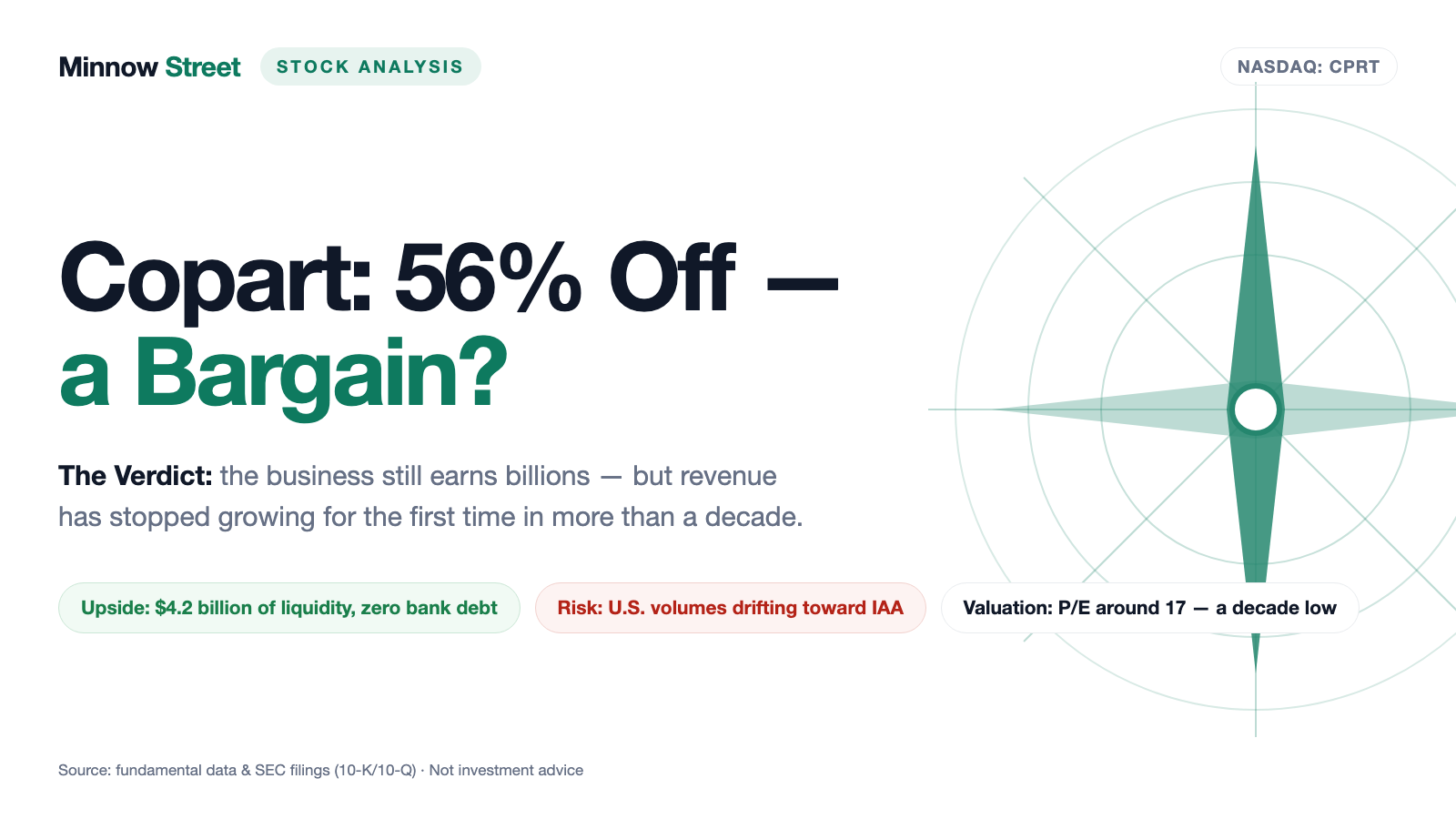
Interactive price chart (TradingView).
Note: pure fact-based analysis, not investment advice and not a solicitation to buy or sell. All figures without guarantee.
The halo effect: when 30 good years start doing your thinking
There is an investor trap that catches the most patient investors of all: the halo effect. It works like this: a stock has made you — or the legends you follow — rich over decades. At some point you stop checking the company and only check the discount. When a stock like that gets cut in half, the reflex fires instantly: "a quality business like this always comes back. This is a gift." Maybe. But the halo never answers the only question that matters now: is the headwind temporary — or has something changed in the business itself?
Copart (Nasdaq: CPRT) is the perfect test case for that reflex. One dollar invested in the stock in early 2000 was worth about $79 at the peak in May 2025 — and still about $34 even after the crash (adjusted price history, as of July 24, 2026). And now this: from the closing high of $63.84 (May 16, 2025) the stock fell to $27.94 by July 24, 2026 — minus 56 percent, minus 57 at the interim low. The last deeper slide ended back in 2003; even the 2008 financial crisis cost the stock "only" 52 percent. So let's make a deal: we hang the halo on the coat rack and read together what Copart itself reported, under penalty of law, to the U.S. securities regulator, the SEC — the annual report (10-K) for fiscal 2025, the three quarterly reports (10-Q) of the current year, and the current reports (8-K) of recent months. In the end you decide for yourself whether a 56 percent discount is a gift — or a fair price for a business facing its first serious question in a long time.
What this analysis covers
- What Copart actually does: the undertaker of the automobile
- How the stock landed on our desk
- The numbers over the years — honestly appraised
- Uncomfortable truth no. 1: U.S. volume is falling — and the industry's most important client is unloading elsewhere
- Uncomfortable truth no. 2: three years of no buybacks — then $1.6 billion in the middle of the crash
- Uncomfortable truth no. 3: the captain leaves the ship — and the founder's son-in-law takes the wheel again
- Valuation: the cheapest in over a decade — for a reason
- Opportunities and risks at a glance
- A human conclusion
- Sources
What Copart actually does: the undertaker of the automobile
When a car costs more to fix than it is worth after an accident, the insurer writes it off — a "total loss." That is exactly where Copart's business begins. The Dallas-based company picks up the vehicle, stores it in one of its yards and auctions it through its own online platform, VB3, to dismantlers, repair shops, dealers and exporters around the world. Founder Willis Johnson, who started with a single junkyard in California in 1982, described the business model in his book "Junk to Gold" (2014) like this: "We are like the septic tanks of the sewer system. You can't have the system without us." Not exactly charming. But it captures the essence: Copart is the undertaker of the automobile — a business nobody envies and almost nobody can replicate.
The scale, per the latest filings: 281 operating facilities worldwide (10-K for fiscal 2025, the year ended July 31, 2025), by the company's own account "over 250 locations in 11 countries" with more than 4 million vehicles sold in the last twelve months (Q3 press release, May 2026). About 1 million registered bidders from over 185 countries participate — and because demand is global, 69.8 percent of U.S. vehicles in fiscal 2025 went to buyers outside the vehicle's state, and 38.8 percent of all U.S. vehicles sold went to international bidders. Much of the land under the storage yards belongs to the company itself: the book value of real estate rose 18 percent in one year to $2,394.6 million (July 31, 2025). Remember this detail — whoever owns the yards where an entire industry parks its wrecks holds a moat made of concrete and acreage. Copart has also operated in Germany since 2012 (acquisition of the salvage exchange WOM) and runs a network of yards there from Hanover to Mannheim; its largest foreign market is the United Kingdom.
Where the merchandise comes from, the annual report states with unusual clarity:
"We process vehicles from hundreds of different vehicle sellers. No single customer accounted for more than 10% of our consolidated revenues for fiscal 2025, 2024, or 2023 and our business does not depend on any particular customer to remain profitable. We obtained 81%, 81%, and 83% of the total number of vehicles processed during fiscal 2025, 2024, and 2023, respectively, from insurance company sellers."
— Copart, Inc., SEC annual report 10-K for fiscal year 2025, Item 1
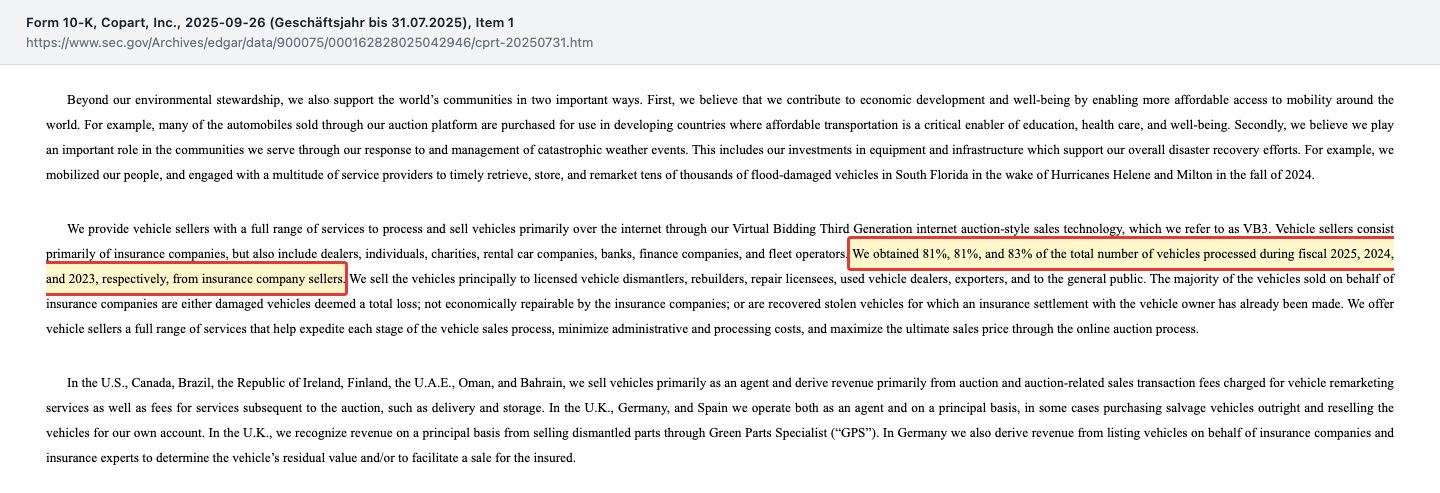
Both halves of that quote are true — and the risk lives exactly between them. No customer brings more than 10 percent of revenue, correct. But four out of five vehicles come from a single industry, and the very first risk factor in the annual report says verbatim that Copart depends "on a limited number of major vehicle sellers." Picture a baker with hundreds of customers — but four out of five rolls are bought by the same canteen. The industry's tailwind was Copart's best ally for decades: cars keep getting more complex and more expensive to repair, so insurers write them off more often. The total-loss rate of the U.S. claims industry reached a record of roughly 23 percent of reported claims in 2025, per data specialist CCC; outgoing Copart CEO Jeff Liaw once put the figure at about 4 percent around 1980. "One in 25" became "almost one in 4." We analyzed the supplier of that statistic, CCC Intelligent Solutions, in detail here. That names the central tension of this analysis, and it runs through every chapter: a decades-old structural tailwind meets, for the first time, a double headwind — an insurance cycle that costs volume, and a competitor courting the industry's most important client.
How the stock landed on our desk
This time it was not a scanner but market observation: in July 2026, Copart's string of new 52-week lows would not stop — on July 23, 2026 the stock marked its low of the year at $26.81, and the close on July 24, 2026 was $27.94. We then recalculated the full price history since 2000 (fundamental data, adjusted closes, as of July 24, 2026): from the high of $63.84 (May 16, 2025) that is minus 56.2 percent; at the interim low of July 21–22, 2026 ($27.17) it was minus 57.4 percent. For comparison, the big declines before it: 2001 to 2003 minus 72.5 percent, the 2008 financial crisis minus 51.8 percent, the 2020 COVID crash minus 43.7 percent, the 2021/22 rate shock minus 35.4 percent. The current slide is the deepest in more than 20 years. When a stock that knew almost only one direction for two decades falls like this, there are two possibilities: the market is overreacting — or it has understood something. Let's find out which.
The numbers over the years — honestly appraised
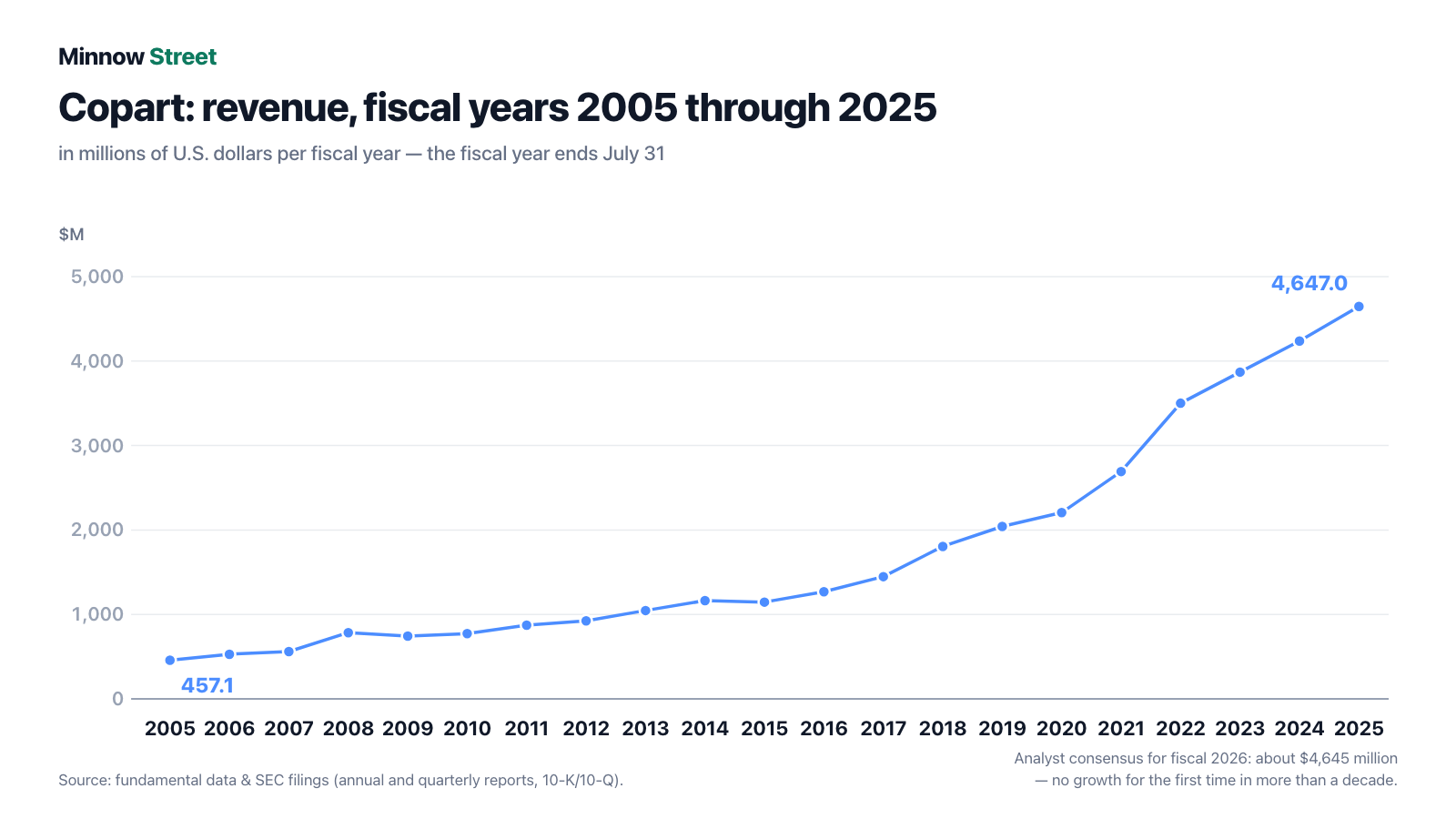
First, what genuinely impresses — and at Copart that is a lot. Revenue rose from $457.1 million in fiscal 2005 to $4,647.0 million in fiscal 2025 (the year ended July 31, 2025) — a tenfold increase in two decades, with only two small dents (2009 and 2015). Most recently: up 10.5 percent (fiscal 2023), up 9.5 percent (fiscal 2024), up 9.7 percent (fiscal 2025).
The quality of that revenue is just as exceptional. In fiscal 2025, $1,696.7 million of it remained as operating income — an operating margin of 36.5 percent — and $1,552.4 million as net income (a 33.4 percent margin). For perspective: of $100 in revenue, a typical car dealer keeps two or three dollars; Copart keeps more than 33. Operating cash flow was $1,799.8 million; after $569.0 million of capital spending, free cash flow came to $1,230.8 million (fiscal 2025; fiscal 2024: $961.6 million; fiscal 2023: $847.6 million). And the balance sheet as of April 30, 2026 is a fortress: $4,199.7 million in cash and short-term U.S. Treasury bills, zero bank and bond debt (just $93.1 million of lease liabilities), $8,774.3 million of equity against $9,649.0 million in total assets — an equity ratio of 91 percent. Plus a new, unsecured $1,250 million revolving credit line signed in January 2026 (running to 2031) — untouched.
And now the crack in the facade. The three quarters of the current fiscal year 2026: revenue up 0.7 percent (Q1 through October 31, 2025), down 3.6 percent (Q2 through January 31, 2026), up 2.1 percent (Q3 through April 30, 2026). After nine months the books show $3,513.8 million — 0.2 percent less than a year earlier. That sounds like nothing, but it is historic: analyst consensus expects $4,644.8 million for the full fiscal year 2026 (ends July 31, 2026) — just below the prior year's $4,647.0 million (data as of July 26, 2026). Every single year of the past decade grew at least 8 percent; the last revenue decline dates to fiscal 2015 (down 1.5 percent). Fiscal 2026 is thus on track to be the weakest year in more than a decade. Earnings are holding up better: $1,156.8 million of net income after nine months (prior year: $1,156.1 million), while earnings per share rose from $1.18 to $1.20 — more on that in a moment, because that little gap has a name: share buyback.
Uncomfortable truth no. 1: U.S. volume is falling — and the industry's most important client is unloading elsewhere
Why has revenue stalled? The quarterly report as of April 30, 2026 spells it out: U.S. service revenue — the core business — fell to $895.5 million in the third quarter (prior year: $898.6 million; down 0.4 percent) and stands at $2,570.5 million after nine months (prior year: $2,626.7 million; down 2.1 percent). That group revenue still grew 2.1 percent to $1,237.1 million in the quarter is owed entirely to the international business: the segment grew 14.1 percent to $234.2 million (service revenue even 17.9 percent to $160.6 million). On the cause in the U.S., the report writes for the quarter:
"The decrease in the U.S. compared to the same period last year was primarily driven by a decrease in volume, partially offset by an increase in revenue per car."
— Copart, Inc., SEC quarterly report 10-Q as of April 30, 2026, MD&A "Service Revenues"
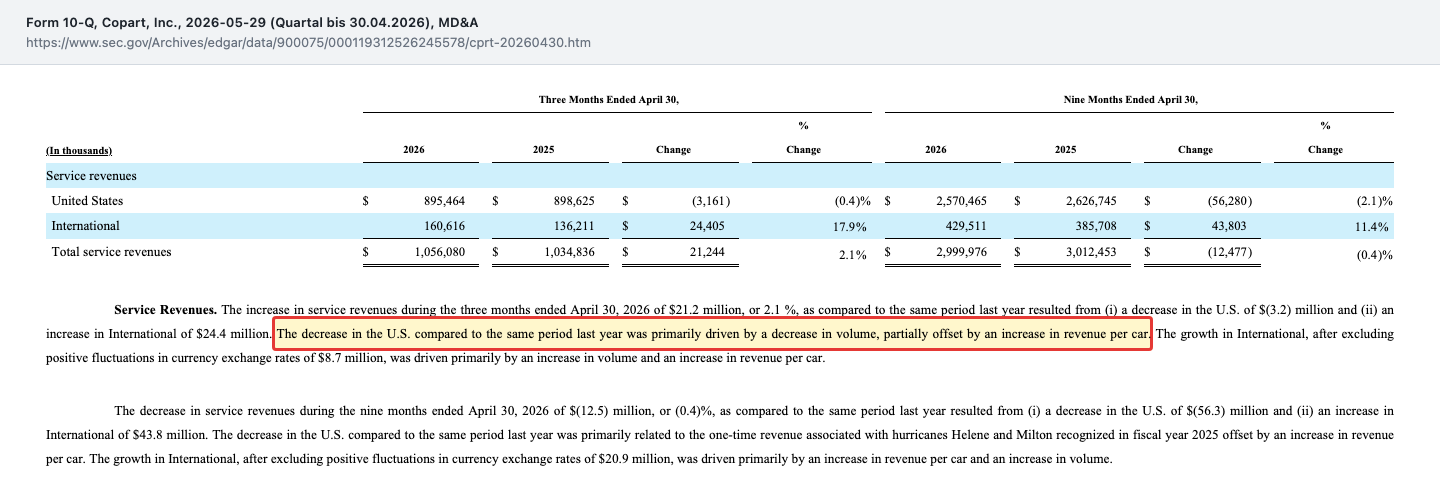
Behind the dry word "volume" sit two stories. The first is the insurance cycle: after years of drastic premium hikes, Americans are cutting back on car insurance — the average full-coverage premium fell 6 percent in 2025, and per industry data roughly one in twelve drivers downgraded from full coverage to liability-only in 2025. But a liability-only driver's wreck never reaches the insurer after a crash — and therefore never reaches Copart. On the Q3 earnings call (May 2026), management put the industry's insured car years at minus 4 percent year over year and said one in six policyholders has reduced coverage — management's framing: cyclical, not structural. How brutally this premium cycle hits everyone attached to auto insurance is something we dissected in our EverQuote analysis — there as a tailwind, here as a headwind.
The second story is more uncomfortable, and it does not appear in Copart's filings: competition. The U.S. salvage-auction market is a duopoly — Copart processes about 4 million vehicles a year, rival IAA (part of RB Global since 2023) about 2.5 million. For years IAA lost share to Copart; since 2025 the picture has turned. Industry reports (Transportation Today, December 2025, based on Bank of America analyst work) estimate that RB Global has expanded its share of the total-loss volume of Progressive — one of the largest U.S. auto insurers — from about 75 to about 90 percent; a Progressive claims manager had still put Copart's share at about 20 percent in an expert interview in mid-2025 (In Practise). At the end of 2025, RB Global reported rising U.S. unit volumes (up 4.7 percent year over year) while Copart's volume fell. Important context: neither Progressive nor IAA is named in any Copart filing — the company discloses no customer names, and no customer crosses the 10 percent threshold. But the direction of the documented numbers — U.S. service revenue down 2.1 percent over nine months while the competitor grows and total demand stagnates — matches exactly what the industry reports describe. To be fair, one caveat belongs here: for the nine months, the quarterly report cites the prior-year base as the main reason — fiscal 2025 included one-time revenue from hurricanes Helene and Milton. Remember the difference: a cycle costs the whole industry volume. A client shifting costs only one company — and it rarely comes alone.
Uncomfortable truth no. 2: three years of no buybacks — then $1.6 billion in the middle of the crash
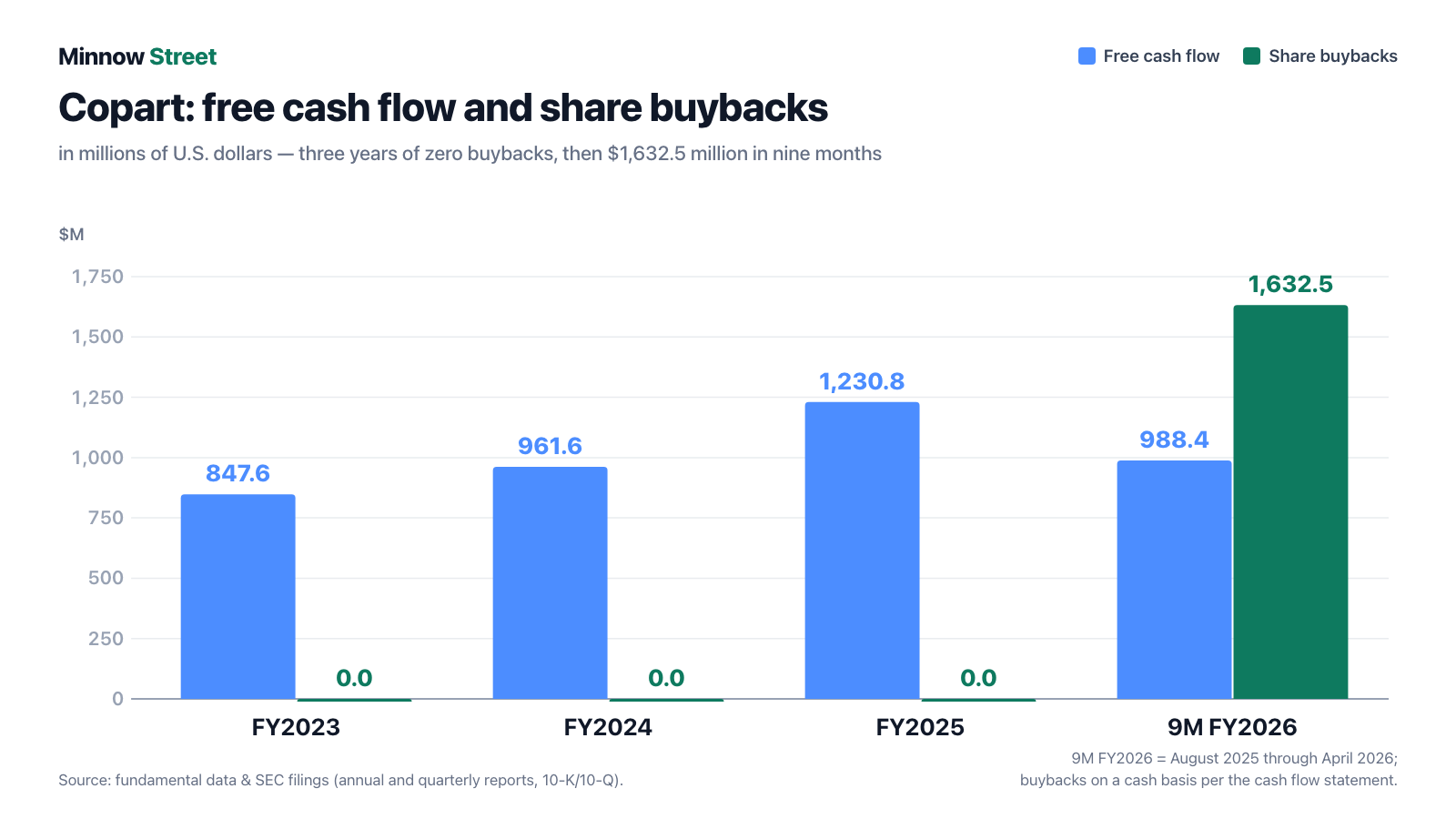
Now to the most remarkable number of the current year. Copart has had a share repurchase program since 2003, last expanded in 2011 — and bought not a single share under it in fiscal years 2023, 2024 and 2025. The company sat on its growing cash pile and let the stock climb. Then came the crash — and Copart opened the throttle:
"The Company repurchased 43,433,164 shares of its common stock during the nine months ended April 30, 2026 at a weighted average price of $37.63 per share totaling $1,632.5 million. The Company did not repurchase any common stock under the program during the nine months ended April 30, 2025."
— Copart, Inc., SEC quarterly report 10-Q as of April 30, 2026, Note 6 "Stock Repurchases"

The pace of those purchases is the real message. It started with $218.2 million in the quarter through January 2026 (5.5 million shares at an average of $39.82). Then, as the price kept falling, came the record quarter through April: roughly $1,414 million in a single quarter — 22.4 million shares in February at an average of $37.01 and 15.6 million in March at $37.69. The share count fell 4.3 percent in nine months to 925.8 million (as of May 27, 2026). That is exactly where the little gap from the numbers chapter comes from: net income was flat after nine months, yet earnings per share rose from $1.18 to $1.20 — fewer shares, same profit, more per share. The funding came out of the bulging treasury: the stock of short-term U.S. Treasury bills fell from $2,008.5 million to $845.6 million, total liquidity from $4,789.1 million to $4,199.7 million. Two footnotes belong to the honest picture: first, Copart bought zero shares in April 2026 — whether pause or change of course, only the next report will tell; the authorization still allows 282.4 million more shares. Second, a buyback is not a growth strategy: it says management considers its own stock undervalued — and that it saw no better use for $1.6 billion. Copart, by the way, has never paid a dividend since its 1994 IPO.
Uncomfortable truth no. 3: the captain leaves the ship — and the founder's son-in-law takes the wheel again
Five and a half weeks after the Q3 numbers, on June 29, 2026, came the current report that pushed the stock down about 8 percent on the day of the announcement and triggered new 52-week lows shortly after:
"On June 29, 2026, Copart, Inc. (the "Company") announced that its Board of Directors (the "Board") appointed A. Jayson Adair, the Company's current Executive Chairman, as Chief Executive Officer and principal executive officer (the "CEO Transition"), effective as of July 31, 2026 (the "Transition Date"). Mr. Adair succeeds Jeffrey Liaw, who will step down as Chief Executive Officer and principal executive officer and will resign from the Board, each effective as of the Transition Date."
— Copart, Inc., SEC current report 8-K of June 29, 2026, Item 5.02

There are two ways to read this switch. The reassuring one: Jay Adair is no stranger — he is the son-in-law of founder Willis Johnson, with the company since 1989 and already CEO from 2010 to 2022. The man under whom much of the historic rise happened takes back the wheel, and with Jane Pocock the head of the successful UK business moves up to President effective August 1, 2026. The filing also stresses that Liaw's departure was "not the result of any disagreement." The uncomfortable reading sits in the details of the same filing: Liaw leaves in the middle of the deepest crash in 20 years, at the end of the first fiscal year without growth — and his transition agreement is remarkably generous: an advisory role through July 2027 for payments totaling $900,000, a fiscal 2026 bonus, 20 hours of private jet use and, above all, relief on his equity awards — the price hurdles on his 2021/2022 option packages are dropped, as is the ten-year holding requirement on his 2022 restricted stock. Someone negotiating terms like these is not leaving in anger — but he is leaving for good. For you as an investor, the sober question remains: a company whose founding family and leadership circle hold more than 10 percent of the shares (per the 10-Q as of April 30, 2026) brings back the old captain in its first real crisis in years. That can mean stability — or that the family only trusts the wheel to one of its own. Both belong in your calculation. For completeness: since October 2023, the U.S. Department of Justice has been investigating possible money-laundering issues around the auction platform; Copart says it cannot estimate the outcome (10-K for fiscal 2025; 10-Q as of April 30, 2026, Note 9).
Valuation: the cheapest in over a decade — for a reason
So what does this company cost now? On July 24, 2026 the stock closed at $27.94, for a market value of about $25.9 billion (925.8 million shares per the quarterly report times the anchor price) (all valuation figures: data as of July 24–26, 2026; they serve as a dated anchor, not a daily-price argument). The trailing price-to-earnings ratio is about 17 — against a ten-year average of about 29. Enterprise value (market value minus net liquidity) equals roughly 13 times annual operating income; the EV-to-EBITDA multiple sits below its entire ten-year range. Trailing free cash flow ($1,339.2 million) works out to a yield of about 5 percent on the market value. In short: measured against its own history, Copart is the cheapest it has been in more than a decade. In absolute terms, though, a P/E of 17 with a price-to-sales ratio of 5.6 is still the price of a quality business, not a clearance rack: the market still pays for duopoly, margin and balance sheet — it just no longer pays for growth. The professionals' view (data as of July 26, 2026): 5 of 11 analysts rate the stock a buy, 6 a hold, none a sell; the mean price target of $40.30 sits about 44 percent above the anchor price. Analyst targets are opinions, not entitlements — but they show the professionals mostly betting on "cycle," not "break." A reminder why that distinction is everything: if Copart grows again from fiscal 2027 — consensus expects revenue up 3.9 percent to $4,826.6 million and earnings of $1.68 per share — this will look like a rare buying opportunity in hindsight. If the U.S. volume stays gone, a P/E of 17 for an ex-growth stock is not a bargain but fair.
Opportunities and risks at a glance
What speaks for Copart:
- A duopoly business with network effects: about 4 million vehicles sold per year, 1 million registered bidders in over 185 countries, 281 company facilities — and real estate with a book value of $2,394.6 million (July 31, 2025) that no attacker can replicate quickly.
- Exceptional earnings power: a 36.5 percent operating margin and $1,230.8 million of free cash flow in fiscal 2025; even in the stagnation year 2026, $988.4 million of free cash flow remained after nine months.
- A fortress balance sheet: $4,199.7 million of liquidity, zero bank and bond debt, a 91 percent equity ratio (April 30, 2026) — plus an untouched $1,250 million credit line.
- The structural tailwind is intact: the total-loss rate hit a record of roughly 23 percent of U.S. claims in 2025 (CCC), and Copart itself expects the long-term trend to continue, per its annual report.
- International grows double-digit (up 14.1 percent in the quarter through April 30, 2026), management is buying its own stock more aggressively than ever in recent history ($1,632.5 million in nine months), and the valuation is the lowest in over a decade (P/E about 17, as of July 26, 2026).
What speaks against it:
- No growth for the first time in over a decade: revenue down 0.2 percent after nine months of fiscal 2026, U.S. service revenue down 2.1 percent; consensus sees the full year just below the prior year.
- Concentration on one industry: 81 percent of vehicles come from insurers, and the annual report's first risk factor warns of dependence on a few major vehicle sellers — while industry reports say Progressive is shifting volume to rival IAA (Copart's share per analyst estimates of late 2025: only about 10 percent).
- The insurance cycle bites: falling premiums, roughly one in twelve U.S. drivers downgraded to liability-only in 2025, insured car years down 4 percent per management — fewer comprehensive policies mean fewer wrecks for the auction.
- Leadership upheaval at the worst moment: CEO Jeff Liaw leaves effective July 31, 2026 in mid-crash with a generous transition package; returning CEO Jay Adair stands for founding-family continuity (insiders hold over 10 percent), not an independent fresh start. A DOJ money-laundering investigation has also been running since October 2023, outcome open.
- The valuation is only relatively cheap: a P/E of about 17 and a price-to-sales ratio of 5.6 (as of July 26, 2026) still price in a quality business — if growth does not return, the valuation loses its argument.
A human conclusion
Back to the halo from the opening. It is not undeserved: Copart proved for three decades that a world-class business can be built on the wrecks of the car world — with margins, balance sheet and market position most companies dream of. None of that has disappeared. But the halo must not dictate the order of your checks. The honest inventory from the filings reads: growth is gone for the first time in more than a decade, U.S. volume is falling, the company's most important customer type is buying less comprehensive coverage, one major client is — per industry reports — increasingly unloading at the only real competitor, and the CEO leaves ship and board at year-end. Against that stand a fortress balance sheet, an intact decades-long trend toward write-off instead of repair, a double-digit-growth international business — and a management team that bet $1.6 billion of its own money on "cyclical," though it also paused in April. Whether you follow that bet depends not on the discount but on your answer to a single question: do you believe the insurers come back and the duopoly holds — or is Copart learning that even septic tanks can face competition? The next annual report (expected September 2026) will deliver the first answers: the first full year without growth, the buyback grid after the April pause, and the first months of the new old CEO. What you make of it is your decision. And that is exactly as it should be.
Sources
All original documents used in this analysis — for your own reading:
- Copart, Inc. — SEC quarterly report 10-Q as of April 30, 2026 (filed May 29, 2026) — most recent periodic report, fully reviewed
- Copart, Inc. — SEC quarterly report 10-Q as of January 31, 2026 (filed March 3, 2026)
- Copart, Inc. — SEC quarterly report 10-Q as of October 31, 2025 (filed November 24, 2025)
- Copart, Inc. — SEC annual report 10-K for fiscal year 2025 (filed September 26, 2025)
- Copart, Inc. — SEC annual report 10-K for fiscal year 2024 (filed September 30, 2024)
- Copart, Inc. — SEC current report 8-K on the CEO transition (filed June 29, 2026) and 8-K on the appointment of Jane Pocock as President (filed July 8, 2026)
- Copart, Inc. — SEC current report 8-K on the new $1,250 million credit agreement (filed January 26, 2026)
- Copart, Inc. — Q3 fiscal 2026 press release (8-K EX-99.1, May 21, 2026)
- Complete SEC filing history of Copart, Inc.: EDGAR overview (sec.gov)
- Fundamental data (metrics, analyst consensus, price history since 2000; data as of July 26, 2026, prices through July 24, 2026), cross-checked against the SEC filings.
- Industry sources, each dated in the text: CCC total-loss data (Crash Course 2025/2026), Transportation Today on the Progressive shift (December 15, 2025), In Practise expert interview (June 2025), earnings call transcripts of Copart and RB Global (May 2026, The Motley Fool).
Transparency & disclaimer: This analysis is a journalistic contextualization of publicly available information and is not investment advice, not a financial analysis in the regulatory sense, and not a solicitation to buy or sell securities. Stock investments carry substantial risks up to and including total loss. All information without guarantee; the data cut-off is noted in the text. The author holds no position in Copart shares at the time of publication.
Our Bottom Line at a Glance
- Market position & business model positive
- A duopoly with network effects and land ownership: about 4 million vehicles sold in twelve months (as of May 2026) versus about 2.5 million at sole major rival IAA, 1 million registered bidders in over 185 countries, 281 company facilities, real estate at a book value of $2,394.6 million (July 31, 2025). The structural tailwind — a record total-loss rate of roughly 23 percent in 2025 (CCC) — is intact.
- Balance sheet & earnings power positive
- Fortress balance sheet and world-class margins: $4,199.7 million of liquidity with zero bank and bond debt, a 91 percent equity ratio (April 30, 2026); a 36.5 percent operating margin and $1,230.8 million of free cash flow in fiscal 2025.
- Growth negative
- No growth for the first time in more than a decade: revenue down 0.2 percent to $3,513.8 million after nine months of fiscal 2026, U.S. service revenue down 2.1 percent; analyst consensus puts the full year at $4,644.8 million, just below the prior year (data as of July 26, 2026). Only international grows double-digit (up 14.1 percent in Q3).
- Seller concentration & competition negative
- 81 percent of vehicles come from insurers (fiscal 2025), the annual report's first risk factor warns of dependence on a few major vehicle sellers — and industry reports (December 2025) estimate Progressive now routes about 90 percent of its total-loss volume to rival IAA. The insurance cycle (insured car years down 4 percent per management) adds pressure.
- Leadership & capital allocation neutral
- CEO Jeff Liaw leaves effective July 31, 2026 in mid-crash — with a generous transition package; returning CEO Jay Adair (CEO 2010–2022, son-in-law of the founder) stands for continuity of the founding family, which holds over 10 percent of the shares. At the same time, after three zero years management repurchased $1,632.5 million of stock in nine months — but paused entirely in April 2026. A DOJ money-laundering investigation has been running since October 2023, outcome open.
Copart is the test case for the halo effect: a demonstrably outstanding business — duopoly, 36.5 percent operating margin, $4.2 billion of liquidity with no bank debt — in its deepest drawdown in more than 20 years (down 56 percent from the high, as of July 24, 2026). The headwinds are real: the first year without revenue growth in over a decade, falling U.S. volume in the insurance cycle, the Progressive shift toward IAA, and an abrupt CEO change. Management has bet $1,632.5 million of buybacks in nine months on "cyclical"; whether it is right will start to show with the annual report in September 2026. Not investment advice.
What Our Rating Means
Open questions
The business works in principle, but one material question is open. As long as it stays open, our findings do not carry a quality verdict.
The substance is beyond doubt: a duopoly market position with owned land, a 36.5 percent operating margin, $1,230.8 million of free cash flow in fiscal 2025, $4.2 billion of liquidity and zero bank debt (April 30, 2026) — no trace of substance risk, hence no red. What blocks green is one essential open operating question: 81 percent of vehicles come from a single industry, the annual report itself warns of dependence on a few major sellers, and while revenue stagnates for the first time in more than a decade, key client Progressive is — per industry reports — shifting volume to the only real competitor. Add the abrupt CEO change effective July 31, 2026 and the ongoing DOJ investigation. Only when U.S. volume turns is the moat proven again rather than asserted. The decision is yours.
A journalistic assessment by our editorial team at the time of the deep dive, based on public sources — not investment advice and not a solicitation to buy or sell. Your personal circumstances (investment goals, risk capacity, taxes) cannot be taken into account. What our levels mean, how verdicts are formed, and what conflicts of interest exist →
Worth Noting
- Hook: market observation of the crash — a string of new 52-week lows in July 2026 (most recently $26.81 on July 23, 2026), drawdown calculated from the adjusted price history since 2000 (fundamental data, as of July 24, 2026). No scanner hit claimed as the source.
- The Progressive/IAA shift comes from industry reports (Transportation Today December 15, 2025, In Practise interview June 2025, RB Global earnings calls) — Copart names no customers in any filing; documented in the filings are only the U.S. volume decline and the seller-dependence risk factor. The figure "insured car years down 4 percent" quoted in the text comes from the earnings call transcript (May 2026), not from an SEC filing.
- Data status: the 10-Q as of April 30, 2026 (filed May 29, 2026) fully reviewed as the most recent periodic report; all filings after it checked (8-K of June 29 and July 8, 2026, Form 4/144 in July 2026 — no 424B*, S-3, SC 13D, Form 25/15). Share count of 925,811,482 from the 10-Q cover page (May 27, 2026); metrics data as of July 26, 2026, prices through July 24, 2026. Analyses are evergreen; daily prices are not a buy argument.
- Do not confuse: Copart (CPRT, online auctions for wrecked vehicles) is not CarParts.com (PRTS, an auto-parts retailer) and not rival IAA (part of RB Global, ticker RBA). The fiscal year ends July 31 — "fiscal 2026" essentially covers August 2025 through July 2026.
- The rating light in this analysis judges the company, not the entry point.
Frequently Asked Questions
Copart, Inc. (Nasdaq: CPRT) of Dallas auctions wrecked and totaled vehicles through its own online platform, VB3 — mainly on behalf of auto insurers that need to monetize written-off cars. The company runs 281 facilities worldwide, sold more than 4 million vehicles in the last twelve months (as of May 2026) and counts about 1 million registered bidders in over 185 countries. In fiscal 2025, 81 percent of vehicles came from insurance companies.
From its closing high of $63.84 (May 16, 2025) the stock fell to $27.94 by July 24, 2026 — down 56 percent, the deepest slide since 2001–2003. Three pressures sit behind it: revenue has stopped growing for the first time in more than a decade (first nine months of fiscal 2026: down 0.2 percent), U.S. volumes are falling in the insurance cycle, and in late June 2026 the company unexpectedly announced CEO Jeff Liaw's resignation — the stock lost about 8 percent on the day of the announcement.
Both are in play. Cyclical: after years of premium hikes, U.S. drivers are reducing coverage (insured car years down 4 percent per management, as of May 2026) — fewer comprehensive policies mean fewer total losses for the auction. Possibly structural: industry reports (December 2025) say major insurer Progressive has shifted its volume toward rival IAA — to an estimated 90 percent. The long-term tailwind, the rising total-loss rate (2025: record of roughly 23 percent, per CCC), remains intact.
Exceptionally solid: as of April 30, 2026, $4,199.7 million in cash and short-term U.S. Treasury bills stood against zero bank and bond debt; equity of $8,774.3 million equals 91 percent of total assets ($9,649.0 million). On top sits a new, unsecured and untouched $1,250 million credit line signed in January 2026 and running to 2031. In fiscal 2025, Copart generated $1,230.8 million of free cash flow.
CEO Jeff Liaw steps down effective July 31, 2026 — fiscal year-end — and also leaves the board; Executive Chairman Jay Adair, son-in-law of founder Willis Johnson and already CEO from 2010 to 2022, takes over again. UK chief Jane Pocock becomes President effective August 1, 2026. Per the 8-K of June 29, 2026, the departure is not the result of any disagreement; Liaw receives a transition agreement through July 2027 with payments, a bonus and relief on his equity awards.
Copart has never paid a dividend since its 1994 IPO. Instead, after three years of complete restraint, it bought back stock massively: 43.4 million shares for $1,632.5 million in the nine months through April 30, 2026 (average $37.63) — the share count fell 4.3 percent to 925.8 million. Purchases paused in April 2026; the 2011 authorization still permits buying back another 282.4 million shares.
Measured against its own history, yes: the trailing P/E stood at about 17 on July 26, 2026, versus a ten-year average of about 29, and enterprise value to operating income at about 13 — the cheapest in more than a decade. In absolute terms it remains the price of a quality business (price-to-sales ratio of 5.6). The mean analyst price target of $40.30 sat about 44 percent above the anchor price of $27.94 (July 24, 2026).
Found an error?
Did you spot a factual error, an outdated number, or a typo in this deep dive? Let us know briefly — your report goes straight to the editorial team.